Tuesday, October 6, 2009

To All the Legal Historians I've Ever Loved, Especially Betsy Clark

I have loved all of my teachers who were legal historians. Then-graduate student (now Professor) Richard Ross led the small group discussion to which I was assigned as an undergraduate student in Gaddis Smith’s American History course in 1987. From Richard, I learned the building blocks of critical thinking and writing about scholarly work. He encouraged his undergraduate students to think about how a particular author interpreted historical events, what the author didn’t say (along with what the author said), and how an author’s arguments could be strengthened.

In law school, Bruce Mann was my first-year Property professor. He brought his “A game” to every class. As a teacher, Bruce has incredibly high standards for himself and his students. He maintains a fundamental optimism about law’s promise tempered with a healthy dash of cynicism that makes his work relevant, clear, challenging.

It was meeting Sarah Barringer Gordon at Penn in 1994 that first inspired me to imagine joining a life of the mind with a life in the law. She was and is one of the smartest people I know. She understands how difficult it is to mentor and be mentored, to give to one’s students without giving away one’s sense of self, to let an idea out without letting go of integrity. Sally gets it.

Sally Gordon introduced me to Betsy Clark.

I first met Betsy when she gave a paper at Penn in the Fall of 2004. In retrospect, it must have been an early version of her article, “’The Sacred Rights of the Weak’: Pain, Sympathy, and the Culture of Individual Rights in Antebellum America,” Journal of American History 82 (1995): 463-493. Betsy was already a member of the faculty at Boston University School of Law at that point (with prior stints at Cardozo, Harvard and an appointment at Penn). I was immediately struck by how she carried herself, how she presented her argument, how smart she was. And when I had a chance to talk with her afterwards, I kept thinking to myself, “How can someone this smart and who writes so well be so nice?” Not syrupy-sweet nice. Nice – as in – she connected right then, right there. She wanted to listen; she was willing to talk. She was engaged with the world.

Family reasons took me to Boston for my third year of law school in 1995-1996. That was also the year I spent at BU studying with Betsy. She encouraged me in my research on 19th century woman suffrage strategies. Betsy made me feel like ideas mattered – like my ideas mattered. I kept pestering her for reading lists – not for my project, but for my general education. What should I read next? And then what? I once asked Betsy what she judged to be the best piece of legal history she had read. She didn’t hesitate in naming Leon Litwak’s Been in the Storm So Long. When she asked me what I thought was the best piece of legal history I had read, I was too embarrassed to say it was hers.

Betsy’s seminar on “The Social History of Rights” exposed me to hard questions about how rights arise. To whom do rights accrue? How are rights articulated? When are rights unprotected? She had a conversational way of running the seminar that made us all feel like colleagues. Betsy was “The Professor,” for sure, but she also was just Betsy. That’s how students thought of her. Betsy. That enormous orange watch she wore. The way she could slip out a joke without your even knowing it was coming. A brilliant, brilliant mind. Quick to connect with people and ideas.

Betsy died on December 26, 1997. I miss her terribly. I have so often wanted to tell her what she meant to me.

Now that I am a law professor myself, I know that with each passing semester, students’ faces might tend to blur or blend. If I see a former student out of context, I might be able to remember where that person sat, but not his or her name. On any given day at the podium, I don’t feel especially important. But I know what an influence Betsy had on me -- I think of her often. So I must pause to acknowledge the special magic that the right teacher can bring to the right student at the right time. Betsy was that magic for me.

Rabban on Maine, Maitland and America

David M. Rabban, University of Texas School of Law, has posted "From Maine to Maitland via America," which appeared in the Cambridge Law Journal 68 (July 2009): 410-435. Here is the abstract:
A small group of largely overlooked American scholars linked the two great English legal historians, Henry Maine [left] and Frederic Maitland. Ancient Law, published by Maine in 1861, and The History of English Law Before the Time of Edward I, published by Frederick Pollock and Maitland in 1895 and written primarily by Maitland, are probably the two most important books about legal history ever written in the English language. In Ancient Law, Maine generated provocative conclusions about legal evolution based largely on works by previous scholars on the history of Roman law. For Henry Adams, who initiated the professional study of legal history in the United States, Maine was both an inspiration and a foil. Adams praised Ancient Law and placed Maine at the same level of intellectual importance as Darwin and Spencer. Yet Maine’s “brilliant hypotheses,” Adams declared, remained “hazardous guesses” unsupported by facts.

In his teaching and scholarship, Adams [right] tested Maine’s “brilliant hypotheses” by examining the facts of English legal history, which Maine had not addressed in Ancient Law. Dismissing as amateurish prior work in England on the history of English law, Adams endorsed and directed his students to German “scientific” methods of research in original sources and to German scholars, such as Rudolph Sohm and Heinrich Brunner, who used these methods while studying the history of Teutonic law. In their Essays in Anglo-Saxon Law, published in 1876, Adams and his students relied on primary sources to test, and often to question, many of Maine’s generalizations. Over the next two decades, other American scholars undertook research in later periods of English legal history, most prominently Melville Madison Bigelow, Oliver Wendell Holmes, Jr., James Barr Ames, and James Bradley Thayer.

Leading late twentieth-century English scholars, such as S.F.C. Milsom and J.H. Baker, have asserted that Maitland essentially created the field of English legal history. Maitland himself had a different view. Like many of his contemporaries in England, he graciously recognized that American scholars had exceeded the English themselves in the study of English legal history. He generously praised and built upon their contributions in his own work, and he corresponded extensively with Ames, Thayer, and especially Bigelow. By contrast, Maitland frequently criticized Maine, often in terms that echoed Adams and his students.
Image credits: Maine, Adams

Myers, Conquering Peace: Military Commissions as a Lawfare Strategy in the Mexican War

Conquering Peace: Military Commissions as a Lawfare Strategy in the Mexican War has just been posted by Erika Myers, Stanford JD 2008. It appeared in the American Journal of Criminal Law (2008). Here's the abstract:
The War on Terror has provoked much discussion on the proper role of law in war. A considerable amount of this debate has centered on the idea of lawfare: the use of international law as a weapon of war - usually by weaker states or unconventional combatants, and usually to America’s disadvantage. This Note examines this theory of lawfare through our experience with military tribunals in the Mexican War; it provides the most extensive study to date of the use of military commissions and councils of war during that conflict. Other articles have surveyed the history of American military tribunals from the Revolutionary period to the present, primarily focusing on the balance of power between the legislative and executive branches over military tribunals in the absence of specific legislation. Few, however, have devoted any significant attention to the Mexican War, and none have thoroughly explored how the Mexican War tribunals functioned as part of the American occupation strategy. This Note argues that General Scott used military tribunals as part of a counterinsurgency strategy, developing innovations tailored to the needs of his occupation yet exceeding the requirements of international law, and that this strategy worked to hamper public support for and decrease the effectiveness of unconventional enemy combatants. This Note is also the first to relate this history to the idea of lawfare, using it to challenge the common perception that lawfare is a strategy of America’s enemies, by showing how Scott used lawfare to American advantage in the occupation of Mexico.

Gallanis on Counsel at the Old Bailey

Thomas P. Gallanis, University of Iowa College of Law, has posted The Mystery of Old Bailey Counsel, which originally appeared in Cambridge Law Journal 65 (March 2006): 159-173. The article “proffers a hypothesis about a persistent historical mystery: Why did the use of defense lawyers in felony trials at the Old Bailey in London increase so noticeably in the last quarter of the eighteenth century?”

Image credit: Sir William Garrow

Golove and Hulsebosch on Early American Constitutions and the Law of Nations

“On an Equal Footing: Constitution-Making and the Law of Nations in the Early American Republic,” by David Golove and Daniel J. Hulsebosch, New York University School of Law, is available here, in conjunction with their forthcoming appearance in the Foreign Relations Law Colloquium of the Georgetown University Law Center. The paper is forthcoming in the NYU Law Review in 2010. Here’s the abstract:
This article argues that the American founders wrote constitutions not simply to organize their domestic governments but also to position the new states, individually and collectively, in relation to the polities around them. From the first state constitutions in 1776 through, at least, the first two presidential administrations of the 1790s, the founding generation undertook constitutionmaking in a geopolitical environment fraught with peril: They made their constitutions while breaking away from one European empire, courting the assistance of others, and then integrating themselves into the Atlantic world of nations on an equal footing. After the Revolution, the founding generation continued to make and remake their constitutions to earn international “recognition” while avoiding the ever-present prospect of war. The key to obtaining recognition, many founder believed, was to express their commitment to the law of nations and to establish governmental institutions that made that commitment credible. This anxious and cosmopolitan historical context is absent from the modern understandings of American constitution-making.

The cosmopolitan dimension of the founding recovered here provides a critical orientation to understanding the original meaning of the foreign affairs provisions. Our focus on the question of constitutional purpose – why did the founders draft and institute constitutions? – differs from conventional exercises in constitutional history, which usually focuses on disaggregated constitutional provisions. When that broader context is appreciated, those provisions appear in a light that is different from more nationalistic interpretations assume. Our interpretation of cosmopolitan drivers of constitution-making should help inform those more conventional approaches to understanding constitutional meaning.

Monday, October 5, 2009

Bowman on Stories of Crimes, Trials and Appeals in Civil War Era Missouri

Stories of Crimes, Trials and Appeals in Civil War Era Missouri is a new article by Frank O. Bowman III, University of Missouri School of Law. It is forthcoming in the Marquette Law Review. Here's the abstract:
This paper explores criminal appellate practice in Missouri from the time of statehood in 1821 until the 1870s, with particular focus on the decades before and after the Civil War. The article uses the stories of three trials in and around Columbia, Missouri - an attempted rape case against a slave that resulted in a lynching, a murder case against a white farmer that ended in his execution, and another murder case successfully appealed - to explore the legal culture of the period. All three trials involved two prominent central Missouri lawyers, James S. Rollins and Odon Guitar, who were also important political figures in Missouri’s Civil War. The article weaves together the trials, the biographies of Rollins and Guitar, and an exploration of contemporary rules and trial and appellate norms to explain the relative dearth of criminal appeals in mid-19th Century Missouri, and the factors that gradually produced an appellate system more like our own.

Law & Society Assn. election underway

If you are a member of the Law and Society Association, it's time to cast your vote. The polls are open for the Board of Trustees election until October 31.


The Candidates for Trustee, Class of 2012 are:

Taunya Lovell Banks, Law, University of Maryland, USA
George Bishart, Law, Hastings College of Law, USA
Annie Bunting, Law and Society, York University, Canada
David Engel, Law, University of Buffalo, USA
Hiroshi Fukurai, Sociology/Legal Studies, University of California, Santa Cruz, USA
Alexandra Huneeus, Law, University of Wisconsin, USA
Fiona Kay, Sociology, Queen's University, Canada
Ron Levi, Criminology, University of Toronto, Canada
Ethan Michelson, Sociology/Law/East Asian Languages, Indiana University, USA
David Nelken, Sociology, Macerata University, Italy, and Law, Cardiff University, Wales
Doris Marie Provine, Justice Studies, Arizona State University, USA
Sherene Razack, Sociology/Equity Studies in Education, University of Toronto, Canada
César Rodriguez-Garavito, Law/Sociology, University of the Andes, Colombia
Gregory Shaffer, Law, University of Minnesota, USA
Susan Sterett, Political Science, University of Denver, USA

You can vote here. Usernames and PINs needed to login were sent to members recently.

Sunday, October 4, 2009

Bach, Ordinary Injustice: How America Holds Court, and more in the book reviews

"The court's decision in Gideon v. Wainwright has been a potent symbol of constitutional rights triumphant. Its holding, that the due process guarantee of the Fourteenth Amendment entitles poor criminal defendants to free lawyers in state prosecutions, was all the more appealing because of the romantic story behind it," writes Anthony Lewis, in a review of Ordinary Injustice: How America Holds Court, by Amy Bach, in the New York Review of Books.

But the Gideon case has not led to a system of criminal justice in which defendants who are poor, as almost all are, are assured the effective assistance of counsel against the power of the state. Many have at best a fleeting encounter with a lawyer, who will probably advise them to plead guilty. After being held in prison because they cannot raise the money for bail, they are likely to take that advice.

Those are some of the shattering conclusions of Amy Bach's remarkable book. Other studies have raised doubts that the high hopes of Gideon v. Wainwright were being met. But Bach has done something different: shown us the reality of the criminal justice process in microscopic, human detail. In different places around the country she watched what went on in courtrooms. Her accounts of what she saw should open others' eyes to unwelcome reality. It is a revealing and important book.
Continue reading here (subscription required).

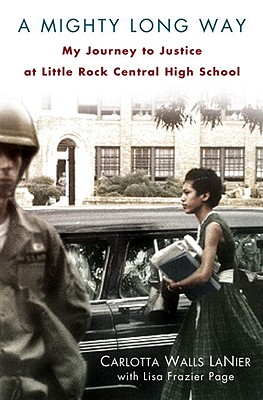
A MIGHTY LONG WAY: My Journey to Justice at Little Rock Central High School by one of the Little Rock Nine, Carlotta Walls LaNier, with Lisa Frazier Page, is reviewed by Kevin Boyle in the Washington Post. He finds it an "affecting new memoir."

On the first day of class 400 whites jammed the streets around Central, screaming racial epithets as the Nine walked stone-faced up to the line of guardsmen, who turned them away. "I was completely stunned," says LaNier, not because she was suddenly at the center of a constitutional crisis -- that thought didn't cross her mind -- but because she'd never missed a day of school in her life.
Continue reading here.

Also in the book pages this week, REHNQUIST: A Personal Portrait of the Distinguished Chief Justice of the United States by Herman J. Obermayer is reviewed in the Washington Post. THE CLINTON TAPES: Wrestling History With the President by Taylor Branch is reviewed in the Washington Post and the Los Angeles Times, where Douglas Brinkley finds it "a weird memoir in which the 42nd president emerges as a self-absorbed political genius and a dazzling player with cunning pragmatism and spot-on observations."

Saturday, October 3, 2009

Young Man Lyndon

While rummaging around in the papers of the Hoover-era Reconstruction Finance Corporation at the National Archives, in an attempt to nail down some facts about its Legal Division, I happened upon this letter from a young congressional secretary (and failed Georgetown law student) to Jesse Jones, a Houston banker and the RFC's leading Democratic director, who was about to take charge of the nation's principal vehicle of state capitalism. At 24, Lyndon Johnson already knew which side the bread was buttered on, and how to lay it on thick. (Click on the image for a better view.)

Oral History, Lawyered Up

John A. Neuenschwander, professor emeritus of history at Carthage College and a municipal judge for the City of Kenosha, Wisconsin, has published A Guide to Oral History and the Law (Oxford University Press, 2009). According to Oxford, the book is:
is the definitive resource for all practitioners of oral history. In clear, accessible language it thoroughly explains all the critical legal issues, including legal release agreements; copyright; privacy; screening, editing, and sealing procedures to protect against defamation; the protection of sealed and anonymous interviews from courtroom disclosure; the role of Institutional Review Boards (IRBs); teaching considerations; and the new issues raised by the use of interviews on the Internet. Neuenschwander's central focus is prevention, rather than litigation, and he cites not only the most recent court cases but also examples of procedures and policies that oral history programs have used effectively to avoid legal difficulties. The book provides more than a dozen sample legal release agreements applicable to a variety of situations. This essential volume will be used by professionals, family historians, and students alike.
Blurbs Donald A. Ritchie, the historian of the U.S. Senate:
Here is the essential legal guide for all those who interview, collect interviews for libraries and archives, or use interviews for their own research. As a history professor, lawyer, and judge, John Neuenschwander is uniquely qualified to explain the various aspects of oral history and the law and to help oral historians avoid legal problems and resolve those issues their work may encounter.
And on IRBs and oral history, be sure to read Zachary M. Schrag, "How Talking Became Human Subjects Research: The Federal Regulation of the Social Sciences, 1965–1991" Journal of Policy History 21, No. 1 (2009): 3-37.

Friday, October 2, 2009

Gallanis reviews Whitman, The Origins of Reasonable Doubt

James Whitman, The Origins of Reasonable Doubt: Theological Roots of the Criminal Trial (2008) is taken up in a review essay, Reasonable Doubt and the History of the Criminal Trial, by Thomas P. Gallanis, University of Iowa. It appears in the University of Chicago Law Review (2009). Here's the abstract:
This is a substantial review of James Whitman's book on "The Origins of Reasonable Doubt: Theological Roots of the Criminal Trial" (Yale University Press 2008). The review proceeds in three main parts. Part I outlines the book's argument. Part II highlights four significant aspects of the book meriting high accolades. Part III raises four questions prompted by the book's thesis. The review concludes that "The argument challenges the conventional wisdom and prompts fresh thinking about seemingly well-understood institutions and doctrines. The thesis is not bulletproof and leaves some questions insufficiently answered. But the questions do not undermine the significance of the accomplishment. This is a groundbreaking book that deserves a broad readership."

Fed 77 Smackdown

Here's an exchange about Federalist No. 77 and the Removal Power:

Seth Barrett Tillman has posted The Puzzle of Hamilton's Federalist No. 77, forthcoming in Harvard Journal of Law and Public Policy 33 (2010): 1-18.
The Founders, the authors of the Constitution of 1787, much like you and me, were flesh-and-blood human beings. As a result, we expect to find errors and exaggeration in their written works. There is nothing new about that insight. But one alleged error has always struck me as somewhat different from other alleged errors. I am speaking of Hamilton's 1788 publication: The Federalist No. 77. There he wrote:

IT HAS BEEN MENTIONED as one of the advantages to be expected from the co-operation of the Senate, in the business of appointments, that it would contribute to the stability of the administration. The consent of that body would be necessary to displace as well as to appoint. A change of the Chief Magistrate, therefore, would not occasion so violent or so general a revolution in the officers of the government as might be expected, if he were the sole disposer of offices. Where a man in any station had given satisfactory evidence of his fitness for it, a new President would be restrained from attempting a change in favor of a person more agreeable to him, by the apprehension that a discountenance of the Senate might frustrate the attempt, and bring some degree of discredit upon himself. Those who can best estimate the value of a steady administration, will be most disposed to prize a provision which connects the official existence of public men with the approbation or disapprobation of that body which, from the greater permanency of its own composition, will in all probability be less subject to inconstancy than any other member of the government.

This is the enigmatic great white whale among Founding-era documents.

Partisans of Senate (or congressional power) agree with Hamilton (or, at least, they think they agree with Hamilton). These commentators look back to the Tenure in Office Act and to any number of statements made on the floor of the House when statutory removal was first debated in 1789 -- all purportedly consistent with Hamilton's statement here. Partisans of presidential power disagree with Hamilton (or, at least, they think they do). They affirm that Hamilton erred. These commentators look to Myers v. United States and to statements made by Madison on the floor of the House during the statutory removal debates. The consensus view, nay - the universal view, is that Hamilton was speaking to the issue of the "removal" of federal officers.

However, this understanding of The Federalist No. 77, the standard view, the view that Hamilton was speaking to "removal," creates as many problems as it might resolve. And this is true without regard to whether or not you think Hamilton correct or erred. First, the standard view is puzzlingly inconsistent with everything we know about Hamilton, the premier Founding-era spokesman for energy and unity in the Executive. How is it that he would concede a role for the Senate in regard to the removal of federal officers, if a contrary view were even remotely tenable? Second, Hamilton's opining on the scope of the removal power is inconsistent with his plan for and the purpose of The Federalist. His plan for The Federalist was to discuss the defects of the then-current regime, the government under the Articles, the need for a more energetic government, and finally, to provide an article-by-article, clause-by-clause defense of the newly proposed Constitution of 1787 as consistent with the principles of Republican government, liberty, and property. Removal is simply not expressly addressed in the Constitution. To bring up "removal" is just bad tactics - why open up that can of worms, particularly where one's conclusion lacks direct textual support or any closely reasoned argument. Was Hamilton really such a poorly skilled tactician and propagandist? There is a third problem with the standard view .... This problem is not historical, but textual. If you read Hamilton's statement, you will notice that he does not actually use the word "removal" or any variant on "removal." Rather, he uses the word "displace." And that is the key to this ancient intellectual puzzle. Hamilton was not speaking to the power of removing federal officers, rather he was speaking to who had authority to displace federal officers. The two words are akin, but they are not at all times and for all purposes the same.
Jeremy D. Bailey, Political Science, University of Houston, has posted his response, The Traditional View of Hamilton’s Federalist No. 77 and an Unexpected Challenge: A Response to Seth Barrett Tillman, which is also forthcoming in Harvard Journal of Law and Public Policy, 33 (2010).
In Federalist No. 77, Alexander Hamilton writes that the Senate's consent would be necessary to "displace" a federal executive officer. Because Hamilton is well known as a defender of executive power, this comment has long been a puzzle. Seth Barrett Tillman proposes to solve this puzzle by reading "displace" as "replace" rather than "remove." If Tillman is correct, then he would not only solve a major interpretative dilemma, but also would liberate those who argue on originalist grounds for unilateral presidential removal powers.

This paper responds to Tillman's argument by considering three ways to consider Hamilton's No. 77: Contemporary evidence, post-1788 evidence, and the structure and place of Hamilton's case for executive energy in The Federalist. It argues that the third way is the most instructive and that this method confirms the traditional reading of Federalist No. 77, that is, that Hamilton believed the president did not hold unilateral removal powers.

Section 1983 at UMKC

The UMKC School of Law announces the Edward A. Smith/Bryan Cave Lecture & Symposium, entitled, Enforcing Constitutional Rights in the 21st Century: Section 1983 Thirty Years After Owen v. Independence. The event commences with a lecture by Pamela S. Karlan, Stanford Law School, "Enforcing Constitutional Rights in the Twenty-First Century," from 6-7 p.m. on Thursday, October 22, 2009. A symposium, "Section 1983 Thirty Years After Owen," follows on Friday, October 23, 2009, from 8:30 to 5:00:
All events will take place at the UMKC School of Law, 500 E. 52nd Street, Kansas City, Missouri. No ticket is required, but RSVPs to PinkmanM@umkc.edu or 816-235-1644 appreciated.

Thursday, October 1, 2009

Dripps on the 14th Amendment, the Bill of Rights, and the (First) Criminal Procedure Revolution

The Fourteenth Amendment, the Bill of Rights, and the (First) Criminal Procedure Revolution is a new article by Donald A. Dripps, University of San Diego School of Law. It is forthcoming in the Journal of Contemporary Legal Issues (2009). Here's the abstract:
The theory that the Fourteenth Amendment incorporates the Bill of Rights established the foundation for the Warren Court's "criminal procedure revolution." Long before the Warren Court, however, there had been another criminal procedure revolution. This first revolution worked slowly and incrementally, led throughout the nineteenth century by legislatures rather than by courts. It included an institutional, an intellectual, and a doctrinal component. When it was over - roughly speaking, around the turn of the nineteenth into the twentieth century - the founders' criminal justice system had been altered beyond recognition.
This essay argues that our understanding of the incorporation question can be strengthened by appreciating the first criminal procedure revolution. The ratification of the Fourteenth Amendment took place just as the doctrinal part of the revolution - the authorization of felony prosecutions by information and of testimony by the defendant - was becoming part of the positive law. These doctrinal changes were incompatible with the Fifth Amendment's indictment and self-incrimination clauses, and this incompatibility was recognized by both their proponents and their opponents. Many of the best jurists in the North and West did not understand the Fourteenth Amendment as imposing these clauses on the states.
To say the history of criminal justice in the nineteenth century provides powerful evidence against the incorporation theory is not to say that this evidence is dispositive. There is evidence on all sides of the incorporation controversy, and how to weigh it is something reasonable people continue to contest. All I claim here is that, however we understand the appeal to the original understanding, the first revolution presents powerful evidence against incorporation of the grand jury and self-incrimination clauses of the Fifth Amendment, and by implication against any theory of total incorporation.

Urofsky's Brandeis: The Book Launch

The College of Arts and Sciences of the American University in Washington, D.C., has announced that Melvin Urofsky, its Historian in Residence, will give a talk on his new biography, Louis D. Brandeis: A Life (Pantheon, 2009), in the Battelle Tompkins Atrium at AU on October 14, 2009, Our previous posts on the book are here and here; more information on the session, here.

Update: Professor Urofsky will also be at Politics and Prose in Washington, D.C. on Sunday, October 11, at 5:00.

Wednesday, September 30, 2009

Krishnan on Globetrotting Law Firms

Globetrotting Law Firms is a new article by Jayanth K. Krishnan, Indiana University School of Law-Bloomington, which draws upon the legal history of India. It is forthcoming in the Georgetown Journal of Legal Ethics (2009). Here's the abstract:
Despite the current financial crisis, prestigious American and British law firms continue to maintain a presence in Continental Europe, Latin America, and China. Yet, in one economically fertile, democratic country - India - such global legal powerhouses are scarcely found. This study seeks to understand empirically why there is a general absence of these and other foreign law firms practicing in India. Based on fieldwork and compiled interview data of lawyers, judges, government officials, activists, and clients from India, the United States, and Britain - the latter two being the foreign countries most interested in gaining access to the Indian legal market - I show that the conventional wisdom on this subject is inadequate, and that there are multiple layers to this debate. But as I also show, what makes this story so fascinating is how both supporters and opponents of foreign law firms in India have strategically coupled their policy arguments with potent symbolic rhetoric to champion their perspectives. The study concludes by outlining a set of preliminary proposals that would permit American, British, and other foreign law firms gradually to enter India but would also incorporate the concerns held by opponents and could serve as the foundation for reaching a comprehensive resolution.

Fellowship resources

With deadlines coming up for fellowship applications, here are some places to look for funding sources for legal historians.
  • Legal history blog posts announcing fellowships are here and here, or click on the "fellowship" labels on the sidebar (then scroll down, and click "older posts" at the bottom for more). We don't post about every fellowship every year, so scan through older posts for relevant funding sources.
  • Announcements for many fellowships from H-Net are here.
A few of words of advice:
  • if you apply for one fellowship, apply for as many others as you can find that might be relevant to your work. For both you and your recommenders, the hard work is writing the first one. The others may require some tweaking, but once the proposals (and letters of recommendation) are written, the subsequent ones are much easier to do.
  • everyone applies for the big national fellowships (e.g. Guggenheim and ACLS). You should apply as well, but you increase your chances of success if you find less well-known funding sources that are targeted directly to your research. (A good example is the Scholar's Award from the Truman Library Institute, which funds work on the Truman era that involves using the Truman Library archives. Great for Cold War-era legal and political history. This fellowship helped fund my work many years ago on Cold War Civil Rights.
  • If you are a law professor applying for fellowships, advice for you is here. A prior LHB round-up of fellowship advice is here.

Tuesday, September 29, 2009

Judicial Review at GWU

The George Washington Law Review and the Washington Area Legal History Roundtable present "Judicial Review: Historical Debate, Modern Perspectives, and Comparative Approaches," to be held on Friday, October 16 at GW Law School, 2000 H St., N.W., Washington, D.C. This symposium takes up the history and contemporary practice of judicial review and is inspired by two new books: Philip Hamburger's Law and Judicial Duty and Barry Friedman's The Will of the People. Each will have its panel; a third panel will be devoted to "contemporary and comparative judicial review."

Here's the schedule, minus the meals and coffee breaks. For more information, please contact Rebecca Bianchi, the special projects editor of the Law Review who is coordinating the symposium, at rbianchi@law.gwu.edu.

9:00am-10:30am Panel I: Law and Judicial Duty
Jacob Burns Moot Court Room, Lerner Hall (L101)

Moderator:

Renée Lettow Lerner
Associate Professor of Law
The George Washington University Law School

Commentators:

Ann Althouse
Robert W. & Irma Arthur-Bascom Professor of Law
University of Wisconsin Law School

Mary Sarah Bilder
Professor of Law
Boston College Law School

G. Edward White
David and Mary Harrison Distinguished Professor of Law
University of Virginia School of Law

Author Reply:

Philip Hamburger
Maurice and Hilda Friedman Professor of Law
Columbia Law School

10:45am-12:15pm Panel II: The Will of the People
Jacob Burns Moot Court Room, Lerner Hall, L101

Moderator:

Peter J. Smith
Professor of Law
The George Washington University Law School

Commentators:

Jenna Bednar
Associate Professor
University of Michigan Department of Political Science

William E. Forbath
Lloyd M. Bentsen Chair in Law
The University of Texas School of Law

Richard Primus
Professor of Law
University of Michigan Law School

Author Reply:

Barry Friedman
Vice Dean and Jacob D. Fuchsberg Professor of Law
New York University Law School

2:00pm-3:30pm Panel III: Contemporary & Comparative Approaches to Judicial Review
Jacob Burns Moot Court Room, Lerner Hall, L101

Moderator:
David Fontana
Associate Professor of Law
The George Washington University Law School

Principal Speakers:

Nelson Lund
Patrick Henry Professor of Constitutional Law & the Second Amendment
George Mason University School of Law

Ayelet Shachar
Canada Research Chair in Citizenship and Multiculturalism
University of Toronto Law School

Commentators:

Vicki C. Jackson
Carmack Waterhouse Professor of Constitutional Law and Associate Dean of
Transnational Legal Studies
Georgetown University Law Center

Mark Tushnet
William Nelson Cromwell Professor of Law
Harvard Law School

ASLH voting closes tomorrow

If you are a member of the American Society for Legal History, to vote in the 2009 election, your ballot must be postmarked by September 30. Details are here. Candidates are here.

Association of Young Legal Historians Call for Papers

The Association of Young Legal Historians invites proposals for an upcoming conference in Frankfurt in March 2010. More information about the organization is here. The call for papers in French, German and English is here. Proposals are due November 16, 2009.

What counts as "young"? I've found no age cut-off in the membership materials for this well established organization. The webpage explains that

Except for professors the Association – as it is stated in its Statutes – is open to all young legal historians. This exemption has been made to provide the possibility for young legal historians, who cannot present their ideas on other conferences to share their research results and have it discussed with other legal historians but without the watching eyes of tutors and mentors. Professors and institutions are only welcome as sustaining members.

Their annual forums "are open to everyone interested in legal history but is still not to a professor holding a chair in legal history."

Here's the call for papers:

Law on Stage
Call for Papers for the XVIth European Forum of Young Legal Historians, 24th-28th March
2010 in Frankfurt am Main

Law appears in various forms. Whether within codes of law, in files, legal documents, by handshake and contracts vis-à-vis a notary, or as finally implemented in courtrooms – law adopts a unique expression. Graceful, sacred, authoritative, and pragmatic: law is being staged.

The European Forum of Young Legal Historians seeks to investigate how these particular forms have emerged and shifted throughout history, and their significance for the legal culture of that time.

Law is only evident through its forms. The perspective of Legal History, however, offers an opportunity to approach this relationship between law and its various forms, where these forms may operate as a facade for normative claims or carry significance on their own. Legal forms emerge from traditions, as a product of shifting legal customs, and through the inherent dynamics of form. Also, legal forms have legitimated new legal contents serving lawmakers’ strategic ends. Change also arises through the action of those subject to the legal norms. So the question to be addressed is: How does law achieve its forms?

This view on the forms of law is also an invitation to reflect on different theoretical and scientific approaches taken in the jurisprudence throughout history. Rules and practices of interpretation, attempts to systematize and integrate legal norms, as well as discussions of the autonomy of law, were also always questions of form. Did one believe in the “pure core” of law behind the form or was the form itself of value? The question we would like to explore is: When and how was the relationship between form and the content of law discussed within jurisprudence?

Finally, the variety of forms evokes questions pertaining to the methodology of legal history. Historical sources can only reveal a fraction of the forms chosen by law in a certain period of time. In order to properly analyse these forms, we usually draw upon thick contextualisation of the subject matter; however, there are a variety of difficulties encountered depending on the period and theme being studied. The Forum should open a space for discussion of such methodological problems; therefore we invite the participants to offer insight and critical reflection on their research method.

We are looking forward to receiving contributions addressing the diverse ways of “staging” law throughout legal history. Please send your abstract (max. 2000 characters) by 16th of November 2009 as well as a short academic CV at frankfurt2010@aylh.org. The regular fee for participants giving a paper will be 50 €, for all other 70 €. We are trying to arrange scholarships.

Further information on the Association of Young Legal Historians and past Forums as well as up-to-date information is available on www.aylh.org.

We look forward to your application and to welcoming you in Frankfurt am Main in Spring 2010.

Lasson on How Maryland Jews Won the Right to Vote

The Gentleman from Hagerstown: How Maryland Jews Won the Right to Vote is an article by Kenneth Lasson, University of Baltimore School of Law. It appeared in Baltimore Jewish Times (2008). Here's the abstract:
This article discusses the early history of Maryland in the context of religious discrimination, specifically in reference to discrimination against those of the Jewish faith, even though the state "was founded as a haven of religious liberty and beacon of toleration." It also highlights a member of the Maryland House of Delegates, Thomas Kennedy, a Christian, as being the leader of the movement to ultimately correct this injustice. Part of the problem were clauses in the state's constitution requiring officeholders to be Christians. Kennedy lost his seat in the House, but didn't give up the battle. Ha had tried several times to get bills passed to solve this problem, but many of these failed. After six years of effort, and after having been reelected to House of Delegates, his bill on behalf of the Jews passed, in February of 1825.

Monday, September 28, 2009

Gillmer on the history of interracial sex

Telling Stories of Love, Sex, and Race is a new paper by Jason Gillmer, Texas Wesleyan University School of Law. Here's the abstract:
The history of interracial sex is often told from the perspective of either legislatures or lynch mobs. The approach has a certain appeal; it allows us to track the ideological currents of the dominant society, as they ebb and flow from passive acceptance of the practice to outright hostility. But the approach also minimizes the role of the participants, routinely casting them as unimportant players in the overall history of sex and race in this country. In this book chapter, I look at the subject of interracial intimacy from the perspective of the people involved: one story involves a white man and black woman from slavery times, and the other involves a black man and white woman from the turn of the century. The purpose is to add some depth and detail to our understanding of some of these relationships, in the process upending some of our basic assumptions about what they might have been like. Indeed, by shining a light on individual cases, we begin to appreciate both the contradictions and complexities of interracial unions, breathing life into a portion of history too often left untold.

Treanor on Horwitz

William Michael Treanor, Dean of Fordham University School of Law, has posted a new essay, Morton Horwitz: Legal Historian as Lawyer and Historian. It appears in TRANSFORMATIONS IN AMERICAN LEGAL HISTORY: ESSAYS IN HONOR OF PROFESSOR MORTON J. HORWITZ, Daniel W. Hamilton & Alfred L. Brophy, eds. (2009). Here's the abstract:
Dean William Treanor examines and celebrates the work of legal historian Morton Horwitz, author of two magisterial histories of American law, The Transformation of American Law, 1780-1860 (Harvard University Press 1977) and The Transformation of American Law, 1870-1960: The Crisis of Legal Orthodoxy (Oxford University Press 1992), through the lens of Horwitz’ path breaking treatment of takings law. With personal memories of Horwitz as a point of departure, Dean Treanor assesses Professor Horwitz’s contribution to the understanding of the evolution of theories of property and the history of the takings clause. Treanor highlights Horwitz’s ability to examine contending views of the takings principle from within the context of larger political and economic movements. Perhaps Horwitz’s greatest contribution to the ongoing conversation about the history of American law, in Dean Treanor’s view, is his awareness of a tension between the ambiguity at the center of takings.

Photo credit.

Book round-up

LOUIS D. BRANDEIS: A Life by Melvin I. Urofsky is reviewed by Alan Dershowitz in the New York Times. Dershowitz finds it a "monumental, authoritative and appreciative biography."

Annette Gordon-Reed's National Book Festival interview appeared in the Washington Post.

Also reviewed this weekend, THE CLINTON TAPES: Wrestling History With the President by Taylor Branch in the NY Times, and Theodore Roosevelt and theCrusade for America by Douglas Brinkley in the LA Times.

Sunday, September 27, 2009

On drones and the war power

Cross-posted from Balkinization: To Whom is a Drone Loyal?

In my west coast copy of the New York Times today, two stories are side-by-side: one on disagreements within the Obama Administration about Afghanistan, and one titled U.S. Drone Strikes Office of Sunni Party In Iraq’s North.” These stories are related, for the politics of war, necessarily at issue in presidential decisionmaking about Afghanistan, are affected by the technologies of warfare. Drones are a technological step that further isolates the American people from military action, undermining political checks on contemporary warfare. And the isolation of the people, historians of war have argued, helps enable on-going, endless war.
When contemplating the scope and limits of presidential war power, constitutional scholars tend to focus on the relationship between the branches and the impact of public opinion. But the existence of drones, the reliance on private contractors, and the absence of a draft are part of a shift in the political structure of American warfare, enabling presidential power.
The role of drones might cause us to believe that an inevitable march of technology, together with strategies of contemporary warfare, have led to the disconnect between most Americans and the wars their nation is engaged in. But military historian Adrien Lewis suggests that these developments were not at all inevitable, and that a fundamental shift in the political structure of American warmaking has occurred since Vietnam, resulting in an isolation of the people from their wars.

Lewis makes this argument in The American Culture of War: The History of U.S. Military Force form World War II to Operation Iraqi Freedom (2007). For Lewis, a loosening of the ties between the people and their government’s use of force begins with the demise of the citizen-soldier after Vietnam. The turn to all-volunteer forces, and now mercenaries (private contractors), effectively removes the American people from war. Americans became “disconnected from the wars the United States was fighting.”
In reaction to opposition to the war in Vietnam, “the armed forces developed doctrines for war that endeavored to mitigate or eliminate the need for the support of the people. In short, they sought a way to fight a war that was not dependent on the will of the people.” This involved a greater reliance on air power rather than land forces, and an increasing use of high tech warfare.
Taking the American people out of war gave presidents “greater freedom to go to war, [and] the White House and the Pentagon greater freedom to fight wars as they saw fit.”
In Iraq and Afghanistan, American warfare is sometimes waged by machines. This raises questions about the morality of war, when an attack can occur with only one side’s mortality at risk. It also raises questions about political constraints on warfare. We need not peer into a future in which machines of warfare are more self-motivating than they already are. When, at another point on the globe, people are killed by an object that has its origins in the United States, but in its nature can owe allegiance to no one, we should ask where the people are in this war, and in their absence from the battle zone, how might they reassert their voice as a check on executive war power.

Saturday, September 26, 2009

Weinrib on the Reinvention of Free Speech

The paper, "Lawyers, Libertines and the Reinvention of Free Speech, 1920–1933," by Laura M. Weinrib, a Ph.D. candidate in Princeton's History Department and Samuel I. Golieb Fellow in Legal History at the New York University School of Law, is available through the NYU Legal History Colloquium's website. The paper is forthcoming, with revisions, as an article in Law and History Review. Here is the abstract:
This article examines the 1920s expansion of the ACLU agenda to incorporate nonpolitical speech. At the beginning of that decade, it was ACLU policy to contest only those obscenity regulations that were "relied upon to punish persons for their political views." By 1931, however, the ACLU was the undisputed leader of the anti-censorship campaign, an aggressive advocate not only of unfettered scientific discussion but also of artistic freedom and birth control. With that shift, a new model of civil liberties began to take shape—one that celebrated individual expressive freedom over substantive political reform.

The catalyst for change was a postal censorship dispute involving a sex education pamphlet, "The Sex Side of Life: an Explanation for Young People," written by the former suffragist and outspoken birth control activist Mary Ware Dennett. Postal authorities declared the pamphlet obscene despite effusive praise by medical practitioners, religious groups, and government agencies for its frank and objective style. When Dennett continued to circulate it by mail in defiance of the postal ban, she was prosecuted for obscenity, and she responded by challenging the postal censorship laws. ACLU board members agreed to sponsor Dennett's case because it instructed the youth on an issue of social importance, thereby advancing the public interest in a direct and familiar Progressive way. Unexpectedly, however, the litigation unleashed a far more sweeping anti-censorship initiative. Dennett's heavily publicized conviction, overturned by the Second Circuit on appeal, generated popular hostility toward the censorship laws and convinced ACLU attorneys that speech should be protected regardless of its social worth.
Image credit (and press release on the Morris Ernst Papers at the University of Texas-Austin)
Image credit: Dennett

Bazelon reviews Friedman, The Will of the People

The Will of the People: How Public Opinion Has Influenced the Supreme Court and Shaped the Meaning of the Constitution by Barry Friedman, which will be released next week, has been reviewed by Emily Bazelon for the New York Times. Hat tip. She finds the book a "thought-­provoking and authoritative history of the Supreme Court’s relationship to popular opinion." Legal historians have seen Friedman's ideas develop in a series of articles, which are posted on SSRN.

According to Bazelon, Friedman

sees the justices and the people as partners in a “marriage” that bypasses the elected legislature and the president. “It frequently is the case that when judges rely on the Constitution to invalidate the actions of the other branches of government, they are enforcing the will of the American people,” he says."...

How well does this claim hold up against the historical record? Friedman’s best evidence is that the people and the court are still married. To be sure, a divorce in the form of diminished authority for the justices would be hard to bring off, given the legal obstacles. And particularly early on, a few marital spats led to serious rifts and estrangement. McCulloch v. Maryland, the 1819 decision upholding the power of Congress to charter a national bank, infuriated states’ rights advocates and brought that century’s fight over federalism to a head. A decade later, when the court ruled in favor of Cherokee sovereignty over Georgia’s assertion of authority to remove the tribe, the state refused to comply, or to appear before the court at all. In the reaction to Dred Scott, the divisive 1857 decision to deny citizenship rights to black people, Friedman sees an “evolution in the nation’s commitment to judicial review,” because the ruling was not met with defiance. But since the country cracked apart four years later in a civil war that the Dred Scott ruling hastened, the fact that the court emerged tarnished but otherwise unharmed seems a bit beside the point.

Friedman’s case strengthens in the 20th century....Friedman is certainly right that over time, the court has proved itself the Teflon branch of government.,..

All of this serves as a response to the argument that judicial review is bad for democracy because it resides in the unelected branch of the federal government. If the court has stayed in the public’s good graces by increasingly reflecting its will, then the justices have learned to make themselves accountable.

Continue reading here.

Friday, September 25, 2009

Finnis on H.L.A. Hart

John Finnis, a member of the law faculties at Oxford University and the University of Notre Dame, has posted H.L.A. Hart: a Twentieth-Century Oxford Political Philosopher. According to the abstract, the essay is
a draft of an invited contribution to a projected volume on Twentieth Century political philosophers[. It] offers first a sketch (by a student and colleague) of H.L.A. Hart's life; second an account of the political philosophy which he explicitly articulated in The Concept of Law (1961), and of its relation to the main currents of Oxford political philosophy in the 1950s; and thirdly an exposition and critical assessment of the normative political theory deployed, to widespread acclaim, in his Law, Liberty & Morality (1963).
Image credit.

National Archives: The Northeast Region

Ancestrymagazine.com has just posted Exploring the National Archives in New York City, a helpful "visit to the National Archives and Records Administration–Northeast Region," with thumbnail sketches of its quite various collections. The piece, written, I believe, by Ted Naanes, commences:
The National Archives and Records Administration-Northeast Region is tucked away in the heart of Manhattan, in the nation’s cultural and financial center. The artifacts of our country’s diverse history are preserved in more than 65,000 cubic feet of carefully organized and managed records. The Northeast Region oversees an enormous variety of valuable information, from court records and military documents to immigration records from Ellis Island. Records held by the region date from 1685 to 1983, and many of them are unique—they do not exist anywhere else in their original form. Between 11,000 and 12,000 visitors visit the facility each year to take advantage of research and archival services and workshops. These visitors include historians, legal researchers, designers and architects learning from past mistakes and successes, and devoted family historians seeking clues about their ancestors. The archives staff, led by director Robert C. Morris, lends expert assistance to all these researchers.

Hilbink on Conservatism and the Making of Rights in Modern America

The Right’s Revolution?: Conservatism and the Making of Rights in Modern America, is a new article by Thomas Hilbink, Open Society Institute. It appears in Studies in Law, Politics, and Society (2009). Here's the abstract:

While many see the 1960s as the era of a ‘‘rights revolution’’ in American law, this article looks back from the present moment of conservative legal dominance to better understand the ways in which conservative ideas began to grow during the heyday of legal liberalism. Using recent histories of post-1945 grassroots conservatism, the author argues that conservative rights claims – while often legally questionable – constituted for many a powerful and persuasive understanding of the Constitution. Due to this popular conservative jurisprudence’s endurance and influence, its existence in the 1960s forces reconsideration of understandings of the 1960s as the era of the ‘‘rights revolution.’’

Hell, I've Seen it!

When I posted the abstract for Charles Barzun's paper on Jerome Frank's Law and the Modern Mind, I was reminded of an exchange between Frank and Felix Frankfurter in 1935, which I happened to stumble upon (again) this week. Frank had just been "purged" from the Agricultural Adjustment Administration. He landed at the Reconstruction Finance Corporation and then was loaned to the Public Works Administration to defend the PWA in a constitutional challenge to its funding of municipal power companies. The "Power Trust" was one of Frankfurter's great foes, and he was concerned that Frank might say something outré and alienate the judges. "It is extremely important to try to employ familiar concepts, expressed in very familiar, simple, unarousing language," the Harvard law professor advised.

Frank, who held the gossip of Frankfurter's protege Thomas Corcoran partially responsible for his firing, did not feel in need of instruction. "My strategy has been exactly that suggested by you, to assert on behalf of the government no more power than is necessary to justify the precise action heretofore taken by it. You ought to know that I do not believe in trying to vindicate abstract principles and that the thing to do is to win particular cases."

The two fired further rounds at each other, including Frankfurter's declaration, "Of course I still continue to think that you are wrong in thinking, as I believe you think, that most of law is bunk, but that you dish up the bunk because other people like to feed on it." Frank replied,
I don't say that "most law is bunk." You remember the farmer who was asked if he believed in baptism and who replied "Believe in it? Hell, I've seen it." I think "law" is damned real. But I do not believe that it works the way it appears, on the surface, to work. I think that many legal ceremonials could be eliminated. But while they exist, they play an important part in their effects on human lives. Therefore, as lawyer, I want to be well up on them and meticulously practice them. To use highbrow terms, I think that, pragmatically, practice, procedure and substantive law intermingle or, to put it differently, "substantive law" is merely one of the implements used in a court fight, one of the implements of persuasion used to induce a court to issue an order which will be backed by armed force, if necessary, to compel someone to do what your client wants him to do.


Image credit

Thursday, September 24, 2009

Dudziak on The Uses of Law in the Bush Administration

I've posted the abstract for one of my current papers: A Sword and a Shield: The Uses of Law in the Bush Administration. This essay is forthcoming in a collection, W as History: America's Leading Historians Take a First Look at the Presidency of George W. Bush, edited by Princeton University political historian Julian Zelizer. The collection will be published by Princeton University Press in 2010. For copyright reasons, I can't post the paper, unfortunately.
One of the points the paper makes is that the Bush administration was not a lawless administration. Instead, law became central. Here's a snippet from the text:
Although the Bush Administration sought to avoid judicial review [of war-on-terror-related policies], lawyers were front and center in White House decision-making. According to Jack Goldsmith, faced with concerns about the possibility of another terrorist attack, and fear of being blamed for not avoiding it, the president could only justify the failure to take protective action if he had a good reason. “A lawyer’s advice that a policy or action would violate the law, especially a criminal law, was a pretty good excuse.” The White House was “haunted” by 9/11, Goldsmith argues, and “obsessed with preventing a recurrence of the expected harsh blame after the next attack.” Because of this, “the question, ‘What should we do?’ ...often collapsed into the question ‘What can we lawfully do?’...It is why there was so much pressure to act to the edges of the law.” The central role played by lawyers had limitations, however. Lawyers “look to legal sources to find the answers,” said 9/11 Commission Executive Director Philip Zelikow. This left out other important factors, such as the impact of a policy on U.S. foreign relations and on domestic public opinion.

The essay also places war-related policies in the context of a broader legal agenda. The essay is not at all comprehensive, however, since essays for this book -- intended for a broad audience -- have to be short. But working on this causes me to think that historians will have much to say about the Bush years for a long time, and one of the moves historians will bring to the table is an effort to contextualize administration actions -- first by beginning the story before 9/11, and finding continuities, and second by setting the Bush years within the broader trajectory of the history of legal conservatism.

Here's the abstract:

The Bush administration has been criticized for departures from the rule of law, but within the administration law was not ignored. Instead it was seen variously as a tool and as a potential threat to the operation of the executive branch. Two narratives compete for attention. In an era when the legality of torture was openly debated, the deployment of law in wartime seemed the most immediate issue. At the same time, however, a decades-long conservative movement to change American law was both significantly furthered and complicated, as Supreme Court appointments moved the Court to the right, but the lack of a common jurisprudence hampered the consolidation of a new conservative constitutional vision. More conservative courts might seem a safe haven for the president, less likely to challenge executive branch actions, but the Bush administration had a complicated relationship with courts. The administration sought out the courts to further aspects of a social policy agenda, such as restricting abortion rights and gun control. But when it came to challenges to the executive branch itself, the Administration used creative means to avoid court jurisdiction, including constitutional theories about executive power. Law was both a sword and a shield: it was a tool used to further some conservative objectives, and it was a shield intended to protect executive autonomy.

Fox on 14th Amendment Citizenship and the Reconstruction-Era Black Public Sphere

Fourteenth Amendment Citizenship and the Reconstruction-Era Black Public Sphere has just been posted by James W. Fox Jr., Stetson University College of Law. It will appear in the Akron Law Review (2009). Here's the abstract:
This article, which is part of a symposium on the 140th anniversary of the fourteenth amendment, explores the Reconstruction-Era black public sphere as a source for possible meanings for the fourteenth amendment. Similar to some of the work of popular constitutionalism scholars, I propose that an important and overlooked source for meanings of constitutional citizenship lies in the statements and actions of those who attempted to redefine citizenship in a more egalitarian and democratic manner and who established meanings for citizenship on the ground. To do this I borrow theoretical frameworks from political and social theory: civil society and the public sphere. I do so because these concepts capture the structure of nineteenth century social experience while at the same time also connecting this experience to modern notions of politics and society. After explicating some of the main principles of civil society and public sphere theory, I analyze a particular form of civil society and the public sphere that I think reveals important aspects of democratic citizenship-the black convention movement. This movement both enacted citizenship on the ground and engaged in a discourse about citizenship in the public sphere that presented alternative, progressive visions of citizenship, ones that included political rights (suffrage) and social rights (access to the public sphere). The article concludes with thoughts on how the black public sphere reflected different and significant understandings of democratic citizenship, equality, freedom compared to how those concepts were constructed in the dominant public sphere.

Wednesday, September 23, 2009

Berger on Reconciling Equal Protection and Federal Indian Law

Bethany Berger, University of Connecticut School of Law, draws upon history in a festschrift essay, Reconciling Equal Protection and Federal Indian Law. It is forthcoming in the California Law Review. Here's the abstract:
In this essay for a festschrift in celebration of Philip Frickey and his work, I show how equal protection and federal Indian law can be reconciled without succumbing to what Professor Frickey has called the seduction of artificial coherence. Federal Indian policies increasingly face arguments that, in providing special treatment for individuals and groups defined in part by descent from indigenous tribes, they violate the requirement of equal protection before the law. I argue that such arguments ignore the congruence of federal Indian policy and equal protection as a matter of constitutional norms, constitutional history, and constitutional text. Federal Indian policies at their best undo the results of defining indigenous peoples as inferior racial groups rather than sovereigns entitled to political and property rights. This consistency between civil rights and protection of tribal rights was recognized by the framers of the fourteenth amendment, and is reflected in both judicial decisions and historical developments in federal Indian policy. American constitutional principles, in other words, support both equal protection and tribal rights, and militate against any false consistency that would undermine the principles of equality and respect on which both are based.

Muller on Americanism Behind Barbed Wire

Americanism Behind Barbed Wire is a new article by Eric L. Muller, University of North Carolina at Chapel Hill School of Law. It will appear in the Nanzan Review of American Studies, Vol. 31. Only the abstract is posted:

The standard narrative about Americanism in the twentieth century tells of a robust debate early in the century between "anti-hyphenates," who preached an intense and highly racialized assimilationism, and cosmopolitans, who imagined new Americans' preserving, rather than abandoning, their ethnic and cultural legacies. On this view, World War I put an end to the cosmopolitan project, and the incarceration of Japanese Americans in World War II was the high-water mark of a racist and xenophobic definition of who could count as "American." The cosmopolitan project, in the standard narrative, would not really resume until the 1960s.
This paper presents evidence that at least modestly complicates the standard narrative. It focuses on the varying methods that federal government agencies used to evaluate the loyalties of incarcerated American citizens of Japanese ancestry during World War II. Comparing the methods used by military agencies with those of the civilian War Relocation Authority, the paper demonstrates that the civilian agency used a model of Americanism that was at least modestly cosmopolitan, and far less defined by racial conceptions of loyalty than the standard narrative would suggest.
Photo credit.

Tuesday, September 22, 2009

Just published: Urofsky, Louis D. Brandeis: A Life

LOUIS D. BRANDEIS: A Life by Melvin I. Urofsky has just been published by Pantheon Books. Adam Liptak in the New York Times calls it "a long, stately and satisfying biography," that "gives a full account of every aspect of Brandeis’s incredibly varied career."

Mr. Urofsky is a law professor and historian at Virginia Commonwealth University, the author of several earlier books on Brandeis and an editor of a five-volume collection of his letters. He is an equable presence here, one who plainly admires Brandeis immensely but also measures and sifts his subject’s actions with a critical eye. The book is a fitting culmination of a distinguished scholarly career.
In the Boston Globe, Harvey A. Silverglate writes that this

massive biography...comes at an opportune time. A patient reader is left with the sense that lawyers, judges, public servants and, indeed, all citizens today face another period of historic choices. Examining the life of Brandeis, one concludes by the end of this remarkable book, shines essential light on how to balance loyalty to enduring verities with the demands for flexibility in assuring the nation’s future....

Urofsky is at his best explaining Brandeis’s jurisprudence of free speech and of privacy. The author makes the convincing case that this justice, more than any other, laid the foundation for many of our current liberties. In a section with obvious implications for the post-9/11 nation, Urofsky demonstrates the practicality of Brandeis’s view that there are few circumstances when government has to limit freedom of speech and invade privacy. And when such actions become necessary, there is never an excuse for doing so outside the parameters of the law.
From the publisher:

The first full-scale biography in twenty-five years of one of the most important and distinguished justices to sit on the Supreme Court–a book that reveals Louis D. Brandeis the reformer, lawyer, and jurist, and Brandeis the man, in all of his complexity, passion, and wit.

Louis Dembitz Brandeis had at least four “careers.” As a lawyer in the late nineteenth and early twentieth centuries, he pioneered how modern law is practiced. He, and others, developed the modern law firm, in which specialists manage different areas of the law. He was the author of the right to privacy; led the way in creating the role of the lawyer as counselor; and pioneered the idea of pro bono publico work by attorneys. As late as 1916, when Brandeis was nominated to the Supreme Court, the idea of pro bono service still struck many old-time attorneys as somewhat radical.

Between 1895 and 1916, when Woodrow Wilson named Brandeis to the Supreme Court, he ranked as one of the nation’s leading progressive reformers. Brandeis invented savings bank life insurance in Massachusetts (he considered it his most important contribution to the public weal) and was a driving force in the development of the Federal Reserve Act, the Clayton Antitrust Act, and the law establishing the Federal Trade Commission.

Brandeis as an economist and moralist warned in 1914 that banking and stock brokering must be separate, and twenty years later, during the New Deal, his recommendation was finally enacted into law (the Glass-Steagall Act of 1933) but was undone by Ronald Reagan, which led to the savings-and-loan crisis in the 1980s and the world financial collapse of 2008.

We see Brandeis, who came from a family of reformers and intellectuals who fled Europe and settled in Louisville. Brandeis the young man coming of age, who presented himself at Harvard Law School and convinced the school to admit him even though he was underage. Brandeis the lawyer and reformer, who in 1908 agreed to defend an Oregon law establishing maximum hours for women workers, and in so doing created an entirely new form of appellate brief that had only a few pages of legal citation and consisted mostly of factual references.

Urofsky writes how Brandeis witnessed and suffered from the anti-Semitism rampant in the early twentieth century and, though not an observant Jew, with the outbreak of the Great War in 1914, became at age fifty-eight head of the American Zionist movement. During the next seven years, Brandeis transformed it from a marginal activity into a powerful force in American Jewish affairs.

We see the brutal six-month confirmation battle after Wilson named the fifty-nine-year-old Brandeis to the court in 1916; the bitter fight between progressives and conservative leaders of the bar, finance, and manufacturing, who, while never directly attacking him as a Jew, described Brandeis as “a striver,” “self-advertiser,” “a disturbing element in any gentleman’s club.” Even the president of Harvard, A. Lawrence Lowell, signed a petition accusing Brandeis of lacking “judicial temperament.” And we see, finally, how, during his twenty-three years on the court, this giant of a man and an intellect developed the modern jurisprudence of free speech, the doctrine of a constitutionally protected right to privacy, and suggested what became known as the doctrine of incorporation, by which the Bill of Rights came to apply to the states.

Brandeis took his seat when the old classical jurisprudence still held sway, and he tried to teach both his colleagues and the public– especially the law schools–that the law had to change to keep up with the economy and society. Brandeis often said, “My faith in time is great.” Eventually the Supreme Court adopted every one of his dissents as the correct constitutional interpretation.

A huge and galvanizing biography, a revelation of one man’s effect on American society and jurisprudence, and the electrifying story of his time.

Excerpts are here and here.