Sunday, March 10, 2013

"Humble Beginnings": The U.S. Supreme Court, Hugo Chavez, and More in the Book Pages

The Washington Post and the New York Times have reviews of Sandra Day O'Connor's new book Out of Order: Stories from the History of the Supreme Court (Random House).  "O'Connor avoids any sharp commentary regarding disputes in which she played a leading role," Joan Biskupic writes in the NY Times, "for example testing the rights of Guantanamo detainees after the Sept. 11, 2011, terrorist attacks."  But "the reader will appreciate insights on life inside the marble bastion."  Read Biskupic's review here.

According to Michiko Kakutani, "the reason to read Out of Order is to get Justice O'Connor's succinct, snappy account of how today's court-- so powerful, so controversial and so frequently dissected by the media-- evolved from such startlingly humble and uncertain beginnings that it initially seemed like a jerry-build enterprise constructed on ad hoc principles."  Read on here.

With the death of Venezuelan President Hugo Chavez this week, the Washington Post has a review of journalist Rory Carroll's Comandante: Hugo Chavez's Venezuela (Penguin), which "traces Chavez'z single-minded rise to power, from a humble boyhood in the dusty town of Barinas through a meteoric trajectory in the army and, eventually, to his 1992 military coup attempt that landed him in prison and made in a national hero."

Also in the Washington Post this week: a review of Jeb Bush and Clint Bolick's Immigration Wars: Forging an American Solution (Threshold), and a review of Moises Naim's The End of Power: From Boardrooms to Battlefields and Churches to States, Why Being in Charge Isn't What it Used to Be (Basic).  And in the New York Times, you'll find a review of Benn Steil's The Battle for Bretton Woods: John Maynard Keynes, Harry Dexter White, and the Making of a New World Order (Princeton), and a review of Susan Jacoby's The Great Agnostic: Robert Ingersoll and American Freethought (Yale).


Anne-Marie Slaughter reviews Sheryl Sandberg's Lean In: Women, Work, and the Will to Lead (Knopf).  "Her point," Slaughter writes "is that notwithstanding the many gender biases that still operate all over the workplace, excuses and justifications won't get women anywhere."  Read the full review here.  And, at the LA Times, Rebecca Traister has a review of Lean In.  Traister hopes "that the early wave of criticism of Sandberg's project-- which has come largely from other feminists making an affronted stink about the narrow luxury of her perch-- doesn't convince her that the women's movement can't use the dynamism, extensive resources, and fresh inspiration she's offering here.

Saturday, March 9, 2013

Weekend Roundup

Robert Zieger (credit)
  • Rest in peace, Robert Zieger (1938-2013). Zieger was a preeminent historian of labor, race, and industrial organization in the United States. [I'll add that he was a generous and kind reader of my work when I was a graduate student.  DRE]
  • Over at the Historical Society, Eric Schultz puts our unprecedented levels of stress in historical perspective.
  • LHB readers who study or work in law school settings may be interested in Mark Graber's recent Balkinization post on "Rethinking of the Rethinking of Legal Education." Here are the first two sentences: "An emerging alliance seems to be developing in American legal education between clinical faculty, faculty with a more practice-orientation, and legal practitioners.  The central theme of that alliance is that too much of legal education is controlled by more scholarly oriented faculty, an increasingly number of whom with PhDs, who are not teaching students basic practice skills." Read on here. [KMT]
  • We note with pleasure that the medievalist Ada Maria Kuskowski, a Law and Society Postdoctoral Fellow at the University of Wisconsin and, last year, a Golieb at NYU, will be joining the History Department at Southern Methodist University later this year.
  • At the request of its managing editor, we note here that Public Discourse, “an online journal designed to educate readers on the moral foundations of free societies,” has posted three articles that “take different positions on the founding principles guiding the American Constitution.”  The journal is a publication of the Witherspoon Institute, a conservative think tank based in Princeton.
  • An updated list of the Harvard Law School's offerings on legal history is here.  Georgetown Law's is here.  [If you have a similar page at your law school, feel free to email it to us.]
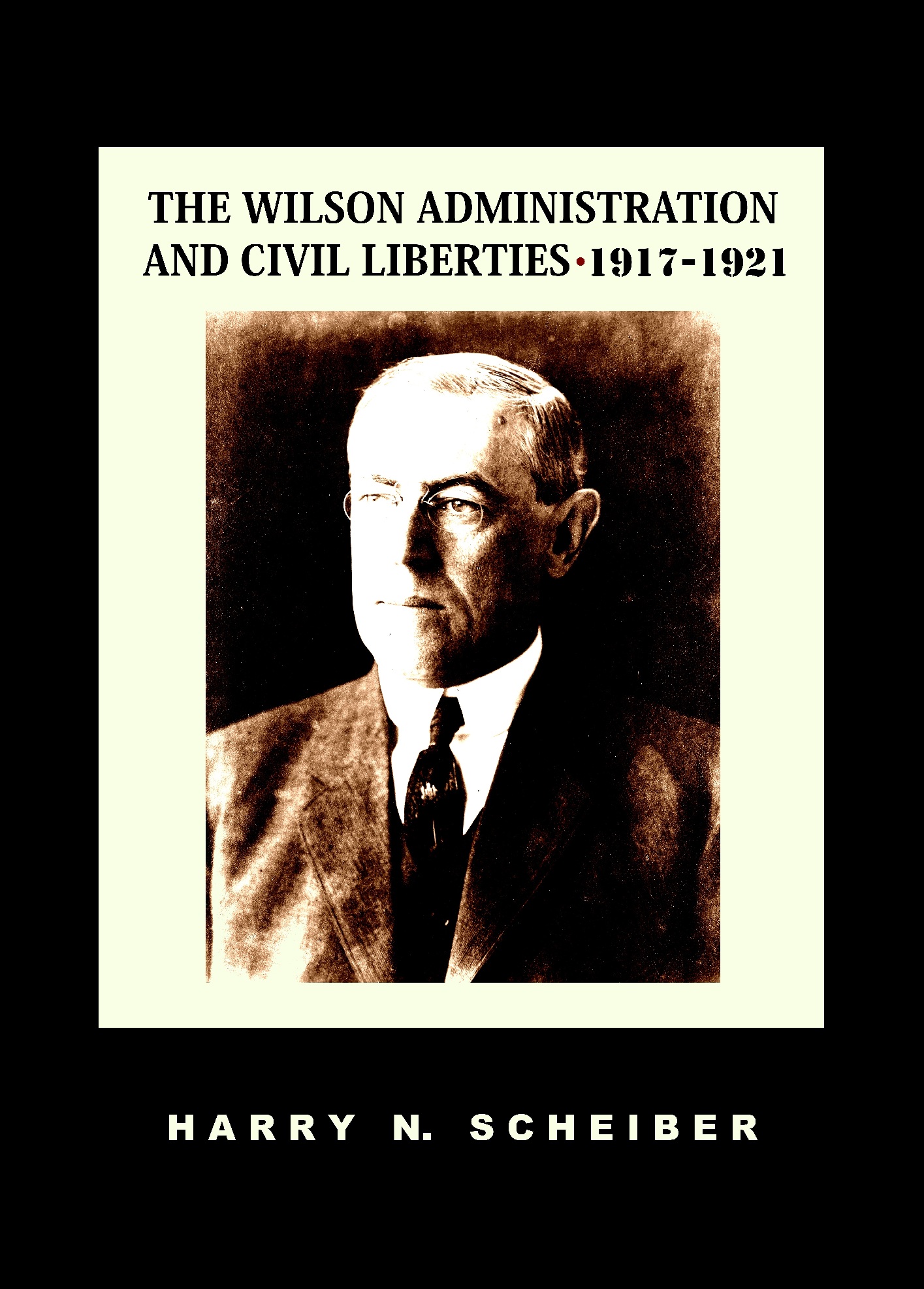
  • Quid Pro Books has announced the arrival of "a high quality, Digitally Remastered™ reprint" of Harry Scheiber's The Wilson Administration and Civil Liberties, 1817-1921 (originally published by Cornell University Press, 1960).
The Weekend Roundup is a weekly feature compiled by all the Legal History Bloggers.

Friday, March 8, 2013

Latin American Legal History: An ASLH Workshop

[Our friends in the ASLH have asked us to move this post up, as the deadline is approaching.]

The American Society for Legal History (ASLH) invites paper submissions for its first annual ASLH Workshop, which will be held immediately preceding the ASLH annual meeting in Miami/Fort Lauderdale (Nov. 7-10, 2013).  The workshop is sponsored by ASLH to promote scholarship in areas of legal history that have been traditionally underrepresented at ASLH meetings and in the Law and History Review.  This year’s workshop topic is Latin American Legal History.  (Workshop topics will rotate on an annual basis.)  The ASLH Legal History Workshop will bring together authors and noted scholars in the field in order to work collaboratively toward refining scholarly writing.  An important objective of the workshop is encouraging scholarly conversations among historians of legal systems from a broad range of historical periods and places.

In order to keep the workshop size small, only four to five papers will be selected from among responses to this general call.  Each selected paper will be assigned one commentator who will prepare substantive feedback about the structure, organization, methodology, and theoretical approaches of the paper.  All papers will be pre-circulated to participants and to commentators in advance of the workshop and must be read prior to the workshop meeting.  Authors will not present their papers.  At the workshop, each commentator will be given half an hour to discuss his/her assigned paper, followed by an hour of general discussion in the larger group.  In this way, each individual author will receive feedback from all the participants of the workshop.  ASLH will provide limited funding for travel expenses and accommodations for authors of selected papers.  (Participation in the ASLH Legal History Workshop does not preclude individuals from presenting at the ASLH annual meeting.)

We invite submissions that engage any aspect of Latin American legal history from scholars at any point in their academic careers.  Interested authors should submit their work-in-progress papers to aslh.workshop@gmail.com on or before April 1, 2013.  Papers should include complete contact information and should not exceed 15,000 words (including footnotes).  Papers in Spanish or other languages will be considered if an abstract (one to two pages) is included in English.  Submissions must not have already appeared in print or have been accepted for publication.  Authors of selected papers will be informed on or before May 30, 2013.  Please direct questions to the ASLH Workshop Coordinator: Lena Salaymeh, Robbins Post-Doctoral Fellow (lenas@law.berkeley.edu).

By participating in the workshop, authors agree to revise their papers thoroughly and to submit them for publication consideration (i.e. blind peer review) with Law & History Review on or before February 1, 2014.  (Submissions to Law & History Review should be not more than 12,000 words, including footnotes.)  Upon peer review approval, Law & History Review will publish the papers either together (in an issue dedicated to Latin American legal history) or separately.  Authors participating in the Workshop consent to publishing in Law & History Review, even if publication delays occur.  However, participation in the ASLH Workshop is not a guarantee of publication in the Law & History Review.  (Also, the ASLH Workshop organizers and the Editor of Law & History Review cannot guarantee a specific publication date.)

Anderson on the Legal History of Unauthorized Practice of Law

Alexis Anderson, Boston College Law School, has posted on BC Law’s website the article Custom and Practice Unmasked: The Legal History of Massachusetts' Experience with the Unauthorized Practice of Law, which appears in Massachusetts Law Review 94 no.4 (2013): 124-141.  (The SSRN posting is here.)

Although the abstract indicates the article’s focus on recent events, Professor Anderson does briefly survey the history of her topic.  Here is the abstract:
Through educational barriers, occupational licensing, and bar association activities, American lawyers have endeavored to achieve a monopoly on the practice of law. One tool that has helped cement their ability to define lawyer-only turf is the unauthorized practice of law (“UPL”) doctrine.

This Article, which explores Massachusetts’ attempts to bar lay practitioners, reveals that the state’s unauthorized practice of law movement took hold relatively recently. It has been marked by fits and starts, by active proponents and by equally determined naysayers, by headline grabbing politicians and bar leaders, and by increasingly assertive judges. Perhaps most importantly, this account also reveals much about the inefficacy of judicial decision making in regulating lay practice.

Massachusetts’ experience with defining the practice of law recently came to the forefront in one hotly contested field – real estate conveyancing. In 2011, the state’s highest court, the Supreme Judicial Court (“SJC”), interpreted the Commonwealth’s UPL statutes in litigation that remains currently unresolved. Real Estate Bar Association, Inc. (“REBA”) v. National Real Estate Information Services, Inc., 459 Mass. 512 (2011). After acknowledging that the “practice of law” is difficult to define, the SJC invoked “custom and practice” as a critical benchmark by which courts should undertake a fact-based inquiry necessary to determine whether certain conduct by laypersons constitutes unauthorized practice.

This review examines the key rationales cited by the SJC for restricting the field to members of the bar. It reveals a tradition which has attempted to reconcile the public’s access to services against lawyers’ interest in protectionism, but which has left UPL principles in a confused muddle. While the Massachusetts judiciary has carved out for itself the constitutional authority to define the practice of law, its few clear precedents provide insufficient guidance for application to modern social needs and economic realities. The underlying REBA litigation is a useful example of the inherent limitations of the kind of case by case approach which has marked the Massachusetts experience. The Article concludes with cautionary remarks about the consequences of judicial control of the UPL doctrine and identifies alternative mechanisms by which courts could proceed.

Jay on the Origins of the Privileges and Immunities of State Citizenship Under Article IV

Stewart Jay, University of Washington School of Law, has posted Origins of the Privileges and Immunities of State Citizenship Under Article IV. Here is the abstract:
The Privileges and Immunities Clause of Article IV provides: “The Citizens of each State shall be entitled to all Privileges and Immunities of Citizens in the several States.” According to Alexander Hamilton, the clause was “the basis of the union,” which may seem odd given its minor significance in modern constitutional law. Part of the reason for its relative unimportance today is the development of constitutional doctrines unforeseeable in the eighteenth century: the invention of the Dormant Commerce Clause and the enactment of the Fourteenth Amendment, which prohibit much of the interstate discrimination that Article IV’s clause was intended to prevent. However, a major explanation for the unseemly fate of the clause lies with early judges who were not faithful to its original purpose. Courts and scholars have perpetuated their errors.

The clause had one overriding purpose: to assure that Americans were not treated as aliens when in states away from their place of citizenship. It was intended to preserve the benefits that Americans had as British subjects, to be afforded the same as local residents anywhere in the country. The ad-vantages of citizenship (or being a subject) were many, ranging from the protection of life, limb, and property to commercial advantages and access to public resources. The multifarious meanings of “privileges” and “immunities” in eighteenth-century writings show that they encompassed every kind of advantage that came from citizenship. This is why Hamilton could claim the clause was “the basis of the union".

There is compelling reason to conclude that the Privileges and Immunities Clause was intended to guarantee Americans traveling or temporarily residing in another state, or doing business or owning property outside their home states, that they would be treated exactly like the local people, without exception, and regardless of whether the right was recognized by other states, including their own. No court and no scholar has ever reached this conclusion, but it is amply supported by the evidence presented here.
 Hat tip: Legal Theory Blog

Thursday, March 7, 2013

The Drone Corollary


Thanks to Karen, Dan, and Clara for inviting me to guest blog here. This year I’ve devoted much of my intellectual energy to teaching, and I plan to share some of the ways that legal history has enriched my classes on the history of U.S. foreign relations. But I thought I’d start things off with a recent political controversy that raised parallels to some of my research on international law and U.S. foreign relations in the early twentieth century.

In January the press got hold of a leaked DOJ white paper written to justify the use of lethal force against U.S. citizens abroad: in other words, drone assassinations. Questions of due process and constitutional rights dominated the publicity that followed, while opposing sides debated the policy’s morality and political wisdom

Recently, legal scholar Rosa Brooks has highlighted a less noticed yet no less important matter: the paper’s endorsement of “a radical assault on traditional legal concepts of sovereignty.” The DOJ paper claims that overseas assassinations do not violate “international legal principles of sovereignty and neutrality” so long as the host nation either gives its consent or is determined to be “unable or unwilling to suppress the threat posed by the individual targeted.” As Brooks points out, this reasoning is circular: presumably if a foreign country refused to give its assent to a drone strike, it would by definition be “unable or unwilling.” In effect, sovereignty disappears as a check on power, undermining international stability.

Brooks turns to recent history to explain this development. She blames humanitarian “crusaders” for crucifying sovereignty on the cross of individual human rights. Advocates of the “Responsibility to Protect” have called for the use of force in order to preempt genocide and rights violations. But by condoning violence to prevent abuses, Brooks argues, “human rights norms have done as much to erode traditional ideas of sovereignty as have more U.S.-centric theories of counterterrorism.”

When I read the white paper, however, its arrogation of the power to override the sovereignty of “unable or unwilling” states suggested to me not so much the recent history of humanitarian intervention, but rather a much older assertion of the right to intervene. In his 1904 “Corollary” tothe Monroe Doctrine, Theodore Roosevelt justified the use of force whenever Caribbean states demonstrated an “inability or unwillingness to do justice” to the rights of foreigners. This similarity of phrasing is no accident. The Roosevelt Corollary and current drone policy both represent legal refractions of changing imperial needs.

Roosevelt’s America had recently become a globally-recognized “Great Power.” As such it faced new imperial demands. With formal colonies in Puerto Rico and the Philippines, and informal ones in Cuba and Panama, control of the Caribbean assumed increased importance for U.S. policymakers. In the words of Roosevelt’s secretary of state, Elihu Root: “The inevitable result of our building the canal must be to require us to police the surrounding premises.” But oft-unscrupulous foreign businessmen complicated this task when they clashed with the region's of-unstable regimes. Roosevelt fretted that European states (Germany in particular) might intervene on behalf of their nationals. His solution was to take on the responsibility for preventing such conflicts by ensuring “order” in the region’s countries. In practice this meant a combination of financial control (“dollar diplomacy”) backed up by marines. (See here and here for more.)

New problems of empire thus required new solutions. Interestingly, the Corollary framed its legal justifications in internationalist terms. It begins with a celebration of law and envisions a future where international law, having achieved the institutional apparatus of domestic law, has made war unnecessary. But because this condition has not yet been achieved, Roosevelt argues, it remains incumbent for the “civilized” nations to exercise an “international police power.” Without referring to the United States per se, these paragraphs outline a vision of world order in which the rights of states are conditioned upon the fulfillment of their duties: in this case, the duty to maintain stability and uphold the rights of foreigners. “Chronic wrongdoing, or an impotence which results in a general loosening of the ties of civilized society…,” Roosevelt warned, would “ultimately require intervention by some civilized nation.” As the preeminent power in the Western Hemisphere, Roosevelt concluded, the United States would take responsibility for exercising “police power” in that region. The sovereignty of states like Haiti, Venezuela, and Nicaragua must ultimately give way to the rights of American investors, the needs of American security, and the interests of international society.

The white paper reflects a similar need to devise a policy for a changing imperial order. This time concerns are global rather than regional, and a lack of order is problematic not because it threatens foreign investment or promotes European intervention, but because gaps in state control provide hiding places for Al-Qaeda. Nevertheless, the logic is the same: American security demands that other states maintain their internal order, and their sovereignty is contingent upon maintaining the kind of order that US deems important. Does this constitute “a radical assault on traditional legal concepts of sovereignty,” as Brooks would have it? An assault, certainly, but a longer historical view counsels caution in deeming anything to be truly “traditional.”

What this history should tell us about the nature of international law I hope to address in a later post… 

The Law of the Biggest Pump

I don't know of an ungated version of this article, but I didn't want it to go unnoticed by legal historians and fellow traveling property scholars.  It is Megan Benson, Railroads, Water Rights and the Long Reach of Houston and Texas Central Railroad Company v. W. A. East (1904), Southwestern Historical Quarterly 116 (Jan. 2013), 261-84.  It commences:
In June 2011, the Texas State Legislature passed and Governor Rick Perry signed the historic Senate Bill (S.B.) 332, an act recognizing "that the landowner owns the groundwater below the surface of the landowner's land as real property."  Eight months later, in early 2012, in the long awaited decision in Edwards Aquifer Authority and the State of Texas v. Burrell Day and Joel McDaniel, the Texas Supreme Court confirmed the same groundwater right, called the law or rule of capture, for Texas groundwater.

In much of the discussion surrounding the legislative journey of S.B. 332 and the two-year deliberation in Edwards, Texans learned a great deal about the nature of groundwater law in their state. Conversations often alluded to the 1904 Texas Supreme Court case Houston and Texas Central Railroad v. W. A. East. This landmark ruling set the parameters for groundwater rights in the state of Texas, determining that it would follow the system referred to as absolute ownership, or the rule of capture, or "the law of the biggest pump."

Fourth Annual Morris L. Cohen Student Essay Competition

[With a hat tip to H-Law, we are happy to post this year's announcement for the Cohen Competition.]

Morris Cohen (Credit YLS Library)
The Legal History and Rare Books Section (LH&RB) of the American Association of Law Libraries, in cooperation with Cengage Learning, announces the Fourth Annual Morris L. Cohen Student Essay Competition (http://www.aallnet.org/sis/lhrb/cohen.html).

The competition is named in honor of Morris L. Cohen, late Professor Emeritus of Law at Yale Law School. Professor Cohen was a leading scholar in the fields of legal research, rare books, and historical bibliography.

The purpose of the competition is to encourage scholarship in the areas of legal history, rare law books, and legal archives, and to acquaint students with the American Association of Law Libraries (AALL) and law librarianship.

Eligibility:
Students currently enrolled in accredited graduate programs in library science, law, history, or related fields are eligible to enter the competition. Both full- and part-time students are eligible. Membership in AALL is not required.

Requirements:
Essays may be on any topic related to legal history, rare law books, or legal archives. The entry form and instructions are available at the LH&RB website. Entries must be submitted by 11:59 p.m., April 1, 2013.

Awards:
The winner will receive a $500.00 prize from Cengage Learning and up to $1,000 for expenses associated with attendance at the AALL Annual Meeting. The runner-up will have the opportunity to publish the second-place essay in LH&RB's online scholarly journal "Unbound: An Annual Review of Legal History and Rare Books."

Wednesday, March 6, 2013

La Croix on the "Interbellum" Constitution and the Spending Power

Alison L. LaCroix, University of Chicago Law School, has posted The Interbellum Constitution and the Spending Power.  Here is the abstract:    
Today, the mechanism of the spending power drives the gears of the modern federal machine. But early nineteenth century constitutional debates demonstrate that the spending power is essentially a workaround, and a recent one at that – a tool by which Congress achieves certain political and legal ends while respecting the formal boundaries set by Article I and the Tenth Amendment. This “interbellum” period was enormously significant for American constitutional law, in particular the constellation of related doctrines concerning congressional power that we now place under the general heading of “federalism”: the spending power, the enumerated powers of Article I, and the anticommandeering principle of the Tenth Amendment. As a historical matter, political and legal actors in the early nineteenth century believed themselves to be living in what this Article argues was a long founding moment, in which the fundamental terms of the federal-state relationship were still open to debate. Constitutional scholars have mistakenly overlooked the constitutional creativity of the period. As a normative matter, I argue for an approach to millennial constitutional interpretation that recognizes the ever-changing nature of the landscape of constitutional permissibility, and that offers documentary evidence of the precise contours of that change. Studying the evolution of the spending power over time, especially where the text itself remains constant, demonstrates that ideas about federal structure are not fixed. Therefore, constitutional federalism itself is not fixed – a particularly important insight in an area of constitutional doctrine that is dominated by originalist approaches.

New Release: Sellars, 'Crimes against Peace' and International Law

New from Cambridge University Press: 'Crimes against Peace' and International Law, by Kirsten Sellars (National University of Singapore). Here's a description from the Press:
In 1946, the judges at the International Military Tribunal at Nuremberg declared 'crimes against peace' – the planning, initiation or waging of aggressive wars – to be 'the supreme international crime'. At the time, the prosecuting powers heralded the charge as being a legal milestone, but it later proved to be an anomaly arising from the unique circumstances of the post-war period. This study traces the idea of criminalising aggression, from its origins after the First World War, through its high-water mark at the post-war tribunals at Nuremberg and Tokyo, to its abandonment during the Cold War. Today, a similar charge – the 'crime of aggression' – is being mooted at the International Criminal Court, so the ideas and debates that shaped the original charge of 'crimes against peace' assume new significance and offer valuable insights to lawyers, policy-makers and scholars engaged in international law and international relations.
And the table of contents:
1. The emergence of the idea of aggression
2. The quest for control
3. The creation of a crime
4. Innovation and orthodoxy at Nuremberg
5. The Allies and an ad hoc charge
6. The elimination of Japanese militarism
7. Questions of self-defence
8. Divisions on the bench at Tokyo
9. The uncertain legacy of crimes against peace
Postscript
To read an excerpt, follow the link.

The book is part of the Cambridge Studies in International and Comparative Law series.

Exhibit on William Borah Opens

Giants once roamed the U.S. Senate.  The Idaho Statesman reports on the opening of an exhibit at the state law library of the leading progressive lawyer and politician William Borah:
William Borah, 1938 or 1939 (LC)
The University of Idaho College of Law and the Idaho State Law Library will sponsor an exhibit honoring the late U.S. senator and lawyer William E. Borah. The exhibit opens at the Idaho State Law Library at the Idaho Water Center, 322 E. Front St., in Boise on Tuesday, March 5, and will be on permanent display.

The exhibit will include photos, documents and other historical artifacts related to Borah. It will showcase his accomplishments as an attorney and as a U.S. senator for Idaho.
More.

Schwartz reviews Pleck, "Not Just Roommates"

The Los Angeles Review of Books recently ran a review of two books on "marriage promotion, cohabitation, and American politics." Contributor Madeleine Schwartz reviewed One Marriage Under God: The Campaign to Promote Marriage in America (New York University Press, 2012), by Melanie Heath, and Not Just Roommates: Cohabitation after the Sexual Revolution (University of Chicago Press, 2012), by Elizabeth Pleck. Here's one of the opening paragraphs of the review:
Today, Americans are getting married less and less; the numbers of unmarried couples and single parents have risen. And yet, marriage — idealized, perfected marriage, marriage “worth fighting for” — has never had such a strong hold on our political imagination. However much the practice may be waning on the ground, the concept of marriage has found a revived energy in the rhetoric of policy-makers and pundits on both the Right and the Left. Cultural conservatives rally around preserving a nostalgic image of the nuclear family, those good old days when a man could walk through the door to a pot roast and a set of smiling faces. Meanwhile, the most exciting political announcement of the last year for Democrats was President Obama’s concession that gay men and women, too, might one day get married. The more insistently Americans seem to be leaving the institution behind, the stronger its purchase on our language and public policy goals. Why? Two books help illustrate the persistence of these ideals. 
Read on here.

Hat tip: bookforum

Tuesday, March 5, 2013

McDougall Profiled

The latest issue of Bostonia, the alumni magazine of Boston University, includes a nice write-up of alumna Sara McDougall and her recently published Bigamy and Christian Identity in Late Medieval Champagne.  (The cover story is devoted to the comedian Marc Maron, another alumnus and an enthusiasm of mine.)  Like many of us, McDougall credits her career choice to inspired undergraduate teaching.  "It is an incredible department," she says of BU's historians.

Tulane Post-Doc in Law & Society

Tulane University has issued the following call for post-doc applications:
The Newcomb College Institute of Tulane University seeks a postdoctoral fellow in law and society for the 2013-14 academic year whose research takes an intersectional approach to gender, reflecting how race, class, sexuality, ethnic, community and national identities shape law and, in turn, how law shapes those identifies. The fellow will work closely with one of the following five faculty on their research projects: Sally J. Kenney, a political scientist who studies women judges, judicial selection, and women’s mass incarceration; Colin Crawford, a legal academic who studies racialized identities in Brazil and the role of Brazilian judges in reforming the legal regime of domestic violence; Melissa Harris-Perry, a political scientist who studies how deliberative democracy can address America's great racial divide, exploring the intersectional question of how personal and political interracial understanding is gendered; or historians Emily Clark and Judith Schaefer who explore the intersection of sex and race and identity formation in New Orleans.

The fellow will do his or her academic research, teach one course, and join the interdisciplinary law and society intellectual community at Tulane University. The fellow will receive regular mentoring and professional development support. The position offers a salary of $50,000, full benefits and library privileges, and library support. Applicants should send a cover letter explaining their research interests, identifying the faculty member they would work with, a c.v., and a list of three references to Laura Wolford, Assistant Director of the Newcomb College Institute, at lwolford@tulane.edu. Screening will begin April 1, 2013 and continue until the position is filled.
Hat tip: H-net

"Constitutionalism, Ancient and Modern": Cardozo Law Review Symposium

The latest issue of the Cardozo Law Review features a symposium on "Constitutionalism, Ancient and Modern." Here's the TOC, with links to the full articles:
“Keep the Public Rich, but the Citizens Poor”: Economic and Political Inequality in Constitutions, Ancient and Modern
John P. McCormick

Precautionary Constitutionalism in Ancient Athens
Adriaan Lanni & Adrian Vermeule

The Origins and Import of Republican Constitutionalism
Clifford Ando

Lifeless Writings or Living Script?:  The Life of Law in Plato, Middle Platonism, and Jewish Platonizers
Melissa S. Lane

Tyrant-Killing Legislation and the Political Foundation of Ancient Greek Democracy
David A. Teegarden

Job’s Justice
Arthur J. Jacobson

Classifying Constitutions: Preliminary Conceptual Analysis
Pasquale Pasquino

Constitutionalism Ancient and Early Modern: The Contributions of Roman Law, Canon Law, and English Common Law
Janelle Greenberg & Michael J. Sechler

Was the Graphe Paranomon a Form of Judicial Review?
Melissa Schwartzberg

Roman Roots for an Imperial Presidency: Revisiting Clinton Rossiter’s 1948 Constitutional Dictatorship: Crisis Government in the Modern Democracies
David Rudenstine

Early Modern Absolutism and Constitutionalism
Kinch Hoekstra

Monday, March 4, 2013

Ruckman on TR's Pardons

P.S. Ruckman, Political Science, Rock Valley College, has posted Theodore Roosevelt and the Pardon Power.  Here is the abstract:
TR at his desk in the White House, 1902 (Credit: LC)
Although Theodore Roosevelt is a popular focus of research and commentary, I am aware of no detailed analysis of his use of the pardon power, either as governor or president, systematic or otherwise. This paper explores Roosevelt's public commentary on pardons and compares it with his actual use of the power. Data are presented on the number of pardons, the offenses addressed as well as the reasons/justifications for the grants. I then show that the circumstances in which Roosevelt exercised clemency are remarkably similar to the clemency environment today. The difference is the manner in which recent presidents have responded to that environment. Finally, I note that recent scholars and observers of the pardon power have increasingly become attracted to a model that Roosevelt strongly supported: the creation and use of a separate and independent board to administer the pardon power.

Judicial Papers, Public Property?

Kathryn A. Watts, University of Washington School of Law, has posted Judges and Their Papers, which will appear in the New York University Law Review in 2013.  Here is the abstract:
From the Harry A. Blackmun Papers, LC
Who should own a federal judge’s papers? This question has rarely been asked. Instead, it has generally been accepted that the justices of the U.S. Supreme Court and other federal judges own their own working papers, which include papers created by judges relating to their official duties, such as internal draft opinions, confidential vote sheets, and case-related correspondence. This longstanding tradition of private ownership has led to tremendous inconsistency. For example, Justice Thurgood Marshall’s papers were released just two years after he left the bench, revealing behind-the-scenes details about major cases involving issues like abortion and flag burning. In contrast, Justice David Souter’s papers will remain closed until the 50th anniversary of his retirement, and substantial portions of Justice Byron White’s papers, including files relating to the landmark case of Miranda v. Arizona, were shredded. In addition, many collections of lower federal court judges’ papers have been scattered in the hands of judges’ families. Notably, this private ownership model has persisted despite the fact that our country’s treatment of presidential records shifted from private to public ownership through the Presidential Records Act of 1978. Furthermore, private ownership of judicial papers has endured even though it has proven ill-equipped to balance the many competing interests at stake, ranging from calls for governmental accountability and transparency on the one hand to the judiciary’s independence, confidentiality and collegiality on the other.

This Article is the first to give significant attention to the question of who should own federal judges’ working papers and what should happen to the papers once a judge leaves the bench. Upon the 35th anniversary of the enactment of the Presidential Records Act, this Article argues that judges’ working papers should be treated as governmental property — just as presidential papers are. Although there are important differences between the roles of President and judge, none of the differences suggest that judicial papers should be treated as a species of private property. Rather, the unique position of federal judges, including the judiciary’s independence, should be taken into account when crafting rules that speak to reasonable access to and disposition of judicial papers — not when answering the threshold question of ownership. Ultimately, this Article — giving renewed attention to a long forgotten 1977 governmental study commissioned by Congress — argues that Congress should declare judicial papers public property and should empower the judiciary to promulgate rules implementing the shift to public ownership. These would include, for example, rules governing the timing of public release of judicial papers. By involving the judiciary in implementing the shift to public ownership, Congress would enhance the likelihood of judicial cooperation, mitigate separation of powers concerns, and enable the judiciary to safeguard judicial independence, collegiality and confidentiality.

Rabban, Shugerman reviewed in Texas Law Review

The latest issue of the Texas Law Review includes four book reviews of interest:

Alfred L. Brophy (University of North Carolina) and Brian Z. Tamanaha (Washington University, St. Louis) review, here and here, respectively, David M. Rabban, Law’s History: American Legal Thought and the Transatlantic Turn to History (Cambridge University Press, 2012).

John Dinan (Wake Forest University) and Mark S. Hurwitz (Western Michigan University) review, here and here, Jed Handelsman Shugerman, The People’s Courts: Pursuing Judicial Independence in America (Harvard University Press, 2012).

Hat tip: The Faculty Lounge

CFP for Law, Literature & the Humanities Assn. of Australasia

The Law, Literature & the Humanities Association of Australasia has issued the following Call for Papers:
Interpellations 5 – 8 December 2013
The Australian National University
Canberra, Australia
The annual conference of the Association invites scholarly and creative research on the theme of interpellations from academics and graduate students working at the crossroads of law, justice, and culture, whether based in legal theory or in disciplines such as literature, art, film, music, history, continental philosophy, anthropology, psychoanalysis, visual culture, or cultural studies. Contributions may take a variety of forms from traditional academic papers to poster presentations, video, or other genres or media. Contributors should provide a title and an abstract of 200 words or less, no later than 31 May 2013, by email sent to coast@law.anu.edu.au. Please include your name and the word Interpellations in the subject line. 
By way of explaining the conference theme, the website includes the following definitions of "interpellations":
  1. to interrupt, from inter- 'between' + pellere 'to drive'
  2. to interrupt the order of the day by demanding an explanation concerning a government action or policy
  3. of an ideology or discourse, to address in order to bring into being or give identity to a subject
  4. to interview with the goal of extracting a confession
For more information, including keynote speakers and registration rates, go to the conference website. (Hat tip: H-law)

Sunday, March 3, 2013

FDR's Bargain Over the New Deal, The Financial Crisis, Battle as Legal Procedure, and More: This Week in the Book Pages

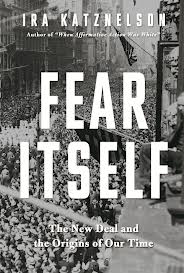
In the Washington Post, Robert G. Kaiser reviews Ira Katznelson's Fear Itself: The New Deal and the Origins of Our Time (Liveright).  According to Kaiser, it is "a sprawling, ambitious book that offers illuminating insights on nearly every page."  Katznelson "demonstrates that Congress's approval of Roosevelt's New Deal depended on the support of racist Southern Democrats, who were happy to support FDR's liberal and occasionally radical economic ideas, provided they did not disrupt the Jim Crow culture of the South."  Read on here.

Also in the Washington Post: a review of Ernest Freeberg's The Age of Edison: Electric Light and the Invention of Modern America (Penguin), and Kevin Boyle reviews The Rebellious Life of Mrs. Rosa Parks (Beacon) by Jeanne Theoharis.  According to Boy, Theoharis adds a "depressing new dimension" to the story of Park's arrest and boycott: "While Park's stance made her a celebrity it also made her a target."

In the Wall Street Journal, Andrew Roberts reviews Stalin's Curse: Battling for Communism in War and Cold War (Knopf) by Robert Gellately, and John Cochrane reviews The Bankers' New Clothes: What's Wrong With Banking and What to Do About It (Princeton) by Anat Admati and Martin Hellwig.

And in the New York Times you'll find a review of Going to Tehran: Why the United States Must Come to Terms with the Islamic Republic of Iran (Metropolitan) by Flynt Leverett and Hillary Mann Leverett, and a review of Alan S. Blinder's After the Music Stopped: The Financial Crisis, the response and the Work Ahead (Penguin)

At The New Republic you'll find a review of James Q. Whitman's The Verdict of Battle: The Law of Victory and the Making of Modern War (Harvard) by David Bell, Professor of History at Princeton.  Some of Bell's remarks will be familiar to those who attended the great author meets reader panel on The Verdict of Battle at the ASLH this past November.  Here's a sample:
Whitman's book does express a lament for the past, but he is a legal scholar, and it is a lawyer's lament, not a soldier's.  He argues that for a long period of time, roughly from the early eighteenth century to the mid-nineteenth century, battles paradoxically gave Western civilization a surprisingly effective means of restraining war's overall destruction.  This was the case because the Western powers saw battle as an "accepted legal procedure," and agreed to abide by the result.
Read on here.

Saturday, March 2, 2013

Weekend Roundup

Mary Ziegler (credit)
  • Hiring update: We are excited to announce that recent guest blogger Mary Ziegler (St. Louis University School of Law) is headed to Florida State University College of Law next fall.
  • Frank Boles, a past president of the Society of American Archivists explores the notion, sometimes mooted by his professional colleagues, that "an ‘archival privilege’ of confidentiality exists, or should exist, to shield an archives from a hostile court’s order” here.  (Hat tip: Hannah T. Miller)
  • The Organization of American Historians has announced the results of its recent election.

    Read more here: http://www.sacbee.com/2013/02/21/5206406/leading-scholar-of-comparative.html#storylink=cpy
  • Emory University President James Wagner recently made some controversial comments about the "three-fifths compromise." Check out the New York Times "Room for Debate" page to follow the ensuing conversation. (Hat tip: the Faculty Lounge)
  • From the Smithsonian.com, an interview with "a wiry, remarkably fit-looking fellow" named Bernard Bailyn about "the shocking savagery of America's early history." (Hat tip: Arts & Letters Daily)
The Weekend Roundup is a weekly feature compiled by all the Legal History Bloggers.

Friday, March 1, 2013

Erman on How Empire Became Constitutional

Sam Erman, Latino Studies Postdoctoral Fellow at the Smithsonian Institution, has posted Citizens of Empire: Puerto Rico, Status, and Constitutional Change.  Here is the abstract:
This paper proposes a new account of how empire became constitutional. When the United States took a deliberate imperial turn in 1898-1899 by annexing Puerto Rico and the Philippines, many jurists thought that the Constitution automatically made these islands proto-states and their residents U.S. citizens with full constitutional protections. Three decades later, this view was no longer mainstream. Contrary to standard accounts, this momentous change was neither quick nor the result of unilateral judicial action. To perceive dynamics extending beyond the judiciary, this study examines the attempts to win U.S. citizenship for Puerto Ricans by their first representative in Washington, Federico Degetau y González. Aware that constitutional meaning was not exclusively the province of courts, he brought claims to U.S. citizenship before administrators, legislators, and the president as well. Officials responded with evasions through concessions. When Degetau sought a right as a citizen, they granted him it on other grounds. Meanings of U.S. citizenship changed as officials reduced the rights that would accompany a grant of citizenship while envisioning without endorsing the possibility of noncitizen U.S. nationals. That novel idea – like the idea of U.S. lands that would never be states and U.S. people with less than full constitutional rights – ripened into conventional wisdom and eventually still-binding doctrine. This suggests that the constitutional law of empire emerged as judges together with administrative and elected officials engaged in an iterative process in which they deployed forms of creative ambiguity to manage perceived conflicts between Constitution and empire.

CFP: The Equal Rights Amendment in the 21st Century

Via H-Net, we have the following Call for Papers: The ERA in the 21st Century: Where have we come from, and where will we go?The conference will be held at Roger Williams University (Bristol, RI), November 15-16, 2013.
Alice Paul (Credit: Library of Congress)
This conference will bring together scholars from areas of history, law, gender studies, literature, political science, and other disciplines that consider the cultural, political, and legal ramifications of the failure of the Equal Rights Amendment. We invite scholars to imagine what is next, as well as give scholars the opportunity to look back at the ERA’s legacy in the popular and social consciousness of the 20th and 21st Centuries.  While the ERA is a topic touched upon in college courses, it has been forgotten by generations of Americans who believe that the Fourteenth Amendment sufficiently addresses the rights of women, and that court precedent (such as Reed v Reed in 1971) and policies (such as Title VII, Title IX) protect their rights.  Critics consider the ERA a nuisance, when it should be a clarion call beckoning women to a cause that was brushed aside in the age of Reagan.

The Equal Rights Amendment, originally introduced to Congress by Alice Paul in 1923, has long served as a symbol of inequality for women in our national heritage.  The amendment is simple, and states:
Section 1. Equality of rights under the law shall not be denied or abridged by the United States or by any state on account of sex.

Section 2. The Congress shall have the power to enforce, by appropriate legislation, the provisions of this article.

Section 3. This amendment shall take effect two years after the date of ratification.
The ERA continued to be introduced to every subsequent congress after its failure in 1923, until 1972, when the amendment was passed in the House, Senate, and was signed by President Richard Nixon.  However, by 1982 the amendment was only ratified by 35 of the necessary 38 states, and it fell into obscurity.  Most people in the US today don’t know the history of this amendment, nor do they know that women still have no Constitutional equality in the United States.

This conference invites proposals for conference papers that examine issues of equality in the United States of America, using the ERA as a conduit through which to open dialogues across academic, legal, and public spheres.

To submit your conference paper proposal, please e-mail a 250-500 word abstract and a CV or brief bio to eraconference2013@gmail.com.
Paper proposals are due by MAY 1, 2013.

For questions about the conference, please contact eraconference2013@gmail.com.

Dodd on the Women's Suffrage Parade of 1913

Lynda G. Dodd, City University of New York City College, has pointed out to us that this Sunday, March 3, marks the centennial “the 1913 suffrage parade that Alice Paul organized in Washington, D.C. during Wilson's first inauguration. The parade launched Alice Paul's phase leading part of the campaign for the Nineteenth Amendment.”  News of this weekend’s centennial celebration and images from the orgainzers of the event are here; the Washington Post's recent story is here.  We are also happy to post some of Professor Dodd’s writings relating to the original parade.

Parades, Pickets and Prison: Alice Paul and the Virtues of Unruly Constitutional Citizenship, Journal of Law and Policy 24 (2008): 339-433
Inez Milholland Boissevain (Credit: LC)
In recent years, constitutional scholars interested in "popular constitutionalism" have examined the role of citizens in interpreting and transforming the Constitution. This article analyzes the campaign for the Nineteenth Amendment led by Alice Paul's Congressional Union and National Women's Woman's Party (NWP). To evaluate the impact of Paul's unyielding campaign of wartime picketing and prison protests in convincing President Wilson to endorse the federal amendment and to work on its behalf, the article scrutinizes the relationship between Paul's more militant tactics and the conciliatory posture adopted by her rival Carrie Chapman Catt and the National American Woman Suffrage Association (NAWSA). The article offers an interdisciplinary analysis of Paul's strategy that incorporates the insights of research on American political development, social movements, and presidential leadership, and draws on the archival records of the NWP, presidential papers, and contemporary newspaper coverage.

Paul's more contentious, unruly methods played a decisive role in obtaining the necessary congressional votes in the House and Senate during Wilson's second term. Paul refused to merely to play the role of the insider lobbyist. She instead perfected the an outsider strategy by appealing directly to voters and the public-first through parades, deputations, petitions, and other well-publicized events, and later through much more oppositional activities, such as anti-incumbent campaigns, pickets, and prison protests. Paul had an astute sense of the power of emotional appeals, and it was this feature of her outsider strategy that made the NWP such a formidable force in the suffrage movement. A kind of insider-outsider dynamic-with Catt eventually serving as the more cooperative suffrage leader, and Paul as the unruly, contentious outsider-appears to have been the crucial combination needed to gain Wilson's help in pushing suffrage through Congress in 1918-19. Paul's most controversial tactics-the picketing and protests in 1917-were implemented with such ruthless determination that Wilson and other opponents in Congress began searching for a way to end the standoff. Paul's resort to civil disobedience may have appeared unruly to her political opponents and the public, but it was in reality a tactic, like all of her strategies, chosen and deployed after a careful consideration of its political impact. That Wilson gave Catt and NAWSA all of the public credit for the shift should not obscure the crucial role that Paul's campaign played in creating this pressure. Given this success, Alice Paul deserves more recognition as a leading exemplar of the transformative model of constitutional citizenship.
Sisterhood of Struggle: Leadership and Strategy in the Campaign for the Nineteenth Amendment, in Feminist Legal History (Tracey A. Thomas & Tracey Jean Boisseau eds., NYU Press, 2011) 
This chapter examines the role of Alice Paul's leadership in securing passage of the Nineteenth Amendment. Recent scholarship on popular constitutionalism reminds us that constitutional history encompasses more than the work of litigators and judges; it also addresses movements for social and political reforms, including constitutional amendments. To achieve success, reformers must consider opportunities and constraints posed by the broader social and political context, make use of available resources, and devise appropriate tactics. All these strategic choices depend upon effective leaders and organizations. When the twenty-eight-year-old Paul assumed the leadership of the militant suffrage campaign, she sought to establish her place among an older generation of remarkable female reformers and activists: Jane Addams, Ida B. Wells-Barnett, Carrie Chapman Catt, Charlotte Perkins Gilman, Florence Kelley, Mary Church Terell, Lillian Wald, among many others. Historians like Anne Firor Scott have called attention to the "extraordinary efflorescence of female leadership" in this era, and a rich literature in women's history has examined these leaders' lives and legacies. Paul's work in the militant suffrage campaign is one of the most notable examples of successful leadership in the "age of reform," and yet her role has never received similarly sustained appraisals.

This chapter focuses, in particular, on two important features of her strategy: her use of a passionate politics relying on emotional appeals for recruitment, mobilization, persuasion, and contention; and her commitment to unruly defiance, through the party accountability campaigns and wartime acts of civil disobedience. Rather than simply describe these tactics and their results, this chapter instead draws on recent scholarship examining the role of leadership style and organizational form in social movements-what one scholar has called "strategic capacity"-in order to explore how these strategies were chosen and implemented, and to assess the strengths and weaknesses of Paul's approach.
 The Rhetoric of Gender Upheaval During the Campaign for the Nineteenth Amendment, Boston University Law Review (2013)
This essay examines the anti-suffragists' rhetoric of gender upheaval during the final years of the suffrage campaign in order to more precisely identify their concerns and justifications regarding the virtues of traditional gender roles and women's civic membership. When scholars of the history of women's civic status focus on "patriarchy's appeal" to "dominant white male citizens," they miss the prevalence of the women who opposed changes to their own civic status. This essay explores their arguments in two leading anti-suffrage journals, The Remonstrance and The Woman Protest, and considers what their legacy might offer to today's debates regarding the evolution of woman's roles.

Changing of the (Guest Blogger) Guard: Welcome, Benjamin Coates!

We have been thrilled to have two terrific guest bloggers with us for the past few months: Christopher Schmidt and Noelani Arista. We are so grateful to them for sharing their perspectives on law and history, and for giving us glimpses of some of the most exciting new work in the field.

The LHB is pleased to announce that Benjamin Coates will be blogging with us for the month of March. He joins us from Wake Forest University, where he is an Assistant Professor in the Department of History.

His research "explores the role of international lawyers in the emergence of the United States as a world power in the early twentieth century." His article "'Upon the Neutral Rests the Trusteeship of International Law': Legal Advisers and American Unneutrality" recently appeared in Caught in the Middle: Neutrals, Neutrality, and the First World War, ed. Johan den Hertog and Samuël Kruizinga (Aksant/Amsterdam University Press, 2011). Another article, titled "The Pan American Lobbyist: William Eleroy Curtis and U.S. Empire, 1884-99," is forthcoming in Diplomatic History.

He teaches courses on diplomatic and international history, including a course that I personally would love to take: "Global Outlaws in History since 1500" ("examin[ing] the motivations, ideologies, goals, and behavior of those who have been deemed “outlaws” to international society since 1500, including pirates, terrorists, smugglers, war criminals, and violators of copyright.").

Ahoy, Benjamin Coates!