Friday, May 21, 2010

Russell, on the legacy of segregation at the University of Texas

This spring, Thomas Russell, University of Denver Sturm College of Law, posted a paper: `Keep the Negroes Out of Most Classes Where There Are a Large Number of Girls': The Unseen Power of the Ku Klux Klan and Standardized Testing at The University of Texas, 1899-1999. We usually hope our papers will have an impact, and often that simply means we hope that someone will download it, read it, find it of value, maybe even cite to it. But Tom may have set a new standard for the impact of an SSRN paper. The paper has been discussed in news articles on Austin News KXAN.com and The Statesman (Austin), and featured in an op-ed by The Daily Texan.

Here's the abstract:
The paper's title is a quotation from The University of Texas registrar nine days after the decision in Brown v. Board of Education. This paper examines 20th-century techniques of racial domination at The University of Texas by crosscutting two narratives.

The first narrative that the paper presents is one of the development of bureaucratic or institutional forms of racial exclusion. The paper describes the university's efforts to limit the application of the Brown v. Board of Education.

In the immediate years after the United States Supreme Court's decision in Brown v. Board of Education, The University of Texas developed and instituted entrance exams that university officials knew would exclude a disproportionate number of African-American applicants. Publicly, the university presented the testing as race-neutral. The university stalled post-Brown integration until the exclusionary admissions testing was in place.

An explicit concern of the university in seeking to exclude African-American students during the 1950s was a racialized sexual concern about the university's white women.

The second narrative is the story of William Stewart Simkins, a law professor at The University of Texas from 1899 to 1929. Professor Simkins helped to organize the Ku Klux Klan in Florida at the conclusion of the American Civil War, and he advocated his Klan past to Texas students.

Like the university registrar during the 1950s, Professor Simkins was explicitly concerned with the sexual defense of white women. Relying upon the analysis of historian Grace Elizabeth Hale, the paper links Professor Simkins's advocacy of the Klan to the early 20th-century history of lynching and white supremacist violence.

During the 1950s, the memory and history of Professor Simkins supported the university's resistance to integration. As the university faced pressure to admit African-American students, the university's faculty council voted to name a dormitory after the Klansman and law professor. The dormitory carries his name to the present day. During this time period, alumni also presented the law school with a portrait of Professor Simkins. Portraits and a bust of Professor Simkins occupied prominent positions within the law school through the 1990s.

The sources for the paper are drawn largely from primary materials of the university's archives, including the papers of the university's Board of Regents, Chancellor, President, and faculty committees. The author completed this research during the 1990s while a member of The University of Texas School of Law faculty.
Tom followed with an open letter to UT-Austin President William Powers, asking him to remove the name of Klansman William Stewart Simkins from a campus dormitory.

The Daily Texan wrote in its editorial:
Despite Simkins’ involvement with the Klan, the Faculty Council christened the dormitory “Simkins Hall” in 1954 — ironically, as Russell points out — five weeks after the Supreme Court’s ruling on Brown v. Board of Education.

Now, in 2010, it seems unconscionable that UT would stand behind the dorm’s name, but officials are less than excited about the prospect of a name change....

There’s a difference between being honest about our history and honoring a notorious racist with a dormitory — and it seems entirely reasonable to dishonor such a dishonorable man.
Here's coverage of this story -- and Tom's SSRN paper -- on KXAN television.


Photos: African-American college students protest segregation at the University of Texas, Austin, April 27, 1949; Portrait of Simkins (from Russell's SSRN paper); Simkins Hall.

Remembering the Joy When the Market is "Grim"

As a current Ph.D. candidate in American history I often feel that the air is filled with dire news. Having a J.D. gives me greater security, but pursuing any type of academic job now is a risk, which is why I sometimes get well-meaning emails titled "depressing article you might want to read." They forward things like this Chronicle of Higher Education piece on how “[g]raduate school in the humanities is a trap,” this LHB post on the “grim” job market for history Ph.D.s., and this Volokh discussion of the "awful" entry-level law market. As long as I don't smell schadenfreude, I don't mind. I applaud those who seek to give honest counsel to current and prospective graduate students. But this post is not about the many reasons to be cautious, pragmatic, and anxious. Rather, it’s about the joy of doing historical work and the reason I hope to keep at it.
A few weeks ago, I received a different sort of email. The subject line was “Flemming v. Nestor,” the name of a little known Supreme Court case that I wrote about in a 2008 article. The sender was a stranger to me. The message made me smile all day long. In fact, after pausing to consider whether it was a cruel joke (on April Fool’s Day, a devious friend convinced me that he had been stabbed and needed me to call his mom), I’ve been smiling ever since.
The email was from a relative of Barbara Nestor, a feisty radical who was married to the Nestor (Fedya) of the case’s title. Drawing on a terrific oral history that I found at the Virtual Oral/Aural History Archive, I was able to include in the article lots of details about the Nestors’ lives: Barbara’s efforts to school her children in labor history, Fedya’s dreams of becoming a great inventor, the difficulty of finding a lawyer to take Fedya’s case (after immigration officials deported him for his political affiliations, the Social Security Administration refused to pay out his accrued Social Security benefits; a lawyer willing to challenge such an action, even as McCarthyism waned, was hard to come by). This relative of Barbara’s wrote to thank me for giving context to the case and for bringing this family story – which she had heard only in bits and pieces – back to life. She also shared with me her recollections of Barbara, a woman who had come to feel like my own lovable and eccentric relative. She closed her email with her take on the point of the article: that through the law, the lives of ordinary people can shape our future.
This message was significant to me on several levels. First, it affirmed my belief in writing accessibly. As academics, we should write for one another; we should develop ideas that are subtle and complex. But I like to think, as I toil over this dissertation, that we can engage non-specialists, too. Second, the email made me appreciate Wikipedia. Professors are understandably wary of students' heavy reliance on this source, and many observers have noted problems with the “wiki” method, but the website is an important gateway. The author of this email found my article through a Wikipedia link, and thankfully – another point to ponder – the Law and History Review made my article free and accessible to her (via History Cooperative).
Most important, the email helped me remember why I chose this path, despite the uncertainty. To me, the best part about writing history is not, as we sometimes joke, that dead people don’t talk back. It is that sometimes, somehow, they do.

What keeps you all going?
Image credits: Dorothy Healey, Barbara Nestor's daughter

Mann on Revolutionary Justice

Better late than never. Only recently did I discover the webcast of Revolutionary Justice: Law and Society in the American Revolution, the address Bruce Mann delivered when he was appointed to the Carl F. Schipper, Jr. Professorship at the Harvard Law School last year. The HLS press release explains:
“Legal histories of the eighteenth century invariably stop when the Revolution begins and resume only after the Revolution has safely ended,” said Mann, who noted that no one has studied the roles law played in the daily lives of people during the war itself. “People hardly stopped trading with one another, assaulting one another or cheating one another just because there was a war going on.”

According to Mann, the war affected different parts of the country in different ways at different times and with different intensities as theaters of military action shifted from one part of the country to another. He noted that while the British occupied some cities, such as New York, Newport and Savannah, for years, other areas faced less disruption. In a talk interspersed with humor, Mann said: “Connecticut, they merely raided, burning the occasional town. New Jersey, they swept through a couple of times, although, like today, New Jersey was more a corridor than a destination.”

Mann noted that during the war law and violence were never very far apart. Recognizing this, he said, is key to understanding “the many diverse ways in which people in the Revolution tried to hold on to, refashion, and reinvent law and legal order.” Courts throughout the new states were suspended and not restored until there were new, formally constituted governments that could authorize them to resume. “Even in the middle of war and occupation,” Mann said, “Americans tried to give legal legitimacy to their actions.”

Mann discussed the provisional measures states took until civil authority could be restored—the committees of safety, which had limited judicial authority in the absence of formal courts, and, in New York, the Committees for Detecting and Defeating Conspiracies, which had subpoena power, the authority to proceed in secret if they chose to, and the authority to call out the militia to arrest “such persons whom they shall judge dangerous to the safety of the State.”

Mann also discussed the Courts of Police appointed by the British military governors of New York, which had broad civil and criminal jurisdiction and sat without juries. Ironically, loyalists disliked these courts nearly as much as they did the Committees for Detecting and Defeating Conspiracies—one ostensibly created to serve them, and the other created to root them out. In addition, he discussed the courts that eventually reopened and how their dockets reflected the progress of the war. The restoration of courts before the threat of military action subsided, Mann said, makes “a powerful statement of the commitment to civil and legal order.”

Thursday, May 20, 2010

Pillsbury on Whitman, The Origins of Reasonable Doubt

Fear and Trembling in Criminal Judgment has just been posted by Samuel H. Pillsbury, Loyola Law School Los Angeles. It is a review essay of JAMES Q. WHITMAN, THE ORIGINS OF REASONABLE DOUBT: THEOLOGICAL ROOTS OF THE CRIMINAL TRIAL (Yale University Press 2008), and it appears in the Ohio State Journal of Criminal Law (2010). Here's the abstract:
This review describes James Whitman's argument that the beyond a reasonable doubt standard for conviction in Anglo-American criminal law was developed to solve a moral and theological dilemma arising from the medieval change from clergy-directed trials by ordeals to the secular jury trial. Whitman writes that the beyond a reasonable doubt standard, like the jury unanimity rule, was designed primarily to assuage what he calls moral doubt, the concern that a decision-maker might condemn himself in the eyes of God by wrongfully convicting an accused of a capital offense. Whitman contends that this concern with decision-maker salvation was greater than any concern with an erroneous determination of the facts and that the greatest challenge for early modern decision-makers was not resolving contested facts but overcoming fear of the spiritual consequences of condemning another human being to death. Whitman contends that this makes the beyond a reasonable doubt standard ill-suited to the challenges of modern litigation, where the hard cases involve fact-finding and decision-makers generally do not fear for their souls in rendering a legal verdict. After considering this argument in both legal and theological terms, the reviewer develops a suggestion of the book’s author, that the early juror experience of "fear and trembling" in judging the most serious crimes might have a useful application to contemporary American criminal justice with its predilection for long terms of incarceration, especially by mandatory sentencing laws.

Hamilton Reviews LaCroix

Over at the Faculty Blog of the University of Chicago Law School, Daniel W. Hamilton, University of Illinois College of Law, reviews Alison L. LaCroix's Ideological Origins of American Federalism, in a post entitled Hiding in Plain Sight. Hamilton's review commences:
Professor LaCroix's new book is a major addition to the dominant interpretations of political authority in the era of the Revolution and the Constitution. We are familiar now with the foundational work on political ideology by Bernard Bailyn and Gordon Wood, and also with the new institutional and Atlantic histories of Jack Greene, Christine Desan, Dan Hulsebosch and Mary Sarah Bilder. To oversimplify, the focus of this ideological history is revealing the conceptual framework of those who successfully pressed for revolution. The focus of the institutional histories is to situate the creation of the new American nation within a broader context of empire and imperial practice. Professor LaCroix in her history of the origins of American federalism, draws on each but also effectively suggests the need for a new category of analysis.
More.

Update: LaCroix's reply to Hamilton is here.

Policy History Conference: June 3-6, 2010

In a few weeks, the Journal of Policy History and the Institute for Political History will hold the sixth biennial Conference on Policy History in Columbus, Ohio. This conference brings together scholars from history, political science, law, sociology, and other social sciences. Topics vary widely, and touch on both international and domestic policy.

The 2010 Conference will feature three plenary sessions:

"A State of War: U.S. Military History as Policy History"-- A Roundtable

Beth Bailey, Temple University

Mark Wilson, University of North Carolina, Charlotte

Peter Mansoor, Mershon Center/Ohio State University

Stephen Ortiz, Bowling Green State University

Jonathan Reed Winkler, Wright State University


"The Media and Politics" -- A Roundtable

Richard R. John, Columbia University

Joe Hallett, Senior Editor, The Columbus Dispatch

Paul Starr, Princeton University


"American Economic Crises in Historical Perspective"

David Robertson, University of Missouri, St. Louis, Chair

Michael Bernstein, Tulane University

Robert M. Collins, University of Missouri, Columbia

Monica Prasad, Northwestern University

David M. Hart, George Mason University


You can find the full program here.

Thurman Arnold Respectfully and Humbly Submits

[Every year, in a class on Washington lawyers, I assign some congressional testimony Thurman Arnold gave at a hearing presided over by two liberal senators, the economist Paul Douglas and the former law professor Wayne Morse, on a proposed code of ethics for government officials. (“Establishment of a Commission on Ethics in Government,” Special Subcommittee of the Committee on Labor and Public Welfare, U.S. Senate, 82d Cong., 1st Sess., July 6, 1951, 371-87.) It’s an interesting exchange, as Arnold is characteristically deadpan in his attack on the code, forthrightly defends the revolving door, and acknowledges that he now would prefer stricter judicial review of agency decisions than the New Dealers sought before the war. As well, Douglas gets off a nice joke about the acquisitiveness of lawyers.

This year I ran out of time before I could read one of my favorite Arnold witticisms, which bears out Laura Kalman’s claim that his “tongue was glued to the inside of his cheek.” The document is a letter, dated October 10, 1936, to William O. Douglas (left), formerly his confederate in alcohol-fueled hi-jinks on the Yale law faculty but at the time a member of the Securities and Exchange Commission. Douglas must have recruited Arnold to serve as trial examiner in a proceeding against the White-Weld firm in the SEC's bid to outlaw wash sales. When he wrote the letter, Arnold had taken the testimony but would soon owe the SEC his intermediate report.

Charles E. Clark was dean of the Yale Law School; Charles U. Samenow, a researcher who was, according to John Henry Schlegel, "absolutely essential" to the success of Clark’s studies of civil courts.]

Dear Bill:

[T]he briefs in the White-Weld case will be due on the 15th, so that I can start to work on my opinion, on which the Commission has given me two weeks.

I have a case to argue in the Supreme Court which comes up some time during the week of October 19 and probably have to go to San Francisco the next week on a case in the Circuit Court of Appeals there. Preparation of these cases is rushing me considerably. My mind is fairly clear as to what an opinion in the White-Weld case should contain. However, I am not reaching my final conclusion until I have seen the briefs. The job of analyzing the testimony and checking up on the briefs is considerable because of the size of the record. I am going to have to work on this evenings and the Commission is not paying me any per diem. Therefore, I wonder if the suggestion that the Commission give me some help in analyzing this enormous record is not a proper one. It is one thing to make up your mind generally on testimony and another to check up on pages and exhibits.

I approach you with deference and fear and trembling on this matter due to your exalted position as Commissioner. I recognize the high official circle in which you move and therefore do not wish to take advantage of the old days when I protected you from Charlie Clark and Samenow and kept them from firing you. I would not for the world mention the fact that in the days when I was an important factor at Yale and you were nothing but a cog my intervention at crucial times saved the Douglas family from being thrown out in the cold and being forced to go on the relief rolls. These considerations are emphatically not the basis of the present cry for help. I only want you to consider the merits of my application just as though you were not under such a heavy obligation to me for standing between you and your family and the ax of one Charles E. Clark.

If you feel that you must turn this down, my own hope is that you will be able to sleep nights afterwards and not toss and toss and toss on account of the gnawing of a guilty conscience.

Respectfully and humbly submitted,

Thurman W. Arnold

Wednesday, May 19, 2010

Howard on the Supreme Court and Religious Freedom

New on the Gilder Lehrman Institute's website is a podcasted lecture by A.E. Dick Howard, the White Burkett Miller Professor of Law and Public Affairs at the University of Virginia School of Law, entitled The Supreme Court and Religious Freedom. It was delivered at Stanford University on August 21, 2008. According to Gilder Lehrman, Professor Howard “presents a short history of the Constitution and discusses the Supreme Court’s role in the ongoing debate about the separation of church and state. Professor Howard looks at the way precedents, the changing face of the Court, and evolving social norms have played roles in shaping the interpretation of this fundamental aspect of American government.”

More scholarship on history, law, and sexuality

Much exciting work seems to be coming from scholars at the intersection of legal history and the history of sexuality. Margot Canaday's The Straight State continues to garner awards and generate buzz. Last week, we spotlighted Timothy Stewart-Winter and Simon Stern's article on same-sex marriage in the antebellum U.S. Meanwhile, I've seen a number of other interesting reviews and articles around the web. Here's a sampling --
In the May 2010 issue of the Journal of the History of Sexuality, William D. Araiza (Brooklyn Law School) reviews four recently published books on same-sex marriage. Here are the first two paragraphs:
The last five years have witnessed dizzying turns in the ongoing controversy over same-sex marriage in the United States. After judicial victories nullified by popular referenda in Hawaii and Alaska in the late 1990s, a more permanent partial victory via judicially mandated civil unions in Vermont gave way to a complete victory for marriage-rights forces in Massachusetts. These victories as well as the local activism in San Francisco and other cities were soured by the near-complete success of the anti-same-sex-marriage referenda approved by voters across the United States in the November 2004 elections. Other turns were to come: court decisions and legislative and referendum votes in California, Connecticut, Iowa, and Vermont. The resolutions in these states, both pro– and anti–marriage rights, will no doubt send both sides into courtrooms, legislative halls, and referendum ballots in the next set of states.

The complexity of this debate is reflected in the four books reviewed here. To repeat a now-familiar pun, they examine gay rights and gay rites (as in marriage) through the prism of politics and culture, transnational comparisons, and, perhaps most interestingly, Christian and Jewish theology. The diversity of approaches through which marriage can be understood nearly guarantees that controversies over marriage rights will remain in some form as live issues in American life for the foreseeable future. The continued centrality of marriage to discussions of gay rights makes recent writing on the topic all the more important.
For those interested in the topic, I also recommend Sarah Barringer Gordon's The Spirit of the Law: Religious Voices and the Constitution in Modern America. Chapter 6 is on "Covenants of Love: Progressive Judaism, Interfaith Activism, and Marriage, 1970-2007."

Yet another from the Journal of the History of Sexuality, "Shifting the Scene of the Crime: Sodomy and the History of American Violence," by Stephen Robertson (University of Sydney). Here's an excerpt:
This article first examines why sodomy has not been analyzed as sexual violence—that is, why sodomy prosecutions have not been part of the history of rape and how gay history has analyzed sodomy cases. It then traces the history of sodomy as part of the history of sexual violence to establish that the use of sodomy to punish sexual violence has long roots in American history, stronger roots than those that exist for the more recent use of the law to prosecute consensual acts. It is not only the nature of acts prosecuted as sodomy that gave the law that character but also the parallel between those acts and their treatment in the law and that of sexual assaults on women and girls. That parallel has significance also for understanding sexual violence generally, requiring a new, broader framework that recasts gender as only one of the identities and hierarchies created by coercion.
Robertson is also the author of a fascinating 2005 article on the problems and possibilities of legal sources for historians of sexuality.

In the current issue of the Journal of Policy History, you can read "'To Strive for Economic and Social Justice': Welfare, Sexuality, and Liberal Politics in San Francisco in the 1960s," by Jonathan Bell (University of Reading). The opening paragraph:
In the mid-1960s, a group of Democratic politicians and welfare policy advocates used a major expansion of the welfare state in California to widen the reach of the party's electoral coalition and to set the stage for the identity politics of the 1970s and beyond. The coming to power of a liberal Democratic administration in California in 1958 heralded a period of social policy experimentation that, in conjunction with the increasing power of a left-liberal movement within the party, provided welfare experts and politicians with the political language through which they would later expand the boundaries of what constituted normative social behavior in areas such as sexuality and individual freedoms. This article explores how liberal politicians like Phil Burton of San Francisco joined with welfare rights lobbyists and bureaucrats to embrace late twentieth-century notions of sexual and gender equality though a broader reconception of economic equality brought about by the expansion of the California welfare state in the early 1960s. These politicians leapt into a local political milieu dominated by individual personalities and cliques in which there was space for a new generation of political entrepreneurs who used appeals to the socially marginalized to help them challenge existing power structures. At the same time, homophile activists were seeking to tie their sexual equality agenda to mainstream political debates over economic and social citizenship. A study of how mainstream liberal politics and the sexual equality movement interacted in San Francisco in a period of rapid social and political change sheds light on the processes through which mainstream politics adapted to changing conceptions of society, including attitudes toward welfare and the "deserving" poor, sexuality, individual rights, and the regulation of capitalism, often before the generally accepted shift in social attitudes in the later 1960s.
Last, from ESQ: A Journal of the American Renaissance, an article on "How Mixed Race Politics Entered the United States: Lydia Marie Child's Appeal," by Robert Fanuzzi (St. John's University). Here's a taste:
For scholars of the colonial and early national United States, it is difficult if not impossible to retell the story of social egalitarianism and political liberty without recounting the social, political, and legal codes governing the practice of miscegenation. Under both the colonial British regime and the post-Revolutionary political order of the United States, these laws and customs operated hand in hand with the equally determinate laws of slavery and citizenship, helping to decide who was a democratic subject and who was not.

In seventeenth- and eighteenth-century Virginia, prohibitions against mixed-race marriages and extramarital unions along with their mixed-race offspring helped to create a new, putatively classless caste system, which equated the dignity of free labor and property holding with a pure British ancestry and the indignity of coercive labor with an African ancestry. In doing so, these laws paved the way for a historic argument for civic equality that rendered the American colonist the genetic bearer of English liberty. In the new American republic, miscegenation laws functioned even more transparently as citizenship decrees, stipulating the whiteness of politically enfranchised subjects and, often capriciously, the blackness of the enslaved or disenfranchised. The logical outcome of these laws, the "one drop of blood" provision, was a testament to the determination of the privileged caste to maintain an artificially scarce supply of citizens by keeping their legal, economic, and political assets from their mixed-race descendants.
(footnotes omitted)

Images:Kinsey Poster, Phil Burton Memorial

Suggestions, Please!

Emily Kadens, a former guest blogger who teaches at University of Texas School of Law, asks for the help of “the collective wisdom of the readers of the Legal History Blog” on behalf of the students in the legal history reading course she’ll be teaching next fall. Each student, it seems, is to recommend a book for the class in their “expressed area of interest.” The areas are quite far ranging:

Ancient and medieval Roman law
Medieval canon law
Medieval or early modern English common law
Pre-modern Chinese law
Islamic family law
African law
Early modern Russian law

Professor Kadens writes that “It would be a huge help to the students to hear recommendations from a variety of experts on their favorite books. Our parameters are: books published since 1985, books under about 300 pages, non-surveys, and books that are well written and accessible to non-specialists.”

Any assistance, in the comments, will, I’m sure, be much appreciated.

Tuesday, May 18, 2010

Friedman, The Will of the People: Live web chat TODAY on SCOTUSblog

Barry Friedman, author of The Will of the People: How Public Opinion Has Influenced the Supreme Court and Shaped the Meaning of the Constitution, will discuss his book in a live chat on SCOTUSblog TODAY at 2:00 p.m. Eastern time. According to the SCOTUSblog announcement:
Readers will submit questions live in a Live Blog window, and someone from SCOTUSblog will moderate. If you cannot make it tomorrow at 2, we encourage you to submit questions in advance, some of which Professor Friedman will answer during the chat. You can submit questions anytime between now and the chat. Email elmiller@akingump.com to do so.

Friedman's website with book info is here. He blogs about the book and the Supreme Court here. Here's the book description:

In recent years, the justices of the Supreme Court have ruled definitively on such issues as abortion, school prayer, and military tribunals in the war on terror. They decided one of American history’s most contested presidential elections. Yet for all their power, the justices never face election and hold their offices for life. This combination of influence and apparent unaccountability has led many to complain that there is something illegitimate—even undemocratic—about judicial authority.

In The Will of the People, Barry Friedman challenges that claim by showing that the Court has always been subject to a higher power: the American public. Judicial positions have been abolished, the justices’ jurisdiction has been stripped, the Court has been packed, and unpopular decisions have been defied. For at least the past sixty years, the justices have made sure that their decisions do not stray too far from public opinion.

Friedman’s pathbreaking account of the relationship between popular opinion and the Supreme Court—from the Declaration of Independence to the end of the Rehnquist court in 2005—details how the American people came to accept their most controversial institution and shaped the meaning of the Constitution.
And the blurbs:
“Deeply informed by history and political science, The Will of the People offers a fresh and insightful look at the most profound problem in American constitutional thought: how and whether the Supreme Court may thwart the will of a democratic majority. With elegance, clarity, and patience, Friedman tells the story of how the Court has gauged public opinion: now giving in to its power, now shaping it, and even occasionally standing up to it. No one who cares about the development of the Supreme Court—or the Constitution—should miss this book.” —Noah Feldman, Bemis Professor of Law, Harvard Law School, and author of Divided by God and After Jihad

“In this beautifully written and extensively researched study, Barry Friedman explodes the common myth that the Supreme Court regularly thwarts the will of national majorities. The next time you hear a politician or pundit blather on about an out-of-control judiciary, tell them to stop pontificating until they have read this remarkable book.” —Jack M. Balkin, Knight Professor of Constitutional Law and the First Amendment, Yale Law School

“Since its inception, the United States Supreme Court has had to walk the delicate line between a respect for majority will and a protection of minority rights. Barry Friedman gathers wide-ranging evidence, much from surprising sources, to support the proposition that the court rarely strays too far from public opinion in the exercise of the power of judicial review, and we are better for it. All readers will profit mightily from this learned book, whether or not they buy into Friedman’s arresting thesis.” —Richard Epstein, James Parker Hall Distinguished Service Professor of Law at the University of Chicago, Peter and Kirsten Bedford Senior Fellow at the Hoover Institution, and Visiting Professor at New York University

Thomas Eliot on Being a "Young Legal Eagle of the New Deal"

Like fellow LHB blogger Dan Ernst, I have a thing for New Deal lawyers and enjoy their oral histories and memoirs. My dissertation involves the lawyers who helped administer federal-state public assistance ("welfare") programs, a lesser known legacy of the Social Security Act. I argue that these lawyers tried to bring the discourse of rights and law to the lawless realm of public assistance administration. They also, apparently, had a lot of fun.
Here are a few choice excerpts from the memoir of Thomas H. Eliot, a Labor Department lawyer who helped draft the Social Security Act and later became the first General Counsel to the Social Security Board.

On female companionship:
There were hardly any female lawyers on the scene. There were very few female lawyers, period. . . . In 1936 I completed the task of hiring ninety lawyers for the Social Security Board's legal staff: just three of them were women. . . . However, young ladies did not have to be members of the bar to attract the attention of young legal eagles of the New Deal.
Eliot proceeds to discuss a house that he and fellow "eagles" called "the Nunnery," where lived six youthful and attractive graduates of Smith, Bryn Mawr, and Vassar. "Enthusiastic[]" square dancing ensued. The residents were also treated to a "plaintive" recorder serenade and the "jovial[]" threat of a house fire, complete with singed grass.

Of course, the work of a New Deal lawyer could also be stressful. Once, Eliot recalled, "a young attorney who hadn't had a raise in salary brought a gun to the office" ("whether to shoot me or himself I never learned"). Eliot built morale by organizing a General Counsel's office softball team:
Nobody had to play but many were glad to, and others came to cheer at our after-hours or weekend contests. As I wrote: "Lots of fun this morning [April 11, 1937] playing baseball [sic]. . . . We lost to the mimeographers, but should improve with practice!" We didn't; but we did manage to defeat our keenest rival, the Bureau of Unemployment Compensation.
It looks like Eliot had the last laugh. While many historians have remarked on lawyers' power and influence in this important era, I have yet to encounter the phrase "a Mimeographer's Deal."

Source: Thomas H. Eliot, Recollections of the New Deal: When the People Mattered (Boston: Northeastern University Press, 1992).

Image: Thomas H. Eliot

Monday, May 17, 2010

Cushman's "Ambiguities of Free Labor Revisited"

"Ambiguities of Free Labor Revisited," the lecture Barry Cushman delivered on April 14, 2010 to inaugurate the James Monroe Distinguished Professorship at the University of Virginia Law School, is now available as a YouTube video here and as an audio podcast from the University of Virginia's site on iTunes U. Dean Paul Mahoney's introduction provides a succinct precis of Professor Cushman's prior scholarship on the constitutional history of the twentieth-century United States.

"Comps" Part II: Law and the American State

Picking up from my earlier post on preparing for legal history "comps," I would encourage graduate students to include on their lists some books and articles that tackle the intersection of legal history and the burgeoning literature (much coming from political science and historical sociology) on law, political economy, and the state. Based on the offerings at recent legal history conferences, this is a hot area. Six shorter pieces that I've found valuable are:
These articles, chapters, and review essays address the relationship between law, courts, state-building, and policy making. They also challenge the enduring assumption that law's role in the development of the American state has been largely negative or obstructionist.

A related piece that I recommend, and continue to grapple with, is Barbara Welke's "Willard Hurst and the Archipelago of American Legal Historiography," from a Spring 2000 Law and History Review symposium on "Engaging Willard Hurst." Welke begins with this simple but thought-provoking observation:
Leading works published since the 1980s relating to law and the modern administrative state that privilege economy and politics—work by scholars like William Novak tracing the nineteenth-century common law roots of the modern regulatory state, Stephen Skowronek on the construction of a national administrative state, and Martin Sklar on the intersection of reform with the rise of corporate capitalism in reshaping the political economy of the American state—remain intensely engaged with the work of Willard Hurst. Leading works published in the same period relating to law and the modern administrative state that privilege gender—work by scholars like Kathryn Kish Sklar on Florence Kelley and women's political culture, Linda Gordon on the welfare state, and Leslie Reagan on abortion—do not cite Hurst in the footnotes or, for the most part, in their bibliographies. For that matter, those from one sub-field do not cite the other and vice versa.
Do others who work in this area have additional suggestions? Any thoughts from non-U.S. legal historians or early Americanists?

Image: James Willard Hurst and his beloved typewriter.

Sunday, May 16, 2010

New in civil rights history: The Eyes of Willie McGee

"When Willie McGee was executed in 1951, the civil-rights movement was just starting to stir," writes Bruce Watson in a Los Angeles Times review of The Eyes of Willie McGee: A Tragedy of Race, Sex, and Secrets in the Jim Crow South by Alex Heard. "Yet as Heard reveals in 'The Eyes of Willie McGee,' something made this case different. Indeed, the forgotten story, while it mirrors 'To Kill a Mockingbird,' has all the complexity of Faulkner."

Willie McGee is not forgotten to civil rights historians, of course. He was executed in 1951 for the alleged rape of a white woman, with little evidence presented at his trial. But this "painstakingly investigated" history will shed welcome light on this important story. While McGee's case made its way to the Supreme Court, the case
sparked FBI investigations, worldwide headlines and protests in major American cities.

Meanwhile, the Civil Rights Congress took up McGee's cause. The organization's communist ties scared off the National Assn. for the Advancement of Colored People and convinced Mississippi that McGee's defense was another "Red plot." By 1950, when publicity had aroused broader support, Albert Einstein, William Faulkner and Norman Mailer demanded clemency or a new trial. Mississippi's governor received 15,000 letters pleading for mercy. And future Congresswoman Bella Abzug was in Mississippi defending McGee.
Continue reading here.

In other book news, 'The Promise:President Obama, Year One,' by Jonathan Alter is taken up today in the San Francisco Chronicle, and elsewhere.

Saturday, May 15, 2010

Transitional Justice and the Freedman's Bank at the Library of Congress

Here are two upcoming lectures of possible interest to legal historians at the John W. Kluge Center of the Library of Congress. Both will be held in the Thomas Jefferson Building, 101 Independence Ave. Washington, DC 20540.

May 20, 2010
“Transitional Justice or Just Transitions? The German Case, 1945-50," Devin Pendas, Burkhardt Fellow, at 12:00 in LJ-119, Thomas Jefferson Building.

While everyone has heard of the Nuremberg Trials, few people are aware that at that same time, tens of thousands of Germans were being prosecuted in German courts for Nazi crimes. Historian Devin Pendas will discuss the surprising role these trials played in the early history of the two Germanys, West and East. Contrary to what many advocates of what has come to be called "transitional justice" would expect, prosecuting Nazi atrocities played an important role in consolidating East Germany's emerging Stalinist dictatorship. And it was West German hostility to prosecuting Nazi crimes that proved most important to its eventual democratic success.

May 26, 2010
“Failure of the Freedman’s Bank: Freedom, Finance and Security in 19th c. American Capitalism,” Jonathan Levy, Mellon Fellow, at 12:00 in LJ-119, Thomas Jefferson Building.

In 1865, Congress chartered the non-profit "Freedman's Savings and Trust Company," a savings bank designed for a population of four million newly emancipated American slaves. By 1873, it had received a staggering $50,000,000 in deposits. But the banking house Jay Cooke & Co. was charged with investing the freedpeople's savings, and when Jay Cooke & Co. failed during the panic of 1873, so did the Freedman's Bank. Liberated from their former masters, the freedpeople had very suddenly come face to face with the frenzied finance of the Gilded Age.

Hat tip

Friday, May 14, 2010

Gervais on The 1909 Copyright Act in International Context

The 1909 Copyright Act in International Context is a new paper by Daniel J. Gervais, Vanderbilt University School of Law. It appears in the Santa Clara Computer and High Technology Law Journal (2010). Can I just say that I think it’s fabulous to see legal history in a computer and high tech journal! Here’s the abstract:
The passage of the 1909 U.S. Copyright Act was embedded in a significant period of evolution for international copyright law. Just a year before, the Berne Convention had been revised for the second time. This Berlin (1908) Act of the Convention in remembered in particular for the introduction of a broad prohibition against formalities concerning the "exercise and enjoyment" of copyright. 1909 was also just one year before a new copyright bill was brought before the British Parliament. This Copyright Act, finally adopted in December 1911 and which entered into force in July 1, 1912, greatly influenced laws in many countries, including Australia, Canada, Israel, New Zealand, Nigeria, and South Africa.

In this Essay, I situate the Berlin Act within the framework of the evolution of the Berne Convention from 1886 until the current 1971 Act and explore the role played by the United States, not as much as a participant in the Berlin Conference but by the way its actions influenced the actions of others. To this end, I discuss sequentially the emergence and evolution of the Berne Convention, and then two areas worthy of deeper analysis when considered against the backdrop of the 1909 Act, namely the prohibition against formalities and the rule imposing retroactive application of the Convention.

Stilt on the Medieval Muhtasib

Kristen Stilt, Northwestern University School of Law, has posted two previously published installments of her research on the medieval muhtasib. The first is Price Setting and Hoarding in Mamluk Egypt, which appeared in The Law Applied: Contextulaizing the Islamic Sharia, ed. Peri Bearman, Wolfhart Heinrichs, Bernard Weiss (I.B. Taurus, London, 2008):
This Article studies the legal position of the muhtasib in medieval Cairo, using the biographical information available about the individuals who held the position to understand the actions they took in office. The muhtasib, who was an inspector of public places and markets in particular, was a key legal actor in terms of applying law immediately to a situation he encountered; he was a common face of the law in society. This Article, influenced in method by legal realism, shows that in addition to the law that a particular muhtasib intended to apply to a particular case, biographical information is crucial in explaining how and why each muhtasib responded to particular events.
The second is Recognizing the Individual: The Muhtasibs of Early Mamluk Cairo and Fustat, which appeared in the Harvard Middle Eastern and Islamic Review 7 (2006): 63-84:
This Article studies the biographies of several key muhtasibs in Mamluk Cairo and Fustat to understand the types of individuals who held the position and how the individual background, education, status among the populace, relationship to the ruling elite, and the means of obtaining the position of each contributed to how the particular muhtasib functioned in office.
Image credit.

Vintage Powe on the History of Supreme Court Confirmation Hearings

Last July, before Justice Sotomayor's confirmation hearing, legal historian Lucas A. ("Scot") Powe, Jr. appeared on NPR's "All Things Considered" to give a brief history lesson. In honor of the hearing to come, here's a taste.
On the first Supreme Court confirmation hearing:

Professor LUCAS POWE (Law and Government, University of Texas; Author, "The Supreme Court and the American Elite, 1789-2008"): Brandeis was a spectacularly controversial nomination. First, he was the first Jew ever to be nominated for the court, and there was blatant anti-Semitism there.

Second, he'd been a very successful lawyer. And after he got really rich, he became what seems to be the first public-interest lawyer in American history, and he started to take on corporations that formerly he would have been taking money from as their advocate, and thus he made a lot of enemies. And former President Taft, Harvard President Lowell, former Attorney General Wickersham, former Secretary of State Elihu Root and several former presidents of the American Bar Association all opposed his nomination.

RAZ: So it was so controversial, they essentially had to have hearings.

Prof. POWE: Yes, they had to have hearings. And it was four months from President Wilson's nomination until the final vote on Brandeis which was, for that era, an incredible amount of time.

RAZ: And so, I mean, what happens, or did Lewis [sic] Brandeis sort of had to show up every day and testify at the hearings?

Prof. POWE: No, Brandeis did not attend his hearings at all. There were people supporting him and obviously people opposing him.

On hearings today:

RAZ: Professor Powe, nowadays it seems, you know, if you make it to the confirmation stage, you're pretty much in. Of course, there was one notable exception in the last 30 years, and that was Judge Bork. Can we really learn anything about these nominees during this process?

Prof. POWE: I don't think that we do. We certainly learn that they are willing to obfuscate, because now we seem to give points to the nominee for the ability to avoid answering the questions being asked.

Take Justice Scalia. When he was questioned by the senators, one senator asked him: Do you consider Marbury versus Madison settled law? And of course, it's been settled law since it came down in 1803, and Justice Scalia refused to answer on the grounds that the question might come before him as a justice.

You can find the full transcript and the audio here.

Image: Brandeis

Stewart-Winter and Stern on Longstreet's "Two Excellent Men"

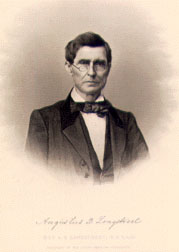
Timothy Stewart-Winter, Yale University, and Simon Stern, Faculty of Law, University of Toronto, have posted Picturing Same-Sex Marriage in the Antebellum United States: The Union of 'Two Most Excellent Men' in Longstreet's 'A Sage Conversation' which also appears in the Journal of the History of Sexuality, 19 (May 2010): 197-222. Here's the abstract:
Augustus Baldwin Longstreet’s short story “A Sage Conversation” appears, at first glance, to be an astonishingly modern tale. It assembles an elaborate social tableau that has at its center “George Scott and David Snow; two most excellent men, who became so much attached to each other that they actually got married” and “raised a lovely parcel of children.” The story appeared in Longstreet’s 1835 collection Georgia Scenes, Characters, Incidents &c. in the First Half Century of the Republic, an early contribution to the tradition of American humor. This collection was reprinted more than twenty times before the end of the century, and has been an object of ongoing fascination for literary critics. However, critics have overlooked the question of how to situate “A Sage Conversation” in relation to the history of sexuality. We interpret “A Sage Conversation” as an artifact of a profoundly different moment from our own in the long, intersecting histories of marriage and sexuality in the United States. To that end, we contextualize the story, from a literary perspective, in relation to the traditions of the tall tale and the narrative of domestic life, and from a social and legal perspective, in relation to nineteenth-century American thought about same-sex sexuality, gender roles, and restrictions on marriage.
Image credit

Thursday, May 13, 2010

Meyler on 'Our Cities Institutions' and the Institution of the Common Law

'Our Cities Institutions' and the Institution of the Common Law has just been posted by Bernadette A. Meyler, Cornell University School of Law, and Princeton University Program in Law and Public Affairs. It is forthcoming in Yale Journal of Law and the Humanities. Here’s the abstract:
The audiences of early modern English drama were multiple, and they intersected with the legal system in various ways, whether through the cross-pollination of the theaters and the Inns of Court, the representations of the sovereign's justice performed before him, or the shared evidentiary orientations of jurors and spectators. As this piece written for a symposium on "Reasoning from Literature" contends, Shakespeare's Measure for Measure addressed to these various audiences the question of whether the King should judge in person. In doing so, it drew on extant political theories suggesting that the King refrain from exposing himself to public censure by condemning criminals and also augured Sir Edward Coke's subsequent resistance on the basis of the common law to King James I's assertion of a right to sit in judgment. Rather than choosing between these positions, the play points out the deficiencies inherent in each and leaves its audiences - including both King James I himself and his subjects - to reason from the examples it provides.
Image.

Bilder and LaCroix on Madison

Over at the Faculty Lounge, Alfred Brophy has a post on two articles in the May 2010 issue of Law & History Review that are the meat of a forum, "James Madison: Law, Interpretation, and Ideology in the 1780s" The articles are Mary Bilder, Boston College Law School, "James Madison, Law Student and Demi-Lawyer"; and Alison LaCroix, University of Chicago Law School, "The Authority for Federalism: Madison's Negative and the Origins of Federal Ideology." Brophy reports:
For a limited time, the full text of the articles by Bilder and LaCroix and comments by David Mattern, David Konig and Peter Onuf are available on the Law and History Review website, which is hosted by Cambridge University Press. (LHR's website is usually gated, but CUP has made an exception for the next several months so that scholars whose institutions do not subscribe to LHR can have access to this discussion).

The Court in the Classroom

The latest issue of Perspectives on History, the newsmagazine of the American Historical Association, is devoted to "Controversy in the Classroom." One contributor is James Coll, an adjunct professor of history at Nassau and Suffolk Community Colleges on Long Island in New York--and a detective in the New York City Police Department! His contribution is Taking the Court into the Classroom: Using Legal Cases to Discuss Controversial Topics. In it, he writes:
Like most teachers in the humanities, I am often confronted with a common problem: How do we discuss controversial topics in the classroom without alienating at least some of the students or discouraging viewpoints that may be at odds with a majority of the class?

To address this dilemma, I have been utilizing a classroom exercise not only to inform students about important and topical issues but also to get them involved in the debate.

One of the prerequisites to passing the U.S. history survey courses I teach is the requirement that each student read and report on—both in writing and orally—an assigned Supreme Court case. Like the Court itself, the legal disputes assigned cover many controversial topics.
More.

UPDATE: James Coll responds in the comments.

Wednesday, May 12, 2010

Digital Archives: Update

One of the reasons I began following this blog was because of its attentiveness to web resources and archives. This post sold me on the promise of digital history. This one introduced me to a favorite teaching tool, an on-line collection of presidential campaign ads. I return to this one whenever I need a photo. There is no substitute for touching and seeing "real" sources, or for physically sifting through piles of archival material (even - perhaps especially - the material that initially appears irrelevant). But resources like these are a boon to every historian with limited time or a limited a research budget.
In the spirit of sharing online finds, here are some that I've used and enjoyed: the oral histories on the Social Security website (full transcripts of interviews with people like Arthur Altmeyer and Wilbur Mills); the American Left Ephemera Collection from the University of Pittsburgh's Digital Research Library; the Supreme Court oral argument recordings at Oyez.org; and the Disability Rights and Independent Living collection, available through the Bancroft Library at the University of California, Berkeley.
It's also now possible to generalize about where to look for treasure troves of digital archives.
  • Second, government libraries and archives. The National Archives and Records Administration has digitized over 125,000 historical documents. You can find them through NARA's searchable database or through the topical "galleries" (e.g., "Courts and Cases," "Federal Programs") on the website. NARA also offers a link to major historical documents, in case you want quick access to an image of the Bill of Rights or the Emancipation Proclamation. The Library of Congress has digitized a number of useful resources, including historical newspapers, documents from the Constitutional Convention, and evidence from famous trials. Most presidential libraries also have digitization projects. I've used the resources on the Harry S. Truman Library website and the Lyndon Baines Johnson Library website. These online repositories are sometimes more limited, but usually offer speeches, photos, executive orders, and oral histories.
  • Third, historical societies and institutes. These archives often have online exhibits or "projects" (such as the one the Gilder Lehman Institute assembled on the Dred Scott decision) which hint at the material in the broader collections. Some, like the Massachusetts Historical Society, have put vast amounts of material online.
For more online archives specific to legal historians, check out the long list that the Triangle Legal History Seminar has assembled.

But I can't end on that note: a digital archives update is not complete without a reference to the great digitization debates.
  • The "millenarian prophecies" that historian Anthony Grafton described in his 2007 New Yorker piece continue. Whither paper books and brick-and-mortar libraries? I encourage interested readers to consult the Historical Society blog for ruminations on this topic.
  • More pragmatic, perhaps, are conversations about the limits and potential pitfalls of the digitization endeavor. Columbia Law School recently hosted a symposium on the legal issues (copyright, defamation, privacy) that can arise from making archives accessible on the web. (Concise takeaway: "putting archival material online is often a lot easier said than done.")
  • Meanwhile, this era of trim budgets has given new urgency to ongoing discussions about which physical archives should be digitized and what information from the virtual realm (a.k.a. "born-digital" materials) ought to be preserved. (Should we devote resources to saving "tweets"? The Library of Congress thinks so.)
Check out this excellent post from the Legal Information Institute at Cornell University Law School for a more thorough discussion of these issues.

Image

European Society for Comparative Legal History: The Inaugural Conference

The program for the Inaugural Conference of the European Society for Comparative Legal History (ESCLH) has been announced. The conference will take place from July 5-6, 2010 at the University of Valencia (Valencia, Spain). The program and more information are here.

• R Jovita Baber, University of Illinois, “Multiplicity of Meanings: Legal Pluralism and the Layer Legality of Land in Sixteenth-century Andes”
• Louis Berkvens, Maastricht University, “An Approach of comparative history of legislation”
• Juan B. Cañizares, University of Valencia / MPIER, Frankfurt/M, “The notion of honour in the injury and slander offences. Normative and scholarly legal comparative approach between Spain and France, late 18th century-late 19th century”
• Chao-ju Chen, National Taiwan University, “In the Name of the Mother: A Feminist Legal History of Naming in Taiwan”
• Serge Dauchy, University of Lille–Nord de France, “A comparative study of legal culture in early Modern Europe”
• Seán Patrick Donlan, University of Limerick, “World is crazier and more of it than we think”: histories of legal and normative hybridity”
• Paul J. du Plessis, Edinburgh University, “Law, modernity and the place of European legal history”
• Matt Dyson, University of Cambridge, “Comparative Legal History: methodology for morphology”
• Francesca Galli, Institut d’Etudes Européennes, Section Juridique, ULB, Brussels, “British, French and Italian measures to deal with terrorism: a comparative study”
• Eduardo Galván, University of Las Palmas de Gran Canaria, “How to govern an archipelago? The Channel Islands and the Canary Islands”
• Jean-François Gerkens, University of Liège, “The Liberation of the Debtor in mora by vis maior, or the Incredible Success Story of a Non Roman Rule”
• Adolfo Giuliani, University of Cambridge, “Two models of fact-finding”
• Jan Hallebeek, VU University Amsterdam, “Some Remarks on the Direct Enforcement of Obligations to Do in the Continental Legal Tradition”
• Karl Härter, MPIER, Frankfurt/M, “The Emergence of the International Order of Criminal Prosecution in the Modern Age: Extradition, Asylum and Mutual Assistance in Criminal Matters”
• Nikitas Hatzimihail, University of Cyprus, “Pre-Historical Private International Law: A Study in Conflicts Historiography”
• Dirk Heirbaut, Ghent University, “Feudal law in Flanders and the Lotharingian principalities: a comparison”
• David Ibbetson, University of Cambridge, “Comparative Legal History: A Methodology”
• Nir Kedar, Bar-Ilan University, “Transplanted Law v. Transplanted Culture: The Unique Case of Israeli Legal History”
• Marcelo Lacombe, NYU, “Constitutionalism , liberalism and militarism. A comparative approach on the evolution of constitutional systems in Europe and Latin America, during the nineteenth century?”
• Pia Letto-Vanamo, University of Helsinki, “Some Remarks on the History of Legal Argumentation”
• Michael A Livingston, Rutgers School of Law, “One Hatred, Many Laws: The Evolution of Antisemitic Laws in Germany, France, and Italy in Comparative Historical Perspective”
• Lara Magnusdottir, University of Iceland, “How to understand a Concordat when you don‘t know what the word means”
• Aniceto Masferrer, University of Valencia, “The French Codification and the Western Legal Traditions”
• Matthew Mirow, FIU College of Law, Miami, “Codification and the Constitution of Cádiz”
• Thomas Mohr, University College Dublin, “The Constitution of the Irish Free State in Inter-War Europe”
• Olivier Moréteau, Louisiana State University, “The ethnocentrism of French legal culture: origins and effects of a superiority complex”
• Anthony Musson, Exeter University, “Common legal heritage? Visual Representations of Law and Justice in Medieval Europe”
• Michael L Nash, Les Roches/Gruyères University of Applied Sciences, “A contrast in evolution: the legal framework of the British and Continental monarchies”
• Heikki Pihlajamäki, University of Helsinki, “The Need of Comparative Legal History in the Nordic Countries: The Case of Early Modern Sweden”
• Merike Ristikivi, University of Tartu, “Terminological turn as a turn of legal culture”
• Graziella Romeo, L. Bocconi University, “The development of the idea of social citizenship in a comparative perspective”
• Jonathan Rose, Sandra Day O’Connor College of Law, “Advocatorum Militia: The Chivalric Ethos of the Legal Profession--Loyalty and Honor”
• Judith Rowbotham, Nottingham Trent University, “Narrating Crime: Nineteenth Century Media Depictions of Crime”
• Stephen Skinner, University of Exeter, “Tainted Law: Critical Legal History and the Italian Penal Code”
• Ditlev Tamm, University of Copenhagen, “From a European to a Global Approach. Some Reflections on the Utility of Comparative law for Legal Education”
• Andreas Thier, University of Zurich, “Legal Transplants, Legal Transfers and Comparative Legal History”
• Judit Valls, University of Girona, “The Spanish Commercial Code of 1829”
• Henry Yeomans, University of Plymouth, “Moderate Measures in Alcohol Policy: British Attitudes and Victorian Hangovers, 1914-1921”

Image credit

A "Breakout" Conference at the Maison Française d’Oxford

"Writing Legal History Breaking Out of National Frameworks (France and the United Kingdom)" is a conference to be held on May 24, 2010 at the Maison Française d’Oxford 2- 10 Norham Road, Oxford OX2 6SE (Tel: 01865 274 220 ; maison@herald.ox.ac.uk). It is sponsored by the Institute of European and Comparative Law, Service Culturel de l’Ambassade de France à Londres, Centre de Théorie et Analyse de Droit (CNRS-UMR 7074), Centre Lyonnais d’Histoire du Droit et de la Pensée Politique, and Centre Toulousain d’Histoire du Droit et des Idées Politiques. All are welcome. For further details, please contact Frédéric AUDREN: frederic.audren@iecl.ox.ac.uk.

Monday 24 May 2010

Convenor: Frédéric AUDREN, CNRS-MFO

Introduction by Luc BOROT (MFO), Jacques KRYNEN (Université Toulouse 1 Capitole) and Frédéric AUDREN (CNRS-MFO)

10:00 - 13.00
John CAIRNS (University of Edinburgh), National, Transnational, and European Legal Histories: Paradigms and Problems

Jean-Louis HALPÉRIN (ENS Ulm, Paris), Is it time for the de-construction of myths in French legal history?

Michael LOBBAN (Mary Queen, University of London), The Varieties of Legal History

Alain WIJFFELS (CNRS - Centre Georges Chevrier), Le ius commune européen: les limites d'une base commune pour l'historiographie du droit anglais et français

Paul BRAND (All Souls, University of Oxford), The English medieval Common Law and the learned law tradition

14:00 - 17.00

Soazick KERNEIS (Université Paris Ouest), Alternative Dispute Resolution. Penal Law, History and Anthropology

Andrew LEWIS (University College London), The Tithe and La Dîme: similarities and différence

Chantal STEBBINGS (University of Exeter), The ‘Unreported’ Tax Case: its Place in the Development of Law in Nineteenth Century England

David DEROUSSIN (Université Jean Moulin Lyon 3), Une nouvelle nationalisation du droit : la culture juridique française vue par la doctrine (1ère moitié du XXè s.)

Conclusion : Louis ASSIER-ANDRIEU (CNRS-ISP Cachan)

Hat tip.