Saturday, June 17, 2017

Weekend Roundup

  • Over at the Library of Congress, there is an online exhibition that may be of interest: "Drawing Justice: The Art of Courtroom Illustration showcases the Library’s extensive collections of original art by talented artists hired by both newspapers and television to capture the personal dynamics of legal trials." (h/t Slate's The Vault)
  •  In the Washington Post, Joanne Freeman (Yale University) writes about the "long, and ominous, history" of violence against members of Congress. 
  • Over at Concurring Opinions, Ronald Collins has a post on the centennial of the Espionage Act of 1917, with commentaries by Derik Bambauer, Erwin Chemerinsky, Geoffrey Stone and Stephen Vladeck.
  • The American Historical Association is offering a "sneak peek" at its January 2018 annual meeting in Washington, DC.  Panels include “New Histories of State Surveillance” and “Sexual Violence in Historical Context."
  • Al Brophy (UNC Law) has posted some thoughts on the famous case State v. Will - "and some other things, too." You'll find them at the Faculty Lounge.
Weekend Roundup is a weekly feature compiled by all the Legal History bloggers.

Friday, June 16, 2017

Legal History at Law and Society

As many LHB readers are aware, the Law and Society Association hosts "Collaborative Research Networks" that sponsors panels for its annual meeting.  After the jump are the panels sponsored by the  Law and History CRN a next week's annual meeting in Mexico City.  H/t: Joanna Grisinger.

Schiller reviews Klarman, "The Framers' Coup"

Over at JOTWELL, Reuel Schiller (UC Hastings) has posted an admiring review of Michael Klarman's The Framers' Coup: The Making of the United States Constitution (2016). Here's a taste:
Michael Klarman’s The Framers’ Coup: The Making of the United States Constitution is a marvel. It’s an 850-page tome that draws us in even though we all know what happens in the end. Indeed, for most readers, the broad outlines of its narrative are ones that we’ve heard many times: in grade school, again in high school, perhaps in college, and, for a lucky few, once again in graduate school. The book’s seven chronological chapters tell our nation’s origin story: the flaws of the Articles of Confederation; the politics of the pre-constitutional period; the Constitutional Convention in Philadelphia; the debate over the constitutional status of slavery; the hard-fought political battles between Federalists and Antifederalists at the state ratifying conventions; ratification itself; and the drafting and adoption of the Bill of Rights.
Yet Klarman manages to give us a story that demands reading despite its familiarity. . . .
And a bit more:
Thus, Klarman’s story of the framing is not one of brilliant political philosophers collaborating on a document to preserve their republican revolution. Instead, it is one of “ordinary politics” (p. 8) in which each side attempted to create a federal government that would further its mundane political interests.  . . .
Read on here.

Monchalin on Colonialism, Crime, and Canada's First Nations

Lisa Monchalin, Kwantlen Polytechnic University, has published The Colonial Problem: An Indigenous Perspective on Crime and Injustice in Canada with the University of Toronto Press. From the publisher:
The Colonial Problem: An Indigenous Perspective on Crime and Injustice in CanadaIndigenous peoples are vastly overrepresented in the Canadian criminal justice system. The Canadian government has framed this disproportionate victimization and criminalization as being an “Indian problem.” In The Colonial Problem, Lisa Monchalin challenges the myth of the “Indian problem” and encourages readers to view the crimes and injustices affecting Indigenous peoples from a more culturally aware position. She analyzes the consequences of assimilation policies, dishonoured treaty agreements, manipulative legislation, and systematic racism, arguing that the overrepresentation of Indigenous peoples in the Canadian criminal justice system is not an Indian problem but a colonial one.
Some reviews of the book:

“Monchalin's timely and innovative book exposes ugly truths about Canada's 'colonial problem' in a comprehensive and compelling way. With a clear focus on the restoration of justice and harmony for Indigenous peoples, Monchalin provides pathways for reimagining and decolonizing current relationships via land-based resurgence, artistic resistance, community campaigns, and ultimately reclaiming the rebellious dignity of Indigenous nations and peoples. This is an important read for anyone seeking Indigenous perspectives on justice and the impacts of ongoing, shape-shifting colonization on Indigenous communities.” -Jeff Corntassel

“Written from an Indigenous perspective, comprehensive yet easy to read, and complete with discussion questions and activities, this book would be a useful classroom text for justice studies, sociology, Indigenous studies, political science, and history. Highly recommended!” -Rob Nestor

“This textbook is long overdue, brilliantly written, and filled with pertinent information that all Canadians and all Indigenous peoples need to know. Monchalin leaves no stone unturned. Understanding this text is key if we truly want to learn to 'live together in a good way' and move toward a 'just' society.” -Wenona Victor

Further information about the book is available here.

Thursday, June 15, 2017

Landmark Cases in Criminal Law in the UK

Landmark Cases in Criminal Law, edited by Philip Handler, Ian Williams, and Henry Mares, is now available from Hart Publishing.
Criminal cases raise difficult normative and legal questions, and are often a consequence of compelling human drama. In this collection, expert authors place leading cases in criminal law in their historical and legal contexts, highlighting their significance both in the past and for the present.

The cases in this volume range from the fifteenth to the twenty-first century. Many of them are well known to modern criminal lawyers and students; others are overlooked landmarks that deserve reconsideration. The essays, often based on extensive and original archival research, range over a wide spectrum of criminal law, covering procedure and doctrine, statute and common law, individual offences and general principles. Together, the essays explore common themes, including the scope of criminal law and criminalisation, the role of the jury, and the causes of change in criminal law.
TOC after the jump.

Wednesday, June 14, 2017

AJLH 57:2

Alfred Brophy has the TOC for the June 2017 issue of the American Journal of Legal History over at the Faculty Lounge.

Yeager on Anglo-Saxon England

From Lawmen to Plowmen: Anglo-Saxon Legal Tradition and the School of LanglandWe missed this one a few years ago. We're posting it now because  there’s more on the LHB about Anglo-Saxonism (like this) than the actual Anglo-Saxons! Stephen Yeager, Concordia University published From Lawmen to Plowmen: Anglo-Saxon Legal Tradition and the School of Langland with the University of Toronto Press in 2014. From the press:

The reappearance of alliterative verse in the fourteenth and fifteenth centuries remains one of the most puzzling issues in the literary history of medieval England. In From Lawmen to Plowmen, Stephen M. Yeager offers a fresh, insightful explanation for the alliterative structure of William Langland’s Piers Plowman and the flourishing of alliterative verse satires in late medieval England by observing the similarities between these satires and the legal-homiletical literature of the Anglo-Saxon era.
Unlike Old English alliterative poetry, Anglo-Saxon legal texts and documents continued to be studied long after the Norman Conquest. By comparing Anglo-Saxon charters, sermons, and law codes with Langland’s Piers Plowman and similar poems, Yeager demonstrates that this legal and homiletical literature had an influential afterlife in the fourteenth-century poetry of William Langland and his imitators. His conclusions establish a new genealogy for medieval England’s vernacular literary tradition and offer a new way of approaching one of Middle English’s literary classics.
A blurb:

“Yeager has an interesting and innovative thesis that sheds a great deal of light on the possible connection between Old English legal-homiletic writing and Middle English alliterative verse.” -Joyce Lionarons

And the TOC:

  • Introduction
  • Chapter 1. From Written Record to Memory: A Brief History of Anglo-Saxon Legal-Homiletic Discourse
  • Chapter 2. Leges Cnuti, Sermones Lupi: Homily, Law, and the Legacy of Wulfstan
  • Chapter 3. Ecclesiastical Anglo-Saxonism in Thirteenth-Century Worcester:The First Worcester Fragment and The Proverbs of Alfred
  • Chapter 4. Laȝamon’s Brut: Law, Literature, and the Chronicle-Poem
  • Chapter 5. Defining the Piers Plowman Tradition
  • Chapter 6. Documents, Dreams and the Langlandian Legacy in Mum and the Sothsegger
  • Conclusion

You can read more about the book here.

Barzun on Kessler and Pozen on the Life Cycle of Legal Theories

Charles L. Barzun, University of Virginia School of Law, has posted Working for the Weekend: A Response to Kessler & Pozen:
In "Working Themselves Impure: A Life Cycle Theory of Legal Theories," Professors Jeremy Kessler and David Pozen argue that prescriptive legal theories tend to cannibalize themselves over time. Drawing on four case studies (originalism, textualism, popular constitutionalism, and cost-benefit analysis), the authors show how these theories tend to gain popularity and momentum only at the cost of abandoning the theoretical and normative motivations that originally inspired them. This brief Response does not take issue - at least not directly - with the authors’ characterizations of the theories they examine. It instead focuses on the last few pages of their article, where the authors discuss what they take to be their study’s methodological implications. I focus on these methodological suggestions because they deal most directly with a question their study as a whole naturally invites: Is the life-cycle theory likely to be helpful to the lawyer, judge, or legal scholar interested in assessing these theories? I offer some reasons for skepticism on this score.

Tuesday, June 13, 2017

A Female Majority on the NZ Supreme Court

We usually limit ourselves to the historical, and not simply the historic, but we're making an exception for this one.  A press release of the New Zealand Law Society announces "The Supreme Court sat today with a bench of three women and two men: the first time in New Zealand’s history that the country’s highest court has sat with a majority of women on the full bench."  More.

Landmark Cases in Public Law in the UK

Landmark Cases in Public Law, edited by Satvinder Juss, King's College London, and Maurice Sunkin, University of Essex, is now out from Hart Publishing.  Saith the press:
Landmark Cases in Public Law answers the need for an historical examination of the leading cases in this field, an examination which is largely absent from the standard textbooks and journal articles of the day. Adopting a contextualised historical approach, this collection of essays by leading specialists in the field provides both an explanation of the importance and impact of the chosen decisions, as well as doctrinal analysis. This approach enables each author to throw light on the driving forces behind the judicial outcomes, and shows how the final reasoning of the court was ultimately as much dependent upon such human factors as the attitudes, conduct, and personalities of the parties, their witnesses, their counsel, and the judges, as the drive to seek legal realignment with the political developments that were widely perceived to be taking place. In this way, this form of analysis provides an exposition of the true stories behind these landmark cases in public law.
TOC after the jump.

Braatz on Penal Reform in the Late 18th Century

Erin Braatz, a former Samuel I. Golieb Fellow at the New York University School of Law, has posted The Eighth Amendment's Milieu: Penal Reform in the Late Eighteenth Century, which appeared in the Journal of Criminal Law and Criminology 106 (2016): 405-472:
Conflicting interpretations of the history of the “cruel and unusual punishments” clause of the Eighth Amendment play a significant role in seemingly never-ending debates within the Supreme Court over the scope of that Amendment’s application.  These competing histories have at their cores some conception of the specific punishments deemed acceptable at the time of the Amendment’s adoption.  These narrow accounts fail, however, to seriously engage with the broader history of penal practice and reform in the eighteenth century.  This is a critical deficiency as the century leading up to the adoption of the Eighth Amendment was a period in which penal practices underwent numerous changes and reforms. 

This Article closely examines the experiments in penal reform that occurred in the American colonies immediately following the Revolution to elucidate what the founding generation thought about penal form, how and why it might change, and its relationship to the creation of the American republic.  It argues that these penal reform movements, which have been ignored in discussions of the Eighth Amendment, were well known during the founding era.  Furthermore, the salience of these reform movements at the time demonstrates a persistent concern among the founders with adopting a more enlightened or civilized penal code in order to distinguish the American republic from monarchical practices in England and Europe.  Foregrounding the content of both the experiments themselves and the debates over penal practice they reflect yields important and previously unrecognized insights for our understanding of the Eighth Amendment’s meaning and its import at the time it was drafted.

This Article helps illuminate current debates over the interpretation and application of the Eighth Amendment, including the use of international comparisons, the idea of evolution or progress, and the concept of proportionality.  It also exposes significant gaps and limitations in the historical accounts relied upon by the Court to date.

Monday, June 12, 2017

The Hermann Kantorowicz Collection at Minnesota Law

The Stefan A. Riesenfeld Rare Books Research Center at the University of Minnesota Law Library has the following post on Riesenfeld Rare Books Blog:
The University of Minnesota Law Library and Riesenfeld Rare Books Center are pleased to announce the creation of the Hermann Kantorowicz Collection, a significant collection of books and articles formerly owned by Hermann Kantorowicz (1877-1940), one of the twentieth century’s most eminent legal scholars. Comprising over 1,850 titles from the sixteenth through twentieth centuries, the Kantorowicz Collection includes notable early modern works, and rare and important scholarship on medieval law, jurisprudence, criminal law and German constitutional law, among other fields. Previously dispersed throughout the Law Library’s collections, Kantorowicz’s library has recently been identified and organized into a discrete collection in the Riesenfeld Center.
More.

Postell's "Bureaucracy in America"

Joseph Postell, University of Colorado-Colorado Springs, has published Bureaucracy in America: The Administrative State’s Challenge to Constitutional Government with the University of Missouri Press.
The U.S. Constitution requires laws be made by elected representatives.  Today, most policies are made by administrative agencies whose officials are not elected. Not coincidentally, many Americans increasingly question whether the political system works for the good of the people. In this trenchant intellectual history, Postell demonstrates how modern administrative law has attempted to restore the principles of American constitutionalism, but it has failed to be as effective as earlier approaches to regulation.
Here’s an endorsement:
“Federal bureaucracy often seems to roam far beyond what Congress has clearly authorized and often does so without meaningful check from courts. Postell’s book demonstrates that Americans have worried about over-reaching officials since colonial times. Bureaucracy in America shows what we can learn from past efforts to secure the people’s rights, even from government officials.”—Jeremy A. Rabkin, George Mason University, author of Law without Nations?

Hancock on Australian barrister Tom Hughes

Historian and biographer Ian Hancock published Tom Hughes QC: A Cab on the Rank with The Federation Press in 2016. From the publisher:
Tom Hughes QC
For more than thirty years, Tom Hughes, a scion of a notable Sydney family of high achievers, was one of Australia’s top barristers, renowned, respected and sometimes feared for his dominating presence in the courtroom. Equally at home in all jurisdictions, his theatrical style, command of language and forensic skills filled public galleries, exposed witnesses, persuaded juries and ensured that judges paid attention. An icon of the Sydney and Australian Bar, he appeared in a raft of celebrated cases, became the subject of many media profiles and was, from the 1970s to the 1990s, the country’s most expensive advocate. 
Hughes has also been a wartime pilot, a politician, an activist federal Attorney-General, a grazier, and a racehorse owner. He survived a broken marriage, a spiteful sacking from ministerial office and a prolonged though not permanent loss of an inherited Catholic faith. He endured years of frustration before finding the right partner to replicate the perfect marriage of his beloved parents. Even in dark times, however, a thorough professional and a prodigious worker, Hughes remained focused on his first love, the law, always upholding its traditions and processes. 
In addition to published material, the book draws on a huge trove of personal records, including fee books, intimate diaries, autobiographical jottings and private correspondence, supplemented by interviews with Hughes, his family, friends and colleagues. Using these sources, the book provides insights into a many-sided character - telling the story of how Hughes and his immediate forebears embraced more of their English than their Irish heritage while becoming distinctively Australian. It also offers a personal perspective on several decades of Australian political, social and legal history.
Praise for the book:

"The subtitle of this compellingly readable biography of Thomas Eyre Forrest Hughes AO QC borrows the underlying philosophical metaphor of the independent Bar. A barrister is available for hire by those who will pay the fee, irrespective of personal, political, social, or other co- incidence with the client, or approval or disapproval of his or her cause. Hughes’s advocacy style has been described as declamatory and theatrical, a characteristic pose was, with ‘menacing pirouette’, to address the side, or even the rear of the courtroom. Occasionally there would be penetrating wit, as when he said of a trade union hearing which had expelled his client that to describe it as a kangaroo court ‘would be an understatement and an insult to a great Australian marsupial.'” –Peter Heerey

“Crime, defamation, constitutional issues, commercial litigation, inquiries - for 60 years Tom Hughes was there, a big man with a big capacity for the big cases. … He has attained almost legendary status as being perhaps the last of his kind. The case for reading his biography is substantial on these grounds alone, and reinforced because Hughes' story comprises many other fascinating narratives.” –Kate Allman

“Most Sydney lawyers have a repertoire of Tom Hughes stories. He became a legend in his lifetime, and was still practising as a barrister well into his 80s. His trademark was a rare ability to persuade and intimidate: judges, juries, witnesses, legal opponents, clients, colleagues, all. Instructing solicitors were fair game, yet it was always an honour to work with Hughes. For more than 50 years he was a commanding presence in Australian and English courts. And as Ian Hancock demonstrates in this excellent biography, he has lived a life of multifaceted eminence.” –Roy Williams

Further information about the book, including interviews and other media coverage, is available here.

Duryea to Be McCurdy Fellow

The University of Virginia School of Law has announced the third Charles W. McCurdy Legal History FellowCatherine Baylin Duryea, a Stanford JD-PhD candidate.  She follows Sara Seo and Ananda Burra.

Sunday, June 11, 2017

ABF Chicago-Area Legal History Workshop

The schedule for 2017-18 for the Chicago-Area Legal History Workshop, sponsored by American Bar Foundation , is out:

Wednesday, Sept. 27, 2017 – Vicky Woeste, American Bar Foundation
Wednesday, Oct. 25, 2017 – Matthew Lindsay, University of Baltimore School of Law
Wednesday, Nov. 15, 2017 – Felice Batlan, Chicago-Kent College of Law
Monday, Dec. 4, 2017 – Sarah Seo, University of Iowa Law School
Wednesday, Jan. 24, 2018 – Joanna Grisinger, Center for Legal Studies, Northwestern University
Wednesday, Feb. 28, 2018 – Sally Hadden, Department of History, Western Michigan University
Wednesday, March 21, 2018 – Felicia Kornbluh, Departments of History and Gender, Sexuality, and Women's Studies, University of Vermont
Wednesday, May 23, 2018 – Evelyn Atkinson, Department of History, University of Chicago

H/t to Joanna L. Grisinger, who has just handed over administration of the workshop back to Victoria Saker Woeste(vswoeste@abfn.org).

(LHB would be very pleased to post the schedules of other legal history workshops once they are finalized.)

Saturday, June 10, 2017

Weekend Roundup

  • Congratulations to Penn Law's Sarah Barringer Gordon on being appointed the Cary and Ann Maguire Chair in Ethics and American History at the John W. Kluge Center of the Library of Congress for the fall semester of 2017.
  • Over at Balkinization, Mark Tushnet (Harvard Law School) urges someone to write a history of "'working the refs,' meaning the Supreme Court, by framing issues before the Court not as raising contestable legal questions on which the author is taking a side, but as presenting the Court with an opportunity to take a stance on some collateral issue."
  • ICYMI:  David Bernstein and Calvin TerBeek continue their exchanges on the intellectual history of originalism on The Faculty Lounge.  And, on the subject of the intellectual (and political) history of originalism, Logan E. Sawyer’s Principle and Politics in the New History of Originalism, is available now as an advance article on the website of the American Journal of Legal History and is forthcoming in the AJLH’s next volume.  Another AJLH advance article: The Poll Tax before Jim Crow, by Brian Sawers.
Weekend Roundup is a weekly feature compiled by all the Legal History bloggers.

Friday, June 9, 2017

Hutchinson on "great cases" and their stories

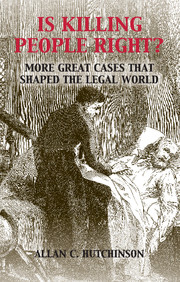
Allan C. Hutchinson, Osgoode Hall Law School, York University published Is Killing People Right? More Great Cases that Shaped the Legal World with Cambridge University Press in 2016. From the publisher:
Is Killing People Right?
"Great cases" are those judicial decisions around which the common law pivots. In a sequel to the instant classic Is Eating People Wrong?, this book presents eight new great cases from the United Kingdom, the United States and Australia. Written in a highly accessible yet rigorous style, it explores the social circumstances, institutions (lawyers, judges and courts) and ordinary people whose stories shaped the law. Across the courts' diverse and uncoordinated attempts to adapt to changing conditions and shifting demands, it shows the law as the living, breathing and down-the-street experience it really is. Including seminal cases in end of life, abortion and equal rights, this is an ideal introduction for students to legal history and jurisprudence.

Here's the Table of Contents:

1. Introduction: on the road (again)
2. Is killing people right? Law and the end of life
3. Oil on troubled waters: the consequences of civil liability
4. The politics of law: cats, pigeons and old chestnuts
5. The companies we keep: the moralities of business
6. Fifty shades of Brown: consent and the criminal law
7. Putting up a defence: sex, murder and videotapes
8. Wade-ing into controversy: a case of accidental activism
9. Playing a different tune: fairness in deal-making
10. Conclusion: surfing the tides.


Further information is available here.

Thursday, June 8, 2017

Eyer on "Protected Class Rational Basis Review"

Katie Eyer (Rutgers Law School) has posted "Protected Class Rational Basis Review," a constitutional law article with a significant historical component. The article appears in Volume 95 of the North Carolina Law Review. Here's the Abstract:
It is commonplace today to associate rational basis review exclusively with groups that are not formally afforded heightened scrutiny under the Supreme Court’s equal protection precedents: groups like gays and lesbians, people with disabilities, and undocumented immigrants. Thus, discussions of the benefits of nurturing a jurisprudence of meaningful rational basis review typically focus exclusively on such “unprotected” groups. In contrast, rational basis review is rarely thought of as providing important protections for groups such as racial minorities and women, who have secured “protected class” status and therefore are subject to regular heightened review of group-burdening classifications.

Drawing on extensive original archival research, this Article challenges this common conception. Race and sex discrimination litigators have often historically relied on rational basis arguments as a complement to heightened scrutiny. And during eras when robust rational basis review was prevalent—such as the 1970s—these claims have often succeeded. Today, as a result of, inter alia, the LGBT rights cases (which have expanded judicial conceptions of the scope of rational basis review), we stand at a moment of increased possibility for meaningful rational basis review. Rational basis arguments thus ought to form a part of how we conceptualize the contemporary possibilities for race and gender justice claims.

Such an approach has the potential to revitalize what has long been a stalled constitutional jurisprudence around sex and race discrimination. As many scholars have acknowledged, it is extraordinarily rare for courts today to find that a government actor engaged in intentional discrimination against women or racial minorities—the contemporary standard for triggering heightened scrutiny. But as the history unearthed herein demonstrates, courts (especially lower courts) have, at times, been willing to find that racially and gender-impactful laws violate rational basis review. Moreover, such review has often had the capacity to undermine widely shared assumptions regarding the rationality of entrenched structures of race and gender oppression. As such, protected class rational basis review may present one of the few realistic alternatives for reviving a meaningful project of race- and gender-based constitutional change today.
The full article is available here.

Cromwell Research Fellowships

[We’ve been asked to post the following notice on Cromwell Fellowships .  Note the deadline of July 11.  Email addresses of the committee members are on this page at the ASLH website.]

In 2017, the William Nelson Cromwell Foundation will make available a number of $5,000 fellowship awards to support research and writing in American legal history by early-career scholars. Early career generally includes those researching or writing a PhD dissertation (or equivalent project) and recent recipients of a graduate degree working on their first major monograph or research project. The number of awards made is at the discretion of the Foundation. In the past several years, the trustees of the Foundation have made five to nine awards. Scholars who are not at the early stages of their careers may seek research grants directly from the Foundation.  For more information, see the Grants page at cromwellfoundation.org.
Application Process for 2017

The Committee for Research Fellowships and Awards of the American Society for Legal History (ASLH) reviews the applications and makes recommendations to the Foundation. (The Cromwell Foundation was established in 1930 to promote and encourage scholarship in legal history, particularly in the colonial and early national periods of the United States. The Foundation has supported the publication of legal records as well as historical monographs.)

Applicants should submit a description of their proposed project (double-spaced, maximum 6 pages including notes; include a working title), a budget, a timeline, and a short c.v. (no longer than 3 pages). The budget and timeline can be part of the Project Description or separate. (There is no application form.) Two letters of recommendation from academic referees should be sent directly to the Committee Chair via email attachment, preferably as .pdf files. Applications must be submitted electronically (preferably in one .pdf file) no later than midnight July 11, 2017. Please send all materials to the selection Committee, here.   Successful applicants will be notified by early November. An announcement of the awards will also be made at the annual meeting of the American Society of Legal History.

Members of the Committee for Research Fellowships and Awards, 2017
Joanna Grisinger (2014), Chair, Northwestern University
Leonardo Barbosa (2015), CEFOR/Câmara dos Deputados, Brazil
Sandra VanBurkleo (2015), Wayne State University
Kenneth Mack (2016), Harvard University
Serena Mayeri (2016), University of Pennsylvania
Katherine Turk (2016), University of North Carolina

Wednesday, June 7, 2017

McNairn on Deliberative Democracy in Upper Canada

Jeffrey L. McNairn, Queen’s University published The Capacity to Judge: Public Opinion and Deliberative Democracy in Upper Canada, 1791-1854 with the University of Toronto Press in 2016. From the publisher:
The Capacity To Judge: Public Opinion and Deliberative Democracy in Upper Canada,1791-1854By the mid-nineteenth-century, "public opinion" emerged as a new form of authority in Upper Canada. Contemporaries came to believe that the best answer to common questions arose from deliberation among private individuals. Older conceptions of government, sociability and the relationship between knowledge and power were jettisoned for a new image of Upper Canada as a deliberative democracy. 
The Capacity to Judge asks what made widespread public debate about common issues possible; why it came to be seen as desirable, even essential; and how it was integrated into Upper Canada's constitutional and social self-image. Drawing on an international body of literature indebted to Jürgen Habermas and based on extensive research in period newspapers, Jeffrey L. McNairn argues that voluntary associations and the press created a reading public capable of reasoning on matters of state, and that the dynamics of political conflict invested that public with final authority. He traces how contemporaries grappled with the consequences as they scrutinized parliamentary, republican and radical options for institutionalizing public opinion. The Capacity to Judge concludes with a case study of deliberative democracy in action that serves as a sustained defense of the type of intellectual history the book as a whole exemplifies.


You can read more about the book here.

CFP: Immigration Control and Resistance

[Via H-ItalianDiaspora  we have the following announcement.]

Immigration Control and Resistance: Historicizing the Present Moment
A Special Issue of the Journal of American Ethnic History

Guest Editors:
Chantel Rodríguez, University of Maryland, College Park
Andy Urban, Rutgers University, New Brunswick

The 2016 presidential election foregrounded public debates about immigration, national security, and belonging in ways that scholars have struggled to understand.  The hardline stances on immigration emanating from the new presidential administration-from Executive Orders aimed at suspending migration from designated majority-Muslim countries to the proposal to "build a wall" on the US-Mexico border-represent to many a daunting expression of how the federal government plans on exercising its power to conduct immigrant surveillance, detention, and deportation.

In this environment, how the United States came to be a "gatekeeping nation" is again a topic of considerable importance. This special issue of the JAEH seeks to historicize the current political moment by examining how the immigration enforcement apparatus developed; how immigration controls functioned during previous eras of enforcement; how immigrant communities and activists have organized to contest and resist such efforts in the past; and how the governance of national borders informed immigration policy. We also seek submissions that historicize Americans and the United States government's attitudes toward refugees, and address how asylum policies in the past have either conformed to or challenged restrictions and controls on migrants already in place.

The editors encourage submissions that examine immigration policies through the multiple frameworks required to understand border surveillance; and that examine the politics of immigration control as both involving federal, state, and municipal actors-as well as social workers, legal advocates, and community and religious leaders-working to disparate ends.  Articles that shed light on the historical origins of the Immigration and Customs Enforcement (ICE) agency and its predecessors, detention facilities and prosecutorial strategies used to remove immigrants are also encouraged.

Lastly, the guest editors welcome submissions that examine cultural responses to restrictive immigration policies and enforcement practices, which historicize how immigrant and ethnic publics have used art, literature, music, and other mediums as modes of criticism

Tuesday, June 6, 2017

JEHL 8:1

Journal on European History of Law 8:1 (2017) is out; ESCLHBlog has the TOC.

Huneeus & Madsen on Comparative History of Human Rights

Alexandra Valeria Huneeus and Mikael Rask Madsen, University of Wisconsin Law School and University of Copenhagen have posted Between Universalism and Regional Law and Politics: A Comparative History of the American, European and African Human Rights Systems, forthcoming in ICON:
Regional human rights have been heralded as one of the greatest innovations of international law of the 20th century. And yet, the broader debate on the history of human rights has paid surprisingly little attention to regional human rights systems, thereby missing some of the most salient strands of the larger history. This article represents a first systematic attempt to compare the institutional histories of the regional human rights systems in Europe, the Americas and Africa. It reveals how the regional rights systems’ evolution has been shaped in part by the same geopolitical dynamics, and how, in many ways, they have explicitly and implicitly worked in tandem, linked by common challenges, and notably by shared ideas and practices. Our story also uncovers that the paths of influence between the regional rights systems are not, as is often assumed, simply unidirectional: while it is undoubtedly the case that the European human rights system became influential in its region earlier, the Latin American and African systems have also contributed to the making of the broader international human rights order.
H/t: Legal Theory Blog

Cravez on Alaska's Territorial Lawyers and Judges

New from the University of Chicago Press: The Biggest Damned Hat: Tales from Alaska's Territorial Lawyers and Judges, by Pamela Cravez (Institute of Social and Economic Research, University of Alaska Anchorage). A description from the Press:
Alaska history from the days before statehood is rich in stories of colorful characters—prospectors, settlers, heroes, and criminals. And right alongside them were judges and lawyers, working first to establish the rule of law in the territory, then, later, laying the groundwork for statehood.

The Biggest Damned Hat presents a fascinating collection of stories ranging from the gold rush to the 1950s. Built on interviews and oral histories from more than fifty lawyers who worked in Alaska before 1959, and buttressed by research into legal history, the book offers a brilliantly multifaceted portrait of law in the territory—from laying the groundwork for strong civil and criminal law to helping to secure mining and fishing rights to the Alaska Court-Bar fight, which pitted Alaska’s community of lawyers against its nascent Supreme Court. Bringing to life a time long past—when some of the best lawyers had little formal legal education—The Biggest Damned Hat fills in a crucial part of the story of Alaska’s history.
More information is available here.

Monday, June 5, 2017

Terem on Islamic Law in Morocco

[We don't usually go this far back, but we missed this one earlier. We’re including it because it’s not every day that we see a monograph on the legal history of Morocco (we posted this on Jessica Marglin’s recent book, speaking of which).] 

Etty Terem, Rhodes College, published Old Texts, New Practices: Islamic Reform in Modern Morocco with Stanford University Press in 2014. From the publisher: 
In 1910, al-Mahdi al-Wazzani, a prominent Moroccan Islamic scholar completed 
his massive compilation of Maliki fatwas. An eleven-volume set, it is the most extensive collection of fatwas written and published in the Arab Middle East during the late nineteenth and early twentieth centuries. Al-Wazzani's legal opinions addressed practical concerns and questions: What are the ethical and legal duties of Muslims residing under European rule? Is emigration from non-Muslim territory an absolute duty? Is it ethical for Muslim merchants to travel to Europe? Is it legal to consume European-manufactured goods? It was his expectation that these fatwas would help the Muslim community navigate the modern world. In considering al-Wazzani's work, this book explores the creative process of transforming Islamic law to guarantee the survival of a Muslim community in a changing world. It is the first study to treat Islamic revival and reform from discourses informed by the sociolegal concerns that shaped the daily lives of ordinary people. Etty Terem challenges conventional scholarship that presents Islamic tradition as inimical to modernity and, in so doing, provides a new framework for conceptualizing modern Islamic reform. Her innovative and insightful reorientation constructs the origins of modern Islam as firmly rooted in the messy complexity of everyday life.

In praise of the book:

"Are Islamic law and modern social needs compatible? In this thoughtful and engaging study the author provides rare insight into how one man's struggle with this issue produced a body of work that has great currency for the issues now confronting all those who will be impacted by the Arab Spring." -Lawrence Rosen

"This brilliantly conceived and meticulous study revises our understanding of the nature of Islamic reformism. By locating fatwas in their social context, Etty Terem shows how the Maliki jurist al-Wazzani fashioned a characteristically Moroccan response to the societal dangers posed by modernity and colonialism." -Jonathan Katz,

You can read more about the book here.

Call for Applications: Postdoctoral Fellow at Duke's Kenan Institute for Ethics

We have the following call for applications:
The Rethinking Regulation Program at the Kenan Institute for Ethics (RR@KIE) at Duke University is seeking a Postdoctoral Fellow for a one-year term (with a possible renewal for a second year, upon mutual agreement of all parties and if funding is available).
RR@KIE fosters research, education, and policy engagement on the evolution, design, deliberation and performance of regulatory systems, across a wide array of policy areas. Linking diverse disciplinary approaches across the Duke campus and beyond, RR@KIE marshals multiple perspectives and methodologies to understand complex problems, confront ethical tradeoffs, and envision solutions.
The Postdoctoral Fellow will support the Rethinking Regulation Program in the following ways:
  • Work with faculty director and executive committee to facilitate collaborative research among faculty and students in the Rethinking Regulation program by, e.g., organizing seminars, workshops, symposia, and other research and outreach activities.
  • Work with faculty director and executive committee to identify priority research areas and seek external funding for these research areas.
  • Assist the faculty in hosting visiting speakers from academia and policy.
  • Assist with policy outreach by writing, editing, and/or reviewing policy briefs, blog posts, webpages, and similar publications.
  • Work with graduate, professional and undergraduate students involved in Rethinking Regulation to help them organize activities and increase membership.
  • Assist with Bass Connections course projects linked with Rethinking Regulation, such as on adaptive governance of emerging technologies, and decision making about complex risks.
  • Conduct self-directed research on regulatory policy topics. Interest in ethical as well as legal, economic, political, cultural, and other aspects of regulation is highly desirable. Interest and ability to collaborate with others is highly desirable.
The candidate must have completed a graduate or professional degree, such as PhD, ScD, MD, JD, SJD, MBA, MPP, MEM, or similar.
Duke University is an Affirmative Action/Equal Opportunity Employer committed to providing employment opportunity without regard to an individual’s age, color, disability, genetic information, gender, gender expression, gender identity, national origin, race, religion, sexual orientation, or veteran status. Essential Physical Job Functions: Certain jobs at Duke University and Duke University Health System may include essential job functions that require specific physical and/or mental abilities. Additional information and provision for requests for reasonable accommodation will be provided by each hiring department.
To apply, send the following materials to kie@duke.edu: a letter of interest and curriculum vita.

Sunday, June 4, 2017

Sunday Book Review Roundup

In the New York Review of Books, Linda Colley reviews David Armitage’s Civil Wars: A History in Ideas, which covers hundreds of years of civil wars to show how these “unnatural” conflicts promote religious and moral rebirth. Armitage also ends with an homage to the historian’s craft:
“Where a philosopher, a lawyer, or even a political scientist might find only confusion in disputes over the term ‘civil war,’ the historian scents opportunity. All definitions of civil war are necessarily contextual and conflictual. The historian’s task is not to come up with a better one, on which all sides could agree, but to ask where such competing conceptions came from....”


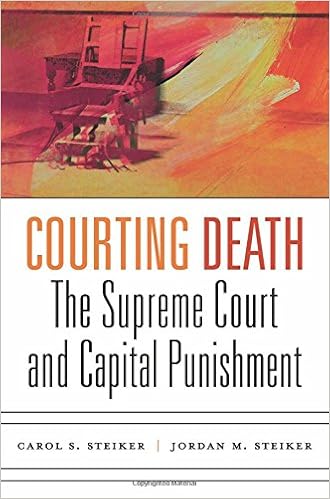
Also in the NYRB, Jed Rakoff reviews Courting Death: The Supreme Court and Capital Punishmentby Carol S. Steiker and Jordan M. Steiker. The Steikers describe the NAACP Legal Defense Fund’s anti-death penalty litigation, and assess the death penalty as a racialized symbol, but don’t totally acknowledge “that rational human beings can feel such revulsion at the taking of an innocent life as to wish the taker dead.” 

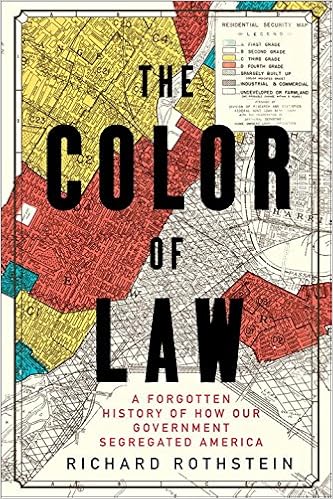
In the Washington Post, Charles Lane reviews The Color of Law: A Forgotten History of How Our Government Segregated America by Richard Rothstein. The review is aptly titled “the New Deal was a raw deal for African Americans.”  Slate’s review of the book puts Rothstein in the context of the equal protection jurisprudence that he’s primarily arguing against, and NPR gives more details on the federal housing policy--that infamous underwriting manual--that Rothstein describes. Not to be outdone by Terry Gross, Slate also features not one but two interviews with Rothstein.

The Guardian features a review of Queer City: Gay London from the Romans to the Present Day by Peter Ackroyd, observing that the book“turns out to be less an excavation than a hasty piece of cultural speed dating,” starting with a “scene-setting cacophony of all the names London has ever called us.”

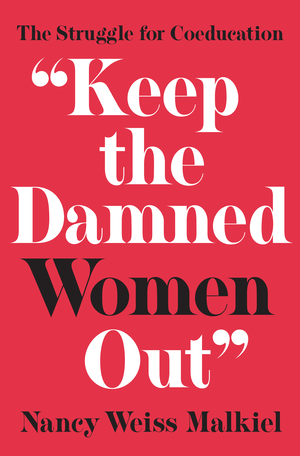
In the LA Review of Books Andrew Seal reviews “Keep the Damned Women Out”: The Struggle for Coeducation. Seal reads Nancy Weiss Makiel’s book alongside other histories of the ivy league--“the jaded memoir-cum-exposés of figures like Walter Kirn, Ross Douthat, William F. Buckley, Dinesh D’Souza, or William Deresiewicz--and admires its focus on the administrators who advanced equality and reform in the ivies.

The New Books Network features interviews with Mary E. Adkins about Making Modern Florida: How the Spirit of Reform Shaped a New State Constitution, an account “of the reformation of the Florida state constitution in the 1960s,” and with Ryan Alford, whose Permanent State of Emergency: Unchecked Executive Power and the Demise of Rule of Law “offers a fresh perspective on debates about the expansion of executive authority in the US in the post-9/11 period” (but throws Nixon in for good measure).

And in the New Rambler, Diana Muir Applebaum reviews the Museum of the American Revolution as well as the revolution itself (“it was a deeply conservative revolution, led by privileged and successful men who intended not to change the world they had inherited, but simply to free themselves from British rule and continue to live in a society not very different form the world of their fathers.”).