Sunday, October 14, 2007

Reviewed: Faludi, The Terror Dream

THE TERROR DREAM: Fear and Fantasy in Post-9/11 America by Susan Faludi (Metropolitan Books/Henry Holt & Company) is reviewed this weekend in the New York Times. But the Faludi review not to miss is Rebecca Traister's interesting pairing of Faludi and the new Springsteen album Magic, at Salon.com. Traister begins:

It may be pop culture heresy to rope together Susan Faludi's new book, "The Terror Dream," and Bruce Springsteen's new album, "Magic," both released this week. Faludi, author of 1991's "Backlash," is a diligent chronicler of the country's gender problems. Springsteen is a swaggering blue-collar cult hero whose critical thinking about American culture has made him an international rock star. Yet there is a neat perfection in the pairing of these two uniquely American storytellers, as if Mars and Venus had conveniently weighed in simultaneously, after six years of consideration, on what exactly has unfolded in this country, with which they are each so critically obsessed, in the wake of the terrorist attacks of Sept. 11, 2001.

Springsteen, of course, has already made one contribution to the national artistic accounting of 9/11 with "The Rising," his 2002 album that Faludi might crankily write off (as she does movies like "United 93" and "World Trade Center") as a piece of art that "seemed to have no purpose but to repeat what we already knew." On it, Springsteen gave voice to those whose lives had been damaged by 9/11: a firefighter who died, one who survived, widows both American and Arab. Five years later, he and Faludi are on related missions: to step back from the firsthand experience of events and attempt to pick out the patterns in all that's gone down since.

Faludi is characteristically grim in her reading of the country's tea leaves; she is unsurprised to report that the cultural signifiers are, as always, oppressive. Springsteen's music has always been buoyed by American symbolism; he's never been shocked by its misuse, but on this record, his grief and anger over its twisted meanings are palpable. Both "The Terror Dream" and "Magic" employ images of surrealist dread to describe the post-9/11 manipulation -- by media and politicians -- that has left us warped and brainwashed, and both deploy terrifying visions to make their points. On the title track and throughout his record, Springsteen describes the creepy carnival tricksterism of the Bush administration and the sinuous ways it has distorted his vision of America, while Faludi sees a vast national conspiracy to put women back in the kitchen and alpha males like John Wayne (or perhaps Bruce Springsteen) back in their lost positions of power.


Continue reading here.

There is also a Faludi review in the Chicago Trib. The Trib has made it harder to find reviews on their website, unfortunately, but the paper has had among the most substantive reviews of the major papers, so it is worth the effort. Go here and scroll down.

Saturday, October 13, 2007

Waterhouse on Reparations and Black Life Under American Law, 1619-1972

Carlton Waterhouse, Florida International University, suggests that "the civil rights legislation of the 1960s and 1970s represented one more step in a series of unfortunate legal events that ultimately reflected the dominant attitude of society's white majority toward ending the Jim Crow practices of the south," in a new article on SSRN. Avoiding Another Step in a Series of Unfortunate Legal Events: A Consideration of Black Life Under American Law from 1619 to 1972 and A Challenge to Prevailing Notions of Legally Based Reparations appeared in the Boston College Third World Law Journal. Here's the abstract:
The growing body of literature on reparations consists primarily of articles showing that black reparations are consistent with various legal theories, promote racial justice, or further broader societal goals like eliminating poverty and promoting education. This article takes the distinct position of challenging reparations supporters to justify their confidence in the legal system to deliver meaningful reparations for slavery and segregation in light of the historic use of law as a means of instantiating white racial supremacy and the prospective individualistic approach to race adopted by contemporary judges and legislators. The article also challenges those who oppose reparations based on its supposed unfairness to contemporary citizens to explain how their position differs from that of past generations who opposed reparations and related legal efforts to redress racial injustices as unfair at that time. To support the challenge to reparations commentators, the article examines the historical framework of blacks' relationship to the law through legislation and court rulings from 1619-1963. The article closes by presenting an alternative approach to reparations focused on building and strengthening black political, economic, and educational institutions.

Friday, October 12, 2007

Remembering Roy Rosenzweig

It is with great sadness that I note the death of Roy Rosenzweig of George Mason University, a widely admired historian, a great human being, and an all around nice guy. He was 57 years old. He is remembered by T. Mills Kelly at edwired as the person who "invented Digital History as a field of serious scholarly endeavor." "We considered him our captain," said the Editor at History Network. He cofounded the Center for History and New Media, supporting projects like History Matters, a web gateway of historical resources for U.S. history teachers, and important digital archives, including the September 11 Digital Archive and the post-Katrina Hurricane Digital Memory Bank.

I first mey Roy in at a meeting in Florence on internationalizing American history. Many Organization of American History stalwarts were there, and I knew just one person. It was before my first book was out, so I was not known in this circle. I was sure I would feel out of place. Roy's warmth made me feel welcome immediately. He treated me as if I mattered from the beginning. And when I had the chance to work with him later on the American Studies Association Nominating Committee, he was the kind of colleague who actually made long committee meetings fun.

He will be sorely missed by many, but he has left a rich legacy for all of us: history on the web.

He is remembered this way on the American Historical Association Blog:

Roy Rosenzweig, the Mark and Barbara Fried Professor of History & New Media at George Mason University, and a friend and councilor of the AHA, passed away yesterday, October 11, 2007, due to complications resulting from advanced cancer of the lungs.

Rosenzweig was that rare academic: consummately knowledgeable, self-reliant, productive, intuitively creative, and above all, a humanist who helpfully bridged the often intimidating gap between the seeming elitism of academia and his students. At George Mason University, Rosenzweig also headed the Center for History and New Media (which he cofounded), and developed it with a pioneering enthusiasm, making it one of the leading centers for digital history.

Indeed, embracing emerging technologies with ardor, but always with a cautious sense of the possible and the real, Rosenzweig fused history and technology with a seemingly effortless ease that inspired many other historians to take off on their own exploratory voyages into new media.

Not surprisingly, Roy Rosenzweig and his colleagues at the Center for History and New Media and received many accolades, including the AHA’s James Harvey Robinson Prize for 2004 and 2006 (for History Matters and World History Matters, respectively, for creating web sites to help students navigate the complexities of U.S and global history). And just a few weeks ago, the Center for History and New Media received a $7.5 million grant from the U.S. Department of Education for creating a clearinghouse for information about history education.

Rosenzweig, who received his PhD from Harvard University in 1978, wrote or edited numerous books and articles including Eight Hours for What We Will: Workers and Leisure in an Industrial City, 1870–1920 (Cambridge University Press, 1983); The Park and the People: A History of Central Park (Cornell University Press, 1992), co-authored with Elizabeth Blackmar, which won the 1993 Historic Preservation Book Award and the 1993 Urban History Association Prize for Best Book on North American Urban History; and, most recently, with Daniel Cohen, Digital History: A Guide to Gathering, Preserving, and Presenting the Past on the Web (University of Pennsylvania Press, 2006).

Roy Rosenzweig received numerous awards for his scholarship and professional contributions, including the Guggenheim Fellowship, which he held in 1989–90. In 2003, he received the Richard W. Lyman Award for his work with digital history. In March 2007 he was conferred the Distinguished Service Award by the Organization of American Historians, for his “outstanding contributions to labor and public history, and his dedication to reaching new and diverse audiences as expressed in his pioneering efforts in the uses of digital technology and new media.”

Dedicated as he was to his teaching, Roy Rosenzweig perhaps treasured more than anything else the admiration and affection of his students, three of whom, remarkably, now work at the AHA building. Roy Rosenzweig was the MA thesis adviser for Lee White, the executive director of the National Coalition for History, and for Chris Hale, publications production manager at the AHA. Rosenzweig was the PhD dissertation adviser for Robert Townsend, the AHA’s assistant director for research and publications. “I have lost both a mentor and a friend with the passing of Roy,” said Lee White. “Few people truly affect the direction that your life takes. Of all of the teachers I have had throughout my education, he is the one whom I will always cherish the most,” Robert Townsend added. Chris Hale particularly appreciated the fact that Rosenzweig was readily accessible to his students, and declared, “that’s rare in academia and, for me, was the best aspect about my whole graduate school experience.”

A long-standing and loyal member of the AHA, Rosenzweig served as the Association’s Vice President for Research from 2004 to 2006. Inventive as always, he used his tenure to bestir the AHA to break out of the inhibiting confines of the traditional annual meeting formats and introduced several new modes of presentation, and worked to open up access to scholarship not only at the meeting but from the pages of the American Historical Review. During his vice presidency, Rosenzweig also successfully led the search for a new editor for the AHR. Rosenzweig was also an enthusiastic founding member of the National History Center, an initiative of the AHA, and served on its planning committee.

In recognition of his invaluable contributions to the Association, to the profession, and to the discipline, the AHA chose Rosenzweig to be the next recipient of the Troyer Steele Anderson Prize to be conferred at the AHA’s 122nd annual meeting in Washington, D.C. Sadly, the prize must now be conferred posthumously. Roy Rosenzweig, a true academic visionary and superlative historian with a social conscience, will be missed by friends, colleagues, and students alike.

There is more from History News Network and the Washington Post.

According to History News Network, in lieu of flowers, donations in Rosenzweig's memory may be made to the Center for History and New Media (CHNM). Make checks payable to the George Mason University Foundation, 4400 University Drive, MS 1A3, Fairfax, VA 22030. Please note that your gift is for the CHNM.

Schnyder on The Cognitive Origins of Corporate Governance in Switzerland, Germany, and the U.S., 1910s-1930s

Gerhard Schnyder, University of Cambridge, has posted the abstract for a new paper, Horse, Cow, Sheep, or 'Thing as Such'? The Cognitive Origins of Corporate Governance in Switzerland, Germany, and the U.S., 1910s-1930s. The paper is not posted, but the author can be reached via his SSRN author page. Here's the abstract:
The US is commonly opposed to continental European countries as a distinct model of corporate governance (CG) in the sense that the US model stresses the protection of outside shareholders, whereas the continental European model is based on a broader stakeholder approach. This goes together with distinct theories of the corporation: the US system, it is based on an individualistic conception while the continental European model is associated with a super-individualistic view of the firm.
In this paper we examine the origin of this opposition by looking at the cases of Switzerland, Germany, and the US. Contrary to very popular corporate governance theories, which see in the different CG models as a quasi-natural effect of different legal traditions, we show that the emergence of two distinct approaches to CG can be localised during the first decades of the 20th century. We analyse the CG debates among legal scholars and economists and the politics of company law reform in the US, Germany and Switzerland and show that all three countries faced a similar structural development of the stock corporation during the second half of the 19th century, which led to an increasing likelihood of a separation between owner-ship and corporate control.
Legal scholars and economists on both shores of the Atlantic diagnosed this evolution in different ways and proposed consequently different remedies. While in the US the view prevailed which consisted in assuring the shareholders a maximal protection against expropriation by opportunistic managers, in Europe the contrary view prevailed which sees independent and powerful managers as the guardian of the interest of all stakeholders. Due to the particular political contexts in the three countries which we analyse, different ideas concerning the organisation of the firm were finally institutionalised and explain the diverging paths that continental European countries and the US went down subsequently.

Blumenthal on The Default Legal Person

Susanna L. Blumenthal, University of Minnesota, has posted the abstract for a fascinating new article, The Default Legal Person. The article itself is not on SSRN, but can be found on-line in the UCLA Law Review. Here's the abstract:
This Article explores the conceptions of responsible agency that informed legal analysis in nineteenth-century America. Standing behind the “reasonable man” famously drawn by Oliver Wendell Holmes, Jr., there was a second figure, which I call the “default legal person,” who personified mental attributes an individual needed to possess - at a minimum - in order to be deemed a legally accountable agent. This default legal person, I argue, was first articulated in the post-Revolutionary period by jurists drawing on new “enlightened” forms of Protestantism, and particularly on the Scottish Common Sense philosophy in which they were schooled, in order to delineate the mental prerequisites of legal responsibility. The figure they constructed was, in essence, a creature of Common Sense, one divinely endowed with intellect, free will, and moral sense.
Turning to the law reports published over the course of the century, and focusing more particularly on the little-studied civil side of the docket, we find that judges tended to deploy the default legal person in the same fashion across cases and time. In any instance in which a plea of incapacity was made, this legal figure served to set the threshold of mental competence - to illustrate how much “mind” a person needed for a particular civil act or wrong to be attributed to him. Yet this is not to say that the threshold of capacity was set at the same level in every doctrinal field. To the contrary, judges altered the character of the default legal person as they transposed it from one field of law to the next, suggesting as they did that the specific mental attributes one needed to be a competent legal actor differed, depending upon the nature of the act involved - whether it was a will, contract, deed, or tort. Across all doctrinal fields, however, judges faced a similar and perplexing problem: How could they determine whether a given individual actually lacked the capacity to act with feeling, intelligence, prudence, or malice? Was it sufficient to show that the act itself was eccentric, or was it necessary to demonstrate that the party in question suffered from some sort of mental disease, as defined by medical men?
In contending with this problem over the course of the century, American judges took a variety of tacks, with more than a few lapsing into incoherence or simply evading the difficulties that litigants presented. However, upon closer scrutiny, it is possible to detect certain patterns to these rulings, and to see judges working to refine their characterizations of the default legal person, in part by varying the standard of mental capacity from one field of private law to the next. As they deployed this legal model in everyday adjudication, I argue, their judicial opinions helped to constitute a conception of responsible agency that was serviceable in the courtroom and beyond. Thus, I conclude that the default legal person may best be seen as a pragmatic means by which judges endeavored to monitor the borderlands of legal competency as they struggled to reconcile competing commitments to natural justice, market efficiency, and social welfare. In deciding cases by reference to this mental threshold, judges in this era demarcated the limits of rationality and responsibility in ways that were culturally contingent, politically consequential, and eminently contestable, ultimately reflecting basic ambiguities and tensions in the liberal legal construction of the moral agent.

Thursday, October 11, 2007

Henderson on Judicial Dissent

M. Todd Henderson, University of Chicago, has posted a new paper, From 'Seriatim' to Consensus and Back Again: A Theory of Dissent. Here's the abstract:
Why do judges dissent? There are several conventional answers. One is that dissents communicate legal theories to future judges, litigants, or politicians in the hope of becoming law later. Another is that dissents reveal the internal deliberation of courts, thus increasing their legitimacy in a democratic society. Both of these suggest that dissent improves the law making process.
Other theories are potentially less benign. For example, dissents are inevitable given the ego and life-tenure of Article III judges or dissents enable majorities to be bolder in their holdings, thereby creating more law than is necessary. Chief Justice Roberts adheres to this latter view, and therefore has called for more unanimity on the Court. Before we can say whether Roberts's goal is worth pursuing, we must have a full account of the reason for dissent.
This paper traces the history of judicial discourse to understand the reason for dissent. Over the past several hundred years, the Supreme Court and its predecessors in England have sometimes issued dissents and sometimes spoken largely with one voice. A specific change in the delivery of opinions has happened at least three times on a grand scale: (1) Chief Justice Mansfield's change from traditional seriatim opinions to an “opinion of the court” in England circa 1760; (2) a similar change in the United States Supreme Court upon the ascendancy of John Marshall to Chief Justice in 1801; and (3) the development of a tradition of writing separately during the New Deal era of the Supreme Court, which has persisted to the present.
This paper shows that in each case the change in judicial discourse was made in an attempt to increase the power of law courts over other forms of dispute resolution. For example, Mansfield and Marshall moved from seriatim opinions to an “opinion of the court” to bring certainty to decisions and thereby increase the power of their courts, whereas the modern move away from unanimity is about achieving the same goal, but by using dissent to placate losers and protect the Court's jurisdiction over politically contentious issues like abortion or affirmative action. In short, history shows that judicial discourse, be it unanimity or seriatim or something in the middle, reflects court power, and those who want to change court power did so through a change in judicial discourse.

"essential reading"

History blogging heavyweight Ralph Luker calls the Legal History Blog, and another newbie blog, Paul Harvey's excellent Religion in American History, "essential reading." Traffic is up, so I hope that means you think so, too!

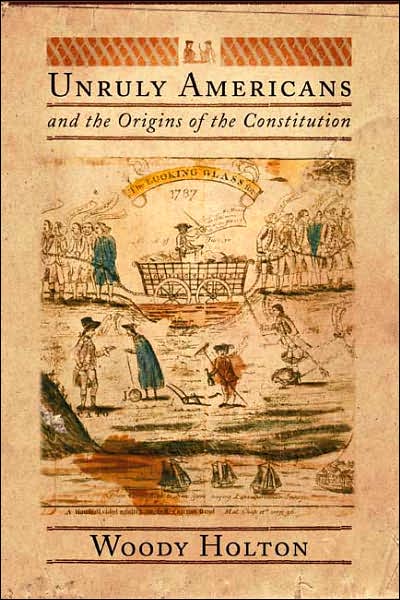
Holton, Unruly Americans and the Origins of the Constitution, among 2007 National Book Award nominees

Don't let anyone tell you that constitutional history is arcane and uninteresting. If you hear that from an editor, remember this: Woody Holton, Unruly Americans and the Origins of the Constitution (Hill and Wang/Farrar, Straus & Gioux), is among this year's National Book Award nominees in Nonfiction. Hat tip. Joining Holton on the list are:

Edwidge Danticat, Brother, I’m Dying (Alfred A. Knopf)

Christopher Hitchens, God Is Not Great: How Religion Poisons Everything (Twelve/Hachette Book Group USA)

Arnold Rampersad, Ralph Ellison: A Biography (Alfred A. Knopf)


Legal history luminary Annette Gordon Reed is among the nonfiction judges.
Here's Holton's book description:
Woody Holton upends what we think we know of the Constitution’s origins by telling the history of the average Americans who challenged the framers of the Constitution and forced on them the revisions that produced the document we now venerate. The framers who gathered in Philadelphia in 1787 were determined to reverse America’s post–Revolutionary War slide into democracy. They believed too many middling Americans exercised too much influence over state and national policies. That the framers were only partially successful in curtailing citizen rights is due to the reaction, sometimes violent, of unruly average Americans.
If not to protect civil liberties and the freedom of the people, what motivated the framers? In Unruly Americans and the Origins of the Constitution, Holton provides the startling discovery that the primary purpose of the Constitution was, simply put, to make America more attractive to investment. And the linchpin to that endeavor was taking power away from the states and ultimately away from the people. In an eye-opening interpretation of the Constitution, Holton captures how the same class of Americans that produced Shays’s Rebellion in Massachusetts (and rebellions in damn near every other state) produced the Constitution we now revere.
About the Author
Woody Holton is an associate professor of history at the University of Richmond and the author of the award-winning book Forced Founders: Indians, Debtors, Slaves, and the Making of the American Revolution in Virginia.
And some blurbs
:
"Woody Holton reframes the coming of the Constitution, revealing the rich debate Americans conducted over the cause of capital in the new land. In this account, real people—farmers, soldiers, taxpayers, speculators, creditors and entrepreneurs—replace images of the Founders, and intimate issues like tax fairness, economic effects, and electoral accountability matter far more than abstractions. The result is a new and compelling history." —Christine Desan, Professor of Law, Harvard Law School
"Move over, Founding Fathers. It turns out that average Americans from the ‘unruly mob’ had more to do with insuring the personal liberties we Americans now hold dear than did the Framers we so revere. Woody Holton’s fascinating and energetic new book makes us take a fresh look at the Constitution, especially the Bill of Rights. The populist underpinnings of our Republic are real, and this has clear implications for the role that citizens ought to play today in reforming American democracy. Holton’s lesson: If the establishment won’t change the system, the people can. They’ve done it from the beginning." —Larry J. Sabato, Director, Center for Politics, University of Virginia

Spillenger reviews Kalman, Yale Law School and the Sixties

Laura Kalman, Yale Law School and the Sixties: Revolt and Reverberations, (University of North Carolina Press, 2005) is reviewed in the Law and History Review by Clyde Spillenger, UCLA. Spillenger writes:

A now-retired scholar of American colonial history is said to have contemned all scholarly work on the twentieth century as mere "journalism." Laura Kalman, whose writings have explored the institutional history of American law during that later period, has for twenty years given the lie to this dyspeptic claim. Like her three previous books, Yale Law School and the Sixties places at its center legal education in the United States, in particular the law school that now regularly rates #1 in the U.S. News and World Report annual rankings of American law schools. And, like her other books, this one confirms her standing as our finest historian of the elite institutions of American law in the twentieth century.

Scholars have frequently identified the untidy events at American universities in the period from 1965–1973 as among the most significant developments of the era. At no time before or since have students at U.S. institutions of higher education pressed so insistently for "relevance" in the university mission—for the view that the university should be, not an oasis from the larger world, but rather intimately concerned with it. Yale University's patrician president, Kingman Brewster, is widely regarded as having navigated these shoals expertly, exhibiting flexibility in the face of student demands while yielding little of the university's actual authority. At Yale Law School, however, these years witnessed greater conflict and harder feelings than at the university as a whole. While it is difficult to tell how deeply and broadly protest sentiment ran among the law student body during the years 1967–1970, it is clear that in those years a group of student activists made things very hot for the faculty and administration.

While the law school's small size and its sometimes uncomfortable intimacy helped intensify faculty-student conflict, Kalman argues that that conflict was framed by a shift in the law faculty's outlook from that of a vibrant Legal Realism in the 1920s and 1930s, to that of a rather complacent postwar liberalism in the 1960s. Dissenting students were apt to accuse the faculty of having abandoned the critical edge that had characterized the work of their Realist forebears. For their part, faculty who believed their reformist bona fides had been demonstrated by their stated opposition to the Vietnam War and by their commitment to civil rights were confounded by students' more "radical" demands for shared governance, reform of the grading system, racial justice (particularly with respect to admissions and faculty hiring), equality for women, and reform of the curriculum to make it more relevant. The ensuing tensions came to a head during the trial of Bobby Seale in New Haven and the "May Day" demonstrations at Yale during the spring of 1970.


There is, in addition, a second institutional drama recounted in this book: the infamous "purge" of junior faculty at the Yale Law School in the mid-1970s, when six assistant professors (most politically left-of-center) were denied tenure virtually en masse. (All six went on to successful careers, some of them highly distinguished, at other academic institutions.) Although there was a lag of a few years between these two sets of events, Kalman considers them to be closely connected. For purposes of her story, she defines "the 1960s" actually as the period from 1967 to the mid-1970s. And she sees "the purge" as having been influenced by some senior faculty's searing memories of the student protests and the siege mentality that had temporarily gripped the law school.

While Kalman is appropriately tentative in allocating responsibility for a "Dark Ages" of faculty-student conflict that no participant remembers fondly, she does demonstrate that many of Yale's faculty were uncreative and even panicky in their response to students' demands in 1967–70. Kalman resists the temptation retrospectively to condemn or lampoon those faculty members (such as Eugene V. Rostow and the redoubtable Alexander Bickel) who seemed least able to understand the meaning of student discontent. At the same time, she signals occasional irritation at what seems like callow and pretentious rhetoric on the part of some student radicals. A few student leaders, such as Black activist J. Otis Cochran, and a few sympathetic but relatively powerless professors make more impressive showings. But this is not a story abounding with heroes—until the book's final two chapters.

Despite the book's title, Kalman at the book's end ventures briefly into the 1980s and 1990s and finds there a savior of sorts: Guido Calabresi, Dean of Yale Law School from 1985–1994 and currently a judge on the United States Court of Appeals for the Second Circuit. Calabresi's spectacular fund-raising and his genial, creative response to renewed student activism in the late 1980s and early 1990s helped resurrect the law school and move it to its enviable place in the legal-educational hierarchy.

Continue reading here.

Wednesday, October 10, 2007

Fall 2007 Law and History Review now on-line

The Fall 2007 issue of the Law and History Review is now in print and available on-line. The contents include:

Articles

"Of Portuguese Origin": Litigating Identity and Citizenship among the "Little Races" in Nineteenth-Century America
Ariela Gross

The Origin and Early History of the Writs of Entry
Joseph Biancalana

The Painful Question: The Fate of Judicial Torture in Early Modern Sweden
Heikki Pihlajamäki

Review Essay


English Criminal Justice Administration, 1650–1850: A Historiographic Essay
Bruce P. Smith

Editor David S. Tanenhaus describes the issue this way:

Our first article, by Ariela Gross, examines nineteenth-century America's "little races," composed of racially ambiguous communities of African, Indian, and European origin along the Eastern seaboard. She reveals how these mixed communities navigated the increasingly rigid black-white color line. Drawing on trial records of cases litigating the racial identity of the Melungeons of Tennessee, the Croatans/Lumbee of North Carolina, and the Narragansett of Rhode Island, she reveals how these communities responded to Jim Crow. As she demonstrates, the Melungeons claimed whiteness; the Croatans/Lumbee asserted Indian identity and rejected association with blacks; while the Narragansett asserted Indian identity, but did not deny their African origins. Ultimately, she contends that these people learned that they could achieve full citizenship in the U.S. polity, but it depended upon them abandoning self-government and distancing themselves from people of African descent.

In our second article, Joseph Biancalana examines the origins and early history of the writs of entry, which were among the earliest writs to be invented after the legal reforms of Henry II. The distinctive feature of a writ of entry was that it challenged what plaintiffs thought was the basis of defendant's claim to disputed land. A writ of entry alleged that a defendant "had no entry" into the land other than by a transaction or taking that did not authorize him to hold the land. Although writs of entry were invented to serve as supplements to the possessory assizes of novel disseisin and mort d'ancestor, it was not clear how to limit their substantive scope so that they would not become substitutes for the writs of right. The solution was to limit the writs to three degrees and thus limit the generations of inheritance that could be included within the writ. That precarious solution did not fare well as markets for land developed in the thirteenth century. The degrees increasingly functioned to limit the number of conveyances linking defendant to entrant, which had nothing to do with the reason for the limitation to three degrees. As Biancalana concludes, the authorization of writs of entry in the post in 1267 accommodated writs of entry to the market for land.

Our third article, by Heikki Pihlajamäki, contends that Swedish legal history, with regard to judicial torture, differs considerably from the continental main stream of ius commune. He argues that judicial torture never existed as a systematic and large-scale practice in Sweden because the strong lay element in lower courts prevented its adoption. Yet, Swedish legal history does partly resemble Continental history in that, because of a wide-spread use of extraordinary punishment, torture was not necessary to produce confessions. Swedish criminal procedure, for example, allowed the use of hard prison, which modern researchers have sometimes confused with judicial torture. He argues that in the early modern conceptual system hard prison was distinguishable from judicial torture, even though both institutions aimed at pressing confessions by harsh treatment of the suspects. The distinction was possible because judicial torture was a purely legal concept without any moral connotation. By the beginning of the nineteenth century, the changing moral connotations of torture helped to elide this earlier distinction and contributed to modern scholars conflating torture with the use of hard prison.

A review essay, by Bruce Smith, serves as our fourth article. In the past half century, the history of English criminal justice administration from roughly 1650 to 1850 has emerged as a dynamic area of legal-historical research. Smith's essay chronicles the origins of the subject among historically minded criminologists in the 1940s, its treatment by social historians in the mid-1970s, and its emergence as a distinct field of legal-historical study in the late 1970s and early 1980s. Smith then reviews the scholarship, published over the past two decades, on English criminal justice in the long eighteenth century, focusing on six areas: criminal legislation; policing; prosecution; pretrial procedure; adjudication; and punishment. After surveying the range of primary source materials made available to scholars of English criminal justice history in recent years, he recommends two methodological initiatives: an increased commitment to comparative legal-historical scholarship in the area of criminal justice administration; and a more sustained engagement by criminal justice historians with the research of academics on Anglo-American law faculties working in the areas of criminal law and criminal procedure.

Continue reading here. To submit your work to the Law and History Review, get started here (and note that, as with other peer-reviewed journals, simultaneous submissions to other journals are not appropriate).

Two from Vladeck on the history of Enemy Aliens and the Suspension Clause

Stephen I. Vladeck, American University, has posted two new articles that look to history for lessons that inform pressing contemporary problems of rights and security. The first is Enemy Aliens, Enemy Property, and Access to the Courts, which will appear in the Lewis and Clark Law Review. Here's the abstract:
A frequent refrain in the contemporary debate over the role of the federal judiciary in the war on terrorism is that the courts have never before been open during “wartime” to individuals identified by the Executive Branch as “enemies.” By so thoroughly involving themselves in the current disputes, critics allege that the federal courts have become unwitting accomplices in “lawfare” by questioning - and sometimes invalidating aspects of - the Bush Administration's conduct of (and in) the war on terrorism.
Although I elsewhere attempt to assess (and critique) the more theoretical implications of this view, the purpose of this symposium essay is to demonstrate, based upon a largely unexplored body of case law, that this conventional wisdom is neither “conventional” nor “wisdom,” but is instead an historical myth. To the contrary, U.S. courts have a long and rich history of hearing wartime cases where the government alleged that a private party was an “enemy,” and the private party maintained that he was not. The common law “enemy alien disability rule,” to whatever extent it remains viable, simply has no application to cases where there is a colorable question as to whether the relevant individual is, in fact, an enemy.
To be sure, the courts have shown broad deference to the government in these cases, as a result of which the government has usually prevailed. But such outcomes have come only after thorough and searching analysis of the underlying jurisdictional fact - of whether the individual is, in fact, an “enemy” under the relevant definition.

The Suspension Clause as a Structural Right will appear in the University of Miami Law Review. Here's the abstract:
The central point of disagreement between the majority and dissenting opinions in the D.C. Circuit in Boumediene v. Bush, the latest in a series of challenges to the detention of non-citizen “enemy combatants” at Guantánamo Bay, Cuba, is the question whether the Constitution's Suspension Clause applies in Guantánamo. In this symposium essay, I argue that both sides of the current debate are focusing on the wrong question because of a deeply rooted historical misunderstanding of the Suspension Clause. Retracing the original understanding of the Clause, the essay argues that the Suspension Clause was meant as a grant of authority to Congress to suspend the writ of habeas corpus in certain circumstances, rather than as a constraint on Congress's power thereto. As such, the Clause delineates the only circumstances wherein Congress may abridge the otherwise-available common law writ of habeas corpus.
The problem, as the essay retraces, comes from reading together the Supreme Court's decisions in Ex parte Bollman (1807) and Tarble's Case (1872), the former of which precluded common-law habeas corpus in the federal courts, and the latter of which denied state courts the authority to issue habeas petitions against federal custodians. As I argue, although each decision is defensible on its own merits, together, they produce a constitutional conundrum vis-a-vis Congress's power over habeas corpus, and one that should limit Congress's power to completely preclude federal habeas jurisdiction over claims cognizable at common law to those cases authorized by the Constitution, i.e., "Cases of Rebellion or Invasion [when] the public Safety may require it."

Straumann on The Peace of Westphalia (1648) as a Secular Constitution

Benjamin Straumann, New York University School of Law, has posted a new paper, The Peace of Westphalia (1648) as a Secular Constitution. Here's the abstract:
“Westphalia” is often used as shorthand for a system of equal and sovereign states; and the peace treaties of Westphalia are sometimes said to have established the modern concept of sovereign statehood. This paper seeks to shift the focus from this popular conception of the Westphalian treaties, and instead to treat them as constitutional documents. I argue that the Westphalian constitutional treaties successfully solved the problem of deep religious disagreement by imposing proto-liberal religious liberties on the estates of the Holy Roman Empire, which left the subjects with exclusively secular duties towards their authorities. The Westphalian constitution also addressed the issue of compliance with its religious provisions by establishing a secular procedure to adjudicate religious disputes that excluded religious reasoning from the courts. This account of Westphalia yields important implications for our view of sovereignty in the Holy Roman Empire. It is argued that Westphalia established a secular order by taking sovereignty over religious affairs away from the discretion of territorial princes and by establishing a proto-liberal legal distinction between private and public affairs. Westphalia must thus be seen as a very successful constitutional experiment in dealing with deep religious disagreements.

Tuesday, October 9, 2007

Joondeph on The Other Side of Federalism: An Empirical Analysis of the Rehnquist Court's Preemption and Dormant Commerce Clause Decisions

Bradley W. Joondeph, Santa Clara University, has posted a new essay, The Other Side of Federalism: An Empirical Analysis of the Rehnquist Court's Preemption and Dormant Commerce Clause Decisions. Here's the abstract:
Most scholars agree that federalism was central to the Rehnquist Court's constitutional agenda. But there is a part of the federalism story that has been largely overlooked: the Court's decisions involving the structural constraints on state governments, the most significant of which are preemption and the dormant Commerce Clause. This article presents an empirical study of the Rehnquist Court's 77 decisions addressing these issues between October 1991 and June 2005. The study is partly qualitative, analyzing the Court's various doctrinal moves with respect to preemption and the dormant Commerce Clause, and partly quantitative, offering a statistical analysis of the justices' voting patterns. Both parts of the study demonstrate that, on this “union-preserving” side of federalism, the five justices most responsible for the Rehnquist Court's “federalism offensive” - Rehnquist, O'Connor, Scalia, Kennedy, and Thomas - were largely indifferent to state policymaking autonomy. If anything, they tended to push the law in the opposite direction, increasing the likelihood that state initiatives would be preempted or invalidated on dormant Commerce Clause grounds. What might explain this tension in the Rehnquist Court's federalism jurisprudence? An examination of the surrounding political context suggests that, in contrast to the broad support within the modern Republican Party for reigning in the federal government, there never developed a similar consensus to empower the states. Indeed, a variety of sources indicate that, when the two objectives conflicted, the modern GOP generally preferred the reduction of economic regulation to robust state autonomy. And this is precisely what the Rehnquist Court's preemption and dormant Commerce Clause doctrine decisions accomplished: They maintained or increased the constitutional restraints on the states' autonomy to regulate private businesses.

Resnik on Transnational Antislavery Work and Women's Rights Movements in the 20th Century U.S.

Judith Resnik, Yale, has posted an abstract for a new essay, Sisterhood, Slavery, and Sovereignty: Transnational Antislavery Work and Women's Rights Movements in the United States During the Twentieth Century. The essay is a chapter in WOMEN'S RIGHTS AND TRANSATLANTIC ANTISLAVERY IN THE ERA OF EMANCIPATION, Kathryn Kish Sklar & James Brewer Stewart, eds., (Yale University Press, 2007). Here's the abstract:
This chapter is part of a book devoted to the history of women's work in anti-slavery movements, the centrality of slavery to the early women's rights movements, and the reliance by activists for gender equality on the analogy between women's oppression and slavery. My focus is on the relationship between sisterhood and slavery during the twentieth and twenty-first centuries. Despite many victories, the last centuries have not eradicated some of the horrors associated with the term slavery nor completed the project of equality for women.
Deployment of the terms sisterhood and slavery remains useful because they mark the capacity of groups that lack formal power nonetheless to work powerful transformations of law and practice. These two words also denote the complexity of and the distinctions among the forms and content of emancipatory work. At times, the projects of gaining equality for persons regardless of their gender and race have been joined. At other points, women's equality rights have been seen as separate from and even conflicting with other movements aimed at furthering human dignity. Moreover, women's rights advocates have been challenged for failing to shape reforms inclusive of women of all classes and colors. And today, as in earlier centuries, advocates debate whether to pursue a singly-focused women's agenda (however complex the definition of its content) or to rely on what is now called mainstreaming (denoting an effort to redress inequality by inserting gender analyses into all forms of policy making). Throughout the eras considered in this volume, the interactions among actors based in different countries (called in the policy literature transnational advocacy networks or transnational norm entrepreneurs) have been instrumental in recognizing the dignity of all humans and in influencing agendas pursued by feminists domestically.
I document these claims by exploring how, during the twentieth century, transnational women's rights groups used the term slavery and a broader understanding of the system of violence against women to redefine war crimes under international law, to organize legal opposition to trafficking in persons, and to change the understanding of the scope of human rights. Thereafter, I consider some of the effects of these movements on the official policies of the United States government. After acknowledging the noxiousness of slavery, this country began to participate in trans-national efforts to stem trafficking in women, a form of slavery. But the United States has been slow to join other transnational work predicated on innovative understandings of the meaning of equality. The long road to women's voting rights in the United States parallels the country's hesitation to ratify and apply domestically the 1979 U.N. Convention to Eliminate All Forms of Discrimination Against Women.
The analytic narrative that I offer and the comparisons drawn highlight that the idea of jurisdiction -- of delineated and bounded authority -- is doing a good deal of work throughout the centuries and the topics examined by contributors to this volume. Jurisdiction is central to slavery, as slave owners' dominion cut off slaves from rights enjoyed by other persons. Jurisdiction is a conceptual basis of the sex-gender system that insisted on distinct roles for women and men. Jurisdiction also marks the moment when trafficking occurs, as persons are moved from one nation to another. Further, within the United States, jurisdiction delineates state from federal authority; state prerogatives (their jurisdiction) have been repeatedly asserted within the United States as an argument against the use of national power to enact equality laws, be they aimed at ending slavery, empowering women victims of violence, or joining international agreements such as CEDAW aspiring to reconfigure women's status. And jurisdiction aptly denotes the effort to protect United States' law against assertions that its normative commitments to human dignity and equality entail obligations not yet understood as implicit in the Constitution.

Monday, October 8, 2007

Get your Legal History via e-mail!

You can now receive the Legal History Blog via e-mail. If you prefer to receive new posts in your inbox, find the new link on the left side of the blog to "Subscribe to the Legal History Blog by Email." You'll get to a prompt to enter your e-mail address, and that's it.

There is also a new RSS feed, also on the left. I hope these new features are helpful.

Perez on The International Atomic Energy Agency -- A Cold War Institution Facing an Age of Terror

Antonio F. Perez, Catholic University, has posted a new article, The International Atomic Energy Agency in the Changing Structure of International Organization Law: A Cold War Institution Facing an Age of Terror. It appeared in CURSO DE DERECHO INTERNACIONAL. Here's the abstract:
This paper, which originated in lectures given at the Annual Course of the Inter-American Juridical Committee of the Organization of American State at Rio de Janeiro, Brazil in August 2005, reviews the origins, history, and future of the International Atomic Energy Agency (the IAEA). It describes the IAEA as the child of the Cold War, which now having grown to adulthood, faces the rigors and challenges of adulthood in a less hierarchical world, yet one filled with the possibilities and fears that now characterize a post-Cold War world in an age of terror. The analysis locates the study of the IAEA as an international organization in terms of its significance for the law of international organizations. Part I addresses the origins of the IAEA as a organization related to the UN, though not strictly one of its specialized organizations, but chiefly in terms of the rise of the Cold War international system during which states possessing nuclear weapons exercised hegemony not only through political, military and economic supremacy. The Atoms for Peace policy represented the grand strategy and political economy underlying the Statute of the IAEA during this period. Part II of the paper addresses how, with the fall of the Cold War system and the rise of new transnational threats and opportunities, the IAEA became more deeply enmeshed in the multilateral system, more deeply and actively cooperating with the UN, yet acquiring its own voice and, to a certain extent, autonomy as an international organization. In brief, therefore, one can view the evolution of the IAEA as a mirror the international system, including evidence that regional and global organizations for the control of nuclear materials and technology are in substantial competition, much as they are in other areas of international governance, such as private international law and trade.

Chiesa on Outsiders Looking In: The American Legal Discourse of Exclusion

Luis E. Chiesa, Pace University School of Law, takes up security and the rights of non-citizens in a new SSRN paper, Outsiders Looking In: The American Legal Discourse of Exclusion. The (new) abstract is here:

This article examines and critiques the American government's use of discourses of exclusion during times of crisis to legitimate the adoption of measures that target certain groups of people primarily on the basis of their status as members of a particular class. The article consists of four parts.
In Part I, I discuss the political philosophy of various prominent European and American thinkers in order to explain why discourses of exclusion seem to lie at the heart of social contract theories of the State. This might explicate why governments have always been seduced by the idea that it might be legitimate to safeguard the rights of some (the non-excluded) at the expense of the rights of others (the excluded).
The next part briefly recounts several instances in which the government of the United States has placed unfair burdens on some groups of people in order to guarantee the safety of the rest of the population. I focus on four cases, namely: the curtailing of the free speech rights of aliens during the Quasi-War of 1798, the persecution of political dissidents after both world wars, the branding of Japanese Americans as an “enemy race” that needed to be contained in order to avoid another Pearl Harbor, and the recurrent attempt to treat suspected terrorists differently depending on whether or not they are American citizens. This historical inquiry will reveal that the United States government has continuously engaged in the practice of inequitably burdening certain groups of people during times of actual or perceived emergency.
In Part III I attempt to demonstrate that the State cannot legitimate the use of an official discourse of exclusion by pointing to the existence of a state of emergency. Even if one accepts that the government can justifiably impose significant burdens on the population during times of emergency, it does not follow that it can do so in an inequitable manner. Besides the fact that enacting measures that target certain groups of people is constitutionally suspect on various grounds, the benefits of making use of such measures do not outweigh the costs. The short-term profits seem to be offset by the fact that trading their liberties for our wellbeing will render us less safe in the long run. Even though these types of measures might help prevent attacks against our nation in the near future, they may also undermine our legitimacy both here and abroad. Ultimately this has the potential of increasing our vulnerability because it will most likely diminish cooperation from those who will probably be in a better position to furnish us with valuable information about possible attacks against our nation.
Finally, in Part IV, I discuss the potential perils of attempting to inequitably target certain groups during times of emergency by examining and critiquing the recent enactment of a statute that authorizes the construction of a wall along the U.S.-Mexico border. Contrary to what its proponents have suggested, this measure, which asymmetrically requires Mexicans to assume a burden that is not imposed on our neighbors to the north, will likely augment the risks of a future terrorist attack, not reduce them.

Sunday, October 7, 2007

History job market tips

Tenured Radical has job market tips for historians -- or for what she calls "the academic version of American Idol." As always, the comments are also helpful. The law market is different, of course, but some advice will carry over.

Reviewed: Thomas, My Grandfather's Son

My Grandfather's Son, by Clarence Thomas, is reviewed by Jabari Asim in today's Washington Post. Asim begins:

Supreme Court Justice Clarence Thomas frames the initial pages of his candid, often anguished memoir with an extended portrait of his grandfather. In doing so, the nation's most intensely scrutinized jurist has made what can only be called a judicious decision.

Myers Anderson, who raised Thomas and his brother, was a fearless, hardworking man. He built his own house, acquired rental property, operated a fuel-oil delivery service, plowed his own crops on his own land, and shot or slaughtered meat for his table. In Thomas's convincing portrait, his barely literate grandfather was as whip-smart and witty as Benjamin Franklin -- if Franklin had been born poor and black in the Deep South. Among Myers's aphorisms on the benefits of hard work: "Old Man Can't is Dead -- I helped bury him" and my personal favorite: "You worth less than a carload of dead men." The book's charm decreases considerably when the author turns his attention to other lives and other matters, such as post-Jim Crow black professionals who worry that they may never measure up to their white counterparts. For some of us, a greater question is whether we will ever equal the black men who raised us after surviving far more harrowing circumstances. This question clearly haunts Thomas as well....

If Anderson ever felt vulnerable, he no doubt kept it to himself and probably had little tolerance for such a notion. "Despite the hardships he had faced, there was no bitterness or self-pity in his heart," Thomas writes. Ironically, both those qualities are abundantly displayed in My Grandfather's Son. Thomas seems unable to resist doing what conservatives have often accused African American leaders of doing: casting himself as a victim.

No tormentor goes unremembered here, from cruel African American high-schoolers who teased him about his dark complexion to an arrogant white seminary classmate who assured him, "One day you will be as good as us."...His use of the past tense belies the ire that rises like steam from so many of these pages. Yale Law School soon rekindled his anger at paternalistic liberals, "ostensibly unprejudiced whites who pretended to side with black people while using them to further their own political and social ends."

In this and other comments, Thomas often implies that most blacks are witless simpletons at the mercy of white liberal duplicity. He is right to warn against African Americans' over-reliance on Democrats and other putative liberals, but his descriptions of his own internecine battles with Reagan-administration stonewallers hardly point to a viable alternative. Those clashes convinced him that "the disease of blind dogma afflicted both parties." Left unsaid is any suggestion of how African Americans should best address such predicaments....

[In recounting Thomas' bitterness over accusations of sexual harrassment by Anita Hill during his Supreme Court nomination battle, Thomas'] evocation of a high-tech lynching, while clearly heartfelt, seemed inappropriate then and does so now. He writes that he must have been inspired by To Kill a Mockingbird, a novel in which a black man goes on trial for raping a white woman. But Anita Hill's blackness complicates his discussions of racist myths about African American men being untrustworthy around white women. He suggests that his upbringing taught him to never forget "what it felt like to live in fear of the power of a mob," but what white mob ever formed to avenge the alleged assault or harassment of a black woman? It's telling and dismaying that Thomas's consideration of the history of injustices against black men doesn't consider the denigration of black women that so often accompanied it.

My Grandfather's Son ends triumphantly as Thomas prepares for his first conference as a member of the Supreme Court. This memoir will not sway those who oppose his fierce, unapologetic conservatism, but it does provide a fascinating glimpse into a tortured, complex and often perplexing personality. Near the end of the book he discusses a desire to allow his life "to be seen as the story of an ordinary person who, like most people, had worked out his problems step by unsure step." In that he has succeeded.

The full review is here.

Stone reviews Goldsmith, The Terror Presidency

Jack Goldsmith's new book The Terror Presidency has gotten much attention lately. Now Geoffrey Stone, Univ. of Chicago, himself the author of an important book on the constitution in wartime, reviews Goldsmith for the Chicago Tribune. Stone writes:

Jack Goldsmith's "The Terror Presidency" is one of the most interesting and most insightful books yet to come out of the Bush White House.

In October 2003, President Bush appointed Goldsmith, a self-described conservative who proudly proclaims that he is not a civil libertarian, head of the Justice Department's Office of Legal Counsel, thus making him chief adviser to the president about the legality of presidential actions. Ten months later, Goldsmith resigned because he could not endorse the unlawful policies the administration had implemented in the war on terror.

Shortly after taking office, Goldsmith reviewed a series of highly confidential opinions written by his predecessors in the Bush administration that defended the legality of "some of the most sensitive counterterrorism operations in the government." To Goldsmith's shock and dismay, he found that some of these opinions "were deeply flawed: sloppily reasoned, overbroad, and incautious in asserting extraordinary constitutional authorities on behalf of the President." What was going on?

In part, "The Terror Presidency" recounts Goldsmith's personal journey during the 10 months he served the president. It describes in considerable detail, consistent with the need to protect classified information, his conversations with John Ashcroft, Alberto Gonzales, David Addington (counsel to the vice president) and other Bush insiders. It is a fascinating and unnerving story. But what makes this work particularly compelling is not its inside-the-White-House anecdotes, but Goldsmith's institutional, historical and legal analyses of the unique challenges that confronted the White House after 9/11....

[Goldsmith suggests that 20th century reforms limiting executive power, in response to abuses in the past, though enacted for good reasons] had a powerfully intimidating effect on government officials, particularly because most of these laws are vaguely worded. Public officials engaged in protecting the national security worry that "investigators acting with the benefit of hindsight" might someday prosecute them for their "heat-of-battle judgment calls." Moreover, these officials are acutely aware that even if they emerge " 'innocent' " from such a prosecution, the investigation itself "can produce reputation-ruining dishonor and possibly end one's career."

The caution generated by this new legal environment has been "reinforced by the swarm of lawyers that rose up in the military and intelligence establishment to interpret" these laws and "provide cover for those asked to act close to the legal line." Over the years, intelligence officers "seeking to avoid 'retroactive discipline' increasingly sought lawyers' permission before acting." By the time of 9/11, "a paralyzing culture of risk-averse legalism" had spread through the military and intelligence Establishments. "[S]pooked by cautious lawyers" -- there are now 10,000 lawyers in the Defense Department alone -- intelligence officers, according to Goldsmith, "failed to take actions that might have prevented the 9/11 attacks."...

To understand this book, it is necessary to keep in mind that Goldsmith generally agrees with the Bush administration about the measures the government must take to protect national security. His objection is not to the policies, but to the way they were adopted. Put differently, he is concerned less with civil liberties than with the separation of powers....

The net effect of the Bush administration approach has been deeply ironic. Although "the President and Vice President wanted to leave the presidency stronger than they found it," they "achieved the opposite." By unlawfully disregarding statutory, international and constitutional law, they "borrowed against the power of future presidencies -- presidencies that . . . will be viewed by Congress and the courts . . . with a harmful suspicion and mistrust." Because of the Bush administration's obsession with excessive presidential power, our nation and our democracy are less secure.
Read the full review here.

Friday, October 5, 2007

Bartrum on The Origins Secular of Public Education: The New York School Controversy, 1840-1842

Ian C. Bartrum, Vermont Law School, has posted a new article, The Origins of Secular Public Education: The New York School Controversy, 1840-1842. It is forthcoming in the NYU Journal of Law & Liberty. Here's the abstract:
As the title suggests, this article explores the historical origins of secular public education, with a particular focus on the controversy surrounding the Catholic petitions for school funding in nineteenth-century New York City. The article first examines the development of Protestant nonsectarian common schools in the northeast, then turns to the New York controversy in detail, and finally explores that controversy's legacy in state constitutions and the Supreme Court. It is particularly concerned with two ideas generated in New York: (1) Bishop John Hughes' objection to nonsectarianism as the “sectarianism of infidelity”; and (2) New York Secretary of State John Spencer's proposed policy of “absolute non-intervention” in school religion. The article traces these ideas through the 1960s school prayer decisions, where they appear as Justice Stewart's objections to “the religion of secularism,” and the general contention that disestablishment requires only that the government not favor one religion over another. In the process, it examines the conceptual problems that arise when we try to enforce religious neutrality by exclusion, rather than inclusion. Ultimately, the article concludes that the Court chose exclusive neutrality, not because it best served the constitutional mandate, but because it forwarded a social policy - begun with the common schools - that treats public schools as nationalizing institutions. Thus, I contend that the Court has chosen to promote cultural assimilation over authentic freedom of conscience.

Thursday, October 4, 2007

"Dipnote"

Is it possible to join the blogosphere without joining the 21st century? The U.S. Department of State seems to have answered the question in the affirmative, with the launch of the department's new blog Dipnote. They got reactions to the name, of course. A p.s. was added to the opening post:
We're new at this. It looks like we broke our own rule and used State jargon in our blog title. "Dipnote" refers to a diplomatic note. It is one of the many ways in which governments formally communicate with each other. The dictionary definition of a diplomatic note is: "A formal communication between an ambassador and a minister (usually the foreign minister) of this host government or another ambassador."
While they are getting some ribbing, it will be an interesting place to see the way American foreign policy is constructed within the blogosphere. Hat tip.

Onwuachi-Willig on Rhinelander v. Rhinelander as a Formative Lesson on Race, Identity, Marriage, and Family

Angela Onwuachi-Willig, University of Iowa, has posted a new article, A Beautiful Lie: Exploring Rhinelander V. Rhinelander as a Formative Lesson on Race, Identity, Marriage, and Family. It is forthcoming in the California Law Review. Here's the abstract:
This essay explores the past and present social meanings of what occurred during a 1920s New York trial court case, Rhinelander v. Rhinelander. Rhinelander involved a claim by Leonard Kip Rhinelander, a white socialite, who filed for annulment of his marriage to Alice Beatrice Jones, a woman of racially ambiguous heritage. Leonard claimed that Alice committed fraud that went to the essence of their marriage by failing to inform him that she was of “colored” blood. According to legend, Leonard and Alice were madly in love, and Leonard filed the lawsuit only because of his father, who refused to accept the relationship. As the story goes, Leonard told Alice to fight the case to ensure that they could be together as husband and wife. Thus, it was a surprise when Alice chose not to “litigate” her whiteness but instead admitted that she was of “colored” descent and argued that Leonard was aware of her race before the marriage. The jury shockingly returned a verdict for Alice.
Rhinelander is often read as a victory for race relations - a victory of a black working-class woman over a wealthy, white male socialite. This essay examines Rhinelander not as a racial victory, but instead as a testament to hierarchies of race in society, societal desire by Whites for legal recognition of the idea of biological race, and the “punishments,” both legally and socially, that can be imposed upon those who dare to transgress racial boundaries of familial intimacy. Part I of this Essay describes the romance of Alice and Leonard Rhinelander and Leonard's actions in filing for an annulment of their marriage. It also details the event of the trial itself and explains the different trial strategies employed by the parties' attorneys in this complex legal battle. Part II focuses on the voice given to Alice, who never testified at trial, by exploring the reasons behind her attorney Lee Parsons Davis's chosen trial strategy for his client and the reasons why Davis was able to succeed in winning the case for Alice, a colored woman, against Leonard, a wealthy white socialite, in 1920s New York. Finally, Part III analyzes Alice's seeming powerlessness over selecting her own defense strategy and defining her own racial identity within the context of today's society. This Part also examines how these simultaneously flexible and inflexible, but exclusionary methods for classifying people according to race work to maintain racially segregated boundaries of love and intimacy in a way that continually fails to unpack cross-racial inequalities and merely stabilizes a pyramid of intimate relationships that leave black-white love at the bottom of the ladder. Overall, this Essay concludes by identifying how Rhinelander foreshadowed the continuing role of racial classifications in maintaining segregated lines of love and intimacy.

Wednesday, October 3, 2007

Call for Papers: 2008 Law and Society Association meeting in Montreal

Joint Annual Meetings of the Law and Society Association and Canadian Law and Society Association
Montreal, Quebec, Canada
May 29 - June 1, 2008

Call for Participation
Due Date: December 12, 2007

The 2008 Annual Meetings of Law and Society Association (LSA) and the Canadian Law and Society Association (CLSA/ACDS) will be held jointly Thursday, May 29 through Sunday, June 1, at the Hilton Bonaventure and Marriott Chateau Champlain hotels in the historic and vibrant city of Montreal.

Theme: Les Territories du Droit: Placing Law

The theme for this meeting signals that law is rooted in places — from families and villages to the global economy — and that law has the power to place and displace people in space, time, and relationships. We invite papers and encourage multi-disciplinary scholarship that reflect on the many dimensions of law, place, and power.

Further information is here.

Jacobson on Equity as Reconciliation in Shakespeare's Last Play

Arthur J. Jacobson, Cardozo, has posted a new essay, The Conscience of the King: Equity as Reconciliation in Shakespeare's Last Play. It appears in a very interesting new collection, The Concept of Equity: An Interdisciplinary Assessment, Daniela Carpi, ed. (Heidelberg: Universitaetsverlag, Winter 2007). Jacobson includes the full table of contents at the beginning of his SSRN paper -- very helpful. Here's the abstract:
The paper explores the understanding of equity found in Shakespeare's last play, King Henry the Eighth. It explains why conscience is at the root of equity. It follows Shakespeare's account of the conditions under which conscience, hence equity, is possible.
Shakespeare's argument proceeds through four trials: that of Buckingham, of Henry's wife Katherine, of his chancellor, Cardinal Wolsey, and of Cranmer, the Archbishop of Canterbury. It holds that conscience, hence equity, is possible only once we are able to apprehend the honor belonging to each life, most especially the honor belonging to the life of an enemy. Apprehension, Shakespeare argues, must lead to appreciation; appreciation, to reconciliation. It is reconciliation that is the highest passion of the man of conscience, the incomparable precondition of equity, the conscience of the king.

Ely on Economic Liberties and the Original Meaning of the Constitution

James W. Ely, Jr., Vanderbilt, has posted a new paper, Economic Liberties and the Original Meaning of the Constitution. Here's the abstract:
This essay examines the waxing support for the ideology and practice of economic liberty in the founding era. It points out that Americans of the late 18th century increasingly challenged British trade restrictions as well as long-accepted governmental regulation of the economy, raising both practical and philosophical objections. The paper considers various aspects of the colonial economy, including wage controls, regulations governing the price of bread and meat, the establishment of public markets, changes in land and inheritance laws, land speculation, and the growth of contracting in a market economy. It also probes the impact of the Revolutionary War on the emerging commitment to a free market. The paper then links the growing acceptance of economic liberty to the framing of state and federal constitutions. Although recognizing that the United States Constitution does not embody a particular economic theory, the paper concludes that the framers envisioned a substantially free market economy based on private property with a large measure of economic liberty for individuals to pursue their own interests.

Tuesday, October 2, 2007

Conference on The Presidency and the Supreme Court

On Sunday and Monday, November 11-12, 2007, the nation's twelve Presidential Libraries, the National Archives and other supporters will be convening a conference, "The Presidency and the Supreme Court." The conference, which will be held at the Franklin D. Roosevelt Presidential Library and Museum in Hyde Park, New York, will assemble a wide range of speakers, including scholars, government officials and journalists, to discuss the complex relationship between Presidentsand the Supreme Court and aspects and impacts of those institutional and personal interactions.

The conference agenda is as follows:

Sunday, November 11, 2007
1:00 p.m.
Welcoming Remarks Dr. Allen Weinstein (Archivist of the United States)
Anna Eleanor Roosevelt (Co-Chair, Franklin and Eleanor Roosevelt Institute)
President George H. W. Bush (via video)

1:15 - 3:00 p.m.
Presidents Hoover and Roosevelt and the 1930s Supreme Court
Chair: Professor and Provost Alan Brinkley (Columbia University)

Professor William E. Leuchtenburg (University of North Carolina)
Professor G. Edward White (University of Virginia)
Jonathan Alter (author and Newsweek Senior Editor)

3:00 - 4:45 p.m.
Shaping the Modern Court: Presidents Truman through George W. Bush
Chair: Dr. Allen Weinstein (Archivist of the United States)

Ambassador C. Boyden Gray (White House Counsel to President George H.W. Bush)
Professor Douglas Brinkley (Rice University)
Professor Laura Kalman (University of California Santa Barbara)

5:00 p.m.Keynote Address
The Honorable Sandra Day O'Connor (retired Associate Justice, Supreme Court of the United States)

Monday, November 12, 2007

9:15 a.m.Welcoming Remarks
Sharon Fawcett (Assistant Archivist for Presidential Libraries)
The Honorable Judith S. Kaye (Chief Judge of the New York Court of Appeals and Chief Judge of the State of New York)

Moderator for the Day: Nina Totenberg (Legal Affairs Correspondent, National Public Radio)

9:30 - 11:30 a.m.
The Presidency, the Supreme Court and Civil Rights

Roger Wilkins (civil rights leader and former Assistant Attorney General)
Professor David A. Nichols (Southwestern College)
The Honorable Shirley Hufstedler (former Secretary of Education and federal judge)
Professor Norman Dorsen (New York University; former President of the ACLU)
Juan Williams (National Public Radio and Fox News).

Lunch Break12:45 - 2:45 p.m.

The Presidency, the Supreme Court and the "Culture Wars"

The Hon. Michael W. McConnell (United States Circuit Judge)
Professor Heather Gerken (Yale Law School)
Professor Michael C. Dorf (Columbia Law School)

3:00 - 5:00 p.m.
The Supreme Court and Presidential Power

Anthony Lewis (author, former New York Times columnist and Supreme Court reporter)Professor John Q. Barrett (St. John's University)
John W. Dean (White House Counsel to President Nixon)
Beth Nolan (White House Counsel to President Clinton)

5:00 p.m.Concluding Remarks Ambassador William J. vanden Heuvel (Founder and Chairman Emeritus, Franklin and Eleanor Roosevelt Institute)

* * *For further information: click here for the conference homepage; to register, call (845) 486-1966.

Chicago Legal History Seminar

Chicago Legal History Seminar
2007-08 Schedule

This seminar series, sponsored by the American Bar Foundation and the Chicago Kent College of Law, features area scholars working in the field of legal history, broadly understood (any period, any context). We welcome anyone in the Chicagoland law and society community to join us for these informal gatherings.

Seminars will take place in the Woods Conference Center at the American Bar Foundation, 750 N. Lake Shore Drive, 4th floor. Coffee and snacks will be served at this late afternoon session.

FRIDAY, SEPTEMBER 21, 2007
2:00 - 3:30 P.M.
"Why Not Defense Counsel? English Practice from the Eighteenth to the Thirteenth Centuries”
Thomas Gallanis, University of Minnesota Law School

WEDNESDAY, OCTOBER 3, 2007
4:00 - 5:30 P.M.
"Antigone's Anachronism: Homeric Mourning in Democratic Athens"
Bonnie Honig, American Bar Foundation/Northwestern University

WEDNESDAY, NOVEMBER 7, 2007
4:00 - 5:30 P.M.
“Preaching in the Courthouse and Judging in the Temple"
Nathan Oman, William and Mary Law School

WEDNESDAY, NOVEMBER 28, 2007
4:00 - 5:30 P.M.
Christopher Schmidt, ABF Visiting Scholar/Visiting Associate Professor, Chicago Kent College of Law

TUESDAY, DECEMBER 11, 2007
4:00 - 5:30 P.M.
Michael Alexander, University of Illinois-Chicago, History Department

TUESDAY, FEBRUARY 12, 2008
4:00 - 5:30 P.M.
Joanna Grisinger, Clemson University, History Department

TUESDAY, MARCH 4, 2008
4:00 - 5:30 P.M.
Allison Tirres, DePaul University School of Law

TUESDAY, APRIL 8, 2008
4:00 - 5:30 P.M.
Serena Mayeri, University of Pennsylvania Law School

TUESDAY, MAY 20, 2008
4:00 – 5:30 P.M.
William Novak, University of Chicago, History Department

Monday, October 1, 2007

Tushnet Conference at Quinnipiac

Quinnipiac University School of Law will host the sixth Conference on Law and Philosophy: The Work of Mark Tushnet

Saturday, Oct. 6, from 8:30 a.m. to 6 p.m. in the School of Law Center Faculty Commons.

Mark Tushnet is the William Nelson Cromwell Professor of Law at Harvard Law School and former law clerk to Justice Thurgood Marshall. Tushnet is a prominent scholar of comparative constitutional law, 20th-century American legal history and constitutional law. He earned both his law degree and master’s degree in history from Yale University and a BA from Harvard University. He is the author of more than 15 books.

The following people will present papers at the conference:

Anthony V. Baker, associate professor of law, Campbell University School of Law
Jack M. Balkin, Knight Professor of Constitutional Law and the First Amendment, Yale Law School
Mary Dudziak, Judge Edward J. & Ruey L. Guirado Professor of Law, History, and Political Science, University of Southern California Gould School of Law
Vicki Jackson, Carmack Waterhouse Professor of Constitutional Law, Georgetown University Law Center
Penelope Pether, law professor, Villanova University School of Law
Louis Michael Seidman, Carmack Waterhouse Professor of Constitutional Law, Georgetown University Law Center
Tushnet will respond to the papers.

To register for the free conference, please contact Georgianna Coleman at georgianna.coleman@quinnipiac.edu.

Quinnipiac University • 275 Mount Carmel Ave • Hamden, CT

On Teaching Brown and Getting Fired

Eric Muller, at Is That Legal? and PrawfsBlawg, has a great post remembering his Univ. of North Carolina colleague Bill Murphy, who just passed away at the age of 87. Eric writes:
On August 6, 1962, the following brief article ran on page 22 of the New York Times:
Teacher, Target of Attacks, Resigns in Mississippi
OXFORD, Miss., Aug. 5 (UPI)-- A University of Mississippi law professor who has been the target of segregationists for several years has resigned to take a better position at the University of Missouri. William P. Murphy, attacked by legislators and others because he is a member of the American Civil Liberties Union, will become a full professor of law at Missouri Sept. 1. He has been at Mississippi since 1953. His resignation came after the State College Board had refused to renew his contract. The professor first came under attack in 1959. That year, however, the College Board rehired him. In 1960, an unsuccessful attempt was made in the Legislature to cut off state funds to anyone belonging to the Civil Liberties Union.
Bill Murphy, my colleague and friend, died yesterday in Chapel Hill at the age of 87. He was absolutely everything any law professor might aspire to be -- erudite, passionate about justice and fairness, and equally engaged in the worlds of ideas and action.
The New York Times doesn't mention it, but the "offense" that got Bill Murphy(effectively) fired at Ole Miss was his insistence on teaching that Brown v. Board of Education was the law of the land and should be followed rather than resisted.

The story continues, with an excerpt from Murphy's oral history, here.

Kornfeld on Water Regulation and the Middle East Conflict

Itzchak E. Kornfeld, Hebrew University of Jerusalem, has posted the abstract for a new article, A Water Solution for the Middle East Conflict. It appeared in the Environmental Law Reporter. Here's the abstract:
The Middle East is the most concentrated region of water scarcity in the world. Since biblical times, the region, specifically the Jordan River Valley, which comprises modern Israel, Jordan, Lebanon, Syria, and the West Bank, has been assailed by a profound shortage of water. Today, as was true in the past three millennia, this region has found itself strewn into the most constricted area of water scarcity in the world. Furthermore, due to mounting demands on the region's water resources in the late 20th and early 21st centuries, water remains a very precious commodity that cannot continue to support the current population or the ever-increasing one. The Jordan River Valley extends from the Golan Heights and Mount Hermon in the north to the Dead Sea in the south and includes Israel, Jordan, Lebanon, Syria, and the West Bank. The river's watershed drains 18,300 square kilometers in these political entities and includes the Sea of Galilee. Eighty percent of the basin, however, is in Israel, Jordan, and the West Bank, which do not have other significant surface water sources, and have only limited groundwater resources. The region's groundwater resources are also over-taxed. But can a comprehensive water allocation plan be worked out? Numerous plans for water allocation of Jordan River Basin waters have been suggested over the past nine decades. One of the first proposals was introduced in 1913 by the Ottoman Turkish Empire. In 1922, following the League of Nations' grant of a mandate over Palestine to Britain, the latter realized that water management and allocation were critical for the region. Ultimately, a plan developed in the 1950s by U.S. Ambassador, Eric Johnson, is the most workable. In addressing international/transboundary water issues international lawyers have developed a number of principles, which are applicable here. These include the doctrine of equitable utilization, as developed in The Helsinki Rules on the Uses of the Waters of International Rivers. I propose a system based on the 1909 Boundary Waters Treaty, entered into by the United States and by Great Britain, on behalf of Canada. That treaty required the establishment of an "International Joint Commission", which had three members from each jurisdiction. The IJC has been working to pacifically resolve disputes for all these years. This system is ideal in light of the Israel-Jordan Peace Treaty of 1994 and The Oslo II Israeli-Palestinian Water Agreement, which form the basis for a future plan under the doctrine of equitable utilization.