Monday, May 22, 2023

Tyler on Judicial Review during Emergencies

Amanda L. Tyler, University of California, Berkeley School of Law, has posted Judicial Review in Times of Emergency: from the Founding through the COVID-19 Pandemic, which is forthcoming in the Virginia Law Review:

Whether deferring to President Lincoln’s blockade at the start of the Civil War, a state’s suspension of creditors’ remedies during the Great Depression, or President’s Roosevelt’s evacuation and mass incarceration of Japanese Americans in the West during World War II, the Supreme Court has regularly permitted the political branches wide discretion to manage national emergencies, even in ways that during peacetime would be viewed as flouting the Constitution. Although there have been a handful of exceptions to this practice, the result has been the same: For all practical purposes, the United States Constitution has meant something different in times of emergency.

In several recent cases, however, an emerging Supreme Court majority has applied increasingly rigorous scrutiny to government regulations predicated upon public health, most notably where they intersect with the exercise of religion, but also in the area of property rights and separation of powers. The Court’s propensity to be so active of late should revive debates over the role of the Constitution in times of emergency and the attendant role of the judiciary during the same.

This article explores the role of the Constitution and judicial review during times of emergency, spanning American history up to and including the Court’s recent orders made in the context of the pandemic, while surveying debates on either side of the competing visions that emerge. Then, after criticizing the Court’s inconsistent approach to its role during the pandemic and acknowledging that many may find fault in its merits assessments of certain cases, the article contends that the application in some recent cases of normal standards of judicial scrutiny during times of emergency should be viewed as a welcome development. The Court’s recent decisions suggest we have traveled some distance in rejecting the prosecution’s argument at the trial of the Lincoln conspirators that the Constitution is “only the law of peace, not of war.” But, as will also be shown, we still have a considerable way to go.

--Dan Ernst

Saturday, May 20, 2023

Weekend Roundup

  • We have an announcement for “The Teaching of Roman Law in the 20th Century: Approaches and Methods,” a  one-day colloquium online on the aims and methods of teaching Roman law in the 20th century featuring speakers from across Europe. Participation is online by reservation here.  The deadline for booking is May 25, 2023, 12:00 noon.  Agenda is here.  The organizers are Tommaso Beggio, University of Trento, and Paul du Plessis, University of Edinburgh.

  • "El próximo miércoles 24 de mayo, a las 11:30h, tendrá lugar el próximo Coloquio de Historia del Derecho. En esta ocasión contaremos con Andréa Slemian (Universidade Federal de São Paolo), que nos hablará de «Circuitos de peticiones. La América portuguesa en el Consejo Ultramarino (siglo XVIII)»."  More on this series here.  Zoom link for this event here.  ID: 829 1079 8716.  Passcode: 60974.
  • Mary Frances Berry, Geraldine R. Segal Professor of American Social Thought at the University of Pennsylvania, will speak at the 14th John Hope Franklin Symposium in Tusla, at 6 p.m. May 24 (Tulsa World).
  • The University of South Dakota Law Review has issued a call for participation for an upcoming symposium on rural lawyers. As our former LHB colleague Emily Prifogle taught us, this is great topic for legal historians!
  • ICYMI: Balkinization recently ran a symposium on Julie Suk's After Misogyny: How the Law Fails Women and What To Do about It (2023). The contribution by Deborah Dinner (Cornell Law School) brings a legal historian's sensibility to the conversation. Emily Bazelon on the Comstock Act (NYT). Alexander A. Reinert’s argument about sovereign immunity and that scrivener’s error in Section 1983 of the Civil Rights Act gets a notice in a Fifth Circuit concurrence (ABAJ).  Rodney Coates on the long history of silencing black lawmakers (Times-Union).  Court packing expansion is back.

Weekend Roundup is a weekly feature compiled by all the Legal History bloggers. 

Friday, May 19, 2023

On American Legal Topography: Argueta Funes on "Outside In: The Oral History of Guido Calabresi"

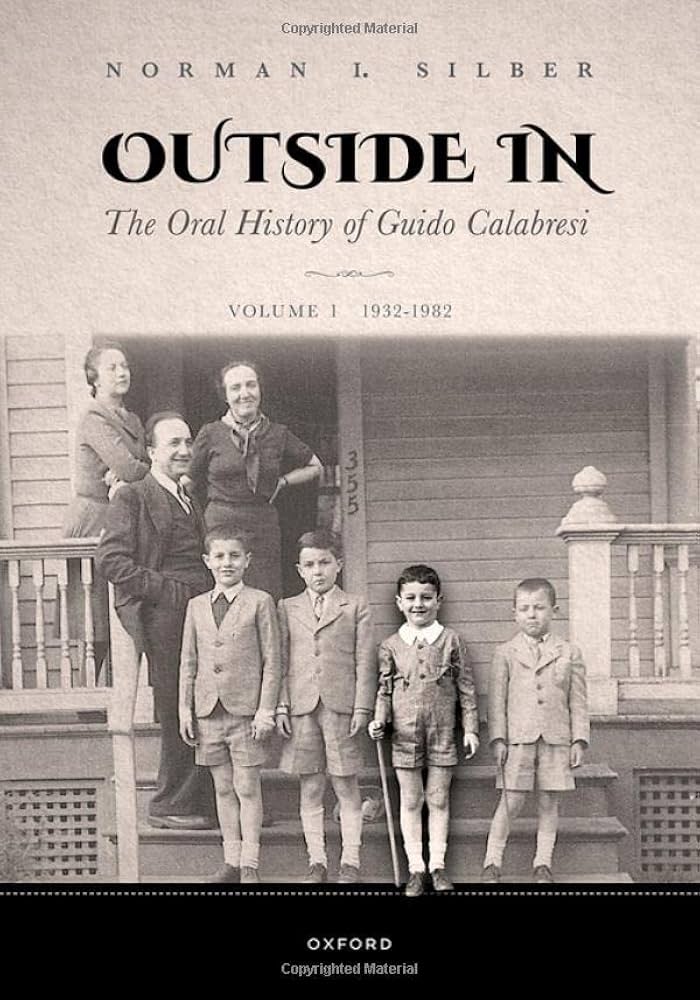
This post, by José Argueta Funes is the sixth in a series of posts in which legal historians reflect on Outside In: The Oral History of Guido Calabresi (Oxford University Press), by Norman I. Silber. Argueta Funes is currently an Academic Fellow at Columbia Law School; as of July 1, he will be an Assistant Professor of Law at Berkeley Law.

The first volume of Outside In (OI) closes with a wonderful reflection on Guido’s third major book, A Common Law for the Age of Statutes (ACLAS). Published in 1982, A Common Law grew out of Guido’s 1977 Holmes Lectures at Harvard Law School. Over the course of the twentieth century, Guido argued, statutes had become the primary source of law in America, displacing the common law. This shift raised a problem of legal change. Statutes were much harder to alter once enacted, and therefore Americans could go on living under laws which would not survive the legislative process if put up to a vote once again. And some of these laws, even if reenacted, would still “not fit . . . our whole legal landscape” (ACLAS, 2). The law and the people would be out of sync. A Common Law set out a radical solution for this problem: allow judges to update statutes. It then endeavored to show that this solution was not radical at all, but rather built upon “antecedents in which a common law court can take comfort” (OI, 391).

A Common Law is usually considered as Guido’s entry in long-running debates about the relationship between common law and legislation and about the nature of legal change. But while reading Outside In, my mind went to a different historical problem: American empire. And I got there by way of Guido’s repeated invocation of a curious phrase: “legal topography.” Guido was not thinking about America’s encroachment on other sovereigns when he used this phrase, which is simply shorthand to describe the work of common-law judges and lawyers. And this shorthand is deeply informed by nineteenth-century ideas about the common law. So, I started to wonder if we might use the idea of a “legal topography” to think about nineteenth-century lawyers engaging with the various kinds of law that existed across the continent and the articulation of empire.

Let me first sketch out what I think Guido means. In A Common Law, Guido uses the phrase “legal topography” (ACLAS, 98) alongside the phrases “legal fabric” (ACLAS, 96) and “legal landscape” (ACLAS, 98). The three phrases seem to refer to legal principles underlying American society (ACLAS 96-97) and to the diverse sources of law and legal interpretation one can find across the land (ACLAS, 98-99). Lawyers and judges weave the fabric or map the landscape—meaning, they articulate the underlying principles and figure out how different pieces or sources of law fit with each other.

This mapping is complicated, for at least two reasons. First, law has its own internal logic that requires some sort of training. Second—and more to the core of A Common Law—these legal cartographers must also keep track of changes in society and figure out how the principles and pieces of law relate to each other in time. All of this is deeply evocative of how nineteenth-century common lawyers described their work. As Kunal Parker has argued, common law judges claimed to “‘read’ the community as it presented itself” in the courtroom to articulate legal change while preserving social identity over time (Parker, 16).

But what if we reorient “legal topography” away from its temporal dimensions and take a more literal, spatial approach? There were many sources and kinds of law in nineteenth-century America. We are used to thinking about state and federal sovereigns and their law, and this problem was central for many nineteenth-century jurists, like Joseph Story. But Story understood that the complexities of this topography extended beyond federalism, hence his knowledge, as Kent Newmyer noted, of merchant customs (Newmyer, 121-22). Recently, Kellen Funk has shown that religious doctrine, too, could supply legal rules to apply in the distribution of church assets. And Greg Ablavsky has recently emphasized that American lawyers could not afford to ignore Spanish, French, or Mexican property law. These sources were out there as part of the topography for lawyers to incorporate them into legal argument. They might do this, too, with the laws of Indian tribes, even as the United States pursued efforts to attack and eliminate them.

Consider an example from Oregon, detailed by Peggy Pascoe in What Comes Naturally. In 1921 the Oregon Supreme Court held that an Indian woman named Ophelia Paquet (Tillamook) could not claim the estate of her deceased white husband, Fred Paquet, because Oregon’s anti-miscegenation statute forbade marriages between white men and Indian women. This was something of a surprise, because that court had previously recognized marriages between Indian women and white men as the source for husbands’ land claims under the Oregon Donation Act (Pascoe, 97). Pascoe astutely reconstructed this case as an example of a white supremacist retrenchment in the American West. But there are also hints behind the case of an underexplored legal topography.

We can glean some outcroppings in the story of how Fred and Ophelia came to be husband and wife. As Pascoe explained, their relationship began sometime in the 1880s, and they soon became the target of a local jury intent on punishing non-marital sexual relations. Fred “consulted a lawyer” who advised him to “hold a ceremony that would meet the legal requirements of an Indian custom marriage” (Pascoe, 104). Fred and Ophelia got married after Fred consulted Ophelia’s relatives and the Tillamook Chief Betsy Fuller. The jury’s harassment apparently stopped thereafter, and Pascoe’s narrative then goes to the end of the story, where shifting attitudes about race would invalidate the marriage and defeat Ophelia’s property claim.

But I would like to pause on the bit of legal advice that Fred received. The lawyer he consulted expected the jury to recognize such a marriage as a legitimate relationship. Put differently, this lawyer is telling us that Indigenous legalities were a feature of Oregon’s late-nineteenth-century legal topography. How extensive this phenomenon was is not clear, but some preliminary archival research suggests he was not alone. Thus, in 1900, a different lawyer could write a brief to the Oregon Supreme Court and claim that because Indians had “resided in the state of Oregon . . . [f]rom time immemorial,” their “customs, when not in conflict with positive law and reasonable in themselves, . . . must be considered as a part of the law of Oregon” (Appellant’s Brief, at 12, Non-she-po v. Wa-win-ta, 62 Pac. 15 (June 22, 1900) (Case No. 3805, Oregon State Archives)). But by 1921, Oregon’s Supreme Court was ready to erase tribal law from the legal topography.

I am likely far from the legal topography that Guido understood himself to be engaging with when he wrote A Common Law. But it is a credit to his understanding of the practices and ideologies surrounding the common law that we might get from him a useful heuristic to understand that work of lawyers in the nineteenth century, and, through them, a window into American empire. The accidents of a legal topography might usefully signal collisions among multiple legal orders, between state legal institutions and popular legalities, between power and law. If we broaden our sense of the sources of law and historicize the legal topography, we might ask, as Guido did, “[w]hat kind of confused landscape, what kind of ragged map, have we got” (ACLAS, 99)?

-- José Argueta Funes

Thursday, May 18, 2023

Russell on Streetcars and the Subsidy Thesis

Thomas D. Russell, University of Denver Sturm College of Law, has posted Blood on the Tracks, which appears in the Seattle University Law Review:

Scene at Capitol Fire, 1911 (NYPL)
Streetcars were the greatest American tortfeasors of the early 20th century, injuring approximately one in 331 urban Americans in 1907. This empirical study presents never-before-assembled data concerning litigation involving streetcar companies in California during the early twentieth century.

This article demonstrates the methodological folly of relying upon appellate cases to describe the world of trial-court litigation. Few cases went to trial. Plaintiffs lost about half their lawsuits. When plaintiffs did win, they won very little money. Regarding the bite taken out of the street railway company, the Superior Court was a flea.

Professor Gary Schwartz and Judge Richard Posner have presented inaccurate empirical data concerning early twentieth-century personal injury litigation. Professor Gary Schwartz was wrong to characterize tort law as generous. Likewise, Judge Richard Posner has been wrong to call tort law efficient. Like Professors Lawrence M. Friedman and Morton Horwitz, I see the amount taken from the street railway companies as quite small. However, I see no deliberate efforts to subsidize the industry.

--Dan Ernst

JACH Spring 2023

The  Spring 2023 issue of the Journal of American Constitutional History is now online

“Charlottesville” as Legal History
Risa Goluboff

The “Cruel and Unusual” Legacy of the Star Chamber
Donald A. Dripps

Franklin’s Talmud: Hebraic Republicanism in the Constitutional Convention and the Debate Over Ratification, 1787-1788
Daniel D. Slate

Reviews and Responses–A MARvel of Constitutional Demythologizing
Jack N. Rakove 

--Dan Ernst

Wednesday, May 17, 2023

Legal Historians on "The Disability Frame"

Last February, we noted that several legal historians would be participating in a University of Pennsylvania Law Review symposium on "The Disability Frame." The published volume is now available online at the Law Review's website. Contributions of interest for readers of this blog include:

Nate Holdren (Drake University), Capitalism Disables: The Case of Workers' Compensation Laws. Abstract:

This article presents an account of disability as social and thus variable, connected to an account of capitalism as an inherently disabling type of society, such that different capitalist societies may disable in different ways, but all of them will disable. The article then takes the early history of workers’ compensation laws in the United States as a case study for the theoretical account of disability and capitalism, arguing that those laws created new incentives for discrimination against disabled people and thus re-organized the process of disabling. The article concludes with brief speculation about what these points imply for the prospects of achieving justice for disabled people through law.

Karen Tani (University of Pennsylvania), Disability Benefits as Poverty Law: Revisiting the "Disabled State". Abstract:

This essay, a contribution to "The Disability Frame" symposium, uses the history of a famous and influential disability benefits case to revisit political scientist Deborah Stone’s argument in THE DISABLED STATE (1984). Observing that “[m]edical certification” of disability had “become one of the major paths to public aid in the modern welfare state,” Stone wondered whether policymakers were asking the “concept of disability” to do too much and whether they were sufficiently alert to the concept’s tendency to expand over time.

Filed in 1983 and decided by the Supreme Court in 1990, Sullivan v. Zebley is an example of those expansionary pressures and their significant results. When the Social Security Administration stopped making Supplemental Security Income payments to 5-year-old Brian Zebley, despite his continuing and severe disabilities, lawyers at the legal aid organization Community Legal Services filed a class action. Operating from a foundational belief that the welfare state should be more robust, Zebley's lawyers contended that not only had the Social Security Administration erred in Zebley’s case, but also that the Agency’s overall eligibility determination process for child disability benefit claimants was too restrictive. The plaintiffs’ ultimate victory before the Supreme Court, and the surprising allies it amassed along the way, illustrate how readily many actors and institutions connected disability to deservingness and embraced disability as a distributional device in the late twentieth century. The post-Zebley backlash against child claimants, however, illustrates how closely the public continued to associate disability with deviance and fraud, especially when they observed take-up among Black citizens. Negative perceptions contributed to the program’s reform in 1996. Congress preserved the new path to eligibility that Zebley created, but also narrowed it. Decisional power, meanwhile, remained in the hands of medical gatekeepers.

This essay casts the Zebley story as one of triumph and tragedy. It was a triumph for poverty lawyers and their clients, who, under hostile circumstances, pressed for a more generous and life-affirming social welfare system. They saw that the boundaries of disability were malleable and they pushed on them. But it remains a tragedy that the best route to subsistence for so many children has further entangled disability with medicalization, suspicion, and surveillance. 

Also of interest: Britney Wilson (New York Law School), Making Me Ill: Environmental Racism and Justice as Disability. Although not a historian, Wilson drew on historical research to explore the intersection of disability, race, civil rights, and environmental justice: Abstract:

Civil rights legal scholars and practitioners have lamented the constraints of the largely intent-based legal framework required to challenge racial discrimination and injustice. As a result, they have sought alternative methods that seemingly require less overt proof of discrimination and are more equipped to address structural harm. One of these proposed solutions involves the use of the Americans with Disabilities Act (ADA)—due to its affirmative mandate to address discrimination by reasonable modification or accommodation—and the framing of issues of racial injustice in terms of disability or the deprivation of medical rights. Environmental justice, an area in which issues of both race and disability are salient and affect one another, is one such context in which advocates have tried to use the ADA to challenge broader structural harm. This Article analyzes cases in which practitioners have used the ADA to challenge issues of environmental injustice to examine the purported utility of the ADA, and disability and medicalization framing, more generally, in addressing structural racism and injustice. Specifically, I discuss the attempted use of the ADA to stop the construction of a petrochemical plant in “Cancer Alley,” Louisiana and to challenge mold on behalf of public housing residents in New York City.

The use of the ADA to challenge environmental injustice has clear legal and social justice narrative benefits that explain its appeal, including the required inclusion of people with disabilities in environmental justice campaigns that disproportionately impact them, but from which they are often left out—except for as examples of the negative consequences of harm. However, the promise of these legal theories has not been adequately tested to proffer the ADA as a true alternative to race-based civil rights laws, and there are many suggestions that it is not. Furthermore, the use of disability as both narrative harm and legal strategy in environmental justice campaigns raises important considerations for racism and ableism as interrelated institutional harms. Therefore, any attempt to expand the disability frame in this direction requires an understanding of racism that does not exclude or otherwise undervalue ableism and vice versa. Otherwise, we risk perpetuating the same problems.

The symposium event featured many other scholars. Rabia Belt's remarks may be of particular interest to readers of this blog. A YouTube recording of her panel is available here.

-- Karen Tani

Farbman, "Plantation Localism"

The Fordham Urban Law Journal has published "Plantation Localism," by Daniel Farbman (Boston College Law School). It is part of a symposium on "Local Government Structure through a Legal Lens: Conversations of Law and Local Governance." Here's the abstract:

Before the Civil War and emancipation, millions of human beings were enslaved across the United States. Most of these people lived on farms and plantations across the southern part of the nation. Scholars have tended to think of slavery as a form of private despotism — oppression undertaken under the color of the private law of property. Alongside this despotic private sphere, ran a weak public sphere of county court government dominated by the planter elite. These counties provided few services, and authorized the planters who controlled them to act as they pleased on their private plantations. The people that were enslaved were thus outside of the scope of public governance — brutally excised from the exclusively white and male political community. This Essay asks: What if, instead of dividing antebellum government into a weak public sphere protecting a despotic realm of private control by white elites, we conceived of the project of government and domination as unitary? What if we rejected the distinction between public and private and looked instead at where power was being wielded and by whom? What if we understood government not as a formal institution but rather as the place where governance happened in day-to-day life? What if, in short, we understood the plantation as a form of local government? Once we understand the plantation as a form of local government that was prevalent and, in some places, dominant across the South, a few things become clear. First, that the idea of the antebellum South as a place of little government and enlarged personal freedom is a fiction. The despotic government of millions of humans on the plantation was extremely intrusive on the lives and liberties of those who were governed. More than this, county governments were not weak so much as they were shells that both delegated power to planters and protected those planters from public oversight and accountability as they governed as despots. This reframing is primarily a historical intervention, but it also raises questions about the nature of localism today. Many local governments in the United States today appear weak but, in practice, operate as “public” shells through which power is delegated to property owners so that they may protect their “communities” from integration, redistributive taxation, and collective regulation. Although the chains of causation between past and present are attenuated, plantation localism echoes through these structural resonances in ways that should unsettle us. 

The full article is available for download here.

-- Karen Tani

Tuesday, May 16, 2023

Guido Calabresi and the “Economic Style,” Part 4 (Conclusion): A “Mixed System”

This post, by Karen Tani (University of Pennsylvania), is the fifth in a series of posts in which legal historians reflect on Outside In: The Oral History of Guido Calabresi (Oxford University Press), by Norman I. Silber.

In three earlier posts in this series (here, here, and here), I suggested the fruitfulness of placing Guido Calabresi’s life alongside the rise of what sociologist Elizabeth Popp Berman has called “the economic style of reasoning”—an approach to governance that flourished in the later decades of the twentieth century and has now become embedded in institutions (e.g., the Congressional Budget Office) and in law (e.g., the consumer welfare standard in antitrust law, executive orders mandating cost-benefit analysis of proposed regulations). [All the Berman quotes in what follows are from Thinking Like an Economist: How Efficiency Replaced Equality in U.S. Public Policy (Princeton University Press, 2022) (“TLE”).] This rise to prominence merits our attention, Berman argues, because, over time, it narrowed the boundaries of what is politically possible, in domains ranging from environmental policy, to social welfare provision, to the governance of regulated industries. It did so by de-legitimizing or crowding out political claims that conflicted with those of the “economic style,” including “claims grounded in values of rights, universalism, equity, and limiting corporate power” (TLE 4). The result, in Berman's assessment, was to reinforce a “conservative turn” in American politics--even though “the most important advocates for the economic style in governance consistently came from the center-left” (TLE 13, 19). (For the fullest and most careful explanation of the argument, please read the book!)
 
In my previous posts, I argued that Calabresi’s scholarship has resonances with “the economic style,” but also sits outside of it. The insider/outsider character of Calabresi's work was a natural outgrowth of his unique path into Law & Economics. It also reflects his real-time reactions to the success of Law & Economics. As he helped that field expand and thrive, he also felt compelled to point out the limitations of economic theory and methodology. The question I ended my last post with was: Did Calabresi’s nuanced approach to Law & Economics help legitimize and spread the less nuanced “economic style” of Berman’s concern? Or (and?) did his work plant seeds of skepticism and resistance?
 
A historian cannot answer this question with any certainty (especially not in a short blog post!), but I will surface some evidence that seems relevant to me. In doing so, I must also acknowledge my affection for the subject of this post (I was one of Calabresi’s law clerks in 2007-08 and cherish that experience). That relationship colors my views, but also, I hope, gives me insight. In what follows, I’ll discuss (1) scholarship (which I’ll bundle with teaching), (2) judicial decisions, and (3) network.

Guido Calabresi standing in front of a classroom holding a boquet of flowers.
"Guido Calabresi Lauded at His Final Torts Class"

I’ve already discussed some of Calabresi’s most important scholarly writings, so I won’t repeat myself here. I’ll simply add this brief assessment. His writings—which informed six decades(!) of teaching at Yale Law School—undoubtedly did give some people their first exposure to the use of economic thinking in law and governance. That matters. Among the consumers of Calabresi’s ideas were powerful people in politics, policymaking, legal practice, and academia, as well as people who would become powerful in those domains later in life.  Moreover, I suspect that Calabresi’s stature, reputation, and charisma gave weight to his ideas. In The Rise of the Conservative Legal Movement, Steve Teles also credits Calabresi with giving Law & Economics respectability, by rebutting the notion “that it was an entirely conservative, University of Chicago project” (Teles 99).

Monday, May 15, 2023

Ablavsky, "Too Much History: Castro Huerta and the Problem of Change in Indian Law"

Gregory Ablavsky (Stanford Law School) has posted "Too Much History: Castro Huerta and the Problem of Change in Indian Law," Supreme Court Review (2022). The abstract:

The Supreme Court’s decision last Term in Castro-Huerta v. Oklahoma dramatically rewrote the rules of criminal jurisdiction in federal Indian law. For the first time since 1882, the Court judicially expanded the scope of state criminal jurisdiction in Indian country, finding that states hold jurisdiction over Indian-on-non-Indian crime concurrently with the federal government. In reaching this conclusion, the Court exemplified the subjectivism that scholars have criticized in the Court’s Indian law jurisprudence for decades. The opinion distinguished or cast aside at least six prior decisions where the Court had seemingly reached the opposite conclusion, as well as concluding that the Court had already substantially limited the Court’s foundational holding in Worcester v. Georgia (1833) that Indian country ordinarily lies outside state authority.

Building on these earlier critiques, this Article uses Castro-Huerta to examine a less explored flaw in the Court’s Indian law rulings—what I call the problem of “too much history.” In Indian law, judges and litigants must make sense of over two centuries of jurisdictional debates, recorded largely not in statutes or constitutional provisions but in dozens of shifting Supreme Court decisions. The key question in Castro-Huerta, and the core of the dispute between majority and dissent, was change--how the law on state jurisdiction in Indian country had shifted over time. But the sheer mass of history makes it hard for the Justices to identify legitimate legal change in Indian law.

This conundrum leads to two broad types of judicial use of history in Indian law. “Good” history decisions, epitomized by this Term’s decision in Ysleta del Sur Pueblo v. Texas, employ specific context to examine narrowly defined legal questions. By contrast, “bad” history opinions, exemplified by Castro-Huerta, turn to the past as an independent source of law, ask broad, unanswerable questions of it, and provide no clear way to assess the inevitable heap of conflicting evidence.

Having laid out this challenge, the Article reexamines the question of the specific historical change at the core at Castro-Huerta. Rather than the majority’s narrative of abandonment and the dissent’s narrative of continuity, I think a more accurate account of what the Court has done with respect to state jurisdiction in Indian country is translation—trying to make sense of older legal principles within a new jurisprudential frame. But this approach makes the Court’s decisions in this area especially prone to misreading and selective citation, as Castro-Huerta underscored. 

Read on here.

-- Karen Tani

Muller's "Lawyer, Jailer, Ally, Foe"

Eric L. Muller, the Dan K. Moore Distinguished Professor of Law in Jurisprudence and Ethics at the University of North Carolina School of Law,  has published Lawyer, Jailer, Ally, Foe: Complicity and Conscience in America's World War II Concentration Camps (University of North Carolina Press):

It is 1942, and World War II is raging. In the months since Pearl Harbor, the US has plunged into the war overseas—and on the home front, it has locked up tens of thousands of innocent Japanese Americans in concentration camps, tearing them from their homes on the West Coast with the ostensible goal of neutralizing a supposed internal threat.

At each of these camps the government places a white lawyer with contradictory instructions: provide legal counsel to the prisoners, and keep the place running. Within that job description are a vast array of tasks, and an enormous amount of discretion they can use for good or for ill. They fight to protect the property the prisoners were forced to leave behind; they help the prisoners with their wills and taxes; and they interrogate them about their loyalties, sometimes driving them to tears. Most of these lawyers think of themselves as trying to do good in a bad system, and yet each ends up harming the prisoners more than helping them, complicit in a system that strips people of their freedoms and sometimes endangers their lives.

In Lawyer, Jailer, Ally, Foe, Eric L. Muller brings to vivid life the stories of three of these men, illuminating a shameful episode of American history through imaginative narrative deeply grounded in archival evidence. As we look through the lawyers’ sometimes-clear and sometimes-clouded eyes, what emerges is a powerful look at the day-by-day, brick-by-brick perpetration of racial injustice—not just by the system itself, but by the men struggling to do good within it.
Some endorsements:

"Eric Muller has built a series of stories of novelistic detail and craft—he's got a gift for storytelling—that's firmly anchored in the primary sources and focused on life in the camps."—Kermit Roosevelt, University of Pennsylvania Carey Law School

"The questions Eric Muller raises can be applied to anyone who played a role in the forced removal and confinement of Japanese Americans, to the War Relocation Authority in general, and, more broadly, to anyone who takes part in an unjust endeavor, even with the best of intentions."—Brian Niiya, Densho.org

"A fascinating and detailed account of one of America’s darkest chapters. Through the eyes and work of three dedicated lawyers we see the struggles of Japanese American citizens stripped of their dignity and rights and locked away simply because of their race." —John Grisham

--Dan Ernst

Saturday, May 13, 2023

Weekend Roundup

  • This week's legal-historian-recognized-for teaching-at-a-law-school is Penn Carey Law's Sophia Z. Lee, whom the JD Class of 2023 chose to receive the Harvey Levin Memorial Teaching Award before her naming as incoming dean.
  • Christoper W. Schmidt on Brad Snyder's Democratic Justice (Jotwell).  
  • "The Franklin D. Roosevelt Presidential Library and Museum will open a new major special exhibition, Black Americans, Civil Rights, and the Roosevelts, 1932-1962, on Saturday, June 3, 2023, in the William J. vanden Heuvel Gallery of the Library and Museum. The exhibit runs through December 31, 2024."
  • Over at the Harvard Law School Forum on Corporate Governance: Banking Crises in Historical Perspective, a report on a paper by Carola Frydman, Northwestern University, and Chenzi Xu, Stanford University.  It “surveys over two hundred empirical studies from the last twenty years (2000-2022) that cover banking crises occurring between 1800 and 1980.”
  • The American Council of Learned Societies has launched a book prize for open access works.  H/t: MS.   
  • ICYMI: Abolition as a "divisive concept" avant la lettre (ACS). 
Weekend Roundup is a weekly feature compiled by all the Legal History bloggers. 

Friday, May 12, 2023

Upham-Bornstein's "Mr. Taxpayer versus Mr. Tax Spender"

Linda Upham-Bornstein, Senior Teaching Lecturer in History, Plymouth State University, has published Mr. Taxpayer versus Mr. Tax Spender: Taxpayers’ Associations, Pocketbook Politics, and the Law during the Great Depression (Temple University Press):

During the Great Depression, the proliferation of local taxpayers’ associations was dramatic and unprecedented. The justly concerned members of these organizations examined the operations of state, city, and county governments, then pressed local officials for operational and fiscal reforms. These associations aimed to reduce the cost of state and local governments to make operations more efficient and less expensive.

Mr. Taxpayer versus Mr. Tax Spender presents a comprehensive overview of these grassroots taxpayers’ leagues beginning in the 1860s and shows how they evolved during their heyday in the 1930s. Linda Upham-Bornstein chronicles the ways these taxpayers associations organized as well as the tools they used—constructive economy, political efforts, tax strikes, and tax revolt through litigation—to achieve their objectives.

Taxpayer activity was a direct consequence of—and a response to—the economic crisis of the Great Depression and the expansion of the size and scope of government. Mr. Taxpayer versus Mr. Tax Spender connects collective tax resistance in the 1930s to the populist tradition in American politics and to other broad impulses in American political and legal history.

Here are two endorsements, one of them mine:

“Nobody else has comprehensively detailed the activities of tax protesters during the Great Depression, and Upham-Bornstein does this very effectively. This book will prove beyond a shadow of a doubt that taxpayer politics are a long-standing American tradition. ‘Mr. Taxpayer versus Mr. Tax Spender’ provides useful analyses of how these movements relate to trends in law and politics, as it provides a wealth of empirical details and richness for this relatively understudied topic.”

—Lawrence Glickman, Professor of American Studies at Cornell University, and author of Free Enterprise: An American History

“In the depth of the Great Depression, middle-class property owners spontaneously organized to ‘raise hell and lower taxes.’ This extensively researched, sensibly organized, and thoughtfully argued book presents nonpartisan political activism, judicial intervention into local government, and a pivotal moment in the fiscal history of the United States. It also reaches a surprising but utterly convincing conclusion: most tax revolters sought not a smaller government but a more efficient and progressive one.”

—Daniel R. Ernst, Carmack Waterhouse Professor of Legal History at Georgetown University Law Center, and author of Tocqueville’s Nightmare: The Administrative State Emerges in America, 1900–1940

--Dan Ernst

Thursday, May 11, 2023

Guido Calabresi and the “Economic Style,” Part 3: Partial Views and “Pearls Beyond Price”

This post, by Karen Tani (University of Pennsylvania), is the fourth in a series of posts in which legal historians reflect on Outside In: The Oral History of Guido Calabresi (Oxford University Press), by Norman I. Silber.

In earlier posts in this series, I suggested the fruitfulness of placing Guido Calabresi’s career alongside the rise of what sociologist Elizabeth Popp Berman has called “the economic style of reasoning”—an approach to governance that flourished in the later decades of the twentieth century and remains prominent. [All the Berman quotes in what follows are from Thinking Like an Economist: How Efficiency Replaced Equality in U.S. Public Policy (Princeton University Press, 2022) (“TLE”).] My first post described Calabresi’s education in economics and in law, as recounted in Outside In. My second post turned to his scholarship and began to explore its fit with “the economic style.” When I left off, I had covered Calabresi's writings on “the decision for accidents” (a.k.a. “the cost of accidents”), and I had mentioned both his excitement and his discomfort at the growing influence of Law & Economics. Looking back on this period, Calabresi said this to Silber: “Because of the way the field was taking off, I was becoming afraid that people would start to think of the economic approach to law as the only thing that is legal scholarship” (OI, v.1, 332).*

Rouen Cathedral, West Façade, Sunlight, 1894 by Claude Monet

This worry is apparent in the use of the phrase “one view of the Cathedral” in the subtitle of Calabresi’s famous 1972 article (with Douglas Melamed) on “Property Rules, Liability Rules, and Inalienability.” Calabresi explains:

[B]ecause of a generic reference Harry Wellington made, I called it “One View of the Cathedral.” I do not think Harry was talking about law and economics at the time; he was talking about art and about how you couldn’t understand the cathedral at Reims by looking at only one of Monet’s impressionist paintings. To understand . . . you had to look at all the paintings. I liked that, and I used it because I wanted to say that law and economics was one important way of looking at legal issues, but it was not the only way.
(OI, v.1, 331). [Image at right: Rouen Cathedral, West Façade, Sunlight, 1894 by Claude Monet, oil on canvas. Credit: National Gallery of Art.]
 
This caveat is important because the article undoubtedly did further expand economics into law--from Torts into Property and beyond. And the intervention was framed in such a way that others felt inspired to push further. As Silber’s commentary explains, “[the article] attracted attention quickly, and a small swarm of academics stepped forward to build upon the ‘Cathedral’ approach” (that is, a modeling approach, in which one plays with different possible configurations of private law rights and remedies and asks about their consequences) (OI, v.1, 337). Soon Calabresi and Melamed’s schema “was being applied to scores of legal fields of study and invoked in many cases” (OI, v.1, 339).

Wednesday, May 10, 2023

Thompson and Pritchard to Discuss Securities Law and the Supreme Court

My Georgetown Law colleague Robert Thompson and his Michigan Law coauthor Adam Pritchard will discuss their new book A History of Securities Law in the Supreme Court via Zoom in a Supreme Court Historical Society-sponsored event at Noon EST on May 31.  Register here.

--Dan Ernst

Farnia, "Imperialism and Black Dissent"

Stanford Law Review has published "Imperialism and Black Dissent," by Nina Farnia (Albany Law School). The abstract:

As U.S. imperialism expanded during the twentieth century, the modern national security state came into being and became a major force in the suppression of Black dissent. This Article reexamines the modern history of civil liberties law and policy and contends that Black Americans have historically had uneven access to the right to freedom of speech in the United States. Through archival research and legal analysis, I conduct four case studies that are representative of key trends in Black dissent after World War II: Black Communism, the Civil Rights Movement, the Black Power movement, and the Movement for Black Lives. These case studies illustrate how the modern national security state has affected the First Amendment right to freedom of speech and managed Black dissent in the United States, particularly when such speech is anti-imperialist or anticapitalist.

I argue that the modern national security state is one of the power structures undergirding free-speech jurisprudence. It operates in concert with free-speech colorblindness, a phenomenon I track in the final Part of this Article, to suppress domestic dissent by subordinated racial groups. The case studies suggest that the practical consequence of free-speech colorblindness is the narrowing of speech rights for Black dissenters and the overall containment of Black dissent.

Read on here

Readers interested in this topic may also wish to read Farnia's "Imperialism in the Making of U.S. Law," which we missed when it came out in 2022.

-- Karen Tani

Tuesday, May 9, 2023

Author's Query: Arthur Corbin

We noted with interest an author's query in the May 11 issue of the New York Review of Books

Prof. Corbin's grandson has unpublished autobiography & recordings, including pivotal role at Yale Law; seeks agent, benefactor, biographer, or publisher.  philip.corbin@aol.com

--Dan Ernst

Guido Calabresi and the “Economic Style,” Part 2: On "Economic Methods" and "Social Democratic Values"

This post, by Karen Tani (University of Pennsylvania), is the third in a series of posts in which legal historians reflect on Outside In: The Oral History of Guido Calabresi (Oxford University Press), by Norman I. Silber.
 
In an earlier post in this series, I suggested the fruitfulness of placing Guido Calabresi's career alongside the rise of what sociologist Elizabeth Popp Berman has called “the economic style of reasoning”—an approach to governance that flourished in the later decades of the twentieth century and remains prominent. [All the Berman quotes in what follows are from Thinking Like an Economist: How Efficiency Replaced Equality in U.S. Public Policy (Princeton University Press, 2022) ("TLE").] That first post described Calabresi’s education in economics and in law, as recounted in Outside In. This post turns to his scholarship and asks about how it fits (or doesn't) with “the economic style.” This question holds interest because the spread of “the economic style” had consequences—which I’ll address in more depth in a subsequent post.
 
As I noted in my last post, “the economic style of reasoning” is Berman’s term for “a distinctive way of thinking about policy” that became visible in Washington “as early as the 1950s, but really spread in policymaking between about 1965 and 1985” (TLE 3, 5). Berman’s account is nuanced, emphasizing that “the economic style” had multiple points of origin*, that various factors contributed to its spread within government, and that the economists at the core of her account “were neither monolithic nor monomaniacally committed to efficiency” (TLE  16). Nonetheless, she does identity two “stances” that are at the “core” of the “the economic style” (TLE 6). The first is “a deep appreciation of markets as efficient allocators of resources” (TLE 6). Importantly, this does not translate into a consistent preference for deregulation or minimal government, but it does mean the application of “a market lens” to all sorts of problems and “an affinity for introducing market-like elements . . . into areas, such as education or healthcare, that are not governed primarily or solely as markets” (TLE 6). The second is a tendency to “place[] a very high value on efficiency as the measure of good policy” (TLE 6). This value might come into play when deciding the best way to achieve a democratically chosen objective. It might also come into play earlier in the process, when deciding which objectives should be pursued. (For more on this argument, without reading the full book, check out Berman's September 2022 LPE blog post.)  
 
To what extent are these “core stances” apparent in Calabresi’s work? As a dilettante in the world of Law & Economics, I am not the best positioned to answer this question, but I can convey what Outside In suggests and hope to generate further conversation. (I can also point readers to more expert discussions of Calabresi's scholarly legacy, such as the contributions to this 2014 special issue of Law & Contemporary Problems.)  
 
There is no doubt that Calabresi’s writings, alongside those of Ronald Coase and others, brought economics precepts and insights into legal domains where they had not previously had much purchase. Here is Calabresi** in Outside In discussing the influence of Coase’s “The Problem of Social Cost” and his “Some Thoughts on Risk Distribution and the Law of Torts”: 

Of course, the interplay of law and economics was there before; but the relationship had focused on particular areas of law where economics had been directly relevant, like antitrust. What Coase’s article and mine did was to invite—indeed to require—people to look at areas of law that were not expressly focused on economics, like torts. In fact, to look at the legal system generally.” 

(OI, v.1, 228) (emphasis added). At this early stage of his career, Calabresi also encountered critics who seemed appalled by what he was doing—to which his general response was to concede that economic theory could not always supply an answer, but to insist that this “most dismal of theories” (as he jokingly put it in “Some Thoughts”) might still yield important insights.

Monday, May 8, 2023

De and Shani on India's Constituent Assembly

Rohit De and Ornit Shani have published, open access, Assembling India’s Constitution: Towards a New History, in Past & Present:

The framing of India’s constitution was a critical event in the global history of both constitution-making and democracy. Conventionally it has been analysed as a founding moment. Its success against multiple odds has been explained as resulting from a vision and consensus among the elite over what would become a pedagogical text for an ‘ignorant’ and undemocratic public. This focus among academics on political elites, and an underlying assumption that constitutional details were beyond the public’s imagination, limited the scope of investigations largely to the Constituent Assembly debates. By directing the inquiry away from these debates towards hitherto unstudied documents, this article offers a paradigm shift in the method of research and understanding of India’s constitution-making. It explores the constitution as it emerged from beyond the Constituent Assembly through engagement with its making among diverse publics. In doing so, it shows that the Indian constitution was not simply founded and granted from above, but came about through many smaller acts of assembly away from the Constitution Hall. It was the public who set normative expectations and tried to educate the members of the Constituent Assembly, and this was critical for the constitution’s future reception and endurance.

–Dan Ernst

Guido Calabresi and the “Economic Style,” Part 1: The Law & Economics Education of Guido Calabresi

This post, by Karen Tani (University of Pennsylvania), is the second in a series of posts in which legal historians reflect on Outside In: The Oral History of Guido Calabresi (Oxford University Press), by Norman I. Silber.
 
When I first met Guido Calabresi, it was in an interview for a clerkship. As an outsider to the world of Yale Law School, I knew him only by reputation and had little sense of how he had achieved his stature. Prior to the interview, I tried to familiarize myself with his legal scholarship, but I lacked the intellectual grounding to really understand the importance of his interventions. The interview went just as I feared, at least from my perspective. We had a moment of connection when we talked about the infamous Korematsu case and my Japanese American grandparents’ experience at that time (the early chapters of Outside In nicely capture why this would resonate with him), but besides that, I remember feeling unsophisticated and uninteresting. I was genuinely surprised when he offered me a job.
 
One of the delights in reading Outside In has been to realize, belatedly, how deeply my research interests intersect with Calabresi’s life. In part, this is because his adulthood covers the period that most interests me as a historian, and because his personal and professional journeys brought him into contact with so many influential people in law and politics. To take one example, my first article was about the revocation of government benefits and privileges as a tool of anti-communist persecution and how this influenced Charles Reich as Reich formulated what became “The New Property.” Calabresi not only knew Reich well, but, like Reich, had clerked for Justice Black during a period when the Supreme Court grappled with loyalty/security cases. All this comes up in Outside In.

I also now see another intersection. This post (one of several) discusses Calabresi as a complex vector of what sociologist Elizabeth Popp Berman has called “the economic style of reasoning”—an approach to governance that rose to prominence in the later decades of the twentieth century and that is central to my current work on disability and law in this period. [All the Berman quotes in what follows are from Thinking Like an Economist: How Efficiency Replaced Equality in U.S. Public Policy (Princeton University Press, 2022). I use the abbreviation “TLE” for citations.]*
 
“The economic style of reasoning” is Berman’s term for “a distinctive way of thinking about policy” that became visible in Washington “as early as the 1950s, but really spread in policymaking between about 1965 and 1985” (TLE 3, 5). Less a coherent theory than a “loose approach to policy problems,” the “economic style” emphasizes the use of “basic microeconomics concepts, like incentives, various forms of efficiency, and externalities” (TLE 3, 5). Translated into policymaking (by liberals as well as conservatives), this has often meant quantification, the use of models to simplify, cost-benefit analysis, and “thinking at the margin” (TLE 5). And, compellingly, it has led to results that appear politically neutral. “[N]evertheless,” Berman cautions, the “economic style” “contains values of its own,” such as “choice, competition, and, especially, efficiency” (TLE 4).

Berman’s Thinking Like an Economist carefully documents “where the economic style of reasoning came from” and “how it spread and was institutionalized in Washington” (TLE 4). (She also explores and critiques the political consequences, to which I’ll return in later posts.) One facet of the “spread,” she argues, was through the field of Law & Economics. Here, Berman places most emphasis on Harvard and University of Chicago industrial organization economists (those interested in "the relationship between firms, industries, and markets”) and their influential converts in law (e.g., Chicago’s Richard Posner) (TLE 72). But Calabresi’s work receives mention, too, as “a separate, fruitful line of intellectual exploration” (TLE 84). In other words, Calabresi was there at the beginning and he mattered, but Berman appears to attribute the rise of economics in law schools (and beyond) largely to other figures.
 
Outside In brings additional nuance to this important account, by (1) describing Calabresi’s Chicago-skeptical training in economics, (2) documenting Calabresi’s somewhat different “economic style” (apparent in both his academic writings and his judicial opinions), and (3) suggesting that he may, in fact, have played a crucial (if complex) role in the “spread” phenomenon that Berman has rightly brought to scholars' attention. 

This post discusses the first: the Law & Economics education—or rather the economics, then law, education—of Guido Calabresi.**

Saturday, May 6, 2023

Weekend Roundup

  • Big news at the Library of Congress: Justice John Paul Stevens's papers are now open for research.
  • Today Tomiko Brown-Nagin, Harvard University, will deliver a commencement address at her alma mater, Furman College (Furman News).
  • Another week and two more legal historians receive law school teaching awards: Sara Mayeux and Daniel Sharfstein at Vanderbilt Law.
  • ICYMI: Gun control in American history (Slate).  Gleanings from the newly opened Stevens papers: Chief Justice Rehnquist and the ISL theory in Bush v. Gore (ABAJ).  Ned Blackhawk interviewed on The Rediscovery of America: Native Peoples and the Unmaking of U.S. History (Yale News). Twelve BYU Law students travel to Calhoun County, Alabama, to learn civil rights history (Anniston Star).

Weekend Roundup is a weekly feature compiled by all the Legal History bloggers. 

Friday, May 5, 2023

Between History and Poetry in Judging: Zhang on "Outside In: The Oral History of Guido Calabresi"

This post, by Alex Zhang, is the first in a series of posts in which legal historians reflect on Outside In: The Oral History of Guido Calabresi (Oxford University Press), by Norman I. Silber

Aristotle wrote that poetry is more scientific than history, for poetry speaks of universals, and history narrates in particulars.  Two millennia later, Guido Calabresi, now a senior Second Circuit judge, told his law clerks at lunch:  “It is in the nature of the law to generalize on an inadequate basis.”  Behind Guido’s memorable quip is an Aristotelian aspiration.  Judging requires—and some might say, should only reach—a resolution of the dispute before the court, bearing in mind the facts and the parties’ contentions that have already been made.  Historiē, as ancient Greek historians recognized, centers on an investigation of the particulars of the past.  But every judicial opinion also grasps at something more: the structure of doctrine, the demands of policy—the universals and the poetry of the law.

In Outside In: The Oral History of Guido Calabresi, Guido tells the story of his fascinating life, with extensive context provided by Norman Silber’s helpful commentaries.  The first volume of this magisterial work starts with Guido’s family history, upbringing, and education.  It ends with Guido’s clerkship with Justice Black, his academic path, and reflections on his paradigm-shifting scholarship.  The second volume is a bipartite narrative of Guido’s tenure as the Dean of the Yale Law School and his time on the bench as a Second Circuit judge.  It includes remarkable stories about how Guido re-invigorated Yale Law School’s faculty, and negotiated its financial independence from the University with Benno Schmidt and William Nordhaus, then Yale’s President and Provost, respectively.  

Of particular interest to scholars and historians of federal courts—and judicial decisionmaking—are Volume II’s in-depth discussions of Guido as a federal appellate judge.  Guido’s transition to the bench, the adjudicative culture of the Second Circuit, and stories about specific cases in torts, immigration, and antidiscrimination all yield insights that help scholars read opinions and decipher doctrinal developments.  As Guido recounts, judges are historians:  They care deeply about the particulars.  Their focus is on the specific arguments made by the parties, as well as the facts that make up the case.  Their respect for the law of the past—and the institution that produced it—make them cautious and incremental in judging.  Volume II, 182.  They “decide cases,” they “explain how [they] get to the result, and that’s what the Law requires.”  Volume II, 202.  For example,  Jon Newman, a former chief judge, “writes for the ‘law.’”  Id.  He once advised Guido:  “You’re a judge.  Decide this case.”  Id.

But even in the heyday of judicial minimalism, judges are also poets—some quite literally.  Dennis Jacobs, a former chief judge, “taught literature before he went on the court,” talked Dante with Guido, and in judging, tried to “weigh words, to hear their resonance, and to pay attention to sound and rhythm.”  Volume II, 177, 187.  Especially memorable is a limerick Judge Jacobs composed in response to Zarda, the case that recognized sexual orientation as a protected trait for antidiscrimination:

The Statute’s Delight
A Statute that Guido “construed”
Was happy to be so renewed.  “I had thought that the text
Explained I was sexed;
Now I’m LG-BTQ’d.”

Volume II, 252.  Guido is also a poet.  He comes from the world of universals, and spent decades in academia pondering “the structure of the Law.”  Volume II, 202.  As Guido transitioned to the bench, he mastered the judicial craft while still—as he had done as a scholar—uncovering, and illuminating, the invisible patterns behind murky caselaw.  His poetic inclination is perhaps the most prominent in tort cases:  As Guido reflects on one of his first opinions, Taber v. Maine, the “length and the style may be a mite too academic,” though “it helps everyone understand the recurring issues” about the Federal Tort Claims Act.  Volume II, 201.  But Guido also recognized that his judicial role means that he must be more of a historian at times—that is, to “restrain[] the inclination that [he] certainly then had to write opinions as though they are law review articles.”  Volume II, 202.

An insight from this part of Guido’s oral history is that we must not only grasp the “history” of cases, but also read their poetry.  Guido explains that every judge writes for a constituency:  “[A]ll judges write for the Law,” but “each of us has, also, a special audience located back in the places from which we come, that we feel we have to answer to, whether consciously or subconsciously.”  Volume II, 202.  While judges “can and should” write for their own “particular constituency,” they cannot do so “to the extent that it makes it difficult for other legal constituencies.”  Id.  This self-consciousness and self-restraint, for Guido, constitute the art of judging.  The law aspires to the universals of poetry, but understands the institutional constraints that ground it in the particulars of history.      

What Guido taught me—as his law clerk and as a scholar—is this courage to read the poetry of the law.  In advocacy, we rely on the particulars of caselaw, because doctrine persuades lawyers, or at least is their vocabulary of persuasion.  One of my recent articles, Antidiscrimination and Tax Exemption (107 Cornell Law Review 1381), focused on the Bob Jones University case from 1983.  I followed my lawyerly instinct, and argued that the doctrinal logic clearly meant that the IRS should deny tax exemption to 501(c)(3) organizations that discriminate on the basis of any protected trait (i.e., not only race).  Such a result, I had thought, countered Robert Cover’s famous critique of the case in Nomos and Narrative—that the Court failed to articulate a public commitment against subsidies for discrimination, in view of the insularity and autonomy asserted by the tax-exempt groups.  In retrospect, mine was a historian’s project, in the Aristotelian sense.  Cover saw something different—beyond the issue of tax exemption and charitable deductions—a battle between antidiscrimination and insular autonomy.  Perhaps he read more the poetry of the law, and as Guido instructs, all of us can too.

-- Alex Zhang

Thursday, May 4, 2023

Legal Historians’ Reflections on “Outside In: The Oral History of Guido Calabresi” – Introduction

As we noted earlier this year, Oxford University Press recently published a two-volume oral history (titled Outside In) of the well-known legal scholar, former law school dean, and federal judge Guido Calabresi. Author Norman I. Silber (Hofstra University) conducted many interviews with Calabresi over a period of years, then arranged the contents of the interviews into chapters, which he supplemented with commentary (his own original research on the topics and figures in each chapter). (The TOC is available here.)
 
The oral histories will be a fascinating read for the many people who have encountered Calabresi over the course of his life, including his many former students and colleagues, his scholarly interlocutors, and the lawyers and litigants who have appeared before him as a judge on the U.S. Court of Appeals for the Second Circuit. 

But the oral histories are also a treasure trove for legal historians, as our forthcoming series of posts will show. Over the coming weeks, we will post reflections from scholars who were once law clerks for Calabresi and who have since made careers out of the study of legal history. Stay tuned! 

-- Karen Tani

Hutchinson's "Hart, Fuller, and Everything After"

Allan C Hutchinson, Osgoode Hall Law School, has published Hart, Fuller, and Everything After: The Politics of Legal Theory (Bloomsbury):

More has been said about the Hart-Fuller debate than can be considered healthy or productive even within the precious world of jurisprudential scholarship – too much philosophising about how law has revelled in its own abstractness and narrowness. But the mission of this book is distinctly and determinedly different – it is not to rework these already-rehashed ideas, but to reject them entirely.

Rather than add to the massive jurisprudential literature that has been generated by all and sundry, the book criticises and abandons the project that Hart and Fuller set in motion. It contends that the turn that was taken in 1957 has led down a series of cul-de-sacs, blind alleys, and dead-ends to nowhere useful or illuminating. It is more than past time to leave their debate behind and strike out in an entirely new and more promising direction. The book insists that not only law, but also all theorising about law, is political in all its derivations, dimensions, and directions.
--Dan Ernst

Wednesday, May 3, 2023

ALI: A Centennial History

The American Law Institute: A Centennial History, edited by Andrew S. Gold and Robert W. Gordon, has been published by Oxford University Press:

This book collects together a series of original essays in honor of the American Law Institute’s (ALI’s) Centennial. The essays are authored by leading experts in their fields, often including current and former Restatement Reporters. The essays also provide a wide range of perspectives on both methodology and the law. The volume coverage focuses on specific ALI undertakings, including some of the more important Restatements and Codes; several leading Principles projects; statutory projects such as the Model Penal Code and the Uniform Commercial Code; themes that cut across substantive fields of law (such as Restatements and codification or Restatements and the common law); and the ALI’s institutional history over the past century. The resulting book is a unique and compelling contribution to its fields of study.

TOC here, but but note that many of the chapters are open access, including Robert W. Gordon's Restatements and Realists.

--Dan Ernst

Tuesday, May 2, 2023

BLHC 2024: Insiders and Outsiders in the History of Law

[We have the following announcement of the CFP for the 26th British Legal History Conference, which will take July 3-6, 2024, at the University of Bristol Law School.  The full call is here.  DRE]

The theme for the British Legal History Conference 2024, "Insiders and Outsiders in the History of Law". . .  Participants will be encouraged to explore the theme by reflecting on dividing lines drawn in the history of the law, and on who, or what, is within and without them.

Insiders, for example, may be lawyers, judges, parliamentarians, monarchs, and others with the power to influence law and its enforcement. Outsiders may be those often left out of, or marginalised in, classical accounts of legal history: for example, women, outlaws, colonial subjects, and enslaved people.

Consideration of insiders and outsiders also prompts us to examine jurisdictional dividing lines and classificatory rules, including substantive doctrinal boundaries and the borders between legal systems.

Moreover, the theme invites reflections on the study of legal history itself: which subjects and methods, and whose voices, are inside or outside our discipline?

Monday, May 1, 2023

Early English Laws

[We have the following announcement.  DRE]

The Early English Laws project publishes online and in print new editions and translations of all English legal codes, edicts, and treatises produced up to the time of Magna Carta 1215.

The project was supported by a collaboration between the Institute of Historical Research at the University of London and the Department of Digital Humanities at King's College London. The AHRC provided initial funding for the first three years of the project (2009–2011). We wish to thank the Selden Society for their support.

The online resource was transferred to the University of St Andrews in 2023; the website is being updated but access to material is now restored.

Yannakakis, "Since Time Immemorial: Native Custom and Law in Colonial Mexico"

Duke University Press has published Since Time Immemorial: Native Custom and Law in Colonial Mexico (2023), by Yanna Yannakakis (Emory University). A description from the Press:

In Since Time Immemorial Yanna Yannakakis traces the invention of Native custom, a legal category that Indigenous litigants used in disputes over marriage, self-governance, land, and labor in colonial Mexico. She outlines how, in the hands of Native litigants, the European category of custom—social practice that through time takes on the normative power of law—acquired local meaning and changed over time. Yannakakis analyzes sources ranging from missionary and Inquisition records to Native pictorial histories, royal surveys, and Spanish and Native-language court and notarial documents. By encompassing historical actors who have been traditionally marginalized from legal histories and highlighting spaces outside the courts like Native communities, parishes, and missionary schools, she shows how imperial legal orders were not just imposed from above but also built on the ground through translation and implementation of legal concepts and procedures. Yannakakis argues that, ultimately, Indigenous claims to custom, which on the surface aimed to conserve the past, provided a means to contend with historical change and produce new rights for the future.
Advance praise:

“Rejecting an older bibliography that romanticized Native customs as ancient and autochthonous, Yanna Yannakakis studies how customs were formulated, how they changed, and how they became central to both law and politics during the colonial period. Rather than conserving a past, she astutely points out that customs enabled a host of different actors to adjust to a present and dream of a better future.” — Tamar Herzog

Since Time Immemorial is a compelling study of how Indigenous communities in colonial Mexico adapted European concepts of custom to their own communal lifeways. It shows how they advanced those reformulated versions in Spanish courts of law, responding strategically to global changes and challenges in the name of local custom, ironically. As with her first book, The Art of Being In-between, Yanna Yannakakis has written a classic in the field of Latin American history.” — Kevin Terraciano

More information, including free access to the Introduction, is available here.

-- Karen Tani