“Abraham Lincoln, lawyer for the slave-owner, Robert Matson,” does fit the description of a Great Emancipator. The fact remains that he did work zealously for Matson. This article argues that the Matson case does not contradict Lincoln’s well-known reputation for hatred of slavery. Rather, in that case he acted in the tradition of John Adams who risked his reputation to represent the British soldiers who perpetrated the Boston Massacre.
Credit: LC
The article first describes Lincoln’s participation in the Matson case, including an analysis of the habeas corpus hearing that preceded it. It continues with a description of Lincoln’s skills as a trial lawyer. It then discusses the antebellum ethical rule enunciated by Lord Brougham and other leading scholars who said that zealous advocacy was required for even the most odious clients. The article concludes that Lincoln was following this rule and that the rule is still valid today. It maintains that Lincoln was acting on the highest level of professionalism in the sole case where he represented a slave owner.
Monday, April 27, 2015
Billings on Lincoln as Zealous Advocate
Roger D. Billings Jr., Northern Kentucky University Salmon P. Chase College of Law, has posted Abraham Lincoln and the Duty of Zealous Representation: The Matson Slave Case, which is forthcoming in the Connecticut Public Interest Law Journal


Paulsens on Lincoln as "The Great Interpreter"
Michael Stokes Paulsen, University of St. Thomas School of Law, and Luke Paulsen, have posted The Great Interpreter, which is forthcoming in First Things (2015):
Hat tip: Legal Theory BlogThis essay examines the constitutional legacy of President Abraham Lincoln, the most important constitutional interpreter in our nation's history. The Civil War was -- in addition to so much else -- a defining act of national constitutional interpretation. The war was fought over fundamental questions of the Constitution's meaning, and over who would have final authority to determine that meaning. The most significant issues of antebellum constitutional dispute -- the present and future status of slavery; the question of who possessed constitutional power to determine that status; the nature of the "Union" and the question of whether a state lawfully could secede; matters of national-versus-state constitutional supremacy and "sovereignty" -- received their final "adjudication" not in any court of law but on the battlefields of the Civil War. It was the case of Grant v. Lee, reduced to final judgment at Appomattox Court House 150 years ago, that constituted the nation's determination of these issues, and that determined also the entire constitutional future of the United States. None of this would have happened had Lincoln not considered himself bound by his oath to advance his independent constitutional views concerning Dred Scott, slavery, Union, national constitutional supremacy, and presidential military powers -- views that frequently placed him at odds not only with the views of nearly half the nation, but often with the Supreme Court as well.
Credit: LC

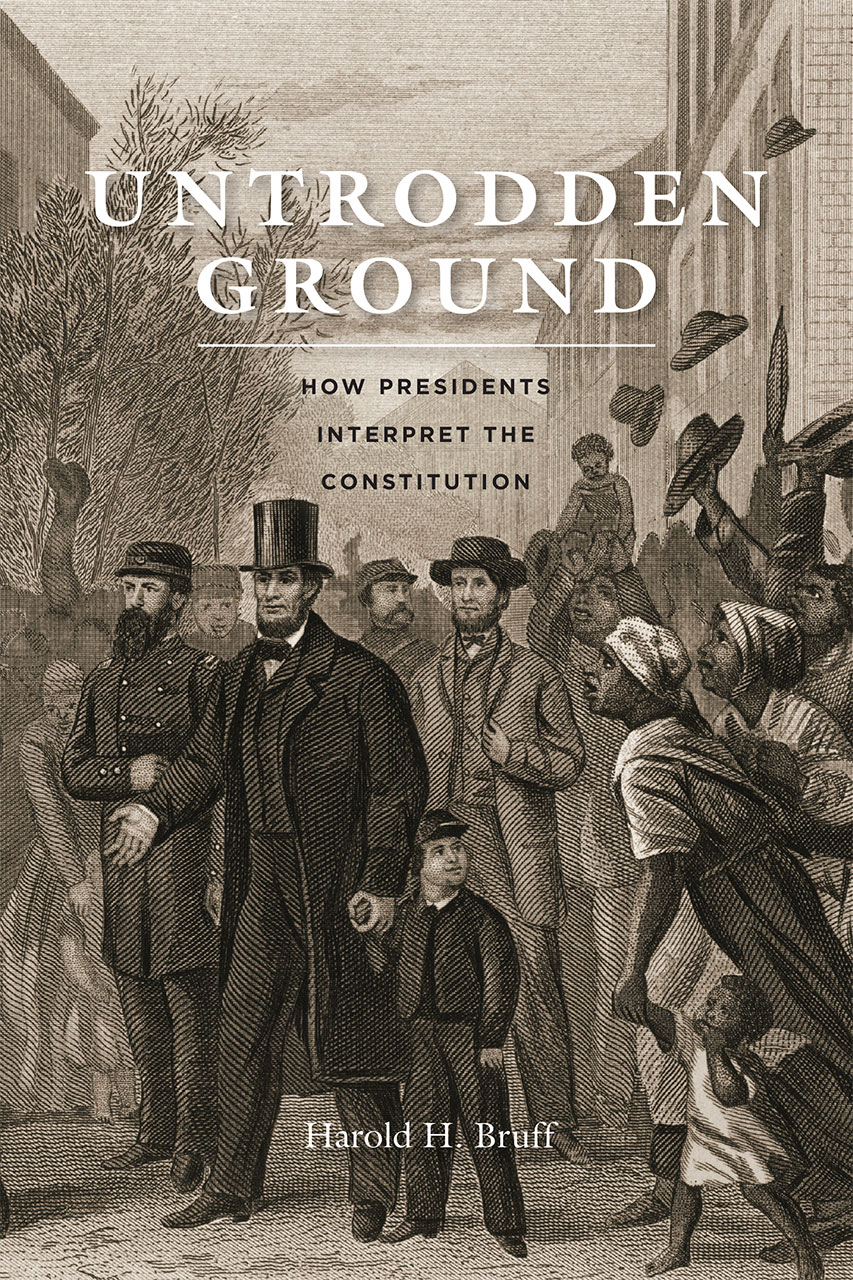
New Release: Bruff on "How Presidents Interpret the Constitution"
New from the University of Chicago Press: Untrodden Ground: How Presidents Interpret the Constitution, by Harold H. Bruff (University of Colorado Law School). A description from the Press:
More information is available here.
Reviewers say:When Thomas Jefferson struck a deal for the Louisiana Purchase in 1803, he knew he was adding a new national power to those specified in the Constitution, but he also believed his actions were in the nation’s best interest. His successors would follow his example, setting their own constitutional precedents. Tracing the evolution and expansion of the president’s formal power, Untrodden Ground reveals the president to be the nation’s most important law interpreter and examines how our commanders-in-chief have shaped the law through their responses to important issues of their time.
Reviewing the processes taken by all forty-four presidents to form new legal precedents and the constitutional conventions that have developed as a result, Harold H. Bruff shows that the president is both more and less powerful than many suppose. He explores how presidents have been guided by both their predecessors’ and their own interpretations of constitutional text, as well as how they implement policies in ways that statutes do not clearly authorize or forbid. But while executive power has expanded far beyond its original conception, Bruff argues that the modern presidency is appropriately limited by the national political process—their actions are legitimized by the assent of Congress and the American people or rejected through debilitating public outcry, judicial invalidation, reactive legislation, or impeachment. Synthesizing over two hundred years of presidential activity and conflict, this timely book casts new light on executive behavior and the American constitutional system.
“Everyone knows that the Supreme Court interprets the Constitution. But in this magisterial book, Bruff shows that presidents have played the most important role in interpreting the Constitution over the course of the nation’s history—and have done so in a way that teaches us not just about the presidency but about the nature of the American Constitution itself. Bruff gives us an engaging account of how presidents from George Washington to Barack Obama have used the powers of their office, and anyone who is interested in the Constitution will learn from, and be challenged by, his original and subtle analysis of what our Presidents have done.”-- David A. Strauss, University of Chicago Law School
"There is no better book for understanding how presidents interpret the Constitution than Untrodden Ground. No one knows the subject better than Bruff. His book is an instant classic, drawing on a lifetime of learning, invaluable experience, extraordinary research, and unique and profound insights. Everyone, including presidents and the people who work for them, can learn a great deal from this terrific book. Indeed, I would suggest, no one should work in the White House or executive branch—or seek to critique what they do—unless they have first read this book and taken its lessons to heart."-- Michael Gerhardt, University of North Carolina School of Law
A Remembrance of Stanley Kutler, from Michal Belknap
[I've invited several of Stanley I. Kutler's students to share their memories of their mentor. Here is a remembrance from Michal R Belknap, Earl Warren Professor of Law, California Western School of Law. Professor Belknap received his Ph.D. from the University of Wisconsin in 1973. His dissertation was “The Smith Act and the Communist Party: A Study in Political Justice."]
In the beginning there were only four of us. When Stan Kutler arrived at Wisconsin in 1964 as an associate professor the department cobbled together a seminar for him. Bill Wiecek, was a new Harvard JD and I had just received my bachelors degree from UCLA. Both of us had expressed some interest in law and the Constitution. The department gave us to Stan, along with Susan Previant Lee, who would eventually abandon history for newspaper writing, and Gordon Bakken, who still had a few credits to go to finish his BA at Madison. Not a lot to work with. But with the energy and infectious enthusiasm for which he would become noted (and a great deal of the hard work he demanded from us), Stan Kutler managed to turn this unpromising little band into a group of pretty productive historians.
Two years later Bill, Gordon, and I had all passed our prelims. They were soon well on the way to writing their dissertations. I, on the other hand, was off for a two-year hitch in the Army, the result of an ROTC scholarship that had helped to pay for my undergraduate education. When I returned, Bill and Gordon were heading out to first jobs, Bill at Missouri and Gordon at Cal State Fullerton. About all I had to show for the intervening two years was an Army Commendation Medal for (forgive me Stan) protecting Richard Nixon.
While I was away, things had changed quite a bit. The tiny band I had joined in 1965 had grown into a large and vigorous seminar. As its senior member, I was supposed to be writing a dissertation. But I did not even have a topic. I started proposing ones I thought would be interesting and Stan started shooting them down, one after another. Then one day he took me to lunch. The Chicago Conspiracy trial was dominating the news, and he suggested political trials might make a good topic. That sounded much more exciting than the ones I had been proposing. But after a week or two of reading, I concluded it was just too big. There did seem to be a lot of parallels, however, between what was then going on in Chicago and the 1949 conspiracy trial of the leaders of the Communist Party of the United States. Unlike most of my previous ideas (which in all honesty were duds), that one appealed to Stan. Little did either of us realize that he had guided me to a topic that would come to dominate my academic career and to which, after a book and numerous articles on Dennis v. United States, I have now returned to write a revisionist book attacking my own earlier work.
While immensely productive, my mentor-student relationship with Stan Kutler was not always an easy one. In 1970 the history TAs went out on strike. Because I was on a fellowship and had not been a TA since before I left for the Army, I was ineligible for membership in the union. But my roommate was a shop steward, and when he asked me to participate in the picketing, I agreed. I did so despite being aware that Professor Kutler was opposed to the strike. I considered joining the TAs who were picketing 4:00 a.m food delivers to the Lakeshore Dorms, a safe demonstration of solidarity with the union that I knew he would never ever learn about. But that seemed like a rather cowardly way to demonstrate my support for the strikers. So instead I joined a group of TAs who were picketing the building in which Stan’s office was located. To put it mildly, that did not go over well with my mentor. After reading me the riot act, he threw me out of his office. For several agonizing hours, I was sure my academic career was over. Then the phone rang. It was Stan, calling to apologize.
Rather than being over, our relationship grew closer and more productive as the years passed. It seemed Stan was always coming up with ways to make my ideas into something better. In my book on Dennis, I had included a fragmented and unexciting discussion of the disciplinary actions taken against the defendants’ lawyers. In Stan’s hands that subject became a chapter in his prize-winning book, The American Inquisition. My dry academic monograph on the Court martial of Army Lieutenant William Calley for Vietnam’s My Lai Massacre inspired him to write an off-Broadway play. That too was a vast improvement on what I had done.
The last time I ever saw him, Stan was still at it. Initially, he greeted my idea of doing a second book on Dennis with what could charitably be called extreme skepticism. Later, although not in good health, he came all the way over from Madison to Milwaukee, where I was presenting a paper on the subject at the Marquette Law School. We had dinner, and as always, he was full of suggestions about how I could improve what I was planning on doing. That dinner was quintessentially Professor Stanley Kutler, and it is a memory I will treasure forever.
[Remembrances continue here.]
 |
| Michal R. Belknap |
Two years later Bill, Gordon, and I had all passed our prelims. They were soon well on the way to writing their dissertations. I, on the other hand, was off for a two-year hitch in the Army, the result of an ROTC scholarship that had helped to pay for my undergraduate education. When I returned, Bill and Gordon were heading out to first jobs, Bill at Missouri and Gordon at Cal State Fullerton. About all I had to show for the intervening two years was an Army Commendation Medal for (forgive me Stan) protecting Richard Nixon.
While I was away, things had changed quite a bit. The tiny band I had joined in 1965 had grown into a large and vigorous seminar. As its senior member, I was supposed to be writing a dissertation. But I did not even have a topic. I started proposing ones I thought would be interesting and Stan started shooting them down, one after another. Then one day he took me to lunch. The Chicago Conspiracy trial was dominating the news, and he suggested political trials might make a good topic. That sounded much more exciting than the ones I had been proposing. But after a week or two of reading, I concluded it was just too big. There did seem to be a lot of parallels, however, between what was then going on in Chicago and the 1949 conspiracy trial of the leaders of the Communist Party of the United States. Unlike most of my previous ideas (which in all honesty were duds), that one appealed to Stan. Little did either of us realize that he had guided me to a topic that would come to dominate my academic career and to which, after a book and numerous articles on Dennis v. United States, I have now returned to write a revisionist book attacking my own earlier work.
While immensely productive, my mentor-student relationship with Stan Kutler was not always an easy one. In 1970 the history TAs went out on strike. Because I was on a fellowship and had not been a TA since before I left for the Army, I was ineligible for membership in the union. But my roommate was a shop steward, and when he asked me to participate in the picketing, I agreed. I did so despite being aware that Professor Kutler was opposed to the strike. I considered joining the TAs who were picketing 4:00 a.m food delivers to the Lakeshore Dorms, a safe demonstration of solidarity with the union that I knew he would never ever learn about. But that seemed like a rather cowardly way to demonstrate my support for the strikers. So instead I joined a group of TAs who were picketing the building in which Stan’s office was located. To put it mildly, that did not go over well with my mentor. After reading me the riot act, he threw me out of his office. For several agonizing hours, I was sure my academic career was over. Then the phone rang. It was Stan, calling to apologize.
Rather than being over, our relationship grew closer and more productive as the years passed. It seemed Stan was always coming up with ways to make my ideas into something better. In my book on Dennis, I had included a fragmented and unexciting discussion of the disciplinary actions taken against the defendants’ lawyers. In Stan’s hands that subject became a chapter in his prize-winning book, The American Inquisition. My dry academic monograph on the Court martial of Army Lieutenant William Calley for Vietnam’s My Lai Massacre inspired him to write an off-Broadway play. That too was a vast improvement on what I had done.
The last time I ever saw him, Stan was still at it. Initially, he greeted my idea of doing a second book on Dennis with what could charitably be called extreme skepticism. Later, although not in good health, he came all the way over from Madison to Milwaukee, where I was presenting a paper on the subject at the Marquette Law School. We had dinner, and as always, he was full of suggestions about how I could improve what I was planning on doing. That dinner was quintessentially Professor Stanley Kutler, and it is a memory I will treasure forever.
[Remembrances continue here.]
Sunday, April 26, 2015
Sunday Book Roundup
This week in The New Rambler, Cass Sunstein reviews Chris Taylor's How Star Wars Conquered the Universe: The Past, Present, and Future of a Multibillion Dollar Franchise (Head of Zeus) in a piece titled "How Star Wars Illuminates Constitutional Law (and Authorship)."
Michael Schulson interviews Kevin Kruse regarding his One Nation Under God: How Corporate America Invented Christian America (Basic) for Salon."My major theme shall be the immense role of serendipity and happenstance in the creative imagination, certainly in single-authored works, but even more in multi-authored ones extending over time. Serendipity imposes serious demands on the search for coherence in both literature and law (and history and life as well). That search leads some people (like Lucas) to become “originalists” of one or another kind, pointing to some sort of Journal of the Whills and suppressing the nature of their own creativity and authorship. The suppression appears to respond to a serious human need, even craving (in both literature and law), but it is a significant obstacle to understanding and critical reflection.
To readers who are not interested in Star Wars, a cautionary note: Some of the following is going to seem (let’s say) a bit obscure; you might want to do some serious skimming. We’ll get to the larger themes before long."

Jilly Leovy's Ghettoside: A True Story of Murder in America (Speigel & Grau) is reviewed in the Los Angeles Review of Books.
Also in the Los Angeles Review of Books there is a review Gordon Park's photoessay, Gordon Parks: Segregation Story (Steidl).
History Today has a review of Sven Beckert's Empire of Cotton: A New History of Global Capitalism (Allen Lane).
H-Net has review Disability Incarcerated: Imprisonment and Disability in the United States and Canada edited by Liat Ben-Moshe, Chris Chapman, Allison C. Carey (Palsgrave Macmillan).
"Rooted primarily in Foucauldian methodologies, the various contributions offer historically focused accounts of incarceration and disability, which set out to speak to present-day concerns in American and Canadian societies. The sociological methodologies are pronounced but not overwhelming. All of the essays are well written and insightful and force us to reconsider key themes in the history of disability and medicine, including the social dynamism of prisons and asylums, the racing and gendering of "imprisoned" subjects, the uses of biopower in regulating society and managing those who fail to conform, and the historical roots of present-day social elimination."

There's also a review of David William's I Freed Myself: African American Self-Emancipation in the Civil War Era (Cambridge University Press), as well as a review of Emily Blanck's Tyrannicide: Forging an American Law of Slavery in Revolutionary South Carolina and Massachusetts (University of Georgia Press).
Michael J. Kramer's The Republic of Rock: Music and Citizenship in the Sixties Counterculture (Oxford University Press) is reviewed on H-Net."Emily Blanck argues that the fugitive slave clause of the United States Constitution (Article IV, Section 2) had its roots in a 1783 ruling by Justice William Cushing of the Massachusetts Supreme Judicial Court to grant a writ of habeas corpus freeing eight South Carolina slaves being detained in jail in order to be returned to their masters. This decision, Blanck contends, led South Carolina’s delegates at the Constitutional Convention to insist on the inclusion of a fugitive slave clause in the newly drafted frame of government and Massachusetts’s delegates shaping that clause to reflect the growing antislavery sentiment in that state. In the process, Blanck reveals, the divisions between northern and southern states, free and slave, usually associated with the antebellum period, began in the earliest days of the Republic. She does so by highlighting the divergent local histories of slavery in Massachusetts and South Carolina, the national history of compromise on the issue between political elites, and the role that African Americans played in shaping those local and national discussions."

Yet another up on H-Net is a review of Peter Baldwin's The Copyright Wars: Three Centuries of Trans-Atlantic Battle (Princeton University Press)."Specifically, Kramer “argues that rock most of all inspired a counterculture defined by issues of citizenship.... I call this polity of sound the republic of rock” (p. 9). Kramer goes on to explain that for many young rebellious Americans vested in the counterculture project, whether they lived in San Francisco or found themselves fighting in Vietnam, rock became a form through which they could interrogate and resist the assimilatory power of “hip capitalism” and “hip militarism” and by so doing create and maintain their own “counterpublic sphere” (pp. 13, 20). In this sphere, men and women used rock to imagine and act out new forms of community and liberatory individual freedom."

Saturday, April 25, 2015
Weekend Roundup
- Congratulations to Justin Simard (Ph.D. candidate, University of Pennsylvania), who has been selected as a Baldy Postdoctoral Fellow by the Baldy Center for Law and Social Policy.
- History News Network interviews Logan Sawyer, Georgia Law (visiting this year at Harvard Law) at the annual meeting of the Organization of American Historians, where he spoke about the conservative movement’s adoption of originalism.
- Around the Symposia: Ariela Gross, USC Gould School of Law, presented From the Streets to the Courts: The Grassroots History of Race, Law and Conservatism to the Center for the Study of Law and Society, Berkeley Law, on April 20. Three days later, William E. Forbath, University of Texas School of Law, presented on Law & Government at the Vanderbilt University Law School. H/t: Legal Scholarship Blog.

- Leopold and Loeb (and Tsarnaev) on JSTOR Daily.
- In an earlier post, we noted legal history in the journals of state historical societies. Now comes the Spring 2015 issue of Washington History, a publication of the Historical Society of Washington, DC, which includes "'Horrible Barbarity': The 1837 Murder Trial of Dorcas Allen, a Georgetown Slave."
- ICYMI: Jill Lepore, The Rule of History: Magna Carta, the Bill of Rights, and the Hold of Time, in the April 20 issue of The New Yorker. And over at New Books in History, Jennifer Delton, Skidmore College, discusses her Rethinking the 1950s: How Anticommunism and the Cold War Made America Liberal (Cambridge University Press, 2013).
- "The American Historical Association has sent a letter to the Atlanta Convention and Visitors Bureau decrying Georgia's proposed 'Religious Freedom Restoration Act,' which would establish a vendor's right to refuse goods or services to individuals based on their religion, sexual orientation, marital status, or whatever other factors might emanate from religious doctrine or practice."
Friday, April 24, 2015
LSA Hurst Award to Sharafi
The Law and Society Association has announced the winners of its 2015 awards. We're excited to see that recent guest blogger Mitra Sharafi (University of Wisconsin) picked up the J. Willard Hurst Award for the best book in Socio-Legal History published within last two years. Here's the citation.
Congratulations to all!
Law and Identity in Colonial South Asia: Parsi Legal Culture, 1772–1947 (Cambridge University Press, 2014).
Sharafi's book is a compelling study of Parsi legal culture in India and Burma from the late 18th century to India's independence from British rule. The book is based on impressive and extensive use of archival resources. These are carefully mined to produce a rich and detailed portrait of this ethnoreligious community's deep interactions with colonial law, the legal system, and the legal profession. As Sharafi demonstrates, these interactions helped create a legal culture and community that was surprisingly invested in the formal legal system under colonial rule. This, in turn, helped shape both Parsi law and community identity.
This book expertly explores key law and society themes, such as legal pluralism under colonial rule, legal culture and consciousness, the disputing process, and the legal profession and its significance. Sharafi also offers deep insights into the changing role of women as legal actors and legal subjects. She examines with depth, precision, and great narrative skill legal issues including marriage and family law, inheritance law, and cultural and racial identity and the law. Her examination spans case law, legislation and legislative reform, and also draws from biographies, personal papers, and other evidence reflecting the legal consciousness of her subjects. The difficulty and scope of her effort, as well as her impressive success in uncovering and bringing to life obscure and difficult-to-access records, especially impressed the committee. It also admired her ability to tell a lively, engaging story about a community that has not yet been the focus of very much sociolegal scholarship.Honorable mentions went to another recent guest blogger, Sophia Z. Lee, for The Workplace Constitution: From the New Deal to the New Right (Cambridge University Press, 2014), and to Ekaterina Pravilova for A Public Empire: Property and the Quest for the Common Good in Imperial Russia (Princeton University Press, 2014).
Congratulations to all!
Call for Submissions: ASLH Student Research Colloquium 2015
[We have the following announcement.]
Graduate students and their faculty mentors take note:
The American Society for Legal History (ASLH) will host a Student Research Colloquium (SRC) on Wednesday, October 28, and Thursday, October 29, 2015, immediately preceding the ASLH's annual meeting in Washington, DC. The SRC will offer a small group of graduate and law students an opportunity to work intensively on in-progress dissertations and law review articles with distinguished ASLH-affiliated scholars.
 The target audience for the SRC includes early post-coursework graduate students and law students interested in legal history. Each participating student will pre-circulate a twenty-page, double-spaced paper to the entire group. These papers will provide the foundation for discussion at the colloquium. Stipends will either partially or completely cover the travel, hotel, and registration costs of attending the annual meeting. Students working in all chronological and geographical fields, including non-U.S. history, are encouraged to apply. Students who have not received any formal training in legal history, but whose projects engage legal-historical themes, also are encouraged to apply, as are students who have not previously participated in the Society's activities. A student may be on the annual program and participate in the SRC in the same year.
To apply to the ASLH's Student Research Colloquium, please submit:
Graduate students and their faculty mentors take note:
The American Society for Legal History (ASLH) will host a Student Research Colloquium (SRC) on Wednesday, October 28, and Thursday, October 29, 2015, immediately preceding the ASLH's annual meeting in Washington, DC. The SRC will offer a small group of graduate and law students an opportunity to work intensively on in-progress dissertations and law review articles with distinguished ASLH-affiliated scholars.
The target audience for the SRC includes early post-coursework graduate students and law students interested in legal history. Each participating student will pre-circulate a twenty-page, double-spaced paper to the entire group. These papers will provide the foundation for discussion at the colloquium. Stipends will either partially or completely cover the travel, hotel, and registration costs of attending the annual meeting. Students working in all chronological and geographical fields, including non-U.S. history, are encouraged to apply. Students who have not received any formal training in legal history, but whose projects engage legal-historical themes, also are encouraged to apply, as are students who have not previously participated in the Society's activities. A student may be on the annual program and participate in the SRC in the same year. To apply to the ASLH's Student Research Colloquium, please submit:
- a cover letter;
- a CV;
- a letter of recommendation from a faculty mentor/advisor;
- a two-page, single-spaced "research statement," describing an in-progress dissertation or law review article.
OAH Book Prizes
The following book prizes were awarded at the recent annual meeting of the Organization of American Historians.
Mary Jurich Nickliss Prize in U.S. Women’s and/or Gender History
Lisa Marguerite Tetrault, Carnegie Mellon University, The Myth of Seneca Falls: Memory and the Women’s Suffrage Movement, 1848-1898
Frederick Jackson Turner Award
Allyson Hobbs, Stanford University, A Chosen Exile: A History of Racial Passing in American Life
Lawrence W. Levine Award
Allyson Hobbs, Stanford University, A Chosen Exile: A History of Racial Passing in American Life
Merle Curti Award (Social History)
Cornelia H. Dayton, University of Connecticut, and Sharon V. Salinger, University of California, Irvine, Robert Love’s Warnings: Searching for Strangers in Colonial Boston
Merle Curti Award (Intellectual History)
Kyle G. Volk, University of Montana, Moral Minorities and the Making of American Democracy
Ray Allen Billington Prize
Jared Farmer, Stony Brook University, SUNY, Trees in Paradise: A California History
Avery O. Craven Award
Edward E. Baptist, Cornell University, The Half Has Never Been Told: Slavery and the Making of American Capitalism
James A. Rawley Prize
Daniel Berger, University of Washington, Bothell, Captive Nation: Black Prison Organizing in the Civil Rights Era
Ellis W. Hawley Prize
Alan McPherson, University of Oklahoma, The Invaded: How Latin Americans and Their Allies Fought and Ended U.S. Occupations
Liberty Legacy Foundation Award
N. D. B. Connolly, Johns Hopkins University, A World More Concrete: Real Estate and the Remaking of Jim Crow South Florida
Darlene Clark Hine Award
Karsonya Wise Whitehead, Loyola University Maryland, Notes from a Colored Girl: The Civil War Pocket Diaries of Emilie Frances Davis
David Montgomery Award
Chantal Norrgard, Independent Scholar, Seasons of Change: Labor, Treaty Rights, and Ojibwe Nationhood
In addition, the Roy Rosenzweig Distinguished Service Award went to Thomas Bender, New York University, and The Late Michael B. Katz, University of Pennsylvania. The Lerner-Scott Prize
Jessica Wilkerson, University of Mississippi, for “Where Movements Meet: From the War on Poverty to Grassroots Feminism in the Appalachian South,” (Ph.D. diss., University of North Carolina, Chapel Hill, 2014). The Willi Paul Adams Award went to Jürgen Martschukat, Erfurt University. The Louis Pelzer Memorial Award went to Christopher M. Florio, Princeton University. And the Binkley-Stephenson Award went to James D. Rice, State University of New York at Plattsburgh, “Bacon’s Rebellion in Indian Country,” Journal of American History 101 (December 2014). The Friend of History Award went to Colin G. Campbell, Chairman Emeritus, Colonial Williamsburg Foundation.
Hat tip: Process
Johnson on "Medieval Law and Materiality"
Just out in the the American Historical Review 120 (April 2015) is Medieval Law and Materiality: Shipwrecks, Finders, and Property on the Suffolk Coast, ca. 1380-1410, by Tom Johnson. According to the AHR, Dr. Johnson “recently completed his doctoral thesis, 'Law, Space, and Local Knowledge in Late-Medieval England,' at Birkbeck, University of London. . . . In October 2015, he will take up a Junior Research Fellowship at Emmanuel College, Cambridge.”
The article commences:
The article commences:
It is now widely recognized that medieval law was more than a system of words and ideas, confined to lawyerly debate and scholarly treatises. Recent scholarship has shown how legal categories and discourses were interwoven with social relations and praxes, mentalities and ideologies, and the operation of the economy. But there is a different dynamic of medieval law that has yet to be explored, namely, the way in which it was implicated in the construction of materiality. Legal discourse in the Middle Ages provided a means of differentiating “what” was matter, what was not, and what attributes it might possess. Thus, medieval legal processes were ontological processes.
New Release: Straumann, "Roman Law in the State of Nature"
New from Cambridge University Press: Roman Law in the State of Nature: The Classical Foundations of Hugo Grotius' Natural Law, by Benjamin Straumann (New York University). The Press explains:


Roman Law in the State of Nature offers a new interpretation of the foundations of Hugo Grotius' natural law theory. Surveying the significance of texts from classical antiquity, Benjamin Straumann argues that certain classical texts, namely Roman law and a specifically Ciceronian brand of Stoicism, were particularly influential for Grotius in the construction of his theory of natural law. The book asserts that Grotius, a humanist steeped in Roman law, had many reasons to employ Roman tradition and explains how Cicero's ethics and Roman law – secular and offering a doctrine of the freedom of the high seas – were ideally suited to provide the rules for Grotius' state of nature. This fascinating new study offers historians, classicists and political theorists a fresh account of the historical background of the development of natural rights, natural law and of international legal norms as they emerged in seventeenth-century early modern Europe.More information is available here.
Thursday, April 23, 2015
For Graduate Students
A new webpage, For Graduate Students, is up on the website of the American Society for Legal History. It commences:
Graduate students are always welcome at the American Society for Legal History. We’re happy to have you join us! The ASLH offers many opportunities to graduate students and law students interested in legal history.More.
Criminal Law and Emotions in European Legal Cultures
[Via H-Law, we have word of the of the following conference, sponsored by the Center for the History of Emotions, Max Planck Institute for Human Development. It will take place at the Max Planck Institute for Human Development, Large Conference Hall, Lentzeallee 94, 14195 Berlin.]
Criminal Law and Emotions in European Legal Cultures: From the 16th Century to the Present
Thursday, 21 May 2015
9:00-9:40 Welcome and Introduction
Ute Frevert, Laura Kounine and Gian Marco Vidor (all Max Planck Institute for Human Development)
9:40-10:40 Keynote
Professor David Sabean (University of California, Los Angeles)
11:00-12:45 Panel 1: Early Modern History, Emotions and Law, co-curated with Claudia Jarzebowski
Malcolm Gaskill (University of East Anglia):
Emotions on the Frontier: Witchcraft in Seventeenth-Century New England
Camilla Schjerning (University of Copenhagen):
"As a Raging Man": Narratives of Transgression and Emotional Communities in Copenhagen, 1771-1800
Allyson F. Creasman (Carnegie Mellon University):
Fighting Words: Anger, Insult, and the "Right of Retort" in Early Modern German Law
Chair: Claudia Jarzebowski (Freie Universität Berlin)
14:00-15:45 Panel 2: Emotions on Trial
Katie Barclay (University of Adelaide):
Performing Emotion and Reading the Body in the Irish Court, c.1800-1845
Elwin Hofman (Catholic University of Leuven):
Angry Killers, Weeping Whores? Emotions in Criminal Trials in the Southern Netherlands, 1750-1800
Shira Leitersdorf-Shkedy (University of Haifa):
"The Sensitive Prosecutor": The Emotional Experience of Prosecutors in Managing Criminal Proceedings
Chair: Stephen Cummins (Max Planck Institute for Human Development)
16:15-17:00 Reflections
Daniel Lord Smail (Harvard University):
Reflections: Violence and Emotions
18:00 Dinner After Dinner Talk
Terry Maroney (Vanderbilt Law School, Nashville)
Friday, 22 May 2015
10:00-11:00 Keynote
Professor Elizabeth Lunbeck (Vanderbilt University, Nashville)
11:30-13:15 Panel 3: Russia, Borders, Encounters
Eugene M. Avrutin (University of Illinois at Urbana-Champaign):
The Confrontations: Emotions and the Meaning of Belief in a Russian Border Town
Marianna Muravyeva (Oxford Brookes University):
"He Called me a Pimp and his Mother a Broad": Emotions of Complaint in the Narratives of Parent Abuse in Early Modern Russia
Daniel Newman (United States Holocaust Memorial Museum):
Emotional Appeals in Early Soviet Criminal Cases: The Plach as Legal Strategy
Chair: Pavel Vasilyev (Max Planck Institute for Human Development)
14:30-16:15 Panel 4: Emotions and Legal Responsibility
Niamh Cullen (University College Dublin):
Love and Honour in 1960s Sicily: The Trial of Filippo Melodia
Hiram Kümper (Universität Mannheim):
Lust and the Movements of the Will: Emotions in the Forensic Conceptualization of Rape, 16th to 19th Centuries
Katariina Parhi (University of Oulu):
Examining Degenerate Souls: Psychopathy and the Question of Responsibility in Early Twentieth-Century Finnish Forensic Psychiatry
Chair: Daphne Rozenblatt (Max Planck Institute for Human Development)
16:45-18:00 Roundtable
with leading commentators Dagmar Ellerbrock (Technische Universität Dresden) and Terry Maroney (Vanderbilt Law School, Nashville)
Wednesday, April 22, 2015
Author's Query: The Hon. Hubert L. Will
[We have the following author's query. He does seem like quite an interesting fellow.]
My father was Judge Hubert L. Will, a Federal Judge for the Northern District of Illinois. He was on the bench from 1961 until his death in 1995. Over the years, I’ve been told some interesting stories about him from attorneys who had cases with him. I’m interested in collecting any of those vignettes about him. I believe he had a deep intellectual understanding of the law and a practical approach to being a judge that shows up not only in his case record, but also in those stories. My purpose for collecting them is twofold: as a family memoir and for possible publication regarding his career as a Judge. If you have an interesting tale to tell about my father and are willing to share it, you can e-mail me at judgehubertwill@gmail.com or mail them to me at P.O. Box 256661, Chicago, IL 60625. Many thanks! Ami Will Allen.
 |
| Judge Hubert L. Will (credit) |
New Release: Heyer on "The Disability Revolution"
New from the University of Michigan Press: Rights Enabled: The Disability Revolution, from the US, to Germany and Japan, to the United Nations, by Katharina Heyer (University of Hawai’i). The Press explains:
Drawing on extensive fieldwork and a variety of original sources, Katharina Heyer examines three case studies—Germany, Japan, and the United Nations—to trace the evolution of a disability rights model from its origins in the United States through its adaptations in other democracies to its current formulation in international law. She demonstrates that, although notions of disability, equality, and rights are reinterpreted and contested within various political contexts, ultimately the result may be a more robust and substantive understanding of equality.

A few blurbs:Rights Enabled is a truly interdisciplinary work, combining sociolegal literature on rights and legal mobilization with a deep cultural and sociopolitical analysis of the concept of disability developed in Disability Studies. Heyer raises important issues for scholarship on comparative rights, the global reach of social movements, and the uses and limitations of rights-based activism.
More information is available here.“This is a major contribution to Disability Studies scholarship and should be interesting to readers who want to learn more about international aspects of disability, particularly readers in political science, law, and history.”
—Carol Poore, Brown University
“Heyer shows how disability rights moved, on both a national and international level, from a medical-driven model based on stigma and charity to an issue of equal rights, inclusion, and dignity. She explores the journey toward treating disability rights as human rights.”
—Michael Waterstone, Loyola Law School
Tuesday, April 21, 2015
Spitzer on Dillon's Rule and Home Rule in Washington State
Hugh D. Spitzer, University of Washington School of Law, has posted 'Home Rule' vs. 'Dillon's Rule' for Washington Cities, which is forthcoming in the Seattle University Law Review 38 (2015): 809-60:
This Article focuses on the tension between the late-nineteenth-century “Dillon’s Rule” limiting city powers, and the “home rule” approach that gained traction in the early and mid-twentieth century. Washington’s constitution allows cities to exercise all the police powers possessed by the state government, so long as local regulations do not conflict with general laws. The constitution also vests charter cities with control over their form of government. But all city powers are subject to “general laws” adopted by the legislature. Further, judicial rulings on city powers to provide public services have fluctuated, ranging from decisions citing the “Dillon’s Rule” doctrine that local governments have only those powers clearly granted to them by the legislature, to the “home rule” view that charter and optional code cities have broad unspecified powers. Despite actions by lawmakers to expand city home rule powers, recent court decisions have puzzled practitioners by alternately voicing these two approaches in a seemingly random fashion.
This Article describes the origin of Dillon’s Rule, places it in a national context, and explains its longevity in Washington despite the legislature’s clear intent to eliminate the rule’s application to most cities. The Article suggests that the zombie-like reappearance of Dillon’s Rule is explained by (1) the vitality of the rule as a doctrine applicable to special purpose districts; (2) appellate judges’ insistence on picking and choosing from doctrines (including ostensibly dead doctrines) to support a case’s outcome; and (3) a combination of doctrinal forgetfulness and carelessness. The Article repeats a recommendation made five decades ago by former University of Washington law professor Philip Trautman that the Supreme Court of Washington should adopt a more consistent approach, one that follows the legislature’s clear intent to make Dillon’s Rule inapplicable to most cities.
Monday, April 20, 2015
Lempert and Stern on Juries
As it happens, two interesting papers on the jury went up on SSRN about the same time. The first is by Richard Lempert, University of Michigan Law School, The American Jury System: A Synthetic Overview. It is forthcoming in the Chicago-Kent Law Review:
This essay, originally written for a Swiss volume, and revised with added material for publication in the Chicago Kent Law Review, is intended to provide in brief compass a review of much that is known about the American jury system, including the jury's historical origins, its political role, controversies over its role and structure, its performance, both absolutely and in comparison to judges and mixed tribunals, and proposals for improving the jury system. The essay is informed throughout by 50 years of research on the jury system, beginning with the 1965 publication of Kalven and Zeisel's seminal book, The American Jury. The political importance of the jury is seen to lie more in the jury's status as a one shot decision maker largely independent of trial court bureaucracies than in its ability to nullify the law. Despite flaws in the jury process and room for improvement, the message that emerges from the literature is that juries take their job seriously and for the most part perform well. There is little reason to believe that replacing jury trials with bench trials or mixed tribunals would improve the quality of American justice, and some reason to think it might harm it.The second SSRN paper is Simon Stern, University of Toronto Faculty of Law, has posted Forensic Oratory and the Jury Trial in Nineteenth-Century America:
The institution of the jury underwent radical change in the United States during the nineteenth century. At the beginning of the century, the jury trial was a form of popular amusement, rivaling the theater and often likened to it.The jury’s ability to find law, as well as facts, was widely if inconsistently defended. The trial’s role as a source of entertainment, and the jury’s ability to nullify, were consistent with a view of forensic oratory that emphasized histrionics, declamation, and emotionally charged rhetoric as means of legal persuasion. By the end of the century, judges had gained more control of the law-finding power, and various questions of fact had been transformed into questions of law. Many of the details that would have aided the lawyers’ dramatic efforts were screened out by a host of new exclusionary rules. The overall effect was to afford less scope for lawyers' emotional excesses — and to make those performances seem disreputable and outmoded. As an institution, the trial continued to figure significantly in American culture through the first three decades of the twentieth century. Numerous factors conspired to weaken the trial’s prominence after that time. Although these changes in forensic style have not usually been considered as a part of that narrative, they may have helped to facilitate the decline of the trial, by reorienting its function away from a broadly representative one, and towards one that emphasized dispassionate analysis in the service of objectivity and technical exactitude, appealing to a rather different community, made up of professional lawyers and those laypersons who could appreciate their values.Fwiw, in congressional testimony in 1938, Roscoe Pound attributed the "scintilla of evidence" standard to frontier Americans' lack of good alternatives to jury trials in the way of entertainment. Thank God for Reality TV! As for "histrionics, declamation, and emotionally charged rhetoric," consider David Gilmour Blythe's Trial Scene, which I believe dates from the 1860s. (Memorial Art Gallery of the University of Rochester.)
Davies on Sherlock Holmes Meets the Mail Classification Act of 1879
Ross E. Davies, George Mason University School of Law, on The Regulatory Adventure of the Two Norwood Builders: Sherlock Holmes Crosses Paths with Congress, the President, the Courts, and the Administrative State, in the Press, in 2015 Green Bag Almanac & Reader 567:
It was almost certainly some combination of law on the books and law in the works that inspired the New York World to publish its 1911 version of the Sherlock Holmes story, “The Adventure of the Norwood Builder,” in not one, but two, formats. (In its Sunday editions from April 9 to July 2, 1911, the World republished the thirteen stories from The Return of Sherlock Holmes in their original sequence, with “Norwood Builder” appearing on April 16.) The law on the books was a series of interpretations of the Mail Classification Act of 1879 by the U.S. Post Office Department (in 1901) and the U.S. Supreme Court (in 1904). The law in the works was the ongoing congressional and presidential interest in tinkering with postal service in general and second-class mail rates in particular — an interest that manifested itself in 1911 in the form of hearings conducted in New York City by a special federal Postal Commission headed by Justice Charles Evans Hughes. The results were: (a) a colorful, relatively small, booklet version of “Norwood Builder” (and similar booklets of the other stories in the series) for in-town readers of the World, and (b) black-and-white, relatively large, tabloid versions of the same stories for out-of-town subscribers to the newspaper. Unfortunately, decisions by several of America’s great libraries to discard their hard copies of the World have left us (at least for now) with the rather plain tabloid version of “Norwood Builder,” but not the colorful booklet version, to share with readers of the Green Bag Almanac & Reader.
New Release: Childs, "Slaves of the State"
New from the University of Minnesota Press: Slaves of the State: Black Incarceration from the Chain Gang to the Penitentiary, by Dennis Childs (University of California, San Diego). A description from the Press:
The Thirteenth Amendment to the United States Constitution, passed in 1865, has long been viewed as a definitive break with the nation’s past by abolishing slavery and ushering in an inexorable march toward black freedom. Slaves of the State presents a stunning counterhistory to this linear narrative of racial, social, and legal progress in America.
Dennis Childs argues that the incarceration of black people and other historically repressed groups in chain gangs, peon camps, prison plantations, and penitentiaries represents a ghostly perpetuation of chattel slavery. He exposes how the Thirteenth Amendment’s exception clause—allowing for enslavement as “punishment for a crime”—has inaugurated forms of racial capitalist misogynist incarceration that serve as haunting returns of conditions Africans endured in the barracoons and slave ship holds of the Middle Passage, on plantations, and in chattel slavery.
Childs seeks out the historically muted voices of those entombed within terrorizing spaces such as the chain gang rolling cage and the modern solitary confinement cell, engaging the writings of Toni Morrison and Chester Himes as well as a broad range of archival materials, including landmark court cases, prison songs, and testimonies, reaching back to the birth of modern slave plantations such as Louisiana’s “Angola” penitentiary.More information is available here.
Sunday, April 19, 2015
Sunday Book Roundup
 In The Nation, two books--The Tyranny of Experts: Economists, Dictators, and the Forgotten Rights of the Poor by William Easterly (Basic) and Thinking Small: The United States and the Lure of Community Development by Daniel Immerwahr (Harvard University Press)--are reviewed in "Development and Humanitarian Politics."
n+1 has a review by Daniel Immerwahr, "What Did You Do in the War, Doctor?" that examines Michal Shapira's The War Inside: Psychoanalysis, Total War, and the Making of the Democratic Self in Postwar Britain (Cambridge) and Peter Mandler's Return from the Natives: How Margaret Mean Won the Second World War and Lost the Cold War (Yale University Press).
The New Books series has a few interesting interviews this week.
- Kirt von Daacke discusses his book, Freedom Has a Face: Race, Identity, and Community in Jefferson's Virginia (University of Virginia Press).
- Carol Faulkner is interviewed about her book, Lucretia Mott's Heresy: Abolition and Women's Rights in Nineteenth Century America (University of Pennsylvania Press).
- Mariana Candido discusses her work, An African Slaving Port and the Atlantic World: Benguela and its Hinterland (Cambridge University Press).
 On H-Net there is a review of Contemporary Challenges to the Laws of War: Essays in Honor of Professor Peter Rowe edited by Caroline Harvey, James Summers, and Nigel D. White (Cambridge University Press).
"Contemporary Challenges to the Laws of War addresses the challenges modern warfare poses to the existing laws that govern the actions of nation-states and nonstate actors in armed conflict. This book is a compilation of essays that are united by an inquisitive theme—“whether the existing laws of war are fit for the purpose” (pp. xix-xxx). The introduction of the book discusses the purpose in historical terms relating to Hague Law and Geneva Law. From this perspective, the purpose of the laws of war is to regulate hostilities. Specifically, the law pursues this purpose by providing protections for certain individuals on the battlefield (Geneva Law) and limiting the means and methods of warfare (Hague Law)."
 Also up on H-Net is a review of William C. Van Norman's Shade-Grown Slavery: The Lives of Slaves on Coffee Plantations in Cuba (Vanderbilt University Press); a review of William A. Link's Atlanta, Cradle of the New South: Race and Remembering the Civil War's Aftermath (UNC Press); and a review of Alan L. Olmsted and Paul W. Rhodes's Arresting Contagion: Science, Policy, and Conflicts over Animal Disease Control (Harvard University Press).
There is a new extra issue of Common-Place online now, with two reviews of interest to legal historians. The first is a review of Jessica M. Lepler's The Many Panics of 1837: People, Politics, and the Creation of a Transatlantic Financial Crisis (Cambridge University Press). The second is a review of Caleb Smith's The Oracle and the Curse: A Poetics of Justice from the Revolution to the Civil War (Harvard University Press).
"Though situated as an examination of that seemingly most reasonable of realms, "the law's public sphere," this book tells a complex transatlantic story of the monumental difficulty, and perhaps the ultimate undesirability, of putting any particular analytical stock in arriving at a final distinction between reason and rationalization, argument and harangue (40). Viewed most broadly, this is a study of the intersecting stories of the early national and antebellum secularization of the law and the period's complementary desecularization of protest."


 There is also a new issue of The Federal Lawyer. The online review examines The Mauthausen Trial: American Military Justice in Germany by Tomaz Jardim (Harvard University Press). Other reviews from the May issue can be found here.
The Guardian reviews Steven Bates's The Poisoner: The Life and Crimes of Victorian England's Most Notorious Doctor (Duckworth).
And, if you're feeling a little tired of being a professor, perhaps you'll be inspired by, "My own personal Fight Club: How an English professor became a cage fighter," an excerpt from Professor Jonathan Gottschall's The Professor in the Cage: Why Men Fight and Why We Love to Watch (Penguin) available on Salon.
Saturday, April 18, 2015
Weekend Roundup
- “[T]he concept of a legal ‘right to work,' harkens back to the early Twentieth Century when this and other substantive due process doctrines were used to strike down Progressive labor laws,” writes former LHB Guest Blogger Sophia Lee in a post on ACSblog that draws upon her book Workplace Constitution. "[H]ow have right-to-work proponents managed to rally successfully behind such an anachronistic term?”
- Here's Penn's press release on LHB Guest Blogger Sarah Barringer Gordon's Guggenheim.
- David Bernstein's new find on the Lochner case, on The Volokh Conspiracy. h/t Brad Snyder
- ICYMI: Sources on Lincoln's assassination from the Miller Center for Public Affairs.
- Ronald Collins has alerted us to some forthcoming Posneria, a biograpy of Judge Richard Posner from Oxford University Press and a new book by the judge, Divergent Paths: The Academy and the Judiciary (Harvard University Press).
- Jo Guldi, Brown University, and Richard Armitage, Harvard University, on The History Manifesto, to the Washington History Seminar at the Woodrow Wilson Center, 5th Floor Conference Room, Monday, April 20, 2015, 4:00pm - 5:30pm. Eric Arnesen, J.R. McNeill, and Rosemarie Zagarri will comment.
- Around the Symposia: On April 13, Gregory Alexander, Cornell Law School, present The Sporting Life: Democratic Culture and the Historical Origins of the Scottish Right to Roam, to the Center for the Study of Law and Society at UC-Berkeley Law. And on April 14 our own Tomiko Brown-Nagin, Harvard Law School, presented to a joint session of Yale’s Legal History Forum and Legal Theory Workshop on new scholarship from law and other humanities and social sciences disciplines. Hat tip: Legal Scholarship Blog.
Friday, April 17, 2015
"Scale": Institute for Advanced Study Fellowships at Durham University
[We have the following announcement.]
 The Institute of Advanced Study is Durham University’s major interdisciplinary research institute, providing a central forum for debate and collaboration across the entire disciplinary spectrum. The Institute seeks to catalyse new thinking on major annual themes by bringing together leading international academics as well as writers, artists and practitioners.
The theme for 2016/17 is ‘Scale’, interpreted in its broadest sense – scientifically, symbolically, legally, philosophically, literarily, politically, economically, and sociologically. Applications for the 2016/17 Fellowship will open on 22 April 2015. Up to 20, three-month fellowships (October-December 2016 and January-March 2017), linked to the annual theme. Applicants may be from any academic discipline or professional background involving research, and they may come from anywhere in the world. IAS Fellowships include honorarium, travel, accommodation, subsistence and costs associated with replacement teaching or loss of salary (where appropriate).
The Institute of Advanced Study is Durham University’s major interdisciplinary research institute, providing a central forum for debate and collaboration across the entire disciplinary spectrum. The Institute seeks to catalyse new thinking on major annual themes by bringing together leading international academics as well as writers, artists and practitioners.The theme for 2016/17 is ‘Scale’, interpreted in its broadest sense – scientifically, symbolically, legally, philosophically, literarily, politically, economically, and sociologically. Applications for the 2016/17 Fellowship will open on 22 April 2015. Up to 20, three-month fellowships (October-December 2016 and January-March 2017), linked to the annual theme. Applicants may be from any academic discipline or professional background involving research, and they may come from anywhere in the world. IAS Fellowships include honorarium, travel, accommodation, subsistence and costs associated with replacement teaching or loss of salary (where appropriate).
Kousser on Voting Rights Disputes, 1957-2013
J. Morgan Kousser, California Institute of Technology, has posted Do the Facts of Voting Rights Support Chief Justice Roberts's Opinion in Shelby County? which is forthcoming in Transatlantica 1 (2015):
In June, 2013, a 5-4 majority of the U.S. Supreme Court brought to an abrupt and likely permanent end the most important provision of the most successful civil rights law in U.S. history. Initially passed in 1965, Section 5 of the Voting Rights Act required “covered jurisdictions,” at first in the Deep South and later extended to Texas, Arizona, Alaska, and certain counties and townships in other states, to “pre-clear” any changes in their election laws with the Justice Department or the District Court of the District of Columbia before putting them into effect. Laws that changed the political structure – for instance, redistricting laws, annexations, and shifts from district to “at-large” elections for local governments – were restricted, as well as provisions and practices that directly affected individuals’ rights to vote. While acknowledging the success of the law in greatly increasing the number of African-American and Latino elected officials, Chief Justice John Roberts contended in his majority opinion in Shelby County v. Holder that the problems of 2013 were much less grave than the “pervasive...flagrant...widespread...rampant” voting discrimination of 1965 and that the coverage formula was outmoded because “today’s statistics tell an entirely different story.”
Neither the Chief Justice nor any scholars or civil rights proponents or opponents have systematically examined the evidence on the entire pattern of proven voting rights violations over time and space. Was the Chief Justice correct in asserting that such violations no longer tracked the coverage scheme in Section 4 of the Act – that, as he put it, the relationship of the formula to problems of vote dilution was purely “fortuitous”? Had the number of violations diminished so much in the years leading up to the 2006 renewal of Section 5 that Congress should have ended preclearance altogether because discrimination had basically disappeared? If the number of voting rights lawsuits has diminished, why is that so?
Based on the largest database of voting rights “events” – successful lawsuits, Section 5 Justice Department objections and “more information requests,” and consent decrees or settlements out of court that led to pro-minority changes – ever compiled, this paper provides a unique overview of the history of U.S. voting rights from 1957, when the first U.S. civil rights law in 82 years passed, through 2013. It shows that the Chief Justice’s factual assertions were incorrect, that the coverage formula was still congruent with proven violations, and that to the extent that recorded violations had decreased, that was not because problems had ended, but because the Supreme Court had made it more difficult to win lawsuits.
Thursday, April 16, 2015
The English Legal Imaginary at Princeton
We have more news on The English Legal Imaginary, Part 1 (Princeton University) , Friday-Saturday, April 17-18, 2015:
Friday, April 17th
Opening remarks
Bradin Cormack and Lorna Hutson
Panel 1: Text, Learning, Interpretation
Chair: Lorna Hutson
Kathy Eden (English and Classics, Columbia): "Forensic Rhetoric and Humanist Education"
Margaret McGlynn (History, Western): "Readers, Readings, and Common Books in the Early Tudor Inns."
Barbara Shapiro (Rhetoric, Berkeley): "Law and the Evidentiary Environment"
Panel 2: Contracting Identities
Chair: Bradin Cormack
Tim Stretton (History, St. Mary's): "Contract and Conjugality"
Luke Wilson (English, OSU): "Contracts, Promises, Obligations"
Panel 3: At Law's Margin
Chair: Sarah Rivett
Alastair Bellany (History, Rutgers), "The Torture of John Felton, 1628"
Mary Nyquist (English, Toronto): "Slaveries and Liberties"
Panel 4: Law and Genre
Peter Goodrich (Cardozo Law): "Lucifugous Law: The Emblem Book and the Depiction of Jurisdiction"
Bradin Cormack (English, Princeton): "Case Thinking"
Sandra Macpherson (English, OSU): "Georgic and the Liability for Things"
Saturday, April 18th
Panel 5: Process and Exception
Chair: Kim Lane Scheppele
Paul Halliday (History, Virginia): "Birthrights and the Due Course of Law."
Bernadette Meyler (Law, Stanford): "Sovereignty, Pardoning, and Early Modern Drama"
Nigel Smith (English, Princeton): "Legal Agency as Literature in the English Revolution: The Canon Inverted"
Panel 6: Extended Sovereignties
Chair: Eleanor Hubbard
Henry Turner (English, Rutgers): "Corporations: Between Law and Literature"
Chris Warren (English, CMU): "The Wars of the British: Gentili, Henry V, and the History of International Law"
Panel 7: Jurisdiction: Temporal and Spiritual
Chair: Nigel Smith
Ethan Shagan (History, Berkeley): "Ecclesiastical Law and Ecclesiastical Polity"
Joshua Phillips (English, Memphis): "Immunities and Monasticism: From Bale to Shakespeare"
Jason Rosenblatt (English, Georgetown): "John Selden on Excommunication: Making Law and Recording it."
Panel 8: Jurisdiction: Constitutional Others
Chair: Linda Colley
Lorna Hutson (English, St. Andrews): "'Impounded as a Stray': The English Legal Imaginary of Scotland in Henry V"
Daniel Hulsebosch (Law, NYU): "Floors, Mirrors, and Ceilings in the Legal Architecture of Empire"
Concluding Remarks
Moderators: Bradin Cormack and Lorna Hutson
H/t: Michelle McKinley
Friedman on "The Big Trial"
New from the University Press of Kansas is The Big Trial: Law as Public Spectacle, by Lawrence M. Friedman, the Marion Rice Kirkwood Professor at Stanford Law School:
The trial of O. J. Simpson was a sensation, avidly followed by millions of people, but it was also, in a sense, nothing new. One hundred years earlier the Lizzie Borden trial had held the nation in thrall. The names (and the crimes) may change, but the appeal is enduring—and why this is, how it works, and what it means are what Lawrence Friedman investigates in The Big Trial.
What is it about these cases that captures the public imagination? Are the headline trials of our period different from those of a century or two ago? And what do we learn from them, about the nature of our society, past and present? To get a clearer picture, Friedman first identifies what certain headline trials have in common, then considers particular cases within each grouping. The political trial, for instance, embraces treason and spying, dissenters and radicals, and, to varying degrees, corruption and fraud. Celebrity trials involve the famous—whether victims, as in the case of Charles Manson, or defendants as disparate as Fatty Arbuckle and William Kennedy Smith—but certain high-profile cases, such as those Friedman categorizes as tabloid trials, can also create celebrities. The fascination of whodunit trials can be found in the mystery surrounding the case: Are we sure about O. J. Simpson? What about Claus von Bulow—tried, in another sensational case, for sending his wife into a coma.? An especially interesting type of case Friedman groups under the rubric worm in the bud. These are cases, such as that of Lizzie Borden, that seem to put society itself on trial; they raise fundamental social questions and often suggest hidden and secret pathologies. And finally, a small but important group of cases proceed from moral panic, the Salem witchcraft trials being the classic instance, though Friedman also considers recent examples.
Though they might differ in significant ways, these types of trials also have important similarities. Most notably, they invariably raise questions about identity (Who is this defendant? A villain? An innocent unfairly accused?). And in this respect, The Big Trial shows us, the headline trial reflects a critical aspect of modern society. Reaching across the nineteenth and twentieth centuries to the latest outrage, from congressional hearings to lynching and vigilante justice to public punishment, from Dr. Sam Sheppard (the fugitive) to Jeffrey Dahmer (the cannibal), The Rosenbergs to Timothy McVeigh, the book presents a complex picture of headline trials as displays of power—moments of didactic theater" that demonstrate in one way or another whether a society is fair, whom it protects, and whose interest it serves.
Wednesday, April 15, 2015
New Release: Pallitto's "In the Shadow of the Great Charter"
Robert M. Pallitto, Seton Hall University, has published In the Shadow of the Great Charter: Common Law Constitutionalism and the Magna Carta (University Press of Kansas).
In the Supreme Court's 2008 ruling on whether Guantanamo detainees could be barred from U.S. courts, Justice Anthony Kennedy cited the U.S. Constitution, of course. But he also linked the decision to the Magna Carta. Why would a twenty-first century judge,even under the extraordinary circumstances of the "war on terror," invoke a document signed by an English king in the thirteenth century? To address this question, as Robert Pallitto does in this clarifying book, is to probe the history of modern civil liberties, and to explore the process by which judges decide individual rights cases. Pallitto's work, with its insight into competing ideas about interpreting the Constitution—"originalism" versus "constitutional common law"—is of critical importance to our understanding of the nation's founding document.
Of far more than symbolic significance, the Magna Carta exerts immediate practical influence on legal outcomes, as Justice Kennedy's opinion demonstrates. To explain this, Pallitto first goes into the Charter's origins, history, and nature, especially its explicit use of "the law of the land" to protect subjects' rights and liberty. The Magna Carta's legacy in the United States reaches back to the nation's founding, with even the colonial charters reflecting its influence. But it is in the Supreme Court's reference to the Charter, spanning the institution's full two-hundred years, that Pallitto finds the greatest impact—most frequently inthe principles of due process (in criminal proceedings) and habeas corpus, but in many other provisions as well. And the weight of this impact registers most deeply and clearly in the development of the constitutional common law—the theory that courts should and do interpret and expand on constitutional texts by reference to tradition and precedent rather than to the drafter's original intent.
Charting the Magna Carta's influence on the contemporary jurisprudence of individual rights—from the legal thought of the American colonies through exemplary cases over the history of the Supreme Court—this book offers resounding evidence of the evolution and value of abiding principles through which American liberty endures.
The Constitution and the Administrative State: Past, Present, and Future
I’m very pleased to participate later this week in The Constitution and the Administrative State: Past, Present, and Future, a conference, open to the public, sponsored by the Stanford Constitutional Law Center, on April 17-18.
Panels include "Gridlock, Partisanship, and the Administrative State"; "Executive, Congressional, and Judicial Oversight"; "Constitutional History and the Administrative State"; "Nondelegation, Complexity, and the Administrative State"; and "Waivers, Licenses, and Other Case-by-Case Decisions: Where Is the Rule of Law?" Christopher DeMuth, Hudson Institute, will deliver a keynote. As you might have guessed, I’m on the history panel, with Aditya Bamzai, Michele Dauber, and Peter Strauss. Robert W. Gordon will moderate.
Panels include "Gridlock, Partisanship, and the Administrative State"; "Executive, Congressional, and Judicial Oversight"; "Constitutional History and the Administrative State"; "Nondelegation, Complexity, and the Administrative State"; and "Waivers, Licenses, and Other Case-by-Case Decisions: Where Is the Rule of Law?" Christopher DeMuth, Hudson Institute, will deliver a keynote. As you might have guessed, I’m on the history panel, with Aditya Bamzai, Michele Dauber, and Peter Strauss. Robert W. Gordon will moderate.
Tuesday, April 14, 2015
HLS's Digitized Manor Rolls, Writs and Statutes
[Via HLS's Karen Beck and H-Law, we have the following Announcement of Digitized English Manor Rolls, Writs, Statutes.
The Harvard Law School Library’s Historical & Special Collections is pleased to announce the release of several early manuscript digital collections of likely interest to students and scholars of late medieval and early modern Anglo-American law and history.
English Manor Rolls. We recently began a multi-year project to conserve and digitize our collection of English manor rolls. The collection consists of 170 court rolls, account rolls, and other documents from various manors, ranging in date from 1282 to 1770. For a complete description of the collection, see the finding aid, which will change and grow as digital images of the rolls become available. Links to the images, along with improved descriptions of the rolls, will be added as the project progresses. We welcome your suggestions for improved descriptions; email specialc@law.harvard.edu with your feedback. [More information.]
Registers of Writs. With funding from the Ames Foundation and the Harvard Law School Library, we have digitized our entire manuscript collection of 19 registers of English legal writs, dating from about 1275 to 1476. A link to the online collection is available here. Cataloging information for each writ may be found by searching Harvard’s library catalog, HOLLIS, and browsing by “other call number”: HLS MS XXX.
Magna Carta and English Statutory Compilations. To celebrate Magna Carta’s 800th birthday, the Ames Foundation and the Harvard Law School Library have digitized our entire manuscript collection of English statutory compilations, dating from about 1300 to 1500. A link to the collection is available here. Search HOLLIS as described above for cataloging information.
Enhancing the Online Descriptions. The Ames Foundation has begun a project to fully describe the contents of these registers and statutes. Visit [here] to read more about the project, to see an example of a fully-described manuscript (HLS MS 184), and to find out how you can help.
Dubber on "The Schizophrenic Jury and other Palladia of Liberty"
Markus D. Dubber, University of Toronto Faculty of Law, has posted The Schizophrenic Jury and Other Palladia of Liberty: A Critical Historical Analysis. As it happens, a student just discussed with me the inappropriateness of such uses of "schizophrenia." I suspect the metaphor is inapt in this case, even though I'm sure it is a terrific paper.
The jury’s history is interestingly schizophrenic, even paradoxical. On one side is the history of the jury as palladium of liberty, often along with other such palladia, notably habeas corpus. On the other is the history of the jury as instrument of oppression. On one side is the jury as English, local, indigenous, democratic; on the other is the jury as French, central, foreign, autocratic. This paper reflects on this paradox, regarding it as neither sui generis nor in need of resolution. Instead, it critically analyzes the jury’s schizophrenic history from the perspective of New Historical Jurisprudence, as an illustration of the fundamental tension between two modes of governance, law and police, which ultimately are rooted in the distinction between autonomy and heteronomy that has shaped the conception and practice of government since classical Athens.
Whittington on State Constitutional Law, 1925-1945
Keith E. Whittington, Politics, Princeton University, has posted State Constitutional Law in the New Deal Period, which is forthcoming in the Rutgers Law Journal:
The 1930s is generally understood to be a period of constitutional revolution in the United States, with a restrictive conservative U.S. Supreme Court giving way to a latitudinarian liberal Court. The politics of judicial review and the substance of constitutional law in the states has rarely been considered. This article begins to integrate the states into the broader story of American constitutional development in these pivotal years. Focusing on a sample of four state courts between 1925 and 1945, this article argues that the U.S. Supreme Court and the struggle over federal constitutional law may have been more idiosyncratic and exceptional than typical of the constitutional politics of the period. Judicial review in the state courts and the elaboration of state-level constitutional law are characterized by continuity rather than transformation during this period. State courts were able to routinely use the power of judicial review to invalidate legislation across this time period, but they rarely found themselves obstructing the core policies being advanced by the other parts of the state governments.
Team Production and the History of the Corporation

Choosing the Partnership: English Business Organization Law During the Industrial Revolution by Ryan Bubb
The Team Production Model as a Paradigm by Brian R. Cheffins
The Long Road to Reformulating the Understanding of Directors' Duties: Legalizing Team Production Theory? by Thomas Clarke
The History of Team Production Theory by Ron Harris
New Release: An Anthology on the Economics of Legal History
Just out from Edward Elgar Publishing is Economics of Legal History, an anthology of twenty-one articles first published between 1967 and 2012. The editor is Daniel Klerman, the Charles L. and Ramona I. Hilliard Professor of Law and History, University of Southern California:
TOC after the jump.Generations of law and economics scholars have been fascinated by history, seeing in its institutions and laws a vast database for illustrating their theories. Equally, historians have seen economic analysis as a helpful tool with which to analyze legal institutions. As a result a vibrant field has emerged in which people trained in law, economics, history and political science have all made significant contributions. This volume brings together the most important works examining legal history from an economic perspective. An original introduction by the editor provides a useful roadmap to the field.
Monday, April 13, 2015
Unexpected Sources of Law at Tel Aviv University
We have word of Unexpected Sources of Law, a two-panel meeting sponsored by the David Berg Institute for Law and History and the Buchmann Faculty of Law, Tel Aviv University, from 17:00 to 19:30 on Monday, April 20, 2015. Roy Kreitner will chair the panels. For further details, email berg@post.tau.ac.il
Colonial Legacies: Law and Religion in India and Burma
Geetanjali Srikantan, Between Norms and Facts: Locating the History of Religion in the Ayodhya Dispute
Levi Cooper, Forum Conveniens: Legal Questions in the Burmese Jewish Community
Suzanne Last Stone (Respondent)
Rethinking Religion and Family Law
Ayelet Libson, Beyond the Fault Line: Revisiting Rabbinic Divorce Law
Lena Salaymeh, Temporalities of Marriage
Daphna Hacker (Respondent)
Blackstone's Commentaries: A Work of Art?
[Via H-Law we have the following announcement.]
"Blackstone's Commentaries: A Work of Art?" An exhibition talk by Cristina S. Martinez, PhD, University of Ottawa. Friday, April 17, 2015, 11:00am-12:00pm, Room 122, Yale Law School, 127 Wall Street, New Haven, CT.
A legal treatise as a work of art? Very few people would confuse the two, yet William Blackstone wrote about architecture before turning to law, and may have brought his orderly artist's eye to bear in organizing the law in his landmark Commentaries on the Laws of England, an 18th-century bestseller and the most influential book in the history of Anglo-American law.
The Yale Law Library will host a talk by Dr. Cristina S. Martinez entitled "Blackstone's Commentaries: A Work of Art?" in conjunction with the exhibition, "250 Years of Blackstone's Commentaries." Her talk will be accompanied by Mark Weiner's video, "Blackstone Goes Hollywood," which includes interviews with Mike Widener and Wilfrid Prest, co-curators of the exhibition.
The talk will take place Friday, April 17, in Room 122 of Yale Law School, 127 Wall Street, at 11am. It is free and open to the public.
Martinez received a PhD in Art History and Law from Birkbeck College, University of London. She is an Adjunct Professor at the Department of Visual Arts at the University of Ottawa and a Faculty Member of the International Summer Institute for the Cultural Study of Law at the University of Osnabrück in Germany. She is the author of the forthcoming book Art, Law, and Order: The Legal Life of Artists in Eighteenth-century Britain (Manchester University Press) and contributed "Blackstone as Draughtsman: Picturing the Law" to the collection edited by Wilfrid Prest, Re-Interpreting Blackstone's Commentaries (2014).
The exhibit "250 Years of Blackstone's Commentaries" is on display through June 2, 2015, in the Rare Book Exhibition Gallery, located on Level L2 of the Lillian Goldman Law Library, Yale Law School. The exhibition will then travel to London, where it will be on view September through November 2015 at the library of the Honourable Society of the Middle Temple, and then on to Sir John Salmond Law Library, University of Adelaide, December 2015 to February.
The exhibit can also be viewed in the Rare Book Collection's Flickr site. For more information, contact Mike Widener, Rare Book Librarian, at (203) 432-4494.
Subscribe to:
Posts (Atom)