Wednesday, January 13, 2016

How to let go of a first book

We recently heard from our resident advice guru, Ms. Peppercorn, about the difficulties of starting a second book. This is a post about a related topic: how to let got of a first.

To echo the words of Serena Mayeri, who blogged about this topic for us a few years ago (and whose first book went on to win many accolades), the thought of "never being able to fix anything ever again" has "filled me with abject terror." I let got of my book manuscript grudgingly and nervously, on the day my page proof corrections were due and not a day sooner. I felt similar bouts of anxiety at other moments of seeming finality -- the day I sent in the manuscript to the press, the day that I sent back my copy edits. Rather than celebrating these accomplishments, I brooded and agonized. I imagine others have different relationships with their first book projects, but, for me, the nagging questions were these: How could I ever say that the book was finished when I felt that more could be done to make it better? How could I let it go when some smarter, richer version of the book seemed within my grasp?

These questions continue to keep me up at night, I'm afraid, but I wanted to pass along some of the advice that I have appreciated in recent months and that gives me comfort now that the book manuscript is largely out of my hands:
Guido Calabresi (credit)

1. Beware of "over-doing." I actually received this piece of advice well before I started the book, when I was clerking for the Honorable Guido Calabresi. An esteemed scholar and astute reader of people, Judge Calabresi warned me of my tendency to, in his words, "over-do" -- that is, to invest too much time and energy into my assignments, beyond what was necessary to do the job. If you know him only by his scholarship (he was a law and economics pioneer), you might be tempted to translate this advice into the idea of diminishing returns. If asked to elaborate, I suspect he would say something more reflective of his personal warmth and humanity. Or, more likely, he would tell you a story -- perhaps about a famous friend whose work is absolutely brilliant but not perfect, or about another friend whose quest for perfection proved paralyzing. The point is, there are junctures at all phases of a project where doing it well turns into over-doing, and the costs may be significant. I can't tell you where the line is, unfortunately, but I found it helpful to remember that a line exists and that part of being a good scholar is knowing to look for it. [NB: Laura Kalman captures Guido beautifully in this recent essay.]  

Coming soon...whether I like it or not!
2. Remember that you're aiming to spark conversation, not end it. This piece of advice (paraphrased) came from one of the commentators at a little conference I put together to workshop a draft of my book manuscript. In an exchange about what a book's conclusion should do, this commentator -- who is the author of multiple well-respected books -- noted that sometimes you end a project without having 'figured it out' and that's OK. One model for a conclusion would actually acknowledge what continues to puzzle you -- as a way of leveling with readers about the complexity of the issues and prompting further reflection. Extending the advice a bit further, I think this commentator was getting at two broader points. First, there is value in grappling with good questions, even when airtight answers elude you. That, in itself, is a form of advancing knowledge. Second, pursuing one set of research questions will naturally open up a host of others, not all of which can possibly be answered in a single volume. To the first-time author, these dangling threads might be unsightly -- or worse, evidence of failure -- but readers may well have a different view. One scholar's dangling threads may be valuable raw material for the tapestry that the broader scholarly community is weaving.

3. Relatedly -- recognize your limitations, and embrace the capacities of others. When talking to a historian friend about the final phases of her first book, she said something to the effect of: "I had done as much with the material as I could do. Someone else might be able to do more, but I had reached my limit." Her tone, notably, was not one of defeat. Looking back on that conversation, the image that springs to my mind is of a long-distance relay runner: she had run as far as possible with the baton and covered valuable ground; she was now ready for her teammates to continue the journey. This advice has been helpful to me because it is a reminder that we all have limitations -- of imagination, of time, of training. We go as far as we can with what we have, and, in a perfect scenario, we inspire others to bring their skills and energies to the enterprise.

4. Think about all those projects waiting in the wings and get excited! Multiple seasoned veterans gave me some version of this advice. It's a reminder that, if all goes well, your first book is just that -- a first book. There will be other publications, and through them, you will continue chipping away at the big questions that fuel your broader research agenda. I am just now starting to take this piece of advice and, indeed, there is something exhilarating about turning to a blank page. I'm still not sure whether I let my book go at the right moment, but the feeling of starting fresh is a nice reward. 

Readers, do you have advice to add? I would also be interested hearing the views of my fellow LHB bloggers, as well as our current guest blogger, Anne Kornhauser (who recently finished a first book that I very much admire).

Tuesday, January 12, 2016

CFP: Law's Empire? Justice, Law & Colonialism

[We have following Call for Papers for Law's Empire? Justice, Law & Colonialism, which we understand for its convenors, Raza Saeed and Carol Jones, is “a  sub-stream of the Socio-Legal Studies Association Conference 2016".  Note that the deadline for submissions is Monday, January 18, 2016.]

This theme aims to approach the categories of Law, Empire and Colonialism from a variety of angles: Law within Empire and the Empire within Law; Law within Colonialism and Colonialism within Law; as well as the multiple theoretical and historical links between these categories. It will address how the instrumentality of law is employed by Empire and Colonialism to initiate and strengthen the control of the dominant regimes. Law in these context(s) becomes tied with the creation of a particular kind of knowledge – one based on classification, differentiation, enumeration and creation of hierarchies of culture, power, customs and normative orders.

This 'violent' and 'totalising' control by colonial regimes led to the fossilisation of local normative orderings, but also dramatically altered the nature of law and justice (as well as the state) in the colonies. But this introduction of a particular tendency in relation to law and the state did not end with the ‘de-colonial’ moment; rather, it has continued in the 'age of Empire' as well. This does not imply that colonialism and Empire should be considered as specific, disparate historical events, but also as conceptual categories that are interwoven in history and interconnected in their logics.

In this regard, the theme will request scholars and researchers working in this field to approach the issue from a variety of standpoints. Possible topics might include: the legal experiments in (Empire's) colonies; the encounters between local and hegemonic legal and normative orders; legal histories; gender, law and colonial; nature of the state in (pre/post)colonial environment; the creation and governance of the colonial/Empire's subject; transplantation of law and justice from Metropole to the colony, and so on.

Abstracts may only be submitted via the Easy Chair Platform. They must be no longer than 300 words and should include your title, name and institutional affiliation and your email address for correspondence.

Belt on the Deific Decree Doctrine and the Insanity Defense

We recently learned that When God Demands Blood: Unusual Minds and the Troubled Juridical Ties of Religion, Madness, and Culpability, University of Miami Law Review 69 (2015): 755-94, by Rabia Belt, Stanford Law School, is available online from the law review.  Here is the abstract:
The deific decree doctrine allows criminal defendants who believe that God commanded them to kill to plead not guilty by reason of insanity to murder. The insanity defense has remained moored to its Judeo-Christian roots, which has artificially limited its bounds.  While civil law has focused on individualism within religion, criminal law has imposed state-defined limits on what religion (or socially acceptable religion) is. This article argues that the deific decree doctrine is too closely tied to artificial limits on insanity imposed by nineteenth-century developments in the mental health profession and criminal law. The doctrine unacceptably privileges certain mentally ill criminal defendants whose delusions fit within an outdated model that is not psychiatrically valid. Moreover, it has disparate gender consequences that harm women with postpartum psychosis who kill their children while supporting men who kill their female partners. The article concludes by calling for the end of the deific decree doctrine and expanding the insanity defense so it more accurately tracks psychiatric understanding of mental illness.

Witt's Reflections on a New Haven Courthouse

Modernism and Antimodernism in the Federal Courts: Reflections on the Federal District Court for the District of Connecticut on the 100th Anniversary of Its New Haven Courthouse, published by John Fabian Witt, Yale Law School, in the Connecticut Law Review 48 (2015): 219-32, is available on-line:
The  story  of  the  federal  courthouse  on  the  New  Haven  Green  is  a perfect parable for the modern history of the federal district courts around the country. One hundred years ago, architect James Gamble Rogers built a post office with a courtroom attached as an afterthought. In the century since, the United States has built its lower federal courts into institutions of the first rank. If we want to understand the federal district courts and their contribution,  including  the  District  Court  for  the  District of  Connecticut, we  need  to  be  students  of  recent  American  history.  And  there  is  no  better structure  for  encapsulating  the  story  of  the  lower  federal  courts  than a building built as if a post office for the ancients, repurposed as a temple of justice for moderns, backed by the authority of the federal government, and filled with people who for one hundred years now have heroically taken the rule of law to be a sacred mission.

Law Talk: Finding the Rule of Law Among German Émigré Intellectuals in Wartime

[by Anne Kornhauser]

How did a group of German émigré intellectuals end up in a book about American liberalism and the rise of the leviathan state? As mentioned in my previous post, my book identifies three areas of concern among liberals who supported the newly enlarged, executive-centered, bureaucratized state but who did so with reservations about the absence of legitimating principles and the direction in which the state might be heading. The areas under threat were democracy, the rule of law, and individual autonomy. Here I will focus on the second, the rule of law.

As Joanna Grisinger superbly shows, the campaign to shore up weakened legal institutions turned technical and piecemeal in the 1940s. In legal thought, meanwhile, most legal realists were dabbling in a sort of eclecticism that lent itself to specific social and political reforms and viewed law as merely instrumental to these goals. By contrast, a group of German émigré intellectuals, who were trained in law and who advised the U.S. government on its strategy to defeat the Nazis and to reconstruct the German state, thought in broad terms about the erosion of legal norms in the wake of the administrative state at war.

There are good reasons why the Germans took up the mantle of what I call "legalism" in the 1940s, but before delineating them let me take a step back to comment on the very presence of the Germans in my book about American liberalism and its state. Although this was less the case when I started this project, German-born intellectuals have been enjoying a scholarly renaissance of late, not least among historians. No small part of this resurgence can be attributed to an outburst of scholarship on Henry Kissinger alone. The reasons for this are rather obvious and I will not rehearse them here.

This revivification of German émigré intellectuals goes well beyond the hoopla surrounding Kissinger. Intellectual and legal historians have brought newfound attention to a larger group of "foreign policy intellectuals," as they ride the wave of transnational historiography and seek to understand what lay behind the postwar assertion of U.S. power. These scholars trace the growth and transformation of the national security state in which German émigrés played a significant, if underappreciated, role. One notable multidisciplinary effort has focused on the concept of "militant democracy," which, put crudely, claims radical limitations on democracy to prevent a threat to its existence. (This concept will be the subject of my next post.)

Faced with a state determined to eradicate all vestiges of fascism and to prevent its resurrection, German legalist émigrés, including Arnold Brecht, Carl Friedrich, Otto Kirchheimer, Karl Loewenstein, and Franz Neumann, among others, turned to the rule of law ideal, as they understood it. Broadly, this ideal valorized the constraining influence of law on political power--including democracy itself in some instances--and its concomitant protection of the individual. In my book, I use "legalism" to describe this set of ideas, as it did not follow precisely either the German concept of the Rechtsstaat or the Diceyean idea of the rule of law.

Legalism was useful for thinking about the state in wartime because it defined legitimate state action under the simultaneous conditions of great duress and maximal power. The state was constrained by circumstances alone. In the legalist view, law had distinct properties, such as generality, impartiality, and non-retroactivity, which would help limit arbitrary power and ensure both procedural and substantive justice for the individual. This set of ideas did not map neatly onto any extant American legal language. Yet if one looked at academic writings, including law journals, and occasionally the popular press, not to mention the documents they wrote for the OSS, concern for legality was at the forefront of the émigrés' thinking about postwar reconstruction and justice. Why the Germans? Among other reasons, they had been thinking about the rule of law and the state since the rise and fall of Weimar and their intellectual training was better suited to the times.

To return to the theme of interdisciplinarity, one lesson I learned from my journey among the Germans is that scholars need to be aware of different disciplinary idioms rather than identifying a single language, such as the language of law in the mid-twentieth-century United States, and assuming this language exhausts the contributions of a discipline--in this case how "the law" was imagined, discussed, and fought over. They might also look in different places: much of this law talk about the American state took place on German soil.

Monday, January 11, 2016

Lash on the "Due Process Understanding" of the 1866 Civil Rights Act

Kurt T. Lash, University of Illinois College of Law, has posted The Due Process Understanding of the 1866 Civil Rights Act:    
Scholars have long looked to the 1866 Civil Rights Act for clues to understanding the original meaning of the Fourteenth Amendment. Despite widely divergent conclusions about the Amendment, almost all scholars share two key assumptions about the Act. First, the framers intended the Fourteenth Amendment’s Privileges or Immunities Clause to retroactively constitutionalize rights protected by the Civil Rights Act of 1866. Second, the framers of the Civil Rights Act sought to enforce the “privileges and immunities of citizens in the several states” protected under Article IV and described in the antebellum case Corfield v. Coryell. A close look at the original sources, however, suggests that neither of these assumptions are correct. The members of the Thirty-Ninth Congress who passed the 1866 Civil Rights Act sought to enforce the equal due process rights of all persons, not just the special privileges and immunities of citizens. Scholars have failed to recognize this by failing to study the original and final versions of the Civil Rights Act.

The original version of the Civil Rights Act guaranteed all persons certain equal rights relating to the protection of person and property. Proponents described these rights as essential aspects of the due process rights of life, liberty, and property originally declared in the Declaration of Independence and constitutionalized by the Fifth Amendment’s Due Process Clause. However, due to concerns that Congress lacked power to enforce the rights of non-citizens, proponents amended the Act to protect only citizens. John Bingham, the man who framed Section One of the Fourteenth Amendment, expressly viewed the 1866 Civil Rights Act as an effort to enforce the Fifth Amendment’s Due Process Clause, but he refused to support the Act. According to Bingham, the amended version unjustly failed to protect all persons’ due process rights. Bingham also insisted that protecting anyone’s due process rights required a constitutional amendment. Bingham subsequently submitted his second version of Section One of the Fourteenth Amendment — a version that included due process rights for all persons. Following the ratification of the Fourteenth Amendment, Congress repassed the Civil Rights Act of 1866 but extended its key provisions to protect all persons and not just citizens. Satisfied that Congress now had the power to enact such legislation, Bingham supported the final version of the Civil Rights Act. The debates of Congress, including the objections of John Bingham, were well published and prompted public commentary which reflected the due process reading of the Civil Rights Act and suggest a Civil Rights Act public understanding of the Due Process Clause.

Spring 2016 in the NYU Legal History Colloquium

The Spring 2016 line-up for NYU’s Legal History Colloquium has been announced.  With the exception of Professor Hill’s session, which will be held on a Tuesday, the colloquium meets Mondays, 4:00-5:50. (And, Professor De, we like your title's hommage to Hendrik Hartog.)

Monday, February 1, 2016
Laura Weinrib, Civil Liberties in Class War Time

Tuesday, February 16, 2016
Roderick M. Hills Jr. The Saints Come Marching Into Constitutional Federalism:  Southern Embrace of a National Evangelical Morality, 1890-1918

Monday, February 29, 2016
Thomas H. Lee, The Influence of Civil Law on American Constitutionalism and the Early Federal Courts

Monday, March 21, 2016
Jenny Martinez, El Pulpo: the United Fruit Company, Corporations, and the Development of International Law

Monday, April 18, 2016

Rohit De, Cows and Constitutionalism: Religious Rites and Economic Rights in the Indian Republic

Monday, May 2, 2016

Samuel Moyn, From Antiwar Politics to Anti-torture Politics: The Vietnam War and the Global War on Terror in Comparison

Janken, "The Wilmington Ten Violence, Injustice, and the Rise of Black Politics in the 1970s"

New from the University of North Carolina Press: The Wilmington Ten: Violence, Injustice, and the Rise of Black Politics in the 1970s (January 2016), by Kenneth Robert Janken (University of North Carolina at Chapel Hill). From the Press:
In February 1971, racial tension surrounding school desegregation in Wilmington, North Carolina, culminated in four days of violence and skirmishes between white vigilantes and black residents. The turmoil resulted in two deaths, six injuries, more than $500,000 in damage, and the firebombing of a white-owned store, before the National Guard restored uneasy peace. Despite glaring irregularities in the subsequent trial, ten young persons were convicted of arson and conspiracy and then sentenced to a total of 282 years in prison. They became known internationally as the Wilmington Ten. A powerful movement arose within North Carolina and beyond to demand their freedom, and after several witnesses admitted to perjury, a federal appeals court, also citing prosecutorial misconduct, overturned the convictions in 1980.
Kenneth Janken narrates the dramatic story of the Ten, connecting their story to a larger arc of Black Power and the transformation of post-Civil Rights era political organizing. Grounded in extensive interviews, newly declassified government documents, and archival research, this book thoroughly examines the 1971 events and the subsequent movement for justice that strongly influenced the wider African American freedom struggle.
A few blurbs:
“Kenneth Janken's Wilmington Ten is a fast-paced, deeply researched investigation of an atrocity whose ordinary black and white victims might otherwise have remained all but forgotten and whose large civil rights significance holds lessons to be taught ever and again.”--David Levering Lewis

“The story of the Wilmington Ten, despite its tragic aspects, demonstrates the power of an inclusive, eclectic, and morally grounded movement to triumph over repression and wrong. Kenneth Janken has written an utterly fascinating account of a tumultuous and transformative episode in the struggle for democracy in America.”
--Timothy B. Tyson
More information is available here.

Sunday, January 10, 2016

"Washington Confidential" and the Washington Lawyer

In today’s Washington Post, John Kelly revisits Washington Confidential (1951), by Jack Lait and Lee Mortimer, two bottom-feeding journalists who wrote popular exposés of the seamy side of American cities.  The title of the on-line version of Kelly’s column, “Commies, clip joints, easy women,” aptly describes the book’s principal concerns, and Kelly gives his readers a good taste of the authors’ misogyny, racism, homophobia, and red-baiting.  He also notes the outraged reaction of the Washington establishment, but he does not mention the dismay of the capital's lawyers.

Wedged between the book’s chapters on the philandering diplomatic corps and possible ties to national organized crime syndicates is “The Right to Petition,” which tars Washington’s lowliest lobbyists and most high-toned law firms with the same brush.  “The law firm of Thurman Arnold, Abe Fortas and Paul A. Porter has practically everything for its field,” Lait and Mortiner wrote.  “Fortas, onetime stooge of Harold Ickes, is the boy to see for anything in the Department of the Interior.”  The $1 million fee earned by “Dean Acheson’s law firm”–Covington & Burling–gets a mention, and readers are urged not to “shed tears for Louis D. Johnson.”  Although “fired as Secretary of Defense,” he had founded Steptoe & Johnson and become “one of the biggest operators on government contracts in town.”  Indeed, thanks to “Truman inflation,” his firm’s cut was now seven-and-a-half percent, rather than the wartime standard of five percent.

Washington Confidential was by no means the only reason why Washington lawyers felt a need to explain themselves in the early 1950s.  The scandals of the Truman administration, for example, provided the occasion for Thurman Arnold’s defense of the revolving door for government lawyers before Senate subcommittee.  Still, the book’s calumnies stung.  Among the grateful reviewers of The Washington Lawyer (1952), in which Charles Horsky, a member of Covington & Burling, defended the Washington bar as an indispensable fourth branch of government, was Lloyd Cutler.  Horsky’s book, Cutler wrote, was “a good antidote for ‘inside’ tipsheets such as Washington Confidential” and “a far better guide for avoiding legal clip joints.”

Sunday Book Roundup

Here's another short version of the Sunday Book Roundup:

Saturday, January 9, 2016

Irregular Armed Conflict and the Laws of War

Readers in Atlanta for the annual meeting of the American Historical Association might consider attending Session 268, Irregular Armed Conflict and the Development of the Laws of War, 1863-1977, tomorrow (that is, Sunday) from 11:00 AM-1:00 PM in Room A601, of the Atlanta Marriott Marquis, Atrium Level.  Timothy Louis Schroer, University of West Georgia, chairs the session.  The papers are “The Long Shadow of General Order 100: US Military Practice in the Boxer Rebellion and the Philippine War,” by Andrei Mamolea, Graduate Institute of International and Development Studies; “The Red Cross and Irregular Warfare, 1863–1949,” by Kimberly Lowe, Lesley University, and “Inventing Proportionality,” by Brian Cuddy, Cornell University.  Laurie Blank, Emory University School of Law, will comment.
The legal controversies that accompany contemporary war—from drones and detainees to intervention and interrogation—are often linked to the idea that the laws of war have struggled to keep up with changing modes of warfare in our global age. No longer confined to a site of battle, war today is everywhere and nowhere. Such irregular forms of warfare—generally waged by and against nonstate actors—are often assumed, almost by definition, to have been external or tangential to the historical development of a legal infrastructure designed to regulate inter-state war. This panel turns the table on that assumption and places irregular warfare at the heart of the development of the laws of war since the mid-nineteenth century.  More

Weekend Roundup

  • The National History Center has guides to research in archives in and around Washington, DC, including the Folger Shakespeare Library, the Library of Congress, the National Archives, the National Library of Medicine, and the Smithsonian Institute.
  • We recently learned that a speech on Magna Carta by Joshua C. Tate, SMU Dedman School of Law, delivered at UC Santa Barbara on November 2, 2015, has gone up on YouTube.
  • Via Slate's The Vault: a roundup (and more here) of the digital history sites that "dazzled" in 2015. One that may be of particular interest to our readers: Reno Divorce History ("illuminating Reno's divorce industry").  
  • Lawyers on the Covers of Alumni Magazines: Lincoln Caplan has a lively profile of Judge Richard Posner in the Harvard Magazine.  And in the Dartmouth Alumni Magazine, Peter Vigneron profiles Allegra Love (right) and her pro bono practice of Deferred Action for Childhood Arrivals and refugee cases in Arizona.
  • Writing for JOTWELL's Legal Profession section, Nick Robinson (Harvard Law School Center on the Legal Profession) has posted an admiring review of Gail Hupper's "Educational Ambivalence: The Rise of a Foreign-Student Doctorate in Law," 49 New Eng. L. Rev. 319 (2015) (mentioned previously on the blog here).  
  • According to its press release, “The National Constitution Center has received a $2 million contribution from the Sidney Kimmel Foundation . . . to renovate and upgrade the Sidney Kimmel Theater and the live production of ‘Freedom Rising.’”
  • Politico New York reports on plans to digitize (and discard) original records at the Municipal Archives of New York.  Half of the 2.8 million boxes in question "contain records kept by district attorneys and courts.”  
  • On Worlds of Law, Marc S. Weiner has recently posted three segments (that’s 1, 2, and 3) of a longer film in progress on the relation between Austrian law and landscape called “Wood, Water, Stone, Sky, Milk.”  The project grows out of his semester in Salzburg as a Fulbrighter in in 2015, Marc tell us the film “deals centrally with certain historical themes.”
  • As a member of the board of the Historical Society for the District of Columbia Circuit, I’m always pleased when I spot someone using one of the Society’s valuable oral history.  Over at Concurring Opinions, Tuan Samahon, Villanova Law, draws upon Judge Oliver Gasch’s in addressing the likelihood that then-Judge Scalia wrote the per curiam for a three-judge district court that Chief Justice Burger drew upon holding the Gramm-Rudman-Hollings Act unconstitutional in Bowsher v. Synar. [DRE]
  • And, speaking of the Historical Society for the District of Columbia Circuit, its January 2016 newsletter is here.
Weekend Roundup is a weekly feature compiled by all the Legal History bloggers.

Friday, January 8, 2016

Call for Applications: Jerome Hall Post-Doc @ Indiana University

The Center for Law, Society and Culture at Indiana University Maurer School of Law has posted the following call for applications:
Indiana University-Bloomington is accepting applications for the Jerome Hall Postdoctoral Fellowship. The application deadline is Friday, February 5, 2016.

The Indiana University Center for Law, Society, and Culture will appoint two post-doctoral fellows for the 2016-17 academic year. We invite applications from scholars of law, the humanities, or social sciences working in the field of sociolegal studies. Pre-tenure scholars, recently awarded PhDs, and those with equivalent professional degrees are encouraged to apply. Advanced graduate students may also apply, but evidence of completion of the doctoral degree or its equivalent is required before beginning the fellowship.

Fellows will devote a full academic year to research and writing in furtherance of a major scholarly project, and will receive a stipend plus a research allowance, health insurance, other benefits, and workspace at the Indiana University Maurer School of Law. They will conduct research at Indiana University and participate in the activities of the Center, which include an annual symposium, a colloquia series, and regular workshops and lectures. The term of the appointment will begin August 1, 2016.
For more information about how to apply, follow the link

Legal Spaces: Rechtsgeschichte-Legal History 23

[We have the following announcement.]

Legal Spaces in “Rechtsgeschichte–Legal History 23."  Journal of the Max Planck Institute for European Legal History.  Editors: Thomas Duve, Stefan Vogenauer.  Frankfurt am Main: Max Planck Institute for European Legal History, 2015.  376 p. ISBN 9783465042372, ISSN 16194993. The journal is available in print and online in open access, for more information see [here.]

Editorial
(Thomas Duve).  A quarter century has passed since the German Democratic Republic joined the Federal Republic of Germany on 3 October 1990 in accordance with article 23 of the German Basic Law (GG). A nation disappeared from the world map and a new legal space emerged.

Did the reunification, however, also mark a turning point in the history of legal scholarship? How has legal scholarship in Germany developed over the course of the last 25 years: during a time characterised by a dynamic globalisation, but also particularly via the digitisation and economisation of legal and scientific systems? We, at the Max Planck Institute, have been pursuing this question via discussions with other scientists and researchers from various legal sub-disciplines over the course of the past several months. These exchanges and discussions served as the impetus for Julian Krüper’s contribution, in which he broaches the topic and considers the question concerning the possibility of a contemporary history of constitutional legal science, provides a broad overview of the current debate and, finally, applies the idea of a »farewell to the interim« to this debate.

Weinrib on Civil Liberties in World War I

Laura M. Weinrib, University of Chicago Law School, has posted Freedom of Conscience in War Time: World War I and the Civil Liberties Path Not Taken, which is forthcoming in the Emory Law Journal:    
This Article examines the relationship between expressive freedom and freedom of conscience in the formative years of the modern First Amendment. It focuses on efforts by the American Union Against Militarism and National Civil Liberties Bureau — the organizational precursors to the ACLU — to secure exemptions from military service for conscientious objectors whose opposition to American involvement in the First World War stemmed from socialist or radical labor convictions rather than religious scruples. Although such men asserted secular, ethical objections to war, advocates strained to expand the First Amendment’s free exercise clause to encompass them. Concurrently, they sought to import a generalized theory of freedom of conscience into constitutional constructions of freedom of speech and press, within and outside the courts. The conception of liberty of conscience that they advanced, which they linked to an “Anglo- Saxon tradition” of individual rights, clashed with Progressive understandings of democratic citizenship and failed to gain broad-based traction.

Civil liberties advocates consequently reframed their defense of political objectors in terms that emphasized democratic dissent rather than individual autonomy. Sympathetic academics and a few judges embraced this Progressive theory of free speech, which celebrated discursive openness as a prerequisite for democratic legitimacy and justified, rather than cabined, the exercise of state power. Even in the interwar period, however, the proponents of this vision remained deeply ambivalent about the courts and generally hostile to individual rights. Although some accepted a limited role for judicial enforcement of the First Amendment’s speech clause, most declined to endorse a court-centered and constitutional right to exemption from generally applicable laws.

Haverty-Stacke, "Trotskyists on Trial: Free Speech and Political Persecution Since the Age of FDR"

Another new release from New York University Press: Trotskyists on Trial: Free Speech and Political Persecution Since the Age of FDR (January 2016), by Donna T. Haverty-Stacke (Hunter College, CUNY). From the Press:
Passed in June 1940, the Smith Act was a peacetime anti-sedition law that marked a dramatic shift in the legal definition of free speech protection in America by criminalizing the advocacy of disloyalty to the government by force. It also criminalized the acts of printing, publishing, or distributing anything advocating such sedition and made it illegal to organize or belong to any association that did the same. It was first brought to trial in July 1941, when a federal grand jury in Minneapolis indicted twenty-nine Socialist Workers Party members, fifteen of whom also belonged to the militant Teamsters Local 544. Eighteen of the defendants were convicted of conspiring to overthrow the government. Examining the social, political, and legal history of the first Smith Act case, this book focuses on the tension between the nation’s cherished principle of free political expression and the demands of national security on the eve of America’s entry into World War II. 
Based on newly declassified government documents and recently opened archival sources, Trotskyists on Trial explores the implications of the case for organized labor and civil liberties in wartime and postwar America. The central issue of how Americans have tolerated or suppressed dissent during moments of national crisis is not only important to our understanding of the past, but also remains a pressing concern in the post-9/11 world. This volume traces some of the implications of the compromise between rights and security that was made in the mid-twentieth century, offering historical context for some of the consequences of similar bargains struck today.
A few blurbs:
"Donna Haverty-Stacke's Trotskyists on Trial makes a valuable contribution to our understanding of American radicalism, the Roosevelt administration's response to criticism of its policies, and the Supreme Court's interpretation of freedom of speech.​  Based on wide-ranging research, her analysis of legal, political, and social issues explains the implications not only for the labor movement but also for civil liberties in wartime and postwar America." —Richard Polenberg

"In Trotskyists on Trial, Donna Haverty-Stacke locates the prosecutions of labor radicals under the Smith Act in the wider national landscape of struggles over national security, civil liberties, and freedom of speech. Crediting the defendants with the political vision and democratic optimism, she chronicles their role in petitioning the government and trying to secure appeal, pardon, and exoneration for those convicted. The civil liberties issues involved in this now forgotten case resonate in a society that lives under the shadow of the national security state and made vulnerable by the weakened political influence of the labor Left." —Elizabeth V. Faue
More information is available here.

Thursday, January 7, 2016

Judith S. Kaye, Dies at 77

We have to note the passing today of the path-breaking and history-making lawyer and judge, Judith S. Kaye, as reported on the website of the New York Times.

Law & Social Inquiry Graduate Student Paper Competition

[We have the following announcement.]

The editors of Law & Social Inquiry are pleased to announce our annual competition for the best journal-length paper in the field of sociolegal studies written by a graduate or law student. Law & Social Inquiry publishes empirical and theoretical studies of sociolegal processes from a variety of disciplinary perspectives. Entries will be accepted starting January 1, 2016 and must be received by March 1, 2016. 

LSI  invites direct submissions from graduate and law students and nominations of student work from faculty. The author must be a graduate student or law student at the time the paper was written and when submitted. Faculty nominations should include a short description along with the paper and contact details for the student.  The winning paper will be published in Law & Social Inquiry and the author(s) will receive a total cash prize of $500 (US). Submissions will be judged by the editors. The winning submission will be sent to selected scholars for advisory reviews to aid with revisions prior to publication.

Please send your best work in Microsoft Word or as a PDF to: lsi-abf@abfn.org.  Please indicate (1) your intention is to be considered for the prize competition; (2) confirm your graduate student status; and (3) that the paper is a sole submission to Law & Social Inquiry, meaning that you have not submitted it to other journals for potential publication. Submission is limited to one paper per student; articles may not be altered or resubmitted with corrections once it has been received by our office.  

Submissions must include a title page with a complete mailing address, e-mail address, and phone number(s). The second page should include a 100-150 (maximum) word abstract. Beginning on the third page, all pages should be paginated.  Text, footnotes, endnotes, and references should be double-spaced, in Times New Roman 12 font, with 1.5” margins on all sides with no headers or footers.  Properly formatted submissions must be no more than 60 manuscript pages.   

For additional information go [here] or [here], email us at lsi-abf@abfn.org, or call our office directly at (312) 9886517

Morrison v. Olson Revisited

"Separation of Powers and the Independent Counsel: Morrison v. Olson Revisited," a program of the Historical Society for the District of Columbia Circuit, including a re-enactment of the argument by by Theodore B. Olson and Catherine Stetson may now be viewed on the Society's website. "Listen to the background of the case, watch the re-enactment of the separation of powers arguments presented to the Court of Appeals, and listen to a panel discussion about the separation of powers doctrine, the influence of the Morrison v. Olson decisions, and the case's legacy."

Aroney et al.'s "Constitution of the Commonwealth of Australia"

Nicholas Aroney, University of Queensland TC Beirne School of Law, Peter Gerangelos, University of Sydney Faculty of Law, Sarah Murray, University of Western Australia Faculty of Law, and James Stellios, Australian National University College of Law, have posted the front matter and first chapter of their new book, The Constitution of the Commonwealth of Australia: History, Principle and Interpretation (Cambridge University Press, 2015):
This book examines the body of Australian constitutional jurisprudence. Its aim is to be original and rigorous yet accessible. It begins by exploring the historical and intellectual context of ideas surrounding the Constitution’s inception, and closely examines its text, structure, principles and purposes in that light. The book then unpacks and critically analyses the High Court’s interpretation of the Constitution in a manner that follows the Constitution’s own logic and method of organisation. Each topic is defined through detailed reference to the existing case law, which is set out historically to facilitate an appreciation of the progressive development of constitutional doctrine since the Constitution came into force in 1901.
The topics taken up in the first chapter, “The Constitution,” are historical origins, political  development, institutions and  principles, and constitutionalism in practice.

Franke on the Perils of Marriage Equality

New from New York University Press: Wedlocked: The Perils of Marriage Equality (November 2015), by Katherine Franke (Columbia University). A description from the Press:
The staggering string of victories by the gay rights movement’s campaign for marriage equality raises questions not only about how gay people have been able to successfully deploy marriage to elevate their social and legal reputation, but also what kind of freedom and equality the ability to marry can mobilize.
Wedlocked turns to history to compare today’s same-sex marriage movement to the experiences of newly emancipated black people in the mid-nineteenth century, when they were able to legally marry for the first time.  Maintaining that the transition to greater freedom was both wondrous and perilous for newly emancipated people, Katherine Franke relates stories of former slaves’ involvements with marriage and draws lessons that serve as cautionary tales for today’s marriage rights movements.  While “be careful what you wish for” is a prominent theme, they also teach us how the rights-bearing subject is inevitably shaped by the very rights they bear, often in ways that reinforce racialized gender norms and stereotypes. Franke further illuminates how the racialization of same-sex marriage has redounded to the benefit of the gay rights movement while contributing to the ongoing subordination of people of color and the diminishing reproductive rights of women.
Like same-sex couples today, freed African-American men and women experienced a shift in status from outlaws to in-laws, from living outside the law to finding their private lives organized by law and state licensure. Their experiences teach us the potential and the perils of being subject to legal regulation: rights—and specifically the right to marriage—can both burden and set you free.
A few blurbs:
"Wedlocked is a brilliantly conceived cautionary tale of the risks of securing a ‘freedom to marry.’ Drawing upon original research into the complications that marriage rights carried for slaves freed in the 1860s, Katherine Franke warns that marriage rights are not the unalloyed triumph for gay people and same-sex couples that the Supreme Court and virtually all commentators have claimed. Anyone interested in gay marriage should read this book—but so should anyone concerned about the stubborn perseverance of racism in America. For those who appreciate irony, compare this fascinating book with Justice Thomas’s skeptical dissent in the recent marriage equality cases.”—William N. Eskridge Jr.

“A provocative intervention into legal and cultural debates concerning same-sex marriage. Plumbing the well-known analogy between race and sexual orientation in new ways, Wedlocked offers a clear-eyed meditation on the traps and tripwires that marriage, as a highly regulative and deeply gendered legal construct, imposes on non-normative communities. With compelling stories, the book takes on the tenets and truisms of same-sex marriage proponents in startling ways. A real conversation-starter.”
—Martha Umphrey
More information is available here.

Wednesday, January 6, 2016

"Capital as a Constitutional Issue": An ICH Seminar

[We're moving this up because the deadline of January 15, 2016 is fast approaching.  Register now!]

The Institute for Constitutional History is pleased to announce another seminar for advanced graduate students and junior faculty: Capital as a Constitutional Issue: Land and Money, 1776-1900.

INSTRUCTORS:
Christine Desan is the Leo Gottlieb Professor of Law at Harvard Law School and the author of a new book Making Money:  Coin, Currency, and the Coming of Capitalism (Oxford University Press, 2014) that seeks to decode the monetary architecture of capitalism.  She is co-founder of Harvard's Program on the Study of Capitalism, an interdisciplinary project that brings together classes, resources, research funds, and advising on that subject and has taught the Program's anchoring research seminar, the Workshop on the Political Economy of Modern Capitalism, with Professor Sven Beckert (History, Harvard University) since 2005.  Desan's research explores money as a legal and political project.  See, e.g., "Beyond Commodification: Contract and the Credit-Based World of Modern Capitalism," in Transformation of American Law II: Essays for Morton Horwitz (2010).   Earlier work focused on the adjudicative power of legislatures and sovereign immunity.  Desan is on the Board of the Institute for Global Law and Policy and is an editor of the journal Eighteenth Century Studies.  This year (2015-2016), she is a fellow at the Radcliffe Institute for Advanced Study.

Elizabeth Blackmar is a Professor of History at Columbia University.  Her scholarship focuses on the history of property relations in the U.S. Her books include Manhattan for Rent, 1785-1850 and The Park and the People: A History of Central Park, co-authored with Roy Rosenzweig. She has published articles on the history of Real Estate Investment Trusts (REITs), the tropes of the "free rider" and "tragedy of commons" in contemporary economic and legal discourse, and the history of family trusts in the 19th century.  She is currently working on a book on the history of land and capital from the colonial era to the present.

PROGRAM CONTENT:
This seminar explores a category, capital, that is often treated as a given - wealth accumulated or money amassed and seamlessly reinvested. But the shape and character of capital have been at the center of constitutional debate throughout American history.  We focus in particular on land and money, critical to state formation and capitalist development in the U.S. from the Revolutionary era to the Gilded Age.  The contests to define or control each expose competing sovereignties (native American, imperial, settler; state and federal) before and long after ratification of the Constitution.  Those contests have also informed the development of political ideologies, party formation, and modes of constitutional interpretation, as well as the architecture of governmental authority.

The seminar will examine classic Constitutional cases (e.g. Chisholm v. Georgia, McCulloch v. Maryland, Fletcher v. Peck, cases on state bills of credit in the Jacksonian era, the Legal Tender cases, and Pollock v. Farmers' Loan and Trust Co.) in relation to underlying political and economic debates over the meaning of territorial and jurisdictional sovereignty; over the powers of Congress, the Presidency and state legislatures to govern money and banking; and over the legitimacy of state actions to set the terms for the accumulation and/or redistribution of wealth.

Magna Charta and Comparative Constitutionalism at AALS

We hear from Danaya C. Wright, University of Florida Fredric G. Levin College of Law, that anyone attending the AALS conference this weeked is encouraged to attend the Legal History Section’s program, “800 Years of Comparative Constitutionalism: The Unique Legacy of Magna Carta.”  It will take place on Saturday, January 9 from 1:30-3:15 in the Beekman Parlor, Second Floor of the New York Hilton Midtown.  Although the program may indicate otherwise, a business meeting will follow the panel for the nomination of a secretary.  Self-nominations to Professor Wright are encouraged: wrightdc@law.ufl.edu

Professor Wright will moderate the panel, whose speakers are R. H. Helmholz, The University of Chicago, The Law School; Renee Lettow Lerner, The George Washington University Law School; Joshua C. Tate, Southern Methodist University, Dedman School of Law; Michael Allan Wolf, University of Florida Fredric G. Levin College of Law

"This program brings together experts on Magna Charta and its influences on modern Anglo-American law. The panel will explore Magna Charta as a founding constitutional document and its effects on juries and on contemporary constitutions. The Section seeks to foster interdisciplinary scholarship and teaching in the broad field of legal history, promote discussion of ideas relating to teaching and research in the history of all legal systems of the present and the past, and mentor scholars in the rich traditions and disciplines of historical legal studies. By using the lens of Magna Charta, this program explores the rich tradition of constitutionalism that is at the foundation of the rule of law."

CFP: 2016 Law & Humanities Junior Scholar Workshop

Re-posting to note that the deadline for applications has been extended to January 15, 2016.

[We have the following call for papers.]

Columbia Law School, the University of Southern California Center for Law, History & Culture, UCLA School of Law, and Georgetown University Law School invite submissions for the twelfth meeting of the Law & Humanities Junior Scholar Workshop, to be held at UCLA School of Law in Los Angeles, California, on June 6 and 7, 2016.

The paper competition is open to untenured professors, advanced graduate students, and post-doctoral scholars in law and the humanities; in addition to drawing from numerous humanistic fields, we welcome critical, qualitative work in the social sciences.  Based on anonymous evaluation by an interdisciplinary selection committee, between five and ten papers will be chosen for presentation at the June Workshop.  At the Workshop, two senior scholars will comment on each paper.  Commentators and other Workshop participants will be asked to focus specifically on the strengths and weaknesses of the selected scholarly projects, with respect to subject and methodology. The selected papers will then serve as the basis for a larger conversation among all the participants about the evolving standards by which we judge excellence and creativity in interdisciplinary scholarship, as well as about the nature of interdisciplinarity itself.

Papers must be works-in-progress that do not exceed 15,000 words in length (including footnotes/endnotes); most papers selected for inclusion in recent years have been at least 10,000 words long.  An abstract of no more than 200 words must also be included with the paper submission.  A dissertation chapter may be submitted, but we strongly suggest that it be edited so that it stands alone as a piece of work with its own integrity.  A paper that has been submitted for publication is eligible for selection so long as it will not be in galley proofs or in print at the time of the Workshop.  The selected papers will appear in a special issue of the Legal Scholarship Network; there is no other publication commitment.  The Workshop will pay the domestic travel and hotel expenses of authors whose papers are selected for presentation.  For authors requiring airline travel from outside the United States, the Workshop will cover such travel expenses up to a maximum of $1000.

Submissions (in Word, no pdf files) will be accepted until January 4, 2016, and should be sent by e-mail to:  Center for the Study of Law and Culture, culture@law.columbia.edu.  Please be sure to include your name, institutional affiliation (if any), telephone and e-mail contact information. 
For more information, please send an email inquiry to culture@law.columbia.edu, and, to see selected papers from previous years, go [here].

Katherine Franke
Sarah Barringer Gordon
Ariela Gross
Naomi Mezey 
Paul Saint-Amour
Hilary Schor 
Clyde Spillenger
Nomi Stolzenberg
Conveners

Originalism Boot Camp at Georgetown Law

[Via Legal Theory Blog, we have the following announcement.]

The Center for the Constitution at Georgetown Law will host the Originalism Boot Camp from May 23-27 of 2016.  This is a program for current law students and recent graduates.  Here are some the highlights.

Up to twenty accepted applicants will receive a $3,000 honorarium for their participation in the Summer Boot Camp. To receive the honorarium, participants must attend all five days of the seminar.  The Georgetown Center for the Constitution will cover travel costs and provide housing for non-resident participants. Travel will be arranged with the assistance of Georgetown Law’s travel agent.

Faculty includes Randy E. Barnett, Lawrence Solum, William Baude, Laura Donohue, Phillip Hamburger, Sai Prakash, and Michael Rappaport. 

Students will meet with Justice Antonin Scalia and Justice Clarence Thomas at the Supreme Court.  Also lunch discussions with Judge Diane Sykes of the U.S. Seventh Circuit Court of Appeals and with Attorney General Ed Meese, panel discussion with Supreme Court litigators, and a comprehensive introduction to originalist constitutional theory and practice.

Please submit your résumé, transcript, and a brief (250 word) statement of interest by March15, 2016. Applications will be accepted on a rolling basis, with priority for honoraria given to early applicants, and may be submitted to Alexa Gervasi at alg90@law.georgetown.edu. The statement of interest should explain how you would be benefited by participation in the Boot Camp.

You can download the program brochure here.

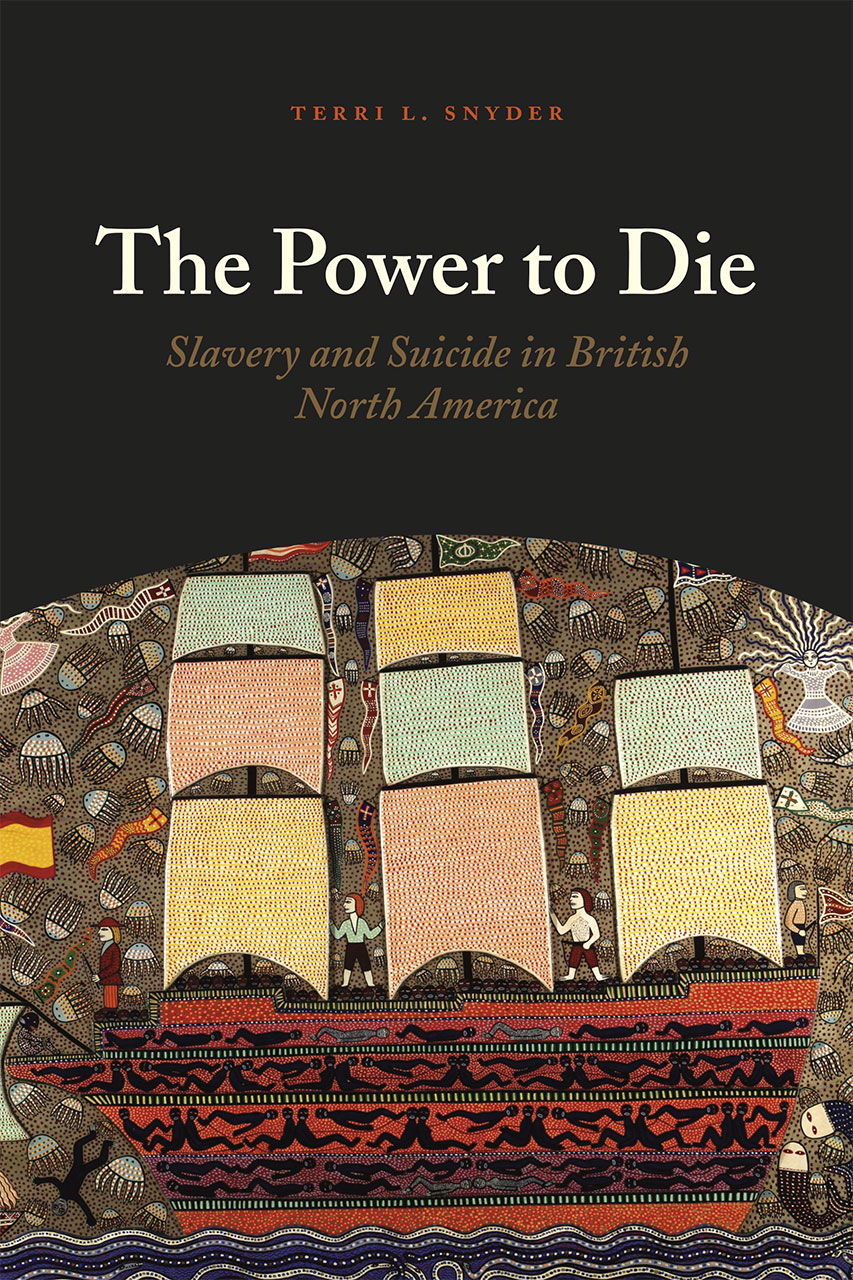
Snyder, "The Power to Die: Slavery and Suicide in British North America"

New from the University of Chicago Press: The Power to Die: Slavery and Suicide in British North America (2015), by Terri L. Snyder (California State University at Fullerton). A description from the Press:
The history of slavery in early America is a history of suicide. On ships crossing the Atlantic, enslaved men and women refused to eat or leaped into the ocean. They strangled or hanged themselves. They tore open their own throats. In America, they jumped into rivers or out of windows, or even ran into burning buildings. Faced with the reality of enslavement, countless Africans chose death instead.

In The Power to Die, Terri L. Snyder excavates the history of slave suicide, returning it to its central place in early American history. How did people—traders, plantation owners, and, most importantly, enslaved men and women themselves—view and understand these deaths, and how did they affect understandings of the institution of slavery then and now? Snyder draws on ships’ logs, surgeons' journals, judicial and legislative records, newspaper accounts, abolitionist propaganda and slave narratives, and many other sources to build a grim picture of slavery’s toll and detail the ways in which suicide exposed the contradictions of slavery, serving as a powerful indictment that resonated throughout the Anglo-Atlantic world and continues to speak to historians today.
A few blurbs:
“Snyder attends to her subject with great intelligence, care, and sensitivity. Drawing together an impressive variety of sources, she probes the connection between the public interest in slavery and the forbidden private will of the enslaved. This excellent study of mortuary politics confirms that the power to die can be as historically consequential as the power to hold, punish, and kill.” -- Vincent Brown

The Power to Die is an important, innovative, and exceedingly well-researched book. Snyder has done some breathtaking archival work and the sheer variety of sources is astounding— drawing on newspapers, antislavery propaganda, ship log books, plantation diaries, account books, and slave narratives, to name a few. This book will be of great interest to many different scholars, including those who work on slavery and early America, but also those eager to know more about law, gender, technology, and early American print culture.” -- Hilary J. Moss
More information is available here. For even more, check out the interview that Snyder did with The Junto, here.

Tuesday, January 5, 2016

Casting a Wide Net: The Varieties of Statist Liberalism

[by Anne Kornhauser]

First, a hearty thank you to Karen, Dan, and company for inviting me to be a guest blogger on this superb site. I will use this opportunity to discuss my book Debating the American State: Liberal Anxieties and the New Leviathan, 1930-1970, in particular its interdisciplinary character--beyond the givens of law and history. Throughout the month, I will highlight the challenges and possibilities for legal historians and others of melding academic disciplines in the realms of writing, publishing, and teaching.

My book is about how statist liberals responded to modern American liberalism's crowning achievement: the "leviathan" state. I grew interested in this topic because I knew that the relationship between liberals and the state that took shape during the New Deal and World War II was more complex than the longstanding political rhetoric of big-government liberals versus small-government conservatives would have us believe. But there was a more scholarly reason as well: After an astounding burst of scholarship on the history of 20th-century American conservatism, liberalism as a public philosophy of the state had been relatively neglected. During an age of conservative ascendancy its history was thought not to matter as much. Yet if liberalism was no longer so resonate as a political creed, its state largely remained. Path dependency, a favorite of political scientists, was a possible explanation, but history does not travel along neatly articulated trails. Besides, this was an uneasy state, perhaps even an unsustainable one. How, then, could historical exploration help explain the persistence of a strong liberal state with a weak liberal creed?

The first step was to leaven my intellectual history with political-institutional history to see what statist liberals thought about the American political institutions when the leviathan (or administrative) state was consolidated in the 1930s and 1940s. It turned out these liberal intellectuals thought a variety of things, some of them quite critical. These more critical liberal views were what interested me as they were less well-known and more revealing. In probing these sympathetic but critical views of the state, I had several aims. First, I sought to show through a cross-disciplinary, global conversation among liberal intellectuals that concerns about the newly hegemonic administrative state was not the provenance of conservatives alone; liberals too had their grievances. But liberal disquietude about the state was not as easy to discern. By looking at a wide variety of critical liberal intellectuals--many of whom were involved in government service--I found that they were thinking along similar lines about the state, but expressing those thoughts in different registers. These intellectuals ran the gamut from American social scientists and legal academics, to German emigre thinkers trained in law and politics, to the political and moral philosopher John Rawls.

Without an interdisciplinary sensibility, I might well have overlooked this shared unease about the the administrative state's increasingly bureaucratized, discretionary, and executive-driven power and the emergency conditions that justified it. The critical liberals all worried about the strains this state placed on the liberal values of majoritarian democracy, the rule of law, and individual autonomy and its die-hard proponents' lack of a rationale, other than that of "necessity," for exercising that power.

Second, by casting a broad net, in terms of the intellectuals' academic disciplines, countries of origin, and argumentative style, I could better see the tensions and contradictions within statist liberal thinking and the resulting issues of legitimacy that swirled around the liberal state. I found that most liberal were unable to or lacked interest in defending the state on principled grounds, while the attempts of others--the "sympathetic critics" of my story--to address this legitimation deficit made little headway, either because they were ignored, were impractical, or gave way to new concerns.

The excavation of tensions within liberal thought wrought by the leviathan state allowed me to offer a alternative explanation for statist liberalism's conceptual and the political weaknesses in contrast to those that blamed frontal assaults on liberal ideals and institutions, poor policy choices or programmatic failures, and ineffective political elites. The fact is most American liberals have offered a largely uncritical defense of the administrative state, though that may be beginning to change.

Structurally, the book looks first at liberal intellectuals' critiques of the New Deal state in its domestic guise. Then it turns to critical reactions to that same state as it operated in World War II, where I use the German occupation as an example of the administrative state at war. For the extended postwar period, I examine the singular figure of John Rawls. With this theory of a just liberal society, Rawls was the first among statist liberal intellectuals to offer a comprehensive attempt to overcome the legitimation deficit opened up by the prevalence of administrative governance and emergency politics in a constitutional democracy. In future posts I will discuss the variety of intellectuals who populate my book and the benefits and potential pitfalls of placing in conversation a bevy of social scientists, legal academics, and philosophers as they reacted to, worried about, and ultimately tried to legitimate the leviathan state while preserving the liberal values that mattered deeply to them.

Kim on Gender, Status, and Legal Performance in Choson Korea

New from the University of Washington Press: The Emotions of Justice: Gender, Status, and Legal Performance in Choson Korea (January 2016) by Jisoo M. Kim (George Washington University). A description from the Press:
The Choson state (1392-1910) is typically portrayed as a rigid society because of its hereditary status system, slavery, and Confucian gender norms. However, The Emotions of Justice reveals a surprisingly complex picture of a judicial system that operated in a contradictory fashion by discriminating against subjects while simultaneously minimizing such discrimination. Jisoo Kim contends that the state's recognition of won, or the sense of being wronged, permitted subjects of different genders or statuses to interact in the legal realm and in doing so illuminates the intersection of law, emotions, and gender in premodern Korea.
A few blurbs:
"The Emotions of Justice is well written... [and] provides an illuminating analysis of the relationship between the state and its subjects before the modern era. This is a sophisticated addition to our understanding of gender roles in Choson." -- Donald Baker

"Its focus on gender and social status makes The Emotions of Justice a significant contribution to the study of Korean legal history. That women, even women slaves, were treated as legitimate legal subjects opens up fascinating tensions in our understanding of the highly stratified and status-conscious Choson society." --Maram Epstein
More information is available here.

Monday, January 4, 2016

FDR's "Four Freedoms" at 75

We have the following announcement:
In commemoration of the 75th anniversary of Franklin D. Roosevelt's "Four Freedoms" Speech, the FDR Presidential Library will present "FDR's Four Freedoms": A Conversation with Alexander Heffner (host of PBS's The Open Mind) and Harvey Kaye (author of The Fight for the Four Freedoms: What Made FDR and the Greatest Generation Truly Great) on Wednesday, January 6, 2016. The program begins at 7:00 p.m. in the Henry A. Wallace Center at the FDR Presidential Library and Home. This is a free public event, and is available by webcast [here.]
 The FDR Library's press release also announces that the library will soon make available "newly enhanced versions of the Four Freedoms Speech" on its website.

Halperin's "Alien and Sedition Acts of 1798"

Out later this year but available for preorder now from the Johns Hopkins University Press is The Alien and Sedition Acts of 1798: Testing the Constitution, by Terri Diane Halperin, who holds a doctorate from the University of Virginia and is an adjunct instructor of history at the University of Richmond:
In May 1798, after Congress released the XYZ Affair dispatches to the public, a raucous crowd took to the streets of Philadelphia. Some gathered to pledge their support for the government of President John Adams, others to express their disdain for his policies. Violence, both physical and political, threatened the safety of the city and the Union itself. To combat the chaos and protect the nation from both external and internal threats, the Federalists swiftly enacted the Alien and Sedition Acts. Oppressive pieces of legislation aimed at separating so-called genuine patriots from objects of suspicion, these acts sought to restrict political speech, whether spoken or written, soberly planned or drunkenly off-the-cuff. Little more than twenty years after Americans declared independence and less than ten since they ratified both a new constitution and a bill of rights, the acts gravely limited some of the very rights those bold documents had promised to protect.

In The Alien and Sedition Acts of 1798, Terri Diane Halperin discusses the passage of these laws and the furor over them, as well as the difficulties of enforcement. She describes in vivid detail the heated debates and tempestuous altercations that erupted between partisan opponents: one man pulled a gun on a supporter of the act in a churchyard; congressmen were threatened with arrest for expressing their opinions; and printers were viciously beaten for distributing suspect material. She also introduces readers to the fraught political divisions of the late 1790s, explores the effect of immigration on the new republic, and reveals the dangers of partisan excess throughout history.

Touching on the major sedition trials while expanding the discussion beyond the usual focus on freedom of speech and the press to include the treatment of immigrants, Halperin’s book provides a window through which readers can explore the meaning of freedom of speech, immigration, citizenship, the public sphere, the Constitution, and the Union.

Sunday, January 3, 2016

Sunday Book Roundup

Common-Place has a published its latest issue with three new reviews for LHB readers. The first is a review of Gateway to Freedom: The Hidden History of the Underground Railroad (Norton) by Eric Foner.

Eric Nelson's The Royalist Revolution: Monarchy and the American Founding (Harvard University Press) is also reviewed.
"Nelson thus attempts to resolve the problem of the presumed disjuncture between a radical revolution and a conservative constitution. He argues that the two were, in fact, connected ideologically and constitutionally by a predominant strain of royalism, “understood as the defense of prerogative powers lodged in a ‘single person’” that is compatible with liberty (115). While admitting that the term “royalist” is problematic, Nelson defends his use of it by claiming that some colonists “equated their position with that of the Stuart monarchs of the seventeenth century and traced the origins of the imperial crisis of the 1760s to the defeat of the seventeenth-century Royalist cause” (240, n32)."
And third from Common-Place is a review of Jodi Schorb's Reading Prisoners: Literature, Literacy, and the Transformation of American Punishment, 1700-1845 (Rutgers University Press).
"Schorb positions imprisoned authors’ perspectives at the center of Reading Prisoners. This helps readers understand the crucial roles that reading and writing prisoners played in the development of American literature and American penitentiary systems. Besides the notable exception of Austin Reed’s 1858 The Life and the Adventures of a Haunted Convict, Schorb’s sources of prisoner writing are primarily published accounts."

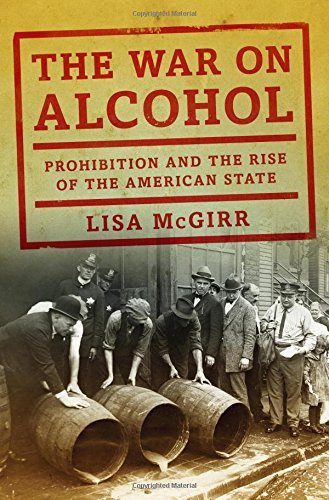
Lisa McGirr's The War on Alcohol: Prohibition and the Rise of the American State (Norton) is reviewed in The New York Times and excerpted in Salon under the title, "You'll never drink again: Sex, race, science and the real story of Prohibition." From the NYT review:
"historian Lisa McGirr tells anything but a nostalgic story. The 18th Amendment, she argues, didn’t just give rise to vibrant night life and colorful, Hollywood-ready characters, like Isidor Einstein, New York’s celebrated “Prohibition Agent No. 1.” More enduringly, and tragically, it also radically expanded the federal government’s role in law enforcement, with consequences that can be seen in the crowded prisons of today."
New Books has an interview with authors Heather Streets-Salter and Trevor R. Getz, discussing their work in Empires and Colonies in the Modern World (Oxford University Press).

The series also interviews Erik Linstrum about his new book, Ruling Minds: Psychology in the British Empire (Harvard University Press).

Saturday, January 2, 2016

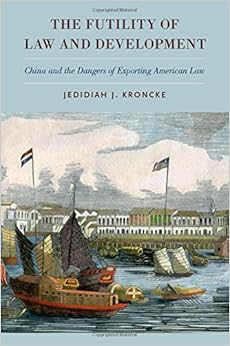
Kroncke, The Futlity of Law and Development

Via Jotwell, we have word of a new release from Oxford University Press: The Futility of Law and Development: China and the Dangers of Exporting American Law (2015), by Jedidiah Kroncke (FGV Direito SP). Here's the description from the Press:
For all the attention paid to the Founder Fathers in contemporary American debates, it has almost been wholly forgotten how deeply they embraced an ambitious and intellectually profound valuation of foreign legal experience. Jedidiah Kroncke uses the Founders' serious engagement with, and often admiration for, Chinese law in the Revolutionary era to begin his history of how America lost this Founding commitment to legal cosmopolitanism and developed a contemporary legal culture both parochial in its resistance to engaging foreign legal experience and universalist in its messianic desire to export American law abroad. Kroncke reveals how the under-appreciated, but central role of Sino-American relations in this decline over two centuries, significantly reshaped in the early 20th century as American lawyer-missionaries helped inspire the first modern projects of American humanitarian internationalism through legal development. Often forgotten today after the rise of the Chinese Communist Party in 1949, the Sino-American relationship in the early 20th century was a key crucible for articulating this vision as Americans first imagined waves of Americanization abroad in the wake of China's 1911 Republican revolution.

Drawing in historical threads from religious, legal and foreign policy work, the book demonstrates how American comparative law ultimately became a marginalized practice in this process. The marginalization belies its central place in earlier eras of American political and legal reform. In doing so, the book reveals how the cosmopolitan dynamism so prevalent at the Founding is a lost virtue that today comprises a serious challenge to American legal culture and its capacity for legal innovation in the face of an increasingly competitive and multi-polar 21st century. Once again, America's relationship with China presents a critical opportunity to recapture this lost virtue and stimulate the searching cosmopolitanism that helped forge the original foundations of American democracy.
And a few blurbs:
"Kroncke recovers a wide-ranging legal cosmopolitanism as the least appreciated, if not outright ignored, of our Founders' shared commitments. Using transnational sources wholly unappreciated to date, he artfully reveals through the Sino-American relationship how this virtue was lost through interwoven transformations in American legal, religious, and diplomatic history. A work whose lessons need by heeded by all those concerned with preserving American law's historical vibrancy in the contemporary era, or with how we conceive of America's role in the international world." -- William E. Nelson

"Americans keep hoping that projects to export our law will be the key to spurring economic growth and liberal rights in developing countries. The projects keep failing, yet the hope always revives. Kroncke's brilliant exploration of two centuries of American lawyers' engagement with China helps to explain why: the missionary-lawyers are the direct secularized heirs of lawyer-missionaries, just as confident in the universal validity of their models and impervious to the true lessons of their experiences. He recovers a time when a more cosmopolitan America was willing to learn from other societies, even while aspiring to be an exemplar of republican democracy." -- Robert Gordon
The JOTWELL review, by Aziz Rana (Cornell Law School), is available here.

Friday, January 1, 2016

Happy new year, and welcome, Anne Kornhauser!

Happy new year! We are delighted to ring in 2016 with the news that Anne Kornhauser will join us as a guest blogger for the month of January.

credit
She is an Associate Professor in History at the City College of New York, where she teaches courses on American Legal History, American Liberalism, and "The Age of Human Rights," among other offerings. She received her PhD in History from Columbia University and has held the prestigious Golieb Fellowship in Legal History at New York University.

Most important, for our purposes, she is the author of Debating the American State: Liberal Anxieties and the New Leviathan, 1930-1970, which was recently published by the University of Pennsylvania Press and which she plans to blog about here. She has also recently authored a contribution to an edited collection on Ruth Rosner Kornhauser, the noted criminologist.

Welcome, Professor Kornhauser!

Varottil on Corporate Law in Colonial India

Umakanth Varottil, National University of Singapore Faculty of Law, has posted Corporate Law in Colonial India: Rise and Demise of the Managing Agency System:
This paper focuses on the managing agency system, a peculiar type of corporate governance arrangement that emanated in India during the colonial period. Under this system, a managing agent (either an individual, partnership firm or company) would be appointed to manage one or more joint stock companies. The managing agent would also hold shares in the managed companies and control their boards of directors. While this system was introduced in the early part of the nineteenth century to facilitate trade and investment by British businesses in India, it was also adopted by Indian businesses. Over a period of time, its advantages were overshadowed by mismanagement by the agents and consequent abuse of the shareholders of the managed companies. The legal response was ineffective as the colonial government refused to recognise or rein in managing agents for nearly a century from its inception. It is only in 1936 that restrictions were imposed. Following India’s independence in 1947, the restrictions were tightened further before the system itself was abolished in 1970. This paper offers an analysis of the system using a corporate law and governance framework, and finds the existence of several institutional, economic, political and social factors that led to its emergence and disappearance.