Friday, December 24, 2021

Wilson, "Bonds of Empire The English Origins of Slave Law in South Carolina and British Plantation America, 1660–1783"

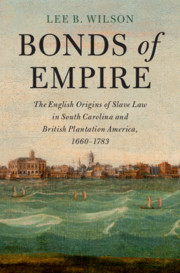
Cambridge University Press has published Bonds of Empire: The English Origins of Slave Law in South Carolina and British Plantation America, 1660–1783, by Lee B. Wilson (Clemson University). A description from the Press:

Bonds of Empire presents an account of slave law that is entirely new: one in which English law imbued plantation slavery with its staying power even as it insulated slave owners from contemplating the moral implications of owning human beings. Emphasizing practice rather than proscription, the book follows South Carolina colonists as they used English law to maximize the value of the people they treated as property. Doing so reveals that most daily legal practices surrounding slave ownership were derived from English law: colonists categorized enslaved people as property using English legal terms, they bought and sold them with printed English legal forms, and they followed English legal procedures as they litigated over enslaved people in court. Bonds of Empire ultimately shows that plantation slavery and the laws that governed it were not beyond the pale of English imperial legal history; they were yet another invidious manifestation of English law's protean potential.
Advance praise:

"This is a book that we’ve needed for a long time, for it demonstrates how readily England's legal language fit chattel slavery in early America. Colonial lawmakers did not need to invent new terms, new procedures to exert power over slaves: colonists could rely upon legal words and practices already found in common law, admiralty, and equity. Slave law was part and parcel of the English empire’s legal regime." -- Sally E. Hadden

"Wilson shows how English law facilitated the expansion and perpetuation of racial slavery in America. The book convincingly argues that all law in the plantation colonies was slave law, insulating owners from moral qualms and facilitating economic growth by transforming enslaved people into property. Bonds of Empire is a timely intervention in the lively new literature on Anglo-American imperial history." -- Peter S. Onuf

More information is available here.

h/t: New Books Network, where you can listen to an interview with Professor Wilson about the book.

-- Karen Tani

Thursday, December 23, 2021

Abraham and Baker on Insurance History and COVID-19

Kenneth S. Abraham, University of Virginia School of Law, and Tom Baker, University of Pennsylvania Carey Law School have posted What History Can Tell Us About the Future of Insurance and Litigation After COVID-19:

This Article, written for the annual Clifford Symposium on Tort Law and Social Policy, chronicles a series of developments in American history that profoundly influenced the course of insurance and insurance law, in order to predict the post-Covid-19 future of these fields. In each instance, there was a direct and decided cause-and-effect relationship between these developments and subsequent change in the world of insurance and insurance law. As important as the influence of Covid-19 is at present and probably will be in the future, in our view the Covid-19 pandemic will not be as significant an influence on insurance and insurance law as the historical developments we identify, and that is part of our message. Nonetheless, the Covid-19 pandemic will cause change, and change does not take place from a standing start. The world of insurance and insurance law have a history that places them already in motion when such new developments as a pandemic occur. Understanding how major historical developments influenced and continue to influence insurance can help us to predict the post-Covid future of insurance.

The developments this Article identifies exercised three different forms of influence. First, certain events in the twentieth-century – most notably the rise of modern tort liability and the introduction of automobiles and computers – stimulated the insurance marketplace, by generating entirely new forms of insurance to protect against the risks posed by or brought into being by these events. Second, other developments – including mass tort and pollution liability, climate change, and natural catastrophes -- influenced the evolution of insurance law doctrine in important ways, bringing modern insurance law into existence. Third, modern finance has affected insurance, and in turn insurance coverage, through the "financialization" of insurance. Having chronicled these events and developments and assessed their influence, the Article concludes by identifying some lessons that can be learned from our analysis, and applies them to support our predictions about the post-Covid world of insurance and insurance litigation.

--Dan Ernst.  H/t: TortsProf Blog

Wednesday, December 22, 2021

Emerson on the Administrative State in Constitutional Theory

Blake Emerson, UCLA School of Law, has posted Executive (Administrative State), a contribution to the Cambridge Handbook of Constitutional Theory:

This chapter examines the relationship between the administrative state and constitutional values and structures with reference to German and American legal and political theory. It recovers from these intertwined traditions three analytical approaches to the administrative state, inspired by scholarship in public administration, political science and comparative law. The first analytical approach understands the administrative state to implement the constitution. The second understands the administrative state to generate new constitutional structures and values. The third understands the administrative state to displace the constitution with patterns and practices of rule that lie outside of the existing governance framework. These frameworks foreground normative analysis of how the administrative state ought to relate to general democratic principles and the specific constitutional rules that institutionalize them. Here I contribute to a robust and growing literature on democracy and the administrative state, which treats welfare and regulatory agencies as potentially advancing rather than merely threatening popular self-government I argue for a differentiated and developmental understanding of the relationship between democracy, constitution, and administration. The concrete administration of democratic values should allow constitutional rules to shift in light of social and historical context. The administrative state should not be strictly limited by, but rather should facilitate critical interrogation of, the constitution’s current instantiation of democratic values.
--Dan Ernst

Tuesday, December 21, 2021

DeBrincat on Salvage and Contract in Colonial Connecticut

We recently learned of two articles you might have missed, both by Dominic DeBrincat, Missouri Western State University.  The first is The Spanish Ship Affair: Wreck, Salvage, and Contested Legal Authority in Colonial Connecticut, Early American Studies: An Interdisciplinary Journal 19, no. 4 (Fall 2021): 699-734:

In 1752, a wounded Spanish ship—laden with gold, silver, indigo, and other valuable goods—wrecked along the Connecticut coast. This episode initially appeared to be a tale of Samaritans rescuing the crew and safekeeping their payload. Such hospitality yielded to avarice as the loosely guarded cargo was plundered. This article looks closely at the county court in New London, Connecticut, to examine how judges, jurors, and local legal officials shouldered the burdens of securing some sense of justice for Spanish officials and British colonists ensnared in what became known as “The Spanish Ship Affair.” It highlights the importance of local colonial courts in maintaining peace, not only in their respective communities, but also in greater imperial contexts. This was especially important in the wake of ineffective responses from the governor, colonial assembly, and vice-admiralty court—institutions purportedly designed to handle inter-imperial conflicts. Emphasis on this county court reveals a flexible judiciary creatively punishing unredeemable criminals, merciful jurors willing to forgive repentant neighbors, and the resultant long-term changes in Connecticut’s political landscape and its legal approaches to shipwrecks.
The second is The Long, Salty Arm of the Law: Colonial Connecticut’s Litigated Maritime Economy and the Origins of Modern Contracts, International Journal of Maritime History, 33 , no. 4 (November 2021): 690-706:

This article examines maritime trade litigation tied to a typical New England jurisdiction – New London County, Connecticut – to reveal two important eighteenth-century trends. First, decision-makers prioritized honouring contract promises – a critical shift from earlier Puritan ideals that privileged fairness in agreements. This transition was essential to developing what became the will theory of contract, in which promise and performance replaced equity as the measures of valid agreements. This shift appeared in Connecticut nearly a century before scholars have suggested it did in the United States. The second trend involves litigants’ choice of court. Despite the availability of several tribunals for pursuing maritime-based legal actions, parties regularly chose the county court to resolve their issues. In an expanding and increasingly impersonal Atlantic marketplace, parties preferred the flexible and familiar proceedings of the local court because judges and jurors treated mariners as if they carried Connecticut's legal protections with them on their distant travels.
–Dan Ernst

Monday, December 20, 2021

AJLH 61:2

American Journal of Legal History 61:2 (June 2021) is now online.
 
Revolutionary Criminal Punishments: Treason, Mercy, and the American Revolution     
Mugambi Jouet
 
José María Torres Caicedo and the Politics of International Law in Nineteenth-Century Latin America     
Sebastián Mantilla Blanco, LL.M, (Dr. iur.)
 
Internment of Enemy Aliens during the World Wars     
Manuel Galvis Martínez
 
Religious Minorities under the Constitution of the Irish Free State, 1922–1937
Thomas Mohr
 
Book Reviews
 
Michael Lobban and Ian Williams (eds), Networks and Connections in Legal History     
William Eves
 
Keila Grinberg, A Black Jurist in a Slave Society: Antonio Pereira Rebouças and the Trials of Brazilian Citizenship     
Bruno Lima
 
Erratum

Erratum to: Radical Histories versus Liberal Histories in Work Injury Law. Nate Holdren, Injury Impoverished: Workplace Accidents, Capitalism, and Law in the Progressive Era

--Dan Ernst

Saturday, December 18, 2021

Weekend Roundup

  • Lincoln Caplan interviews Tomiko Brown-Nagin on the civil-rights movement in Harvard Magazine.  Caplan also reviews The Anti-Oligarchy Constitution: Reconstructing the Economic Foundations of American Democracy, by Joseph Fishkin and William E. Forbath in Harvard Magazine.
  • Notre Dame's Kresge Law Library at Notre dame has announced its acquisition of fourteen “ rare English legal documents from the 15th to 18th centuries... [including] final concords; indentures, . . . common recoveries, to evade the strictures of entailment; and bonds."  More.
  • A new podcast, The Age of Consent,  “explores the history of sexual consent and asks whether understanding that history can help tackle present-day problems in securing convictions for sexual offences....  The first episode, Consent Through The Ages, featuring Dr Laura Lammasniemi and Professor Vanessa Munro, also of Warwick Law School, . . . discusses the Victorian scandal of ‘The Maiden Tribute of Modern Babylon,’ a series of articles in Pall Mall magazine exposing child trafficking in the late 19th century. Although it ended with the magazine’s editor, W T Stead, in prison, the reports came to be regarded as instrumental in persuading Parliament to raise the age of consent from 13 to 16 for girls.  More.
  • "When renowned documentary film producer and historian Malinda Maynor Lowery was named the Cahoon Family Professor in History [at Emory University] this summer, she decided to revamp her survey course 'Legal History of Native Peoples' as soon as she heard that students in Emory College of Arts and Sciences arrive ready to dig into research and connect dots across disciplines."  More.
  • ICYMI: The first American vaccine mandate (WaPo). The Commission on the Supreme Court’s findings may end up helping to set reform in motion, rather than stopping it in its tracks, say Ryan D. Doerfler and Samuel Moyn (The Atlantic). 
Weekend Roundup is a weekly feature compiled by all the Legal History blogger.


Friday, December 17, 2021

The Letter of Recommendation system

Over the past two weeks, we--Mitra Sharafi (University of Wisconsin Law) & Ronit Stahl (Berkeley History)--have shared results from our 2021 online poll and survey on the academic Letter of Recommendation (LOR) system. Most scholars who responded were in law and/or history at US universities. 

Here are the posts, all in one place:

We hope this series will help our fields restructure their application processes. 

--posted by Mitra Sharafi

Thursday, December 16, 2021

The LOR system (part 5): Possible fixes

 This is the final installment in a five-part series on the Letter of Recommendation (LOR) system. In spring 2021, Ronit Stahl and Mitra Sharafi conducted an online poll and survey among scholars, mostly in law and history. Here are parts 1, 2, 3 and 4. This final post steps back from the feedback we received to add our own thoughts. 

Sometimes all it takes is asking why.


“Why do we need letters of recommendation?” I (Ronit) asked a campus program on whose faculty advisory board I sit. Somewhat flummoxed, a couple of faculty and staff mustered answers, several of which amounted to “because we always have” or “because someone on campus told us this was a ‘best practice.’”


I pressed on: “what purpose do they serve?” Eventually, the answer became clear: the program wanted to ensure that graduate advisors knew about and approved their students’ participation in this program. “Great,” I replied, “a form ought to do the trick.” And so we moved from a formal letter of recommendation to a form on which an advisor simply had to sign that they were aware of and supported their student.


Sometimes it takes more than one person to ask. During the conversation described above, I had allies, other faculty who agreed that letters of recommendation were unnecessary for the program. More recently, a postdoc program at BU changed their application to require only names and contact info from applicants up front, with references to be requested from applicants who make it further in the process. As Professor Kecia Ali’s tweet and replies suggest, it’s likely the change came from multiple people pressing the university to shift.


There are encouraging signs of change elsewhere, too. The Law and Society Association is eliminating its former requirement of letters of nomination for prizes based on single works (like books, articles, dissertations, and papers). And funding agencies organizations like the Social Science Research Council and American Institute for Indian Studies are no longer requiring LORs.


More after the jump.

Wednesday, December 15, 2021

Rg 29 (2021)

[We have the following announcement.  DRE]

Rechtsgeschichte - Legal History 29 (2021) is now available in print from the publishers, Vittorio Klostermann Verlag, and online in Open Access via the journal's website. The nearly 500 pages of this year's issue of Rechtsgeschichte - Legal History 29 once again offer a selection of outstanding articles, shorter discussion pieces and book reviews on important topics in legal history. Some of these relate to the Institute's core research fields, others explore stimulating work in other areas.

The preparation of this issue was overshadowed by the death of Michael Stolleis in March 2021, and it therefore opens with an obituary of this extraordinary scholar by Thomas Duve. Over the years, Michael Stolleis contributed many articles and book reviews to this journal, and his knowledge, insights and advice will be much missed.

In this issue's Research section, two of the mpilhlt's Directors offer contributions on fundamental issues in legal theory (Marietta Auer) and on legal history as the history of normative knowledge (Thomas Duve). Wolfram Brandes' article looks back over half a century of research on Byzantine legal history in Frankfurt.

Three Focus sections present contributions on the circulation of 'legal books' in early modern Iberian America (ed. by Manuela Bragagnolo) and oral history as a method of contemporary legal history (ed. by Sigfrido Ramírez Pérez and Stefan Vogenauer) as well as selected papers from the 25th Annual Forum of Young Legal Historians (ed. by Wouter De Rycke et al).

Thirteen scholars offer their perspectives on Martti Koskenniemi's monumental To the Uttermost Parts of the Earth in this year's Forum, which also includes a reply by the author.

The many, multilingual book reviews of the Critique section cover a wide range of topics, both geographically and chronologically. They are followed by two Marginalia taking the long view: Johannes W. Flume analyses the buildings of bourses and stock exchanges throughout the centuries, and Michael Widener complements and enriches the Focus on 'legal books' with a discussion of book illustrations from Yale Law Library from the Middle Ages to the present day, which are also the subject of this issue's photo series.

Tuesday, December 14, 2021

The LOR system (part 4): What to do?

 This is the fourth in a five-part series on the Letter of Recommendation (LOR) system, describing feedback received in spring 2021 by Mitra Sharafi and Ronit Stahl on an online poll and survey. Here are parts 1, 2, and 3.

Our earlier blogposts conveyed the dissatisfaction of many respondents who filled out our online survey on the LOR system. What to do?


At the personal level, some respondents shared these strategies for making LOR-writing more manageable:

  • I only write for graduate students that I advise or have a close working relationship with and understanding from the start that I will be writing letters for them. Currently, I am writing for 10 Ph.D. (and former Ph.D.) students. That number is down from a few years ago. For me, it's not just the letters. I give students feedback on their letters and related materials. This is as time-consuming as writing letters. But I also think it is as important and part of the training that I do -- at the undergraduate, but especially at the graduate level.

  • "I write letters of recommendation on Mondays." This adapts advice I received from one of my mentors […] when I was on the job market. She suggested this as a way to keep applications from devouring all the time you are willing to give them. Now that I am mostly a letter-writer, I find this helps me manage the workload (and avoid missing deadlines). And when students want to know "how much lead time do you need," the answer - especially once a letter has been written - is somewhere between one and seven days. I also give my students guidance on what to give me to help me write a good letter. [link updated by eds]

  • I generally ask Ph.D. students I'm writing for to give me a chart with positions they're applying for with all the details so that I have a master list for each student and also have their basic materials (CV, cover letter for earliest position, the current status of their progress . . . ), link to job/fellowship - so I can see the full details, and date the letter is due and how to submit it. They update these as the semester/year goes along. But given posting practices, there are many things that don't make the original or updated list and so there are generally more letters. But this does allow me to get a first foundational letter written that I can then work from. 

  • For most Ph.D. students I advise or work closely with I write a new letter late summer/early fall for jobs and postdocs for interfolio. This gives them a letter to go to in case they don't have time to contact me or in case an emergency would mean that I wouldn't be able to get a letter written.

  • Get students to send me a bullet point list of things they think I should highlight in the letter. It helps me do the tailoring more precisely, and brings in a transparency to the system that it sorely requires.


More after the jump.

Monday, December 13, 2021

Nackenoff and Novkov's "American by Birth"

We’re unaccountably slow to post on this one.  Carol Nackenoff, Swarthmore College, and Julie Novkov, University at Albany, State University of New York, have published American by Birth: Wong Kim Ark and the Battle for Citizenship (University Press of Kansas):

American by Birth
explores the history and legacy of Wong Kim Ark and the 1898 Supreme Court case that bears his name, which established the automatic citizenship of individuals born within the geographic boundaries of the United States. In the late nineteenth century, much like the present, the United States was a difficult, and at times threatening, environment for people of color. Chinese immigrants, invited into the United States in the 1850s and 1860s as laborers and merchants, faced a wave of hostility that played out in organized private violence, discriminatory state laws, and increasing congressional efforts to throttle immigration and remove many long-term residents. The federal courts, backed by the Supreme Court, supervised the development of an increasingly restrictive and exclusionary immigration regime that targeted Chinese people. This was the situation faced by Wong Kim Ark, who was born in San Francisco in the 1870s and who earned his living as a cook. Like many members of the Chinese community in the American West he maintained ties to China. He traveled there more than once, carrying required reentry documents, but when he attempted to return to the United States after a journey from 1894 to 1895, he was refused entry and detained. Protesting that he was a citizen and therefore entitled to come home, he challenged the administrative decision in court. Remarkably, the Supreme Court granted him victory.

This victory was important for Wong Kim Ark, for the ethnic Chinese community in the United States, and for all immigrant communities then and to this day. Though the principle had links to seventeenth-century English common law and in the United States back to well before the American Civil War, the Supreme Court’s ruling was significant because it both inscribed the principle in constitutional terms and clarified that it extended even to the children of immigrants who were legally barred from becoming citizens. American by Birth is a richly detailed account of the case and its implications in the ongoing conflicts over race and immigration in US history; it also includes a discussion of current controversies over limiting the scope of birthright citizenship.

Here is an endorsement:

“We have long needed a biography of Wong Kim Ark, and American by Birth delivers. It’s the history of American citizenship, the tireless efforts of one man and his lawyers to challenge cruel and racist policies, and Wong Kim Ark’s continuing legacy today. Nackenoff and Novkov’s timely book is a must-read!” 
    —Erika Lee, author of America for Americans: A History of Xenophobia in the United States, and director of the Immigration History Research Center, University of Minnesota
Check out the Balkinization symposium, here.

Saturday, December 11, 2021

Weekend Roundup

  • Now on YouTube: Helen Knowles’s recent Supreme Court Historical Society lecture on >Elsie Parrish and her fight for the minimum wage at the height of the depression," culminating in "the landmark Supreme Court Case, Parrish v. West Coast Hotel." 
  • Via SCOTUSblog, here is the final report of that  Presidential Commission on the Supreme Court ofthe United States. What word of FDR's Court-packing plan, you ask?  "Scholars disagree." 
  • “Brown University, Tougaloo College and the University of New Mexico School of Law partnered in June to host The Conversation, a three-week summer research dialogue among rising second-, third- and fourth-year undergraduates around issues of race, justice and the law as they have affected “involuntary Americans” (e.g., Indigenous peoples here before Columbus, Black people brought here enslaved, and Mexicans here before the Treaty of Guadalupe Hidalgo, and immigrants brought here as children).”  More.
  • For your year-end giving consideration: the ASLH!

Weekend Roundup is a weekly feature compiled by all the Legal History blogger.

Friday, December 10, 2021

CFP: A Virtual Conference on Law, History, and Visual Culture

 [We have the following Call for Papers.  DRE.]

Through a Legal Lens: Law, History, and Visual Culture, May 26, 2022 (virtual)

Law is often seen, and indeed often presents itself, as image-less, a text-based discourse. Perhaps for this reason, the use of images in legal historical research is an undervalued and under-researched--if fascinating--area.

This one-day conference aims to encourage the asking of questions, to reflect the growing interest and scholarship in the interdisciplinary field of law, history and visual culture. The conference offers a forum for discussion, debate and the presentation of research. The conference will construe ¡¥visual culture¡| widely, to attract papers from a range of disciplines. With a focus on images in and of law, subjects for papers may include, but are by no means limited to:

  • television, film and theatre
  • artworks (including sculpture), photography and graffiti
  • architecture and maps
  • legal artefacts and objects
  • clothing and costume associated with the law

The organizers are keen to welcome scholars from any stage in their career and, as the conference is held online, submissions are invited from all jurisdictions.

Submit a 250 word abstract to: la.visualimagesconference@northumbria.ac.uk.  The deadline for submissions is the 1st February 2022.  The organisers are: Victoria Barnes, Helen Rutherford, Clare Sandford-Couch and Sarah Wilson.

The LOR system (part 3): Unmanageable?

This is the third in a five-part series on the Letter of Recommendation (LOR) system, describing feedback received in spring 2021 by Ronit Stahl and Mitra Sharafi to an online poll and survey. Here are parts 1 and 2.

At the heart of our survey were two questions:

1. Does the LOR system feel manageable to you? 

2. What are the biggest obstacles or challenges built into the LOR system (at a structural level)? 


We share a sample of answers to these questions together. Much of this feedback was critical of the LOR system and, especially the increasingly labor-intensive and administratively unmanageable elements of a system that do not live up to the promise of reducing, in the words of one respondent, “the inherent problems of elitism, bias, secrecy, and wasted time.”


For example, from the perspective of letter-writers:

  • It causes an immense amount of work for certain faculty and is not particularly useful in many situations

  • As someone writing more than 30-35 letters for undergraduates and graduates, each tailored to a particular application, the process feels cumbersome, labor-intensive and frustrating.

  • I read a lot of letters and I write a lot of letters because I am in a place with a relatively large set of graduate programs and lots of undergraduates. The biggest obstacle is that there is little oversight over LOR: so some folks are not writing letters that represent the applicants' work. I have been stunned to see what some of my colleagues write when I have the rare chance to read their letters. The second (structural) feature is that the more you read the better you get. I have noticed that for folks who have less practice, the letters are not that helpful to the candidate. Finally, a third structural problem: I know that some committees are "reading the letterhead" … which is really the worst sort of elitism.

  • I think the bigger question is about how little many referees know about how to write an effective letter. That has a distorting effect on hiring/appointment processes...one almost inevitably selects those whose referees know to write knowledgeably and in a way that targets the particular appointment.

  • [Q. Biggest obstacle:] That requesters feel obliged to waive their rights to the letter and that so much thoughtful analysis - and actionable pre-publication feedback - goes unheard. I tell students that their letter will be received better if they waive their rights, but I always tell them the general outline of what I plan to write, and I offer to share it if they wish to see it. Overall, I think more transparency would be better.

  • [Q. Biggest obstacle:] In my field, History, the outrageous and unthinking requirement of LOR for all entry level applications. Why are applicants required to submit complete applications? This wastes everyone's time and leads to rote, low-quality LOR, wasting their function. An application should require a cover letter and CV. Finalists should submit complete applications.

  • They offer little in the contexts that I read them. I am not through my tenure cycle yet, so I have yet to sit in on tenure meetings or vote on tenure and promotion cases, so perhaps it is useful there (but maybe not the 9-12 letters required at my institution). I find that I don't even read (or just skim for red flags) most letters of recommendation for grants, job applications, and PhD applications because they are all the same and typically glowing ("this person is the very best there is in the whole world. . . ").

  • [Q. Biggest obstacle:] Time. From an applicant perspective, it is suddenly a huge disadvantage to have an advisor with a lot of students for example. That has nothing to do with whether you are a good candidate or not. I know someone whose recommender won't write letters if they don't think s/he has a good chance at the job.


More after the jump.

Thursday, December 9, 2021

Brewer on Creating a Common Law of Slavery

Holly Brewer, University of Maryland, will present “Creating a Common Law of Slavery for England and its New World Empire” in the Washington Early American Seminar on Zoom at 4:00 EST on Friday, December 10.

--Dan Ernst

American Legal Education Abroad: Critical Histories

Here is a fuller description, including the TOC, of the previously noted essay collection, American Legal Education Abroad: Critical Histories, edited by Susan Bartie and David Sandomierski (New York University Press:

The second half of the twentieth century witnessed the export of American power-both hard and soft-throughout the world. What role did US cultural and economic imperialism play in legal education? American Legal Education Abroad offers an unprecedented and surprising picture of the history of legal education in thirteen countries beyond the United States. Each study in this book represents a critical history of the Americanization of legal education, re-examining prevailing narratives of exportation, transplantation, and imperialism. Collectively, these studies challenge the conventional wisdom that American ideas and practices have dominated globally. American Legal Education Abroad begins with a foundational history by leading Harvard Law School historian Bruce Kimball, who explains the factors that created a transportable American legal model, and the book concludes with reflections from Susan Carle and Bob Gordon, whose observations on recent disruptions within US law schools suggest that their influence within the global order of legal education may soon fall into further decline.

This book should be considered an invaluable resource for anyone in the fields of law, legal history, socio-legal studies, law and society, legal education, comparative law, colonial and postcolonial legal studies, globalisation and law, and intellectual and cultural history.

Table of Contents

Introduction  

Part 1: Foundation Stories


1. The Proliferation and Transformation of Harvard's Case Method in the United States, 1870s-1990s. Bruce A. Kimball

2. How America Did (and Didn't) Influence English Legal Education, circa 1870-1965. David Sugarman

Part 2: Americanization-Critical Histories


3. American Influences, Canadian Realities: How "American" Is Canadian Legal Education? Philip Girard

4. Functionalism, Legal Process, and the Transformation (and Subordination) of Australian Law Schools. Susan Bartie

5. Conservatives, Nationalists, and American Romantics Debating Legal Education in Kwame Nkrumah's Ghana. John Harrington and Ambreena Manji

6. Transplantation and Domestication of American Models of Legal Education in Nigeria. J. Jarpa Dawuni and Rebecca Emiene Badejogbin

7. Model, System, or Node? Understanding Legal Education Reform in Twentieth-century China and Beyond. Jedidiah J. Kroncke

8. Transplants in Estonian Legal Education: Influences from the US Legal System. Irene Kull, Merike Ristikivi, and Aleksei Kelli

9. "The Turn to the West": American Legal Education and Educational     Reforms in the Swedish Welfare State, 1950-2000. Kjell Å Modéer

10. The American Case Method and New Japanese Legal Education. Yoshiharu Matsuura

11. Legal Education in France Turns Its Attention to the Harvard Model. Jean-Louis Halpérin

12. American Moment(s): When, How, and Why Did Israeli Law Faculties Come to Resemble Elite US Law Schools? Pnina Lahav

13. Catalytic Agents? Lon Fuller, James Milner, and the Lawyer as Social Architect, 1950-1969. David Sandomierski

14. Legal Teaching and the Reconceptualizing of the State: Global Law and New Legal Education Loci. José Garcez Ghirardi

15. Socratic Method, Philippine-style: To Unhave or Uphold? Emily Sanchez Salcedo

Part 3: US Perspectives


16. Rethinking Assumptions about the Global Influence of US Legal Education. Susan D. Carle

17. The Harvard Models in Their Native Habitat and Abroad: Reflections. Robert W. Gordon

The Contributors

Rebecca Emiene Badejogbin, Director of Academics, Council of Legal Education, Nigerian Law School.

Susan Bartie, Senior Lecturer in Law, University of Tasmania.

Susan D. Carle, Professor of Law, American University Washington College of Law.

J. Jarpa Dawuni, Associate Professor of Political Science, Howard University, Washington, DC, and Executive Director, Institute for African Women in Law.

José Garcez Ghirardi, Associate Professor, FGV SP Law School, Brazil.

Philip Girard, Professor, Osgoode Hall Law School, Toronto.

Robert W. Gordon, Professor of Law, Stanford University, and Chancellor Kent Professor of Law & Legal History, Emeritus, at Yale University.

Jean-Louis Halpérin, Professor (exceptional class), École Normale Supérieure, Paris and Director of the Unité mixte de recherche 7074-Centre for Legal Theory and Analysis (CNRS-University Paris X-ENS and EHESS).

John Harrington, Professor of Global Health Law and Director of the Centre for Law and Global Justice, Cardiff University and Director of the ESRC Doctoral Training Programme in Wales.

Aleksei Kelli, Professor of Intellectual Property Law, Faculty of Law, University of Tartu, Estonia.

Bruce A. Kimball, Professor in Philosophy and History of Education, The Ohio State University.

Jedidiah J. Kroncke, Associate Professor of Law, University of Hong Kong.

Irene Kul, Professor of Civil Law and Head of the Department of the Civil Law, University of Tartu, Estonia.  

Pnina Lahav, Professor, Boston University School of Law.

Ambreena Manji, Professor of Land Law and Development, Cardiff University.

Yoshiharu Matsuura, Professor Emeritus and Designated Professor for a special graduate program, Nagoya University Graduate School of Law.

Kjell Å Modéer, Professor Emeritus of Legal History, Lund University, Sweden.

Merike Ristikivi, Associate Professor of Legal History in the Faculty of Law, University of Tartu, Estonia.

Emily Sanchez Salcedo, Teacher, Commercial Law Department, De La Salle University in the Philippines.

David Sandomierski, Assistant Professor, Faculty of Law, Western University in London, Ontario.

David Sugarman, Professor Emeritus of Law, Lancaster University Law School; Senior Associate Research Fellow, Institute of Advanced Legal Studies, University of London; and Senior Associate, Centre for Socio-Legal Studies, University of Oxford.  

Wednesday, December 8, 2021

Widener on "Legal Books"

Michael Widener has published From Law Book to Legal Book: The Origin of a Species” is now out, open access, in volume 29 of Rechtsgeschichte Rg, the journal of the Max Planck Institute for Legal History:

This article responds to the question posed in the title of the 18 June 2020 workshop of the Max Planck Institute for European Legal History: “What is a Legal Book? Crossing Perspectives between Legal History and Book History.” Bridging the gap between legal history and book history requires a broader conception of legal literature, one that the term “legal book” captures more accurately than the narrower “law book.” The field of legal history has begun to take greater interest in legal books as social and cultural phenomena, as objects of commerce and as artifacts. The article develops a definition of “legal book” using illustrations of law books that are taken from the books themselves, including allegorical images, author portraits, and depictions of lawyers at work. These images highlight the book’s function in law as symbol, text, and artifact. The article concludes by pointing to opportunities for collecting, research, and teaching that the broader definition of “legal book” presents for curators and the historians they serve.
--Dan Ernst

The LOR system (part 2): How the system has changed

This is the second in a five-part series on the Letter of Recommendation (LOR) system, describing feedback received in spring 2021 by Mitra Sharafi and Ronit Stahl to an online poll and survey. Part 1 is here.

How has the Letter of Recommendation (LOR) system changed in recent years? As historians, we recognize that processes are not static. Attention to the ways in which the LOR system has changed may provide useful insights into both benefits and drawbacks.


Some respondents to our survey underscored that the mechanism of letter submission has altered how the LOR system--and expectations around it--operate.

  • As a writer, there are too many different systems and they each require separate accounts and log-ins and agreeing to terms and conditions pages that I feel pressured to agree to even when I don't like the terms.

  • It has become increasingly unwieldy as institutions move to online submissions. There is also an increasing expectation of tailored letters. When I was a graduate student looking for a job, my recommenders submitted one letter to a dossier service, run by the graduate school, which then sent out the letters as I requested them in a packet with a university seal. That morphed into the online dossier services, where I submitted one letter and the students used the service to send out the letters. Now institutions have their own online systems that no longer accept letters from online services, so I have to submit individual letters for each job--and that often means as many as 20 submissions with different portals, all with different deadlines. The online submission system has the perverse effect of making it seem "easier" to obtain letters. So I now write letters for a range of things that did not require them in the past: study abroad for undergrads, other undergrad programs, small research grants for undergrads and grad students, etc. 

  • The manageability question has also changed over the course of my years of teaching. When I first began teaching in the mid-1990s there was a rhythm to the job market. Letter writing was concentrated in the late summer and early fall. That hasn't been true now for a number of years. The students I work with are applying for positions basically year round with each position or fellowship asking them to jump through a different set of hoops, so that they're not only writing new cover letters, but a whole variety of other required statements, each tailored to the given position/"fellowship." I worry greatly about this burden on them. It is what concerns me most. This also has meant that there is no longer a cycle or rhythm to letter writing; it is ongoing and unending… It is striking to me how fundamentally LORs have changed [over the last century]. It is clear that the burden of letter writing has dramatically increased. I think about my letters which range from 2 to 3 (or sometimes 4, although a letter should never be that long) pages and compare them to letters from the 1920s or 1940s, which were brief: a few sentences or a paragraph, with often multiple potential candidates referred to in the same letter. Equally brief were the statements that faculty submitted to university placement files for students. And briefer still was the phone call, where a man was taken simply on the recommendation of his advisor. This was all before there was a "job market." It was a closed, discriminatory system. Many of us who spend countless hours today writing letters for students were completely closed out of or marginalized in that system.


More after the jump.

Tuesday, December 7, 2021

Pirie's "Rule of Laws"

Fernanda Pirie, Centre for Socio-Legal Studies, Oxford, has published The Rule of Laws: A 4000-Year Quest to Order the World (Basic Books):

Almost without exception, the laws enforced throughout the world today are modelled on systems developed in Western Europe in the eighteenth and nineteenth centuries. For two hundred years, European colonisers exported their laws everywhere they could. But in many places they weren't filling a void: again and again, they displaced local traditions that were already ancient when Vasco Da Gama first made landfall in India. Even the Romans, first framers of the European tradition, were inspired by earlier precedents.  

Where, then, did it all begin? And what sophisticated approaches to justice have been lost in the drive for uniformity? In The Rule of Laws, anthropologist Fernanda Pirie traces the development of the world's great legal systems - Chinese, Indian, Roman, and Islamic. But she also shows how common people-tribal assemblies, merchants, farmers-have called on laws to define their communities, regulate trade, and resist outsiders. The variety of the world's laws, Pirie reveals, has long been almost as great as the variety of its societies. Although legal principles originating in Western Europe now seem to dominate the globe, a more complicated legal reality persists on the ground, one that is evident everywhere from the influence of Islamic law across the Middle East, to the persistence of traditional codes among nomadic Tibetan yak herders, to the unwritten rules of gangs worldwide.

At the heart of this story is a persistent paradox. Rulers throughout history have used laws to impose order. But they have also offered ordinary people a way to resist authority and to express their diverse visions for a better world. 
--Dan Ernst

Monday, December 6, 2021

Seminar on a 19th-Century UK Trademark Prosecution

We have word of a forthcoming online seminar hosted by CREATe (the Research Council funded centre for copyright research at the University of Glasgow, UK) by Dr Elena Cooper, Leverhulme Early Career Fellow, CREATe, on “the connections between criminalisation and UK trade mark law in the nineteenth century, through the lens of the late nineteenth century branding history of a particular business: the Jaeger clothing company.”  Dr Jennifer Davis, University of Cambridge, will be the discussant; Dr Luis Porangaba, CREATe, will chair.  Dr. Cooper’s abstract:

Jaeger was established in the UK in 1884 by a City of London businessman, Lewis Tomalin, as a business concerning the manufacture and sale of woollen underwear and clothing. Taking Jaeger's early business history as a focus, the presentation will explore the relationship between branding practices and legal rules regulating the use of trade marks, particularly the criminal law of false marking under the UK Merchandise Marks Act 1887. I will analyse the commercial and legal agreements concerning the use of the Jaeger trade mark, including the relationship of the UK business to a zoologist and physician:  Professor Gustav Jaeger of Stuttgart, Germany. Then, drawing on original archival material, I will uncover the high-profile criminal prosecution of Jaeger in the late nineteenth century, instigated by the Board of Trade (a UK Government Department). Whereas most trade mark prosecutions at this time, involved a trade-mark owner bringing action for unauthorised use of a trade mark by a third party, the Board of Trade's prosecution of Jaeger concerned the application of the criminal law to Jaeger's own branding practices. I will conclude by drawing attention to the way that the specific branding history of Jaeger, takes us to new perspectives on nineteenth century ideas about trade marks (the relationship between trade marks and personality, and trade marks as indicators of geographical origin), as well as the significance of criminalisation to the historical development of trade mark law.  
The Seminar will take place online via zoom on Friday 10th December at 10am UK time. Should you wish to attend, please contact Dr Cooper: elena.cooper@glasgow.ac.uk.

--Dan Ernst

The Letter of Recommendation (LOR) system (part 1): Scholars speak up

Earlier in 2021, we--Ronit Stahl (Berkeley History) and Mitra Sharafi (University of Wisconsin Law)--found that we were both tweeting about the ills of the academic Letter of Recommendation (LOR) system. We were both dissatisfied with the general expectation that all applications (from jobs and postdocs to archive grants and summer programs) require multiple (often tailored) letters of recommendation and typically request them at the first stage of application. 


We wanted to hear more from other scholars in law and history. Were they struggling with the LOR system as much as we were? How and why has the LOR system become more unwieldy over time? Most importantly, what can be done to make the system more manageable and worthwhile for everyone involved? (One notable difference between law and history is that law school admissions are run through a centralized system, requiring faculty to upload a single letter. Another is that unlike tenure-track history jobs, most tenure-track law jobs require recommendations by phone call, not by letter.)


We set up a poll and survey via Twitter and Google forms. We received 46 votes on the poll and 21 responses to the survey. We also received e-mails from three people, and had one in-person meeting. We share what we learned now, as a multi-part blogpost series. In parts 1-4, we describe some patterns and views emerging from our efforts at data collection. In part 5, we consider how the LOR system may be reformed.


The first thing to say is: *many many thanks* to everyone who took the time to share their experiences with us. Not only do many of you spend an inordinate amount of time writing LORs, you also then spent extra time answering our questions about them!


Secondly, it is not our aim here to make letter requesters feel guilty about asking for letters. Our academic world runs on LORs, although there are signs here and there that this may be changing. For example, TT job searches now occasionally only ask for LORs for finalists and some grant agencies are no longer asking for LORs. We are questioning the LOR system, not those who ask for letters. We recognize that in our current system, asking for letters is mandatory for anyone who wants to launch an academic career. But we wonder whether it needs to be so.


Now, to our results--after the jump. 

Saturday, December 4, 2021

Weekend Roundup

  • Jessica A. Shoemaker, University of Nebraska College of Law, reviews Gregory Ablavsky’s Federal Ground: Governing Property and Violence in the First U.S. Territories (Oxford University Press, 2021), in the Michigan Law Review (and SSRN).
  • In the New York Review of Books: Sarah Seo (Columbia Law School) on "Reimagining the Public Defender," reviewing books by Jonathan Rapping (Gideon's Promise), Sara Mayeux (Free Justice), and Matthew Clair (Privilege and Punishment). (The article is free to read, but you have to register.)
  • The New Jersey Council for the Humanities announces the launch of its Stanley N. Katz Prize for Excellence in Public Humanities a January 2022 kickoff event featuring a conversation with former ASLH president Stan Katz.
  • The Heyburn Initiative strengthens the University of Kentucky Libraries’ mission to archive and digitize “collections from federal judges, justices, and other leaders related to the judiciary with connections to Kentucky" (UKnow).
  • ICYMI:  Mark Tushnet's pet peeves about legal scholarship include originalism. (Balkinization).  A. Douglas Melamed interviews Herbert Hovenkamp, mostly about antitrust, but also about his historical training (SSRN) . George Boyer Vashon: New York’s First African American Attorney (Historical Society of the New York Courts). The Supreme Court of Georgia is set to kick off 175th anniversary celebration (Johnson City Press).

Weekend Roundup is a weekly feature compiled by all the Legal History bloggers

Friday, December 3, 2021

SAPD 35:2

Studies in American Political Development 35:2 (October 2021) has been published:

From civil rights to social policy: the political development of family and medical leave policy
Kumar Ramanathan

Naturalizing affection, securing property: Family, slavery, and the courts in Antebellum South Carolina, 1830–1860
Gwendoline M. Alphonso

Select No Gestapo: J. Edgar Hoover's world-wide intelligence service and the limits of bureaucratic autonomy in the national security state
Harry Blain

The 1982 Voting Rights Act Extension as a “Critical Juncture”: Ronald Reagan, Bob Dole, and Republican Party-Building
Richard Johnson

When Think Tanks Refuse Thinking: Why American Pro-Market Conservatives Oppose Market Integration
Benedikt Springer 

--Dan Ernst

Thursday, December 2, 2021

Shymansky on Georgetown Law and the New Deal

It’s not open access, but I could not be happier to see that Ryan Shymansky's “The Spirit of the New Deal" at Georgetown Law: Change and Constraint from 1933 to 1940, has been published in the Journal of Southern Legal History 28 (2020): 17-70.  Mr. Shymansky is a 2019 graduate of the Georgetown University Law Center.  From the introduction:

credit
This Article will proceed in several parts and will highlight both the changes wrought at Georgetown Law by the New Deal as well as the factors that limited their impact. Part I discusses the general history of Georgetown Law and the Great Depression to establish the law school's position at the outset of the New Deal. Part II considers the changes the New Deal brought to Georgetown Law, with a particular focus on enrollment, the student body, curricular changes, alumni involvement, and relationships with government figures. While accepting their significance, Part III suggests two primary reasons that these changes did not leave an even greater mark on the law school: the ideological gravity of Scholastic natural law, and the institutional power of the Regency. In the end, Georgetown Law's Jesuit heritage and structure proved resistant to a full-throated embrace of the New Deal and complicated the possibility of truly transformative change before the effective end of the Regency in the early 1960s.

--Dan Ernst

Wednesday, December 1, 2021

Farbman, "'An Outrage Upon Our Feelings': The Role of Local Governments in Resistance Movements"

Cardozo Law Review has published "An Outrage Upon Our Feelings": The Role of Local Governments in Resistance Movements, by Daniel S. Farbman (Boston College Law School). Here's the abstract:

After the election of 2016, many who opposed President Trump and his policies argued that local governments and local power would be the best tools to resist those policies and strengthen democracy. Among the most prominent acts of local resistance in the last decade have been resolutions that declare a town or a city a “Sanctuary” and refuse to cooperate with federal authorities in the deportation of undocumented immigrants. This Article situates these resolutions in a long tradition of local opposition to state and federal laws that towns and cities deem unjust by examining local opposition to the Fugitive Slave Law of 1850. Drawing on original archival research, this Article exposes striking similarities between contemporary tactics of local resistance and the tactics of local governments in 1850–1851 that passed formal resolutions opposing the Fugitive Slave Law. This examination of how local governments responded to the Fugitive Slave Law poses two broad questions: what did local governments think they were doing when they passed these resolutions? And how much power did local governments really have to achieve those goals? The answers to these questions are complex and context specific. The local struggles that resulted in these resolutions were part of an ongoing political struggle against the seemingly intractable problem of slavery. The local resistance chronicled here is exceptional neither in its heroism nor its effectiveness. Rather it is striking in its familiar messiness and ambition. In some cases, towns seemed to have modest expressive goals that could be met by their resolutions. In other cases, the towns’ resolutions seem to suggest a much broader set of substantive goals that were beyond the power or capacity of the town to achieve. Examining these responses to the Fugitive Slave Law offers a new analytical perspective on local responses to the deportation crisis. Examining what local governments think they are doing when they pass sanctuary ordinances and comparing that with what they are empowered or willing to do helps us think more clearly about how and by what means local governments can resist national policies and engage in broad political struggles.

The full article is available here.

-- Karen Tani

Book Launch for Cazzola's "Political Thought of Thomas Spence"

 [We have word of the following virtual book launch.  DRE]

The Political Thought of Thomas Spence: Beyond Poverty and Empire, by Matilde Cazzola
Thursday 16th December 19:00 CET

The book is an intellectual analysis of the political ideas of English radical thinker Thomas Spence (1750–1814), who was renowned for his "Plan", a proposal for the abolition of private landownership and the replacement of state institutions with a decentralized parochial organization. While he has long been considered an eccentric and anachronistic figure, the book sets out to demonstrate that Spence was a deeply original, thoroughly modern thinker, who translated his themes into a popular language addressing the multitude and publicized his Plan through chapbooks, tokens, and songs. The book is therefore a history of Spence's political thought "from below", designed to decode the subtle complexity of his Plan. It also shows that the Plan featured an excoriating critique of colonialism and slavery as well as a project of global emancipation.

Dr Matilde Cazzola is a Senior Research Fellow at the Max Planck Institute for Legal History and Legal Theory in Frankfurt, Germany. She earned her PhD in History from the University of Bologna in 2019. Her work focuses on the political and legal thought of a number of administrators of the British Empire in North America, the Caribbean and India in the 1750s–1900s and on British imperial philanthropy.

The other speakers are Prof. Alastair Bonnett (Newcastle University), Prof. Harry Dickinson (Edinburgh University), and Prof. Marcus Rediker (University of Pittsburgh).  Register here.