Developments in the private and public equity markets are changing the role equity investment plays in the United States, and therefore what "stock market" means as a matter of political economy. During the 20th century, securities and other laws did much to tame the "animal spirits" of industrial capitalism, epitomized by the "Robber Barons." In order to raise large sums, businesses offered stock to the public, thereby subjecting themselves to the securities laws. Compliance required not only disclosure, transparency, but more subtly, that the firms themselves undergo a process of Weberian rationalization. A relatively broad middle class was comfortable investing in such corporations, and the governance of firms and thus much of the economy was understood to be answerable to this class. Citizens understood such arrangements as theirs, part of "the American way."
In recent years, in conjunction with rising inequality in the United States, there has been a decisive shift from broad-based ownership of firms to much more concentrated forms of ownership in both private and public markets. Private equity markets are concentrated by legal definition: relatively few people are qualified to participate directly. Yet private equity has become the preferred method of capital formation, epitomized by "unicorns," firms valued at over $1 billion without being publicly traded. Public equity markets are dominated by funds with trillions of dollars under management, and small staffs, who are in effect "guardians" for the portfolios that ensure long-term stability for individuals and institutions, notably through retirement and endowments. The governance of the U.S. economy has to a surprising degree become a matter of grace: the nation now relies on a small elite to make good decisions on its behalf about the allocation of capital, the governance of firms, and the preservation of portfolio value. This consolidation of ownership rivals that of the late 19th century, and may challenge the law to address the equity markets in new ways.
Tuesday, March 14, 2017
Westbrook(s) on Concentration in Equity Markets
Amy Westbrook, Washburn University School of Law, and David A. Westbrook, SUNY Buffalo Law School, have posted Unicorns, Guardians, and the Concentration of the U.S. Equity Markets:


Monday, March 13, 2017
CFP: ASLH 2017 (Deadline Extended)
[We are moving up our original post of this CFP for ASLH 2017 because the deadline has just been extended to April 3. More information on the meeting is on the ASLH's website.]
 The 2017 Annual Meeting of the American Society for Legal History will take place in Las Vegas, Nevada, from October 26 – October 29, 2017. The Program Committee
invites proposals on any facet or period of legal history, anywhere in
the world. We also strongly encourage thematic proposals that traverse
traditional chronological or geographical fields.
The 2017 Annual Meeting of the American Society for Legal History will take place in Las Vegas, Nevada, from October 26 – October 29, 2017. The Program Committee
invites proposals on any facet or period of legal history, anywhere in
the world. We also strongly encourage thematic proposals that traverse
traditional chronological or geographical fields.
Limited financial assistance (covering airfare and ground transportation only) is available for presenters in need, with priority given to graduate students, post-doctoral fellows, and scholars from abroad.
The Program Committee welcomes proposals for full sessions and individual papers. Given the number and high quality of submissions, however, individual papers are much less likely than full sessions to be accepted. Individual paper submitters are encouraged to connect with other scholars (through H-Law, etc.) to coordinate the submission of complete session proposals.
The Committee encourages the submission of a variety of different types of program proposals, including:
All program presenters must be current members of the Society by the date of the Annual Meeting.
Prospective participants may submit proposals for multiple sessions, with the understanding that, absent exceptional circumstances, no individual may appear more than once on the final program in any capacity. The Program Committee strives to include as many participants as possible in the Annual Meeting, and will work with session organizers to identify suitable replacements for any sessions from which a participant has had to withdraw.
All proposals must be submitted via our online system. Please visit [here] for updates and additional information. The deadline for all proposals is [now] April 3, 2017.
The 2017 Annual Meeting of the American Society for Legal History will take place in Las Vegas, Nevada, from October 26 – October 29, 2017. The Program Committee
invites proposals on any facet or period of legal history, anywhere in
the world. We also strongly encourage thematic proposals that traverse
traditional chronological or geographical fields.Limited financial assistance (covering airfare and ground transportation only) is available for presenters in need, with priority given to graduate students, post-doctoral fellows, and scholars from abroad.
The Program Committee welcomes proposals for full sessions and individual papers. Given the number and high quality of submissions, however, individual papers are much less likely than full sessions to be accepted. Individual paper submitters are encouraged to connect with other scholars (through H-Law, etc.) to coordinate the submission of complete session proposals.
The Committee encourages the submission of a variety of different types of program proposals, including:
- Traditional paper panels (3-4 papers, with a separate chair-commentator);
- Incomplete panels lacking either one paper or a chair-commentator (whether 2-paper panels with a chair-commentator, or 3-paper panels without a chair-commentator), which the Program Committee will try to complete;
- Skills/Pedagogical workshops (chair, 3-4 presenters);
- Author-meets-reader panels (up to two (2) book authors, with 2-3 commentators);
- Roundtable discussions (1-2 chairs, with 3-4 commentators);
- “Lightning Round” sessions (1-2 chairs, with 8-12 presenters, speaking for three-minutes each, on projects at any stage of development, in a related geographical/temporal/thematic/methodological field);
- Pre-conference symposium programs (more information below).
- Session title
- Submitter’s name and contact information
- Titles of each proposed paper / presentation
- A 300-word description of the proposed session
- A c.v. for each presenter / chair / commentator (including complete contact information)
- Any special scheduling requests (note that we may not be able to accommodate all scheduling requests.)
- For paper-based panels only: a 300-word abstract of each paper
- A 300-word abstract of the paper
- A c.v. for each presenter (including complete contact information)
- Program title (and whether half-day or full-day)
- Presenter bios and contact information
- Program description (including summary, format, learning objectives, planned sessions, and how stated learning objectives will be met)
- Equipment/technology needs
All program presenters must be current members of the Society by the date of the Annual Meeting.
Prospective participants may submit proposals for multiple sessions, with the understanding that, absent exceptional circumstances, no individual may appear more than once on the final program in any capacity. The Program Committee strives to include as many participants as possible in the Annual Meeting, and will work with session organizers to identify suitable replacements for any sessions from which a participant has had to withdraw.
All proposals must be submitted via our online system. Please visit [here] for updates and additional information. The deadline for all proposals is [now] April 3, 2017.
Gross and de la Fuente in LAPA Workshop
Today in Princeton’s Law and Public Affairs Workshop: Comparing Law, Race, Slavery and Freedom in the Americas: Freedom Suits in Cuba, Louisiana, and Virginia, 1763-1803, by Ariela Gross and Alejandro de la Fuente:
Enslaved people across the Americas made claims on legal institutions in order to gain their freedom or improve their lives. Many shared legal knowledge across broad networks that crossed boundaries of nation and empire. Yet those borders made a difference; the varying trajectories of legal regimes helped set the terms within which free and enslaved people of color operated. Our book is a transnational and comparative study of the ways in which people of color challenged the boundaries of slavery and freedom, black and white, using Cuba, Louisiana and Virginia as case studies over several centuries. Unlike older comparative studies, our work uses the techniques of cultural-legal history, studying the interactions of ordinary people with law in their everyday lives. The chapter we will present focuses on freedom suits by enslaved people during the Age of Revolution, 1763 to 1803.
Johnson on Cultural Representations of an Inuit Child Abandoment Case
Rebecca Johnson, University of Victoria Faculty of Law, has posted Justice and the Colonial Collision: Reflections on Stories of Intercultural Encounter in Law, Literature, Culture and Film, which appeared in No Foundations: an Interdisciplinary Journal of Law and Justice 9 (2012): 68-96:
In this paper, I explore the Canadian national imagination of Justice and Indigenous-Settler relations through an exploration of the case R v. Kikkik, a high profile trial from the 50s involving an Inuit woman accused of both murder and child abandonment. In particular, I ask what might be learned about both colonization and justice through exploring how this tale was told through 4 genres: the trial transcripts; a narrative account in a best-selling book; three Inuit sculptures; and a documentary film. Set alongside each other, these different texts make visible the many challenges for the legal imagination as it seeks to do justice at the encounter of settler and indigenous legal orders. Each genre of story, with its enabling and limiting conditions, provides us with a different field of vision. Taking inspiration from James Clifford’s work on juxtaposition (Clifford 1988, 10), the recasting and repositioning of those stories alongside each other can better help us understand how, in the space of intercultural encounter, we are both caught in and implicated in the stories of the other.
Sharfstein's "Thunder in the Mountains"
Daniel J. Sharfstein, Vanderbilt Law School, has published Thunder in the Mountains: Chief Joseph, Oliver Otis Howard, and the Nez Perce War with W. W. Norton:
“One of the epic tales of American history, rendered by a master storyteller. Daniel Sharfstein breathes new life into the fascinating figures at the heart of the Nez Perce War.” — Karl Jacoby, author of The Strange Career of William Ellis: The Texas Slave Who Became a Mexican Millionaire
"Beautifully wrought and impossible to put down, Daniel Sharfstein’s Thunder in the Mountains chronicles with compassion and grace that resonant past we should never forget.” — Brenda Wineapple, author of Ecstatic Nation: Confidence, Crisis, and Compromise, 1848-1877
“Daniel Sharfstein offers a searing account of an American tragedy: how Oliver Otis Howard, a champion for the rights of freed slaves, became an architect of the dispossession and subjugation of Native people. This beautifully written book will change the way readers think about the era of Civil War and Reconstruction.” — Ari Kelman, author of A Misplaced Massacre: Struggling Over the Memory of Sand Creek
Some endorsements:The epic clash of two American legends—their brutal war and a battle of ideas that defined America after Reconstruction.
Oliver Otis Howard thought he was a man of destiny. Chosen to lead the Freedmen’s Bureau after the Civil War, the Union Army general was entrusted with the era’s most crucial task: helping millions of former slaves claim the rights of citizens. He was energized by the belief that abolition and Reconstruction, the country’s great struggles for liberty and equality, were God’s plan for himself and the nation. To honor his righteous commitment to a new American freedom, Howard University was named for him.
But as the nation’s politics curdled in the 1870s, General Howard exiled himself from Washington, D.C., rejoined the army, and was sent across the continent to command forces in the Pacific Northwest. Shattered by Reconstruction’s collapse, he assumed a new mission: forcing Native Americans to become Christian farmers on government reservations.
Howard’s plans for redemption in the West ran headlong into the resistance of Chief Joseph, a young Nez Perce leader in northeastern Oregon who refused to leave his ancestral land. Claiming equal rights for Native Americans, Joseph was determined to find his way to the center of American power and convince the government to acknowledge his people’s humanity and capacity for citizenship. Although his words echoed the very ideas about liberty and equality that Howard had championed during Reconstruction, in the summer of 1877 the general and his troops ruthlessly pursued hundreds of Nez Perce families through the stark and unforgiving Northern Rockies. An odyssey and a tragedy, their devastating war transfixed the nation and immortalized Chief Joseph as a hero to generations of Americans.
Recreating the Nez Perce War through the voices of its survivors, Daniel J. Sharfstein’s visionary history of the West casts Howard’s turn away from civil rights alongside the nation’s rejection of racial equality and embrace of empire. The conflict becomes a pivotal struggle over who gets to claim the American dream: a battle of ideas about the meaning of freedom and equality, the mechanics of American power, and the limits of what the government can and should do for its people. The war that Howard and Joseph fought is one that Americans continue to fight today.

“One of the epic tales of American history, rendered by a master storyteller. Daniel Sharfstein breathes new life into the fascinating figures at the heart of the Nez Perce War.” — Karl Jacoby, author of The Strange Career of William Ellis: The Texas Slave Who Became a Mexican Millionaire
"Beautifully wrought and impossible to put down, Daniel Sharfstein’s Thunder in the Mountains chronicles with compassion and grace that resonant past we should never forget.” — Brenda Wineapple, author of Ecstatic Nation: Confidence, Crisis, and Compromise, 1848-1877
“Daniel Sharfstein offers a searing account of an American tragedy: how Oliver Otis Howard, a champion for the rights of freed slaves, became an architect of the dispossession and subjugation of Native people. This beautifully written book will change the way readers think about the era of Civil War and Reconstruction.” — Ari Kelman, author of A Misplaced Massacre: Struggling Over the Memory of Sand Creek
Sunday, March 12, 2017
Walker on Why Carolyn Bryant Lied about Emmett Till
Anders Walker, Saint Louis University, draws upon his forthcoming book, The Burning House: Jim Crow and the Paradox of Diversity (Yale University Press) for the post, Why Did She Lie about Emmett Till? on HNN.
Sunday Book Review Roundup
Legal historians, indulge your interests in war, crime, and Nazi Germany with this week's book reviews:
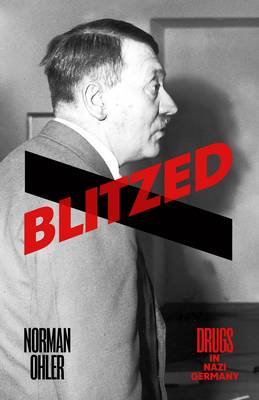
In the NY Times, one can read about Nazi policemen (Frank McDonough’s The Gestapo: The Myth and Reality of Hitler’s Secret Police) and in the NYRB, about Nazi drug-users (Norman Ohle’s Blitzed: Drugs in the Third Reich, which covers Hitler’s use of traditional stimulants as well as “by-products of uterine blood, the sexual hormone Testoviron, and even Orchikrin, a derivative of bulls’ testicles”).
In The Guardian, Julia Lovell reviews The Cultural Revolution on Trial, Alexander Cook’s history of the the 1980 trial of the Gang of Four, which, Cook argues, “exposed intriguing faultlines in a political system struggling to break with revolutionary politics,” and Colin Kidd reviews David Horspool’s Oliver Cromwell: The Protector and Cromwell’s “dithering” between political forms.
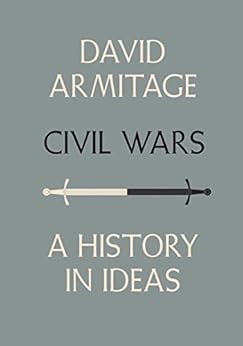
In the New Rambler, John Witt reviews David Armitage’s Civil Wars: A History in Ideas, which is a “brilliant … adventure” through civil wars throughout the ages, and shows how the contested meaning of the “civil war” is a “core feature of its significance.” Karen R. Long reviews Armitage’s book for Newsday.
In the LARB, Brian Goodman reviews Timothy Garton Ash’s Free Speech: Ten Principles for a Connected World and Josh Jacobs reviews John Pfaff’s Locked In: The True Causes of Mass Incarceration and How to Achieve Real Reform, which seeks to correct the “myth” that punishment of drug offenses and other nonviolent crimes, alone, caused mass incarceration. Rachel Lu reviewed Pfaff’s book for the National Review.
The March issue of the Federal Lawyer includes reviews of Game Over: The Inside Story of the Greek Crisis, by George Papaconstantinou; Waging War: The Clash Between Presidents and Congress, 1776 to ISIS, by David J. Barron, and Once in a Great City: A Detroit Story, by David Maraniss.
The New Books Network offers interview-reviews with Christopher Lowen Agee (on his recent book, The Streets of San Francisco: Policing and the Creation of a Cosmopolitan Liberal Politics, 1950-1972), Tyina Steptoe (on Houston Bound: Culture and Color in a Jim Crow City), Phoebe Chow (on Britain’s Imperial Retreat from China, 1900-1931), Paul Harvey (on Bounds of Their Habitation: Race and Religion in American History), and Benjamin Schonthal (on Buddhism, Politics and the Limits of Law: The Pyrrhic Constitutionalism of Sri Lanka, which examines the relationship between constitutional law and religious conflict in Sri Lanka during the twentieth and twenty-first centuries). And if your desire reviews of Blitzed parallels a young Nazi's hunger for Orchikrin, check out this interview with Norman Ohler.
In The Guardian, Julia Lovell reviews The Cultural Revolution on Trial, Alexander Cook’s history of the the 1980 trial of the Gang of Four, which, Cook argues, “exposed intriguing faultlines in a political system struggling to break with revolutionary politics,” and Colin Kidd reviews David Horspool’s Oliver Cromwell: The Protector and Cromwell’s “dithering” between political forms.
In the New Rambler, John Witt reviews David Armitage’s Civil Wars: A History in Ideas, which is a “brilliant … adventure” through civil wars throughout the ages, and shows how the contested meaning of the “civil war” is a “core feature of its significance.” Karen R. Long reviews Armitage’s book for Newsday.
In the LARB, Brian Goodman reviews Timothy Garton Ash’s Free Speech: Ten Principles for a Connected World and Josh Jacobs reviews John Pfaff’s Locked In: The True Causes of Mass Incarceration and How to Achieve Real Reform, which seeks to correct the “myth” that punishment of drug offenses and other nonviolent crimes, alone, caused mass incarceration. Rachel Lu reviewed Pfaff’s book for the National Review.
The March issue of the Federal Lawyer includes reviews of Game Over: The Inside Story of the Greek Crisis, by George Papaconstantinou; Waging War: The Clash Between Presidents and Congress, 1776 to ISIS, by David J. Barron, and Once in a Great City: A Detroit Story, by David Maraniss.
The New Books Network offers interview-reviews with Christopher Lowen Agee (on his recent book, The Streets of San Francisco: Policing and the Creation of a Cosmopolitan Liberal Politics, 1950-1972), Tyina Steptoe (on Houston Bound: Culture and Color in a Jim Crow City), Phoebe Chow (on Britain’s Imperial Retreat from China, 1900-1931), Paul Harvey (on Bounds of Their Habitation: Race and Religion in American History), and Benjamin Schonthal (on Buddhism, Politics and the Limits of Law: The Pyrrhic Constitutionalism of Sri Lanka, which examines the relationship between constitutional law and religious conflict in Sri Lanka during the twentieth and twenty-first centuries). And if your desire reviews of Blitzed parallels a young Nazi's hunger for Orchikrin, check out this interview with Norman Ohler.
Saturday, March 11, 2017
Weekend Roundup
- It's more than a year away, but you should still put this down in the calendar: "Legal History and Empires, Perspectives from the colonized" will be hosted by the University of the West Indies, Cave Hill Campus, Barbados on July 11-13, 2018. This conference follows on the "Legal Histories of the British Empire" conference in Singapore in 2012. In between, a 2015 conference was planned for Accra, Ghana. Unfortunately, "Traditions, Borrowings, Innovations & Impositions: Law in the Post-Colony and in Empire" was cancelled due to Ebola in other parts of west Africa. Watch for the Caribbean conference's Call for Papers, coming later this year.
- A recording of Federal Government Historians, the recent AHA panel, is here, courtesy of C-SPAN. “Historians who work within the federal government talked about how their institutions document and influence policy making, while striving to remain objective in a political environment. They spoke about their research projects, preservation initiatives, and how they help other historians access classified documents.”
- Also available online is Helen Z.M. Rodgers: First Woman Graduate of Buffalo Law School, a lecture by Bernadette Gargano, Lecturer in Law, Legal Analysis, Writing and Research, SUNY Buffalo Law School.
- The TOC for the Journal of Supreme Court History 41:1 (March 2017) is here.
- Today, at Princeton University: Beyond Stonewall: New Histories of Religion and Sexuality in America.
- Christopher Beauchamp, Brooklyn Law School, performs a valuable service for anyone who has yet to say goodbye to law reviews. In the Green Bag, of course.
- On Thursday, March 30 at 3:30 PM, at the Miller Center for Public Affairs at the University of Virginia, Joanne Freeman, Yale University, delivers the lecture “A Shilly-Shally Thing:” The Constitution, the Presidency, and Alexander Hamilton.
- ICYMI: Bob Darcy, emeritus from Oklahoma State University, on Why constitutional history doesn't end in 1791, in the Tulsa World.
- Updates: Looking to join a panel for this year's annual meeting of the American Society for Legal History? Check out the recent posts to the H-Law listserv. Also: “The Pope is not Lord of the World," a reading course on Francisco de Vitoria's Erste Relectio über die kirchliche Gewalt, at Max Planck this summer.
Weekend Roundup is a weekly feature compiled by all the Legal History bloggers.
Friday, March 10, 2017
JAH 103:4
 The Journal of American History 103:4 (March 2017) is out:
"Regenerating the World: The French Revolution, Civic Festivals, and the Forging of Modern American Democracy, 1793-1795," by Matthew Rainbow Hale
"Accounting for Conquest: The Price of the Louisiana Purchase of Indian Country," by Robert Lee
"Singing Exoticism: A Historical Anthropology of the G.I. Songs 'China Night' and 'Japanese Rumba,'" by Shin Aoki
"'We Can't Grow Food on All This Concrete': The Land Question, Agrarianism, and Black Nationalist Thought in the late 1960s and 1970s," by Russell Rickford
Textbooks and Teaching
"Globalizing the U.S. Survey," by Scott E. Casper and Laura Westhoff
"Globalizing the U.S. Survey-Course Textbook: Challenges, Choices, and Opportunities," by Carl J. Guarneri
"Why I'm Trying to Bring the World In," by Mary Ann Heiss
"Debating Political Economy: An Approach to Teaching the United States and the World," by Patrick Iber
"'Spanning the Globe to Bring You the Constant Variety of Sports': Teaching the United States and the World in the Cold War," by Molly M. Wood
Repetti on Taft v. Bowers
And while we’re on the topic of tax history, James R. Repetti, Boston College Law School, has posted Taft v. Bowers: The Foundation for Non-Recognition Provisions in the Income Tax, which appears in the ACTEC Law Journal 42 (2017): 23-27:
Taft v. Bowers is a Supreme Court decision that is rarely studied in law schools or discussed by scholars. Yet, it is a case of vast significance. In the Taft decision, the Supreme Court confirmed that Congress may create non-recognition exceptions to the income tax that merely defer the recognition of income, rather than permanently exclude it. If the Taft case had been decided differently, it is likely that the number of non-recognition provisions in the Internal Revenue Code ("Code") would be significantly reduced.
New Tax History from Mehrotra
Ajay K. Mehrotra, American Bar Foundation, has posted three papers. The first is A Bridge Between: Law and the New Intellectual Histories of Capitalism, which appeared in the Buffalo Law Review 64 (2016): 1-22:
The second is "From Contested Concept to Cornerstone of Administrative Practice": Social Learning and the Early History of U.S. Tax Withholding, which appeared in the Columbia Journal of Tax Law 7 (2016): 144-168:
The American historical profession has in recent years witnessed a significant revival of two subfields that were once thought to be nearly dead. Both intellectual history and what is often referred to today as the history of capitalism are flourishing. In some cases, the two fields have converged. What role has law and legal history played in this revival and convergence? How have formal and informal laws, legal institutions, and legal actors and processes informed our conceptual understanding of the origins and development of modern American capitalism? This essay explores these historiographical and programmatic questions as part of a symposium directed at “Opportunities for Law’s Intellectual History.” This brief essay explores the role of law and legal history as a bridge between the two revived subfields. It does so in three parts. Part I briefly chronicles the recent revival of the two subfields. Part II explores why law, in its broadest sense, may be particularly well suited to help integrate the convergence between intellectual history and the new histories of capitalism. Why, that is, law has been and may continue to be a bridge between the two subfields. Part III uses the history of American tax law and policy as one example to show how law is vital to our understanding of the new intellectual histories of capitalism. The essay concludes with a modest set of observations on where the new literature on law and the intellectual histories of capitalism may be headed.
The second is "From Contested Concept to Cornerstone of Administrative Practice": Social Learning and the Early History of U.S. Tax Withholding, which appeared in the Columbia Journal of Tax Law 7 (2016): 144-168:
The process of establishing a stable and effective system of taxation is a hallmark of nearly all modern states. Among the many modern administrative innovations adopted to facilitate effective tax compliance in the United States, arguably none has been more significant than the use of third-party reporting and tax withholding. Yet, like most administrative achievements, the effective implementation of information reporting and tax withholding did not occur quickly or easily. The evolution of withholding and third-party reporting thus raises a series of important historical questions: how did a contested administrative concept become an accepted and celebrated method of tax collection? What were the pivotal periods of administrative reform during this seemingly path-dependent process? Why were activists, commentators, and lawmakers opposed to the growth of this administrative practice? And, how did reformers and government officials overcome this hostility during critical junctures in the development of this important administrative achievement? One of the principal aims of this article is to attend to the early U.S. history of income tax withholding and third-party information reporting. Building upon earlier studies, this article contends that examining the pre-1943 adoption of income tax withholding is critical not only to a deeper historical understanding of how information reporting and withholding were transformed from a contested concept to an administrative cornerstone, but also to our future expectations of administrative and bureaucratic reform.The third, written with Julia Ott, The New School for Social Research, is The Curious Beginnings of the Capital Gains Tax Preference, which appeared in the Fordham Law Review 84 (2016): 2517-2536
Despite the importance of the capital gains tax preference, and the controversy it often evokes, there has been relatively little serious scholarly attention paid to the historical development of this highly significant tax provision. This Article seeks to move beyond the normative and presentist concerns for or against the tax preference to recount the empirical beginnings and early twentieth-century development of this important tax law. In exploring the curious beginnings of the capital gains tax preference, this brief Article has several aims. First, its main goal is to show that the preference is not a timeless or transhistorical concept, but rather a historically contingent one—a concept that has been shaped not purely by economic logic, but rather by political compromise and social experience. Second, it uses the capital gains tax preference to shed light on broader historiographical questions about the rise and fall of different guiding principles of American political economy. Third, by examining the shifting political coalitions and constituencies behind the tax preference, it intends to show that it is not simply wealthy and elite American taxpayers and their representatives who have supported this tax law. Rather, over time, the law has had a variety of proponents, suggesting that the provision’s persistence can be explained as much by political forces and institutional inertia as by seemingly inexorable economic reasoning. Ultimately, an exploration of the beginnings and early twentieth-century development of the capital gains tax preference provides an opportunity to think about how “we are what we tax” -- the theme of this law review symposium.
Bennett's latest Australian judicial biography
Federation
Press has published Sir
Frederick Darley: Sixth Chief Justice of New South Wales 1886-1910 by John Michael Bennett, AM.
This is the fifteenth volume in Bennett’s series on judicial lives, a project
he began as Senior Research Fellow in Law at the Australian National University
four decades ago. From the press:
J M Bennett’s Sir Frederick Darley, the new biography in his acclaimed "Lives of the Australian Chief Justices" series, describes in fascinating detail one of the most extraordinary episodes in Australian judicial history. In November 1886, the circumstances being unprecedented, New South Wales had three successive Chief Justices.

On 4 November Sir James Martin died in office. Attorney-General Want, pressing a false claim to the vacancy, nevertheless declined it. The salary was too low. The great orator W B Dalley, QC, also rejected the position. His health was failing. F M Darley, QC, was immediately approached, but having a large family to support, he also declined. The government turned to Julian Salomons, QC, who accepted and was gazetted. Almost immediately, without taking his seat, he resigned for the extraordinary reasons disclosed in Dr Bennett’s fascinating chapter on the “Phantom Chief Justice”. A perplexed government urged Darley’s reconsideration. He did so reluctantly, serving from 29 November at great financial sacrifice. As the Hon Keith Mason, AC, QC, notes in his insightful foreword, Darley’s reluctance to serve was ultimately “matched only by his reluctance to relinquish the role over 20 years later”.
Richly detailed chapters trace Darley’s progression from birth and education in Ireland to Bar practice there at a time when too many lawyers competed for too little work. Darley migrated to Sydney, succeeding beyond his wildest hopes to build a preeminent practice, command a fortune and become a Legislative Councillor.
Always regarding Australia as his “adopted country”, he retained his “Irishness” to the end. With characteristic care and precision, the author reviews Darley’s judicial career, his distinguished presidency over the Supreme Court in difficult years, and his work administering the colony on many occasions as Lieutenant-Governor.
Darley might well have retired in 1902 when he accepted a place on the English Royal Commission inquiring into the poor military performance in the Boer War. But despite illness, and resistance to social and industrial change, he persevered on the bench until his death in 1910.
Praise for the
book:
“Frederick
Darley was a prominent barrister, influential Legislative Councillor, Chief
Justice of New South Wales, and Lieutenant-Governor. Darley's career has largely
been overlooked and underestimated until this exceptional work by the esteemed
author and legal historian Dr Bennett…In this book, Dr Bennett gives us a rare
insight into the toll and sacrifice of judicial office. Further, in recounting
Darley's work in protecting the authority of the Court itself as an
institution, he gives us a unique perspective of the friction and tension that
arises between the judicial arm of government and the Executive, as well as between
the court and the media.” -Basem Seif
“Darley
became such a successful “economic immigrant” that he was reluctant to
sacrifice his large earnings as a barrister for the salary of Chief Justice.
(The book contains a cartoon from Bulletin showing Darley about to enter the
court, carrying a huge bag labelled “Income 7000 pounds per year”, being met by
an attendant who warns him “If you go in there you’ll have to leave at least
half of that bundle behind”.) But eventually, after several of his colleagues
declined the offer, he was persuaded to accept. He was to prove just
as
reluctant to give up the office in the early twentieth century….This book is a
worthy addition to J M Bennett’s extraordinary collection of judicial
portraits.” –Graham Fricke
Full
information is available here.
Fede on Justice Duvall's Slavery Cases
Andrew T. Fede’s Not the Most Insignificant Justice: Reconsidering Justice Gabriel Duvall’s Slavery Law Opinions Favoring Liberty, is now out in the Journal of Supreme Court History and is available online. He tells us:
In the article I suggest that Justice Gabriel Duvall, who shares a common ancestor with Barak Obama and Richard Cheney, has been unfairly labeled as our most insignificant U.S. Supreme Court Justice. Before Duvall’s judicial career, he, like other Maryland lawyers, including Francis Scott Key, filed suits for enslaved people seeking their liberty. While on the Supreme Court, Duvall wrote two slavery law opinions that endorsed approaches to the hearsay rule and the implied manumission doctrine, which were contrary to the pro-slavery, anti-manumission trend that swept through the Southern courts in the years before the Civil War and reached the Supreme Court in the Dred Scott case. The article also contrasts Duvall’s opinions with the views of Chief Justices John Marshall and Roger Taney.
Thursday, March 9, 2017
AJLH 57:1
Al Brophy, one of the editors of the American Journal of Legal History, has the TOC for 57:1 (March 2017) over at the Faculty Lounge.
Journal of Southern Legal History, Vol. 24
I was thrilled to see, when volume 24 (2016) of the Journal of Southern Legal History landed in my mail folder this week, that it included an article by one of my students, Blake B. Hulnick, Georgetown Law Class of 2015. Here's the TOC:
Jared McClain, "An Analysis of Charles Pinckney's Contributions at the Constitutional Convention of 1787"
Blake B. Hulnick, "Consumer Crusader: Hugo Black as Senate Investigator"
David Franham, "'A High and Delicate Trust": How Ignorance and Indignation Combined to Expand President Lincoln's Claimed Power to Suspend Habeas Corpus in the Case of John Merryman"
Dalton Windham, "'The White Ribbon Army': Politics and Race Relations of the Georgia Women's Christian Temperance Union from 1880 to 1907"
Jack L. Sammons, "Brainerd Currie at Mercer: Two Versions"
Jared McClain, "An Analysis of Charles Pinckney's Contributions at the Constitutional Convention of 1787"
Blake B. Hulnick, "Consumer Crusader: Hugo Black as Senate Investigator"
David Franham, "'A High and Delicate Trust": How Ignorance and Indignation Combined to Expand President Lincoln's Claimed Power to Suspend Habeas Corpus in the Case of John Merryman"
Dalton Windham, "'The White Ribbon Army': Politics and Race Relations of the Georgia Women's Christian Temperance Union from 1880 to 1907"
Jack L. Sammons, "Brainerd Currie at Mercer: Two Versions"
Bratton on the Separation of Corporate Law and Social Welfare
William W. Bratton, University of Pennsylvania Law School, has posted The Separation of Corporate Law and Social Welfare, which is forthcoming in the Washington and Lee Law Review:
A half century ago, corporate legal theory pursued an institutional vision in which corporations and the law that creates them protect people from the ravages of volatile free markets. That vision was challenged on the ground during the 1980s, when corporate legal institutions and market forces came to blows over questions concerning hostile takeovers. By 1990, it seemed like the institutions had won. But a different picture has emerged as the years have gone by. It is now clear that the market side really won the battle of the 1980s, succeeding in entering a wedge between corporate law and social welfare. The distance between the welfarist enterprise of a half century ago and the concerns that motivate today’s corporate legal theory has been widening ever since. This Essay examines the widening gulf. It compares the vision of the corporation and of the role it plays in society that prevailed during the immediate post-war era, before the fulcrum years of the 1980s, with the very different vision we have today, and traces the path we took from there to here. It will close with a brief prediction regarding corporate law’s future.
Cong on Marriage & Gender in Revolutionary China
Xiaoping
Cong, University of Houston, has published Marriage,
Law and Gender in Revolutionary China, 1940-1960 with Cambridge
University Press (2016). From the publisher:
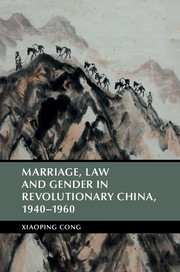
Xiaoping Cong examines the social and cultural significance of Chinese revolutionary legal practice in the construction of marriage and gender relations. Her book is an empirically rich investigation of the ways in which a 1943 legal dispute over an arranged marriage in a Chinese village became a legal, political and cultural exemplar on the national stage. This conceptually groundbreaking study revisits the Chinese Revolution and its impact on women and society by presenting a Chinese experience that cannot and should not be theorized in the framework of Western discourse. Taking a cultural historical perspective, Cong shows how the Chinese Revolution and its legal practices produced new discourses, neologisms and cultural symbols that contained China's experience in twentieth-century social movements, and how revolutionary practice was sublimated into the concept of 'self-determination', an idea that bridged local experiences with the tendency of the twentieth-century world, and that is a revolutionary legacy for China today.
Table of
Contents after the jump.
Wednesday, March 8, 2017
Lyall's "Granville Sharp's Cases on Slavery"
New from Hart Publishing: Granville Sharp's Cases on Slavery, by Andrew Lyall, a retired member of staff in Law at University College Dublin.
The press is offering a 20 percent discount to those who order online and use the discount code CV7.The purpose of Granville Sharpe's Cases on Slavery is twofold: first, to publish previously unpublished legal materials principally in three important cases in the 18th century on the issue of slavery in England, and specifically the status of black people who were slaves in the American colonies or the West Indies and who were taken to England by their masters. The unpublished materials are mostly verbatim transcripts made by shorthand writers commissioned by Granville Sharp, one of the first Englishmen to take up the cause of the abolition of the slave trade and slavery itself. Other related unpublished material is also made available for the first time, including an opinion of an attorney general and some minor cases from the library of York Minster.
The second purpose, outlined in the Introduction, is to give a social and legal background to the cases and an analysis of the position in England of black servants/slaves brought to England and the legal effects of the cases, taking into account the new information provided by the transcripts. There was a conflict in legal authorities as to whether black servants remained slaves, or became free on arrival in England.
Lord Mansfield, the chief justice of the court of King's Bench, was a central figure in all the cases and clearly struggled to come to terms with slavery. The material provides a basis for tracing the evolution of his thought on the subject. On the one hand, the huge profits from slave production in the West Indies flooded into England, slave owners had penetrated the leading institutions in England and the pro-slavery lobby was influential. On the other hand, English law had over time established rights and liberties which in the 18th century were seen by many as national characteristics. That tradition was bolstered by the ideas of the Enlightenment.
By about the 1760s it had become clear that there was no property in the person, and by the 1770s that such servants could not be sent abroad without their consent, but whether they owed an obligation of perpetual service remained unresolved.
Bilder on Appeals to Privy Council
Mary Sarah Bilder, Boston College Law School, The Relevance of Colonial Appeals to the Privy Council, in Texts and Contexts in Legal History: Essays in Honor of Charles Donahue (The Robbins Collection Center), 413-428:
For the past two centuries, the colonial appeals to the Privy Council fell between the cracks on both sides of the Atlantic. For Americans, the creation of the Supreme Court and the absence of published reports of appeals implied legal discontinuity between “American” (post-1787) law and the pre-1787 British imperial world. For the British, the loss of the Atlantic colonies and the lack of printed precedents in appeals implied legal discontinuity between English common law and the colonial appeals. Elsewhere I have written about the importance of the appeals for colonial American legal history and the history of the development of the global law of the colonial world. Here I want to focus on the importance of the appeals for English legal history.
Whittington on Faithless Electors
Keith E. Whittington, Princeton University, has posted Originalism, Constitutional Construction, and the Problem of Faithless Electors, which is forthcoming in the Arizona Law Review:
In the wake of the 2016 presidential election, opponents of President-elect Donald Trump launched an unprecedented lobbying effort to encourage the presidential electors to vote for an alternative candidate. These efforts were bolstered in part with arguments based on the original meaning and purpose of the Electoral College.
In this Article, I argue that these historical arguments are flawed as an understanding of the meaning and purpose of the presidential selection system embedded in the U.S. Constitution. Electors were not established to exercise a veto on the popular choice for president, but rather were expected to exercise discretion only in a context in which the people were unable to decide who should be president.
In addition to its practical import, the “faithless electors” example shows the theoretical value of the conceptual distinction between constitutional interpretation and constitutional construction. An appreciation of how the office of presidential elector has been constructed over time exposes how radical of a departure the lobbying effort was from American constitutional traditions and democratic commitments and illustrates a better approach to thinking about how a fixed constitutional text should be joined with a living constitutional practice.
Tuesday, March 7, 2017
Morley on the Federal Equity Power
Michael T. Morley, Barry University School of Law, has posted The Federal Equity Power:
Erie killed general law. Due to statutory, constitutional, and fairness constraints, a federal court generally must apply state substantive law in diversity and supplemental jurisdiction cases.
Since our nation’s founding, however, federal courts have treated equity as an independent branch of general law, binding of its own force in all cases that come before them. In Guaranty Trust Co. v. York, the Supreme Court held that, notwithstanding Erie, federal courts may continue to rely on traditional principles of equity derived from the English Court of Chancery to determine the availability of equitable relief, such as injunctions, receiverships, and equitable liens, in cases arising under state law. This so-called “equitable remedial rights doctrine” is based on an anachronistic misunderstanding of the nature of the federal equity power. This Article offers a bold new approach to understanding the nature and limits of the federal equity power.
There is no single body of equity law that federal courts must apply in all cases that come before them. In cases arising under state law, there is no basis in the Constitution, federal law, or Federal Rules of Civil Procedure for courts to impose their own equitable standards for relief. Rights and remedies are inextricably intertwined. The manner in which state-created rights are protected is as much a matter of substantive state policy as the state’s initial creation and allocation of those rights. A federal court must apply state statutes and precedents — not uniform, centrally devised federal standards — to determine the availability of equitable relief for state-law claims.
Conversely, for cases arising under federal statutes, the equitable principles that apply are a question of statutory interpretation. When a federal law authorizes equitable relief, a court may presume Congress intended to incorporate traditional equitable principles, absent a clear statement to the contrary in the law’s text or legislative history. And for constitutional cases, federal courts may presumptively apply traditional equitable principles as a matter of constitutional common law, unless Congress chooses to displace it. Thus, contrary to received wisdom, there is no single federal equity law. The scope of equitable relief a federal court may afford depends on the underlying law from which a claim arose.
Just Added: Historians Respond to the Advent of Trump
One of the events just added to the upcoming annual meeting of the Organization of American Historians in New Orleans, April 6-9, is the panel Historians Respond to the Advent of Trump. It meets Saturday, April 8, from 11:00 am to 12:30 pm:
Robert Self, Brown University is to chair the session. The panelists are Benjamin L. Alpers, University of Oklahoma (Authoritarianism in America); Ibram X. Kendi, University of Florida (Race and Racism); Joanne Meyerowitz, Yale University (LGBTQ Rights); Maria Cristina Garcia, Cornell University (Immigration and Refugees); Jennifer Nelson, University of Redlands (Reproductive Rights).
The advent of Donald J. Trump to the U.S. presidency demands the attention of historians, regardless of partisan affiliation or conviction. Trump's ascendancy has amplified, and potentially normalized, a civic discourse grounded in racism, sexism, xenophobia and homophobia, and derived from political scripts with long histories. His presidency seems destined to alter public policy dramatically on a range of issues, including immigration and refugees, policing and incarceration, reproductive rights, health care, climate change, corporate regulation, public funding of scientific research, arts, and the humanities, and much more. Since Donald J. Trump is the second president in sixteen years to be elected while losing the popular vote, the November 2016 result raises additional historical questions about the mechanics and democratic character of U.S. elections. While no single session can capture the full range of historical issues and entanglements raised by Trump's rise, the historians featured in this panel will frame a number of key questions for broader discussion and reflection.
Robert Self, Brown University is to chair the session. The panelists are Benjamin L. Alpers, University of Oklahoma (Authoritarianism in America); Ibram X. Kendi, University of Florida (Race and Racism); Joanne Meyerowitz, Yale University (LGBTQ Rights); Maria Cristina Garcia, Cornell University (Immigration and Refugees); Jennifer Nelson, University of Redlands (Reproductive Rights).
Balleisen's "Fraud" (in the News)
 Ralph Nader interviewed Edward Balleisen, Duke University, on his book, Fraud: An American History from Barnum to Madoff. The podcast is available here. Also, Glenn Altschuler, Cornell University, reviewed the book in the Tulsa World.
CFP: 25 Years of the Colombian Constitutional Court
Icesi University in Cali, Colombia, is calling for proposals to the “Precedente Forum: 25 years of the Colombian Constitutional Court.” We accept papers both in English or Spanish. The deadline to submit abstracts is March, 28, 2017. [The call, in Spanish and English, is here.]
Hurren on the Criminal Corpse
Elizabeth T. Hurren, University of Leicester,
has published Dissecting the
Criminal Corpse: Staging Post-Execution Punishment in Early Modern England
with Palgrave Macmillan (2016). From the press:
Those convicted of homicide were hanged on the public gallows before being dissected under the Murder Act in Georgian England. Yet, from 1752, whether criminals actually died on the hanging tree or in the dissection room remained a medical mystery in early modern society. Dissecting the Criminal Corpse takes issue with the historical cliché of corpses dangling from the hangman’s rope in crime studies. Some convicted murderers did survive execution in early modern England. Establishing medical death in the heart-lungs-brain was a physical enigma. Criminals had large bull-necks, strong willpowers, and hearty survival instincts. Extreme hypothermia often disguised coma in a prisoner hanged in the winter cold. The youngest and fittest were capable of reviving on the dissection table. Many died under the lancet. Capital legislation disguised a complex medical choreography that surgeons staged. They broke the Hippocratic Oath by executing the Dangerous Dead across England from 1752 until 1832.
Remarkably
(by North American standards), this book is open access under a CC-BY license. You can
download it for free here.
Dissecting the Criminal Corpse is
part of the Palgrave series “Historical Studies in the Criminal Corpse and its
Afterlife.”
Here’s the
Table of Contents:
Part
I-Introduction
Ch.1: The
Condemned Body Leaving the Courtroom
Ch.2:
Becoming Really Dead: Dying by
Degrees
Ch.3: In
Bad Shape: Sensing the Criminal Corpse
Part II-
Preamble
Ch.4:
Delivering Post-Mortem ‘Harm’: Cutting the Corpse
Ch.5:
Mapping Punishmnet: Provincial Places to Dissect
Ch.6: The
Disappearing Body: Dissection to the Extremities
Ch.7: “He that Hath an Ill-Name Is Half-Hanged”: The
Anatomical Legacy of the Criminal Corpse
Full
information is available here.
Law and Colonial Violence: A Workshop Report
[We are grateful to Lia Brazil, a PhD Candidate in the history of International Law and colonial warfare at the European University Institute, Florence, for this very full report on a day-long workshop at Queen Mary University of London.]
I recently attended a workshop on ‘Law and Colonial Violence', at Queen Mary University of London, on February 14th. Organised by Boyd van Dijk (EUI/KCL), Jacob Ramsay Smith (QMUL) and Joseph McQuade (Cambridge), it drew together a diversity of speakers from the fields of history, social sciences, and law, which resulted in a fascinating day of discussion. Welcoming participants to the workshop, Ramsay Smith argued that this interdisciplinary approach intended to bring together different analyses and concepts of colonial violence and law, alongside both international human rights law, and laws of war, to enrich understanding of the formation, operation and disintegration of Empires, and their legacies. He described the wide variety of agents populating the papers, from those involved in policing the colonised state, to ‘non-official actors', including settlers, businessman, and planters, as well as indigenous actors, who often challenged the colonial state's monopoly of force. Certain papers also highlighted the role of jurists, and Ramsay Smith argued, that they, and even the law itself, may be seen as deeply implicated in the creation and maintenance of Empire, including its utility of violence. His speech touched on many of these major themes of the conference, before finishing to reflect on how an understanding of this past may be critical for understanding aspects of modern law.
Focusing on the cases of India and Egypt, the first panel, ‘Imperial Policing, Punishment and Control' presented a coherent overview of the legal mechanisms that facilitated colonial control through violence and repression within the British Empire. Opening the session, Alastair McClure (Cambridge), addressed both the excessive forms of violence in colonial governance, such as the 1864 Whipping Act, and the growing anti-colonial response to these by Indian actors in newspapers and pamphlets. His discussion of the lexicon of imperial violence presented strong parallels with the paper by Mark Condos (QMUL), who also focused on India. Condos' analysis of the British implementation of emergency legislation in India against the perceived threat posed by ‘fanatics' and ‘terrorists' highlighted the malleability of such terms, across the colony, to permit the swift application of the law, mechanisms which he argued have a strong resonance with today's discourses. Focusing on the Egyptian case, Ifdal Elsaket (Leiden/NVIC), also pointed to fear, particularly that of revolt, as a motivation for extreme legal measures, a factor exacerbated for the British in Egypt by its geographic proximity to the Ottoman Empire during the Great War. Like Condos, her paper discussed the continuities in imperial policing laws, particularly in the case of the 1928 Assembly Law, a version of which is still applied in Egypt today. Together these papers emphasised the way law interacted with colonial society, often providing what Elsaket termed "a skeleton code" for governance, which allowed other restrictions to be fleshed out as needed. By institutionalising excessive violence or repression in the law, as ‘states of exception', measures such as executions, or ad hoc trials, could be framed with legal respectability – until such language broke down.
During the second panel, the workshop's focus broadened from domestic colonial law, to the law of wars and conquest, and here, the papers employed varied approaches to understanding the construction and application of the law. Andrew Arsan (Cambridge) emphasised the political dimensions in the application of law internationally in his assessment of the dual restoration of justice in Ottoman Mount Lebanon in 1860 by an international commission and a French expeditionary force. His paper addressed complex layers of sovereignty, particularly the issue of Ottoman Turkey's exclusion from the law of nations, and thus, civilisation. Following this Claire Vergerio (Oxford), presented on the ‘intellectual revival' of the Italian jurist Alberico Gentili from 1874, arguing Gentili's De iure belli (1598) was also used by nineteenth century international lawyers to justify and legitimate the exclusionary nature of the laws of war. Finally, Edward Cavanagh (Cambridge) returned to the practice of warfare through conquest in the case of the 1919 Re Southern Rhodesia enquiry. Here, the existence of colonial conquest and violence at the intersection between property rights, English Common Law, and colonial corporations, such as the British South Africa Company, indicated the significance of territorial control and expansion to the construction and operation of colonial laws. Drawing these papers together, Elisabeth Leake (Leeds) placed emphasis on certain exclusionary dimensions of late nineteenth and early twentieth international law, premised on the European concept of sovereignty.
New methods and approaches to international law remained central to the discussion during the third panel, where papers explored the law as a point of contest, illuminating the existence of levels of subaltern agency, and of alternative perspectives on international law. Therefore, when discussing the repatriation of the skull of Sultan Mkwawa - leader of the Wahehe tribe of the former German colony in South-East Africa - as part of the Treaty of Versailles, Jeremiah Garsha (Cambridge) emphasised "reading against the grain of the archives". By focusing on the language through which the skull was framed in competing legal arguments, his paper illustrated a measure of agency possessed by the colonised tribe in their ability to transverse European legal systems. Similarly, by contextualising the dissent of Radhabinod Pal at the Tokyo Trial (1946 – 1948) alongside his broader legal writings, Milinda Banerjee (Ludwig-Maxmilian University/Presidency University) pointed to the ability of a ‘global intellectual history' to explain the emergence of a discourse non-European, or what he termed, ‘subaltern sovereignty'. Situating her analysis in the context of discussions about the revision of the Geneva Conventions in the 1970s, Eleanor Davey (Manchester), explored the relationship between so-called ‘non-state actors' and emerging international humanitarian law, highlighting the role and tensions surrounding the participation of national liberation movements, and humanitarian organisations such as the International Committee of the Red Cross, and the World Health Organization. Rotem Giladi's paper (Helsinki/Jerusalem), presented a novel approach to a well-worn historical subject, through an investigation of the silence of international lawyers in response to the scandal generated by the occupation of the Rhine by French colonial troops at the Great War. Explicit in his paper were two significant considerations for future research: the relationship between the civilising mission and race, and that between the law and gender.
For me, two themes were particularly resonant throughout the day. The first, the concept of ‘change and continuity' in examining law and colonial violence, was discussed in the aftermath of the first session by Kim Wagner (QMUL), who suggested that the long focus of the papers both bridged a divide between the nineteenth and twentieth century, and questioned the Great War as a point of rupture. This theme was explored again in response to the final panel by Van Dijk, who pointed to a shift in the vocabulary of colonialism after 1919 and the Paris Peace Conferences. However, he described colonialism as ‘reconfigured', not necessarily ‘overcome', and emphasised the continued legacies of Empire for international law throughout the twentieth century.
Different notions of colonial violence and control was the second major theme, and I was struck by how it weaved its way throughout the papers, though varying in scale, discourse, and resonance. It ranged from the ‘spectacles' of extreme repressive violence permitted by colonial legislation, like those discussed by McClure and Condos in relation to British India, or the public hangings and shootings described by Arsan on Mount Lebanon, to more subtle forms, as apparent in the control over the colonised body seen in Garsha's discussion of the Wahehe skull. Examples of violence and repression through conventional warfare, and small wars, also proliferated, with particular attention to their aftermath, such as Cavanagh's study of the enquiry into the 1893 conquest in Rhodesia, or Giladi's examination of the ‘Horror on the Rhine'. Taken together, the papers therefore presented an image of the law as a mechanism for legitimising and sanctioning colonial violence, as a means of repression, control, and conquest. However, as in the last panel, they provided insight to the ways in which the norms imposed by the law could to an extent be used, re-adapted, and critiqued, by the subaltern themselves.
Ending the day, these two themes seemed unified in the keynote speech, delivered by Dirk Moses (University of Sydney) and entitled "Empire, Resistance and Security: The Law of Nations from Vitoria to Gaza". Here, in an expansive exploration of the development of the laws of occupied territory, Moses discussed the continued alignment of our international legal system, particularly international humanitarian law, with settler expansion. He argued that the legacy of Imperial mentalities remains integral to the law today, which he illustrated through reference to the Israeli-Palestinian conflict. Tracing the development of the law of occupied territory through pivotal theorists of international law, including Vitoria, Vattel, Lieber, and Oppenheim, Moses showed how doctrine on the ‘right of resistance' was framed through European experience of war, and the colonial encounter. Building on discussions earlier in the day, he discussed the limits of the applicability of laws of war towards ‘uncivilised' people. Moses argued that the same understanding framed the legitimacy of resistance during WWII, ensuring only by the Geneva Conventions of 1949 did resistance in occupation receive extended, though still limited, protection. Drawing these strands towards the present, Moses argued that the current ‘transformative occupation' of Palestinian territory by Israel is facilitated by humanitarian law's prioritisation of the security and mobility rights of colonists, over the occupied. In this instance, he argues it is possible to see within international law both the reflected asymmetries of the international system, and the residue of the unequal imperial global order of the nineteenth century. Strikingly, Moses framed his address with the writings of Raphael Lemkin, the Polish lawyer popularly remembered for coining the term genocide. Lemkin's work led to the classification of Nazi colonial practices and expansion through Lebensraum as genocide. Yet, as Moses concluded, despite these efforts, imperial legacies within international humanitarian law allow the conquest and annexation of occupied territory to remain possible today.
Concluding the day, participants engaged in a roundtable discussion, where Gerry Simpson (LSE) addressed some aspects of Moses' lecture. He agreed with international humanitarian law's capacity to facilitate violence, and questioned whether international law today can be considered egalitarian. However, Simpson also pointed to a distinction between criticism and critique of humanitarian law, and discussed the need to ‘stabilise' the law by assessing its varied sources, including its deep historical texture. Finally, he posed questions of whether it is possible in a fragmented legal universe to talk of a single international law. This awareness of the transfer of meaning across geographical contexts was also discussed during the roundtable by Wagner, who turned attention to how the terminology of ‘savagery' made certain types of violence permissible. Providing the last comments, Leake returned to the idea of sovereignty, arguing that modern international law necessitates the existence of the nation-state. She also pointed to a tension, present in many of the day's papers, between the aspirations of legal theory, and the practice of violence. This view of a fragmented, rather than homogenous, legal universe was certainly explored by panellists, who presented a complex view of the law over the last century and a half, as a mechanism for both limiting and exerting colonial aspirations and control, as well as subverting it.
I recently attended a workshop on ‘Law and Colonial Violence', at Queen Mary University of London, on February 14th. Organised by Boyd van Dijk (EUI/KCL), Jacob Ramsay Smith (QMUL) and Joseph McQuade (Cambridge), it drew together a diversity of speakers from the fields of history, social sciences, and law, which resulted in a fascinating day of discussion. Welcoming participants to the workshop, Ramsay Smith argued that this interdisciplinary approach intended to bring together different analyses and concepts of colonial violence and law, alongside both international human rights law, and laws of war, to enrich understanding of the formation, operation and disintegration of Empires, and their legacies. He described the wide variety of agents populating the papers, from those involved in policing the colonised state, to ‘non-official actors', including settlers, businessman, and planters, as well as indigenous actors, who often challenged the colonial state's monopoly of force. Certain papers also highlighted the role of jurists, and Ramsay Smith argued, that they, and even the law itself, may be seen as deeply implicated in the creation and maintenance of Empire, including its utility of violence. His speech touched on many of these major themes of the conference, before finishing to reflect on how an understanding of this past may be critical for understanding aspects of modern law.
Focusing on the cases of India and Egypt, the first panel, ‘Imperial Policing, Punishment and Control' presented a coherent overview of the legal mechanisms that facilitated colonial control through violence and repression within the British Empire. Opening the session, Alastair McClure (Cambridge), addressed both the excessive forms of violence in colonial governance, such as the 1864 Whipping Act, and the growing anti-colonial response to these by Indian actors in newspapers and pamphlets. His discussion of the lexicon of imperial violence presented strong parallels with the paper by Mark Condos (QMUL), who also focused on India. Condos' analysis of the British implementation of emergency legislation in India against the perceived threat posed by ‘fanatics' and ‘terrorists' highlighted the malleability of such terms, across the colony, to permit the swift application of the law, mechanisms which he argued have a strong resonance with today's discourses. Focusing on the Egyptian case, Ifdal Elsaket (Leiden/NVIC), also pointed to fear, particularly that of revolt, as a motivation for extreme legal measures, a factor exacerbated for the British in Egypt by its geographic proximity to the Ottoman Empire during the Great War. Like Condos, her paper discussed the continuities in imperial policing laws, particularly in the case of the 1928 Assembly Law, a version of which is still applied in Egypt today. Together these papers emphasised the way law interacted with colonial society, often providing what Elsaket termed "a skeleton code" for governance, which allowed other restrictions to be fleshed out as needed. By institutionalising excessive violence or repression in the law, as ‘states of exception', measures such as executions, or ad hoc trials, could be framed with legal respectability – until such language broke down.
During the second panel, the workshop's focus broadened from domestic colonial law, to the law of wars and conquest, and here, the papers employed varied approaches to understanding the construction and application of the law. Andrew Arsan (Cambridge) emphasised the political dimensions in the application of law internationally in his assessment of the dual restoration of justice in Ottoman Mount Lebanon in 1860 by an international commission and a French expeditionary force. His paper addressed complex layers of sovereignty, particularly the issue of Ottoman Turkey's exclusion from the law of nations, and thus, civilisation. Following this Claire Vergerio (Oxford), presented on the ‘intellectual revival' of the Italian jurist Alberico Gentili from 1874, arguing Gentili's De iure belli (1598) was also used by nineteenth century international lawyers to justify and legitimate the exclusionary nature of the laws of war. Finally, Edward Cavanagh (Cambridge) returned to the practice of warfare through conquest in the case of the 1919 Re Southern Rhodesia enquiry. Here, the existence of colonial conquest and violence at the intersection between property rights, English Common Law, and colonial corporations, such as the British South Africa Company, indicated the significance of territorial control and expansion to the construction and operation of colonial laws. Drawing these papers together, Elisabeth Leake (Leeds) placed emphasis on certain exclusionary dimensions of late nineteenth and early twentieth international law, premised on the European concept of sovereignty.
New methods and approaches to international law remained central to the discussion during the third panel, where papers explored the law as a point of contest, illuminating the existence of levels of subaltern agency, and of alternative perspectives on international law. Therefore, when discussing the repatriation of the skull of Sultan Mkwawa - leader of the Wahehe tribe of the former German colony in South-East Africa - as part of the Treaty of Versailles, Jeremiah Garsha (Cambridge) emphasised "reading against the grain of the archives". By focusing on the language through which the skull was framed in competing legal arguments, his paper illustrated a measure of agency possessed by the colonised tribe in their ability to transverse European legal systems. Similarly, by contextualising the dissent of Radhabinod Pal at the Tokyo Trial (1946 – 1948) alongside his broader legal writings, Milinda Banerjee (Ludwig-Maxmilian University/Presidency University) pointed to the ability of a ‘global intellectual history' to explain the emergence of a discourse non-European, or what he termed, ‘subaltern sovereignty'. Situating her analysis in the context of discussions about the revision of the Geneva Conventions in the 1970s, Eleanor Davey (Manchester), explored the relationship between so-called ‘non-state actors' and emerging international humanitarian law, highlighting the role and tensions surrounding the participation of national liberation movements, and humanitarian organisations such as the International Committee of the Red Cross, and the World Health Organization. Rotem Giladi's paper (Helsinki/Jerusalem), presented a novel approach to a well-worn historical subject, through an investigation of the silence of international lawyers in response to the scandal generated by the occupation of the Rhine by French colonial troops at the Great War. Explicit in his paper were two significant considerations for future research: the relationship between the civilising mission and race, and that between the law and gender.
For me, two themes were particularly resonant throughout the day. The first, the concept of ‘change and continuity' in examining law and colonial violence, was discussed in the aftermath of the first session by Kim Wagner (QMUL), who suggested that the long focus of the papers both bridged a divide between the nineteenth and twentieth century, and questioned the Great War as a point of rupture. This theme was explored again in response to the final panel by Van Dijk, who pointed to a shift in the vocabulary of colonialism after 1919 and the Paris Peace Conferences. However, he described colonialism as ‘reconfigured', not necessarily ‘overcome', and emphasised the continued legacies of Empire for international law throughout the twentieth century.
Different notions of colonial violence and control was the second major theme, and I was struck by how it weaved its way throughout the papers, though varying in scale, discourse, and resonance. It ranged from the ‘spectacles' of extreme repressive violence permitted by colonial legislation, like those discussed by McClure and Condos in relation to British India, or the public hangings and shootings described by Arsan on Mount Lebanon, to more subtle forms, as apparent in the control over the colonised body seen in Garsha's discussion of the Wahehe skull. Examples of violence and repression through conventional warfare, and small wars, also proliferated, with particular attention to their aftermath, such as Cavanagh's study of the enquiry into the 1893 conquest in Rhodesia, or Giladi's examination of the ‘Horror on the Rhine'. Taken together, the papers therefore presented an image of the law as a mechanism for legitimising and sanctioning colonial violence, as a means of repression, control, and conquest. However, as in the last panel, they provided insight to the ways in which the norms imposed by the law could to an extent be used, re-adapted, and critiqued, by the subaltern themselves.
Ending the day, these two themes seemed unified in the keynote speech, delivered by Dirk Moses (University of Sydney) and entitled "Empire, Resistance and Security: The Law of Nations from Vitoria to Gaza". Here, in an expansive exploration of the development of the laws of occupied territory, Moses discussed the continued alignment of our international legal system, particularly international humanitarian law, with settler expansion. He argued that the legacy of Imperial mentalities remains integral to the law today, which he illustrated through reference to the Israeli-Palestinian conflict. Tracing the development of the law of occupied territory through pivotal theorists of international law, including Vitoria, Vattel, Lieber, and Oppenheim, Moses showed how doctrine on the ‘right of resistance' was framed through European experience of war, and the colonial encounter. Building on discussions earlier in the day, he discussed the limits of the applicability of laws of war towards ‘uncivilised' people. Moses argued that the same understanding framed the legitimacy of resistance during WWII, ensuring only by the Geneva Conventions of 1949 did resistance in occupation receive extended, though still limited, protection. Drawing these strands towards the present, Moses argued that the current ‘transformative occupation' of Palestinian territory by Israel is facilitated by humanitarian law's prioritisation of the security and mobility rights of colonists, over the occupied. In this instance, he argues it is possible to see within international law both the reflected asymmetries of the international system, and the residue of the unequal imperial global order of the nineteenth century. Strikingly, Moses framed his address with the writings of Raphael Lemkin, the Polish lawyer popularly remembered for coining the term genocide. Lemkin's work led to the classification of Nazi colonial practices and expansion through Lebensraum as genocide. Yet, as Moses concluded, despite these efforts, imperial legacies within international humanitarian law allow the conquest and annexation of occupied territory to remain possible today.
Concluding the day, participants engaged in a roundtable discussion, where Gerry Simpson (LSE) addressed some aspects of Moses' lecture. He agreed with international humanitarian law's capacity to facilitate violence, and questioned whether international law today can be considered egalitarian. However, Simpson also pointed to a distinction between criticism and critique of humanitarian law, and discussed the need to ‘stabilise' the law by assessing its varied sources, including its deep historical texture. Finally, he posed questions of whether it is possible in a fragmented legal universe to talk of a single international law. This awareness of the transfer of meaning across geographical contexts was also discussed during the roundtable by Wagner, who turned attention to how the terminology of ‘savagery' made certain types of violence permissible. Providing the last comments, Leake returned to the idea of sovereignty, arguing that modern international law necessitates the existence of the nation-state. She also pointed to a tension, present in many of the day's papers, between the aspirations of legal theory, and the practice of violence. This view of a fragmented, rather than homogenous, legal universe was certainly explored by panellists, who presented a complex view of the law over the last century and a half, as a mechanism for both limiting and exerting colonial aspirations and control, as well as subverting it.
Monday, March 6, 2017
Scalia Papers to HLS
Our friends at Historical and Special Collections Department of the Harvard Law School Library report that Justice Scalia's papers are going to HLS.
Cohen on the NYC Women's Court
Amy J. Cohen, Ohio State University, Michael E. Moritz College of Law, has posted Trauma and the Welfare State: A Genealogy of Prostitution Courts in New York City, forthcoming in the Texas Law Review:
At least since the early twentieth century, informal specialized prostitution courts have tried to double as social welfare agencies. For this reason, prostitution courts illustrate in particularly explicit ways how public welfare administration and criminal court administration share similar ideas and practices and how these ideas and practices reinvent themselves over time. The article traces three moments of prostitution court reform in New York City: the New York Women’s Court that opened in Manhattan in 1910, the Midtown Community Court that opened in Manhattan in 1993, and four new prostitution courts that opened in New York City in 2013. It examines how court reformers in each moment use informal procedure to promote social welfare, social control, and individual responsibility, and it ties each approach to changing conceptions of the American welfare state. Ultimately, the article argues that the genealogy of prostitution courts illuminates for the present how court reformers are using the language of trauma to negotiate the welfare logics of today.
That Harvard Conference on Slavery and the Universities
ICYMI: Jennifer Schuessler’s story in the New York Times, Confronting Academia’s Ties to Slavery:
In 1976, archivists at Harvard’s natural history museum opened a drawer and discovered a haunting portrait of a shirtless enslaved man named Renty, gazing sorrowfully but steadily at the camera. Taken on a South Carolina plantation in 1850, it had been used by the Harvard biologist Louis Agassiz to formulate his now-discredited ideas about racial difference.[A quotation of Alfred Brophy and more, here.]
On Friday, Harvard’s president, Drew Gilpin Faust, stood at a lectern under a projection of Renty’s face and began a rather different enterprise: a major public conference exploring the long-neglected connections between universities and slavery.
Cushman on the Missing Justice in Coleman v. Miller
Barry Cushman, Notre Dame Law School, has posted The Missing Justice in Coleman v. Miller, forthcoming in the Journal of Supreme Court History 42 (2017) 67-76:
All nine of the sitting justices took part in the 1939 case of Coleman v. Miller, which concerned whether the Kansas legislature had ratified the pending Child Labor Amendment. One of the issues in the case was decided by a vote of 5-4, while another was resolved by a vote of 7-2. With respect to a third issue, however, Chief Justice Charles Evans Hughes reported that it presented “a question upon which the Court is equally divided and therefore the Court expresses no opinion upon that point.”
Scholars understandably have been puzzled by how a decision in which a full Court participated could have been “equally divided” on an issue. Shortly after the decision was handed down, the Yale Law Journal published an anonymous Note entitled Sawing a Justice in Half, which remarked that the division “should astonish even a Yogi magician.” The perplexed author concluded by asking, “is it possible to saw a Justice vertically in half during a conference and have him walk away whole?” This brief article seeks to determine what happened in Coleman, and to pin down the identity of the missing justice
Tenure-Track Position in Law and Society with a Focus on the Global South
[We have the following announcement. (Note the deadline of April 7, 2017.)]
The Department of History and the Department of Political Science at Concordia University in Montreal, Quebec, seek applications for a tenure-track cross-appointment in Law and Society with a focus on the Global South. We welcome applications from scholars with research in law and society in colonial, postcolonial, international, transnational, or comparative contexts. Research specialties may include, but are not limited to: transitional justice, empire and the law, peace and conflict studies, legal pluralism, and law in everyday social life and informal contexts. Applicants must have a Ph.D., or be near completion of a doctoral degree, in History, Political Science, or a relevant discipline. The successful candidate will be housed in one of the two departments and will contribute to the interdisciplinary Minor in Law and Society.
Applications must consist of a cover letter, current curriculum vitae, a writing sample, a statement of teaching philosophy/interests, a statement of research achievements/interests, and evidence of teaching effectiveness, and should be addressed to the Hiring Committee. Candidates must also arrange to have three letters of reference sent directly to:
Dr. Peter Gossage
Chair, Department of History
Concordia University
1455 de Maisonneuve Blvd. W.
LB 1001.05
Montréal, Québec, Canada, H3G 1M8
History.Chair@concordia.ca
Subject to budgetary approval, we anticipate filling this position, normally at the rank of Assistant Professor, for August 1, 2017. Completed applications are due by April 7, 2017, after which assessment will immediately begin. Inquiries about the position should be directed to Dr. Gossage or to Dr. Marlene Sokolon, Chair, Department of Political Science: PoliticalScience.Chair@concordia.ca
All qualified candidates are encouraged to apply; however, Canadian citizens and permanent residents of Canada will be given priority. Concordia University is committed to employment equity.
The Department of History and the Department of Political Science at Concordia University in Montreal, Quebec, seek applications for a tenure-track cross-appointment in Law and Society with a focus on the Global South. We welcome applications from scholars with research in law and society in colonial, postcolonial, international, transnational, or comparative contexts. Research specialties may include, but are not limited to: transitional justice, empire and the law, peace and conflict studies, legal pluralism, and law in everyday social life and informal contexts. Applicants must have a Ph.D., or be near completion of a doctoral degree, in History, Political Science, or a relevant discipline. The successful candidate will be housed in one of the two departments and will contribute to the interdisciplinary Minor in Law and Society.
Applications must consist of a cover letter, current curriculum vitae, a writing sample, a statement of teaching philosophy/interests, a statement of research achievements/interests, and evidence of teaching effectiveness, and should be addressed to the Hiring Committee. Candidates must also arrange to have three letters of reference sent directly to:
Dr. Peter Gossage
Chair, Department of History
Concordia University
1455 de Maisonneuve Blvd. W.
LB 1001.05
Montréal, Québec, Canada, H3G 1M8
History.Chair@concordia.ca
Subject to budgetary approval, we anticipate filling this position, normally at the rank of Assistant Professor, for August 1, 2017. Completed applications are due by April 7, 2017, after which assessment will immediately begin. Inquiries about the position should be directed to Dr. Gossage or to Dr. Marlene Sokolon, Chair, Department of Political Science: PoliticalScience.Chair@concordia.ca
All qualified candidates are encouraged to apply; however, Canadian citizens and permanent residents of Canada will be given priority. Concordia University is committed to employment equity.
Saturday, March 4, 2017
Weekend Roundup
- Did you publish a book on non-US legal history in 2015 or 2016? Don't forget to nominate it for the ASLH's new book prize! The deadline for the Peter Gonville Stein Award is March 15, 2017.
- If you work on law and religion, you may be interested in this conference on conversion at the Newberry Library (Sept.14-16, 2017). CFP here.
- Check out the Women’s History Month Portal at the Library of Congress.
- The University of Minnesota's Immigration History Research Center launches #ImmigrationSyllabus
- Georgetown University’s Working Group on Slavery, Memory, and Reconciliation has released its report.
- In the February issue of The American Historian, published by the Organization of American Historians and distributed to its members, Glen Jeansonne rehabilitates Herbert Hoover, Sonya Ramsey “traces the history of public schools following the seminal Brown v. Board decision,” and a president (the OAH’s that is) takes on fake news.
- The blog of the Historical Society of the Courts of the State of New York profiles Charlotte Smallwood-Cook, the first woman District Attorney in New York State.
- Check out the newly designed portal to the website of the Miller Center for Public Affairs at the University of Virginia.
- ICYMI: Susan Rose-Ackerman on the legislative assault on the Administrative Procedure Act (1946); the NYT on the New York Municipal Archives.
- ICYMI Update: Jed Handelsman Shugerman on the early years of the US Department of Justice, in Emily Bazelon's article in the New York Times Magazine.
Weekend Roundup is a weekly feature compiled by all the Legal History bloggers.
Friday, March 3, 2017
Lubin on Vedic Ritual Codes
Timothy Lubin, Washington and Lee University, has posted Custom in the Vedic Ritual Codes as an Emergent Legal Principle, which appeared in the Journal of the American Oriental Society 136 (2016): 669–687:
The degree to which the early dharma literature was an extrapolation from the earlier ritual codes can be seen from a number of shared features of form and content. One of these that has not received more than passing notice is the fact that the Dharmasastric principle of regarding customary norms as a valid basis of dharma, both in general (sadācāra, śiṣṭācāra) and in limited spheres (deśācāra, grāmadharma, kuladharma, etc.), has its origins in ritual rules in the śrautasūtras and gṛhyasūtras show that already in these rulebooks established practices of particular social groups were accepted as a valid authority in certain contexts where explicit textual warrant was lacking, and that a further distinction was there made between the general norms of experts and the valid particular norms of locality or social group.
Schneiderman's Genealogy of Canadian Constitutional Culture
David Schneiderman, University of Toronto Faculty of Law, has posted Canadian Constitutional Culture: A Genealogical Account, which is forthcoming in the Oxford Handbook of the Canadian Constitution, ed. Nathalie Des Rosiers, Patrick Macklem, and Peter Oliver:
How might one explain Canadian constitutional practices that have produced outcomes that are, within limits, heterogeneous and pluralistic? The chapter inquires into this question by tapping into constitutional culture, referring to dominant understandings of the fundamental norms that guide relations between citizens and states and between institutions of the state. Contemporary constitutional culture, it is argued, is partly the product of choices made in the past by imperial and early Canadian authorities. Taking a genealogical approach to Canadian constitutional culture, the chapter examines three episodes in Canada’s constitutional past that help to frame discussions about the constitutional present. Each illustrates the difficulty of governing those who are different; of aspiring to homogeneity while necessitating some heterogeneity in practice. They are representative samples of the waves of accommodation and assimilation that have been recurring features in Canada’s constitutional story and illustrative of the basic elements that make up Canadian constitutional culture.
Thursday, March 2, 2017
Bernstein on Hawley on Substantive Due Process
David Bernstein, George Mason University Antonin Scalia Law School, has posted The History Of ‘Substantive’ Due Process: It's Complicated, which appeared in the Texas Law Review 95 (2016): 1-11:
The history of what has come to be known as substantive due process is fraught with political implications, even more so now that same-sex marriage has joined abortion as a right protected by the Court under the rubric of due process. It’s tempting to create a simplified version of the past that explains how we got from point A to point B, and that implicitly or explicitly teaches some profound lesson about the present. History, rarely truly lends itself to such convenience. It’s complicated.
With that in mind, this essay discusses a recent Texas Law Review article by Joshua Hawley. Hawley seeks to demonstrate that modern substantive due process jurisprudence was a novel invention of the Warren and Burger Courts, having no significant antecedents in the due process jurisprudence of the so-called Lochner era. Hawley makes some eminently reasonable points, especially with regard to how the Court replaced its historic natural-rights-based constitutionalism with a positivist understanding of the law that invites Justices to read their own philosophical views into the Due Process Clauses. Nevertheless, not all of Hawley’s claims are persuasive. In this essay, I complicate the story Hawley tells, by discussing alternative and additional explanations for the developments he discusses
Oxford "LibGuides" on Legal History
Check out the "Oxford LibGuides”on legal history--that is, guides, resources on legal history at Oxford University. Elizabeth Wells
prepared guides on Ancient Law (Excluding Roman Law); Legal History:
Western Europe; Legal History: England & Common Law Tradition;
and International Law: Origins & History. Margaret Watson prepared the guide on Roman Law.
Wednesday, March 1, 2017
Goldstein on Nativism and the Constitution
Jared A. Goldstein, Roger Williams University School of Law, has posted Unfit for the Constitution: Nativism and the Constitution, from the Founding Fathers to Donald Trump.
The executive order on travel issued by President Donald Trump in January 2017 does not use the word Muslim but instead identifies the foreigners who should be barred from entry as those who “bear hostile attitudes” toward the United States “and its founding principles” and who “do not support the Constitution.” As this article shows, anti-immigrant movements have long used hostility-to-the-Constitution as the touchstone for identifying unwanted immigrants. In the 1840s, the Know-Nothings opposed Irish immigration based on a belief that Catholicism was incompatible with the Constitution. In 1882, when Congress enacted the Chinese Exclusion Act, it declared that the Chinese were too foreign to embrace constitutional principles. In 1924, Congress enacted the National Origins Act out of the belief that members of the so-called Nordics race alone were genetically disposed to embrace constitutional values, while Jews, Italians, Poles, and others would destroy the nation’s constitutional system. Congress repudiated these nativist beliefs in 1965 when it adopted the Immigration and Nationality Act, which declares that people of any race or nationality are equally capable of embracing the nation’s constitutional values.
The executive order, however, demonstrates the persistence of the nativist belief that foreigners who do not share traits considered prototypically American are likely to harbor hostility to constitutional values. The history of nativism and the Constitution explored in this article reveals that the belief that American identity is defined by devotion to a common creed embodied in the Constitution has long been intertwined with beliefs that American identity is also defined by race, religion, and ethnicity.
Cahillane on the Irish Free State Constitution
Out with
Manchester University Press is Drafting the
Irish Free State Constitution by Laura Cahillane, University of
Limerick. From the publisher:
Drafting the Irish Free State Constitution challenges the myths surrounding the Irish Free Constitution by analysing the document in its proper historical context, by looking at how the Constitution was drafted and elucidating the true nature of the document. It examines the reasons why the Constitution did not function as anticipated and investigates whether the failures of the document can be attributed to errors of judgement in the drafting process or to subsequent events and treatment of the document.
As well as giving a comprehensive account of the drafting stages and an analysis of the three alternative drafts for the first time, the book considers the intellectual influences behind the Constitution and the central themes of the document. This work constitutes a new look at this historic document through a legal lens and the analysis benefits from the advantage of hindsight as well as from the fact that the archival material is now available.
Here is the
TOC:
Foreword by
Mr Justice Gerard Hogan
Introduction
1. The
Constitution Committee and the beginning of the drafting process
2. The
drafts
3.
Consideration by the government of the three drafts
4. British
reaction to the draft constitution
5. Debates
in the constituent assembly
6. Themes
and influences
7. The
people's constitution
8.
Anti-party politics
9. The
legacy of the Irish Free State Constitution
Conclusion
Further
information is available here.
CFP: Views of Legal Culture Across Time
[Via Legal Scholarship Blog, we have the following announcement.]
Call for Papers: XXIIIrd Annual Forum of the Association of Young Legal Historians in Naples, May 30 - June 1, 2017. Under the title History of Law and Other Humanities: Views of the Legal Culture across the Time, the Forum will be devoted to the Relations between Law and Humanities, in order to propose new instruments of research. Presentations should be in English and should not exceed 20 minutes. Submit an abstract, CV, and list of publications by March 15, 2017, to forum 2017aylh[@]gmail.com.
Call for Papers: XXIIIrd Annual Forum of the Association of Young Legal Historians in Naples, May 30 - June 1, 2017. Under the title History of Law and Other Humanities: Views of the Legal Culture across the Time, the Forum will be devoted to the Relations between Law and Humanities, in order to propose new instruments of research. Presentations should be in English and should not exceed 20 minutes. Submit an abstract, CV, and list of publications by March 15, 2017, to forum 2017aylh[@]gmail.com.
Subscribe to:
Posts (Atom)