Following work published in 2006, this article explores the history of the phrase 'intellectual property' as it was used in the 19th century and early 20th century by jurists speaking French, Spanish, Italian, and English. During this period 'intellectual property' was used by many commentators to refer to copyright alone; indeed, in Spanish, the phrase unambiguously meant just copyright. The article sketches out how officials in WIPO's predecessor organization rechristened it an 'intellectual property' entity and helped establish the modern, umbrella sense of the term for patents, copyrights, trademarks, etc. Finally, the manuscript explores how the property-or-not debate has animated discussions of copyright theory throughout the history of copyright law.
Wednesday, July 15, 2009
Hughes on the Origin of Intellectual Property
Notes on the Origin of Intellectual Property: Revised Conclusions and New Sources is a new paper from Justin Hughes, Yeshiva University Benjamin N. Cardozo School of Law. Here's the abstract:


Duxbury on Lord Wright
Neil Duxbury, London School of Economics Law Department, has posted Lord Wright and Innovative Traditionalism. Here is the abstract:
This study presents the mid-twentieth century English lord of appeal, Lord Wright, as an innovative traditionalist judge. Judges have a duty to be creative, Wright believed, but only within the framework of existing legal authority. Wright explained his innovative traditionalist perspective in relation to precedent, public policy and legislation, and he illustrated his perspective particularly by way of contributions to decisions on worker compensation, commercial contracts, restitution and international criminal law. He was not always a bold judge, as is especially evident from his contribution to Liversidge v. Anderson. But his efforts to develop the law without undermining established precedents and statutory authority could be subtly effective. In contract and tort decisions he consistently argued that personal liability should attach only to outcomes which could reasonably have been expected to come about. He was realistic, and believed courts must be realistic, about the tendency of the business world to be guided primarily by its own norms. He incisively criticized implied contract theory and advanced a conception of unjust enrichment which, in England, was considerably ahead of its time. In employment law, he added a twist to freedom-of-contract reasoning, arguing that if it is permissible for individuals to use their economic advantage to impose contractual terms on weaker parties then it should also be permissible for those parties to combine and gain the upper hand. After World War II, he argued that the positive laws necessary for punishing war criminals already existed. This study draws these arguments together in an effort to capture Wright’s judicial style and to show that some of his contributions to legal thought and doctrine run deep and are historically significant.Hat tip: Legal Theory Blog
Morris L. Cohen Fellowship Winner Announced
From David Warrington, Harvard Law School Library, we have the following:
The Harvard Law School Library is very pleased to announce that the winner of the inaugural Morris Cohen Fellowship in American Legal Bibliography and History is Sara Mayeux, a JD – History Ph.D. student at Stanford University. Ms. Mayeux will be conducting research in the Library’s manuscript collections for her project, "A Cultural History of the Criminal Defense Attorney, 1900-1930," a project that she began as a student in Stanford Law School's Legal Studies Workshop. This project seeks to explore perceptions of the criminal defense bar both among the general public and the legal elite in the first decades of the 20th century---the era in which the American legal profession became more specialized and stratified, the national drama of Prohibition fueled popular fears about crime, and Progressive thinkers proposed sweeping legal reforms.Image credit.The fellowship was created in honor of Morris L. Cohen, Librarian of the Harvard Law School Library from 1971 until 1981 [pictured at left]. One of the country’s leading authorities in legal research and bibliography, Mr. Cohen’s Bibliography of Early American Law (1998) is the definitive work on the topic. Author of more than a dozen books, he is currently Professor of Law Emeritus at the Yale Law School.

Tuesday, July 14, 2009
Recipients of Canadian Legal History Awards Announced
 According to the Law Times:
The Osgoode Society for Canadian Legal History has unveiled a group of recent award recipients.
Mary Stokes, a doctoral student in legal history at Osgoode Hall Law School who is working on the history of municipal law in 19th century Ontario, will receive the R. Roy McMurtry Fellowship in Legal History. The fellowship supports scholars conducting research in Canadian legal history.
Myles Leslie, a doctoral student at the University of Toronto, will claim the Peter Oliver Prize in Canadian Legal History for his article, “Reforming the Coroner: Death Investigation Manuals in Ontario 1863-1894,” published in Ontario History, 2008. The prize is awarded annually for a published work in Canadian legal history written by a student.
Janet Ajzenstat, professor emerita at McMaster University, is the first winner of the John T. Saywell Prize for Canadian Constitutional Legal History for her book, The Canadian Founding: John Locke and Parliament [which is reviewed here].
The Saywell Prize is given biannually to the best new book in Canadian legal history that makes an important contribution to an understanding of the constitution and/or federalism.
Abrams on the history of the Oregon initiative process
The Majority Will: A Case Study of Misinformation, Manipulation, and th e Oregon Initiative Process is a new article by Paula L. Abrams, Lewis & Clark Law School. It is forthcoming in the Oregon Law Review. Here's the abstract:
Photo credit.
 e Oregon Initiative Process is a new article by Paula L. Abrams, Lewis & Clark Law School. It is forthcoming in the Oregon Law Review. Here's the abstract:
The controversy over the use of the initiative process to enact social policy began in the progressive era and remains heated today. Direct legislation eliminates the deliberative process of legislative and executive review, circumventing the checks and balances that define representative democracy. The absence of these checks and balances poses a high risk that voters will act on the basis of inaccurate or biased information. Appeals to voter prejudice can be a particularly potent and harmful strategy to agitate the majority against minority groups.
This article examines deception and discrimination in the initiative process by presenting a case study of one of the earliest and controversial initiatives, the Oregon School Bill. The School Bill mandated public education for all children, effectively destroying private, particularly Catholic, education. The challenge to Oregon’s compulsory public education law yielded a landmark U.S. Supreme Court decision, Pierce v. Society of Sisters. This article offers case-specific insight into how voters can be manipulated by misinformation and prejudice. It explores the tension between representative democracy and direct legislation, particularly how the initiative undermines the deliberative process. The article analyzes how voter ignorance, fear, and prejudice toward minority groups may taint the initiative process. Finally, the article examines legal solutions and recommends that the courts closely scrutinize direct legislation that harms historically disadvantaged groups.
Gedicks on the Originalist Roots of Substantive Due Process
Originalist Roots of Substantive Due Process: Higher-Law Constitutionalism and the Fifth Amendment has been posted by Frederick Mark Gedicks, Brigham Young University J. Reuben Clark Law School. This short essay for the BYU Law School magazine is based on Gedick's longer article on the same subject. Here's the abstract:
The notion of “substantive” due process originated in Sir Edward Coke’s notion of a “higher-law” constitutionalism that understood natural and customary rights as limits on crown prerogatives and perhaps even parliamentary lawmaking. The American colonies adopted higher-law constitutionalism in their revolutionary struggle, carried it with them through independence and constitutional ratification, and constitutionalized it in the Fifth Amendment Due Process Clause. Substantive due process of law is made textually consistent with the Fifth Amendment Due Process Clause by the normative definition of “law” inherited from the classical natural law tradition, which maintained that an unjust law was not really a law. Deprivations of life, liberty, or property effected on the authority of unjust legislative acts did not comply with the law of the land or the due process of law, because regardless of the process such acts afforded, the deprivations they imposed were not accomplished by a true “law.” The classical understanding of law and the substantive understanding of the due process of law that it underwrote are evident in legal dictionaries and in judicial decisions and arguments of counsel during the years immediately before and after ratification of the Bill of Rights in 1791. On balance, these authorities show that one widely held public understanding of the Fifth Amendment Due Process Clause in the late eighteenth century included judicial protection of unenumerated substantive rights against congressional encroachment.
Monday, July 13, 2009
Hugh Davis Graham research grant in 20th century political/policy history
The Institute for Political History, a nonprofit foundation, is pleased to announce that it is accepting applications for the Hugh Davis Graham Award. The purpose of this grant, named in honor of the late Professor Hugh Graham, is to assist scholars undertaking archival research in the fields of Twentieth-Century American Political/Policy History and American Political Development. Applications must include the following materials:
1. Application cover page (see template available here)
2. One (1) page double-spaced description of research proposal that also explains the historiographical significance of the project
3. One (1) page budget of monies to be used and specific research collections to be consulted during the award period
4. One (1) page vitae
5. One (1) page letter of recommendation. This letter must be in a signed, sealed envelope and be included with the application packet. E-mailed and late applications will not be considered. Preference will be given to doctoral students and untenured faculty. Applications must be received by November 2, 2009 and the award in the amount of up to $2000 will be announced at the Policy History Conference to be held at the Hyatt on Capitol Square Hotel in Columbus, Ohio from June 3-6, 2010. The award is taxable. Please send materials to Hugh Davis Graham Award, c/o Journal of Policy History, Saint Louis University, 3800 Lindell Blvd., P.O. Box 56907, St. Louis, MO 63156-0907.
1. Application cover page (see template available here)
2. One (1) page double-spaced description of research proposal that also explains the historiographical significance of the project
3. One (1) page budget of monies to be used and specific research collections to be consulted during the award period
4. One (1) page vitae
5. One (1) page letter of recommendation. This letter must be in a signed, sealed envelope and be included with the application packet. E-mailed and late applications will not be considered. Preference will be given to doctoral students and untenured faculty. Applications must be received by November 2, 2009 and the award in the amount of up to $2000 will be announced at the Policy History Conference to be held at the Hyatt on Capitol Square Hotel in Columbus, Ohio from June 3-6, 2010. The award is taxable. Please send materials to Hugh Davis Graham Award, c/o Journal of Policy History, Saint Louis University, 3800 Lindell Blvd., P.O. Box 56907, St. Louis, MO 63156-0907.
Mashaw and Perry on Administrative Statutory Interpretation in the Antebellum Republic
Administrative Statutory Interpretation in the Antebellum Republic is a new article by Jerry Louis Mashaw and Avi Perry, Yale Law School. it is forthcoming in the Michigan State Law Review. Here's the abstract:
There are many reasons to doubt whether administrative interpretation was an important part of lawmaking in the early American republic. The conventional wisdom of contemporary lawyers seems to be that until the Chevron case, statutory interpretation was primarily the role of courts. The modest attention to agency statutory interpretation prior to Chevron, combined with the avalanche of post-Chevron scholarly commentary, suggests that from the founding until 1984 the law followed the pattern of Chief Justice Marshall’s pronouncement in Marbury v. Madison, that saying “what the law is” was the province of the federal courts. Post-Chevron, of course, scholars have discovered not only that administrators interpret statutes, but have even argued that administrative interpretation has displaced adjudication in courts as the primary means by which federal common law is developed. Historians and scholars of American political development have focused our attention in a similar direction. Professor Theodore J. Lowi famously declared that “[t]he first century was one of government dominated by Congress and virtually self-executing laws.” Equally famously, Stephen Skowronek labeled the pre-1877 national government a state of “courts and parties.” If statues were specific and self-executing, as Lowi claims, administrative interpretation could hardly be of much importance. Self-executing statutes contain their own behavioral requirements and
presumably, enforcement is through prosecution in the courts. Similarly, a government that is composed primarily of courts and parties is necessarily a government in which administrators play minor roles. Therefore, the interpretations of these bit players in the legal system are hardly worthy of sustained attention. But nineteenth century congressional government followed by the twentieth century emergence of an administrative state is not the whole story. In short, well before the Civil War, national administration in the United States was substantial, and statutes were never self-interpreting. Moreover, statutory interpretation was largely an administrative function at the national level because administrative action was virtually free from appellate-style judicial review. This was not a system in which administrators had Chevron or some other form of deference. It was a system in which administrators had absolute and final authority to interpret the law. In this Article, we explore two aspects of administrative interpretation in the antebellum republic. We first look at the structures and processes of administrative interpretation. Modern lawyers know where to look for agency interpretations. The Federal Register bristles with agency interpretive material, and formal opinions in agency adjudications are compiled and reported in much the same fashion as judicial opinions. Every agency is required by the Federal Register Act to publish a description of its internal organization and the processes by which it conducts business. Outsiders seeking an interpretation are generally informed about how to petition for a ruling of some sort, what types of interpretive statements an agency issues, and where the final authority to make binding pronouncements lies. The structures and processes for agency interpretation were informal and eclectic in the nineteenth century, and certainly in the antebellum period. The internal processes of departments were opaque and no single source compiled or reported administrative decisions. There was no widely available process for unifying interpretation where administrative and judicial approaches diverged. Within departments there was a constant struggle between center and periphery for interpretive authority. The role of the Attorney General in unifying administrative interpretation across departmental jurisdictions was quite uncertain, and then, as now, the position of the President as “Interpreter-in-Chief” was contested. Part I will address these structural and procedural issues. In Part II, we turn to the question of interpretive methodology. Evidence here is sketchy and conclusions must be quite tentative. Agencies, like courts, tend to address questions of methodology directly only when there is interpretive disagreement requiring an agency to explain its reasoning process. This is common today in hotly-contested adjudicatory or rulemaking proceedings. By contrast, in antebellum America, most administrative adjudication was informal and there was no required rulemaking process. In this context, interpretive methodology must be discerned mostly from the administrative practices of line agencies. Officials provided interpretations in various documentary forms but only rarely attended to the meta-question of how statutes should be interpreted. In Part III, the interpretive practices of Attorneys General are considered. Opinions of the Attorneys General tended to be somewhat more self-conscious about method, particularly as these officers began to see their opinion-writing function as quasi-judicial. We will look at both sources of methodological evidence, but the results thus far are suggestive at best. The Article then concludes with some reflections on lessons learned and mysteries yet unsolved concerning agency interpretation in antebellum America.
The Question of Rights
Recently announced is the program and other information for the conference "The Question of Rights in U.S. Society," to be held September 17-18, 2009, on the campus of San Francisco State University:
General information is here; the program is here.In September 2009, San Francisco State University will host a conference exploring the question and place of rights in American history, politics, and society. The conference will meet on the campus of San Francisco State University on September 17 and 18, 2009. Americans have fought over questions of individual and collective rights since the nation’s founding. Our goal is to bring together a wide variety of people from a range of academic, activist, legal, and community spaces to examine the place of rights within the broader context of American society.

Morag-Levine on The Common Law Origins of American Regulatory Culture
Common Legalism: On the Common Law Origins of American Regulatory Culture is a new paper by Noga Morag-Levine, Michigan State University College of Law. Here's the abstract:
At least since Tocqueville, American legal practices and institutions have been seen as different in key respects from those of both England and continental Europe. Within this three-way comparison, evident Anglo-American differences diverted the search for the origins of U.S. legal culture away from explanations rooted in the common law tradition. It is widely accepted that the distinguishing features of American legal institutions, beginning with the primacy of adjudication within the administrative process, and continuing with the emphasis on juries and litigants in court procedure, closely correspond with key common law principles. Nonetheless, the prominent line of explanation, evident in Robert Kagan’s work on American adversarial legalism, has highlighted elements intrinsic to American political structure and history as explanation for trans-Atlantic institutional differences. This paper argues that notwithstanding differences between England and the United States, common law ideology and institutions played a crucial role in the creation of a distinct administrative state model in the United States. The paper accounts for the divergence between England and the United States through the fact that in England the common law has long competed with countervailing continental legal and political traditions. Common law ideology existed across key junctures of English history as an oppositional ideology aimed at curtailing perceived abuses of the king’s prerogative, and later parliamentary social legislation. Once we view the common law’s role in England through this oppositional lens, it becomes easier to see how and why common law ideology might explain distinctive elements of American legal culture, not only vis a vis continental Europe, but England as well. With this goal in mind, the paper draws on key works in English legal history to explain the coexistence of competing common law and continental legal ideologies in England over time, and the implications of this struggle where both similarities and differences between England and the United States are concerned. With this history in place, the role of legal traditions in the creation and persistence of contemporary differences between American and European legal cultures can come into clearer view.
Sunday, July 12, 2009
Sunday book review round-up: books on conservatives, California, Lena Horne, Satchel Page, and more
THE CONSERVATIVES: Ideas and Personalities Throughout American History by Patrick Allitt in the Boston Globe by former congressman Mickey Edwards.

Golden Dreams: California in an Age of Abundance, 1950-1963 by Kevin Starr is reviewed in the Los Angeles Times and the San Francisco Chronicle.
Civil rights history is a part of Stormy Weather: The Life of Lena Horne by James Gavin, reviewed in the Los Angeles Times. Another civil rights story, SATCHEL: The Life and Times of an American Legend by Larry Tye is taken up in the Washington Post.
DANGEROUS GAMES: The Uses and Abuses of History by Margaret MacMillan is reviewed in the Washington Post.
Still "Ugly" After All These Years, is an essay in the NY Times on William J. Lederer and Eugene Burdick’s 1958 novel The Ugly American. And the New York Times remembers Lloyd Gaines, who mysteriously disappeared after winning his civil rights case against the University of Missouri in 1938, a stepping stone to Brown v. Board of Education.
Saturday, July 11, 2009
Now you can follow the blog on twitter
 Inching cautiously into the 21st century...
 The Legal History Blog now feeds directly to twitter, so if you prefer to get your legal history updates that way, you can follow the blog here.
A plea for proper cites to archival records...
While sifting through a few different collections of records this week, I wanted to be sure to track down a couple of sources mentioned in secondary works, and also to see what else mi ght have been alongside those documents in the same files. One citation had the author and recipient of a letter, and its date. That's all. The bibliography disclosed the collections consulted, so I could narrow it down to a couple of possible collections. But the citations contained no box or file numbers. It should have been easy to find the letter, but it was not in any of the files I examined.
ght have been alongside those documents in the same files. One citation had the author and recipient of a letter, and its date. That's all. The bibliography disclosed the collections consulted, so I could narrow it down to a couple of possible collections. But the citations contained no box or file numbers. It should have been easy to find the letter, but it was not in any of the files I examined.Citations sometimes get truncated in a different way. Readers of law review articles will be familiar with a citation practice unknown elsewhere: "on file with the xyz law review," or "on file with author." Twice I have tried to consult such sources, and contacted an author and a law review about them. Both times the sources could not be located.
I suspect that both sorts of citation practices are often used to save space. A press might ask an author to cut down the length of endnotes. Fewer pages mean lower publishing costs, of course. Sometimes law review editors try to streamline cites, without realizing that those pesky record group numbers and unwieldy file names are a precise road map to the author's source material.
 of endnotes. Fewer pages mean lower publishing costs, of course. Sometimes law review editors try to streamline cites, without realizing that those pesky record group numbers and unwieldy file names are a precise road map to the author's source material.
So what's an author to do when faced with an editor's effort to trim your citations? For starters: just say no. And to back yourself up: most archives have guidelines for how to cite to their materials, like the guidelines from the National Archives of the U.S., and the Canadian Library and Archives.
Please. Your colleagues will love you for it.
Images 1 and 2.
Digitizing the Year Books: The Next Step
 David J. Seipp, Boston University School of Law, announces that his index and paraphrase of printed Year Book reports is now complete in the sense that all reports in the chronological series from 1268 through 1535, with all Year Book material from 1399 through 1509 printed only in Abridgements, have been indexed and either fully paraphrased or summarized. This project is sponsored by the Ames Foundation, and will continue by reconstructing missing Year Books of 31 to 37 Edward III from the Abridgements. The database as now updated remains freely searchable [here]."
Hat tip: H-Law
Friday, July 10, 2009
FDR & FF, part II: The Justice gets Mothballed
There was much serious correspondence between Justice Felix Frankfurter and President Franklin Roosevelt during the early 1940s. But their letters were often personal and affectionate. Another round between the soldier and his Commander-in-Chief was set  off by a letter Frankfurter received in September 1943. (The opening round is here.) Major General Myron C. Cramer wrote:
“My dear ‘General’ Frankfurter,” Roosevelt replied.
 ed:
ed:
Image credit: FF, FDR.
 off by a letter Frankfurter received in September 1943. (The opening round is here.) Major General Myron C. Cramer wrote:
Since you have passed the age of sixty, fixed by Congress for the retirement of officers of the Regular Army below the grade of general officer, you have, by direction of the President, been transferred, effective this date, to the Inactive Reserve.Frankfurter wrote to the president that he had been “placed on the martial shelf as a superannuated major.”
“My dear ‘General’ Frankfurter,” Roosevelt replied.
I regret that you have been retired. You should always remember, however, that General Napoleon Bonaparte was retired to Elba while still in his forties.And Frankfurter respond
I think there is an error in General Cramer’s statement to you that you have been transferred to the “Inactive Reserve”. I think he meant the “Inactive Preserve”. The status is somewhat akin to the process of pickling alcohol!
Always sincerely,
Franklin D. Roosevelt
C. in C.
ed:My dear C-in-C:
Allow me to say that your letter of even date is doubly gratifying, to wit:
1. That you should compare my case to that of General Napoleon Bonaparte again proves how deeply rooted your are in legal tradition. Even in your military administration in time of war you rely on precedent.
2. More heartening still, is your correction of General Cramer’s designation of my status. For you to assure me that I am transferred to the “Inactive Preserve”, which gives me a status “somewhat akin to the process of pickling in alcohol”, affords me justifiable grounds for assuming that I can rely on you for my good spirits in the future.
Respectfully and gratefully yours,
Gender and the New Zealand Bar, 1926
While I'm traveling, here's a research note I recently rediscovered from my Fulbright in New Zealand over a decade ago. I still think it's revealing of the masculinist assumptions of the early twentieth-century New Zealand bar, albeit acted upon back "home."
The note is summaries two letters among the papers of Sir Francis H.D. Bell at the Alexander Turnbull Library in Wellington, which is now part of New Zealand's National Library. Bell was New Zealand's leading lawyer in the early twentieth century, a very imposing figure who revered the bar and its traditions, not least of all as a proving ground of masculinity, which he tended to think of in athletic and fraternal terms, as one would expect from the president of the Wellington Rugby Football Union and the Wellington Cricket Association, and the Grandmaster of the Grand Lodge of Antient Free and Accepted Masons of New Zealand.
When Bell wrote these letters he had just finished a lengthy term as Attorney General under a Reform Prime Minister. He was in London and writing the current Attorney General (Francis Rolleston) and Solicitor General (Arthur Fair, who had served under Bell).
 Bell to Francis Rolleston, May 28, 1926. "I am concerning myself with the matters of retaining Counsel for the Government in the Flour Milling Case, and I hope that I am not thereby infringing any of the privileges of your office. As you know, I argued the case when A.G. with the Solicitor-General and have had something to do with the direction of the preparation of the papers to go to England from New Zealand. I told [William Downie] Stewart [, Jr., Bell's immediate successor as AG] before I left that I meant to have as one of the Juniors a young lady lawyer because of the enormous mass of evidence and the necessity of getting somebody at a reasonable cost to master (or mistress) it for the Conferences of Counsel. And I have, after conference with the Government solicitors in London, sent preliminary papers, including the evidence, to Miss Clarkson who is a grand-daughter of Sir John Gorst and a daughter of a lady born in New Zealand. She will not, of course, be heard in the P.C., but she is already doing what I want in absolutely mastering the evidence. My difficulty in previous cases, which I have had to control in the P.C., has been to have the Counsel coached in the facts."
Bell to Arthur Fair, May 28, 1926. "I have arranged with the young lady barrister to be a Junior without audience at a moderate fee and to get up the whole of the evidence. I sent her the print and she is doing the job exactly as I hoped, so that at any conference of Counsel or at the Hearing if any question of fact arises, she will be able to supply the answer. The solicitors will never do it and since Northcote's death we have never been able to get a Junior to master the facts when the evidence is voluminous."
For the New Zealand context, see Jock Phillips, A Man's Country, rev. ed. (Penguin, 1996) and Carol Brown, "Ethel Benjamin: New Zealand's First Woman Lawyer" (B.A. Hons. thesis, University of Otago, 1985). For the U.S., see Michael Grossberg, "Institutionalizing Masculinity: The Law as a Masculine Profession," in Meanings for Manhood, ed. Mark C. Carnes and Clyde Griffen (Chicago: University of Chicago Press, 1990).
Image credit.
The note is summaries two letters among the papers of Sir Francis H.D. Bell at the Alexander Turnbull Library in Wellington, which is now part of New Zealand's National Library. Bell was New Zealand's leading lawyer in the early twentieth century, a very imposing figure who revered the bar and its traditions, not least of all as a proving ground of masculinity, which he tended to think of in athletic and fraternal terms, as one would expect from the president of the Wellington Rugby Football Union and the Wellington Cricket Association, and the Grandmaster of the Grand Lodge of Antient Free and Accepted Masons of New Zealand.
When Bell wrote these letters he had just finished a lengthy term as Attorney General under a Reform Prime Minister. He was in London and writing the current Attorney General (Francis Rolleston) and Solicitor General (Arthur Fair, who had served under Bell).
 Bell to Francis Rolleston, May 28, 1926. "I am concerning myself with the matters of retaining Counsel for the Government in the Flour Milling Case, and I hope that I am not thereby infringing any of the privileges of your office. As you know, I argued the case when A.G. with the Solicitor-General and have had something to do with the direction of the preparation of the papers to go to England from New Zealand. I told [William Downie] Stewart [, Jr., Bell's immediate successor as AG] before I left that I meant to have as one of the Juniors a young lady lawyer because of the enormous mass of evidence and the necessity of getting somebody at a reasonable cost to master (or mistress) it for the Conferences of Counsel. And I have, after conference with the Government solicitors in London, sent preliminary papers, including the evidence, to Miss Clarkson who is a grand-daughter of Sir John Gorst and a daughter of a lady born in New Zealand. She will not, of course, be heard in the P.C., but she is already doing what I want in absolutely mastering the evidence. My difficulty in previous cases, which I have had to control in the P.C., has been to have the Counsel coached in the facts."
Bell to Arthur Fair, May 28, 1926. "I have arranged with the young lady barrister to be a Junior without audience at a moderate fee and to get up the whole of the evidence. I sent her the print and she is doing the job exactly as I hoped, so that at any conference of Counsel or at the Hearing if any question of fact arises, she will be able to supply the answer. The solicitors will never do it and since Northcote's death we have never been able to get a Junior to master the facts when the evidence is voluminous."
For the New Zealand context, see Jock Phillips, A Man's Country, rev. ed. (Penguin, 1996) and Carol Brown, "Ethel Benjamin: New Zealand's First Woman Lawyer" (B.A. Hons. thesis, University of Otago, 1985). For the U.S., see Michael Grossberg, "Institutionalizing Masculinity: The Law as a Masculine Profession," in Meanings for Manhood, ed. Mark C. Carnes and Clyde Griffen (Chicago: University of Chicago Press, 1990).
Image credit.
Mashaw on Antebellum Federal Administration
Jerry Louis Mashaw, Yale Law School, has posted Center and Periphery in Antebellum Federal Administration: the Multiple Faces of Popular Control, which is forthcoming in University of Pennsylvania Journal of Constitutional Law. Here’s the abstract:
Steven Calabresi and Christopher Yoo make a basic claim in their new book: all presidents are essentially unitarians. In one way or another they all seek to have exclusive control over the executive power and to direct the activities of those in the executive branch. The evidence for this claim is a broad survey of governmental practice from the earliest days of the Republic to the 21st century. At this level, the Calabrese-Yoo claim is not terribly controversial. A somewhat stronger claim, however, occasionally creeps into their discussion. That stronger claim might be stated as an argument for the normative force of practice. Because presidents have acted consistently as if they were the exclusive seat of executive power, that practice should govern our constitutional understandings of the allocation of power within the federal government.
This stronger claim is much more problematic. To make it out at least the following issues would need to be addressed: what is the normative force of practice. 'What practices count as having normative force.‘ 'And, how is practice to be interpreted‘ Other papers at this conference address these questions and I have addressed the interpretive issue in an earlier article. In this contribution I will leave those issues mostly to the side. However, the title of this panel, 'Presidential and Popular Control of Bureaucratic Elites,' suggests an obvious normative basis for linking presidential control of the bureaucracy with popular democracy. Presidents are popularly elected. Hence, whatever the other arguments for presidential control of bureaucratic elites, one is surely that it tends to implement popular control of the bureaucracy.
I’m sympathetic to the basic thrust of this claim. But my purpose here is different. I want to explore other meanings of popular control and, in keeping with the historical orientation of this conference, how those other meanings were operationalized in the organization of the early Republic. For unitarianism has no exclusive claim to democratic legitimacy. And, as we shall see, other ideas and mechanisms of popular control are competitive with the unitarian vision, both theoretically and as a matter of governmental operation. The recognition that popular control has other meanings and is operationalized through devices that compete with presidential direction can provide a more realistic assessment of both the normative power and the practical reach of unitarianism, whatever the aspirations of antebellum presidents, or their successors.
To some degree this description of practices in the early Republic is a retelling of the old story of the struggle between center and periphery in all substantial organizations, public or private. But my narrative is not entirely descriptive. Early practices were based upon normative considerations. Americans then and now have been committed to multiple forms of popular control of government. I will close therefore with some reflections on the degree to which these commitments, notwithstanding their competition with unitary presidential control, tend to increase popular control of governmental action, which, in some sense, is what democracy is all about.
Thursday, July 9, 2009
Frankfurter, FDR, and "Inter leges arma silent"
Needing a break from another piece of my war project, I turned to archival research this week, and I stumbled upon an unlikely interchange. I was looking for records from Felix Frankfurter's service in the U.S. Army JAG Corps, as a window into his thinking on war and security. I found nothing on this in Frankfurter's World War I era War Departmen t files. But then, in his correspondence with Franklin Delano Roosevelt, I came across Frankfurter's resignation from the Corps. Or, at least, his attempt. The letter was sent shortly after Frankfurter joined the Supreme Court.
The interchange begins:
Inter leges arma silent was not a maxim of the hard-headed Romans. Nevertheless, under the circumstances, it is, I suppose, sensible for me to lay down my paper arms by resigning my commission as a Major in the Reserve Corps.
There is probably some official in the War Department to whom I might appropriately make this martial communication, but I should like to salute once more my Commander-in-Chief before Senator Nye takes away his constitutional powers!
With great respect, I am, Sir,
Faithfully yours,
Major, J.A.G.-Res.

 t files. But then, in his correspondence with Franklin Delano Roosevelt, I came across Frankfurter's resignation from the Corps. Or, at least, his attempt. The letter was sent shortly after Frankfurter joined the Supreme Court.
The interchange begins:
March 6, 1939
Dear C-i-C:
Inter leges arma silent was not a maxim of the hard-headed Romans. Nevertheless, under the circumstances, it is, I suppose, sensible for me to lay down my paper arms by resigning my commission as a Major in the Reserve Corps.
There is probably some official in the War Department to whom I might appropriately make this martial communication, but I should like to salute once more my Commander-in-Chief before Senator Nye takes away his constitutional powers!
With great respect, I am, Sir,
Faithfully yours,
Major, J.A.G.-Res.
The president responded:
March 14, 1939

My dear Major Frankfurter --
Your effort to retire from the United States Army at this time of crisis has been rejected.
If instead of consulting the words of Cicero (a mere talker) to find the motto "inter leges arma silent", you had consulted the famous phrase of Major General Ceasar (a doer), "leges impellent arma", i.e., laws make for war -- you would see that it is more essential than ever that you remain in the Army....
I regret that it is impossible at this moment to consider you for promotion to the rank of Lieutenant Colonel. I am informed that this will depend somewhat on your conduct during the next few years....
With great respect, I am, Sir.
(signed) Franklin D. Roosevelt
Commander-in-Chief
More to come!
Medieval Studies: Call for Papers
The International Congress on Medieval Studies has issued a call for papers for the conference "Law as Culture: Lordship, Profit, and Rationality," to be held at Western Michigan University, Kalamazoo, Mich., on May 13-16, 2010. The organizers are Alexander Volokh, Emory Law School, and Paul Hyams, Cornell University. The call follows; information on submissions is here.
Hat tip: H-LawBoth economic and legal argument draws deeply on notions of reason and logic. These are found among ordinary men and women far from the schools. As economic historians document, medieval people (prudent peasants, as McCloskey puts it) were perfectly capable of responding to economic incentives. Moreover, law played a crucial role in shaping those incentives. We welcome proposals for papers that explicitly link legal history with economic history in explaining the dynamics of
medieval life and culture.
Here are some examples of possible topics:
-- The canon law generated regulations concerning Usury, the Just price etc. during the "long" Twelfth Century. Meanwhile, secular laws sought to regulate markets (through laws on forestalling, regrating, engrossing, Assize of Bread and Ale etc.) and boosted those on coining offenses. This sustained attempt to restrain economic activity through law must be largely explicable from the context of economic change against which it was made. How might the Legal Revolution (the whole or any part) and the rising "Profit Economy" (Lester Little) be causally linked?
-- Why did England's Angevin reforms of land law precede by at least a generation the provision of common law remedies for defaults by economic agents (action of Account) and the alienation of capital assets by tenants for life (action of Waste)?
-- How far can economics (e.g., far fewer seigniorial demesnes) explain why the Capetians and other European rulers did not transform their land law in a similar way to the English?
-- Did the development of accounting practices (e.g., input-output, like the English Pipe Rolls, double-entry, profit-and-loss, etc.) advance the cause of rationality in commerce and law in any material way? The lexicography of "reason" and associated words would be interesting in this context. So might possible changes in the themes of literature such as fabliaux, such as the balance between sexual and financial trickery in the victories of women and other supposedly disempowered characters over their superiors.
-- What measure of economic analysis was possible before words like capital, interest, profit entered European languages in the generations surrounding 1200?
-- Were advances in numeracy as relevant to legal history as they patently are to the development of economic rationality?
Most generally, we welcome contributions along the following lines:
-- What economic phenomena can be better understood as driven, or at least influenced, by legal change?
-- What medieval social phenomena previously thought to be beyond the domain of economics can be explained as rational behavior by goal-oriented agents maximizing their utility subject to constraints?
-- Can the tools of modern economics such as game theory, contract theory, or behavioral economics enhance our understanding of medieval history?
-- To what extent can we explain legal change itself as the response of particular people in power to economic incentives?

Histories of Legal Transplantations
The symposium issue of Theoretical Inquiries in Law, "Histories of Legal Transplantations," is now out.
Western Legal Imperialism: Thinking About the Deep Historical Roots
James Q. Whitman
The Concept of Law: A Western Transplant?
Jean-Louis Halpérin
Transplantation and Mutation in Anglo-American Trust Law
Joshua Getzler
Transplants and Timing: Passages in the Creation of an Anglo-American Law of Slavery
Christopher Tomlins
Deciding Against Conciliation: The Nineteenth-Century Rejection of a European Transplant and the Rise of a Distinctively American Ideal of Adversarial Adjudication
Amalia D. Kessler
The Invention of Legal Primitivism
Steven Wilf
Race, Marriage, and Sovereignty in the New World Order
Jane Dailey
Constitutional Transplants
Morton J. Horwitz
Some Reflections on the Transplantation of British Company Law in Post-Ottoman Palestine
Ron Harris and Michael Crystal
Jefferson Goes East: The American Origins of the Israeli Declaration of Independence
Yoram Shachar
Argonauts of the Eastern Mediterranean: Legal Transplants and Signaling
Assaf Likhovski
American Moment[s]: When, How, and Why Did Israeli Law Faculties Come to Resemble Elite U.S. Law Schools?
Pnina Lahav
Foreign Law Between "Grand Hazard" and Great Irritation: The Bulgarian Experience After 1878
Jani Kirov
Legal Transplants and the Frontiers of Legal Knowledge
Michele Graziadei
Western Legal Imperialism: Thinking About the Deep Historical Roots
James Q. Whitman
The Concept of Law: A Western Transplant?
Jean-Louis Halpérin
Transplantation and Mutation in Anglo-American Trust Law
Joshua Getzler
Transplants and Timing: Passages in the Creation of an Anglo-American Law of Slavery
Christopher Tomlins
Deciding Against Conciliation: The Nineteenth-Century Rejection of a European Transplant and the Rise of a Distinctively American Ideal of Adversarial Adjudication
Amalia D. Kessler
The Invention of Legal Primitivism
Steven Wilf
Race, Marriage, and Sovereignty in the New World Order
Jane Dailey
Constitutional Transplants
Morton J. Horwitz
Some Reflections on the Transplantation of British Company Law in Post-Ottoman Palestine
Ron Harris and Michael Crystal
Jefferson Goes East: The American Origins of the Israeli Declaration of Independence
Yoram Shachar
Argonauts of the Eastern Mediterranean: Legal Transplants and Signaling
Assaf Likhovski
American Moment[s]: When, How, and Why Did Israeli Law Faculties Come to Resemble Elite U.S. Law Schools?
Pnina Lahav
Foreign Law Between "Grand Hazard" and Great Irritation: The Bulgarian Experience After 1878
Jani Kirov
Legal Transplants and the Frontiers of Legal Knowledge
Michele Graziadei
Wednesday, July 8, 2009
Waldron on Natural Right in The Nineteenth Century
Jeremy J. Waldron, NYU Law School, has posted The Decline of Natural Right, which is forthcoming in The Cambridge History of Nineteenth Century Philosophy, ed. Allen Wood and Songsuk Susan Hahn (Cambridge University Press). Here is the abstract:
What happened to the doctrine of natural right in the nineteenth century? We know that it flourished in the seventeenth and eighteenth centuries. We know that something like it - the doctrine of human rights and new forms of social contract theory - flourished again in the second half of the twentieth century and continues to flourish in the twenty-first. In between there was a period of decline and hibernation - uneven, to be sure, and never complete - but a period in which to invoke natural right was always to invite intellectual ridicule and accusations of political irresponsibility. This article asks: How far can the decline of natural right in the nineteenth century be attributed to the reaction against the revolution in France? How far it was the effect of independent streams of thought, like positivism and historicism? Why was radical thought so ambivalent about natural right throughout the nineteenth century, and why was socialist thought in particular inclined to turn its back on it? As a framework for thought, natural right suffered a radical decline in the social and political sciences. But things were not so clear in jurisprudence, and natural right lived on to a much riper old age in the writings of some prominent economists. So we have to ask: What is it about this theory that allowed it to survive in these environments, when so much of the rest of intellectual endeavor in the nineteenth century was toxic or inhospitable to it. Finally, I shall ask how far American thought represents an exception to all of this. Why and to what extent did the doctrine survive as a way of thinking in the United States, long after it had lost its credibility elsewhere?
Curry reviews Friedman on Judge John Minor Wisdom
Champion of Civil Rights: Judge John Minor Wisdom by Joel William Friedman was reviewed for the Law and Politics Book Review by Brett W. Curry, Departmen t of Political Science, Georgia Southern University. Curry writes:
 t of Political Science, Georgia Southern University. Curry writes:
In many ways, Judge John Minor Wisdom’s was a life of contradiction. Though he is known today as a pioneering appellate judge who contributed to numerous civil rights advances for African Americans, few would have expected the genteel Eisenhower Republican to follow such a path. Born in the segregated South to a socially prominent Louisiana family, his father was a cotton broker and a Democrat. Wisdom was also one of the rare sons of the Bible Belt to have little use for organized religion (p.10). Moreover, even as Judge Wisdom advanced the cause of civil rights as a member of the “Fifth Circuit Four,” breaking down racial barriers in opinion after opinion, he maintained memberships in racially restrictive clubs (p.xi). Ultimately, President Bill Clinton best summed up this tension when he awarded Judge Wisdom the Presidential Medal of Freedom in 1994: “He is a son of the Old South who became an architect of the new South” (p.374).
As one of the twentieth century’s most formidable jurists, John Minor Wisdom has not wanted for scholarly attention. Wisdom’s dedication to enforcing the promise of BROWN v. BOARD OF EDUCATION merited his inclusion as one of Jack Bass’ (1990) “Unlikely Heroes.” Peltason (1971) termed him one of the “Fifty-Eight Lonely Men” charged with carrying out school desegregation in the South. Despite the scholarly interest Wisdom has engendered, Joel William Friedman’s judicial biography paints a comprehensive portrait of the man, based on personal interviews, historical materials, and – most importantly – Wisdom’s judicial opinions themselves. In doing so, Friedman has produced a thoughtful, evenhanded appraisal of Wisdom’s life and work – topics surely deserving of a stand-alone biography....
Joel William Friedman’s CHAMPION OF CIVIL RIGHTS: JUDGE JOHN MINOR WISDOM provides an intimate picture of “one of the most progressive and influential federal judges of the twentieth century” (p.2). In particular, Friedman’s work effectively conveys three of Judge Wisdom’s most central characteristics – his eloquence, his emphasis on practicality, and his general belief in the limited role of the judge.
Wisdom was, above all, pragmatic (pp.115, 216). When U.S. Supreme Court Justice Stephen Breyer once asked Judge Wisdom “whether it was better for a judge to be theoretical or practical,” Wisdom chose the latter (p.285) – and he displayed that trademark practicality in opinion after opinion. Perhaps the best example of his pragmatism is contained in UNITED STATES v. JEFFERSON COUNTY BOARD OF EDUCATION where he succinctly noted, “The only school desegregation plan that meets constitutional standards is one that works” (p.211). Such statements, Justice William Brennan would later note, displayed Wisdom’s ability to “forthrightly ground [his opinions] in practical realities, rather than platitudinous theory” (p.212).
Friedman’s work also conveys Wisdom’s recognition of the limits on the judiciary. Wisdom never viewed his judicial role as “that of reformer” (p.191), and Friedman even notes that Wisdom believed “judicial micromanagement of school desegregation” to be “perilously close to the perimeter of the judicial function” (p.206). Finally, in an observation that echoes contemporary notions of “judicial minimalism” (Sunstein 1999), Friedman concludes that, “where a case could be decided on its specific facts, [Wisdom] felt no urgency to address far-reaching constitutional questions” (p.298).

The full review is here.
Tuesday, July 7, 2009
Novkov reviews memoir of Betty Roberts, first woman justice on the Oregon Supreme Court
With Grit and by Grace: Breaking Trails in Law and Politics - A Memoir by Betty Roberts is reviewed for the Law and Politics Book Review by Julie Novkov. Novko v finds the book a "fascinating personal account" of Roberts'
 v finds the book a "fascinating personal account" of Roberts'
 liberal feminist journey from a hardscrabble existence in Texas as a child to the Oregon Supreme Court. While Roberts is telling her own story, she narrates two other stories as well: one of a state and its sometimes tumultuous political development, and another of the path of professional American women from the era of the feminine mystique to an era of equal rights under the law. Roberts is justly proud of the progress she identifies in both of these narratives, but she is by no means complacent that feminism has completed its work. Overall, the book is a lively, arresting read in which Roberts establishes herself as a tireless worker and keen political strategist, but also speaks in a no-nonsense, lightly humorous, and quintessentially Oregonian voice....
Overall, the reader gains a sense of her as a relentless optimist, a woman who never allowed others’ negative attitudes or the adverse circumstances she faced to prevent her from moving forward. Her tone is deceptively conversational and down-to-earth, at times almost obscuring the extraordinary nature of her accomplishments: her repeated breaking of gender barriers with electoral successes in the state house and senate, her near capture of nominations for two state-wide offices, and her service as an appellate, and then supreme court judge. She achieved these milestones not just as a woman, but as a divorced woman with children in a time when both divorce and motherhood were seen as political millstones. While Roberts does not reflect extensively on why she was able to overcome these barriers, attributing it mostly to her persistence and good fortune, her narrative suggests that both elite Oregonians and Oregon voters appreciated her straightforward, matter-of-fact attitude.
Liberal feminism – the belief that women are inherently equal to men – has been a lifetime lodestone for Roberts. She writes frankly about her own path toward extending her personal liberal principles of equality to incorporate sexual orientation; she eventually performed Oregon’s first same-sex marriages in Multnomah County. She has less to say about race, but most of her active political career encompassed a period in Oregon’s politics when racial struggles tended to be more local and often occurred outside of formal political structures. The liberal feminist principle of choice also characterized Roberts’ active career, both in her decisions to run for various offices and her decision in 1985 to step back from active engagement in high-level law and politics. Some might frame her choice to follow her husband into retirement as an anti-feminist act, but Roberts clearly understands it as representing her own secure capacity to choose her life path with wisdom and sensitivity toward achieving an appropriate balance for herself and her family.
I recommend Roberts’ memoir as an engaging read for anyone interested in the real world of law and politics. In particular, it would make a great gift for a starting law student or for someone who has just completed the bar exam.
Walker on "the Ghost of Jim Crow"
Just out from Oxford University Press is The Ghost of Jim Crow: How Southern Moderates Used Brown v. Board of Education to Stall Civil Rights, by Anders Walker, St. Louis University Law School. Here's the publisher's summary:
In "Letter from Birmingham Jail," Martin Luther King, Jr. asserted that "the Negro's great stumbling block in his stride toward freedom is not the White Citizen's Counciler or the Ku Klux Klanner, but the white moderate, who is more devoted to 'order' than to justice." To date, our understanding of the Civil Rights era has been largely defined by high-profile public events such as the crisis at Little Rock high school, bus boycotts, and sit-ins-incidents that were met with massive resistance and brutality. The resistance of Southern moderates to racial integration was much less public and highly insidious, with far-reaching effects. The Ghost of Jim Crow draws long-overdue attention to the moderate tactics that stalled the progress of racial equality in the South.
Anders Walker explores how three moderate Southern governors formulated masked resistance in the wake of Brown v. Board of Education . J. P. Coleman in Mississippi, Luther Hodges in North Carolina, and LeRoy Collins in Florida each developed workable, lasting strategies to neutralize black political activists and control white extremists. Believing it possible to reinterpret Brown on their own terms, these governors drew on creative legal solutions that allowed them to perpetuate segregation without overtly defying the federal government. Hodges, Collins, and Coleman instituted seemingly neutral criteria--academic, economic, and moral--in place of racial classifications, thereby laying the foundations for a new way of rationalizing racial inequality. Rather than focus on legal repression, they endorsed cultural pluralism and uplift, claiming that black culture was unique and should be preserved, free from white interference. Meanwhile, they invalidated common law marriages and cut state benefits to unwed mothers, then judged black families for having low moral standards. They expanded the jurisdiction of state police and established agencies like the Mississippi Sovereignty Commission to control unrest. They hired black informants, bribed black leaders, and dramatically expanded the reach of the state into private life. Through these tactics, they hoped to avoid violent Civil Rights protests that would draw negative attention to their states and confirm national opinions of the South as backward. By crafting positive images of their states as tranquil and free of racial unrest, they hoped to attract investment and expand southern economic development. In reward for their work, John F. Kennedy and Lyndon Johnson appointed them to positions in the federal government, defying notions that Republicans were the only party to absorb southern segregationists and stall civil rights.
An eye-opening approach to law and politics in the Civil Rights era, The Ghost of Jim Crow looks beyond extremism to highlight some of the subversive tactics that prolonged racial inequality.

Monday, July 6, 2009
Somin on Ober on Democracy and Knowledge in Classical Athens
Democracy and Political Knowledge in Ancient Athens is a short review ess ay just posted by Ilya Somin, George Mason University School of Law. It appeared in Ethics (April 2009). Here's the abstract:
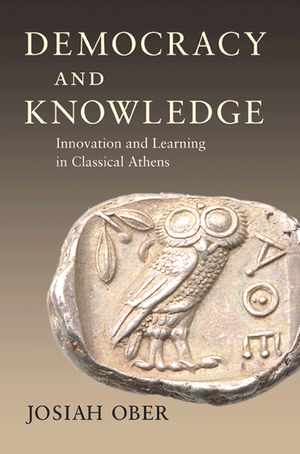 ay just posted by Ilya Somin, George Mason University School of Law. It appeared in Ethics (April 2009). Here's the abstract:
In his excellent book Democracy and Knowledge: Innovation and Learning in Classical Athens Josiah Ober argues that ancient Athenian democracy surmounted the dangers of political ignorance and made effective use of dispersed citizen knowledge to forge good public policy. He effectively demonstrates that Athenian democracy was more successful than the oligarchic and tyrannical governments of rival Greek city-states. He also shows how Athenian institutions worked to reduce the dangers of political ignorance.
On the other hand, Ober is less successful in showing that the relatively impressive performance of Athenian democracy should lead us to be optimistic about today’s democratic states. Indeed, his account suggests that Athens’ success in overcoming political ignorance was in large part the result of two important ways in which it differed from modern democracies: the small size of its electorate and the very narrow range of functions performed by its government.
Weiner honored at Rutgers
Legal historian Mark Weiner, has been named the 2009-2010 Chancellor’s Distinguished Research Scholar at Rutgers University, Newark. The award "honors professors w ho have done exceptional scholarly work on a subject of fundamental intellectual importance." A prolific scholar, Weiner's recent work, according to the announcement, "concerns clan relationships and chieftaincies in medieval law and society. Weiner’s latest work investigates how legal developments in the middle ages can shed light on efforts today to develop the rule of law in weak states and regions of the world which nurture international terrorism." Hat tip.
 ho have done exceptional scholarly work on a subject of fundamental intellectual importance." A prolific scholar, Weiner's recent work, according to the announcement, "concerns clan relationships and chieftaincies in medieval law and society. Weiner’s latest work investigates how legal developments in the middle ages can shed light on efforts today to develop the rule of law in weak states and regions of the world which nurture international terrorism." Hat tip.
Weiner has also been named a Fulbright Scholar for fall 2009. He will travel to University of Akureyi, Iceland to teach "an intensive course on U.S. constitutional law and to conduct research for a new book about the destruction of clan identity as a prerequisite for the development of the rule of law and the contemporary historical consciousness of medieval kinship structures and legal institutions." Weiner was also selected by students as Professor of the Year in spring 2009.
Congratulations!
Sunday, July 5, 2009
Sunday Book Round-up: works on Marian Anderson, I.F. Stone, George Washington, Ellis Island, and WWI
 THE SOUND OF FREEDOM: Marian Anderson, the Lincoln Memorial, and the Concert That Awakened America by Raymond Arsenault is reviewed in the Washington Post.
Jackson Lears reviews AMERICAN RADICAL: The Life and Times of I. F. Stone by D. D. Guttenplan for the New York Times.
The Boston Globe takes up AMERICAN PASSAGE: The History of Ellis Island by Vincent J. Cannato.
Also reviewed in the Washington Post is THE ASCENT OF GEORGE WASHINGTON: The Hidden Political Genius of an American Icon by John Ferling, and in the New York Times, WORLD WAR ONE by Norman Stone.
Pierson v. Post: The Appeal
[This is the fourth and final installment in a series of posts on the case of Pierson v. Post. The series begins here.]
The Appeal
If one puzzle was why litigants bothered to commence and appeal a suit when so little money was at stake, another is why the judges of the New York Supreme Court devoted so much attention and learning to the case. The judges had it before them for quite some time: the jury reached its verdict in Fordham’s court on December 30, 1802, and the New York Supreme Court did not announced its decision until September 10, 1805. It reversed the judgment of the justice’s court and awarded Pierson $121.37 (about $2,150 today) for his “costs and charges” in the appeal.
Fernandez puts the appeal in the context of a campaign by New York’s elite lawyers to raise the sophistication of New York’s bench and bar. Encouraging JPs to pay some attention to the official “law in the books” was one important goal. This could be accomplished by the publication in New York of a well-known legal genre, the JP manual, such as Samuel Brown, The Justice’s Directory, or, Points on Certiorari: Being a Digest of the Cases Reported by Johnson and Caines (1813). It could also be advanced through the aggressive review of the JPs’ judgments. Fernandez writes that by 1814 the New York Supreme Court was handling hearing nearly two hundred appeals from Justice’s Courts every year, even though many involved small monetary judgments. She posits that “a disciplinary process [was] at work.”
Another target of the campaign to create “learned law for New York” was the legal profession itself. A display of learning could up the ante for legal argument, exclude the socially undistinguished from remunerative litigation in a kind of intellectual arms race, and affirm the well-educated lawyer’s own sense of the bar as a learned profession. The campaign had a broader, social dimension as well. As New York democratized, a new breed of politicians denounced judge-made common-law as the last refuge of feudal privilege in republican America and demanded codification by the more popular legislature. The great paladin who marched out to face down this challenge was James Kent (1763-1847), who served as a justice (1798-1804) and chief justice of the New York Supreme Court (1804-1814) and as the state’s chancellor (1814-1823). Kent insisted that “a great proportion of the rules and maxims which constitute the immense code of the common law” was readily knowable from the reports. Further legal treatises, including his own Commentaries on American Law (1826-1830), were surer guides to legal principles than whatever the lesser breed of lawyer-legislators could enact in a code. In short, as the legal historian John H. Langbein writes, “Kent made his career stand for the learned law.”
Fernandez notes that in colonial New York, as elsewhere in the common-law world, elite lawyers tried to raise the level of learning in the legal profession with “moots,” arguments of hypothetical cases before a select audience, often of law students. New York’s judges, she speculates, may have had a similarly didactic aim in Pierson v. Post. Every learned lawyer ought to have devoted hours of their apprenticeship to reading the Justinian and the great natural law jurists of the European continent on the origins of property. When the case bobbed up from Fordham’s court, they seized it as an occasion to “create a more refined legal profession and a body of sophisticated law for New York State.”
For Pierson v. Post to serve the judges’ purpose, it would have to turn on fundamental principles of law rather than some failure to comply with a trivial provision of the Twenty-Five Dollars Act or the overlooking of a well-established rule of law. Fernandez’s discovery of the judgment roll has now revealed that the judges might have overturned the case on narrow grounds and instead chose to make the case turn on the acquisition of property.
We knew from Livingston’s dissent that Sanborn listed six errors in the proceedings before the JP and that he ultimately abandoned all except the third. The judgment roll preserves Sanborn’s original list. As Sanborn had it, his client suffered the “manifest error” of the JP court in the following ways:
1. Fordham’s order to the constable to summon Pierson was directed to either of the two constables of the town of Southampton when it should have named a single person;
2. Pierson was summoned on the same day as the trial, without the minimum six days’ notice required under the Twenty-Five Dollar Act.;
3. Post’s complaint was “not sufficient in law for the said Lodowick Post to have[,] maintain[,] or support his said action”;
4. The jury summons did not specify the reason for which the jurors were to appear;
5. Fordham “found” the court costs when the jury ought to have done it; and
6. “By the law of the land judgment ought to have been rendered and given” for Pierson, not Post.
Note two things about this list. First, the first, second, fourth, and fifth errors are all procedural. Of these, only the second seems very serious, and it is mitigated by Fernandez’s discovery of a partially illegible document suggesting that Pierson did in fact have notice of the suit, only that he received it orally rather than in writing. Fernandez writes of the fifth error that Fordham surely itemized and totaled up the court costs but that this was not inconsistent with the jury having “found” them once he did.
Even if the Supreme Court judges were not intent on a display of learning they might have rejected these arguments. As Donahue writes, they are “the kind of picky points that might well be dismissed on the ground of harmless error, or, to put it more colloquially, ‘we’ve got to cut the JP’s some slack.’” This attitude would also have been consistent with the position Samuel Brown took in his JP manual: “The sound rule of construction, in respect to the courts of justices of the peace, is to be liberal in reviewing their proceedings, as far as respects regularity and form.”
Second, neither the third error, upon which Sanborn ultimately took his stand, nor the sixth (which seemingly duplicates the third) identified the particular legal theory Post had advanced. As far as they go, they were consistent with either a tort or a property theory of the case. Even so, Fernandez thinks that the tort theory would have failed (because of the recreational nature of Post’s hunting) and it would have failed to advance the judges’ goal of making a convincing display of their legal learning (because it would only require the affirmation of a well-recognized principle of the common law.

 If the judges were determined to have a learned discussion of “the classic issue of how one establishes possession and ownership of wild animals,” the two lawyers in the appeal were quite capable of playing their roles, for they were as able as any in the state. Nathan Sanford (pictured at left) was appointed a U.S. Commissioner of Bankruptcy in 1802. The following year he became U.S. Attorney for New York. He would hold that post until 1815 and serve in the U.S. Senate from 1815-1821 and from 1825-1831. He succeeded Kent as Chancellor, serving between his senatorial terms. Post’s lawyer, Cadwallader David Colden (pictured at right), was classically educated in New York and London and practiced law in New York City and Pough- keepsie. He became U.S. Attorney for New York in 1798 and mayor of New York City in 1819. He served in the U.S. House of Representatives from 1821 to 1823.
The authors of the majority and dissenting opinions were also well-trained; their disagreement may well have been a matter of “personal politics,” to use Bethany Berger’s phrase. Berger notes that Henry Brockholst Livingston and Daniel Tompkins were both members of New York’s political elite. Livingston had been elected to the state assembly in 1786 and was appointed to the U.S. Supreme Court in 1807. Tompkins served as governor of New York (1807-1817) and Vice President of the United States (1817-1825). Both opposed the Federalists and backed Thomas Jefferson in the fierce presidential election of 1800.
 Yet the two men had different social origins, which might well have influenced how they regarded fox hunting or deference to local elites. Livingston was the scion of one of New York’s richest families, which owned 500,000 acres on which lived “thousands of tenant farmers in an American version of English manorial society.” This quasi-feudal arrangement persisted until the “Anti-Rent Wars” of the 1840s. Tompkins’s parents, in contrast, lived as tenants on a great manorial estate, and although they moved before Tompkins’s birth, his modest social origins were part of his political persona. During his gubernatorial campaign he described himself as “a ‘humble farm boy,” who had “‘not a drop of aristocratical or oligarchical blood’” in his veins.
 No one has yet turned up any explanation by Livingston or Tompkins of their intentions in writing their opinions. Berger ventures, though, that Livingston (pictured at right) might have been speaking for his fellow aristocrats when he took up the perspective of the “gentleman” in an encounter with “a saucy intruder.” I would add that his “reasonable pursuit” standard would give a great deal of discretion to the landowning jurors of the JP courts. Berger also writes that although Tompkins's opinion was not as revealing of his class bias–he delivered no tirade against fox hunting as an aristocratic pastime–he evidently put vindicating the person who “actually got the job done” above defending “the norms of the leisure pursuits of the gentleman.”
 Finally, what about the dog that didn’t bark? If Kent was so invested in the campaign for a learned law, why did he not write an opinion? In 1805 he was chief justice, and on many other occasions he welcomed the chance to flaunt his erudition. One possibility is that Kent had not been present when the decision was argued or announced. Fernandez speculates–without, it must be said, much to back her up–that Kent had a special reason to leave the job to Tompkins. As a law student, Tompkins (pictured at left) heard Kent deliver a series of law lectures in New York in 1794-95, but he rarely emulated his master by writing lengthy opinions. In fact, he rarely wrote at all. Before Pierson v. Post, Fernandez writes, his opinions appear in reports of only eleven of 258 cases, and three of those “opinions” consisted of a single line announcing his agreement with his brethren. His opinion in Pierson v. Post was twice as long as any he had written before.
Fernandez speculates that Kent, in effect, pushed his former student Tompkins to the front of the class and made him recite his lesson. “How else was the process of ‘upgrading’ the legal community going to proceed without providing more junior members of the bar and bench with such opportunities?” she writes. If this was Kent’s aim, Fernandez thinks he must have been disappointed in his pupil, for Tompkins “robotically” followed Sanborn’s argument and did not produce a fresh analysis of his own.
Final Judgment
The last word on Pierson v. Post must go to its first historian. “Through this case the actors yet live,” wrote Hedges in 1895. “They speak, although dead, with a record and a judgment that far outlasts all other monument to their memory. Pierson and Post, Peace to their Ashes!”
Image credits: Colden, Sanford, Kent, Livingston, Tompkins, Anti-Rent War
Update: The published version of these essays appears in The Green Bag, 2d series, including its on-line edition, here.
The Appeal
If one puzzle was why litigants bothered to commence and appeal a suit when so little money was at stake, another is why the judges of the New York Supreme Court devoted so much attention and learning to the case. The judges had it before them for quite some time: the jury reached its verdict in Fordham’s court on December 30, 1802, and the New York Supreme Court did not announced its decision until September 10, 1805. It reversed the judgment of the justice’s court and awarded Pierson $121.37 (about $2,150 today) for his “costs and charges” in the appeal.
Fernandez puts the appeal in the context of a campaign by New York’s elite lawyers to raise the sophistication of New York’s bench and bar. Encouraging JPs to pay some attention to the official “law in the books” was one important goal. This could be accomplished by the publication in New York of a well-known legal genre, the JP manual, such as Samuel Brown, The Justice’s Directory, or, Points on Certiorari: Being a Digest of the Cases Reported by Johnson and Caines (1813). It could also be advanced through the aggressive review of the JPs’ judgments. Fernandez writes that by 1814 the New York Supreme Court was handling hearing nearly two hundred appeals from Justice’s Courts every year, even though many involved small monetary judgments. She posits that “a disciplinary process [was] at work.”
Another target of the campaign to create “learned law for New York” was the legal profession itself. A display of learning could up the ante for legal argument, exclude the socially undistinguished from remunerative litigation in a kind of intellectual arms race, and affirm the well-educated lawyer’s own sense of the bar as a learned profession.
 The campaign had a broader, social dimension as well. As New York democratized, a new breed of politicians denounced judge-made common-law as the last refuge of feudal privilege in republican America and demanded codification by the more popular legislature. The great paladin who marched out to face down this challenge was James Kent (1763-1847), who served as a justice (1798-1804) and chief justice of the New York Supreme Court (1804-1814) and as the state’s chancellor (1814-1823). Kent insisted that “a great proportion of the rules and maxims which constitute the immense code of the common law” was readily knowable from the reports. Further legal treatises, including his own Commentaries on American Law (1826-1830), were surer guides to legal principles than whatever the lesser breed of lawyer-legislators could enact in a code. In short, as the legal historian John H. Langbein writes, “Kent made his career stand for the learned law.”
Fernandez notes that in colonial New York, as elsewhere in the common-law world, elite lawyers tried to raise the level of learning in the legal profession with “moots,” arguments of hypothetical cases before a select audience, often of law students. New York’s judges, she speculates, may have had a similarly didactic aim in Pierson v. Post. Every learned lawyer ought to have devoted hours of their apprenticeship to reading the Justinian and the great natural law jurists of the European continent on the origins of property. When the case bobbed up from Fordham’s court, they seized it as an occasion to “create a more refined legal profession and a body of sophisticated law for New York State.”
For Pierson v. Post to serve the judges’ purpose, it would have to turn on fundamental principles of law rather than some failure to comply with a trivial provision of the Twenty-Five Dollars Act or the overlooking of a well-established rule of law. Fernandez’s discovery of the judgment roll has now revealed that the judges might have overturned the case on narrow grounds and instead chose to make the case turn on the acquisition of property.
We knew from Livingston’s dissent that Sanborn listed six errors in the proceedings before the JP and that he ultimately abandoned all except the third. The judgment roll preserves Sanborn’s original list. As Sanborn had it, his client suffered the “manifest error” of the JP court in the following ways:
1. Fordham’s order to the constable to summon Pierson was directed to either of the two constables of the town of Southampton when it should have named a single person;
2. Pierson was summoned on the same day as the trial, without the minimum six days’ notice required under the Twenty-Five Dollar Act.;
3. Post’s complaint was “not sufficient in law for the said Lodowick Post to have[,] maintain[,] or support his said action”;
4. The jury summons did not specify the reason for which the jurors were to appear;
5. Fordham “found” the court costs when the jury ought to have done it; and
6. “By the law of the land judgment ought to have been rendered and given” for Pierson, not Post.
Note two things about this list. First, the first, second, fourth, and fifth errors are all procedural. Of these, only the second seems very serious, and it is mitigated by Fernandez’s discovery of a partially illegible document suggesting that Pierson did in fact have notice of the suit, only that he received it orally rather than in writing. Fernandez writes of the fifth error that Fordham surely itemized and totaled up the court costs but that this was not inconsistent with the jury having “found” them once he did.
Even if the Supreme Court judges were not intent on a display of learning they might have rejected these arguments. As Donahue writes, they are “the kind of picky points that might well be dismissed on the ground of harmless error, or, to put it more colloquially, ‘we’ve got to cut the JP’s some slack.’” This attitude would also have been consistent with the position Samuel Brown took in his JP manual: “The sound rule of construction, in respect to the courts of justices of the peace, is to be liberal in reviewing their proceedings, as far as respects regularity and form.”
Second, neither the third error, upon which Sanborn ultimately took his stand, nor the sixth (which seemingly duplicates the third) identified the particular legal theory Post had advanced. As far as they go, they were consistent with either a tort or a property theory of the case. Even so, Fernandez thinks that the tort theory would have failed (because of the recreational nature of Post’s hunting) and it would have failed to advance the judges’ goal of making a convincing display of their legal learning (because it would only require the affirmation of a well-recognized principle of the common law.

 If the judges were determined to have a learned discussion of “the classic issue of how one establishes possession and ownership of wild animals,” the two lawyers in the appeal were quite capable of playing their roles, for they were as able as any in the state. Nathan Sanford (pictured at left) was appointed a U.S. Commissioner of Bankruptcy in 1802. The following year he became U.S. Attorney for New York. He would hold that post until 1815 and serve in the U.S. Senate from 1815-1821 and from 1825-1831. He succeeded Kent as Chancellor, serving between his senatorial terms. Post’s lawyer, Cadwallader David Colden (pictured at right), was classically educated in New York and London and practiced law in New York City and Pough- keepsie. He became U.S. Attorney for New York in 1798 and mayor of New York City in 1819. He served in the U.S. House of Representatives from 1821 to 1823.
The authors of the majority and dissenting opinions were also well-trained; their disagreement may well have been a matter of “personal politics,” to use Bethany Berger’s phrase. Berger notes that Henry Brockholst Livingston and Daniel Tompkins were both members of New York’s political elite. Livingston had been elected to the state assembly in 1786 and was appointed to the U.S. Supreme Court in 1807. Tompkins served as governor of New York (1807-1817) and Vice President of the United States (1817-1825). Both opposed the Federalists and backed Thomas Jefferson in the fierce presidential election of 1800.
 Yet the two men had different social origins, which might well have influenced how they regarded fox hunting or deference to local elites. Livingston was the scion of one of New York’s richest families, which owned 500,000 acres on which lived “thousands of tenant farmers in an American version of English manorial society.” This quasi-feudal arrangement persisted until the “Anti-Rent Wars” of the 1840s. Tompkins’s parents, in contrast, lived as tenants on a great manorial estate, and although they moved before Tompkins’s birth, his modest social origins were part of his political persona. During his gubernatorial campaign he described himself as “a ‘humble farm boy,” who had “‘not a drop of aristocratical or oligarchical blood’” in his veins.
 No one has yet turned up any explanation by Livingston or Tompkins of their intentions in writing their opinions. Berger ventures, though, that Livingston (pictured at right) might have been speaking for his fellow aristocrats when he took up the perspective of the “gentleman” in an encounter with “a saucy intruder.” I would add that his “reasonable pursuit” standard would give a great deal of discretion to the landowning jurors of the JP courts. Berger also writes that although Tompkins's opinion was not as revealing of his class bias–he delivered no tirade against fox hunting as an aristocratic pastime–he evidently put vindicating the person who “actually got the job done” above defending “the norms of the leisure pursuits of the gentleman.”
 Finally, what about the dog that didn’t bark? If Kent was so invested in the campaign for a learned law, why did he not write an opinion? In 1805 he was chief justice, and on many other occasions he welcomed the chance to flaunt his erudition. One possibility is that Kent had not been present when the decision was argued or announced. Fernandez speculates–without, it must be said, much to back her up–that Kent had a special reason to leave the job to Tompkins. As a law student, Tompkins (pictured at left) heard Kent deliver a series of law lectures in New York in 1794-95, but he rarely emulated his master by writing lengthy opinions. In fact, he rarely wrote at all. Before Pierson v. Post, Fernandez writes, his opinions appear in reports of only eleven of 258 cases, and three of those “opinions” consisted of a single line announcing his agreement with his brethren. His opinion in Pierson v. Post was twice as long as any he had written before.
Fernandez speculates that Kent, in effect, pushed his former student Tompkins to the front of the class and made him recite his lesson. “How else was the process of ‘upgrading’ the legal community going to proceed without providing more junior members of the bar and bench with such opportunities?” she writes. If this was Kent’s aim, Fernandez thinks he must have been disappointed in his pupil, for Tompkins “robotically” followed Sanborn’s argument and did not produce a fresh analysis of his own.
Final Judgment
The last word on Pierson v. Post must go to its first historian. “Through this case the actors yet live,” wrote Hedges in 1895. “They speak, although dead, with a record and a judgment that far outlasts all other monument to their memory. Pierson and Post, Peace to their Ashes!”
Image credits: Colden, Sanford, Kent, Livingston, Tompkins, Anti-Rent War
Update: The published version of these essays appears in The Green Bag, 2d series, including its on-line edition, here.
Thomas on Newspaper Reportage on the Fourteenth Amendment
George C. Thomas, III, Rutgers-Newark Law School, has posted Newspapers and the Fourteenth Amendment: What Did the American Public Know About Section 1? which also appears in Journal of Contemporary Legal Issues 18 (2009). Here's the abstract:
Image credit: Senator Jacob HowardFor over sixty years scholars have debated whether Section 1 of the Fourteenth Amendment "incorporated" the Bill of Rights guarantees and thus made them enforceable against the states. Recently, the debate has turned to what the state legislators might have known when they ratified the amendment. In this paper, presented at the University of San Diego Law School on January 7, George Thomas discusses the body of evidence already available and then presents new evidence gathered from a search of newspaper archives for the period 1865 to 1869. He discovered one newspaper article that clearly makes the incorporation case and three others that offer lesser degrees of support for the proposition that educated men of the era were aware that Section 1 included the Bill of Rights. But 96% of the articles that discussed "privileges" and "immunities" gave no hint of a connection with the Bill of Rights.


Saturday, July 4, 2009
Rose on Medieval Law and Lawyers
Jonathan Rose, Arizona State University Law School, has posted on SSRN several items from his "backlist":
“Litigation and Political Conflict in Fifteenth-Century East Anglia: Conspiracy and Attaint Actions and Sir John Fastolf,” Journal of Legal History, 27 (April 2006): 53-80.
“Litigation and Political Conflict in Fifteenth-Century East Anglia: Conspiracy and Attaint Actions and Sir John Fastolf,” Journal of Legal History, 27 (April 2006): 53-80.
Sir John Fastolf was a wealthy fifteenth-century knight and a successful military commander in the wars with France. During the last decade of his life, he was involved in a number of legal disputes with his East Anglian adversaries, the supporters of the Duke of Suffolk. This paper studies one of those disputes, which involved conspiracy and attaint actions between John Andrew, a Suffolk adherent, and Thomas Howes and John Porter, two Fastolf servants.“Feodo de Compedibus Vocato le Sewet: The 15th Century Prison 'Oeconomy'"
This dispute is interesting for two reasons. Most importantly, it shows that one cannot fully understand the operation of the fifteenth-century legal system without an awareness of the social and political context of litigation. Some contemporary litigation had a clear political nature and political considerations influenced the resolution of legal issues. All aspects of this litigation illustrates the interrelation between the operation of the legal and political systems. Often, legal actions and institutions were vehicles and arenas for political disputes.
This litigation also offers an opportunity to explore some fifteenth-century legal issues, especially those that arose in attaint actions. There is very little existing scholarship on actions of attaint. This paper, by studying an actual attaint in detail, provides further detail on this area of medieval English legal history. The paper is based on numerous primary sources in the plea rolls and Year Books.
In the Fastolf Papers in the Archives of Magdalen College, University of Oxford, is an account of payments and expenses of Sir John Fastolf made during ten years of litigation from 1449-1459, Fastolf Paper 42. One entry in this document is both puzzling and interesting. It reads:“Memorandum Quod: John Fastolf and the Founding of Magdalen College,” Magdalen College Record (2003)
Item paid by Thomas Howes . . . for the fee of shackles called the sewet (feodo de compedibus vocato le sewet) both for himself and for John Porter until the jurors impaneled in the attaint might appear before the justices of the King at Westminster
In this instance, the payment occurred in connection with an attaint brought by John Porter, a Fastolf servant, to overturn a jury verdict in a conspiracy case brought against him and another Fastolf servant, Thomas Howes by John Andrew, a Suffolk official and lawyer and a member of the East Anglian affinity of William de la Pole, the Duke of Suffolk.
This entry raises several interesting questions: what was the fee of shackles and why was it called the 'sewet'? The answer lies in the financial characteristics of the medieval century prison system, its 'Oeconomy.' Moreover, understanding the meaning of sewet does not answer the substantive question regarding the propriety of its imposition. The purpose of this paper is to explore these questions. In general, sewet was a payment of money or practice to make prison life less onerous.
The paper begins with an overview of the various fees charged prisoners by keepers in the medieval prisons, especially those in London, the Fleet, Newgate, Ludgate, the King's Bench Marshalsea and the sheriff's Counters. The charging of fees by keepers was a controversial practice. There were persistent complaints about these fees. From the 14th century through the 17th century, there were numerous regulations enacted detailing what fees were permissible and the amounts that could be charged.
The paper turns to use of irons, a controversial practice, both to determine what were considered the appropriate and inappropriate uses of irons and to understand the legitimacy of the fee for removing them, feodo de compedibus. A primary justification for the use of irons was to prevent prisoners from escaping. However, prisoners complained about the inappropriate use of irons and the imposition of fees to remove them. Again, over several centuries, numerous measures regulated such fees.
With this background, the paper then focuses on the meaning of sewet, a later spelling of suete, which was part of a term, suete de prisone. This term perplexed medieval scholars at the beginning of the 20th century. Although they correctly identified the core meaning, the primary investigation failed to understand that the various contexts in which it was used suggested that there were multiple meanings of the term. There was also contemporary confusion as to what Latin word was appropriate to use in official records. By the middle of the 20th century, Latham connected this Law French term with the Latin word, suavitas. Thus, sewet meant a payment of money for ameliorating prison conditions, making life there 'sweeter.' Although not disagreeing with this earlier scholarship, the paper argues for further refinement of the meaning, connecting the term also with the liability of keepers for the escape of prisoners. The paper reviews the multiple contexts and spellings of sewet and its equivalents to further explore its meaning and use. The paper asserts that the most common reason for paying sewet or suete de prisone was the removal the prisoner's irons. Removal of the irons increased the likelihood of escape and the potential for the keeper's liability for a fine or damages because of the escape as well liability for the debt of prisoner to the latter's creditor.
The paper then turns to an analysis of the propriety of charging sewet in the particular instance reflected in the entry in the Fastolf Paper 42. The use of irons was permissible in some instance and escape from the King's Bench Marshalsea was a recognized problem. However the use of irons was probably inappropriate in the case of Howes and Porter, given the reason for their imprisonment, their failure to pay a ransom to the king for their conviction in Andrew's conspiracy suit, and the low likelihood of their escape. While it is impossible to know the amount of the fee in this case, it may not be necessary as a 1445 statute appeared to prohibit the charging of sewet. Moreover, plea roll entries suggest that during the time of Howes and Porter were charged sewet, the statute was enforced strictly. In addition, Sir John Fastolf, who paid all these expenses, was a visible and easy target, for an abusive charge. Thus the paper concludes that charging of sewet to remove Howes' and Porter's irons was dubious and probably, although not clearly, inappropriate.
Magdalen College in Oxford was founded in 1458 by William Waynflete, Bishop of Winchester. This article discusses the role of Sir John Fastolf, a special benefactor of the college, in the founding. As this article explains, Fastolf’s property played a significant role in enabling Bishop Waynflete to establish Magdalen College.“Legal Profession in Medieval England: A History of Regulation,” Syracuse Law Review 48 (1998).
This article examines the history of the regulation of the English legal profession in medieval England. Two interrelated reasons make this a worthwhile endeavor: both the legal profession and its initial regulation emerged during this period. The primary objectives of this article are to identify and study the important legislation from the mid-thirteenth century to the end of the fifteenth century regulating the admission of lawyers to practice and the conduct of practicing lawyers. Critical regulations were adopted during this period. In addition, judges used their inherent power to control the admission of lawyers and sanction their misconduct. In studying this medieval regulation, this article discusses the problems and forces that led to the enactment of the various statutes and ordinances and identifies their objectives, analyzes the meaning and effect of these regulations, and attempts to appraise their historical and current significance. In addition to the historical interest in these matters, studying medieval regulation of the legal profession offers an important opportunity to discover the extent to which this initial regulation and the concerns that prompted it are similar to modern regulation and concerns regarding lawyers.“The Ambidextrous Lawyer: Conflict of Interest and the Medieval Legal Profession,” University of Chicago Roundtable 7 (2000).
Before turning to an examination of the medieval regulation, this article provides some historical background regarding the origins and emergence of the English legal profession and the general climate of opinion in the latter half of the thirteenth century.
In the medieval era, ambidexterity, the medieval term for conflict of interest, appeared in two primary contexts: lawyer discipline and the civil liability of lawyers to victims of their misconduct. This paper studies ambidexterity, a common form of medieval lawyer misconduct, in these two contexts. The paper examines the medieval regulation of ambidexterity by analyzing the different types of conflicts, the specific loyalty duties and their rationales, and the sanctions applied. Finally, the analysis identifies the ways in which medieval conflict of interest regulation is both similar to and dissimilar from its modern treatment. The paper identifies about 75 cases, arising primarily from 1278-1400, which were classified for discussion into five categories: switching sides in the same litigation (classic ambidexterity), adversity to a former client, adversity to a client on an unrelated matter, simultaneous representation of multiple plaintiffs or defendants, and conflicts with a lawyer's personal interest.
The paper concludes that these judicially developed loyalty norms were strongest and most commonly and strictly applied to classic ambidexterity, but that loyalty duties were also owed to former clients. In both categories, protection of confidentiality played an important role. Loyalty norms also arose with regard to adversity to client on an unrelated matter, but differently as it was created consensually through contractual retainers, not by judicial or regulatory fiat. Implementation of these norms occurred in lawyers' suits for arrearages in the annuities owed by clients. Potential conflicts of interest, simultaneous representation of multiple parties, were not treated as problematic and no loyalty norms arose in such cases. Nor were conflicts with a lawyer's personal interest considered a significant problem. Finally, although the medieval cases revealed interesting similarities with modern conflict of interest regulation, the differences were more pronounced. The medieval conduct was more egregious, the loyalty duties narrower, and the remedies more limited although more punitive. The paper then considers the civil liability of lawyers to victims of ambidexterity. This portion of the paper begins with a preliminary survey of the evolution of the civil liability of lawyers. The discussion then moves to an analysis of about 30 cases involving civil liability. The paper concludes, based on this subset of cases involving ambidexterity, that the civil liability of lawyers evolved apart from the development of negligence based liability and that the civil liability of lawyers was more limited in several respects than its modern counterpart. The paper concludes with some general conclusions regarding the medieval treatment of ambidexterity and by suggesting further areas of useful research.
Subscribe to:
Posts (Atom)