Monday, March 23, 2015
How Do You Say "Bastard” in Medieval Latin?
A progress report from Sara McDougall, John Jay College of Criminal Justice and the CUNY Graduate Center, on her new history of illegitimate birth in medieval Europe, the focus of her work this year as a Mellon Fellow in the School of Historical Studies of the Institute for Advanced Study.


Emergent Paradigms: Current Issues and Debates in Cultural Legal Studies
[Via H-Law, we have the following announcement for the 6th International Osnabrueck Summer Institute (OSI) on the Cultural Study of the Law.]
Emergent Paradigms: Current Issues and Debates in Cultural Legal Studies
The sixth International Osnabrueck Summer Institute on the Cultural Study of the Law will be held from August 3 to 9, 2015 at the University of Osnabrueck, Germany. It aims to encourage and further promote the interdisciplinary study and research of the interrelations between law and culture, based on the idea that the extended cultural study of the law will foster profitable scholarly exchange and dialogue between legal studies and the humanities.
The Institute will offer a combination of thematic workshop sessions, small group seminars and a final symposium for 15-20 international participants (doctoral, post-doctoral and advanced M.A. – see below for eligibility). The introductory workshop will address the range and potential of interdisciplinary studies and approaches in field of law and the humanities. The remaining thematic sessions and small group seminars will focus on key issues and debates in current cultural legal studies, for example:
* The tripartite relationship between culture, cultural rights, and the nation state
* The historical emergence of dominant (legal) concepts of property as well as current struggles about culture as heritage, property and resource for creativity (including concepts such as copyright, intellectual property and authorship)
* The cultural presence and representation of the law and the role of culture in the representation and dissemination of the concept of rights (e.g. law and literature, life writing and human rights, visual culture and rights rhetoric)
The main objective of the Institute is the encouragement of scholarly exchange across disciplines and the critical debate of current research projects and work in progress. Participants will have the opportunity to present and discuss their own work both within the larger group and in individual sessions with members of the OSI faculty.
Faculty for the 2015 OSI include Stephen Best (Berkeley, English); Cristina S. Martinez (Ottawa, Visual Arts); Richard Perry (CSU San José /Berkeley Law); Leti Volpp (Berkeley Law); Martin Zeilinger (Toronto, OCAD).
In addition, the OSI will feature a professional workshop presenting and discussing scholarship and grant opportunities for young international researchers sponsored by the EU and the German Academic Exchange Service.
The Summer Institute invites doctoral and postdoctoral students from various academic fields whose research interests and projects are situated at the interface between law and the humanities and who are concerned with a better understanding of the interdependence of law and culture.
Doctoral candidates in literature, the law, the arts, the humanities, and the related social sciences are encouraged to apply, as are advanced students pursuing a J.D. or its equivalent (such as the L.L.B). Young scholars or junior faculty members who have received a Ph.D. or corresponding degree in the last five years are also eligible. While applications by doctoral/post-doctoral students are prioritized, the Summer Institute will also consider strong applications from advanced Master students about to conclude their studies and with a strong interest in interdisciplinary research. There are openings for 15-20 students to participate in the Summer Institute.
Due to its international audience, the Summer Institute will be completely conducted in English. Please note: The OSI does not offer language instruction classes, either in German or in English.
Applicants should complete:
* The application form on our website (see below);
* An up-to-date curriculum vitae.
* A statement of purpose no more than two pages long, describing current scholarly interests, previous research, and how the Summer Institute would specifically further their interests and plans. Applicants are also encouraged to comment on their specific interest in interdisciplinary approaches and how these affect their own work.
Students interested in taking part in the Summer Institute should submit their applications no later than April 15, 2015. Detailed and updated information about the Institute, the sessions, international faculty, admission and fees can be found here.
Please direct all inquiries and questions to the OSI coordinator: lawandculture@uos.de
Forthcoming: Kruse, One Nation Under God
Forthcoming on April 7, 2015, from Basic Books, One Nation Under God: How Corporate America Invented Christian America by Kevin Kruse. Here's the Press description:
We’re often told that the United States is, was, and always has been a Christian nation. But in One Nation Under God, historian Kevin M. Kruse reveals that the idea of “Christian America” is an invention—and a relatively recent one at that.

As Kruse argues, the belief that America is fundamentally and formally a Christian nation originated in the 1930s when businessmen enlisted religious activists in their fight against FDR’s New Deal. Corporations from General Motors to Hilton Hotels bankrolled conservative clergymen, encouraging them to attack the New Deal as a program of “pagan statism” that perverted the central principle of Christianity: the sanctity and salvation of the individual. Their campaign for “freedom under God” culminated in the election of their close ally Dwight Eisenhower in 1952.
But this apparent triumph had an ironic twist. In Eisenhower’s hands, a religious movement born in opposition to the government was transformed into one that fused faith and the federal government as never before. During the 1950s, Eisenhower revolutionized the role of religion in American political culture, inventing new traditions from inaugural prayers to the National Prayer Breakfast. Meanwhile, Congress added the phrase “under God” to the Pledge of Allegiance and made “In God We Trust” the country’s first official motto. With private groups joining in, church membership soared to an all-time high of 69%. For the first time, Americans began to think of their country as an officially Christian nation.
During this moment, virtually all Americans—across the religious and political spectrum—believed that their country was “one nation under God.” But as Americans moved from broad generalities to the details of issues such as school prayer, cracks began to appear. Religious leaders rejected this “lowest common denomination” public religion, leaving conservative political activists to champion it alone. In Richard Nixon’s hands, a politics that conflated piety and patriotism became sole property of the right.
Provocative and authoritative, One Nation Under God reveals how the unholy alliance of money, religion, and politics created a false origin story that continues to define and divide American politics to this day.Some early blurbs:
“Thorough and thought-¬provoking scholarship…Kruse reveals the marketing machine behind American godliness with authority, insight, and clarity. He illustrates key turning points along the way to provide a cohesive picture of a well-powered movement. He hands us the agenda behind the Pledge of Allegiance, ‘in God we trust,’ and other cornerstones of American patriotism. In short, he exposes the PR man behind the pious curtain.” --Library Journal, starred review
“In this riveting book, Kevin Kruse combines the history of religion with the history of capitalism to craft an original interpretation about America’s religious identity. Revisionist in the best sense—bold, daring, and intelligent—it will change how we think about the American past.” --Andrew Preston, author of Sword of the Spirit, Shield of Faith: Religion in American War and Diplomacy
“In this brilliant and iconoclastic book, Kevin M. Kruse shows how an unholy alliance of greedy businessmen, venal clergy, and conservative politicians exploited American spirituality for partisan gain. Kruse’s research is extraordinary, his prose vivid, his argument profound. One Nation Under God is essential reading for anyone interested in understanding contemporary culture in the United States.”--Ari Kelman, author of the Bancroft Prize-winning A Misplaced MassacreMore information is available here.
Intelligence Services and Civil Liberties: Security and Privacy in Historical Perspective
[We have the following announcement of the spring lecture series of the German Historical Institute, Washington, DC.]
To strengthen national security in the climate of fear after the September 11, 2001, the U.S. Congress rushed to pass the U.S. Patriot Act, which George W. Bush signed into law on October 26, 2001. This law gave law enforcement agencies unprecedented powers to gain access to the telephone, e-mail and other records of U.S. citizens and to secretly search homes and offices through "national security letters" rather than regular court warrants. In December 2005, the New York Times revealed that President Bush had also secretly authorized the National Security Agency to monitor the international telephone and electronic communications of Americans without the court-approved warrants required for domestic spying under the Foreign Intelligence Surveillance Act. Most recently, Edward Snowden's 2013 revelations about the National Security Agency's global mass surveillance have sparked controversy and demonstrated that totalitarian regimes are not the only ones that regularly invade citizens' privacy both at home and abroad.
The German Historical Institute's Spring Lecture Series 2015, "Intelligence Services and Civil Liberties: Security and Privacy in Historical Perspective," organized in cooperation with the National History Center, seeks to explore these issues in a comparative and historical perspective. Our speakers will examine how democratic governments in Germany, the United States, and Switzerland have grappled with balancing the need for security and citizens' rights.
All lectures begin at 6:30 pm (refreshments will be served from 6:00 to 6:30 pm) and will be held at the German Historical Institute, 1607 New Hampshire Avenue NW (Directions). Please RSVP (acceptances only) by Tel. 202.387.3355, Fax 202.387.6437 or E-mail .
- Parliamentary Oversight of Intelligence: The German Experience
April 2, 2015
Speaker: Wolfgang Krieger (University of Marburg)
- The History of the Fourth Amendment
April 23, 2015
Speaker: Laura K. Donahue (Georgetown University)
- Freedom against Freedom: Swiss State Security in the Cold War Era-and Beyond
May 14, 2015
Speaker: Georg Kreis (University of Basel)
- Security, Privacy, and the German-American Relationship
June 4, 2015
Speaker: Loch K. Johnson (University of Georgia)
Sunday, March 22, 2015
Sunday Book Roundup
 Making Marie Curie: Intellectual Property and Celebrity Culture in an Age of Information by Eva Hemmungs Wirten (Chicago University Press) is reviewed in The Wall Street Journal, without a pay-wall.
"Intriguingly, the author suggests that the ineligibility of women to own property under French law might have shaped Curie’s perspective. “Because the law excluded her from the status of person upon which these intellectual property rights depend,” Ms. Wirtén writes, “the ‘property’ road was closed to Marie Curie. The persona road was not.”"
The Times Literary Supplement reviews The Making of the Modern Police, 1780-1914 edited by Paul Lawrence (Pickering & Chatto).

Last Sunday's The New York Times Sunday Book Review was a special issue on "The Secret Life of Money," and it included reviews of books such as The Summit: Bretton Woods, 1944: JM Keynes and the Reshaping of the Global Economy by Ed Conway (Pegasus).
In The New York Review of Books reviewer Christopher Jencks asks, "The War on Poverty: Was It Lost?" when reviewing Legacies of the War on Poverty edited by Martha Bailey and Sheldon Danziger (Russell Sage).
Doug McAdam and Karina Kloos discuss their 2014 book, Deeply Divided: Racial Politics and Social Movements in Postwar America (Oxford University Press) with the New Books series.
"What has gotten us to this point of high political polarization and high income inequality? McAdam and Kloos offer a novel answer to what divides us as a country that focuses on the role social movements have in pulling parties to the extremes or pushing parties to the middle. They argue that the post-World War II period was unusual for its low levels of social movement activities and the resulting political centrism of the 1950s. The Civil Rights movement that followed – and the related backlash politics of the Southern Democrats – pushed the parties away from the center and toward regional realignment. Along the way, activists re-wrote party voting procedures that reinforced the power of vocal minorities within each party, thereby entrenching political polarization for the decades to come."
 The New Books series has other interviews to check out as well. Another is an interview with Michelle Nickerson, who discusses her book, Mothers of Conservatism: Women and the Postwar Right (Princeton University Press).
A third interview from New Books is with Linda Gordon about her recently co-written work (with Dorothy Sue Cobble and Astrid Henry), Feminism Unfinished: A Short, Surprising History of American Women's Movements (Liveright).
H-Net brings us several reviews as well. H-Net reviews Sacred Scripture, Sacred War: The Bible and the American Revolution by James P. Byrd (Oxford University Press).
 Securing the West: Politics, Public Lands, and the Fate of the Old Republic, 1785-1850 by John R. Van Atta (Johns Hopkins University Press) is also reviewed.
"In Securing the West: Politics, Public Lands, and the Fate of the Old Republic, 1785-1850, historian John R. Van Atta examines ideological and political debates surrounding land policy in the United States from the early Republic to the 1850s. The book is a fine discussion of the complexity and importance of policymaking at the federal level in these years. The book is well written and engagingly presented, but it overlooks some important pieces of the story."A review of another land-use book, Sonia Hirt's Zoned in the USA: The Origins and Implications of American Land-Use Regulation (Cornell University Press) is also up on H-Net.
Last but not least, The Federal Lawyer has its April issue up online with a review by Henry Cohen of Lincoln on Law, Leadership, and Life by Jonathan W. White (Cumberland House)."This is an excellent book and an impeccable introduction to American zoning for anyone interested in US city planning and urban geography. In one sense, it is a primer on US zoning theory and practice: it provides all the basic elements and history in a mercifully succinct manner in under two hundred pages. This would be an ideal book to give to a student or colleague just cutting his or her teeth in urban studies. Yet, at the same time, Sonia Hirt makes some original contributions to the field by clearly placing American practices in international and historical perspective. The book worked for me on both levels."

"Jonathan White, the author of Lincoln on Law, Leadership, and Life, told me that he had wanted the title of this book to be Lincoln’s Advice for Lawyers, but that the publisher wished to secure a broader audience for it. Although this book is largely about Lincoln’s advice for lawyers, the broader title is legitimate, because much of Lincoln’s advice for law- yers can apply to life in general. As White writes, “Lincoln believed that the highest duty of a lawyer was to be a peacemaker in his community. Therefore, any read- er who deals with interpersonal conflict can learn from Lincoln’s insights. Indeed, Lincoln’s lessons for attorneys can apply to almost any walk of life.”"
Saturday, March 21, 2015
Otherwise Occupied
You may have noticed that my co-blogger Karen Tani hasn't been posting much lately. That's because shortly before midnight on March 14, 2015, she gave birth to Sloane Tani Kiley. Karen, her husband Sean Kiley, and Sloane are now healthy, happy, and home.
Weekend Roundup
 |
| Hong Yen Chang (credit) |
- The California Supreme Court’s reversal on Monday of its 1890 decision denying Hong Yen Chang’s application to the bar generated several news reports, including one in the Los Angeles Times, San Jose Mercury News, the Yale Alumni Magazine, and on NPR. UC Davis Law's APALSA student group describes the work of its Hong Yen Chang Project, in advocating for the reversal here.
- On Monday, April 20, the Lewis & Clark Community College, Godfrey, Illinois, will host a session in the Illinois Supreme Court Historic Preservation Commission’s History on Trial series devoted to the Alton School Cases, “a series of seven circuit court trials and five Illinois Supreme Court appeals from 1897 to 1908, in which Scott Bibb, an African-American father of two school-age children, resisted the newly imposed racial segregation in the Alton school system.” More and hat tip: Riverbender.com
- Over at her Wartime blog, LHB Founder Mary Dudziak reflects on Edward S. Corwin's notion of "totality" in his book on the World War II state, Total War and the Constitution.
- A study of the legal history of Clermont County, Kansas, is underway, according to this report in the Clermont Sun.
- On May 1, the Securities and Exchange Commission Historical Society will open its thirteenth (virtual) gallery. Curated by Teresa Koncick, The Open Door: Roles of Women in Securities Regulation “looks at the roles and progressive participation of women in two key and contemporaneous regulatory agencies–the U.S. Securities and Exchange Commission, and the National Association of Securities Dealers (now FINRA)–from the 1930s to the 2000s.”
Friday, March 20, 2015
Shoemaker Wins Brown Prize
 Congratulations to Karl Shoemaker,
Wisconsin Law, for winning the 2014 John Nicholas Brown Prize of the Medieval
Academy for his book, Sanctuary and Crime in the Middle Ages, 400-1500 (Fordham
University Press, 2011). The Academy
awards the prize "for a distinguished first book in the field of medieval
studies judged by the selection committee to
be of outstanding quality." (This
year's co-recipient is Leslie Lockett for Anglo-Saxon
Psychologies in the Vernacular and Latin Traditions [University of Toronto
Press, 2011].)
New Release: Hatch on the Lincoln Assassination Conspiracy Trial
 Frederick Hatch has published The Lincoln Assassination Conspiracy Trial and Its Legacy (Jefferson, Mo.: McFarland, 2015):
The eight people charged with conspiring to assassinate President Abraham Lincoln were tried by a military commission under military law. The author contends that this was illegal, since the civilian legal system was fully functioning. The many ways in which the defendants’ rights were violated are described, as are the ways in which the trial testimony was either not accurate or not legally obtained. The trial is also compared with other incidents in which the U.S. military was used in police and judicial functions, with questionable results. The book is a warning against unchecked power by the executive branch of the government.
New Release: Prosecuting Cross-Dressing in 19th-Century San Francisco
 Clare Sears, Associate Professor of Sociology and Sexuality Studies at San Francisco State University, has published Arresting Dress: Cross-Dressing, Law, and Fascination in Nineteenth-Century San Francisco (Durham: Duke University Press, 2015). It appears in the series "Perverse Modernities." The press explains:
In 1863, San Francisco’s Board of Supervisors passed a law that criminalized appearing in public in “a dress not belonging to his or her sex.” Adopted as part of a broader anti-indecency campaign, the cross-dressing law became a flexible tool for policing multiple gender transgressions, facilitating over one hundred arrests before the century’s end. Over forty U.S. cities passed similar laws during this time, yet little is known about their emergence, operations, or effects. Grounded in a wealth of archival material, Arresting Dress traces the career of anti-cross-dressing laws from municipal courtrooms and codebooks to newspaper scandals, vaudevillian theater, freak-show performances, and commercial “slumming tours.” It shows that the law did not simply police normative gender but actively produced it by creating new definitions of gender normality and abnormality. It also tells the story of the tenacity of those who defied the law, spoke out when sentenced, and articulated different gender possibilities.
Thursday, March 19, 2015
Grove on the Political Question Doctrine
Tara Leigh Grove, William & Mary Law School, has posted Reconsidering the Political Question Doctrine, which is forthcoming in the New York University Law Review 90 (2015). Here is the abstract:
This Article challenges the conventional narrative about the political question doctrine. Scholars commonly assert that the doctrine, which instructs that certain constitutional questions are “committed” to Congress or to the executive branch, has been part of our constitutional system since the early nineteenth century. Furthermore, scholars argue that the doctrine is at odds with the current Supreme Court’s view of itself as the “supreme expositor” of all constitutional questions. This Article calls into question both claims. The Article demonstrates, first, that the current political question doctrine does not have the historical pedigree that scholars attribute to it. In the nineteenth century, “political questions” were not constitutional questions but instead were factual determinations made by the political branches that courts treated as conclusive in the course of deciding cases. Second, when the current doctrine was finally created in the mid-twentieth century, the Supreme Court used it to entrench, rather than to undermine, the Court’s emerging supremacy over constitutional law. Under the current doctrine, the Court asserts for itself the power to decide which institution decides any constitutional question. With control over that first-order question, the Court can conclude not only that an issue is textually committed to a political branch but also that an issue is committed to the Court itself. This analysis turns on its head the assumption of scholars that the current doctrine is at odds with judicial supremacy. The modern political question doctrine is a species of — not a limitation on — judicial supremacy.
Shugerman on the ICC and the Rise of Modern Campaign Finance
Jed Handelsman Shugerman, Fordham Law School, has posted The Dependent Origins of Independent Agencies: The Interstate Commerce Commission and the Rise of Modern Campaign Finance and Capture. Here is the abstract:
Independent regulatory agencies are some of the most powerful institutions in the United States, and we think of them today as designed to be insulated from political control. This Article shows that their origins were the opposite: this model first emerged in the late nineteenth century because it offered more political control.
The modern executive’s design of unitary presidential control over most offices, along side “independent” regulatory agencies, took shape in the winter of 1886-1887. Congress repealed the Tenure of Office Act, giving the President the unchecked power to dismiss principal officers, and ending the Senate’s power to protect those officers. Shortly afterward, Congress created the Interstate Commerce Commission, the first model for the modern independent agency. These two statutes are a basic foundation for the modern executive branch: the unitary executive’s power over most offices, alongside independence regulatory commissions that are sometimes called a “fourth branch of government.”
This structural change was triggered by a sudden and significant transformation in American campaign finance. In the nineteenth century, parties relied on “assessments,” officeholders paying a percentage of their salary as a kickback to their party. Due to the federal prohibition of patronage “assessments” in 1876 and 1883, the parties were forced to adopt our more recognizable modern system of large special interest campaign contributions. The Senate had less incentive to fight for its power over federal offices and assessment money, and it suddenly needed to increase its access to railroad money. The Interstate Commerce Commission was the Senate’s means of attracting that money. The existing scholarship on the Interstate Commerce Commission generally contends that Congress was “shifting responsibility,” decreasing its own power so that it could punt difficult issues and delegate them to a new commission. To the contrary, this Article shows that the Senate and the President were seizing power, not punting away thorny questions. The ICC was a rejection of a far more independent enforcement model (private civil litigation in federal or state courts) towards a model of shared political accountability model (a commission nominated by the President and confirmed by the Senate for six-year terms. This story shows how sudden changes in campaign finance triggered dramatic changes in constitutional design, and set the foundation for the modern executive branch.
Boast on Property and Indigenous Peoples in New Zealand, the US, and Latin America
 |
| Richard Boast (credit) |
Property Rights and Public Law Traditions in New Zealand, New Zealand Journal of Public and International Law 11 (2013): 161-82 (Special Issue: 21st Birthday of the New Zealand Bill of Rights Act):
This article is about the public law aspect of New Zealand's land law system. It seeks to discover the broad characteristics of New Zealand land law from the standpoint of public policy and the country's distinctive legal history. The article suggests that while components of the New Zealand system have been borrowed from elsewhere, such as the Torrens system (devised in South Australia) or the nationalisation of petroleum in 1937 (based on similar legislation in the United Kingdom), the particular combination of these components that mark the legal framework in place today is unique. This combination also includes some features not found elsewhere, including the concept of Maori freehold land and the creation of a new vesting regime for the foreshore and seabed in 2011. It is also argued that any proposal to reform or remodel New Zealand's system of property law (including through reforms to the New Zealand Bill of Rights Act 1990) should take the existing framework into account.Bringing the New Philology to Pacific Legal History, Victoria University of Wellington Law Review 40 (2011): 399-416:
This article is a study of the main features of the so-called new philology, a school of historians based mainly in the United States who have pioneered a novel approach to the history of indigenous societies under colonial rule by focusing on day-to-day "mundane" texts, typically legal documents or documents preserved in legal records,written in indigenous languages. It is suggested that New Zealand provides a unique opportunity to experiment with the approaches of the new philology outside Latin America as it meets the basic requirement of having preserved a significant amount of written documentation recorded in an indigenous language. What such a study might reveal is unclear, but the overall conclusion is that it should certainly be attempted. One weakness of the new philology, however, is that while it is based strongly on legal documents, it does not engage with law or with legal processes as such.Contextualising the Decisions of the Native Land Court: The Chatham Islands Investigations of 1870, Victoria University of Wellington Law Review 41 (2010): 623-52:
One of the outcomes of the Lost Cases project at the Faculty of Law at Victoria University will be an edition of nineteenth century judgments of the Native Land Court. These decisions have never been reported before. The anticipated date of publication is mid- to late- 2011, and the volume will report leading decisions of the Native Land Court, Compensation Court, and associated bodies from 1865 to 1894. The date of 1894 has been selected as a cut-off for the reason that the Native Land Court Act 1894 established a new appellate body, the Native Appellate Court – today the Maori Appellate Court – which began issuing appellate judgments immediately. Until this point all appeals had been by means of rehearings and no formal appellate structure existed. Future volumes will report decisions of the Native Land Court and Native Appellate Court down to the present day. This article explores the current state of the historiography relating to the Native Land Court, and by reference to the Chatham Islands Investigation of 1870, suggests that a more complex and nuanced approach to the work of the Court is needed. The full texts of the Chatham Islands judgments of 1870 are printed as an Appendix.Felix Cohen and the Spanish Moment in Federal Indian Law: A Study in Law, Politics and Historiography, Victoria University of Wellington Law Review 39 (2008): 419-56:
One of the best-known discussions of the historical foundations of native title law is Felix Cohen's famous paper on the Spanish Origins of Federal Indian Law, published originally in 1942 and since then reprinted many times.
This article cites Cohen's paper in its political and historiographical context, paying particular attention to Cohen's role as one of the architects of the Indian Reorganisation Act of 1934, and considering also shifts in American historiography and legal writing relating to the Spanish legacy as exemplified by legal historians such as James Brown Scott and historians such as H E Bolton. This article also considers fully Cohen's analysis of the precise ways in which Spanish law penetrated the legal framework of Federal Indian Law in the United States and concludes that, as a historical discussion, Cohen's work is in need of substantial revision. In particular Cohen's arguments that Spanish law influenced federal Indian law via international law and by means of judicial consideration of old Spanish land claims seem difficult to sustain.
Wednesday, March 18, 2015
In praise of memoirs
Legal historians often use memoirs—by litigants,
legal professionals and social movement activists—as raw materials for our larger narratives. Few of
us reach into the scholarship on memoirs as a genre, although the Journal of Law and Society's special issue on "Legal Life Writing" (March 2015) is a happy recent exception (see this earlier post). What literary
scholars call “life writing” includes memoirs, autobiographies, diaries, letters, scrapbooks, and possibly family histories. As Sidonie Smith and Julia
Watson describe it, life writing reflects “historically situated practices of
self-representation.” I’ve been dipping into this literature for my own work on legal memoirs and family histories, and have come across some real gems. Here are my favorites.
If you read just one thing on life writing,
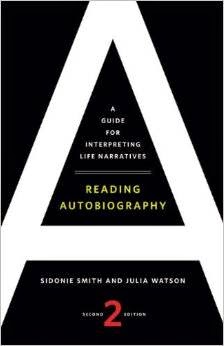
make it Sidonie Smith and Julia Watson’s superb book, Reading Autobiography: A Guide for Interpreting Life Narratives.
This classic offers a "tool kit" of themes (ch.9) that will get you thinking even in your
driest moments. Some highlights include: agency, audience, authority and authenticity, coherence
and closure, evidence, identity, memory, online lives, space and place, trauma
and “scriptotherapy,” and voice. Equally, the book provides a handy list of
sixty sub-genres of life narrative (Appendix A), like autohagiography (!), war
memoirs, and narratives of captivity, conversion, filiation, imprisonment,
slavery, survival, travel, and war.
New Release: Orland, Capital Punishment Trials of Mafia Murderers
Just out from Carolina Academic Press is Capital Punishment Trials of Mafia Murderers by Leonard Orland, University of Connecticut School of Law:
Based on the author's review of thousands of pages of trial testimony and briefs, this unique book explores the capital punishment trials of two Mafia murderers. Both were convicted based in large part on the testimony of other Mafia murderers who cooperated with the government. In both cases, the juries declined to vote for capital punishment. The book enables readers to understand and evaluate the American system of criminal justice through an examination of how complex federal criminal trials are conducted. The book also explores several important policy issues: How should a capital punishment jury be selected? How should the federal government decide which defendants should face a capital punishment trial and which defendants, facing capital punishment, should be rewarded if they cooperate and testify against other murderers? A unique feature of the book is an appendix containing the primary legal documents — jury questionnaire, indictment, jury instructions and legal and constitutional opinions. This would enable students, whether undergraduate or law school, to use the book as a casebook or as supplemental reading in a variety of courses — criminal law, criminal procedure, federal criminal law, and capital punishment.
Dinner on Divorce and the Fathers' Rights Movement
Deborah Dinner, Washington University in Saint Louis School of Law, has posted The Divorce Bargain: The Fathers' Rights Movement and Family Inequalities. Here is the abstract:
A vast literature documents the history of the women’s and gay liberation movements in the late twentieth century, but we still know little about how heterosexual men navigated dramatic change in the legal regulation of families. This Article provides the first legal history of the fathers’ rights movement. It analyzes how middle-class white men responded to rising divorce rates by pursuing reform in both family law and welfare policy. This history offers novel insight into the relationship between the private law of divorce, which regulates largely middle-class families, and public welfare state policies, which have the greatest effect on poor families. This Article challenges the assumption that these private and public family law systems operate in parallel, showing instead that they are interdependent.
Through the mid-twentieth century, marriage shaped the relationship not only between men and women but also between middle-class men and the state: men supported children and wives in exchange for legal protection of male familial authority. In the 1960s and 1970s, escalating divorce rates and the emergence of no-fault divorce laws upset this balance. By the mid-1980s, activists and federal and state legislators forged a new political compromise: fathers’ rights activists conceded ongoing child support obligations in exchange for greater access to custody upon divorce. This “divorce bargain” catalyzed a shift from common law presumptions favoring maternal custody to statutory recognition of joint custody. In so doing, it reinforced private rather than public responsibility for children living in nonmarital families.
The divorce bargain promoted formal equality and sex neutrality within private family law, but also entrenched gender and class inequalities. The bargain failed to challenge women’s disproportionate responsibility for childrearing within marriage, yet enabled men to use custody rights as leverage in child support and spousal maintenance negotiations. In addition, tying paternal responsibilities to custody rights advanced middle-class men’s caregiving interests but hurt those of low-income fathers who could not afford to pay child support. The state vilified these men as “deadbeat dads” who did not merit legal protection. The history of fathers’ rights advocacy for the divorce bargain, therefore, reminds us not to confuse liberalism with equality.
New Release: Miller, "Managing Inequality"
New from New York University Press: Managing Inequality: Northern Racial Liberalism in Interwar Detroit (Dec. 2014), by Karen R. Miller (LaGuardia Community College, City University of New York). A description from the Press:
In the wake of the Civil War, many white northern leaders supported race-neutral laws and anti-discrimination statutes. These positions helped amplify the distinctions they drew between their political economic system, which they saw as forward-thinking in its promotion of free market capitalism, and the now vanquished southern system, which had been built on slavery. But this interest in legal race neutrality should not be mistaken for an effort to integrate northern African Americans into the state or society on an equal footing with whites. During the Great Migration, which brought tens of thousands of African Americans into Northern cities after World War I, white northern leaders faced new challenges from both white and African American activists and were pushed to manage race relations in a more formalized and proactive manner.

The result was northern racial liberalism: the idea that all Americans, regardless of race, should be politically equal, but that the state cannot and indeed should not enforce racial equality by interfering with existing social or economic relations. In Managing Inequality, Karen R. Miller examines the formulation, uses, and growing political importance of northern racial liberalism in Detroit between the two World Wars. Miller argues that racial inequality was built into the liberal state at its inception, rather than produced by antagonists of liberalism. Managing Inequality shows that our current racial system—where race neutral language coincides with extreme racial inequalities that appear natural rather than political—has a history that is deeply embedded in contemporary governmental systems and political economies.More information is available here.
Tuesday, March 17, 2015
Hibbitts on Lawyering and War-Waging in American History
Former Guest LHB Blogger Bernard J. Hibbitts, University of Pittsburgh School of Law, has just published Martial Lawyers: Lawyering and War-Waging in American History, one of the boldest and most original articles I can remember. It appears online in the Seattle Journal for Social Justice 13 (2015). Hibbitts takes aim at what he calls
Hibbitts argues, to the contrary, that
Hat tip: LHB Founder Mary L. Dudziak, whose contribution to the same symposium, War and Peace in Time and Space, isn't exactly chopped liver, either.
Update: Here is the SSRN post of the article.
the “JAG myth”—the prevailing notion that the exclusive military role of lawyers in American history has been the relatively benign one of administering military justice while standing by to advise battlefield personnel of their legal rights and responsibilities, as needed. The image is neat, tidy, bloodless, and notably self-satisfying in its displacement of responsibility for violence onto others.
 |
| Captain John Marshall (credit) |
[f]rom the very beginning of colonization, lawyers in America have been primary wagers of war. Leaving aside for the moment professional soldiers who only began proliferating in significant numbers in the late nineteenth century, lawyers as an occupational group have been uniquely prominent in American history as invaders, battlefield commanders and soldiers, militia leaders, armed revolutionaries, filibusters, rebels, paramilitary intelligence agents, proponents of militarism, and civilian war managers. American lawyers have enthusiastically organized war, led war, and fought war.In short, “war has shaped American lawyers both professionally and personally, and . . . lawyers have in turn played a major role in shaping the American way of war.”
Hat tip: LHB Founder Mary L. Dudziak, whose contribution to the same symposium, War and Peace in Time and Space, isn't exactly chopped liver, either.
Update: Here is the SSRN post of the article.
A Conference for Ira Berlin
 The University of Maryland’s History Department is hosting a conference in honor of Ira Berlin, entitled Slavery, Freedom, and the Remaking of American History. It will take place in the McKeldin Library Professor Berlin's former students and past
or present members of the Freedmen & Southern Society Project will present.
Many of the papers are of interest to legal historians, including:
Presumption of Guilt: Race, Liberty, and Policing in the Early Republic
Kate Masur, Northwestern University
Salvador v. Turner: Black Litigants, Citizenship, and Local Courts in the Antebellum American South
Kimberly M. Welch, West Virginia University
Not by Reason of Color Alone: Class and Character in Ex-Slaves' Encounters with the Law, 1865-1867
Leslie S. Rowland, University of Maryland
Making History, Making the Constitution: The Fifteenth Amendment in American Political Culture, 1870-1920
Stephen A. West, The Catholic University of America
Hood on Reviving the Non-Delegation Doctrine
Although apparently it went up on SSRN in December, we’ll note, for the benefit of historical commentators on Justice Thomas’s concurring opinion in Department of Transportation v. Association of American Railroads, that Joel William Hood, Brigham Young University J. Reuben Clark Law School, has posted Before There Were Mouseholes: Resurrecting the Non-Delegation Doctrine. Here is the abstract:
There are now over five-hundred federal agencies and departments. Some are executive, others independent, but most are a far cry from the strict separation of powers originally conceived in the United States Constitution and envisioned in other founding-era documents. The purpose of this paper is to examine those documents and other fundamental writings that influenced the delegates to the Federal Convention of 1787 in order to demonstrate that the non-delegation doctrine was — and still is — an integral and inherent part of separation of powers. In fact, it is the doctrine upon which the bedrock principle of separation of powers was laid. This assertion invites the reader to critique in new light the Court’s decisions regarding the administrative state since J.W. Hampton, Jr., & Co. v. United States, 276 U.S. 394 (1928).
This night light is magnified through the following evidence: Non-delegation doctrine debate during Federal Convention; Non-delegation amendment included in James Madison's original 17 amendments for the Bill of Rights; State constitutions at the time of the ratification of the Constitution; Philosophical background of the Framers (Locke and Montesquieu); 18th-century dictionaries.
Around the Law Reviews
Available on line is a symposium on New York Times v. Sullivan in volume 66 of the Alabama Law Review, with an introduction by Paul Horwitz and contributions by (among others) Christopher W. Schmidt and Mark Tushnet. Also available online is Daniel J. Hulsebosch’s The Revolutionary Portfolio: Constitution-Making and the Wider World in the American Revolution, Suffolk Law Review (2014): 759-822; and William E. Nelson, The Imperfections of the Rule of Law, 67 SMU Law Review 67 (2014). The latest (gated) issue of Law and Social Inquiry includes a symposium on Kunal Parker's Common Law, History, and Democracy in America, with contributions from Marianne Constable, Shai Lavi, Renisa Mawani, and a response by Professor Parker. Also, Matthew A. Axtell reviews Walter Johnson’s River of Dark Dreams: Slavery and Empire in the Cotton Kingdom.
New Release: Ebright, "Advocates for the Oppressed: Hispanos, Indians, Genízaros, and Their Land in New Mexico"
New from the University of New Mexico Press: Advocates for the Oppressed: Hispanos, Indians, Genízaros, and Their Land in New Mexico, by Malcolm Ebright (Center for Land Grant Studies). The Press explains:


Struggles over land and water have determined much of New Mexico’s long history. The outcome of such disputes, especially in colonial times, often depended on which party had a strong advocate to argue a case before a local tribunal or on appeal. This book is partly about the advocates who represented the parties to these disputes, but it is most of all about the Hispanos, Indians, and Genízaros (Hispanicized nomadic Indians) themselves and the land they lived on and fought for.
Having written about Hispano land grants and Pueblo Indian grants separately, Malcolm Ebright now brings these narratives together for the first time, reconnecting them and resurrecting lost histories. He emphasizes the success that advocates for Indians, Genízaros, and Hispanos have had in achieving justice for marginalized people through the return of lost lands and by reestablishing the right to use those lands for traditional purposes.More information is available here.
Monday, March 16, 2015
Barrozo on "History, Reason, and Will in Modern Law"
Paulo Barrozo (Boston College - Law School) has posted "The Great Alliance: History, Reason, and Will in Modern Law," Law and Contemporary Problems, Vol. 78, No. 1, 2015. Here's the abstract:
Hat tip: Legal Theory Blog
This article offers an interpretation of the intellectual and political origins of modern law in the nineteenth century and its consequences for contemporary legal thought.The full article is available here.
Social theoretical analyses of law and legal thought tend to emphasize rupture and change. Histories of legal thought tend to draw a picture of strife between different schools of jurisprudence. Such analyses and histories fail to account for the extent to which present legal thought is the continuation of a jurisprudential settlement that occurred in the nineteenth century. That settlement tamed the will of the masses under the influence of authoritative legal thought, conceptions of political morality, and a general sense of social evolution.
The principal mechanism of the settlement was a compact between legal rationalism and historicism to which popular will acceded. After a period of polarization around the time of the American and French revolutions, nineteenth century legal rationalism came to see historical events as the outcome of the cunning operation of reason in the world, and legal historicism came to appeal to the rationalizations of legal reason in order to endow historical matter with both conceptual stability and intellectual authority. Popular will bought into both. Modern law and the main schools of legal thought have remained, ever since, bound to this convergence of reason and history in the face of will. Modern law is therefore as much about continuity as it is about rupture; as much about unity as it is about strife.
Hat tip: Legal Theory Blog
Perino on Insider Trading in the Continental Congress
Michael A. Perino, St. John's University School of Law, has posted A Scandalous Perversion of Trust: Modern Lessons from the Early History of Congressional Insider Trading, which appeared in Rutgers University Law Review 67 (2014): 335-92. Here is the abstract:
The Stop Trading on Congressional Knowledge Act of 2012 (the “STOCK Act”) affirms that members of Congress are not exempt from insider trading prohibitions. Legal scholars, however, continue to debate whether the legislation was necessary. Leveraging recent scholarship on fiduciary political theory, some commentators contend that because members owe fiduciary-like duties to citizens, to their fellow members, and to Congress as an institution, existing insider trading theories already prohibited them from using material nonpublic information for personal gain. These arguments, while plausible, are incomplete. They rely on broad conceptions of legislators as fiduciaries, but provide scant evidence that members violate institutional norms when capitalizing on confidential information, a crucial step for fitting their trading into existing legal doctrines.
This Article fills that gap. Like other scholarship on governmental fiduciaries, it examines the foundational norms in Congress, focusing specifically on an episode not previously discussed in the literature. In 1778, Samuel Chase, a member of the Second Continental Congress, used his knowledge of plans to purchase supplies for the Continental Army to reap a substantial profit by cornering the market for flour in his home state. This Article documents the reaction to the Chase scandal and demonstrates that from the earliest days of the institution congressmen expected that members would not attempt to use confidential information for financial gain. Alexander Hamilton and other critics universally concluded that Chase had committed a “scandalous perversion of [his] trust.” This episode and other evidence compiled here strongly suggest that the STOCK Act was unnecessary to hold members of Congress liable for insider trading.
Reuse of the Field Procedure Code and Other Legal Texts
We have news, via Kellen Funk, the Legal History Fellow at Yale Law School, that he and Lincoln Mullen, and assistant professor in the Department of History and Art History, George Mason University, are in the midst of a digital history project, Detecting Text Reuse in Nineteenth-Century Legal Documents: Methods and Preliminary Results, and have just posted an update focusing on the Field Procedure Code.
From Professor Mullen's website:
From Professor Mullen's website:
How can you track changes in the law of nearly every state in the United States over the course of half a century? How can you figure out which states borrowed laws from one another, and how can you visualize the connections among the legal system as a whole?More.
Kellen Funk, a historian of American law, is writing a dissertation on how codes of civil procedure spread across the United States in the second half of the nineteenth century. He and I have been collaborating on the digital part of this project, which involves identifying and visualizing the borrowings between these codes. The problem of text reuse is a common one in digital history/humanities projects. In this post I want to describe our methods and lay out some of our preliminary results. To get a fuller picture of this project, you should read the four posts that Kellen has written about his project:
Three by Tani on the Administrative State
 My co-blogger Karen M. Tani, University of California, Berkeley, has been productive. Here’s aforthcoming article, a just published article, and one from her backlist:
Administrative Equal Protection: Federalism, the Fourteenth Amendment, and the Rights of the Poor, Cornell Law Review 100 (2015).
This Article intervenes in a burgeoning literature on “administrative constitutionalism,” the phenomenon of federal agencies — rather than courts — assuming significant responsibility for elaborating the meaning of the U.S. Constitution. Drawing on original historical research, I document and analyze what I call “administrative equal protection”: interpretations of the Fourteenth Amendment’s Equal Protection Clause in a key federal agency at a time when the Clause’s meaning was fiercely contested. These interpretations are particularly important because of their interplay with cooperative federalism — specifically, with states’ ability to exercise their traditional police power after accepting federal money.States' Rights, Welfare Rights, and the 'Indian Problem': Negotiating Citizenship and Sovereignty, 1935-1954, Law and History Review 33 (2015)
The Article’s argument is based on a story of change over time. In the late 1930s, when federal courts appeared reluctant to vindicate equal protection claims, the federal Social Security Board (later to become part of the Department of Health, Education and Welfare) took a more active role via its administration of federal grants for state-run public welfare programs. Through the 1940s and 1950s, agency lawyers developed and applied a nondeferential rationality model of equal protection to assess state welfare rules. When paired with the agency’s control over generous federal subsidies, this interpretation had tangible consequences: administrators challenged some of the era’s most restrictive state welfare laws and, in the process, spread the notion that poor Americans had constitutional rights, including under the Fourteenth Amendment. In the mid 1960s, as the agency became embroiled in battles over school desegregation, administrators deftly recharacterized their constitutional interpretation as a statutory one. They saw their constitutional arguments take on new life, however, as welfare rights advocates (including former agency personnel) wielded them in court. Both developments are visible in the landmark case King v. Smith (1968). There the Supreme Court affirmed the poor claimants’ victory in the court below, but rejected the lower court’s equal protection holding in favor of one grounded in the agency’s novel statutory interpretation. Administrative equal protection thus continued to operate as a meaningful constraint on state action — and in fact helped remake the administration of American poor relief in the late twentieth century — but remained hidden from view.
In addition to giving content and direction to the study of administrative constitutionalism, this history enriches legal scholarship in three ways: (1) it provides context for the “new federalism” revolution of the last decades of the twentieth century; (2) it opens up new questions about today’s “uncooperative federalism”; and (3) it helps explain the penurious protections that today’s equal protection jurisprudence offers the poor.
Starting in the 1940s, American Indians living on reservations in Arizona and New Mexico used the Social Security Act of 1935 to assert unprecedented claims within the American federal system: as U.S. and state citizens, they claimed federally subsidized state welfare payments, but as members of sovereign nations, they denied states the jurisdiction that historically accompanied such beneficence. This article documents their campaign, and the fierce resistance it provoked, by tracing two legal episodes. In 1948, through savvy use of both agencies and courts, and with aid from former government lawyer Felix Cohen, reservation Indians won welfare benefits and avoided accompanying demands for state jurisdiction; the states, in turn, extracted a price -- higher subsidies -- from the federal government. Arizona officials re-opened the dispute in 1951, by crafting a new welfare program that excluded reservation Indians and suing the federal government for refusing to support it. The 1954 dismissal of the case was a victory for Indians, but also lent urgency to efforts to terminate their anomalous status. Together these episodes illustrate the disruptive citizenship claims that became possible in the wake of the New Deal and World War Two, as well as the increasingly tense federal-state negotiations that followed.Flemming v. Nestor: Anticommunism, the Welfare State, and the Making of “New Property," Law and History Review 26 (2008)
This essay uses the 1960 Supreme Court case Flemming v. Nestor to explore the relationship between Cold War anticommunism, America’s burgeoning welfare state, and Charles Reich’s influential interpretation of constitutional due process. That interpretation, set forth in Reich’s seminal article “The New Property” (1964), is often remembered for its connection to the War on Poverty, the modern welfare rights movement, and the spectacular rise and fall of constitutional protections for the poor between the late 1960s and mid-1970s. This essay reminds readers of the article’s grounding in an earlier era and a broader set of concerns. Reich’s personal glimpses of anticommunist persecution showed him how the growth of the state — even its most benign-seeming arms — could create opportunities for the enforcement of political and ideological conformity. Flemming v. Nestor encapsulated Reich’s fears: After years of paying into Social Security, longtime U.S. resident Fedya Nestor was deported to Bulgaria and his benefits revoked, on account of his dabblings with the Communist Party (or more likely, the more serious involvement of his U.S. citizen wife and stepdaughter). In what Reich later described as “the most important of all judicial decisions concerning government largess,” the Supreme Court held that Nestor had no vested property interest in the benefits he had supposedly “earned,” and hence no valid claim under the Due Process Clause. A decade later, Flemming v. Nestor remained good law, but Reich and his followers had succeeded in convincing federal judges to adopt a different view: one that recognized the coercive potential within acts of government beneficence and that expanded the ambit of constitutional due process.
Sunday, March 15, 2015
Sunday Book Roundup
 This week there's a review of Who Cooked Adam Smith's Dinner? (Portobello Books) written by Katrine Marcal and translated by Saskia Vogel in the New Statesman.
Lucy Stone: An Unapologetic Life by Sally G. McMillen (Oxford University Press) is reviewed by Janet Napolitano in the Los Angeles Times.
"Elizabeth Cady Stanton, Lucretia Mott and Susan B. Anthony are memorialized as leading suffragists in a marble statue in the Rotunda in our nation's Capitol. In this thought-provoking new biography, Sally G. McMillen argues persuasively that one person is missing from that Mt. Rushmore of women: Lucy Stone."Napolitano has another review in The Washington Post, "Higher education isn't in crisis," which reviews two books: Ryan Craig's College Disrupted: The Great Unbundling of Higher Education (Palsgrave) and Kevin Carey's The End of College: Creating the Future of Learning and the University of Everywhere (Riverhead).
 Leonard L. Richards's Who Freed the Slaves? The Fight Over the Thirteenth Amendment (University of Chicago Press) is reviewed by the Washington Independent Review of Books.
In Salon there is an excerpt, "Religious Ignorance kills kids: How two Richard Nixon aides sneakily altered a law that still costs children's lives," from Bad Faith: When Religious Belief Undermines Modern Medicine (Basic) by Paul Offit.
There's a new issue of Common-Place up online here, with a review of Cornelia H. Dayton and Sharon V. Salinger's Robert Love's Warnings: Searching for Strangers in Colonia Boston (University of Pennsylvania Press).
Barney Frank's memoir, Frank: A Life in Politics From the Great Society to Same-Sex Marriage (Farrar, Straus and Giroux) is reviewed in The Washington Post."Historians have perceived warning, which was distinctive to New England, as an expression of the region's distaste for outsiders and stinginess with relief for the poor. Some scholars have interpreted the concept literally—as physical banishment of those who did not have legal habitancy in the towns from which they were being warned. Other scholars have recognized that warning did not require eviction, but they have nonetheless misunderstood its purpose, presuming that declarations like Love's were intended to inform sojourners that they were not legal inhabitants of the town and therefore could not receive poor relief. Dayton and Salinger, however, expose the limits of these conventional interpretations of warning. New Englanders were no xenophobic penny-pinchers, they argue; on the contrary, the region's warning system was integral to what was arguably the most generous welfare system in the British Empire."

Saturday, March 14, 2015
Ms. Peppercorn Considers: Successful Panel Proposals
Ms. Peppercorn has brazenly joined a proposed panel, just
submitted to the powers that be for the annual ASLH meeting to be held in
Washington, D.C. later this year. The
deadline is actually tomorrow, so our submission is thankfully in good time. Ms.
Peppercorn’s efforts along these lines have caused her to reflect on the art of
appealing to conference program committees.
ASLH, for example, has become a competitive environment, turning away
many great proposals. This is thanks not
only to the impressive growth of the field of legal history, but also to the
high quality and diversity of topics that members have come to expect when they
attend the annual conference.
So what hints does she have for the hopeful legal historian
either for this or other conferences?
First, it helps to have a full panel to propose. Program committee members are harried
individuals, and seeing clearly that a group of people have come together to
create a more or less coherent topic makes the committee’s job considerably
simpler. They don’t have to worry that
papers won’t fit together, because the proposers have already assured them that
they will. Smashing papers together that
don’t fit naturally can be a disaster, as many committees have learned at ASLH
and elsewhere.[1]
Second, making some effort to address the
announced theme of the conference is also a good idea. That said, Ms. Peppercorn failed hopelessly
at this. She will light a candle to the
program gods, in hopes that they will forgive the oversight.
Finally, it helps to bring in panelists from outside the
field, if at all possible. There are
many great historians whose work touches on topics of interest to legal
historians but who may not attend the meeting on a regular basis, or any basis
at all. Ms. Peppercorn often finds that
such folk are more likely to accept an invitation to present or comment if they
don’t have to travel far to do so. Thus,
a careful look around the local schools (fortunately, in Washington there are
many excellent ones to choose from) can yield good results. In our case, we approached a fine local
expert to comment on our panel, and thankfully he agreed.
So at this season of proposals, just remember to travel in
panel-sized packs, listen to the group leader (in the form of the CFP theme),
and enlist new recruits.
It also helps, Ms. Peppercorn should mention in closing, not
to be greedy. If you gave a paper last
year, don’t try to hog the sandbox. And
don’t attach your name to multiple proposals.
The invaluable Miss Manners would call such behavior “Infectious
Greed.” Ms. Peppercorn recognizes that
most legal historians cannot be accused of such a disease, but nonetheless on
occasion we have been known to stray gently into the danger zone. When tempted, remember that double dipping is
never good manners, even in the land of the multidisciplinary.
[1]
Some groups (can you say Law and Society Ass’n?) have made such smashing a brand
of their organization. They thus provide
valuable presentation notations for many scholars’ CVs, but a less satisfying
environment in terms of predictably high integration of papers.
Weekend Roundup
- From History News Network: Elizabeth Tandy Shermer (Loyola University Chicago) places recent right-to-work laws in historical context.
- The Centre for Law and Culture at St. Mary’s University, Twickenham, seeks submissions for its 2015 conference (September 10-11, 2015). The theme this year is "change." (Hat tip: Legal Scholarship Blog)
- A warm welcome to the blogosphere to Litera Scripta, the blog of the Bounds Law Library Special Collections at the University of Alabama School of Law.
- Former ASLH President Constance Backhouse is leading “an external review of the practices and policies within [Dalhousie University's] embattled dental school,” which “has been roiled in controversy since December when news broke that a group of male fourth-year dentistry students had posted disturbing comments on a Facebook page, including offensive comments about female classmates.” More.
- Around the colloquia: Sam Lebovic, George Mason University, presented “From Censorship to Classification: How World War II Remade American Press Freedom” to Yale’s Legal History Forum on March 10. Hat tip: Legal Scholarship Blog.
- Although we've all been focusing on the due date for proposals for ASLH 2015 in Washington, DC, October 29-November1, we have, via Legal Scholarship Blog, the save-the-date reminder for ASLH 2016 in Toronto, October 27-30.
- From Balkinization: LHB founder Mary Dudziak (Emory Law) on "Edward Corwin and the 'Totality' of America's World War II."
- The Library of Congress's Magna Carta Lecture Series is winding up. The last lecture is on Monday, April 6, and will feature Magna Carta scholar Nicholas Vincent (University of East Anglia). He will be speaking on “Magna Carta from Runnymede to Washington: Old Laws, New Discoveries.”
- From Inside Higher Ed: "PhD Coursework: Advice to My Younger Self."
Friday, March 13, 2015
New Release: Arlidge and Judge, "Magna Carta Uncovered"
New from Hart Publishing: Magna Carta Uncovered, by Anthony Arlidge (Queen's Counsel) and Igor Judge (former Lord Chief Justice of England and Wales). A description from the Press:
More information is available here.2015 marks the 800th anniversary of the grant at Runnymede of Magna Carta.The story of how Magna Carta came into being, and has been interpreted since, and its impact on individual rights and constitutional developments has more twists and turns than any work of historical fiction.
The authors bring their wide legal experience and forensic skills to uncover the original meaning of the liberties enshrined in Magna Carta, and to trace their development in later centuries up to the drafting of the Constitution of the United States of America. By providing that the powers of the King were not unlimited, the Charter was groundbreaking, yet it was also a conservative document, following the form of Anglo-Saxon charters and seeking to return government to the ways of the Norman kings.
This book tells the enthralling, ultimately inspirational, story of Magna Carta in a concise and readable fashion and will captivate laymen and lawyers alike.

Reid on Augustus's Morals Reform
Charles J. Reid Jr., University of St. Thomas School of Law, has posted Law Reform in the Ancient World: Did the Emperor Augustus Succeed or Fail in His Morals Legislation? Here is the abstract:
This is an Article with a dual purpose. First, it is concerned with the process of law reform: How do we judge a given reform's success or failure? Do we adopt strictly linear metrics? Or do we look at non-linear impacts? Thus: In the campaign against tobacco, do we judge it a success because it has reduced cigarette smoking? Or because it reduced the political power of the tobacco companies?
In this Article, I apply this complex means of analyzing law reform to the Emperor Augustus' morals legislation. Legal historians have typically regarded Augustus' morals legislation as having achieved, at best, mixed results. These historians, however, have tended to perform a linear assessment of the legislation. Did Augustus achieve the results he professed to want: that is, were cases of adultery prosecuted more frequently? Was elite childbirth encouraged? I argue, in contrast, that the legislation must be seen against Augustus' larger political agenda, which was the subjection of elite families to the laws of the emerging Roman Empire. Seen in these political terms, I argue that the legislation can be judged in substantial measure as successful.
Peck on Legal Responses to Kansan Drought
 |
| Drought Committee Meeting, Scott City, 1936 (LC) |
In this article I examine legal responses to drought in Kansas since statehood in 1861 by persons and various levels of government. An article about drought should probably use or create a definition for the term. Although precision in such definitions can be important in some legal contexts, it is not required here. The term drought has many meanings. I have not adopted any one definition against which to examine the legal responses, but rather have chosen to accept and use some periods of Kansas drought identified by experts.
Even after identifying drought periods since statehood, one finds it difficult to discern whether a legal event during or following a drought has necessarily been a direct response to a particular drought or instead just a part of sound, long-term water resources planning efforts. Some state water planning efforts, such as the State Water Plan in Kansas, involve attempts to deal with droughts generally.
This article is essentially retrospective and descriptive, not prospective and analytical. Analyses of state drought programs outside Kansas have been conducted, including a recent one published by the American Water Resources Association, which described and analyzed case studies in proactive drought management in Texas, Oregon, Hawaii, and Oklahoma. Such a study of responses to drought in Kansas, along with comparative analysis with other states' drought management techniques and experience, would be a worthy project.
Subscribe to:
Posts (Atom)