The American Council of Learned Societies has announced its awards for 2010. Several legal history-related projects are on the list.
ACLS Fellows include:
Andrew Wender Cohen
Associate Professor, Department of History, Syracuse University - Contraband: Smuggling and the Birth of the American Century
Peter Decherney
Assistant Professor, English, University of Pennsylvania - Hollywood’s Copyright Wars: Pirates, Plagiarists, and Technophobes, from Edison to the Internet
Pablo Piccato
Associate Professor, History, Columbia University - A Century of Crime in Modern Mexico: A Historical Perspective
Daniel M. Goldstein
Associate Professor, Anthropology, Rutgers University, New Brunswick - Law's End: Community Justice, Citizen Security, and Human Rights in Evo's Bolivia
Ruth Mazo Karras
Professor, History, University of Minnesota, Twin Cities - Quasi-Marital Unions in Medieval Europe
Charles A. Ryskamp Research Fellowship recipients include:
Kate Masur
Assistant Professor, History, Northwestern University - “In All Things American Citizens”: African Americans and Federal Employment in Post-Emancipation America.
Ekaterina Pravilova
Assistant Professor, History, Princeton University - “Res publicae” in the Imperial State? Property and Power in the Russian Empire, 1860-1917
Monday, June 14, 2010
Student paper award from Supreme Court Historical Society
The Supreme Court Historical Society invites submissions for the Hughes-Gossett Award for the best student paper submitted to the Journal of Supreme Court History. The winner will be awarded a $500 cash prize and publication in the Journal.
The paper must be on some aspect of the Supreme Court's history. Authors must have been enrolled as students at the time the paper was written. Past winners have been law school students or doctoral students in the departments of history, government, and political science.
Papers may be of any length and may be submitted on an ongoing basis to Clare Cushman, Managing Editor, at: chcush at aol.com.
Hat tip: AHA Today.
The paper must be on some aspect of the Supreme Court's history. Authors must have been enrolled as students at the time the paper was written. Past winners have been law school students or doctoral students in the departments of history, government, and political science.
Papers may be of any length and may be submitted on an ongoing basis to Clare Cushman, Managing Editor, at: chcush at aol.com.
Hat tip: AHA Today.


The Executed and the Spared: 2 New Books
 Perusing the New York Times book review I came across David Oshinsky's review of In the Place of Justice: A Story of Deliverance, by former death row inmate Walter Rideau. In 1961, Rideau was convicted of murder and given Louisiana's harshest sentence. His subsequent 44 years -- spent mostly in Angola -- were unusual: although he experienced the abuses that made the prison infamous, his journalism, advocacy, and negotiation skills brought him national fame. Life magazine dubbed him "The Most Rehabilitated Prisoner in America." Ultimately, Rideau was re-tried and convicted of a less serious offense; the lighter sentence triggered his immediate release.
 In the Place of Justice is his memoir. It is a "painfully candid" one, by Oshinsky's assessment. It is also the story of "deliverance" that Rideau promises in his subtitle. Oshinsky describes the author as "the rarest of American commodities — a man who exited a penitentiary in better shape than when he arrived."
You can read the full review here, and another review here. You can find an excerpt from the book here.
Meanwhile, the University of Chicago Press seems to be making a big push for Last Words of the Executed, by journalist Robert K. Elder. It is "an oral history of American capital punishment, as heard from the gallows, the chair, and the gurney." Here's part of the Press's description:
The product of seven years of extensive research . . . the book explores the cultural value of these final statements and asks what we can learn from them. We hear from both the famous—such as Nathan Hale, Joe Hill, Ted Bundy, and John Brown—and the forgotten, and their words give us unprecedented glimpses into their lives, their crimes, and the world they inhabited. Organized by era and method of execution, these final statements range from heartfelt to horrific. Some are calls for peace or cries against injustice; others are accepting, confessional, or consoling; still others are venomous, rage-fueled diatribes. Even the chills evoked by some of these last words are brought on in part by the shared humanity we can’t ignore, their reminder that we all come to the same end, regardless of how we arrive there.The book is not, according to the synopsis, a "political" one.
The disclaimer at the end made me think about the decisions we make, consciously or not, when we build our projects around particular sources. The book may not be political, but what about the decision to use these direct statements? Excerpting them gives the speaker the chance to connect, to persuade, and to criticize, albeit at a time and in a place designated by the state (and in a context chosen by the author). I'm not saying that these sources are inherently pro- or anti-death penalty. My point is that they humanize as few other sources can, and -- as I'm sure Walter Rideau knows -- to humanize is to lend a type of power. I'd be interested in hearing from others who have written about controversial legal-historical topics, such as slavery, religion, and marriage. Do you have to disavow political intentions when you publicize your work? Do you think about your source choices as political ones?
Another question that seems worth pondering is why last words have been relatively well preserved. After coming across Elder's book, I realized I had seen "last words of the executed" articles before. Last September, when the death penalty was again in the news, a New York Times op-ed contributor pulled together a collection of last words that she found on the Texas Department of Criminal Justice website. (The statements are still there, carefully organized and easily accessible.) Back in 2007, CNN.com used CourtTV records to do something similar.
You can find excerpts of the book, including a foreword by oral history legend Studs Terkel, here. For Elder's perspective, check out the interview he gave to WHYY's Marty Moss-Coane. You can listen here.
Image credit
Saturday, June 12, 2010
Curry on Teaching Roe v. Wade
Lynne Curry, Eastern Illinois University, discusses her experiences teaching Roe v. Wade in a general education course on constitutional history in “Beyond ‘Choice’: Roe v. Wade as U. S. Constitutional History,” Journal of Women's History 22 (Summer 2010): 166-170. Curry commences:
Update: Access to the article was ungated when I posted, but that no longer seems to be the case. I'm leaving the post up anyway.
More.I teach a general education course in U. S. constitutional history to undergraduates, the majority of whom are not history majors and, in fact, do not have much knowledge of—nor do they have a particular interest in—either women's or gender history. The occasional student is actively hostile to both. But Roe v. Wade (410 U. S. 113, 1973) is a case that virtually all students recognize, even if they do not know exactly what it is that the Supreme Court actually said. Not infrequently, they view Roe either as a case about a narrowly (and often imprecisely) defined "feminist" issue that does not concern them directly or, alternatively, as a ruling that concerns them only in the abstract sense that they might one remote day be faced with a personal decision about whether or not to carry a pregnancy to term. Students do not often begin my courses regarding reproductive rights as having the same fundamental significance in U. S. constitutional history as, say, freedom of speech or the free exercise of religion, and in this sense they are no different than large segments of the American public. What is more, today's traditional students are coming of political age at a time when sound-bite-as-discourse has impoverished our political vocabulary, with the unfortunate consequence of reducing the complexity of the key constitutional issues underlying Roe to the trope of "making a choice," something akin to consumers' freedom to choose among brands of toothpaste at Walgreen's drug store. My response has been to reposition Roe in my teaching as a case that dealt with principles that are integrally imbedded within American history rather than marginal to it.

Update: Access to the article was ungated when I posted, but that no longer seems to be the case. I'm leaving the post up anyway.
Lawyers as Agency Historians: Customs and Veterans Claims
Every year much of my legal history examination is a question that asks students to analyze some federal administrative scheme in existence from the Progressive Era through the New Deal that we hadn’t discussed in class in terms of the concepts and developments we did discuss–a kind of historical issue-spotter, if you will. This year’s topic was the customs system, from the stillborn Tariff Commission of 1882 through the Reciprocal Trade Agreement Act of 1934 (If anyone is interested I can post the narrative.) Working out the duties of the local appraisers, general appraisers, board of general appraisers, U.S. Customs Court and Court of Customs Appeals was something of a struggle. It would have been much easier had I stumbled upon The History of American Customs Jurisprudence (1941) before rather than just after I had written the exam. The book, festooned with forewords from John W. Davis, Roscoe Pound, and others, was obviously a labor of love, written by a lawyer in the U.S Customs Division of the Department of Justice named William H. Futrell.
Because of this post, I probably can’t test on the veteran’s benefits system, which I had previously considered when I realized that a woman lawyer, Lucy Somerville Howorth, served on the Board of Veterans Appeals. Were I to write such a question, I’d rely on a recently published paper by another government lawyer, James D. Ridgway, who is an attorney with the United States Court of Appeals for Veterans Claims. The paper is The Splendid Isolation Revisited: Lessons from the History of Veterans Benefits Before Judicial Review, and the abstract follows:
Because of this post, I probably can’t test on the veteran’s benefits system, which I had previously considered when I realized that a woman lawyer, Lucy Somerville Howorth, served on the Board of Veterans Appeals. Were I to write such a question, I’d rely on a recently published paper by another government lawyer, James D. Ridgway, who is an attorney with the United States Court of Appeals for Veterans Claims. The paper is The Splendid Isolation Revisited: Lessons from the History of Veterans Benefits Before Judicial Review, and the abstract follows:
The history of warfare is grittier and more complex than that portrayed by the jingoistic news reels of old. So too, the history of veterans benefits is much more checkered and conflicted than might be suggested by slogans welcoming home the nation's heroes. Understanding the history and origins of a complex administrative area such as veterans law is vitally important to good practice and thoughtful scholarship. However, because attorneys were not involved in the system for generations while it evolved during two centuries without the oversight of judicial review, very few practitioners or scholars today have any direct experience with veterans benefits in the era before the creation of the U.S. Court of Appeals for Veterans Claims in 1988 - or even access to someone with such experience. This lack of institutional memory can be a serious handicap because the Veterans Judicial Review Act did not reinvent the veterans benefits system, but merely placed an independent, federal court above a system with a long history of policy conflicts and a well established political dynamic. Although this article tells the story of veterans benefits in the United States chronologically from the Revolutionary War through the Agent Orange Act of 1991, each subsection has its own narrative and offers a lesson about the politics and policy that still drive veterans law today. Ultimately, veterans law continues to weigh competing policy justifications, search for the proper roles of readjustment and long-term benefits, and struggle with its deep ties to both politics and medicine.
Batlan on Settlement Houses and Sociological Jurisprudence
Felice Batlan, Chicago-Kent College of Law, has posted Law and the Fabric of the Everyday: The Settlement Houses, Sociological Jurisprudence, and the Gendering of Urban Legal Culture, which originally appeared in the Southern California Interdisciplinary Law Journal 15 (2006): 235-284. Here’s the abstract:
Image Credit: Jane AddamsThis article demonstrates that settlement houses at the turn of the century were particularly important and vibrant legal sites, in which women settlement workers played groundbreaking and multiple legal roles. Settlement houses provided a geographical and intellectual space where diverse legal actors participated in analyzing, examining, discussing, popularizing, and reforming law. Through experimentation and confrontation with the lived reality and everyday lives of the poor, settlement workers participated in the creation and practice of sociological jurisprudence. By exploring the specific legal work that settlement workers performed and the legal services that they provided, we can see that under the rubric of philanthropy and social work, women settlement workers were actually practicing law and engaging in a type of jurisprudence which was deeply grounded in the daily life of the home and neighborhood. Simultaneously, however, settlement workers, using the law and state power, engaged in social control often putting immigrant women under intense scrutiny. Through this close analysis of the legal work of settlement houses, this article departs from other legal history narratives that understand sociological jurisprudence as arising from the academy and instead argues that it arose from the ground-up.

Friday, June 11, 2010
Reich Remembers Black, J.
A Passion for Justice is Charles A. Reich’s remembrance of his clerkship with Justice Hugo Black during the 1953 Term of the U.S. Supreme Court. It is just out in Volume 26 of the Touro Law Review, illustrated with Reich's own photographs. Reich writes:
More.
Image credit.
Thanks and a hat tip to John Q. Barrett
I have previously written about Justice Black, but always with a sense of constraint imposed by the confidentiality of a law clerk’s position. But now that more than fifty years have passed, and now that the Court is a constant subject of political debate that is frequently based on misconceptions, I feel that the claims of history and the study of law have become paramount. For historians, the story of how the new Chief Justice began as a “law and order” judge but by the end of the 1953 Term had been transformed, with the crucial intervention of Justice Black, into the “liberal” judge of the “Warren Court,” needs to be recorded while there is still a witness able to do so. For aspiring legal academics, a close-up of one Justice’s thought processes and tactics should prove valuable. For law students I would like to provide a picture of one individual who truly loved the law. For all of the above and for the public as well, there is the ultimate test of what makes a good judge: a passion for justice.

More.
Image credit.
Thanks and a hat tip to John Q. Barrett
In Honor of the World Cup - South African Legal History
 In honor of the 2010 FIFA World Cup, which begins today, I've pulled together some scholarship on the legal history of South Africa. It's an exciting area, and there seems to be room for much more work.
One of the major books in the field is The Making of South African Legal Culture, 1902-1936: Fear, Favour, and Prejudice (2001), by Martin Chanock (La Trobe University, Victoria). Coverage includes Roman-Dutch law; the State’s African law; land and labor law; and criminal law. The publisher describes the book as a "revisionist analysis." Here's a snippet of a review, by Frank Salamone:
Martin Chanock takes a refreshing approach to legal history, viewing it as a cultural product. As such it is in constant flux, responding to the issues of the day while recreating itself. This approach is a fine complement to histories that view South African law as forged in the Roman Empire and the Renaissance, ignoring its adaptation to the processes of colonialism and apartheid.Wesley Pue has posted another review here. (Pue, a professor at the University of British Columbia, notes that the legal history of South Africa is particularly germane to Canadians.)
A second major theme of Chanock's excellent work is that of multiplicity. It is his contention that South African law developed in response to a number of claims and influences. He says that no single voice dominated its development. Thus, many factors figured into its development, each competing and sometimes cooperating in its shaping.
Finally, Chanock claims, quite rightly I believe, that his work has implications beyond the understanding of South African legal culture. It is part of "a larger process of legal colonization—a transfer of ideas, images, doctrine, institutions and legislative models" that marks the period Chanock covers. This insight into a more general process lends greater weight to Chanock's book. It indeed provides a general frame for understanding the colonial process.
Other scholars have contributed to the field by tackling more discrete episodes and topics. In the Spring 2009 issue of the History Workshop Journal, you can find "Who Killed Meyer Hasenfus? Organized Crime, Policing and Informing on the Witwatersrand, 1902–8," by Charles van Onselen (University of Pretoria). Here's the abstract:
For three decades, dating back to 1886, the gold mining industry at the heart of South Africa’s industrial revolution underwrote a social structure in which men outnumbered women to an alarming degree. This imbalance spawned a trade in commercial sex which for many years was dominated by Russo-Polish gangsters. The prevalence of ‘organized vice’ posed a dilemma for successive governments, which sought to retain the appeal of prostitutes in labour markets characterized by shortages of male workers while simultaneously seeking to eliminate the worst excesses of organized crime. This already delicate balance was upset after the South African War (1899-1902) when London Irish and Cockney Jews arrived to contest the hegemony of East European underworld elements. As part of an effort to infiltrate ‘foreign’ Russo-Polish gangs, the Milner administration resorted to the use of informers, thereby further inflaming conflict between East European and ‘English’ gangsters. The economic downturn of 1906-8 set the stage for a tragedy culminating in the death of an informer, Meyer Hasenfus. But amidst all the complexities it became exceedingly difficult to determine culpability and several independent-minded prostitutes, led by a woman centrally involved in the Hasenfus case, used the moment to stage a revolt and cast off the yokes of their pimps. The death of Hasenfus marked a turning point in the history of local crime.Another article from the History Workshop Journal (2005) is "Verwoerd's Bureau of Proof: Total Information in the Making of Apartheid," by Keith Derek Breckinridge (University of KwaZulu-Natal). This is Breckenridge's summary:
Hendrik Verwoerd, Apartheid's founder, imposed what he called the 'Bewysburostelsel' – a term that is best translated as the 'bureau of proof regime' – on South Africa during the 1950s. This paper is a narrative of the administrative catastrophe that followed from the grand project of building a central biometric population register for all Africans, the issuing of identity cards and classification of the huge body of fingerprints that poured in from the countryside. The story examines internally-generated crises and some of the ways those subjected to the Bewysburo sought to defeat it. It offers a new explanation of the origins of Verwoerd's Bantustan policy, for the pervasiveness of violence in the 1960s, and for the Apartheid state's paradoxically blind strength in the decades that followed. The paper thus addresses some of the key questions in the history of the Apartheid state, but it may also offer several important lessons for the contemporary American, and British, effort to build centralised national security databases, like John Poindexter's recently-closed office of Total Information Awareness, or David Blunkett's biometric identity card.All my searches for South African legal history turned up work by Vertrees C. Malherbe (University of Cape Town), who has used legal records to explore patterns of family formation and sexuality. One recent example is "Born Into Bastardy: The Out-of-Wedlock Child in Early Victorian Cape Town," Journal of Family History (2007). Here's the abstract:
"Born into Bastardy" contributes to research into family life and law as it evolved in South Africa's "mother city" from the seventeenth century. It traces the legal framework in which illegitimacy occurred and the experience of out-of-wedlock children when the father was absent or negligent in providing support. Histories of illegitimacy lead to considerations of the destruction of unwanted children by abortion and infanticide, or their abandonment to custodial care. The early years of Victoria's reign coincided with the emancipation of slaves throughout the British Empire. The fact that Cape Town had been home to slaves for whom marriage was proscribed until very recent times affects significantly this account of children born into bastardy.Malherbe is also the author of "Illegitimacy and Family Formation in Colonial Cape Town, to c. 1850," Journal of Social History (2006).
Last, for a fascinating archival source, refer back to Mary's 2006 post on South African anti-apartheid periodicals.
Enjoy the games, and please comment below if you have other reading suggestions!
image credit: flag.
Thursday, June 10, 2010
Miles on Art as Plunder
 One of my summer jobs in law school was helping a professor edit a case book on art law. Ever since, I've kept an eye out for interesting historical work on the topic. I recently came across Art as Plunder: The Ancient Origins of Debate about Cultural Property (2008), by Margaret Miles (University of California, Irvine). Miles focuses on art theft in Sicily under the governorship of Gaius Verres, and, more specifically, on the Verrines, the speeches that Cicero penned in connection with his prosecution of the rogue appointee. Miles also considers Britain's decision to repatriate art that Napoleon captured during his invasion of Italy. Overarching questions, according to the publisher, are: "What happens to art in time of war? Who should own art, and what is its appropriate context? Should the victorious ever allow the defeated to keep their art?"
Here's a paragraph from a review:
Miles has no serious doubts that Verres was more or less guilty as charged. But in her new study of his plundering of works of art (which includes a lengthy retrospective on the origins of art collecting in the Graeco-Roman world, and a fascinating discussion of the impact of the case on later issues of cultural property) she does tease out some of the complexities that underlie Cicero’s invective. In broad terms, we can detect a development in the ancient world from the idea of art as essentially a public or religious medium to the idea of art as the object of private collecting and connoisseurship. The late second and early first century BC in Italy was a particularly loaded moment in that transition, as the Romans came increasingly in contact with the artistic traditions of the Greek world, and works of art flowed to Rome from the eastern Mediterranean as the prize of conquest. Intensely debated were the role of Greek art within the “native” traditions of Roman culture, the legitimacy of the private ownership of luxury arts, and how far it was appropriate for an elite Roman to fashion himself as a “lover of art”.You can find the rest of the review here. A review with a more legal bent is here.
Research Professorship at the ABF
[We have the following job announcement from the American Bar Foundation.]
Pending budgetary approval, the American Bar Foundation (ABF) invites applications to join its Residential Research Faculty as Research Professors beginning in the 2011-12 academic year.
We seek candidates with distinguished records of scholarship in law and the social sciences or demonstrated potential for such accomplishments. Research area, discipline, methodology, and rank are open. The ABF is strongly committed to diversity in hiring.
The ABF is an independent, scholarly research institute committed to social science research on law, legal institutions, and legal processes. Its faculty consists of leading scholars in the fields of law, sociology, psychology, political science, economics, history, and anthropology. Research Professors may be appointed either full- or part-time. When Research Professors are jointly appointed with law or social science faculties of Chicago-area institutions, the ABF works closely with these institutions to coordinate on matters such as salary, benefits, and other work arrangements.
The Appointments Committee will begin reviewing applications on August 15, 2010. We ask that applicants submit a letter of application, a curriculum vitae, a brief (no more than 2-page) description of current research and plans for future research, and a list of three references.
Application letters should be addressed to Robert Nelson, Director, and sent in electronic form to Roz Caldwell, Senior Administrative Assistant, at roz@abfn.org with the subject line “Faculty Search.” Queries about the application process can be directed to Ms. Caldwell at (312)988-6531.
Hat tip.
Pending budgetary approval, the American Bar Foundation (ABF) invites applications to join its Residential Research Faculty as Research Professors beginning in the 2011-12 academic year.
We seek candidates with distinguished records of scholarship in law and the social sciences or demonstrated potential for such accomplishments. Research area, discipline, methodology, and rank are open. The ABF is strongly committed to diversity in hiring.
The ABF is an independent, scholarly research institute committed to social science research on law, legal institutions, and legal processes. Its faculty consists of leading scholars in the fields of law, sociology, psychology, political science, economics, history, and anthropology. Research Professors may be appointed either full- or part-time. When Research Professors are jointly appointed with law or social science faculties of Chicago-area institutions, the ABF works closely with these institutions to coordinate on matters such as salary, benefits, and other work arrangements.
The Appointments Committee will begin reviewing applications on August 15, 2010. We ask that applicants submit a letter of application, a curriculum vitae, a brief (no more than 2-page) description of current research and plans for future research, and a list of three references.
Application letters should be addressed to Robert Nelson, Director, and sent in electronic form to Roz Caldwell, Senior Administrative Assistant, at roz@abfn.org with the subject line “Faculty Search.” Queries about the application process can be directed to Ms. Caldwell at (312)988-6531.
Hat tip.
Wednesday, June 9, 2010
The Art of the Bookstore Talk
 Have you ever seen a book or paper presentation and thought, 'I could never do that'? I had one of those moments as I watched a legal historian friend talk about her recently published book to an audience at a local bookstore.
For her prepared remarks, she described how she came to the topic; she then used anecdotes from one of the chapters to illustrate the book's themes. It was a coherent and engaging presentation of a complicated project. What really left me in awe, though, was her acrobatic performance in the Q&A session, which was like a mix of guerrilla warfare and sketch comedy.
One attendee, for example, urged her to say more about a specific piece of data. He wanted the minutiae. The very next questioner took the conversation in the opposite direction and asked her a variant of the "objectivity question": How could she purport to take a neutral stance on the very controversial issues in her book, and wasn't it her duty, as an educator, to provide moral and ethical guidance to her readers? (Unsatisfied with her answer, he posed the same challenge twice more.) A third questioner was determined to pull her out of the several decades the book covered and back to "the beginning of time," or at least "ancient Egypt." Several audience members pressed her to predict the future (causing the other historians in the audience to squirm). She responded, I thought, with grace and conviction: she took each question seriously; she did not allow the Q&A to become a debate; and when she refused to go down a particular path, she explained why.
I imagine this is more of an art than a science, but I wondered whether you all had useful tips for this type of talk. Do you engage questions that you consider far outside the scope of your project? Do you opine on current events? When you give a talk to non-academic audiences, how do you understand your role?
image credit
Tuesday, June 8, 2010
The Corporation according to Berle, Again
Here’s yet another contribution to that symposium in volume 33 of the Seattle University Law Review on Berle & Means’s Modern Corporation and Private Property. It is Corporate Power in the Public Eye: Re-Assessing the Implications of Berle's Public Consensus Theory, by Marc Moore, Faculty of Laws, University College London, and Antoine Reberioux, Universite Paris Ouest Nanterre La Defense. Here is the abstract:
Adolf A. Berle, Jr. is widely regarded to be the intellectual pioneer of corporate governance as a field of academic inquiry. The seminal text which he co-authored with Gardner Means in 1932, The Modern Corporation and Private Property, is today still regarded by many scholars as the most influential academic account of the subject. On a descriptive level, Berle is credited with identifying the separation of ownership and control within public companies. From a normative standpoint, moreover, Berle is often depicted as the original defender of the principle that we today know as shareholder primacy.
This article takes issue with both the above interpretations of Berle’s work, which we argue misrepresent the nature and extent of Berle’s lifetime contribution to corporate governance scholarship. We instead present a contextual and integral understanding of Berle’s ideas aimed at both highlighting and analyzing the wider institutional quality of his corporate governance scholarship. For this purpose, we rely principally on the two Berleian texts which are most heavily associated with his work on corporate governance, namely The Modern Corporation (1932) itself (notably including Berle’s 1968 updates to the original version) and Power Without Property (1959). Furthermore, we analyze Berle’s overall corporate governance project in accordance with what we see as its three core sub-themes, namely: A. the superior effectiveness of internal (corporate) over external (market) actors in allocating corporate capital; B. civil society and the public consensus as a continuous informal check on managerial decision-making power; and C. limited-form shareholder democracy (as opposed to shareholder primacy or shareholder wealth maximization) as a socially instrumental institution.
We suggest that Berle’s scholarship, when viewed in this integral and non-selective way, provides the basis for a realistic and dynamic understanding of the concept of shareholder democracy and its relationship with wider civil society processes of public and political opinion formation. This has significant implications both for the legitimate role of the political-regulatory state in corporate governance, and also for the wider debate about involvement of non-shareholder groups (e.g. workers) in internal firm governance processes.
Monday, June 7, 2010
Brinkley on the Pecora Commission Hearings
 It's not often that we link to Vanity Fair, but, then again, it's not often that Vanity Fair has Alan Brinkley (Columbia University). His recent article, titled "When Washington Took on Wall Street," recovers the Pecora Commission Hearings, in which the Senate Committee on Banking and Currency demanded an explanation for the stock market crash of 1929 and ensuing financial crisis. Brinkley describes how special counsel Ferdinand Pecora used his questioning of J. P. Morgan Jr. and other "banksters" to both "tease out information about the bank's internal practices" and "stoke the public's wrath toward the financiers." Brinkley also considers why, despite the obvious parallels to today's series of financial debacles, we have not seen a comparably exhaustive investigation. Here's a paragraph from the article:
The Pecora Commission, as the Senate investigation came to be known, was a spectacular event in the darkest days of the Great Depression. It had a lasting impact on the public’s image of the financial world, and it helped make possible new laws and regulations aimed at preventing a Depression-size calamity from befalling the country again. What few anticipated was how fragile those laws and regulations would eventually prove to be—and how, in time, the tide would turn. The abuses highlighted by the Pecora Commission have clear parallels with the abuses that led to the financial meltdown of the past two years. Where the parallel breaks down is in comparison with the Pecora Commission itself. Congress has been remarkably decorous about investigating what went wrong. No Wall Street executives have been questioned for days at a time by a skilled interrogator. The Obama administration’s financial-reform bill—which would establish new procedures for seizing and dismantling failed banks, and also diminish the prospect of taxpayer-funded bailouts—faces strong, perhaps unanimous, Republican opposition. Even if the bill passes, it would represent a relatively modest response to the existing range of problems. In April, the Securities and Exchange Commission agreed (on a split vote) to file civil charges against Goldman Sachs, alleging that the firm defrauded some of its investors by selling them a portfolio of highly risky mortgage-related securities. The S.E.C. further charged that Goldman did not inform clients that the securities they were purchasing had been selected with the help of an investor who was expecting to profit from their decline in value. So far, the charges do not name any figures in Goldman’s senior management.You can read the rest here.
UPDATE: I've just learned that Michael Perino (St. John's University School of Law) has been working on a book-length treatment of the Pecora investigation, with a focus on how it changed American finance. The book, titled The Hellhound of Wall Street, will be out this fall.
Image credit: Ferdinand Pecora with Senators James Couzen and Duncan Fletcher, Jan. 11, 1934.
Hat tip: bookforum
Patterson on the Moynihan Report
The United States Studies Program of the Woodrow Wilson International Center for Scholars announces a book chat on Freedom is Not Enough: The Moynihan Report and America’s Struggle over Black Family Life from LBJ to Obama, by James T. Patterson, Ford Foundation Professor of History Emeritus, Brown University. The Center explains:
The event will take place on Friday, June 11, 2010, 11:00 a.m. - 12:30 p.m, 4th Floor Conference Room, Woodrow Wilson Center, 1300 Pennsylvania Avenue N.W., Washington, D.C.. It is a free public event, but RSVPs are requested, to usstudies@wilsoncenter.org.The American controversy over race, poverty, and welfare came to a head in 1965 when The Negro Family: The Case for National Action-the infamous "Moynihan Report"-became public. In his new book, award-winning historian James T. Patterson uses the report as a starting point for a penetrating examination of the debate that ensued and its impact on the struggle for civil rights.

The "Goodly Heritage" of a Federal District Court
The latest in a series of Occasional Publications of the Bounds Law Library of the University of
Alabama School of Law is now available, It is A Goodly Heritage: Judges and Historically
Significant Decisions of the United States District Court for the Middle District of Alabama,
1804-1955, compiled by R. Volney Riser of the University of West Alabama. It consists of
biographically sketches of the eleven judges who served in the district before Frank M. Johnson,
Jr., along with an opinion or other document for each. (A brief story on the book from the Montgomery Advertiser is here.) The letter accompanying my copy said that additional copies are “free for the asking,” presumably here.
Alabama School of Law is now available, It is A Goodly Heritage: Judges and Historically
Significant Decisions of the United States District Court for the Middle District of Alabama,
1804-1955, compiled by R. Volney Riser of the University of West Alabama. It consists of
biographically sketches of the eleven judges who served in the district before Frank M. Johnson,
Jr., along with an opinion or other document for each. (A brief story on the book from the Montgomery Advertiser is here.) The letter accompanying my copy said that additional copies are “free for the asking,” presumably here.
Sunday, June 6, 2010
Out of Range
I think it is a good thing that broadband doesn't quite reach everywhere.

I will be out of range for the next week. Apologies, but I am leaving you in good hands.
Photo: Wyoming ranch.

I will be out of range for the next week. Apologies, but I am leaving you in good hands.
Photo: Wyoming ranch.
Fichter on How the East Indies Trade Transformed Anglo-American Capitalism, summer reads, and more in the book pages
The New Republic on-line reviews takes up So Great a Proffit: How the East Indies Trade Transformed Anglo-American Capitalism by James R. Fichter. Steven Hahn writes:

DUKE ELLINGTON'S AMERICA by Harvey G. Cohen is reviewed in the New York Times.
History titles make it into the LA Times summer reading list, including:
 ured in a list of garden books in the NYT Summer Reading issue. (For westerners focused on low water gardens, you can still have an edible yard. I just harvested peaches(!) in my new California garden.)

Historians of colonial and early national America have, for the past decade or so, insisted that we broaden our horizons to encompass what they call an “Atlantic world.” After all, the colonies of British North America and then the United States took shape in an intense international environment of cross-cutting political, economic, and cultural currents. Oceanic trade, population movements (voluntary and involuntary), plantation agriculture, mercantile policies, spiritual practices, and revolutionary ideologies linked Europe, Africa, and the Americas, and regularly traversed the boundaries that various colonial powers attempted to impose. Admittedly, most of this scholarship has focused on the Anglo-American Atlantic, but it has pried inward-looking Americanists out of their parochialism, raised a host of challenging new perspectives, and on occasion delighted in its own self-satisfied cosmopolitanism.Continue reading here.
James Fichter’s wonderful and important book suggests that the Atlanticists may be far less cosmopolitan than they presume. Fichter tells a story of war, empire, trade, smuggling, capital accumulation, and enormous transformations in political economy between the last decade of the eighteenth century and the third decade of the nineteenth. And the main actors would be familiar to anyone interested in the Atlantic world of the time: Britain, France, Spain, the Netherlands, and the United States. But in Fichter’s telling, their world is the Pacific and Indian Oceans; and if he is right, they may have played a far more significant role there than we have previously thought. Indeed, Fichter finds in the East India trade both the reconfiguring of British empire and an enormous stimulus to American economic development.

DUKE ELLINGTON'S AMERICA by Harvey G. Cohen is reviewed in the New York Times.
History titles make it into the LA Times summer reading list, including:
ColossusAlso of interest:
Hoover Dam and the Making of the American Century
Michael Hiltzik
Freedom Summer
The Savage Season That Made Mississippi Burn and Made America a Democracy
Bruce Watson

The Cross of RedemptionBooks like EAT YOUR YARD: Edible Trees, Shrubs, Vines, Herbs and Flowers for Your Landscape by Nan K. Chase are feat
Uncollected Writings
James Baldwin
Edited and with an Introduction by Randall Kenan
 ured in a list of garden books in the NYT Summer Reading issue. (For westerners focused on low water gardens, you can still have an edible yard. I just harvested peaches(!) in my new California garden.)
Saturday, June 5, 2010
History Conference Blogging
Via Ralph Luker, the Policy History and Historical Society Conferences are covered by Claire Potter and Randall Stephens. (Claire even covers guest blogger Karen Tani's "superb" conference paper!):
Claire Potter is your host at the Policy History Conference in Columbus, Ohio: Day One, Day Two.
Randall Stephens is your host at The Historical Society Conference in Washington, DC: Day One, Day Two, Day Three.
Baker and Milsom, Second Edition
 Just published by the Oxford University Press is a new edition of Baker and Milsom’s Sources of English Legal History Private Law to 1750, by Sir John Baker. The OUP calls the work:
According to the press, this edition includes “sources discovered since the first edition published in 1986.” It has been “comprehensively revised and updated in light of recent scholarship, including corrections to some sources in light of law reports that were previously unavailable.”"The definitive source book on the development of the common law of persons, obligations, and property - an essential reference point for all legal historians or comparative lawyers engaged in this history of the common law. [It] translates the sources into modern, accessible English, making the primary materials accessible to students of legal history. The sources themselves offer a rich resource for historians of English society, government, and economics, revealing the operation of the courts in personal and economic disputes."

More, including a pdf of the first chapter, here.
Friday, June 4, 2010
Dari-Mattiacci and Plisecka on Sumptuary Laws in Ancient Rome
Luxury in Ancient Rome: Scope, Timing and Enforcement of Sumptuary Laws has just been posted by Giuseppe Dari-Mattiacci and Anna E. Plisecka, both of the University of Amsterdam - Amsterdam Center for Law and Economics. Here's the abstract: 

Between 182 BC and 18 BC, Roman lawmakers enacted a series of sumptuary laws regulating banquet expenditures. These regulations included a maximum for the number of guests and restrictions on specific foods; moreover, they were reiterated over time but were rarely enforced. Traditional explanations based on morals, protection of patrimonies and political competition do not fully account for the scope, timing and enforcement patterns of such laws. We advance and formalize a novel hypothesis, which is based on four elements: (1) luxury is a signal of wealth; (2) the senatorial class holding political power enacts sumptuary laws to restrict signaling when individuals coming from an emerging class (the equestrians) become wealthier than them; (3) enforcement of such laws would facilitate signaling of wealth and hence would be counterproductive; finally (4), the reiteration of these laws can be explained as an attempt to leverage on the expressive function of the law. The rise of sumptuary legislation occurred when the senatorial class lost economic power to the equestrians, its fall when they also lost political power to the princeps (and later the emperor). These points are discussed against the historical and legal background and presented formally.Image credit.
Networking
I used to think that academic work was a solitary endeavor: that professors shut themselves away with their sources, thought long and hard about them, and emerged years later with masterly tomes. In fact, it is highly collaborative. I always read the "Acknowledgments" section of books because I love visualizing the network of archivists, editors, colleagues, mentors, and family members who have become invested in a project and helped it succeed.
After reading a particularly rich set of acknowledgments last week, I started thinking about how one builds the networks that are so vital to good academic work. I did a little research on the AHA website and came upon a resource titled "How to Be a Good Graduate Student," by Marie desJardins (University of Maryland, Baltimore County). Amidst the funding and publishing advice was a section on networking. I'm re-posting some of it here with my comments so that legal history graduate students can profit from it and so that more senior scholars can chime in.
desJardins' first point is that networking is a skill: although it comes naturally to some people, most of us have to learn. So where do you start? desJardins suggests conferences -- and adds, for the introverts out there, that "[j]ust going . . . and standing in the corner isn't enough." I confess that I did exactly that for part of my first ASLH meeting. I knew only a few people, and I was nervous about approaching established scholars, even at this remarkably friendly conference. I remember going up to my hotel room during that first lunch break and eating a bagel (which, in true graduate student fashion, I hoarded at the free continental breakfast) because I was too shy to tag along with another group.
Fortunately, a few circumstances helped me make the most out of the meeting: (1) I presented a paper, and (2) I connected with a few graduate student acquaintances. Presenting a paper is useful because usually people in the audience will ask you questions or approach you afterward to chat. These conversations are a way to get to know scholars from other institutions who are interested in similar ideas or methodologies. Connecting with other graduate students is helpful because they will be able to introduce you to the handful of people they know.
 desJardins also suggests "[i]ntroducing yourself to people whose presentations you found interesting, and asking a relevant question or describing related research you're doing." I concur. At the same time, I would urge graduate students to not be discouraged if the opportunity doesn't arise. I've found that emailing people after a conference has been just as useful and has given me a chance to organize my thoughts.
After reading a particularly rich set of acknowledgments last week, I started thinking about how one builds the networks that are so vital to good academic work. I did a little research on the AHA website and came upon a resource titled "How to Be a Good Graduate Student," by Marie desJardins (University of Maryland, Baltimore County). Amidst the funding and publishing advice was a section on networking. I'm re-posting some of it here with my comments so that legal history graduate students can profit from it and so that more senior scholars can chime in.
desJardins' first point is that networking is a skill: although it comes naturally to some people, most of us have to learn. So where do you start? desJardins suggests conferences -- and adds, for the introverts out there, that "[j]ust going . . . and standing in the corner isn't enough." I confess that I did exactly that for part of my first ASLH meeting. I knew only a few people, and I was nervous about approaching established scholars, even at this remarkably friendly conference. I remember going up to my hotel room during that first lunch break and eating a bagel (which, in true graduate student fashion, I hoarded at the free continental breakfast) because I was too shy to tag along with another group.
Fortunately, a few circumstances helped me make the most out of the meeting: (1) I presented a paper, and (2) I connected with a few graduate student acquaintances. Presenting a paper is useful because usually people in the audience will ask you questions or approach you afterward to chat. These conversations are a way to get to know scholars from other institutions who are interested in similar ideas or methodologies. Connecting with other graduate students is helpful because they will be able to introduce you to the handful of people they know.
 desJardins also suggests "[i]ntroducing yourself to people whose presentations you found interesting, and asking a relevant question or describing related research you're doing." I concur. At the same time, I would urge graduate students to not be discouraged if the opportunity doesn't arise. I've found that emailing people after a conference has been just as useful and has given me a chance to organize my thoughts.
"[T]alk about your research interests every chance you get," desJardins urges. I agree in theory, but I also think that conferences offer valuable opportunities for other types of professional conversations, so I wouldn't urge people to continually steer discussions toward their own scholarship. I think you can gain just as much by, as desJardins also suggests, having summaries of your work "mentally prepared." That way, when someone asks what you work on, you can provide a clear and concise answer. (I now say something like "welfare rights before the movement.") You can follow up with a more detailed explanation if the person is genuinely interested.
If all of this seems daunting, start with smaller gatherings. I've felt lost at Law and Society, for example, but I've formed enduring friendships at the one-day legal history conferences that my home institution occasionally hosts.
Other suggestions from this helpful guide include maintaining relationships via e-mail, volunteering for program committees, and sending your resume to book review editors. Do you agree that networking is an important skill? If so, what other tips would you offer aspiring legal historians?
Image: Peter Hoffer "networking" with Justice Scalia.
Thursday, June 3, 2010
The Media and Historical Research
Jan Crawford of CBS News reported this evening on memos Elena Kagan wrote as a law clerk for Justice Thurgood Marshall. Having clerked for him myself -- and having myself been the subject of mildly misleading inferences drawn from memos and similar documents in Marshall's papers -- I don't want to comment (much) on the substance of the report, although I can't refrain from observing that one thing a good law clerk does (or at least did, in the Judge's chambers) is anticipate the justice's views on cases up for argument. (Recall that that was William Rehnquist's defense of his memo to Robert Jackson urging that Plessy v. Ferguson should be reaffirmed in Brown v. Board of Education. [My view is that other evidence indicated that Rehnquist's characterization was misleading to the extent that it represented that Rehnquist was simply sketching one side of Jackson's thinking without himself endorsing it. But without that other evidence his characterization would be unexceptionable.]) Inferring Kagan's views -- especially her current views -- from law clerk Kagan's memos is an iffy proposition: The inferences might be right, but they have to be discounted in light of chambers practices.
For me, the more interesting aspect of Crawford's reporting is the way she characterizes the process of finding the memos. She describes the memos as "obtained by CBS News" and as "buried in Marshall's paper in the Library of Congress." Obviously, CBS News did obtain the memos, and I suppose that someone unfamiliar with archival practices might describe putting memos in file folders -- clearly labeled with case names or numbers -- as "burying" them. But, geez Louise, ALL YOU HAD TO DO TO GET THE MEMOS WAS ASK FOR THE BOXES CONTAINING THE MEMOS WRITTEN DURING THE TERM KAGAN CLERKED FOR MARSHALL. Frankly, I'm surprised that it took so long for a reporter to walk over to the Library of Congress Manuscript Division and do just that.
2010 Hurst Prize Winner: Peggy Pascoe, What Comes Naturally
Peggy Pascoe, University of Oregon, Department of History, has won the Willard Hurst Prize for 2010 from the Law and Society Association for her new boo k, What Comes Naturally: Miscegenation Law and the Making of Race in America (Oxford University Press). Here's the Prize Committee's citation:
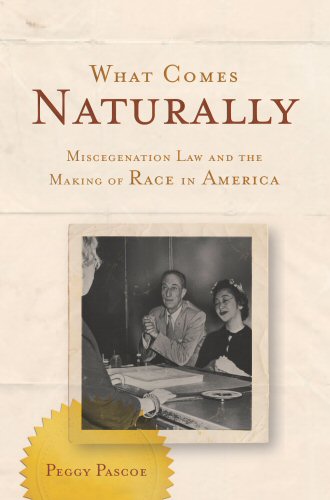 k, What Comes Naturally: Miscegenation Law and the Making of Race in America (Oxford University Press). Here's the Prize Committee's citation:
What Comes Naturally is a comprehensive, interesting, and important sociolegal history that takes us through the history of miscegenation law beyond its commonly accepted geography. It analyzes how by “naturalizing” miscegenation law, politics, religious beliefs and scientific knowledge came together to sustain a set of legal parameters that eventually became policy in the post Civil War world throughout the United States, enhancing and expanding the Black/White race dichotomy, while complicating it in gendered terms. The book is an outstanding contribution richly nuanced and insightful. It expands our understanding of conceptions of race, not only in the South, but elsewhere. It contains as well a superb elucidation of the role that gender played in the process of defining and elaborating on miscegenation.The Hurst Prize is for the best work in sociolegal history. This year's prize committee included Blanca G. Silvestrini, University of Connecticut (chair), Lawrence M. Friedman, Stanford University, Arthur F. McEvoy, Southwestern Law School, Robert Chao Romero, University of California, Los Angeles, and Lucy E. Salyer, University of New Hampshire.
In her study of the way in which the law defined interracial relationships as illicit sex, Pascoe also explores how ideas of sexuality and scientific knowledge intersected with social norms, to produce ideas of what was “natural” in sexual and racial relations. The book is based on an impressive body of primary sources that take us on a journey from local lawmaking and courts, into the world of immigrants and national policy makers. The writing is gracious and appealing. Pascoe makes theory come alive through analysis of the way people actually lived and thought. She opens the door to further research on the ‘creation of the ‘off-white’ America;’ expands and critiques the commonly accepted ‘natural’ dichotomy of Black and White and sheds new and welcome light on the history of law and society.
More Environmental Legal History
The oil keeps coming, and so does the environmental legal history. After my post on this subfield, a few readers called my attention to more recent work in this area.
Volume III of the Cambridge History of Law in America (2008) includes a chapter on "Law and the Environment" by Betsy Mendelsohn (University of Maryland). Here's the first paragraph:
In 2006, the University Press of Kansas published Unlikely Environmentalists: Congress and Clean Water, 1945-1972, by Paul Milazzo (Ohio University). Here's part of the publisher's summary:

The rest of the article "looks at the recent recruitment of historians into the world of toxic-tort law and examines the ways that the craft of history is used and abused in the legal system." Drawing on the author's personal experiences, the article "identif[ies] the important ways that historians’ skills can be used on behalf of people claiming to be harmed by a variety of industries as well as the ways that these same skills have been used to defend industry activities." You can read the full article here.
For more on Rosner and Markowitz's book, Deceit and Denial: The Deadly Politics of Industrial Pollution, check out their impressive website. It includes reviews and supporting documents.
For a comparative perspective, see the English translation of The Age of Smoke: Environmental Policy in the United States and Germany, 1880-1970 (2009), by Frank Uekoetter (Research Institute of the Deutsches Museum, Munich). Here's a summary from the publisher:
Hat tip: David Schorr, Merlin Chowkwanyun
Volume III of the Cambridge History of Law in America (2008) includes a chapter on "Law and the Environment" by Betsy Mendelsohn (University of Maryland). Here's the first paragraph:
At first glance, 'environmental law' might seem, from its name, a phenomenon of the late twentieth century, growing out of the 1960s environmental movement and taking off with the National Environmental Policy Act of 1969. In fact, environmental law cannot be understood apart from the long-established debates and tensions that define the traditions of American law as a whole: individual rights and the extent of state power, the authority of law and its means of implementation. Long before the mid-twentieth century, American law was fully engaged with such matters as, for example, the private use of common resources, such as wildlife and rivers; private activity that injured public health and welfare, such as the emission of industrial wastes; and the municipal assumption of administrative power to build networked sanitary infrastructure. Courts had accepted science-based rationales to authorize law that limited private rights. Governments had engaged in interstate responses to environmental problems that crossed jurisdictional boundaries.You can view a few more pages on google books.
In 2006, the University Press of Kansas published Unlikely Environmentalists: Congress and Clean Water, 1945-1972, by Paul Milazzo (Ohio University). Here's part of the publisher's summary:
Environmental activism has most often been credited to grassroots protesters, but much early progress in environmental protection originated in the halls of Congress. As Paul Milazzo shows, a coterie of unlikely environmentalists placed water quality issues on the national agenda as early as the 1950s and continued to shape governmental policy through the early 1970s, both outpacing public concern and predating the environmental movement.
Milazzo examines a two-decade crusade to clean up the nation’s water supply led by development boosters, pork barrel politicians, and the Army Corps of Engineers, all of whom framed threats to the water supply as an economic rather than environmental problem and saw pollution as an inhibitor of regional growth. Showing how the legislative branch acted more assertively than the executive, the book weaves the history of the federal water pollution control program into a broader narrative of political and institutional development, covering all major clean water legislation as well as many other landmark environmental laws.

You can find a review here.
At the annual meeting of the American Association for the History of Medicine, traditionally a collegial conclave of subspecialists, a panel on the history of childhood diseases ended up in a shouting match after a respected historian who had been a consultant for the tobacco, asbestos, soft-drink, and lead industries, presented a paper arguing that the lead industry had done nothing wrong before the 1950s, and that, in any case, the problem of childhood lead poisoning was vastly overblown. During the conference the halls were abuzz with gossip and amazement, and it soon became apparent that many more members had been consulting for industry. The then-current president of the Association and Professor of Medicine and History at Washington University had been testifying and writing affidavits for the tobacco industry for nearly fifteen years. Another Professor of Medicine and History at Duke University had worked for the tobacco industry as well as the lead industry throughout the 1990s; less well-known historians had been recruited by Big Tobacco and other industries. Some fifty-seven colleagues have worked for the tobacco industry alone.[footnotes omitted]

The rest of the article "looks at the recent recruitment of historians into the world of toxic-tort law and examines the ways that the craft of history is used and abused in the legal system." Drawing on the author's personal experiences, the article "identif[ies] the important ways that historians’ skills can be used on behalf of people claiming to be harmed by a variety of industries as well as the ways that these same skills have been used to defend industry activities." You can read the full article here.
For more on Rosner and Markowitz's book, Deceit and Denial: The Deadly Politics of Industrial Pollution, check out their impressive website. It includes reviews and supporting documents.
For a comparative perspective, see the English translation of The Age of Smoke: Environmental Policy in the United States and Germany, 1880-1970 (2009), by Frank Uekoetter (Research Institute of the Deutsches Museum, Munich). Here's a summary from the publisher:
You can find a review here.For a sense of general trends in this field, I've been in touch with David Schorr, a legal historian who chairs the Law and Environment Program at Tel Aviv University and recently visited at Georgetown. (He has posted a bunch of work in this area on SSRN.) His sense is that the field is growing rapidly, owing to a rise in interest in environmental issues, but that no cohesive body of environmental legal historians exists. Scholars interested in the policy angle write for policy historians, those interested in the environmental justice movement write for historians working on similar movements, etc. Do others have opinions on the state of this subfield?In 1880, coal was the primary energy source for everything from home heating to industry. Regions where coal was readily available, such as the Ruhr Valley in Germany and western Pennsylvania in the United States, witnessed exponential growth-yet also suffered the greatest damage from coal pollution. These conditions prompted civic activism in the form of “anti-smoke” campaigns to attack the unsightly physical manifestations of coal burning. This early period witnessed significant cooperation between industrialists, government, and citizens to combat the smoke problem. It was not until the 1960s, when attention shifted from dust and grime to hazardous invisible gases, that cooperation dissipated, and protests took an antagonistic turn. The Age of Smoke presents an original, comparative history of environmental policy and protest in the United States and Germany. Dividing this history into distinct eras (1880 to World War I, interwar, post–World War II to 1970), Frank Uekoetter compares and contrasts the influence of political, class, and social structures, scientific communities, engineers, industrial lobbies, and environmental groups in each nation. He concludes with a discussion of the environmental revolution, arguing that there were indeed two environmental revolutions in both countries: one societal, where changing values gave urgency to air pollution control, the other institutional, where changes in policies tried to catch up with shifting sentiments. Focusing on a critical period in environmental history, The Age of Smoke provides a valuable study of policy development in two modern industrial nations, and the rise of civic activism to combat air pollution. As Uekoetter's work reveals, the cooperative approaches developed in an earlier era offer valuable lessons and perhaps the best hope for future progress.


Hat tip: David Schorr, Merlin Chowkwanyun
Cohen Competition Winner Announced
The Morris L. Cohen Student Essay Competition Committee of the American Association of Law Libraries has announced the winner and runner-up in its 2009-2010 competition. Justin Simard, who is enrolled at the University of Pennsylvania in its J.D./Ph.D. Program in American Legal History, wrote the winning entry, “‘The Citadel Must Open Its Gates to the People:’ Judicial Reform at the 1821 New York Constitutional Convention.” The runner-up was Ian Burke, who is enrolled in the MLIS program at the University of Denver, for his paper “The City and the River: The Thames in the Liber Albus.” More here.
Wednesday, June 2, 2010
"Transformative" Supreme Court Appointments
My current research project is on the Supreme Court in the 1930s. Obviously, one part of the story is the transformation of the Supreme Court after the crisis of 1936-37. There's general agreement that Roosevelt transformed the Supreme Court by his appointments starting with Hugo Black and including Felix Frankfurter, Stanley Reed, and William O. Douglas. But -- particularly in light of discussions of Elana Kagan's nomination -- it's important to understand exactly how that transformation occurred, or perhaps more precisely, what Roosevelt thought he was getting when he nominated those Justices.
The basic story is simple. Roosevelt was looking for justices who would uphold the New Deal's major initiatives or, more generally, who held expansive views of the scope of the national government's powers under Article I. He was relatively indifferent to his nominees' views on issues of civil rights and civil liberties, as his nominations of Reed and, later, James Byrnes show. (I plan another post about the Hughes Court's civil rights and civil liberties cases prior to 1937.) But, I think purely as a contingent matter -- that is, not intrinsically related to their views on national power -- some of Roosevelt's nominees happened to hold liberal views on those issues. Yet, some of the nominees, especially Frankfurter and, again later, Robert Jackson, defended their positions on the scope of national power not with an affirmative case for national power but with a negative case about the appropriate role of the Supreme Court in a democratic government. That negative case, they believed, had implications for the Court's role in civil liberties and civil rights cases.
In the years after 1937 the Court, now "controlled" by FDR's appointees, struggled to develop a coherent account of the Constitution and the Court's role in enforcing it that would simultaneously affirm broad national power and give the Justices some role to play in enforcing civil rights and civil liberties. Today we tend to think, or so I believe, that Harlan Fiske Stone solved the problem early on with Carolene Products' Footnote 4, but within the Court Footnote 4 was only one of the options on the table. Basically, or so I am likely to argue when my work is done, the Roosevelt Court floundered in its early years: The Justices knew pretty much where they wanted to come out, but had an extremely difficult time coming up with an account of their role that satisfied them when they reached the conclusions they did.
I mentioned Elena Kagan in this post because my sense -- based on no inside information, of course -- is that her selection reflects a strategic calculation by President Obama similar to FDR's. What the President wants is a Supreme Court that will stand aside when or if Congress enacts the programs the President favors, and is relatively indifferent to his nominees' views on other questions. Put pretty crudely, SG Kagan hasn't been vetted for her views on what we might call "Warren Court" (or "Brennan-Marshall") issues (other than the scope of national power) -- which may be why some on the liberal-left side of the spectrum are nervous about what she would do as a Justice dealing with those issues. (A minor point that I haven't seen made elsewhere: Even assuming all the somewhat critical things some have said about the way she structured her career, her first career choice was to decide who to clerk for on the Court of Appeals. Again, assuming that she wanted to get a Supreme Court clerkship, when she made her choice there were a number of "feeder" judges, some quite liberal, some less liberal, some conservative, and some extremely conservative. She chose to clerk for Abner Mikva, about as liberal a feeder judge one could have found when she made her choice. I for one (to use a locution favored by the Justice she clerked for) think that provides some indication of her views on Brennan-Marshall issues.)
Two from Wright on 19th C Family Law History
Danaya C. Wright, University of Florida Levin College of Law, has posted two articles on 19th century family law. The first is Well-Behaved Women Don't Make History: Rethinking Family, Law, and History, which appeared in the Wisconsin Women's Law Journal (2004). Here's the abstract:
In this article, I focus on three principal claims. The first is that in the transition from the rules of coverture to the newly emerging family law of the 1858 Divorce and Matrimonial Causes Court, the debilitating effects of coverture remained. Women were forced to conform to narrow roles of traditional passive womanhood, and the rights to civil divorce did not enable these nineteenth-century litigants to control their futures in any meaningful way. The second is that the issues and prejudices of the period naturally formed the core assumptions and relationships that continue to define family law. Because the focus in the nineteenth century was on the heterosexual couple, and control over their children and their property, the family law of today remains mired in that model. For that reason, such important "family" issues as health care, homelessness, child abuse, and a living wage are not considered central family law issues and the values of family law do not prevail in these areas. Instead, the model of fault, marital breach, and male rights in women's chastity remain central despite the move to no-fault divorce and greater domestic rights. Third, historians and scholars have generally applauded the enterprise of family law as being good for women, as protecting their important interests in the domestic sphere, and as being liberalizing for women outside that sphere. I challenge this liberalization narrative for obscuring the role family law plays in the perpetuation of gender inequality and separate spheres. I argue that family law is not only not liberating, but it is constraining and limiting for women in the nineteenth century and today who wanted legal rights, rights that are the currency of the public sphere. My arguments are supported by extensive empirical data from my research into the 19th-century divorce court records.Untying the Knot: An Analysis of the English Divorce and Matrimonial Causes Court Records, 1858-1866 is published in the University of Richmond Law Review (2004). Here's the abstract:
This article is a detailed analysis of nearly 10 years of records from the 1858 Divorce and Matrimonial Causes Court in England, the first unified family law court in the common law system. It contains a detailed analysis of the cases filed by nearly 2500 petitioners along a variety of axes, cause of action, grounds for divorce, success of divorce, child custody petitions, alimony petitions, property orders to name a few.
Tuesday, June 1, 2010
Back on-line: The Case of 'Death for a Dollar Ninety-Five': Miscarriages of Justice and Constructions of American Identity
I had to take my paper The Case of 'Death for a Dollar Ninety-Five': Miscarriages of Justice and Constructions of American Identity, off the web until a year after it appeared in print. The book, When Law Fails: Making Sense of Miscarriages of Justice, Austin Sarat and Charles Ogletree, Jr., eds., has been out for more than a year, and th e paper has just been reposted on SSRN. Here’s the abstract:
 e paper has just been reposted on SSRN. Here’s the abstract:
This is a story about a case long forgotten. It was a case that needed to be forgotten, to safeguard the meaning of American justice. The case of Death for a Dollar Ninety-Five began one July night in Marion, Alabama, in 1957, and soon captured the attention of the world. It involved an African American man, a white woman, and the robbery of a small amount of change late in the evening. The conviction was swift and the penalty was death. International criticism soon rained down on the Alabama Governor and the American Secretary of State, leading to clemency and a life sentence. For $1.95. And the case was forgotten. This story helps us to see the way narratives of American justice and injustice are managed. The United States identifies itself with the rule of law, and so miscarriages of justice are often perceived as breaches in that identity, violations of the nation's own core principles. Resolutions of miscarriages of injustice, this paper argues, are often about repairing a breach in American identity, making America whole again. What happens to the person at the center of the story is, at best, secondary. For the story to turn out right, the nation is restored, and the person is forgotten.The photo shows Tuskegee, Alabama civil rights attorney Fred Gray, who represented Jimmy Wilson, the defendant at the center of this paper, during his appeals and clemency proceedings. I interviewed Mr. Gray, who still practices law in Tuskegee. His memoir is Bus Ride to Justice.

Welcome to Guest Blogger Mark Tushnet
The Legal History Blog welcomes Mark Tushnet, Harvard Law School, who will be guest blogging in June. Mark needs no introduction to LHB readers. He’s a rare scholar in tha t he is prominent in more than one field. Mark is a leading Constitutional Law scholar. When I was starting out, he was most well known as an important Critical Legal Studies scholar. Along the way, he has published significant work in legal history.
I first encountered Mark’s work when I was in law school through his book The American Law of Slavery, 1810-1860: considerations of humanity and interest. When I started working on civil rights history, his book The NAACP's Legal Strategy Against Segregated Education, 1925-1950 was essential reading. Mark is the leading biographer of Thurgood Marshall, publishing two biographies: Making Civil Rights Law: Thurgood Marshall and the Supreme Court, 1956-1961, and Making Constitutional Law: Thurgood Marshall and the Supreme Court, 1961-1991, and a collection of Marshall’s work: Thurgood Marshall: His Speeches, Writings, Arguments, Opinions, and Reminiscences. Other work includes: Slave Law in the American South: State V. Mann in History and Literature, A Court Divided: The Rehnquist Court and the Future of Constitutional Law, Taking the Constitution Away from the Courts, and much more. Mark now seems to publish as many books a year as most people publish articles. As his work has taken him to other circles, he has remained a friend of legal history, and of legal historians. We are pleased to have him join us for a while.
Welcome to Mark!
Photo credit.
 t he is prominent in more than one field. Mark is a leading Constitutional Law scholar. When I was starting out, he was most well known as an important Critical Legal Studies scholar. Along the way, he has published significant work in legal history.
I first encountered Mark’s work when I was in law school through his book The American Law of Slavery, 1810-1860: considerations of humanity and interest. When I started working on civil rights history, his book The NAACP's Legal Strategy Against Segregated Education, 1925-1950 was essential reading. Mark is the leading biographer of Thurgood Marshall, publishing two biographies: Making Civil Rights Law: Thurgood Marshall and the Supreme Court, 1956-1961, and Making Constitutional Law: Thurgood Marshall and the Supreme Court, 1961-1991, and a collection of Marshall’s work: Thurgood Marshall: His Speeches, Writings, Arguments, Opinions, and Reminiscences. Other work includes: Slave Law in the American South: State V. Mann in History and Literature, A Court Divided: The Rehnquist Court and the Future of Constitutional Law, Taking the Constitution Away from the Courts, and much more. Mark now seems to publish as many books a year as most people publish articles. As his work has taken him to other circles, he has remained a friend of legal history, and of legal historians. We are pleased to have him join us for a while.
Welcome to Mark!
Photo credit.

Katz on Publishing and University Prestige
 Last June Dan posted a link to Stanley Katz's speculations on the future of academic publishing. “I have no doubt," Katz wrote at that time, "that we are rapidly moving into an environment of tiny initial print runs (if there is any print run at all) followed by print-on-demand, combined with some form of electronic delivery.” In a recent "Brainstorm" post for the Chronicle of Higher Education, Katz returns to the question of whether university presses will "survive in the digital age."
Katz begins by reiterating two reasons to believe that the typical university press would be "an irresistible target for the bean counters in campus financial planning offices": "the apparent decline of traditional academic print publishing" and "the pressure on universities to restructure their budgets in order to cope with dramatically decreased budgets." In fact, he finds, most universities have not abandoned their presses.
But that does not mean that the industry hasn't fundamentally changed. To get a sense of what has happened and what the future holds, Katz suggests that we consider the successes of some of the larger presses (e.g., Princeton) alongside the closure and possible restructuring of presses like Southern Methodist University.
You can read the rest of the post here.
Subscribe to:
Comments (Atom)