Friday, November 10, 2017

How Black Litigants Shaped Their Civil Cases Against Whites

Today I’m guest blogging about how black southerners negotiated the post-Civil War legal landscape.  In particular, I want to consider how they worked to shape their civil cases against whites. This research is laid out in greater detail in my new book, Litigating Across the Color Line: Civil Cases Between Black and White Southerners from the End of Slavery to Civil Rights.

As African Americans litigated civil cases against whites in the U.S. South from the end of the Civil War to the mid-20th century, they saw that the outcomes of their cases would often have enormous economic effects on their families. At the same time, black litigants generally seem to have recognized the difficulties of operating within the southern legal system – an institution in which those making decisions generally had very different interests than their own. To give their cases the best possible chance, then, black litigants in almost one thousand civil cases that reached eight southern appellate courts between 1865 and 1950 often employed a range of strategies.  While their lawyers undoubtedly played a key part in many of these strategies, black litigants played an important role in shaping and executing them as well.  

First, in almost every civil case between black and white southerners that I found in eight southern state supreme courts, black litigants had hired white lawyers to represent them. The white lawyers involved were often prominent members of the community and seem to have generally taken on a few black litigants’ cases alongside their larger practice of cases involving white litigants.  Often, white lawyers seem to have taken on black clients because their cases promised to yield a large financial reward. At times, however, they seem to have also been influenced by personal connections, paternalism, ideas of professionalism, or very occasionally, to have genuinely sympathized with the causes of their black clients. Using a white lawyer helped make black litigants’ cases seem less threatening and more acceptable to white judges and juries. At the same time, it limited the kinds of cases they could bring and the types of arguments that their suits could make.

A number of black litigants also emphasized connections with prominent whites in their communities.  While this occurred particularly often in cases during the three and a half decades after the Civil War, such strategies were also occasionally employed in the first half of the 20th century.  At times, black litigants mentioned their ties with local whites in their testimony, including at times their connections to former masters. In other cases, black litigants may have played a part in identifying the white witnesses who frequently testified in their favor in such cases.  

Black litigants also shaped their testimony based on their understanding of the relevant law. Case files suggest that they gained some knowledge of the law from coaching and conversations with their lawyers. They also learned from participating in legal actions and daily experiences in a law-saturated society.  Black litigants then often worked with their lawyers to shape their testimony to meet the demands of the law for their particular case. In suits over bequests, for example, black litigants’ testimony sometimes helped to establish the testator’s intention to leave the bequest to them, an element that one 19th century Tennessee judge called “the great rule in the construction of wills.”[i] In fraud cases, on the other hand, black litigants’ testimony often worked to establish proof of physical injury and loss of income, two important elements to proving such a claim.

Finally, some black litigants used their knowledge of white southern racial attitudes to present themselves in ways that would elicit favorable responses from largely white juries and judges. In the decades after the Civil War, they occasionally presented themselves as having been loyal to their former masters, even after the end of the war.  At other times they presented themselves as hardworking, “respectable,” or unthreatening. The ways in which they presented themselves also shifted over time. During the two decades after widespread disfranchisement occurred at the end of the 19th century, black litigants often presented themselves in their testimony as more ignorant, more vulnerable, and more trusting of whites than they actually were. 

These strategies played a part in some African Americans’ continuing ability to litigate and win civil cases against whites in the Jim Crow South, even after black men largely lost the right to vote. At the same time, these strategies sometimes limited their cases in important ways.  Moreover, even as they carefully negotiated the southern legal landscape, black litigants found that in contrast to the broad range of cases litigated between whites, they had the most success bringing certain kinds of cases against whites.  The kinds of cases they could litigate shifted over time, as well, as the constraints they operated under changed.  I’ll be back talking about this in my next blog post in a few days.


[i] Lynch v. Burts, 48 Tenn. 600 (1870).

Thursday, November 9, 2017

Jaffe on Gandhi, Lawyers & the Court boycott

James Jaffe, University of Wisconsin, has published "Gandhi, Lawyers, and the Courts' Boycott during the Non-Cooperation Movement" in Modern Asian Studies 51:5, 1340-68.
Here's the abstract:

This article analyses the role of the legal profession and the evolution of aspects of Indian nationalist ideology during the Non-Cooperation Movement of 1920–22. Very few legal professionals responded to Gandhi's call to boycott the British courts despite significant efforts to establish alternative institutions dedicated to resolving disputes. First identified by leading legal professionals in the movement as courts of arbitration, these alternative sites of justice quickly assumed the name ‘panchayats’. Ultimately, this panchayat experiment failed due to a combination of apathy, repression, and internal opposition. However, the introduction of the panchayat into the discourse of Indian nationalism ultimately had profound effects, including the much later adoption of constitutional panchayati raj. Yet this discourse was then and remains today a contested one. This is largely a legacy of Gandhi himself, who, during the Non-Cooperation Movement, imagined the panchayat as a judicial institution based upon arbitration and mediation. Yet, after the movement's failure, he came to believe the panchayat was best suited to functioning as a unit of village governance and administration.

Wednesday, November 8, 2017

Great Documents of New York Legal History

Word has reached us of an upcoming event sponsored by the Historical Society of the New York Courts, Documenting Our Past: Great Documents of New York Legal History, to be held on Thursday, November 30, 2017, at 6:30 PM, at the Association of the Bar of the City of New York, 42 West 44th Street.  CLE credits available.  According to an announcement:
The Society is partnering with the New York State Archives for this program in which leading experts will discuss early documents of State importance that provide a window into NYS legal foundations. The program will also cover the importance of the preservation of early court records and the recent transfer of court documents to State Archives.
After a welcome from the Hon. Albert M. Rosenblatt, President, Historical Society of the New York Courts, the event will consist of three presentations and a panel discussion moderated by Daniel Hulsebosch, the Charles Seligson Professor of Law at the NYU School of LawThomas J. Ruller, Assistant Commissioner and State Archivist, New York State Archives, State Education Department, will speak generally on the preservation of court records.  Leah Moren Green, Esq., Corporate Counsel, Caterpillar Inc., will speak on documents relating to the Erie Canal, and Dr. Dennis J. Maika, Senior Historian and Education Director, New Netherland Institute, will speak on the Flushing Remonstrance.

Hushchynski on the Bar and the Russian Annexation of Belarus

We’re assuming your Belarusian is no better than ours; still we want to note the posting (in that language) of Legislative Support for the Bar on the Territory of Belarus at the End of the 18th – the First Third of the 19th Century, by Ihar Hushchynski, Belarusian State Pedagogical University.  Here is the English abstract:
At the end of the 18th century the territory of Belarus was annexed by the Russian Empire, but local judicial system and court proceedings remained different from Russian domestic provinces until 1840. Participation of professional advocates in judicial proceeding was one of main features. The activities of the bar of Western provinces of the Russian Empire was based on the rules of the Statute of the Grand Duchy of Lithuania of 1588 and Sejm constitutions of the Polish-Lithuanian Commonwealth, which remained in force. At the end of the 18th – the first third of the 19th century, this legislative base was complemented and to some extent adjusted by a number of laws issued by Russian Government. This adapted the activities of the bar of the Western provinces to the new administrative and judicial order, which combined local law traditions with Russian governance practices.

Tuesday, November 7, 2017

Narayan on Widows and Anglo-Hindu law

In 2016, Rochisha Narayan, Yale-NUS College, Singapore, published "Widows, Family, Community, and the Formation of Anglo-Hindu Law in Eighteenth-Century India" in Modern Asian Studies 50:3, 866-97. Here is the abstract:
Late eighteenth-century colonial agrarian and judicial reforms had a direct
impact on women from elite and non-elite backgrounds. Informed by
British liberal ideologies and upper-caste Brahmanical norms, colonial policies
marginalized women’s access to, and control over, resources in the emergent
political economy. In this article, I reconstruct histories of the ways in which
Anglo-Hindu law compromised women’s status as heirs, businesswomen, and
members of society who wielded social capital with other community groups.
Focusing on widows in Banaras who commandeered their property disputes,
I illustrate that pre-colonial precedents of case-resolution under the Banaras
rulers, and practices of ‘forum shopping’ by disputants themselves, shaped
the widows’ approach to the colonial courts. Colonial judicial plans being
incommensurable to everyday life, the courts incorporated pre-colonial forms
of dispute handling and maintained a flexible approach to the practice of colonial
law under the supervision of an Indian magistrate for a period of time. These
characteristicsmade the courts popular among local society in the Banaras region.
However, British officials, insistent on applying abstract scriptural laws, aligned
customary practice to the dictates of Anglo-Hindu law. This article shows that the
narrow legal subject position available to widows under scriptural law reordered
their relationships with family and community networks to their disadvantage.

LHR seeks Assoc. Editor for Digital Projects

We have the following call for applications (which includes an exciting announcement about a new digital platform for legal-historical work):
Law and History Review, a leading journal of legal history, seeks an Associate Editor for Digital Projects to manage its new digital imprint, The Docket. The ideal candidate has a thorough knowledge of legal history and a strong grasp of communication through social media and other digital forums. Public historians are especially encouraged to apply. The Associate Editor will be responsible for publishing articles, interviews, and other items that mirror and expand on the content of issues of Law and History Review, as well as participating in editorial deliberations of the journal. Editor-in-Chief Gautham Rao, and Associate Editors Angela Fernandez, Elizabeth Papp Kamali, and Jedidiah Kroncke will begin reviewing applications on December 1, 2017 and expect to make an appointment by January 15, 2018.

To apply, please send a cover letter that explains your credentials, a C.V., and a list of three references (with name, position, mailing address, email address, and phone number) to lhrsearch1@gmail.com. Please direct any inquiries about the position to Gautham Rao at grao@american.edu.

Law and History Review is published quarterly by Cambridge University Press for the American Society for Legal History.

Hammond's "God's Businessmen"

God's Businessmen: Entrepreneurial Evangelicals in Depression and War, by the late Sarah Ruth Hammond (and edited by Darren Dochuk, Department of History, Notre Dame University), is out from the University of Chicago Press.
The evangelical embrace of conservatism is a familiar feature of the contemporary political landscape. What’s less well-known, however, is that the connection predates the Reagan revolution, going all the way back to the Depression and World War II. Evangelical businessmen at the time were quite active in opposing the New Deal—on both theological and economic grounds—and in doing so claimed a place alongside other conservatives in the public sphere. Like previous generations of devout laymen, they self-consciously merged their religious and business lives, financing and organizing evangelical causes with the kind of visionary pragmatism that they practiced in the boardroom.

In God’s Businessmen, Sarah Ruth Hammond explores not only these men’s personal trajectories but also those of the service clubs and other institutions that, like them, believed that businessmen were God’s instrument for the Christianization of the world. Hammond presents a capacious portrait of the relationship between the evangelical business community and the New Deal—and in doing so makes important contributions to American religious history, business history, and the history of the American state.
A celebration of the book and its author, The Religion of Business: In Honor of Sarah Hammond, will take place at Yale University on December 8, 2017.

Monday, November 6, 2017

Carr on Animal Welfare Law in 19th-Century Scotland

Daniel James Carr, University of Edinburgh Law School, has posted The Historical Development of Animal Welfare Law in Nineteenth Century Scotland:
This paper examines the development of animal welfare in Scotland. Whilst the law developed in tandem with developments across nineteenth century Britain, the paper draws attention to the distinctive Scottish situation. By examining the development from disparate common law protections to the statutory interventions of the nineteenth century the paper charts that development, and begins to place it within nascent 'humanist' movements emerging around this time. The piece examines how the Scottish doctrinal law took a distinctive direction in decisions, and in particular considers contemporary opinion. The paper is the first to take a look at the particular Scottish development and opens up new avenues of research into the nineteenth century, and also frames developments in the modern law which I will pursue in future research.

Tucker on Labor Law History

Eric Tucker, York University Osgoode Hall Law School, has posted On Writing Labour Law History: A Reconnaissance:
Labour law historians rarely write about the theoretical and methodological foundations of their discipline. In response to this state of affairs, this article adopts a reconnaissance strategy, which eschews any pretense at providing a synthesis or authoritative conclusions, but rather hopes to open up questions and paths of inquiry that may encourage others to also reflect on a neglected area of scholarship. It begins by documenting and reflecting on the implications of the fact that labour law history sits at the margins of many other disciplines, including labour history, legal history, labour law, industrial relations and law and society, but lacks a home of its own. It next presents a short historiography of the writing of labour law history, noting its varied and changing intellectual influences. Next the article notes some of the methodological consequences of different theoretical commitments and discusses briefly the possibilities opened up by computer technologies as revealed by two interesting projects that rely heavily on the construction of sophisticated data bases. Finally, the article reflects on the methodological challenges I have experienced in my current project on labour law’s recurring regulatory dilemmas and conclude with some thoughts on the contribution labour law history can make to our understanding of the dynamics that shape its current challenges.

Why African Americans Were Able To Litigate and Win Civil Cases Against Whites in the Jim Crow South

I’m back again today guest blogging about some of the research in my new book, Litigating Across the Color Line: Civil Cases Between Black and White Southerners from the End of Slavery to Civil Rights. In my last blog post, I discussed how I found the almost one thousand civil cases between black and white southerners highlighted in my book. Today, I wanted to discuss why African Americans continued to be able to litigate -- and win -- these cases against whites in the Jim Crow South.

It has generally been assumed that African Americans litigated few civil cases against white southerners in the post-Reconstruction South, and faced widespread inequality in the cases that they did pursue. However, the civil cases involving black southerners that historians and legal scholars have examined in the greatest depth often explicitly revolve around issues of race or racial justice and are the kinds of cases that black litigants found particularly difficult to litigate and often fared the worst in. 

In fact, I found that the vast majority of appellate civil cases that black southerners were able to litigate against whites between 1865 and 1950 took place over economic disputes that originated from their daily lives: cases over contracts, bequests, transactions, personal injury, and property. The outcome of most of their cases would usually have an immediate impact only on the families involved in the suit. Black litigants were also surprisingly successful in civil suits that reached southern state supreme courts. Of the 980 state supreme court cases I examined across eight states during this period, black litigants won 59% of their appellate suits against whites.  

 So why were black southerners not only able to litigate these suits but often won them as well?  There were a number of factors, including the nature of the legal system itself. Undoubtedly, these appellate suits are also not completely representative of black litigants' lower-level suits -- although in these suits, African Americans had often won in trial courts as well. However, the fact that black southerners could litigate and win suits against whites at any level during the era of Jim Crow was also due in large part to the ways that white southerners and black litigants viewed these suits.   

In part because of the limited scope of most of these suits, they often seemed relatively unthreatening to white southerners.  African American access to the courts also seemed much less dangerous than their access to the ballot box because most cases would be mediated by white judges and juries. White southerners argued that generally white judges and juries could be trusted to make the “right” decisions in black southerners’ cases.  Moreover, at times, black southerners’ civil cases actually seemed to uphold white people’s rights.  In cases claiming bequests left in a white man’s will, for instance, a decision for the black litigant upheld the white testator’s right to leave a bequest to whom he pleased. In other instances, whites viewed black litigants’ cases as upholding the system of white supremacy, even as they inconvenienced a few individual whites.  In fraud cases in which African Americans emphasized their ignorance and lack of business understanding, black litigants’ testimony arguably strengthened white claims about black inequality.

At the same time, the outcome of these suits could often have a life-changing effect on the families and finances of the black litigants involved. The results of African Americans’ litigation would determine whether they would have their own land under their feet, funds to replace missing wages when they were injured, or be paid for a year’s work.  Other cases decided whether they would be able to inherit property that had been left them in a will or if they had a legitimate claim to ownership of a horse or mule.

I argue that the very discrepancy between how white and black southerners viewed these suits played an important part in allowing them to continue.  As a result of their view of these suits as relatively unthreatening – and sometimes even beneficial – to white supremacy, white southerners allowed African Americans to continue to access the civil courts even after black men were largely disfranchised throughout the South at the end of the 19th and beginning of the 20th centuries.  At the same time, because African Americans had important economic stakes in the outcomes of their suits, they often did everything they could to achieve a favorable decision. This included hiring white lawyers, emphasizing connections with prominent whites in their communities, shaping their testimony based on their understanding of the relevant law, and using their knowledge of white southern racial attitudes to present themselves in ways that would elicit favorable responses from largely white juries and judges.

I’ll be back in a few days to discuss in greater detail the ways that a number of black litigants adeptly negotiated an often hostile legal system in which the actors making decisions often had very different interests than their own. 

Slavery and the Constitution: An NEH Summer Institute

[We have the following announcement.]

Slavery and the Constitution is a new NEH Summer Institute designed to examine the relationship between slavery and the Constitution and will enable 25 faculty members from two- and four-year colleges and universities to study the relationship between slavery and the United States Constitution. It will be held in Washington, DC from July 8-21, 2018 at the Library of Congress’ Kluge Center.  Seven eminent scholars will offer seminars, lead scholarly discussions, and provide research assistance on the topic of slavery and the Constitution. The Institute’s scholars will also guide the participants through primary documents and the continuing scholarly debate over the relationship between slavery and the Constitution from its writing to the Civil War. The stipend for the program is $2100.  [More information is here.]

Saturday, November 4, 2017

Weekend Roundup

  • The Historical Society of the DC Circuit has a quite competent history Calmly to Poise the Scales of Justice: A History of the Courts of the District of Columbia Circuit by Jeffrey Brandon Morris.  Recently, the Society posted on its website the full text of two earlier histories completed in 1976:  An Anecdotal History of the United States District Court for the District of Columbia, by District Court Judge Mathew F. McGuire, and History of The United States Court of Appeals for The District of Columbia Circuit in The Country's Bicentennial Year.  The latter two books are available free here
  •  Issue 6 (November 2017) of the European Legal History: The Newsletter of the Max Planck Institute is here.  H/t: ESCLH
  • Historians have long had HNN as a platform for reaching the general public.  More recently, as we have noted, they have published op-eds on the Washington Post’s website, Made by History.  More recently still, we learned of another platform, not just for historians but the academe as a whole: The Conversation
  • Just out from Princeton University Press is How to Do Things With International Law
    by Ian Hurd, a political scientist at Northwestern.  “Conventionally understood as a set of limits on state behavior, the ‘rule of law’ in world politics is widely assumed to serve as a progressive contribution to a just, stable, and predictable world.”  Perhaps not, the book argues.
Weekend Roundup is a weekly feature compiled by all the Legal History bloggers. 

Friday, November 3, 2017

ASLH 2018: Call for Papers

[We have the Call for Papers for the 2018 Annual Meeting of the American Society for Legal History in Houston, Texas.  Note that the deadline for submissions is March 1, 2018.]

The Program Committee of the ASLH invites proposals for complete panels and individual papers for the 2018 meeting to be held November 8-11, 2018, in Houston, Texas. Panels and papers on any facet or period of legal history from anywhere in the world are welcome.

Panel proposals should include the following: a c.v. for each person on the panel, including complete contact information; 300-word abstracts of individual papers; complete or partial drafts of papers, where possible; and a short description of the panel.

The Program Committee also welcomes any other form of structured presentation to fill a 90-minute slot in, for example, author-meets-reader, lightning round, workshop, or roundtable format. Sufficient information following the general guidelines for panel proposals should be provided for the Committee to assess the merits of the presentation.

Individual paper submissions should consist of an abstract, a draft paper (where possible), and a c.v. Given the number and high quality of panel and other complete sessions submitted, individual papers are much less likely than full sessions to be accepted.

The Program Committee additionally seeks proposals for full-day or half-day pre-conference symposia crafted around related themes to augment traditional conference offerings. Please provide a program title, the intended length of program, a program description, a c.v. and contact information for each presenter, and any information technology requirements. The Program Committee is available to consult with organizers of such symposia as they develop their proposal.

Prospective participants may submit proposals for multiple sessions, with the understanding that, absent exceptional circumstances, no individual may appear more than once on the final program in any capacity. The Program Committee strives to include as many participants as possible and will work with session organizers to identify suitable replacements for any sessions from which a participant has had to withdraw.

The members of the Program Committee are Angela Fernandez, Katrina Jagodinsky, Emily Kadens, H. Timothy Lovelace, Michelle McKinley, Daniel J. Sharfstein, Joshua C. Tate, and John Wertheimer. The co-chairs of the Program Committee are Professors Catharine MacMillan (catharine.macmillan@kcl.ac.uk) and Matthew C. Mirow (mirowm@fiu.edu).

All program presenters must be current members of the Society by the date of the Annual Meeting. All proposals must be submitted here.  Please visit here for updates and additional information.

How to Find Civil Cases Between White and Black Southerners in State Court Records

I’m excited to be guest blogging all month here at the Legal History Blog. I am a lecturer in American History at the University of Sussex in England and my new book Litigating Across the Color Line: Civil Cases Between Black and White Southerners from the End of Slavery to Civil Rights is releasing this month. My book examines almost one thousand civil cases between black and white southerners that took place across eight southern state supreme courts from 1865 to 1950. In these hitherto largely unexamined cases, individual black and white southerners contested economic matters central to their lives including disputes over property, contracts, transactions, personal injury, and bequests.  These suits between black and white southerners continued to regularly take place in southern courts even after disfranchisement set in around the South. My book considers how African Americans were able to litigate and win suits against whites in the Jim Crow South – and the limitations they met and compromises they had to make in order to do so. 

Throughout the month, I’ll be blogging about different aspects of my research, including the role of black women in these suits, the frequent suits brought by former slaves against their former masters, how these suits shifted over time, the strategies used by black southerners that helped them to win suits against whites, and these suits' links to the U.S. Civil Rights movement. I’ll also be providing links to some excerpts from the archival case files of some key cases examined in my book, which highlight what these sources look like and may be useful for teaching.

Before discussing what I found in my research, though, I wanted to start by discussing how I found these court records. These appellate civil cases are a very rich source in which much further research remains to be done. While the suits themselves are not representative of all civil cases litigated by African Americans in lower courts, they allow analysis of African Americans’ experiences in both trial and appellate courts. The archival case files of suits that reached southern supreme courts generally include the full trial records of the lower court case as well as records of the appeal. Often, the archival records for each case number 200 or 300 pages and include extensive trial testimony from African Americans as well as others in their communities.

I found these civil cases involving African Americans by doing advanced keyword searches on the LexisNexis database in the state supreme court records of each of the states examined. The search terms I used included “slave, freedman, freedwoman, Negro, black, Africa, African, color, colored and Negress.” As these cases took place over 85 years, certain terms were more common during certain periods than others.

After these keyword terms produced thousands of cases on LexisNexis, I then went through the LexisNexis record of the court cases to determine if the case actually involved a black litigant, and whether it took place between black litigants or between one or more black and white litigants. In many cases it was possible to determine this from the LexisNexis record, but in some cases it was necessary to look at the archival record or census data to determine the racial identity that southern courts and southern society assigned to the litigants.

Courtesy of the Kentucky Dept. for Libraries and Archives.

After compiling long lists of cases that might involve African Americans for each of the eight states, I then turned to archives in each state to examine the original archival case files. Generally, the case files were held by the state archives of that particular state. In Arkansas, however, the records were at the University of Arkansas at Little Rock’s Law Library and in Virginia, records were held by the Virginia State Law Library, The Library of Virginia, and the University of Richmond’s William Taylor Muse Law Library (for a complete list of all the archives I consulted, see the Bibliography of Litigating Across the Color Line).  Fortunately, the vast majority of case files involving African Americans that I sought at these archives and law libraries still survived.  Some case files were still tied in what seemed to be their original faded ribbon, and several archivists noted that these records had only rarely been requested.  I concluded my search for these cases here at the archives by examining the case files to check the racial identities assigned to the litigants. As a result of this research, I found 980 appellate civil cases between black and white litigants and 397 appellate civil cases between two or more black litigants in the state supreme courts of eight southern states from 1865 to 1950.

I’ll be back again in a few days with more about how I analyzed this data and what I found in these cases. 

Welcome, Melissa Milewski!

We here at Legal History Blog are pleased to have Melissa Milewski guest blogging with us this month.  Her Ph.D. in U.S. History is from New York University. She has been a visiting scholar at the American Academy of Arts & Sciences and has taught at Columbia University.  Currently, she is a Lecturer in American History at the University of Sussex in England.  She has just published Litigating Across the Color Line: Civil Cases Between Black and White Southerners from the End of Slavery to Civil Rights (Oxford University Press) and will be blogging about her book.

Surrency Prize to Adler

At the recently concluded Annual Meeting of the ASLH, the Society's Surrency Prize for 2017 was awarded to Jeffrey S. Adler, University of Florida, for “The Greatest Thrill I Get is When I Hear a Criminal Say, ‘Yes, I Did It’: Race and the Third Degree in New Orleans, 1920-1945," Law and History Review 34 (Number 1, 2016): 1-44.   The citation reads:
Adler draws on a rich array of sources, including coroner reports and other archival materials, to correct our understanding of the history of police interrogation practices, specifically the use of the “third-degree” interrogations designed to secure confessions. Even as law enforcement professionalized and foreswore coerced confessions, police chiefs continued to defend the practice as a crime fighting tool. In a local study of New Orleans, Adler shows how the use of third-degree interrogation practice shifted from whites accused of crimes to blacks, and came to play a role in enforcing Jim Crow.

This outstanding article contributes to a wide range of conversations: the birth of modern due process; evolving professional conceptions of policing; law enforcement and race; and the relation of professional and popular justice. Importantly, Adler’s argument suggests how racial hierarchy can change in form without necessarily improving the welfare or standing of minorities. As public authorities increasingly repudiate lynching, these forces of popular justice were then channeled into the enforcement of the criminal law.
The Surrency Prize Committee was chaired by Kenneth F. Ledford, Case Western Reserve University.  Its other members were Shaunnagh Dorsett, University of Technology, Sydney; Malick W. Ghachem, Massachusetts Institute of Technology; Maribel Morey, Clemson University; and Reva Siegel, Yale University.

Chatterjee on women, monks, and coverture

In 2016, Indrani Chatterjee, University of Texas at Austin, published "Women, Monastic Commerce, and Coverture in Eastern India circa 1600-1800 CE" in Modern Asian Studies 50:1, 175-2016. Here's the abstract:
This article argues that economic histories of the transition to colonial economics
in the eighteenth century have overlooked the infrastructural investments that
wives and widows made in networks of monastic commerce. Illustrative examples
from late eighteenth-century records suggest that these networks competed with
the commercial networks operated by private traders serving the English East
India Company at the end of the eighteenth century. The latter prevailed. The
results were the establishment of coverture and wardship laws interpellated
from British common law courts into Company revenue policies, the demolition
of buildings. and the relocation of the markets that were attached to many of
the buildings women had sponsored. Together, these historical processes made
women’s commercial presence invisible to future scholars.

Sutherland Prize to Brand

At the annual meeting of the ASLH, the Sutherland Prize Committee, chaired by Neil Jones, Cambridge University, announced its unanimous selection of a Prize winner and an honorable mention.  Here is the citation for the Prize winner:
The Sutherland Prize for 2016 is awarded for an article addressing the far-reaching question of the extent to which the outcome of late-medieval common law litigation in England was determined by ‘official’ legal doctrine found in law reports, plea roll arguments and Inns of Court readings, rather than generally being determined by juries exercising their own normative discretion. In an article published in 1989 in the Wisconsin Law Review, David Millon argued that ‘Perhaps … the premodern common law supposed that local communities speaking through juries, rather than official agents of the state, should enjoy the power to decide the normative questions on which judgment rested.’ With a focus on civil litigation in the period around 1300, and by means of a detailed, scholarly, and illuminating examination of evidence provided by plea rolls and law reports, the author shows that ‘Millon’s pessimism about the value of attempting to reconstruct substantive legal doctrine from Year Books and plea rolls in the pre-modern period is misplaced’, and that this is so for three main reasons. Firstly, ‘there is much more evidence for the effective judicial control of juries than Millon’s model … might suggest’, operating, for example, through judicial control of the presentation of ‘evidence’ to juries; judicial ‘charging of juries’; judicial examination of juries as to the basis for their verdicts; and judicial consideration of verdicts before giving judgment. Secondly, evidence from the period around 1300 suggests that ‘the straight judicial application (and on occasion making) of substantive legal rules in cases that did not involve any jury fact-finding’ was ‘of much greater significance and importance’ than Millon’s account suggested, for example in cases where judgment was given simply on the basis of undisputed facts which had emerged in pleading. And thirdly, that Millon’s approach underestimated the role and significance of ‘official’ rules at the pleading stage, which seems to have involved ‘a considerable amount of argument not just about matters of procedure … but also about substantive legal matters’, which helped to shape the issues which went to jury trial. The article, by an author intimately familiar with the sources, serves not only to shed new light upon the litigation process at common law in the period, but is of much wider, and indeed fundamental, significance for the historiography – past, present and future – of the medieval common law, showing, as it does that ‘The “official” legal rules were important and legal historians have not been wasting their time in attempting to reconstruct their development from the early Year Books and still earlier law reports and the plea rolls.’ For these contributions the Sutherland Prize for 2016 is awarded to Professor Paul Brand for his article ‘Judges and Juries in Civil Litigation in Later Medieval England: The Millon Thesis Reconsidered’, 37 Journal of Legal History (2016), 1-40.
In addition the Committee unanimously recommended “that honourable mention be made of Professor Tim Hitchcock and Professor William J. Turkel’s article ‘The Old Bailey Proceedings, 1674-1913: Text Mining for Evidence of Court Behavior’, 34 Law and History Review (2016), 929-955."  The Committee explained that the article
breaks new ground through its statistical and ‘data mining’ approach to the entire body of the Old Bailey Proceedings Online 1674-1913. The authors provide a detailed analysis of the shape of the Proceedings as a whole, showing how the distribution of text between both sessions and individual trials evolved between the late seventeenth century and the early twentieth century; compare the resulting measures of a changing text to statistics reflecting court behaviour so as to examine how changes in the text reflect or hide changing patterns of court behaviour; and, by combining these two approaches, assess the reliability of the Proceedings as evidence of practice at the Old Bailey in the eighteenth century, and of changing court behaviour in the nineteenth century, providing in the process further evidence as to the development of the practice of plea-bargaining. The article will provide a fundamental reference-point for all future work on the Old Bailey Proceedings. . .  .

Thursday, November 2, 2017

Cromwell Dissertation Award to Glass for "These United States"

This year's Cromwell Dissertation Prize was awarded to Maeve Herbert Glass for her dissertation “These United States: A History of the Fracturing of America.” Glass holds a J.D. from Columbia Law School, where she is currently an Academic Fellow. She received her from Ph.D. from Princeton University in 2016. Here's the citation:

In a masterful narrative that is at once elegant and riveting, Glass challenges the dominant view that states were America’s primary ideological units in the early national period, positing instead that America emerged from a coastal trading network that extended from Massachusetts “southward” to Virginia, South Carolina, and Georgia. Relying on a detailed analysis of commercial records in Massachusetts, Glass uncovers a lost America in which Boston merchants shared more in common with South Carolina planters than they did residents of Springfield or Worcester. She argues that philosophical debates over slavery led to a “fracturing” of the United States in the decades after the founding, as abolitionists learned to use the language of state sovereignty to weaken the hold of America’s coastal trading elite.
The award is given by the William Nelson Cromwell Foundation, with the advice of the American Society for Legal History. The members of this year's ASLH Cromwell Dissertation Prize Advisory Subcommittee were Anders Walker (Saint Louis University School of Law), Chair; H. Robert Baker (Georgia State University); Lisa Ford (University of New South Wales); and Laura Weinrib (University of Chicago Law School).

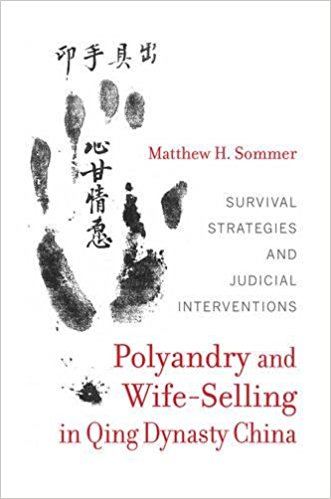
Inaugural Stein Prize to Sommer for "Polyandry and Wife-Selling in Qing Dynasty China"

[We have the following announcement from the 2017 Annual Meeting of the ASLH.]

The 2017 Stein Book Award winner is Matthew H. Sommer, Stanford University, for Polyandry and Wife-Selling in Qing Dynasty China: Survival Strategies and Judicial Interventions (University of California Press, 2015).
Matthew Sommer’s Polyandry and Wife-Selling in Qing Dynasty China is a masterful study of the marriage, sexual, and reproductive strategies of the rural poor. Drawing on twenty years of research and over 1,200 cases from central and local Chinese archives, Sommer’s book explores the prevalence of two legally prohibited and morally contra-normative practices: wife-selling and the marriage of one woman to multiple men. Husbands who could not support their wives and children sometimes brought in another man as an extra spouse in return for work or financial support. At the other end of the spectrum, a husband sometimes sold his wife to another man, who took her and her children under an agreement. The book shows why the rural poor pursued these strategies and why their villages tolerated them. It also reveals that magistrates charged by the state with enforcing a Confucian code of female chastity pragmatically accommodated the practices in the face of rural suffering. Sommer artfully weaves a narrative of gendered history from below. He shows that we cannot make a clean distinction between marriage and trafficking, or between marriage and prostitution. Sex work was in fact integral to marriage, and women’s sexual labor should be treated in this light. There is something here for everyone: law situated in the context of illegal and quasi-legal customary practices, female agency in a patrilineal and even murderously male-focused society, and real insight into the meaning of sex work, concubinage, marriage, remarriage, and brideprice (or dower) versus dowry. Sommer pushes back against gender histories that portray Chinese women only as victims, although he acknowledges that women’s agency does not make this a happy story. This powerful and concentrated study of non-elite behavior will be of lasting significance not only for the field of Chinese legal history, but also for social and gender history, as well as for the history of sex, marriage, violence, and the family.
Honorable mentions: went to Jessica Marglin for Across Legal Lines: Jews and Muslims in Modern Morocco (Yale University Press, 2016), and to Li Chen for Chinese Law in Imperial Eyes: Sovereignty, Justice, and Transcultural Politics (Columbia University Press, 2016).

The members of the Committee on the Peter Gonville Stein Book Award were Mitra Sharafi, chair, University of Wisconsin; Sally Gordon, University of Pennsylvania; Paul du Plessis, University of Edinburgh; Michael Grossberg, Indiana University; Kristin Mann, Emory University; Sara McDougall, John Jay College of Criminal Justice; Bianca Premo, Florida International University; and Taisu Zhang, Yale Law School.

Cromwell Article Prize to Mayeux for "What Gideon Did"

This year's Cromwell Article Prize went to Sara Mayeux (Vanderbilt University) for "What Gideon Did," which appeared in Volume 15 of the Columbia Law Review (2016). The award is for the best article in American legal history published by an early career scholar. Cribbing from Vanderbilt's press release:
“Sara Mayeux pulls off an impressive feat in teaching us something important and new about one of the nation’s most iconic Supreme Court cases,” the committee announcing Mayeux’s prize wrote. “This is the kind of history that forces students and researchers to rethink existing frameworks.” 
Mayeux’s exploration of Gideon involved both extensive archival research and the development of an original argument. “Many accounts of Gideon’s legacy focus on what it has not accomplished,” Mayeux said. “Criminal legal scholars, advocates and journalists claim that Gideon has failed to guarantee meaningful legal help for poor people charged with crimes. Scholars of constitutional theory say that Gideon did not represent a significant doctrinal shift; it simply imposed a pre-existing national consensus that people charged with crimes should have access to competent legal representation on a few states that didn’t already provide public defenders.” 
By reviewing Gideon in the context of the history of public defenders, Mayeux exposes both doctrinal and institutional changes the case has inspired since 1963, when the Supreme Court decided the case.
Read on here.

The award is given by the William Nelson Cromwell Foundation, with the advice of the American Society for Legal History. The members of this year's ASLH Cromwell Article Prize Advisory Subcommittee were: Mary Ziegler (Florida State University); Erika Pani (Colegio de México); Daniel Sharfstein (Vanderbilt University); and John Witt (Yale University).

Cromwell Book Prize to Tani for "States of Dependency"

As I mentioned in an earlier post, LHB Blogger Karen Tani, UC Berkeley Law, received the Cromwell Book Prize at last weekend’s meeting of the American Society for Legal History for her States of Dependency: Welfare Rights, and American Governance, 1935-1972 (New York: Cambridge University Press, 2016).  Here is the citation:
Historians and social scientists, Karen M. Tani maintains, have gotten the history of welfare and the rise of the American administrative state all wrong.  In this nuanced, fresh, original, and challenging social history of administrative law, waves of poverty reformers from the New Deal to the 1970s made dramatic advances in the treatment and understanding of the poor while being thwarted by larger legal values and structures such as the federal system itself.  Throughout the book, Tani casts a bright light on the middle managers, poverty reformers, and lawyers/administrators in the localities and the states whom the national policy makers charged to carry out the new reforms.  It was these bureaucrats who fleshed out the policies and implemented the changing values of welfare reform in the twentieth century United States.  In the first part of the book, these reformers/administrators sought uniformity, centralization, professionalization, and the establishment of legal rights of the poor.  And although federal law mattered, the most important action occurred on the ground in the localities and in the various states.  Beginning about 1950, in the second half of the work, reformers ran into resistance from exactly those localities and the states.  Federalism proved to be alive and well, and resistant to change.  State and local authorities curbed what they perceived as federal overreach, expressed their suspicion of the enterprise of bureaucratic governance, and acted on their long-simmering resentment of the intrusions of the New Deal into state and local affairs.  As a result, the limits of administrative government became clear which, in turn, inspired yet a new wave of lawyers and reformers.  They worked to establish that the poor were national citizens and used the federal courts to do so.  National citizenship carried with it a right against abusive state and local welfare policies.  National citizenship also entrenched the assumption in the culture the value that aid to the poor constituted income support and constituted a valid function of government.  This interpretation challenges older histories of administrative law, of women’s history, and social welfare history while demonstrating (most impressively) how legal history can transform conventions in non-legal history subfields such as women’s history.  Tani provides a compelling account of how the web of dependencies affected the poor, the balance of federalism, and the quality of American governance.
The overall chair of Advisory Committee on the Cromwell Prizes is John D. Gordan III.  The Book Prize Subcommittee was chaired by Thomas Mackey and included Felice Batlan, Sophia Lee, and Jonathan Levy.

Stanford Center for Law and History Workshop

[We have the following program for the Stanford Center for Law and History Workshop for 2017-18.]

The Stanford Center for Law and History Workshop will meet three times per quarter. The meetings are on the following Thursdays from 12:45-2:15 PM. To RSVP and receive the papers in advance, sign up for the email list.

Fall Quarter (meeting in Stanford Law School, Neukom 104)
·        October 12 – Matthieu Abgrall, Stanford Department of Classics: “Using Data for a Legal History of Archaic Greece”
·        November 9 – Gregory Ablavsky, Stanford Law School: “Species of Sovereignty: Native Nationhood, International Law, and the Early United States”
·        November 30 – Ron Harris, Center for Advanced Study in the Behavioral Sciences at Stanford University, and Tel Aviv University School of Law: “The Birth of the Business Corporation East and West: Eurasian Trade Institutions and their Migration, 1400–1700”

Winter Quarter (location to be announced)
·        January 18 – Luca Scholz, Stanford Department of History: “Historicizing Freedom of Movement: The Case of the Old Reich”
·        February 1 - Ariela Gross, Center for Advanced Study in the Behavioral Sciences at Stanford University, and University of Southern California School of Law: “Comparing Law, Race, Slavery and Freedom in the Americas: Cuba, Louisiana, and Virginia.” 
·        March 1 – Rabia Belt, Stanford Law School: “Race, Disability, and the Vote”

Spring Quarter (location to be announced)
·        April 19 – Rebecca McLennan, UC Berkeley Department of History: “The Wild Life of Law: The Bering Sea Conflict, 1885-1893”
·        May 3 – Alexandra Stern, Stanford Department of History: “‘A Rough Region:’ Lawlessness and the Reconstruction of Indian Territory, 1866 - 1885”
·        May 24 – Elizabeth Katz, Stanford Law School, “The Creation and Evolution of Courts of Domestic Relations”

Preyer Awards to Funk and Ossei-Owusu

The American Society for Legal History created the Kathryn T. Preyer Scholars Award to recognize promising new entrants to the field. This year’s Preyer Prize winners are Kellen Funk and Shaun Ossei-Owusu.

Funk is a doctoral candidate in history at Princeton University, where he studies American legal, political, and religious history. He also holds a J.D. from Yale Law School. His paper is entitled, “The Swearer’s Prayer: Race, Piety, and the Rise of Oaths in Modern American Practice.”

Ossei-Owusu is the Kellis E. Parker Teaching Fellow at Columbia Law School, where he draws on law, history, and sociology to study government services to the poor. He holds a J.D. and Ph.D. from the University of California, Berkeley. His paper is entitled, “Racial Discounting and Self-Help: Blacks, Americanization, and the Early Twentieth-Century Legal Aid Movement.”

Both scholars presented their work at the Preyer Memorial Prize Panel at the annual meeting. Jed Shugerman (Fordham University School of Law) commented on Funk’s paper. Susan Carle (American University Washington College of Law) commented on Ossei-Owusu’s paper.

The members of the the 2017 Preyer Memorial Committee were H. Timothy Lovelace (Indiana University), Chair; Melissa Hayes (independent scholar); Michael Hoeflich (University of Kansas); Rabia Belt (Stanford University); and Jed Shugerman (Fordham University School of Law).

A Prize on the History of the US Treasury

[We have the following announcement.]

For over two hundred years, the United States Treasury has been at the forefront of American history and the history of the federal government. From Alexander Hamilton to the 2007-2008 Financial Crisis, the Treasury has faced wars, panics, and a rapidly changing American and global economy.

To promote and preserve the history of this institution, the Treasury Historical Association (THA) invites essay submissions for the inaugural 1500 Penn Prize.  Named in honor of the location of the Treasury’s historic main building, the prize seeks to reward outstanding scholarship on the history and significance of the Treasury to American history—widely conceived. The THA welcomes scholarly essays that cover any period of American history, as well as any aspect of the Treasury’s past, including studies of policies, politics, architecture, people, and culture.

Essays will be judged by a panel of historians and Treasury experts.  The winner of this contest will receive a $250 honorarium as well as an invitation to speak at the THA’s prestigious Noontime Lecture Series in the historic Cash Room of the Treasury building in Washington, D.C. Past speakers have included leading scholars and former Secretaries of the Treasury.  The THA will cover travel costs to Washington D.C. up to $750.

Submissions must be double-spaced, 12-point font, and no more than 12,000 words including footnotes Submissions should also include a current CV and a cover page. The cover page should include contact information and author’s affiliation.  Essay submissions should be sent via email as a PDF attachment to Michael Caires via email to mtc2p@virginia.edu.

For questions on the 1500 Penn Prize or the THA Noontime Lecture Series, contact Michael Caires via email at mtc2p@virginia.edu.  For more information on the Treasury Historical Association visit here.  The deadline is January 31, 2018. The winner will be announced in April 2018.

Wednesday, November 1, 2017

US Constitutional History Job at Alabama

[We're moving this up as a reminder that there's an awfully good job out there this year!]

We’ve just learned of a search for a constitutional historian at the assistant professor level in the Department of History at the University of Alabama.  “The successful candidate will be expected to teach US Constitutional History to and from 1877, in addition to upper-level undergraduate and graduate courses in their areas of expertise and the American Civilization survey.”  More.

Constitutional History: Comparative Perspectives

[We have word of Constitutional History: Comparative Perspectives, a jointly sponsored conference by the University of Illinois College of Law and the University of Bologna School of Law to be held at the University of Bologna School of Law, November 13-14, 2017. H/t: Balkinization.]

Accompanying the spread of constitutional government around the world has been a profound interest in the comparative aspects of constitutional law. Scholars have catalogued the differing features of national constitutions and examined how different constitutional systems resolve common legal issues. So, too, judges faced with legal questions have sought guidance in the decisions of constitutional courts of other nations. While comparative constitutional law is therefore a well-established field, less attention has been paid so far to the comparative dimensions of constitutional history. The Illinois-Bologna Conference aims to address that shortcoming by energizing the study and analysis of constitutional history from comparative perspectives. The conference has several interrelated goals. It will provide a forum for presentation and discussion of current research on issues of constitutional history that crosses national boundaries. Relevant topics in this regard include such things as the origins of constitutional governments in different nations, changes in constitutional structures over time, comparative studies of the shifting roles of constitutional actors, the development of individual rights in different systems, and the legitimacy and longevity of constitutions in various nations. The conference will also bring together scholars who, at present, are working on constitutional histories of single jurisdictions—with the expectation that conversations among these scholars will allow for sharing of methodologies and point also to fresh areas of research that may transcend national boundaries. In addition, the conference has relevance to the task of judging. In some nations, notably the United States, constitutional history plays an important and sometimes decisive role in the resolution by courts of questions of constitutional law. The conference will take up the place of constitutional history in constitutional adjudication. By comparing the practices of courts around the world, the conference will trace the movement (or not) of constitutional history from the academy to the courthouse and examine the risks and benefits of modern practices.

 Monday, November 13, 2017

 09:30 - 10:00  OPENING REMARKS
Nicoletta Sarti (President, University of Bologna School of Law)
Giovanni Luchetti (Director, Department of Legal Studies, University of Bologna)
Giuseppe de Vergottini (University of Bologna)
Jason Mazzone (University of Illinois)
Justin O. Frosini (Center for Constitutional Studies and Democratic Development)

10.00 - 11.30  KEYNOTE
Justice Silvana Sciarra (Constitutional Court of Italy)
Chair: Susanna Mancini (University of Bologna)

11:30 - 13:30  PANEL ONE: Challenges of Executive and Legislative Power
Catherine Andrews (CIDE, Mexico): “The Constitution Will Be Our Last Hope in the Monetary Storm:” Moderating and Conservative Powers in Mexico (1821-1841)
Francesco Biagi (University of Bologna, Italy): Separation of Powers and Forms of Government in the MENA Region following the “Arab Spring:” A Break with the Past?
Margit Cohn (Hebrew University, Israel): The History of Unilateral Semi-Formal Executive Measures: Their Origin and Evolution in the United Kingdom and the United States
Chair: Giuseppe de Vergottini (University of Bologna, Italy)

15:00 – 18:00  PANEL TWO: Constitutional Origins
Justin O. Frosini & Viktoriia Lapa (Bocconi University, Italy): The Arduous Road to Approving the 1996 Ukrainian Constitutional Preamble and its Legal Value Today
 Dante Gatmaytan (University of the Philippines): Runt of the Litter: Former Colonies and Unattainable Constitutional Benchmarks
Mark Somos (Max Planck Institute for Comparative Public Law and International Law, Germany): Sigonius’ Method: A Sixteenth-Century Italian Source of British Imperial Reform
Miguel Manero de Lemos (University of Macau, China): Too late for the Standing Committee of the National People’s Congress to Take a Step Back?: The Basic Laws of Hong Kong and Macau as Constitutions of China and the Fall-Off of the “One Country, Two Systems” Principle
Chair: Jason Mazzone (University of Illinois, USA)

Tuesday, November 14, 2017

09.30 - 13:00 PANEL THREE: Judicial Authority and its Limits
Sana Alsarghali (An-Najah University, Palestine): The First Palestinian Constitutional Court: A New Hope or a False One?
Elena Ferioli (University of Bologna, Italy): From Seriatim to Dissent: An Historical Overview of Opinion-Delivery Practices in the United States and Canada
Mario Alberto Cajas Sarria (ICESI, Colombia): Judicial Review of Constitutional Amendments in Colombia in a Political Historical Perspective, 1953-2016
Fabian Duessel (Association of Asian Constitutional Courts, South Korea): Origins and Evolution of Constitutional Complaint in South Korea and Taiwan
Chair: Justin Frosini (Bocconi University, Italy)

14:30 - 17:00  PANEL FOUR: Membership: Inclusion and Exclusion
Menachem Mautner (Tel Aviv University, Israel): The Dangerous Thinness of Liberal Constitutionalism
Noura Karazivan (University of Montreal, Canada): The Extraterritorial Scope of Constitutional Rights: A US/Canada Comparison
Gohar Karapetian (University of Groningen, Netherlands): Uniformity and Diversity: A Confrontation Between French and Dutch Thought on Citizenship
Chair: Susanna Mancini (University of Bologna, Italy)

Goluboff's "Vagrant Nation" Wins Reid Prize

Here’s some more news from the recent ASLH meeting.  The John Phillip Reid Book Award went to Risa Goluboff, UVA Law, for Vagrant Nation: Police Power, Constitutional Change, and the Making of the 1960s (New York: Oxford University Press, 2016).  The selection committee, chaired by Brad Snyder and including Stuart Banner, Susan Carle, Laura Edwards, and Christian McMillen, prepared the following citation:.
Risa Goluboff’s Vagrant Nation tells the story of the legal challenges to vagrancy law from 1949 to 1972 and about a dynamic era of constitutional change. It features the bottom-up stories of soapbox orators, African Americans, civil rights activists, prostitutes, homosexuals, poor people, hippies, antiwar protesters, and other nonconformists who did not meet society’s definitions of respectability and morality. At the same time, it captures the equally heroic stories of the lawyers and Supreme Court justices who helped decriminalize vagrancy law. This lively narrative combines brilliant writing, exhaustive research, and in-depth analysis. It is not just a story about vagrancy; it reveals an overlooked aspect of America’s civil rights revolution during “the long 1960s.” Vagrant Nation exemplifies how legal historians can combine social history and constitutional history, and it makes a major contribution to legal scholarship about civil rights and civil liberties.

Cheesman on the Rule of Law & Burma

In 2016, Nick Cheesman, Australian National University published "Rule-of-law Lineages in Colonial and Early Post-colonial Burma" in Modern Asian Studies 50:2, 564-601. Here is the abstract:
These days the rule of law is often invoked in Burma. Although its contemporary
salience is partly a consequence of recent global trends, the rule of law also has
lineages in the country’s colonial and early post-colonial periods. To examine
these lineages, this article distinguishes between its procedural and substantive
conceptions. Whereas the latter conception recognizes the subjects of law as
freely associating equals, the former is compatible with a range of political
practices, including those that are undemocratic. The records of decisions in
criminal cases before Burma’s superior courts during the period of British
domination suggest that some semblance of procedural rule of law did exist, and
that it was compatible with the rule of colonial difference. Out of this procedural
rule of law a nascent, substantive type emerged during the early years of
democratic life in the post-colony, before the onset of military dictatorship. The
article concludes that more effort to structure interpretations of the rule of law in
history might better enable discussion about the concept’s continued relevance.

Cromwell Research Grant Recipients Announced

At the ASLH’s Annual Meeting in Las Vegas last weekend, John D. Gordan III, the chair of the Advisory Committee on the Cromwell Prizes announced the following recipients of Cromwell Early Career Research Grants: Evelyn Atkinson, Faith Barter, Hunter Harris, Brandon Jett, Julia Lewandowski, Allison Madar, Scott Macdowell, Jennifer Morgan, Joshua Mound, Daniel Platt, and Emily Prifogle.  He also announced the award of Senior Research Grants to Kate Elizabeth Brown and Kimberly K. Smith.  Both are funded and awarded by the William Nelson Cromwell Foundation.