Friday, January 17, 2020

More Than a Contract Part I, Premo with J. Mansilla

As I’m joined by my colleague and fellow historian of Peru, Judith Mansilla, for the next two blog posts, we bring in another voice to harmonize with us: the contemporary Spanish musician Alejandro Sanz. In his ballad Hicimos un trato (We made a deal), he croons:

Hicimos un trato, no sé si te acuerdas …     We made a deal, I don’t know if you remember…  
…que un trato es un trato                             that a deal is a deal
Mucho más que un contrato                         Much more than a contract  (cont'd)

Thursday, January 16, 2020

Boyd, Ramsay and Ali on Imprisonment for Debt in Colonial Victoria

Jodie Boyd, RMIT University, and Ian Ramsay and Paul Ali, Melbourne Law School, have posted "Contrary to the Spirit of the Age": Imprisonment for Debt in Colonial Victoria, 1857–90, which appears in the Melbourne University Law Review 42 (2019): 737-779:
The reintroduction in 1857 of imprisonment for debt in colonial Victoria flew in the face of international momentum for its abolition. In its criminalisation of debt and poverty, the Fellows Act 1857 (Vic) (21 Vict, No 29) also defied the rapid advancement of democratic and egalitarian principles in the fledgling colony. Frequently referred to as ‘gross class legislation’, the law was used unabashedly to target poor small debtors, leaving ‘mercantile men’ with significant debt untroubled by the prospect of a debtors’ gaol. Despite consistent and broad opposition to the Fellows Act, its advocates resisted repeated attempts to abolish or meaningfully amend it. It is argued here that the law, and its survival against the ‘spirit of the age’, can be understood as part of a broader story of conservative resistance to the democratic innovations that threatened the power of the Victorian mercantilist establishment.
--Dan Ernst

Halevi on "Islam’s Global and Material Reformation in the Age of Rida, 1865–1935"

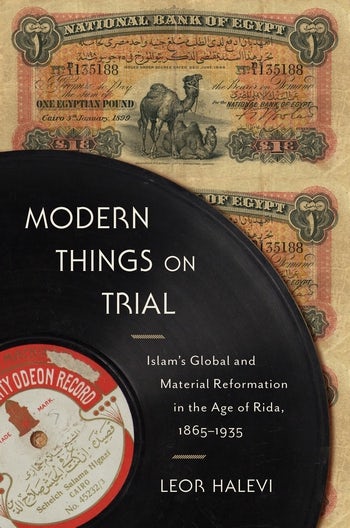
Via the New Books Network (New Books in Law), we have word of the publication of Modern Things on Trial: Islam’s Global and Material Reformation in the Age of Rida, 1865–1935 (Columbia University Press, 2019), by Leor Halevi (Vanderbilt University). A description from the press:
In cities awakening to global exchange under European imperial rule, Muslims encountered all sorts of strange and wonderful new things—synthetic toothbrushes, toilet paper, telegraphs, railways, gramophones, brimmed hats, tailored pants, and lottery tickets. The passage of these goods across cultural frontiers spurred passionate debates. Realizing that these goods were changing religious practices and values, proponents and critics wondered what to outlaw and what to permit.

In this book, Leor Halevi tells the story of the Islamic trials of technological and commercial innovations of the late nineteenth and early twentieth centuries. He focuses on the communications of an entrepreneurial Syrian interpreter of the shariʿa named Rashid Rida, who became a renowned reformer by responding to the demand for authoritative and authentic religious advice. Upon migrating to Egypt, Rida founded an Islamic magazine, The Lighthouse, which cultivated an educated, prosperous readership within and beyond the British Empire. To an audience eager to know if their scriptures sanctioned particular interactions with particular objects, he preached the message that by rediscovering Islam’s foundational spirit, the global community of Muslims would thrive and realize modernity’s religious and secular promises.

Through analysis of Rida’s international correspondence, Halevi argues that religious entanglements with new commodities and technologies were the driving forces behind local and global projects to reform the Islamic legal tradition. Shedding light on culture, commerce, and consumption in Cairo and other colonial cities, Modern Things on Trial is a groundbreaking account of Islam’s material transformation in a globalizing era.
A few blurbs:
Leor Halevi's original study offers important perspectives on turn of the twentieth-century Islamic reformist thought in the context of changing relations between law and material history. He matches up instructive readings in legal opinions delivered in Cairo by Rashid Rida with innovative background research on the new products and technologies that prompted questions to him from around the Muslim world. Brinkley Messick
This nuanced, meticulously researched, yet accessible study illuminates how significant early-twentieth-century debates on Islamic law often revolved around some surprisingly ordinary objects and how local anxieties and input shaped a reformist Islam with transregional appeal. Halevi's focus on the material dimensions of modern Islamic thought adds a very welcome and promising dimension to the scholarship in this field. Muhammad Qasim Zaman
More information is available here.

-- Karen Tani

Wednesday, January 15, 2020

Spring 2020 at the Washington History Seminar

[The Washington History Seminar has announced its lineup for Spring 2020.  It meets Mondays (unless noted above) at 4:00 pm in the Woodrow Wilson Center, 6th Floor Moynihan Board Room, Ronald Reagan Building, Federal Triangle Metro Stop, Washington, DC.  DRE]

The seminar is co-chaired by Eric Arnesen (George Washington University) and Christian Ostermann (Woodrow Wilson Center) and is organized jointly by the National History Center of the American Historical Association and the Woodrow Wilson Center's History and Public Policy Program. It meets weekly during the academic year. The seminar thanks its anonymous individual donors and institutional partners (the George Washington University History Department and the Lepage Center for History in the Public Interest) for their continued support

January 13-Sidney Blumenthal
The Political Life of Abraham Lincoln: Volumes I-III

January 21-David Roll (Tuesday)
George Marshall: Defender of the Republic

January 27-Jeremy Popkin
A New World Begins: The History of the French Revolution

January 30-Norman Naimark (Thursday)
Stalin and the Fate of Europe: The Postwar Struggle for Sovereignty

February 3-Astrid M. Eckert
West Germany and the Iron Curtain: Environment, Economy, and Culture in the Borderlands

February 10-Amy Offner
Sorting Out the Mixed Economy: The Rise and Fall of Welfare and Development States in the Americas

February 24-Lawrence Glickman
Free Enterprise: An American History

March 2-Amy Aronson
Crystal Eastman: A Revolutionary Life

March 9-Duncan White
Cold Warriors: Writers Who waged the Literary Cold War

March 16-Giuliana Chamedes
A Twentieth-Century Crusade: The Vatican's Battle to Remake Christian Europe

March 23-Eric Weitz
A World Divided: The Global Struggle for Human Rights in the Age of Nation-States

March 30-Eileen Boris
Making the Woman Worker: Precarious Labor and the Fight for Global Standards, 1919-2019

April 6-Sarah Miller-Davenport
Gateway State: Hawaii and the Cultural Transformation of America

April 13-Ellen DuBois
Suffrage: Women’s Long Battle for the Vote

April 20-Sarah Wagner
What Remains: Bringing America's Missing Home from the Vietnam War

April 27-Thavoila Glymph
The Women’s Fight: The Civil War’s Battles for Home, Freedom, and Nation

May 4-Sarah Milov
The Cigarette: A Political History

May 11-John Connelly
From Peoples into Nations: A History of Eastern Europe

May 18-Benjamin Hopkins
Ruling the Savage Periphery: Frontier Governance and the Making of the Modern State.

Whewell's "Law across Imperial Borders"

Emily Whewell, a  Senior Researcher at the Max Planck Institute for European Legal History, has published Law across imperial borders: British consuls and colonial connections on China's western frontiers, 1880-1943 (Manchester University Press):
Law across imperial borders offers new perspectives on the complex legal connections between Britain's presence in Western China in the western frontier regions of Yunnan and Xinjiang, and the British colonies of Burma and India. Bringing together a transnational methodology with a social-legal focus, it demonstrates how inter-Asian mobility across frontiers shaped British authority in contested frontier regions of China. It examines the role of a range of actors who helped create, constitute and contest legal practice on the frontier-including consuls, indigenous elites and cultural mediators. The book will be of interest to historians of China, the British Empire in Asia and legal history.
Introduction
Part I: The Burma-China frontier
1 Treaty-making and treaty-breaking: transfrontier salt and opium, 1904-11
2 On the move: people crossing the frontier, 1911-25
3 Consuls and Frontier Meetings, 1909-35

Part II: Through the mountains and across the desert: Xinjiang
4 Isolation and connection: law between semicolonial China and the Raj
5 Administering justice and mediating local custom
6 The British end game in Xinjiang: the decline of consular rights, 1917-39

Conclusion
–Dan Ernst

du Plessis, ed., "Wrongful Damage to Property in Roman Law: British Perspectives"

Oxford University Press (in partnership with Edinburgh University Press) has released Wrongful Damage to Property in Roman Law: British Perspectives (Dec. 2019), edited by Paul J. du Plessis (University of Edinburgh). A description from the Press:
Few topics have had a more profound impact on the study of Roman law in Britain than the lex Aquilia, a Roman statute enacted c.287/286 BCE to reform the Roman law on wrongful damage to property. This volume investigates this peculiarly British fixation against the backdrop larger themes such as the development of delict/tort in Britain and the rise of comparative law.

Taken collectively, the volume establishes whether it is possible to identify a 'British' method of researching and writing about Roman law.
More information, including the table of contents, is available here.

-- Karen Tani

Tuesday, January 14, 2020

Schrag's "Baby Jails"

My Georgetown Law colleague Philip G. Schrag, has just published Baby Jails The Fight to End the Incarceration of Refugee Children in America (University of California Press) a history of the Flores decision:
For decades, advocates for refugee children and families have fought to end the U.S. government’s practice of jailing children and families for months, or even years, until overburdened immigration courts could rule on their claims for asylum. Baby Jails is the history of that legal and political struggle. Philip G. Schrag, the director of Georgetown University’s asylum law clinic, takes readers through thirty years of conflict over which refugee advocates resisted the detention of migrant children. The saga began during the Reagan administration when 15-year-old Jenny Lisette Flores languished in a Los Angeles motel that the government had turned into a makeshift jail by draining the swimming pool, barring the windows, and surrounding the building with barbed wire. What became known as the Flores Settlement Agreement was still at issue years later, when the Trump administration resorted to the forced separation of families after the courts would not allow long-term jailing of the children. Schrag provides recommendations for the reform of a system that has brought anguish and trauma to thousands of parents and children. Provocative and timely, Baby Jails exposes the ongoing struggle between the U.S. government and immigrant advocates over the duration and conditions of confinement of children who seek safety in America.
--Dan Ernst

Law & History CRN at LSA

[In a reminder that service to the discipline ought not be a life sentence, we have the following announcement, concerning the Law & History Collaborative Research Network of the Law and Society Association.]

We're delighted to announce that the Law & History Collaborative Research Network (CRN 44) has new organizers! They are: Nate Holdren, Assistant Professor in the Law, Politics, & Society Program at Drake University; Elizabeth D. Katz, Associate Professor of Law at Washington University School of Law; and Charlotte Rosen, Ph.D. candidate in the Department of History at Northwestern University. More information, including contact information for the organizers, is available [here.]

We have enjoyed organizing the Law & History CRN for the past several years, and are delighted that it's going to be in such great hands going forward. Please join me in welcoming Charlotte, Elizabeth, and Nate!

Sincerely,

Joanna Grisinger, Center for Legal Studies, Northwestern University
Logan Sawyer, University of Georgia Law School
Kathryn Schumaker, Institute for the American Constitutional Heritage, University of Oklahoma
Kimberly Welch, Department of History, Vanderbilt University

[Thanks alike, to the outgoing and incoming citizen-scholars.  DRE.]

Copies and Originals, Premo

In a terrific book about notaries in colonial Cuzco, Peru, Kathryn Burns reminds us how frequently official writers distorted, left blank, and forged contracts and parts of court cases, leaving traces of their control over the order of the historical record.[1]  But, if official writers held the power to shape the archive, at the same time, ordinary Spanish colonial subjects—many of whom did not read or write themselves-- commandeered the form of legal protocols and served as legal agents outside of court. 

The notary-free contract was a part of daily life, and it crossed any simple divide between colonizer and colonized, enslaved and free, state and subject.  People picked up and reproduced, out loud, in rough orthography, on the backsides of printed text and scraps of paper, the formula for contracts that had been set in manuals for legal personnel. (cont'd)

Monday, January 13, 2020

Likhovski on the "Colonial Legal Laboratory" in the Jurisprudence of the British Empire

Assaf Likhovski, Tel Aviv University Buchmann Faculty of Law, has posted A Colonial Legal Laboratory? Jurisprudential Innovation in the British Empire, which is forthcoming in the American Journal of Comparative Law:
In this article, I examine jurisprudence textbooks and related works written in the British Empire in the late-19th and early-20th centuries, focusing mostly on British India, but also discussing Mandatory Palestine and British-ruled Egypt. Some of the jurisprudential works from the British Empire were merely summaries of the leading English books. However, there were also more original works, characterized by several unique features. First, some of the works produced in the Empire were more influenced by Continental and American legal theories than the equivalent English textbooks (for example, by early-20th-century French and American sociological approaches to law). Second, the need to mention non-English legal systems in these works sometimes led their authors to question key English notions about the nature and development of law (critiquing, for example, Henry Maine’s description of Hindu law). Finally, some nationalist local legal scholars also created a unique genre of jurisprudential works: texts that used western jurisprudential theories to describe the main features of non-western legal systems, such as Hindu, Jewish and Islamic law.

These unique aspects of colonial jurisprudential works illustrate a broader phenomenon: the fact that legal scholars in imperial peripheries were not always simply passive receivers of ideas produced at the center of empires, but in some cases created works containing interesting jurisprudential insights. The notion that the British Empire was a “legal laboratory” in which legal scholars experimented with new ideas has already been discussed in the literature, largely based on examples taken from the fields of legislation (the codification of English law in 19th-century India), or forensic science. This article explores the extent to which the British Empire was also a site of jurisprudential innovation.
--Dan Ernst

Bird, "Criminal Dissent: Prosecutions under the Alien and Sedition Acts of 1798"

New from Harvard University Press: Criminal Dissent: Prosecutions under the Alien and Sedition Acts of 1798 (Jan. 2020), by Wendell Bird (visiting scholar, Emory University School of Law). A description from the Press:
In the first complete account of prosecutions under the Alien and Sedition Acts, dozens of previously unknown cases come to light, revealing the lengths to which the John Adams administration went in order to criminalize dissent.
The campaign to prosecute dissenting Americans under the Alien and Sedition Acts of 1798 ignited the first battle over the Bill of Rights. Fearing destructive criticism and “domestic treachery” by Republicans, the administration of John Adams led a determined effort to safeguard the young republic by suppressing the opposition.
The acts gave the president unlimited discretion to deport noncitizens and made it a crime to criticize the president, Congress, or the federal government. In this definitive account, Wendell Bird goes back to the original federal court records and the papers of Secretary of State Timothy Pickering and finds that the administration’s zeal was far greater than historians have recognized. Indeed, there were twice as many prosecutions and planned deportations as previously believed. The government went after local politicians, raisers of liberty poles, and even tavern drunks but most often targeted Republican newspaper editors, including Benjamin Franklin’s grandson. Those found guilty were sent to prison or fined and sometimes forced to sell their property to survive. The Federalists’ support of laws to prosecute political opponents and opposition newspapers ultimately contributed to the collapse of the party and left a large stain on their record.
The Alien and Sedition Acts launched a foundational debate on press freedom, freedom of speech, and the legitimacy of opposition politics. The result was widespread revulsion over the government’s attempt to deprive Americans of their hard-won liberties. Criminal Dissent is a potent reminder of just how fundamental those rights are to a stable democracy.
Advance praise:
Wendell Bird combines wide and deep research, analytical skill, and clear and strong prose to illuminate the history of the Alien and Sedition Acts of 1798. In addition to his superb, thoughtful treatment of the Sedition Act—a landmark in the history of contests over the meaning of freedom of speech and freedom of the press—Bird enriches our understanding of the neglected Alien Acts. This fine book will be invaluable to any student of free speech and free press, of citizenship, of the early American republic, and of the formative period of U.S. constitutional history.—R. B. Bernstein

A benchmark history of the Alien and Sedition Acts and their place in the political culture of the 1790s. With encyclopedic erudition, Bird documents the legal history of criminalized dissent and the rhetoric of transatlantic revolution and reaction that drove partisan politics in the early republic. He also does something more: he restores the necessity of a vibrant, contested polity to its rightful place at the center of American political ideas. Never has the Jeffersonian argument for an active and dissenting citizenry been more important, and never before have we had a more thorough treatment of that argument’s origin and legacy.—Matthew Crow
More information is available here.

-- Karen Tani

Saturday, January 11, 2020

Weekend Roundup

  • Legal scholars and historians on the uproar over changes to India's citizenship laws: read this by Shubhankar Damthis by Rohit De and Surabhi Ranganathanthis by Madhav Khoslathis by Gautam Bhatia, and this by Neeti Nair. Here's a useful microsyllabus on citizenship and provisional belonging in South Asia, by Swati Chawla, Jessica Namakkal, Kalyani Ramnath, and Lydia Walker.
  • On January 14, 2020, the Max Planck Institute for European Legal History hosts a colloquium on Decolonial Comparative Law, with Ralf Michaels and Lena Salaymeh.
  • "The [British] National Archives have provoked outcry from academics by announcing a new trial restricting readers to 12 documents a day” (Telegraph, via HNN).
  • Trey Gaines, Director of the Bartow History Museum, is to speak on the history of the 1869 Courthouse in Cartersville, Georgia, on January 15 from noon to 1 p.m.  (More)
 Weekend Roundup is a weekly feature compiled by all the Legal History bloggers.

Friday, January 10, 2020

Khorakiwala on India's Colonial High Courts

By: Rahela Khorakiwala, an independent scholar based in Mumbai, India, has published From the Colonial to the Contemporary: Images, Iconography, Memories, and Performances of Law in India's High Courts (Hart, 2020):
From the Colonial to the Contemporary explores the representation of law, images and justice in the first three colonial high courts of India at Calcutta, Bombay and Madras. It is based upon ethnographic research work and data collected from interviews with judges, lawyers, court staff, press reporters and other persons associated with the courts.

Observing the courts through the in vivo, in trial and practice, the book asks questions at different registers, including the impact of the architecture of the courts, the contestation around the renaming of the high courts, the debate over the use of English versus regional languages, forms of addressing the court, the dress worn by different court actors, rules on photography, video recording, live telecasting of court proceedings, use of CCTV cameras and the alternatives to courtroom sketching, and the ceremony and ritual that exists in daily court proceedings.

The three colonial high courts studied in this book share a recurring historical tension between the Indian and British notions of justice. This tension is apparent in the semiotics of the legal spaces of these courts and is transmitted through oral history as narrated by those interviewed. The contemporary understandings of these court personnel are therefore seen to have deep historical roots. In this context, the architecture and judicial iconography of the high courts helps to constitute, preserve and reinforce the ambivalent relationship that the court shares with its own contested image.
--Dan Ernst

Law and the Lettered City

What is the historical relationship between law and writing, legality and literacy? As a guest blogger whose work centers primarily on colonial Latin America, I might be in a good position to offer some reflections on these questions. After all, historians of colonial Latin America have long emphasized the litigiousness of its inhabitants. Many wax poetic about the mountains of yellowing civil suits and vertiginously tall leather-clad notary ledgers held in national archives. Still, the population generally didn’t read and write much. (Even a hundred years ago, the literacy rates in most countries in the region was under 30 percent.) This means there is a lot of law in Latin America’s past but not a lot of traditional literacy. (cont'd)

Thursday, January 9, 2020

Sanga on the Race to the Bottom in Corporation Law

Sarath Sanga, Northwestern University Pritzker School of Law, has posted On the Origins of the Market for Corporate Law:
I study the origins of the market for corporate charters and the emergence of Delaware as the leader of this market. Specifically, I assemble new data on 19th and 20th-century corporations to evaluate two widely-held beliefs: (1) the U.S. Supreme Court is responsible for enabling a national market for corporate charters in the 19th century and (2) Delaware became the leader in this market only because New Jersey (the initial leader) repealed its extremely liberal corporate laws in 1913. I argue that both claims are false: The Supreme Court always opposed a national market for corporate charters, and New Jersey’s decline began a decade before its 1913 repeal. It is more likely that the market for corporate charters emerged as a collateral consequence of interstate commerce and that New Jersey declined because Delaware and other states simply copied its laws.
--Dan Ernst

Ward's "English Legal Histories"

Out now from Hart: English Legal Histories, by Ian Ward, Professor of Law, Newcastle University:
English Legal Histories is an exciting and innovative approach to the study of English law. Written in an accessible style intended for students as well as a broader audience, it takes the reader beyond the narrower confines of legal doctrines and cases, and invites them to consider the myriad contexts within which English law has been shaped: the politics, the economics, the art, the poetry. Reaching from the Reformation through to the age of Reform, it tells stories, the 'histories', of English law. Histories of the constitution and government, of crime and contracts, tort and trespass, property and equity. Of the people who made that law, those who wrote it, and those who suffered it. For it is in the end a human story, of justice and injustice, of success and failure, good luck and bad. The law is full of statutes and instruments, cases and precedent, but its history is full of people and peculiarity. Which is what, of course, makes it so endlessly fascinating.
Table of Contents after the jump.

Fear, Loathing, and Legal History on the Campaign Trail

Today’s Washington Post includes the story, “The surreal lives of 2020 campaign spouses: What happens when your loved one wants to be president.”  Of John Bessler, the husband of Amy Klobuchar, and Bruce Mann, the husband of Elizabeth Warren, it reports, “Bessler says he and Mann geek out about their shared love of legal history whenever they run into each other.”  H/t: RAE

--Dan Ernst

Wednesday, January 8, 2020

McClellan on Early Women's Rights Activists and the 14th Amendment

Angus McClellan, Claremont Graduate University, has posted Early Women's Rights Activists and the Meaning of the 14th Amendment:
The purpose of this paper is to consider the meaning of the 14th Amendment as it applies to women in the United States through the perspective of the women’s rights litigants, advocates, and their allies in the 1860s and 1870s. Originalism as a method for constitutional interpretation can take many forms, including giving weight to the original intent of the drafters of the Constitution or its amendments, or deferring to the understandings of the ratifiers in state conventions and legislatures, or perhaps giving weight to the “public meaning” or “public understanding” of the documents by considering newspaper editorials, pamphlets, and dictionary definitions in use at the times of their ratifications. This paper is an originalist approach to understanding the 14th Amendment by turning to a group of people who were particularly active in the earliest debates on its meaning. Modern interpretations as well as those from contemporaneous statesmen and jurists will be considered as well to provide some orientation and comparison.

To map this argument broadly, modern scholars argue that the 14th Amendment protects some or all categories of individuals within the jurisdiction of the United States, and they variously claim that Section 1 protects substantive or procedural civil, political, natural, fundamental, or common law rights, or even social equality. Adding to this the variety of definitions of rights or “equality,” there is a wide spectrum of scholarly thought on what the 14th Amendment protects, and to whom it applies. Part II be divided between political efforts and legal efforts. It will focus first on the political efforts and the accompanying interpretations of the 14th Amendment from some of the most prominent activists during the 1860s and 1870s. It will then explore the legal arguments of women’s rights activists and their attorneys engaged in litigation from three notable cases in the earliest days of the 14th Amendment.
--Dan Ernst

Pioneer African Women in Law Project

[We noted the following on H-Announce.  DRE]

Pioneer African Women in Law Project (PAWLP)

Women across the continent of Africa have historically played important leadership roles. Today, despite colonial re-gendering of our societies, African women continue to rise. The Pioneer African Women in Law Project (PAWLP) is a digital archive project designed to document in one collection, the lives and contributions of African women pioneers in the different fields of law across Africa.

What areas of the law are included? AND What is the measure of a pioneer?  A “pioneer” is measured by any woman who was the “first” in any  field of the legal professions in any country-- first woman lawyer, magistrate, judge, prosecutor, attorney general, chief justice, first president of apex court,  law professor, first female Senior Advocates of Nigeria (SAN), first woman president of a legal association, e.g. national bar association, Commonwealth association of judges or lawyers etc.

Who can submit an entry?  Entries are open to all interested authors. Cross and interdisciplinary submissions are especially welcome.  Entries should be original and not previously published elsewhere

Deadline for submissions?  Send an email of expression of interest to confirm if the entry is still available. Once you have the greenlight, you have one month to submit your entry.  Entries are accepted on a rolling basis till all “pioneers” are covered.

What are the requirements for an entry?  All submissions have to meet the following criteria:
    Typed in microsoft word and no more than 2000 words (including all references)
    Use endnotes to cite all references and outside work consulted
    Provide a picture of the person where possible (please make sure there are no copyright restrictions).

Content of entries.  All entries should aim to include the following information:
    Early life, including family background
    Educational background
    Professional achievements, focusing especially on the “first” role.
    Contributions the person made to the law, the profession and other social, cultural and political areas as applicable.
    A closing statement why you think the person is a pioneer in the field.

How do I submit my entry?  Email your entry as a word attachment to info@africanwomeninlaw.com. In the subject line use “PAWLP SUBMISSION”

Enquiries: All inquiries should be directed to: info@africanwomeninlaw.com.

What happens after I submit my entry? We will review your entry and get back to you as soon as we are done editing. Once your submission is approved, it will be published on our website and in a forthcoming book project.

Contact Info: Institute for African Women in Law; info@africanwomeninlaw.com

Tuesday, January 7, 2020

Mikhail on Gienapp's "Second Creation"

My Georgetown Law colleague John Mikhail has posted Fixing Implied Constitutional Powers in the Founding Era, revision and extension of his Balkinization symposium review of Jonathan Gienapp’s The Second Creation, which is forthcoming in Constitutional Commentary 34 (2020): 507-516:
The Second Creation by Jonathan Gienapp is a marvelous study of the earliest debates over constitutional language, meaning, and interpretation. In virtually every aspect, the book is brilliantly conceived, meticulously researched, and masterfully executed. This essay agrees with Gienapp’s key insight that, in many respects, the Constitution was obscure, unfinished, and uncertain in 1789, and we can learn a great deal by paying closer attention to how constitutional debates actually unfolded in the first years after its adoption. A close encounter with that history reveals that constitutional meanings were ambiguous, unstable, and “up for grabs” right from the start. Nonetheless, the essay challenges Gienapp’s thesis to some extent by examining the earliest congressional debates over implied powers and offering a different interpretation of these events than he does, which focuses less on issues of language, meaning, and ontology, and more on the complex interplay of economic interests, regional alignments, and political power. By setting aside the dizzying swirl of semantics and considering how members of Congress actually voted on the removal debate, amendments, the bank bill, and other early controversies, one can identify some remarkably consistent through lines that render the entire sequence of events, and the talking points of politicians, less inchoate and more intelligible. As with so much else that occurred in the founding era, two key factors explaining what transpired are land and slavery.
--Dan Ernst

Jahner, "Literature and Law in the Era of Magna Carta "

New from Oxford University Press: Literature and Law in the Era of Magna Carta (Dec. 2019), by Jennifer Jahner (California Institute of Technology). A description from the Press:
The monograph series Oxford Studies in Medieval Literature and Culture showcases the plurilingual and multicultural quality of medieval literature and actively seeks to promote research that not only focuses on the array of subjects medievalists now pursue -- in literature, theology, and philosophy, in social, political, jurisprudential, and intellectual history, the history of art, and the history of science -- but also that combines these subjects productively. It offers innovative studies on topics that may include, but are not limited to, manuscript and book history; languages and literatures of the global Middle Ages; race and the post-colonial; the digital humanities, media and performance; music; medicine; the history of affect and the emotions; the literature and practices of devotion; the theory and history of gender and sexuality, ecocriticism and the environment; theories of aesthetics; medievalism.

Literature and Law in the Era of Magna Carta traces processes of literary training and experimentation across the early history of the English common law, from its beginnings in the reign of Henry II to its tumultuous consolidations under the reigns of John and Henry III. The period from the mid-twelfth through the thirteenth centuries witnessed an outpouring of innovative legal writing in England, from Magna Carta to the scores of statute books that preserved its provisions. An era of civil war and imperial fracture, it also proved a time of intensive self-definition, as communities both lay and ecclesiastic used law to articulate collective identities. Literature and Law in the Era of Magna Carta uncovers the role that grammatical and rhetorical training played in shaping these arguments for legal self-definition. Beginning with the life of Archbishop Thomas Becket, the book interweaves the histories of literary pedagogy and English law, showing how foundational lessons in poetics helped generate both a language and theory of corporate autonomy. In this book, Geoffrey of Vinsauf's phenomenally popular Latin compositional handbook, the Poetria nova, finds its place against the diplomatic backdrop of the English Interdict, while Robert Grosseteste's Anglo-French devotional poem, the Chateau d'Amour, is situated within the landscape of property law and Jewish-Christian interactions. Exploring a shared vocabulary across legal and grammatical fields, this book argues that poetic habits of thought proved central to constructing the narratives that medieval law tells about itself and that later scholars tell about the origins of English constitutionalism.
More information is available here.

-- Karen Tani

Monday, January 6, 2020

Mortenson and Bagley on Delegation at the Founding

Julian Davis Mortenson and Nicholas Bagley, University of Michigan Law School, have posted Delegation at the Founding:
This article refutes the claim that the nondelegation doctrine was part of the original constitutional understanding. As a matter of theory, the founding generation saw nothing untoward about delegating the authority to make rules so long as Congress did not irrevocably alienate its power to legislate. Any particular use of such delegated authority could validly be characterized as the exercise of either executive or legislative power, depending on the relationships a speaker wished to emphasize. Either way, there was no basis to claim that the Constitution prohibited administrative rulemaking. As a matter of practice, the early federal Congresses adopted dozens of laws that broadly empowered executive and judicial actors to adopt binding rules of conduct for private parties on some of the most consequential policy questions of the era. Yet the people who drafted and debated the Constitution virtually never raised objections to delegation as such, even as they feuded bitterly over many other questions of constitutional meaning.
--Dan Ernst

McGarity, "Pollution, Politics, and Power: The Struggle for Sustainable Electricity"

New from Harvard University Press: Pollution, Politics, and Power: The Struggle for Sustainable Electricity, by Thomas O. McGarity (University of Texas School of Law). A description from the Press:
The electric power industry has been transformed over the past forty years, becoming more reliable and resilient while meeting environmental goals. A big question now is how to prevent backsliding.
Pollution, Politics, and Power tells the story of the remarkable transformation of the electric power industry over the last four decades. Electric power companies have morphed from highly polluting regulated monopolies into competitive, deregulated businesses that generate, transmit, and distribute cleaner electricity. Power companies are investing heavily in natural gas and utility-scale renewable resources and have stopped building new coal-fired plants. They facilitate end-use efficiency and purchase excess electricity produced by rooftop solar panels and backyard wind turbines, helping to reduce greenhouse-gas emissions.
But these beneficial changes have come with costs. The once-powerful coal industry is on the edge of ruin, with existing coal-fired plants closing and coal mines shutting down. As a result, communities throughout Appalachia suffer from high unemployment and reduced resources, which have exacerbated a spiraling opioid epidemic. The Trump administration’s efforts to revive the coal industry by scaling back environmental controls and reregulating electricity prices have had little effect on the coal industry’s decline.
Major advances therefore come with warning signs, which we must heed in charting the continuing course of sustainable electricity. In Pollution, Politics, and Power, Thomas O. McGarity examines the progress made, details lessons learned, and looks to the future with suggestions for building a more sustainable grid while easing the economic downsides of coal’s demise.
Advance praise:
In revealing many encouraging emission reductions by the electric power industry, Thomas O. McGarity shows what citizen action, regulation, and competition can contribute to expanding energy efficiencies and renewables like solar and wind. This book is a well-documented, eye-opening antidote to the ‘doom and gloom’ enveloping so many concerned people.—Ralph Nader
Pollution, Politics, and Power is a tour de force, analyzing environmental regulation of the power industry over the last half-century. With unmatched mastery, McGarity illuminates the current policy debates by placing them in their historical context, with a bull’s-eye on coal.—Richard Lazarus
More information is available here.

-- Karen Tani

Saturday, January 4, 2020

Call for Submissions: ASLH Preyer Award

[We have the following announcement.  DRE]

Call for Submissions:  Preyer Award. American Society for Legal History

Submissions are welcome on any topic in legal, institutional and/or constitutional history. Early career scholars, including those pursuing graduate or law degrees, those who have completed their terminal degree within the previous year, and those independent scholars at a comparable stage, are eligible to apply. At the annual meeting of the Society two early career legal historians designated Kathryn T. Preyer Scholars will present what would normally be their first papers to the Society. While papers simultaneously submitted to the ASLH Program committee are eligible, Preyer Award winners must present their paper as part of the Preyer panel and will be removed from any other panel.

 Submissions should be a single MS Word document consisting of a complete curriculum vitae, contact information, and a complete draft of the paper to be presented. Papers should not exceed 50 pages (12 point font, double-spaced) and must contain supporting documentation. In past competitions, the Committee has given preference to draft articles and essays, though the Committee will also consider shorter conference papers, as one of the criteria for selection will be the suitability of the paper for reduction to a twenty-minute oral presentation. The deadline for submission is MARCH 13, 2020.  The two Kathryn T. Preyer Scholars will receive a $500 cash award and reimbursement of expenses up to $750 for travel, hotels, and meals. Each will present the paper that s/he submitted to the competition at the Society’s annual meeting. The Society’s journal, Law and History Review, has published several past winners of the Preyer competition, though it is under no obligation to do so.

Named after the late Kathryn T. Preyer, a distinguished historian of the law of early America known for her generosity to early career legal historians, the program of Kathryn T. Preyer Scholars is designed to help legal historians at the beginning of their careers. At the annual meeting of the Society two early career legal historians designated Kathryn T. Preyer Scholars will present what would normally be their first papers to the Society. The generosity of Professor Preyer’s friends and family has enabled the Society to offer a small honorarium to the Preyer Scholars and to reimburse, in some measure or entirely, their costs of attending the meeting. The competition for Preyer Scholars is organized by the Society’s Kathryn T. Preyer Memorial Committee.

Please send submissions by March 13, 2020 to Laura Kalman, Chair, Preyer Award Committee, University of California, Santa Barbara, kalman@history.ucsb.edu.  She will forward them to other committee members.

Friday, January 3, 2020

Paperless Law and Extrajudicial Legality


I am so grateful that Mitra invited me to be the guest blogger during this first month of the new year and decade.  If I understand correctly, for your New Year’s resolution, you couldn’t decide between learning more about Latin American legal history or thinking more about the relationship between literacy and legal culture, right? Well, great news! My posts this month will be about both. 

I’ll be blogging about the vibrant world of law that transcended the written record in colonial and contemporary Latin America. I begin with a reflection on the enduring legacy of the concept of the Lettered City in Latin America—the idea that bureaucratic writing served as an ordering tool of elite domination over the “illiterate” masses. The next post will consider the persistent practices of ordinary Latin Americans taking law into their own hands, copying legal manuals, contracts and other documents. Then I’ll be joined by a fellow historian of Lima to explore more deeply extrajudicial contracts and verbal agreements in the seventeenth century, followed by my reflections on how the promotion of paperless law, as opposed to written law and litigation, was fundamental to Spanish colonialism. Finally, I’ll conclude, along with another co-poster, with a reflection on paperless citizenship in early twentieth-century Cuba. 

So kick off those running shoes—who needs them?—and let me help you achieve your New Year’s goals.

--Bianca Premo

Paperless Law and Extrajudicial Legality

I am so grateful that Mitra invited me to be the guest blogger during this first month of the new year and decade.  If I understand correctly, for your New Year’s resolution, you couldn’t decide between learning more about Latin American legal history or thinking more about the relationship between literacy and legal culture, right? Well, great news! My posts this month will be about both. 

I’ll be blogging about the vibrant world of law that transcended the written record in colonial and contemporary Latin America. I begin with a reflection on the enduring legacy of the concept of the Lettered City in Latin America—the idea that bureaucratic writing served as an ordering tool of elite domination over the “illiterate” masses. The next post will consider the persistent practices of ordinary Latin Americans taking law into their own hands, copying legal manuals, contracts and other documents. Then I’ll be joined by a fellow historian of Lima to explore more deeply extrajudicial contracts and verbal agreements in the seventeenth century, followed by my reflections on how the promotion of paperless law, as opposed to written law and litigation, was fundamental to Spanish colonialism. Finally, I’ll conclude, along with another co-poster, with a reflection on paperless citizenship in early twentieth-century Cuba. 

So kick off those running shoes—who needs them?—and let me help you achieve your New Year’s goals.

--Bianca Premo

Scott and Venegas Fornias on slavery and salvation

Rebecca Scott (University of Michigan) and Carlos Venegas Fornias (Instituto Cubano de Investigación Cultural Juan Marinello, La Habana, Cuba) have published the following article: "María Coleta and the Capuchin Friar: Slavery, Salvation, and the Adjudication of Status," William and Mary Quarterly 3d ser., 76:4 (October 2019), 727-62. Here is the abstract:
This article explores the dynamics of the enslavement of free persons of African descent, tracing the process by which acts of force were clothed in robes of law. Freed by the abolition of slavery in Saint Domingue/Haiti, could a young woman called María Coleta maintain her freedom once she left the island of Hispaniola to seek out the father of her unborn child? The answer seemed to be no. In the years that followed her arrival in Havana in 1796, Coleta was claimed and held as a slave by Francisca Lorignac, who had advanced payment for Coleta's passage to Cuba. Each child subsequently born to Coleta was baptized into slavery. In December 1816, Coleta became deathly ill, and a Capuchin friar was called to administer last rites. But Coleta insisted that she would accept absolution only if the friar made a written record of her narrative and submitted it to a judge to initiate a suit for freedom for her daughters. The lawsuit that followed—whose case file opens with a transcript of Coleta's confesiones—reveals both a deep indeterminacy of status emerging from the Haitian Revolution and the uncertain path toward legal redress in a neighboring slaveholding society.
Further information is available here.

--Mitra Sharafi

Thursday, January 2, 2020

Kostal, "Laying Down the Law The American Legal Revolutions in Occupied Germany and Japan"

New from Harvard University Press: Laying Down the Law: The American Legal Revolutions in Occupied Germany and Japan, by R. W. Kostal (Western University, Ontario). A description from the Press:
A legal historian opens a window on the monumental postwar effort to remake fascist Germany and Japan into liberal rule-of-law nations, shedding new light on the limits of America’s ability to impose democracy on defeated countries.
Following victory in World War II, American leaders devised an extraordinarily bold policy for the occupations of Nazi Germany and imperial Japan: to achieve their permanent demilitarization by compelled democratization. A quintessentially American feature of this policy was the replacement of fascist legal orders with liberal rule-of-law regimes.
In his comparative investigation of these epic reform projects, noted legal historian R. W. Kostal shows that Americans found it easier to initiate the reconstruction of foreign legal orders than to complete the process. While American agencies made significant inroads in the elimination of fascist public law in Germany and Japan, they were markedly less successful in generating allegiance to liberal legal ideas and institutions.
Drawing on rich archival sources, Kostal probes how legal-reconstructive successes were impeded by German and Japanese resistance on one side, and by the glaring deficiencies of American theory, planning, and administration on the other. Kostal argues that the manifest failings of America’s own rule-of-law democracy weakened U.S. credibility and resolve in bringing liberal democracy to occupied Germany and Japan.
In Laying Down the Law, Kostal tells a dramatic story of the United States as an ambiguous force for moral authority in the Cold War international system, making a major contribution to American and global history of the rule of law.
Advance praise:
In 1945, Americans boldly set out to remake the legal systems of occupied Japan, where they knew nothing about Japanese law, and Germany, where they often ignored German experts. Kostal’s book is a wonderfully novel, clear, and caustic history of the successes and failures of these endeavors.—Robert W. Gordon
This much-needed and compelling book examines American legal reform in occupied Germany and Japan, emphasizing the centrality of individual rights and the rule of law to American conceptualizations of democratic transformation. Kostal’s close attention to the successes, hypocrisies, and shortcomings of these American efforts offers vital insights while highlighting the intellectual, institutional, and moral limits of American visions of postwar democratization.—Jennifer M. Miller
More information is available here.

-- Karen Tani

Wednesday, January 1, 2020

Welcome, Bianca Premo!

Bianca PremoWe are very pleased to have Professor Bianca Premo (Florida International Universityjoin us as our first guest blogger of the new decade. She is a historian of Latin America and the author of two scholarly monographs. The Enlightenment on Trial: Ordinary Litigants and Colonialism in the Spanish Empire (Oxford University Press, 2017) is a comparative study of how ordinary, often illiterate litigants made law modern in the courtrooms of vast regions of the eighteenth-century Spanish empire. Children of the Father King: Youth, Authority and Legal Minority in Colonial Lima (UNC Press, 2005) reveals how Lima's children were socialized into colonial hierarchies and how adults viewed and practiced their roles as authority figures over children in a legal culture that favored elite fathers and distant kings. Prof. Premo has also co-edited Raising an Empire: Children in Early Modern Iberia and Colonial Latin America (University of New Mexico Press, 2007), a collection on children and childhood in early modern Spain, Portugal, and colonial Latin America. She is the author of over a dozen articles and book chapters on colonial Peru and Mexico and early modern Spain, spanning the fields of legal studies, ethnohistory, gender, family history, and Atlantic history. Her next research projects will take her deeper into the history of childhood and gender--and into the twentieth century. You can read more about Prof. Premo's work and interests here.

Welcome, Bianca Premo!

--Mitra Sharafi

Tuesday, December 31, 2019

Thank you, David Schwartz!

We are happy to have had Professor David S. Schwartz (University of Wisconsin) join us as our last guest blogger of the decade. Here are his posts from December 2019:
Thank you for sharing your insights on everything from indexing to originalism, Prof. Schwartz!

--Mitra Sharafi

Venkatraman on Press Freedom in Travancore State

V. Venkatraman, Rajapalayam Rajus’ College, has posted Implementation of Press Legislations and Political Control Over the Writings of the Press in Travancore State, 1910-1935:
The public opinion was chiefly mobilized by the press in Travancore state very actively since 1910. The press and political literature in Travancore state have contributed much to the political movement against the Diwan of Travancore and also the British Government. The Malayalam Press started writing against the Government of Travancore frequently. Irked by this, the Diwan of Travancore treated these publications as seditious, disloyal and contemptuous statements against them and spread disaffection among the people of Travancore state.

The Government of Travancore passed series of legislations to control the anti-British stand of the press from 1903 to 1935. They are (a) Press Regulations 11 of 1079(M.E)(1903); (b) Section 117 and 145A of Travancore Penal Code, 1923; (c) Press Legislations of 1926; (d) Travancore Press(Emerging Power) Act, 1930; (e) Press Regulations, 1935.

The Travancore Press carried in various discussions and deliberations in their papers. They remarked the highhandedness of the Government authorities and continued their stand up to the establishment of responsible Government in Travancore.
--Dan Ernst

Slattery on Aboriginal Title in Canada

Brian Slattery, York University-Osgoode Hall Law School, has posted Aboriginal Title and the Royal Proclamation of 1763: Origins and Illusions:
Some legal historians have argued that the law of Indigenous rights in Canada is a modern invention, stemming from the Calder decision in 1973. In this essay, I consider the origins of Indigenous rights in 18th and 19th century law, focusing on Aboriginal title and the Royal Proclamation of 1763. My conclusion is that the modern law is in fact grounded in ancient doctrines of common law that evolved in British North America from the early days of settlement. These doctrines were recognized and affirmed in the Royal Proclamation of 1763 and were applied in a series of leading 19th century cases.
--Dan Ernst

Monday, December 30, 2019

Originalism and the Limits of Semantic Meaning


[by David Schwartz, guest blogger]

The prevailing version of originalism—known as “original public meaning” (OPM) originalism—purports to be an historical semantic inquiry. The legally controlling meaning of a particular word, phrase, or clause in the Constitution is what it would have meant to a hypothetical reasonable person during the ratification debates. As of ratification, these meanings became “fixed.” (A small point: June 1788 when the ninth state ratified and the Constitution was deemed to be effect, or later?) While originalism in all its flavors, including OPM originalism, has been subject to various damning criticisms, I would like to suggest a further critique of the concept of original public meaning that has not to my knowledge been advanced.
My claim is this: where the ratification debates reveal a dispute over multiple meanings that are semantically plausible, semantics cannot provide a basis to choose one over another. If this is right, then the range of disputed constitutional meanings that can arguably be addressed by OPM originalism is even narrower than its critics have suggested.
When pieces of text have just one plausible meaning, that meaning requires no discussion or explanation. The meaning goes without saying.  When I used the word “Constitution” in the opening paragraph, I did not need to explain that I was referring to the United States Constitution proposed by the Philadelphia Convention of 1787 and ratified by eleven states in 1787-88. The original public meaning of “the Constitution” in the previous paragraph is plainly that particular constitution.
But suppose I were to say, “There was widespread belief that the original charter of government of the United States was deeply flawed.” Note here that my authorial intention is irrelevant under the theory of original public meaning: again, the determining factor is the “objective” meaning to a hypothetical reasonable reader.
Some actual reasonable readers could take me to be referring, again, to the Constitution. But others would suppose I meant the Articles of Confederation. (A few others might even wonder whether I was referring to the Declaration of Independence, which has been viewed with some plausibility as the first United States governmental charter.) Context might, of course, make all but one meanings of my phrase “charter of government” implausible, with the result that its meaning is as plain as my use of “the Constitution” in these paragraphs. But such context might itself be absent or disputed, as is the case with many constitutional provisions.
OPM originalism presupposes that historical inquiry into semantic meaning can produce, at least in some substantial number of contested cases, a uniquely correct meaning. But the very fact of a plausible difference of opinion about the meaning of “charter of government” precludes an original public meaning of that term. The problem is that the choice among possible meanings cannot be resolved by any criteria that can reasonably be called “semantic.” 

Johnson on late medieval English legal cultures

Tom Johnson (University of York) has published Law in Common: Legal Cultures in Late-Medieval England with Oxford University Press. From the publisher: 
There were tens of thousands of different local law-courts in late-medieval England, providing the most common forums for the working out of disputes and the making of decisions about local governance. While historians have long studied these institutions, there have been very few attempts to understand this complex institutional form of 'legal pluralism'.
Law in Common provides a way of understanding this complexity by drawing out broader patterns of legal engagement. Tom Johnson first explores four 'local legal cultures' - in the countryside, in forests, in towns and cities, and in the maritime world- that grew up around legal institutions, landscapes, and forms of socio-economic practice in these places, and produced distinctive senses of law.

Johnson then turns to examine 'common legalities', widespread forms of social practice that emerge across these different localities, through which people aimed to invoke the power of law. Through studies of the physical landscape, the production of legitimate knowledge, the emergence of English as a legal vernacular, and the proliferation of legal documents, the volume offers a new way to understand how common people engaged with law in the course of their everyday lives.

Drawing on a huge body of archival research from the plenitude of different local institutions, Law in Common offers a new social history of law that aims to explain how common people negotiated the transformational changes of the long fifteenth century with, and through legality.
Here's the Table of Contents:
Introduction: Local Legal Cultures and Common Legalities in Late-Medieval England 
Part I: Local Legal Cultures 
  • 1: Rural Legal Culture: Ordaining Community 
  • 2: Urban Legal Culture: Institutional Density 
  • 3: Maritime Legal Culture: Expertise and Authority 
  • 4: Forest Legal Culture: Accounting for Vert and Venison 
Part II: Common Legalities 
  • 5: The Legal Landscape 
  • 6: The Economy of Legitimate Knowledge 
  • 7: Legal English and the Vernacularization of Law 
  • 8: Common Legal Documents 
Conclusion: Towards a Common Constitution 
Bibliography
Further information is available here

--Mitra Sharafi

Sunday, December 29, 2019

Revisionism and Rehabilitation

[by David Schwartz, guest blogger]

Our understanding of the post-Civil War Supreme Court in what might be called its “dark age” – from the 1870s to 1936 – has been shaped by a long-running debate between “progressive” historians and “revisionists.” The progressive historians gave us the conventional narrative of a Lochner-era Court bending or discarding judicial principle to serve the interests of wealth and implement their personal policy preference for laissez faire economics. The revisionists, starting in the 1970s, complicated that account by showing that much economic reform legislation was upheld in this era, at least at the state level, and arguing that the progressive critique reductively ignored the influence of jurisprudential ideology and doctrine on the Court’s decisions.

In her masterful article published last year in the Law and History Review, In Defense of Progressive Legal Historiography, Laura Kalman offers a graduate seminar in these debates, honoring the contributions of both sides and calling for a synthesis of the progressive thesis and revisionist antithesis. Arguably that has already occurred, insofar as the debate has died down and sophisticated historians recognize that judicial decisions are shaped by ideology, doctrine, and institutionalism, as well as political, social, and economic factors. While Kalman’s actual defense of progressive legal historiography could have been more forceful for my tastes, she did slip in a devastating critique of revisionism, showing it to have a significant reductive quality of its own. Not only did the revisionists tend to reduce progressive historiography to a caricature—that judges were utterly unprincipled quasi-legislators implementing their policy preferences by blocking all social reform—but they also overstated their case by treating judicial decisions themselves as the only (or primary) admissible evidence. They thereby ignored the justices’ speeches, professional networks, and biographical data of the sort presented in Arnold Paul’s Conservative Crisis and the Rule of Law (1960), that shed considerable light on the justices’ attitudes and motivations.

Revisionism about the late nineteenth/early twentieth century Supreme Court can be critiqued on a related but different ground: its tendency to venture beyond legal intellectual history and into judicial rehabilitation projects.

Friday, December 27, 2019

Albert, Guruswamy, Basnyat and friends on founding constitutional moments

Richard Albert (University of Texas at Austin), Menaka Guruswamy (senior advocate, Supreme Court of India), and Nishchal Basnyat (Cambridge University) have co-edited Founding Moments in Constitutionalism, now out with Hart Publishing. From the press:
Founding Moments in ConstitutionalismFounding moments are landmark events that break ties with the ancien régime and lay the foundation for the establishment of a new constitutional order. They are often radically disruptive episodes in the life of a state. They reshape national law, reset political relationships, establish future power structures, and influence happenings in neighbouring countries. This edited collection brings together leading and emerging scholars to theorise the phenomenon of a founding moment. What is a founding moment? When does the 'founding' process begin and when does it end? Is a founding moment possible without yielding a new constitution? Can a founding moment lead to a partial or incomplete transformation? And should the state be guided by the intentions of those who orchestrated these momentous breaks from the past? Drawing from constitutions around the world, the authors ask these and other fundamental questions about making and remaking constitutions.
 Table of Contents after the jump:

Thursday, December 26, 2019

Meisel, "A History of the Law of Assisted Dying in the United States"

Alan Meisel (University of Pittsburgh) has posted "A History of the Law of Assisted Dying in the United States." which is forthcoming in the Southern Methodist University Law Review (2020). The abstract:
The slow growth in the number of states that have enacted legislation to permit what is often referred to as “death with dignity” legislation—and more frequently referred to popularly as “physician assisted suicide” laws—has begun to accelerate in the past few years since the enactment of the first such statute in Oregon in 1994.

Like much other social reform legislation, there is a long history behind it. In this case, the history in the United States dates back at least to the latter part of the nineteenth century. Not until the 1980s, however, did these efforts gain any traction in courts and legislatures. What is probably more responsible than anything else for reviving interest in and providing momentum for legalization is the recognition by state courts, beginning with the Karen Ann Quinlan case in New Jersey in 1975, that the right to be free from unwanted interference with one’s bodily integrity encompasses a right to refuse even life-sustaining medical treatment. The recognition of this so-called right to die was only a short conceptual step—though a long political one—from recognizing that competent adults also should have the right to actively end their lives under certain conditions.

As of the end of 2019, the efforts of a small number of advocacy groups through lobbying, litigation, and public education have resulted in the enactment of death with dignity legislation in nine states and recognition of the right by one state supreme court. Despite dire warnings from opponents of legalization, it has not resulted in either wholesale abuse of the dying or the legalization of active euthanasia (either voluntary or involuntary). 
Read on here. (h/t: Legal Theory Blog)

-- Karen Tani

Tuesday, December 24, 2019

Rubenstein and Henderson on Woman Citizenship in Australian Archives

Kim Rubenstein and Andrew Henderson, Australian National University, have posted Record and Recollection: Women’s Active Citizenship and National Archives, which appears in Law & History 6 (2019): 98-124:
Postmodern theories of the development of archival collections argue that archives created and administered under executive power often exclude voices and accounts outside the mainstream. These critiques are generally directed towards the absence of life experiences outside the purview of the central activities of the state. However, there is little empirical testing of how women’s active contributions within the concerns of government activity are recorded. This article tracks two events, recorded in the oral histories of two women lawyers collected as part of the Trailblazing Women and the Law Project, through the records of the National Archives of Australia (NAA). Its purpose is to start investigating how well these women, who have been active citizens, are ‘recorded’ in the formal national memory. It highlights the importance of undertaking further research to determine how well the NAA, as a state-run archive, represents women’s active citizenship in its telling of Australian legal history.
--Dan Ernst

Peterson, "Constitutionalism in Unexpected Places"

Farah Peterson (University of Virginia) has posted the abstract for her article "Constitutionalism in Unexpected Places," forthcoming in the Virginia Law Review:
Before, during, and after the ratification of the federal Constitution of 1787, Americans believed that they were governed under an unwritten constitution, a constitution that described an arrangement of power, confirmed ancient rights, and restricted government action. The existence of this unwritten constitution, and particularly its continuity, is something legal scholars have not adequately understood. Instead, both originalists and scholars of the “living” constitution think of 1787 as a hard break from the past and a starting point for their investigations.

But Americans of the Founding generation did not share our view that the only constitution that mattered was the one the Framers designed. This Article focuses on a feature of American colonial life that reappeared with striking continuity for three generations after Independence—the vindication of unwritten constitutional rights by mob action, and specifically, the tradition of mobs turning to Indian costume to express a specific series of constitutional grievances. During the age of the Revolution, many Americans believed that mobs in the streets performed a legitimate role in the enforcement of their unwritten constitution. These mob actions involved ritualistic violence and consistent, non-linguistic symbolism. The endurance of this form of constitutional engagement, employing the same symbols to assert the same suite of legal claims, is simply astonishing. It is evidence of the tenacity of a series of constitutional commitments predating the Founding that were not encompassed by, or replaced with, a written constitution.

This Article also makes a methodological point. An exclusive focus on official texts and the words, pamphlets, and letters of great men robs historical investigation of its depth and risks missing crucial insights about the past. Important evidence revealing how Americans conceived of their constitution and of themselves as legal actors can be found in their customs, in behavior, in performances in public spaces, and in the life of important ideas in literature and art. This Article focuses on a peculiar phenomenon as a way of modeling this point. The white protestor in Indian costume may seem like an oddity, but a deeper investigation reveals him to be a missing link, a key to how Americans believed their society was constituted, how they thought about justice, and how they understood the obligations the Revolution laid upon its inheritors.
We'll update this post when the full article is available for download. (h/t: Legal Theory Blog)

-- Karen Tani