Showing posts with label Juries. Show all posts

Thursday, January 8, 2026

ASLH/Notre Dame Graduate Legal History Colloquium

[We have the schedule for the ASLH/Notre Dame Graduate Legal History Colloquium to be held on February 7, 2026, from 10 AM - 4 PM (EST) at the Notre Dame Law School in South Bend, Indiana.  Here is the registration form.  DRE]

9:45 - 10:05 AM  Registration/Welcome 

10:05 - 11:00 AM  Paper #1: Early American Constitutional Interpretation

"Codes and Constitutions in McCulloch v. Maryland

Author: Benjamin Keener, University of Pennsylvania
Respondent: Jeffrey A. Pojanowski, Notre Dame Law School 

11:05 - 12:00 PM  Paper #2: Legal and Religious Constitutions at the Founding        

"Reverend Founding Fathers: The Presbyterian Church Constitution, 1776-1837"

Author: Mintae Cha, University of Notre Dame
Respondent: Richard W. Garnett, Notre Dame Law School

12:05 - 1:00 PM  Afternoon Break (Lunch)

1:05 - 2:00 PM  Paper #3: The Early American Jury 
                     

"Government By Jury"

Author: Nathaniel Donahue, New York University
Respondent: Christian R. Burset, Notre Dame Law School

2:05 - 3:00 PM  Paper #4: Administration at the Founding


"Reframing the Decision of 1789: The Independence of Officeholders from their Official Superiors"

Author: Tingfeng Yan, University of Chicago
Respondent: Emily S. Bremer, Notre Dame Law School

3:05 - 4:00 PM  Paper #5: History and the Anti-Federalists                    

"'Time Only Can Determine': The Role of History in the Writings of the Anti-Federalists"

Author: Matthew Levine, Stanford University
Respondent: Katlyn Marie Carter, University of Notre Dame

Tuesday, December 2, 2025

Frampton, "The Radical Roots of the Representative Jury"

The Yale Law Journal has published "The Radical Roots of the Representative Jury," by Thomas Ward Frampton (University of Virginia School of Law). The abstract:

For most of American history, the jury was considered an elite institution, composed of “honest and intelligent men,” esteemed in their communities for their “integrity,” “reputation,” or “sound judgment.” As a result, jurors were overwhelmingly male, jurors were overwhelmingly white, and jurors disproportionately hailed from the middle and upper social classes. By the late 1960s, an entirely different, democratic conception of the jury was ascendant: juries were meant to pull from all segments of society, more or less randomly, thus constituting a diverse and representative “cross-section of the community.” This Article offers an intellectual and social history of how the “elite jury” lost its hegemonic appeal, with particular emphasis on the overlooked radicals—anarchists, socialists, Communists, trade unionists, and Popular Front feminists—who battled to remake the jury. This Article offers a novel look at the history and tradition of the American jury, demonstrating how the Sixth Amendment’s meaning was—gradually, unevenly, but definitively—reshaped through several decades of popular struggle, grassroots mobilization, strategic litigation, and social-movement contestation. 

Read on here.

-- Karen Tani  

Friday, October 24, 2025

Lettow Lerner on the Civil Jury Trial and Re-examination Clauses

Renee Lettow Lerner, George Washington University Law School, has posted two of her entries in The Heritage Guide to the Constitution, edited by Josh Blackman and John G. Malcolm (2025).  The first is The Civil Jury Trial Clause of the Seventh Amendment:

This essay discusses the Civil Jury Trial Clause—also known as the Preservation Clause—of the Seventh Amendment to the U.S. Constitution. I provide background on English civil jury practice in common-law courts in the late eighteenth century and distinguish it from equity practice in the Court of Chancery. The essay describes Blackstone’s praise for the civil jury as well as the role the civil jury played in the events leading up to the American Revolution. The question of a federal constitutional right to civil jury trial provoked heated disputes in the Philadelphia Convention and the ratification debates. The ratification debates featured arguments between prominent Anti-Federalists and Federalists, including Patrick Henry and James Madison in Virginia, and Brutus and Alexander Hamilton in New York. Hamilton made his strongest case against a federal constitutional right to a civil jury in The Federalist No. 83.

The essay gives a detailed account of the drafting of the Seventh Amendment in the First Congress and the development of the historical test following opinions by Justice Joseph Story. Under the historical test, federal courts decide whether a civil jury trial is required by the Seventh Amendment based on the practices of English courts in 1791, the year the Amendment was ratified. The essay examines the difficulties in applying the historical test. These problems became especially acute after the merger of law and equity in the Federal Rules of Civil Procedure in 1938, when pretrial discovery facilitated party settlement before trial, and more complicated cases could be sent to civil juries. Courts have also struggled with applying the Seventh Amendment after the advent of adjudication by administrative agencies. The “public rights” doctrine addresses this issue, but the U.S. Supreme Court’s decision in SEC v. Jarkesy (2024) has called that doctrine’s scope into question. 

The second is The Re-examination Clause of the Seventh Amendment:

This essay discusses the origins, history, and current interpretation of the Re-examination Clause of the Seventh Amendment to the U.S. Constitution. As Justice Joseph Story declared, the Re-examination Clause is separate from the right to civil jury trial in the Amendment’s Preservation Clause. The Re-examination Clause states that no fact tried by a jury shall be “re-examined” in federal court except by the rules of “the common law.” This provision had no counterpart in the state constitutions. The essay explains the methods of review of jury verdicts in English common-law courts in the late eighteenth century, focusing on the remedy of a new trial. Technically, these methods were not called appeals, although they functioned as such. The delegates to the Philadelphia Convention of 1787 assigned broad appellate review of federal and state courts to the U.S. Supreme Court, “both as to law and fact.” Many of the delegates believed such broad appellate jurisdiction was necessary to ensure uniform interpretation of federal laws and to prevent state courts, and state juries, from subverting federal law. James Madison was especially concerned about the latter problem.

The Anti-Federalists, especially Brutus, were alarmed at this grant of far-reaching appellate review to the U.S. Supreme Court.  They believed such appellate review would undermine civil jury trial.  The essay describes in detail James Madison’s effort to mollify the Anti-Federalists by drafting what became the Re-examination Clause, together with the modifications made in the First Congress.  It explains the origins of the historical test for the Seventh Amendment in a case involving the Re-examination Clause.  The historical test requires the federal courts to adhere to the practices of re-examining jury verdicts according to the common law of England in 1791, the year the Seventh Amendment was ratified.  The Supreme Court had maintained a fairly strict interpretation of the historical test.  Judgment notwithstanding the verdict, now known as judgment as a matter of law, was eventually permitted because of the English common-law practice of receiving a verdict subject to the judge’s opinion on law.  Federal courts permit remittitur, requiring a plaintiff to agree to reduced damages or face a new trial, but not additur, requiring a defendant to agree to additional damages or face a new trial.  The Supreme Court moved away from the traditional strict historical test in Gasperini v. Center for Humanities (1996), a decision that drew a strong dissent from Justice Antonin Scalia. 

--Dan Ernst 

Saturday, June 29, 2024

Weekend Roundup

  • In the Talking about Methods podcast series over at Frontiers of Socio-Legal Studies, Linda Mulcahy talks to Michael Lobban, All Souls College, Oxford, about working with archives as a legal historian.
  • The commentaries continue on the U.S. Supreme Court's use of history (and various reflections on the use of history in judicial decisionmaking) in the recently decided Second Amendment case United States v. Rahimi: Eric Segall at Dorf on Law; Mark Tushnet at Balkinization; Jennifer Tucker at CNN; Saul Cornell at Slate.
  • "Australia’s first civilian jury was entirely female. Here’s how ‘juries of matrons’ shaped our legal history," by Alice Neikirk, University of Newcastle (The Conversation).
  • Balkinization is hosting a symposium on Mark A. Graber's Punish Treason, Reward Loyalty: The Forgotten Goals of Constitutional Reform after the Civil War (University of Kansas Press, 2023).  The first posts are by Anne Twitty, David S. Schwartz, and Evan D. Bernick.
  • Queens University has noted the prizes won by two of its doctoral candidates.  Michael Borsk received two awards for his article, “Conveyance to Kin: Property, Preemption, and Indigenous Nations in North America, 1763-1822,” William and Mary Quarterly 80, no. 1 (January 2023): 87-124.  They are the Peter Oliver Prize in Canadian Legal History from the Osgoode Society for Canadian Legal History, awarded to the best published work by a student, and the 2024 Jean-Marie Fecteau Prize by the Canadian Historical Association, awarded to the best article published in a peer-reviewed journal.  Margaret Ross won the best article prize awarded by the Canadian Committee on the History of Sexuality for her article, “‘Your Town Is Rotten’: Prostitution, Profit, and the Governing of Vice in Kingston, Ontario, 1860s–1920s,” Journal of the History of Sexuality 32 (May 2023).
  • ICYMI:  Washington [State's] legal history, including West Coast Hotel v. Parrish, captured in murals for a Wenatchee courtroom (NCWLIFE). John A. Lupton on John Doe and Richard RoeMark Tushnet thinks some more about originalism (after stopping trying to make sense of originalism) (X).  Blake Emerson puts Jarkesy in historical context (Marketplace).
Weekend Roundup is a weekly feature compiled by all the Legal History bloggers.

Saturday, June 8, 2024

Weekend Roundup

  • Natasha Wheatley, Princeton University, discusses her book, The Life and Death of States: Central Europe and the Transformation of Modern Sovereignty (Princeton, 2023) on the Talking Legal History podcast with Siobhan M. M. Barco.

  • LHB Co-Blogger Karen Tani was part of a stellar lineup at a plenary session of this weekend's American Political History Conference, entitled "The Courts and American Democracy." The other panelists were Julian Mortenson, and Gautham RaoRachel Shelden moderated.  DRE
  • Another book event for Alison LaCroix's Interbellum Constitution: On June 17, Professor LaCroix is on the program of a Town Hall of the National Constitution Center with William B. Allen, a political theorist who was edited and translated Montesquieu’s The Spirit of the Laws.  Register here.  
  • Dylan C. Penningroth will discuss Before the Movement: The Hidden History of Black Civil Rights on Tuesday, June 18, 2024, at 6 p.m. at the City of West Hollywood’s Council Chambers/Public Meeting Room located at 625 N. San Vicente Boulevard. The event is free and open to the public. Reservations are requested, here.
  • The Historical Society of the New York Courts and the Supreme Court, New York County Civil Branch, are sponsoring a hybrid event, NY County Courthouse WPA Murals: Who Created Them and What Do They Represent? at the New York County Courthouse Rotunda at 60 Centre Street, NYC, Tuesday, June 25, 2024, from 1:00 - 2:30 PM.  The speakers are Greta Berman, emerita The Julliard School, and Helen A. Harrison, the former director of the Pollock-Krasner House and Study Center, Stony Brook Foundation.  Jon Ritter, Clinical Professor of Art History, New York University, will moderate.
  • Dueling books on American constitutionalism at the NCC's next Town Hall, on June 12, btw: Center: Yuval Levin’s American Covenant: How the Constitution Unified Our Nation—and Could Again and Aziz Rana’s The Constitutional Bind: How Americans Came to Idolize a Document That Fails Them.  Jeffrey Rosen moderates.  Register here.
  • The Organization of American Historians has announced  two new awards: the Award for Contributions to Public Policy, and the Joseph L. Peyser Prize for New France History.  "The Award for Contributions to Public Policy will annually recognize a scholar of any discipline who has made a significant contribution to U.S. public policy through historical research. The award is made possible through the generosity of J. Morgan Kousser, Professor of History and Social Science Emeritus at California Institute of Technology." 
  • The intellectual historian and author of a great book on the history of social science, Dorothy Ross, has died.  Here is Johns Hopkins's notice. 
  • On the ABAJ's Modern Law Library podcast: Madiba K. Dennie discusses her book, The Originalism Trap: How Extremists Stole the Constitution and How We the People Can Take It Back.
  • ICYMI:  Why Americans Have a Right to Trial by Jury (History).  A historical marker for Sully Jaymes, the first Black lawyer in Springfield, Ohio (Springfield News-Sun).

 Weekend Roundup is a weekly feature compiled by all the Legal History bloggers.

Friday, May 24, 2024

A 17th-Century Grand Jury Exhortation

Just out, open access, in Law and History Review: A Grand Jury Exhortation, edited and introduced by Benjamin Keener, a JD candidate at Penn Law:

This essay brings to light a rare feature of the Stewart legal system. Grand jury charges remain understudied, partly for want of primary source materials. The brief historical and biographical sketches of the essay are appended by a unique and relevant artifact of the time: a preamble or exhortation to a grand jury charge, ostensibly delivered by a Justice of the King's Bench, John Dodderidge.

--Dan Ernst

Wednesday, October 25, 2023

Frampton on the First Black Jurors

Thomas Frampton, University of Virginia School of Law, has posted The First Black Jurors and the Integration of the American Jury, which is forthcoming in the New York University Law Review:

Supreme Court opinions involving race and the jury invariably open with the Fourteenth Amendment, the Civil Rights Act of 1875, or landmark cases like Strauder v. West Virginia (1880). Legal scholars and historians unanimously report that free people of color did not serve as jurors, in either the North or South, until 1860. In fact, this Article shows, Black men served as jurors in antebellum America decades earlier than anyone has previously realized. While instances of early Black jury service were rare, campaigns insisting upon Black citizens’ admission to the jury-box were not. From the late 1830s onward, Black activists across the country organized to abolish the all-white jury. They faced, and occasionally overcame, staunch resistance. This Article uses jury lists, court records, convention minutes, diaries, bills of sale, tax rolls, and other overlooked primary sources to recover these forgotten efforts, led by activists who understood the jury-box to be both a marker and maker of citizenship. A broader historical perspective—one that centers Black activists in the decades before the ratification of the Fourteenth Amendment in 1868—offers a new way of thinking about the relationship between race, rights, citizenship, and the jury.
--Dan Ernst

Wednesday, September 13, 2023

Frampton on the First Black Jurors

Thomas Frampton, University of Virginia School of Law, has posted The First Black Jurors and the Integration of the American Jury, which is forthcoming in the New York University Law Review:

Supreme Court opinions involving race and the jury invariably open with the Fourteenth Amendment, the Civil Rights Act of 1875, or landmark cases like Strauder v. West Virginia (1880). Legal scholars and historians unanimously report that free people of color did not serve as jurors, in either the North or South, until 1860. In fact, this Article shows, Black men served as jurors in antebellum America decades earlier than anyone has previously realized. While instances of early Black jury service were rare, campaigns insisting upon Black citizens’ admission to the jury-box were not. From the late 1830s onward, Black activists across the country organized to abolish the all-white jury. They faced, and occasionally overcame, staunch resistance. This Article uses jury lists, court records, convention minutes, diaries, bills of sale, tax rolls, and other overlooked primary sources to recover these forgotten efforts, led by activists who understood the jury-box to be both a marker and maker of citizenship. A broader historical perspective—one that centers Black activists in the decades before the ratification of the Fourteenth Amendment in 1868—offers a new way of thinking about the relationship between race, rights, citizenship, and the jury.
--Dan Ernst

Thursday, August 31, 2023

Papp Kamali on Fact Finding in Medieval English Law

Elizabeth Papp Kamali, Harvard Law School, has published open access Finding Facts in Medieval English Law, in the Journal of Legal Analysis 15 (2023): 158-182:

Accounts of the post-Lateran IV period tend to emphasize the different procedural paths taken by English courts, which adopted jury trial for felony cases, and continental European courts, which turned toward inquisitorial methods and a greater reliance on confession. This article argues that the fact-finding strategies of the two systems had more in common than may appear at first glance due, in part, to a shared cultural reservoir exemplified by the strategy of circumstantial inquiry employed by confessors. Rather than focusing on the point of greatest difference, the trial jury, this article examines pre-trial investigative processes to emphasize shared jurisprudential priorities.

--Dan Ernst

Friday, April 21, 2023

Lettow Lerner's "Very Short Introduction" to the Jury

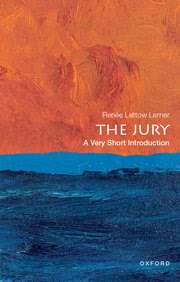
Renée Lettow Lerner, George Washington Law, has published The Jury: A Very Short Introduction (Oxford University Press):

From ancient Athens to modern Asia, cultures have wanted ordinary people involved in making legal decisions. This Very Short Introduction charts juries from antiquity through the English-speaking world and beyond to Europe, Latin America, Africa, and Asia. Today, juries have become a symbol of democracy and popular legitimacy.

But in English-speaking countries, jury trials are declining. Civil juries have been virtually abolished everywhere except the United States, and plea bargaining is taking the place of criminal jury trials. In this book, Renée Lettow Lerner describes the benefits and challenges of using juries, including jury nullification. She considers how innovations from non-English-speaking countries may be key to the survival of citizen participation in the legal system.

Along the way, the book tells how a small German state invented a way of using jurors that is now found around the world. And it reveals why some defendants preferred to be crushed to death by weights rather than convicted by a jury.

--Dan Ernst

Thursday, July 14, 2022

Crosby on the Jury in the UK and the US

K. Crosby, Senior Lecturer in Law, Newcastle Law School, has posted several articles on the jury in the United Kingdom England and the United States.

Arguments: Jury lawfinding debates in 1842 New Hampshire,
published in A Cultural History of Law, vol 5: A Cultural History of Law in the Age of Reform 1820-1920, ed. Gary Watt and Ian Ward (Bloomsbury, 2019), 91-110:

C.D. Gibson "The Jury" (1906) (NYPL)
The Age of Reform 1820-1920 witnessed a significant move from popular constitutionalism, rooted in traditions of participatory democracy, to a much more exclusive, judge-centric, view of the law (Kramer 2004). This chapter explores this general development through detailed consideration of the particular case of Pierce v State (1843) 13 NH 536. The importance of the Pierce case, which concerned a conflict between the respective powers of judge and jury, has long been acknowledged. In the Supreme Court’s 1895 rejection of jury lawfinding, it was one of the most influential cases cited by Harlan J; and in more recent academic literature its final appellate judgments have been described as “two of the most well-reasoned discussions opposing the jury’s right to judge the law” (Conrad 1998: 69). But despite its foundational status within the judicial rejection of the jury lawfinding argument, little is known about the way the judgments were formed. The present chapter relies on contemporary newspaper reports and pamphlets to fills this gap in the cultural history of the case. In so doing, we will shed light on the popular cultural reception of constitutional developments in the Age of Reform.
Abolishing Juries of Matrons, Oxford Journal of Legal Studies 39 (2019): 259-284:
This article explores the last 50 years of the jury of matrons, a special type of jury used in England and Wales until the middle of the 20th century to secure reprieves for pregnant women sentenced to death. Despite claims that the jury of matrons had fallen out of use by the middle of the Victorian era, such juries were used in over 10% of cases in which women were sentenced to death during the first three decades of the 20th century. Exploring the circumstances in which the jury of matrons was abolished in 1931 can help us see how various important parts of the contemporary criminal justice system of England and Wales developed. In particular, it allows us to see in greater detail how ideas of the jury and of capital punishment were changing at this time, and how important political networks were in securing legislative reforms.
Keeping Women off the Jury in 1920s England and Wales, Legal Studies 37 (2017): 695-717:
The Sex Disqualification (Removal) Act 1919 ended the prohibition on female jurors. This did not mean that English and Welsh juries became representative institutions overnight, however: the property qualifications ensured that juries were still drawn from the top few per cent of the local population; and the 1919 Act expressly permitted trial judges to order single-sex juries where the nature of the evidence required it. The continued existence of peremptory challenges allowed defendants in felony trials to exclude women from their juries whenever they preferred to be tried only by men. Finally, some judges permitted female jurors to excuse themselves from particular trials if they so desired. This paper explores the effects these factors had on the practical enjoyment of the female jury franchise after the passing of the 1919 Act. It finds that the picture is remarkably localised: rates of women serving on juries were very different for the five assize circuits for which adequate records exist (Midland, Oxford, South Eastern, South Wales and Western). By exploring these issues, this paper reveals how flexible the female jury franchise was in its early years, and shows how important local differences were in keeping women off the jury.
--Dan Ernst

Tuesday, June 22, 2021

Essays in Honour of DeLloyd J. Guth

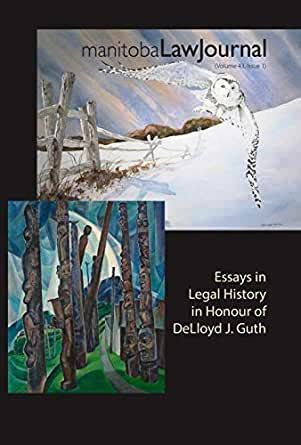
Manitoba Law Journal 43:1 (2020) was devoted to Essays in Legal History in Honour of DeLloyd J. Guth.  It publishes three articles delivered in the Annual DeLloyd J. Guth Lecture Series as well as two others, included to "affirm[] the commitment of the MLJ in its new era to legal history."  Here’s the TOC:

Preface
Bryan P. Schwartz, Darcy L. MacPherson

Two “White” Perspectives on Indigenous Resistance: Emily Carr’s Klee Wyck, the RCMP, and Title to the Kitwancool Valley in 1927
Hamar Foster

Lawyers in the ‘Slammer’ and in Hiding: The Pitfalls of Advocating for Unpopular Causes at the British Columbia Bar, 1900-1925
John McLaren, Pooja Parmar

Scandal, the Law and the Press: Attacking Immorality in Britain: Duelling 1760-1830
Donna T. Andrew

“We have centuries of work undone by a few bone-heads”: A Review of Jury History, a Present Snapshot of Crown and Defence Counsel Perspectives on Bill C-75’s Elimination of Peremptory Challenges, and Representativeness Issues
Michelle I. Bertrand, Richard Jochelson, David Ireland, Kathleen Kerr-Donohue, Inga A. Christianson, Kaitlynd Walker

The Trajectory of Three Marketing Boards in Canada: Gone, Going… and Curiously Persistent
Bryan P. Schwartz

--Dan Ernst

Thursday, April 2, 2020

Murray on Populist Prosecutorial Nullification

Kerrel Murray, University of North Carolina School of Law, has posted Populist Prosecutorial Nullification, which is forthcoming in volume 96 of the NYU Law Review:
No one doubts that prosecutors may sometimes decline prosecution notwithstanding factual guilt. Everyone expects prosecutors to prioritize enforcement based on resource limitation and, occasionally, to decline prosecution on a case-by-case basis when they deem justice requires it. Recently, however, some state prosecutors have tested the boundaries of this power by asserting the right to refuse categorically to enforce certain state laws. Examples include refusals to seek the death penalty and refusals to prosecute prostitution or recreational drug use.

There is thus a burgeoning need for a pertinent evaluative framework. To answer that call, this Article offers the first extended analysis of the normative import of the locally elected status of the state prosecutors who make such pledges. In so doing, it finds that local elections make all the difference. There may well be something suspect about unilateral prosecutorial negation of democratically enacted law. Yet there is something distinctly democratic, and thus justifiable, about an elected prosecutor who can claim popular sanction for the exact same act.

This Article first unspools a once-robust American tradition of localized, populist criminal-law non-enforcement, best seen in jury nullification. It then applies democratic theory to construct a normative basis for reviving that tradition in the context of state prosecutors’ categorical non-enforcement. These moves uncover a before-now unappreciated connection: at least where the prosecutor ties her categorical nullification to the polity’s electorally expressed will, she accomplishes wholesale what nullifying juries could once do retail. Appreciating that relationship helps uncover a phenomenon best thought of as populist prosecutorial nullification. Building upon that finding, I set out a novel framework for evaluation of state prosecutors’ categorical non-enforcement that is keyed to the concept of localized popular will.
--Dan Ernst

Wednesday, May 8, 2019

Anderson on 19th-Century Trial Manuals on Jury Challenges

April J. Anderson has posted Peremptory Challenges at the Turn of the Nineteenth Century: Development of Modern Jury Selection Strategies As Seen in Practitioners’ Trial Manuals, which she wrote as a Yale Law student in a seminar on the history of the jury trial.  It is forthcoming in 2020 in the Stanford Journal of Civil Rights and Civil Liberties:
Peremptory strikes on the basis of race, national origin, religion, and class are well-known problems in modern jury selection, and have led to calls to abolish peremptory strikes altogether. Defenders of peremptory strikes argue that they are a fixture of the common law system that should not be discarded because of a few abuses.

This Article explores how and why strategic jury selection developed in the United States by looking at previously unstudied primary source materials: nineteenth-century trial-attorneys’ practice guides. Peremptory challenges and voir dire are difficult to study because court records often leave them out. Even when strikes are recorded, an attorney’s strategy may not be evident to the outsider. But practice guide materials reveal these strategies, demonstrating that nineteenth-century attorneys used peremptory strikes to eliminate jurors based on stereotypes regarding race, national origin, religion, and class. They also show how a number of features of the modern American jury selection system—most notably, extended pretrial questioning of jurors—were expanded from their more limited common law forms to make it easier for lawyers to either respond to particular social prejudices in American society or to make discriminatory peremptory challenges.

These findings have important implications for the modern-day debate over peremptory challenges. While proponents of peremptory challenges point to their ancient origins as justification for keeping them, a historical perspective shows that modern jury selection looks nothing like its English common law progenitor. Analysis of turn-of-the-century practices, the beginnings of the procedures we use now, exposes modern abuses as part of a trend that began in the 1800s. Simply put, the problems reformers now point to are not recent abuses that have crept in to an ancient system. They have existed for as long as the jury selection procedures we know have been practiced. Modern jury selection and abusive tactics grew up simultaneously in the 1800s as a reaction to the country’s social divisions, suggesting that discrimination as a trial strategy is inevitable in a heterogeneous society where courts allow extended voir dire and unfettered peremptory challenges.
---DRE

Saturday, February 9, 2019

Weekend Roundup

  • The latest "AHR interview" is with Bianca Premo and Yanna Yannakakis, on their forthcoming American Historical Review article on legal jurisdiction and indigenous agency in colonial Mexico.
  • HLS’s Annette Gordon-Reed speaks on Confederate iconography and bias as part of the University of Houston Law’s Distinguished Speakers series on February 14 from 4:00 p.m. to 5:15 p.m.
  • Seth Barrett Tillman has posted his latest briefs in the Emoluments Clause litigation, here and here
  • Books in Review. Karen J. Greenberg on Jonathan Gienapp’s Second Creation in The Nation.  David W. Blight on Judge Richard Gergel’s Unexampled Courage in the New York Times.
  • ICYMI: The Minnesota Spokesman-Recorder’s “Minnesota Black History Salute” of Lena O. Smith, “Minnesota’s first female African American lawyer.”  The Knox Student on the Illinois Supreme Court Historic Preservation Commission’s traveling exhibit on the history of Illinois's judiciary.
Weekend Roundup is a weekly feature compiled by all the Legal History bloggers.

Friday, December 28, 2018

Chin on Frampton, "The Jim Crow Jury"

Over at JOTWELL, you'll find an admiring review by Gabriel "Jack" Chin (UC Davis) of "The Jim Crow Jury," by Thomas Ward Frampton (Harvard Law School). The article appears in Volume 71 of the Vanderbilt Law Review (2018). Here's a taste of the review:
This article challenges the practice of non-unanimous criminal jury verdicts in Louisiana. In a certain sense, the article was irrelevant, moot, by the time it saw print. This is not because, say, it was about an election that was already over, or made an argument that the courts had definitively rejected. Instead, the claim in this paper was so factually, legally and historically compelling that even in draft form it spurred concrete action; thanks in part to this paper, the policy it analyzed was both declared unconstitutional by a court, and repealed by the voters. 
The article carefully recounts the history of the substantial elimination of African Americans from juries in Louisiana after Reconstruction. African Americans were, of course, a major part of the population of most of the former Confederate states, and amounted to a majority in Louisiana, Mississippi, and South Carolina. As Frederick Douglass wrote, “the liberties of the American people” depended on “the Jury-box” as well as “the Ballot-box,” if allowed to serve on juries, there was the danger that African American defendants would get a fair hearing, and that Whites (and White officials) accused of crimes against African Americans could be convicted. These were risks that White supremacists could not accept.
Read on here.

Friday, August 17, 2018

Papp Kamali on a Papal Interdict and Trial by Jury

Elizabeth Papp Kamali, Harvard Law School, has posted Trial by Ordeal by Jury in Medieval England, or Saints and Sinners in Literature and Law, which appears in Kate Gilbert and Stephen D. White, eds., Emotion, Violence, Vengeance and Law in the Middle Ages: Essays in Honour of William Ian Miller (Leiden: Brill, 2018):
Using a miracle tale as a focal point, this paper illuminates the political and cultural context of York at the turn of the twelfth to thirteenth century in order to make sense of England’s rapid transition from trial by ordeal to trial by jury after 1215. More specifically, the paper highlights the possible impact of the period of papal interdict (c. 1208 – 1214), imposed by Pope Innocent III in response to King John’s intransigence over the appointment of a new archbishop of Canterbury, during this transitional period in criminal procedure. It argues that the interdict, with its suspension of liturgies, might have forced experimentation with alternative means of reaching verdicts in felony cases. The paper also suggests that juries might have been involved in the issuance of ordeal verdicts in the late ordeal period in England, in which case the shift from trial by ordeal to trial by jury may be less a moment of rupture than a transition from one form of trial using juries to another, albeit a trial form more starkly desacralized after 1215. It is the author’s hope that the paper will serve as a starting point for further research, not a decisive answer to the questions it raises, including whether England’s rapid adoption of final jury verdicts may owe something to the tussle between King John and a particularly imperial and imperious pope.

Wednesday, May 30, 2018

Kamali & Green on England's Adoption of Trial by Jury

Elizabeth Papp Kamali, Harvard Law School, and Thomas A. Green, University of Michigan Law School, have posted The Assumptions Underlying England's Adoption of Trial by Jury for Crime, which appears in Law and Society in Later Medieval England and Ireland: Essays in Honour of Paul Brand, ed. Travis Baker (New York: Routledge, 2018), 51-81.
Within a few years of Lateran IV’s prohibition of priestly involvement in trial by ordeal, England moved definitively toward a criminal justice system based on trial by jury. This paper will explore the underlying assumptions of king, council and justices at the time of the criminal trial jury’s introduction (c. 1220) as to the jury’s precise function within a prosecutory system that countenanced only capital sanctions for those convicted of felony. Unearthing these assumptions will require careful consideration of earlier ordeal procedure and other kinds of juries in the late twelfth and early thirteenth centuries, most notably juries of presentment, coroners’ inquests, and juries tasked with responding to writs de odio et atia. It will also require situating trial by jury within the broader context of felony adjudication with its manifold escape valves, including benefit of clergy, sanctuary, abjuration and pardons. The paper will rely on a re-examination of primary source materials and engagement with the existing secondary literature to grapple with the broad questions of what constituted serious criminal wrongdoing, what jurors were expected to know and do in adjudicating felony cases, and the extent to which jurors’ verdicts were based on knowledge or belief in the guilt of an individual, as opposed to such factors as reputation, rumor or expected recidivism. With regard to the issue of jury independence, the paper will query whether juries engaged in unilateral nullification of the law, or whether verdicts that appear to be contrary to the law reflect instead a consensus of judge and jury. Related to this is the macro-level question of what constituted the law, including the related matters of how jurors were to know the law and respond to it. As a think piece, this paper will test several hypotheses regarding problems fundamental to the history of English criminal law, some of which may prove unresolvable.

Tuesday, January 9, 2018

Davies on the Motions Practice and Homes of the Fuller Court

Ross E. Davies, George Mason University Antonin Scalia Law School, has posted Supreme Court Practice 1900: A Study of Turn-of -the-Century Appellate Procedure, Journal of Law 7 (2017): 33-46.  “In 1900 practice in the Supreme Court of the United States often involved direct dealings with individual Justices at their home offices. This paper sketches that aspect of appellate litigation at the turn of the century."  The article includes what Professor Davies aptly terms “Justice John Marshall Harlan’s rather chilling in-chambers opinion explaining his refusal to allow an appeal in a jury-and-race case.”