Showing posts with label Social Welfare. Show all posts

Wednesday, February 4, 2026

JAH 112:3

There is much of interest to legal historians in the latest issue of the Journal of American History (112:3):

Presidential Address: Historians' Voices in Times of Peril
David W Blight

“Disabled by Law”: Ableism and Self Advocacy in Eighteenth-Century British America
Laurel Daen

Plenary Powers: Chinese Immigration, Sovereignty Challenges, and the Making of Federal Immigration Power in the U.S. West
Julian Lim

The Long War on Welfare: Taxpayer Activists and the Politics of Backlash in Depression-Era America
Brooke Depenbusch

--Dan Ernst.  H/t GR 

Friday, July 18, 2025

Korostyshevsky on Drunkards and Guardianship in the US

LHR day continues here at LHB: David Korostyshevsky, Colorado State University, has published Incapable of Managing His Estate: Habitual Drunkards and the Expansion of Guardianship in the Nineteenth-Century United States online in Law and History Review:

During the first half of the nineteenth century, Mid-Atlantic States expanded guardianship to include habitual drunkards. Legislators in Pennsylvania, New York, and New Jersey empowered courts to put habitual drunkards under guardianship, a legal status that stripped them of their rights to own property, enter into contracts, make wills, and, in some states, even vote. Amid the dramatic nineteenth-century expansion of male suffrage, the habitual drunkard signified a masculine failure of self-government that disqualified propertied men from the privileges of full citizenship. The struggle to define habitual drunkenness, detect the habitual drunkard, and put him under guardianship transformed the courtroom into an arena for contesting the thresholds of compulsion, policing respectable manhood, and drawing the borders of full citizenship in the nineteenth-century United States.

--Dan Ernst 

Friday, November 8, 2024

CFP: Regulating the Global Movement of Care

 [We have the following CFP.  DRE]

W G Hart Workshop 2025: Regulating the Global Movement of Care.  Institute for Advanced Legal Studies, London.  11-12 June 2025

We invite abstracts (of 250-300 words) for the 2025 W G Hart Workshop focusing on the role of law in regulating the global movement of care. Given the historical and contemporary significance of the issue of the movement of carers, we welcome abstracts that explore the legal regulation of care (including comparative and international aspects) through the lens of a variety of disciplines: law, history, anthropology, politics, sociology, criminology, and creative arts.

The Workshop is organised around four themes - precarity, advocacy, protection, and kinship networks (see below) - reflecting the varied facets through which law's role in regulating the movement of care can be examined. Care is broadly defined and includes healthcare, social care, domestic care, as well as unpaid care. Legal requirements often create precarity by imposing stringent professional regulatory standards on migrant care workers or permitting the claw back of visa fees. Law may also be a tool in the hands of carers and individuals and organisations who support them to battle against exploitation. Legal regulation may, in some instance, offer protection to migrant care workers. Law, in particular immigration requirements, can also define relationships between migrant carers and their broader kinship networks both in their host countries and in the countries that they come from.

Abstracts should be emailed to adrienne.yong@city.ac.uk and p.saksena@leeds.ac.uk by 5pm on Monday, 6 January 2025. Please also include a brief biography of the speaker in the submission. Further details on the workshop themes are included below.

Academic Directors:

Dr Adrienne Yong (City St George's, University of London)
Dr Priyasha Saksena (University of Leeds)
Dr Amanda Spalding (University of Leeds)
Dr Amrita Limbu (University of Leeds)
Professor Marie-Andrée Jacob (University of Leeds)

More after the jump.

Wednesday, May 17, 2023

Legal Historians on "The Disability Frame"

Last February, we noted that several legal historians would be participating in a University of Pennsylvania Law Review symposium on "The Disability Frame." The published volume is now available online at the Law Review's website. Contributions of interest for readers of this blog include:

Nate Holdren (Drake University), Capitalism Disables: The Case of Workers' Compensation Laws. Abstract:

This article presents an account of disability as social and thus variable, connected to an account of capitalism as an inherently disabling type of society, such that different capitalist societies may disable in different ways, but all of them will disable. The article then takes the early history of workers’ compensation laws in the United States as a case study for the theoretical account of disability and capitalism, arguing that those laws created new incentives for discrimination against disabled people and thus re-organized the process of disabling. The article concludes with brief speculation about what these points imply for the prospects of achieving justice for disabled people through law.

Karen Tani (University of Pennsylvania), Disability Benefits as Poverty Law: Revisiting the "Disabled State". Abstract:

This essay, a contribution to "The Disability Frame" symposium, uses the history of a famous and influential disability benefits case to revisit political scientist Deborah Stone’s argument in THE DISABLED STATE (1984). Observing that “[m]edical certification” of disability had “become one of the major paths to public aid in the modern welfare state,” Stone wondered whether policymakers were asking the “concept of disability” to do too much and whether they were sufficiently alert to the concept’s tendency to expand over time.

Filed in 1983 and decided by the Supreme Court in 1990, Sullivan v. Zebley is an example of those expansionary pressures and their significant results. When the Social Security Administration stopped making Supplemental Security Income payments to 5-year-old Brian Zebley, despite his continuing and severe disabilities, lawyers at the legal aid organization Community Legal Services filed a class action. Operating from a foundational belief that the welfare state should be more robust, Zebley's lawyers contended that not only had the Social Security Administration erred in Zebley’s case, but also that the Agency’s overall eligibility determination process for child disability benefit claimants was too restrictive. The plaintiffs’ ultimate victory before the Supreme Court, and the surprising allies it amassed along the way, illustrate how readily many actors and institutions connected disability to deservingness and embraced disability as a distributional device in the late twentieth century. The post-Zebley backlash against child claimants, however, illustrates how closely the public continued to associate disability with deviance and fraud, especially when they observed take-up among Black citizens. Negative perceptions contributed to the program’s reform in 1996. Congress preserved the new path to eligibility that Zebley created, but also narrowed it. Decisional power, meanwhile, remained in the hands of medical gatekeepers.

This essay casts the Zebley story as one of triumph and tragedy. It was a triumph for poverty lawyers and their clients, who, under hostile circumstances, pressed for a more generous and life-affirming social welfare system. They saw that the boundaries of disability were malleable and they pushed on them. But it remains a tragedy that the best route to subsistence for so many children has further entangled disability with medicalization, suspicion, and surveillance. 

Also of interest: Britney Wilson (New York Law School), Making Me Ill: Environmental Racism and Justice as Disability. Although not a historian, Wilson drew on historical research to explore the intersection of disability, race, civil rights, and environmental justice: Abstract:

Civil rights legal scholars and practitioners have lamented the constraints of the largely intent-based legal framework required to challenge racial discrimination and injustice. As a result, they have sought alternative methods that seemingly require less overt proof of discrimination and are more equipped to address structural harm. One of these proposed solutions involves the use of the Americans with Disabilities Act (ADA)—due to its affirmative mandate to address discrimination by reasonable modification or accommodation—and the framing of issues of racial injustice in terms of disability or the deprivation of medical rights. Environmental justice, an area in which issues of both race and disability are salient and affect one another, is one such context in which advocates have tried to use the ADA to challenge broader structural harm. This Article analyzes cases in which practitioners have used the ADA to challenge issues of environmental injustice to examine the purported utility of the ADA, and disability and medicalization framing, more generally, in addressing structural racism and injustice. Specifically, I discuss the attempted use of the ADA to stop the construction of a petrochemical plant in “Cancer Alley,” Louisiana and to challenge mold on behalf of public housing residents in New York City.

The use of the ADA to challenge environmental injustice has clear legal and social justice narrative benefits that explain its appeal, including the required inclusion of people with disabilities in environmental justice campaigns that disproportionately impact them, but from which they are often left out—except for as examples of the negative consequences of harm. However, the promise of these legal theories has not been adequately tested to proffer the ADA as a true alternative to race-based civil rights laws, and there are many suggestions that it is not. Furthermore, the use of disability as both narrative harm and legal strategy in environmental justice campaigns raises important considerations for racism and ableism as interrelated institutional harms. Therefore, any attempt to expand the disability frame in this direction requires an understanding of racism that does not exclude or otherwise undervalue ableism and vice versa. Otherwise, we risk perpetuating the same problems.

The symposium event featured many other scholars. Rabia Belt's remarks may be of particular interest to readers of this blog. A YouTube recording of her panel is available here.

-- Karen Tani

Wednesday, April 5, 2023

Raffield's "Shakespeare's Strangers and English Law"

Paul Raffield, University of Warwick, has published Shakespeare's Strangers and English Law (Hart/Bloomsbury):

Through analysis of 5 plays by Shakespeare, Paul Raffield examines what it meant to be a 'stranger' to English law in the late Elizabethan and early Jacobean period. The numbers of strangers increased dramatically in the late sixteenth century, as refugees fled religious persecution in continental Europe and sought sanctuary in Protestant England.

In the context of this book, strangers are not only persons ethnically or racially different from their English counterparts, be they immigrants, refugees, or visitors. The term also includes those who transgress or are simply excluded by their status from established legal norms by virtue of their faith, sexuality, or mode of employment.

Each chapter investigates a particular category of 'stranger'. Topics include the treatment of actors in late Elizabethan England and the punishment of 'counterfeits' (Measure for Measure); the standing of refugees under English law and the reception of these people by the indigenous population (The Comedy of Errors); the establishment of 'Troynovant' as an international trading centre on the banks of the Thames (Troilus and Cressida); the role of law and the state in determining the rights of citizens and aliens (The Merchant of Venice); and the disenfranchised, estranged position of the citizen in a dysfunctional society and an acephalous realm (King Lear).

--Dan Ernst

Saturday, March 11, 2023

Weekend Roundup

  • Earlier this week, the White House announced appointments to Permanent Committee for the Oliver Wendell Holmes Devise.  The Committee is composed of the Librarian of Congress and four additional members appointed by the President.  The new appointees are Risa Lauren Goluboff, Martha S. Jones, and Trevor Morrison.  UVA's notice on Dean Goluboff's appointment is here; NYU's on Dean Emeritus Morrison's is here.  
  • On March 23, Kevin Butterfield, director of the John W. Kluge Center at the Library of Congress, will discuss his book, The Making of Tocqueville’s America: Law and Association the Early United States, in support of the ongoing exhibit at the Library of Congress, Join In: Voluntary Associations in America.
  • Nicole Carlson Maffei has posted Lucile Lomen (1920-1996), an essay on the first woman to serve as a clerk to a justice of the U.S. Supreme Court, on the Supreme Court Historical Society website.
  • “An archive belonging to attorney Linda Coffee, who filed the initial lawsuit in Rowe v. Wade, will go up for auction" (Dallas Morning News).
  • "Stanford University Historian Gregory Ablavsky will lecture on 'The Past, Present, and Future of Native Sovereignty in Federal Law' at 5 p.m. March 15 Shideler Hall room 152," University of Miami (Ohio).

  • Queen Mary, University of London, announces its new LLM in Common Law Theory and Practice. “Unique in the landscape of legal postgraduate education, this programme combines theoretical and applied study of the common law. Whether you are you are unfamiliar with the common law or have studied in a common law jurisdiction and wish to deepen your knowledge, this programme offers a contextual and critical insight into the common law and its workings.” 
  • ICYMI: From the Poor Laws to the Social Security Act (History Channel). A library exhibit on the buildings that housed the University of Arkansas School for Law.  A notice of Norman Silber’s oral history of Judge Guido Calabresi. (Law.com).  Diane Minear, an attorney in the Spencer Fane Overland Park, Kansas, on Myra Bradwell.
  • Updates: A notice of  Laura M. Weinrib’s lecture,“Money, Politics, and the Constitution in the ‘Golden Age’ of Capitalism,” at an event honoring her 2021 appointment as the Fred N. Fishman Professor of Constitutional Law at the Harvard Law School (Harvard Crimson).  Also, we noted with interest that the William Nelson Cromwell Foundation supported this digitization project (NYT).

 Weekend Roundup is a weekly feature compiled by all the Legal History bloggers.

Tuesday, January 17, 2023

Zanoni on Welfare as We Knew It

Amy Zanoni has published Remembering Welfare as We Knew It: Understanding Neoliberalism through Histories of Welfare in the Journal of Policy History:

The political transformation that culminated in the Personal Responsibility and Work Opportunity Reconciliation Act fueled scholarly interest in welfare history. As politicians dismantled welfare, scholars discovered long histories of raced and gendered social control, intertwined public and private interests, and fixations on work and personal responsibility. They also recovered more promising possibilities of cash assistance. This article examines foundational welfare histories published between 1971 and 2018. I suggest that this somewhat isolated body of work has shed bright light on the history of neoliberalism from the perspective of people never fully included into social citizenship.  It exposes how neoliberalism is and is not different from mid-century liberalism and recovers a long history of resistance. In an era when few talk about cash assistance, welfare historiography is vital for restoring fading memory of its redistributive potential. 

--Dan Ernst

Thursday, December 1, 2022

Vanatta on the Financialization of Public Pensions

Sean Vanatta, University of Glasgow has posted The Financialization of U.S. Public Pensions, 1945-1974:

This article examines a major transformation public employee pension investment in the United States, from investing public funds in public infrastructure in the 1940s and 1950s, to investing public funds in private securities—corporate bonds, stocks, and mortgages—in the 1960s and 1970s. Three factors drove this change. First, in the adjacent field of professional asset management, motivated financial elites orchestrated a shift in state-level trust law, from legally-sanctioned investment lists, which encouraged amateur investment and safety, to the “prudent man rule,” framed by professional risk-taking and discretion. Second, declining municipal bond yields during World War II led public pension managers to gradually reconceptualize the political goals of pension investment, from balancing retiree returns against low-cost public infrastructure, to maximizing public employee benefits at minimal taxpayer cost by achieving maximum returns in financial markets. Professional asset managers, who joined pension policy networks in the 1950s, encouraged this change. Third, when state and local governments liberalized investment rules to allow public investments in private securities, public officials hired these same asset managers to make these investments. These relationships created new channels for ideology and influence to move from financial elites to state policymakers, through which financial elites continuously pushed for further liberalization. Ultimately, this article argues, financialization was not the product of a radical break or crisis in the 1970s, but was a continuous process in the post-World War II era, one initially pursued by state and local government officials in service of welfare liberalism.

--Dan Erns

Tuesday, June 28, 2022

Brimmer, "Claiming Union Widowhood"

We missed this one back when Duke University Press published it in 2020 (thanks to New Books Network for flagging it): Claiming Union Widowhood: Race, Respectability, and Poverty in the Post-Emancipation South, by Brandi Clay Brimmer(Spelman College). About the book:

In Claiming Union Widowhood, Brandi Clay Brimmer analyzes the US pension system from the perspective of poor black women during and after the Civil War. Reconstructing the grassroots pension network in New Bern, North Carolina, through a broad range of historical sources, she outlines how the mothers, wives, and widows of black Union soldiers struggled to claim pensions in the face of evidentiary obstacles and personal scrutiny. Brimmer exposes and examines the numerous attempts by the federal government to exclude black women from receiving the federal pensions that they had been promised. Her analyses illustrate the complexities of social policy and law administration and the interconnectedness of race, gender, and class formation. Expanding on previous analyses of pension records, Brimmer offers an interpretive framework of emancipation and the freedom narrative that places black women at the forefront of demands for black citizenship.

A few blurbs: 

“Brandi Clay Brimmer has written an amazing social history that transforms the study of poor black women’s quest for citizenship and recognition. Through finely grained research she revises our understanding of the racialized gendered state from the standpoint of poor women themselves. She advances how we think about the agency of newly emancipated women from after the Civil War into the late nineteenth century, in the process challenging existing interpretations about the origins of social assistance in the modern United States. This is historical research at its best.” — Eileen Boris

“This compelling study of eastern North Carolina black women’s claims for Union widows’ pensions marshals methodologically complex evidence to make striking arguments on questions of racialized motherhood, the origins of the welfare state, class formation, and Reconstruction’s failures. Brandi Clay Brimmer recaptures in rich detail the lives of heretofore unknown women who tried and often failed to secure their full Fourteenth Amendment rights. This book is a timely contribution to current debates on the nation’s history of racial injustice and a poignant saga of promises made and promises broken.” — Glenda Elizabeth Gilmore

More information is available here. An interview with the author is available here, at New Books Network. 

-- Karen Tani

Friday, September 3, 2021

Kornbluh and Tani on Polier, Wickenden and Reich's Poverty Law

Felicia Kornbluh, University of Vermont, and Karen Tani, University of Pennsylvania, have posted The Poverty Law Education of Charles Reich, which appeared in the Touro Law Review 36 (2020): 807-821:

This essay, written for a symposium on the life and legacy of Charles Reich, explores how Reich came to be interested in the field of poverty law and, specifically, the constitutional rights of welfare recipients. The essay emphasizes the influence of two older women in Reich’s life: Justine Wise Polier, the famous New York City family court judge and the mother of one of Reich’s childhood friends, and Elizabeth Wickenden, a contemporary of Polier’s who was a prominent voice in social welfare policymaking and a confidante of high-level federal social welfare administrators. Together, Polier and Wickenden helped educate Reich about the facts on the ground, including potential constitutional violations, and encouraged him to write about these issues. Subsequently, they used their powerful networks to circulate Reich’s writings and amplify his arguments. This history showcases Reich’s deep connections to left-liberal reformers who came of age during the New Deal: although he famously critiqued some of their handiwork, he relied heavily on their ideas, expertise, and good will.
--Dan Ernst

Saturday, July 17, 2021

Weekend Roundup

  • John O'Dowd's appreciation of Andrew Bremner Lyall, a historian of East African land law eighteenth-century Ireland and the law of slavery, appears in the Irish Times.
  • Congratulations to former LHB Guest Blogger and current Editor of Law and History Review Gautham Rao upon his election to the Advisory Council of the Society for Historians of the Early American Republic.
  • ICYMI: Nelson Lichtenstein on the revival of the antimonoply tradition (WaPo).  Stephen Carter remembers Justice Thurgood Marshall (NYT).
 Weekend Roundup is a weekly feature compiled by all the Legal History bloggers.

Saturday, June 5, 2021

Weekend Roundup

  • Nate Holdren, Drake University, discusses Injury Impoverished: Workplace Accidents, Capitalism, and Law in the Progressive Era (2020) over at New Books Network. The book also just picked up another award: the Philip Taft Labor History Award, offered by the ILR School at Cornell University, in cooperation with the Labor and Working-Class History Association (LAWCHA). You can read the citation here.
  • The American Bar Foundation has announced its 2021-22 Doctoral and Post-Doctoral Fellows. We were excited to see a few historians on the list, including Hardeep Dhillon and Alex Reiss-Sorokin. You can read more about them and their research here.
  • Here's a web portal on Legal History at the  University of Michigan
  • The Call for the Asian Law and Society Association's conference is up. The conference will be virtual on 17-18 Sept.2021 with the theme: Law, Crisis and Revival in Asia. Proposals are due July 15. 
  • Over at UVic in British Columbia: Pooja Parmar and John McLaren (both of the U. of Victoria) gave a Dean's Lecture series, "Racism, Rights, and Empire in the Dominion of Canada: The Case of the Komegata Maru." Video here.
  • The following events at the annual Roosevelt Reading Festival of the FDR Presidential Library  are of potential interest to legal historians: Eric Rauchway, Why the New Deal Matters (6/15, 4pm); John A. Riggs, High Tension: FDR's Battle to Power America (6/15, 6pm); David Levering Lewis, The Improbable Wendell Willkie: The Businessman Who Saved the Republican Party and His Country, and Conceived a New World Order (6/16, 4pm).  More.
 Weekend Roundup is a weekly feature compiled by all the Legal History bloggers.

Friday, May 28, 2021

Kahn, "Divorce, American Style"

The University of Pennsylvania Press has published Divorce, American Style: Fighting for Women's Economic Citizenship in the Neoliberal Era (May 2021), by Suzanne Kahn (Roosevelt Institute). A description from the Press:

In the 1970s, the divorce rate in the United States doubled, and longtime homemakers suddenly found themselves at risk of poverty, not only because their husband's job was their sole source of income, but also because their insurance, retirement, and credit worthiness were all tied to their spouse's employment. Divorce, American Style examines how newly divorced women and policymakers responded to the crisis that rising divorce rates created for American society.

Suzanne Kahn shows that, ironically, rising divorce rates led to policies that actually strengthened the social insurance system's use of marriage to determine eligibility for benefits. Large numbers of newly divorced women quickly realized their invisibility within the American welfare state, which did not distribute benefits to most women directly but rather through their husbands. These newly divorced women organized themselves into a political force, and they were remarkably successful in securing legislation designed to address divorced women's needs. But this required significant compromise with policymakers, and these new laws specifically rewarded intact marriages, providing more robust benefits to women in longer marriages. These incentives remain in place today. Indeed, in the thirty years since this legislative compromise, activists' efforts to grapple with the legal system created out of this crisis have affected such high-profile debates as the fight over the Affordable Care Act and the battle for marriage equality.

Divorce, American Style contests the frequent claim that marriage has become a more flexible legal status over time. Enduring ideas about marriage and the family continue to have a powerful effect on the structure of a wide range of social programs in the United States.

More information is available here.

-- Karen Tani


Thursday, December 24, 2020

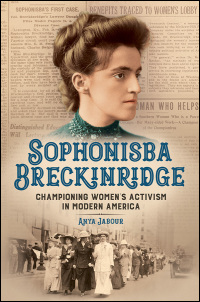
Jabour on Sophonisba Breckenridge

 The University of Illinois Press has published a biography on the important twentieth-century reformer and academic Sophonisba Breckenridge: Sophonisba Breckinridge: Championing Women's Activism in Modern America (2020), by Anya Jabour (University of Montana). A description from the Press:

Sophonisba Breckinridge's remarkable career stretched from the Civil War to the Cold War. She took part in virtually every reform campaign of the Progressive and New Deal eras and became a nationally and internationally renowned figure. Her work informed women's activism for decades and continues to shape progressive politics today.

Anya Jabour's biography rediscovers this groundbreaking American figure. After earning advanced degrees in politics, economics, and law, Breckinridge established the University of Chicago's School of Social Service Administration, which became a feminist think tank that promoted public welfare policy and propelled women into leadership positions. In 1935, Breckinridge’s unremitting efforts to provide government aid to the dispossessed culminated in her appointment as an advisor on programs for the new Social Security Act. A longtime activist in international movements for peace and justice, Breckinridge also influenced the formation of the United Nations and advanced the idea that "women’s rights are human rights." Her lifelong commitment to social justice created a lasting legacy for generations of progressive activists.

Advance praise:

"In propulsive prose, Anya Jabour brings to life progressive feminist Sophonisba Breckinridge, whose forty-year career as an advocate for social justice provides a model of 'passionate patience' for progressives in the twenty-first century."--Robyn Muncy

"Anya Jabour has written an outstanding biography of Sophonisba Breckinridge. She has thoroughly convinced me of Breckinridge's important role in American and women's history and how much of each is revealed by her lifelong activism. The research is expansive and the writing is flawless."--Joan M. Johnson

More information is available here.

-- Karen Tani

Monday, November 23, 2020

Witt Reviews Holdren's "Injury Impoverished"

John Fabian Witt, Yale Law School, has posted Radical Histories/Liberal Histories in Work Injury Law, a review forthcoming in the American Journal of Legal History of Nate Holdren’s Injury Impoverished: Workplace Accidents, Capitalism, and Law in the Progressive Era:

Nate Holdren has written a brilliant, impassioned, and intellectually stimulating book on the legal history of industrial accidents. According to Holdren, work injuries were at their core a form of labor exploitation. He describes the law of work accidents as a machinery of injustice that bolstered the legitimacy of a violent and inhuman capitalist system. He fiercely critiques the workers’ compensation reforms enacted by progressive reformers a century ago as legitimating a form of systematic labor violence. He insists on recognizing and attending to the dignity of each accident victim, both in the content of his argument and as a matter of literary form. Injury Impoverished is a welcome if unsettling rebuke to complacent accounts of the field, perhaps my own among them. But Holdren’s analysis also raises many questions. Holdren attributes little value to the dramatically safer workplaces of the middle of the twentieth century. His cautious admiration for the litigation system of the years before workers’ compensation rests on a fantastical conception of the way 19th-century tort law actually worked. He calls for an impossibly demanding form of "justice as recognition" from the law. He misses the ways in which workers co-opted new forms of accident law and turned them to their own interests. And his single-minded focus on commodification and the point of production leads him to discount the surrounding political and legal institutions that shaped the social meaning of work injuries.

--Dan Ernst

Tuesday, November 10, 2020

Sposini on Certifying Insanity in Ontario

Filippo Maria Sposini, a PhD candidate at the University of Toronto, has published Just the Basic Facts: The Certification of Insanity in the Era of the Form K in the Journal of the History of Medicine and Allied Sciences 75 (April 2020): 171–192: 

This paper investigates the certification of insanity through a standardized template called Form K which was used in Ontario between 1873 and 1883. My main thesis is that the introduction of the Form K had profound and long-lasting effects on the determination of insanity. In particular, it created a unique case in the history of certification, it grounded civil confinement on a strategy of consensus, and it informed mental health documentation for more than a century. As the result of a transnational mediation from Victorian England, the Form K prescribed an examination setting which involved a high number of participants, including three physicians and several witnesses. By comparing this case with other jurisdictions of the time, this paper shows how Ontario became a distinctive case worldwide. In order to get a closer look at this medico-legal procedure, I consider the archival records of the Toronto asylum and conclude that the certification of insanity relied on a strategy of consensus. While the Form K proved quite successful in preventing legal actions, it produced financial, logistic, and bureaucratic issues. The Form K was thus discontinued after a decade, yet its structure influenced Ontario’s mental health documentation throughout the twentieth century. This paper shows the relevance of the certification of insanity for transnational history and for understanding contemporary issues of involuntary confinement and stigma in mental health.

--Dan Ernst

Monday, October 12, 2020

Prifogle, "Legal Landscapes, Migrant Labor, and Rural Social Safety Nets in Michigan, 1942-1971"

Emily Prifogle (University of Michigan Law) has posted "Legal Landscapes, Migrant Labor, and Rural Social Safety Nets in Michigan, 1942-1971." Here's the abstract:

In the 1960s, farmers pressed trespass charges against aid workers providing assistance to agricultural laborers living on the farmers’ private property. Some of the first court decisions to address these types of trespass, such as the well-known and frequently taught State v. Shack (1971), limited the property rights of farmers and enabled aid workers to enter camps where migrants lived. Yet there was a world before Shack, a world in which farmers welcomed onto their land rural religious groups, staffed largely by women from the local community, who provided services to migrant workers. This article uses Michigan as a case study to examine the informal safety net those rural women created and how it ultimately strengthened the very economic and legal structures that left agricultural workers vulnerable. From the 1940s through the 1960s, federal, state, and local law left large gaps in labor protections and government services for migrant agricultural laborers in Michigan. In response, church women created rural safety nets that mobilized local generosity and provided aid. These informal safety nets also policed migrant morality, maintained rural segregation, and performed surveillance of community outsiders, thereby serving the farmers’ goals of having a reliable and cheap labor force. 

The full article is available here. (h/t @WomenKnowLaw)

-- Karen Tani

Thursday, May 28, 2020

Fleming on the Public Interest in the Private Law of the Poor

Anne Fleming, Georgetown University Law Center, has posted The Public Interest in the Private Law of the Poor, which appeared in the Harvard Law & Policy Review 14 (2019): 159-203:
This Article begins to explore the uncharted connections between private law and poverty law, revealing a striking pattern that is only visible when these two bodies of law are viewed in the same frame. Many poverty law scholars have focused on the rules that regulate government assistance to the poor. They have left largely left unexamined the private law of the poor — meaning, laws that govern the private economic relationships of those living in poverty or in danger of falling into destitution. At the same time, the study of private law is flourishing among scholars who seek to understand the law’s vision of justice in relations between private individuals. But these scholars often seek that vision within the law’s doctrinal structures, which betray little overt concern with poverty.

Revealing the connections between the two fields, this Article shows how concerns about public spending on poor relief have shaped debates over the private law of the poor for over a century. It traces the recurrence of one rationale for regulation, the prevention of “pauperism,” that explicitly linked private law rules with poverty alleviation. Proponents of the anti-pauperism argument claimed that private law, if properly structured, could help prevent dependence on poor relief and thereby reduce the burden on the public fist of caring for poor households. Thus, they imagined the private law of the poor as one component of a larger system of rules designed to keep families self-supporting and off the poor relief rolls.

Drawing on original research across a range of source materials, this Article traces the history of the anti-pauperism argument and offers several explanations for its enduring appeal. It then describes the implications of this history for law and economics scholars, for present-day fights against economic inequality and in favor of regulatory reform, and for breaking down the silos between private law and poverty law.
--Dan Ernst

Saturday, May 23, 2020

Weekend Roundup

  • Katrina Jagodinsky will use a three-year, $460,000 grant from the National Science Foundation to explore how habeas corpus was used in the American West by various marginalized groups to claim freedom and establish their rights between 1812 and 1924.”  More.
  • Over at the blog of the Historical Society of the New York State Courts is a post summarizing John Oller’s article, forthcoming in Judicial Notice, entitled “George Wickersham: ‘The Scourge of Wall Street.’”  The video of the Society’s webinar, "Lessons Learned from the 1918 Flu Pandemic," is here; its video, "The Evolution of Slavery, Abolition in NY, and the NY Courts: The Lemmon Slave Case," is here.
  • Sadly but not surprisingly, the Law Books course at Rare Books School, taught by Mike Widener (assisted by Ryan Greenwood) has been cancelled for summer 2020. 
  • If you're not already zoomed out: Fridays at 6pm Eastern Time is Drinking with Historians, hosted by Matt Gabriele (Virginia Tech) and Varsha Venkatsubramanian (UC-Berkeley) and with a different guest each week. Registration is here.
Weekend Roundup is a weekly feature compiled by all the Legal History bloggers. 

Saturday, March 28, 2020

Weekend Roundup

  • We the People, the podcast of the National Constitution Center, recently released an episode on "The Constitution and the Coronavirus." One of the featured guests is legal historian Polly Price (Emory University School of Law).  
  • ICYMI:  A national compendium of exhibits on the centennial of the 19th Amendment (Antiques).  Miriam Seifter, Wisconsin Law, on gubernatorial emergency power.  In case you want to brush up on a real war president for those FDR vs. DJT comparisons: thisUpdate: Okay, but what took so long?  Update: Mashpee Wampanoag Tribe To Lose Its Reservation (WBUR).
Weekend Roundup is a weekly feature compiled by all the Legal History bloggers.