Showing posts with label Rights. Show all posts

Thursday, June 25, 2026

Bilder on the Blessings of Liberty and the Bill of Rights

Mary Sarah Bilder, Boston College Law School, has posted The Blessings of Liberty and Bills of Rights, which will appear in National Constitution Center’s essay collection, The Promise of America: Reflections On Our Enduring Ideals (Simon & Schuster, 2026):

With the final words of the Preamble, “We the People . . . ordain and establish this Constitution” to “secure the Blessings of Liberty to ourselves and our Posterity.” Today, Americans might point to the Bill of Rights, the first ten amendments of the US Constitution, as an important example of those liberties. Two hundred and fifty years ago, Americans also referred to the Bill of Rights, but they meant a 1689 English document. Over two centuries, the bill of rights transformed. This history underscores the continuity of a culture of rights and liberties as bulwarks against power. But it also reveals the conceptual challenges that arose as rights developed under a monarchical constitution were replaced with rights within a free constitution of the people. 

--Dan Ernst 

Wednesday, June 17, 2026

CFP: Inclusion, Exclusion, and Resistance in the Renaissance World

[Via H-Law, we have the following CFP.  DRE]

Inclusion, Exclusion, and Resistance in the Renaissance World, ca. 1300–1700

The history of rights in the Renaissance is also a history of their limits. The vocabularies of dignity, right, and resistance that Renaissance thinkers developed to claim freedom and constrain power were never universal; they were always already structured by categories that determined who belonged to the community (citizens, subjects), who was tolerated within it (religious minorities), and who was excluded from it altogether (enslaved persons, women). This session asks how those boundaries were drawn, contested, and redrawn across the Renaissance world — and how rights expanded for some while narrowing or vanishing for others.

Abstracts on any of the following are welcome: toleration and the limits of confessional belonging; colonial encounter and new categories of subjecthood; resistance theory and who may act in defense of a community; the jurisprudence of slavery and the boundaries of personhood; and the legal and political status of women, whose rights often narrowed even as others expanded.

Depending on the abstracts received, this session may take the form of a traditional panel of papers or a roundtable discussion for the 2027 Renaissance Society of America Conference in Philadelphia (March 11–13). Please indicate your preferred format, and feel free to describe your contribution as either a research paper or a set of reflections drawing on your current work.

Abstracts are invited from scholars across all relevant disciplines. Papers recovering neglected or unexpected traditions are especially welcome. Early-career scholars are encouraged to submit.

Please send a 300-word abstract and a short copy of your c.v. to karrsn@uc.edu 

Tuesday, April 21, 2026

Stenlund on Sweden, Rule-of-Law Talk, and the US Right

On Tuesday, April 28, 15:00-16:30, Helsinki time, which is seven hours ahead of EDT, Karolina Stenlund, a lecturer at the Faculty of Law at the University of Helsinki, the holder of a doctoral degree in law, and a former visiting doctoral researcher at Harvard Law School, will present in the Helsinki Legal History Series seminar:

My presentation for HLHS will be on an article that examines the uneasy relationship between the rule of law and democratic backsliding through a legal-historical case study of Sweden. Challenging the conventional assumption that legality and the rule of law inherently safeguard democracy, the article traces how early rule-of-law discourse and rights-based litigation in Sweden emerged not from left-wing civil rights activism but from a right-libertarian legal movement inspired by U.S. public-interest law firms. Through an analysis of the landmark 2006 "Uppsala case" and the intellectual and strategic foundations behind it, the article shows how concepts such as equality and the rule of law were mobilized to expand judicial power and reshape the balance between courts and the political branches. By situating these developments within Sweden's unique political and constitutional history, the article highlights how legal strategies aimed at strengthening individual rights can simultaneously redistribute political power in ways that complicate dominant narratives of democratic resilience. The piece forms part of an ongoing research project and should be read as work in progress.
Online attendance (listen-only) here.

--Dan Ernst

Saturday, May 24, 2025

Weekend Roundup

  • Over at Balkinization: a symposium on Dylan C. Penningroth's Before the Movement: The Hidden History of Black Civil Rights (Liveright, 2023), featuring contributors Evelyn Atkinson (Tulane), Ian Ayres (Yale), Mark Graber (Maryland), Steve Griffin (Tulane), Carol Rose (Yale), and Mark Tushnet (Harvard).
  • Aditya Bamzai, University of Virginia School of Law, Johann Neem, Western Washington University, Farah Peterson, University of Chicago Law School, and Jack Rakove, Stanford University, on the Articles of Confederation at the National Constitution Center (YouTube). 
  • Thomas J. McSweeney, William & Mary Law School, a recipient of the university's 2025 McGlothlin Award for Exceptional Teaching.
  • On Tuesday, June 10, 2025, 12PM – 1PM (Pacific) the Oregon Historical Society will host, as part of its series, "Historians and the News," the virtual event Free Speech, Misinformation, and National Security, a conversation with Sam Lebovic and Christopher McKnight Nichols.  Register here.
  •  Stephanie Hall Barclay, Georgetown University Law Center, responds to
    John Marshall Harlan (LC)
    Jud Campbell’s “Determining Rights” in the Harvard Law Review.
  • ICYMI: Harvard's Magna Carta (The Crimson). Charles Barzun on the quiet radicalism of Justice Souter (SCOTUSblog).  Centre College's sculpture of John Marshall Harlan (Lane Report). Bruce Ackerman and Susan Rose-Ackerman on the APA and Postwar Fears of Executive Power (Slate). Wong Kim Ark's great grandson and birthright citizenship (Post Reports).

Weekend Roundup is a weekly feature compiled by all the Legal History bloggers. 

Thursday, February 13, 2025

Campbell on Founding-Era Notions of Constitutional Rights

 "Determining Rights," an article by Stanford Law's Jud Campbell, is now out in the Harvard Law Review:

This Article explores Founding-era views about the grounding of constitutional rights and how those rights obtained determinate legal content. Today, we typically view constitutional rights as textually grounded, gaining their force through ratification, and we treat the task of determining their content as a question of law — that is, a question for judges to decide using legal criteria. But the designers of the Bill of Rights did not share that vision. In the eighteenth century, fundamental rights were often grounded in natural or customary law rather than in enacted text, and enumerating them was usually declaratory, marking their existence without altering their meaning. Moreover, determining the content of underdeterminate rights was up to the people themselves, often through ordinary politics. To be sure, it was possible to determine rights textually, as exemplified by the amount-in-controversy threshold in the Seventh Amendment. By and large, however, members of the First Congress rejected this specificatory approach in favor of declaratory provisions, as exemplified by the First Amendment’s simple reference to “the freedom of speech, or of the press.” In so doing, the Bill of Rights mostly reaffirmed the existence of natural and customary rights, without determining their content. Recovering this history is especially timely, with so many features of rights jurisprudence now in flux. Seeking a historical anchor, some Justices have recently embraced a “text and history” approach that asserts fidelity to original meaning. This method, however, proceeds from mistaken historical assumptions and creates a distorted image of the original Bill of Rights. Yet a historically guided path forward is far from clear in a legal culture that rejects many of the conceptual premises of Founding-era constitutionalism. As a work of intellectual history, this Article cannot tell us where to go from here. But it reveals forgotten ways of thinking that merit consideration as the Supreme Court continues to determine our rights, whether it admits so or not.

--Dan Ernst

Wednesday, November 15, 2023

Baude, Campbell and Sachs on "General Law" and the 14th Amendment

William Baude, University of Chicago Law School, Jud Campbell, Stanford Law School, and Stephen E. Sachs, Harvard Law School, have posted General Law and the Fourteenth Amendment, which is forthcoming in the Stanford Law Review:

The Fourteenth Amendment’s Section One is central to our constitutional law. Yet its underlying principles remain surprisingly obscure. Its drafting history seems filled with contradictions, and there is no scholarly consensus on what rights it protects, or even on what kind of law defines those rights.

This Article presents a new lens through which to read the Fourteenth Amendment—new to modern lawyers, but not to the Amendment’s drafters. That lens is general law, the unwritten law that was taken to be common throughout the nation rather than produced by any particular state. Though later disparaged in the era of Erie Railroad Co. v. Tompkins, general law was legal orthodoxy when the Amendment was written.

To those who created the Fourteenth Amendment, general law supplied the fundamental rights that Section One secured. On this view, while Section One identified the citizens of the United States, it did not confer new rights of citizenship. Instead, it secured preexisting rights—rights already thought to circumscribe state power—by partially shifting their enforcement and protection from state courts and legislatures to federal courts and Congress. This general-law understanding makes more sense of the historical record than existing theories, which consider the Fourteenth Amendment solely in terms of federal or state law. And it has significant implications for modern Fourteenth Amendment doctrine, from state action to civic equality to “incorporation” to “substantive due process.”
--Dan Ernst

Saturday, June 3, 2023

Weekend Roundup

  • Ron Harris. the Kalman Lubowsky Professor of Law and History, Tel Aviv University, delivered "The Globalization of Company Law 1844-1914," the Youard Lecture in Legal History for 2023, at the University of Oxford Faculty of Law on May 30.
  • A recording of that Supreme Court Historical Society session on securities regulation and the Supreme Court with Adam Pritchard and Robert Thompson has been posted to YouTube.
  • Ken Bridges, South Arkansas Community College, on the "Brooker Brothers," two African American lawyers who “shaped Arkansas’s legal landscape” (El Dorado News-Times)
  • ICYMI: Emily Blanck, Rowan University, on her forthcoming Remembering Emancipation: Juneteenth as America’s Emancipation Holiday (University of North Carolina Press) (Rowan Today).  A South Carolina lawyer will ask the Supreme Court to rename Brown v. Board of Education as Briggs v. Elliott  (ABAJ).  Steven Mintz on Rights Talk (IHE Blog).  Troy J.H. Andrade on encountering Queen Lili‘uokalani at the National Portrait Gallery (ACS).  A career tip for Brandeis University graduate students from Winston Bowman, Associate Historian at Federal Judicial Center.
 Weekend Roundup is a weekly feature compiled by all the Legal History bloggers.

Tuesday, February 7, 2023

Campbell on "General Citizenship Rights"

Jud Campbell, University of Richmond School of Law, has posted General Citizenship Rights, which will appear in the Yale Law Journal:

Current scholarship and case law assume that citizenship rights come in only two sets: state and national. This binary approach reflects broader contemporary attitudes about the positivist grounding of constitutional rights and the dualistic character of American sovereignty. From the Founding up until Reconstruction, however, many Americans took a different view. For those steeped in older ways of thinking, citizenship rights included not only local and national rights but also general citizenship rights. Premised on social-contractarian assumptions and a common jurisprudential heritage, general citizenship rights were fundamental rights that were putatively held by all American citizens. Moreover, these rights were secured across state lines through the conferral of general citizenship in Article IV, reflecting the interstate dimensions of federalism. Coming in three sets, not two, citizenship rights were thus based not only on the positively enacted law of particular sovereigns but also on general law, coupled with the notion that Americans belonged to a federative political family. Recovering these ideas of general citizenship rights and general citizenship enables new ways of seeing our constitutional past and can help to clarify or resolve long-running controversies about the Privileges and Immunities Clause in Article IV and the Privileges or Immunities Clause in the Fourteenth Amendment. This history also points toward a different way of framing those disputes, focused less on linguistic analysis of constitutional text and more on underlying conceptions of fundamental rights, federalism, and sovereignty.

--Dan Ernst

Thursday, October 21, 2021

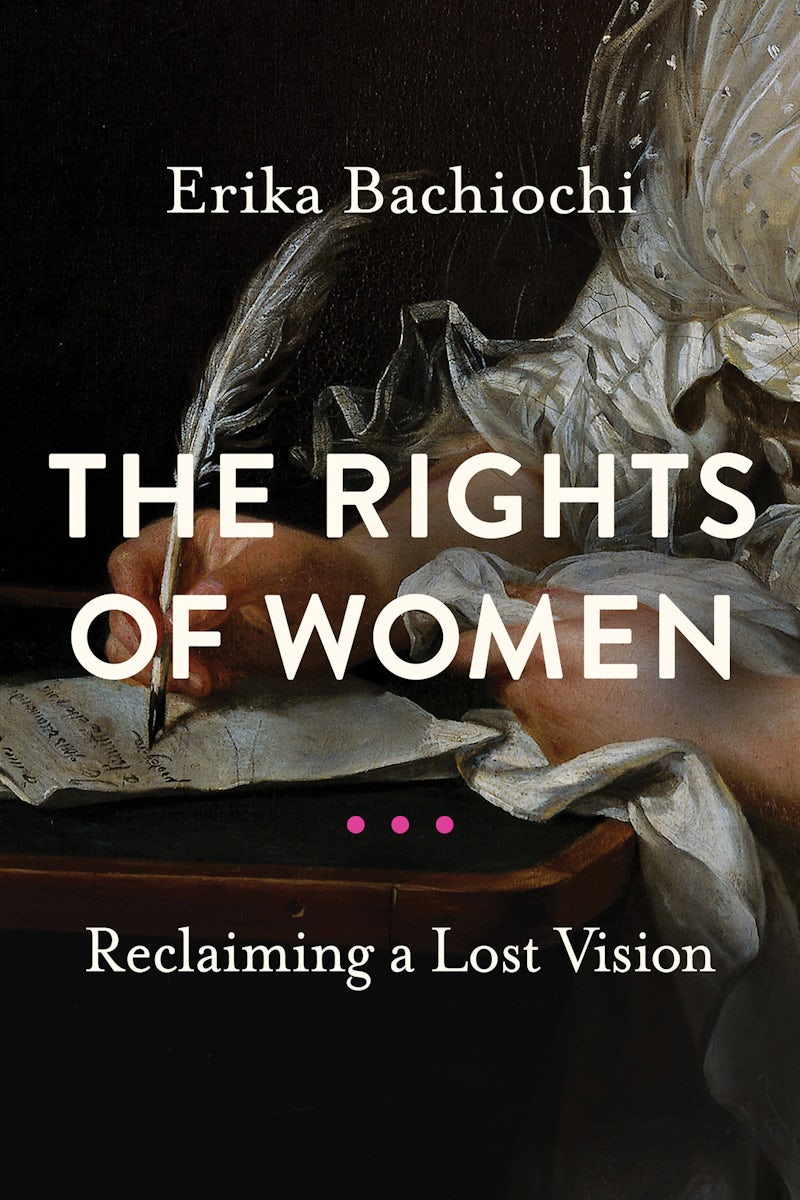
Bachiochi, "The Rights of Women: Reclaiming a Lost Vision"

Notre Dame Press has published The Rights of Women: Reclaiming a Lost Vision, by Erika Bachiochi (Ethics and Public Policy Center / Abigail Adams Institute). A description from the Press:

In The Rights of Women, Erika Bachiochi explores the development of feminist thought in the United States. Inspired by the writings of Mary Wollstonecraft, Bachiochi presents the intellectual history of a lost vision of women’s rights, seamlessly weaving philosophical insight, biographical portraits, and constitutional law to showcase the once predominant view that our rights properly rest upon our concrete responsibilities to God, self, family, and community.

Bachiochi proposes a philosophical and legal framework for rights that builds on the communitarian tradition of feminist thought as seen in the work of Elizabeth Fox-Genovese and Jean Bethke Elshtain. Drawing on the insight of prominent figures such as Sarah Grimké, Frances Willard, Florence Kelley, Betty Friedan, Pauli Murray, Ruth Bader Ginsburg, and Mary Ann Glendon, this book is unique in its treatment of the moral roots of women’s rights in America and its critique of the movement’s current trajectory. The Rights of Women provides a synthesis of ancient wisdom and modern political insight that locates the family’s vital work at the very center of personal and political self-government. Bachiochi demonstrates that when rights are properly understood as a civil and political apparatus born of the natural duties we owe to one another, they make more visible our personal responsibilities and more viable our common life together.

This smart and sophisticated application of Wollstonecraft’s thought will serve as a guide for how we might better value the culturally essential work of the home and thereby promote authentic personal and political freedom. The Rights of Women will interest students and scholars of political theory, gender and women’s studies, constitutional law, and all readers interested in women’s rights.

Advance praise:

"Bachiochi adds an important new voice to the conversation criticizing the nation’s turn to revering market profit and the freedom to be left alone above all else. Feminists may not agree with all of her critique of contemporary feminism, but they would do well to engage with her powerful argument that conceptualizing the movement’s goal as sex equality in the workplace is too narrow." —Maxine Eichner

“Rights cannot flourish alone. They need to be embedded in a thicker moral context that gives voice to the goods that they should serve, the social duties that govern their exercise, and the virtues that enable respect for them. In this book, Erika Bachiochi recovers a tradition of thought about women’s rights that fully recognizes this and, with Mary Wollstonecraft at one end and Mary Ann Glendon at the other, offers an important, salutary correction, not only to libertarian feminism in particular but also to contemporary rights-talk in general.” —Nigel Biggar,

More information is available here. You can listen to an interview with the author here, at New Books Network.

-- Karen Tani

Sunday, November 1, 2020

LHR 38:3

Now available online is Law and History Review 38:3 (August 2020):

Introduction: Rebecca Scott's History of Public Rights
Amy Chazkel

Discerning a Dignitary Offense: The Concept of Equal “Public Rights” during Reconstruction
Rebecca J. Scott

The Right to Come and Go
Miranda Spieler

Response to Rebecca Scott's “Discerning a Dignitary Offense”
Laura F. Edwards

“I Could Not Come in Unless over their Dead Bodies”: Dignitary Offenses
Thavolia Glymph

Rights, Dignity, and Public Accommodations
Christopher W. Schmidt

Public Rights
Joseph William Singer

--Dan Ernst

Monday, September 21, 2020

Robinson, Mäkinen, Slotte, & Haara, eds., "Rights at the Margins: Historical, Legal and Philosophical Perspectives"

Earlier this year, Brill released Rights at the Margins: Historical, Legal and Philosophical Perspectives, edited by Jonathan Robinson (independent scholar), Virpi Mäkinen (University of Helsinki), Pamela Slotte (Åbo Akademi University), and Heikki Haara (University of Helsinki). A description from the Press:

The essays in this volume explore the ways rights were available to those in the margins of society. By tracing pivotal judicial concepts such as 'right of necessity' and 'subjective rights' back to their medieval versions, and by situating them in unexpected contexts such as the Franciscans' theory of poverty and colonization or today's immigration and border control, this volume invites its readers to consider whether individual rights were in fact, or at least in theory, available to the marginalized. By focusing not only on the economically impoverished but also those who were disenfranchised because of disability, gender, race, religion or infidelity, this book also sheds light on the relationship between the early history of individual rights and social justice at the margins.
Contributors: Wim Decock, Heikki Haara, Virpi Mäkinen, Alejandra Mancilla, Julia McClure, Ilse Paakkinen, Mikko Posti, Jonathan Robinson, John Salter, Pamela Slotte, and Jussi Varkemaa. 

More information, including the TOC, is available here

H/t New Books in Law.

-- Karen Tani

Saturday, March 21, 2020

Weekend Roundup

  • Reuven S. Avi-Yonah, University of Michigan Law School, has posted Why Study Tax History?, a review of volume 9 of Studies in the History of Tax Law, ed. P. Harris and D. de Cogan (Hart, 2019). 
  • Mary Dudziak recently tweeted out a link to the panel she moderated at SHAFR on in 2017 on War, Law, and Restraint, with Rosa Brooks, Jack Goldsmith, Helen Kinsella and John Fabian Witt.
Weekend Roundup is a weekly feature compiled by all the Legal History bloggers. 

Saturday, March 14, 2020

Weekend Roundup

  • The Organization of American Historians has cancelled its annual meeting. But you can still skim the excellent program that the organizers put together. Margot Canaday (Princeton University) and Craig Steven Wilder (MIT) co-chaired the program committee. AND, if you were scheduled to present, check out this invitation (via Twitter) from The Docket (the online companion to the Law & History Review): "We’re sad about all that awesome #legalhistory scholarship that was going to be at #OAH20 and we’d like to be of service. The Docket will publish abstracts, full papers, etc. for any law, policy, or politics related OAH panel!" 
  • For those who have moved to online teaching, Twitter is filled with good resources right now. For example, Aimi Hamraie (Vanderbilt University) tweeted out an excellent guide to "accessible teaching in the time of COVID-19," tapping into some hard-won wisdom from "disabled culture and community." 
  • The Library of Congress may be closed to the public, but we believe its “crowdsourcing initiative By the People” continues.  The newest campaign to enlist the public’s help in making "digital collection items more searchable and accessible online is Herencia: Centuries of Spanish Legal Documents includes thousands of pages of historical documents in Spanish, Latin and Catalan."
  • ICYMI: An exhibit at the Lombard Historical Society on “the first woman to ever vote in an Illinois municipal election, an attorney named Ellen Martin.”  Patti Smith’s blurb of Ralph Nader’s cookbook: “A wonderful blend of consumer protection and consumer pleasure.” H/t: JLG
  • And if you can face it: Duke University Press has put together this Navigating the Threat of Pandemics collection--free to read online until June 1 (books) and Oct.1 (articles). LHB readers may appreciate this one especially.
Weekend Roundup is a weekly feature compiled by all the Legal History bloggers. 

Thursday, December 26, 2019

Meisel, "A History of the Law of Assisted Dying in the United States"

Alan Meisel (University of Pittsburgh) has posted "A History of the Law of Assisted Dying in the United States." which is forthcoming in the Southern Methodist University Law Review (2020). The abstract:
The slow growth in the number of states that have enacted legislation to permit what is often referred to as “death with dignity” legislation—and more frequently referred to popularly as “physician assisted suicide” laws—has begun to accelerate in the past few years since the enactment of the first such statute in Oregon in 1994.

Like much other social reform legislation, there is a long history behind it. In this case, the history in the United States dates back at least to the latter part of the nineteenth century. Not until the 1980s, however, did these efforts gain any traction in courts and legislatures. What is probably more responsible than anything else for reviving interest in and providing momentum for legalization is the recognition by state courts, beginning with the Karen Ann Quinlan case in New Jersey in 1975, that the right to be free from unwanted interference with one’s bodily integrity encompasses a right to refuse even life-sustaining medical treatment. The recognition of this so-called right to die was only a short conceptual step—though a long political one—from recognizing that competent adults also should have the right to actively end their lives under certain conditions.

As of the end of 2019, the efforts of a small number of advocacy groups through lobbying, litigation, and public education have resulted in the enactment of death with dignity legislation in nine states and recognition of the right by one state supreme court. Despite dire warnings from opponents of legalization, it has not resulted in either wholesale abuse of the dying or the legalization of active euthanasia (either voluntary or involuntary). 
Read on here. (h/t: Legal Theory Blog)

-- Karen Tani

Tuesday, October 8, 2019

Tunnicliffe on Canada and the International Bill of Rights

Jennifer Tunnicliffe (University of Waterloo) has published Resisting Rights: Canada and the International Bill of Rights, 1947-76 in UBC Press' Law and Society series. From the publisher:
Resisting Rights
From 1948 to 1966, the United Nations worked to create an international bill of rights that would provide a common standard for human rights protection around the globe. Canadians celebrate their country’s central role in this endeavour every Human Rights Day. Yet a detailed study of government policies toward these early UN documents tells a different story.
Resisting Rights analyzes the Canadian government’s initial opposition to the development of international human rights law, exploring how and why this position changed from the 1940s to the 1970s. Jennifer Tunnicliffe takes both international and domestic developments into account to explain how shifting cultural understandings of rights influenced policy, and to underline the key role of Canadian rights activists in this process.
In light of the erosion of Canada’s traditional reputation as a leader in developing human rights standards at the United Nations, this is a timely study. Tunnicliffe situates current policies within their historical context to reveal that Canadian reluctance to be bound by international human rights law is not a recent trend, and asks why governments have found it important to foster the myth that Canada has been at the forefront of international human rights policy since its inception.
Resisting Rights will appeal to students and scholars of the development of domestic and international human rights, and more generally of Canadian history, politics, diplomacy, and foreign policy, particularly at the United Nations. It will also find an audience among individuals or organizations interested in Canada’s human rights history.
Praise for the book:

"A blow-by-blow account spanning nearly thirty years, Resisting Rights provides a detailed history of the Canadian state’s transformation from an initial opponent of universal human rights in the late 1940s to one of its leading proponents by the mid-1970s, a journey made possible only by the persistence and tenacity of Canadian human rights activists. A welcome addition to the growing body of scholarship on the history of human rights in Canada." - Andrew S. Thompson

Further information is available here.

Wednesday, May 22, 2019

MacMillan and Smith, eds., "Challenges to Authority and the Recognition of Rights"

Here's an interesting collection that we missed when it came out last summer: Challenges to Authority and the Recognition of Rights: From Magna Carta to Modernity (Cambridge University Press), edited by Catharine MacMillan (King's College London) and Charlotte Smith (University of Reading). A description from the Press:
While challenges to authority are generally perceived as destructive to legal order, this original collection of essays, with Magna Carta at its heart, questions this assumption. In a series of chapters concerned with different forms of challenges to legal authority - over time, geographical place, and subject matters both public and private - this volume demonstrates that challenges to authority which seek the recognition of rights actually change the existing legal order rather than destroying it. The chapters further explore how the myth of Magna Carta emerged and its role in the pre-modern world; how challenges to authority formed the basis of the recognition of rights in particular areas within England; and how challenges to authority resulted in the recognition of particular rights in the United States, Canada, Australia and Germany. This is a uniquely insightful thematic collection which proposes a new view into the processes of legal change.
More information, including the TOC, is available here.

-- Karen Tani

Friday, May 10, 2019

Murray, Shaw, & Seigel, eds., "Reproductive Rights and Justice Stories"

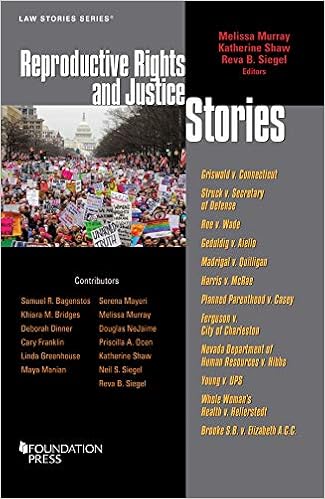
New from Foundation Press, in the "Law Stories" Series, Reproductive Rights and Justice Stories, edited by Melissa Murray (NYU Law), Katherine Shaw (Benjamin N. Cardozo School of Law), and Reva B. Siegel (Yale Law School). A description from the Press:
This book tells the movement and litigation stories behind important reproductive rights and justice cases. The twelve chapters span topics including contraception, abortion, pregnancy, and assisted reproductive technologies, telling the stories of these cases using a wide-lens perspective that illuminates the complex ways law is debated and forged―in social movements, in representative government, and in courts. Some of the chapters shed new light on cases that are very much part of the constitutional law canon―Griswold v. Connecticut, Roe v. Wade, Planned Parenthood v. Casey, Nevada Department of Human Resources v. Hibbs. Others introduce the reader to new cases from state and lower federal courts that illuminate paths not taken in the law. 
Reading the cases together highlights the lived horizon in which individuals have encountered and struggled with questions of reproductive rights and justice at different eras in our nation’s history―and so reveals the many faces of law and legal change. The volume is being published at a critical and perhaps pivotal moment for this area of law. The changing composition of the Supreme Court, increased executive and legislative action, and shifting political interests have all pushed issues of reproductive rights and justice to the forefront of contemporary discourse. The volume is suited to a wide range of law school courses, including constitutional law, family law, employment law, and reproductive rights and justice; it could also be assigned in undergraduate or graduate courses on history, gender studies, and reproductive rights and justice.
All of the editors have contributed solo- or co-authored essays. The other contributors are: Samuel R. Bagenstos (University of Michigan Law); Khiara M. Bridges (Boston University School of Law); Deborah Dinner (Emory Law); Cary Franklin (University of Texas at Austin School of Law); Linda Greenhouse (New York Times/Yale Law School); Maya Manian (University of San Francisco School of Law); Serena Mayeri (University of Pennsylvania School of Law); Douglas NeJaime (Yale Law School); Priscilla A. Ocen (Loyola Law School, Los Angeles); Neil S. Siegel (Duke Law).

It looks like some of the essays are available on SSRN. For example, here is Reva Siegel and Linda Greenhouse's chapter on "The Unfinished Story of Roe v. Wade."

Saturday, April 20, 2019

A Better Book: Trust Oneself, then Know Oneself


A week ago I had the pleasure of being on a panel focused on my recent book, Almost Citizens. Sophia Lee asked me a question that zeroed in on one of the book’s core claims: ambiguity often acts as a tool and pathway for legal and political actors seeking to alter constitutional meaning. Sophia’s question also cast into relief the topic of this post: the need both to trust one’s instincts and to interrogate them.

Sophia’s question ran along these lines:
Almost Citizens unfolds in two parts.  The first concerns Federico Degetau, a legal idealist. He believed that the Supreme Court would, if squarely presented with the issue, adhere to settled constitutional understandings and judge Puerto Ricans to be rights-rich U.S. citizens of a future state. That never happened. The book’s second half focuses on Puerto Ricans who use politics to gain rights.  They have more success.  Yet the book is sympathetic to Degetau. The afterword pines for a revival of older constitutional understandings.  So which is it: Is law or politics dominant? Was Degetau savvy or naïve?
I was really happy to get the question.  Sophia had identified the tension between my faith in the autonomy of law and my comprehension that law had no existence apart from the broader world. At a general level, these were strands in legal history that another of last week’s panelists, Bob Gordon, had influentially spelled out 35 years ago. This post concerns how that tension mapped onto my own intuitions and research trajectory.

I was a 1L in law school and had yet to start my doctoral program in American Culture when I first encountered the Insular Cases (1901-1905).  It was thus very much as a lawyer (in the making) that I read these cases remaking the constitutional law of U.S. empire. I was struck by the absence of unequivocally binding doctrine to be found in them. Contrast many historians, who were more likely to notice the justices’ racial rhetoric, their dicta sympathetic to empire, and their failure to rein in colonialism.

My initial interpretation of events ran along formalist lines.  By trusting that I was analyzing the cases correctly, I could distinguish myself from a host of prior work. I argued that other scholars over-read the early Insular Cases. Downes v. Bidwell (1901) had no majority opinion. It thus could not have invented as binding doctrine the proposition that Puerto Rico was unincorporated, hence neither destined for statehood nor entitled to non-fundamental constitutional rights.  Gonzales v. Williams (1904) expressly declined to decide whether Puerto Ricans were U.S. citizens, so it did not hold that they were noncitizen nationals.  A justice firmly opposed to the doctrine of territorial nonincorporation joined the majority opinion in Dorr v. United States (1904), so it made little sense to identify that decision as establishing the doctrine as binding law.  Nor was Rasmussen v. United States (1905) a promising candidate. Its author, Justice Edward White, sought to influence how the Supreme Court reporter depicted the decision because he worried that the decision would not settle the question.

But as I moved from dissertation more firmly to book, I gained insight into my predilections.  I was overinvested in Puerto Rico’s first elected representative to Washington, the brilliant lawyer Federico Degetau y González.  As Sophia observed, Degetau shared my soft spot for legal formalism. He knew that citizenship, full constitutional rights, and eventual statehood were the constitutional consequences of annexation under the settled late-nineteenth-century constitutional understandings that I term the Reconstruction Constitution. He saw that new precedents had not overturned the prior case law.  And he expected law to tame politics if courts were provided the proper opportunity. He was wrong.

The more that I researched, the clearer it became that everyone around Degetau saw his legal quest as quixotic.  He left office politically isolated. He made little progress toward citizenship, full constitutional rights, or eventual statehood.  The Court was not opposed to empire and would not confront and overawe politics. The justices were caught between competing impulses: adhere to settled constitutional understandings and avoid dooming the U.S. imperial experiment.

By gaining perspective on Degetau (and myself), I was able to reinterpret the Court’s fractured, evasive decisions.  The justices were not silent on empire; they had not simply left prior constitutional doctrine in place.  The Court was productively ambiguous (for more on legal ambiguity as the handmaiden of empire, see Katrina Quisumbing King’s excellent dissertation-now-book-project). To reconcile the Constitution and empire, it cooperated with nonjudicial actors in a slow, creative process characterized by judicial vagueness.  This became a key claim of the book. Constitutional revolutions are not always marked by landmark cases.  Sometimes they are hidden behind fractured decisions, underdefined terms, narrow holdings, suggestive dicta, and the legal innovations and on-the-ground decisions of bureaucrats, lawmakers, and presidents.

That leads to my answer to Sophia’s questions.  Law never dominated politics. But during the late nineteenth century, the Reconstruction Constitution did slow down imperialistic projects.  As a result, I think there’s value to pursuing a politics dedicated to lodging key commitments in constitutional law.  On that front, we could do worse than to resurrect aspects of the Reconstruction Constitution.  As to Degetau, he was both savvy and naïve.  He was a genius at ginning up citizenship disputes all across the federal government.  But he was overoptimistic in his assessment of the promise of a purely legal strategy.  In making that mistake, he resembles me. I frequently find myself disappointed that courts do not more fully vindicate their professed precedential commitments.  Had I been an elite advocate for Puerto Rico in the early twentieth century, I might have backed Degetau. The value of taking years to write the book decades after the events it depicted were over is that I was able to convey both the attractions and the perils of my and Degetau’s mistaken premise.


--Sam Erman

Tuesday, April 2, 2019

Schneider on the Tanana Chiefs Conference

Out in 2018 with the University of Alaska Press (distributed by the University of Chicago Press) was The Tanana Chiefs: Native Rights and Western Law, edited by William Schneider. From the publisher:
The Tanana ChiefsAt the turn of the twentieth century, life was changing drastically in Alaska. The gold rush brought an onslaught of white settlers to the area, railroad companies were pushing into the territory, and telegraph lines opened up new lines of communication. The Native groups who had hunted and fished on the land for more than a century realized that if they did not speak up now, they would lose their land forever. 
This is the story of a historic meeting between Native Athabascan leaders and government officials, held in Fairbanks, Alaska in 1915. It was one of the first times that Native voices were part of the official record. They sought education and medical assistance, and they wanted to know what they could expect from the federal government. They hoped for a balance between preserving their way of life with seeking new opportunities under the law. 
The Tanana Chiefs chronicles the efforts by Alaska Natives to gain recognition for rights under Western law and the struggles to negotiate government-to-government relationships with the federal government. It contains the first full transcript of the historic meeting as well as essays that connect that first gathering with the continued efforts of the Tanana Chiefs Conference, which continues to meet and fight for Native rights.
Praise for the book includes:

 “William Schneider, Alaska’s premier oral historian, whose dedication to the preservation of Alaska and Alaska Native culture is widely known and highly respected, makes a significant contribution with this volume on the Tanana Chiefs conference in Fairbanks in the summer of 1915.” -Alaska History

Further information is available here.

Monday, December 24, 2018

Greene and Tew on Comparative Constitutional History

Jamal Greene, Columbia University Law School, and Yvonne Tew, Georgetown University Law Center, have posted Comparative Approaches to Constitutional History, which appears in Comparative Judicial Review (2018):  379-402:
An historical approach to constitutional interpretation draws upon original intentions or understandings of the meaning or application of a constitutional provision. Comparing the ways in which courts in different jurisdictions use history is a complex exercise. In recent years, academic and judicial discussion of “originalism” has obscured both the global prevalence of resorting to historical materials as an interpretive resource and the impressive diversity of approaches courts may take to deploying those materials. This chapter seeks, in Section B, to develop a basic taxonomy of historical approaches. Section C explores in greater depth the practices of eight jurisdictions with constitutional courts or apex courts that engage in constitutional review: those of the United States, Canada, Germany, Australia, India, Hong Kong, Malaysia, and Singapore.

Because our selection of cases aims to be illustrative rather than exhaustive, we do not attempt to draw firm conclusions about the global use of constitutional history. Still, the qualitative evidence that follows hints at what might well be universal within constitutional judging: (1) the significance of history broadly understood, and (2) the limits on history’s reach into contemporary rights conflicts.