Showing posts with label Feminism. Show all posts

Friday, July 3, 2026

Bayefsky on Tradition and Feminism in Constitutional Adjudication

Rachel Bayefsky, UVA Law, has published Tradition and Feminism in Constitutional Rights Adjudication in the Virginia Law Review:

In recent years, “tradition” has been influentially invoked in constitutional rights adjudication and legal scholarship. The Supreme Court, in contexts ranging from abortion to the Second Amendment to freedom of speech, has looked to tradition to illuminate the contours of constitutional rights and the boundaries of permissible government regulation. Some legal theorists have defended “traditionalism” as a way to tether constitutional rulings to the people’s customs instead of judges’ moral views.

From a feminist perspective, the rise of tradition may be cause for concern, if not alarm. Why integrate into constitutional rights adjudication the practices and understandings of eras in which women were subject to severe political, economic, and social subordination? Yet the relationship between feminism and traditionalism depends on the form that traditionalism takes: what it is, how it is justified, and how it responds to moral critique.

This Article unpacks the idea of tradition, and it investigates the interaction between tradition and women’s rights in constitutional law. I argue that a concern for tradition, properly understood, contains resources to guide an approach toward constitutional adjudication that can be conducive to, rather than hostile to, women’s rights. For example, traditionalists often seek to glean insight from concrete experience rather than relying on abstract principles; they should therefore examine a range of experiences, including those of women. And the traditionalist interest in continuity supports acceptance of the last century’s advancements in women’s rights rather than attempts to “roll back the clock.”

Thus, values integral to traditionalism can support positions favorable to women’s rights. I apply this view of tradition to several constitutional questions, including the right to contraception, the permissibility of public single-sex education, pregnancy discrimination, and the scope of the Equal Protection Clause. I also engage in broader reflection about the determinacy of traditionalist analysis and the relationship between traditionalist reasoning and moral evaluation.

--Dan Ernst 

Saturday, April 11, 2026

Weekend Roundup

  • The California Law Review's podcast has posted an episode on Michael Banerjee's "What Harvard’s Lawsuit Should Have Said" (published in the journal's online companion in August 2025).
  • Congratulations to Kunal Parker, Miami Law, on his selection as Beatrice Webb Visiting Professor at the London School of Economics! 
  • And congratulations to Edward J. Balleisen, the new Provost of George Washington University! (GW Today)
  • Nathan Dorn on Lodovico Carerio: Heresy, Lawbooks, and the Inquisition in the Kingdom of Naples (In Custodia Legis).   
  • "The 1874 Arkansas Constitution and records from the convention that produced it are now available online through a collaboration between the University of Arkansas Libraries and the Quill Project at the University of Oxford" (Arkansas News
  • Lawbook Exchange's April catalogue of Scholarly Law and Legal History.     
  • The National Constitution Center has announced the opening on May 15 of "Governing the Nation, a new permanent gallery exploring the Constitution’s system of separated powers."  Its development was guided by "a distinguished scholarly advisory board representing leading universities and research institutions, ensuring a rigorous and balanced exploration of the separation of powers and federalism," including H. W. Brands, Cristina Rodríguez, Yuval Levin, Michael Klarman, Gail Heriot, and Ilan Wurman.
  • Deborah Rosen reviews Andrew Fede's A Degraded Caste of Society in the Journal of Southern History.
  • That E.O. on the PRA:  The American Historical Association and American Oversight file suit (CBS News).  The Trump Administration Is Trying to Erase Its Own History (Atlantic Daily).  Joyce Vance with the court filing (Civil Discourse).  The AHA's notice of the lawsuit.
  • More on Birthright CitizenshipSteve Vladeck, Georgetown Law, on the "pitched battle within the legal academy over the fairly transparent efforts of a small cohort of right-wing law professors to provide a fig leaf of historical support for the Trump administration’s legally and morally odious position in the birthright citizenship case" (One First). Philip Hamburger, Columbia Law, on Allegiance, Birthright, and Citizenship (Law & Liberty).  For a brief time only, you may read, open access, the introduction to Anna O. Law's Migration and the Origins of American Citizenship, here.

Weekend Roundup is a weekly feature compiled by all the Legal History bloggers. 

Saturday, March 7, 2026

Weekend Roundup

  • "Read an exciting article on the legal history of Britain or the British empire published in 2025? Consider nominating the article to the ASLH Sutherland Prize for 'the best article on the legal history of Britain and/or the British Empire published in the previous year.' Self-nominations are also accepted. The deadline is June 1" (H-Law).
  • ICYMI: Keith Whittington on the Historic Case for Birthright Citizenship (Dispatch). Hettie V. Williams on Black Women and the Brown Decision (Black Perspectives).  The California Judicial Center Library celebrates the "impactful women" of the state's legal history (EIN Presswire).  Julie Suk on the Declaration of Independence at 250 (Fordham Law News).  On that reunion of the descendants of the litigants in Plessy v. Ferguson (Tulane Law).  Rachel F. Seidman on Women Who Changed the Laws Shaping Economic Independence (Smithsonian). The Unique Protections of the Pennsylvania Constitution (JDSupra).

Weekend Roundup is a weekly feature compiled by all the Legal History bloggers.

Monday, November 10, 2025

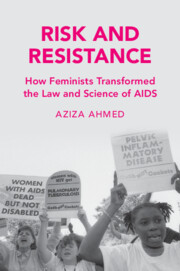
Ahmed, "Risk and Resistance: How Feminists Transformed the Law and Science of AIDS"

Cambridge University Press has published Risk and Resistance: How Feminists Transformed the Law and Science of AIDS, by Aziza Ahmed (Boston University School of Law). A description from the Press:

How did women come to be seen as 'at-risk' for HIV? In the early years of the AIDS crisis, scientific and public health experts questioned whether women were likely to contract HIV in significant numbers and rolled out a response that effectively excluded women. Against a linear narrative of scientific discovery and progress, Risk and Resistance shows that it was the work of feminist lawyers and activists who altered the legal and public health response to the AIDS epidemic. Feminist AIDS activists and their allies took to the streets, legislatures, administrative agencies, and courts to demand the recognition of women in the HIV response. Risk and Resistance recovers a key story in feminist legal history – one of strategy, struggle, and competing feminist visions for a just and healthy society. It offers a clear and compelling vision of how social movements have the capacity to transform science in the service of legal change. 

Praise from reviewers:

"Risk and Resistance: How Feminists Transformed the Law and Science of AIDS is a moving and meticulous study about the grass-roots activists who made visible women’s plight during a time when AIDS treatment and funding were entirely focused on men. The initial definition of AIDS as ‘a gay men’s disease’ led to long-term distributional injustices: the exclusion of women from clinical trials, from disability benefits, and even from being counted in the statistics of its devastation. Aziza Ahmed has crafted a magnificent genealogy of specific organizational strategies that linked individual women into powerful communities of patients, medical researchers, service providers, and litigators. Their advocacy reframed not merely responses to the AIDS crisis but to all subsequent epidemics including COVID. This book is the chronicle of hard-fought interventions that redirected the course of legal and medical history and that transformed social outcomes to the betterment of all." -- Patricia Williams 

"Risk and Resistance is a tour de force. It is the book that was missing from the catalogue about HIV/AIDS and the catastrophic health, legal, and political crises in its wake. In beautiful prose and rich story-telling, Aziza Ahmed corrects the historical record, rewriting women and crucial, feminist activism into the folds of a devastating era in global history. With this book, Professor Ahmed has penned a pathbreaking contribution to law and feminist theory." -- Michele Bratcher Goodwin

More information is available here.

-- Karen Tani  

Monday, March 31, 2025

Lupu Remembers Steinem at the HLR Banquet

Ira C. Lupu, George Washington University Law School, has posted Gloria Steinem at the Harvard Law Review Banquet, which appeared in the Green Bag:

In the Spring of 1971, Gloria Steinem became the first woman to be the keynote speaker at the prestigious annual banquet of the Harvard Law Review. At that time, as an editor of the Review, I played an instigating part in the process that led to this controversial invitation. I attended the Banquet, and I paid close attention to the speech and its aftermath. In 1998, I decided to memorialize that experience in this essay, which frames the event in its cultural and political context – the rise of feminism, the Vietnam War, and American student radicalism, among other phenomena. In her book My Life on the Road (2015), Ms. Steinem draws explicitly from details in the essay in describing her experience at the Banquet.
--Dan Ernst

Monday, November 25, 2024

JSCH 49:3

Journal of Supreme Court History 49:3 has been published:

"Judge" Eugene Brooks: Supreme Court Messenger, Proponent of Black Awareness, 1881-1926
Terence Walz

"The ct is disposed to consider the merits…Wow!": Anthony Lewis Takes Us Inside the Oral Arguments in NAACP v. Alabama ex rel. Flowers (1964)
Helen J. Knowles-Gardner

An End to Rebel "Punishment": The Test Oath Cases and the Constitutional Politics of Confederate Disqualification
M. Henry Ishitani

"Our Leading Feminist": Dorothy Kenyon and the Origins of Equal Protection for Women in Hoyt v. Florida
Isabel Miller

The Judicial Bookshelf
(reviews of Michael Nelson: Vaulting Ambition: FDR's Campaign to Pack the Court, and Greg Zipes, Justice and Faith, The Frank Murphy Story.
Donald Grier Stephenson, Jr.

--Dan Ernst

Saturday, April 13, 2024

Weekend Roundup

  • A report on the chair lecture of Harvard Law School professor Elizabeth P. Kamali, "on the development of 13th century English felony law through the lens of historical artifacts" (Harvard Crimson).
  • The latest podcast in the series of Historical Society of the New York Courts on articles published in Judicial Notice is with John Q. Barrett and Henry “Hank” M. Greenberg on Benjamin N. Cardozo.  “Together, they explore lesser-known stories of Cardozo’s life, emphasizing his sense of humor and his writing style.” 
  • An interview with Annette Gordon-Reed on on Book Banning, Originalism, and "Hamilton" (FM).
  • The ABA Commission on Women has conferred its Margaret Brent Prize on Dolores Atencio, visiting scholar at the University of Denver Latinx Center in the Sturm College of Law, who “created the national legal history project Luminarias de la Ley/Luminaries of the Law™ to identify and chronicle the accomplishments of Latina lawyers.”
  • The New York State Library in Albany will host a webinar, on The Sewing Girl's Tale: A Story of Crime and Consequences in Revolutionary America (Holt, 2022), with the author John Wood Sweet, on Wednesday, April 24, 2024 from noon until 1 pm (New York Almanack).
  • We were interested to learn recently of the archives of the Feminist Legal Theory Project at Emory University.  A presentation by visiting scholar Samuel S. Burry, on the value of the archive for his research is here.
  • We were impressed by a thread illustrating how GPT-4 could be used to modernize a page of an Admiralty Court deposition from 1635 @Marinelives.org
  • In May 2025, the McNeil Center for Early American Studies at the University of Pennsylvania will convene a conference on the theme Where is Early America? The call for papers is available here. 
  • ICYMI: Andrew Silow-Carroll on how a 100-year-old law changed American immigration policy to this day (JTA).  Joan Biskupic went into Justice O’Connor's papers and came out with some documents on the writing of Chevron (CNN).  The truth about the Comstock Act (American Prospect).  That 1864 Arizona abortion law, via the AZ Mirror, NPR, WaPo, and the NYT.  A student on that digital habeas corpus project at the University of Nebraska.  An appreciation of Kellis E. Parker, the first Black professor at Columbia Law School (CLS).

 Weekend Roundup is a weekly feature compiled by all the Legal History bloggers.

Saturday, July 30, 2022

Weekend Roundup

  • The journal Federal History seeks “an assistant editor for a Law and Constitution roundtable. . . .  The editor will develop and edit this annual panel in conjunction with the journal editor.  This is a volunteer position and requires minimal time.  Must have a background in U.S. legal and constitutional history." For more information or to apply, send a letter of interest and cv to  Benjamin Guterman, Editor, Federal History, at federalhistory@gmail.com. H/t: H-FedHist/JLG.
  • Martha Allbertson Fineman, Emory Law, seeks a repository for the records of the Feminism and Legal Theory Project.  (Ms.) 
  • A new entry is up in the HLS series, “Cases in Brief”: Carol Steiker discusses Furman v. Georgia, "a 1972 landmark Supreme Court decision that declared the death penalty unconstitutional under the Eighth Amendment."
  • On September 21, 2022 , at 12:00 p.m, EDT, in honor of Constitution Day, the Supreme Court Historical Society will, via Zoom, screen its newest documentary, on Marbury v. Madison, and host a discussion with the Society’s Clare Cushman and Donald B. Ayer, Chair of the Publications Committee. Register.
  • The Board of Directors of the University of California Hastings College of the Law has voted to drop “Hastings” from its name and proceed as the University of California College of the Law, San Francisco (Reuters).
  • Historical Review, "a publication of the Florida Supreme Court Historical Society, features articles celebrating the 50th anniversary of the Florida Office of the State Courts Administrator"(Florida Bar News).
  • Federal judges attended the Originalism Summer Seminar, which we assume was sponsored by the Georgetown Center for the Constitution  (Joseph Mark Stern).
  • Congratulations to Aditya Bamzai, UVA Law, upon his election to the American Law Institute.
  • ICYMI: Mary Ziegler on the Disappearance of the "Life of the Mother" exemption (Atlantic).  Brad Snyder on why the Warren Court largely bears the for the current Supreme court’s  unfounded assertions of judicial supremacy (Politico). Steven Lubet on the Supreme Court’s selective history (The Hill)Allison Orr Larsen on the Court's use of history in Dobbs and Bruen (Politico).  A tipping point for professors and the collective good of peer review? (Slate).

Weekend Roundup is a weekly feature compiled by all the Legal History blogger.

Tuesday, June 21, 2022

Berger and Scherpa on Mohegan Women and the Mohegan Church

Bethany Berger, University of Connecticut School of Law, and Chloe Scherpa, have posted Mohegan Women, the Mohegan Church, and the Lasting of the Mohegan Nation:

On a hill at the end of Church Lane in rural Uncasville, Connecticut, stands the Mohegan Congregational Church. To someone unfamiliar with its history, the church might represent Mohegan acculturation, a triumph of missionaries in breaking an Indigenous people from their “heathen” ways. But the church is part of a long history of Mohegan transformation of non-Indian ways to preserve their land and community in the face of colonialism. While most of these efforts won only temporary success, the church remained as a center of the tribe, paving the way for tribal recognition and reestablishment of the Mohegan Reservation in the late twentieth century. And women were always the center of this history, recovering and making visible women’s traditional importance in Mohegan politics and culture. This Article tells this story, along with the story of the missionary woman whose work with the Mohegans allowed her to resist prescribed roles for early-nineteenth-century White women.

Sherpa, who now is in house at the Travelers Indemnity Company, worked on this topic as a student in Professor Berger’s Race and Property in U.S. History class

--Dan Ernst

Friday, April 1, 2022

Monopoli on Feminist Legal History and Legal Pedagogy

Paula A. Monopoli, University of Maryland Francis King Carey School of Law, has posted Feminist Legal History and Legal Pedagogy, which also appears at 108 Virginia Law Review Online 91 (2022):

Women are mere trace elements in the traditional law school curriculum. They exist only on the margins of the canonical cases. Built on masculine norms, traditional modes of legal pedagogy involve appellate cases that overwhelmingly involve men as judges and advocates. The resulting silence signals that women are not makers of law—especially constitutional law. Teaching students critical modes of analysis like feminist legal theory and critical race feminism matters. But unmoored from feminist legal history, such critical theory is incomplete and far less persuasive. This Essay focuses on feminist legal history as foundational if students are to understand the implications of feminist legal theory. It offers several examples to illustrate how centering women and correcting their erasure from our constitutional memory is essential to educating future judges and advocates.
–Dan Ernst

Thursday, October 21, 2021

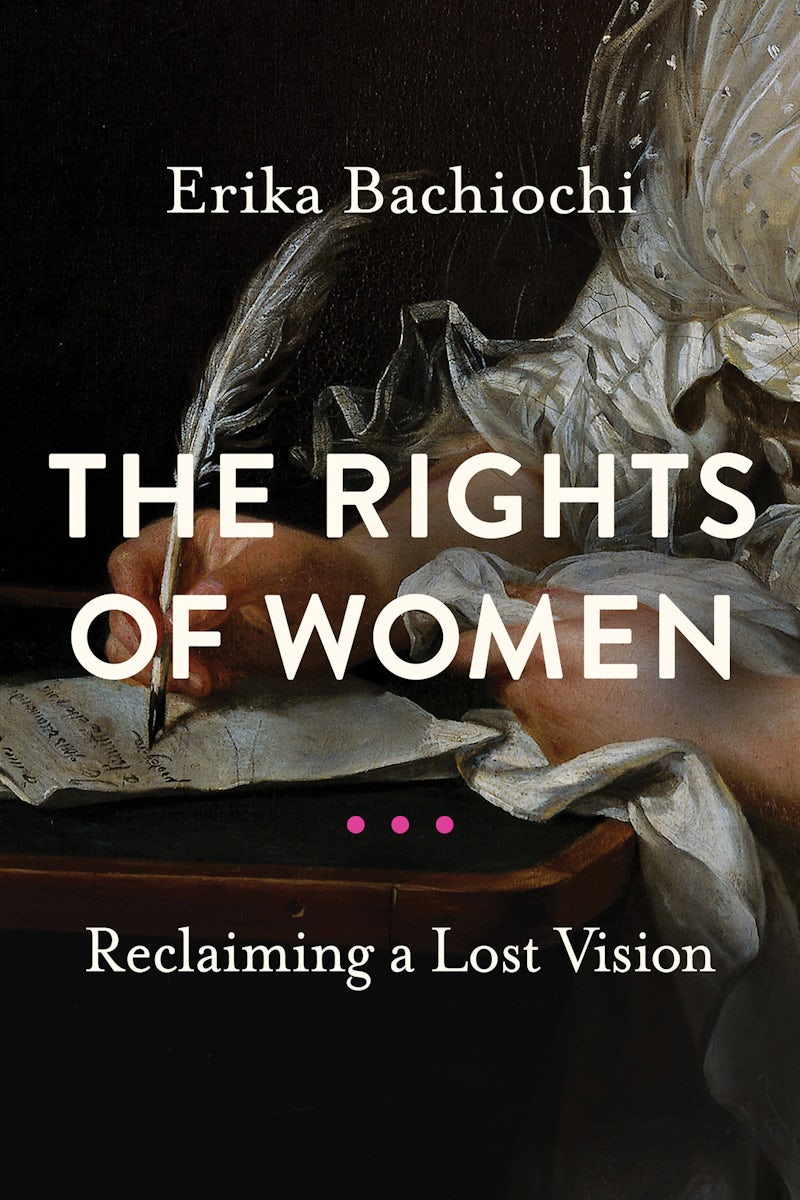
Bachiochi, "The Rights of Women: Reclaiming a Lost Vision"

Notre Dame Press has published The Rights of Women: Reclaiming a Lost Vision, by Erika Bachiochi (Ethics and Public Policy Center / Abigail Adams Institute). A description from the Press:

In The Rights of Women, Erika Bachiochi explores the development of feminist thought in the United States. Inspired by the writings of Mary Wollstonecraft, Bachiochi presents the intellectual history of a lost vision of women’s rights, seamlessly weaving philosophical insight, biographical portraits, and constitutional law to showcase the once predominant view that our rights properly rest upon our concrete responsibilities to God, self, family, and community.

Bachiochi proposes a philosophical and legal framework for rights that builds on the communitarian tradition of feminist thought as seen in the work of Elizabeth Fox-Genovese and Jean Bethke Elshtain. Drawing on the insight of prominent figures such as Sarah Grimké, Frances Willard, Florence Kelley, Betty Friedan, Pauli Murray, Ruth Bader Ginsburg, and Mary Ann Glendon, this book is unique in its treatment of the moral roots of women’s rights in America and its critique of the movement’s current trajectory. The Rights of Women provides a synthesis of ancient wisdom and modern political insight that locates the family’s vital work at the very center of personal and political self-government. Bachiochi demonstrates that when rights are properly understood as a civil and political apparatus born of the natural duties we owe to one another, they make more visible our personal responsibilities and more viable our common life together.

This smart and sophisticated application of Wollstonecraft’s thought will serve as a guide for how we might better value the culturally essential work of the home and thereby promote authentic personal and political freedom. The Rights of Women will interest students and scholars of political theory, gender and women’s studies, constitutional law, and all readers interested in women’s rights.

Advance praise:

"Bachiochi adds an important new voice to the conversation criticizing the nation’s turn to revering market profit and the freedom to be left alone above all else. Feminists may not agree with all of her critique of contemporary feminism, but they would do well to engage with her powerful argument that conceptualizing the movement’s goal as sex equality in the workplace is too narrow." —Maxine Eichner

“Rights cannot flourish alone. They need to be embedded in a thicker moral context that gives voice to the goods that they should serve, the social duties that govern their exercise, and the virtues that enable respect for them. In this book, Erika Bachiochi recovers a tradition of thought about women’s rights that fully recognizes this and, with Mary Wollstonecraft at one end and Mary Ann Glendon at the other, offers an important, salutary correction, not only to libertarian feminism in particular but also to contemporary rights-talk in general.” —Nigel Biggar,

More information is available here. You can listen to an interview with the author here, at New Books Network.

-- Karen Tani

Tuesday, April 20, 2021

Zier on "Feminism, Insanity, and Property Rights in 1940s America"

Magdalene Zier (JD/PhD candidate, Stanford Law School) has posted "'Champion Man-Hater of All Time': Feminism, Insanity, and Property Rights in 1940s America," which is forthcoming in the Michigan Journal of Gender & Law. Here's the abstract:

Legions of law students in property or trust and estates courses have studied the will dispute, In re Strittmater’s Estate. The cases, casebooks, and treatises that cite Strittmater present the 1947 New Jersey supreme court decision as a model of the “insane delusion” doctrine. Readers learn that snubbed relatives successfully invalidated Louisa Strittmater’s will, which left her estate to the Equal Rights Amendment campaign, by convincing the court that her radical views on gender equality amounted to insanity and, thus, testamentary incapacity. By failing to provide any commentary or context on the overt sexism, these sources affirm the court’s portrait of Louisa Strittmater as an eccentric landlady and fanatical feminist.

This is troubling. Strittmater should be a well-known case, but not for the proposition that feminism is an insane delusion. Despite the decision’s popularity on law school syllabi, no scholar has interrogated the case’s broader historical background. Through original archival research, this Article centers Strittmater as a case study in how social views on gender, psychology, and the law shaped one another in the immediate aftermath of World War II, hampering women’s property rights and efforts to achieve constitutional equality. More than just a problematic precedent, the case exposes a world in which the “Champion Man-Hater of All Time”—newspapers’ epithet for Strittmater—was not only a humorous headline but also a credible threat to the postwar order that courts were helping to erect. The Article thus challenges the textbook understanding of “insane delusion” and shows that postwar culture was conducive to a strengthening of the longstanding suspicion that feminist critiques of gender inequality were, simply put, crazy. 

The full article is available here.

-- Karen Tani

Thursday, December 24, 2020

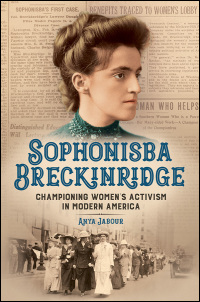
Jabour on Sophonisba Breckenridge

 The University of Illinois Press has published a biography on the important twentieth-century reformer and academic Sophonisba Breckenridge: Sophonisba Breckinridge: Championing Women's Activism in Modern America (2020), by Anya Jabour (University of Montana). A description from the Press:

Sophonisba Breckinridge's remarkable career stretched from the Civil War to the Cold War. She took part in virtually every reform campaign of the Progressive and New Deal eras and became a nationally and internationally renowned figure. Her work informed women's activism for decades and continues to shape progressive politics today.

Anya Jabour's biography rediscovers this groundbreaking American figure. After earning advanced degrees in politics, economics, and law, Breckinridge established the University of Chicago's School of Social Service Administration, which became a feminist think tank that promoted public welfare policy and propelled women into leadership positions. In 1935, Breckinridge’s unremitting efforts to provide government aid to the dispossessed culminated in her appointment as an advisor on programs for the new Social Security Act. A longtime activist in international movements for peace and justice, Breckinridge also influenced the formation of the United Nations and advanced the idea that "women’s rights are human rights." Her lifelong commitment to social justice created a lasting legacy for generations of progressive activists.

Advance praise:

"In propulsive prose, Anya Jabour brings to life progressive feminist Sophonisba Breckinridge, whose forty-year career as an advocate for social justice provides a model of 'passionate patience' for progressives in the twenty-first century."--Robyn Muncy

"Anya Jabour has written an outstanding biography of Sophonisba Breckinridge. She has thoroughly convinced me of Breckinridge's important role in American and women's history and how much of each is revealed by her lifelong activism. The research is expansive and the writing is flawless."--Joan M. Johnson

More information is available here.

-- Karen Tani

Wednesday, September 23, 2020

Barzun on MacKinnon

Charles L. Barzun, University of Virginia School of Law, has posted Catharine MacKinnon and the Common Law:

Few scholars have influenced an area of law more profoundly than Catharine MacKinnon. In Sexual Harassment of Working Women (1979), MacKinnon virtually invented the law of sexual harassment by arguing that it constitutes a form of discrimination under Title VII of the Civil Rights Act of 1964. Her argument was in some ways quite radical. She argued, in effect, that sexual harassment was not what it appeared to be. Behavior that judges at the time had thought was explained by the particular desires (and lack thereof) of individuals was better understood as a form of social domination of women by men. Judges, she argued, had failed to see that such conduct was a form of oppression because the social and legal categories through which they interpreted it was itself the product of male power.

This argument is not your typical legal argument. It may not even seem like a legal argument at all. But this article explains why on one, but only one, model of legal reasoning, MacKinnon’s argument properly qualifies as a form of legal reasoning. Neither the rationalist nor the empiricist tradition of common-law adjudication can explain the rational force of her argument. But a third, holistic tradition of the common law captures its logic well. It does so because, like MacKinnon’s argument (but unlike the other two traditions), it treats judgments of fact and value as interdependent. This structural compatibility between MacKinnon’s argument about gender oppression, on the one hand, and the holistic tradition of the common law, on the other, has theoretical and practical implications. It not only tells us something about the nature of law; it also suggests that critical theorists (like MacKinnon) may have more resources within the common law tradition to make arguments in court than has been assumed.

--Dan Ernst

Monday, June 22, 2020

Katz on the Campaign for Woman Officeholding in Ohio

Elizabeth D. Katz, Washington University in St. Louis School of Law, has posted "A Woman Stumps Her State": Nellie G. Robinson and Women's Right to Hold Public Office in Ohio, which appeared in a symposium issue on the Nineteenth Amendment in the Akron Law Review:
In recognition of the centennial of the Nineteenth Amendment, this essay provides an introduction to a largely overlooked yet essential component of the women’s movement: the pursuit of women’s legal right to hold public office. From the mid-nineteenth century through ratification of the federal suffrage amendment in 1920, women demanded access to appointed and elected positions, ranging from notary public to mayor. Because the legal right to hold office had literal and symbolic connections to the right to vote, suffragists and antisuffragists were deeply invested in the outcome. Courts and legislatures varied in their responses, with those in the Midwest and West generally more willing than those in the Northeast and South to construe or create law permitting women to hold office. This account centers on the experiences of Nellie G. Robinson, a pioneering woman lawyer whose efforts to secure public office in Ohio received nationwide attention in the years surrounding the turn of the twentieth century. To contextualize Robinson’s successes and failures, the essay expands to consider the parallel efforts of other women lawyers from the period, as well as the broader history of women’s officeholding in Ohio—a state with laws and politics reflecting the major trends and tensions in the national women’s officeholding movement.

This essay was written for a symposium issue of the Akron Law Review, organized with the Center for Constitutional Law. The topic for the conference and symposium was "The 19th Amendment at 100: From the Vote to Gender Equality."
--Dan Ernst

Friday, June 5, 2020

Sepper and Dinner on Feminist and Gay Lib Movements

Elizabeth Sepper, University of Texas at Austin School of Law, and Deborah Dinner, Emory University School of Law, have posted Shared Histories: The Feminist and Gay Liberation Movements for Freedom in Public, which is forthcoming in the University of Richmond Law Review 54 (2020): 759-797:
This Symposium on the fiftieth anniversary of the Stonewall Rebellion presents the opportunity to evaluate the regulation and deregulation of gender and sexuality in public space. In 1969, LGBTQ people erupted against policing, harassment, and exclusion in public spaces. That same year, the growing feminist movement also launched protests for women's equality in public accommodations.

Our essay analyzes two case studies, from New Jersey in the late 1960s and California in the mid-1980s, to show what we might learn by integrating the histories of LGBTQ and feminist public accommodations activism. These case studies offer two lessons. First, the regulation of cisgender women and LGBTQ people stemmed from common sources of both law and custom. Public authorities and private businesses limited the access of unescorted heterosexual women, gay people, and gender nonconformists to public accommodations and surveilled their gathering in public space. For each of these groups, such policing was justified by fears of sexuality perceived to threaten the hetero-patriarchal family. Second, feminist and LGBTQ people's respective fights for equality in public reinforced one another. Before 1969, no city, state, or federal law prohibited sex, sexual orientation, or gender identity discrimination in public accommodations. Beginning in the 1960s, the LGBTQ and feminist movements pursued court battles and legal reforms. They ensured that liquor licensing no longer targeted cisgender women and LGBTQ people. Over the course of the 1970s and ‘80s, virtually all states came to adopt public accommodations laws prohibiting sex discrimination, and cities and states slowly began to explicitly include sexual orientation as well. Feminist and LGBTQ legal victories evolved in an interdependent rather than isolated manner.
--Dan Ernst

Tuesday, December 10, 2019

Zarnow, "Battling Bella: The Protest Politics of Bella Abzug"

New from Harvard University Press: Battling Bella: The Protest Politics of Bella Abzug, by Leandra Ruth Zarnow (University of Houston). A description from the Press:
Bella Abzug’s promotion of women’s and gay rights, universal childcare, green energy, and more provoked not only fierce opposition from Republicans but a split within her own party. The story of this notorious, galvanizing force in the Democrats’ “New Politics” insurgency is a biography for our times.

Before Alexandria Ocasio-Cortez, Elizabeth Warren, or Hillary Clinton, there was New York’s Bella Abzug. With a fiery rhetorical style forged in the 1960s antiwar movement, Abzug vigorously promoted gender parity, economic justice, and the need to “bring Congress back to the people.”

The 1970 congressional election season saw Abzug, in her trademark broad-brimmed hats, campaigning on the slogan “This Woman’s Place Is in the House—the House of Representatives.” Having won her seat, she advanced the feminist agenda in ways big and small, from gaining full access for congresswomen to the House swimming pool to cofounding the National Women’s Political Caucus to putting the title “Ms.” into the political lexicon. Beyond women’s rights, “Sister Bella” promoted gay rights, privacy rights, and human rights, and pushed legislation relating to urban, environmental, and foreign affairs.

Her stint in Congress lasted just six years—it ended when she decided to seek the Democrats’ 1976 New York senate nomination, a race she lost to Daniel Patrick Moynihan by less than 1 percent. Their primary contest, while gendered, was also an ideological struggle for the heart of the Democratic Party. Abzug’s protest politics had helped for a time to shift the center of politics to the left, but her progressive positions also fueled a backlash from conservatives who thought change was going too far.

This deeply researched political biography highlights how, as 1960s radicalism moved protest into electoral politics, Abzug drew fire from establishment politicians across the political spectrum—but also inspired a generation of women.
Advance praise:
“This riveting biography could not be more timely. Bella Abzug’s career provides a crucial link in the histories of radicalism, feminism, and electoral politics from the 1930s to the 1990s. Through deep research, thorough historical grounding, and a lively writing style, Zarnow has produced a compelling account of a powerful female politician who fought for peace, racial justice, and gender equality.”—Estelle B. Freedman
“Bella Abzug speaks to our times from this well-wrought biography by historian Leandra Zarnow. Abzug knew progressive change is a not a sprint but a lifetime struggle in which racial and gender equity, economic justice, and peace belong together. From the hard times of the red scare to the glory days of left liberalism in the 1960s and ’70s and right through the reaction that followed, she marshaled grassroots energy to embolden her liberal colleagues with her signature flair, modeling the kind of courage we so need now.”—Nancy MacLean
More information is available here.

-- Karen Tan

Tuesday, September 24, 2019

Mehrotra on Fellows on Cardozo on the Welch Tax Case

Ajay K. Mehrotra, Executive Director of the American Bar Foundation and professor at the  Northwestern Pritzker School of Law, has posted "Life in All Its Fullness": Cardozo, Fellows, and the Critical Context of Welch v. Helvering," which appears in Pittsburgh Tax Review 16 (2019): 151-159:
This brief essay comments on Mary Lou Fellows recent contribution to the edited volume, Feminist Judgements. It explores Fellows's main contribution to a feminist re-evaluation of U.S. Supreme Court Justice Benjamin Cardozo's opinion in the canonical tax law case, Welch v. Helvering. The essay stress Fellows's innovative mix of sociolegal historical analysis and a humanistic law and literature approach. It also contends that Fellows may not go far enough in her feminist re-evaluation of Welch.
--Dan Ernst

Tuesday, March 19, 2019

Sepper and Dinner on Sex in Public

Elizabeth Sepper, Washington University in Saint Louis School of Law, and Deborah Dinner, Emory University School of Law, have posted Sex in Public, which is to appear in the Yale Law Journal:
This Article recounts the first history of sex in public accommodations law—a history essential to debates that rage today over gender and sexuality in public. Just fifty years ago, not only sexual minorities but also cisgender women were the subject of discrimination in public. Restaurants and bars displayed "men-only" signs. Women held secondary-status in civic organizations, like Rotary and Jaycees, and were excluded altogether from many professional bodies, like press clubs. Sports—from the Little League to the golf club—kept girls and women from achieving athletic excellence. Insurance companies and financial institutions subsumed married women's identities within those of their husbands. Over the course of the 1970s, the feminist movement protested and litigated against sex discrimination in public accommodations. They secured state laws opening up commerce and leisure for "full and equal enjoyment" by both sexes. At the time "sex" was added to state public accommodations laws, feminists, their opponents, and government actors understood sex equality in public to signify more than equal access to the public sphere. It also implicated freedom from the regulation of sexuality and gender performance and held the potential to transform institutions central to dominant masculinity, like baseball fields and bathrooms. This history informs the interpretation of public accommodations laws in controversies from same-sex couples' wedding cakes to transgender people's restroom access.

Saturday, July 1, 2017

Weekend Roundup

  • From Notches: "A Portrait of Jane Crow." Rosalind Rosenberg (Barnard College) discusses her recently published book on Pauli Murray.
  • The Washington Post will launch a new podcast "about the history of the U.S. Constitution and the great debates that have shaped it over time."
  • Over at the National Constitution Center's blog, Serena Mayeri (Penn Law) "explains what Loving v. Virginia did and did not do for marriage and racial equality in the United States."
  • Judge Jon O. Newman will deliver the 13th Annual Robert H. Jackson Lecture on the Supreme Court of the United States in the Hall of Philosophy at the Chautauqua Institution at 4PM on Wednesday, August 16, 2017.
  • The Italian Society of Law and Economics welcomes submissions of papers on any topic regarding the Economic Analysis of Law [including the “History of Law and Economics Thought”] for its 13th annual conference to be held in Rome at LUMSA University on December 15-16, 2017.
Weekend Roundup is a weekly feature compiled by all the Legal History bloggers.