Showing posts with label Human Rights. Show all posts

Friday, April 3, 2026

Dardini on the 14th Amendment, Human Rights, and American Samoa

Ross Dardani, Muhlenberg College, has published, open access, The Influence of Fourteenth Amendment Jurisprudence and the Universal Declaration of Human Rights in the U.S. Empire, in Law and History Review:

This article analyzes the influence of Fourteenth Amendment jurisprudence and the United Nation’s Universal Declaration of Human Rights (UDHR) during congressional debates in 1949 that focused on establishing a territorial government for American Samoa. In these hearings, naval leaders argued that Supreme Court decisions that had interpreted the Fourteenth Amendment as demanding colorblindness and others that established property ownership as a fundamental right, along with the creation of the UDHR, meant that Samoans might not be able to protect their land from further white-settler colonialism if Congress passed legislation establishing a civilian government in American Samoa. U.S. military leaders believed that the Court’s decisions in Buchanan versus Warley (1917) and Shelley versus Kraemer (1948), and the UDHR, could prohibit American Samoa from enforcing race-based land ownership restrictions if lawmakers extended citizenship, equal protection, or due process to American Samoa. Members of Congress, however, believed that the Court’s past rulings in the Insular Cases, models set in other unincorporated territories (e.g., the Philippines and Hawaii), and Federal Indian law established legal precedents that meant Samoans would be able to continue restricting land ownership on the basis of race if they became U.S. citizens and were governed by equal protection and due process. Samoan leaders demonstrated the unsettled nature of constitutional law in American politics by emphasizing that any congressional act that extended citizenship, equal protection, or due process to American Samoa would ultimately be reviewed and interpreted by the Court. For these Samoans, even if members of Congress were interpreting past Court precedents correctly, a future majority of justices could adopt a different understanding of what the extension of U.S. citizenship, equal protection, or due process meant for American Samoa by ruling that non-Samoans had fundamental constitutional rights to land ownership in American Samoa. This article thus helps explain how and why Samoan and naval leaders influenced U.S. lawmakers when Congress was considering legislation that would extend citizenship, equal protection, and due process protections to American Samoa in 1949. This legal history demonstrates how different interpretations of the Constitution, the UDHR, and fundamental rights influenced various actors within the context of the U.S. empire, illuminating the ambiguous nature of constitutional law in the U.S. unincorporated territories.

--Dan Ernst 

Thursday, April 2, 2026

Witte and Pin's "Legal Foundations of Religious Freedom"

John Witte, Jr., Emory University, and Andrea Pin, University of Padua, have published The Legal Foundations of Religious Freedom: Human Rights in the United States and Europe (Notre Dame Press):

In The Legal Foundations of Religious Freedom, authors John Witte Jr. and Andrea Pin explore the Christian and secular origins of rights in the Western legal tradition and the complex interplay between human rights and religious freedom norms in modern law, religion, and culture. They analyze historical documents and recent cases from the United States Supreme Court, the European Court of Human Rights, and the Court of Justice of the European Union to articulate the historical, theoretical, and legal tension of human rights and religious freedom on both sides of the Atlantic. The authors contrast the serious threats to new religious minorities and traditional religious accommodations with firm new protections of religious freedoms in both Europe and America.

Ultimately calling for robust protection of the fundamental rights and liberties of all people and faiths, Witte and Pin caution that religious freedom and other human rights claims can only do so much to bridge the widening cultural divides over law and religion in modern Western societies. It is our responsibility to embrace the fundamental goods of dignity, fraternity, and justice.

--Dan Ernst 

Wednesday, March 11, 2026

Bauer to Lecture on Reparations for Victims of Brazil's Dictatorship

 [We have the following announcement.  DRE.]

Nos complace informaros de la celebración del próximo Coloquio de Historia del Derecho de la UAM. En esta ocasión contaremos con la presencia de la profesora Caroline Silveira Bauer, Universidade Federal do Rio Grande do Sul, que nos hablará de “Las posibilidades de reparación de crímenes cometidos por empresas y particulares durante la dictadura de 1964 en Brasil.”  [“The possibilities of reparation for crimes committed by companies and individuals during the 1964 dictatorship in Brazil.”]  Adjunto a este correo se puede encontrar un resumen de su propuesta, junto con la programación prevista para este ciclo de Coloquios.

El encuentro se celebrará el próximo viernes 13 de marzo, a las 11:30 h, en el seminario VI de la cuarta planta de la Facultad de Derecho. Asimismo, también se podrá seguir a través del siguiente enlace: Coloquios HD | UAM | Reunión-Unirse | Microsoft Teams.  

Wednesday, January 28, 2026

CFP: Narrating Justice: Postwar Trials in Memory and Culture

[We have the following CFP.  DRE.]

On behalf of the organizers, the Polish Academy of Sciences – Scientific Centre in Vienna, the Faculty of History, University of Warsaw, and the Museum of the Second World War, we invite you to participate in the conference "Narrating Justice: Postwar Trials in Memory and Culture”, which will take place on June 11-12, 2026, in Vienna. 

The discussion on post-war reckoning provides an opportunity to reflect on contemporary responses to violence and human rights violations, as well as on the role of scholarly research in the face of current conflicts and growing political tensions in Europe and around the world. The conference seeks to examine post-war trials as a long-term historical, legal, social, and cultural phenomenon. Drawing on approaches from different fields of scholarship, it will address the immediate post-1945 tribunals and their aftermath, as well as later trials and broader processes of post-conflict justice in diverse contexts. Attention will be given to the historical, social, and media contexts of these trials, their forms of documentation and reception, as well as their representation in literature, film, theatre, music, and the visual arts. We also invite contributions focusing on non- European contexts, perspectives, and historical settings.

We invite abstracts covering topics that include, but are not limited to:

Historical and Legal Contexts: The Nuremberg Trials and their impact on the development of international criminal law; Trials in Germany, Austria, Poland, and other countries; Shifts in legal categories: from war crimes to crimes against humanity

Social and Political Dimensions: Reception of post-war trials in European societies; Public debates on guilt, responsibility, and retribution; The role of victims’ and witnesses’ testimonies

Trials in the Media: Press, radio, television, and digital coverage of trials, Documentary recordings as historical sources, Visual and rhetorical strategies in depicting perpetrators and victims

Cultural and Artistic Representations: Trials as motifs in literature, theatre, film, and the visual arts; Artistic reconstructions, reinterpretations, and revisitations; Documentary literature and nonfiction in the context of legal history

Memory Studies and Politics of Memory: Post-war trials in European cultural memory; Transnational and comparative perspectives; Institutionalization of the memory of trials
(museums, archives, education)

Contemporary Relevance: Continuities between post-war tribunals and modern international courts; Narratives of responsibility in the context of contemporary conflicts; Challenges for law, memory, and justice in the twenty-first century.

Timeline and Submissions:  Proposals must include, in a single PDF file: (1) paper abstract (max. 1,000 words); and 2) brief biography of the author(s).  All conference submissions must be in English, and all accepted works are to be presented in English.  Proposals for the conference should be submitted to office@vienna.pan.pl by March 22, 2026.

Accommodation and Travel.  The conference will take place over two days, on 11–12 June 2026, at the Polish Academy of Sciences – Scientific Centre in Vienna (Boerhaavegasse 25, 1030 Vienna).  The organisers encourage in-person participation by all speakers. However, depending on the circumstances, some presentations could be delivered online. Please note that invited speakers will be responsible for their transport to and from Vienna.

Participation in the conference is free of charge, and participants will be offered lunch and coffee during the breaks. Participants without institutional support may receive reimbursement of travel expenses up to €150 per person, as well as modest complimentary accommodation at the PAS Scientific Centre in Vienna. For those requesting support, a brief statement of purpose (500–650 words) should be submitted with the abstract and biography.

Inquiries can be made by e-mail to monika.gromala@vienna.pan.pl, milena.blahuta@vienna.pan.pl

Sunday, January 18, 2026

Sunday Roundup

  • Also newly available online: Michael McConnell and Noah Rosenblum's debate on originalism at NYU Law on November 19, 2025. 
  • William M. Treanor, the Agnes Williams Sesquicentennial Professor of Constitutional Law and Constitutional History and Dean Emeritus of Georgetown Law, will deliver the 2025 Gouverneur Morris Endowed Lecture of the Bronx County Historical Society at Fordham Law, which is co-sponsoring the event, on Wednesday, January 28, 2025 at 6:30 pm.  Dean Treanor’s topic: “The Constitution’s Penman, Gouverneur Morris" (New York Almanack).  
  • Jeremy Kessler on the law and history of bans on history of viewpoint discrimination at a Columbia Law School alumni luncheon.  (The event is called the "Stone Circle" Luncheon, and I'm embarrassed to say I was slow to get the reference.)  (Columbia Law School). 
  • Heidi Kitrosser reviews Patrick G. Eddington, The Triumph of Fear: Domestic Surveillance and Political Repression from McKinley to Eisenhower (Georgetown University Press, 2025) (Lawfare).

--Dan Ernst 

Thursday, August 7, 2025

Van Schaack's Annotated Bibliography on Crimes against Humanity

Beth Van Schaack, the Leah Kaplan Visiting Professor in Human Rights at Stanford Law School, has posted Crimes Against Humanity: An Annotated Bibliography:

This is an annotated bibliography of scholarship and jurisprudence involving crimes against humanity, an important element of the international criminal law canon. It elucidates the history of this offense (which traces its roots to the World War I period), elements of this offense, lingering areas of doctrinal indeterminacy, efforts at universal codification, and the most innovative scholarship grappling with the reach of this international offense. 

--Dan Ernst 

Thursday, January 23, 2025

Duke Human Rights Archive

We've been told that the David M. Rubenstein Rare Book & Manuscript Library at Duke University is offering research travel grants to work with the Human Rights Legal Collections of the Duke Human Rights Archive.   The DHRA director explains that the archive "has strong collections on legal history related to immigration law, international human rights law, Guantanamo, Attica, and the death penalty," detailed here.  For example, it has the Minneapolis law firm Dorsey & Whitney's files on its pro bono representation of Bahraini detainees at Guantánamo Bay and the papers of Juan E. Méndez, who served as the UN's Special Rapporteur on Torture and the Special Adviser for the Prevention of Genocide. 

--Dan Ernst  H/t: AZB

Wednesday, January 15, 2025

Sugarman on the "Hidden Histories" of the Pinochet Case

David Sugarman, Lancaster University Law School, has published “The Hidden Histories of the Pinochet Case” open access in the Journal of Law and Society   51: 4 (2024): 459–490:

Credit: LC
The world’s imagination was caught by the 1998 arrest in London of General Augusto Pinochet on charges of egregious human rights crimes and the 16-month battle to extradite him to Madrid. For the first time, a former head of state had, while travelling abroad, been arrested on such charges, with his claim to immunity being rejected by a national court. The case’s notoriety increased when Lord Hoffmann, a judge when it first came before the Law Lords, did not publicly disclose his links with Amnesty International, an intervenor in the proceedings. Pinochet’s release on health grounds compounded the controversy. This article reveals hidden histories behind the Pinochet case, advancing our understanding of its progression and wider significance. It illuminates the relationship between law and politics, the role of personal views and judicial creativity in the UK’s top court, the ways in which law operates in practice, and its promise and limitations.

--Dan Ernst

Wednesday, November 27, 2024

Levin Center on Congressional Oversight of the War on Terror

[We have the following announcement from the Levin Center for Oversight and Democracy of the Wayne State University Law School.  DRE.]

Today, the Levin Center for Oversight and Democracy, with the support of the U.S. Capitol Historical


Society, is releasing a new Portrait in Oversight describing two in-depth Senate investigations into the torture and mistreatment of individuals in U.S. custody during the wars in Iraq and Afghanistan.

Both oversight investigations – the first by the Senate Armed Services Committee from 2004 to 2009, and the second by the Senate Select Committee on Intelligence from 2007 to 2014 -- collected evidence exposing the role of senior U.S. defense and intelligence officials in devising, approving, and directing the use of brutal interrogation methods on Abu Ghraib and Guantanamo Bay detainees. Both Senate investigations also led to enactment of new laws to prohibit the future abuse of individuals in U.S. custody.

“The explosive release of 2004 photos showing prisoners being tortured at Abu Ghraib Prison in Iraq shocked the American public and led to worldwide condemnation of U.S. brutality,” said Jim Townsend, director of the Levin Center. “This new Portrait in Oversight demonstrates how Congress exposed government misconduct, held U.S. military and intelligence officials accountable for what they did, and paved the way for laws to prevent this shameful history from repeating itself.”

“Checks and balances are the foundation of the American governmental system," said Jane L. Campbell, President & CEO of the U.S. Capitol Historical Society.  "It's therefore vital to the health of our democracy that Congress continues to exert its power of oversight on our co-equal branches of government. The U.S. Capitol Historical Society thus commends the work of the Levin Center to inform Americans of the history of this vital process, including the aftermath of the September 11 terrorist attacks.”

The portrait is being released today in observance of the 16th anniversary of the Senate Armed Services Committee’s action on November 20, 2008, approving a 265-page report detailing how senior U.S. Department of Defense officials ordered abusive interrogation methods to be used on U.S. detainees. Six years later, on December 9, 2014, the Senate Select Committee on Intelligence released to the public a 700-page executive summary of its still classified report on the role of the Central Intelligence Agency in the misconduct.

Wednesday, October 16, 2024

Barrett on the “Nuremberg Trials”

John Q. Barrett, St. John's University School of Law, has posted The Nuremberg Trials: A Summary Introduction:

This lecture was delivered on May 4, 2016, at Jagiellonian University in Krakow, Poland, at “The Nuremberg Symposium: The Nuremberg Laws & the Nuremberg Trials,” sponsored by the International March of the Living, the Raoul Wallenberg Centre for Human Rights, and Jagiellonian University.  The lecture explains that following World War II, there were thirteen “Nuremberg trials” of Nazi war criminals and introduces those proceedings by discussing:   

(1)   The predicate human behavior: making war;
(2)   International law's progress in addressing that behavior before World War II;
(3)   Nazism as human and national regression;
(4)   World War II;
(5)   Legal analysis and war condemnation during World War II;
(6)   The Allied nations' military defeat of Nazi Germany;
(7)   The Allies' international Nuremberg trial of 1945-1946;
(8)   The twelve subsequent American trials in Nuremberg;
(9)   The legal legacy of the Nuremberg trials; and
(10) The human rights legacy, including the Holocaust knowledge legacy, of the Nuremberg  trials.

This lecture appears in a symposium issue that also includes lectures and remarks by Wojciech Nowak, Richard Heideman, Shmuel Rosenman, Irwin Cotler, Alan Dershowitz, Samantha Power, Justin Trudeau, Robert Badinter, Luis Moreno-Ocampo, Ayelet Shaked, Zdzislaw Mach, Michael Berenbaum, Edward Mosberg, John Dyson, Dorit Beinish, Sam Rugege, Rosalie Silberman Abella, Marie Thérèse Mukamulisa, Malcolm Hoenlein, Ron Prosor, Elizabeth Buettner, Brooke Goldstein, Stuart Eizenstat, Phyllis Greenberg Heideman, David Machlis, Gregory Peterson, and Aleksandra Gliszczynska-Grabias.

--Dan Ernst

Saturday, April 6, 2024

Weekend Roundup

  • Penn Law Dean Sophia Lee discusses "her work as a legal scholar and historian of administrative law" (Regulatory Review).  And outgoing UVA Law Dean Risa Goluboff reflects on her tenure (UVA Today).
  • Congratulations to Bethany Berger upon her receipt of the Perry Zirkel ’76 Distinguished Teaching Award at UConn Law (UConn Today).
  • Jacob Coffelt  University of Padova, on Codifying IHL before Lieber and Dunant: the 1820 treaty for the regularization of war (Humanitarian Law & Policy).
  • Joy Milligan and Bertrall Ross, UVA Law, “discuss how we should interpret a Constitution that was not written for or drafted by ‘We the People,” on the Sidebar podcast.
  • Prairie View A&M history professor Ronald Goodwin discussed the early Republic and how Americans tried to define equality and interpret the Constitution in the first decades of the United States. (C-SPAN)
  • Jedidiah Kroncke reviews Aziz Rana's The Constitutional Bind: How Americans Came to Idolize a Document That Fails Them (Jotwell).
  • George Fisher, Stanford Law School , discusses his latest book, Beware Euphoria: The Moral Roots and Racial Myths of Today’s War on Drugs, a history of criminal law and criminal institutions, including the regulation of alcohol and drugs (Legal Aggregate).
  • The April 2024 issue of the Newsletter of the Historical Society of the DC Circuit is now available
  • ICYMI:  Judge John Bush of the US Court of Appeals for the Sixth Circuit said the originalist approach to interpreting text “is consistent with, and indeed will thrive” with advancements in AI (Bloomberg).  Mississippi’s Jim Crow Laws Still Haunt Black Voters Today  (Marshall Project). Sponsors of removed historical marker dedicated to Elizabeth Gurley Flynn ask judge to reconsider (Concord Monitor).
  • ICYMI, April Fools Edition: Dueling, the Second Amendment, and the Fifth Circuit (Dorf on Law). 

  Weekend Roundup is a weekly feature compiled by all the Legal History bloggers.

Thursday, January 11, 2024

Sugarman on "The Hidden Histories of the Pinochet Case"

David Sugarman, Professor of Law Emeritus at the Law School of Lancaster University, is lecturing on The Hidden Histories of the Pinochet Case in the "Director's Seminar" at the Institute of Advanced Legal Studies.  The event will occur in the IALS Council Chamber, Institute of Advanced Legal Studies, 17 Russell Square, London WC1B 5DR on February 6, 2024, 5:00PM - 6:30PM.  You may register here.

Autumn 2023 marked the 25th anniversary of Augusto Pinochet’s arrest in London, and the subsequent decisions of Britain’s top court denying Pinochet’s claim as a former head of state to immunity. It was the first time that a former head of state had, while travelling abroad, been arrested on charges of genocide and crimes against humanity, and where that former leader’s claims to immunity were rejected by a domestic court. Hugely controversial, Pinochet’s arrest and the “Pinochet precedent” changed the meaning of international justice, giving a massive fillip to human-rights movements, galvanising victims and their loved ones, activists and lawyers.   

This lecture brings into the open the hidden histories of the Pinochet case. It reveals what went on behind the scenes, in law and in politics. Drawing on a unique set of 250 interviews with victims, NGO’s, activists, judges, lawyers, politicians, government officials and journalists during or shortly after the case, and exhaustive archival research, it casts new light on:

• Pinochet’s arrest.
• The mobilisation of a human rights coalition determined to indict Pinochet.
• The turbulent legal proceedings in London, including the decision to rehear the case as Lord Hoffmann lacked the appearance of judicial independence.
• The vital roles played by victims, their representatives, the superjuez, lawyers, journalists and media outlets (notably, El País) in sustaining the case against Pinochet versus the powerful forces seeking to resist it.
• Pinochet’s release on health grounds.

Under huge pressure many people produced high quality work, but there were structural and personal shortcomings. The lecture lays bare the collaborations that arose, and the professional and personal fissures that ensued.

The struggle to bring Pinochet to justice in London and Madrid was a remarkable endeavour. It has special saliency in an era when autocracy, impunity and denialism of human rights crimes are on the rise, and the notion of international justice is being challenged.
The lecture is situated at the intersection of law, politics, activism, the humanities and the social sciences. It will appeal to the IALS community and beyond.

Speaker: David Sugarman is Professor of Law Emeritus at the Law School of Lancaster University; Senior Associate Research Fellow, Institute of Advanced Legal Studies, University of London; Senior Associate, Centre for Socio-Legal Studies, University of Oxford. He has authored, co-authored and edited 24 books and special issues of journals, and has published over 100 articles and book chapters. He has written widely on the Pinochet case including in the Modern Law Review, Journal of Law and Society, Journal of Spanish Cultural Studies, Amicus Curiae, The Guardian, The Times, The Santiago Times, Open Democracy and El Mostrador. He has contributed to TV and radio on the subject, and has delivered keynote lectures on the case in Australia, Austria, Canada, Chile, France, Germany, Italy, Spain, the UK and the USA.  

Chair: Professor Carl Stychin, IALS Director.

 --Dan Ernst

Thursday, February 2, 2023

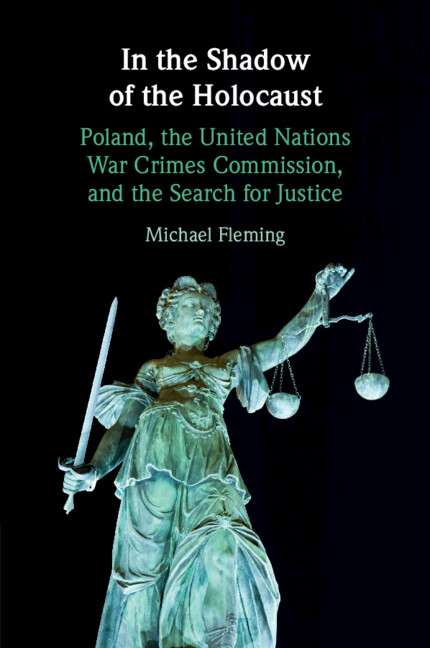
Fleming on "Poland, the United Nations War Crimes Commission, and the Search for Justice"

Cambridge University Press has published In the Shadow of the Holocaust: Poland, the United Nations War Crimes Commission, and the Search for Justice (2022), by Michael Fleming (Polish University Abroad, London). A description from the Press:

In the midst of the Second World War, the Allies acknowledged Germany's ongoing programme of extermination. In the Shadow of the Holocaust examines the struggle to attain post-war justice and prosecution. Focusing on Poland's engagement with the United Nations War Crimes Commission, it analyses the different ways that the Polish Government in Exile (based in London from 1940) agitated for an Allied response to German atrocities. Michael Fleming shows that jurists associated with the Government in Exile made significant contributions to legal debates on war crimes and, along with others, paid attention to German crimes against Jews. By exploring the relationship between the UNWCC and the Polish War Crimes Office under the authority of the Polish Government in Exile and later, from the summer of 1945, the Polish Government in Warsaw, Fleming provides a new lens through which to examine the early stages of the Cold War.
A sample of advance praise:

"This pathbreaking book sheds important new light on post-war attempts to prosecute Nazi war criminals and collaborators through an analysis of the participation in the United Nations’ War Crimes Commission of representatives of the Polish government, first that established in the west after the Polish defeat and then by the pro-communist government established by the Soviets. It is essential reading for all those interested in the problem of how to prosecute genocide and crimes against humanity." -- Antony Polonsky

 More information is available here. (h/t New Books Network)

-- Karen Tani

Monday, December 5, 2022

Federal History 14

Federal History 14 (2022), the journal of the Society for History in the Federal Government, has been published.  Here’s the TOC:

Editor’s Note
        — Benjamin Guterman

Roger R. Trask Lecture
        — Arnita Jones

Articles

A Clash of Principles: The First Federal Debate over Slavery and Race, 1790
        — Paul J. Polgar

From Conspiracy to Policy: James V. Martin, the “Air Trust” Narrative, and the 1926 Air Commerce Act
        — Sean Seyer

“Substantive Accomplishments”: Richard Nixon, High School Student Environmentalists, and the President’s Environmental Merit Awards Program
        — Neil Buffett

The Contribution of U.S. Military Advisors in the Dominican Republic to Operation Unified Response, Haiti Earthquake Relief, 2010
        — Bradley Lynn Coleman

Interview

An Interview with Kelly J. Shannon
        — Alexander Poster

Roundtable

From Selma to Moscow: How Human Rights Activists Transformed U.S. Foreign Policy
by Sarah B. Snyder
        – Introduction by Paul Adler
        – Review by Theresa Keeley
        – Review by Robert Rakove
        – Review by Matthew K. Shannon
        - Response by Sarah B. Snyder

   Recent Publications

        Human Rights–A Select List

Tuesday, November 22, 2022

Bessler's "Death Penalty's Denial of Fundamental Human Rights"

The Death Penalty's Denial of Fundamental Human Rights: International Law, State Practice, and the Emerging Abolitionist Norm, by John Bessler, University of Baltimore, is due out next month from Cambridge University Press, in its series, ASIL Studies in International Legal Theory:

The Death Penalty's Denial of Fundamental Human Rights details how capital punishment violates universal human rights-to life; to be free from torture and other forms of cruelty; to be treated in a non-arbitrary, non-discriminatory manner; and to dignity. In tracing the evolution of the world's understanding of torture, which now absolutely prohibits physical and psychological torture, the book argues that an immutable characteristic of capital punishment-already outlawed in many countries and American states-is that it makes use of death threats. Mock executions and other credible death threats, in fact, have long been treated as torturous acts. When crime victims are threatened with death and are helpless to prevent their deaths, for example, courts routinely find such threats inflict psychological torture. With simulated executions and non-lethal corporal punishments already prohibited as torturous acts, death sentences and real executions, the book contends, must be classified as torturous acts, too.
Here is a post on the book in which Professor Bessler explains how Cesare Beccaria and other Enlightenment thinkers understood torture differently than we do today.  And here is an appearance by Professor Bessler on German TV during the recently concluded 8th World Congress Against the Death Penalty.  Finally, here is the book’s TOC:

Introduction
1. The death penalty: from draconian legal codes to the enlightenment
2. The abolitionist movement: state practice, international law, and global progress
3. Death threats and the law of torture: the death penalty's inherently cruel and torturous characteristics
4. Human dignity and the law's evolution: prohibiting capital punishment through a jus cogens norm
Conclusion
 
--Dan Ernst

Thursday, May 19, 2022

The Search for Humanity after Atrocity

[We have the following announcement of a conference.  DRE]

The Search for Humanity After Atrocity.  October 16-17, 2022. In-person at Kean University, Union, NJ

Keynote Speaker: Loung Ung - Khmer Rouge Genocide Survivor, Activist, Author
Plenary Speakers: Eduardo Gonzalez and Ines Hernandes-Avila

Please click here to visit our website to register and for more information. Registration is open now. Discounted rate for students.

Recognizing that the search for humanity after atrocity is as imperative as it is elusive, this two-day conference will interrogate recent strides that are renewing scholarly and popular interest and debate. The conference, based on an NEH-funded seminar held at Kean University in June, 2021, will assemble engaged scholars and informed practitioners who honor the reciprocity of scholarship and activism for energizing a network in common search for humanity after atrocity. The conference's premise is the belief that post-atrocity renewal possesses the most promise if it is propelled by those who were and are vulnerable and victimized. *The intention is to have an in-person conference with the understanding that the need may arise to shift to a virtual format depending on the status of the pandemic this fall.

Contact Stephanie Reese at reeseste@kean.edu for details or to inquire about co-sponsorship opportunities.

Saturday, September 11, 2021

Weekend Roundup

  • Over at Talking Legal History, Siobhan M. M. Barco talks with former LHB Guest Blogger Samuel Fury Childs Daly “about his J. Willard Hurst Prize winning book A History of the Republic of Biafra: Law, Crime, and the Nigerian Civil War (Cambridge University Press, 2020). Daly is Assistant Professor of African and African American Studies and History at Duke University."

  • The Bristol Centre for Law and History Research welcomes Dr Andrew J. Bell, a lecturer at the University of Bristol Law School.  "His research focuses on the law of obligations, comparative law and – excitingly for us! – comparative legal history.”  More.
  • Over at the LPEBlog, the symposium on Destin Jenkins' Bonds of Inequality continues.
  • ICYMI: Relocating the grave of a leading Tennessee lawyer (Tennessean).  “A rock star of local theater will help tell the stories of enslaved people in Prince George’s County, Maryland, who successfully filed lawsuits in the 1700s that led to their freedom” (WTOP).

 Weekend Roundup is a weekly feature compiled by all the Legal History bloggers.

Thursday, June 17, 2021

Venzke & Heller, eds., "Contingency in International Law: On the Possibility of Different Legal Histories"

New from Oxford University Press: Contingency in International Law: On the Possibility of Different Legal Histories, edited by Ingo Venzke (University of Amsterdam) and Kevin Jon Heller (University of Copenhagen). A description from the Press:

This book poses a question that is deceptive in its simplicity: could international law have been otherwise? Today, there is hardly a serious account left that would consider the path of international law to be necessary, and that would refute the possibility of a different law altogether. But behind every possibility of the past stands a reason why the law developed as it did. Only with a keen sense of why things turned out the way they did is it possible to argue about how the law could plausibly have turned out differently.

The search for contingency in international law is often motivated, as it is in this volume, by a refusal to resign to the present state of affairs. By recovering past possibilities, this volume aims to inform projects of transformative legal change for the future. The book situates that search for contingency theoretically and carries it into practice across many fields, with chapters discussing human rights and armed conflict, migrants and refugees, the sea and natural resources, foreign investments and trade. In doing so, it shows how politically charged questions about contingency have always been.

The Table of Contents:

Thursday, July 23, 2020

Bassiouni's life in international law

The memoirs of M. Cherif Bassiouni (formerly of DePaul College of Law and the International Criminal Court), A Man of Many Flags: Memoirs of a War Crimes Investigator are out with Hart Publishing. From the press:
M Cherif Bassiouni was a towering figure in international law. He was personally connected to some of the most historically relevant moments of the past century: the Suez War; the Camp David Accords; the fall of Muammar el-Qaddafi in Libya and the establishment of the International Criminal Court. A true global citizen – raised in Egypt, educated in Europe and emigrated to the United States – his life cut across cultures and religions. This fascinating memoir gives an immediate and personal eye-witness account of the operation of international events during a tumultuous period.

Table of Contents after the jump:

Thursday, June 4, 2020

Murder Mystery, Legal History III: The Afterlives of Empire in MM Kaye and Agatha Christie


An Indian butler is shot on a moonlit island filled with radiant Chinars at the centre of Kashmir’s dal lake. A German housemaid is clubbed to death on a Berlin street lined with families of British officers occupying former homes of wealthy Nazis. An English secretary is strangled in a charming white washed cottage “amid the scent of roses and jasmine” in sunny Cyprus. A leftwing Arab Zanzibari is poisoned on a flight from Mombasa throwing suspicion on a small group of English and American tourists. A picnicking party finds itself stranded on an Andaman island, amid a raging hurricane, as a killer picks off the guests one by one. Pirate treasures, Nazi diamonds, Russian spies, gun runners and Mau-Mau fighters are thrown into alongside love, hate, lust, greed, fear and revenge in the mix of motives.

As I moved on from Nairobi following research leads to London and then Delhi, I found my research sites mirrored in the work of M.M Kaye. I was looking at histories of civil liberty lawyering across territories that had been part of the British empire, most of my lawyers were engaged in resisting the powers of a variety of Emergency regimes, be it during anti-colonial wars of independence (Kenya, Malaysia, Cyprus); struggles of postcolonial state formation (India, Pakistan, Sri Lanka), or during military occupation (postwar Europe). These mobile lawyers moved across colonial/postcolonial jurisdictions in the course of their practice, and using their lives as an archive helped think across fields that are usually historiographicaly distinct. The independence and partitions in South Asia are seen as distinct from the long drawn out wars of decolonization in Kenya, Malaysia, Cyprus and Palestine, while the British occupation in post-war Europe is rarely put together with events in Asia and Africa. Yet they come together in concert in Kaye’s mystery volumes, as places deeply interconnected. Lt. Colonel Robert Melville in Death inBerlin for instance has served in Egypt and is headed to Malaya after Berlin (Berlin counts as a home posting, according to his horrified wife). The murder of Monica Ford’s brother in a Mau Mau in Kenya is a turning point in the plot of Death in Cyprus.

These interconnections are not a coincidence, Kaye’s murder mysteries are based on notes she had taken while following countries where her husband served as a British military officer during the 2nd World War and after. Death in Berlin (1955) is dedicated to “army wives like (herself) who have followed the drum”. Mary Margaret (Mollie) Kaye was very much a child of the Raj. Born to an intelligence officer in the British Indian Army, M.M Kaye returned to Simla in 1941 after a decade of living in London and earning a living as a writer and children’s book illustrator. Like many of her heroines, she got engaged a British Indian army officer in a whirlwind romance, having two children before his divorce with his wife in Ireland got finalized. As she would later explain, “We just couldn't wait. Had it been peacetime, I wouldn't have done it because of the way I had been brought up. But these were the pressures of war." Kaye’s considerable fame came from her hugely popular Indian historical novels, The Far Pavilions  and the Shadow of the Moon which are both set in the aftermath of the Indian Rebellion of 1857 (Kaye’s great uncle Sir John Kaye was a leading historian of the Revolt of 1857 and the First Afghan War). However, her lesser known works include a set of six murder mysteries set in India (Andamans and Kashmir), Kenya, Germany, Cyprus and Zanzibar.

Read together they tell a story of an Empire in retreat, carrying it’s flotsam and jetsam with it. Discussing their contemporaries in a Srinagar ball on the eve of Indian independence, Major Hugo Creed, dispassionately notes that the eccentric Lady Candera, was a “special brand in the Indian Empire. Next year there will be no Indian Empire, so that brand will become extinct- along with Johnnies and Helens and their ilk. They won’t go to ground in England, because it will not be able to give them what they want, so the Lady Candera’s will retire to infest places like Cyprus and Maderia and the Johnnies and Helens will probably get themselves to Kenya”. As recent scholarship has shown, tools of colonial governance including the managing of anti-colonial emergencies were exported from region to region. Binyamin Blum for instance shows how Palestinian policemen and forensic practices were exported to Kenya, and as were counter-insurgency tactics from Malaya. The legal infrastructure in place in East Africa and South-east Asia, were often transplants of law codes developed in colonial India. 

 Kaye’s cast of characters is always led by a plucky damsel (often in distress and a silent, strong, sardonic hero, usually with a job in military intelligence. Their frequent clashes animate the investigation, with slaps, rough kissing and making sounds like “infuriated and frightened kitten’. Military men (bluff and genial, old and doddery, young and resentful); military wives, ranging from Mrs Leslie in Berlin , “the model of an army wife (“one knew instinctively that she referred to her husband’s regiment as “My regiment”, to the regimental wives as “my wives”, did her duty as to Welfare, and all that concerned the good of the battalion, played an excellent game of bridge, and adequate game of tennis and gold, read all the bestsellers, and was sincerely convinced that there was only one regiment in the British army that counted”) to those that absolutely hated army life, Stella Melville for whom the East was “uncivilized and frightening). There are several predatory women on the lookout for other men’s husbands (Death in Cyprus actually has four); eccentric spinsters like Miss Pond in Death in Kashmir who wore in “addition to an anxious expression, a haphazard collection of garments that gave the impression of being flung together in a hurry…including short buttoned boots, a batik scarf, mustard yellow gloves and several assorted beads”;   middle aged secretaries in love with their bosses, an occasional loud American or an extremely Anglicized “native” who can mix with the English such as Sayyide Zuhra-binti-Salem, who the heroines discovers with some shock, speaks seven languages, has a BA degree and was “considerably better educated than herself or for that matter the majority of European women”. While superficially similar to say Orwell’s cast of colonials in Burmese Days, written several decades later, Kaye’s gaze is sympathetic of the dying breed. Reviewing Johnny and Helen Warrender, the hardrinking polo playing office of the Lunjore Lancers and his social climbing wife in Death in Kashmir as “their world crumbled around them” with the mechanization of the cavalry, the “makrs of dissipation and weakness” and “discontented middle age settled upon them”.  India was to be given her freedom and there was “nothing left for the Johnnies and Helens except memories and debts”. Kaye’s heroine notes, “there is always something more pitiful in the destruction of petty but prized possessions than in the crash of dynasties, for the latter is at least spectacular and dramatic, while the former is of no more account in the eye of history than the breaking of the child’s toy”. Trapped into an army routine, Stella Melville draws a quivering breath and says “I hate the army! I hate it, Oh why did Robert have to be a soldier? Why couldn’t he have been a farmer or a pig-breeder or a stockbroker or anything but a solider?.....the dirt, the dust, the flies, the dark secret faces, the horrible heat and the awful club life?..the awfulness of brassy sunshine?

The advantage of a detective novel, is no one needs to be what they seem, and the easy stereotypes could actually be an effective disguise. So the rosy cheeked Bonzo and Alec, 18 year old twin military officers in Kashmir who spend most of their time skiing and wooing the heroine, are Boris and Alexis with a White Russian mother, and possible communist sympathies? Why passions seeth under the regimental Memsahib’s sensible tweeds. Is the bluff and hearty colonel, looking forward to his retirement on an pension in an converted “worker’s flat” or can his loyalties be tempted by financial game? If the crime in the detective novel arises out of social conditions, the “malice domestic” in Kaye’s novels arise out of the temptations of Empire.  
           
The Occupation Detective Novel: Berlin as a Space of Emergency

Written during the travels of an army wife, it is no surprise that every site is one of a legal exception/Emergency. Her two Indian novels are set in Kashmir and the Andaman Islands. Kashmir, was a semi-autonomous princely state in 1947 operating outside of colonial law, soon to be drawn into a long drawn out international conflict between India and Pakistan with successive emergency regimes in both Indian and Pakistani administered Kashmir. The Andamans, a penal colony in the Indian Ocean, as Uditi Sen argues, was imagined as “terra nullius” open to colonial/postcolonial authority and transformation. Cyprus and Kenya are both sites of violence wars of decolonization and draconian laws, while Zanzibar (though semi-autonomous) is on the brink of revolution.
             Novels written in the wake of an occupying army adds Berlin and postwar Germany to the mix of sites of decolonization in interesting ways. Postwar Berlin was divided into sectors run by different allied powers and was a site of jurisdictional conflict. While military authorities exercised jurisdiction over uniformed servicemen, their authority over civilians remained ambiguous. These tensions played out in the real life case of Madsen v Kinsella, where the glamorous Brooklyn born wife of an American serviceman was convicted of murdering her pilot husband in occupied Germany. Mrs Madsen’s filed a habeas corpus petition arguing that the US Court for the Allied High Commission in Germany did not have the jurisdiction to try her. A suspect, like Madmoiselle Beljame in Death in Berlin might easily disappear into the Soviet sector, never to reappear. 

While Kaye’s gaze on Asia and Africa is appreciative of the colour and natural beauty, the “shattered ruins” of Berlin remind her of the “stupidity of it all! The waste and horror of man’s inhumanity to man”. The devastation is there to see, unlike in the British colony, where the devastation is imagined in the future. The naïve heroine in Death in Zanzibar is reminded that of the romanticism of the colony, “It is the only place I have yet hit upon where black and white and every shade in between’em appear to be able to live together in complete friendliness and harmony with no color bar. It is a living proof and practical demonstration that it can be done, They are all, whatever their race or caste or religion, loyal subjects of His Highness the Sultan..but it won’t last, In the end one …of them will manage to destroy it…Progress is a Lout”. In Berlin, Britain’s changing role in the world is underlined, as Norah Leslie, the Brigadier’s wife confesses that German’s terrified her, not because of their politics, but their industry. In contrast to postwar Britain with its welfare state, a country “too intent on its tea breaks, five day week and next pay rise”, the German workmen were willing and eager to work flat out, they are finding their feet and bursting with confidence. The changing world stage would requires special measures that might seem “un British”, a young schoolboy told off for snooping as “not British” austerely replies, “ “the secret service has to snoop. Where’d us British be if we didn’t? Beat by the Russians and the Japanese, and the FBI, that’s what”.  As AWB Brian Simpson charts, the 1950s, saw Britain trying to simultaneously build a postwar order with lipservice to human rights and the rule of law, while trying to keep it’s colonial territories and counter-insurgencies outside their jurisdiction. 

Crime in the Colony: Empire and the Golden Age Detective Novel


"Take all this business about Kenya," said Major Palgrave. "Lots of chaps gabbing away who know nothing about the place! Now I spent fourteen years of my life there. Some of the best years of my life, too."
Despite Major Palgrave’s central role in the plot of Agatha Christie’s A CaribbeanMystery, the readers never do get to know much about the “business in Kenya” or apart from the convenience of drowning, a chance remark by a Venezuelan tourist and a blackmailing housekeeper, do we know much of the Caribbean either.
In contrast, empire, in all its forms, courses through early English detective fiction. Wilkie Collin’s  The Moonstone, which set the rules for the early genre, centered on a diamond (named after the Hindu god Chandra) that was stolen during the Siege of Seringapatnam and a troupe of Indian jugglers. Dr Watson meets Holmes after being injured in service in the 2nd Afghan War. The Indian Rebellion of 1857 drives the plot in the Sign of Four. Sumatran bacteria, Lime house Opium dens, comrades from the Boer Wars, mysterious Malays and Calcutta trained snake charmers menace who young women with swamp adders . It existed as part of the landscape, as a racial stereotypes, as a signifier of criminality, of oriental exoticism and shaping the political economy. An Indian student, Daulat Ras (“quiet and methodical”) is one of the key suspects in the Adventure of the Three Students, while the key antagonist in the Sign of Four is a blow dart wielding Tonga, from the Andaman Islands. Laura Otis even suggests that Holmes is the creation of a physician, who see’s the detective as protecting the “British nation” from the ills of contamination of the empire.  Holmes’s himself declares that he spent two years in Tibet after his “death” at the Reichenbach Falls (an episode delightfully reimagined by Jamyang Norbu in the Mandala of Sherlock Homes).
            In contrast, the Empire recedes from view in the Golden Age Detective Novel. Take for example, the work of Agatha Christie (whose first husband was born in Peshawar and the second worked as an archeologist in Iraq and Syria), the empire functions largely as a backstage to remove characters from the scene. Never doe’ll sons are sent off to Australia (Dumb Witness), mining prospects in Africa are occasionally "motives for murder (A Pocketful of Rye), grandchildren in Ceylon remove an eyewitness from the scene (4:50 fromPaddington) returning memsahibs struggle with the absence of a fleet of servants (Mrs McGinty’s Dead) and a policeman retiring from Malaysia (perhaps service during the insurgency) investigates a serial killer in an English Village (Murder in Easy). Earnest archaeologists (Murder in Mesopotamia), women politicians (Appointment with Death) and writers of salacious novels (Death on the Nile) may voyage to the east, but travel with a self-contained world of Home Counties Englishman and a smattering of temperamental Europeans. Historian Christopher Prior contrasting Christie’s pre-war and postwar fiction notes a general trend where the postwar books showed a spike in the number of murderers who had connections to or were born in the colonies. The “natives” are clearly ruled out as suspects, though occasionally a clever murderer might disguise themselves with a turban.  I pick Christie as the key example, because she is the third most published writer in  the English language, outsold only by William Shakespeare (and the Bible!) and sells more in India than in the UK at present. In contrast, her contemporaries with the exception of the New Zealand settings of Ngaio Marsh (a New Zealander herself) limit themselves to London squares and English country houses.

The central conceit of picking a Belgian detective, was Christie’s (and Poirot’s) self-awareness of how contemptuously the English viewed foreigners. Poirot self-consciously becomes more foreign, when he wants suspects to under-estimate him. Christie’s pre-war works are full of casual anti-Semitic and racist observances, made bearable only by the ruthless decimation of European nationalities, the French are mendacious, the Italians and Spaniards temperamental, the Americans are flashy and tasteless, and one character is gently dismissed with the words “Poor creature, she’s a Swede”.  Significantly, unlike say Holmes, race and nationality are never correlated to criminality. It was usually the “Old School Tie” wearing establishment Englishman or the gentle paragon of the Women’s Institute who was pouring strychnine into the soup.
            The one stock character is the retired colonial army officer/official, neatly summed up as Miss Marple listens to Major Palgrave drone on “somewhat uninteresting recollections of a lifetime”,
 “ It was a routine with which she was well acquainted. The locale varied. In the past, it had been predominantly India. Majors, Colonels, Lieutenant-Generals - and a familiar series of words: Simla. Bearers. Tigers. Chota Hazri - Tiffin. Khitmagars, and so on. With Major Palgrave the terms were slightly different. Safari. Kikuyu. Elephants. Swahili. But the pattern was essentially the same. An elderly man who needed a listener so that he could, in memory, relive days in which he had been happy. Days when his back had been straight, his eyesight keen, his hearing acute. Some of these talkers had been handsome soldierly old boys, some again had been regrettably unattractive, and Major Palgrave, purple of face, with a glass eye, and the general appearance of a stuffed frog, belonged in the latter category.
Indeed, the stock character is so familiar, it allows a villain to disguise themselves as an Anglo Indian colonel with a turbaned Indian butler, choleric temper, gout and tables laden with Benares brass. But as Poirot points out, the “retired Anglo Indian army officer, a well-known comic figure with a liver and choleric temper” is “bogus, very bogus”. Empire is both an exit and a disguise. 

Hickory Dickory Death: Decolonizing London

            I want to briefly turn to Hickory DickoryDock  (1955),  the one Christie novel that has a sizable number of  non-White characters (apart from Death Comes as the End, which is set in Thebes in 2000 BC). An international student’s boarding house in London (built by knocking down through two Victorian townhouses) is disturbed by a series of mysterious thefts of items ranging from a diamond ring, a stethoscope, lightbulbs and bath salts. Set in the 1950s, it’s one of the few to reflect the changing composition of University of London students, it’s inhabitants include two Indians studying political science, a Jamaican law student, a West African, an Egyptian, an American Fulbright scholar, several Frenchwomen, a stolid Dutchman and two unnamed Turks and an Iraqi. Owned by a Greek proprietress (often drunk) and excitable Italian staff, it’s managed by a cheerful Englishwoman just returned from Singapore, which meant she “understood racial differences and people’s susceptibilities”. Scholarly appreciation of Christie, gingerly steps around Hickory Dickory Dock, embarrassed by the racial stereotypes and the extremely improbably plot that leads to 3 murders within 48 hours and the plausibility of three-way switch between a bottle of morphine, a bottle of bicarbonate of soda and a bottle of boracic acid.  The TV adaptation changes the settings to the 1930s and erases all the non-White characters from the script.
            This is one of the few Christie’s that gives a sense of a changing United Kingdom, and there are ways of reading her stereotypical representations against the grain . As Poirot’s secretary Miss Lemon remarks, “half our nurses in our hospitals seem to be black nowadays….and I understand much pleasanter and more attentive than the English ones”. The expansion of the National Health Service at the end of the Second World War had led to a severe shortage in medical personnel, which was met by increased recruitment of nurses from Jamaica and the Bahamas. Beginning with arrivals on Windrush, the Carribeannurses and medical professionals were integral to building the NHS and faced both arduous working conditions and racism. The passing acknowledgement in Christie’s murder mystery, comes up sharply in contrast with say the absence of Caribbean nurses in Call the Midwife, a contemporary TV show depicting the lives of midwives in East London in the 1950s (the first West Indian nurse joins the cast in Series Seven). With increasing numbers of students from the colonies/former colonies coming to the UK to study, London increasingly became a hub of anti-colonial activism in the 1950s, allowing the creation of networks across regions and colonies. Mitra Sharafi’s new work shows, several were studying law in the Inns of Court and would return to lead movements for political and social change in their homes. While colonial law students had been coming to London since the late 19th century, the second world war widened the demographics and politics. Wartime travel restrictions changed the requirements for legal training in London. Instead of spending two years in London to train at the Inns of Court, prospective students could do the first year of coursework in  their own countries and only spend nine months in the UK keeping their dinners and giving the qualifying exams. These changes opened up the profession to wider demographic, including women and students from working class backgrounds, including several lawyers who I follow in my current research.  Unlike the sons of merchants, colonial officials and landed gentry who came to study in the late 19th and early 20th century, the 1940s saw children of schoolteachers, railway engine drivers and small shopkeepers making their way to LOndon.  It is not surprising that Elizabeth Johnston, the Jamaican lawyer is described by Poirot as the most intelligent person in the hostel, is both studying law and is found to be card carrying member of the Communist Party.  This also makes student hostels, like the one on Hickory Road, a site for police surveillance 
            Christopher Prior classifies thenon-white cast into one of three stereotypes: arrogant and condescending; simple and credulous and excitable and temperamental. Yet, each of Christie’s stereotypes can be inverted to reveal something about the politics of the time. Take Elizabeth Johnstone, the Jamaican law student dismisses her American housemate’s feeling that something is wrong, as “her American way of thought. They are all the same, these Americans, nervous, apprehensive, suspecting every kind of foolish thing! Look at the fools they have made of themselves with their witch hunts, their hysterical spy mania and their obsession over communism”. As a left wing Carribean student, Johnstone is acutely aware of the McCarthy era witch hunts which were actively criticized for their departure from ordinary legal norms in London’s leftists circles. Pamplets were written on the Rosenberg prosecution and the Smith Act cases, and student groups debated and followed the American “Red Scare”.

            The West African student, Akibombo, discomfits his housemates by suggesting the murder is the result of a blood feud or an honor killing. While much of his description is a crude caricature, the actual solution involves convoluted family relationships, dressed up in modern scientific language.  Finally, the Indian medical student, Chandra Lal is dismissed as a suspect by Poirot, given that his mind is entirely occupied by “politics and persecution mania”, and indeed Lal is in full form, threatening to cause an international incident when his room is searched as part of the murder investigation and calling out his housemates for borderline racist humor. When the housemates express surprise at a “seemingly senseless” damage to Elizabeth Johnstone’s notes, Lal becomes “excited and voluble” pointing out this is “oppression, deliberate oppression of native races, contempt and prejudice, colour prejudice”. Christie intends Lal to be a figure of caricature, but reading him in the 21st century, shows him to be astute, analogizing the narrative of “senseless violence” with the British who claim to not know, “Why the Mau Mau? Why does Egypt resent the Suez Canal”. The answers, he suggests are clear, well authenticated examples of racial oppression. With Indian independence, the postcolonial Indian state had emerged as a powerful voice in international affairs pointing out racial discrimination and arguing for decolonization. It successfully passed a General Assemblyresolution condemning the anti-Indian legislation in South Africawas engaged in drafting the UDHR, drew attention to atrocities carried out by colonial authorities in Malaysia and East Africa and sharply responded to racial discrimination against it’s citizens in the UK. The British state was both embarrassed and exasperated by Indian use of the international institutions and media, and believed them to by hypocritical given its military action in Hyderabad, Goa and Kashmir, and limiting of rights of its own citizens through constitutional amendments. As mysterious thefts plague the hostel, the other Indian student Gopal Ram just “smiles and says material possessions do not matter” but only because nothing has yet been stolen from him. 

My posts so far have largely looked at murder mysteries written by British authors with colonial settings, in my last post I will turn to a set of detective stories written by Indians, Singaporeans and Kenyans set in the same period.