Showing posts with label Africa. Show all posts

Friday, May 1, 2026

Petipeti on Continuity in Congolese Constitutional History

Mujinga Pathou Petipeti, University of Kinshasa Faculty of Law, has published The Formation of the State in the Democratic Republic of the Congo: Institutional and Constitutional History of a Quest for the Submission of the State to the Rule of Law in the Open Journal of Political Science:

The formation of the State in the Democratic Republic of the Congo cannot be reduced to the colonial sequence or to the legal arrangements that emerged from the Berlin Conference of 1885. Rather, it must be understood within a much longer historical trajectory in which precolonial political structures, diplomatic relations, colonial transformations, and post-independence constitutional developments progressively shaped the Congolese State. This article examines the institutional and constitutional history of the Congo from the ancient political formations of the Congo Basin to the contemporary constitutional order established by the Constitution of 18 February 2006. By adopting a historical and constitutional approach, the study highlights the existence of organized political authorities and international diplomatic relations long before the colonial period, particularly through the Kingdom of Kongo and its interactions with European powers and the Holy See. It then analyzes the profound transformations introduced by colonial rule, the creation of the Congo Free State, the Belgian colonial administration, and the constitutional struggles that followed independence in 1960. Particular attention is devoted to the authoritarian experience of the Zairean regime under Mobutu and to the constitutional reconstruction of the Democratic Republic of the Congo after 1997. The article argues that the Congolese constitutional trajectory reflects a continuous and unfinished quest to subject state power to the rule of law. While the Constitution of 2006 formally establishes the Democratic Republic of the Congo as a state governed by the rule of law, significant challenges remain in translating constitutional principles into effective institutional practice. The Congolese experience therefore illustrates the broader difficulties encountered by postcolonial states in consolidating democratic governance, institutional stability, and legal accountability within complex historical and geopolitical contexts.

--Dan Ernst 

Wednesday, March 25, 2026

Global Dissertation Prize

[We have the following announcement from the ASLH.  DRE.]

The American Society for Legal History (ASLH) is delighted to announce a new dissertation prize: the Global Dissertation Prize for the best dissertation in global legal history. The [prize] recognizes the best dissertation from the previous calendar year on topics centered outside the United States. Eligible dissertations must be written in English and submitted for a PhD, JSD, or equivalent doctoral degree, excluding the JD, awarded in the previous calendar year (for example, a dissertation for a PhD awarded in 2025 would be eligible in 2026). Dissertations should not be predominantly focused on the US and may examine contexts, processes, or institutions that are local, regional, imperial, comparative, global, or otherwise. 

Submissions should be made by the author including only (1) the dissertation as submitted to the university for the degree, and (2) a curriculum vitae. 

To be considered for the year’s prize, the author should e-mail a PDF electronic copy of the dissertation and author’s curriculum vitae to the prize committee chair (globaldissertationprize@aslh.net) with the subject heading: GLOBAL DISSERTATION PRIZE SUBMISSION. Please title the PDF as “author last name” and “short title” .pdf (for example, Adewoye Lawyers Southern Nigeria.pdf).  

Deadline for Submissions: June 1, 2026.  Award Amount: $500.

Tuesday, January 6, 2026

Italian Review of Legal History 11

[Italian Review of Legal History 11 (2025) has been published open access online.  Unsurprisingly, most of the contributions are in Italian.  We note those available in English below.  H/t: ESCLH Blog.  DRE.]

Sul Diritto dei popoli, il pensiero di John Rawls (English
Antonio Padoa Schioppa

La diserzione nel contesto della mobilitazione generale: Esperienza storica e sfide attuali (English
Serhii Khalymon, Liudmyla Litvin, Viktor Tyshchuk
 
Giurisdizione militare e stato democratico. Dalla giustizia dei capi alla legge 180/1981
Floriana Colao

Cura dei poveri e sicurezza sociale nell’Inghilterra di Età Tudor: Il ruolo dei Justices of the Peace
Dolores Freda

La colonizzazione democratica. Lotte per la terra, riforma agraria e attuazione costituzionale nel dopoguerra
Paolo Passaniti

Lo sviluppo della teoria dell’atto amministrativo come espressione dei valori del diritto amministrativo (English)
Andrzej Adamczyk

El espejo tiznado: el Tratado de París (1898) en la historia jurídica de Puerto Rico (English
José R. Gómez Biamón 

Il concetto di “popolo” nella prospettiva intergenerazionale
Raffaele Marzo

Un esame filosofico del patto sociale nella ricostruzione della società sudafricana (English
Konanani Happy Raligilia, Rorisang Gomolemo Thage, Lufuno Tokyo Nevondwe, Kolawole Olusola Odeku, Lesiba Benedict Moshoeu

Altri temi

Para uma história de gavetas: o projeto de código penal brasileiro de Galdino Siqueira (1913)
Ricardo Sontag

Schede bibliografiche


Recensione a Antonio Grilli, Resistenza e repressione. Il Tribunale speciale per la difesa dello Stato nella RSI (1943-1945), Roma, Carocci, 2024
Floriana Colao

Recensione a Paolo Passaniti, La riforma agraria in Italia. La Maremma dell’Ente Maremma, Pisa, Pacini, 2024
Federico Roggero

Il fascino dell’anomalia: leggendo Davide Rossi, Il lungo Novecento della frontiera adriatica. Transizioni istituzionali e modifiche giuridiche, Soveria Mannelli, Rubbettino, 2025
Alberto Sciumè

Recensione a Mario Ascheri e Fabrizio Ricciardelli, The City-states in Late Medieval Italy, Roma, Viella Editrice, 2024
Claudia Storti

Dibattiti: Una storia non solo per storici. Presentazione della monografia di Marzia Lucchesi, Diritto, pedagogia e femminismo. Valeria Benetti (1908-1914), Napoli, Satura Editrice, 2023 (San Salvatore Monferrato, 27 giugno 2025)
Introduzione al dibattito sul libro di Marzia Lucchesi Diritto, pedagogia e femminismo. Valeria Benetti 1908-1914
Enrico Beccaria

Valeria Benetti e il lungo itinerario della questione femminile
Ettore Dezza

Considerazioni sul volume di Marzia Lucchesi Diritto, pedagogia e femminismo. Valeria Benetti (1908-1914)
Giulia Giustetto

Alcune considerazioni tra passato e presente sul libro di Marzia Lucchesi Diritto, pedagogia e femminismo. Valeria Benetti 1908-1914
Claudia Storti

L’attualità del pensiero e dell’opera di Valeria Benetti
Marzia Lucchesi

Friday, September 19, 2025

Keller on China, Legal Transplants, and Policy Irritants

Kevin Byrne Keller, a Visiting Fellow in East Asian Legal Studies at Harvard Law and PhD candidate in history at Yale, has published From Legal Transplants to Policy Irritants: Chinese Economic Expansion and Global Legal Change in the American Journal of Comparative Law:

Since the 1970s, comparative law scholars have studied “legal transplants”: legal institutions that emerged in one location and then were moved to (or forced upon) another. This research agenda offers little traction on one of today’s most pressing questions of global legal change. For several decades, Chinese leaders have encouraged Chinese enterprises to increase their international engagement. Those leaders insist that they have no desire to alter the legal systems of their economic partners, but China’s growing global economic presence does seem to affect legal systems elsewhere.

To make sense of this pattern, this Article draws on and extends Gunther Teubner’s concept of a “legal irritant.” It introduces the idea of a “policy irritant”: a policy that a country implements, inspired by policies elsewhere, that places pressure on and potentially reshapes the country’s legal regime. To demonstrate how the concept of a policy irritant improves our understanding of theoretical questions about legal change and concrete questions about current global conflicts, this Article offers a case study of the Madaraka Express, a China-funded railroad project in Kenya.

From a theoretical perspective, the Article makes two contributions to the literature on legal transplants. First, it reveals that policy emulation can catalyze legal change. Second, it observes that policy emulation can result in changes both to the recipient legal system and to the policy being emulated. At a more concrete level, the Article offers two insights into China’s engagement with the Global South. First, the introduction of China-inspired policies caused controversy in Kenya not because those policies were inherently insidious, but because they rubbed roughly against features of Kenya’s legal system that many Kenyans value highly. Second, Kenya’s legal system has shown strength in the face of pressures introduced by China-inspired policies, and has in some instances forced changes in those policies.

--Dan Ernst

Saturday, January 25, 2025

Weekend Roundup

  • Congratulations to Rabiat Akande, University of Maryland Francis King Carey School of Law, upon being named the 2025 Wilson H. Elkins Professor by the University System of Maryland, which comes with “an award of $80,000 over two years to support a research project titled ‘Law and the Histories of Empire’” (The Elm). 
  • A nice notice by Ronald A. Brand of his University of Pittsburgh School of Law colleague and legal historian Bernard Hibbitts upon Professor Hibbitts's retirement.
  • The American Historical Association is hosting a congressional briefing on the history of the U.S. House of Representatives.  It will take place on Wednesday, January 29 at 9:00 a.m. ET in Rayburn House Office Building Room 2075.  The panelists are Kathryn Cramer Brownell (Purdue University), Matthew Green (Catholic University of America), and Rachel Shelden (Pennsylvania State University).
  • Pamela Brandwein reviews Mark Graber's Punish Treason, Reward Loyalty: The Forgotten Goals of Constitutional Reform After the Civil War (Lawfare). 
  • Paul Moreno reviews Stuart Banner’s The Most Powerful Court in the World: A History of the Supreme Court of the United States (Law & Liberty).
  •  Talbot Publishing, an imprint of The Lawbook Exchange, Ltd., has published G. I. Tunkin: Selected Works, edited and translated by William E. Butler.
  • ICYMI: The Constitution disappears from the White House website (Newsweek).  Rockingham County (Virginia) Circuit Court is celebrating the restoration and digitization of “a Burnt Deed Book from 1815, a Land Book from 1878, and a Land Tax Book dating as far back as 1812" (WHSV).  "Harvard Outsources Program to Identify Descendants of Those Enslaved by University Affiliates" (Harvard Crimson).
  • Update: Mary Frances Berry on the Executive Order suspending civil rights enforcement (Yahoo/The Grio).  John Yoo on birthright citizenship (AEI).

 Weekend Roundup is a weekly feature compiled by all the Legal History bloggers.

Monday, November 18, 2024

ASLH Jane Burbank Global Legal History Prize to Balakrishnan

Continuing our round-up of the prizes and award announced at the recent meeting of the American Society for Legal History, we turn now to the Jane Burbank Global Legal History Prize. About the prize: 

The Jane Burbank Article Prize in global legal history will be awarded annually to the best article in regional, global, imperial, comparative, or transnational legal history published in the previous calendar year. Submissions may address any topic or period, and may focus on case studies in which the analysis relates to broader processes or comparisons. 
This year's award went to Sarah Balakrishnan (Duke University) for “Prison of the Womb: Gender, Incarceration, and Capitalism on the Gold Coast of West Africa, c. 1500–1957,” Comparative Studies in Society and History 65:2 (2023): 296-320. The citation:

This stunningly original article challenges several dominant tendencies in the global history of prisons, particularly a persistent focus on male incarceration and an emphasis on penal practices of the colonial state. Through careful analysis of a wide range of sources, including testimony of female prisoners, Balakrishnan tells a radically new story. It centers on the incarceration of women in so-called native prisons in nineteenth-century colonial Gold Coast (southern Ghana). The phrase “prison of the womb” describes a startling pattern: captive women were threatened with impregnation in efforts to urge dept repayment and tort settlement by kin groups. Palm oil merchants targeted women and utilized the punishment to enforce collection of payments on loans and amass capital. The committee was deeply impressed by the originality of the article, its deft combination and close interpretation of varied sources, and its broader significance for the regional and global history of carceral politics and practices.

The prize committee awarded an honorable mention to Max Mishler (University of Toronto) for “‘Improper and Almost Rebellious Conduct’ Enslaved People’s Legal Politics and Abolition in the British Empire,” American Historical Review, 128:2 (2023): 648–684.

Congratulations to Professor Balakrishnan and Professor Mishler!

-- Karen Tani

Monday, October 21, 2024

A Podcast on Colonialism and Its Normative Systems

We learned from Dr. Raquel Sirotti, a postdoctoral researcher in the "Historical Regimes of Normativity" department at the Max Planck Institute for Legal History and Legal Theory in Frankfurt, of the launch of a project she and her research group has developed. Tramas Coloniais is a seven-episode documentary podcast in Portuguese, about the history of colonialism in Africa and its normative systems.  Episodes are being released weekly until November 20th. The project has also created a website with written and audio sources and a bibliography for each episode.  The Spotify link for the first episode is here.

--Dan Ernst

Thursday, April 25, 2024

Daly to Speak on Africa's Military Regimes

Samuel Fury Childs Daly, University of Chicago, will present "Forward March: Time and Ideology in Africa’s Military Regimes, 1970-2000," in the EuroStorie research seminar series "Time and Identity" in Room 247, Unioninkatu 33, University of Helsinki, on Friday, May 3, 1:00pm-2:00pm (UTC+2).  You may also join via Zoom.

Across Africa, independence was followed by a wave of military coups and martial revolutions. The men who staged them had utopian visions. In Nigeria and other former British colonies, military officers believed they could remake their countries in the image of an army. Soldiers tried to condition civilians to think like they did—and when that failed they tried to beat the bad habits out of them by force. Militarism became the animating force of African politics. Like its better-known counterparts – communism, capitalism – militarism had a culture, an aesthetic, and a philosophy. It also had a theory of time, and military ideas about temporality permeated military dictatorships. Africa’s military regimes had revolutionary ambitions. Nearly all soldiers were committed to transforming their societies – though they didn’t always spell out what they wanted them to become. Coups were power grabs, but they also came with ideas. After they mopped up the blood in the barracks, soldiers set about governing. The ideology they created – militarism – is one of the twentieth century’s most neglected ideologies.
--Dan Ernst


Wednesday, January 3, 2024

The Docket 6:3-4

Issues 3-4 of Volume 6 of The Docket, the online companion of Law & History Review, published by the American Society for Legal History, is now online:

Ryan Reft, Library of Congress Sources on PGA Tour v. Martin

Professor Rabiat Akande discusses Entangled Domains: Empire, Law and Religion in Northern Nigeria

The Docket interviews Ziv Bohrer and Danny Orbach

Allen Boyer reviews Sir John Baker, Reports from the Notebooks of Edward Coke (2022-23)

Grace Mallon reviews Fritz, Monitoring American Federalism

Saru Arifin on Coolie Ordinance 1880 in Colonial Indonesia: The Refinement of Slavery for Indigenous Laborers

--Dan Ernst

Saturday, September 2, 2023

Weekend Roundup

  • Gwen Seabourne and Joanna McCunn, the organizers of the 26th British Legal History Conference, which will be held in July 2024 at the University of Bristol Law School and the Centre for Law and History Research, discuss their preparations here.  
  • In Episode 4 of the Max Planck Lawcast, Christopher Murphy talks with Alicia Haripershad about her preliminary findings on the role of missionaries as legal actors in the British colonies of South Africa and Zambia.  In Episode 3, he discusses the regulation of poverty in England and Wales in the early seventeenth century with Victoria Hooton, MPI-Frankfurt.
  • Although the announcement leaves us uncertain as to whether the event is open to the public, NYU will host a discussion of The Eight: The Lemmon Slave Case and the Fight for Freedom (SUNY Press) with author Judge Albert M. Rosenblatt, Judicial Fellow, NYU School of Law, Chief Judge Rowan D. Wilson of the New York Court of Appeals, and Sarah L. H. Gronningsater, Assistant Professor of History, University of Pennsylvania.  Dean Troy McKenzie, Cecilia Goetz Professor of Law at NYU Law, will provide welcome remarks.  The event will take place on Wednesday, September 20, 2023, from 4:30 PM - 6:00 PM, at NYU Law, 40 Washington Square South New York, NY 10012.  H/T: RD.
  • The National Historical Publications & Records Commission offers various grants for projects involving public engagement with historical records. Follow the link for more information and to read about previous grantees.
  • ICYMI: The first and only Texan on the U.S. Supreme Court (Weatherford Democrat). Mark Joseph Stern on The Volunteer Moms Poring Over Archives to Prove Clarence Thomas Wrong (Slate). The hosts of Strict Scrutiny recently spoke with Ari Berman about "the rise and fall of the Voting Rights Act." David Beito on that 14th Amendment, Section 3 Argument and the Debs precedent (The Hill).

 Weekend Roundup is a weekly feature compiled by all the Legal History bloggers.

Tuesday, July 18, 2023

Akande's "Entangled Domains"

Rabiat Akande, Osgoode Hall Law School, York University, has published Entangled Domains: Empire, Law and Religion in Northern Nigeria (Cambridge University Press, 2023):

Set in Africa’s most populous Muslim country, the book takes on a paradox: colonial governance in Northern Nigeria entailed indirect rule through Muslim intermediaries and caliphate institutions; yet, the state insisted on its secularity. In unravelling this puzzle, the book offers a provocative account of secularism as a contested yet contingent mode of governing and religious difference. Drawing on detailed archival research, the book illustrates constitutional struggles triggered by the colonial state’s governance of religion and interrogates its legacy in the postcolonial state. The book illuminates the dynamic interplay between law, religion, and power in the political context of the modern state’s unique emergence from colonial processes.
--Dan Ernst

Wednesday, December 21, 2022

CFP: Tangier Statute Centenary Conference

[We have the following Call for Papers.  DRE.]

Tangier Statute Centenary Conference, 18 December 2023, Tangier.

On 18 December 2023 (i.e. a year from now), Willem Theus (KU Leuven – UCLouvain), Dr Michel Erpelding (University of Luxembourg), Prof Dr Francesco Tamburini (University of Pisa), Prof Dr Fouzi Rherrousse (University of Oujda), and [Geert van Calster] are organising a conference to celebrate the centenary of the Statute of Tangier, signed at Paris. Credit for kicking off the process goes to Willem.

This treaty, signed between France, Spain and the United Kingdom, and later joined by Sweden, Belgium, the Netherlands, Portugal and Italy, provided for the creation of a new legal entity: the International Zone of Tangier. Established by 1925, the Tangier Zone was formally an integral part of Morocco, but subject to a special regime that left most of its institutions under the joint administration of several Western powers. This special regime would last until Morocco’s independence in 1956, with some international elements remaining in place under a Royal Charter until 1960.

Thinking about the Zone triggers an extravaganza of thoughts on international commercial courts, conflict of laws, history of law and so much more. The call asks for papers on

The Politics of Individual Powers Towards/Within the Zone
Moroccan Attitudes and Policies Towards/Within the Zone and Its Institutions
The Interzonal and Foreign Relations of the International Zone17
Politics in the International Legislative Assembly
The Veto-Role of the Committee of Control
The Zone’s Legal System/Codes
The Operation, Case Law and Reforms of the Mixed Court
The Bar of the International Zone

Careers of Individual Lawyers/Officials/Businessmen/Intermediaries
The Tangier Banking System
The Ecclesiastical, Jewish and Sharia Courts
The Working and Case Law of the American Consular Court
The Spanish Civil War and its Impact on the Zone
The Architecture of the International Administrative Buildings of the Zone
Smugglers and the Law; and
The Legal System of the Transition Period (1956–1960)

The call and further details are available in Arabic, English, French, Italian and Spanish.

Friday, March 25, 2022

Yackee on Colonialism, Foreign Investment and the Frieden Thesis

Jason W. Yackee, University of Wisconsin Law School, has posted Colonialism, Foreign Investment and Property Rights Reconsidered, a paper he will present next month at the 79th Annual Midwest Political Science Conference:

In an article in [International Organization], now somewhat old but still regularly cited, Professor Jeffrey Frieden (1994) imaginatively presented European colonialism as resolving what has become known as the “credible commitment” problem in the IPE literature on foreign investment. Frieden claimed that colonialism’s aim or function was to prevent expropriation of metropolitan investment. I revisit Frieden’s provocative interpretation, arguing that it gets things wrong—both about colonialism and investment. The better interpretation highlights themes associated with the school of historical rather than of rational institutionalism: the role of subjective ideas; of path dependence, and of unintended consequences. Through a close examination of French colonialism in Africa I show that the problem of credible commitment was both subjectively and objectively absent, and that patterns of colonial investment are better explained as a function of material factors, then-dominant economic beliefs and ideas, and the French government’s policy interventions and abstentions. The investment story of French colonialism in Africa is about the relative lack of private investment—arguably due, at least in part, to an excess of rights, allocated to the wrong people and of the wrong type—even in those sectors of the economy that Frieden suggests are most sensitive to the colonial resolution of credible commitment problems.
–Dan Ernst

Thursday, September 16, 2021

Landauer on Alexandrowicz and international law (part 2)

Carl Landauer, international lawyer, has published "The Polish Rider: C. H. Alexandrowicz and the reorientation of international law, Part II: declension and the promise of renewal" in the London Review of International Law, volume 9, issue 1 (March 2021), pp.3-36. We posted this on part 1 when it came out last year. Here's the abstract for part 2: 

This article is the second of a two-part analysis of the work of the international legal historian, CH Alexandrowicz. Part II analyses Alexandrowicz’s narrative of the decline of international law represented by 19th-century positivism and the scramble for African territory, where legal principles such as the protectorate became mere tools for acquisition, and treaties bereft of obligation. It traces his sympathy for the post-independence ‘new states’, his hope for the renewal of international law, the Romantic narrative imbuing his secular, modernist eschatology, and his continuing engagement with Indian Constitutional development.

Further information is available here.

--Mitra Sharafi 

Saturday, September 11, 2021

Weekend Roundup

  • Over at Talking Legal History, Siobhan M. M. Barco talks with former LHB Guest Blogger Samuel Fury Childs Daly “about his J. Willard Hurst Prize winning book A History of the Republic of Biafra: Law, Crime, and the Nigerian Civil War (Cambridge University Press, 2020). Daly is Assistant Professor of African and African American Studies and History at Duke University."

  • The Bristol Centre for Law and History Research welcomes Dr Andrew J. Bell, a lecturer at the University of Bristol Law School.  "His research focuses on the law of obligations, comparative law and – excitingly for us! – comparative legal history.”  More.
  • Over at the LPEBlog, the symposium on Destin Jenkins' Bonds of Inequality continues.
  • ICYMI: Relocating the grave of a leading Tennessee lawyer (Tennessean).  “A rock star of local theater will help tell the stories of enslaved people in Prince George’s County, Maryland, who successfully filed lawsuits in the 1700s that led to their freedom” (WTOP).

 Weekend Roundup is a weekly feature compiled by all the Legal History bloggers.

Tuesday, August 3, 2021

Tilley and friends on global medical cultures & law

[We share the following announcement of a new publication.]

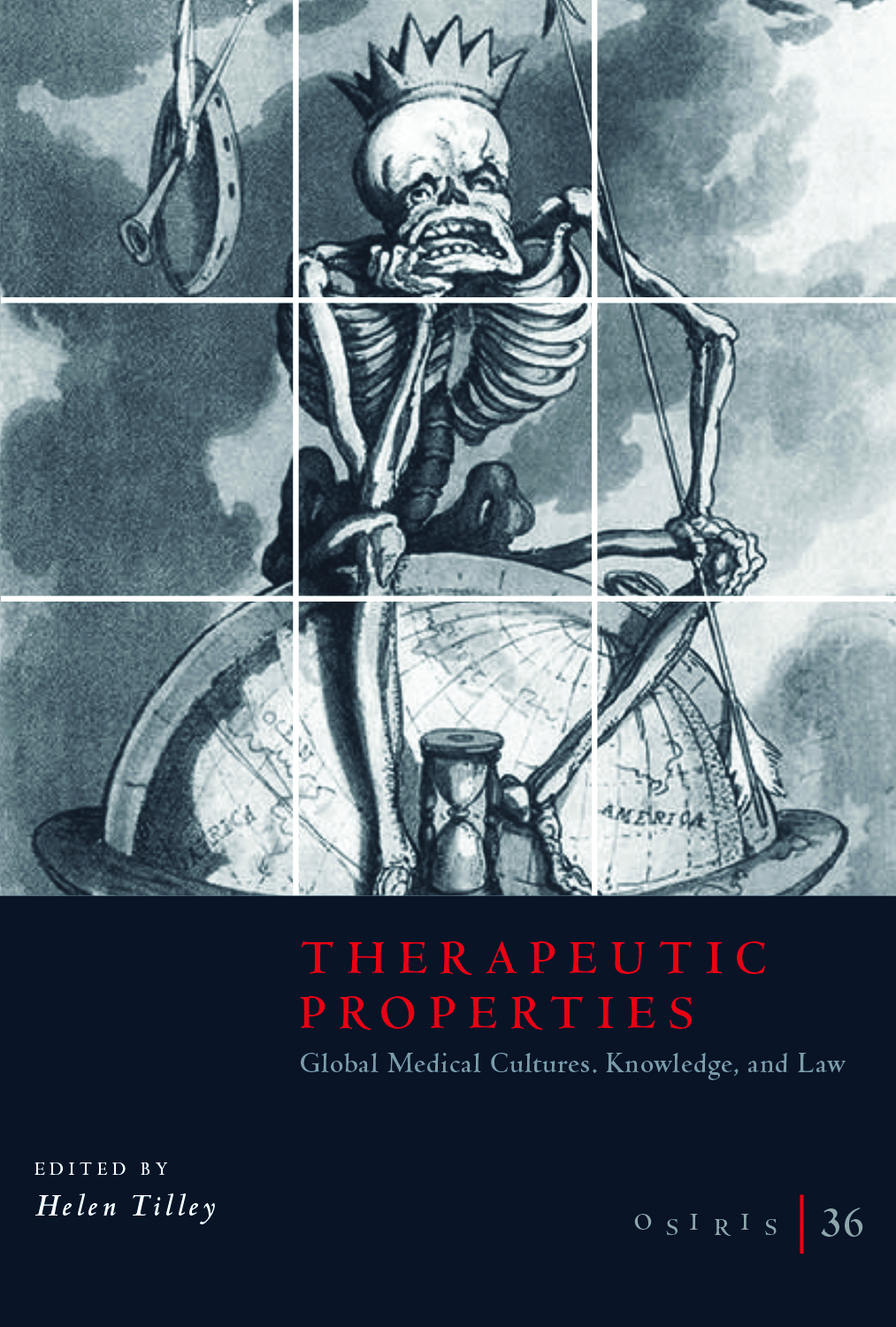
 Osiris, Volume 36:

Therapeutic Properties: Global Medical Cultures, Knowledge, and Law

Edited by Helen Tilley

Published by the University of Chicago Press on behalf of the History of Science Society

This volume of Osiris takes as its point of departure a simple premise: we have yet to fully flesh out the complex historical interplay between medicine and law across the globe. Therapeutic Properties takes an inventive look at the issue, presenting welcome insights on the worldwide ascendancy of biomedicine, the persistence of nonofficial and unorthodox approaches to healing, and the legal contexts that have served to shape these dynamics.

The contributions draw upon source material from the Americas, Africa, Western Europe, the Caribbean, and Asia to trace the influence of penal and civil codes, courts and constitutions, and patents and intellectual properties on not only health practices, but also the very foundations of state-sanctioned medicine. The authors explore, too, how institutions of global governance, including those underpinning empires and trade, have historically created feedback loops that enabled laws and regulatory regimes to spread, amplifying their effects and standardizing approaches to diseases, drugs, professions, personhood, and well-being along the way. Highlighting the payoff of interdisciplinary and transnational analyses, Therapeutic Properties adroitly teases apart how different actors fought to write the rules of global health, rendering certain approaches to life and death irrelevant and invisible, others pathological and punishable by law, and others still, normal and natural.

Table of Contents after the jump:

Friday, April 9, 2021

Houser's "Bureaucrats of Liberation"

Myra Ann Houser, Associate Professor of History, Ouachita Baptist University, has published Bureaucrats of Liberation: Southern African and American Lawyers During the Apartheid Era (Leiden University Press, distributed by the University of Chicago Press, 2021):

Bureaucrats of Liberation
narrates the history of the Southern Africa Project of the Lawyers’ Committee for Civil Right under law, a civil rights organization founded in 1963 at the request of President John F. Kennedy. Between 1963 and 1994, the Southern Africa Project connected lawyers from Namibia, South Africa, and the United States. Within the Project’s network, activist lawyers exchanged funding resources, provided logistical support for political trials, and mediated new voting and governmental systems.

The Project’s history provides a lens into twentieth century geopolitics tied to anti-apartheid, decolonization, Cold War, and movements agitating against white supremacy. In doing so, it pays careful attention to the Project’s different eras, beginning with US Executive Branch officials helming the effort and evolving into a space where more activist-oriented attorneys on both sides of the Atlantic drove its mission and politics.

--Dan Ernst

Tuesday, April 6, 2021

Global Forensic Histories Workshop

A group of historians of law, medicine, and science came together for a virtual workshop in March 2021. The Global Forensic Histories Workshop was co-organized by Binyamin Blum (UC Hastings Law) and our blogger Mitra Sharafi (University of Wisconsin Law School). It was co-sponsored by UC Hastings Law, UW Law School, and the American Society for Legal History. 

Here is the line-up of papers:

Day 1 (Chair: Binyamin Blum)

Khaled Fahmy (University of Cambridge), “Forensic Medicine in nineteenth- century Egypt”

  • Mina Khalili (New York University), “Redefining Criminal Evidence”

Susanna Blumenthal (University of Minnesota), “Toward a Genealogy of the Pathological Liar”

Mitra Sharafi (University of Wisconsin–Madison), “Planted Poison and Wrongful Convictions”

Ian Burney (Manchester University), “A History of Innocence: Erle Stanley Gardner, the Court of Last Resort, and the Pursuit of Wrongful Conviction in Post-war America”

Day 2 (Chair: Mitra Sharafi)

Projit Mukharji (University of Pennsylvania), “Psychic Detectives: Occult technologies and braided forensics in the British Raj”

Keren Weitzberg (University College London), “White Backlash”

Claire Cage (University of South Alabama), “Reproductive Bodies and Forensic Medicine in Modern France”

Catherine Evans (University of Toronto), “Burning Bodies and Medico- Legal Expertise in Nineteenth-Century Britain”

Binyamin Blum (University of California, Hastings), “Forensic Culture in the Age of Empire: How Colonialism Shaped the Forensic Sciences”

Chris Hamlin (University of Notre Dame), “The severing of forensic medicine from public health”

The group shared meals at the end of each day using Uber Eats and SpatialChat.

--Mitra Sharafi

Wednesday, March 31, 2021

Welcome, Samuel Fury Childs Daly!

 We are delighted to welcome our guest blogger for the month of April: Samuel Fury Childs Daly (Duke University). 

Professor Daly is a historian of twentieth-century Africa. His research combines the methods of legal, military, and social history to examine the post-independence period in both West and East Africa. He is the author of A History of the Republic of Biafra: Law, Crime, and the Nigerian Civil War (Cambridge University Press, 2020), a study of the Biafra War (1967-70). Using an original body of legal records from the secessionist Republic of Biafra, the book looks at how technologies, survival practices, and moral ideologies emerging from the fighting shaped how crime was practiced and perceived after Biafra's defeat. Connecting the violence of the battlefield to violent crime, it sheds new light on law and politics in Africa after colonialism. 

Prof. Daly's current project is a transnational history of military desertion over the longue durée. From desertion in 17th-century Kongo armies to the African experience in the world wars, this project reveals how leaving the battlefield could be a productive act. At many points in African history, deserters founded communities, created new social orders, and generated fresh ideas about honor and obligation. 

Prof. Daly's other research interests include the global history of drug trading, customary law in the British empire, and the history of policing and prisons.

Welcome, Professor Daly!

--Mitra Sharafi

Friday, January 29, 2021

Van Hulle's "Britain and International Law in West Africa"

Inge Van Hulle, Tilburg University, has just published Britain and International Law in West Africa: The Practice of Empire (Oxford University Press).  The book appears in the OUP series, The History and Theory of International Law.  Here is the abstract:

Africa often remains neglected in studies that discuss the historical relationship between international law and imperialism during the nineteenth century. When it does feature, focus tends to be on the Scramble for Africa, and the treaties concluded between European powers and African polities in which sovereignty and territory were ceded. Drawing on a wide range of archival material, Inge Van Hulle brings a fresh new perspective to this traditional narrative. She reviews the use and creation of legal instruments that expanded or delineated the boundaries between British jurisdiction and African communities in West Africa, and uncovers the practicality and flexibility with which international legal discourse was employed in imperial contexts. This legal experimentation went beyond treaties of cession, and also encompassed commercial treaties, the abolition of the slave trade, extraterritoriality, and the use of force.

The book argues that, by the 1880s, the legal techniques that were fashioned in the language of international law in West Africa had largely developed their own substantive characteristics. Legal ordering was not done in reference to adjudication before Western courts or the writings of Western lawyers, but in reference to what was deemed politically expedient and practically feasible by imperial agents for the preservation of social peace, commercial interaction, and humanitarian agendas.

--Dan Ernst