Showing posts with label Prisons. Show all posts

Friday, May 22, 2026

Reynolds on the Federal Judiciary and Prison Administrators

Con Reynolds, Counsel to the Chair, U.S. Sentencing Commission, has posted The Original Role of Article III in Federal Imprisonment.  The article is forthcoming in the University of Pennsylvania Law Review:

Since the late 1970s, the Supreme Court has pushed federal courts to defer to prison administrators. This deferential attitude and its justifications-namely, administrator expertise, the limited rights of prisoners, and the separation of powers-are packaged in a protective layer of history and tradition, with the Court framing deference as a return to Article III's original "hands-off" role in prison affairs. This approach has exposed countless people to abuse and neglect behind bars, especially those living in the nation's largest prison system: the Federal Bureau of Prisons. 

This Article challenges this deferential attitude and its underpinnings by recovering Article III's historical place in federal imprisonment. It unearths forgotten statutes and case law that authorized early federal courts to oversee and modify conditions of federal confinement. And by mining digital newspaper archives, it recovers over 650 instances of Article III playing this interventionist role from the Founding through the mid-20th century. Beneath these powers and practices lay the belief that Article III's core function was to set a floor and a ceiling of life and liberty behind bars for those it imprisoned. 

These findings upend justifications for judicial deference to prison administrators, especially in the federal context. Article III's original role, in theory and in practice, was to cabin federal prison administrator discretion, rather than affirm it. This role reflected ideas opposite the ones animating deferential attitudes today-namely, that incarcerated people and the state incarcerating them owe duties to one another, courts have special expertise in defining and enforcing those duties, and their doing so both respects the separation of powers and fulfills its end of thwarting tyrannical concentration of power.

--Dan Ernst 

Thursday, April 9, 2026

Ritger's "Houses of Correction"

Matthew Ritger, Dartmouth College, has published Houses of Correction: Carceral Institutions and Humanist Culture in Early Modern England (University of Pennsylvania Press):

More than 250 years before the rise of the modern penitentiary, houses of correction pioneered the use of forced labor and individualized sentences within institutions of confinement, promoting reform and the “hope of amendment” for every individual. Yet these earlier carceral institutions faced many of the problems that remain familiar today: corruption scandals, recidivism, and abuses of power.

In Houses of Correction, Matthew Ritger turns to the archives of England’s first house of correction, Bridewell, to show how humanist reformers provided ideas, justifications, and administration for what came to be called bridewells, workhouses, and “Literary worke-houses,” even as repeated scandals made it clear that these coercive institutions would forever be at odds with the ideals of humanist culture. Examining how the work of writers including More, Shakespeare, and Milton dealt with humanism’s entanglements with these new prisons, Houses of Correction constructs the first book-length literary history of some of early modern Europe’s most influential carceral institutions. 

--Dan Ernst 

Friday, January 16, 2026

Resnick's "Impermissible Punishments"

Judith Resnik, Yale Law School, has published Impermissible Punishments: How Prison Became a Problem for Democracy (University of Chicago Press):

Impermissible Punishments explores the history of punishment inside prisons and how governments grappled with obligations to justify the punishments they impose. Legal scholar Judith Resnik charts the creation of the corrections profession and weaves together the stories of people who made rules for prisons and the stories of those living under the resulting regimes.

Resnik maps three centuries of shifting ideas, norms, and legal standards aiming to draw lines between permissible and impermissible punishments. Her account documents the impact of World War II, the United Nations, the US Civil Rights movement, and the pioneering prisoners who insisted that law should protect their individual dignity. Taking us to the present, Resnik analyzes the expansion of imprisonment, the inability of public and private prisons to provide safe housing, and the impact of abolition politics.

Exploring the interdependency of people in and out of prisons, Impermissible Punishments examines what governments committed to equality owe to the people they detain and argues that many contemporary forms of punishment need to end. 

UCL Faculty of Laws will host an impressive book launch on May 14.  Also, horrifically, this.

--Dan Ernst 

Wednesday, September 24, 2025

JAH 112:2

[The latest issue of the Journal of American History, 112:2 (September 2025), includes much legal history.  Here’s the JAH’s summary.  DRE]

In recent years, sociologists have noted how the aggressive policing of small debts such as unpaid parking tickets contributes to the disproportionate incarceration of poor people and people of color. Justin T. Clark demonstrates how, centuries ago, debt played a similarly underappreciated role in the development of North American carceral punishment. Surprisingly, most early eighteenth-century prisoners in Boston were debtors, not criminals. After a series of evangelical religious awakenings, New England authorities began to imagine that imprisonment could serve a punitive (and not simply a procedural) function for criminals as well. This history may help us better understand the conditions leading to what legal historians have called the present “re-establishment” of debtor’s prisons.

Emancipated mothers whose children had been apprenticed against their wishes challenged those apprenticeships in the courts and enlisted the assistance of the Freedmen’s Bureau through the late 1860s. While the immediate goal was child recovery, freedwomen’s protests of apprenticeship marked a pursuit of long-denied reproductive justice rather than just an effort to contend with an individual act of kidnapping. By placing Black mothers at the center of postwar custody battles, Jessica Wicks-Allen illuminates how gender shaped the fight for family integrity in slavery’s aftermath and underscores the political and emotional stakes of reunion.

Nicole Martin encourages historians to view Reconstruction from an unexpected perspective: western boardinghouses of Nevada’s Comstock Lode. While western mining centers lay on the fringes of the consolidating nation, they provide a powerful lens for understanding how the idealized free-labor home at the heart of Reconstruction policy played out in rapidly industrializing economies struggling to reconcile older and newer values. By drawing on the private and public writings of people who lived in and ran Comstock boardinghouses, she insists that we turn our view of Reconstruction inward into the intimate lives of ordinary Americans to better understand the on-the-ground compromises that contributed to the success of American empire.

Crack cocaine cast a long shadow over the 1980s. While much is known about the carceral efforts to curb the drug’s influence, far less is understood about the urban political economy driving its spread. Pedro A. Regalado examines the rise of drug capitalism in New York City, revealing how long-simmering tensions in the city’s rental housing market created an opening for an illegal enterprise that extracted profit from buildings that landlords had struggled to exploit. Tenants fought back, defending the habitation value of housing and forging new alliances with police, housing courts, and elected leaders—a pattern that took hold nationwide.

Monday, August 18, 2025

Graham on the Forgotten History of Prison Law

Wynne Muscatine Graham, Lecturer in Law, UCLA, has published The Forgotten History of Prison Law: Judicial Oversight of Detention Facilities in the Nation's Early Years in the Harvard Law Review 138 (May 2025): 1716-1768:

Walnut Street Prison (wiki)
Prison law is characterized by judicial deference to penal administrators. Despite the well-documented horrors that occur behind prison walls, federal and state courts often decline to intervene, asserting, among other things, that prisoners’ rights are limited and that the judicial branch lacks the power and expertise to get involved in the inner workings of detention facilities. Moreover, jurists often assume that the nation’s first courts largely stayed out of prisons and jails, and contemporary judicial deference is therefore historically rooted.

This Article complicates that historical narrative. It shows that the nation’s Founding generation established an expansive system of judicial oversight over prisons and jails that lasted through much of the nineteenth century. During that period, state and local judges across the fledgling republic conducted regular inspections of detention facilities; set prison and jail rules and policies; appointed, removed, and occasionally served as penal administrators; managed the funding and building of jail facilities; and remedied abuses. On occasion, federal courts also interceded on behalf of prisoners.

Relying on neglected state statutes, case law, and reports, as well as the writings of prison theorists and observers, this Article explores the oft-ignored history of American prison law. In so doing, this Article shows how far modern courts have diverged from their early predecessors, especially at the state and local levels. For jurists - and particularly originalists - who use history to inform contemporary doctrine, this Article provides a fuller account of the early relationship between courts and prisons. Finally, this Article reveals a model of judicial oversight from which scholars and advocates can learn.

--Dan Ernst 

Monday, November 18, 2024

ASLH Jane Burbank Global Legal History Prize to Balakrishnan

Continuing our round-up of the prizes and award announced at the recent meeting of the American Society for Legal History, we turn now to the Jane Burbank Global Legal History Prize. About the prize: 

The Jane Burbank Article Prize in global legal history will be awarded annually to the best article in regional, global, imperial, comparative, or transnational legal history published in the previous calendar year. Submissions may address any topic or period, and may focus on case studies in which the analysis relates to broader processes or comparisons. 
This year's award went to Sarah Balakrishnan (Duke University) for “Prison of the Womb: Gender, Incarceration, and Capitalism on the Gold Coast of West Africa, c. 1500–1957,” Comparative Studies in Society and History 65:2 (2023): 296-320. The citation:

This stunningly original article challenges several dominant tendencies in the global history of prisons, particularly a persistent focus on male incarceration and an emphasis on penal practices of the colonial state. Through careful analysis of a wide range of sources, including testimony of female prisoners, Balakrishnan tells a radically new story. It centers on the incarceration of women in so-called native prisons in nineteenth-century colonial Gold Coast (southern Ghana). The phrase “prison of the womb” describes a startling pattern: captive women were threatened with impregnation in efforts to urge dept repayment and tort settlement by kin groups. Palm oil merchants targeted women and utilized the punishment to enforce collection of payments on loans and amass capital. The committee was deeply impressed by the originality of the article, its deft combination and close interpretation of varied sources, and its broader significance for the regional and global history of carceral politics and practices.

The prize committee awarded an honorable mention to Max Mishler (University of Toronto) for “‘Improper and Almost Rebellious Conduct’ Enslaved People’s Legal Politics and Abolition in the British Empire,” American Historical Review, 128:2 (2023): 648–684.

Congratulations to Professor Balakrishnan and Professor Mishler!

-- Karen Tani

Monday, May 6, 2024

Meyn on Convict Leasing

Ion Meyn, University of Wisconsin Law School, has posted White-on-Black Crime: Revisiting the Convict Leasing Narrative, which is forthcoming in the Wisconsin Law Review:

Between 1880 and 1915, the Southern criminal legal system enslaved and re-enslaved legally emancipated Black persons. Under the conventional account of this period, the law facilitated and legitimatized these practices, however odious and racially discriminatory. This view—one that critiques as it accepts the legality of the system—provides an explanation for a significant number of cases in which a Black person was convicted and sent to forced labor.

And yet, there is growing evidence that many convictions were not facilitated by law but rather the result of criminal conspiracies to traffic Black victims. County-level arrest data indicates “convictions” occurred in lockstep with the labor demands of businesses that contracted with local state actors. Numerous personal accounts from victims and their families indicate that arrests occurred in the absence of any criminal suspicion. This empirical data suggests many Black “convicts” were instead victims of human trafficking. Because completing these White-on-Black crimes required coordination among multiple parties, a criminal conspiracy was formed that implicated White participants in kidnapping, false imprisonment, perjury, peonage, reckless endangerment, and reckless homicide.

This Essay examines archival evidence that suggests the criminal trafficking of Black men was a common, if not widespread, practice between 1880 to 1915. Under this alternative view the term “convict leasing” is over-inclusive and mislabels these victims of human trafficking. Under the alternative view the historical Black crime rate is not only inflated but fabricated; conversely, the historical White crime rate omits a significant amount of criminal activity. This alternative view centers the criminal conduct of White beneficiaries, inviting a close accounting of their crimes and ill-gotten gains.
--Dan Ernst

Saturday, February 17, 2024

Weekend Roundup

  • Now on YouTube: the National Constitution Center’s panel on “the history of the African American fight for freedom during the Civil War and Reconstruction periods”  Edda Fields-Black and James Oakes were panelists.  Thomas Donnelly of the NCC moderated.
  • The Union County Board of County Commissioners is hosting Gibbons v. Ogden: Its Continuing Importance 200 Years Later with Edward Hartnett, Seaton Hall, on Tuesday, March 4th from 12:30 p.m. until 1:30 p.m. "at the Courtroom of Honorable Lisa Miralles Walsh (A.J.S.C.) on the 1st Floor Tower of the Union County Courthouse, located at 2 Broad Street, Elizabeth." 
  • Last semester, in the  course titled “Research Methods in Judicial History,” Yale students "had the opportunity to delve into the working papers of former Supreme Court Justice Potter Stewart ’37 LAW ’41 (Yale Daily News).
  • This season in the Institute for Justice's podcast series Bound by Justice is devoted to property cases, including "a tour of the house at issue in Pennsylvania Coal v. Mahon" and three pods on the history of zoning."
  • ICYMI: "Of Course Presidents Are Officers of the United States," says Mark Graber (The Atlantic).  Mug commemorating real-life crime 1823 style flies to 10 times estimate (Antiques Trades Gazette).  John Q. Barrett on Cardozo's quip (SSRN). How a 1924 Immigration Act Laid the Groundwork for Japanese American Incarceration: An Interview with Mae Ngai (Smithsonian).

Weekend Roundup is a weekly feature compiled by all the Legal History bloggers.

Monday, December 25, 2023

Post-Doc on Policing and Carcerality at the University of Minnesota

 [We have the following announcement.  DRE.]

The Andrew W. Mellon Foundation Sawyer Seminar on “Just Policing: Transnational Perspectives on the Definition and Possibility of Justice in Law Enforcement,” housed at the Institute for Advanced Study (IAS) at the University of Minnesota, invites applications for a post-doctoral fellow in the 2024-2025 Academic Year. The successful candidate will have a research agenda that is concerned with policing and/or carcerality broadly conceived.

The majority of the fellowship time is devoted to research and writing in line with the fellow’s research agenda. Fellow will be expected to participate in Sawyer Seminar and IAS Fellow activities, and to present their research to the seminar; assist graduate seminar and mentor graduate students in connection to the seminar; engage with seminar participants and visiting scholars; and lead panel discussions and small group meetings.

Qualifications.  

  • Ability to be in residence on the Twin Cities campus of the University of Minnesota for the period of the fellowship. The postdoctoral fellow is expected to attend in-person meetings and events at the IAS several times a week
  • Ph.D. or other doctoral degree (including J.D.) completed by August 15, 2024 and no earlier than 2019
  • Scholarly background in areas related to policing, the criminal legal system, or carcerality
  • Excellent writing and analytical skills

This is a full-time, 9-month position and is funded for one year. The salary is $62,000 with a comprehensive benefits package. Start date is August 28, 2024.  Applications received before January 15, 2024 will receive priority consideration. Notification is in early spring. Applications are submitted through the University of Minnesota’s Employment System. Search for job #359021.

Applications must include:

  • Cover letter discussing your background in policing or carceral studies and interests in engaging with the seminar
  • Completed application form (see below)
  • Curriculum Vitae
  • A research proposal describing what you would do during the fellowship year and how it articulates with the Sawyer Seminar description; this should include a statement of the problem you will investigate, the methods you will use to investigate it, and the significance of your research (1,400 words maximum)
  • Writing sample (one published article or book chapter, or a work in progress)
  • One confidential letter of recommendation sent to IAS by the recommender. Letter should be sent directly to Susannah Smith at slsmith@umn.edu. The subject line should read “Sawyer recommendation: [applicant’s name]”slsmith@umn.edu

Saturday, August 20, 2022

Weekend Roundup

  • "Although the U.S. Congressional Record has been in a digital format for some time, a version that can easily be searched is now available on an online platform—offered by the Brigham Young University J. Reuben Clark Law School"  (ABA Journal).  For all of BYU Law's legal corpora: this.
  • Andrew Delbanco, the Alexander Hamilton Professor of American Studies at Columbia University, will deliver the 2022 Jefferson Lecture in the Humanities, entitled, “The Question of Reparations: Our Past, Our Present, Our Future,” on October 19, 2022, “at President Lincoln’s Cottage historic site and museum in Washington, D.C., at 6:30 p.m. The lecture is free and open to the public and will stream online [here.] In his remarks, Delbanco will address reparations for slavery in the United States, using history, philosophy, and literature to examine a wide range of perspectives on the debate.”
  • “The New Haven Museum will commemorate Connecticut Freedom Trail Month with a virtual presentation, ‘Uncovering Their History: African, African American, and Native American Burials in Hartford’s Ancient Burying Ground, 1640-1815,’ by historian, educator, author, and recently named publisher of Connecticut Explored magazine, Dr. Katherine A. Hermes, on Wednesday, September 14, 2022, at 6 p.m. Register here" (Patch).
  • Two Trinity College students spent ten weeks this summer researching “the stories of inmates at the country’s first state prison and to investigate the roots of mass incarceration” for their project, ‘Humanizing History at Old New-Gate Prison’” (More).
  • A notice of Dame Priscilla Olabori Kuye, “the first and only woman to become the President of the Nigerian Bar Association” (The Nigerian Lawyers).
  • ICYMI: From Poison Control Statutes to Pope Pius IX: The History of Anti-Abortion Law, by Elisabeth Griffith (Literary Hub).  Seth Barrett Tillman, Maynooth University School of Law and Criminology, questions a reference to the British Conservative politician John Enoch Powell (SSRN).  DRE.  David Adler on John Marshall Harlan's imperishable Plessey dissent (NLJ).
 Weekend Roundup is a weekly feature compiled by all the Legal History bloggers.

Monday, June 13, 2022

Rawlings on a Thieftaker and Gaoler

Philip Rawlings, Queen Mary University of London, School of Law, has posted The Highwayman's Case: John Everett - Soldier, Robber, Publican, Gaoler:

Of the two parties named in The Highwayman's Case, only John Everett (or Everet) has left a significant trace. Born in Hitchin in 1690, he abandoned his wife and an apprenticeship in around 1709, becoming a soldier, then a court bailiff, a robber, an informer, an alehouse keeper, an inmate of the Fleet prison, a gaoler, a thieftaker, and, finally, around the age of 40, he returned to robbery, was arrested, convicted, and executed. His life provides insights into the relationship between criminals and the justice system. In the 1720s, when Everett was active, the authorities became increasingly concerned about gangs of robbers believed to be infesting London, and breaking these gangs meant depending on robbers like Everett giving evidence against their former comrades. But it was his work as a keeper in the Fleet prison that made him notorious. He was brought before the first parliamentary inquiry into the prisons, and, although never prosecuted, his involvement in the abuse of prisoners brought the financial ruin that, according to Everett, led him to commit his final robbery.

--Dan Ernst

Saturday, September 11, 2021

Weekend Roundup

  • Over at Talking Legal History, Siobhan M. M. Barco talks with former LHB Guest Blogger Samuel Fury Childs Daly “about his J. Willard Hurst Prize winning book A History of the Republic of Biafra: Law, Crime, and the Nigerian Civil War (Cambridge University Press, 2020). Daly is Assistant Professor of African and African American Studies and History at Duke University."

  • The Bristol Centre for Law and History Research welcomes Dr Andrew J. Bell, a lecturer at the University of Bristol Law School.  "His research focuses on the law of obligations, comparative law and – excitingly for us! – comparative legal history.”  More.
  • Over at the LPEBlog, the symposium on Destin Jenkins' Bonds of Inequality continues.
  • ICYMI: Relocating the grave of a leading Tennessee lawyer (Tennessean).  “A rock star of local theater will help tell the stories of enslaved people in Prince George’s County, Maryland, who successfully filed lawsuits in the 1700s that led to their freedom” (WTOP).

 Weekend Roundup is a weekly feature compiled by all the Legal History bloggers.

Tuesday, January 19, 2021

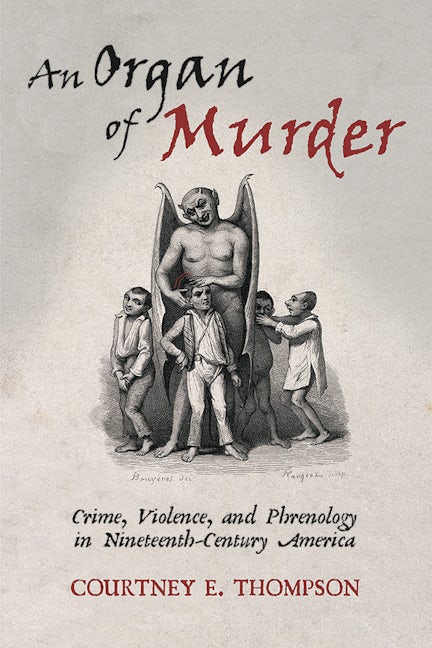
Thompson on crime, violence, and phrenology

Courtney E. Thompson (Mississippi State University) has published An Organ of Murder: Crime, Violence, and Phrenology in Nineteenth-Century America with Rutgers University Press. From the publisher: 

An Organ of Murder explores the origins of both popular and elite theories of criminality in the nineteenth-century United States, focusing in particular on the influence of phrenology. In the United States, phrenology shaped the production of medico-legal knowledge around crime, the treatment of the criminal within prisons and in public discourse, and sociocultural expectations about the causes of crime. The criminal was phrenology’s ideal research and demonstration subject, and the courtroom and the prison were essential spaces for the staging of scientific expertise. In particular, phrenology constructed ways of looking as well as a language for identifying, understanding, and analyzing criminals and their actions. This work traces the long-lasting influence of phrenological visual culture and language in American culture, law, and medicine, as well as the practical uses of phrenology in courts, prisons, and daily life.

 Praise for the book:

"Courtney Thompson provocatively measures the face, head, and soul of American phrenology and invites us to a discovery of the historical origins of scientific criminology." - Stephen Casper

"In this compelling book, Courtney Thompson takes readers to the prisons, courtrooms, and streets of antebellum cities to expose just how phrenology claimed authority on criminality. Rich in detail and analysis, An Organ of Murder vividly illustrates the long history of making criminal minds and bodies into objects of medical and scientific inquiry." - Carla Bittel

Further information is available here.

--Mitra Sharafi

Friday, June 19, 2020

Talking Legal History: Chase's "We Are Not Slaves"

A new episode of Talking Legal History, a podcast hosted by Siobhan M. M. Barco, is now up on the website of the American Society of Legal History.
In this episode, Siobhan talks with Robert Chase about his book, We Are Not Slaves: State Violence, Coerced Labor, and Prisoners’ Rights in Postwar America (University of North Carolina Press, 2020). Chase is Associate Professor of History at Stony Brook University.

In We Are Not Slaves, Chase draws from three decades of legal documents compiled by prisoners to narrate the struggle to change prison from within. Told from the vantage point of the prisoners themselves, this book weaves together untold but devastatingly important truths from the histories of labor, civil rights, and politics in the United States as it narrates the transition from prison plantations of the past to the mass incarceration of today.

This episode is part of a series featuring legal history works from UNC Press. Support for the production of this series was provided by the Versatile Humanists at Duke program.
--Dan Ernst

Tuesday, February 25, 2020

Adam and friends on crime and forensic objectivity

Alison Adam (Sheffield Hallam University, UK) has edited Crime and the Construction of Forensic Objectivity from 1850, now out with Palgrave Macmillan (2020). From the press:
coverThis book charts the historical development of "forensic objectivity" through an analysis of the ways in which objective knowledge of crimes, crime scenes, crime materials and criminals is achieved. Taking an interdisciplinary approach, with authors drawn from law, history, sociology and science and technology studies, this work shows how forensic objectivity is constructed through detailed crime history case studies, mainly in relation to murder, set in Scotland, England, Germany, Sweden, USA and Ireland. Starting from the mid-nineteenth century and continuing to the present day, the book argues that a number of developments were crucial. These include: the beginning of crime photography, the use of diagrams and models specially constructed for the courtroom so jurors could be "virtual witnesses," probabilistic models of certainty, the professionalization of medical and scientific expert witnesses and their networks, ways of measuring, recording and developing criminal records and the role of the media, particularly newspapers in reporting on crime, criminals and legal proceedings and their part in the shaping of public opinion on crime. This essential title demonstrates the ways in which forensic objectivity has become a central concept in relation to criminal justice over a period spanning 170 years.
Chapter line-up after the break:

Tuesday, February 18, 2020

Bratz on Gold Coast Prisons in BC Legal History Roundtable

Erin Braatz, Suffolk Law School, will present in the of the Boston College Legal History Roundtable Thursday, February 27, at 4:30 in BC Law’s Rare Book Room.  (Refreshments are available starting at 4:15 pm.)  Professor Bratz will be presenting “Civilization & Sovereignty: The Birth of the ‘Native’ Prison”:
This paper describes the rise of so-called “native” prisons on the Gold Coast of Africa in the mid-nineteenth century (present-day Ghana) and argues that these prisons arose out of jurisdictional struggles between British colonial officials and indigenous leaders on the coast.  It then situates these struggles within the history of the global spread of the prison during the nineteenth century, contending that the prison played a central role in defining civilization and articulating changing notions of sovereignty.
(Instructions for accessing the paper are in the final paragraph of the website introduction.)

--Dan Ernst

Monday, November 11, 2019

Rubin on early US prison history

Ashley T. Rubin, University of Hawaii Mānoa, Hawaiʻi has published "Early US Prison History Beyond Rothman: Revisiting The Discovery of the Asylum" in the Annual Review of Law and Social Science 15 (2019), 137-54. Here's the abstract:
David J. Rothman's The Discovery of the Asylum, one of the first major works to critically interrogate the beginning of America's extensive reliance on institutionalization, effectively launched the contemporary field of prison history. Rothman traced the first modern prisons’ (1820s–1850s) roots to the post-Revolution social turmoil and reformers’ desire for perfectly ordered spaces. In the nearly 50 years since his pioneering work, several generations of historians, inspired by Rothman, have amassed a wealth of information about the early prisons, much of it correcting inaccuracies and blind spots in his account. This review examines the knowledge about the rise of the prison, focusing on this post-Rothman work. In particular, this review discusses this newer work organized into three categories: the claim that prisons were an invention of Jacksonian America, reformers’ other motivations for creating and supporting prisons, and the frequently gendered and racialized experiences of prisoners. The review closes by reflecting on the importance of prison history in the contemporary context and suggesting areas for future research.
 Further information is available here.

--Mitra Sharafi

Monday, October 28, 2019

Morieux on 18th-century prisoners

Due out in November 2019 by Renaud Morieux, University of Cambridge is The Society of Prisoners: Anglo-French Wars and Incarceration in the Eighteenth Century with Oxford University Press. From the publisher:
Cover for 

The Society of Prisoners


In the eighteenth century, as wars between Britain, France, and their allies raged across the world, hundreds of thousands of people were captured, detained, or exchanged. They were shipped across oceans, marched across continents, or held in an indeterminate limbo. The Society of Prisoners challenges us to rethink the paradoxes of the prisoner of war, defined at once as an enemy and as a fellow human being whose life must be spared. Amidst the emergence of new codifications of international law, the practical distinctions between a prisoner of war, a hostage, a criminal, and a slave were not always clear-cut. Renaud Morieux's vivid and lucid account uses war captivity as a point of departure, investigating how the state transformed itself at war, and how whole societies experienced international conflicts. The detention of foreigners on home soil created the conditions for multifaceted exchanges with the host populations, involving prison guards, priests, pedlars, and philanthropists. Thus, while the imprisonment of enemies signals the extension of Anglo-French rivalry throughout the world, the mass incarceration of foreign soldiers and sailors also illustrates the persistence of non-conflictual relations amidst war. Taking the reader beyond Britain and France, as far as the West Indies and St Helena, this story resonates in our own time, questioning the dividing line between war and peace, and forcing us to confront the untenable situations in which the status of the enemy is left to the whim of the captor.
Table of Contents after the jump:

Monday, June 24, 2019

Towards New Histories of Imprisonment in England

We’ve recently learned that the conference Towards New Histories of Imprisonment in England, 1500-1850, will be held July 15-16 at Keble College, University of Oxford.  It is free, although the conference organizers ask attendees to register here.  The program is here; here’s the organizers' description:
The conference brings together historians, criminologists and literary scholars to explore ongoing research into English imprisonment, discuss recent developments in the field, and set out new agendas for the history of prisons and imprisonment. The conference takes an inclusive view of imprisonment, including not only criminal custody and incarceration, but also the imprisonment of debtors, political prisoners and prisoners of war. The papers further encompass the complete range of penal institutions that existed across the sixteenth to nineteenth centuries, beyond the penitentiary, such as lock-ups, roundhouses, compters or counters, gaols, houses of correction or bridewells, prisoner of war camps and prison hulks. Broadly, our speakers seek to explore the role that imprisonment and prisoners played in English social, economic, religious political and legal life.
--Dan Ernst

Wednesday, January 16, 2019

Walker on Structural Racism and Structuralist History

Anders Walker, Saint Louis University School of Law, has posted Freedom and Prison: Putting Structuralism Back into Structural Inequality, which appeared in the University of Louisville Law Review 49 (2011): 267 : “Critics of structural racism frequently miss structuralism as a field of historical inquiry. This essay reviews the rise of structuralism as a mode of historical analysis and applies it to the mass incarceration debate in the United States, arguing that it enriches the work of prevailing scholars in the field. “