Showing posts with label Gender. Show all posts

Friday, May 1, 2026

Rudolph on Colonialism and Blackstone's Family Wealth

Julia Rudolph, North Carolina State University, has published William Blackstone, Family Man: New Contexts in Gender, Jurisprudence, and Jamaica in Law and History Review:

While much has been written about William Blackstone, the jurist, politician, and legal writer, this article provides a critical new understanding of Blackstone, the husband, friend, and investor. It considers Blackstone’s legal and economic actions as well as ideas, analyzing his strategies for managing family wealth and comparing them to the strategies employed by a member of his extended family who was a Jamaican planter. Here, the article contributes to recent scholarship on the global dimensions of English and British legal history. It offers a fuller account of Blackstone’s proximity to the colonial plantation economy by investigating how economic change and imperial controversies impacted his personal and professional life. It also exposes Blackstone’s conventionally masculine bias by detailing the different ways in which he privileged male interests when making personal investment choices and when coming to judicial decisions about women’s property claims. A gendered ideology, which positioned male authority as central to the success of the household, state, and empire, furnished the framework within which Blackstone justified the operation of law and directed his own actions as head of his family. Placing Blackstone’s jurisprudence and experience within the contexts of patriarchy and colonialism, the article sheds new light on this influential figure, showing how he embodied the core features of an eighteenth-century family man and shaped modern ideas about male authority, property, and power.
--Dan Ernst

Wednesday, April 29, 2026

Siegel & Ziegler, "Dismantling Equality Rights Through 'Biological-Sex' Talk"

Reva B. Siegel (Yale Law School) and Mary Ziegler (University of California, Davis) have posted Dismantling Equality Rights Through "Biological-Sex" Talk, which is forthcoming in Volume 105 of the Texas Law Review. The abstract:

In rejecting the sex-discrimination claims of transgender claimants in United States v. Skrmetti (2025), the Supreme Court introduced a new term for sex into equal protection law: “biological sex.” The Court made clear its view that laws recognizing biological-sex differences warrant judicial deference. Claims on biological sex also appear in the legislation and briefing of West Virginia v. B.P.J. and Little v. Hecox, cases challenging bans on transgender athletes’ participation in girls’ teams under the Constitution and Title IX this Term.

Biological sex is a movement signature—the fingerprint of advocates who are supplying the Supreme Court with resources for the stealth overruling of United States v. Virginia (1996), Justice Ginsburg’s opinion for the Court explaining the Constitution’s guarantees against sex discrimination (which judges apply in cases of discrimination on the basis of sexual orientation and gender identity, as well). We trace the usage of biological sex to the declarations, bills, and briefs of faith-identified social conservatives who mobilized against LGBT victories in Obergefell v. Hodges and Bostock v. Clayton County and under Title IX. Represented by advocates such as Alliance Defending Freedom (ADF) and Heritage Foundation, these Americans are now seeking reversal of constitutional and civil rights of other Americans as contrary to nature and divine command.

Conflict over transgender rights is tied to conflict over sexual orientation and gender roles in overt and subterranean ways, as this Article shows. The idiom of biological sex draws upon physiological naturalism—traditions of reasoning from the body—that courts long employed when deferring to laws enforcing gender roles before the rise of sex equality law. 

By following talk of biological sex in state statutes and lower-court cases, we show that the movement is providing resources for the stealth overruling of Virginia as the decision reaches its thirtieth anniversary. Biological sex directs judges to defer to the judgments of the political branches rather than to scrutinize sex-based state action for sex-role stereotyping—a code associating sex difference and judicial deference that revives in contemporary idiom the very traditions of reasoning from the body that United States v. Virginia rejected. 

Read on here.

-- Karen Tani 

Tuesday, January 20, 2026

AHA John K. Fairbank Prize to Sommer

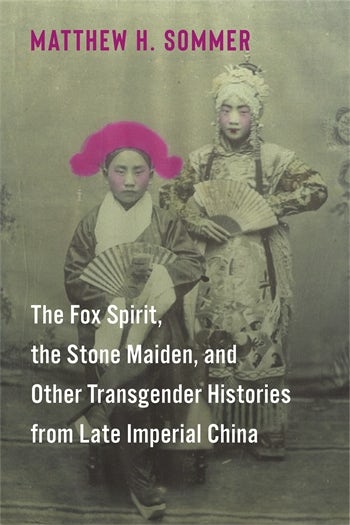
Among the prizes and awards announced at the recent meeting of the American Historical Association was the John K. Fairbank Prize in East Asian History ("offered annually for an outstanding book in the history of China proper, Vietnam, Chinese Central Asia, Mongolia, Manchuria, Korea, or Japan, substantially after 1800"). This year's award went to legal historian Matthew H. Sommer (Stanford University) for The Fox Spirit, the Stone Maiden, and Other Transgender Histories from Late Imperial China (Columbia Univ. Press, 2024). The citation:

Matthew H. Sommer’s The Fox Spirit, the Stone Maiden, and Other Transgender Histories from Late Imperial China is a landmark study that recovers the hidden lives of gender-nonconforming individuals through meticulous archival research. By combining legal, medical, and literary sources with a nuanced transgender framework, Sommer broadens the field of modern East Asian history, illuminating how embodiment, identity, and social practice shaped Qing society and redefining global conversations about gender and modernity.

Congratulations to Professor Sommer!

-- Karen Tani 

Friday, December 12, 2025

ASLH Burbank Article Prize to Fei

Continuing with our notices of the awards, prizes, and fellowships announced at the recent meeting of the American Society for Legal History, we turn now to the Jane Burbank Global Legal History Article Prize. About this prize

The Jane Burbank Article Prize in global legal history will be awarded annually to the best article in regional, global, imperial, comparative, or transnational legal history published in the previous calendar year. Submissions may address any topic or period, and may focus on case studies in which the analysis relates to broader processes or comparisons. Articles on methodological or theoretical contributions are also welcome.

The 2025 Burbank Prize winner was Du Fei (University of Oklahoma), for “Fatima’s Inheritance: Law, Islam, and Gendered Archive-Making in India’s Early Modern Global Connections,” Past and Present 266:1 (2025): 40-74. The citation:

In this piece, Du uses a source long familiar to South Asianists—a collection of letters and documents which includes a short account of a court case between a free Muslim woman and enslaved people she owned, conducted in multiple legal fora across the Indian Ocean—to ask new questions. Du considers the case at three levels: the case summary itself and its process, in a pluralistic legal world where “Islamic law” was central but not hegemonic or monolithic; the way it came to be included in a South Asian manual of different prose genres that usually focused on male actors; and the way that manual itself became an iconic source for western orientalists with their own ideas about gender and Islam. In doing so, he draws on scholarship from multiple fields to show how women in the Indian Ocean world helped “co-produce” legal and archival records, only for their presence to be silenced through the layers of recension that create primary sources in the form they come down to us. Du’s excavation of Fatima’s case can serve as a model for legal historians of any era or region in teasing apart the different gendered actors and social meanings that construct the records we use.

An Honorable Mention went to Rui Hua (Boston University), for “The Cheese, the Worm, and the Law: Grassroots Legal Cosmopolitanism in the Manchurian Borderland, 1906-1927,” Modern Asian Studies 58:4 (2024): 1201-1221.

Congratulations!

-- Karen Tani 


Thursday, December 4, 2025

Classroom Materials on the Supreme Court, 1874-1921

[We have the following announcement from the Supreme Court Historical Society.  DRE]

Rights, Commerce, and Reform: A New Era of Supreme Court History Classroom Resources

Discover Supreme Court History from 1874-1921 with a new era of resources from Beyond the Bench, our civics education website. The new era, Rights, Commerce, and Reform, includes over 20 new case summaries, resources, and life stories from the Waite, Fuller, and White Courts ready for classroom use.

Featured resources include:

  • Justice Oliver Wendell Holmes: The Boston native, Civil War soldier, and Associate Justice whose legal theories revolutionized modern understanding of the law; 
  • Belva Lockwood: The educator, activist, and attorney who became both the first woman to argue before the Supreme Court and to run for President of the United States;  
  • Civil Rights Cases (1883): The Supreme Court decision that held the Civil Rights Act of 1875 to be unconstitutional and paved the way for Plessy v. Ferguson (1896) and Jim Crow segregation; 
  • Muller v. Oregon (1908): The Supreme Court decision that upheld a gender-based state labor law and created a clear legal distinction between men and women in the workplace;  
  • Standard Oil Co. v. United States (1911): The Supreme Court decision that established the “rule of reason” in antitrust law and demonstrated the government’s power to regulate monopolies and increase competition; and  
  • The Judiciary Act of 1891: The law that created the United States Courts of Appeals and helped shape the modern Judiciary.

Friday, November 28, 2025

ASLH Peter Gonville Stein Book Award to Sommer for "The Fox Spirit, the Stone Maiden, and Other Transgender Histories from Late Imperial China"

We are delighted to pass along news of the awards, prizes, and fellowships announced at the recent meeting of the American Society for Legal History, starting with the Peter Gonville Stein Book Award. 

About the award: "The Peter Gonville Stein Book Award is awarded annually for the best book in non-US legal history written in English. This award is designed to recognize and encourage the further growth of fine work in legal history that focuses on all regions outside the United States, as well as global and international history. To be eligible, a book must be published during the previous calendar year." 

This year's award went to Matthew Sommer (Stanford University) for The Fox Spirit, the Stone Maiden, and Other Transgender Histories from Late Imperial China (Columbia University Press, 2024). The citation:


Looking back at a lifelong engagement with Chinese legal history in the Ming and Qing dynasties, with a special focus on gender and sexuality, Matthew Sommer breaks new ground in his most recent book, The Fox Spirit, the Stone Maiden, and Other Transgender Histories from Late Imperial China (Columbia, 2024), uncovering several cases with transpeople who have been hiding in plain sight in the source material. The core of the book is based on routine and palace memorials from the First Historical Archives in Beijing, but Sommer also supplements his deep source base with popular tales about “the strange,” treaty port journals and newspapers, case books, legal codes, and compendia of traditional Chinese medicine. In contrast to his previous two books, which theorized about gender and sexuality based on thousands of legal cases, this book presents a concise series of case studies that identify what Sommer calls “transgender paradigms” in Chinese legal and social history. Among the figures that appear in these microhistories, we encounter a diverse set of gender non-conforming individuals, including eccentric midwives, cross-dressing clergy, unconventional physicians, and fox spirit mediums. One of the most interesting findings of the book is that while magistrates who prosecuted cases against trans people tended to rely on legal provisions banning heterodoxy, they were often confronted with the fact that there were no appropriate statutes that could prosecute cases involving trans people. Instead, they had to resort to interpretations of law that reveal interesting assumptions about gender, the body, law, procreation, and the fear of the unknown. This compelling and generative book is both a deep dive into complex and dense sources as well as a refreshing intervention into several subfields of legal history.

Honorable Mentions went to: Lauren Benton (Yale University) for The Called it Peace: Worlds of Imperial Violence (Princeton University Press, 2024) and to Samuel Fury Childs Daly (University of Chicago) for Soldier’s Paradise: Militarism in Africa after Empire (Duke University Press, 2024).

Congratulations to all the honorees! 

-- Karen Tani  

Monday, November 10, 2025

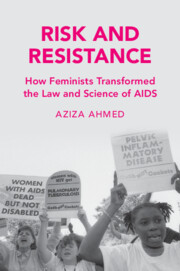
Ahmed, "Risk and Resistance: How Feminists Transformed the Law and Science of AIDS"

Cambridge University Press has published Risk and Resistance: How Feminists Transformed the Law and Science of AIDS, by Aziza Ahmed (Boston University School of Law). A description from the Press:

How did women come to be seen as 'at-risk' for HIV? In the early years of the AIDS crisis, scientific and public health experts questioned whether women were likely to contract HIV in significant numbers and rolled out a response that effectively excluded women. Against a linear narrative of scientific discovery and progress, Risk and Resistance shows that it was the work of feminist lawyers and activists who altered the legal and public health response to the AIDS epidemic. Feminist AIDS activists and their allies took to the streets, legislatures, administrative agencies, and courts to demand the recognition of women in the HIV response. Risk and Resistance recovers a key story in feminist legal history – one of strategy, struggle, and competing feminist visions for a just and healthy society. It offers a clear and compelling vision of how social movements have the capacity to transform science in the service of legal change. 

Praise from reviewers:

"Risk and Resistance: How Feminists Transformed the Law and Science of AIDS is a moving and meticulous study about the grass-roots activists who made visible women’s plight during a time when AIDS treatment and funding were entirely focused on men. The initial definition of AIDS as ‘a gay men’s disease’ led to long-term distributional injustices: the exclusion of women from clinical trials, from disability benefits, and even from being counted in the statistics of its devastation. Aziza Ahmed has crafted a magnificent genealogy of specific organizational strategies that linked individual women into powerful communities of patients, medical researchers, service providers, and litigators. Their advocacy reframed not merely responses to the AIDS crisis but to all subsequent epidemics including COVID. This book is the chronicle of hard-fought interventions that redirected the course of legal and medical history and that transformed social outcomes to the betterment of all." -- Patricia Williams 

"Risk and Resistance is a tour de force. It is the book that was missing from the catalogue about HIV/AIDS and the catastrophic health, legal, and political crises in its wake. In beautiful prose and rich story-telling, Aziza Ahmed corrects the historical record, rewriting women and crucial, feminist activism into the folds of a devastating era in global history. With this book, Professor Ahmed has penned a pathbreaking contribution to law and feminist theory." -- Michele Bratcher Goodwin

More information is available here.

-- Karen Tani  

Friday, August 8, 2025

ASLH's Virtual New Books Series

[Here's another reason to join the American Society for Legal History: Members can virtually participate in this series on great new books in the field.  DRE]

Making Connections: New Works in Legal History Series, 2025-2026 

All sessions will be on Zoom Wednesdays from 6:00-7:00 pm (Central Time).  We will send an email two weeks in advance of each event.  You must RSVP to receive the zoom link.  RSVP messages will be sent to membership approximately 1 week before the event.  ASLH Members can watch videos of previous events on our members page
 
September 17, 2025 – Esther Liberman Cuenca, The Making of Urban Customary Law in Medieval and Reformation England (Oxford University Press, 2025) with interlocutor Sara M. Butler
 
October 22, 2025 – Sonia Gomez, Picture Bride, War Bride: The Role of Marriage in Shaping Japanese America (NYU Press, 2024) & Kathryn Schumaker, Tangled Fortunes: The Hidden History of Interracial Marriage in the Segregated South (Basic Books, 2025)
 
December 10, 2025 – Marla A. Ramírez, Banished Citizens: A History of the Mexican American Women Who Endured Repatriation (Harvard University Press, 2025) with interlocutor Kevin R. Johnson
 
January 21, 2026 – Omar Youssef Cheta, How Commerce Became Legal: Merchants and Market Governance in Nineteenth-Century Egypt (Stanford University Press, 2025) with interlocutor Nurfadzilah Yahaya
 
February 25, 2026 – Tadashi Ishikawa, Geographies of Gender: Family and Law in Imperial Japan and Colonial Taiwan (Cambridge University Press, 2025) with interlocutor Jisoo M. Kim
 
March 25, 2026 – Serena Mayeri, Marital Privilege: Marriage, Inequality, and the Transformation of American Law (Yale University Press, 2025) with interlocutor Margot Canaday
 
April 15, 2026 – Kevin Arlyck, The Nation at Sea: The Federal Courts and American Sovereignty, 1789–1825 (Cambridge University Press, 2025) with interlocutor Alison LaCroix

Tuesday, July 8, 2025

Mayeri, "Marital Privilege: Marriage, Inequality, and the Transformation of American Law"

Yale University Press has published Marital Privilege: Marriage, Inequality, and the Transformation of American Law, by Serena Mayeri (University of Pennsylvania). A description from the Press:

The United States is unusual among wealthy western nations in the degree to which the law channels public benefits and private economic resources through marriage. This remains so despite seismic changes in American family life in the last several decades of the twentieth century. During this period, marriage rates declined while divorce and nonmarital childbearing soared. Social movements—for racial and economic justice, women’s and gay rights and liberation, civil liberties, and reproductive freedom—transformed the legal landscape.
 
In Marital Privilege, Serena Mayeri tells the stories of parents and partners, activists and lawyers who challenged the legal primacy of marriage. They made innovative constitutional claims in courts and launched grassroots efforts to change laws and practices that penalized nonmarital relationships. But even though reforms eliminated the most visible discrimination against women, people of color, and children born to unmarried parents—and, eventually, against gay and lesbian Americans—marriage’s privileged status endured. Because marriage increasingly correlated with education and wealth, marital primacy intensified racial and economic inequality. Marital Privilege explains how, as American law selectively incorporated principles of liberty and equality, the benefits of marriage became increasingly unavailable to those who needed them most.  

Advance praise:

“Serena Mayeri’s hugely ambitious project is to map the changing legal status of marriage from the perspective of single women of color, gays and lesbians, feminists who wanted to reform (or even abolish) marriage, alternative family units, and unmarried fathers, among so many others. While the history of marriage looks different when considered from its edges, Mayeri ultimately demonstrates the resilience of an institution that so many labored to change over decades and decades.  This astonishingly comprehensive and organically intersectional book is a masterpiece that will be influential for years to come.” —Margot Canaday

“Mayeri masterfully shows how legal challenges to marriage over the past several decades made marriage itself more egalitarian but left intact marriage’s dominant legal status and preserved marital status as an engine of inequality.”—Douglas NeJaime

“‘Marriage is everywhere in American law.’ What often goes unnoticed by those who enjoy its manifold benefits and privileges is painfully written on the lives in its shadow. In this brilliant history, Serena Mayeri explains how despite a half century of challenges, marriage remains a key engine in the reproduction of inequality today.”—Barbara Young Welke

More information is available here.

-- Karen Tani 

Saturday, June 21, 2025

Weekend Roundup

  • The Minnesota Supreme Court Historical Society is hosting a one-hour CLE panel, A Dive Into Unitary Executive Theory: Presidential Powers and Limitations, on June 24 from 3-4 CDT in person at the Minnesota Judicial Center.  The panelists are Christine Chabot, Marquette University Law School; Heidi Kitrosser, Northwestern University Pritzker School of Law; and Nick Bednar, University of Minnesota Law School
  • UC Irvine School of Humanities on its alumna, Stanford Law's Bernadette Meyler 
  • Modern Criminal Law Review had a symposium on Chloë Kennedy’s Inducing Intimacy: Deception, Consent and the Law (Cambridge University Press, 2024).  A podcast version is here.
  • ICYMI:  How Much Money Do Historians Make From Their Writing? (Contingent Magazine).  Kate Hampton on a Montana antidiscrimination case from 1881 (Daily Montana).  Manisha Sinha on Lincoln and the abolitionists (Unpopulist). John Yoo on Putting the Executive in "Unitary Executive" (Law & Liberty).  St. Louis's Old Courthouse (Ladue News).

 Weekend Roundup is a weekly feature compiled by all the Legal History bloggers. 

Thursday, May 8, 2025

OAH Binkley-Stephenson Award to Zipf

At its annual meeting in April, the Organization of American Historians awarded the Binkley-Stephenson Award (for "the best article that appeared in the Journal of American History during the preceding calendar year") to Karen L. Zipf (East Carolina University) for "Exposing the Masculinist Narrative in Federal Antislavery Law: A History of U.S. v. Tony Booker (1980)," Journal of American History, 110 (March 2024), 689–714. The citation:

“Exposing the Masculinist Narrative in Federal Antislavery Law: A History of US. V. Tony Booker (1980),” by Karen Zipf (East Carolina University), is a deeply researched and compelling contribution to modern slavery studies, showing that lawyers in the Civil Rights Division of the Department of Justice were trying to apply a gendered lens to U.S. antislavery law. Zipf highlights a missed opportunity to unite antislavery law and anti–sex trafficking law because judges could not overcome their “masculinist” reading of slavery as male, and sex trafficking as female. The lawyers in U.S. v. Tony Booker, the case at this heart of this article, worked hard to show that labor contractors tried to create a “climate of fear” by threatening sexual assault, debt bondage, violence, and death to keep farm workers in bondage. Despite the work of feminist theorists and legal analysts to apply gendered analysis to the language of the Thirteenth Amendment, it was not until the 1990s and later that courts began to recognize sexual violence as an essential component of involuntary labor. Well-grounded in Black feminist theory, legal history, and slavery history, Zipf’s essay will be foundational for scholars assessing slavery after emancipation.

Congratulations to Professor Zipf!

-- Karen Tani 

Monday, March 17, 2025

Self-Contradictory Victory Announcements

Today’s post about my new book, We the Men, focuses on another form of forgetting in America’s dominant stories about itself—forgetting the work the nation still has to do.
As modern Americans, many of us have encountered people who announce or assume that the nation has left the sexist bad old days behind.  Still, I was surprised to discover just how early in American history those premature declarations began appearing and how important a role they have played in perpetuating inequality.
Wildly exaggerated accounts of American progress toward sex equality have been common in both everyday settings and legal institutions since before the Nineteenth Amendment’s 1920 ratification made sex-based disenfranchisement unconstitutional. These declarations are routinely framed in terms of American women universally, although white women have tended to be top of mind.
The stories forget what remains undone, even to the extreme of proclaiming that the United States has already achieved sex equality. For example, a 1918 textbook assured young readers that: “All men and women are regarded as equals before the law.” At the time, thirty-three out of forty-eight states maintained sex-based restrictions on the franchise. Although women had spent decades mobilizing for equality, discrimination against women at work, in marriage, and in every other arena was still legal and pervasive throughout the nation.
Judges have been suggesting or proclaiming that the nation has moved past sex discrimination for almost as long as American women have been mobilizing to challenge male supremacy. In fact, many of the judiciary’s sunniest proclamations about American progress have appeared in decisions denying women equality, as courts rationalize their rejection of women’s claims by insisting that women already have so much.
I call these decisions “self-contradictory victory announcements” because judges boast about America’s embrace of sex equality while simultaneously enforcing male supremacy. While women are not the only marginalized group to have experienced the judiciary’s self-contradictory declarations, cases perpetuating women’s inequality have long been prominent triggers for self-contradiction.
The Supreme Court continued its long tradition of self-contradictory victory announcements in Dobbs v. Jackson Women’s Health Organization (2022). This decision overruled Roe v. Wade (1973) in the course of upholding an anti-abortion law from Mississippi, the Gestational Age Act of 2018.
This line of argument turned on obscuring how far America still has to go. Dobbs never mentioned that men held 85.1% of the seats in the Mississippi legislature that passed the Gestational Age Act in 2018. Dobbs also did not mention that the Mississippi governor who championed the bill and signed it into law was the latest in the state’s uninterrupted line of white male governors. Boasting about women’s electoral and political power while ignoring these persistent inequalities made it easier to deny how politicians can endanger women when constitutional safeguards disappear.
— Jill Hasday


Friday, February 14, 2025

Hasday's "We the Men"

Jill Elaine Hasday, University of Minnesota Law School, has published We the Men: How Forgetting Women's Struggles for Equality Perpetuates Inequality (Oxford University Press):

In a nation whose Constitution purports to speak for “We the People,” too many of the stories that powerful Americans tell about law and society include only We the Men. A long line of judges, politicians, and other influential voices have ignored women's struggles for equality or distorted them beyond recognition by wildly exaggerating American progress. Even as sexism continues to warp constitutional law, political decision making, and everyday life, prominent Americans have spent more than a century proclaiming that the United States has already left sex discrimination behind.

Jill Elaine Hasday's We the Men is the first book to explore how forgetting women's struggles for equality—and forgetting the work America still has to do—perpetuates injustice, promotes complacency, and denies how generations of women have had to come together to fight for reform and against regression. Hasday argues that remembering women's stories more often and more accurately can help the nation advance toward sex equality. These stories highlight the persistence of women's inequality and make clear that real progress has always required women to disrupt the status quo, demand change, and duel with determined opponents.

America needs more conflict over women's status rather than less. Conflict has the power to generate forward momentum. Patiently awaiting men's spontaneous enlightenment does not. Transforming America's dominant stories about itself can reorient our understanding of how women's progress takes place, focus our attention on the battles that are still unwon, and fortify our determination to push for a more equal future.
The introduction is here.  TOC after the jump.

–Dan Ernst

Tuesday, January 14, 2025

Carol Weiss King (1895-1952)

[The second of the two essays in the exam for my legal history course is biographical.  (If you'd like to read prior ones, start here.)  This year, Carol Weiss King seemed like the obvious choice.  DRE]

Carol Weiss King (CWK) was born on August 24, 1895, the youngest child of a well-to-do Jewish lawyer and his wealthy wife in New York City.  Her father, Samuel William Weiss (b. 1852) was the son of William Weiss (b. 1819), who had been born in Austria in 1819, emigrated to the United States in 1848, and become a grocer in a small town in northeastern Pennsylvania.  Two of CWK’s brothers graduated from the Columbia Law School.  One, Louis, was Editor in Chief of the Columbia Law Review and worked at a corporate “law factory” before joining a successor to his father’s law firm.  After World War II, he reorganized it as the firm now known as Paul, Weiss.

CWK’s father died in 1910, but his family had sufficient wealth to support a comfortable lifestyle.  Carol attended Barnard College, Columbia’s “sister school,” graduating in 1916.  She volunteered with a nonprofit that drafted progressive labor legislation and, after the United States’ entry into World War I, with a precursor to the American Civil Liberties Union that defended draft resistors and other antiwar radicals.  Because the Columbia Law School, like Harvard and Yale, did not yet admit women, she enrolled in the NYU Law School in the fall of 1917, when it was a night school largely attended by immigrants and their children.  

That same fall, she married Gordon King, a tall, slim, fashionably attired Harvard College graduate who traced his lineage back to the American Revolution.  “Seldom had more opposites mated,” an acquaintance said.  Gordon lunched at the Harvard Club; Carol joined picket lines.  Gordon dressed in black tie and dinner jacket every evening; Carol only experimented with short, “flapper” skirts before settling on being “inconspicuously badly dressed.”  Journalists described her as “a short, stocky woman of great energy,” with thick, horn-rimmed glasses and “unruly dark hair.”

The couple lived in a row house in Manhattan that Carol’s mother bought for them as Gordon pursued a somewhat indifferent career as a writer.  The Weiss family’s housekeeper also lived with and worked for them.  Gordon remained a brilliant conversationalist, but, as his brother recalled, he grew restless, depressed, and embarrassed at not earning his keep.  To lift his spirits, he traveled to France without Carol; CWK’s biographer, who personally knew her subject, hinted that he had affairs.  “Carol learned to keep her life with Gordon in a separate compartment,” the biographer wrote.   If something he did hurt her, “she put it into that compartment and then moved back into other parts of her life.”  Presumably the couple practiced birth control, as a policeman once admonished them for a public display of affection on a park bench, but their only child, a son, was not born until New Year’s Eve, 1925.  The housekeeper and Gordon looked after him during the day.  The child was spending the summer with his Weiss relations in Maine when Gordon died suddenly in July 1930.  CWK never remarried, and she gave her honorific as “Mrs.” when testifying before Congress.

CWK graduated from NYU Law in 1920 and, thanks to her brother, got the temporary clerkship she needed to satisfy a requirement of the New York bar by working for Max Lowenthal.  Lowenthal was a Harvard Law graduate in Felix Frankfurter’s orbit who became independently wealthy in the corporate reorganization practice.  Lowenthal was close to the great progressive federal trial judge Julian Mack, and he appointed her receiver in several bankruptcies of small businesses.  

But CWK had no desire to develop a commercial practice.  She had always been something of a rebel: in August 1917, she telegrammed Gordon, “Hurray for the Russian Revolution.  I will marry you.”  The Palmer Raids of 1919-20, a roundup and deportation of leftist aliens directed by the Department of Justice, radicalized her.  She asked three lawyers noted for their civil liberties cases and loosely associated in an expense-sharing arrangement, to hire her.  They declined.  “We’re not making a living for ourselves, so we couldn’t possibly afford to hire you,” one explained, but he suggested that she rent a room in their suite and open her own office.  CWK did and took on the clients that even her suitemates neglected, the foreign born facing deportation.  Immigration, her biographer noted, was an underdeveloped field of law, waiting for “a young ambitious lawyer with a creative turn of mind and a need to be needed.”

At first, CWK appeared only in deportation hearings presided over by immigration officials on Ellis Island, with occasional detours to federal district court to file writs of habeas corpus.  Then a client came to her with a civil case to be tried before a jury.  She prepared painstakingly but lost.  Devastated, she did not return to her office for a week.  For years thereafter, she limited her role on nonimmigration matters to preparing cases, writing briefs, and plotting legal strategy.  She left courtroom argument to others, whom she thought would better serve her clients.

CWK took over from one of her suitemates the editing of a newsletter to which like-minded lawyers contributed articles on their unpublished cases and developments in immigration, labor, and civil liberties law.  From 1924 through 1945, the newsletter helped lawyers on the left learn of each other and their activities.

Some of the best-known cases were brought by the International Labor Defense (ILD), the legal arm of the Communist Party (CP).  These included two that reached the Supreme Court: Powell v. Alabama (1932), the first appeal involving the rape convictions of a group of young African American men known as the Scottsboro Boys; and Herndon v. Lowry (1937), in which Angelo Herndon, a Black CP organizer, was sentenced to 18 to 20 years on a chain gang for distributing Communist pamphlets in Atlanta.  Asked at the last minute to prepare Herndon’s appeal to the state supreme court, CWK learned that an ILD lawyer had taken the only copy of the record with him on a vacation to Atlantic City.  She immediately found someone to drive her there (as she had never learned to drive), checked the “Jewish” hotels until she found where the lawyer was staying, returned to Manhattan, wrote the brief, and mailed it off by 4:30 the next morning.  

For the ILD, as well, she testified in 1935 against a bill to deport Fascists and Communists, that was intended, as a sponsor put it, to “develop the homogeneity” and save the jobs “of our people.”  CWK protested that Americans were part of “a race of aliens,” because the ancestors of all of them had come from abroad.  She urged Congress not to “attempt to solve the economic problem by attacking the aliens,” and she warned that the bill was “the opening wedge” of an attack on American citizens.

In 1937, as a representative of another CP affiliate, the American Committee for the Protection of the Foreign Born (ACPFB), CWK testified against a bill that would forbid the naturalization of any alien who “believes in any form of government other than that of the United States.”  For the ACPFB, as well, in 1938 she successfully defended Harry Bridges, the leader of the West Coast longshoremen union, in a deportation proceeding over his alleged membership in the CP. Ten years later, Attorney General Tom Clark would add the ACPFB to his list of subversive organizations.

During World War II, the deportation of Communists largely halted, because the Atlantic Ocean was unsafe and the Soviet Union was an American ally, but it started up again with the Cold War.  The passage of the Administrative Procedure Act (APA) raised the possibility of a dramatic overhaul of deportation hearings.  At the Immigration and Naturalization Service (INS), located in the Department of Justice since 1940, an official might be a “presiding inspector,” overseeing a hearing, one day and an “examining inspector,” prosecuting the government’s case, the next.  The APA required that an agency organize its trial examiners into a separate division and protect their tenure and salaries.  Attorney General Clark contended that the APA did not apply to deportation proceedings, however, a position CWK identified as part of his pattern of “illegal, improper and inhuman conduct . . . in dealing with the problems of the foreign born” when she opposed Clark’s nomination to the U.S. Supreme Court in 1949.  In February 1950, the Court, in a case brought by other lawyers on behalf of a Chinese seafarer who had overstayed his shore leave, ruled that the APA did apply to deportation hearings and required the INS to segregate “the duties of prosecutor and judge.”  CWK exulted: 14,000 hearings would have to be retried, and pending deportations were suspended.  Seven months later, however, Congress reversed the decision with a rider to an appropriations bill, and the old practice continued.

CWK helped found the National Lawyers Guild (NLG) in 1936, testified before Congress on behalf of its immigration committee, and remained a member long after prominent liberals, including Thurman Arnold, Jerome Frank, and Robert H. Jackson, resigned.  She always denied being a member of the CP, and her brother-in-law believed her: “For whatever she may have thought of the economic ideals of the Marxists, one can say with certainty that she hated governmental tyranny wherever it occurred, whether in Russia or any other country, including her own.”  Even so, a lawyer who was a CP member claimed that she “knew everything that went on in the Party because people totally trusted her and needed her.”  

In February 1951, the Saturday Evening Post profiled CWK under the headline, “The Communist’s Dearest Friend.”  Because the CP was staffed by hundreds of the foreign born who entered the country illegally or could never become citizens because of their Communist activities, it needed a network of lawyers to keep it in business, the profile claimed.  Not only did CWK have “a major hand” in setting up that network; she was “the core around which it revolves.”  The stigma resulting from this and similar mentions in the press took an emotional toll.  When a liberal law professor who had worked with her on the Herndon case ran into her in a dingy cafeteria, she greeted him with the question, “Well, have you become a bastard, too?”

In the summer of 1951, CWK told a judge she was too ill to serve as court-appointed counsel in a criminal prosecution of CP leaders.  In fact, after years of heavy smoking, she was dying of cancer.  Hospitalized for ten days in October 1951, she argued before the U.S. Supreme Court on November 26 in a dispute over the eligibility for bail of aliens awaiting deportation.  She seemed exhausted in what was her first appearance before the Court; even her friends thought she was shrill and dwelt too much on her client rather than the law.  Concerned that the walk from the Court to Union Station might be too much for her, the INS lawyers, who considered one of the nation’s great experts on immigration law, gave her a ride.  In December she twice underwent surgery.  On January 22, 1952, she died.  She never knew the outcome of her lone Supreme Court case, a 5-4 defeat for her side.

The New York Times numbered her immigration cases in the thousands.  “Sailors from Pakistan, longshoremen from Yugoslavia, day laborers from Italy, students from Africa, waiters, bakers, furriers” came to her, said her brother-in-law.  The red-baiting columnist Westbrook Pegler sneered that she was “as red as Stalin himself,” but the progressive journalist I. F. Stone was more thoughtful: “An ailing woman, she fought almost hopeless battles in the musty obscurity of law courts with lovably cynical good cheer and incredible stamina.”  “She did what she wanted to do,” her brother-in-law concluded.  “She never lowered her colors.  She was true to herself.”  

--Dan Ernst.  Sources after the jump.

Monday, November 25, 2024

JSCH 49:3

Journal of Supreme Court History 49:3 has been published:

"Judge" Eugene Brooks: Supreme Court Messenger, Proponent of Black Awareness, 1881-1926
Terence Walz

"The ct is disposed to consider the merits…Wow!": Anthony Lewis Takes Us Inside the Oral Arguments in NAACP v. Alabama ex rel. Flowers (1964)
Helen J. Knowles-Gardner

An End to Rebel "Punishment": The Test Oath Cases and the Constitutional Politics of Confederate Disqualification
M. Henry Ishitani

"Our Leading Feminist": Dorothy Kenyon and the Origins of Equal Protection for Women in Hoyt v. Florida
Isabel Miller

The Judicial Bookshelf
(reviews of Michael Nelson: Vaulting Ambition: FDR's Campaign to Pack the Court, and Greg Zipes, Justice and Faith, The Frank Murphy Story.
Donald Grier Stephenson, Jr.

--Dan Ernst

Monday, November 18, 2024

ASLH Jane Burbank Global Legal History Prize to Balakrishnan

Continuing our round-up of the prizes and award announced at the recent meeting of the American Society for Legal History, we turn now to the Jane Burbank Global Legal History Prize. About the prize: 

The Jane Burbank Article Prize in global legal history will be awarded annually to the best article in regional, global, imperial, comparative, or transnational legal history published in the previous calendar year. Submissions may address any topic or period, and may focus on case studies in which the analysis relates to broader processes or comparisons. 
This year's award went to Sarah Balakrishnan (Duke University) for “Prison of the Womb: Gender, Incarceration, and Capitalism on the Gold Coast of West Africa, c. 1500–1957,” Comparative Studies in Society and History 65:2 (2023): 296-320. The citation:

This stunningly original article challenges several dominant tendencies in the global history of prisons, particularly a persistent focus on male incarceration and an emphasis on penal practices of the colonial state. Through careful analysis of a wide range of sources, including testimony of female prisoners, Balakrishnan tells a radically new story. It centers on the incarceration of women in so-called native prisons in nineteenth-century colonial Gold Coast (southern Ghana). The phrase “prison of the womb” describes a startling pattern: captive women were threatened with impregnation in efforts to urge dept repayment and tort settlement by kin groups. Palm oil merchants targeted women and utilized the punishment to enforce collection of payments on loans and amass capital. The committee was deeply impressed by the originality of the article, its deft combination and close interpretation of varied sources, and its broader significance for the regional and global history of carceral politics and practices.

The prize committee awarded an honorable mention to Max Mishler (University of Toronto) for “‘Improper and Almost Rebellious Conduct’ Enslaved People’s Legal Politics and Abolition in the British Empire,” American Historical Review, 128:2 (2023): 648–684.

Congratulations to Professor Balakrishnan and Professor Mishler!

-- Karen Tani

Thursday, August 29, 2024

CFP: A Research Handbook on Gender, History, and Law

[We have the folllowing CFP.  DRE]

Call for Contributions for Research Handbook on Gender, History, and Law (Edward Elgar)

As part of Edward Elgar's Research Handbooks in Gender and Law Series edited by Robin West and Alexander Maine, this volume on Gender, History, and Law aims to bring together critical and thought-provoking contributions on the most pressing topics, issues and approaches within legal and gender history. The collection aims to set the agenda in the field and serve as the most important and up-to-date point of reference for researchers as well as students, policy-makers, and lawmakers. 

We are aiming for about 30 essays of 8,000-10,000 words by scholars of legal and gender history on any topic that fits within the book's broad themes, including but not limited to gendered history within legal categories such as family, criminal law and international law, on particular historical periods, on specialist topics such as capitalism and labor, sexuality, race, identity, citizenship, the legal profession and courts, and on sources and methodology. 

The Research Handbook will be published in English, but we seek to provide a broad global perspective. To fulfill its aim of providing cross-cutting scholarship in law and history, each contribution should explore perspectives on what it means to do legal history in the chosen area in the context of the author's own approach.

Manuscripts must be original and not published elsewhere, and are due to the editors by July 1, 2025. Publication is anticipated to be in the summer of 2026.

Please submit abstracts by September 30, 2024. For questions and to submit abstracts, please feel free to reach out to any of us.

Rosemary Auchmuty (r.auchmuty@reading.ac.uk)

Caroline Derry (caroline.derry@open.ac.uk)

Danaya Wright (wrightdc@law.ufl.edu)

Wednesday, July 10, 2024

The History Behind Rahimi

[We have the following announcement from the National Association of Women Lawyers of the first of a two-part series of podcasts, The History Behind U.S. v. Rahimi.  DRE.]

Join NAWL Advocacy Committee Members, Siobhan Barco, Princeton PhD Candidate, and Nicolette Sullivan, Milbank LLP Associate, as they interview a distinguished panel of historians and advocates for freedom from gender-based violence, including, Laura Edwards, Class of 1921 Bicentennial Professor in the History of American Law and Liberty in the History Department at Princeton University, Sara Mayeux, Associate Professor of Law and History at Vanderbilt University, and Margaret Drew, Associate Professor at UMass Law School. This episode kicks off a compelling two-part series exploring the historical context surrounding the Supreme Court case, U.S. v. Rahimi.

Please note that this episode was recorded before the Supreme Court decision was issued in this case. NAWL strongly supports the Supreme Court's decision in U.S. v. Rahimi, upholding federal restrictions preventing those under domestic violence restraining orders from possessing firearms. This ruling reaffirms critical protections against gun violence, particularly for individuals at heightened risk in domestic abuse situations. NAWL remains committed to advocating for policies against gender-based violence recognizing that gender equality cannot be achieved without freedom from gender-based violence.

Friday, June 7, 2024

CFP: Law, colonialism and gender in the Muslim world

[Via H-Law, we have the following CFP.  DRE]

Law, colonialism and gender in the Muslim world

This conference aims to bring together scholars working on the legal history of the Muslim world who focus on the colonial period and are interested in ‘gender-coded law’ (i.e. all legal domains that automatically invoke connotations of gender).

Several scholars have implied that imperialism did not affect gender relations in the Muslim world, since family law remained relatively untouched by the colonial powers (Anderson, Buskens, Peters). There are, however, several examples in colonial legal history that point to the influence of imperial powers on gender relations through law. The interdiction of homosexuality in British India (Radics) and the ban on interreligious marriage in the Dutch East-Indies (De Hart) are only two examples of the imperial footprint on gender laws. Moreover, nineteenth-century Western imperialism affected the thinking about gender in the Muslim world (Massad, Cuno, Khouloussy, Surkis). This suggests that contemporary gender-coded laws in Muslim-majority countries cannot be understood without studying the legislation issued by the imperial powers.

Academics who work in the field of legal history, gender history and/or social history (or a combination of these) are invited to share their research on the laws that were introduced in the Muslim territories during French, Dutch, British, Russian, or other colonial rule that touch upon gender. Proposals may concern various periods and topics, ranging from property law and land tenure to criminal law and family law.

The conference will be held at the University of Amsterdam on December 19 and 20, 2024. It will be a small (max. 15 participants) research seminar/workshop. Applications for participation, including 250-word abstracts and a 100-word brief biography should be sent to m.voorhoeve@uva.nl by July 1, 2024. If selected, the conference organization provides for travel and accommodation. The conference will be held at the historical building of the Allard Pierson Museum in the city centre of Amsterdam, which is close to Central Station.

Suggested paper topics include, but are not limited to:

  • The participation of colonial bureaucrats and local (religious) elites to the formation of colonial gender-coded law
  • Debates on gender-coded law in the press and other sources such as colonial law magazines
  • The circulation of law between the ‘homeland’ and the colonies as between various colonies and empires
  • Crosspollination and circulation of ideas about law and gender within the Muslim world during the Age of Empire/Nahda period

Contact Information: dr. Maaike Voorhoeve, Amsterdam School of Historical Studies, University of Amsterdam, the Netherlands

Thursday, May 30, 2024

Morgan on "Women, Violence and the Law – A Hidden History"

Mudlark press has published The Walnut Tree: Women, Violence and the Law – A Hidden History, by Kate Morgan (2024). A description from the press:

'A woman, a dog and a walnut tree, the more they are beaten, the better they’ll be.'

So went the proverb quoted by a prominent MP in the Houses of Parliament in 1853. His words – intended ironically in a debate about a rise in attacks on women – summed up the prevailing attitude of the day, in which violence against women was waved away as a part and parcel of modern living – a chilling seam of misogyny that had polluted both parliament and the law. But were things about to change?

In this vivid and essential work of historical non-fiction, Kate Morgan explores the legal campaigns, test cases and individual injustices of the Victorian and Edwardian eras which fundamentally re-shaped the status of women under British law. These are seen through the untold stories of women whose cases became cornerstones of our modern legal system and shine a light on the historical inequalities of the law.

We hear of the uniquely abusive marriage which culminated in the dramatic story of the ‘Clitheroe wife abduction’; of the domestic tragedies which changed the law on domestic violence; the controversies surrounding the Contagious Diseases Act and the women who campaigned to abolish it; and the real courtroom stories behind notorious murder cases such as the ‘Camden Town Murder’.

Exploring the 19th- and early 20th Century legal history that influenced the modern-day stances on issues such as domestic abuse, sexual violence and divorce, The Walnut Tree lifts the lid on the shocking history of women under British law – and what it means for women today.

An interview with Morgan is available here, at New Books Network. 

-- Karen Tani