Showing posts with label marriage. Show all posts

Tuesday, March 17, 2026

The Witte Backlist

John Witte, Jr.,  Emory University School of Law, an eminent historian of law and religion, has posted a number of his papers, most (but not all) of which are brief:  Church, State, and Marriage: Three Reformation Models; The Tradition of Traditional Marriage; Religious Liberty (Foundations); the preface to To Have and to Hold: Marrying and its Documentation in Western Christendom, 400-1600, edited by Philip L. Reynolds and John Witte, Jr. (2007); Protestant Law; Christianity and Law in the Enlightenment; Josef Bohatec: The First Historian of the Calvinist Reformation of Rights; the introduction to Christianity and Democracy in Global Context, edited by John Witte, Jr. (1993); and Johannes Althusius and the Universal Rule of Natural Laws and Rights.

--Dan Ernst 

Sunday, February 15, 2026

Sunday Roundup

  • NYU Law's notice of Ashraf Ahmed, Lev Menand, and Noah Rosenblum's article, "The Making of Presidential Administration,” upon its naming as winner of the annual Award for Scholarship in Administrative Law from the American Bar Association Section of Administrative Law and Regulatory Practice. The notice also includes a Q&A with Rosenblum. 
  • Historical research figured prominently in the decision of Judge Chad F. Kenney, Eastern District of Pennsylvania, turning aside a challenge to the qui tam provisions from the False Claims Act on unitary executive grounds (JDSupra). 
  • A notice of UC Berkeley professor David Henkin's legal-history-laden course on love, sex and marriage. 
  • In March, SWOP NSW will host walking tours of Sydney’s historic "red light district."  “With 8 speakers each evening, the tour will cover both the personal anecdotes of those involved in sex work and the legislation that has shaped their lives. Speakers will share their stories on various topics, including current, historical, and future laws that aim to protect sex workers, as well as the advocates who have been instrumental in achieving these legal advancements." 
  • Vice President Mike Pence and former Deputy Assistant to the President Greg Jacob are teaching the course, The Character of the American Constitution, at George Mason’s Schar School of Policy and Government.  The first class “walked students through the origins of the Declaration of Independence, exploring what the Declaration meant and where the writers got the ideas.”  (GMU).

--Dan Ernst 

Friday, February 13, 2026

Christensen-Nugues on Forced Marriages and the Apostolic Penitentiary

Charlotte Christensen-Nugues, Lund University, has published, open-access,  Consent and Coercion: Forced Marriages in Supplications to the Apostolic Penitentiary, 1484-92, in the Journal of Medieval History:

In the late Middle Ages, hundreds of Christians from all over Europe sent supplications to the Papal Curia to be freed from promises made under duress. This article analyses the supplications about forced marriages that were submitted to the Apostolic Penitentiary during the pontificate of Pope Innocent VIII (1484–92). The study is based on mainly unedited source material that has not been investigated before. The article examines who turned to the Penitentiary for annulment because of force (age, gender, and social status), who was designated as the compelling party, and, finally, what kind of coercion the petitioners had been subjected to. Particular focus is given to the narrative strategies of the petitioners and how their stories relate to legal theory and cultural norms in late medieval society.

--Dan Ernst 

Saturday, January 10, 2026

Weekend Roundup

  • A historian's' amicus brief, sponsored by the Brennan Center for Justice, has been filed in United States v. Hemani, "a constitutional challenge to a federal statute prohibiting any individual who 'is an unlawful user of or addicted to any controlled substance' from possessing a firearm." The signatories are Holly Brewer, Saul Cornell, Brian DeLay, Randolph Roth, Simon Stern, Stephen Taylor, and William Treanor.  
  • The life and legacy of John Hope Franklin, an episode of the radio program, Black America (KUT).
  • A recording of that Federalist Society panel on originalism and birthright citizenship, including Kurt Lash, Amanda Frost, and Keith Whittington, is here.   
  • The John Carter Brown Library, Brown University, seeks a research associate to "undertake directed research and produce public-facing and scholarly work on histories and legacies of religions and freedom in the early Americas with an emphasis on the eighteenth century." 
  • Jessica Lake will discuss her book, Special Damage: The Slander of Women and the Gendered History of Defamation Law at UVA Law on Tuesday, February 10, 2026, from 5-6 p.m.  
  • The schedule has been announced for that symposium at Boston College on February 20 to honor the life and work of the late  Ken Kersch.   
  • In memoriam: Daniel Walker Howe (UCLA).
  • Lady Margaret Hall's notice of the ASLH and Cromwell Foundations award of its William Nelson Cromwell Article Prize to Grace Mallon.
  • The January 2026 newsletter of the Historical Society of the District of Columbia Circuit is here
  • "Talbot Publishing, an imprint of The Lawbook Exchange, Ltd., is pleased to announce the publication of M.H. Hoeflich and John Moreland’s Little Law Books."
  • Alex Wellerstein discusses his new book, The Most Awful Responsibility: Truman and the Secret Struggle for Control of the Atomic Age (LGM Podcast). 
  • The finalists for the African American Intellectual History Society's Pauli Murray Book Prize in Black Intellectual History (Black Perspectives).
  • Gregory P. Downs and Kate Masur on "Jan. 6 and the Long Shadow of Civil War- and Reconstruction-Era Political Violence" (Talking Points Memo).
  • ICYMI: Jack Rakove on what’s wrong with The American Revolution by Ken Burns (Washington Monthly).  Anna O. Law on birthright citizenship, in an interview heralding her book (The Redoubt).  Max Skjönsberg on Maitland, Smith, and Laissez-Faire (Law and Liberty).  Ilya Somin on Chief Justice Roberts on the Declaration of Independence (Volokh Conspiracy). A Timeline of Divorce in America (History).

Weekend Roundup is a weekly feature compiled by all the Legal History bloggers.

Monday, December 15, 2025

CFP: Marital Breakdown in the Common Law World

[We have the following CFP.  DRE]

Broken Bonds: New Perspectives on Marital Breakdown in the English Common Law World, 1801-1969

20th April 2026, 9.30am - 5.30pm in The Great Hall of Northumbria University, Sutherland Building, Ellison Place, Newcastle upon Tyne.

Marital breakdown is not a modern phenomenon. Options available to separating spouses in the English Common Law World were, however, heavily restricted by gender and economic status, with wives occupying a significantly more vulnerable position. Before 1857, full divorce remained the preserve of wealthy men who could navigate the expensive Parliamentary divorce process. The Divorce and Matrimonial Causes Act 1857 transformed this landscape, establishing the Court for Divorce and Matrimonial Causes and making divorce accessible beyond the elite. This legislation influenced divorce law in England and Wales and across the Common Law World well into the twentieth century.

[The deadline for submitting abstracts is Monday, February 2, 2026.  For more information, visit the conference website.]

Saturday, November 22, 2025

Weekend Roundup

  • An interesting notice of the St. Olaf College Collaborative Undergraduate Research and Inquiry team and its investigation of how, if at all, the 17th Amendment shifted the balance of power between rural and urban constituents.
  • The links to the recordings of two recent talks sponsored by the Supreme Court Historical Society, John Fabian Witt on The Radical Fund and G. Edward White and Gerard Magliocca's books on Robert H. Jackson are new available.  Also, Professor White draws upon his book in a post on the blog of the Oxford University Press.  
  • ICYMI: Gordon S. Wood's remarks upon receiving the Irving Kristol Award of the American Enterprise Institute.  John O. McGinnis and Mike Rappaport object to what they consider Jill Lepore’s “particularly shabby” treatment of Justice Scalia’s ideas in her recent Atlantic article on originalism (Law & Liberty).

Weekend Roundup is a weekly feature compiled by all the Legal History bloggers.

Monday, September 15, 2025

CFP: Crime and Conjugality in Europe, pre-1800

[We have the following CFP.  DRE]

Call for papers: Crime and Conjugality in Europe, pre-1800.  6 July 2026, 9.00 AM - 6 July 2026, 6.00 PM.  All Souls College, University of Oxford.

We seek expressions of interest in participating in a one-day workshop on the theme of ‘crime and conjugality’ in European history prior to c. 1800, with the aim of producing an edited collection of essays on the topic thereafter. 

Context: Marriage is a social institution with complex functions and meanings that are neither transparent nor unchanging. It does much to determine many women’s legal capacity, social agency, and rights; it has shaped and been shaped by deeply gendered, patriarchal relations of power between and among women and men. As such, it has long been a site and source of conflicts both personal and political. The conversations at our one-day workshop will contribute to the historical analysis of this culturally significant pattern of social action by exploring its relationship with criminal law in the pre-modern past.  

The long history of marriage in Europe has been described as a shift from sacrament to contract but criminal law played parts in its regulation throughout. Even when canon law was the primary regulatory framework for ‘sacramental’ unions within Europe, the criminal laws of secular authorities also shaped marriage and the ways in which it served as an instrument in a wide field of power relations, well before state control and civil marriages came to dominate. We want to draw together a group of scholars whose work will afford new perspectives on marriage and its relationship with other social and political structures by looking comparatively at how criminal law helped define the institution before and during its early, haphazard ‘secularization’.  

The ultimate aim is a volume of essays in which individual chapters will examine how criminal law policed who could marry and how: which close personal relationships counted as conjugal? Other chapters will study how marriage altered criminal responsibility for acts otherwise understood when committed by the unmarried: what did marriage make lawful or unlawful? We aim to have chapters that explore the criminal law’s role in marriage both before and after the sixteenth-century religious reformation, in both civil and common law jurisdictions, and into the encounters that defined the colonial era, through to the emergence of civil marriage regimes. The collaborative, comparative format of a collection of essays by experts in the histories of different times and places seems the best way to examine the varied histories of this subject. Collectively, the papers will highlight some of the ways criminal law helped construct normative, functional distinctions between conjugal and non-conjugal relationships in pre-modern Europe. 

Possible topics for papers include but are not limited to the following: Abduction/forced marriage; adultery; bigamy; child Marriage; concubinage; legitimacy/bastardy; aestrictions on unions that crossed legal, national, racial, religious, sexual, social or other boundaries in ways deemed criminal; polygamy/plural marriage; spousal/intimate partner violence; spousal homicide; and marital status and criminal responsibility: behaviours made lawful or unlawful or differently categorised depending on the status of the actors (e.g., for men, theft from or the sexual or physical assault of women, and for women, spousal homicide and infanticide). 

If you are interested in participating in the workshop, with an eye to a possible contribution to the intended essay collection, please send a working title and a brief abstract (c. 300 words) to both organisers by 15 September 2025. 

Note that places for the workshop are limited, and booking, via Eventbrite, will be essential. A facility for booking will be added to this page in 2026.  While the workshop will be free to attend, we are unfortunately unable to cover travel or accommodation costs for participants.   

Contact addresses for the organisers: Gwen Seabourne (g.c.seabourne@bristol.ac.uk) and Krista Kesselring (krista.kesselring@dal.ca) 

Saturday, September 13, 2025

Weekend Roundup

  • What an interesting way to encourage student interest in legal historical research!  American Legal Histories is an exhibit at the Lillian Goldman Law Library of sources used in Yale University’s historical collections by students in YLS’s American Legal History course, “each week in class and over the semester in their final research papers. The exhibit highlights a document chosen by each student from their research in primary source collections, online and in person, from Yale and elsewhere.  
  • NYU Law's post on Sarah Seo, who recently joined its faculty (NYU).  
  • Bob Bauer, Richard Pildes and Samuel Issacharoff have launched the NYU Law Democracy Project, which seeks to engage,"along many dimensions and from diverse ideological perspectives," the challenge of the "dissatisfaction with democratic government [that] has been pervasive for the last decade throughout the West."
  • You can always check in on the most recent, digitally published, and open-access articles and book reviews in Law and History Review at its First View page at the Cambridge University Press. 
  • The Supreme Court Historical Society's recording of John Q. Barrett's lecture, “Away Without Leave but Back in Washington, Briefly: Nazi Prosecutor Justice Robert H. Jackson on the Road to Nuremberg, September 1945,” is now available on the Society's YouTube site.
  • Gerard Magliocca, the winner of the Erwin N. Griswold Prize of the Supreme Court Historical Society, will discuss his new book Washington’s Heir: The Life of Justice Bushrod Washington at the Supreme Court of the United States on September 25, 2025 at 6:00 PM at the Supreme Court of the United States.
  • Over at Just Security: my Georgetown Law colleagues Marty Lederman and John Mikhail's ongoing series of posts on birthright citizenship.  DRE 
  • Lawbook Exchange's September 2025 list of Scholarly Law and Legal History is here.   
  • We are not the first to note the irony that the U.S. Immigration and Customs Enforcement's Human Rights Violator Law Division is advertising for a historian.  Julia Rose Kraut's discussion of the history of ideological exclusion and deportation suggests that they been at it for a while (Unsung History).
  • ICYMI: American Historical Association Sends Letter in Support of the State Historical Society of Iowa Research Center (AHA).  A century later, the gunshots from the historic Ossian Sweet house still echo (Detroit Free Press).

  Weekend Roundup is a weekly feature compiled by all the Legal History bloggers.

Wednesday, September 10, 2025

Hughes's "Shattered Idol"

Tom Hughes has published A Shattered Idol: The Lord Chief Justice and his Troublesome Women (Marble Hill Publishers):

After the death of his first wife, Lord Chief Justice Coleridge’s unmarried daughter Mildred was expected to serve as housekeeper, hostess and companion to her father, one of the best known figures in Victorian England. But Mildred wanted to marry Charles Warren Adams, the irascible secretary of the Victoria Street Society for which Mildred worked. After disputed accounts of an incident “in a darkened room,” Lord Coleridge forbade the two to meet. And so began a scandal of the rich peer’s daughter and the fortune-hunting journalist that intrigued London society.

Worse was to follow - the threat of a breach-of-promise action as Lord Coleridge tried to end his attachment to a much younger divorcée with whom he had had an affair on a liner returning from America, a libel suit that revealed every squalid detail of his tyranny over his daughter, and public humiliation as he was questioned in his own court by his would-be son-in-law.

Tom Hughes has written the first full-length account of a scandal that enthralled Britain for more than a decade. This is a thrilling and wonderfully told story of “a family which has gone to ruin itself.”
Sir Paul Coleridge, KC, provides a foreword.

–Dan Ernst

Friday, August 8, 2025

ASLH's Virtual New Books Series

[Here's another reason to join the American Society for Legal History: Members can virtually participate in this series on great new books in the field.  DRE]

Making Connections: New Works in Legal History Series, 2025-2026 

All sessions will be on Zoom Wednesdays from 6:00-7:00 pm (Central Time).  We will send an email two weeks in advance of each event.  You must RSVP to receive the zoom link.  RSVP messages will be sent to membership approximately 1 week before the event.  ASLH Members can watch videos of previous events on our members page
 
September 17, 2025 – Esther Liberman Cuenca, The Making of Urban Customary Law in Medieval and Reformation England (Oxford University Press, 2025) with interlocutor Sara M. Butler
 
October 22, 2025 – Sonia Gomez, Picture Bride, War Bride: The Role of Marriage in Shaping Japanese America (NYU Press, 2024) & Kathryn Schumaker, Tangled Fortunes: The Hidden History of Interracial Marriage in the Segregated South (Basic Books, 2025)
 
December 10, 2025 – Marla A. Ramírez, Banished Citizens: A History of the Mexican American Women Who Endured Repatriation (Harvard University Press, 2025) with interlocutor Kevin R. Johnson
 
January 21, 2026 – Omar Youssef Cheta, How Commerce Became Legal: Merchants and Market Governance in Nineteenth-Century Egypt (Stanford University Press, 2025) with interlocutor Nurfadzilah Yahaya
 
February 25, 2026 – Tadashi Ishikawa, Geographies of Gender: Family and Law in Imperial Japan and Colonial Taiwan (Cambridge University Press, 2025) with interlocutor Jisoo M. Kim
 
March 25, 2026 – Serena Mayeri, Marital Privilege: Marriage, Inequality, and the Transformation of American Law (Yale University Press, 2025) with interlocutor Margot Canaday
 
April 15, 2026 – Kevin Arlyck, The Nation at Sea: The Federal Courts and American Sovereignty, 1789–1825 (Cambridge University Press, 2025) with interlocutor Alison LaCroix

Tuesday, July 8, 2025

Mayeri, "Marital Privilege: Marriage, Inequality, and the Transformation of American Law"

Yale University Press has published Marital Privilege: Marriage, Inequality, and the Transformation of American Law, by Serena Mayeri (University of Pennsylvania). A description from the Press:

The United States is unusual among wealthy western nations in the degree to which the law channels public benefits and private economic resources through marriage. This remains so despite seismic changes in American family life in the last several decades of the twentieth century. During this period, marriage rates declined while divorce and nonmarital childbearing soared. Social movements—for racial and economic justice, women’s and gay rights and liberation, civil liberties, and reproductive freedom—transformed the legal landscape.
 
In Marital Privilege, Serena Mayeri tells the stories of parents and partners, activists and lawyers who challenged the legal primacy of marriage. They made innovative constitutional claims in courts and launched grassroots efforts to change laws and practices that penalized nonmarital relationships. But even though reforms eliminated the most visible discrimination against women, people of color, and children born to unmarried parents—and, eventually, against gay and lesbian Americans—marriage’s privileged status endured. Because marriage increasingly correlated with education and wealth, marital primacy intensified racial and economic inequality. Marital Privilege explains how, as American law selectively incorporated principles of liberty and equality, the benefits of marriage became increasingly unavailable to those who needed them most.  

Advance praise:

“Serena Mayeri’s hugely ambitious project is to map the changing legal status of marriage from the perspective of single women of color, gays and lesbians, feminists who wanted to reform (or even abolish) marriage, alternative family units, and unmarried fathers, among so many others. While the history of marriage looks different when considered from its edges, Mayeri ultimately demonstrates the resilience of an institution that so many labored to change over decades and decades.  This astonishingly comprehensive and organically intersectional book is a masterpiece that will be influential for years to come.” —Margot Canaday

“Mayeri masterfully shows how legal challenges to marriage over the past several decades made marriage itself more egalitarian but left intact marriage’s dominant legal status and preserved marital status as an engine of inequality.”—Douglas NeJaime

“‘Marriage is everywhere in American law.’ What often goes unnoticed by those who enjoy its manifold benefits and privileges is painfully written on the lives in its shadow. In this brilliant history, Serena Mayeri explains how despite a half century of challenges, marriage remains a key engine in the reproduction of inequality today.”—Barbara Young Welke

More information is available here.

-- Karen Tani 

Wednesday, May 7, 2025

OAH Nickliss Prize to Gomez, "Picture Bride, War Bride"

At its annual meeting in April, the Organization of American Historians awarded the Mary Nickliss Prize in U.S. Women’s and/or Gender History ("given annually for the most original book in U.S. women’s and/or gender history") to Sonia C. Gomez (Santa Clara University) for Picture Bride, War Bride: The Role of Marriage in Shaping Japanese America (New York University Press). The citation:

Picture Bride, War Bride is an understated yet powerful new take on the gendered politics of immigration, racial formation, and interethnic relationships. Looking at the immigration of Japanese brides, the book analyzes the role of marriage in producing a dialectic of exclusion and “differential inclusion” in federal immigration laws, from the Gentlemen’s Agreement of 1908 to the Hart-Cellar Act of 1965. Sonia Gomez persuasively argues that compulsory heterosexual marriage enabled Japanese wives to achieve degrees of inclusion in U.S. society.

This graceful and wide-ranging book spans periods, geographies, and gendered identities, deftly linking national and international governance, politics and war, to intimate details of Japanese and American lives. Impressively researched, this compassionately written account of Issei bachelors, Japanese wives, and wartime interracial relationships reveals the dynamic role that gender and family played in the deployment of cultural difference and attitudes toward assimilation. Finally, this boo realizes the long stated but rarely attained goal of using gender as a category of analysis: it tacks between women’s and men’s experiences and the intersecting impact of masculine and feminine ideations. 

To the literature on “war brides,” Gomez contributes three original narratives. First, marriages between Japanese women and U.S. servicemen transformed postwar immigration laws. Second, African American GIs who fought to marry Japanese women pushed civil rights organizations to challenge antimiscegenation laws. Finally, these marriages changed the postwar racial landscape by troubling, even eliding, the Black/white binary. “War brides” navigated layers of white supremacy, interethnic tensions within communities of color, and a legal regime structured to privilege heterosexual masculinity. Much more than a community study, Picture Bride, War Bride presents a fresh, multiethnic narrative of gender, race, sexuality, law, politics, and culture in the twentieth-century United States.

Congratulations to Professor Gomez!

-- Karen Tani

Saturday, November 16, 2024

Weekend Roundup

  • The Irish Legal History Society will hold its annual general meeting on November 29.  Following the meeting John G. Gordon will lecture on “‘Where there’s a Will there’s a Contest’: The Will of the Very Rev Frank Henry PP: From Carrickfergus to Rome”  (Law Society Gazette).
  • A notice of Deserted Wives and Economic Divorce in 19th Century England and Wales: For Wives Alone, on Section 21 of the Matrimonial Causes Act of 1857, which allowed deserted women to have their feme sole status. Professor Olive Anderson died in 2015 before completing the book. Northumbria University professor academic Dr. Jennifer Aston subsequently came across the manuscript and, with the support of Anderson's daughters, completed it.
  • On November 8, David Wilkins, University of Richmond, delivered the address “Apart & Akin,” on “the shared histories and legal statuses of Native peoples and African Americans,” at  Appalachian State University (The Appalachian).
  • Yale Law School's notice of Keith E. Whittington’s The Impeachment Power (Yale).
  • Kate Masur discussed her graphic history Freedom Was In Sight: A Graphic History of Reconstruction the Washington D.C. Region at the Smithsonian National Museum of African American History and Culture (YouTube).
  • Carl Rice, a visiting assistant professor of Greek and Roman studies at Vassar College, lectured on “Roman Religion and the Citizens of Empire, 200-450 CE,” at the Center for Medieval and Renaissance Studies at Binghamton University (Pipe Dream).
  • Korematsu v. United States was re-argued on its 80th anniversary in an event sponsored by the Robert H. Jackson Center at George Washington University Law School (YouTube).
  •  ICYMI: The 18th‑Century Origins of Recess Appointments (History).  Uncovering the Legal Records of France’s Once-Largest Jewish Community--an 18th-century pinkas, in Metz (Mosaic).

 Weekend Roundup is a weekly feature compiled by all the Legal History bloggers.

Saturday, October 21, 2023

Weekend Roundup

  • The count-down is on to the Annual Meeting of the American Society for Legal History (Oct. 26-28 in Philadelphia)! Note that if you missed the pre-registration deadline, you will be able to register on-site.
  • Congratulations to Kim Nielsen (University of Toledo) on winning the William Best Hesseltine Award for Best Wisconsin Magazine of History Article of the Year for 2022. Her winning article is “Ott v. Ott: Family Violence, Divorce, and Women’s Agency in Nineteenth-Century Wisconsin,” Wisconsin Magazine of History 106/2 (Winter 2022). (h/t H-Net).
  • Congratulations to Zach Jonas, a recent graduate of Georgetown Law, for winning the 2023 Hughes-Gossett Award for Students of the Supreme Court Historical Society for his article “FDR’s Court-packing and the Struggle for Civil Rights,” published in the July 2023 issue of the Journal of Supreme Court History and discussed here.
  • The “second-annual flagship conference," Current Perspectives on the History of Guns and Society, of the Center for the Study of Guns and Society at Wesleyan University took place October 13-14. Historians, museum curators, legal scholars, journalists, filmmakers, and other experts attended.
  • The National Constitution Center takes you on a tour of its exhibit on the Civil War and Reconstruction, via YouTube
  • A notice of Saul Cornell’s research in advance of the oral arguments in United States v. Rahimi (Fordham News).
  • The Supreme Court Historical Society has just added a new resource to our civics website, which  is designed to provide educators and students with resources about the Supreme Court, written at a secondary level, that are easy to incorporate into existing lessons. It is a case summary for Barron v. Baltimore.
  • A Section 3 Conference.  “On October 30, the University of Minnesota Law School, in collaboration with the Center for the Study of Politics and Governance at the Hubert H. Humphrey School of Public Affairs, the American Constitution Society, and the Federalist Society, will hold a conference bringing together legal and policy experts to discuss the ongoing lawsuits to disqualify Donald Trump from the 2024 presidential ballot.”  Presenters include Josh Blackman, Mark Graber, Kurt Lash, and Eric Segall, q.v. this.  For the livestream option for virtual attendees, this.
  • ICYMI: Legal Historian Tomiko Brown-Nagin and Sherrilyn Ifill discussed the immediate aftermath of the Students for Fair Admissions’ suit against Harvard (Harvard Crimson).  Joe Jackson, Plaintiff, vs. Chicago American League Baseball Club, Defendant: Never-Before-Seen Trial Transcript (ABAJ).  David Adler on Brandeis’s opinion in Whitney v. California (Laramie Boomerang).  George Will takes up the Pacific Legal Foundation's antiregulatory campaign to reverse Slaughter-House on the privileges and immunities clause (WaPo). Andrew Porwancher, Arizona State University, notes that Jews had to demand equality in revolutionary America (Pittsburgh Post-Gazette). Chance Bonar, Tufts University, on ancient slavery (Akron Legal News).  Scott Douglas Gerber on Georgia’s anti-slavery origins (Albany Herald).

Weekend Roundup is a weekly feature compiled by all the Legal History bloggers.

Friday, October 6, 2023

Gillmer on Slavery, Marriage in the US West

Jason Gillmer, Gonzaga University School of Law, has posted Pearson v. Pearson: A Story of Slavery, Marriage, and the West, Told in Black and White:

This Article is a narrative history of a relationship between a white man named Richard and a Black woman named Laura that started in slavery and ended twenty-seven years later in a trial over whether they were husband and wife. The story follows some of the usual plotlines. Richard purchased Laura at a slave sale and brought her to his home in Missouri; he then married a white woman and they had a daughter together. Within a few years, however, that marriage fell apart, and soon after, Richard allegedly freed Laura and the two of them went to California and built a life together. Twenty years later, after Richard died, Richard’s long-lost daughter brought suit in a California courtroom. She sought to eject Laura from the home she shared with Richard on the theory she, rather than Laura, was Richard’s sole surviving heir and entitled to his large estate.

This Article recreates the story of Richard and Laura to offer an intimate glimpse into the complexities of interracial relationships during slavery and the decades that followed. It is built out of the trial transcripts—which until now have remained hidden for 150 years—and relies heavily on the actual words of the lawyers, witnesses, and litigants to shape the narrative. The uniqueness of this approach is also what provides its value. Relying on their words and voices, this Article shines a light on how the parties and the participants saw their world, not on how others saw it for them. Richard and Laura’s story is also noteworthy in that it spans several decades and unfolds over several milestones—slavery, the Gold Rush, and westward expansion—creating the opportunity to expand our understanding of the individual experiences of people involved in Black-white relationships beyond what is typically found in the literature. Hearing about their story, and about the courtroom battle over the legitimacy of their relationship, provides context for why interracial families, even today, continue to suffer from minor indignities and open hostilities simply because they broke the norm. 
--Dan Ernst

Friday, May 19, 2023

On American Legal Topography: Argueta Funes on "Outside In: The Oral History of Guido Calabresi"

This post, by José Argueta Funes is the sixth in a series of posts in which legal historians reflect on Outside In: The Oral History of Guido Calabresi (Oxford University Press), by Norman I. Silber. Argueta Funes is currently an Academic Fellow at Columbia Law School; as of July 1, he will be an Assistant Professor of Law at Berkeley Law.

The first volume of Outside In (OI) closes with a wonderful reflection on Guido’s third major book, A Common Law for the Age of Statutes (ACLAS). Published in 1982, A Common Law grew out of Guido’s 1977 Holmes Lectures at Harvard Law School. Over the course of the twentieth century, Guido argued, statutes had become the primary source of law in America, displacing the common law. This shift raised a problem of legal change. Statutes were much harder to alter once enacted, and therefore Americans could go on living under laws which would not survive the legislative process if put up to a vote once again. And some of these laws, even if reenacted, would still “not fit . . . our whole legal landscape” (ACLAS, 2). The law and the people would be out of sync. A Common Law set out a radical solution for this problem: allow judges to update statutes. It then endeavored to show that this solution was not radical at all, but rather built upon “antecedents in which a common law court can take comfort” (OI, 391).

A Common Law is usually considered as Guido’s entry in long-running debates about the relationship between common law and legislation and about the nature of legal change. But while reading Outside In, my mind went to a different historical problem: American empire. And I got there by way of Guido’s repeated invocation of a curious phrase: “legal topography.” Guido was not thinking about America’s encroachment on other sovereigns when he used this phrase, which is simply shorthand to describe the work of common-law judges and lawyers. And this shorthand is deeply informed by nineteenth-century ideas about the common law. So, I started to wonder if we might use the idea of a “legal topography” to think about nineteenth-century lawyers engaging with the various kinds of law that existed across the continent and the articulation of empire.

Let me first sketch out what I think Guido means. In A Common Law, Guido uses the phrase “legal topography” (ACLAS, 98) alongside the phrases “legal fabric” (ACLAS, 96) and “legal landscape” (ACLAS, 98). The three phrases seem to refer to legal principles underlying American society (ACLAS 96-97) and to the diverse sources of law and legal interpretation one can find across the land (ACLAS, 98-99). Lawyers and judges weave the fabric or map the landscape—meaning, they articulate the underlying principles and figure out how different pieces or sources of law fit with each other.

This mapping is complicated, for at least two reasons. First, law has its own internal logic that requires some sort of training. Second—and more to the core of A Common Law—these legal cartographers must also keep track of changes in society and figure out how the principles and pieces of law relate to each other in time. All of this is deeply evocative of how nineteenth-century common lawyers described their work. As Kunal Parker has argued, common law judges claimed to “‘read’ the community as it presented itself” in the courtroom to articulate legal change while preserving social identity over time (Parker, 16).

But what if we reorient “legal topography” away from its temporal dimensions and take a more literal, spatial approach? There were many sources and kinds of law in nineteenth-century America. We are used to thinking about state and federal sovereigns and their law, and this problem was central for many nineteenth-century jurists, like Joseph Story. But Story understood that the complexities of this topography extended beyond federalism, hence his knowledge, as Kent Newmyer noted, of merchant customs (Newmyer, 121-22). Recently, Kellen Funk has shown that religious doctrine, too, could supply legal rules to apply in the distribution of church assets. And Greg Ablavsky has recently emphasized that American lawyers could not afford to ignore Spanish, French, or Mexican property law. These sources were out there as part of the topography for lawyers to incorporate them into legal argument. They might do this, too, with the laws of Indian tribes, even as the United States pursued efforts to attack and eliminate them.

Consider an example from Oregon, detailed by Peggy Pascoe in What Comes Naturally. In 1921 the Oregon Supreme Court held that an Indian woman named Ophelia Paquet (Tillamook) could not claim the estate of her deceased white husband, Fred Paquet, because Oregon’s anti-miscegenation statute forbade marriages between white men and Indian women. This was something of a surprise, because that court had previously recognized marriages between Indian women and white men as the source for husbands’ land claims under the Oregon Donation Act (Pascoe, 97). Pascoe astutely reconstructed this case as an example of a white supremacist retrenchment in the American West. But there are also hints behind the case of an underexplored legal topography.

We can glean some outcroppings in the story of how Fred and Ophelia came to be husband and wife. As Pascoe explained, their relationship began sometime in the 1880s, and they soon became the target of a local jury intent on punishing non-marital sexual relations. Fred “consulted a lawyer” who advised him to “hold a ceremony that would meet the legal requirements of an Indian custom marriage” (Pascoe, 104). Fred and Ophelia got married after Fred consulted Ophelia’s relatives and the Tillamook Chief Betsy Fuller. The jury’s harassment apparently stopped thereafter, and Pascoe’s narrative then goes to the end of the story, where shifting attitudes about race would invalidate the marriage and defeat Ophelia’s property claim.

But I would like to pause on the bit of legal advice that Fred received. The lawyer he consulted expected the jury to recognize such a marriage as a legitimate relationship. Put differently, this lawyer is telling us that Indigenous legalities were a feature of Oregon’s late-nineteenth-century legal topography. How extensive this phenomenon was is not clear, but some preliminary archival research suggests he was not alone. Thus, in 1900, a different lawyer could write a brief to the Oregon Supreme Court and claim that because Indians had “resided in the state of Oregon . . . [f]rom time immemorial,” their “customs, when not in conflict with positive law and reasonable in themselves, . . . must be considered as a part of the law of Oregon” (Appellant’s Brief, at 12, Non-she-po v. Wa-win-ta, 62 Pac. 15 (June 22, 1900) (Case No. 3805, Oregon State Archives)). But by 1921, Oregon’s Supreme Court was ready to erase tribal law from the legal topography.

I am likely far from the legal topography that Guido understood himself to be engaging with when he wrote A Common Law. But it is a credit to his understanding of the practices and ideologies surrounding the common law that we might get from him a useful heuristic to understand that work of lawyers in the nineteenth century, and, through them, a window into American empire. The accidents of a legal topography might usefully signal collisions among multiple legal orders, between state legal institutions and popular legalities, between power and law. If we broaden our sense of the sources of law and historicize the legal topography, we might ask, as Guido did, “[w]hat kind of confused landscape, what kind of ragged map, have we got” (ACLAS, 99)?

-- José Argueta Funes

Thursday, March 24, 2022

Kesselring and Stretton"s "Marriage, Separation, and Divorce in England, 1500-1700"

K. J. Kesselring and Tim Stretton have published Marriage, Separation, and Divorce in England, 1500-1700, with the Oxford University Press:

England is well known as the only Protestant state not to introduce divorce in the sixteenth-century Reformation. Only at the end of the seventeenth century did divorce by private act of parliament become available for a select few men and only in 1857 did the Divorce Act and its creation of judicial divorces extend the possibility more broadly. Aspects of the history of divorce are well known from studies which typically privilege the records of the church courts that claimed a monopoly on marriage. But why did England alone of all Protestant jurisdictions not allow divorce with remarriage in the era of the Reformation, and how did people in failed marriages cope with this absence? One part of the answer to the first question, Kesselring and Stretton argue, and a factor that shaped people's responses to the second, lay in another distinctive aspect of English law: its common-law formulation of coverture, the umbrella term for married women's legal status and property rights. The bonds of marriage stayed tightly tied in post-Reformation England in part because marriage was as much about wealth as it was about salvation or sexuality, and English society had deeply invested in a system that subordinated a wife's identity and property to those of the man she married. To understand this dimension of divorce's history, this study looks beyond the church courts to the records of other judicial bodies, the secular courts of common law and equity, to bring fresh perspective to a history that remains relevant today.

--Dan Ernst

Friday, February 18, 2022

Haksgaard on Unmarried Women and the Homestead Act

Hannah Haksgaard, University of South Dakota Knudson School of Law, has posted Including Unmarried Women in the Homestead Act of 1862, which is forthcoming in volume 67 of the Wayne Law Review:

South Dakota Homesteader (LC)
When Congress passed the Homestead Act of 1862 it decided to distribute land to single, unmarried women. Most Congressional members who supported including unmarried women did so because women were a necessary part of empire building—women were expected to marry, bear children, and engage in building permanent communities. Few Congressional members cared about women’s equality or the progressive goals of the women’s rights movements, although some Congressional members thought women would be incapable of successfully homesteading. This article presents the fascinating history of including unmarried women in the Homestead Act of 1862 by conducting an intensive study of the act’s statutory history, beginning in 1843. Building on the work of historians, this article analyzes how the lived experiences of female homesteaders matched up with the expectations of the Congressional members who included them, on such topics as women’s willingness and ability to homestead, women’s equality, and women’s role in marriage and reproduction. Throughout, this article explores how this statutory history can influence our understanding of antebellum unmarried women’s rights.

--Dan Ernst

Friday, May 28, 2021

Kahn, "Divorce, American Style"

The University of Pennsylvania Press has published Divorce, American Style: Fighting for Women's Economic Citizenship in the Neoliberal Era (May 2021), by Suzanne Kahn (Roosevelt Institute). A description from the Press:

In the 1970s, the divorce rate in the United States doubled, and longtime homemakers suddenly found themselves at risk of poverty, not only because their husband's job was their sole source of income, but also because their insurance, retirement, and credit worthiness were all tied to their spouse's employment. Divorce, American Style examines how newly divorced women and policymakers responded to the crisis that rising divorce rates created for American society.

Suzanne Kahn shows that, ironically, rising divorce rates led to policies that actually strengthened the social insurance system's use of marriage to determine eligibility for benefits. Large numbers of newly divorced women quickly realized their invisibility within the American welfare state, which did not distribute benefits to most women directly but rather through their husbands. These newly divorced women organized themselves into a political force, and they were remarkably successful in securing legislation designed to address divorced women's needs. But this required significant compromise with policymakers, and these new laws specifically rewarded intact marriages, providing more robust benefits to women in longer marriages. These incentives remain in place today. Indeed, in the thirty years since this legislative compromise, activists' efforts to grapple with the legal system created out of this crisis have affected such high-profile debates as the fight over the Affordable Care Act and the battle for marriage equality.

Divorce, American Style contests the frequent claim that marriage has become a more flexible legal status over time. Enduring ideas about marriage and the family continue to have a powerful effect on the structure of a wide range of social programs in the United States.

More information is available here.

-- Karen Tani


Monday, August 17, 2020

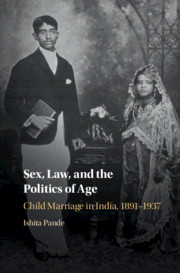
Pande on child marriage in colonial India

         Ishita Pande (Queen's University, Ontario) has published Sex, Law, and the Politics of Age: Child Marriage in India, 1891-1937 with Cambridge University Press. From the publisher: 


     Ishita Pande's innovative study provides a dual biography of India's path-breaking Child Marriage Restraint Act (1929) and of 'age' itself as a key category of identity for upholding the rule of law, and for governing intimate life in late colonial India. Through a reading of legislative assembly debates, legal cases, government reports, propaganda literature, Hindi novels and sexological tracts, Pande tells a wide-ranging story about the importance of debates over child protection to India's coming of age. By tracing the history of age in colonial India she illuminates the role of law in sculpting modern subjects, demonstrating how seemingly natural age-based exclusions and understandings of legal minority became the alibi for other political exclusions and the minoritization of entire communities in colonial India. In doing so, Pande highlights how childhood as a political category was fundamental not just to ideas of sexual norms and domestic life, but also to the conceptualisation of citizenship and India as a nation in this formative period. 
Praise for the book:  
"In this theoretically rigorous feminist history, Ishita Pande shows us how and why imperial 'age of consent' controversies should more aptly be read as regimes of reproductive temporality that shape minority and majority political claims in South Asian modernity in all its worldly ambition. Sex, Law and the Politics of Age opens up the terrain of 'juridical childhood' to a whole new set of questions and methods, rethinking girlhood as a prism of colonial and postcolonial ambition and a secularizing epistemic lever in the process." -Antoinette Burton
"A fascinating read, this book adeptly and sensitively renders the child as a moral-political category, and a socio-cultural construct, of modernity in colonial India. Through a close reading of the Child Marriage Restraint Act of 1929, Pande brilliantly intertwines debates on sexuality, childhood and age with the carving of a Hindu reformist nation." -Charu Gupta
"Here, finally, is a superbly researched and expansive South Asian/Indian history of the categories of age and consent, and their translations and tribulations within legal and social structures of surveillance and control. An indispensable book for scholars of law, gender and sexuality." -Anjali Arondekar
"Pande brilliantly deploys the generative power of gender analysis and queer theory to reinterpret one of the most widely-debated topics in colonial South Asian historiography: the question of ‘child marriage’. This rigorous and beautifully written book will be required reading for all historians and scholars of gender and sexuality in the twentieth century." -Todd Shepard 
You can join the author for an online book event, "Sex, Law, and the Politics of Age with Ishita Pande" on Monday, August 24, 2020 at 12.30-1.30pm CDT. Register here.
Further information about the book is available here.  
--Mitra Sharafi