Showing posts with label family. Show all posts

Friday, August 8, 2025

ASLH's Virtual New Books Series

[Here's another reason to join the American Society for Legal History: Members can virtually participate in this series on great new books in the field.  DRE]

Making Connections: New Works in Legal History Series, 2025-2026 

All sessions will be on Zoom Wednesdays from 6:00-7:00 pm (Central Time).  We will send an email two weeks in advance of each event.  You must RSVP to receive the zoom link.  RSVP messages will be sent to membership approximately 1 week before the event.  ASLH Members can watch videos of previous events on our members page
 
September 17, 2025 – Esther Liberman Cuenca, The Making of Urban Customary Law in Medieval and Reformation England (Oxford University Press, 2025) with interlocutor Sara M. Butler
 
October 22, 2025 – Sonia Gomez, Picture Bride, War Bride: The Role of Marriage in Shaping Japanese America (NYU Press, 2024) & Kathryn Schumaker, Tangled Fortunes: The Hidden History of Interracial Marriage in the Segregated South (Basic Books, 2025)
 
December 10, 2025 – Marla A. Ramírez, Banished Citizens: A History of the Mexican American Women Who Endured Repatriation (Harvard University Press, 2025) with interlocutor Kevin R. Johnson
 
January 21, 2026 – Omar Youssef Cheta, How Commerce Became Legal: Merchants and Market Governance in Nineteenth-Century Egypt (Stanford University Press, 2025) with interlocutor Nurfadzilah Yahaya
 
February 25, 2026 – Tadashi Ishikawa, Geographies of Gender: Family and Law in Imperial Japan and Colonial Taiwan (Cambridge University Press, 2025) with interlocutor Jisoo M. Kim
 
March 25, 2026 – Serena Mayeri, Marital Privilege: Marriage, Inequality, and the Transformation of American Law (Yale University Press, 2025) with interlocutor Margot Canaday
 
April 15, 2026 – Kevin Arlyck, The Nation at Sea: The Federal Courts and American Sovereignty, 1789–1825 (Cambridge University Press, 2025) with interlocutor Alison LaCroix

Wednesday, April 2, 2025

Savarese on Parents' Habeas Suits in Late 19th-Century United States

Laura Savarese, Michigan State University, has posted The Origins of Family Rights and Family Regulation: A Dual Legal History, which is forthcoming in the Stanford Law Review:

The history of the state’s intrusions on the rights of marginalized parents has become central to today’s critical accounts of American family law and family courts, and rightly so. Missing from the conversation, however, is a full account of how those rights first entered the law, and how the state assumed its now-familiar, though often unfulfilled, obligation to afford due process to the parents and children it separates.

This Article is the first to locate that transformation in a now-forgotten wave of habeas litigation brought by parents seeking their children’s return from orphan asylums and juvenile reformatories—the institutions that comprised the nascent child welfare and juvenile justice systems in the late nineteenth century. Those conflicts are visible in archival sources and a set of state court cases that have not received systematic study. Drawing on those sources, this Article argues that modern understandings of the right to family integrity were forged through legal challenges to the state’s growing power to remove children from their parents, in the name of child welfare, from the Civil War through the Progressive Era. Parents, as habeas petitioners, pushed courts to recognize and enforce their rights to notice and an opportunity to be heard, to draw a distinction between child neglect and family poverty, and to affirm parents’ right to regain custody after they remedied the reasons for children’s removal—establishing the core legal principles that delimit the state’s power today.

Recapturing the story of resistance to the family regulation system, at its inception, offers insights for today’s efforts to transform or dismantle that system, and deepens our understanding of the genesis and function of constitutional family rights. Critically, recovering this line of cases provides a more complete account of the history and tradition in which substantive due process protections for family autonomy are rooted. This account also lends support to more ambitious conceptions of the right to family integrity, advocated today, as a tool for expanding legal protections against family separations and terminations of parental rights, as well as affirmative entitlements to state assistance for childrearing. At the same time, the records of parents’ legal challenges offer a warning about the limits of procedural rights and litigation as means of advancing parents and children’s interests, absent a more radical redistribution of public resources to meet families’ material needs.
--Dan Ernst

Wednesday, April 6, 2022

Siegel, "The Politics of Constitutional Memory"

Reva Siegel (Yale Law School) has posted "The Politics of Constitutional Memory," forthcoming in the Georgetown Journal of Law & Public Policy. The abstract:

Those who sought votes for women made claims for liberty and equality in the family on which constitutional law might now draw—but there is no trace of their voices or claims in constitutional law. The Supreme Court scarcely mentions the Nineteenth Amendment when interpreting the Constitution. Nor do Supreme Court opinions mention those who led women’s quest for political voice or the constitutional arguments they made in support of women voting, even though these arguments spanned two centuries. There is no method of interpretation that the Justices employ with sufficient consistency to account for this silence in our law.

This Article introduces the concept of constitutional memory to explain this silence in our law. Constitutional interpreters produce constitutional memory as they make claims on the past that can guide decisions about the future. It is the role of constitutional memory to legitimate the exercise of authority; but constitutional memory plays a special role in legitimating the exercise of authority when constitutional memory systematically diverges from constitutional history. Systematic divergence between constitutional memory and constitutional history can legitimate authority by generating the appearance of consent to contested status relations and by destroying the vernacular of resistance. Though women contested their lack of political authority in the constitutional order over two centuries, there is no trace of their arguments in constitutional law.

To illustrate, the Article examines a long-running tradition of suffrage argument that began before the Reconstruction Amendments and continued in evolving forms after the ratification of the Nineteenth Amendment: that women needed the vote to democratize the family. Two centuries of constitutional arguments are nowhere reflected in the United States Reports. As a consequence, constitutional doctrines about liberty and equality in the family appear to lack historical antecedents.

But argument, inside and outside of courts, can counter the politics of memory. Justices across the spectrum regularly make heterodox claims on the past. Constitutional interpreters can invoke the voices of the disfranchised and the concerns that the disfranchised brought to the democratic reconstruction of America. Imagine how we might understand our Constitution in another generation if we did. 

A full draft is available here, at SSRN.

-- Karen Tani

Tuesday, September 15, 2020

David's "Kinship, Law and Politics"

Joseph E. David, Sapir Academic College, Israel, has published Kinship, Law and Politics: An Anatomy of Belonging in the Law in Context series of Cambridge University Press:
Why are we so concerned with belonging? In what ways does our belonging constitute our identity? Is belonging a universal concept or a culturally dependent value? How does belonging situate and motivate us? Joseph E. David grapples with these questions through a genealogical analysis of ideas and concepts of belonging. His book transports readers to crucial historical moments in which perceptions of belonging have been formed, transformed, or dismantled. The cases presented here focus on the pivotal role played by belonging in kinship, law, and political order, stretching across cultural and religious contexts from eleventh-century Mediterranean religious legal debates to twentieth-century statist liberalism in Western societies. With his thorough inquiry into diverse discourses of belonging, David pushes past the politics of belonging and forces us to acknowledge just how wide-ranging and fluid notions of belonging can be.
Some endorsements:

'Not since Charles Taylor have scholars seen such a profound inquiry into the sources of selfhood and the nature of belonging in community. Joseph David draws on a stunning range of ancient and modern, familiar and forgotten figures to probe the depths of human nature and our essential bonds of marriage and family, friendship and faith, property and state. This is interdisciplinary and interreligious scholarship of the highest caliber.'

John Witte, Jr. - Director of the Center for the Study of Law and Religion, Emory University

'Joseph David’s book is an immensely erudite and deep exploration of the meaning of belonging and identity. David’s brilliant examination of the belonging and identity in their different layers and in diverse historical settings, is of fundamental importance to the understanding of the complexity of the concept and the vital role it plays in contemporary political and cultural life.'

Moshe Halbertal - New York University

--Dan Ernst

Monday, August 17, 2020

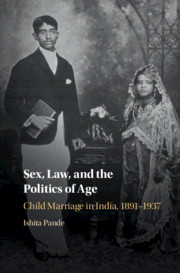
Pande on child marriage in colonial India

         Ishita Pande (Queen's University, Ontario) has published Sex, Law, and the Politics of Age: Child Marriage in India, 1891-1937 with Cambridge University Press. From the publisher: 


     Ishita Pande's innovative study provides a dual biography of India's path-breaking Child Marriage Restraint Act (1929) and of 'age' itself as a key category of identity for upholding the rule of law, and for governing intimate life in late colonial India. Through a reading of legislative assembly debates, legal cases, government reports, propaganda literature, Hindi novels and sexological tracts, Pande tells a wide-ranging story about the importance of debates over child protection to India's coming of age. By tracing the history of age in colonial India she illuminates the role of law in sculpting modern subjects, demonstrating how seemingly natural age-based exclusions and understandings of legal minority became the alibi for other political exclusions and the minoritization of entire communities in colonial India. In doing so, Pande highlights how childhood as a political category was fundamental not just to ideas of sexual norms and domestic life, but also to the conceptualisation of citizenship and India as a nation in this formative period. 
Praise for the book:  
"In this theoretically rigorous feminist history, Ishita Pande shows us how and why imperial 'age of consent' controversies should more aptly be read as regimes of reproductive temporality that shape minority and majority political claims in South Asian modernity in all its worldly ambition. Sex, Law and the Politics of Age opens up the terrain of 'juridical childhood' to a whole new set of questions and methods, rethinking girlhood as a prism of colonial and postcolonial ambition and a secularizing epistemic lever in the process." -Antoinette Burton
"A fascinating read, this book adeptly and sensitively renders the child as a moral-political category, and a socio-cultural construct, of modernity in colonial India. Through a close reading of the Child Marriage Restraint Act of 1929, Pande brilliantly intertwines debates on sexuality, childhood and age with the carving of a Hindu reformist nation." -Charu Gupta
"Here, finally, is a superbly researched and expansive South Asian/Indian history of the categories of age and consent, and their translations and tribulations within legal and social structures of surveillance and control. An indispensable book for scholars of law, gender and sexuality." -Anjali Arondekar
"Pande brilliantly deploys the generative power of gender analysis and queer theory to reinterpret one of the most widely-debated topics in colonial South Asian historiography: the question of ‘child marriage’. This rigorous and beautifully written book will be required reading for all historians and scholars of gender and sexuality in the twentieth century." -Todd Shepard 
You can join the author for an online book event, "Sex, Law, and the Politics of Age with Ishita Pande" on Monday, August 24, 2020 at 12.30-1.30pm CDT. Register here.
Further information about the book is available here.  
--Mitra Sharafi

Tuesday, April 14, 2020

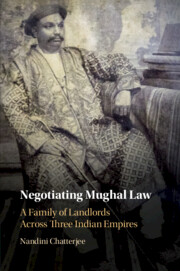
Chatterjee on Mughal Law

Nandini Chatterjee, University of Exeter, has published Negotiating Mughal Law: A Family of Landlords across Three Indian Empires with Cambridge University Press. The book is available on an Open Access basis. From the publisher: 
Negotiating Mughal LawBased on a completely reconstructed archive of Persian, Hindi and Marathi documents, Nandini Chatterjee provides a unique micro-history of a family of landlords in Malwa, central India, who flourished in the region from at least the sixteenth until the twentieth century. By exploring their daily interactions with imperial elites as well as villagers and marauders, Chatterjee offers a new history from below of the Mughal Empire, far from the glittering courts of the emperors and nobles, but still dramatic and filled with colourful personalities. From this perspective, we see war, violence, betrayal, enterprise, romance and disappointment, but we also see a quest for law, justice, rights and righteousness. A rare story of Islamic law in a predominantly non-Muslim society, this is also an exploration of the peripheral regions of the Maratha empire and a neglected princely state under British colonial rule. 
Praise for the book:

 "This book is an important work that enriches our understanding of family, empire and estate in South Asia. The analysis moves away from state policy and image-building to the micro-processes that actually reproduce state power. It achieves this through the mastery of difficult sources presented in a wide comparative frame.'"- Sumit Guha 

"In tracking a single family's legal documents over three centuries, Nandini Chatterjee has written an extraordinary book, upturning our understanding of how Mughal law worked and how it was experienced by its subjects. It will be revelatory for anyone interested in Islamic, South Asian, or Mughal history." - Samira Sheikh

Further information is available here.

--Mitra Sharafi

Wednesday, January 1, 2020

Welcome, Bianca Premo!

Bianca PremoWe are very pleased to have Professor Bianca Premo (Florida International Universityjoin us as our first guest blogger of the new decade. She is a historian of Latin America and the author of two scholarly monographs. The Enlightenment on Trial: Ordinary Litigants and Colonialism in the Spanish Empire (Oxford University Press, 2017) is a comparative study of how ordinary, often illiterate litigants made law modern in the courtrooms of vast regions of the eighteenth-century Spanish empire. Children of the Father King: Youth, Authority and Legal Minority in Colonial Lima (UNC Press, 2005) reveals how Lima's children were socialized into colonial hierarchies and how adults viewed and practiced their roles as authority figures over children in a legal culture that favored elite fathers and distant kings. Prof. Premo has also co-edited Raising an Empire: Children in Early Modern Iberia and Colonial Latin America (University of New Mexico Press, 2007), a collection on children and childhood in early modern Spain, Portugal, and colonial Latin America. She is the author of over a dozen articles and book chapters on colonial Peru and Mexico and early modern Spain, spanning the fields of legal studies, ethnohistory, gender, family history, and Atlantic history. Her next research projects will take her deeper into the history of childhood and gender--and into the twentieth century. You can read more about Prof. Premo's work and interests here.

Welcome, Bianca Premo!

--Mitra Sharafi

Wednesday, July 17, 2019

Hasday, Intimate Lies and the Law

Out any day now from Oxford University Press: Intimate Lies and the Law, by Jill Elaine Hasday (University of Minnesota). In canvassing and analyzing the current law of "intimate deception," the book devotes significant attention to history. Specifically, the book explores why the remedies available to deceived intimates contracted significantly over the course of the twentieth century. Here’s a description from the Press:
Intimacy and deception are often entangled.  People deceive to lure someone into a relationship or to keep her there, to drain an intimate’s bank account or to use her to acquire government benefits, to control an intimate or to resist domination, or to capture myriad other advantages.  No subject is immune from deception in dating, sex, marriage, and family life.  Intimates can lie or otherwise intentionally mislead each other about anything and everything.
Suppose you discover that an intimate has deceived you and inflicted severe—even life-altering—financial, physical, or emotional harm.  After the initial shock and sadness, you might wonder whether the law will help you secure redress.  But the legal system refuses to help most people deceived within an intimate relationship.  Courts and legislatures have shielded this persistent and pervasive source of injury, routinely denying deceived intimates access to the remedies that are available for deceit in other contexts.
Jill Elaine Hasday’s Intimate Lies and the Law is the first book that systematically examines deception in intimate relationships and uncovers the hidden body of law governing this duplicity.  Hasday argues that the law has placed too much emphasis on protecting intimate deceivers and too little importance on helping the people they deceive.  The law can and should do more to recognize, prevent, and redress the injuries that intimate deception can inflict.
Entering an intimate relationship should not mean losing the law’s protection from deceit.
A few blurbs:
"Intimate Lies and the Law is rigorous, bold, and carefully researched, yet terrifically readable. Hasday has dug far and deep into the law and social science of intimate deception to give us an authoritative volume on this wrenching human domain. Whereas the law often blames victims for being duped, Hasday imagines a world in which trust is supported and rewarded. Her proposal for change-that the law treat intimate deception more like other kinds of deception-is powerful and sweeping, yet practical and workable. Timely and important, Intimate Lies and the Law has the potential to reshape not only the legal terrain but the very human relationships that live and breathe in the law's shadow." -- Elizabeth Emens

"In Intimate Lies and the Law, Jill Hasday maps a big, fascinating, sobering subject: the law's regulation (including neglect) of deceptions amongst those closest to us. She explores this difficult terrain masterfully with verve, thoroughness, and a keen eye for the telling detail. She casts in a new light a huge and influential body of law that teems with experiences and lessons that are simultaneously familiar and odd. This is an important book that will be of interest not only to academics but also to general readers. Impressively rigorous, it is also exceptionally accessible." -- Randall Kennedy
More information, including a preview of the book's introduction, is available here, at Professor Hasday's website. 

-- Karen Tani 

Wednesday, July 10, 2019

Milanech, "Paternity: The Elusive Quest for the Father"

Harvard University Press has released Paternity: The Elusive Quest for the Father (June 2019), by  Nara B. Milamich (Barnard College). A description from the Press:
For most of human history, the notion that paternity was uncertain appeared to be an immutable law of nature. The unknown father provided entertaining plotlines from Shakespeare to the Victorian novelists and lay at the heart of inheritance and child support disputes. But in the 1920s new scientific advances promised to solve the mystery of paternity once and for all. The stakes were high: fatherhood has always been a public relationship as well as a private one. It confers not only patrimony and legitimacy but also a name, nationality, and identity.

The new science of paternity, with methods such as blood typing, fingerprinting, and facial analysis, would bring clarity to the conundrum of fatherhood—or so it appeared. Suddenly, it would be possible to establish family relationships, expose adulterous affairs, locate errant fathers, unravel baby mix-ups, and discover one’s true race and ethnicity. Tracing the scientific quest for the father up to the present, with the advent of seemingly foolproof DNA analysis, Nara Milanich shows that the effort to establish biological truth has not ended the quest for the father. Rather, scientific certainty has revealed the fundamentally social, cultural, and political nature of paternity. As Paternity shows, in the age of modern genetics the answer to the question “Who’s your father?” remains as complicated as ever.
A few blurbs:
“‘Mama’s baby, Papa’s maybe.’ DNA testing has all but destroyed the uncertainty that has attended paternity for millennia. Milanich has written a fascinating history of the ways societies have coped with anxiety about paternity, and how that anxiety has helped construct notions of fatherhood, masculinity, race, and family.”—Annette Gordon-Reed

“This splendid work shows how the development and use of paternity testing over several centuries determined individuals’ fates. For millions of people, ‘Who’s your daddy?’ was not simply an idle question, but often a matter of life or death.”—Sonya Michel
More information is available here.

-- Karen Tani

Thursday, July 12, 2018

Ransmeier on Human Trafficking in China

Johanna Ransmeier, University of Chicago has published Sold People: Traffickers and Family Life in North China with Harvard University Press. From the publisher: 
Cover: Sold People in HARDCOVERA robust trade in human lives thrived throughout North China during the late Qing and Republican periods. Whether to acquire servants, slaves, concubines, or children—or dispose of unwanted household members—families at all levels of society addressed various domestic needs by participating in this market. Sold People brings into focus the complicit dynamic of human trafficking, including the social and legal networks that sustained it. Johanna Ransmeier reveals the extent to which the structure of the Chinese family not only influenced but encouraged the buying and selling of men, women, and children. 
For centuries, human trafficking had an ambiguous status in Chinese society. Prohibited in principle during the Qing period, it was nevertheless widely accepted as part of family life, despite the frequent involvement of criminals. In 1910, Qing reformers, hoping to usher China into the community of modern nations, officially abolished the trade. But police and other judicial officials found the new law extremely difficult to enforce. Industrialization, urbanization, and the development of modern transportation systems created a breeding ground for continued commerce in people. The Republican government that came to power after the 1911 revolution similarly struggled to root out the entrenched practice. 
Ransmeier draws from untapped archival sources to recreate the lived experience of human trafficking in turn-of-the-century North China. Not always a measure of last resort reserved for times of extreme hardship, the sale of people was a commonplace transaction that built and restructured families as often as it broke them apart.
Praise for the book:

“This brilliant exposé—no other word will do—concentrates on late Qing (or Manchu) China at the end of the 19th century, when trafficking was illegal but the laws were widely ignored or too vague. Ransmeier pursues the subject into the era of the post-1911 Republic, and on to Mao’s China, where the Communist Party’s one-child policies put a new kind of pressure on the family. As Ransmeier underlines, trafficking was not a system but a process, and it still is.” -Jonathan Mirsky

“Making innovative use of police and court archives dating from the late nineteenth and early twentieth centuries, Ransmeier shows that Chinese families often bought and sold family members… China today still suffers from widespread human trafficking. Ransmeier’s richly detailed stories of individual cases show how societies can come to accept the trade in people as a normal kind of business.” -Andrew J. Nathan

“Although several books touch on human trafficking as it relates to prostitution, gender issues, or famine, this is the first to focus specifically on trafficking and on the many different forms it took in late-Qing and Republican China. Meticulously researched and drawing on an impressive array of archival documents from a wide range of collections, Sold People is a rich, fascinating work.” -Kathryn Edgerton-Tarpley

“A remarkable work of social history. While cognizant of legal debates and elite discourse about slavery and trafficking, the book’s greatest strength is the way it delves into the nitty-gritty world of individual traffickers and their individual victims that emerge from local yamen and police records. Sold People marks Johanna Ransmeier as a leader in the new generation of social historians of China.” -Ruth Rogaski

Further information is available here.

Friday, March 30, 2018

Peabody on Slavery & Family in the French Indian Ocean

Sue Peabody, Washington State University, published Madeleine's Children: Family, Freedom, Secrets, and Lies in France's Indian Ocean Colonies with Oxford University Press in 2017. From the publisher:
Cover for 

Madeleines Children


Madeleine's Children uncovers a multigenerational saga of an enslaved family in India and two islands, Réunion and Mauritius, in the eastern empires of France and Britain during the eighteenth and nineteenth centuries. A tale of legal intrigue, it reveals the lives and secret relationships between slaves and free people that have remained obscure for two centuries.
 As a child, Madeleine was pawned by her impoverished family and became the slave of a French woman in Bengal. She accompanied her mistress to France as a teenager, but she did not challenge her enslavement there on the basis of France's Free Soil principle, a consideration that did not come to light until future lawyers investigated her story. In France, a new master and mistress purchased her, despite laws prohibiting the sale of slaves within the kingdom. The couple transported Madeleine across the ocean to their plantation in the Indian Ocean colonies, where she eventually gave birth to three children: Maurice, Constance, and Furcy. One died a slave and two eventually became free, but under very different circumstances. On 21 November 1817, Furcy exited the gates of his master's mansion and declared himself a free man. The lawsuit waged by Furcy to challenge his wrongful enslavement ultimately brought him before the Royal Court of Paris, despite the extreme measures that his putative master, Joseph Lory, deployed to retain him as his slave.
 A meticulous work of archival detection, Madeleine's Children investigates the cunning, clandestine, and brutal strategies that masters devised to keep slaves under their control-and paints a vivid picture of the unique and evolving meanings of slavery and freedom in the Indian Ocean world.
Praise for the book:

"What does it mean to be free? To be a slave? To belong to a family? In this remarkable book, historian Sue Peabody--one of the world's leading authorities on slavery in the French Empire--shows that these big questions are often intertwined. Through an intimate portrait of one enslaved man fighting for his dignity, Peabody shines a brilliant light on the worlds in which he and his forebears lived, stretching from India to the Mascarene Islands to the courts of Paris. This is both biography and global history at their very best." -Brett Rushforth

"This gripping family history of slavery and freedom in France and its Indian Ocean empire during the eighteenth and nineteenth centuries resurrects in inviting detail the lives of Madeleine--sold into slavery in India and freed on Bourbon Island, though not told of her manumission for nineteen years--and of her children. With help from family and friends, Furcy, one of those children held in slavery by ruse, vigorously pursued legal recognition of his free status in the Mascarene Islands of the Indian Ocean and in France--and won. Drawing on thousands of pages of archival and legal documents to reconstruct their lives with astonishing detail, Peabody presents us with the first autobiographical narrative of slaves held by French citizens and in the process illuminates the internal architectures of slavery and freedom in France's Indian Ocean colonies."-Pier M. Larson

"'Madeleine's Children' is a detailed exposition of the lives of slaves in the Indian Ocean world in the late eighteenth to early nineteenth centuries. Based on years of meticulous research, it brings vividly to life the tensions between slave-owners and slaves during a tumultuous period of shifting legal challenges to, and definitions of, slavery. Thoroughly recommended to scholars of the Indian Ocean world and of slavery." -Gwyn Campbell

Further information is available here.

Thursday, January 25, 2018

Balancing book and family

Every scholar faces a unique blend of personal responsibilities they must balance alongside their research and writing lives. This post will focus on my experience balancing parenthood while on the tenure track and writing my book.  It is my hope that some of the advice that follows will apply beyond my experience, though I can imagine that many of the LHB’s readers might have faced similar challenges.  I also want to add that the difficulties academics encounter in trying to balance work and family life are not much different than any working parent or caregiver.

As a graduate student who hoped to have kids, I often wondered and discussed the best timing. Some of my friends had children at different points during graduate school, while others waited for graduation or for tenure. I chose to wait until after I started my job, but I don’t believe there is any such thing as perfect timing (or that one can always choose the timing!). 

I learned I was pregnant during the first semester of my new job. I was nervous at first to talk to my department chair about it. Auburn had allowed me to defer my position by a year to accept my postdoc, so I figured they might not be thrilled to learn that I would need some time off the next fall (I was due about a week before the fall semester). When I finally approached my chair, he immediately expressed his overwhelming excitement and support. I share this detail—which I’ve told very few people—because I think there is often anxiety about the unknown when adjusting to a new job or professional situation. Department cultures vary, as do university policies for family leave. 

Teaching while pregnant is less than ideal, even in the smoothest of pregnancies, but I had good support from my colleagues and my partner. I was also able to take a semester of parental leave after having both of my summer babies (in 2011 and 2014).  I believe the arrival of your first child is always jarring, but my daughter Olivia’s arrival came with a health scare and twelve days in the NICU.  I had made so many plans for how the first days of parenthood would go; the reality shattered those expectations. I was in the hospital for less than twenty-four hours after giving birth and spent the next two weeks sleeping in a dingy Montgomery hotel when I wasn’t holding vigil next to my daughter’s NICU bed. It was terrifying, but Olivia is now a thriving, healthy 6-year-old. She taught me from day one that with kids, there is often no point to making plans about how things “should” go.

Family leave semesters create an interesting dynamic, even in the best of departments with supportive colleagues like mine. Sometimes colleagues or friends who have not had a family leave semester don’t necessarily understand what they entail.  Sometimes they expect that you might be able to do research or service obligations during those semesters. During my first parental leave, I foolishly tried to make plans to do “a little bit of work” during naptimes or after Olivia went to bed (ha!). Even if your child’s sleep schedule allows for short windows of time, parents are often too busy with other tasks or too tired from the baby’s schedule to get real thinking done. [Side note: I absolutely understand that for many parents, real work has to be done during these months, so it must be possible to function at some level!] As a result of my expectations, I spent much of those few months worried about work—what I should be doing, the writing/reading I should be accomplishing. In my last post, I indicated how one way to balance it all involves forgiveness when you fall short of your own high expectations. I may come back to that point a few times in this post, too. Dwelling on the work I wasn’t doing robbed me of some of the joys and precious moments with my new daughter. It was a hard lesson but one I remembered when I took my second family leave semester after my son’s arrival.

The semester that I returned to teaching after my first family leave was one of my most difficult semesters. I taught three classes, including two new preps that required writing new lectures. I had an infant at home who required near-constant attention (let’s face it, they all do!). Honestly, that time is a blur for me now. I’m not sure how I managed to balance it all. I do remember that I did virtually no writing or research that spring.

At Auburn, the university’s policy is to allow for an extension of the tenure clock after having a baby or any major life event. My chair thought I probably wouldn’t need the extra time, but I figured it was better to be safe than sorry. I applied for and received the extension after both of my family leave semesters.  I would highly recommend that anyone in a similar situation find a trusted senior colleague or someone outside of your department to ask about family leave policies and the possibility of extending the tenure clock. Although I was not able to communicate the absence in research productivity on my c.v., at least my tenure and promotion materials reflected that I had two family leave semesters. I did end up needing one of those two extensions to complete the requirements for tenure on time. It is difficult to predict how the book publication process will go (more on that in the next post), so it is always a good idea to arrange for extra time if you can.  More on my story after the jump break…

Thursday, October 12, 2017

CFP: Regulating Age of Consent and Child-Marriage in the British Empire

Krishnaraja Wadiyar IV & Rana Prathap Kumari (wiki)
[We have the following call for papers.] 

Comparative perspectives on regulating age of consent and child-marriage in the British Empire, 1880 to 1930.  June 15, 2018.  SOAS University of London.

This is a call for proposals for a one-day interdisciplinary conference which aims to explore the debates that led to the reform of age of consent laws around the British Empire during the years 1880 to 1930. The conference is particularly interested in exploring the issues of age of consent and child marriage through interdisciplinary and comparative perspectives in law and history.

Intertwined within these debates are notions of gender, women's rights, biology, and attempts to understand the native psyche. These compete with tropes of cultural relativism, orientalism, the female victim, and the white man's burden amongst other concerns. For the purpose of this conference, consent is interpreted widely to include physical and intellectual consent to sexual activities as well as marriage.  The conference aims to bring together the growing number of scholars who are currently working on the histories of age of consent in the British Empire.

Recognising that the development and history of the age of consent debate is transnational, international, and multi-layered one, the conference is conceived of as a starting point for forming an international network of scholars working in the area.

Themes of the conference include but are not limited to notions of consent-physical and/or intellectual; age of consent campaigns and national movements; religion/class/region based perspectives on consent; comparative or regional studies on age of consent/marriage; age of consent for males; consent, female body, and nationalism/imperialism.

Please send 300-word abstract with a short bio to ageofconsentsoas@gmail.com. The deadline is 08 January 2018.  Bursaries might be available for PG students.  Organisers: Dr Kanika Sharma (SOAS) and Dr Laura Lammasniemi (Anglia Ruskin University).

Thursday, August 10, 2017

Special issue: The Child at Risk

We've learned of a special issue of SOLON: Journal of Law, Crime & History 7:1 (2017) on "The Child at Risk in Modern Britain." Daniel J. R. Grey is the guest editor. Here is the line-up:


Daniel J. R. Grey, Introduction: The Child at Risk in Modern Britain, 1-15

Margaret L. Arnot, Perceptions of Parental Child Homicide in English Popular Visual Culture 1800-1850, 16-74

Kim Stevenson,
, ‘Children of a Very Tender Age Have Vicious Propensities’: Child Witness Testimonies in Cases of Sexual Abuse, 75-97

Judith Rowbotham, When to Spare the Rod? Legal Reactions and Popular Attitudes Towards the (In)Appropriate Chastisement of Children, 1850-1910, 98-125

Victoria Bates, The Child as Risk: Precocious Girls and Sexual Consent in Late Victorian Britain, 126-144

Kate Bradley, Saving the Children of Shoreditch: Lady Cynthia Colville and Needy Families in East London, c.1900-1960, 145-163
Conference Report

Rhiannon Pickin, Lives Trials and Executions, Liverpool, 24 May 2017, 164-168

Further information is available here.