Showing posts with label Slavery. Show all posts

Wednesday, August 5, 2026

Edwards on the Minority Rights First Amendment

Jerry Edwards, West Virginia University College of Law, has posted The Birth of the Minority Rights First Amendment:

An incongruence exists in the literature on the nineteenth-century history of expressive freedom. Legal-tradition scholars have determined that the First Amendment was majoritarian, observing that outside of judicial enforcement of the rule against prior restraints, courts rarely involved themselves in disputes over expressive rights. Instead, the judiciary deferred to the judgments of legislatures and juries. Meanwhile, scholars examining the nineteenth-century popular tradition discovered a very different understanding of the First Amendment. They found that the antislavery conception of expressive freedom centered dissenters’ rights, arguing that Republicans embedded a libertarian understanding of free speech in the Fourteenth Amendment in 1868. This Article reexamines the nineteenth-century popular tradition and discovers new evidence that reconciles these seemingly incompatible traditions.

The popular-tradition scholars are correct that the antislavery movement oversaw a shift from the founding generation’s majoritarian understanding of expressive freedom to a minority rights conception. Slave states, emboldened by the majoritarian paradigm, suppressed antislavery advocacy and the fledgling Republican Party in the South. This prompted antislavery Republicans to advocate for protection of political dissenters, unpopular minority groups, and free discussion nationwide, birthing the minority rights First Amendment. However, Republicans did not intend for this to be a counter-majoritarian right. The judiciary had historically backed the Slave Power, so Republicans did not trust it to secure and preserve liberty. Instead, they sought to implement their minority rights vision through normative prescriptions and structural protections—namely, multiracial democracy in the South and congressional enforcement of civil rights. Accordingly, majoritarian legal doctrine was not a barrier to the Republican vision of expressive freedom. Unfortunately, this project failed when white majorities, aided by federal acquiescence, overthrew multiracial democracy in the South, taking down the minority rights First Amendment with it.

This Article’s findings provide further support for the view that the juricentric First Amendment is a twentieth-century invention. This means that the history the Supreme Court has used to justify its interventionist approach in First Amendment cases is misleading at best and mistaken at worst. Its reliance on these historical misrepresentations has proven detrimental to the development of speech doctrine, obscuring the contingent decisions it is making in the present. This Article suggests that the Court embrace transparency, eschew law-office history, and recommit to defending multiracial democracy.

--Dan Ernst 

Saturday, August 1, 2026

Weekend Roundup

  • ASLH President (and former Legal History Blog co-moderator) Mitra Sharafi discusses her new book, Fear of the False: Forensic Science and the Law of Crime in Colonial South Asia (Cornell University Press) over at the New Books Network.  
  • Penn Carey Law announces the awarding of its first Certificate of Study in History and Historical Research Methods, which provides students with "a structured pathway to build expertise in legal history without the multi-year commitment of Penn Carey Law’s JD/PhD Program in American Legal History." 
  • Todd C. Peppers and Madison Mycoff  on how Chief Justice Warren Burger celebrated the Declaration of Independence in 1971 (SCHS).   
  • "Cooley Law School Professor Joseline Jean-Louis Hardrick recently premiered, “If These Headlines Could Talk,” an original historical documentary musical that brings the landmark decisions of the Warren Court to life through storytelling, music, archival materials, and legal history" (Florida Bar News).
  • Kali N. Murray, Marquette Law, on the haunting of American trademark law (by fugitive slave advertisements) (Marquette Today). 
  • Over at Shugerblog, Jed Shugerman (Boston University School of Law) has been "fact-checking" the U.S. Supreme Court. The latest installment is here

 Weekend Roundup is a weekly feature compiled by all the Legal History bloggers. 

Saturday, July 4, 2026

Weekend Roundup

  • Rosa Goluboff and G. Edward White reflect on the enduring legacy of the Declaration of Independence (Virginia Law). 
  • William Novak reflects on Polan Fellowship and the Future of Democracy (Michigan Law).  
  • Legal historian Jennifer Mnookin is now president of Columbia University (NYT). 
  •  For Most of Its History, the Supreme Court Didn’t Pretend to Be Apolitical: a preview of Rachel Shelden's forthcoming The Political Supreme Court: A Forgotten History (TPM).
  • The Max Planck Institute for Legal History and Legal Theory is expanding its collaboration with India through the launch of the Centre for Legal History of India, in cooperation with the National Law School of India University in Bangalore and the NALSAR University of Law in Hyderabad. 

  • The July newsletter of the Historical Society of the District of Columbia Circuit is here.  It includes a report of the Society's recent panel on U.S. v. Lewis “Scooter” Libby.
  • From the Touro Law Review: a podcast episode featuring David S. Reynolds, interviewed by Rodger Citron, on Reynolds's recent book The Two Ships That Shaped America: The Mayflower, the White Lion, and the History of the Nation.  

Weekend Roundup is a weekly feature compiled by all the Legal History bloggers. 

Saturday, June 27, 2026

Weekend Roundup

  • William Howard Taft (LC)
    Andrea Scoseria Katz on "Taft at the Beach: What the Supreme Court Misses About a Key Unitary Executive Precedent" (Can We Still Govern?) 
  • Michael Dreeben looks back at Humphrey's Executor (Just Security). 
  • Martha Jones's illustrated story in the New York Times Magazine on Elizabeth Freeman, who sued for her own freedom, is here
  • That Modern Criminal Law Review workshop, "Ancient Criminal Law: A Global Perspective," may be viewed here and just heard here.  
  • A notice of "Myths and Misunderstandings in Modern Irish History," by Patrick Geoghegan, the 2026 Hardiman lecture at the Supreme Court (Law Society Gazette). 
  • A Q&A with Hadar Aviram's Behind Ancient Bars: Narratives of Incarceration in the Hebrew Bible (University of California Press) (UC SF Law). 
  • Michael Dorf asks What Weight, If Any, Should Be Given Racist Laws In A History-and-Tradition Test? (Dorf on Law.)
  • Nineteenth-Century NY Law and Birthright Citizenship: New York v. Miln (1837) (New York Almanack).  
  • A notice of Stacey Patton's Strung Up: How White America Learned to Lynch Black Children (Beacon Press, 2026) (New York Almanack).
  • "Reflecting on America’s 250th anniversary: Revolution, the Constitution, and the founders" in the Princeton University Press's list (PUP).  And, while we're at it, Princeton University and the Revolution.  
  • Lawbook Exchange's June 2026 list in Scholarly Law and Legal History.   
  • State Constitution Roundup: What made Pennsylvania's first ever constitution so radical that it only lasted 14 years?  (WHYY).  1776 NC Constitution exhibit [is] part of ‘Capitol 250’ July 4 fest (Coastal Review).  Bayard v. Singleton: Judicial review’s NC origins (Carolina Journal).  The Hawaii Constitution (State Court Report). 
  • ICYMI: HIAS's illustrated history of US immigration (HIAS).  Eugene V. Debs, Constitutional Voice (NCC).  An appreciation of Raphael Lemkin, "the author of the concept of genocide" (UJE).  Benjamin Perry and the fight against secession (Greenville Journal). 

Weekend Roundup is a weekly feature compiled by all the Legal History bloggers. 

Tuesday, June 23, 2026

Book Event: Taxation, Racial Capitalism, Slavery and International Law

[We have the following announcement.  DRE]

Taxation, Racial Capitalism, and the International Rule of Law: From Colonial Slavery to Global Governance

Wednesday, July 22, 2026, 12:00–1:30 PM EST.  This webinar brings into dialogue two important recent books:

The Human Toll: Taxation and Slavery in Colonial America by Anthony C. Infanti (University of Pittsburgh School of Law)

Racial Capitalism and International Tax Law: The Story of Global Jim Crow by Steven A. Dean (Boston University School of Law)
The discussion will explore how legal and fiscal systems have historically contributed to structures of domination, exclusion, and racialized inequality, from the fiscal architecture of colonial America to the contemporary global tax order. By placing these works in conversation, the webinar examines the relationship between taxation, racial capitalism, historical injustice, and the rule of law, while reflecting on the capacity of legal institutions to address past and present inequalities.

The event will be chaired by Paolo Davide Farah (The University of Tulsa College of Law), who will serve as moderator and discussant. Carliss N. Chatman (SMU Dedman School of Law) will also serve as discussant.

The conversation may be of particular interest to scholars working in taxation, international law, comparative law, legal history, civil rights, critical legal studies, race and the law, socio-economics, political economy, international human rights, and related fields.  Participation is free and open to all.  [Register here.]

Saturday, June 6, 2026

Weekend Roundup

  • Via the American Branch of the International Law Association (ABILA): a recording is now available of the recent webinar on "Indigenous Legal Orders, Legal Pluralism, and the Coloniality of Method Across Comparative Law, International Law, IP, and Trade Governance."
  • ICYMI:  The lower house of the Rhode Island legislature has unanimously approved a bill to rescind the state's "approval–in May 1861–of a proposed amendment to the U.S. Constitution that would have permanently protected slavery from federal interference" (Providence Journal).  The Supreme Court’s long history of racial profiling in immigration (SCOTUSblog). The "idea of changing the number of Supreme Court justices is hardly new" (NCC)--just ask Rachel Shelden, who says as much in Made by History (now behind a paywall at the Philadelphia Inquirer).

Weekend Roundup is a weekly feature compiled by all the Legal History bloggers.  

Saturday, May 30, 2026

Weekend Roundup

  • A review symposium on Serena Mayeri’s Marital Privilege: Marriage, Inequality, and the Transformation of American Law, with contributions from Albertina Antognini, Cary Franklin, Jessica Dixon Weaver, Deborah Dinner, Linda C. McClain, and Katie Eyer, with a response by Professor Mayeri (BU Law Review Online).  
  • Marlene Trestman will be in conversation about her book, Fair Labor Lawyer: The Remarkable Life of New Deal Attorney and Supreme Court Advocate Bessie Margolin, in person and online, with Senior Judge Beryl A. Howell of the US District Court for the District of Columbia at the Capital Jewish Museum in DC on June 4, from 6:30-7:30.  Register here.
  • Bill Littlefield reviews Gautham Rao's White Power: Policing American Slavery (arts fuse).
  • Jonathan Parry reviews H.S. Jones’s Liberal Worlds: James Bryce and the Democratic Intellect (London Review of Books).
  • Robert Tsai and others will discuss John Brown's provisional constitution on June 29. 
  • Rodger Citron on that podcast with Samantha Barbas on her book on New York Times v. Sullivan (Verdict).   

Weekend Roundup is a weekly feature compiled by all the Legal History bloggers. 

Tuesday, May 19, 2026

Rao's "White Power"

It is publication day for White Power: Policing American Slavery (University of North Carolina Press), by Gautham Rao.  The book is the initial entry in the UNC Press’s new series, W. Hodding Carter III Books:

Beginning in the colonial era and growing through the American Revolution and the Southern plantation system, slaveholders’ violent police regime continued after Emancipation, through Reconstruction, to today. Moving across time, space, and place, White Power uncovers how slaveholders created their own white supremacist police and government to deny Black people rights, power, and humanity.

Legal historian Gautham Rao introduces us to laws that empowered white people to forcibly exercise their desired racial superiority over Black people, shows how they spread from the South throughout the nation, and traces the rebellions, fugitivity, activism, and legal systems that challenged them. Rao’s narrative includes slaveholders, lawmakers, and the Ku Klux Klan, dramatic escapes by runaway enslaved people, abolitionist activism in courtroom showdowns, and pitched battles between white paramilitaries and enslaved rebels. He offers a new interpretation of the history of policing in the US, centering the institution and legacy of slavery and speaking to the origins of today’s persistence of white vigilance, white supremacist militia groups, and white racist cops determined to maintain power over Black people by force. Equally determined, however, was Black Americans’ refusal to accept it. 

DC-area folks can catch Professor Rao in conversation on White Power with the Library of Congress's Ryan Reft at 6:30 tonight at People's Book in Takoma Park, Maryland. 

–Dan Ernst

Saturday, May 16, 2026

Weekend Roundup

  • We have two reports of Maggie Blackhawk's discussion at Dartmouth College on May 6 of "the centrality of American colonialism and Native American history to legal understandings of the United States Constitution (The Dartmouth; Dartmouth News).  
  • Lucy Salyer, University of New Hampshire, explains Wong Kim Ark and birthright citizenship on NBC News' "Here's the Scoop" (YouTube).
  • Rebecca Tushnet's 2025 Nies Lecture on Intellectual Property at Marquette Law School, entitled  “History and Tradition in First Amendment Intellectual Property Cases” is here.
  • That symposium over at Balkinization on Stephen Skowronek's The Adaptability Paradox is now complete and is available here.
  • More on the litigation over the executive order curtailing the Presidential Records Act: Jonathan Shaub scores the government lawyers who defended the executive order (Lawfare).  The American Historical Association explains a recent hearing in the dispute.  
  • Michael C. Blumm, Lewis and Clark Law School, has posted the preface, table of contents, and first chapter of the second edition of his West Nutshell, A Brief American Legal History, which surveys "American legal history from the Colonial Era to the Trump administration, including an extensive chapter on the first six months of the second Trump administration." 
  • John O. McGinnis reviews The Making and Breaking of the American Constitution: A Thousand-Year History by Mark Peterson (Law & Liberty). 
  • ICYMI:  Florida’s new history course whitewashes the founders on slavery (Salon)

Weekend Roundup is a weekly feature compiled by all the Legal History bloggers. 

Friday, May 8, 2026

Pope on Class and the Original Meanings of the 13th and 14th Amendments

James Gray Pope, Rutgers Law School, has posted Economic Class and the Original Meanings of the U.S. Thirteenth and Fourteenth Amendments:

This article suggests that present-day judicial interpretations of the U.S. Thirteenth and Fourteenth Amendments depart sharply from their original meanings on questions of class power. I propose that the concept of "slavery to society," hitherto largely ignored, lay at the heart of the framers' thinking about class and race. By late 1865, leading Republicans held that the Thirteenth Amendment directly banned not only chattel slavery and physically or legally coerced labor (its full scope according to contemporaneous Democrats and most present-day courts), but also slavery to society. Unlike chattel slavery, which could be eliminated by conferring the freedom of contract, slavery to society operated through the formal freedom of contract, tilting the background rules and customs governing market relations to enable a ruling caste or class to dominate and exploit a subordinate caste or class. With this in mind, the Republicans condemned both race-specific and facially race-neutral labor laws that, while respecting the formal freedom of contract, enabled capitalists to inflict on laborers a form of slavery or involuntary servitude. Concerning the Fourteenth Amendment, I propose that the Republicans' support for maximum hours laws during the two years between that Amendment's proposal and ratification indicates that a vast chasm separated their concept of labor freedom from the laissez-faire version enforced by American courts during the so-called Lochner Era.

--Dan Ernst 

Saturday, April 11, 2026

Weekend Roundup

  • The California Law Review's podcast has posted an episode on Michael Banerjee's "What Harvard’s Lawsuit Should Have Said" (published in the journal's online companion in August 2025).
  • Congratulations to Kunal Parker, Miami Law, on his selection as Beatrice Webb Visiting Professor at the London School of Economics! 
  • And congratulations to Edward J. Balleisen, the new Provost of George Washington University! (GW Today)
  • Nathan Dorn on Lodovico Carerio: Heresy, Lawbooks, and the Inquisition in the Kingdom of Naples (In Custodia Legis).   
  • "The 1874 Arkansas Constitution and records from the convention that produced it are now available online through a collaboration between the University of Arkansas Libraries and the Quill Project at the University of Oxford" (Arkansas News
  • Lawbook Exchange's April catalogue of Scholarly Law and Legal History.     
  • The National Constitution Center has announced the opening on May 15 of "Governing the Nation, a new permanent gallery exploring the Constitution’s system of separated powers."  Its development was guided by "a distinguished scholarly advisory board representing leading universities and research institutions, ensuring a rigorous and balanced exploration of the separation of powers and federalism," including H. W. Brands, Cristina Rodríguez, Yuval Levin, Michael Klarman, Gail Heriot, and Ilan Wurman.
  • Deborah Rosen reviews Andrew Fede's A Degraded Caste of Society in the Journal of Southern History.
  • That E.O. on the PRA:  The American Historical Association and American Oversight file suit (CBS News).  The Trump Administration Is Trying to Erase Its Own History (Atlantic Daily).  Joyce Vance with the court filing (Civil Discourse).  The AHA's notice of the lawsuit.
  • More on Birthright CitizenshipSteve Vladeck, Georgetown Law, on the "pitched battle within the legal academy over the fairly transparent efforts of a small cohort of right-wing law professors to provide a fig leaf of historical support for the Trump administration’s legally and morally odious position in the birthright citizenship case" (One First). Philip Hamburger, Columbia Law, on Allegiance, Birthright, and Citizenship (Law & Liberty).  For a brief time only, you may read, open access, the introduction to Anna O. Law's Migration and the Origins of American Citizenship, here.

Weekend Roundup is a weekly feature compiled by all the Legal History bloggers. 

Wednesday, March 18, 2026

Law's "Migration and the Origins of American Citizenship"

The official date is still about a week hence, but because the book is already getting noticed in social media, we’ll note now the imminent publication of Anna O. Law’s Migration and the Origins of American Citizenship: African Americans, Native Americans, and Immigrants (Oxford University Press):

Since the late nineteenth century, the US federal government has enjoyed exclusive authority to decide whether someone has the ability to enter and stay in US territory. But freedom of movement was not guaranteed in the British colonies or early US. By contrast, voluntary migrants were met with strict laws and policies created by colonies and states, which denied free mobility and settlement in their territories to unwanted populations.

Migration and the Origins of American Citizenship presents a story of constitutional development that traces the confluence of the logics of slavery and settler colonialism in early legal rulings and public policy about migration and citizenship. The book examines the division of labor between the national and state governments that endured for over a century, reasons why that arrangement changed in the late nineteenth century, and what the transformation meant for people subject to those regimes of control. Drawing into one study the migration policy histories of groups of people that are usually studied separately, and combining the methodologies of political science, history, and law, Anna O. Law reveals the unmistakable effects of slavery and Native American dispossession in modern US immigration policy.

--Dan Ernst 

Tuesday, February 24, 2026

JCWE: Historians of Crisis in a Moment of Crisis

The Journal of the Civil War Era 16:1 (March 2026) is a special issue of interest to legal historians, assembled by its editors, Kate Masur, Northwestern University, and Gregory Downs, University of California, Davis.  In addition to a review essay and book reviews, it includes the following:

What Is To Be Done? Historians of Crisis in a Moment of Crisis
Gregory P. Downs, Kate Masur

Burrowed in the Bloodline: The Stories That Sustain Me
Ryan W. Booth

The Specter of the Fugitive Slave Act of 1850 Today
Justene Hill Edwards

Parodic Exaggeration, Transparent Lying, and Conspiracy Thinking in US History
Elaine S. Frantz

A-Mouldering in Our Graves?
John W. Hall

Survival with Sanity: Sarah Cook, Black Optimistic Realist
Scott Hancock

Lessons From My Grandfather's FBI File
Martha S. Jones

Slouching Towards Arlington House
W. Caleb Mcdaniel

The Current Situation of 2025: Thoughts on Media, the Public Sphere, and Education
Scott Reynolds Nelson

Storytelling, Digital Archives, and Black Women's Reproductive History in Real Time
Tamika Y. Nunley

A Guide to Surviving Interesting Times: Lessons from an Unpredictable Past
Erika Pani

We the People State of Mississippi": Letter Writing, Archiving, and Democracy from Reconstruction to Today
Lindsey R. Peterson

In 2025, an Echo of the 1800s: The Fight for Black Citizenship in the Chickasaw and Choctaw Nations
Alaina E. Roberts

Habits of Mind: How History Teaches Humility
Aaron Sheehan-Dean

Empathy, Humility, and Good Faith: Studying History in Times of Crisis
Margaret M. Storey

Meeting the Moment at Elizabeth City State University
Melissa N. Stuckey

The Freedman's Memorial
Robert K. Sutton

Exceptional Times
Michael Vorenberg

The Civil War's Unfinished Business
Fay A. Yarbrough

--Dan Ernst

Monday, December 15, 2025

ASLH Dudziak Prize to "Petitioning for Freedom"

Continuing with our notices of the awards, prizes, and fellowships announced at the recent meeting of the American Society for Legal History, we turn now to one that is close to our hearts: the Mary L. Dudziak Digital Legal History Prize. About this prize

The Dudziak Prize, named in honor of Mary L. Dudziak, a leading scholar of twentieth century U.S. legal history and international relations as well as a digital history pioneer, is awarded annually to an outstanding digital legal history project. These projects may take the form of either traditionally published peer reviewed scholarship or born-digital projects of equivalent depth and scope.

The 2025 Dudziak Prize winner was “Petitioning for Freedom,” directed by Katrina Jagodinsky and the Digital Legal Research Lab at the University of Nebraska Lincoln. The citation:

“Petitioning for Freedom,” developed by Katrina Jagodinsky and her team at the Digital Legal Research Lab at the University of Nebraska Lincoln, offers a deeply researched and carefully curated online database of over 2,000 habeas petitions filed across the American West in the nineteenth and early twentieth centuries. The database inventory continues to be updated monthly with a diverse array of petitions from those challenging slavery, peonage, removal and deportation, state custody over Indigenous wards, and abusive husbands’ custody over their dependents. The database offers a regularized schema of records whose handwritten originals are often buried under the haphazard organization and inconsistent recording practices of their rendering courts, and alongside this, the project site provides numerous essays and stories drawn from the habeas proceedings to help researchers at all levels understand the records and make informed interpretations about the deployment of legal power against and on behalf of the less empowered peoples of the American West.

An Honorable Mention went to Stephen Robertson's Harlem in Disorder: A Spatial History of How Racial Violence Changed in 1935 (Stanford University Press, 2024).

Congratulations!

-- Karen Tani

Wednesday, December 10, 2025

Cromwell Article Prize to Hall, Mallon

Continuing with our notices of the awards, prizes, and fellowships announced at the recent meeting of the American Society for Legal History, we turn now to the William Nelson Cromwell Article Prize, which is awarded by the William Nelson Cromwell Foundation "after a review of the recommendation of the Cromwell Prize Advisory Committee of the American Society for Legal History." About this award:

The William Nelson Cromwell Foundation Article Prize is awarded annually to the best article in American legal history published in the preceding calendar year by an early career scholar. Articles published in the field of American legal history, broadly conceived, will be considered. There is a preference for articles in the colonial and early National periods. Articles published in the Law and History Review are eligible for the Surrency Prize and will not be considered for the Cromwell Article Prize. 

The 2025 Cromwell Article Prize went to two scholars: Aaron Hall (University of Minnesota) for “Bad Roads: Building and Using a Carceral Landscape in the Plantation South,” Journal of American History 111, no. 3 (2024): 469-96, and Grace E. Mallon (Oxford University), for “Negotiated Federalism: Intergovernmental Relations on the Maritime Frontier, 1789-1815,” William and Mary Quarterly 81, no. 4 (2024): 687-720.

The citation for Hall's article:

Aaron Hall’s “Bad Roads” traces the making, significance, and effects of ordinary public ways that ran through the South in the age of slavery. This important article speaks to scholarship on legal history, state building, slavery, and the carceral state, and challenges existing ideas of public and private. In this piece, Hall draws upon an inchoate, rarely studied set of documents to explain how roads were a significant and singular site of governance in slave states. He shows how public power helped construct private planter authority, as well as gave rise to a unique carceral spatial regime. Hall’s article is beautifully written and works with complex archival materials in a way that makes truly intricate and difficult historical work feel effortless. “Bad Roads” ties together multiple topics in legal and political history, including the role of state power in road building, the mechanics of how roads enabled policing, and the way public roads structured and complicated slavery—much like, as he shows, public roads themselves both connected and bounded private property and enslaved people’s lives. This article has important implications for our understanding both of slavery and its development and the post-emancipation evolution of policing and turn toward mass incarceration. We know that slavery existed because state law sanctioned it, but Aaron gives us a chance to really see how in even the most quotidian ways, the state made slavery and slavery made the state.

The citation for Mallon's article: 

Grace Mallon’s “Negotiated Federalism” examines the federal government’s efforts to enforce its new authority after the Founding. Federal officials quickly realized that they required the participation and consent of state governments, as federal laws could not take effect without the legislation, investment, and manpower of state governments. The piece showcases how Atlantic port cities presented a crucial test case for negotiated federalism, where the federal government sought to exercise power in spaces where states had already entrenched their authority. As early federal officials set up customs and lighthouse services, rebuilt coastal fortifications, and enforced regulations, they had to negotiate with states to determine “which powers each level of government could exercise.” As a result, federal power depended on a state’s willingness to negotiate its authority. The crisply written article tackles big questions of federalism through granular details of practical problems and personality conflicts. Based in impressive primary source research in state and federal official records and correspondence, Mallon brings multiple areas of scholarship together to describe how power was worked out ‘in the course of ordinary government administration instead of in high theory. “Negotiated Federalism” takes something that we feel is well-understood (federalism at the founding) and through a creative path through the archive mines new and provocative ways of seeing the past that help us see the present more clearly.

Congratulations to both awardees!

-- Karen Tani

Friday, November 28, 2025

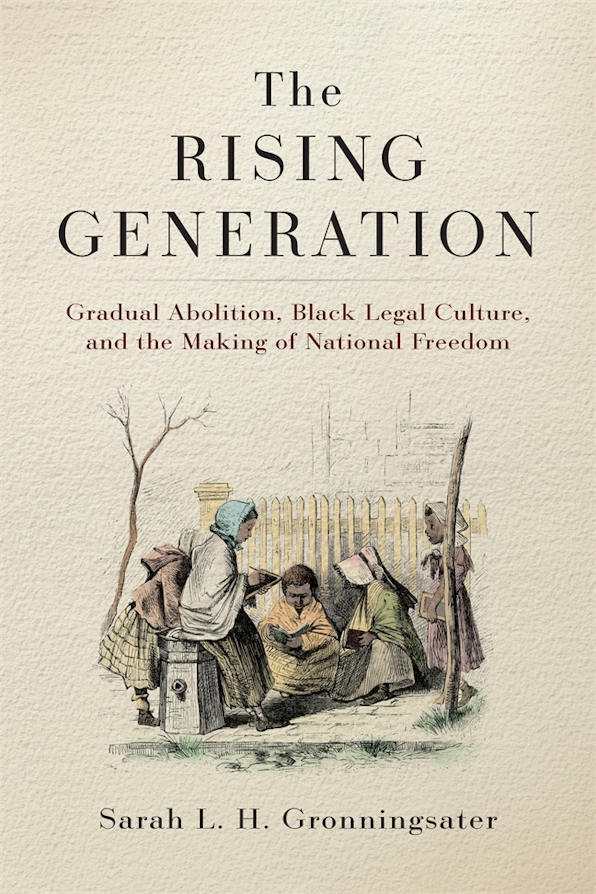
ASLH Cromwell Book Prize to Gronningsater for "The Rising Generation"

Continuing with our notices of the awards, prizes, and fellowships announced at the recent meeting of the American Society for Legal History, we turn now to the William Nelson Cromwell Book Prize

About the award: "The William Nelson Cromwell Foundation Book Prize is awarded annually to the best book in the field of American legal history by an early career scholar. The prize is designed to recognize and promote new work in the field by graduate students, law students, post-doctoral fellows and early career faculty. The work may be in any area of American legal history, including constitutional and comparative studies, but scholarship in the colonial and early national periods will receive some preference."

This year's award went to Sarah L. H. Gronningsater (University of Pennsylvania) for The Rising Generation: Gradual Abolition, Black Legal Culture and the Making of National Freedom (University of Pennsylvania Press, 2024). The citation:


Elegantly rendered and beautifully constructed, Sarah Gronningsater’s  traces the experiences of a formative generation of New Yorkers – people born into the quasi-freedom granted by New York’s emancipation laws. By using a varied and creative source base, Gronningsater chronicles how their lives were shaped by gradual emancipation, and how their experiences and struggles within that legal regime translated into political activism in their later years. Gronningsater convincingly shows how legal consciousness gained early in life connected a generation of freedpeople who later used that knowledge to influence the larger national conversation about citizenship and racial equality in the United States.

Congratulations to Professor Gronningsater!

-- Karen Tani  

Thursday, October 23, 2025

Murray on "Marks, Meaning and the Haunting of American Trademark Law"

 The Texas Law Review (Volume 103, issue 9) recently published an essay of interest: Kali Murray (Marquette University Law School), "Seeing the Dead: Marks, Meaning and the Haunting of American Trademark Law." The essay draws on history to discuss "trademark’s fraught relationship with social identities of race and caste in the United States." An excerpt from the Introduction (footnotes omitted):

Slave labor was central to the making of the modern world. It gave Europeans the means to occupy and develop the Americas. The trade in slaves helped merchants accumulate capital that was reinvested in agriculture, industry, and infrastructure. Slave plantations produced the sugar, cotton, and coffee that propelled the industrial revolution in the North Atlantic countries.

Trademark law is an ideal place to consider the relationship of intellectual property to the political, social, and economic system of enslavement. Trademarks, which protect the commercial signs associated with the goods and services of its users, seem to be intimately connected to the economic practices of enslavement, either because a slave market would advertise its services in selling enslaved individuals using trade names or because goods like sugar or cotton produced by enslaved persons would be trademarked.

I use fugitive slave advertisements—advertisements placed in colonial and antebellum newspapers that sought the return of an enslaved person to their enslaver—to explore the relationship of trademark law and the construction of race and caste in the United States. . . .  

Read on here.

-- Karen Tani  

Saturday, October 18, 2025

Weekend Roundup

  • Congratulations to Alison LaCroix, University of Chicago Law School, upon the awarding to her of the American Historical Association’s Littleton-Griswold Prize in American Law and Society for The Interbellum Constitution: Union, Commerce, and Slavery in the Age of Federalisms!
  • Laura F. Edwards, Class of 1921 Bicentennial Professor in the History of American Law and Liberty at Princeton University, will deliver three lectures on the theme “The Legal Geography of the Civil War Era and Its Lasting Legacy,” as the 2025 Steven and Janice Brose Distinguished Lecture Series at Penn State University on October 23-25. 
  • A notice of Emma Brush, a legal historian recently appointed Assistant Professor of Law, Jurisprudence and Social Thought at Amherst College (Amherst Student).  
  • Evan D. Bernick, Northern Illinois University College of Law, has posted his review of Born Equal by Akhil Amar, Yale Law School.
  • Jane Manners's historian's amicus brief for the Brennan Center in Grundmann v. Trump (D.C. Cir.), involving the Trump administration’s motion to dismiss Susan Tsui Grundmann's challenge to her removal from the Federal Labor Relations Authority.   
  • “The Origins of the Major Questions Doctrine,” which Rachel Rothschild, Michigan Law, presented at last year's annual meeting of the ASLH, has been selected "one of the top 10 environmental law papers published in 2024" (Michigan Law). 
  • ICYMI: Still more Lepore: Arts FuseJustice Amy Coney Barrett on originalism (and more) (C-SPAN).  Marcus Rediker reviews The Zorg by Siddharth Kara (NYT).

Weekend Roundup is a weekly feature compiled by all the Legal History bloggers.

Thursday, October 16, 2025

Newman on the End of Slavery in Britain

Simon P. Newman, University of Glasgow, has published Taken Not Given: The End of Slavery in Britain in Law and History Review:

Between the mid-seventeenth and the late-eighteenth centuries thousands of enslaved people were brought to the British Isles. Many were enslaved, and they were publicly bought and sold, marked by brands, collars and manacles, and some were sent from Britain into plantation slavery. Slavery did not, hoverer, flourish in Britain. By the time of Somerset v Stewart (1772) and Knight v Wedderburn (1778) the large majority of people of color in Britain were free, many of them self-liberated. Despite the best efforts of enslavers to maintain their property rights in people, the enslaved regularly escaped. Newspaper “runaway advertisements” were invented in London during the second half of the seventeenth century, and between the 1650s and 1770s they reveal the development of the freedom seeker in the public sphere. The Somerset and Knight decisions did little to change slavery in the British Isles but rather confirmed a change that was all but complete. The most significant impact of the decisions was in the colonies, where planters interpreted the courts’ actions as evidence of a growing imperial threat to the institution of slavery.

--Dan Ernst 

Saturday, October 4, 2025

Weekend Roundup

  • John W. Cairns, professor of Civil Law at the University of Edinburgh, will deliver this year’s Eason-Weinmann Lecture on International and Comparative Law at Tulane Law School on November 20, 2025, at 5 p.m. in the Wendell H. Gauthier Moot Court Room 110.  Professor Cairns’s lecture, "The Civil Code of the State of Louisiana: Context and Contents," will kick off a conference on the bicentennial of the Louisiana Civil Code.  
  • A notice and recording of Richard Primus's discussion with Noah Feldman of Professor Primus's book, The Oldest Constitutional Question, at HLS on September 25 (Harvard Law Today). 
  • UVA Law's notice of G. Edward White's Robert H. Jackson: A Life in Judgment (Oxford University Press). 
  • "Jamie Raskin (D-MD), former Federal Judge Michael Luttig, and Baltimore University Law Professor Kimberly Wehle discuss the history of the U.S. Constitution at an event hosted by George Washington's Mount Vernon" (C-SPAN).  
  • My Georgetown Law colleague John Mikhail lectured on anti-slavery and the Constitution on September 17 as part of Ithaca College’s observance of Constitution Day (Ithacan).  DRE. 
  • Last month, Nancy Cott, Harvard University, spoke on “Doctors, Lawyers, and Feminists on the Road to Roe v. Wade" at Vanderbilt Law (Vanderbilt)
  • Kurt Lash discusses constitutional debates over slavery before the Civil War (NCC). 
  • One of the Drinan Visiting Professors are at the Boston College Law School is Rebecca Horwitz-Willis, a recipient of the Kathryn T. Preyer Award from the American Society of Legal History (BC Law).

  • The Organization of American Historians is sponsoring two webinars on immigration in October.  The first, on denaturalization, will take place at 6pm ET on October 14.  Register here.  The second, on U.S. deportation policies from the Alien Friends Act of 1798 to today, will take place at 6pm ET on October 30.  Register here.  Both webinars are co-sponsored by the Immigration and Ethnic History Society.   
  • The October 2025 issue of the newsletter of the Historical Society of the DC Circuit is now available.  
  • We ought to have noticed sooner Time Immemorial, the podcast of the Osgoode Hall Society for Canadian Legal History. 
  • ICYMI: (Before the government shutdown), visitors to the National Archives react to seeing the entire Constitution (WaPo).  Jillian Foley on America’s Privacy Policy (HNN).  Douglas M. Charles, Penn State, on history repeating itself at the FBI (The Conversation).
Weekend Roundup is a weekly feature compiled by all the Legal History bloggers.