Showing posts with label Ireland. Show all posts

Saturday, June 27, 2026

Weekend Roundup

  • William Howard Taft (LC)
    Andrea Scoseria Katz on "Taft at the Beach: What the Supreme Court Misses About a Key Unitary Executive Precedent" (Can We Still Govern?) 
  • Michael Dreeben looks back at Humphrey's Executor (Just Security). 
  • Martha Jones's illustrated story in the New York Times Magazine on Elizabeth Freeman, who sued for her own freedom, is here
  • That Modern Criminal Law Review workshop, "Ancient Criminal Law: A Global Perspective," may be viewed here and just heard here.  
  • A notice of "Myths and Misunderstandings in Modern Irish History," by Patrick Geoghegan, the 2026 Hardiman lecture at the Supreme Court (Law Society Gazette). 
  • A Q&A with Hadar Aviram's Behind Ancient Bars: Narratives of Incarceration in the Hebrew Bible (University of California Press) (UC SF Law). 
  • Michael Dorf asks What Weight, If Any, Should Be Given Racist Laws In A History-and-Tradition Test? (Dorf on Law.)
  • Nineteenth-Century NY Law and Birthright Citizenship: New York v. Miln (1837) (New York Almanack).  
  • A notice of Stacey Patton's Strung Up: How White America Learned to Lynch Black Children (Beacon Press, 2026) (New York Almanack).
  • "Reflecting on America’s 250th anniversary: Revolution, the Constitution, and the founders" in the Princeton University Press's list (PUP).  And, while we're at it, Princeton University and the Revolution.  
  • Lawbook Exchange's June 2026 list in Scholarly Law and Legal History.   
  • State Constitution Roundup: What made Pennsylvania's first ever constitution so radical that it only lasted 14 years?  (WHYY).  1776 NC Constitution exhibit [is] part of ‘Capitol 250’ July 4 fest (Coastal Review).  Bayard v. Singleton: Judicial review’s NC origins (Carolina Journal).  The Hawaii Constitution (State Court Report). 
  • ICYMI: HIAS's illustrated history of US immigration (HIAS).  Eugene V. Debs, Constitutional Voice (NCC).  An appreciation of Raphael Lemkin, "the author of the concept of genocide" (UJE).  Benjamin Perry and the fight against secession (Greenville Journal). 

Weekend Roundup is a weekly feature compiled by all the Legal History bloggers. 

Saturday, March 14, 2026

Weekend Roundup


  • A head's up to those thinking about submitting proposals for the annual meeting of the American Society for Legal History in Banff, November 12-14: the deadline is March 24.   
  • Legal history bulks large among the finalists for the book division of the American Bar Association’s Silver Gavel Awards for Media and the Arts: The Zorg: A Tale of Greed and Murder that Inspired the Abolition of Slavery, by Siddharth Kara; The Radical Fund: How a Band of Visionaries and a Million Dollars Upended America, by John Fabian Witt; We The People: A History of the U.S. Constitution, by Jill Lepore; You Can't Kill a Man Because of the Books He Reads: Angelo Herndon's Fight for Free Speech, by Brad Snyder; American Scare: Florida's Cold War on Black and Queer Lives, by Robert Fieseler; and The Containment: Detroit, the Supreme Court, and the Battle for Racial Justice in the North, by Michelle Adams.  
  • The Irish Legal History Society has announced its 2026 essay prize.  "Submissions are invited by 31 May on any topic within Irish legal history, broadly conceived, from both undergraduates and postgraduates."
  • The U.S. Department of Justice has announced that a museum devoted to its past will open in July 2026. 
  • Anna Snyder on the "odd omission" of lawyers in commemorations of the 250th anniversary of independence (AHA Perspectives). 
  • "The 1957 executive order signed by President Dwight Eisenhower to enforce the desegregation of Little Rock Central High School is one of the documents on display at the Clinton Presidential Center at a new exhibit chronicling the history of the 27 amendments to the Constitution" (Arkansas Advocate).    
  • Michele Goodwin’s Presidential Address to the Law & Society Association prompted June Carbone to reflect on teaching Johnson v. McIntosh and Dred Scott in the comment Claiming History.
  • ICYMI:  Phillip W. Magness on Justice Thomas's dissent in the IEEPA decision (Law & Liberty). A notice of Vernon Burton's talk, “The First Amendment and Lincoln’s Constitutional Legacy" at Clemson's "week of celebrating First Amendment rights and history" (Clemson News). Tarun Choudhury on Sir Garfield Barwick (Legal Service India).  Ernie Walton thinks that Originalists Need the Classical Legal Tradition (Public Discourse).

 Weekend Roundup is a weekly feature compiled by all the Legal History bloggers.

Saturday, February 21, 2026

Weekend Roundup

  • Boston College Law's notice of its new legal historian, Marco Basile (BC Law).   
  • G. Edward White, UVA Lawdiscusses his new biography Robert H. Jackson: A Life in Judgement on the American Bar Association's Modern Law Library podcast.  
  • Jessica LakeMelbourne Law School, discusses her book Special Damage: The Slander of Women and the Gendered History of Defamation Law (UVA Law). 
  • Clare Cushman discusses US Supreme Court Justice Day helped establish the Court's recusal practice (SCHS).
  • A notice of Confluences of Law and History. Irish Legal History Society Discourses and Other Papers, edited by Niamh Howlin and Felix M. Larkin (Irish Catholic).
  • ICYMI: The groundbreaking legal career of Judge Lucile Watts (Michigan Public Radio).  The “Renaissance” in Civic Education: Beyond the Salmon P. Chase Center (The Lantern).  Bhagat Singh Thind and his Citizenship Case (New York Alamanck).

 Weekend Roundup is a weekly feature compiled by all the Legal History bloggers.

Thursday, January 29, 2026

CFP: Four Nations Law and the Humanities

[We have the following CFP for The Four Nations Law and the Humanities Forums.  DRE]

We are excited to announce the calls for papers for Four Nations Law and the Humanities Forums 2026!

Located around the country during 2026, the forums will provide an important space to develop research excellence at the intersections of law and the humanities, and foster intellectual community, supporting early-career scholars. Hosted at the University of Glasgow, Queen’s University Belfast, University of Warwick, and Cardiff University, these workshops are a series held across the four UK nations, in collaboration with the Law and the Humanities Hub (LHub) at the Institute of Advanced Legal Studies.

The forums will workshop ECRs’ work in progress and offer a rigorous context addressing the nature of interdisciplinary research in law and the humanities and its paths of development.

Criteria for Selection.  Contributions developed by early-career scholars will be selected based on their demonstration of excellence in scholarship and practice. Proposed participation may be written papers or creative work (in visual, sonic, film, etc. form), at any intersection within Law and the Humanities, including research that connects law with history, philosophy, literature, art, performance, linguistics, cultural and media studies, creative practice, and other humanistically-informed fields and methods.
     
Eligibility: The forums are open to individuals currently pursuing a PhD or DPhil, or who are within seven years of having completed their PhD, with due accommodation for career breaks, who are actively carrying out research in Law and the Humanities.

Forums Dates.  The dates of the workshops are as follows:

21st May - University of Glasgow
25th June - Queen’s University Belfast
2nd  July - Cardiff University
17th July - University of Warwick 

The workshops will bring law and humanities scholarship to wider audiences through the engagement of legal scholars as well as humanities scholars, ensuring that the research is not confined to law or the humanities.

Forums Format.  A limited number of works in progress will be selected for each forum. Each forum will be based on pre-reading of all papers and works by all attendees, and will include:

A friendly opening session;

Workshop sessions of 45 minutes dedicated to the submitted papers/works. Each session will include an invited senior commentator and an open discussion addressing subject matter, method, interdisciplinarity, and creativity. The authors/creators will not be expected to present.  The discussion will include all participants in conversational style (not as a Q&A).

The scholarship, creative practice, and networking will be fostered and supported through the participating institutions and LHub, via the Four Nations website, a concluding online plenary, and associated networks such as Legal Humanities Association and the Art/Law Network.

Submissions.  Please submit a CV; statement of interest in the forum, including an explanation of your eligibility (up to 250 words); and a 500-1,200-word proposal for a paper, or in the case of an artwork submission, the work and a 300-word description. Please also indicate which location you wish to attend.  

If accepted, submission of the completed paper will be expected a month prior to the chosen workshop, and should be up to 6000 words, or the completed artwork if non-text. 

Proposal Submission Deadlines.  Dates for the submission are as below.  

28th February - University of Glasgow
31st March - Queen’s University Belfast
30th April - Cardiff University and University of Warwick

NB: Location preferences may not always be possible.  Please send the above to Lucy.FinchettMaddock@gold.ac.uk and Lhub@sas.ac.uk. 

Completed Works Deadlines for Accepted Proposals:

21st May - University of Glasgow
25th May - Queen’s University Belfast
2nd June - Cardiff University
17th June - University of Warwick

For further information, please do contact Lucy.FinchettMaddock@gold.ac.uk and LHub@sas.ac.uk.

With thanks to funding from IALS LHub, Learned Society Wales, and University of Dundee, for their additional funding and support.

Wednesday, December 10, 2025

A Festschrift for W.N. Osborough

New from Four Courts Press: A Sense of Place: Studies in British and Irish legal history in memory of W.N. Osborough, edited by Sparky Booker and Kevin Costello:

W.N. Osborough was described by the Irish Times on his death in 2020 as Ireland’s ‘greatest legal historian’. He wrote prolifically on Irish legal history and culture for over fifty years, re-established legal history as an undergraduate option in university law degrees and was the moving force behind the establishment of the Irish Legal History Society in 1988.

Throughout this volume the authors uncover new insights into the evolution and practice of law in Britain and Ireland and honour Nial’s impressively wide-ranging interests, which spanned traditional periodizations and geographical divides.

Contributors: Sir John Baker, Paul Brand, Jane Ohlmeyer, Colum Kenny, Robin Frame, Sparky Booker, Niamh Howlin, Thomas Mohr, Ian Williams, Kevin Costello, R.H. Helmholz, Charles Lysaght, Richard McMahon, Paddy Waldron, Paul O’Brien, Mary O’Dowd, Colm Lennon and John McCafferty. 

Sparky Booker is a historian of law, culture and society in late medieval Ireland. She is Assistant Professor in Irish Medieval history at TCD . Kevin Costello is an assistant professor at UCD. His principal research interests lie in the fields of Legal History and Administrative Law.

--Dan Ernst 

Saturday, November 22, 2025

Weekend Roundup

  • An interesting notice of the St. Olaf College Collaborative Undergraduate Research and Inquiry team and its investigation of how, if at all, the 17th Amendment shifted the balance of power between rural and urban constituents.
  • The links to the recordings of two recent talks sponsored by the Supreme Court Historical Society, John Fabian Witt on The Radical Fund and G. Edward White and Gerard Magliocca's books on Robert H. Jackson are new available.  Also, Professor White draws upon his book in a post on the blog of the Oxford University Press.  
  • ICYMI: Gordon S. Wood's remarks upon receiving the Irving Kristol Award of the American Enterprise Institute.  John O. McGinnis and Mike Rappaport object to what they consider Jill Lepore’s “particularly shabby” treatment of Justice Scalia’s ideas in her recent Atlantic article on originalism (Law & Liberty).

Weekend Roundup is a weekly feature compiled by all the Legal History bloggers.

Friday, September 12, 2025

Aulakh's "Empire and the Peasant Proprietor"

Preet S. Aulakh,York University, has published Empire and the Peasant Proprietor: Inter-Colony Land Reform in the Victorian Era (Oxford University Press):

As the British Empire consolidated its geographical possession of distant lands by the 19th century, the agrarian nature of its colonies necessitated careful considerations about land tenure relationships. After intense debates around property rights and political economy, several land laws were enacted across the Empire between 1868 and 1875, which recognised the proprietary rights of peasant cultivators. Empire and the Peasant Proprietor examines this transformative shift in the imperial approaches to land tenure.

Through a comparative analysis of historical land tenure arrangements in three diverse colonial sites, Punjab, Ireland, and Prince Edward Island, the book identifies two crucial mechanisms which facilitated the institutionalisation of peasant proprietorship. One, there was a fortuitous ideological alignment between important governing agents in the three colonies. Two, the debate about the impact of land reform in the colonies on the 'sanctity' of English principles was redirected, allowing for inter-colony analogies and precedents to support the proprietary rights of peasant cultivators.

Empire and the Peasant Proprietor demonstrates the importance of these reciprocal influences within the imperial system and provides insight into contemporary challenges of secure land rights for a large proportion of the global population that continues to be dependent on agriculture for sustenance.

This is an open access title available under the terms of a CC BY-NC-ND 4.0 International licence. It is free to read on Oxford Scholarship Online and offered as a free PDF download from OUP and selected open access locations.
--Dan Ernst

Monday, May 19, 2025

Bemmer on Early Irish Law in Helsinki Seminar

Jaqueline Bemmer, a Marie S. Curie Fellow with the Research Group Medieval History at Leuven, will present in the  Helsinki Legal History Series seminar on Thursday, May 22, from 3 pm - 4:30 pm in P673, Porthania, University of Helsinki.  You may attend via Zoom.  She will speak on "Rethinking the Margins: Early Irish Law and the Post-Roman Legal Landscape":

The early Irish laws, sometimes referred to as fénechas, constitute the largest extant body of vernacular legal writing in Europe outside the Graeco-Roman world – yet they remain largely unknown beyond a small specialist audience. Unlike the roughly contemporary Germanic edicts, these texts were not issued by kings but preserve the customary laws (or socio-legal customs) of the local population in early medieval Ireland. Committed to parchment in the 7th and 8th centuries by scholars trained in Irish and early Church law, grammar and poetry, this legal material reflects an oral tradition transmitted and transformed within monastic scriptoria. Notably, these jurists chose to write in Old Irish – a Goidelic Celtic language – rather than Latin, a decision paralleled only by the Anglo-Saxons who wrote in Old English.

The resulting legal texts are extraordinarily rich, and cover a wide array of social and legal topics. My current Marie Sklodowska-Curie project places these Irish laws in dialogue with contemporary post-Roman edicts from the Continent (often labeled ‘leges barbarorum’), to explore continuities and contrasts in legal thought across the early medieval West. In this talk, I will present aspects of this ongoing research and highlight the comparative potential of the Irish material in relation to developments in Francia, Lombardy, and beyond.

--Dan Ernst

Monday, November 18, 2024

CFP: Oaths and Oath-Taking in Historical Perspective

 [We have the following CFP.  DRE.]

Oaths and Oath-Taking in Historical Perspective: Britain, Ireland, and the British Empire, 1700 to the Present, 7 March 2025, Northumbria University in Newcastle.

Organisers: Henry Miller and James McConnel, Northumbria University

As the 2023 coronation of King Charles III highlighted, oaths remain a feature of modern British public life. Indeed, though largely taken for granted, oaths and declarations continue to play a much wider role within many state agencies (e.g., cabinet government,  parliaments, the judiciary, the magistracy, the armed forces, and the police force). Oaths also feature in other parts of life in the UK: professions including doctors, senior lawyers, and CoE ministers are still required to take oaths. Oaths are also a requirement of some civil society groups (e.g., the Scouts) and are required for membership of some mass-membership associations (e.g., Freemasonry and Orangeism). And since 2004, oaths have been performed at UK citizenship ceremonies up and down the country. Crucially,  all these oaths are not just subscribed to in writing, but also performed in person, often in a public, ceremonial context.

In recent decades, early modern historians have advanced our understandings of oaths and oath-taking. As a result, we now have a much better understanding of the role of oaths in changing conceptions of the political community, evolving crown-subject/state-citizen  relations, and in relation to generating trust during the upheavals of the seventeenth century and their aftermath. However, understanding the evolution and role of oaths over the longue durée (especially beyond the early eighteenth century) requires more attention, and without assuming they inevitably declined after their early modern heyday. While in the British context, the practice of national oath-taking led by the state  declined after the early eighteenth century, oaths remained in common use for a wide variety of purposes. For example, oaths were ubiquitous in civil society, taken on a peer-to-peer basis on admission to friendly societies, trade unions, and various forms of voluntary association. Similarly, although the use of oaths as religious tests to disbar non-Anglicans from public office was largely dismantled in the nineteenth century, this does not explain the varied and continued use of written and oral oaths right  up to the present day. Rather than charting a decline from an early modern peak and seeing oaths as an archaic practice that retains a residual presence today, we instead want to explore the different roles that oaths perform and have performed and why this  has mattered in different temporal, geographic, social, and political contexts.  

This one-day interdisciplinary conference to be held on Friday 7 March 2025 at Northumbria University in Newcastle seeks to bring together early modern and modern historians, as well as scholars from across the humanities and social sciences, to consider the historical and contemporary roles of oaths and oath-taking in Britain and Ireland, and beyond. The keynote lecture will be delivered by Prof. Ted Vallance (Roehampton).  

Possible topics could include, but are not confined to:

Language and rituals of oaths
Subversive oaths
Oaths and secrecy  
Religious oaths and tests
Loyalty, the constitution, and the state
Assertory and promissory oaths
Perjury and oaths as legal instruments
Oaths and modernity
Oaths, business, and capitalism
Oaths, performance, practice, and behaviour
Oaths as speech acts
Oaths, vows, swearing, and promises
Oaths and dispute resolution
Oath and material culture
Literacy and oath taking
Oaths and the history of emotions
Resisting oaths
Conscience and notions of honour
Oaths and marriage
Oaths as abjurations
Oaths and professionalism
Mundane / profane oaths
Comparative perspectives on oaths and oath-taking
 
We welcome proposals of c. 250 words (for 15-minute in-person presentations) concerning these or other topics, to be submitted, along with a short CV, by the end of Friday, 20 December 2024. The submissions should be sent  to henry.miller@northumbria.ac.uk.  Proposers will be informed of the outcome in early January 2025.  

We have some limited funding available to support travel and, if appropriate, accommodation, expenses costs of speakers: this will be reserved for those who are early career researchers, independent scholars, or in fixed term posts. If you wish to be considered  for this financial support, please indicate your likely costs of attending the workshop; and we would also ask that you first draw on any internal sources to which you have access.

Friday, August 23, 2024

Howlin on Female "Firsts" in the Legal Profession

Niamh Howlin, University College Dublin College of Business and Law, has posted Women as Both Insiders and Outsiders in the History of the Legal Profession:

The Sex Disqualification (Removal) Act 1919 removed the legal barrier to women entering the legal professions. In November 1921, Frances Kyle and Averil Deverell were the first women to be called to the Irish bar. The experiences of these early women barristers have in recent years been documented and commemorated in exhibitions and portraiture, as well as through various conferences, other events, books, periodicals and poetry, particularly in the context of the centenary of the 1919 Act. These add to the growing body of literature examining the experiences of early women lawyers and judges in England and other jurisdictions.

Much recent focus has been on historic ‘firsts’ or ‘trailblazers’, but it is important not to let this obscure the broader story of how women experienced working in the legal professions. Indeed, this point was made twenty years ago by Bacik, Costello and Drew who observe, ‘[t]his phenomenon of the highly visible trailblazer woman should be understood not necessarily as an example of ‘advances’ made by women, but as a reminder of continuing male domination.’ Glazer and Slater identify strategies employed by early women professionals: superperformance, separatism, subordination and innovation. They add that while early women professionals did not consciously choose such strategies, ‘it quickly became clear to them that entrance into the elite world of professionalism would require special strategies for women.’ ‘Superperforming’ women were pioneers, and often achieved historic ‘firsts.’ Bacik, Costello and Drew refer to this as the ‘first woman to’ phenomenon, and caution that this ‘does not necessarily provide evidence of absence of discrimination, but rather often signals the continued and persistent exclusion of women – the exception that proves the rule.’

While recognizing the significance of the trailblazers and ‘famous firsts’, this paper seeks to go beyond commemoration, to consider the lived experiences of women at the Irish Bar in the twentieth century. It looks at the challenges they faced, the type of work they did and the strategies they adopted to succeed in a gendered environment. This paper draws on archival research as well as interviews conducted with men and women who were in practice at the Irish Bar from the 1950s until the late 1990s.
--Dan Ernst

Friday, June 7, 2024

Hunt on Taxation in the Irish Free State

Emer Hunt, Sutherland School of Law, University College Dublin, has posted Transition without Change: Taxation by the Irish Free State, which is to appear in volume 11 of Studies in the History of Tax Law, edited by Peter Harris and Dominic de Cogan (Hart Publishing):

The Irish Free State, established in 1922, saw an effective continuation of the tax laws in force during the previous colonial period. This was quite marked, both in the continuity of legislation and tax administration and, indeed, was viewed as positive by some revolutionary politicians of the era. The degree of continuity-or stasis-could be a reflection of the nationalist focus on the identity of the ruler rather than the content of the rules, an answer to the economic imperative of raising revenue for the new state or a desire to impress the erstwhile rulers with the conservatism of the new regime. This chapter examines the formation of the modern Irish state in 1922 within the microcosm of tax laws and against the backdrop of a desire for self-determination which was not expressed through tax law and policies.
--Dan Ernst

Monday, March 25, 2024

The Centenary of the Irish Free State Constitution

Palgrave Macmillan has published the essay collection, The Centenary of the Irish Free State Constitution: Constituting a Polity?  Its editors are Laura Cahillane, Senior Lecturer in the School of Law at the University of Limerick, and Donal K. Coffey, Assistant Professor in the School of Law and Criminology at the National University of Ireland, Maynooth.  It appears in the series Palgrave Modern Legal History.

This book deals with the role, development, and legacy of the first Constitution of independent Ireland within the wider context of the establishment of the State. After decades of relative neglect, the 1920s have been receiving increased attention from historians recently thanks to the centenary of the State’s foundation. This book continues this trend of re-examination of this period and looks at key themes, such as the establishment of institutions under the Irish Free State Constitution and the focus on the ideals of popular sovereignty and democracy. It does so from novel and cross-disciplinary perspectives, and it also looks at areas which have received little to no previous attention; from individual aspects like property rights, the Irish language and environmental rights to aspects such as opposition and partition.

 The TOC is here.

–Dan Ernst

Tuesday, December 19, 2023

Howlin's "Barristers in Ireland"

Niamh Howlin, Sutherland School of Law, University College Dublin, has published Barristers in Ireland: An evolving profession since 1921 (Four Courts Press):

Barristers played significant roles in Irish public life in the twentieth century as lawmakers, politicians, civil servants, broadcasters, judges, academics and social reformers. This book is the first to examine the profession from the turbulent twenties until the Celtic Tiger years. It looks at who the barristers were, how they worked and how they were perceived. It also examines the impact of partition, the experiences of women at the bar, and traces how the profession changed over the course of the twentieth century. Drawing upon interviews conducted with barristers, published memoirs, records of the Bar Council and the King’s Inns, government publications and archival sources, this book paints a picture of a profession that was rooted in tradition yet constantly evolving.

Extracts are here

--Dan Ernst

Saturday, November 18, 2023

Weekend Roundup

  • The Richmond Free Press has reported the discovery of “144 moldy boxes filled with the decaying legal papers of one of Richmond’s legal giants, Roland J. 'Duke' Ealey,” a 1939 graduate of the Howard Law School.  Topics include “Poll tax litigations and campaign information; Richmond Crusade For Voters literature and training materials; Prince Hall Fraternal Order of Black Freemasonry documents; Massive Resistance and the Byrd Machine; Interstate Highway System family displacement records; [and] Brown v. Board of Education paperwork. 
  • The Annual General Meeting of the Irish Legal History Society on Friday, December 1, 2023, includes, at 6.45 GMT, the Winter Discourse, “The Trials of Bad Bridge,” by Elaine Farrell and Leanne McCormick.  It is open to non-members who register for the event.
  • Richard W. Ireland, on delight in legal history, especially as engendered by "Characters, Not Caricatures: Sketches taken from life principally in Court on the Western Circuit" (Legal History Miscellany).
  • From the American Historical Review, an interesting Call for Proposals: AHR Special Issue: “The Mistakes I Have Made." 
  • Speaking of the Supreme Court Historical Society, the discussion it hosted on Cliff Sloan’s The Court at War: FDR, His Justices, and the World They Made is now on YouTube.
  • Asheesh Kapur Siddique has published The Ideological Origins of “Written” Constitutionalism in Early American Studies: An Interdisciplinary Journal. "Building on recent scholarship on the coproduction of writing practices and state formation, it argues that the mode of constitution-making inaugurated in the aftermath of the American Revolution represented less a moment of origin than an ideological project of revising the relationship between document and statecraft characteristic of the early modern British Empire."
  • Over at Credit Slips, my Georgetown Law colleague Adam Levitin is part of a discussion, arising from the briefing in the Purdue Pharma bankruptcy case before the Supreme Court, about the constitutional significance of unpublished English opinions.  See here and here.  DRE
  • Brad Snyder discusses his book, Democratic Justice: Felix Frankfurter, the Supreme Court, and the Making of the Liberal Establishment, with Jeffrey Rosen at the New-York Historical Society on Tuesday, December 12, 6:30 – 7:30 pm ET.  The charge for livestream access for nonmembers is $30.
  • ICYMI: “American LGBTQ+ Museum’s first traveling exhibition celebrates Lambda Legal’s history" (gay city news). "More Than 100 Years Later, Army Overturns Convictions of 110 Black Soldiers After 1917 Houston Riots" (Military.com).
  • Update"Leviathan Production has entered development on a feature adaptation of Henry Ford’s War on Jews and the Legal Battles Against Hate Speech, a historical work penned by Victoria Saker Woeste" (Deadline).

Weekend Roundup is a weekly feature compiled by all the Legal History bloggers.

Tuesday, October 24, 2023

Studies in the History of Tax Law

New from Hart Publishing: Studies in the History of Tax Law, Volume 11, edited by Peter Harris and Dominic de Cogan:

This book is a continuation of the prestigious series which is drawn from the papers of the biennial Cambridge Tax Law History Conference. The authors are a mix of academics and senior tax professionals from the judiciary and practice with representatives from 9 countries. The series continues to investigate current tax policy debates in an historical context. The papers fall within three basic categories:

1.  UK and Irish tax, looking at a variety of topics such as tax administration, cases and judges (Whitney, Singer, Viscount Radcliffe), the taxation of royal forests, the taxation of spirits, and income tax transition in the Irish Free State; 

2.  International taxation, with chapters on the role of international organisations (OECD, League of Nations) and on South Africa's early attempts to address double taxation (tax treaties); and 

3.  Non-UK tax systems, including chapters on the legacy of colonial influence (Dutch East Indies), early developments in China, New Zealand, and the USA, an influential Canadian report (Carter Commission), development of the GAAR in Scandanavia, and the receipt of Roman tax law in Europe.

--Dan Ernst.  Table of Contents after the jump.

Wednesday, February 22, 2023

Irish Legal History Student Essay Prize

[We have the following announcement.  DRE.]

The Irish Legal History Society is now accepting entries for its second student-essay competition.  Essays on any period of Irish legal history should submitted by the end of May 2023.  The winning entrant will receive a prize of €250.  The competition is open to under-graduate and post-graduate students.

Essays must be written in English, and be the work of students who are enrolled in a third-level institution in Ireland or abroad, or within a one-year expiration of that enrolment.  Essays must be no longer than 5,000 words – including all references.

The inaugural competition was won jointly by Jessica Commins (UCD/Amsterdam) and Andrew Byrne Keefe (TCD/Harvard).

Founded in 1988, the society examines, explores, and engages with all issues relating to legal history on the island of Ireland, from earliest times to the present day – including the work of Irish lawyers abroad.  Its mission is to encourage the study of, and advance the knowledge of, the history of Irish law.

Saturday, October 29, 2022

Weekend Roundup

  • The Organization of American Historians has announced a free webinar, Immigration Restriction Then and Now: Re-Examining the Impact and Legacy of the 1921 and 1924 Immigration Acts
    We invite you to join us on November 10, at 7pm ET, for a webinar with the contributors from the September 2022 Journal of American History special issue on immigration.  Register here.
  • Applications for the REU Site Summer Research Program open on November 1.  "Building an interactive and relational database of petitions for freedom, our lab is committed to training undergraduates in critical legal inquiry, archival research methods, data collection and processing, and in transcription and encoding techniques that allow us to demonstrate patterns and strategies in legal mobilization and legal decision making."  More.
  • To mark the centenary of the passage of the Irish Free State Constitution, “a theatrical reconstruction of the process that led to its drafting was held in the very room where it was agreed - the appropriately named Constitution Room in the Shelbourne Hotel” (Irish Times).
  • Harvard Law Professor Adrian Vermeule delivered a lecture, "The Original Scalia," on October 19, 2022, with comments from Lawrence Lessig and the Hon. Andrew Oldham, of the United States Court of Appeals for the Fifth Circuit.  Jack Goldsmith moderated.
  • ICYMI: Harvard University appoints Richard Cellini to lead its "Legacy of Slavery Remembrance Program (Harvard Gazette).  Michael C. Dorf on "The Injustice, Insincerity, and Destabilizing Impact of the SCOTUS Turn to History" (Verdict).  Harvard Law Professor Molly Brady on the spooky side of property law (Harvard Law Today).

Weekend Roundup is a weekly feature compiled by all the Legal History bloggers.

Wednesday, October 5, 2022

Mohr on Founding the Irish Free State

Thomas Mohr, Sutherland School of Law, University College Dublin, has posted The Foundation of the Irish State on 6 December 1922:

This article examines the importance of 6 December 1922 as the foundation date of the Irish State. It does so through analysis of the reaction of contemporary media to events on that date and the days that surrounded it. The importance of this date is highlighted by its inseparable connection with three major themes in the history of the early years of the Irish State. These are the Civil War, partition and acceptance of Dominion status under the 1921 Treaty. This article also analyses media reaction to the 1922 Constitution of the Irish Free State that formally came into force on 6 December 1922. It also examines the reaction of a selection of foreign media to the birth of the Irish State. The analysis includes hopes for the future of the new State expressed in contemporary media. The article concludes that, although the date of 6 December 1922 has not been the subject of substantial commemoration in the decades that followed, the significance ascribed to it by people alive at the time underlines its importance as the birth date of the self-governing Irish State.
--Dan Ernst

Thursday, September 8, 2022

CFP: Centennial Conference on the Irish Constitution

Here is the CFP, from the Irish Legal News

A landmark conference taking place this year will mark the centenary of independent Ireland’s first constitution and the birth of the modern Irish state.

Taking place on Monday 5 December, the conference has been jointly convened by the School of Law at the University of Limerick, Maynooth University Social Sciences Institute and the Courts Service and sponsored by the Shelbourne Hotel, where it will take place.

It aims to bring together lawyers, historians, judges and scholars of all levels to discuss aspects of the important document at what was a turning point in Irish legal history.

Those who might like to contribute to the event have been invited to respond to the call for papers by Friday 23 September 2022.

More.

--Dan Ernst

Monday, August 22, 2022

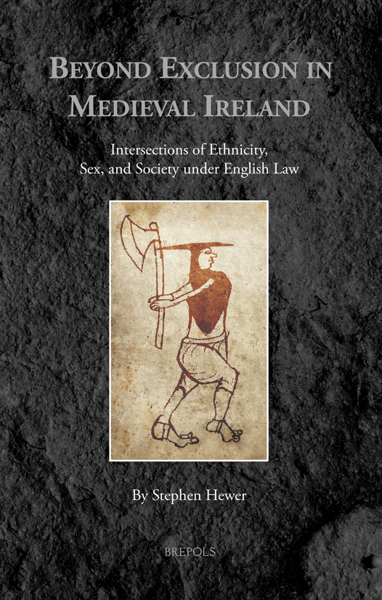
Hewer, "Beyond Exclusion in Medieval Ireland"

Brepols Publisher has released Beyond Exclusion in Medieval Ireland: Intersections of Ethnicity, Sex, and Society Under English Law (2022), by (University of Liverpool). A description from the Press:

The notion that all Gaelic peoples were immediately and ipso facto denied access to the English royal courts in Ireland, upon the advent of the English in 1167, has become so accepted in academic and popular histories of Ireland that it is no longer questioned. This book tackles this narrative of absolute ethnic discrimination in thirteenth- and early fourteenth-century English Ireland on the basis of a thorough re-examination of the Irish plea rolls. A forensic study of these records reveals a great deal of variation in how members of various ethnic groups and women who came before the royal courts in Ireland were treated. Specifically, it demonstrates the existence of a large, and hitherto scarcely noticed, population of Gaels with regular and unimpeded access to English law, identifiable as Gaelic either through explicit ethnic labelling in the records or implicitly through their naming practices.  

More information is available here. (h/t New Books Network.)

-- Karen Tani