Showing posts with label Urban History. Show all posts

Friday, July 4, 2025

Brady on "Public Use" in State Constitutions

Maureen E. Brady, Harvard Law School, has posted Debates Over "Public Use" in the State Constitutional Conventions:

Historians and legal scholars alike have previously noted that the meaning of "public use" began to change in the nineteenth century, continuing into the twentieth. In the hands of some state courts, "public use" expanded from an approach dependent on "use by the public" to one that at least occasionally tolerated "use for the public benefit." This shift in meaning laid the groundwork for Berman v. Parker, the urban renewal decision from the United States Supreme Court that provided support for the broad reading of "public use" in the 2005 decision Kelo v. City of New London

In this Essay, I focus my attention on one of the vectors for the emergence of "public benefit" conceptions of the public use requirement: state constitutional text itself. In the nineteenth century, several states specifically authorized takings for private use in their state constitutions, usually to benefit local and economically critical industries. In other states, this approach was explicitly rejected. 

Although these private-use provisions have been noted by other scholars, this Essay collects and examines them as a group, including the lessons about "public use" that one might glean from the fruitful and fascinating debates that these provisions engendered among nineteenth-century lawyers at constitutional conventions. The conventions are an important site for understanding the logic underlying "public benefit" conceptions of "public use." And they might shape the future of "public use" doctrine by offering historical grounding for alternative conceptions of the line between permissible and impermissible takings, whether as a matter of federal or state constitutional law. 

Dan Ernst

Friday, May 30, 2025

Costello on the Borough Origins of Judicial Review

Kevin Costello, Sutherland School of Law, University College Dublin, has posted Two Eighteenth Century Somerset Boroughs and the Origins of Modern Judicial Review:

The function of modern judicial review is to correct infringements of those elementary standards which must be observed by officials exercising public power. That framework of standards includes norms against exercising power for an improper or corrupt purpose, or when biased, or in disregard of the precepts of natural justice. Of course, for the high court to be able to judicially review jurisdictional , jurisdictional error must be proven: ‘it is axiomatic that a defect has to be proven for in order for certiorari to issue’. Since the late eighteenth century, it has been possible to prove a breach of those standards by written witness testimony in the form of an affidavits. But the power of the High Court to admit witness statements to prove official breaches of jurisdiction was not always recognised.

--Dan Ernst

Thursday, May 22, 2025

Daniel on the Birth of Municipal Bankruptcy Law

Josiah M. Daniel III, Vinson & Elkins and UT Austin, has posted The Historiographical Problem of Municipal Bankruptcy Law:

This is the first archivally researched history of the genesis of municipal bankruptcy law, 1933-1938. It also compares the historical method with law and economics (L&E) for finding and telling the story.

Congressman Hatton Sumners, Judiciary Committee chair, was the key actor. The legislative process was a laboratory for new forms of relief under the Bankruptcy Clause of the Constitution, seeking to relieve the insolvency experienced during the Depression by irrigation districts in “the Valley” of Texas, new towns in Florida, and elsewhere across the nation that could not collect taxes and pay their municipal bonds. State governments were helpless; the Constitution’s Contract Clause forbade “impairing the Obligation of Contracts,” and voluntary, private restructuring agreements were frustrated by the “holdout problem.”

From a variety of models, it was composition with creditors that succeeded politically. Congress from 1933 to 1937 amended the Bankruptcy Act of 1898 by enacting the First and Second Municipal Bankruptcy Acts—known as Chapter IX—based on composition. L&E scholars credit this to freshman Florida congressman Mark Wilcox who worked in conjunction with a bondholders’ group. But it was Sumners who determined that the composition model was constitutional and politically most feasible. He navigated through opposition that insisted “bankruptcy” required turnover of the debtor’s assets in exchange for a discharge and that such legislation would destroy the municipal credit market. Municipal bankruptcy did leave all assets in the debtor’s hands and granted a discharge, and the credit market survived. And relevantly to a key issue in reorganizational bankruptcy today, Sumners crafted the first, and still the only, statutory injunctive relief applicable in the bankruptcy case of an artificial entity for the protection of nondebtor third parties—here, all officers and inhabitants of a municipal debtor—against creditors’ collection efforts.

Municipal bankruptcy became a New Deal agenda item, and Franklin Roosevelt helped push the legislation to enactment in the spring of 1934. The Supreme Court invalidated the first act in the 1936 Ashton case, but Justice Cardozo dissented and outlined small changes that Sumners and Congress utilized in enacting the second act in 1937. Then Sumners led the oral arguments in 1938’s Bekins case that sustained it.

Municipal bankruptcy law succeeded in effectuating municipal-bond restructuring agreements, and its essence lives in today’s Bankruptcy Code as Chapter 9, providing discharge of unpayable debt and more commonly furnishing the platform upon which towns and taxing districts negotiate such deals. Chapter IX worked in the past, and Chapter 9 works today. Sumners, not Wilcox, was primarily responsible for the legislation. Nothing was assured; the story demonstrates change over time, with Sumners the key actor. And the project of finding and interpreting the genesis of municipal bankruptcy is one for legal history, not for L&E, the author argues.
--Dan Ernst

Saturday, March 22, 2025

Weekend Roundup

  • Penn Carey Law’s notice of Dean Sophia Lee's recent article on "the evolution of Fourth Amendment privacy from weak pre-Reconstruction protections through its development over the years, culminating in Boyd v. United States."
  • A Q&A with Felicia Kornbluh and LHB Guest Blogger Jill Hasday on Professor Hasday’s new book We the Men in Ms. Magazine.  Her post on OUPblog is here.
  • The League of Women Voters of Pullman and Whitman County will host the virtual event, “History of Disability Rights” on 7-8:30 p.m. March 31 over Zoom (Lewiston Tribune).
  • James E Hurford reviews The Legal History of the Church of England: From the Reformation to the Present, by Norman Doe and Stephen Coleman (Law Society Gazette).
  • Stephen B. Presser review Jonathan Gienapp's Against Constitutional Originalism for the Federalist Society.

 Weekend Roundup is a weekly feature compiled by all the Legal History bloggers.

Wednesday, March 19, 2025

Cuenca's "Making of Urban Customary Law in Medieval and Reformation England"

Esther Liberman Cuenca has published The Making of Urban Customary Law in Medieval and Reformation England (Oxford University Press):

Drawing on a quantitative analysis of hundreds of printed and archival sources from 77 towns, The Making of Urban Customary Law in Medieval England is the first cross-regional investigation into the history of urban customs since Mary Bateson's seminal, two-volume work Borough Customs (1904-1906). In contrast to English common law and church law, which both had long institutional and academic traditions devoted to training men in their legal philosophies, customary law constituted local practices that acquired the force of law over time. Urban customary law regulated political officeholding, trade, property holding, and even moral behaviour in English towns.

The Making of Urban Customary Law argues that urban customs, which governed the lives of people in English towns, were crucial to the development of a distinct, bourgeois identity in England-an evolution that this new study tracks from the early twelfth to the late sixteenth centuries. In the years following the Black Death, and especially during the Reformation period, this law became more concerned with defining political authority, maintaining morality, and articulating a consensus about the “common good” for townspeople.

This book makes two principal claims: First, customary law advanced the business interests of an urban oligarchy. These were urban (male) elites who drafted laws and obtained privileges to enhance their wealth and assert their political independence from local lords, and often made claims about the legitimacy of their privileges or laws by rooted them in history or some kind of ancestral past. These lawmakers also made considerable efforts to establish their identities as morally upright and even-handed patriarchs. In so doing, urban customary law played a central role in the development of a distinct bourgeois identity in medieval and Reformation England. Second, this law lent particular meanings to the “common good” in towns, as it helped these lawmakers articulate policies that cohered to their vision of an ideal civic community.

--Dan Ernst

Tuesday, January 21, 2025

Highsmith on Governing the Company Town

Brian Highsmith, Lecturer and Academic Fellow in Law and Political Economy at the Harvard Law School, has posted Governing the Company Town, which is forthcoming in the Stanford Law Review:

Workers in Pullman, 1914 (CHM)
This Article explores the forms of public and private governance that facilitate localized corporate domination. Researchers have documented the oppressive employment relationship that characterized historical “company towns,” but few accounts yet have examined these communities as local governments. I use archival research to identify institutional continuities between corporate fiefdoms like George Pullman’s model town outside Chicago (1880-1898) and Disney’s self-governed district near Orlando (1967-2023). I demonstrate that local government law has contributed to the recent reemergence of company-dominated enclaves, namely by deferring to private governance and facilitating jurisdictional fragmentation.

During the Gilded Age and Progressive Era, proprietors of company-owned towns exercised absolute control over workers through the private law of property and contract. Mining bosses and industrial barons like Pullman intentionally rejected the municipal form, using dismissal and eviction to enforce company policy as the operative governing authority within their dominions. This strategy became less effective after the New Deal, leading observers to pronounce the demise of the company town. But I argue that parallel developments in local government law have allowed the company town’s continuation through new institutional forms, enabling corporate titans to wield public powers without accountability to any broad public. Rather than facilitating domination over captive worker-residents, these institutional forms are used primarily to externalize costs and escape democratic obligations like taxation—goals that also deeply shaped the governance of historical company towns. I review this playbook through several recent case studies, demonstrating how territorial and functional fragmentation have facilitated the proliferation of corporate enclaves—allowing spatially-concentrated private capital to secede from local democratic control.

I suggest that the company town can be understood as a democratic phenomenon: a distinctive form of private tyranny. Since the Founding, theorists have acknowledged the vulnerability of small and non-diverse jurisdictions to tyrannical rule-by-faction. By contextualizing new examples like Elon Musk’s efforts to incorporate his model towns in Texas, I show that this fear is realized where corporate interests either commandeer our formal institutions of governance or displace their typical role in structuring public life.
--Dan Ernst

Wednesday, October 23, 2024

Robertson's "Harlem in Disorder"

Stephen Robertson, George Mason University has published Harlem in Disorder: A Spatial History of How Racial Violence Changed in 1935, a digital monograph that the Stanford University Press released earlier this year. 

The violence that spread across Harlem on the night of March 19, 1935 was the first large-scale racial disorder in the United States in more than a decade and the first occurrence in the nation’s leading Black neighborhood. However, as many observers pointed out, the events were “not a race riot” of the kind that had marked the decades after the Civil War. Racial violence took a new form in 1935.

Through a granular analysis of those events and the mapping of their locations, Harlem in Disorder reveals that Harlem’s residents participated in a complex new mix of violence that was a multifaceted challenge to white economic and political power. Tracing the legal and government investigations that followed, this project highlights how that violence came to be distorted, diminished, and marginalized by the concern of white authorities to maintain the racial order, and by the unwillingness of Harlem's Black leaders and their white allies to embrace fully such direct forms of protest.

Focused on capturing rather than simplifying the complexity of the new form of racial violence, Harlem in Disorder is a multi-layered, hyperlinked narrative that connects different scales of analysis: individual events, aggregated patterns, and a chronological narrative. Its structure foregrounds individual events to counter how data can dehumanize the past, and to make transparent the interpretations involved in the creation of data from uncertain and ambiguous sources.

Here are some encomia:

Harlem in Disorder is a remarkable achievement. It embodies the promise of digital humanities, creating a deeply immersive and analytically rich history of a milestone event in the history of New York City and 1930s America. Robertson achieves an enviable balance by bringing clarity to the 1935 Harlem Riot without diminishing the complexity of the motives of its participants, officials, and commentators. All future works on American collective violence and urban unrest will need to take into account this book’s findings and Robertson’s exemplary scholarship.” W. Fitzhugh Brundage, University of North Carolina

Harlem in Disorder gives new meaning to the idea of a deep dive. The work is a model for anyone planning to do a digital history project, and a powerful answer for those who still wonder what value digital history has.” Elizabeth Dale, University of Florida

Harlem in Disorder is a landmark in digital scholarship. Integrating remarkable research, innovative strategies, and compelling narrative, this work demonstrates new dimensions of historical understanding. Stephen Robertson portrays individuals and their complex humanity in a way never before possible.” Edward Ayers, Recipient of the National Humanities Medal

Harlem in Disorder evenhandedly unfolds the events of March 1935 in half-hour segments, allowing us to envision what actually occurred. Robertson comprehensively reconstructs the disorder and its later representations in the media, courts, investigations, and culture—an unprecedented accomplishment.” Amanda I. Seligman, University of Wisconsin, Milwaukee

As Bridget Laramie Kelly's review in the Journal of Social History makes clear, the book joins a debate on "the utility of terms such as riot, uprising, protest, revolution, and disorder."

--Dan Ernst

Monday, October 10, 2022

Rector, "Toxic Debt: An Environmental Justice History of Detroit"

We missed this April 2022 release from the University of North Carolina Press: Toxic Debt: An Environmental Justice History of Detroit, by Josiah Rector (University of Houston). A description from the Press:

From the mid-nineteenth until the mid-twentieth century, environmentally unregulated industrial capitalism produced outsized environmental risks for poor and working-class Detroiters, made all the worse for African Americans by housing and job discrimination. Then as the auto industry abandoned Detroit, the banking and real estate industries turned those risks into disasters with predatory loans to African American homebuyers, and to an increasingly indebted city government. Following years of cuts in welfare assistance to poor families and a devastating subprime mortgage meltdown, the state of Michigan used municipal debt to justify suspending democracy in majority-Black cities. In Detroit and Flint, austerity policies imposed under emergency financial management deprived hundreds of thousands of people of clean water, with lethal consequences that most recently exacerbated the spread of COVID-19.

Toxic Debt is not only a book about racism, capitalism, and the making of these environmental disasters. It is also a history of Detroit's environmental justice movement, which emerged from over a century of battles over public health in the city and involved radical auto workers, ecofeminists, and working-class women fighting for clean water. Linking the histories of urban political economy, the environment, and social movements, Toxic Debt lucidly narrates the story of debt, environmental disaster, and resistance in Detroit.

A sample of the advance praise:

“Josiah Rector’s history of environmental justice in Detroit is breathtaking in its ambition and scope. Integrating environmental justice, urban history, and political economy, Rector lays out how environmental inequality came to be, as a confluence of white segregationists working with capitalists in industry, finance, and real estate at the expense of workers and communities. This dazzling debut is extensively researched, innovative, and a must-read for those interested in environmental justice, labor history, and contemporary problems that continue to land particularly hard on Black, Brown, and poor bodies and communities in Detroit and beyond.”—Julie Sze

More information is available here.

-- Karen Tani

Friday, June 11, 2021

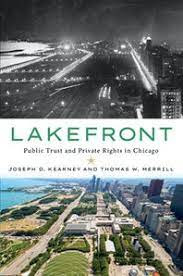
Kearney and Merrill's "Lakefront"

Joseph D. Kearney, Marquette Law, and Thomas W. Merrill, Columbia Law, have published Lakefront: Public Trust and Private Rights in Chicago (Cornell University Press):

How did Chicago, a city known for commerce, come to have such a splendid public waterfront—its most treasured asset? Lakefront reveals a story of social, political, and legal conflict in which private and public rights have clashed repeatedly over time, only to produce, as a kind of miracle, a generally happy ending.

Joseph D. Kearney and Thomas W. Merrill study the lakefront's evolution from the middle of the nineteenth century to the twenty-first. Their findings have significance for understanding not only Chicago's history but also the law's part in determining the future of significant urban resources such as waterfronts.

The Chicago lakefront is where the American public trust doctrine, holding certain public resources off limits to private development, was born. This book describes the circumstances that gave rise to the doctrine and its fluctuating importance over time, and reveals how it was resurrected in the later twentieth century to become the primary principle for mediating clashes between public and private lakefront rights. Lakefront compares the effectiveness of the public trust idea to other property doctrines, and assesses the role of the law as compared to more institutional developments, such as the emergence of sanitary commissions and park districts, in securing the protection of the lakefront for public uses.

By charting its history, Kearney and Merrill demonstrate that the lakefront's current status is in part a product of individuals and events unique to Chicago. But technological changes, and a transformation in social values in favor of recreational and preservationist uses, also have been critical. Throughout, the law, while also in a state of continual change, has played at least a supporting role.
Fulsome encomia by the likes of Banner and Hartog after the jump.

Thursday, April 29, 2021

Wolf reviews Cohen's "Saving America's Cities"

Michael Allan Wolf, University of Florida Levin College of Law, has posted Between Jacob(s) and Moses: Ed Logue, Urban Redevelopment Lawyer, which appears in the Journal of Affordable Housing and Community Development Law:

In Saving America’s Cities: Ed Logue and the Struggle to Renew Urban America in the Suburban Age, her thorough, fascinating, Bancroft Award-winning study of the life and work of Ed Logue, Harvard historian Lizabeth Cohen has presented a volume that should sit on every housing and community development lawyer’s bookshelf. I suggest nestling this volume between Jane Jacobs’s 1961 cri de coeur, The Death and Life of Great American Cities, and Robert Caro’s 1975 biographical masterpiece, The Power Broker: Robert Moses and the Fall of New York. This review focuses on the legal aspect of Logue’s oeuvre. Those born in the 1960s and later have no first-hand knowledge of how significant federal dollars and tax expenditures, supplemented by ambitious state and private-sector participation, can dramatically increase the supply of affordable housing and redevelop, in positive and negative ways, large swaths of the urban landscape. For that reason, this review provides ample details concerning Logue’s successes and failures on the ground. 

--Dan Ernst

Monday, March 15, 2021

Cummings on Lawyers and the Struggle for LA

Scott L. Cummings, UCLA Law, has published An Equal Place: Lawyers in the Struggle for Los Angeles (Oxford University Press, 2020):

An Equal Place
is a monumental study of the role of lawyers in the movement to challenge economic inequality in one of America's most unequal cities: Los Angeles. Breaking with the traditional focus on national civil rights history, the book turns to the stories of contemporary lawyers, on the front lines and behind the scenes, who use law to reshape the meaning of low-wage work in the local economy.

Covering a transformative period of L.A. history, from the 1992 riots to the 2008 recession, Scott Cummings presents an unflinching account of five pivotal campaigns in which lawyers ally with local movements to challenge the abuses of garment sweatshops, the criminalization of day labor, the gentrification of downtown retail, the incursion of Wal-Mart groceries, and the misclassification of port truck drivers.

Through these campaigns, lawyers and activists define the city as a space for redefining work in vital industries transformed by deindustrialization, outsourcing, and immigration. Organizing arises outside of traditional labor law, powered by community-labor and racial justice groups using levers of local government to ultimately change the nature of labor law itself. 
Cummings shows that sophisticated legal strategy — engaging yet extending beyond courts, in which lawyers are equal partners in social movements — is an indispensable part of the effort to make L.A. a more equal place. Challenging accounts of lawyers' negative impact on movements, Cummings argues that the L.A. campaigns have achieved meaningful reform, while strengthening the position of workers in local politics, through legal innovation. Dissecting the reasons for failure alongside the conditions for success, this groundbreaking book illuminates the crucial role of lawyers in forging a new model of city-building for the twenty-first century.

--Dan Ernst

Saturday, October 24, 2020

Weekend Roundup

  • The Wall Street Journal interviewed Laura Phillips Sawyer (University of Georgia School of Law) for this piece on the Justice Department's pursuit of Google over its allegedly anti-competitive conduct. 
  • Anders Walker reviews Walter Johnson’s The Broken Heart of America: St. Louis and the Violent History of the United States (2020) on Jotwell. 
  • Ellen DuBois speaks on her book on Suffrage: Women's Long Battle for the Vote in the Washington History Seminar on Monday, October 26 at 4:00 pm ET.  Register for the webinar here or watch on live our Facebook Page.
  • Just published: Holmes Reads Holmes: Reflections on the Real-Life Links Between the Jurist and the Detective, ed. Ross E. Davies and M. H. Hoeflich (Lawbook Exchange, 2020).
  • ICYMI: Alexander Zhang, a J.D./Ph.D. student in law and history at Yale, on "The Forgotten Third Amendment [that] Could Give Pandemic-Struck America a Way Forward" (The Atlantic).  50 historic moments in the U.S. Supreme Court (Stacker via the Buffalo News).  Jerold Auerbach recalls--not happily--his Development of Legal Institutions class at Columbia Law School.  For more on Julius Goebel, this.
Weekend Roundup is a weekly feature compiled by all the Legal History bloggers. 

Friday, May 8, 2020

Blickle on the Spanish Flu and German Cities

Kristian Blickle, Federal Reserve Bank of New York, has posted FRBNY Staff Report No. 921, Pandemics Change Cities: Municipal Spending and Voter Extremism in Germany, 1918-1933:
We merge several historical data sets from Germany to show that influenza mortality in 1918-1920 is correlated with societal changes, as measured by municipal spending and city-level extremist voting, in the subsequent decade. First, influenza deaths are associated with lower per capita spending, especially on services consumed by the young. Second, influenza deaths are correlated with the share of votes received by extremist parties in 1932 and 1933. Our election results are robust to controlling for city spending, demographics, war-related population changes, city-level wages, and regional unemployment, and to instrumenting influenza mortality. We conjecture that our findings may be the consequence of long-term societal changes brought about by a pandemic.
--Dan Ernst

Friday, December 20, 2019

Robichaud, "Animal City"

Fans of Hendrik Hartog's classic "Pigs and Positivism" might be intrigued by this new release from Harvard University Press: Animal City: The Domestication of America, by Andrew A. Robichaud (Boston University). A description from the Press:
Americans once lived alongside animals. They raised them, worked them, ate them, and lived off their products. This was true not just in rural areas but also in cities, which were crowded with livestock and beasts of burden. But as urban areas grew in the nineteenth century, these relationships changed. Slaughterhouses, dairies, and hog ranches receded into suburbs and hinterlands. Milk and meat increasingly came from stores, while the family cow and pig gave way to the household pet. This great shift, Andrew Robichaud reveals, transformed people’s relationships with animals and nature and radically altered ideas about what it means to be human.

As Animal City illustrates, these transformations in human and animal lives were not inevitable results of population growth but rather followed decades of social and political struggles. City officials sought to control urban animal populations and developed sweeping regulatory powers that ushered in new forms of urban life. Societies for the Prevention of Cruelty to Animals worked to enhance certain animals’ moral standing in law and culture, in turn inspiring new child welfare laws and spurring other wide-ranging reforms.

The animal city is still with us today. The urban landscapes we inhabit are products of the transformations of the nineteenth century. From urban development to environmental inequality, our cities still bear the scars of the domestication of urban America.
Advance praise:
“Based on exhaustive research, Animal City provides a rich description of nineteenth-century human and animal lives, including the landscapes, laws, economies, and institutions that shaped them. Robichaud has made a landmark contribution to how we understand this formative period in American urban and animal history.”—Peter Alagona 
“In ways that can seem unimaginable today, urban animals played a major role in shaping how nineteenth-century Americans debated laws, considered the boundaries of brutality, transformed economies and environments, and ultimately understood themselves. Through masterful storytelling and deep historical research, Andrew Robichaud paints this ecologically diverse urban world in vivid colors, showing readers that we cannot understand modern cities without acknowledging their controversial and often invisible animal past.”—Catherine McNeur
More information is available here.

-- Karen Tani

Monday, November 25, 2019

Forbath on Radical Lawyering and Constitutional Imagination on the Lower East Side

William E. Forbath, University of Texas at Austin School of Law, has posted Class Struggle, Group Rights and Socialist Pluralism on the Lower East Side–Radical Lawyering and Constitutional Imagination in the Early Twentieth Century:
This paper is a rough draft of two chapters in a book-in-progress. It explores the advocacy, institution-building and constitutional imaginary of a handful of socialist lawyers, as they helped build the International Ladies Garment Workers Union in early twentieth century New York. These lawyer-leaders along with union chiefs, thousands of rank and file leaders and activists, and hundreds of thousands of new immigrant workers waged massive general strikes and forged industry-wide agreements and collective bargaining, while they also clashed over just how democratic and pluralist their socialist union would be.

These struggles were a site of constant legal invention. They drew new immigrant workers into a deeply contentious experiment in reconstructing labor-capital relations on the basis of group rights with no footing in the official legal order: to organize, strike, and bargain on an industry-wide basis, to be dealt with by employers not as individual workers but as one big corporate body. The official order did more than refuse to recognize these rights; it condemned workers’ efforts to exercise them. Yet, despite the courts’ best efforts, this dramatic experiment largely succeeded; and the union membership ending up rallying behind the lawyer-leaders and activists committed to a deeply democratic, federated, socialist and multi-cultural vision of “group rights” and union organization.

Jewish Workers in N.Y. Needle Trades (NYPL)
In the process, they forged a new rights consciousness - a consciousness of both peoplehood and class, mixing ethno-racial and class based conceptions of group rights. Not simply a brand of rights talk, it was a social and constitutional imaginary. Such an imaginary dwells at the intersection of ideas and social action. It is an assembly of analytic, normative and narrative pieces, along with what Raymond Williams calls “structures of feeling.” An imaginary gains traction in virtue of its capacity to express ideas, aspirations and normative principles about social structures and social relations, at the same time as it explains and helps reproduce – or, in the case of a counter-hegemonic imaginary like this one, helps efforts to remake – those structures and relations. The Jewish socialist constitutional imaginary whose adventures the paper follows did all three: expressed, explained and helped remake.

In addition to testing out the notion of a constitutional imaginary, this paper about the past has a present political point. Today, corporate and group rights are found mostly in the normative and conceptual toolkits of various kinds of conservative thinkers. Liberals and progressives see them as fraught with dangers for individual freedom. If liberal democracy is imperiled, the response should be shoring up the individual civil rights and civil liberties of post-New Deal liberalism, enshrined by the Warren and Burger Courts.

A century ago, things looked different. When left-leaning liberals, “advanced Progressives” and socialists imagined what might come next, after the overthrow of constitutional laissez-faire, it was not only Jews like the ones in this paper but many others who hoped that group rights would be part of the new constitutional firmament. Like left-leaning legal, political and social thinkers in many parts of the globe, they thought that modern liberalism could not make good on its promises of individual freedom and equality unless it took on board key precepts from its rivals and interlocutors: pluralism and socialism. They saw corporate and group rights as building blocks of a social-democratic and pluralist liberalism – or of a liberal and pluralist socialism. Individual rights alone could not secure a broad distribution of power on behalf of members of subordinate economic and ethno-racial groups. That kind of distributional work also required group rights.

When the dust settled, of course, there were no such group rights in the post-New Deal firmament. There were some individual rights doing certain kinds of functionally similar work. But in the politico-constitutional milieu of the Cold War, even these were pressed into an older liberal legal mold. So, one of the ambitions of this work-in-progress is to acquaint liberal and progressive readers with an alternate brand of American constitutionalism in action, more pluralist and socialist than the one we got.

During the Cold War, the socialist pluralist outlook of the lawyer-leaders in this story was repressed and forgotten. It had features worth remembering. It refused to choose between ethno-racial particularity and class universalism. It fashioned institutions, forms of advocacy and a legal and constitutional discourse that took up the competing claims of socialism, pluralism and liberalism, and individual and group rights, mediating the inescapable tensions among them and subjecting them all to stubbornly democratic principles. It rejected the notion of putting off the empowerment of ordinary workers for the indefinite socialist future, instead striving to implement it in the capitalist present, with the legal and institutional tools at hand. Its practitioners explained their ethics and style of advocacy in terms of the moral and political logic of a social movement that strives to prefigure the kind of world it hopes to create. It also rejected prevailing romantic, racialist conceptions of ethno-racial group identities, in favor of a pragmatic, open-ended view that emphasized democratic agency, change and self-invention. As we revisit the socialist tradition, this chapter in socialist history and legal history offers food for thought.
--Dan Ernst

Monday, November 4, 2019

Gardner on "Immigrant Sanctuary as the 'Old Normal': A Brief History of Police Federalism"

The Columbia Law Review has published "Immigrant Sanctuary as the 'Old Normal': A Brief History of Police Federalism," by Trevor George Gardner (Washington University School of Law). The abstract:
Three successive presidential administrations have opposed immi­grant-sanctuary policy, at various intervals characterizing state and local government restrictions on police participation in federal immigra­tion enforcement as reckless, aberrant, and unpatriotic. This Article finds these claims to be ahistorical in light of the long and singular his­tory of a field this Article identifies as “police federalism.” For nearly all of U.S. history, Americans within and outside of the political and juridi­cal fields flatly rejected federal policies that would make state and local police subordinate to the federal executive. Drawing from Bourdieusian social theory, this Article conceptualizes the sentiment driv­ing this longstanding opposition as the orthodoxy of police auton­omy. It explains how the orthodoxy guided the field of police federalism for more than two centuries, surviving the War on Alcohol, the War on Crime, and even the opening stages of the War on Terror. In construct­ing a cultural and legal history of police federalism, this Article pro­vides analytical leverage by which to assess the merits of immigrant-sanctu­ary policy as well as the growing body of prescriptive legal scholar­ship tending to normalize the federal government’s contemporary use of state and local police as federal proxies. More abstractly, police feder­alism serves as an original theoretical framework clarifying the struc­ture of police governance within the federalist system.
Read on here.

Saturday, June 8, 2019

Weekend Roundup

  • The University of Chicago Law School has posted the video of Why Madison Matters: Rethinking Democracy in America,”  this year’s Maurice and Muriel Fulton Lectureship in Legal History, delivered by James T. Kloppenberg, the Charles Warren Professor of American History at Harvard University.   As the Law School’s website reports, “Drawing from Madison's writings along with those of other founding fathers, including James Wilson and Alexander Hamilton, Kloppenberg suggested that they aimed not merely to balance competing interests but to pursue what Madison called ‘justice and the general good.’”  
  • The Department of Government at the University of Texas at Austin invites graduate student submissions for the sixth annual Graduate Conference in Public Law, to be held October 24-25, 2019.  Among the contemplated submissions are papers on "Constitutional or Political Development."  Julie Novkov, University at Albany, SUNY, who writes at the intersection of law, history, US Political Development, and subordinated identities, will deliver the keynote.
  • Call for Papers: Law and Governance of a Global City: 17th-Century Amsterdam," June 2020.  "Four hundred years ago, like today, globalisation and urbanisation impacted the world’s cities. In seventeenth-century Amsterdam, the afflux of trade and migrants prompted rapid economic and demographic growth, resulting in dynamic multicultural urban life and leading to complex questions of governance."  H/t: JG.
 Weekend Roundup is a weekly feature compiled by all the Legal History bloggers.

Wednesday, May 15, 2019

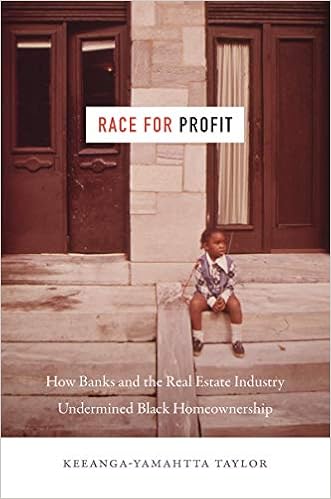
Taylor, "Race for Profit"

Out later this year from the University of North Carolina Press (but available for pre-order now): Race for Profit: How Banks and the Real Estate Industry Undermined Black Homeownership (2019), by Keeanga-Yamahtta Taylor (Princeton University). A description from the Press:
Keeanga-Yamahtta Taylor offers a damning chronicle of the twilight of redlining and the introduction of conventional real estate practices into the Black urban market, uncovering a transition from racist exclusion to predatory inclusion. Widespread access to mortgages across the United States after World War II cemented homeownership as fundamental to conceptions of citizenship and belonging. African Americans had long faced racist obstacles to homeownership, but the social upheaval of the 1960s forced federal government reforms. In the 1970s, new housing policies encouraged African Americans to become homeowners, and these programs generated unprecedented real estate sales in Black urban communities. However, inclusion in the world of urban real estate was fraught with new problems. As new housing policies came into effect, the real estate industry abandoned its aversion to African Americans, especially Black women, precisely because they were more likely to fail to keep up their home payments and slip into foreclosure. 
Taylor narrates this dramatic transformation in housing policy, its financial ramifications, and its influence on African Americans. She reveals that federal policy transformed the urban core into a new frontier of cynical extraction disguised as investment.
A few blurbs:
"This is an incredibly important history. Well-written, persuasive, and brimming with insightful analysis, Race for Profit is a book that people have been waiting for."--Beryl Satter 
"Taylor offers a strong account of major transformations in U.S. affordable housing policy and its impact on African American communities. This is an extraordinary book, measured and incisive, with a rich and compelling narrative."--Joseph Heathcott
More information is available here.

-- Karen Tani

Tuesday, July 3, 2018

Lehavi on Commons and Anti-Commons in Israel

Amnon Lehavi, Interdisciplinary Center Herzliyah , Radzyner School of Law, has posted Re-Romanticizing Commons and Community in Israeli Discourse: Social, Economic, and Political Motives, which is forthcoming in Theoretical Inquiries in Law:
Public discourse in Israel is taking a somewhat surprising turn in its vacillation between individualism and collectivism. While mainstream public opinion in the 1980s and 1990s pointed to the failures of common- and public-property regimes, elected officials, entrepreneurs, and consumers are nowadays singing the praises of commons and communities. The re-romanticizing of commons and community is driven by a number of explicit and implicit motives, which also underscore, however, the limits of a full-fledged return to common property regimes. This article highlights three instances of the reemergence of the commons- and community-discourse across the Israeli landscape.

First, while the old-style “cooperative kibbutz” suffered a substantial decline in past decades, the evolution of a new type of midlevel communitarianism in the “renewing kibbutz” has led to a growing demand to join the ranks of such kibbutzim.

Second is the development of urban shared office-space compounds such as WeWork, and the next phase of urban commons: co-living buildings.

Third, the emergence of “community villages” on state-owned lands, located mostly in Israel’s peripheral areas, has been praised by governmental agencies and residents alike as restoring a key role for community for middle-class families. But this advocacy may also be driven by exclusionary social and political motives, as applicants may be turned down based on open-ended criteria, such as “incompatibility with social life in the community” or incongruity with its “social-cultural texture.”

These case studies serve as a basis for offering new theoretical tools for thinking about the commons, fifty years after The Tragedy of the Commons presented their apparent failures. A fresh theory of commons and community could highlight how the revived discourse attests to the need to design a new set of balances between the perils of commons and anticommons, between values of anonymity and familiarity, and between governance by hierarchy and egalitarian rules.

Thursday, March 1, 2018

Walker's "Most of 14th Street Is Gone"

Just out from OUP is Most of 14th Street Is Gone: The Washington, DC Riots of 1968, by J. Samuel Walker:
“Left behind were hundreds of burned-out buildings, whole blocks that looked as though they had been bombed into oblivion.” These words, written by the Washington Post's Leonard Downie Jr., do not describe a war zone but rather the nation's capital reeling in the wake of the riots of April 1968. In the devastating aftermath of Martin Luther King's assassination, a community already plagued by poor living conditions, unfair policing, and segregation broke into chaos.

These riots brought well-documented tragedy and heartbreak--not only among the families of those who lost their lives but also among those who lost their homes, possessions, jobs, and businesses. There was anger, fear, and anxiety throughout the city of Washington, DC, from the White House to the residential neighborhoods of the capital. There was an excruciating dilemma for President Lyndon Johnson. He was outraged by the violence in the streets, but he also keenly aware that African American citizens who joined the riots had legitimate grievances that his civil rights initiatives did little to address.

J. Samuel Walker's Most of 14th Street is Gone takes an in-depth look at the causes and consequences of the Washington, DC riots of 1968. It shows the conditions that existed in Washington, DC's low-income neighborhoods, setting the stage for the disorders that began after King's murder. It also traces the growing fears produced by the outbreaks of serious riots in many cities during the mid-1960s. The centerpiece of the book is a detailed account of the riots that raged in Washington, DC from the perspectives of rioters, victims, law enforcement officials, soldiers, and government leaders. The destruction was so extensive that parts of the city were described as “smoldering ruins block after block.” Walker analyzes the reasons for the riots and the lessons that authorities drew from them. He also provides an overview of the struggle that the city of Washington, DC faced in recovering from the effects of the 1968 disorders. Finally, he considers why serious riots have been so rare in Washington, DC and other cities since 1968. Walker’s timely and sensitive examination of a community, a city, and a country rocked by racial tension, violence, and frustration speaks not only to this nation’s past but to its present.