Showing posts with label public health. Show all posts

Monday, November 10, 2025

Ahmed, "Risk and Resistance: How Feminists Transformed the Law and Science of AIDS"

Cambridge University Press has published Risk and Resistance: How Feminists Transformed the Law and Science of AIDS, by Aziza Ahmed (Boston University School of Law). A description from the Press:

How did women come to be seen as 'at-risk' for HIV? In the early years of the AIDS crisis, scientific and public health experts questioned whether women were likely to contract HIV in significant numbers and rolled out a response that effectively excluded women. Against a linear narrative of scientific discovery and progress, Risk and Resistance shows that it was the work of feminist lawyers and activists who altered the legal and public health response to the AIDS epidemic. Feminist AIDS activists and their allies took to the streets, legislatures, administrative agencies, and courts to demand the recognition of women in the HIV response. Risk and Resistance recovers a key story in feminist legal history – one of strategy, struggle, and competing feminist visions for a just and healthy society. It offers a clear and compelling vision of how social movements have the capacity to transform science in the service of legal change. 

Praise from reviewers:

"Risk and Resistance: How Feminists Transformed the Law and Science of AIDS is a moving and meticulous study about the grass-roots activists who made visible women’s plight during a time when AIDS treatment and funding were entirely focused on men. The initial definition of AIDS as ‘a gay men’s disease’ led to long-term distributional injustices: the exclusion of women from clinical trials, from disability benefits, and even from being counted in the statistics of its devastation. Aziza Ahmed has crafted a magnificent genealogy of specific organizational strategies that linked individual women into powerful communities of patients, medical researchers, service providers, and litigators. Their advocacy reframed not merely responses to the AIDS crisis but to all subsequent epidemics including COVID. This book is the chronicle of hard-fought interventions that redirected the course of legal and medical history and that transformed social outcomes to the betterment of all." -- Patricia Williams 

"Risk and Resistance is a tour de force. It is the book that was missing from the catalogue about HIV/AIDS and the catastrophic health, legal, and political crises in its wake. In beautiful prose and rich story-telling, Aziza Ahmed corrects the historical record, rewriting women and crucial, feminist activism into the folds of a devastating era in global history. With this book, Professor Ahmed has penned a pathbreaking contribution to law and feminist theory." -- Michele Bratcher Goodwin

More information is available here.

-- Karen Tani  

Tuesday, November 4, 2025

Epidemics and the Law

New from Hart/Bloomsbury: Epidemics and the Law from Plague to the Present, edited by Emily Gordon, Charles Mitchell and Ian Williams (University College London):

Building on previous studies of infectious diseases undertaken by social historians of medicine, this collection explores the histories of epidemics and disease by looking at the legal measures deployed against them.

Whilst previous works have considered the mechanisms by which legal change occurs, the social and political assumptions on which new laws and new legal structures are premised and the social changes which follow, this book focuses on the way in which historical actors understood law to be a complex means of responding to disease and the way in which that law shaped (and limited) the responses which could be made to disease.

Taking an interdisciplinary approach, it features contributions from scholars across a range of academic disciplines who consider the wider implications of epidemics and disease beyond the obvious health effects. The collection focuses first on regulatory responses such as the quarantine laws and border policies in the eighteenth century, the framing of 'disease' in the Colonial Immigration Acts in the nineteenth century and the ethics of public health in the twentieth century in Great Britain. It then goes on to consider developments in broader legal doctrine which themselves resulted from social and/or legal responses to disease, including the centralisation of labour regulation in the wake of the black death, property disputes about leper houses, pest houses and fever hospitals, and the prosecution of medical professionals for disease transmission in 19th century England.

Methodologically all the chapters are historical, but a range of approaches has been taken, from quite traditional doctrinal legal history through socio-legal history to traditional political and social history, to bring the history of epidemics and the legal measures deployed against them in to sharp focus.

--Dan Ersnt.  TOC after the jump. 

Thursday, October 23, 2025

AHA Congressional Briefings on AI and Vaccines

[We have the following announcement of the American Historical Association.  DRE.]

The American Historical Association invites you to attend two Congressional Briefings that will be held in the coming weeks. The first will offer historical perspectives on artificial intelligence, and the second on vaccines. 

The briefing on the history of artificial intelligence will take place on Wednesday, October 29, at 9:00 a.m. ET in Rayburn House Office Building Room 2044. Panelists Sarah Igo (Vanderbilt Univ.), Aaron Mendon-Plasek (Purdue Univ.), and Rebecca Slayton (Cornell Univ.) will discuss the historical context of privacy and national security issues that are being transformed by AI. Kathryn Cramer Brownell (Purdue Univ.) will serve as moderator.

The briefing on the history of vaccines will take place on Wednesday, November 5, at 3:00 p.m. ET in Rayburn House Office Building Room 2075. Panelists Elena Conis (Univ. of California, Berkeley), David M. Oshinsky (New York Univ.), and Michael Willrich (Brandeis Univ.) will discuss the history of vaccines against diseases including smallpox, polio, and measles. The briefing will also explore the public’s perception of vaccines and how the role of the federal government in vaccine development and distribution has changed over time. Sarah Weicksel, AHA executive director, will serve as moderator. 

Both events are open to the public; no registration is required. A breakfast spread and coffee will be served. If you have any questions, please email brosenbaum@historians.org.

We are monitoring the government shutdown and will announce any changes in the days before the event.

The AHA’s Congressional Briefings series seeks to provide Congressional staff members, journalists, and other members of the policy community with the historical context essential to understanding contemporary issues. The sessions are strictly nonpartisan and avoid advancing particular policy prescriptions or legislative agendas. Recordings of our recent briefings providing historical perspectives on are available on the AHA’s website.

Thursday, December 14, 2023

Frohlich, "From Label to Table: Regulating Food in America in the Information Age"

The University of California Press has published From Label to Table: Regulating Food in America in the Information Age (Oct. 2023), by Xaq Frohlich (Auburn University). A description from the Press:

How did the Nutrition Facts label come to appear on millions of everyday American household food products? As Xaq Frohlich reveals, this legal, scientific, and seemingly innocuous strip of information can be a prism through which to view the high-stakes political battles and development of scientific ideas that have shaped the realms of American health, nutrition, and public communication. By tracing policy debates at the U.S. Food and Drug Administration, Frohlich describes the emergence of our present information age in food and diet markets and examines how powerful government offices inform the public about what they consume. From Label to Table explores evolving popular ideas about food, diet, and responsibility for health that have influenced what goes on the Nutrition Facts label—and who gets to decide that.

Praise from reviewers:

"This absorbingly interesting book shines a novel light on the development of nutritional labeling in the United States. Taking its inspiration from science and technology studies, it knowledgeably identifies shifting 'assemblages' of people-plus-things in an intriguing and detailed history."—Anne Murcott

"From Label to Table is an archaeology of the food label, digging down through the sedimentary levels that the label's seemingly simple contents conceal. Tracing this story is a signal accomplishment, but there is more. Interwoven with the narrative is an analysis that maps the FDA's changing methods of food regulation onto the broader dynamics of twentieth-century American capitalism, especially the shift from the New Deal order to post-1980 neoliberal politics. The book adeptly moves between these levels, thereby inserting the emergence of informational food labeling as part of the transformations of late capitalism."—Roger Horowitz

More information is available here. An interview with Professor Frohlich is available here, at Nursing Clio. 

-- Karen Tani 

Friday, November 24, 2023

Sood and Ehrman-Solberg on the Effects of Racial Restrictive Covenants

Aradhya Sood, University of Toronto, and the late Kevin Ehrman-Solberg, have posted Mapping Prejudice:
Racial covenants, which were used throughout the U.S. during the first half of the 20th century, were clauses in property deeds that prohibited the sale or rental of property to racial and ethnic minorities. This paper studies the long-run causal and persistent effects of racially restrictive covenants on racial sorting, racial homeownership differentials, and house prices. Using novel data on racial covenants and a quasi-experimental design that exploits time to build delays in housing and the 1948 U.S. Supreme Court ruling that made racial covenants unenforceable, we compare newly built, covenanted (and hence all-white) neighborhoods built before 1948 with covenanted neighborhoods constructed after the verdict, as the post-1948 neighborhoods lost a primary legal way to coordinate segregation. We find that about 5-17% of the observed neighborhood racial residential sorting and 6-17% of racial homeownership sorting, measured from 1980 to 2020, can be causally linked to racial covenants of the past. In addition, while the treated and control neighborhoods exhibit some differences in public amenities, particularly in the distance to highways and the restrictiveness of zoning regulations, these differences do not drive the observed persistent effects. Instead, homophily bias or unobserved housing quality are the likely drivers behind the persistent effects.

--Dan Ernst

Monday, October 10, 2022

Rector, "Toxic Debt: An Environmental Justice History of Detroit"

We missed this April 2022 release from the University of North Carolina Press: Toxic Debt: An Environmental Justice History of Detroit, by Josiah Rector (University of Houston). A description from the Press:

From the mid-nineteenth until the mid-twentieth century, environmentally unregulated industrial capitalism produced outsized environmental risks for poor and working-class Detroiters, made all the worse for African Americans by housing and job discrimination. Then as the auto industry abandoned Detroit, the banking and real estate industries turned those risks into disasters with predatory loans to African American homebuyers, and to an increasingly indebted city government. Following years of cuts in welfare assistance to poor families and a devastating subprime mortgage meltdown, the state of Michigan used municipal debt to justify suspending democracy in majority-Black cities. In Detroit and Flint, austerity policies imposed under emergency financial management deprived hundreds of thousands of people of clean water, with lethal consequences that most recently exacerbated the spread of COVID-19.

Toxic Debt is not only a book about racism, capitalism, and the making of these environmental disasters. It is also a history of Detroit's environmental justice movement, which emerged from over a century of battles over public health in the city and involved radical auto workers, ecofeminists, and working-class women fighting for clean water. Linking the histories of urban political economy, the environment, and social movements, Toxic Debt lucidly narrates the story of debt, environmental disaster, and resistance in Detroit.

A sample of the advance praise:

“Josiah Rector’s history of environmental justice in Detroit is breathtaking in its ambition and scope. Integrating environmental justice, urban history, and political economy, Rector lays out how environmental inequality came to be, as a confluence of white segregationists working with capitalists in industry, finance, and real estate at the expense of workers and communities. This dazzling debut is extensively researched, innovative, and a must-read for those interested in environmental justice, labor history, and contemporary problems that continue to land particularly hard on Black, Brown, and poor bodies and communities in Detroit and beyond.”—Julie Sze

More information is available here.

-- Karen Tani

Tuesday, August 9, 2022

Sharafi on Abortion in South Asia

It was published some time ago but has just gone open access: Abortion in South Asia, 1860–1947: A medico-legal history, by former LHBlogger Mitra Sharafi, University of Wisconsin Law School, in Modern Asian Studies:

In the progression of stages toward unintended lives, the two stops on either side of abortion—contraception and infanticide—have been studied extensively by historians of South Asia. We know much less about abortion, particularly during the colonial period. Drawing upon published judgments, unpublished case records, forensic toxicology reports, and treatises on Indian medical jurisprudence, this article suggests that anti-abortion law was generally enforced in colonial India only when women died as a result of illegal abortions. This approach was contrary to the Indian Penal Code (IPC), which criminalized most abortions even when the women survived. The pattern was a continuation of the pre-IPC approach in India. This article explores possible explanations for the lax enforcement of anti-abortion law in South Asia during the late nineteenth and early twentieth centuries, considering abortion as experienced by South Asian and British women alike. It proposes as contributing factors: challenges in detection, the social movement for the protection of Hindu widows, colonial anxieties about false allegations of abortion among South Asians, the common phenomenon of imperial (British) husbands and wives living apart, and physicians’ desire to protect doctor–patient confidentiality. The article focuses on two key cases involving abortion: the Whittaker-Templeton case from Hyderabad (1896–1902) in which a British woman died following an abortion; and the Parsi matrimonial case of T. v. T. from Bombay (1927), in which a Zoroastrian woman alleged that her pharmacist husband had forced her to terminate three pregnancies by ingesting drugs.
–Dan Ernst

Thursday, March 10, 2022

Legal Histories of Disease: The Stanford Legal History Conference

[We have the following announcement.  DRE]

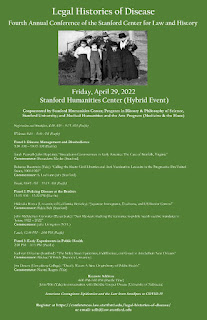
The Stanford Center for Law and History is delighted to share the full information for our Center's fourth annual conference, which will be held on April 29, 2022 as a hybrid event in-person at the Stanford Humanities Center and online via Zoom. The conference theme is Legal Histories of Disease.

The conference will explore how the law has historically responded to health crises and what contemporary insights can be drawn from this history. The one-day conference will be held on Friday, April 29, 2022, and is cosponsored by the Stanford Humanities Center; Program in History & Philosophy of Science, Stanford University; and Medical Humanities and the Arts Program (Medicine & the Muse).

The conference will include three panels followed by a keynote session featuring Professor John Witt of Yale Law School who will take part in a discussion of his recently published book, American Contagions: Epidemics and the Law from Smallpox to COVID-19 with Professor Deirdre Cooper Owens of the University of Nebraska.

The complete schedule and panel abstracts are available here.

Register here to reserve your in-person space at the Stanford Humanities Center or to receive the Zoom link details which will be sent about a week before the event.  All are welcome to attend every session or particular sessions of interest. Breakfast, lunch, and snacks will be served for those who attend in-person. Note: in-person registration is on a first-come, first-served basis and seating is limited.

We also ask all those who attend in-person to comply with current Stanford event guidelines regarding COVID which can be found here.

This event is open to the general public, as well as the Stanford community, both in-person and online. If you have any questions, please contact sclh@law.stanford.edu

Friday, November 19, 2021

Fletcher on Pandemics in Indian Country

Matthew L. M. Fletcher, Michigan State University College of Law, has posted Pandemics in Indian Country: The Making of the Tribal State, which is forthcoming in the University of St. Thomas Law Journal:

This Essay is inspired by the fascinating narrative told by John Fabian Witt theorizing how epidemics make states and how states can also make epidemics. The two stories centered in Peshawbestown, Michigan of the 1881 smallpox outbreak and the 2020-2021 COVID-19 pandemic seems to play into that story. The state (acting through the local and federal government) made the 1881 outbreak fatal, while the epidemic (acting through the tribal and federal government) made the state (in this case, the tribe) in 2020-2021. The story here seems to be one of sovereignty. In the smallpox era, the tribes exercised almost no sovereignty. Now they are practically self-governing; the incredible success of the Grand Traverse Band is a ringing endorsement. The tribe is acting like a capable and responsive government. But I argue there is more going on here. Sovereignty – whether liberal or authoritarian, in Witt’s words – is the first step in the analysis, but not the last. Culture is the second step. 
This Essay intends to gently disrupt Professor Witt’s theory by superimposing Anishinaabe political theory on American Contagions. The very notion of sovereignty is foreign to Anishinaabe. Western political theory insists on the power of a sovereign entity to enforce a social contract or else society will collapse. Anishinaabe political theory does not. The difference matters.
--Dan Ernst

Wednesday, November 3, 2021

Chemerinsky and Goodwin on Civil Liberties in Pandemics

Erwin Chemerinsky, University of California, Berkeley School of Law, and Michele Goodwin, University of California, Irvine, have published Civil Liberties in a Pandemic: The Lessons of
History
in the Cornell Law Review 106 (2021): 815-850

Throughout American history, whenever there has been a crisis the response has been a deprivation of rights. Today, the United States is in the midst of the worst health crisis in over a century. As of this writing, over 500,000 people have died. The pandemic reveals underlying institutional and infrastructural problems in society. We argue, based on history, there is every reason to fear that the pandemic could be used as justification for a massive deprivation of rights and abuses.

Part I of this Article sets the context: Throughout American history, whenever there has been a crisis the response has been an unnecessary loss of liberty. Part II describes how courts have widely used the test from Jacobson v. Massachusetts in analyzing the government’s restrictions that have been imposed in dealing with COVID-19 and explains why this is undesirable. Part III argues that the usual tests for constitutional rights should be applied in analyzing particular government restrictions and applies this in considering the restrictions that have been imposed in four areas: speech, religion, abortion, and business closure.

--Dan Ernst

Tuesday, October 12, 2021

Grossman's "Choose Your Medicine"

It’s hard to imagine a more timely book or an author who has devoted more thought and research to his subject.  Lewis A. Grossman, American University, has just published Choose Your Medicine: Freedom of Therapeutic Choice in America (Oxford University Press):

Throughout American history, lawmakers have limited the range of treatments available to patients, often with the backing of the medical establishment. The country's history is also, however, brimming with social movements that have condemned such restrictions as violations of fundamental American liberties. This fierce conflict is one of the defining features of the social history of medicine in the United States.

In Choose Your Medicine, Lewis A. Grossman presents a compelling look at how persistent but evolving notions of a right to therapeutic choice have affected American health policy, law, and regulation from the Revolution through the Trump Era. Grossman grounds his analysis in historical examples ranging from unschooled supporters of botanical medicine in the early nineteenth century to sophisticated cancer patient advocacy groups in the twenty-first. He vividly describes how activists and lawyers have resisted a wide variety of legal constraints on therapeutic choice, including medical licensing statutes, FDA limitations on unapproved drugs and alternative remedies, abortion restrictions, and prohibitions against medical marijuana and physician-assisted suicide. Grossman also considers the relationship between these campaigns for desired treatments and widespread opposition to state-compelled health measures such as vaccines and face masks.

From the streets of San Francisco to the US Supreme Court, Choose Your Medicine examines an underexplored theme of American history, politics, and law that is more relevant today than ever.

Some encomia:

"Grossman's work displays his mastery not only of the law, but also of everything else that makes medicine and health enduringly fascinating aspects of human history. Life, death, fear, love, pride, greed, envy, and ambition spring repeatedly from its pages. If you only read one book to understand the social cleavages that make it hard for Americans and their political leaders to 'follow the science' and end the pandemic, it should be this one." -- William M. Sage, Professor of Law and Medicine, The University of Texas at Austin

"What have 'life, liberty, and the pursuit of happiness' meant for medicine? Lewis Grossman provides a provocative answer, showing how Americans across the political spectrum used the law to fight—often against their physicians—for therapeutic choice. The legalization of medical marijuana and compassionate use of experimental cancer drugs are, in his view, just the most recent examples of a 200-year-old tradition of medical rights-making in the US, often linked to expressions of religious freedom. A fascinating diagnosis of the American wariness of the state and medical science." -- Angela N. H. Creager, Thomas M. Siebel Professor in the History of Science, Princeton University

"From George Washington's Deathbed in 1799 to the D.C. Circuit's courtroom in 2007 hearing argument in the landmark case of Abigail Alliance, Grossman's book takes readers on a thrilling historical ride to understand what 'therapeutic choice' has meant for this country and what the sometimes unstable marriage between medicine and law has wrought." -- I. Glenn Cohen, Deputy Dean and James A. Attwood and Leslie Williams Professor of Law, Harvard Law School, and Faculty Director, Petrie-Flom Center for Health Law Policy, Biotechnology & Bioethics

"Meticulously researched, engagingly written, and deeply relevant, Lewis Grossman begins with the question of therapeutic freedom in the early 21st century and traces a vital thread connecting two centuries of legal studies, consumer history, and American politics. Choose Your Medicine provides a thorough and trenchant meditation on what is gained—and what has been lost—in foregrounding individual choice in the forging of US health policy and law." -- Jeremy Greene, William H. Welch Professor of Medicine and the History of Medicine, Johns Hopkins University

--Dan Ernst

Friday, April 16, 2021

Federal History 2021

Federal History: Journal of the Society for History in the Federal Government 13: 2021 is available online.  Here’s the TOC:

Editor’s Note
Benjamin Guterman

Roger R. Trask Lecture
Bill Williams

The Case for John Jay’s Nomination as First Chief Justice
Benjamin Lyons

“This disease . . . knows no State boundaries”: The 1918 Spanish Influenza Epidemic and Federal Public Health
Jonathan Chilcote

“America must remain American”: The Liberal Contribution to Race Restrictions in the 1924 Immigration Act
Kevin Yuill

The Combined Chiefs of Staff and the Public Health Building, 1942–1946
Christopher Holmes

Federalism and the Limits on Regulating Products Liability Law, 1977–1981
Ian J. Drake

Gerald Ford’s Clemency Board Reconsidered
Alan Jaroslovsky

Interview An Interview with Chandra Manning
Benjamin Guterman

--Dan Ernst

Thursday, December 31, 2020

Public Health, 1893-1939

PHS Dispensary No. 32 (LC)

[Longtime LHB readers will recall that for the exam in my legal history course I write an essay about some administrative regime I did not cover in class and ask students to compare it with ones we did.  The topics of previous essays include federal grazing policy, motor carrier regulation, meat inspection, and the US Commerce Court.  This year’s essay, on public health, follows.  DRE]

Although public health measures date from ancient times, “the science of public health is of very recent origins,” wrote Henry Bixby Hemenway, a lawyer and doctor, in his leading treatise on public health law, published in 1914,   For centuries, knowledge of the causes of disease was “crude and chaotic.”  During  the nineteenth century, however, doctors came to understand the true origins of infectious diseases and developed systematic methods to prevent them  And not a moment too soon:  Common knowledge might have sufficed when most Americans lived in rural areas, but by Hemenway’s day “a large proportion of the population is crowded within urban walls.”  Illnesses could devastate an entire region’s economy by incapacitating its workers.

Hemenway thought that too many still scoffed at preventive methods, believing they could protect themselves or count on courts to abate disease-creating nuisances as they arose.  They did not realize that “infectious diseases approach stealthily and work their injury before their presence is suspected.”  Now “specially trained executives” were a necessity, and public health administration had to be “recognized as a special profession.”  No government department touched “the life of every citizen” more closely, he maintained.  “An efficient service means an efficient community."

Already, some municipalities had met the challenge.  As the Wisconsin Supreme Court wrote in a 1909 decision, Milwaukee authorized its commissioner of health to “summarily abate nuisances of all kinds, destroy diseased or infected food, clothing, and other like articles, establish temporary hospitals in case of epidemics, and, in fine, to exercise very broad and autocratic powers in all matters relating to the conservation of the public health.”  Indeed, the commissioner’s power to act without a prior hearing or even notice “at times must trench closely upon despotic rule.”  But it could not be otherwise: “The public health cannot wait upon the slow processes of a legislative body or the leisurely deliberation of a court.  Executive boards or officers who can deal at once with the emergency under general principles laid down by the lawmaking body must exist if the public health is to be preserved in great cities.”

Unfortunately, public health officials owed their jobs to the political party that controlled of city government.  Indeed, just a few years earlier, Hemenway claimed, “a certain ward politician who was without any special training or education which fitted him for the place” ran Chicago’s public health department.   “Until the importance of the health positions is generally appreciated by the citizens they will be used, in many cases at least, as means whereby political favors can be repaid,” he warned.

Ideally, Hemenway wrote, a single administrator, “expert in the line of official duty,” should run a health department.  The administrator should, in turn, appoint subordinates, who should be experts, removable only for cause, and paid “an adequate salary, not by fees.” Departments should be organized to make every subordinate “definitely responsible for a definite portion of the work” and to assign at least one subordinate to “every point of danger.”  Subordinates should “give personal attention to individual items,” not the top administrator.
    
The judicial response to public health administration tended to focus on health officials’ power to act in emergencies without prior notice and a hearing.  As one court wrote, “The public health might suffer or be imperiled if action could be delayed until a protracted hearing could be brought to a termination.”  But the courts insisted that the affected parties could contest the health officials’ actions in lawsuits filed after the fact.  When the affected parties did in the nineteenth century, courts usually refused to treat health officials’ factual determinations as final and conclusive and instead tried them de novo.  Thus, in Miller v. Horton (1891), the Massachusetts Supreme Judicial Court, in an opinion by Oliver Wendell Holmes, Jr., upheld a trial judge’s determination, in a subsequent bench trial, that a horse destroyed by the Board of Health did not have glanders, an infectious bacterial disease, after all.  

In People ex rel. Copcutt v. Board of Health (1893), decided by the New York Court of Appeals, a board of health did give the owner of a wood mill a hearing before declaring his ponds a public nuisance, because of the sewage that seeped into them.  When the millowner sought damages for the board-ordered destruction of the dams that created the ponds, a trial judge upheld the board’s action, but only after making his own determination that the ponds were public nuisances.  The Court of Appeals affirmed, but in the process emphasized the need for de novo review after the fact.  The board of health “could obtain its information from any source and in any way,” the court noted.  If such factual determinations were “final and conclusive,” it continued, “the citizen would in many cases hold his property subject to the judgments of men holding ephemeral positions in municipal bodies and boards of health, frequently uneducated and generally unfitted to discharge grave judicial functions.”  The court then approvingly quoted a treatise writer: “where the public authorities abate a nuisance under authority of a city ordinance ‘they are subject to the same perils and liabilities as an individual.’”

After the turn of the twentieth century, appellate courts still required after-the-fact review of the emergency actions of boards of health, but some started to instruct trial courts to give public health officials the benefit of the doubt.  Valentine v. City of Englewood (1908) was a suit for wrongful imprisonment brought by the father of a girl quarantined for having scarlet fever.  New Jersey’s highest court agreed that the board of health’s determination was not final and conclusive, but it also instructed trial courts simply to determine whether the board had “reasonable and probable cause” for its factual determination.  Although some evidence suggested the girl did not have scarlet fever, the board of health had “acted with care, and not hastily, for it decided only after a conference between its own physician, a reputable physician of Englewood called in by the plaintiff, and a specialist from the city of New York.”  The appellate court therefore affirmed the trial court’s dismissal of the father’s lawsuit.

In contrast, in North American Cold Storage Company v. Chicago (1908), the U.S. Supreme Court seemingly held the line on de novo review of a public health official’s finding of fact.  Acting without a hearing, the Commissioner of Health of the City of Chicago had demanded that the complainant, the owner of a cold storage warehouse, turn over for destruction forty-seven barrels of poultry because, in the words of the Municipal Code, the poultry “had become putrid, decayed, poisonous, or infected in such a manner as to render it unsafe or unwholesome for human food.”  When the warehouseman refused, the city blocked all deliveries to or from his establishment.  The warehouseman sought an injunction against the blockade, the trial court dismissed his suit, and the warehouseman appealed to the U.S. Supreme Court.

Rufus Peckham wrote the Court’s opinion, from which only David Brewer dissented, without opinion.  Not surprisingly, Peckham, a dissenter in Jacobson and the author of the Court’s Lochner opinion, volunteered that Chicago’s total blockade of warehouse “would seem to have been arbitrary and wholly indefensible.”  The issue before the Court, however, was whether the lack of a hearing before the commissioner acted violated the warehouseman’s right to due process under the Fourteenth Amendment.  After quoting Holmes’s opinion in Miller, Peckham concluded it did not, but only because “the ex parte finding of the health officers as to the fact [of the poultry’s unwholesomeness] is not in any way binding” in a subsequent judicial proceeding.  “If a party cannot get his hearing in advance of the seizure and destruction, he has the right to have it afterward, which right may be claimed upon the trial in an action brought for the destruction of his property, and in that action those who destroyed it can only successfully defend if the jury shall find the fact of unwholesomeness.”

Yet Peckham rejected the warehouseman’s argument that he could only be denied a hearing if an emergency existed, that courts should determine whether one existed, and that none had existed in his case, because poultry in cold storage remained unchanged for up to three months.  Peckham countered that the Municipal Code left the existence of an emergency to “the reasonable discretion of the legislature,” which had delegated it to the commissioner.  Whether an emergency existed was not “a subject for review by the courts.”

Writing in 1914, Hemenway expected more judges to defer to the factual determinations of public health officials.  After all, he wrote, “the judge devotes his attention to law and its interpretation; it is not to be presumed that he knows the relative merits of different food preservatives.”  But he also thought judges would be tempted to intervene anyway if affected parties could not appeal an unfavorable order up the chain of command within a public health department.  To prevent the temptation from arising, Hemenway argued, health departments should provide for internal appeals from subordinates to superiors.

The administration of public health also was the subject of controversy at the federal level.  The first federal public health agency was the Marine Hospital Service, which ran hospitals for sailors in the nation’s seaports and was created within the Treasury Department.  Over time, the Service acquired other duties, including the administration of quarantines, inspecting immigrants, and preventing the interstate transmission of disease.  To recognize these functions, the agency was renamed the Public Health Service (PHS) in 1902.  Two years later, at the suggestion of President Theodore Roosevelt, the National Academy for the Advancement of Science (NAAS) created a committee to study how the PHS and other health-related agencies might be combined to “make a more efficient health machine in the Federal Government.”  TR backed the effort in his last message to Congress in December 1908.  “This nation cannot afford to lag behind in the worldwide battle now being waged by all civilized people with microscopic foes of mankind, nor ought we longer to ignore the reproach that this government takes more pains to protect the lives of hogs and of cattle than of human beings,” Roosevelt declared.

In 1910, with the support of TR’s successor, William Howard Taft, Oklahoma Senator Robert Owen introduced a bill to create a Department of Public Health.  Owen called health “a National Asset” and estimated the annual loss to the United States from preventable illness and death at $4 billion.  He considered the fight against preventable disease to be “a contest between intelligence and ignorance” and insisted that “all the authority, dignity and power of the general government must be put behind the truth.”  Irving Fisher, a Yale economist who chaired the NAAS committee, argued that the PHS would never get the resources it needed if it remained a mere bureau.  “As long as we have a Bureau of Health subordinate to a department of something else, health will always be regarded as subordinate to something else,” he maintained.  

To illustrate his point, Fisher referred to an earlier incident.  In March 1900, Joseph J. Kinyoun, a bacteriologist serving as Federal Quarantine Officer in San Francisco for the PHS’s predecessor, identified an outbreak of the bubonic plague and ordered a quarantine.  Outraged politicians complained the quarantine “inflicted incalculable injury upon the state, both in reputation and financially,” because it had resulted in the shunning of all things Californian.  The governor denied that the plague was ever in San Francisco and accused Kinyoun of injecting cadavers with plague bacilli to justify his fallacious findings and conducting a malicious conspiracy against the state.  The governor, it was said, mobilized “all the political machinery ... at his command to discredit Kinyoun and secure his removal.”  He dispatched a delegation of powerful businessmen to Washington to lobby the Secretary of the Treasury.  Although the head of Kinyoun’s Service warned that dismissing him would be “an abject surrender to the local political elements” and ruin the Service’s reputation, the Secretary removed Kinyoun from his post anyway.

Fisher, the allopathic doctors who dominated the American Medical Association, and other supporters probably anticipated smooth sailing for the Owen bill.  After all, Democrats and Republicans had each called for the improvement of he federal public health administration in the last presidential campaign.  Instead, as a journalist wrote, “a merry war among our medical brethren” broke out, as homeopaths, eclectics, osteopaths and other heterodox physicians warned that the allopaths would use the new department to make their practices the national standard and thereby create a “doctors trust.”  In reply, Fisher protested, “All that we are in favor of is ... to get the light of science on medicine.  We do not care where it comes from.”  But Congress, “amazed at the intensity and character of the opposition,” abandoned the bill and left PHS in the Treasury Department, where it remained until 1939.
    
PHS finally escaped the Treasury Department after the passage of the Reorganization Act of 1939.  President Franklin Delano Roosevelt had first asked for a law to enable him to reorganize the federal government in January 1937, but Congress refused, on the ground that it would delegate too much power to the president and limit its members’ influence over patronage appointments.  It passed a reorganization act in 1939 only because it put some agencies off limits and by its terms expired in two years.  The statute also allowed Congress to block the president’s reorganization plans by passing a Concurrent Resolution within sixty days.    

Reorganization Plan No. 1, which became effective in the summer of 1939, grouped various authorities, administrations, boards, and bureaus into three “superagencies”: the Federal Security Agency, the Federal Works Agency, and the Federal Loan Agency.

FDR put his proposal in a global context.  “In these days of ruthless attempts to destroy democratic governments,” he told Congress, “it is baldly asserted that democracies must always be weak in order to be democratic at all; and that, therefore, it will be easy to crush all free states out of existence.”  His proposed reorganization would enable “the people’s Government” to carry out “the people’s will” and “make democracy work. . . .  We are not free if our administration is weak.”  FDR’s critics saw it differently.  The Chicago Tribune warned that the reorganization would abet FDR’s continued transferal of “the resources of the country from private enterprise to political management” under “what the Germans call the Fueher.”  If FDR was not stopped, the result could only be “the absolutism which exists in Germany, Italy, and Russia."

Saturday, October 17, 2020

Weekend Roundup

  • We’ve previously noted that Linda Kerber will deliver the 2020 Charles Homer Haskins Prize Lecture from the College and Law at the University of Iowa at 3:00 PM Eastern Time on Wednesday, October 28 and our now please to pass along word that Constance Backhouse, ASLH delegate to the American Council of Learned Societies and a former ASLH president, and former ASLH Treasurer, Craig Klafter, nominated Professor Kerber was nominated for this prize.
  • A recording of the 2020 Roger Trask Lecture of the Society for History in the Federal Government, delivered by Bill Williams, formerly Chief of the Center for Cryptologic History at the National Security Agency, is here.
  • The 14th Annual South Asia Legal Studies Workshop happened online this week, hosted by the University of Wisconsin Law School. It included a good crop of legal history papers (program here).
  • "100 Years After the 19th Amendment: Their Legacy, and Our Future,” a traveling exhibit of the American Bar Association, opens at the University of Kentucky J. David Rosenberg College of Law on October 18.  Several events are planned, and the UK Law Library has created an accompanying websiteMore.
  • Update: Over at IEHS Online, the website of the Immigration and Ethnic History Society, Jane Hong interviews Lucy Salyer about Under the Starry Sky. (Also: it does have legs: I discussed Laws Harsh as Tigers in class this semester, too!  DRE.)

Weekend Roundup is a weekly feature compiled by all the Legal History bloggers. 

Friday, September 11, 2020

Lee to Lecture on Contagious Diseases and the Rule of Law in the British Empire

[We have the following announcement from the Transnational Legal History Group Seminar of the Centre for Comparative and Transnational Law of the Chinese University of Hong Kong.  DRE]

‘Protecting Women and Morals? Contagious Diseases Laws and the “Rule of Law” Ideal in the British Empire, 1886-1899’ by Dr. Jack Jin Gary Lee (Online)

What does it mean for liberal empires to invoke the rule of law, on the one hand, and to expand their
control over subject populations, on the other? This article examines debates over the freedom of women during the repeal of the Contagious Diseases (CD) ordinances by the Protection of Women and Girls ordinances in the directly ruled colonies of Hong Kong and the Straits Settlements (Singapore, Penang and Malacca). Originating in Hong Kong, CD laws were used to contain the spread of venereal diseases among soldiers and other populations across the modern British empire. Officials employed these laws to police prostitution and subject working-class, “native” women to medical surveillance. While the compulsory medical examination of women ended with the repeal of CD laws across the British Empire, the Straits Settlements and Hong Kong continued to regulate prostitution for the protection of “native” women and their freedom, revealing the peculiar significance of the “rule of law” under liberal imperialism. In a historical ethnography of the “rule of law” ideal, Dr. Jack Jin Gary Lee demonstrates how officials utilized its central premise of individual liberties as a comparative frame of evaluation to formulate a racially differentiated mode of gendered sovereignty.

Dr. Jack Jin Gary Lee’s research and teaching examines the significance of culture, law and politics in social processes of state-making and governance. He is working on a book on the significance of law and race in the making of “direct rule” in the modern British Empire. Focusing on the re-constitution of Jamaica and the Straits Settlements (Singapore, Penang and Malacca) as Crown Colonies in the latter half of the nineteenth century, this project examines the workings (and postcolonial legacies) of liberal imperialism in relation to colonies marked as plural societies. Notably, Lee’s dissertation on this topic won the University of California, San Diego’s 2018 Chancellor’s Dissertation Medal (Social Sciences).

Register here by 5pm, 22 September 2020 to attend the seminar.

Monday, June 22, 2020

Schiller on Milov, "The Cigarette"

The latest post in JOTWELL's Legal History Section comes from Reuel Schiller (UC Hastings Law), who has written an admiring review of Sarah Milov's The Cigarette: A Political History (Harvard University Press, 2019). Here's an excerpt from the review:

Until the early 1980s, my high school had a smoking lounge. It was a medium-sized room off the lobby with some beat-up furniture where students could hang out, smoking their Marlboros and their clove cigarettes. There was even a king and queen of the smoking lounge, pictured in the yearbook alongside the prom’s royal court.

Today such an accommodation of smoking is unimaginable. Indeed, in most states, it would be illegal. In the past forty years, the United States transformed from a society where the cigarette represented a combination of sophistication and rebellion to one in which smokers are benighted addicts, suffering for their own moral failures. Sarah Milov’s breathtaking The Cigarette: A Political History explains how this happened. In telling this story, her narrative weaves together legal, political, and economic history in a manner that calls for a revaluation of the dimensions of twentieth-century liberalism and the nature of its decline. The book is a compelling exercise in historical synecdoche: its subject is the political history of the cigarette, but its story is that of the twentieth-century American state.

And one other choice bit:
Frankly, one could teach a course on twentieth-century legal history using this book as a textbook. It speaks to a broad range of subjects central to the interests of legal historians: the role of law in constituting capitalism; the interaction of law, gender, and race in the construction of social movements; the simultaneously emancipatory and constraining potential of framing policy preferences as rights; the profound role of the administrative state in structuring politics and policy; the rise of public interest litigation; the importance of understanding the legal history of agriculture, a field sorely neglected by legal historians.
Read on here.

-- Karen Tani

Saturday, June 20, 2020

Weekend Roundup

  • The National History Center hosts a virtual congressional briefing on the history of vaccination usage and policy on Monday, June 22 at 11 a.m.  More.
  Weekend Roundup is a weekly feature compiled by all the Legal History bloggers.

Friday, June 12, 2020

Parmet on Jacobson v. Massachusetts

Wendy E. Parmet, Northeastern University School of Law, has posted Rediscovering Jacobson in the Era of COVID-19, which is forthcoming in the Boston University Law Review Online:
As courts continue to hear constitutional challenges to COVID-related orders, citations to the Supreme Court’s 1905 decision, Jacobson v. Massachusetts, have been proliferating. This essay re-examines Justice Harlan’s nuanced and ambiguous opinion in Jacobson, situating in in its epidemiological and jurisprudential context. The essay also looks at Jacobson’s complex legacy, and how judges, including Chief Justice Roberts in South Bay United Pentecostal Church v. Newsom, have been applying Jacobson as they review COVID-19 social distancing orders.
--Dan Erns.  H/t: Legal Theory Blog

Saturday, May 23, 2020

Weekend Roundup

  • Katrina Jagodinsky will use a three-year, $460,000 grant from the National Science Foundation to explore how habeas corpus was used in the American West by various marginalized groups to claim freedom and establish their rights between 1812 and 1924.”  More.
  • Over at the blog of the Historical Society of the New York State Courts is a post summarizing John Oller’s article, forthcoming in Judicial Notice, entitled “George Wickersham: ‘The Scourge of Wall Street.’”  The video of the Society’s webinar, "Lessons Learned from the 1918 Flu Pandemic," is here; its video, "The Evolution of Slavery, Abolition in NY, and the NY Courts: The Lemmon Slave Case," is here.
  • Sadly but not surprisingly, the Law Books course at Rare Books School, taught by Mike Widener (assisted by Ryan Greenwood) has been cancelled for summer 2020. 
  • If you're not already zoomed out: Fridays at 6pm Eastern Time is Drinking with Historians, hosted by Matt Gabriele (Virginia Tech) and Varsha Venkatsubramanian (UC-Berkeley) and with a different guest each week. Registration is here.
Weekend Roundup is a weekly feature compiled by all the Legal History bloggers. 

Saturday, April 25, 2020

Weekend Roundup

  • Barbara Allen Babcock, the first woman member of the Stanford Law School faculty, the Judge John Crown Professor of Law, Emerita, the author of Woman Lawyer: The Trials of Clara Foltz (2011, and a great promoter of the history of women in the legal profession has died. Here's Stanford's press release. 
  • Congratulations to Jennifer Mnookin, a historian of the law of evidence, Erika Lee, a historian of immigration law and policy, and my law dean William Treanor, a constitutional historian of the Founding, upon their induction into the American Academy of Arts and Sciences.  I was also very pleased to see my Georgetown colleague Michael Kazin among the inductees.  DRE
  • Julian Mortenson and Nicholas Bagley’s attack on the originalist case for the nondelegation in American constitutional law has prompted two responses on SSRN by Ilan Wurman and Aaron Gordon
  • ICYMI: Richard Lazarus’s Rule of Five, on Massachusetts v. EPA, in Harvard Law Today.The NYT obit of Richard Sobol, who went from Columbia Law to Arnold, Fortas & Porter to the Lawyers Constitutional Defense Committee in 1965.
 Weekend Roundup is a weekly feature compiled by all the Legal History bloggers.