Showing posts with label Canada. Show all posts

Monday, July 20, 2026

Corcos on Tocqueville in Canadian Judicial Opinions

Christine A. Corcos, Louisiana State University Paul M. Hebert Law Center, has posted The Uses of Alexis de Tocqueville's Writings in Canadian Judicial Opinions, which appears in Moréteau on Law, Language and Heritage, edited by Agustín Parise, Mariano Vitetta and Michel Séjean (Praxis Jurídica Ediciones, 2026) 1:365-386 

At least one scholar, Nancy McCormack, has examined the reasons for which Canadian judges cite to philosophers in their writings. She notes that John Stuart Mill leads the list, but Confucius, Plato, Aristotle, Machiavelli, Thomas More, Hobbes, Locke, Descartes, and Kant are some of the other choices. Interestingly, she does not discuss Tocqueville. However, a number of Canadian judges have mentioned or discussed Tocqueville and his writings in their opinions, or cited passages from secondary sources that cite him. The most popular Tocquevillian writing for such jurists, whether in the majority or the dissent is Democracy in America, to support various views as they interpret the Charter and various statutes. Because he analyzed government in the areas of separation of powers, elections, judicial review, and human rights, these are the areas that judges find of great interest, and that they mine for quotations or support in cases in these issues come to the fore.

--Dan Ernst 

Thursday, March 26, 2026

AJLH 64:4

We're a bit late in noticing it, but the American Journal of Legal History 64:4 has been published

Mr Locke’s enclosure: the uncommon law of property in the Second Treatise
Hannah Carrese

John Locke, famously, told a property origin story. This article tells a property theory origin story, asking how Locke’s property theory, which omits common rights, emerged from a common law of property that centred them—and showing how this omission influenced the colonial American law that Locke drafted. Locke was silent on or rejected the common law of property, which recognized common rights and defences against privatization of commons through enclosure. Instead, Locke adopted law reform arguments lauding enclosure because it improved waste land. Locke’s property theory therefore attempts to improve the common law of property by orienting it around private rather than common property. He asks a question about the origin of property absent from common law: how do we create private rights to common land? He takes ‘waste’ to have purely negative connotations, avoiding the neutral meanings of that word at common law. And he stipulates that enclosure of English commons requires only tacit consent of commoners, excluding common law defences against enclosure. Locke’s is an equal opportunity enclosure. His spoilage principle and plan to reform Virginia’s land laws sought to benefit the poor by preventing vast enclosures and rural depopulation. However, he theorized a clean chain of title, absent in common law, which could prevent messy disputes over wealthy estates. This article shows the common law background from which Locke departed, thus deepening understanding of both our private property regime, often justified by Locke’s property theory, and a sometimes-overlooked alternative to it, the common law of property.
The laws of ‘an old and settled society’? The law of contract in New South Wales 1815–1850
Warren Swain

The history of contract law in New South Wales in the decades after the closure of the Court of Civil Jurisdiction in 1814 has not received much attention from legal historians. This is an important omission. At the heart of this story is a simple but critical inquiry: the way in which the law of contract in the colony mirrored or diverged from the law of contract that applied back in London. This was rarely a matter that judges addressed explicitly. Piecing together the relationship is an exercise in reconstruction. This can only be done by examining the body of case law. The creation of the Australasian Colonial Legal History Library, combined with readily searchable newspaper reports, has made this easier. The evidence in the mid-nineteenth century is still sometimes sketchy. Context is relevant. The colony moved from a quasi-military penal colony to a significant hub of commercial activity. The period also saw a shift in the legal system as the old informal systems evolved into a much more legalistic one. For the most part, New South Wales contract law was aligned with that in England. Some issues, like the desertion of sailors demanded local solutions. There are other examples in which well-established English contract doctrine did not necessarily fit very well with the conditions of the colony.
Who is a central bank for? The founding and legal design of the Bank of Canada
Dan Rohde

The Bank of Canada is an independent Crown corporation that sees its primary responsibility to be promoting Canada’s economic welfare by maintaining low and stable inflation. When it was first created in 1934, however, the Bank was a radically different institution—a privately owned corporation primarily meant to anchor Canada’s economy globally and manage foreign exchange. Not only was the Bank not tasked with managing inflation, but key policymakers behind its founding thought doing so would be a severe mistake. This article offers the first legal history of the Bank’s founding. It maps the enormous public debate that accompanied the creation of the Bank and the various, often contradictory visions expressed for it. The article labels these five visions: a Bankers’ Bank, a Government Bank, an Imperial Bank, an Economists’ Bank, and a Bank of the People. The article then looks at the original legal design of the Bank and argues that it largely fit the Imperial Bank model. Charting this history helps us better understand this vital organ of Canadian government, and has the potential to upset many of our accepted, contemporary notions of central banking.

--Dan Ernst 

Thursday, February 26, 2026

Strange on Penal Expertise and the Death Penalty in the 1950s

Carolyn Strange, Australian National University, has published, open access, The Contestation of Penal Expertise in the Age of the Expert: Thorsten Sellin and the Death Penalty in the 1950s, in Law and History Review:

Readings of the history of penal expertise trace its rise to the late nineteenth century and its decline to the late twentieth century, with the crumbling of the welfare state. Despite stark differences along Whiggish and Foucauldian lines in evaluations of that history, a consensus has emerged that the penal-welfare complex peaked around mid-century, dependent on correctional experts. Most studies of that phenomenon have focused on the institutionalization and “treatment” of “problem” populations while neglecting the role of penal expertise in critiques of capital punishment. When Britain and Canada undertook major inquiries into the death penalty in the 1950s, they turned to the world’s foremost expert on the subject: sociologist Thorsten Sellin. Yet, these government-appointed studies devalued his academic capital in favor of the lived expertise of police. By examining the contestation of Sellin’s sources, methods, and conclusions, this paper puts the chronology of penal welfarism and its experts into question. Not simply a case of ill-informed opinion prevailing over criminological evidence, the dismissive treatment of this penal expert highlights the need to apply a more capacious understanding of contending forms of expertise at numerous points in penal history, rather than setting the devaluation of penal expertise in the recent past.

--Dan Ernst 

Saturday, December 20, 2025

Weekend Roundup

  • Catherine Ceniza Choy, Cybelle Fox, Leti Volpp, and Hidetaka Hirota "discuss how the 1875 Page Act laid the foundation for the Chinese Exclusion Act and later immigration laws in the United States" (Berkeley Talks).
  • "Remembering Mitsuye Endo and the Supreme Court Case That Helped End Incarceration" (Densho).
  • Applications for the Baldy Center Post-Doctoral, Mid-Career, and Senior Fellowships in Legal Studies 2026-27 at the University at Buffalo School of Law are now open!   
  • Adam Feldman on the death of the norm of consensus on the U.S Supreme Court--and after (SCOTUSblog).
  • The Brennan Center for Justice's "Playbook for Countering Originalism in Court."
  • "Inside the Supreme Court of Canada: The Road to the Charter" (CPAC).  
  •  Christopher Bryant, University of Cincinnati College of Law, on the temporary insanity defense of the bootlegger George Remis (UC Law). 
  • ICYMI: A train wreck and Grand Central station (Smithsonian).  The History of the Kings County Supreme Court Library (NYLJ).  Rhinelander v. Rhinelander (NYT Magazine). The 1884 Cannibalism-at-Sea Case That Still Has Harvard Talking (Harvard Magazine).

Weekend Roundup is a weekly feature compiled by all the Legal History bloggers.

Wednesday, December 10, 2025

Adams and Stanger-Ross on Exiling Japanese Canadians

Eric M. Adams and Jordan Stanger-Ross have published Challenging Exile: Japanese Canadians and the Wartime Constitution (UBC Press):

In September 1945, Canadian democracy faced a fundamental question of constitutional law: Could citizens be expelled on the basis of race? Canada proposed exiling Japanese Canadians to Japan, a country devastated by war. Thousands who had already experienced uprooting, internment, and dispossession were now at risk of banishment. Challenging Exile investigates the origins, administration, litigation, and aftermath of this attempt at gross injustice, and shares the stories of resilience of those who faced it.

How did Japanese Canadians navigate the challenges arrayed against them? Eric M. Adams and Jordan Stanger-Ross detail the circumstances and personalities behind the proposed exile. They follow the lives of families facing government orders that forced them from their homes, stripped their livelihoods and possessions, and deprived them of fundamental rights. And they analyze the constitutional framework of the court case in which lawyers and judges grappled with the meaning of citizenship, race, and rights at a time of change in Canadian law and politics.

Unfolding in a context of global conflict, sharpened borders, and racist suspicion, the story told in Challenging Exile has enduring relevance for our own troubled times.

This meticulous and moving account of a shameful episode in Canada’s past tells a necessary story not only for scholars and historians of law, politics, and human rights, but also for lawyers, judges, and readers of Canadian history.

The University of Alberta's notice of the book is here

--Dan Ernst 

Monday, October 13, 2025

Challenging Exile: Japanese Canadians and the Wartime Constitution

[We have the following announcement of a book launch to be held at the Library and Archives of Canada on Wednesday, November 12, from 7 - 8pm EST, with the doors opening at 6:30pm.  DRE]

Join us for the launch of Challenging Exile: Japanese Canadians and the Wartime Constitution  [University of Chicago Press] by Eric M. Adams and Jordan Stanger-Ross, presented by Library and Archives Canada.

In September 1945, Canadian democracy faced a fundamental question of constitutional law: could citizens be expelled on the basis of race? Canada proposed exiling Japanese Canadians to Japan, a country devastated by war. Thousands who had already experienced uprooting, internment and dispossession were now at risk of banishment. Challenging Exile investigates the origins, administration, litigation and aftermath of this attempt at gross injustice and shares the stories of resilience of those who faced it.

How did Japanese Canadians navigate the challenges arrayed against them? Eric M. Adams and Jordan Stanger-Ross detail the circumstances and personalities behind the proposed exile. They follow the lives of families facing government orders that forced them from their homes, stripped their livelihoods and possessions, and deprived them of fundamental rights. They also analyze the constitutional framework of the court case in which lawyers and judges grappled with the meaning of citizenship, race and rights at a time of change in Canadian law and politics.

Unfolding in a context of global conflict, sharpened borders and racist suspicion, the story told in Challenging Exile has enduring relevance for our own troubled times.

This meticulous and moving account of a shameful episode in Canada’s past tells a necessary story not only for scholars and historians of law, politics and human rights, but also for readers of Canadian history.

About the authors

Eric M. Adams is a professor in the Faculty of Law at the University of Alberta. He has written widely on constitutional law, legal history, employment law, human rights and legal education.

Jordan Stanger-Ross is a professor of history at the University of Victoria. He is the author of numerous works on the history of migration and race in North America.

[Register here.] 

Saturday, October 4, 2025

Weekend Roundup

  • John W. Cairns, professor of Civil Law at the University of Edinburgh, will deliver this year’s Eason-Weinmann Lecture on International and Comparative Law at Tulane Law School on November 20, 2025, at 5 p.m. in the Wendell H. Gauthier Moot Court Room 110.  Professor Cairns’s lecture, "The Civil Code of the State of Louisiana: Context and Contents," will kick off a conference on the bicentennial of the Louisiana Civil Code.  
  • A notice and recording of Richard Primus's discussion with Noah Feldman of Professor Primus's book, The Oldest Constitutional Question, at HLS on September 25 (Harvard Law Today). 
  • UVA Law's notice of G. Edward White's Robert H. Jackson: A Life in Judgment (Oxford University Press). 
  • "Jamie Raskin (D-MD), former Federal Judge Michael Luttig, and Baltimore University Law Professor Kimberly Wehle discuss the history of the U.S. Constitution at an event hosted by George Washington's Mount Vernon" (C-SPAN).  
  • My Georgetown Law colleague John Mikhail lectured on anti-slavery and the Constitution on September 17 as part of Ithaca College’s observance of Constitution Day (Ithacan).  DRE. 
  • Last month, Nancy Cott, Harvard University, spoke on “Doctors, Lawyers, and Feminists on the Road to Roe v. Wade" at Vanderbilt Law (Vanderbilt)
  • Kurt Lash discusses constitutional debates over slavery before the Civil War (NCC). 
  • One of the Drinan Visiting Professors are at the Boston College Law School is Rebecca Horwitz-Willis, a recipient of the Kathryn T. Preyer Award from the American Society of Legal History (BC Law).

  • The Organization of American Historians is sponsoring two webinars on immigration in October.  The first, on denaturalization, will take place at 6pm ET on October 14.  Register here.  The second, on U.S. deportation policies from the Alien Friends Act of 1798 to today, will take place at 6pm ET on October 30.  Register here.  Both webinars are co-sponsored by the Immigration and Ethnic History Society.   
  • The October 2025 issue of the newsletter of the Historical Society of the DC Circuit is now available.  
  • We ought to have noticed sooner Time Immemorial, the podcast of the Osgoode Hall Society for Canadian Legal History. 
  • ICYMI: (Before the government shutdown), visitors to the National Archives react to seeing the entire Constitution (WaPo).  Jillian Foley on America’s Privacy Policy (HNN).  Douglas M. Charles, Penn State, on history repeating itself at the FBI (The Conversation).
Weekend Roundup is a weekly feature compiled by all the Legal History bloggers. 

Friday, May 30, 2025

Keyes on the Evolution of Legislative Drafting

John Mark Keyes, University of Ottawa, has posted Evolution of Legislative Drafting Style in English:

This paper reviews the evolution of legislative drafting style in English beginning in the Middle Ages in England through to modern reforms adopted by the national drafting offices of Canada, the UK, Australia and New Zealand. It concludes there is remarkable similarity in the styles adopted by these offices with the exception of some of the more debatable techniques proposed to enhance the readability of legislation.
--Dan Ernst

Saturday, January 11, 2025

Weekend Roundup

  • Lawbook Exchange's January 2025 catalogue of Scholarly Law & Legal History books, including the one pictured below right. 
  • Two book events will be live at and streamed from the FDR Library: Roosevelt Sweeps Nation: FDR's 1936 Landslide and the Triumph of the Liberal Ideal with David Pietrusza on January 15, 2025, at  2pm ET, and Dear Miss Perkins: A Story of Frances Perkins's Efforts to Aid Refugees from Nazi Germany with Rebecca Brenner Graham on January 27, 2025, at 2pm ET.   
  • CFP: "The Yale Whitney Humanities Center Working Group 'Cultural Foundations of Law and Public Administration' plans on publishing an edited volume on Cultures of Good Legislation/Good Administration that will address different cultural contexts (West/Global South/Asia). A hybrid symposium at Yale is also intended to foster the dialogue between the contributors."  H-Law.
  • ICYMI, American Expansionist Edition: Why Thomas Jefferson Faced Opposition to the Louisiana Purchase (History Channel).  How the U.S. could in fact make Canada an American territory (The Conversation).

Weekend Roundup is a weekly feature compiled by all the Legal History bloggers

Thursday, November 28, 2024

Lim on Canadian Originalism in the Great Depression

Preston Jordan Lim, Villanova University Charles Widger School of Law, has posted The Great Depression and Canada's Major Originalist Decade, which is forthcoming in the Osgoode Hall Law Journal:

Few periods of Canadian history have been as momentous or terrible as the Great Depression. The Dominion and provincial governments’ inability to combat financial and environmental catastrophe led many Canadians to openly question the appropriateness of their constitutional framework. As legal historians have since documented, many leading jurists of the time believed that a strong central government could, through the institution of national programs, contain the Great Depression; in the eyes of these 1930s jurists, the Judicial Committee of the Privy Council—then Canada’s apex court—had sapped the federal government of its powers by misinterpreting the British North America Act, 1867.

Although scholars have correctly identified the Great Depression as a period of intellectual ferment and even revolution, none has fully accounted for the prevalence of originalist thought in the legal debates of the time. In response to the Great Depression, the major legal thinkers and reformers of the 1930s deployed originalist arguments. They criticized the Privy Council for having departed from the original intentions of the Fathers of Confederation and the original meaning of the Constitution. While the leading jurists of the period all tended to employ originalist reasoning, they often disagreed on interpretive outcomes. Thus, while many jurists used originalist reasoning to argue in favour of a strong central government, some argued that the original intentions of the Framers and the original public meaning of constitutional provisions favoured a federalist interpretation of the British North America Act. I conclude that the dominance of originalism during the legal debates of the 1930s bears several lessons for modern constitutional theorists. The fact, for example, that jurists of all ideological backgrounds employed originalist logic demonstrates that the characterization of originalism as inherently conservative makes little sense in the Canadian context. 
--Dan Ernst

Saturday, October 5, 2024

Weekend Roundup

  • The University of Florida Levin College of Law has announced its inaugural conference on originalism, Originalism: The What, Why, and How?  It will be held Thursday, October 24 and Friday, October 25. 
  • On Tuesday, October 8 at 1 p.m. ET at the National Constitution Center, “Stanford University professor Jonathan Gienapp, . . . is joined by Stephen Sachs of Harvard Law School to discuss Gienapp’s challenge to originalists’ unspoken assumptions about the Constitution, the history of originalism as a constitutional methodology, and its role in constitutional interpretation today.”  Register to attend online here.
  • On October 8, 2024, from 7:00 p.m. - 8:00 p.m., the Supreme Court Historical Society and the Washington Presidential Library will host, at Mount Vernon, “a conversation between American University professor Gautham Rao, Georgetown Law professor Steve Vladeck, and Lindsay Chervinsky, the new Executive Director of the George Washington Presidential Library” on “the history of the U.S. Supreme Court and politics.”  More.
  • On October 9, the University of Kentucky Libraries will welcome Judge Robert L. Wilkins of the United States Court of Appeals for the District of Columbia Circuit, for a roundtable discussion, in which Judge Wilkins “will share how an entry in UK Libraries’ Notable Kentucky African Americans database led him to find his family’s stories in court records at the Kentucky Department of Libraries and Archives" (UK News).
  • At the National Constitution Center at Noon ET on Wednesday, October 16, Kenneth Mack, Harvard University joins David Greenberg to discuss Greenberg’s new biography, John Lewis: A LifeMore.
  • Caroline Burnham Kilgore, Pennsylvania's first female lawyer, gets a historical marker (Daily Times).
  • The Historical Society for the DC Circuit has published its October 2024 newsletter.  The contents include notice of a memorial celebration for the life and career of Magistrate Judge Alan Kay and the opening of an oral history I conducted with him in 1997. DRE.
  • Historical Society of the New York Courts has named Julia Rose Kraut its new Director of Programs, Education, and Research.  More.
  • Thank you, Helen Knowles-Gardner, for noting that the US Supreme Court has digitized and posted its Journal online!  As soon as she did, I used it and learned that in 1919 the Court granted Charles Evans Hughes's request that each side receive two hours to argue Commercial Cable Co. v. Burleson, before it decided that the case was moot and reversed Learned Hand's opinion below.  DRE 
  • The Right Honourable Richard Wagner, Chief Justice of Canada, previews the celebration next year of 150th anniversary of “ the only bilingual and bijural apex court in the world.”
  • Cambridge University PhD student Emily Rhodes delved into petitions submitted by women to the Lancashire quarter sessions courts between 1660 and 1720 ...  to get financial help for taking in parentless children” (BBC).
  • On her summer vacation from Syracuse University, Abi Greenfield compiled a dataset of about 500 political cartoons about the Canadian Constitution from five periods in Canadian history (Syracuse University News).
  • When University of Miami doctoral candidate Jordan Rogers is not working on his degree, he is the part-time curator of history at the City of Miami Black Police Precinct and Courthouse Museum.  In that capacity, he opened the exhibit, “Anything but a Slum: Miami-Overtown Before I-95/395.” On display until November 1, it “provides a detailed look into the history of segregated Black life in Miami in the decades before the implementation of the U.S. highway system in the 1950s and 1960s” (University of Miami).
  • "After five years of planning, a group of Shenandoah University faculty and students has unveiled a virtual reality experience called ‘the Great Experiment.’  [It] takes users to Philadelphia in 1787, where the founders of a new nation are creating the Constitution. Through the virtual reality experience, users get to visit the room where it happened" (WHSV). 
  • C-SPAN Classroom's lesson plan for teaching The Federalist Papers.
  • Lawbook Exchange's October catalogue of Scholarly Law & Legal History is here.
Weekend Roundup is a weekly feature compiled by all the Legal History bloggers.


Saturday, June 29, 2024

Weekend Roundup

  • In the Talking about Methods podcast series over at Frontiers of Socio-Legal Studies, Linda Mulcahy talks to Michael Lobban, All Souls College, Oxford, about working with archives as a legal historian.
  • The commentaries continue on the U.S. Supreme Court's use of history (and various reflections on the use of history in judicial decisionmaking) in the recently decided Second Amendment case United States v. Rahimi: Eric Segall at Dorf on Law; Mark Tushnet at Balkinization; Jennifer Tucker at CNN; Saul Cornell at Slate.
  • "Australia’s first civilian jury was entirely female. Here’s how ‘juries of matrons’ shaped our legal history," by Alice Neikirk, University of Newcastle (The Conversation).
  • Balkinization is hosting a symposium on Mark A. Graber's Punish Treason, Reward Loyalty: The Forgotten Goals of Constitutional Reform after the Civil War (University of Kansas Press, 2023).  The first posts are by Anne Twitty, David S. Schwartz, and Evan D. Bernick.
  • Queens University has noted the prizes won by two of its doctoral candidates.  Michael Borsk received two awards for his article, “Conveyance to Kin: Property, Preemption, and Indigenous Nations in North America, 1763-1822,” William and Mary Quarterly 80, no. 1 (January 2023): 87-124.  They are the Peter Oliver Prize in Canadian Legal History from the Osgoode Society for Canadian Legal History, awarded to the best published work by a student, and the 2024 Jean-Marie Fecteau Prize by the Canadian Historical Association, awarded to the best article published in a peer-reviewed journal.  Margaret Ross won the best article prize awarded by the Canadian Committee on the History of Sexuality for her article, “‘Your Town Is Rotten’: Prostitution, Profit, and the Governing of Vice in Kingston, Ontario, 1860s–1920s,” Journal of the History of Sexuality 32 (May 2023).
  • ICYMI:  Washington [State's] legal history, including West Coast Hotel v. Parrish, captured in murals for a Wenatchee courtroom (NCWLIFE). John A. Lupton on John Doe and Richard RoeMark Tushnet thinks some more about originalism (after stopping trying to make sense of originalism) (X).  Blake Emerson puts Jarkesy in historical context (Marketplace).
Weekend Roundup is a weekly feature compiled by all the Legal History bloggers.

Thursday, May 23, 2024

Lessard and Plante on Animals and the Law in Québec

Let the Wild Rumpus Start! Michaël Lessard and Marie-Andrée Plante, Université de Sherbrooke, have posted Where the Wild Things Are (and Have Been): An Archeology of Legal Discourses on Animals in Québec, which is forthcoming in the Alberta Law Review:

Are animals mere things in the eyes of the law? Public discourse suggests so. However, the history of legal discourses about animals reveals another story. For better or for worse, animals have not been considered as mere things in law. It was long recognized that animals possess certain characteristics that are observable in beings, such as agency, sentience, and sociability. Together, agency, sentience, and sociability constitute a cluster of being-like characteristics sketching, through time, a portrait of the animal that is distanced from the image of a mere object of property. To support this conclusion, we ask where the “wild things” are and have been in our legal history. We relocate animals in the history of legal discourses surrounding them in the territory of Québec, beginning slightly before codification. As many individuals worldwide would like to see their own jurisdiction explicitly recognize that animals are not things but beings, Québec provides a fruitful case study for international readers on the impact that such a change may have on legal norms and discourses.
--Dan Ernst

Sunday, May 19, 2024

Sunday Roundup

Some items arrived too late for our usual Weekend Roundup.

  • Boston University Law's appreciation of (fellow Dubuquer) David Seipp as he goes emeritus.
  • My Georgetown Law colleague Adam Levitin on the majority opinion in CFPB v. CFSA: "Supreme Court Justices aren't just historians, and when they foray into English constitutional history, in particular, they are in real danger of getting out over their skis" (Credit Slips).
  • That AI-generated "recording" of the argument in Brown. Laurence Tribe says that Chief Justice Warren's voice was more gravelly.  Also, Kenneth W. Mack talks to Jill Lepore on the 70th anniversary of Brown (The Last Archive).
  • ICYMI: Talking to high school juniors about the history of the First Amendment (Williamsport Sun-Gazette).  The Day after Brown (NPS).  The Washington Supreme Court overturns the conviction of Jim Wallahee, wrongly prosecuted for hunting deer on traditional Yakama tribal grounds in 1924 (Chronicle).

--Dan Ernst

Saturday, February 10, 2024

Weekend Roundup

  • Stephen J. Pollak (credit)
    Stephen J. Pollak died a week ago.  He was Assistant Attorney General for the Civil Rights Division during Lyndon Johnson's administration, a long-time partner at the Washington law firm of Shea & Gardner, and an imaginative, dedicated, and extremely thoughtful President of the Historical Society of the District of Columbia Circuit, the kind of lawyer a legal historian dreams of working with but rarely finds.  Here is the in memoriam page of the Lawyers Committee for Civil Rights Under Law.  He gave an oral history to the Historical Society of the DC Circuit, which I've previously described here.  He gave another to the LBJ Library.  DRE
  • From the Osgoode Society for Canadian Legal History: "Former Supreme Court of Canada judge Ian Binnie will talk to the Osgoode Society about four prominent litigators whose careers [spanned] Canadian legal history from Confederation to the present: Oliver Mowat, W.N. Tilley, J.J. Robinette, and Ian Scott."  May 1, 2024 - 5:30 pm at Zoom.  Register here.
  • The Women’s and Gender Studies Institute and The Centre for the Study of the United States in the Munk School of Global Affairs & Public Policy at the University of Toronto has posted a notice for a Postdoctoral Fellow.  The co-taught course the fellow would teach may include “gender and the American legal system.”  More.  H/t: H-Law.
  • ICYMI:  "In today’s gun rights cases, historians are in hot demand" (OBP).   But "does racist history count"? (LA Times.)
  • Update: An panelists at an HLS symposium dispute the history of universal injunctions (Harvard Law Today).
Weekend Roundup is a weekly feature compiled by all the Legal History bloggers.

Monday, November 27, 2023

Keay, Inwood, & Long on Criminal Sentencing in BC, 1864-1913

Ian Keay, Queen's University, Kris Inwood, University of Guelph, and Blair Long, Cape Breton University, have posted Institutional Change and Criminal Sentencing on the Frontier: Evidence from British Columbia's Jails, 1864-1913:

BC Penitentiary 1877 (wiki)
In this paper we document the effect of transformative institutional change on criminal sentencing in a frontier environment. New historical evidence digitized from British Columbia’s (BC) prison admission ledgers allows us to track changes in sentencing distributions from 1864 to 1913. We find that as BC's criminal justice system moved from informal and locally independent colonial institutions, toward a set of institutions that closely resemble the system in place today, average sentences got longer and sentence dispersion fell. We isolate the increase in sentence length and decrease in sentence dispersion that can be attributed to changes in judicial decision-making by controlling for changes in the observable characteristics of the province's prison population. We also show that changes in the sentencing distribution were coincident with a reduction in judicial discretion, an increase in sentence predictability, and an expansion in the criminal justice system along the extensive margin. 
--Dan Ernst

Tuesday, October 24, 2023

Studies in the History of Tax Law

New from Hart Publishing: Studies in the History of Tax Law, Volume 11, edited by Peter Harris and Dominic de Cogan:

This book is a continuation of the prestigious series which is drawn from the papers of the biennial Cambridge Tax Law History Conference. The authors are a mix of academics and senior tax professionals from the judiciary and practice with representatives from 9 countries. The series continues to investigate current tax policy debates in an historical context. The papers fall within three basic categories:

1.  UK and Irish tax, looking at a variety of topics such as tax administration, cases and judges (Whitney, Singer, Viscount Radcliffe), the taxation of royal forests, the taxation of spirits, and income tax transition in the Irish Free State; 

2.  International taxation, with chapters on the role of international organisations (OECD, League of Nations) and on South Africa's early attempts to address double taxation (tax treaties); and 

3.  Non-UK tax systems, including chapters on the legacy of colonial influence (Dutch East Indies), early developments in China, New Zealand, and the USA, an influential Canadian report (Carter Commission), development of the GAAR in Scandanavia, and the receipt of Roman tax law in Europe.

--Dan Ernst.  Table of Contents after the jump.

Friday, July 7, 2023

Wallace on Canada's Power to Detain and Deport

Simon Wallace, York University Osgoode Hall Law School, has posted “Police Authority is Necessary”: The Canadian Origins of the Legal Powers to Detain and Deport, 1893-1902, which appears in the Queen’s Law Journal:

When and why did Canada develop the legal powers to detain and deport immigrants? At the beginning of the twentieth century, Canada did have legal powers authorizing deportations, but the laws lay as inactive dead letters. After a significant American diplomatic effort to establish a continental immigration exclusion program, initially resisted by Canadian corporate and state actors, Canada activated immigration police powers in the summer of 1900. After extensive archival research, this legal history shows that the government endorsed immigration police powers when it appeared that Canada was the destination for thousands of Jewish Roumanian refugees and that the Americans planned to set up extensive border controls along the Canadian-American frontier. From there, Canada quickly developed and enhanced its immigration policing powers and laws to forestall American economic sanctions. This article considers how government, corporate interests, international law, and American interest combined to eventually lead to the passage of a 1902 law that firmly established Canada’s right to arrest, detain, and deport undesirable immigrant.
--Dan Ernst

Friday, June 23, 2023

Telfer and Torrie on the Saskatchewan Moratorium Act

Thomas G. W. Telfer, Western University Faculty of Law, and Virginia Torrie, Affiliated Researcher, Desautels Centre for Private Enterprise and the Law, University of Manitoba Faculty of Law, have posted Debt Postponement, Debtor Protection, and Creditor Interests: The Role of the Saskatchewan Moratorium Act Reference Case in Reinforcing the Bankruptcy and Insolvency Power, which appears in the Saskatchewan Law Review (2023) 86.1 SLR 41-82:

Canada’s prairie provinces have long attempted to secure the economic fortunes of their residents by enacting legislation to restrict the enforcement of debt. Provincial efforts to restrict creditor collection actions date back to the Financial Crisis in 1914 and extended through the Dust Bowl and Great Depression of the 1930s, and into the early 1940s. Saskatchewan enacted its first such statute in 1914, but by 1929 it had followed Alberta’s lead and created a comprehensive scheme of debt relief with its Debt Adjustment Act. In 1941, Alberta’s Debt Adjustment Act was declared ultra vires by the Supreme Court of Canada. The ruling cast doubt on the validity Saskatchewan’s Act by implication. Saskatchewan responded by repealing its Debt Adjustment Act and enacting the Moratorium Act in 1943. However, the province’s constitutional problems did not end there. In 1955 it referred the validity of its newest Moratorium Act to the Saskatchewan Court of Appeal, and on appeal the Supreme Court of Canada declared that the statute ultra vires for trenching on the federal government’s jurisdiction over bankruptcy and insolvency. The decision continued the trend of expanding the bankruptcy power and was influential for clarifying the broad scope of this federal power, articulating clear definitions of bankruptcy and insolvency, and acknowledging the stigma of bankruptcy and the dual policy goals of social and economic rehabilitation. This paper argues that the Moratorium Act Reference case is a landmark decision, for affirming that debt adjustment legislation is exclusively within the scope of federal bankruptcy and insolvency law, and the enduring influence of Justice Rand’s judgment on the further development of the modern Canadian bankruptcy and insolvency system.

--Dan Ernst

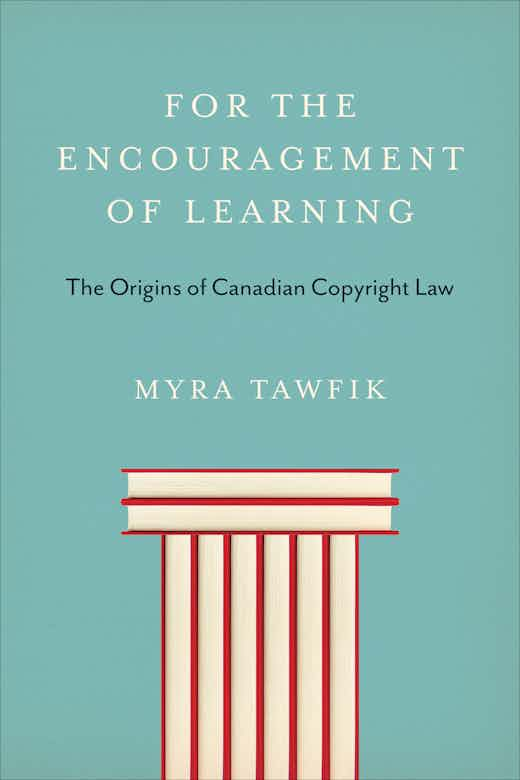
Tawfik, "For the Encouragement of Learning: The Origins of Canadian Copyright Law"

The University of Toronto Press has published For the Encouragement of Learning: The Origins of Canadian Copyright Law (2023), by Myra Tawfik (University of Windsor). A description from the Press:

For the Encouragement of Learning addresses the contested history of copyright law in Canada, where the economic and reputational interests of authors and the commercial interests of publishers often conflict with the public interest in access to knowledge. It chronicles Canada’s earliest copyright law to explain how pre-Confederation policy-makers understood copyright’s normative purpose.

Using government and private archives and copyright registration records, Myra Tawfik demonstrates that the nineteenth-century originators of copyright law intended to promote the advancement of learning in schools by encouraging the mass production of educational material. The book reveals that copyright laws were integral features of British North American education policy and highlights the important roles played by teachers, education reformers, and politicians in the emergence and development of the laws. It also explains how policy-makers began to consider the relationship between copyright and cultural identity formation once British interference into domestic copyright affairs increased, and as Canadian Confederation neared. Using methodologies at the intersection of legal history and book history, For the Encouragement of Learning embeds the copyright legal framework within the history of Canada’s book and print culture.

From reviewers:

"For the Encouragement of Learning is an essential text for fully understanding the origins and development of copyright law in Canada. By grounding her insights in deeply researched historical contexts – colonial and Anglo-American copyright, educational and cultural trends, resistance to British copyright laws, the reading needs of French Canadians, to name but a few – Myra Tawfik has given us a landmark study for assessing Canadian copyright law’s past, present, and future." -- Robert Spoo

"Painstakingly researched and meticulously written, Myra Tawfik’s book provides a sweeping picture of early Canadian copyright history while dropping delicious anecdotes. Vast amounts of information are put together and transformed for the reader to experience an easy storytelling of Canadian copyright law within general Canadian history. It is the pre-Confederation copyright history book that was missing in Canada." -- Ysolde Gendreau

More information is available here. An interview with Professor Tawfik is available here, at New Books Network.

-- Karen Tani