Showing posts with label Cold War. Show all posts

Tuesday, June 23, 2026

Ewing and Moretta on the Cold War and the UK Right to Strike

K.D. Ewing and Andrew Moretta have published Labour Law, the Cold War, and the Right to Strike: A Legal and Political History of Order 1305 (Hart/Bloomsbury):

Surprisingly, the prohibition on the right to strike was retained by the Attlee administration after the Second World War, and was transformed to become a weapon of government during the Cold War to deal with what were wrongly claimed by ministers to be Communist-inspired strikes engineered for subversive purposes.

In a deep analysis of Order 1305, the authors provide a reassessment of the role of the State in industrial relations. Challenging much contemporary learning in labour law, the book is informed by a very detailed engagement with Cabinet and ministerial papers, which highlight the contradictions on the part of government in simultaneously promoting and containing trade union power. These sources also highlight the extent to which trade unions both relied on and were co-opted by the State.

The main focus of the book, however, is the role of Order 1305 in the control of trade union activists, with the continuing presence of the criminal law and allegations of communist inspired strikes ensuring an important role for MI5 and Special Branch in post-war industrial relations. Material unearthed at the National Archives demonstrates unequivocally not only that trade unions were deeply penetrated, but also that trade union activists were the subject of extensive surveillance, as the authors fully reveal.
–Dan Ernst.  TOC after the jump.

Monday, July 17, 2023

LHR 41:2

Law and History Review 41:2 has been published.  It is a remarkable, guest-edited collection of articles on Law, Courts, and Constitutions in Twentieth-Century South Asia, four of them published open access.

Law, Courts, and Constitutions in Twentieth-Century South Asia
Saumya Saxena, Alastair McClure

The Drafting of the Constitution of the Union of Burma in 1947: Dominion Status, Indo–Burmese Relations, and the Irish Example
Donal K. Coffey

Nepal's Constitutional Foundations between Revolution and Cold War (1950–60)
Mara Malagodi

Constitutions and Modernity in Post-Colonial Afghanistan: Ethnolinguistic Nationalism and the Making of an Afghan Nation-State

Elisabeth Leake

Negotiating Nationhood: Constitutional Warfare, International Law, and the Birth of Bangladesh
Cynthia Farid

Policing Sati: Law, Order, and Spectacle in Postcolonial India

Saumya Saxena

Killing in the Name Of? Capital Punishment in Colonial and Postcolonial India
Alastair McClure

Mergers and Legal Fictions: Coverture and Intermarried Women in India
Leilah Vevaina

Courts and Constitutions in South Asia and the Global South: A View from the Middle East
Faiz Ahmed 

--Dan Ernst

Thursday, February 2, 2023

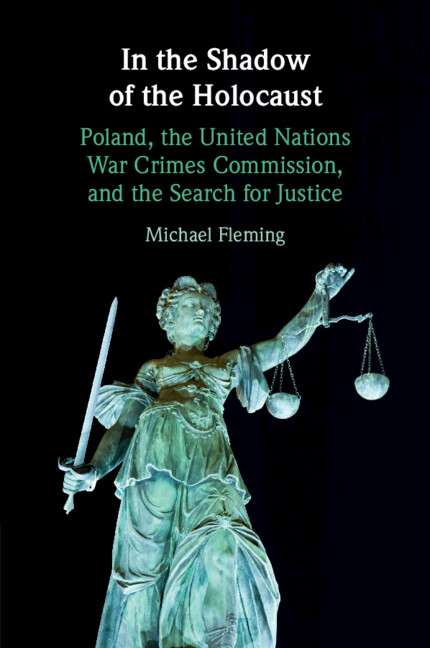
Fleming on "Poland, the United Nations War Crimes Commission, and the Search for Justice"

Cambridge University Press has published In the Shadow of the Holocaust: Poland, the United Nations War Crimes Commission, and the Search for Justice (2022), by Michael Fleming (Polish University Abroad, London). A description from the Press:

In the midst of the Second World War, the Allies acknowledged Germany's ongoing programme of extermination. In the Shadow of the Holocaust examines the struggle to attain post-war justice and prosecution. Focusing on Poland's engagement with the United Nations War Crimes Commission, it analyses the different ways that the Polish Government in Exile (based in London from 1940) agitated for an Allied response to German atrocities. Michael Fleming shows that jurists associated with the Government in Exile made significant contributions to legal debates on war crimes and, along with others, paid attention to German crimes against Jews. By exploring the relationship between the UNWCC and the Polish War Crimes Office under the authority of the Polish Government in Exile and later, from the summer of 1945, the Polish Government in Warsaw, Fleming provides a new lens through which to examine the early stages of the Cold War.
A sample of advance praise:

"This pathbreaking book sheds important new light on post-war attempts to prosecute Nazi war criminals and collaborators through an analysis of the participation in the United Nations’ War Crimes Commission of representatives of the Polish government, first that established in the west after the Polish defeat and then by the pro-communist government established by the Soviets. It is essential reading for all those interested in the problem of how to prosecute genocide and crimes against humanity." -- Antony Polonsky

 More information is available here. (h/t New Books Network)

-- Karen Tani

Thursday, April 7, 2022

Briker & Driver, "Brown and Red: Defending Jim Crow in Cold War America"

Recently published in the Stanford Law Review: "Brown and Red: Defending Jim Crow in Cold War America," by Gregory Briker (Yale University, J.D./Ph.D. candidate) and Justin Driver (Yale Law School). The abstract:

It would be difficult to overstate the centrality of Brown v. Board of Education to American law and life. Legal scholars from across the ideological spectrum have lavished more attention on that Supreme Court decision than any other issued during the last century. In recent decades, the standard account of Brown has placed that most-scrutinized opinion in a geopolitical context. Brown, the standard account maintains, must be viewed as a product of the Cold War era. By the 1950s, the persistence of laws codifying racial subordination had become an embarrassment for the United States on the global stage. The U.S. effort to defeat communism around the world thus rendered the recognition of civil rights for Black Americans a Cold War imperative.

This Article complicates and challenges that account by exploring the central role that anticommunism played in segregationists’ opposition to Brown and civil rights. Throughout most of the twentieth century, a broad array of Americans contended that preserving Jim Crow was a Cold War imperative in its own right. For this group, anticommunism and segregation were not just compatible, but inextricably intertwined. Their ranks included northerners and southerners alike: politicians, jurists, columnists, and ordinary citizens. White supremacists did not invoke anticommunism merely as a disingenuous ploy to combat Brown. Both long before and long after 1954, anticommunism helped to shape the contours of segregationist thought. The defenders of Jim Crow assailed integration as a product of communistic central government authority. They insisted that racial equality would create discord within the United States, just as the Soviets desired, and that civil rights activists were tainted by communist affiliations. Many segregationists viewed themselves as committed Cold Warriors, undertaking closely connected fights against both a foreign ideological threat and a domestic social one. As such, the Cold War represented not only a divide between the United States and the Soviet Union; it also reflected a debate within the United States over the relationship between racial justice, national security, and foreign policy.

Understanding that segregationists viewed their cause as a Cold War imperative recasts dominant views within legal academia, where this essential component of Brown’s geopolitical context remains underappreciated. While it is tempting to dismiss every segregationist invocation of anticommunism as the product of either irrationality or opportunism, it would be a mistake to do so. Linking segregation with anticommunism transformed the defense of Jim Crow from a regional priority into a national one. Anticommunism also helped resolve a core tension in the segregationist belief that Black citizens did not actually want integration, allowing civil rights lawsuits to be attributed to communist agitation. Reckoning with this significant element of the civil rights era, this Article thus illuminates the logic of a racist worldview. In so doing, it provides a fuller, more accurate portrait of a critical period in constitutional history, of the complex dynamics undergirding legal change, and of the malleable, tenacious character of racism in modern America.

Read on here.

-- Karen Tani

Saturday, March 19, 2022

Weekend Roundup

  • "Rules and Exceptions: Casuistry, Equity, and Prerogative," the 2021-22 Cotterrell Lecture in Sociological Jurisprudence delivered by Lorraine Daston, Director Emerita of Max Planck Institute for the History of Science and Professor at the Committee on Social Thought at the University of Chicago, is now available on Queen Mary University of London’s YouTube channel
  • On March 31, the American Foundings series at the Catholic University of America continues with How Should We Remember? History, Meaning, and Community.  The panelists are Jack Rakove, Coe Professor of History and American Studies Emeritus, Stanford University; Jamelle Bouie, Opinion Columnist, New York Times, and Kate Masur, Professor of History, Northwestern UniversitySamuel Fisher, Assistant Professor of History, Catholic University of America, moderates.
  • On March 30, The National Museum of American History will posthumously present its Great Americans Medal to Ruth Bader Ginsburg “for her groundbreaking judicial work and commitment to gender equality and human rights accepted by her daughter and son  Professor Jane C. Ginsburg and James Ginsburg followed by a donation of significant artifacts representing Justice Ginsburg's Supreme Court career.”  More.
  • Also via National Archives Museum Online: Laura F. Edwards in conversation with Adam Rothman on her book, Only the Clothes on Her Back. More.
  • "The Cold War and the Canon of Liberalism," the 2022 Carlyle Lectures at the University of Oxford, by Samuel Moyn, Yale Law School, are available here.
  • In “The Economic Constitution,” Mark A. Graber reviews The Anti-Oligarchy Constitution: Reconstructing The Economic Foundations of American Democracy, by Joseph Fishkin and William Forbath (Democracy). 
  • Update: Legal history figures among the twenty-nine finalists for the ABA’s 2022 Silver Gavel Awards for Media and the Arts (ABA Journal).

Weekend Roundup is a weekly feature compiled by all the Legal History bloggers.

Wednesday, December 12, 2018

Washington History Seminar Spring 2019 Schedule

The Spring 2019 schedule for the Washington History Seminar is out:

January 14      Panel Discussion: Joshua Shifrinson on Rising Titans, Falling Giant: How Great Powers Exploit Power Shifts; Joseph Parent and Paul MacDonald on Twilight of the Titans: Great Power Decline and Retrenchment; David Edelstein on Over the Horizon: Time, Uncertainty, and the Rise of Great Powers; Stacie Goddard on When Right Makes Might: Rising Powers and World Order

January 28      Derek Leebaert on Grand Improvisation: America Confronts the British Superpower, 1945-1957

February 4      Kathleen Day on Bankers, Bailouts, and the Struggle to Tame Wall Street

February 12*   Fitzhugh Brundage on Civilizing Torture: An American Tradition

February 25     Kate Lemay on Triumph of the Dead: American WWII Cemeteries, Monuments, and Diplomacy in France

March 4           Stephan Kieninger on The Diplomacy of Détente: Cooperative Security from Schmidt to Shultz

March 11         Ngoei Wen-Qing on The Arc of Containment: Britain, the United States, and Anticommunism in Southeast Asia

March 18         Devin Fergus on Land of the Fee: Hidden Costs and the Decline of the American Middle Class 

March 25         Gail Hershatter on Women and China’s Revolution

April 1             Sarah Igo on The Known Citizen: A History of Privacy in Modern America

April 4*            Robert Jervis on How Statesmen Thing: The Psychology of International Politics

April 8             Jennifer Miller on Cold War Democracy: The United States and Japan

April 15           Daniel Immerwahr on How to Hide an Empire: A History of the Greater United States

April 22           Felix Boecking on No Great Wall: Trade, Tariffs, and Nationalism in Republican China, 1927-1945

April 29           Konrad Jarausch on Broken Lives: How Ordinary Germans Experience the Twentieth Century

May 6             Piotr Kosicki on Catholics on the Barricades: Poland, France and Revolution, 1891-1956

May 13           Joanne Freeman on The Field of Blood: Violence in Congress and the Road to Civil War

*event does not take place on Monday

Tuesday, July 10, 2018

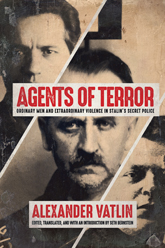
Vatlin on state-sponsored violence in the USSR

We missed this one in 2016. Agents of Terror: Ordinary Men and Extraordinary Violence in Stalin's Secret Police by Alexander Vatlin, Moscow State University has been edited and translated by Seth Bernstein and published by the University of Wisconsin Press. From the press:
Agents of TerrorIn the Great Terror of 1937–38 more than a million Soviet citizens were arrested or killed for political crimes they didn't commit. What kind of people carried out this violent purge, and what motivated them? This book opens up the world of the Soviet perpetrator for the first time. Focusing on Kuntsevo, the Moscow suburb where Stalin had a dacha, Alexander Vatlin shows how Stalinism rewarded local officials for inventing enemies. 
Agents of Terror reveals stunning, detailed evidence from archives available for a limited time in the 1990s. Going beyond the central figures of the terror, Vatlin takes readers into the offices and interrogation rooms of secret police at the district level. Spurred at times by ambition, and at times by fear for their own lives, agents rushed to fulfill quotas for arresting “enemies of the people”—even when it meant fabricating the evidence. Vatlin pulls back the curtain on a Kafkaesque system, forcing readers to reassess notions of historical agency and moral responsibility in Stalin-era crimes.
Praise for the book: 

“Groundbreaking. In the first detailed description of Stalin’s mass terror, Vatlin unfolds the day-to-day working of the Soviet political police who carried out orders to select, arrest, interrogate, and often murder their fellow citizens. An absorbing, heartrending account.” -David Shearer

“Although the literature on the Great Terror has improved markedly over the past twenty-five years, only a handful of case studies consider how the purges took place at the grassroots level. Thankfully, Alexander Vatlin’s pathbreaking work has now become available to English-speaking audiences. One can only hope that Agents of Terror will inspire more research on the purge’s perpetrators and victims as well as on the broader sociology of this brutal period.” -David Brandenberger

“A sensationally significant, detailed microhistory of Stalin’s Great Terror, based on the criminal files of NKVD agents who were arrested as scapegoats at the end of the terror—what some historians have called the purge of the purgers.” -Lynne Viola

Further information is available here.

Friday, May 4, 2018

Goldstein on the Cold War Trials of "the Legless Veteran"

Robert Justin Goldstein, emeritus professor of political science at Oakland University, has published  Discrediting the Red Scare: The Cold War Trials of James Kutcher, “The Legless Veteran” in the Landmark Law Cases and American Society series at the University Press of Kansas:
During the Allies’ invasion of Italy in the thick of World War II, American soldier James Kutcher was hit by a German mortar shell and lost both of his legs. Back home, rehabilitated and given a job at the Veterans’ Administration, he was soon to learn that his battles were far from over. In 1948, in the throes of the post-war Red Scare, the hysteria over perceived Communist threats that marked the Cold War, the government moved to fire Kutcher because of his membership in a small, left-wing group that had once espoused revolutionary sentiments. Kutcher’s eight-year legal odyssey to clear his name and assert his First Amendment rights, described in full for the first time in this book, is at once a cautionary tale in a new period of patriotic one-upmanship, and a story of tenacious patriotism in its own right.

The son of Russian immigrants, James Kutcher came of age during the Great Depression. Robbed of his hope of attending college or finding work of any kind, he joined the Socialist Workers Party, left-wing and strongly anti-Soviet, in his hometown of Newark. When his membership in the SWP came back to haunt him at the height of the Red Scare, Kutcher took up the fight against efforts to punish people for their thoughts, ideas, speech, and associations. As a man who had fought for his country and paid a great price, had never done anything that could be construed as treasonous, held a low level clerical position utterly unconnected with national security, and was the sole support of his elderly parents, Kutcher cut an especially sympathetic figure in the drama of Cold War witch-hunts. In a series of confrontations, in what were highly publicized as the “case of the legless veteran,” the federal government tried to oust Kutcher from his menial Veterans’ Administration job, take away his World War II disability benefits, and to oust him and his family from their federally subsidized housing. Discrediting the Red Scare tells the story of his long legal struggle in the face of government persecution—that redoubled after every setback until the bitter end.

Thursday, March 22, 2018

Kealey on Policing Canada

Gregory S. Kealey, University of New Brunswick, published Spying on Canadians: The Royal Canadian Mounted Police Security Service and the Origins of the Long Cold War with the University of Toronto Press in 2017. From the publisher: 
Spying on CanadiansAward winning author Gregory S. Kealey’s study of Canada’s security and intelligence community before the end of World War II depicts a nation caught up in the Red Scare in the aftermath of the Bolshevik Revolution and tangled up with the imperial interests of first the United Kingdom and then the United States. 
Spying on Canadians brings together over twenty five years of research and writing about political policing in Canada. Through itse use of the Dominion Police and later the RCMP, Canada repressed the labour movement and the political left in defense of capital. The collection focuses on three themes; the nineteenth-century roots of political policing in Canada, the development of a national security system in the twentieth-century, and the ongoing challenges associated with research in this area owing to state secrecy and the inadequacies of access to information legislation. This timely collection alerts all Canadians to the need for the vigilant defence of civil liberties and human rights in the face of the ever increasing intrusion of the state into our private lives in the name of countersubversion and counterterrorism.
 In praise of the book:

"Canadians instantly recognize the CIA and Britain’s MI5 as dramatized in film, fiction and folklore. Popular culture overlooks our own history of domestic surveillance. Spying on Canadians turns on the lights. It is an absorbing account of a hammer in search of a nail." -Holly Doan

"Gregory S. Kealey is one of the recognized authorities in security studies. He does an excellent job in these essays of analyzing how the needs and opinions of their political masters and the nature of the perceived economic, political, and ethnic threats influenced the ideology of those who directed and implemented political policing." -Lorne Brown


"Gregory S. Kealey’s work on the history of security and, especially, the archival legwork involved in ‘digging’ for this restricted material is exceptional."-Patrizia Gentile

Further information is available here.

Monday, February 19, 2018

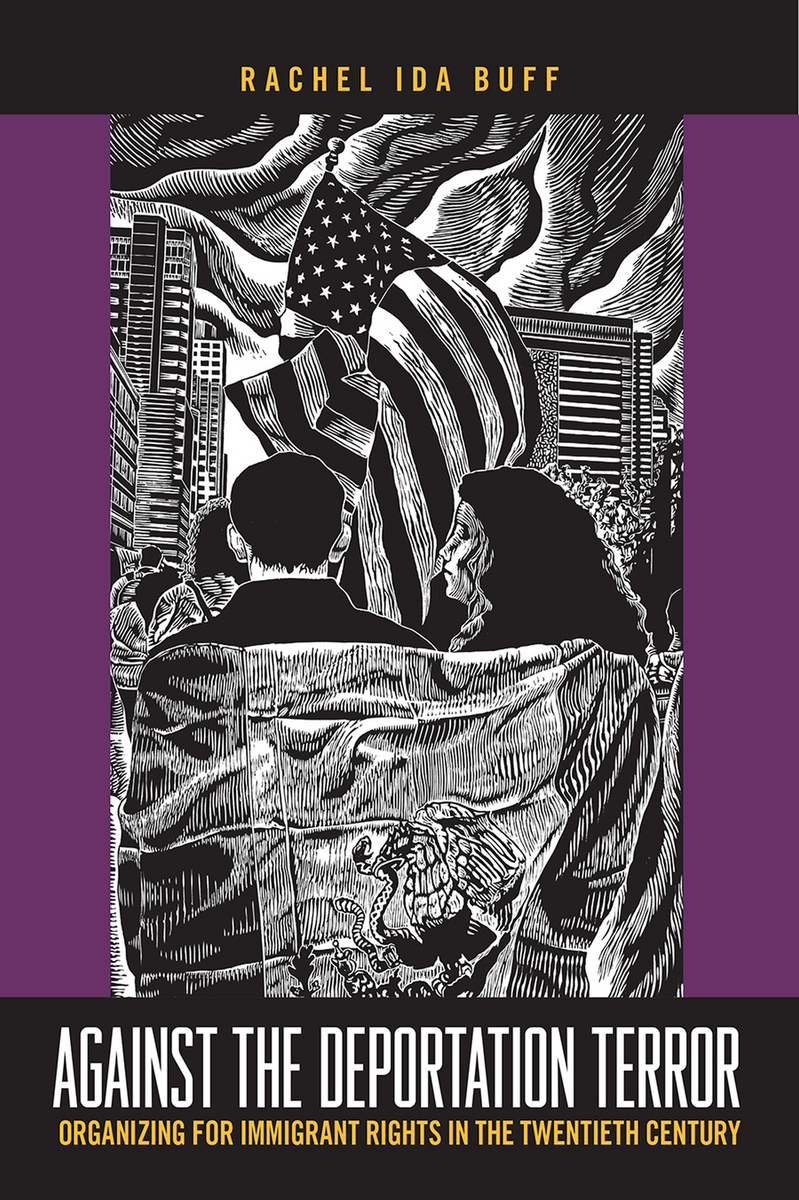
Bluff, "Against the Deportation Terror"

New from Temple University Press: Against the Deportation Terror: Organizing for Immigrant Rights in the Twentieth Century (Nov. 2017), by Rachel Ida Bluff (University of Wisconsin-Milwaukee). A description from the Press:
Despite being characterized as a "nation of immigrants," the United States has seen a long history of immigrant rights struggles. In her timely book Against the Deportation Terror, Rachel Ida Buff uncovers this multiracial history. She traces the story of the American Committee for the Protection of the Foreign Born (ACPFB) from its origins in the 1930s through repression during the early Cold War, to engagement with "new" Latinx and Caribbean immigrants in the 1970s and early 1980s. 
Functioning as a hub connecting diverse foreign-born communities and racial justice advocates, the ACPFB responded to various, ongoing crises of what they called "the deportation terror." Advocates worked against repression, discrimination, detention, and expulsion in migrant communities across the nation at the same time as they supported reform of federal immigration policy. Prevailing in some cases and suffering defeats in others, the story of the ACPFB is characterized by persistence in multiracial organizing even during periods of protracted repression. 
By tracing the work of the ACPFB and its allies over half a century, Against the Deportation Terror provides important historical precedent for contemporary immigrant rights organizing. Its lessons continue to resonate today.
An advance review:
"Against the Deportation Terror makes a significant contribution to the historiography of immigration, citizenship, and noncitizenship. Buff's revisionist history of the American Committee for the Protection of the Foreign Born (ACPFB) provides the framework for her larger argument about the political mobilization of noncitizens within the increasingly repressive immigration regime between the 1920s and the early 1960s. The ACPFB's history is vital to an understanding of the historical roots of the contemporary immigrants' rights movement. This book will play a major role in the burgeoning scholarship on the history of the multinational 'American Left' in the twentieth century."
—David Gutiérrez
More information is available here.

Monday, December 11, 2017

A New FJC "Famous Federal Trial": The Flag Salute Cases

First Graders Saluting the Flag, 1942 (LC)
Perhaps you, like me, have been unaware of the growing set of materials on Famous Federal Trials that the Federal Judicial History Office of the Federal Judicial Center has produced over the years.  I gather that most or all were prepared "Federal Trials and Great Debates in U.S. History," a summer institute for teachers that the FJC runs in partnership with the American Bar Association Division for Public Education.  Just out is Gobitis v. Minersville School District and Barnette v. West Virginia State Board of Education: The Flag Salute Cases, by by Winston Bowman, Associate Historian, Federal Judicial History Office, Federal Judicial Center.  The others are:

U.S. v. Lyon, U.S. v. Cooper, and U.S. v. Callender: The Sedition Act Trials
U.S. v. Aaron Burr: The Treason Trial
U.S. v. The Amistad: The Mende Slave Revolt.
Ex parte Merryman: Habeas Corpus During the Civil War
U.S. v. Susan B. Anthony: The Fight for Women's Suffrage
Chew Heong v. U.S.: Chinese Exclusion and the Federal Courts
In re Eugene V. Debs: The Pullman Strike and American Railway Union Boycott.
Olmstead v. U.S.: The Prohibition Trial of a Seattle Bootlegger.
U.S. v. Julius Rosenberg: The Atomic Spy Trial
Bush v. Orleans Parish School Board: The Desegregation of New Orleans Public Schools
U.S. v. Dellinger: The Chicago Seven Conspiracy Trial

Friday, September 1, 2017

Garcia's "Refugee Challenge in Post-Cold War America"

Released today from the Oxford University Press is The Refugee Challenge in Post-Cold War America by María Cristina García, the Howard A. Newman Professor of American Studies in the Department of History at Cornell University:
For over forty years, Cold War concerns about the threat of communism shaped the contours of refugee and asylum policy in the United States, and the majority of those admitted as refugees came from communist countries. In the post-Cold War period, a wider range of geopolitical and domestic interests influence which populations policymakers prioritize for admission.

The Refugee Challenge in Post-Cold War America examines the actors and interests that have shaped refugee and asylum policy since 1989. Policymakers are now considering a wider range of populations as potentially eligible for protection: victims of civil unrest, genocide, trafficking, environmental upheaval, and gender-based discrimination, among others. Many of those granted protected status since 1989 would never have been considered for admission during the Cold War.

Among the challenges of the post-Cold War era are the growing number of asylum seekers who have petitioned for protection at a port of entry and are backlogging the immigration courts. Concerns over national security have also resulted in deterrence policies that have raised important questions about the rights of refugees and the duties of nations. María Cristina García evaluates the challenges of reconciling international humanitarian obligations with domestic concerns for national security.

Saturday, July 15, 2017

Weekend Roundup

  • Attention Scalia, J., biographers: in an anecdote recounted here at 1:23, the director David O. Russell disrupts the justice's appearance in Hadley Arkes's class at Amherst.
Weekend Roundup is a weekly feature compiled by all the Legal History bloggers.

Tuesday, April 4, 2017

Empire and Imperialism: (Mis)Framing Cross-Cultural Engagements

One major shift in modern anthropology occurred when the discipline “came home.” By the mid-20th century the neat division between sociological studies of Western nations and anthropological studies of non-Western societies progressively broke down. Harold Miner penned the classic article “Body Ritual Among the Nacirema” to highlight the necessity and discomfort of subjecting American culture to the same sort of dispassionate analysis of ritual as had been applied with such rigor abroad.

This move spurred ongoing debates about the inter-relationship between theories of interpretation and various subjects of analysis. The thread therein that became increasingly relevant in my experience writing Futility was examining the assumption that those studied were on the other side of various social inequalities. Edward Said’s influential work on the concept of Orientalism spawned numerous analyses about how foreign cultures are represented in academic writing. Implicit in these debates were the implications that arise when these representations are applied across power asymmetries. One book that impacted my own thinking on overseas state-action in this regard was James Scott’s Seeing Like a State, which explored attempts to “modernize” populations by powerful foreign agents who had deemed them underdeveloped.

What then did it mean then for anthropologists to study American law and lawyers, who were most often socially more powerful than anthropologists themselves? The answer to this is still unsettled, and there is still a great deal of discomfit when anthropologists write about the powerful. In my own work, I confronted this tension when my subject of study became American lawyers in China, and where the dominant frames of analysis I inherited from my home discipline were ill-fit to capture the structure of Sino-American relations.

The most common term used by critical scholars to describe almost all American legal interactions abroad in the contemporary era is imperialism. Imperialism is a decidedly capacious concept, as it can capture modes of influence from direct territorial colonialism to a range of cultural and economic influences between and within nations.

In my graduate studies, I first came to the literature on “law and development” not through the frequently cited article by David Trubek and Marc Galanter, “Scholars in Self-Estrangement,” but through their contemporary James Gardner, who wrote an extensive post-mortem on US legal reform efforts in Latin America entitled Legal Imperialism. Gardner’s choice of the frame of imperialism reflected the implicit normative judgment of the word, and tried to capture the ethnocentrism he came to see at the heart of his own work as an exporter of American law.

Yet, the central irony of Gardner’s work was that whatever type of imperialist he had been, he was not only a failed imperialist—in that his and his cohort’s attempt to influence Latin American legal education did not come to fruition—but also that from Gardner’s own analysis it is clear that the project was doomed from the start by a whole host of conceptual and logistical presumptions that the American lawyers engaged in the project carried with them.

Thursday, March 9, 2017

Cong on Marriage & Gender in Revolutionary China

Xiaoping Cong, University of Houston, has published Marriage, Law and Gender in Revolutionary China, 1940-1960 with Cambridge University Press (2016). From the publisher:
Marriage, Law and Gender in Revolutionary China, 1940–1960
Xiaoping Cong examines the social and cultural significance of Chinese revolutionary legal practice in the construction of marriage and gender relations. Her book is an empirically rich investigation of the ways in which a 1943 legal dispute over an arranged marriage in a Chinese village became a legal, political and cultural exemplar on the national stage. This conceptually groundbreaking study revisits the Chinese Revolution and its impact on women and society by presenting a Chinese experience that cannot and should not be theorized in the framework of Western discourse. Taking a cultural historical perspective, Cong shows how the Chinese Revolution and its legal practices produced new discourses, neologisms and cultural symbols that contained China's experience in twentieth-century social movements, and how revolutionary practice was sublimated into the concept of 'self-determination', an idea that bridged local experiences with the tendency of the twentieth-century world, and that is a revolutionary legacy for China today.
Table of Contents after the jump.

Tuesday, December 27, 2016

Ethel Rosenberg as the "Government's Hostage"

Mark Denbeaux, director of the Center for Policy and Research at Seton Hall University School of Law, and four co-authors and research fellows have posted The Government's Hostage: The Conviction and Execution of Ethel Rosenberg:
Ethel and Julius Rosenberg (Wiki)
Whether or not Ethel Rosenberg was guilty of the offense for which she was tried, convicted, and executed, there is little doubt that the evidence upon which the conviction was based was threadbare. Indeed, even the government itself thought so. The government’s prosecution of Ethel relied exclusively on the testimony of David and Ruth Greenglass, Ethel’s brother and sister-in-law. A July 17, 1950 internal FBI memo declared there was not enough evidence to arrest Ethel Rosenberg. The government did not discover any new evidence against Ethel between the release of that memo and Ethel’s arrest on August 11, 1950. Furthermore, no new evidence was discovered in the time between her arrest and her indictment on January 31, 1951, shortly before her trial in March. And it was in that brief period that both the Greenglasses’ stories dramatically evolved as to the extent of Ethel’s supposed connections with the alleged conspiracy.

Her conviction and execution rested on three claims: (1) Ethel asked Ruth to convey Julius’ espionage recruitment offer to David; (2) Ethel typed up notes containing nuclear secrets in order to transmit them to the Soviets; and (3) Ethel and Julius received a mahogany table and other gifts from the Soviets as a reward for their commitment to the cause. Of the three, the only evidence present at the time Ethel was indicted was Ruth’s statement that Ethel asked Ruth to convey Julius’ recruitment offer to David. Despite giving several statements, over the course of eight months, neither Ruth nor David Greenglass mentioned Ethel typing up the notes until two weeks before trial. The indictment and pretrial documents also fail to report that Ethel received gifts from the Russians. This accusation was first introduced into the trial documents during the Greenglasses’ trial testimony.

The conclusion in the July 17, 1950 FBI memo, stating that the evidence against Ethel was insufficient to warrant prosecution, remained true throughout her arrest, prosecution, conviction, and execution.

The reason for her prosecution seems clear: Ethel was executed because she refused to cooperate with the Government to help convict her husband, Julius. Ethel was merely a pawn used for leverage in the government’s attempt to build a case against Julius Rosenberg.

Saturday, October 29, 2016

Weekend Roundup

  • Available in advance are two book reviews in the American Journal of Legal History: Kimberly Welch on Jonathan M. Bryant’s Dark Places of the Earth: The Voyage of the Slave Ship Antelope, and Sanford V. Levinson on David Cole’s Engines of Liberty: The Power of Citizen Activists to Make Constitutional Law
  • The History and Public Policy Program of the Woodrow Wilson International Center for Scholars seeks interns for the Cold War International History Project, the Nuclear Proliferation International History Project, and the North Korea International Documentation Project. Deadline: November 6More.
  • “Retired Oregon State University professor of history William G. Robbins will give a talk entitled, “The Malheur Occupation and Public Lands in the West” at 2 p.m. Saturday [i.e., today] in the Moreland Gallery at the Benton County Historical Museum.”  H/t: Philomath Express.
  • If you're missing out on this year's meeting of the American Society for Legal History, you can follow the conversation on Twitter. Search for #ASLH2016. And for blog readers who are there, keep those tweets coming!
Weekend Roundup is a weekly feature compiled by all the Legal History bloggers.

Friday, October 28, 2016

Silber on Monroe Freedman and Domestic Anticommunism

Norman I. Silber, Hofstra University School of Law, has posted Monroe Freedman and the Morality of Dishonesty: Multidimensional Legal Ethics as a Cold War Imperative, which appears in the Hofstra Law Review 44 (2016): 1127-60.
This Article reaches into the personal history of Monroe Freedman, a pioneer in multi-dimensional legal ethics, to advance an explanation for his advocacy and his signal contributions to legal ethics - particularly his landmark article of 1966, Professional Responsibility of the Criminal Defense Lawyer: The Three Hardest Questions, where he inquired into situations in which candor might not be either moral or professional. It argues that his outspoken defense of lying as sometimes necessary and even moral behavior in the adversary system should be understood as an outgrowth of his early religious perspective about the nature of moral obligations, as well as a response to excesses of the Cold War that touched him personally. It contends that Monroe’s confidence in the fundamental fairness of government rules, processes, and punishments—and that of hundreds of other young lawyers - was undermined by experience with the National Lawyers Guild, inquisitions, and FBI surveillance during the 1950s, and that understanding the history does at least as much to explain his attitude about ethics in an adversary system as his better-known encounters with the problems of criminal defense lawyers in more immediate contexts. Focusing on these earlier events offers insight not just into Monroe and the genesis of his position in that article, but offers an alternative explanation for the modern development of multidimensional professional ethics.

Monday, July 4, 2016

Lovelace on "William Worthy's Passport" and more in June JAH

The June issue of the Journal of American History is now out. One article that is sure to interest many of our readers is "William Worthy's Passport: Travel Restrictions and the Cold War Struggle for Civil and Human Rights," by H. Timothy Lovelace, Jr. (University of Indiana Maurer School of Law). Here's the abstract:
In April 1964 Malcolm X boldly challenged black activists to “expand the civil rights struggle to the level of human rights” and “take the case of the black man in this country before the nations in the U.N.” But nearly two years earlier, William Worthy, black America’s star foreign correspondent, had taken his case before both U.S. courts and the United Nations. In 1961 Worthy defied the U.S. travel ban to Cuba to report on racial progress on the island. The State Department had the names of more than two hundred citizens who had violated the travel ban, but federal officials singled out the radical journalist for prosecution, making him the first American convicted of returning to the United States without a valid passport. H. Timothy Lovelace Jr. explores how Worthy invoked the U.S. Constitution and international human rights law to fight his selective prosecution and uses Worthy v. United States to offer fresh understandings of black internationalism in the 1960s.
Full content is available only to subscribers, unfortunately.

Friday, May 13, 2016

Jones to Speak on Mexican Anti-Subversion Laws, 1941-70

On Monday, May 16, 2016, 4:00pm - 5:30pm, in the 6th Floor Moynihan Boardroom of the Woodrow Wilson International Center for Scholars, Halbert Jones, St. Antony's College, University of Oxford, will present “Crimes Against the Security of the Nation”: World War II, the Cold War, and the Evolution of Mexico’s Anti-Sedition Laws, 1941-1970:
While, until recently, relatively little attention has been given to the importance of international conditions in accounting for the longevity of Mexico’s post-revolutionary regime, Halbert Jones will show how World War II and the Cold War played a pivotal role in enabling successive Mexican governments to enact, expand, and apply one of its most controversial legal tools, a provision in the federal penal code criminalizing what it described as acts of “social dissolution.”  The legislation, in force from 1941 to 1970, prescribed severe penalties for vaguely defined crimes of subversion, and it was invoked over the course of those decades against striking workers, student protesters, and a famous communist muralist, among others who were said to be spreading “foreign propaganda” and undermining national security.  By the time Mexico’s 1968 student movement called for the repeal of the measure, however, it had become a symbol of what critics saw as the arbitrary nature of the regime.  The removal of the provision from the books in 1970 – and its replacement with a clause introducing the new crime of “terrorism” – therefore highlights the ability of an authoritarian political system to adapt to changing international and domestic political conditions.