Showing posts with label Housing. Show all posts

Tuesday, January 21, 2025

Highsmith on Governing the Company Town

Brian Highsmith, Lecturer and Academic Fellow in Law and Political Economy at the Harvard Law School, has posted Governing the Company Town, which is forthcoming in the Stanford Law Review:

Workers in Pullman, 1914 (CHM)
This Article explores the forms of public and private governance that facilitate localized corporate domination. Researchers have documented the oppressive employment relationship that characterized historical “company towns,” but few accounts yet have examined these communities as local governments. I use archival research to identify institutional continuities between corporate fiefdoms like George Pullman’s model town outside Chicago (1880-1898) and Disney’s self-governed district near Orlando (1967-2023). I demonstrate that local government law has contributed to the recent reemergence of company-dominated enclaves, namely by deferring to private governance and facilitating jurisdictional fragmentation.

During the Gilded Age and Progressive Era, proprietors of company-owned towns exercised absolute control over workers through the private law of property and contract. Mining bosses and industrial barons like Pullman intentionally rejected the municipal form, using dismissal and eviction to enforce company policy as the operative governing authority within their dominions. This strategy became less effective after the New Deal, leading observers to pronounce the demise of the company town. But I argue that parallel developments in local government law have allowed the company town’s continuation through new institutional forms, enabling corporate titans to wield public powers without accountability to any broad public. Rather than facilitating domination over captive worker-residents, these institutional forms are used primarily to externalize costs and escape democratic obligations like taxation—goals that also deeply shaped the governance of historical company towns. I review this playbook through several recent case studies, demonstrating how territorial and functional fragmentation have facilitated the proliferation of corporate enclaves—allowing spatially-concentrated private capital to secede from local democratic control.

I suggest that the company town can be understood as a democratic phenomenon: a distinctive form of private tyranny. Since the Founding, theorists have acknowledged the vulnerability of small and non-diverse jurisdictions to tyrannical rule-by-faction. By contextualizing new examples like Elon Musk’s efforts to incorporate his model towns in Texas, I show that this fear is realized where corporate interests either commandeer our formal institutions of governance or displace their typical role in structuring public life.
--Dan Ernst

Friday, November 24, 2023

Sood and Ehrman-Solberg on the Effects of Racial Restrictive Covenants

Aradhya Sood, University of Toronto, and the late Kevin Ehrman-Solberg, have posted Mapping Prejudice:
Racial covenants, which were used throughout the U.S. during the first half of the 20th century, were clauses in property deeds that prohibited the sale or rental of property to racial and ethnic minorities. This paper studies the long-run causal and persistent effects of racially restrictive covenants on racial sorting, racial homeownership differentials, and house prices. Using novel data on racial covenants and a quasi-experimental design that exploits time to build delays in housing and the 1948 U.S. Supreme Court ruling that made racial covenants unenforceable, we compare newly built, covenanted (and hence all-white) neighborhoods built before 1948 with covenanted neighborhoods constructed after the verdict, as the post-1948 neighborhoods lost a primary legal way to coordinate segregation. We find that about 5-17% of the observed neighborhood racial residential sorting and 6-17% of racial homeownership sorting, measured from 1980 to 2020, can be causally linked to racial covenants of the past. In addition, while the treated and control neighborhoods exhibit some differences in public amenities, particularly in the distance to highways and the restrictiveness of zoning regulations, these differences do not drive the observed persistent effects. Instead, homophily bias or unobserved housing quality are the likely drivers behind the persistent effects.

--Dan Ernst

Wednesday, August 9, 2023

Brady on Cottages as Public Nuisances

Maureen E. Brady, Harvard Law School, has posted  Cottages as Public Nuisances: The Long History of Land Use Regulation of the Poor, which is forthcoming in the DePaul Law Review:

Cottage Homes of England (NYPL)
In the Fourth Book of his Commentaries on the Law of England, in a chapter entitled “Offenses Against the Public Health, and the Public Police or Oeconomy,” William Blackstone sited his discussion of “common nuisances.” Although many things on this list of what we now call public nuisances are familiar—blockages of public roads, disorderly saloons, trades emitting offensive smells or sounds—one stands out. Blackstone described as a typical nuisance the erection of “cottages,” going on to discuss and even criticize the situation of these dwellings alongside uses like fireworks and the keeping of hogs in close quarters.

The aim of this Essay is to examine Blackstone’s discussion of cottages in context, endeavoring to use it toward two ends. The first is to better understand the concept of public nuisance and its limits. As others have chronicled, there has been a renaissance in interest in the tort in recent years, spurred on by multimillion dollar litigation invoking it in contexts ranging from the opioid epidemic to climate change. Here, I engage in a close reading of Blackstone’s passage and its citations, examining why cottages were regulated as public nuisances in the first instance and how that history connects to broader developments in English (and later American) law and society. As it turns out, cottages bore a closer relationship in many ways to public nuisance “classics,” like road blockages and certain public health risks, than it might at first appear.

Second, the story of the cottage illustrates the uneasy—and often, ineffective—ways that the state has deployed land use regulation to manage the poor. The story of the cottage evokes the old adage: “everything old is new again.” Cottages became targets because many sprung up informally on common property in an era in which the state was formalizing private title—not so different from the pressures on, and persistence of, informal settlements in some parts of the world today. Regulators sought to proscribe cottages to control the movement of labor while simultaneously limiting the accumulation of the poor, for a mix of seemingly legitimate and illegitimate reasons (compare the public health and safety risks of crowding to the notion that poverty and cohabitation leads to idleness). Centuries later, regulators and the citizens voting for them put forth a similar mix of motives to justify regulating apartment buildings and other forms of multifamily housing. The inclusion of cottages in Blackstone’s list illustrates the enduring appeal of land use law in all its forms—the tort law of nuisance, contract law, and regulation—as a means of defining and managing real and perceived social harms.
--Dan Ernst

Friday, June 3, 2022

Rose on Property Law and Inequality

Carol M. Rose, University of Arizona James E. Rogers College of Law, has posted Property Law and Inequality: Lessons from Racially Restrictive Covenants, which is forthcoming in the Northwestern University Law Review:

A longstanding justification for the institution of property is that it encourages effort and planning, enabling not only individual wealth creation but indirectly wealth in an entire society. Equal opportunity is a precondition for this happy outcome, but some have argued that past inequalities of opportunity have distorted wealth distribution in contemporary America. This article explores the possible role of property law in such a distortion, using the historical example of racially restrictive covenants in the first half of the twentieth century. I will argue that the increasing professionalization and standardization of real estate practices in that era included racial covenants to appeal to a predominately white market clientele, resulting in a curtailment of opportunities of African Americans to acquire wealth in real estate. Racial covenants have been unenforceable under Constitutional law since 1948, but I will argue that they were also a distortion of standard property law and that they undermined the principles on which property law rests. Courts might have recognized this at the outset and later, but for some reasons that this article suggests, they did not, with long lasting repercussions for racial wealth inequalities.
--Dan Ernst

Monday, January 24, 2022

Stone on Constance Baker Motley's Housing Litigation

Donovan J. Stone, a 20211 graduate of the Duke Law School, has published Constance Baker Motley’s Forgotten Housing Legacy in the Utah Law Journal:

Constance Baker Motley 1965 (LC)
Constance Baker Motley led the legal assault on Jim Crow and became the first Black woman appointed to the federal bench. She spent two decades with the NAACP’s Legal Defense and Educational Fund, assisting Thurgood Marshall in Brown v. Board of Education. Afterward, she desegregated the South’s public schools and universities and argued ten cases before the Supreme Court, winning nine. Motley also represented countless protestors jailed for their activism, including Martin Luther King, Jr.

Despite Motley’s achievements, scholars have largely overlooked her career. And those who have examined Motley’s work have generally focused on her efforts to dismantle school segregation. Public school desegregation was foundational to Motley’s LDF litigation, but her practice also extended beyond school desegregation. Motley filed scores of cases challenging racial discrimination in voting rights, public accommodations, and housing access.

Using archival research, this Article explores the latter category–Motley’s housing docket–through the lens of Stewart v. Clarke Terrace Unit No. 1, a case she litigated in Shreveport, Louisiana. Filed in 1954, Clarke Terrace was LDF’s first lawsuit challenging discrimination in privately constructed but federally insured housing developments. It sought to enforce the rights of African Americans who purchased homes in a new subdivision only to have nearby white residents sabotage the development. Uncovering Clarke Terrace challenges conventional narratives pigeonholing Motley as an education attorney. It highlights her housing advocacy and demonstrates that this work was pivotal to Motley’s clients, even if forgotten by historians. This analysis powerfully advances appreciation for and understanding of Motley’s civil rights legacy.

--Dan Ernst

Wednesday, October 21, 2020

Jarwala on Racially Restrictice Covenants and the Changed Conditions Doctrine

Alisha Jarwala, a 2020 graduate of the Harvard Law School, has posted The More Things Change: Hundley v. Gorewitz and 'Change of Neighborhood' in the NAACP’s Restrictive Covenant Cases, which is forthcoming in the Harvard Civil Rights-Civil Liberties Law Review 55 (2020):

Racially restrictive covenants flourished throughout the United States in the early twentieth century. These private agreements prohibited the sale or rental of specific parcels of land to non-white individuals, with the goal of maintaining residential segregation. Today, the primary case associated with restrictive covenants is Shelley v. Kraemer, in which the Supreme Court used the state action doctrine to strike down restrictive covenants in 1948.

However, there was a road not taken. The NAACP challenged hundreds of restrictive covenants and lost the majority of these cases, with a notable exception in 1941: Hundley v. Gorewitz. In Hundley, a federal court struck down a racially restrictive covenant in Washington, D.C., under a different theory: the “change of neighborhood” doctrine. This doctrine allows a court in equity to declare a restrictive covenant unenforceable if there has been such a radical change in the neighborhood that the covenant’s original purpose has been defeated. NAACP lawyer Charles Hamilton Houston was able to persuade the D.C. Circuit that a racially restrictive covenant was unenforceable if a neighborhood was already becoming predominantly Black, and the Hundleys kept their home.

This Note seeks to provide a legal historical account of Hundley v. Gorewitz and the change of neighborhood doctrine in the fight against restrictive covenants. A close examination of this case and doctrine provides insights into the NAACP’s civil rights litigation strategy. First, Hundley demonstrates the NAACP’s desire to use litigation as a tool to educate the courts and the public about the social and economic impacts of restrictive covenants. In addition, the use of this doctrine highlights Houston’s legal pragmatism: Ideologically, the change of neighborhood doctrine was a compromise because it accepted the premise of segregated neighborhoods. In making this argument, Houston utilized the converging interests of white homeowners, who wanted to be able to sell their properties to Black buyers. Ultimately, Hundley and the change of neighborhood doctrine showcase Houston’s ingenuity, pragmatism, and forward thinking at a time when the NAACP faced long odds in the fight against housing segregation.

--Dan Ernst

Wednesday, January 24, 2018

Johnston on Segregation and the DC Federal Courthouse (and Zasloff on DOJ and the Fair Housing Act)

James H. Johnston, a lawyer, writer, and lecturer in Washington D.C., has just published Segregation in the Federal Courthouse in Washington D.C. Before and After Brown v. Topeka Board in the Howard Law Journal.  To borrow from the introduction of this thoroughly researched article:
Attempts to eliminate the [DC Bar] Association’s whites-only policy [including access to its library] began in 1950 and included seven proposed votes by members, two lawsuits trying to integrate the Bar, two lawsuits trying to block integration, three court of appeals opinions, one federal district court opinion, and several dead cats before integration was achieved in 1958.   The judiciary hardly distinguished itself. All but one of the federal judges hearing the lawsuits held honorary memberships in the segregated Association.  And, two legal titans involved in settling [African American lawyer Huver]  Brown’s original complaint [seeking access to the library in 1939], Robert Jackson and E. Barrett Prettyman, revisited the constitutionality of segregation in the 1950s as Supreme Court justice and Court of Appeals judge in the school cases. Both seemed to forget the precedent set in the library case. Court of Appeals Judge Prettyman saw nothing wrong with segregated schools in Washington, D.C.  Supreme Court Justice Jackson struggled with the same issue before joining a unanimous Court in the landmark desegregation case Brown v. Board of Education.
Update: You may now read the article as it appears in volume 61:1 of the Howard Law Review, where it appears with Al Brophy's Black Power in a Prison Library and Jonathan Zasloff’s “Between Resistance and Embrace: American Realtors, the Justice Department and the Uncertain triumph of the Fair Housing Act, 1968-1978."  Here is the abstract for Professor Zasloff's article:
Despite the historical consensus that the Fair Housing Act was ineffective and toothless, the first decade after the Act’s passage saw sharply reduced rates of discrimination. After demonstrating that such a significant drop could not have been the result of overall changing racial attitudes, this Article attempts to show that it resulted from the enforcement of the Act itself – especially the vigorous efforts of the Department of Justice. Not only did DOJ successfully sue hundreds of landlords and developers across the country (including the heretofore unknown New Yorker Donald J. Trump), but it focused its efforts on America’s real estate agents – a linchpin of the system of housing discrimination. These actions succeeded: this Article presents evidence from the realtors themselves and from fair housing advocates – who did not figure to be overly optimistic – that substantial changes in behavior resulted from aggressive litigation by federal civil rights law enforcement. The efforts were not a universal success, for by the end of the 1970’s discrimination rates remained far too high. And they did not alter patterns of segregation. But they represented a significant policy success. The Article concludes how the story of successful civil rights enforcement generates important theoretical implications in the psychology of law, theories of social norms, and the celebrated “Convergence Thesis” of American civil rights law.

Tuesday, September 1, 2015

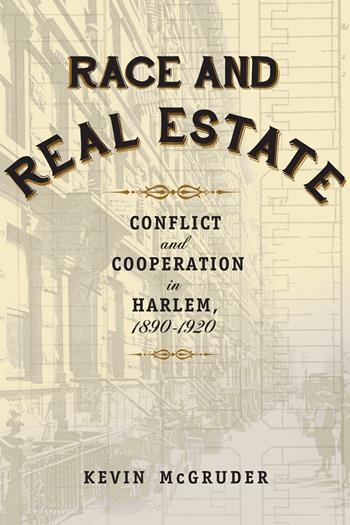
McGruder, "Race and Real Estate: Conflict and Cooperation in Harlem, 1890-1920"

New from Columbia University Press: Race and Real Estate: Conflict and Cooperation in Harlem, 1890-1920 (June 2015), by Kevin McGruder (Antioch College). The Press explains:
Through the lens of real estate transactions from 1890 to 1920, Kevin McGruder offers an innovative perspective on Harlem's history and reveals the complex interactions between whites and African Americans at a critical time of migration and development. During these decades Harlem saw a dramatic increase in its African American population, and although most histories speak only of the white residents who met these newcomers with hostility, this book uncovers a range of reactions.
Although some white Harlem residents used racially restrictive real estate practices to inhibit the influx of African Americans into the neighborhood, others believed African Americans had a right to settle in a place they could afford and helped facilitate sales. These years saw Harlem change not into a "ghetto," as many histories portray, but into a community that became a symbol of the possibilities and challenges black populations faced across the nation.
This book also introduces alternative reasons behind African Americans' migration to Harlem, showing that they came not to escape poverty but to establish a lasting community. Owning real estate was an essential part of this plan, along with building churches, erecting youth-serving facilities, and gaining power in public office. In providing a fuller, more nuanced history of Harlem, McGruder adds greater depth in understanding its development and identity as both an African American and a biracial community.
A blurb of note:
"Kevin McGruder's meticulous study shows us exactly how black migrants to Harlem between 1890 and 1920 created a community. His analysis of the role of black real estate agents and black churches in 'opening' Harlem to black residents is fascinating, and his attention to the ways that ethnicity structured white responses to the movement of blacks to white neighborhoods is nuanced and insightful." — Beryl Satter, Rutgers University
More information, including the TOC and an excerpt, is available here.

Friday, July 31, 2015

Oliveri, "Setting the Stage for Ferguson: Housing Discrimination and Segregation in St. Louis"

Rigel Christine Oliveri (University of Missouri School of Law) has posted "Setting the Stage for Ferguson: Housing Discrimination and Segregation in St. Louis," which is forthcoming in the Missouri Law Review. Here's the abstract:
The events of fall 2014 in Ferguson, MO (the shooting death of Michael Brown by a white police officer and the subsequent protests and riots), have been examined from many angles – the policing of minority communities, the militarized police response to peaceful protests, the poor schools and job prospects for young people like Mr. Brown, etc… This paper adds another factor to the analysis: housing discrimination.

St. Louis is one of the most segregated places in the country and this is not an accident. The history of St. Louis is replete with discriminatory housing laws, policies, and practices. While these were common throughout the United States, they were particularly egregious, widespread, and pervasive in industrial mid-western cities like St. Louis. St. Louis, in fact, was where three of fair housing law’s most foundational fair housing cases emerged from: Shelly v. Kraemer, which held that racially restrictive covenants could not be enforced by courts; Jones v. Mayer, which held that private acts of race discrimination in housing were prohibited by the Civil Rights Act; and United States v. City of Black Jack, which recognized the use of disparate impact theory in fair housing cases. When we look closely at these cases – not just the legal principles that they established but the physical, racial geography of the homes, neighborhoods, and cities that were contested – we can see how they reflected the racist forces that shaped the reality of modern metropolitan St. Louis.

This paper traces the history of housing discrimination in the St. Louis metro area using these cases as a framework, concluding with a discussion of how these historical forces resonate in contemporary Ferguson. The paper concludes with suggestions for reforms that might help undo what a century’s worth of officially sanctioned discrimination and segregation have wrought.
Hat tip: Poverty Law

Monday, May 11, 2015

Banks v. Housing Authority and a Multi-Racial Approach to the Equal Protection Clause, Part 1

The Ping Yuen Public Housing Project in 1956
(San Francisco Public Library, Historical Photo Collection)
While researching Forging Rivals, I came across a number of great stories that didn't make it into the book. One of my favorites concerned the 1953 California appellate court case, Banks v. Housing Authority and the relationship between African American civil rights organizations and San Francisco’s Chinese American community. Everyone who has advised me about writing a blog has told me to keep each entry short, so, because this is a complicated story, I’ll tell it over two separate posts.

Chinese Americans faced appalling discrimination in San Francisco prior to World War II. Hemmed into Chinatown’s crowded, substandard housing, San Francisco’s Chinese population faced discrimination in employment, housing, and public accommodations, hostility from police and public health officials, and violence from bigoted demagogues who stoked white working class fears about competition for jobs. While San Francisco’s tiny African American community (less than 5000 people prior to the War) faced discrimination, it was not subject to the extreme race hatred and bigotry that marked relations between the white and Asian communities.

The 1940s saw a dramatic shift in this racial dynamic. Both the image and the fortunes of the Chinese American community changed as the decade progressed. White Americans came to view the community differently. The Chinese had been loyal allies during the War – heroic resisters of Japanese aggression. After the War, most of those living in the United States were staunch supporters of the Kuomintang and thus stood at the forefront of the anti-communist struggle against “Red” China. This status as war heroes and cold warriors led to a dramatic decline in anti-Chinese sentiment. It also resulted in tangible benefits for the Chinese American community, such as a loosening of restrictions on immigration, political appointments for Chinese Americans, and the provision of government benefits targeted specifically at their communities. In San Francisco, it meant access to local political power, including patronage positions in local government, and the building of the Ping Yuen public housing project in Chinatown. At the same time, African Americans’ position in the racial hierarchy shifted. As African Americans streamed into the city in increasing numbers, hostility towards them grew. Discrimination in employment increased, as did housing and educational segregation, and police hostility. As historian Scott Tang has elegantly written, in postwar California, African Americans replaced Chinese Americans as the “new objects of racial scorn.”

This shifting racial dynamic was played out in a fascinating manner in the litigation that the NAACP brought to desegregate San Francisco’s public housing, a case known as Banks v. Housing Authority. Prior to 1950, the San Francisco Housing Authority segregated its public housing by race. Whites lived in projects in white neighborhoods and African Americans lived in a single project in the Western Addition. Immediately after World War II, the Housing Authority built two more housing projects, North Beach Place in the predominantly Italian North Beach neighborhood and the Ping Yuen apartments in Chinatown. According to the Housing Authority’s “neighborhood pattern” policy, only Italian Americans would be allowed to live in North Beach Place and only Chinese Americans would be admitted to Ping Yuen. Every racial and ethnic group in the city would be given a number of public housing slots proportional to the need for public housing in their community. Thus, the distribution of public housing would be equal among the different communities, but it would be separate.

Prior to the World War II, San Francisco’s African American community didn’t object to this approach. Indeed, at that time, the city’s African American elites didn’t demand that the Housing Authority integrate its properties. They simply asked that it build them “their own” public housing in the Western Addition. Thus, when the Westside Courts opened in 1943, the African American community considered it to be a political victory. By the late 1940s, however, civil rights groups had turned decisively against the “separate but equal” premise of the demand to build Westside Courts. Consequently, in 1951, the NAACP sued the Housing Authority, asserting that the neighborhood pattern policy violated the Equal Protection Clause of the Fourteenth Amendment.

For the details of the lawsuit and its controversial aftermath, stay tuned. They will be the subject of my next post.

Saturday, January 31, 2015

Weekend Roundup

  • From the Consumer Law & Policy Blog: historical perspectives on the Supreme Court's current Fair Housing Act case (here and here). (Hat tip: Torts Today)
  • From Inside Higher Ed: A law school vice dean tells students that the historical record could do without the gender biased comments they have been leaving in female professors' teaching evaluations ("If you have any doubts that posterity will somehow muddle through without the benefit of your fashion advice, allow me to dispel them once and for all”). 
  • The Georgetown Journal of Law & Modern Critical Race Perspectives is hosting the conference The Moynihan Report: 50 Years Later, Thursday, February 5, 2015, 10AM to 4PM, Gewirz Student Center, 12th Floor, Georgetown University Law Center.  Speakers include my GULC colleagues Paul Butler, Anthony Cook and Gary Peller, as well as Donald Tibbs, Drexel University, and Justin Hansford, St. Louis University.  DRE
Weekend Roundup is a weekly feature compiled by all the Legal History bloggers.

Thursday, May 8, 2014

Graduate Student Fellows in Democracy & Markets at the Tobin Project

Continuing our notices of graduate fellowships, here’s a post on 2014 Graduate Student Fellows in Democracy & Markets at the Tobin Project.  As the Project's website explains, “The Tobin Project awards fellowships annually to graduate students across disciplines and institutions whose research addresses the relationship between democracy and markets. In monthly forums throughout the academic year, the students present and discuss their work with one another for uniquely interdisciplinary feedback.”  The fellows include three historians, all studying at Yale:

Mara Caden, Making Money: Labor, Coinage, and the Geography of Currency in Britain and its Empire, 1690-1740

Zane Curtis-Olsen, Reclaiming the "City of Homes": Squatting and Housing Protest in Philadelphia, 1964-1996

Samuel Milner, Guideposts to Where? The Industrial Response to the Johnson Administration's Price and Wage Policies

No historians were among Tobin’s 2014 Graduate Student Fellows in National Security.

Friday, May 2, 2014

New Release: Gold, "When Tenants Claimed the City"

New from the University of Illinois Press: When Tenants Claimed the City: The Struggle for Citizenship in New York City Housing (April 2014) by Roberta Gold (Fordham University). A description from the Press:
In postwar America, not everyone wanted to move out of the city and into the suburbs. For decades before World War II, New York's tenants had organized to secure renters' rights. After the war, tenant activists raised the stakes by challenging the newly-dominant ideal of homeownership in racially segregated suburbs. They insisted that renters as well as owners had rights to stable, well-maintained homes, and they proposed that racially diverse urban communities held a right to remain in place--a right that outweighed owners' rights to raise rents, redevelop properties, or exclude tenants of color. Further, the activists asserted that women could participate fully in the political arenas where these matters were decided.
Grounded in archival research and oral history, When Tenants Claimed the City: The Struggle for Citizenship in New York City Housing shows that New York City's tenant movement made a significant claim to citizenship rights that came to accrue, both ideologically and legally, to homeownership in postwar America. Roberta Gold emphasizes the centrality of housing to the racial and class reorganization of the city after the war, the prominent role of women within the tenant movement, and their fostering of a concept of "community rights" grounded in their experience of living together in heterogeneous urban neighborhoods.
A blurb:
"Is the purchase of a single-family house in the suburbs really the only route to housing happiness? With vigorous, readable prose Roberta Gold uncovers the history of an alternative vision. In New York City, leftist men and women agitated for the rights of renters to build interracial, affordable, locally-controlled communities of apartment dwellers. As Americans contemplate the lessons of the last decade's foreclosure crisis, they would do well to consider the possibilities illuminated in When Tenants Claimed the City." --Amanda Seligman
More information is available here.

Thursday, April 10, 2014

Perry, Vogel, Barnes, and More Reviewed in the Law & Politics Book Review

The Law & Politics Book Review is out with a new batch of reviews. Items of interest include:

  • Mark Rush (Washington and Lee University) reviews Michael J. Perry, HUMAN RIGHTS IN THE CONSTITUTIONAL LAW OF THE UNITED STATES (Cambridge University Press, 2013).
  • Herschel Nachlis (Department of Politics, Princeton University) reviews David Vogel, THE POLITICS OF PRECAUTION: REGULATING HEALTH, SAFETY, AND ENVIRONMENTAL RISKS IN EUROPE AND THE UNITED STATES (Princeton University Press, 2012).
  • Jeb Barnes (Department of Political Science, University of Southern California) reviews Andrea Boggio, COMPENSATING ASBESTOS VICTIMS: LAW AND THE DARK SIDE OF INDUSTRIALIZATION (Ashgate, 2013).
  • Samuel B. Hoff (Department of History, Political Science, and Philosophy, Delaware State University) reviews Douglas S. Massey, et al., CLIMBING MOUNT LAUREL: THE STRUGGLE FOR AFFORDABLE HOUSING AND SOCIAL MOBILITY IN AN AMERICAN SUBURB (Princeton University Press, 2013).
  • Mariah Zeisberg (University of Michigan) reviews Graham Dodds, TAKE UP YOUR PEN: UNILATERAL PRESIDENTIAL DIRECTIVES IN AMERICAN POLITICS (University of Pennsylvania Press, 2013).

Sunday, December 29, 2013

Sunday Book Roundup

The web is light on book reviews this weekend, but here's a few that readers might find interesting. And, the Best Books of 2013 post has been updated one last time.

The Wall Street Journal reviews The Great Rent Wars: New York 1917-1929 (Yale) by Robert M. Fogelson. 

In the New York Times there's a review of Michael Burleigh's Small Wars, Faraway Places: Global Insurrection and the Making of the Modern World 1945-1965 (Viking). Reviewer Daniel Larison writes:
"In “Small Wars, Faraway Places,” Michael Burleigh recounts the violent end of the British and French empires in Africa and Asia, and their partial replacement by the United States in its often ill-informed and costly efforts to combat Communism during the early stages of the Cold War. Burleigh surveys many of the major international wars and anticolonial insurgencies between 1945 and 1965, but opts to focus most on those involving America, Britain and France, and how they related to the rivalry with the Soviet Union. The result is a well-researched and readable account of two tumultuous decades. Burleigh judges most of these wars, both small and large, to have been futile and destructive. But while he clearly has no interest in defending or rehabilitating such conflicts, he nonetheless offers a fair, thoughtful assessment of the motives and interests behind them. He also takes care to understand and explain the grievances of the insurgents." 
And in the Washington Post, Lincoln in the World: The Making of a Statesman and the Dawn of American Power (Crown) by Kevin Peraino is reviewed.
"Peraino similarly casts a revealing and fresh light on the complex diplomacy in the fall of 1862 aimed at averting British recognition of the Confederacy or a European intervention to halt the fighting. It has often been asserted that the Union victory at Antietam in September of that year, and the issuance of the Emancipation Proclamation that swiftly followed, effectively put an end to the threat of British interference, both by transforming the North’s war into a moral crusade and by establishing the inevitability of Union victory. But in fact, Peraino recounts, the ambiguous Union victory at Antietam actually increased (albeit briefly) the inclination of Lord Palmerston, the British prime minister, to press for an armistice; and as for the Emancipation Proclamation, Palmerston initially dismissed it as “trash.”"