Showing posts with label crime and violence. Show all posts

Tuesday, March 24, 2026

Newman's "Law and Justice in Song"

Daniel NewmanCardiff University, has published Law and Justice in Song Murder Ballads and Popular Music (Routledge):

This book examines the murder ballad form, songs about death and killing, from a legal history perspective. It is held that taking on the long history of the murder ballad is a way that we can understand how death and killing in song has a function in dealing with the world around us. The book integrates law and humanities scholarship with diverse musical case studies to construct a typology of murder ballads and thus conceptualise the central messages of how murder ballads have treated death and killing. Drawing on a cultural form in which assessment and consideration of death and killing are so vigorously and richly enacted gives lawyers a guide to how those who do not see these matters through a primarily legal lens might understand this part of their world. The study will be of interest to academics and researchers working in the areas of Criminal Law, Legal History, Socio-Legal Studies, Criminology, and Musicology.

Professor Newman discuisses his book on JLS Blog

--Dan Ernst

Wednesday, July 10, 2024

The History Behind Rahimi

[We have the following announcement from the National Association of Women Lawyers of the first of a two-part series of podcasts, The History Behind U.S. v. Rahimi.  DRE.]

Join NAWL Advocacy Committee Members, Siobhan Barco, Princeton PhD Candidate, and Nicolette Sullivan, Milbank LLP Associate, as they interview a distinguished panel of historians and advocates for freedom from gender-based violence, including, Laura Edwards, Class of 1921 Bicentennial Professor in the History of American Law and Liberty in the History Department at Princeton University, Sara Mayeux, Associate Professor of Law and History at Vanderbilt University, and Margaret Drew, Associate Professor at UMass Law School. This episode kicks off a compelling two-part series exploring the historical context surrounding the Supreme Court case, U.S. v. Rahimi.

Please note that this episode was recorded before the Supreme Court decision was issued in this case. NAWL strongly supports the Supreme Court's decision in U.S. v. Rahimi, upholding federal restrictions preventing those under domestic violence restraining orders from possessing firearms. This ruling reaffirms critical protections against gun violence, particularly for individuals at heightened risk in domestic abuse situations. NAWL remains committed to advocating for policies against gender-based violence recognizing that gender equality cannot be achieved without freedom from gender-based violence.

Tuesday, October 31, 2023

CFP: New Approaches to Rape Studies in the Long Eighteenth Century

 [We have the following CFP.  H/t: H-Announce.  DRE]

New Approaches to Rape Studies in the Long Eighteenth Century


Co-Editors: Jolene Zigarovich (University of Northern Iowa, USA) & Doreen Thierauf (North Carolina Wesleyan University, USA)

Frances Ferguson’s foundational ‘Rape and the Rise of the Novel’ (1987) drew attention to the ‘perverse collusion between the structural passivity of the female body’ and legal as well as psychological obstacles in women’s capacity to consent. Toni Bowers powerfully asserts in Force or Fraud: British Seduction Stories and the Problem of Resistance, 1660-1760 (2011), ‘Eighteenth-century seduction stories … shed light on anxieties with “British” self-definition that remain pertinent in our own day’ and ‘reveal connections between resistance practices of many kinds’. Valuing these and other earlier debates, this special issue acknowledges that critical discourse has evolved in its priorities and politics.

To reflect new strategies of addressing rape, this special issue seeks to bring together writing by scholars of art, literature, history, feminist studies, and legal studies to engage current movements against sexual violence and assess how we approach gender-based violence in eighteenth-century literature and culture. Moving beyond the legal implications of Lord Chief Justice Matthew Hale’s claim that rape was a charge ‘easily to be made and hard to be proved’, a context detailed at length by Gregory Durston (JECS 2005;2006), we invite contributions that consider rape from feminist, anti-racist, and/or queer perspectives with the goal to foster solidarity and transform the analysis of sexual violence in eighteenth-century studies.

The wide circulation of the #MeToo movement in online spaces since 2017 has renewed scholarly interest in eighteenth-century sexual violence and leads us to call for revisions of older methodological approaches. We take our cue from Erin Spampinato who, writing in differences (2021), deprioritizes ‘adjudicative’ methods of approaching rape in literature—that is, scholars’ legalistic weighing of characters’ motivation and criminal conduct. Spampinato offers a ‘capacious’ conception of sexual violence enabling critics to register a greater number of acts as harmful and worthy of scholarly engagement. Supporting Spampinato’s wider definition of rape, the editors particularly welcome articles on gender-based violence in nonheterosexual, queer, colonial, and working-class contexts to destabilise traditional critical approaches that center literary and historical representations of middle-class heterosexual violence. Questions articles may address, but are not limited to, include: What are the historical continuities—and discontinuities–between eighteenth-century sexual violence and contemporary definitions of ‘rape culture’? What methodological strategies can bring sexual assault in historic depictions from the margins to the centre of critical attention? What kinds of scholarly futures can a focus on sexual violence, broadly conceived, unlock? How can twenty-first century lenses resituate and reconfigure former methodologies and offer responsible ways to analyse literary and historical representations of sexual violence?

Please send 300-word abstracts with working title for a 6,000-8,000 word article and CV by 1 March 2024 to Jolene Zigarovich (jolene.zigarovich@uni.edu) and Doreen Thierauf (dthierauf@ncwu.edu). Authors will be notified if their proposals have been accepted by 15 March 2024 and complete articles will be due by 1 November 2024. This special issue is being considered at The Journal for Eighteenth-Century Studies.

Contact Email: jolene.zigarovich@uni.edu

Tuesday, May 10, 2022

CFP: Feminists Confront State Violence

[We have the following CFP.]

Feminists Confront State Violence

Issue number 148 (January 2024).  Abstract Deadline: June 1, 2022.  Co-Edited by Anne Gray Fischer, Sara Matthiesen, and Marisol LeBrón.  Contact: contactrhr@gmail.com

Radical History Review
seeks proposals for feminist analyses that explore how communities have conceptualized, negotiated, and challenged structures of state violence. Historically, people on the front lines of a range of historical and contemporary struggles have exposed how state violence operates in the lives of women and vulnerable populations through forms of active harm as well as organized abandonment. Spectacular forms of state violence, such as religious persecution, enslavement, colonial dispossession, genocide, sterilization, policing, and human caging coexist alongside formal and informal practices of state neglect that harm and kill by refusing to cultivate healthy, safe, and dignified lives for all. In the face of the violence of the (pre)modern state, many people have developed strategies of survival, care, and reproduction that aim to reduce harm such as mutual aid projects, intentional communes, and worker collectives. These efforts can, however, be quickly overwhelmed by the enormous scope of need created by state neglect. Ironically, modern-day global emergencies—from femicide in Latin America and medical apartheid in the Global South to the climate catastrophe worldwide—expose the unique capacity of the state to respond on a massive scale to its own harms and failures. Feminist scholars, then, have identified a formidable contradiction: how to make demands for the equitable distribution of care, safety, and life on a (pre)modern state that unequally distributes violence, immiseration, and death? We invite feminist contributions that examine how communities have historically negotiated the difficult contradiction of making reparative demands on a violent state. In particular, we are interested in pieces that draw from surprising examples and unexpected archives in order to show efforts to deliver care, organize practices of survival, and foster societal transformation while laboring under conditions of structural violence; and to ask what alternative visions of social organization such struggles have produced. This issue aims to create a feminist archive of campaigns, tactics, frameworks, and circumstances that illuminate how people have named, analyzed, and struggled against the multiscalar and capacious nature of regimes of violence across all time periods, geographic contexts, and conceptions of governance. Some topics may include, but are not limited to:

    The interrelationship between state abandonment and state violence
    Crime, punishment, anti-carceral projects, and abolitionism
    Indigenous, decolonial, and anti-colonial projects
    Natural disaster, famine, and environmental crisis
    Gender-based and transphobic violence, serial murders, and femicide
    Migration and contests over borders
    Riot, rebellion, revolution, and war
    Struggles between capital and labor, especially around reproductive labor
    Electoral politics, suffrage, and disenfranchisement

The RHR publishes material in a variety of forms. We welcome submissions that use images as well as text. In addition to conventional research articles, we encourage submissions to our various departments, including Historians at Work; Teaching Radical History; Public History; Interviews; (Re)Views and The Abusable Past. We encourage contributions from historically under-represented groups. Procedures for submission of articles: By June 1, 2022, please submit a one-page abstract summarizing the article as an attachment to contactrhr@gmail.com with “Issue 148 Abstract Submission” in the subject line. By July 15, 2022, authors will be notified whether they should submit a full version of their article for peer review. The due date for full-length article submissions will be in November 2022. Please send any images as low-resolution digital files embedded in a Word document along with the text. If chosen for publication, you will need to supply high-resolution image files (at a minimum of 300 dpi) and secure permission to reprint the images. Those articles selected for publication after the peer review process will be included in issue 148 of the Radical History Review, scheduled to appear in January 2024.

Thursday, May 27, 2021

McQuade on terrorism and colonial law

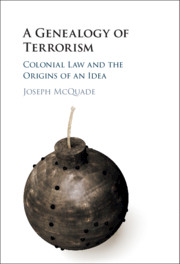
 Joseph McQuade (University of Toronto) published A Genealogy of Terrorism: Colonial Law and the Origins of an Idea with Cambridge University Press in 2020. From the publisher: 

Using India as a case study, Joseph McQuade demonstrates how the modern concept of terrorism was shaped by colonial emergency laws dating back into the nineteenth and early twentieth centuries. Beginning with the 'thugs', 'pirates', and 'fanatics' of the nineteenth century, McQuade traces the emerging and novel legal category of 'the terrorist' in early twentieth-century colonial law, ending with an examination of the first international law to target global terrorism in the 1930s. Drawing on a wide range of archival research and a detailed empirical study of evolving emergency laws in British India, he argues that the idea of terrorism emerged as a deliberate strategy by officials seeking to depoliticize the actions of anti-colonial revolutionaries, and that many of the ideas embedded in this colonial legislation continue to shape contemporary understandings of terrorism today.

Praise for the book:

"A brilliant deconstruction of the colonial prose of counter-terrorism and its post-colonial legacy, McQuade's book provides new insights into how legal states of exception were crafted to delegitimize revolutionary violence. A must read for anyone wishing to understand the true nature of British ‘rule of law' in India and its global ramifications." - Sugata Bose

"The declaration of a global war on terrorism in 2001 did not come out of the clear blue sky. Instead, as Joseph McQuade demonstrates in this brilliantly conceived and researched genealogy, some of its most forgotten roots lie in Britain's colonial administration in India and its diplomatic efforts on the world stage. An essential contribution to imperial and international legal history." - Samuel Moyn

Further information is available here.

--Mitra Sharafi

Tuesday, February 9, 2021

Cheney on law and environmental change in Qing China

 Wesley Cheney (Bates College) has published "Threats to Gong: Environmental Change and Social Transformation in Northwest China" in Late Imperial China 41:2 (Dec.2020), 45-94. Here is the abstract: 

This article examines legal cases centering on the management of communal resources along the Tao River watershed during the Qing dynasty. Local commons, or gong holdings, had lasted for generations, but frayed when faced with subsistence pressures, demographic changes, and market penetration. Lineages could not maintain pastures if members’ own shrinking holdings made it difficult to put food on the table. Villages could not enforce regulations if outsiders were not bound by communal norms. And groups could not set aside forests if commercialization displaced local cultural values for prices, communally-held woodlands for units of timber. Focusing on village-level practices, this article argues that gong regimes were, above all, a matter of social relationships. Beginning in the eighteenth century, these relationships became strained as material conflicts were inflected by increasingly violent articulations of intercommunal, and often ethnic, difference. Behind the ethnicized brutality of the 1860s lay these long-term conflicts between different modes of production.

Prof. Cheney was a Hurst Institute fellow in 2017. Further information is available here

--Mitra Sharafi