Showing posts with label Islam. Show all posts

Friday, December 12, 2025

ASLH Burbank Article Prize to Fei

Continuing with our notices of the awards, prizes, and fellowships announced at the recent meeting of the American Society for Legal History, we turn now to the Jane Burbank Global Legal History Article Prize. About this prize

The Jane Burbank Article Prize in global legal history will be awarded annually to the best article in regional, global, imperial, comparative, or transnational legal history published in the previous calendar year. Submissions may address any topic or period, and may focus on case studies in which the analysis relates to broader processes or comparisons. Articles on methodological or theoretical contributions are also welcome.

The 2025 Burbank Prize winner was Du Fei (University of Oklahoma), for “Fatima’s Inheritance: Law, Islam, and Gendered Archive-Making in India’s Early Modern Global Connections,” Past and Present 266:1 (2025): 40-74. The citation:

In this piece, Du uses a source long familiar to South Asianists—a collection of letters and documents which includes a short account of a court case between a free Muslim woman and enslaved people she owned, conducted in multiple legal fora across the Indian Ocean—to ask new questions. Du considers the case at three levels: the case summary itself and its process, in a pluralistic legal world where “Islamic law” was central but not hegemonic or monolithic; the way it came to be included in a South Asian manual of different prose genres that usually focused on male actors; and the way that manual itself became an iconic source for western orientalists with their own ideas about gender and Islam. In doing so, he draws on scholarship from multiple fields to show how women in the Indian Ocean world helped “co-produce” legal and archival records, only for their presence to be silenced through the layers of recension that create primary sources in the form they come down to us. Du’s excavation of Fatima’s case can serve as a model for legal historians of any era or region in teasing apart the different gendered actors and social meanings that construct the records we use.

An Honorable Mention went to Rui Hua (Boston University), for “The Cheese, the Worm, and the Law: Grassroots Legal Cosmopolitanism in the Manchurian Borderland, 1906-1927,” Modern Asian Studies 58:4 (2024): 1201-1221.

Congratulations!

-- Karen Tani 


Thursday, October 9, 2025

Siddiqui's "Islamic Law on Trial"

Sohaira Siddiqui, Georgetown University, has published Islamic Law on Trial: Contesting Colonial Power in British India (University of California Press, 2025):

Prior to the East India Company’s establishment in India in 1661, Islamic law was widely applied by the Mughal Empire. But as the Company’s power grew, it established a court system intended to limit Islamic law. Following the Great Rebellion of 1857, the decentralized Islamic legal system was replaced with a new standardized system. Islamic Law on Trial interrogates the project of juridical colonization and demonstrates that alongside—and despite—the violent displacement of Muslim legal sovereignty, Muslims were able to engage with and even champion Islamic law from inside the colonial judiciary. The outcome of their work was a paradoxical legal terrain that appeared legitimate to both Muslim practitioners and English colonizers. Sohaira Siddiqui challenges long-standing assumptions about Islamic law under British rule, the ways in which colonial power displaced preexisting traditions, and how local Muslim elites navigated the new institutions imposed upon them.

Georgetown University Qatar's notice of the book is here

 --Dan Ernst

Monday, November 12, 2018

O'Donnell's "Basic Bibliography" of Islam & Jurisprudence

Patrick S. O’Donnell, bibliographer extraordinaire, has posted Islam & Jurisprudence (or, ‘Islamic Law’): A Basic Bibliography.  As he explains over on Ratio Juris:
I have completed my latest bibliography, on Islam and Jurisprudence, available here. The introduction:

This compilation, like most of my bibliographies, has two constraints: books, in English. I trust the inference will not be made that this implies the best works are only in English, as it merely reflects the limits of my knowledge and research. “Jurisprudence” in this case can refer to Islamic philosophy and/or theory of law, as well as historical and existing legal systems in those countries in which Islam is (i) a state-sanctioned religion, (ii) predominant as a religious orientation in the society, (iii) or has a significant impact on the country’s legal system in one way or another. I have used the phrase “Islam and Jurisprudence” for the title to reflect the fact that it is a perilous endeavor to conclusively identify, except perhaps philosophically or theologically (and even then, there are inherent problems), Islamic law as such (i.e., in any kind of absolutist or ‘pure’ sense) in legal systems on the ground, as we say, even if we rightly derive warrant for this appellation from both emic and etic reasons. This list does not aspire to be exhaustive, although I hope it is at least representative of the depth and breadth of the available literature. I welcome suggestions for titles I may have inadvertently missed.

Tuesday, March 6, 2018

LHR 36:1

Law and History Review 36:1 (February 2018)  is now available on Cambridge Core.

In This Issue
Gautham Rao

Affective Debts: Manumission by Grace and the Making of Gradual Emancipation Laws in Cuba, 1817–68
Adriana Chira

Russian Capitalism on Trial: The Case of the Jacks of Hearts
Sergei Antonov

Law, Custom, and Social Norms: Civil Adjudications in Qing and Republican China
Xiaoqun Xu

Beneath Sovereignty: Extraterritoriality and Imperial Internationalism in Nineteenth-Century Egypt
David Todd

“On the other hand the accused is a woman…”: Women and the Death Penalty in Post-Independence Ireland
Lynsey Black

New Takes on Jim Crow: A Review of Recent Scholarship
Anders Walker

Book Reviews
Steve Pincus , The Heart of the Declaration: The Founders’ Case for an Activist Government, New Haven, London: Yale University Press, 2016.  Reviewed by Claire Priest

Wendell Bird , Press and Speech under Assault: The Early Supreme Court Justices, the Sedition Act of 1798, and the Campaign Against Dissent, New York: Oxford University Press, 2016. Reviewed by Britt P. Tevis

Alfred L. Brophy , University, Court, and Slave: Pro-Slavery Thought in Southern Colleges and Courts and the Coming of the Civil War, New York: Oxford University Press, 2016. Reviewed byJohn W. Wertheimer

James T. Kloppenberg , Toward Democracy: The Struggle for Self-Rule in European and American Thought, New York: Oxford University Press, 2016. Reviewed by R. B. Bernstein

Nicholas L. Syrett , American Child Bride. A History of Minors and Marriage in the United States, Chapel Hill: The University of North Carolina Press, 2016. Reviewed by Geraldine Gudefin

A. Naomi Paik , Rightlessness: Testimony and Legal Redress in U.S. Prison Camps since World War II, Chapel Hill: University of North Carolina Press, 2016. Reviewed by Torrie Hester

Jefferson Decker , The Other Rights Revolution: Conservative Lawyers and the Remaking of American Government, New York: Oxford University Press, 2016. Reviewed by Ann Southworth

Tuesday, February 13, 2018

Kimmel on conversion in early modern Spain

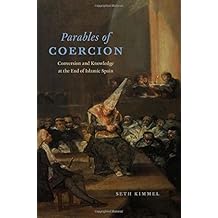
Out with the University of Chicago Press' Law and Society series, we missed this one when it appeared in 2015. Seth Kimmel (Columbia University) has published Parables of Coercion: Conversion and Knowledge at the end of Islamic SpainThe book was awarded the American Comparative Literature Association's Harry Levin Award in 2017. From the press:
Parables of Coercion: Conversion and Knowledge at the End of Islamic Spain
In the sixteenth and seventeenth centuries, competing scholarly communities sought to define a Spain that was, at least officially, entirely Christian, even if many suspected that newer converts from Islam and Judaism were Christian in name only. Unlike previous books on conversion in early modern Spain, however, Parables of Coercion focuses not on the experience of the converts themselves, but rather on how questions surrounding conversion drove religious reform and scholarly innovation.
In its careful examination of how Spanish authors transformed the history of scholarship through debate about forced religious conversion, Parables of Coercion makes us rethink what we mean by tolerance and intolerance, and shows that debates about forced conversion and assimilation were also disputes over the methods and practices that demarcated one scholarly discipline from another.
 Praise for the book:

"In Parables of Coercion Kimmel succeeds wonderfully in excavating the intersection of early modern Spanish socioreligious and intellectual history and in deciphering its various discourses....Kimmel further uncovers the dialectical relationship between socioreligious discord and innovative cultural production by religious intellectuals in seventeenth-century Spain, and in the process he manages brilliantly to render meaningless the conventional, simplistic characterization of early modern Spain as a purely intolerant society. It was far more complicated during the sixteenth century afterlife of Islamic Spain than historiographical orthodoxy suggests." -Modern Philology

"Ranging across canon law, sacred philology, and history in sixteenth- and early seventeenth-century Spain, Seth Kimmel aims to demonstrate how the phenomenon of Muslim converts to Christianity was entertained by experts in those disciplines, as well as the ways in which the Morisco question affected the disciplines themselves." -Renaissance Quarterly

"Kimmel has written a fascinating study of the learned cultures built out of a century of Spanish Christian intolerance toward Islam, beginning with the coerced conversion of Spain's Muslims to Christianity in the early sixteenth century, to the expulsion of the Moriscos (as the converts and their descendants were called) in the early seventeenth. He shows us how the evolving  'Morisco question' animated the emergence of disciplines such as philology, history, theology, political theory, and economics. In the process, he provides us with an alternate and disquieting history of our own scholarly, political, and religious practices." -David Nirenberg

Further information is available here.