Showing posts with label Spain. Show all posts

Monday, November 4, 2024

McKinley on Self-Purchase in 17th-C Andalucia

Michelle A. McKinley, University of Oregon, has published  Financing Freedom: Self-Purchase and Reenslavement in Seventeenth-Century Andalucía in the William and Mary Quarterly, 3d ser., 81, no. 4 (October 2024): 651–86

This article explores cases in which slaveholders, enslaved and freed people, and courts battled over the customary interpretation of the rights of wage-earning slaves in seventeenth-century Andalucía. Throughout the Spanish Empire, enslaved people could purchase their freedom through the processes of cortación (later known as coartación) and ransom (rescate). People paid their purchase price in installments and eventually received freedom papers, which were notarized agreements that reflected the terms of both parties upon receipt of payment. However, freedom papers do not reveal what happened when contracting parties experienced changed circumstances, and many of the particularities of waged enslavement on the Iberian Peninsula and in the Spanish Empire have remained obscure to scholars. Wage-earning slaves inhabited an ambiguous legal space of conditional liberty with rights determined by custom or social practice rather than legislation. Legal cases can shed new light on how the conditions of waged enslavement and conditional liberty were understood and contested in historical moments of economic crisis in seventeenth-century Andalucía. By focusing on stressful moments of property confiscation and currency devaluation, we can see the meanings ascribed to conditional liberty and the attendant legal rights that people who inhabited this conditional status wielded or struggled to enforce in the absence of legislation or codified doctrine.

--Dan Ernst

Friday, July 5, 2024

Residencies in Regimes of Normativity at Max Planck

[We are in receipt of a special edition of the newsletter of the Department of “Historical Regimes of Normativity” of the Max Planck Institute for Legal History and Legal Theory consisting of a call for scholarships and guest residencies for 2025/26.  DRE]

We are looking for outstanding PhD students, post-doctoral or senior researchers who are passionate about legal history and would like to join our department for three or six months.

What Are We Looking for?  Your project should relate to our department’s research agenda. We are especially interested in legal historical studies on:

  • Key concepts of the School of Salamanca;
  • Production of Knowledge of Normativity in the Iberian Worlds;
  • The Papacy (and the Roman Curia) in the early modern and contemporary period.

When Can You Come? Start your research stay on 1 April 2025, 1 July 2025, 1 October 2025, or 5 January 2026.

When is the Deadline? Submit your application by 30 August 2024 via our online application system. We will let you know our decision in October.

What Do You Need to Apply? (1) Research Proposal: Up to 2,500 words explaining how your project fits with our research; (2) References: Contact details of two scholars who can provide references (if needed); and (3) Publications: PDFs of three relevant publications from the last five years.

Please note: Once you get the scholarship, you cannot change the start date or the month.

More information here.

Thursday, October 5, 2023

Deardorff's "Tale of Two Granadas"

Max Deardorff, University of Florida, has published A Tale of Two Granadas: Custom, Community, and Citizenship in the Spanish Empire, 1568–1668 (Cambridge University Press, 2023):

This book offers a wide-ranging analysis of transforming conceptions of citizenship in the Spanish monarchy as it became a global empire. Side-by-side case studies of old Granada (southern Spain, core settlement of Spain's last independent Islamic polity) and colonial New Kingdom of Granada (modern Colombia) show that Spanish ecclesiastics' involvement in the Council of Trent (1545-1563) went hand-in-hand with the monarchy's thinking about the structure and cohesion of its empire. With fine-grained archival work, the book shows how two subject communities -- Andalusi "moriscos" of old Granada and indigenous Muiscas of the New Kingdom of Granada -- weathered a century of political and social change that followed. At stake were the question of the terms of colonial indigenous integration into the monarchy’s social structures and the looming threat of disenfranchisement faced by Granada’s “moriscos.” A Tale of Two Granadas makes the case that even more than 1492, the year that completely reshaped the monarchy was 1568. That year was both the beginning of the famed Rebellion of the Alpujarras in southern Spain, and the year when the famous Junta Magna met in  Madrid to lay out grand new plans for the administration of the monarchy's colonies overseas.
Here is an endorsement:
‘In this lucidly written book, Max Deardorff explores what citizenship meant for those social actors in the early modern Spanish territories who faced degrees of exclusion due to their ethnicity and proximity to orthodox Christianity. Meticulously researched and engagingly written, Deardorff brings together the Iberian Atlantic by looking at lesser-studied regions and the people inhabiting their margins, and also, at the Spanish powerholders who moved across the two jurisdictions.’

Joanne Rappaport - Georgetown University
--Dan Ernst

Wednesday, June 21, 2023

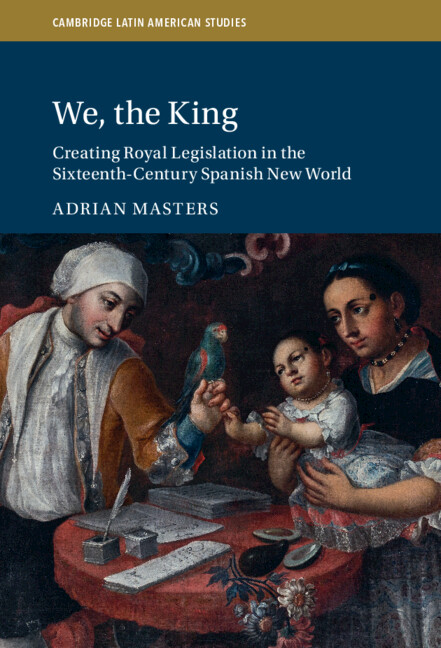
Masters, "We, the King: Creating Royal Legislation in the Sixteenth-Century Spanish New World"

Cambridge University Press has published We, the King: Creating Royal Legislation in the Sixteenth-Century Spanish New World (2023), by Adrian Masters (Universität Trier, Germany). A description from the Press:

We, the King challenges the dominant top-down interpretation of the Spanish Empire and its monarchs' decrees in the New World, revealing how ordinary subjects had much more say in government and law-making than previously acknowledged. During the viceregal period spanning the post-1492 conquest until 1598, the King signed more than 110,000 pages of decrees concerning state policies, minutiae, and everything in between. Through careful analysis of these decrees, Adrian Masters illustrates how law-making was aided and abetted by subjects from various backgrounds, including powerful court women, indigenous commoners, Afro-descendant raftsmen, secret saboteurs, pirates, sovereign Chiriguano Indians, and secretaries' wives. Subjects' innumerable petitions and labor prompted – and even phrased - a complex body of legislation and legal categories demonstrating the degree to which this empire was created from the “bottom up”. Innovative and unique, We, the King reimagines our understandings of kingship, imperial rule, colonialism, and the origins of racial categories.

A sample of praise from reviewers:

‘Meticulously researched and beautifully written, We, the King unveils the labyrinthine petitioning process involved in enacting thousands of legislative decrees and reveals how diligent vassals shaped colonial policies and categories of difference. It dismantles the standard view of the Spanish colonial state as the architect of legal rule that was all-seeing and all-pervasive. This outstanding work should be required reading for all colonial Latin Americanists.’ -- Nancy E. van Deusen

‘Adrian Masters has produced an ambitious study of early modern bureaucracy, law-making, and subaltern agency. Deeply researched and carefully written, We, the King is an indispensable resource for scholars of the Iberian empire.’ -- Michelle McKinley

More information is available here. An interview with Professor Masters is available here, at New Books Network.

-- Karen Tani

Saturday, August 28, 2021

Weekend Roundup

  • Above the Law's Kathryn Rubino interviews Patricia Cain about Paving the Way: The First American Women Law Professors and her career.
  • The University of Arkansas School of Law Alumni Society Board of Directors has awarded its 2021 Commitment to Justice award to the federal judge (and legal historian) Morris Arnold. (More.)
  • On September 16th from 3-4 p.m. EDT, the Library of Congress will present (via webinar) its annual Constitution Day Lecture. Kurt Lash (University of Richmond) will present “The Transformation of the Bill of Rights: Incorporation Doctrine and the Fourteenth Amendment.” More information here
  • The Balkinization symposium on James Pfander's Cases Without Controversies comes to a close, with several author responses (here's the first).
  • "Roosevelt Institute Morgenthau Scholar Dr. Abby Gondek talks to FDR Library Supervisory Archivist Kirsten Carter about how data visualizations from 3,000 letters from the public about the Emergency Refugee Center in Oswego, NY, reveal the US government’s response through the War Refugee Board to rescue refugees during the Holocaust."  (FDRLibrary YouTube)
  • ICYMI:  Lawrence B. Glickman on "Business as Usual: The Long History of Corporate Personhood" (Boston Review)Melvin I. Urofsky reviews Presumed Guilty: How the Supreme Court Empowered the Police and Subverted Civil Rights, by Erwin Chemerinsky (NYT).  Mary Ziegler on the Texas, the Supreme Court and Roe v. Wade (NYT).

 Weekend Roundup is a weekly feature compiled by all the Legal History bloggers.

Tuesday, November 19, 2019

Downs, "The Second American Revolution The Civil War-Era Struggle over Cuba and the Rebirth of the American Republic"

The University of North Carolina Press has published The Second American Revolution: The Civil War-Era Struggle over Cuba and the Rebirth of the American Republic (Nov. 2019), by Gregory P. Downs (University of California, Davis). A description from the Press:
Much of the confusion about a central event in United States history begins with the name: the Civil War. In reality, the Civil War was not merely civil--meaning national--and not merely a war, but instead an international conflict of ideas as well as armies. Its implications transformed the U.S. Constitution and reshaped a world order, as political and economic systems grounded in slavery and empire clashed with the democratic process of republican forms of government. And it spilled over national boundaries, tying the United States together with Cuba, Spain, Mexico, Britain, and France in a struggle over the future of slavery and of republics.
Here Gregory P. Downs argues that we can see the Civil War anew by understanding it as a revolution. More than a fight to preserve the Union and end slavery, the conflict refashioned a nation, in part by remaking its Constitution. More than a struggle of brother against brother, it entailed remaking an Atlantic world that centered in surprising ways on Cuba and Spain. Downs introduces a range of actors not often considered as central to the conflict but clearly engaged in broader questions and acts they regarded as revolutionary. This expansive canvas allows Downs to describe a broad and world-shaking war with implications far greater than often recognized.
Advance praise:
"A bold and refreshing interpretation of the Civil War that challenges scholars to bring the singular story out of its narrow, hyperspecialized confines of national history, reframing it into a watershed moment shaped by hemispheric and global forces that remade the nineteenth-century Atlantic world."--Matt D. Childs
"With beautiful, elegant prose, Downs takes the old topic of the revolutionary quality of the Civil War and moves it forward in unexpected and exciting ways by putting it in conversation with the revolutionary nature of the Atlantic in the same period. This is a truly pioneering and innovative book."--Michael Vorenberg
More information is available here.

-- Karen Tani

Friday, September 6, 2019

Essays on Fascist, Nazi and Authoritarian Criminal Law

Ideology and Criminal Law: Fascist, National Socialist and Authoritarian Regimes, edited by Stephen Skinner and published by Hart, is now available:
With populist, nationalist and repressive governments on the rise around the world, questioning the impact of politics on the nature and role of law and the state is a pressing concern. If we are to understand the effects of extreme ideologies on the state's legal dimensions and powers – especially the power to punish and to determine the boundaries of permissible conduct through criminal law – it is essential to consider the lessons of history. This timely collection explores how political ideas and beliefs influenced the nature, content and application of criminal law and justice under Fascism, National Socialism, and other authoritarian regimes in the twentieth century. Bringing together expert legal historians from four continents, the collection's 16 chapters examine aspects of criminal law and related jurisprudential and criminological questions in the context of Fascist Italy, Nazi Germany, Nazi-occupied Norway, apartheid South Africa, Francoist Spain, and the authoritarian regimes of Brazil, Romania and Japan. Based on original archival, doctrinal and theoretical research, the collection offers new critical perspectives on issues of systemic identity, self-perception and the foundational role of criminal law; processes of state repression and the activities of criminal courts and lawyers; and ideological aspects of, and tensions in, substantive criminal law.
–Dan Ernst

Friday, May 3, 2019

Burney, Hamlin and friends on Global Forensic Cultures

Out now with Johns Hopkins University Press is Global Forensic Cultures: Making Fact and Justice in the Modern Era, edited by Ian Burney, University of Manchester and Christopher Hamlin, University of Notre Dame. From the publisher: 

Contemporary forensic science has achieved unprecedented visibility as a compelling example of applied expertise. But the common public view—that we are living in an era of forensic deliverance, one exemplified by DNA typing—has masked the reality: that forensic science has always been unique, problematic, and contested. Global Forensic Cultures aims to rectify this problem by recognizing the universality of forensic questions and the variety of practices and institutions constructed to answer them.
Groundbreaking essays written by leaders in the field address the complex and contentious histories of forensic techniques. Contributors also examine the co-evolution of these techniques with the professions creating and using them, with the systems of governance and jurisprudence in which they are used, and with the socioeconomic, political, racial, and gendered settings of that use. Exploring the profound effect of "location" (temporal and spatial) on the production and enactment of forms of forensic knowledge during the century before CSI became a household acronym, the book explores numerous related topics, including the notion of burden of proof, changing roles of experts and witnesses, the development and dissemination of forensic techniques and skills, the financial and practical constraints facing investigators, and cultures of forensics and of criminality within and against which forensic practitioners operate.
Covering sites of modern and historic forensic innovation in the United States, Europe, and farther-flung imperial and global settings, these essays tell stories of blood, poison, corpses; tracking persons and attesting documents; truth-making, egregious racism, and sinister surveillance. Each chapter is a finely grained case study. Collectively, Global Forensic Cultures supplies a historical foundation for the critical appraisal of contemporary forensic institutions which has begun in the wake of DNA-based exonerations.
Table of Contents after the jump:

Sunday, January 27, 2019

On the Indigenous Experience in the Americas


One of the issues that habitually frustrates me is the disconnect between historians who work on the colonial period and those who specialize in the indigenous world. Theoretically, both engage with the same period and depend on similar or even (on occasions) identical sources, but their aims and their readings are often diverse, the bibliography they consult is habitually distinct, and they frequently belong to different fields and professional associations. The result is that they are seldom in conversation with one another. Having participated recently in a search for a historian of Indigenous North America made this clear to me, but so have many years working as a scholar of Spanish America.

How could one place colonial and indigenous history in dialogue? To answer this question, I authored two pieces. The first piece was concerned with Indigenous right to land, the other focused on campaigns to resettle natives in new, Spanish-style communities.[i]

Attempting to understand why some historians insisted on Spanish respect to native land rights (mostly historians of the Spanish colonial state) while others criticized Spain for the massive dispossession of natives (mainly historians interested in the native experience of empire), I observed how respect to native rights operated in the colonial period.  I argued that respect did not guarantee continuity. On the contrary, it (often) introduced change. This could happen because Spanish judges, although willing to recognize indigenous right to land, understood land rights not according to Indigenous law but according to European juridical traditions. These judges tied land rights to occupation and described occupation in ways that resonated with the European experience. The result was both the suppression of ancient rights as well as the invention of new entitlements. In other words, examination of how European norms were applied vis-à-vis natives enabled to affirm that respect to native rights and native dispossession could operate simultaneously.

With regards to native resettlement, historians of native Spanish America usually denounced resettlement campaigns as a colonial measure aimed at controlling, converting, and exploiting the native population. Yet, as a historian of Spain in both Europe and the Americas I knew that resettlement did not only target natives but also Spaniards and that it operated in both the Old and the New World. Justifying it were contemporary convictions that only people who resided in proper communities (and indigenous communities were not considered “proper”) could be tied to the polity religiously and civically. The question when resettlement was required, against whom, and for which end, thus demanded a larger and a longer vision. As happened in the case of native land rights, just looking at natives, just looking to the Americas, was insufficient.

These remarks are not meant to diminish the plight of native Americans. European colonialism turned the native world upside down. It was a human-made hurricane that touched and upset almost everything. But, regardless of how terrible it had been, if we wish to understand how it operated, we should not separate the study of the native world from the study of the colonial (and by extension European) world, with which it was closely entangled.


[i]  Tamar Herzog. “Colonial law and ‘Native Customs’: Indigenous Land Rights in Colonial Spanish America.” The Americas 63(3) (2013): 303-321 and Tamar Herzog. “Indigenous Reducciones and Spanish Resettlement: Placing Colonial and European History in Dialogue.” Ler História 72 (2018): 9-30 (an earlier version of this work was published under the title “Terres et déserts, société et sauvagerie. De la communauté en Amérique et en Castille à l’époque moderne.” Annales HSS 62 (3) (2007): 507-538)).

Sunday, January 20, 2019

Citizenship, Naturalization, and Belonging: Attempting a Comparative Legal Research


In 2003 I published a book on citizenship and belonging in Spain and Spanish America.[1]  Having surveyed hundreds of conflicts in which individuals requested rights (or were forced to comply with duties) either in local communities or in the kingdom, I discovered that both litigants and those who opposed them, both local and royal authorities, both jurists and laymen, referenced a similar set of criteria. According to it, status, rather than being automatically abstracted from birth or descent, hinged upon the ability to demonstrate attachment to the community. Attachment could be demonstrated in multiple ways: local residence, marriage to a local person, owning of real estate, or paying taxes. Although a legal presumption protected those born locally to locally born parents –in their case the presumption held that they loved the community and were loyal to it— if there was reason to believe the contrary, then despite local birth to locally born parents, these individuals would be considered foreign. The same was true of those born outside to foreign parents. In their case, the presumption held that they had no love to the community. But if they could demonstrate that they did (by referencing the indications enumerated above that demonstrated integration) then they would be recognized as members.

In both Spain and Spanish America, these categories operated vis-à-vis both the local community (constituting individuals as vecinos) and the kingdom community (recognizing them as naturales). Initially, each Spanish kingdom had its own community of natives, which was distinguished from others (there were natives of Castile, natives or Aragón, and so forth). However, by the late sixteenth century, the category “natives of the kingdoms of Spain” also made its appearance. First applied in the Americas, where only “natives of Spain” could theoretically reside and undertake commercial activities, by the early eighteenth century this category was also applied in the Iberian Peninsula. Thereafter, legally, at least, there was only one community of natives in Spain and it included all Spaniards.

My aim in pursuing these questions was to write a history that would observe NOT how states and kings defined members but how residents engaged in the elaboration of a legal distinction between natives and foreigners, Spaniards and aliens. Rather than discovering what the law meant, I was after the question how historical actors used the law and how this use influenced what they said and what they did. I also wanted to re-think debates regarding citizenship. These debates affirmed the importance of medieval urban citizenship to the formation of state centered citizenship, but normally failed to explain how these processes of borrowing and extension took place. Spain and Spanish America gave an interesting answer because they demonstrate that to determine who Spaniards were people asked about their urban membership. If the literature tended to affirm that there were no citizens in monarchical territories, my wish was to showcase their importance. Methodologically, I was interested in reconstructing the legalities of the past not by referencing abstract legal doctrines, jurisprudence, or legislation, but instead by analyzing the words and behavior of a multiplicity of actors. Undertaking a task similar to the one linguists perform when they analyze speech to reconstruct the rules that govern it, I wanted to understand how contemporaries conceived of membership. Why did they think they had rights? How did they explain their refusal to allow others to enjoy them?  I was also fascinated by the need to reconstruct rules by observing conflict. I asked: what do moments of disagreement tell us about consensus? How can we learn from them what happened when people agreed?  

In chapter 8 of that book I engaged with comparative research. I asked whether if we applied the same questions and methodology to England, France, and Italy, we would reveal similarities. Because I could not carry out the same detailed archival research in my comparative examples, I decided to focus instead on examining the secondary literature.

The historians whose work I read affirmed that membership in England, France, and Italy was radically different than what I have discovered in Spain and Spanish America. Yet, as I read through their scholarship I found plenty of indications that such might not have been the case. Municipal and kingdom communities also existed in England, France, and Italy and, in most of the cases I reviewed, membership in them implied the imposition of a certain regime of privileges and duties. In all these places, obtaining status as member was contingent on behavior, which could be formally recognized by the competent authorities or implicitly acquired through prescription. Behaviors recognized as meaningful were also extremely similar: permanent residence and tax payment ranked high but so did marriage to a local or the purchase of real estate. Local birth to locally born parents could be significant on occasions, but it was mostly treated as a legal presumption, not a condition sine-qua-non. Prima-facie, England did look somewhat different because of the tying of freedom to the exercise of certain professions. Yet, in the early modern period, freedom and Continental citizenship came to be closely associated, most clearly in the ruling of common law courts. Similarly, if subjecthood in England seemed divergent when observed through the famous Calvin Case, it stopped being thus if analyzed, for example, by studying how imperial subjects negotiated status as Englishmen.[2]

I thus concluded that similarities between the Spanish, Italian, French, and English experience might have been much greater than is currently accepted and that that there was, in fact, a common European framework that operated across the continent despite the existence of local variations. As a historian of Spain, I thus wondered: Can Spanish history be normalized rather than exoticized (as it usually is)? Can it be made central to narratives of European (and legal) formation? Can we converse across national historiographies to imagine a common European past or is this attempt doomed to fail? How to overcome a tendency to highlight particularities rather than to search for what we share?


[1] Tamar Herzog. Defining Nations: Immigrants and Citizens in Early Modern Spain and Spanish America. New Haven: Yale University Press, 2003; Vecinos y extranjeros. Hacerse español en la edad moderna. Madrid: Alianza Editorial, 2006; Nations, Citoyens, Immigrés dans L’Espagne et l’Amérique espagnole du XVIIIe siècle. Paris: Le Poisson Volant, 2017.
[2] On these issues, see the most recent Hannah Weiss Muller. Subjects and Sovereign: Bonds of Belonging in the Eighteenth-Century British Empire. New York: Oxford University Press, 2017 and my review, published in the William and Mary Quarterly 75 (1) (2018): 179-182. Also see Daniel J. Hulsebosch. “English Liberties Outside England. Floors, Doors, Windows, and Ceilings in the Legal Architecture of Empire.” In Lorna Hutson ed. The Oxford Handbook of English Law and Literature, 1500-1700. Oxford: Oxford University Press, 2017, 748-772.