Showing posts with label Judaism. Show all posts

Monday, October 19, 2026

Berman, "Who Is American? Belonging and the Question of Jewish Citizenship"

Princeton University Press has published Who Is American? Belonging and the Question of Jewish Citizenship (2026), by Lila Corwin Berman (New York University). A description from the Press: 

The history of Jews in the United States is often told as if they immigrated, gained citizenship, and almost immediately achieved full legal rights. Yet this story fundamentally misses how citizenship rights worked for Jews and countless others who arrived on American shores. In Who Is American? Lila Corwin Berman draws on case law, statutes, and debates to argue that both the laws of American citizenship and Jews’ position in them changed repeatedly across the twentieth century. Courts, policymakers, and the public persistently asked what it meant to be Jewish under the law. Were Jews a race, a nationality, a religion—or some combination of each? The answer carried profound legal consequences. Not only did it determine Jews’ citizenship status, but it also affected the rights they could exercise. Just as significantly, the meaning of the categories under law changed over time, affecting Jews’ self-understanding, their political ideals, and their relationships to other groups of Americans.

Who Is American? tells a history that resonates powerfully with today’s high-stakes battles over citizenship and rights. As Berman concludes, citizenship law has always been better at posing questions about the terms of belonging than at providing any ultimate resolution. The tangled story of Jewish citizenship demonstrates the limits of law and explains why the United States continues to fall into new and, often, unsettling debates about who is American. 

A sample of praise from reviewers: 

“This provocative book definitively explodes the longstanding and misleading myth of ‘American Jewish exceptionalism,’ namely, that American Jews gained citizenship automatically, uncontroversially, and irrevocably—unlike their brethren in Europe and elsewhere. Berman demonstrates that the granting of citizenship was always contingent and disputed. This book will be required reading for everyone concerned with the past, present, and future of Jews in America.”—David Sorkin

“A timely, accessible, and fascinating contribution to American Jewish history and to the history of citizenship in the United States more broadly.”—Jessica M. Marglin

More information is available here. An interview with Professor Berman is available here,  via New Books in Law.

-- Karen Tani

Wednesday, June 17, 2026

Ancient Criminal Law: A Global Perspective


 [We have the following announcement.  DRE]

On June 24, 2026 (at 12pm Eastern), join us for an international workshop featuring contributors to a forthcoming Modern Criminal Law Review Special Issue on “Ancient Criminal Law: A Global Perspective,” guest edited by Clifford Ando (University of Chicago).

Recent years have witnessed several revolutions in the study of ancient law. These include new models for the study of ancient states, deriving in particular from comparative study; new interpretive emphasis on the limits of state infrastructural power; detailed study of the pluralist nature of legal authority in ancient empires in particular; and the extraordinary recovery of previously unknown documentary materials, especially in central Asian and East Asian contexts. This issue seeks to bring these new insights to bear on the study of criminal law in a global array of contexts:  the Ancient Near East, classical Athens, Qin and Han period China, the high Roman empire, and rabbinic Judaism.

Participants include: 

Clifford Ando, University of Chicago (moderator)
Beth Berkowitz, Columbia University
Ari Bryen, Vanderbilt University
Liang Cai, University of Notre Dame
Benjamin Gallant, Harvard University
Adriaan Lanni, Harvard University
Mark Letteney, University of Washington
Seth Richardson, University of Chicago
Andrew Wolpert, University of Florida

To join us for this free online event, please register here. Registration is encouraged, but not required; if you prefer to join the event directly, head over to the MCLR+ YouTube channel at the time of the event (please note the time zone). All attendees will have the opportunity to post questions and comments via YouTube live chat.

Friday, April 4, 2025

Furstenberg on Rabbinic Evidence for the Spread of Roman Legal Education

Yair Furstenberg has published open access in Law and History Review Rabbinic Evidence for the Spread of Roman Legal Education in the Provinces:

A long tradition of comparative scholarship has succeeded to establish the impact of Roman legal environment on rabbinic law making during the first two centuries CE, particularly in the field of family and status. Yet, the specific channels for acquiring this knowledge have hitherto remained a matter of conjecture. This paper argues that the rabbis were exposed to the contents of the current legal handbooks. Tractate Qiddushin (on betrothal) of the Mishnah includes two peculiar units: the first (1.1–5) regarding forms of acquisition and the second (3.12) on the status of newborns. Both units appear in key points in the tractate and exhibit striking structural and conceptual similarities to extended portions of the Roman school tradition regarding the laws of status, as handed down in Gaius’ Institutes and Pseudo-Ulpian's liber singularis regularum. It is therefore suggested that these units provide the earliest literary attestation already around the turn of the third century CE for the dissemination of Roman legal education among non-Roman provincials in the East, who sought to adjust their local practices into Roman-like legal structures.

--Dan Ernst

Monday, February 17, 2025

Halberstam, "Trial Stories in Jewish Antiquity"

Oxford University Press has published Trial Stories in Jewish Antiquity: Counternarratives of Justice (2024), by Chaya T. Halberstam (King's University College, University of Western Ontario). A description from the Press:

What can early Jewish courtroom narratives tell us about the capacity and limits of human justice? By exploring how judges and the act of judging are depicted in these narratives, Trial Stories in Jewish Antiquity: Counternarratives of Justice challenges the prevailing notion, both then and now, of the ideal impartial judge. As a work of intellectual history, the book also contributes to contemporary debates about the role of legal decision-making in shaping a just society. Chaya T. Halberstam shows that instead of modelling a system in which lofty, inaccessible judges follow objective and rational rules, ancient Jewish trial narratives depict a legal practice dependent upon the individual judge's personal relationships, reactive emotions, and impulse to care.

Drawing from affect theory and feminist legal thought, Halberstam offers original readings of some of the most famous trials in ancient Jewish writings alongside minor case stories in Josephus and rabbinic literature. She shows both the consistency of a counter-tradition that sees legal practice as contingent upon relationship and emotion, and the specific ways in which that perspective was manifest in changing times and contexts.

More information is available here. An interview with the author is available here, at New Books in Law.

-- Karen Tani

Thursday, April 4, 2024

Balkin's Parable of Constitutional Fidelity

Jack M. Balkin, Yale Law School, has posted Rabbi Akiva and the Crowns: A Parable of Constitutional Fidelity in Boston University Law Review:

Historian Jonathan Gienapp argues that the Founding generation held very different views about constitutions, law, rights, and judicial review than lawyers do today. His target is conservative originalism, but his arguments are important for originalists and non-originalists alike. How is faithful interpretation of the Constitution possible if we inhabit a very different world from the generation that produced it?

This essay answers that question by retelling a famous story in the Gemara about Moses and the Talmudic sage Rabbi Akiva, who lived a thousand years later. The story explains how the rabbis who compiled the Talmud in the sixth century C.E. dealt with the problem of interpreting religious texts that had been written hundreds of years earlier in a very different world. The rabbis argued that faithful interpretation of the law must recognize the distance between past and present and accept the need for creative adaptation in the face of transformations, upheavals, and ruptures. The same lessons hold true for constitutional interpretation today.
--Dan Ernst

Tuesday, June 7, 2022

2022-23 Katz Center fellows: "Jews and Modern Legal Culture"

"Jews and Modern Legal Culture" is the theme of the Herbert D. Katz Center for Advanced Judaic Studies at the University of Pennsylvania in 2022-23. Here's an announcement about the Katz Center's incoming fellowship class:

The Katz Center is thrilled to announce the cohort for the 2022–23 academic year, engaging the theme of Jews and Modern Legal Culture. The fellows will join us from Israel, France, Germany, Canada, and the United States, and represent a range of methodological, disciplinary, and historical specializations. Our goal as always is to promote generative intellectual exchange not only among the fellows but also with the Penn community and the public more broadly.

Continuing and building on the 2021–22 fellowship year devoted to Rethinking Premodern Jewish Legal Cultures, the Katz Center’s coming year turns its attention to the study of law between the eighteenth and twenty-first centuries, an era of transition from a world of empires to the modern age of the nation-state and international law. 

We are also pleased to include in this announcement the names of two University of Pennsylvania faculty members who will join the cohort as part of a new Penn faculty fellowship initiative. We are grateful to the deans of the School of Arts and Sciences and Graduate School of Education for their support. 

We look forward to hosting these distinguished scholars and seeing how they expand our understanding of Jewish culture’s engagement with law, democracy, the state, modernity, and justice.

2022–2023 Katz Center Fellows

Itamar Ben Ami, Humboldt University of Berlin
Ruth Meltzer Fellowship
Legal Theocracy: The Ultra-Orthodox Adaptation of Halakhah to the Statist Era

Sigal Ben-Porath, Graduate School of Education
University of Pennsylvania Faculty Fellowship
Free Speech for and about Jews: A Legal and Normative Analysis

Leora Bilsky, Tel Aviv University
Primo Levi Fellowship
Cultural Genocide in the Eichmann Trial: A View from Below

Emmanuel Bloch, UC Berkeley School of Law
Thomas and Elissa Ellant Katz Fellowship
The Tsni’ut Laws: Halakhah and Metahalakhah in the Twentieth and Twenty-First Centuries

Yonatan Y. Brafman, Tufts University
Thomas and Elissa Ellant Katz Fellowship
Jewish Law, Philosophy, Systematicity

Julie Cooper, Tel Aviv University
Ariel and Joshua Weiner Family Fellowship
Legal Foundations of the Diasporic Jewish Nation

Carolyn J. Dean, Yale University
Primo Levi Fellowship
Bystanders, Jews, and the Legal Imagination in Vichy France

Noƫmie Duhaut, Leibniz Institute of European History, Mainz
Ariel and Joshua Weiner Family Fellowship
French Jews, Legal Practice, and the Construction of Empire

Ayala Fader, Fordham University
Ivan and Nina Ross Family Fellowship
Haredi Jews, Health, and Legal Cultures

Marc Flandreau, Department of History
University of Pennsylvania Faculty Fellowship
Sovereign Default, International Law, and the Anglo-Jewish Financial Community in the Nineteenth Century

Elisabeth Gallas, Leibniz Institute for Jewish History and Culture – Simon Dubnow
Jody Ellant and Howard Reiter Family Fellowship
“We Accuse!”: History of Jewish Indictments in the Nineteenth and Twentieth Centuries

Nan Goodman, University of Colorado
Ivan and Nina Ross Family Fellowship
The Memory of Sabbatianism and American Legal Culture

Tafat Hacohen-Bick, Ben Gurion University of the Negev
Louis Apfelbaum and Hortense Braunstein Apfelbaum Fellowship
Yirah, Law, and the Birth of Modern Hebrew Literature

Dana Hollander, McMaster University
Louis Apfelbaum and Hortense Braunstein Apfelbaum Fellowship
German Legal Comparatism and the Modern Understanding of Jewish Law

Tamir Karkason, Martin Luther University of Halle – Wittenberg
Dalck and Rose Feith Family Fellowship
Translating Citizenship: Jews and Ottoman Law in the Nineteenth Century

Jessica Marglin, University of Southern California
Thomas and Elissa Ellant Katz Fellowship
The Extraterritorial Mediterranean: Jews, Sovereignty, and Law in the Nineteenth Century

Thomas Prendergast, Hebrew University of Jerusalem
Maurice Amado Foundation Fellowship
Habsburg Jewish Legal Scholars, Sociology, and the Global Imperial Turn

Chaim Saiman, Villanova University
Albert J. Wood Fellowship
The New American Halakhah: Praxis of Contemporary American Beth Dins

Nomi Stolzenberg, University of Southern California
Ellie and Herbert D. Katz Distinguished Fellowship
The Place of the Jew in the Law of Religious Liberty

Elly Teman, Ruppin Academic Center, Israel
Charles W. and Sally Rothfeld Fellowship
Surrogacy in Israel: Between Jewish and Secular Law

Avishalom Westreich, College of Law and Business, Israel
Israel Institute Visiting Faculty Fellowship; Roberta and Stanley Bogen Visiting Scholar
The Civil Revolution of Jewish Law in Israel

Sarah Zager, St. Olaf College
Ruth Meltzer Fellowship
Deontology and Virtue Ethics in Halakhah

-- Karen Tani

Tuesday, February 13, 2018

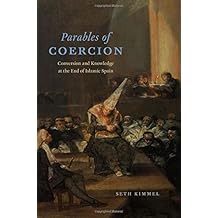
Kimmel on conversion in early modern Spain

Out with the University of Chicago Press' Law and Society series, we missed this one when it appeared in 2015. Seth Kimmel (Columbia University) has published Parables of Coercion: Conversion and Knowledge at the end of Islamic Spain. The book was awarded the American Comparative Literature Association's Harry Levin Award in 2017. From the press:
Parables of Coercion: Conversion and Knowledge at the End of Islamic Spain
In the sixteenth and seventeenth centuries, competing scholarly communities sought to define a Spain that was, at least officially, entirely Christian, even if many suspected that newer converts from Islam and Judaism were Christian in name only. Unlike previous books on conversion in early modern Spain, however, Parables of Coercion focuses not on the experience of the converts themselves, but rather on how questions surrounding conversion drove religious reform and scholarly innovation.
In its careful examination of how Spanish authors transformed the history of scholarship through debate about forced religious conversion, Parables of Coercion makes us rethink what we mean by tolerance and intolerance, and shows that debates about forced conversion and assimilation were also disputes over the methods and practices that demarcated one scholarly discipline from another.
 Praise for the book:

"In Parables of Coercion Kimmel succeeds wonderfully in excavating the intersection of early modern Spanish socioreligious and intellectual history and in deciphering its various discourses....Kimmel further uncovers the dialectical relationship between socioreligious discord and innovative cultural production by religious intellectuals in seventeenth-century Spain, and in the process he manages brilliantly to render meaningless the conventional, simplistic characterization of early modern Spain as a purely intolerant society. It was far more complicated during the sixteenth century afterlife of Islamic Spain than historiographical orthodoxy suggests." -Modern Philology

"Ranging across canon law, sacred philology, and history in sixteenth- and early seventeenth-century Spain, Seth Kimmel aims to demonstrate how the phenomenon of Muslim converts to Christianity was entertained by experts in those disciplines, as well as the ways in which the Morisco question affected the disciplines themselves." -Renaissance Quarterly

"Kimmel has written a fascinating study of the learned cultures built out of a century of Spanish Christian intolerance toward Islam, beginning with the coerced conversion of Spain's Muslims to Christianity in the early sixteenth century, to the expulsion of the Moriscos (as the converts and their descendants were called) in the early seventeenth. He shows us how the evolving  'Morisco question' animated the emergence of disciplines such as philology, history, theology, political theory, and economics. In the process, he provides us with an alternate and disquieting history of our own scholarly, political, and religious practices." -David Nirenberg

Further information is available here.