Showing posts with label death. Show all posts

Tuesday, November 22, 2022

Bessler's "Death Penalty's Denial of Fundamental Human Rights"

The Death Penalty's Denial of Fundamental Human Rights: International Law, State Practice, and the Emerging Abolitionist Norm, by John Bessler, University of Baltimore, is due out next month from Cambridge University Press, in its series, ASIL Studies in International Legal Theory:

The Death Penalty's Denial of Fundamental Human Rights details how capital punishment violates universal human rights-to life; to be free from torture and other forms of cruelty; to be treated in a non-arbitrary, non-discriminatory manner; and to dignity. In tracing the evolution of the world's understanding of torture, which now absolutely prohibits physical and psychological torture, the book argues that an immutable characteristic of capital punishment-already outlawed in many countries and American states-is that it makes use of death threats. Mock executions and other credible death threats, in fact, have long been treated as torturous acts. When crime victims are threatened with death and are helpless to prevent their deaths, for example, courts routinely find such threats inflict psychological torture. With simulated executions and non-lethal corporal punishments already prohibited as torturous acts, death sentences and real executions, the book contends, must be classified as torturous acts, too.
Here is a post on the book in which Professor Bessler explains how Cesare Beccaria and other Enlightenment thinkers understood torture differently than we do today.  And here is an appearance by Professor Bessler on German TV during the recently concluded 8th World Congress Against the Death Penalty.  Finally, here is the book’s TOC:

Introduction
1. The death penalty: from draconian legal codes to the enlightenment
2. The abolitionist movement: state practice, international law, and global progress
3. Death threats and the law of torture: the death penalty's inherently cruel and torturous characteristics
4. Human dignity and the law's evolution: prohibiting capital punishment through a jus cogens norm
Conclusion
 
--Dan Ernst

Thursday, December 26, 2019

Meisel, "A History of the Law of Assisted Dying in the United States"

Alan Meisel (University of Pittsburgh) has posted "A History of the Law of Assisted Dying in the United States." which is forthcoming in the Southern Methodist University Law Review (2020). The abstract:
The slow growth in the number of states that have enacted legislation to permit what is often referred to as “death with dignity” legislation—and more frequently referred to popularly as “physician assisted suicide” laws—has begun to accelerate in the past few years since the enactment of the first such statute in Oregon in 1994.

Like much other social reform legislation, there is a long history behind it. In this case, the history in the United States dates back at least to the latter part of the nineteenth century. Not until the 1980s, however, did these efforts gain any traction in courts and legislatures. What is probably more responsible than anything else for reviving interest in and providing momentum for legalization is the recognition by state courts, beginning with the Karen Ann Quinlan case in New Jersey in 1975, that the right to be free from unwanted interference with one’s bodily integrity encompasses a right to refuse even life-sustaining medical treatment. The recognition of this so-called right to die was only a short conceptual step—though a long political one—from recognizing that competent adults also should have the right to actively end their lives under certain conditions.

As of the end of 2019, the efforts of a small number of advocacy groups through lobbying, litigation, and public education have resulted in the enactment of death with dignity legislation in nine states and recognition of the right by one state supreme court. Despite dire warnings from opponents of legalization, it has not resulted in either wholesale abuse of the dying or the legalization of active euthanasia (either voluntary or involuntary). 
Read on here. (h/t: Legal Theory Blog)

-- Karen Tani

Friday, May 24, 2019

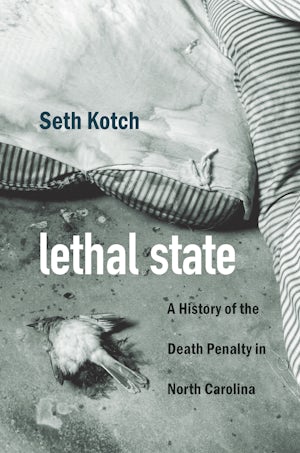
Kotch on the Death Penalty in North Carolina

The University of North Carolina Press has published Lethal State: A History of the Death Penalty in North Carolina, by Seth Kotch (University of North Carolina, Chapel Hill). A description from the Press:
For years, American states have tinkered with the machinery of death, seeking to align capital punishment with evolving social standards and public will. Against this backdrop, North Carolina had long stood out as a prolific executioner with harsh mandatory sentencing statutes. But as the state sought to remake its image as modern and business-progressive in the early twentieth century, the question of execution preoccupied lawmakers, reformers, and state boosters alike.

In this book, Seth Kotch recounts the history of the death penalty in North Carolina from its colonial origins to the present. He tracks the attempts to reform and sanitize the administration of death in a state as dedicated to its image as it was to rigid racial hierarchies. Through this lens, Lethal State helps explain not only Americans' deep and growing uncertainty about the death penalty but also their commitment to it.

Kotch argues that Jim Crow justice continued to reign in the guise of a modernizing, orderly state and offers essential insight into the relationship between race, violence, and power in North Carolina. The history of capital punishment in North Carolina, as in other states wrestling with similar issues, emerges as one of state-building through lethal punishment.
Advance praise:
"With poignant prose and an acute analytical eye, Kotch has written a harrowing and unforgettable history that exposes the inequity of the death penalty in the United States. Some of this eye-opening and moving story is peculiar to North Carolina, but, alas, much of it is not. Anyone interested in how the death penalty has been applied and why it continues to be applied in the United States should read Lethal State."--W. Fitzhugh Brundage 
"Few historical studies have so thoroughly refocused my understanding of one of the foremost issues of our time: the criminal justice system's persistently inequitable treatment of African American men. Beautifully and passionately written, Lethal State should convince any fence-sitter that the arbitrary, utterly unjustly administered death penalty should finally become thing of the past, as it has in every Western nation except the U.S."--Jacquelyn Dowd Hall
More information is available here.

-- Karen Tani

Tuesday, July 25, 2017

Dudziak on Death and the War Power

Mary L. Dudziak, Emory University School of Law, has posted Death and the War Power:
In the vast literature on American war powers, attention is rarely paid to the product of war – the dead human body – and its impact on war politics and war powers. In legal scholarship on the war powers, the practice of war usually happens in the background. Presidents, Congress and courts are in the foreground. Killing in war is thereby a background phenomenon – an aspect of the social context within which the war powers are exercised. This Essay puts death at the center of the analysis. Drawing upon the insights of important recent historical works on death, I argue that the dead body has a political life. The political history of American war death recasts an important problem in the history of American war powers: the atrophy of political restraints on presidential power.

Using historian Drew Gilpin Faust’s idea of a “republic of suffering” in the Civil War as a point of departure, the Essay argues that the culture of American war changed when American wars became only foreign wars. The principal character of American civilians’ relationship to war death in the 20th century was distance from the carnage. Distance accomplished two things: first, a “republic” framed in relation to war death was lost; and second, the U.S. government could exert control over what civilians at home could perceive. Massive mobilization during World War II might appear to be a challenge to the argument that distance from the battlefield matters, so the Essay examines the American civilian experience with war’s violence during that war. Using censored and uncensored World War II casualty photographs, I show the way the very view of war death was managed by the U.S. government for the purpose of maintaining domestic mobilization. Civilians therefore engaged a curated view of death meant to enhance their support for the war effort.

The change over time in the civilian experience with war is not recognized in the literature about war and American law. Instead, legal scholars tend to use the Civil War as a more important historical example than Cold War conflicts, even though the Cold War era bears more resemblance to the present context (militarily and in the impact on U.S. civilians). Meanwhile, cultural distance from war death has increased, helping to produce the profound apathy that characterizes contemporary American war politics. This apathy enables the current legal structure of war authorization: Congress fails to act, and presidents rely on new interpretations of outdated authorizations, or their own constitutional power. Ultimately, I argue, a crucial and unexamined factor in the atrophy of political restraints on presidential power to use military force is the distance between American civilians and the carnage their wars have produced.

Wednesday, May 31, 2017

Butler on Forensic Medicine in Medieval England

Forensic Medicine and Death Investigation in Medieval England (Paperback) book coverBack in 2015, Forensic Medicine and Death Investigation in Medieval England by Sara M. Butler, Loyola University New Orleans came out with Routledge. From the press:

England has traditionally been understood as a latecomer to the use of forensic medicine in death investigation, lagging nearly two-hundred years behind other European authorities. Using the coroner's inquest as a lens, this book hopes to offer a fresh perspective on the process of death investigation in medieval England. The central premise of this book is that medical practitioners did participate in death investigation – although not in every inquest, or even most, and not necessarily in those investigations where we today would deem their advice most pertinent. The medieval relationship with death and disease, in particular, shaped coroners' and their jurors' understanding of the inquest's medical needs and led them to conclusions that can only be understood in context of the medieval world's holistic approach to health and medicine. Moreover, while the English resisted Southern Europe's penchant for autopsies, at times their findings reveal a solid understanding of internal medicine. By studying cause of death in the coroners' reports, this study sheds new light on subjects such as abortion by assault, bubonic plague, cruentation, epilepsy, insanity, senescence, and unnatural death.
Praise for the book:

"…by effectively framing the inquest socially and legally, her book makes a convincing case for a fundamental shift in the history of coronership and, opening up a wonderful set of sources, it tables fresh questions about medieval life, justice and knowledge." - Silvia De Renzi

“Butler’s understanding of the Coroners’ Rolls (their internal reports to the Crown) is profound, detailed, imaginative, and sympathetic. What emerges is a portrait of the coroner as, in the main, conscientious and honest…In sum, Butler’s latest book, based on a deep knowledge of the primary sources, is an excellent study of a neglected institution of English medieval law and government.” - Faith Wallis


Building upon her experience writing the book, Sara Butler encourages medical historians to make better use of legal sources in her recent blogpost, "Reading the Legal Record like a Physician" (H/t: Legal History Miscellany)

Further information about her book is available here.