Showing posts with label military law. Show all posts

Saturday, July 18, 2026

Weekend Roundup

  • In Law & Liberty, Dennis Weiboldt (J.D., Ph.D. candidate, Notre Dame) writes about "Bob Jones's Warning." "By recalling the circumstances under which Bob Jones University v. United States reached the Court, both conservatives and progressives will find lessons about the perils that accompany the aggressive use of executive power to reform American colleges and universities." 
  • The Docket's interview of Anna O. Law about her book, Migration and the Origins of American Citizenship (Oxford University Press, 2026) Ilya Somin's Jotwell review of the book. 
  •  An update on and review of the Constitutional History Project of the American Historical Association (AHA).    
  • Regnat Populus: Digitizing 190 Years of Arkansas Constitutional History opened at the Mullins Library on the University of Arkansas campus (KUAF). 
  •  The Morris/Sussex Vicinage of New Jersey Courts recently opened a self-guided exhibit on more than 270 years of Morris County's legal and civic history.
  • On September 10 and 11, Lafayette College will host Democracy: Past, Present, and Future, a symposium featuring plenary talks by Hélène Landemore, political science at Yale, and Akhil Reed Amar, YLS, with a series of panel discussions, including more than twenty members of the Lafayette faculty.  
  • A series of satirical paintings of legal professionals by "the contemporary artist and fabulist Cassou."
  • Lawbook Exchange's July catalog of Scholarly Law & Legal History. 
  • ICYMI: David Blight on DJT and the Smithsonian (NYT).  Michael Dorf on Historical Analogies in Second and Seventh Amendment Cases (Dorf on Law).  Noah Feldman says that the Supreme Court’s originalism is dead, dead, dead (Seattle Times).  Lawyers Should Spend More Time Studying Legal History (Above the Law).  White House Defends 1882 Immigration Law Excluding Chinese Immigrants (Forbes).  A history of justices testifying before Congress (SCOTUSblog). What the American Founders Did Was a Reluctant Revolution: An Interview with Lee J. Strang (Hungarian Conservative).

Weekend Roundup is a weekly feature compiled by all the Legal History bloggers. 

Wednesday, November 27, 2024

Levin Center on Congressional Oversight of the War on Terror

[We have the following announcement from the Levin Center for Oversight and Democracy of the Wayne State University Law School.  DRE.]

Today, the Levin Center for Oversight and Democracy, with the support of the U.S. Capitol Historical


Society, is releasing a new Portrait in Oversight describing two in-depth Senate investigations into the torture and mistreatment of individuals in U.S. custody during the wars in Iraq and Afghanistan.

Both oversight investigations – the first by the Senate Armed Services Committee from 2004 to 2009, and the second by the Senate Select Committee on Intelligence from 2007 to 2014 -- collected evidence exposing the role of senior U.S. defense and intelligence officials in devising, approving, and directing the use of brutal interrogation methods on Abu Ghraib and Guantanamo Bay detainees. Both Senate investigations also led to enactment of new laws to prohibit the future abuse of individuals in U.S. custody.

“The explosive release of 2004 photos showing prisoners being tortured at Abu Ghraib Prison in Iraq shocked the American public and led to worldwide condemnation of U.S. brutality,” said Jim Townsend, director of the Levin Center. “This new Portrait in Oversight demonstrates how Congress exposed government misconduct, held U.S. military and intelligence officials accountable for what they did, and paved the way for laws to prevent this shameful history from repeating itself.”

“Checks and balances are the foundation of the American governmental system," said Jane L. Campbell, President & CEO of the U.S. Capitol Historical Society.  "It's therefore vital to the health of our democracy that Congress continues to exert its power of oversight on our co-equal branches of government. The U.S. Capitol Historical Society thus commends the work of the Levin Center to inform Americans of the history of this vital process, including the aftermath of the September 11 terrorist attacks.”

The portrait is being released today in observance of the 16th anniversary of the Senate Armed Services Committee’s action on November 20, 2008, approving a 265-page report detailing how senior U.S. Department of Defense officials ordered abusive interrogation methods to be used on U.S. detainees. Six years later, on December 9, 2014, the Senate Select Committee on Intelligence released to the public a 700-page executive summary of its still classified report on the role of the Central Intelligence Agency in the misconduct.

Saturday, March 23, 2024

Weekend Roundup

  • Paula J. Giddings will discuss “The Prescient Life of Ida B. Wells,” “a crusading journalist and pioneer in the fights for women’s suffrage and against segregation and lynchings” in conversation with FDR Library Director William Harris, in the Library’s Henry A. Wallace Center at 6:00 p.m. ET on Tuesday, March 26, 2024, and streaming on YouTube and Facebook.  Register here.
  • Congratulations to John Cairns, University of Edinburgh, upon the announcement that he is to receive an honorary doctorate from the University of Glasgow.
  • Heikki Pihlajamäki, Professor of Comparative Legal History at the University of Helsinki, has “won the Gad Rausing Prize for Outstanding Humanities Research. Pihlajamäki was awarded the prize, worth 1.5 million Swedish krona.”  More.
  • Frances M. Clarke, University of Sydney, is the first Australian to win the Gilder Lehrman Lincoln Prize, which “rewards the finest scholarly work published in the prior year in English on Abraham Lincoln, the American Civil War soldier, or the American Civil War era.” She and her coauthor, Rebecca Jo Plant, University of California, San Diego, won the prize for Of Age: Boy Soldiers and Military Power in the Civil War Era (Oxford University Press).
  • ICYMI: "Maricopa County Honors Public Defenders and Landmark Legal Victories [such as Gideon v. Wainwright] During 'Public Defense Recognition Week'” (Hoodline).  "How Virginia Used Segregation Law to Erase Native Americans" (Time--the new home of Made by History).

Weekend Roundup is a weekly feature compiled by all the Legal History bloggers.

Monday, December 4, 2023

Prakash on the Commander-in-Chief Clause

Saikrishna Prakash, University of Virginia School of Law, has posted Deciphering the Commander-in-Chief Clause, which appears in the Yale Law Journal:

George Washington (LC)
The conventional wisdom is that the Commander-in-Chief Clause arms the President with a panoply of martial powers. By some lights, the Clause not only equips the President with exclusive control over military operations, but also conveys the powers to start wars, create military courts, direct and remove officers, and wield emergency wartime powers. Under such readings, the meaning of “commander in chief” is as obvious as it is unequivocal—it confers some measure of absolute and unchallengeable authority upon the President. Yet, seemingly paradoxically, proponents of this stance cannot say where the Commander in Chief’s power begins and ends. In particular, establishing the Clause’s limits is an acute and persistent problem.

Using eighteenth-century understandings as a yardstick, this Article topples the orthodox reading of the Clause and demarcates the Clause’s elusive frontiers. In contrast to modern assumptions, the Article reveals that eighteenth-century commanders in chief enjoyed neither sole nor supreme authority over the military. Throughout the seventeenth and eighteenth centuries, there were, at any one time, a multitude of British and American commanders in chief, and both assemblies and other military officials consistently directed these commanders, often in quite intrusive ways. By borrowing a familiar expression, the Constitution incorporated the modest, contemporary conception. Rather than being a sui generis military potentate, the President is nothing more than a chief commander, or what Alexander Hamilton called the “first General and Admiral.” The Commander in Chief of the Army and Navy lacks a vast arsenal of military authority but instead possesses only the constrained powers of a general and admiral. Crucially, the Clause does not grant any exclusive authority over peacetime operations or even the conduct of war. Nothing about the term “commander in chief” would have suggested such autonomy because previous chief commanders had lacked such independence. Indeed, early Presidents never objected to congressional bills that sought to regulate military operations pervasively, including wars. Rather, they signed the proposals into law and, thereafter, sought to faithfully execute them.

To be sure, the President is more than a mere general and admiral. Due to the rest of Article II and the Presentment Clause, the President wields considerable authority and influence over the military, far more than a generic commander in chief would. These other sources of power convey authority over the appointment, direction, and removal of military officers and substantial influence on which military bills will become law. In the grand scheme of things, the Commander-in-Chief Clause is far less significant than these other clauses.

How we read the Commander-in-Chief Clause matters. Without a sense of the Clause’s alpha and omega, Presidents will continue to cite it to evade, minimize, and commandeer congressional powers. If this Article’s assertions are correct, however, Presidents will no longer be able to insist that the Founders established a chief commander that can start wars or one that enjoys exclusive authority over operations. By decrypting the Clause, this Article highlights the extent to which Presidents have amassed power untethered from constitutional moorings and also may help fend off further executive overreach. Although some puzzles remain, this Article takes some initial strides in the long march towards deciphering the Commander-in-Chief Clause. 
--Dan Ernst

Saturday, April 29, 2023

Weekend Roundup

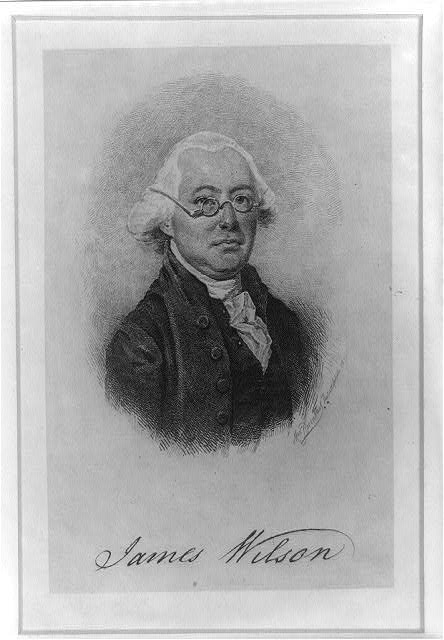
  • James Wilosn: (LC)
    John Mikhail, Georgetown Law, will speak on "James Wilson and 'We The People'" over Zoom as the Supreme Court Historical Society’s Law Day Lecture on Tuesday, May 2 at Noon, EDT.  Register here.
  • In A Model of Feminist Legal History, Rosemary Auchmuty reviews Sharon Thompson's Quiet Revolutionaries: The Married Women’s Association and Family Law (Frontiers of Socio-Legal Studies).
  • Benjamin C. Waterhouse reviews Scalia: Rise to Greatness, 1936 to 1986, Newsmax’s James Rosen’s “unapologetic ode to Antonin Scalia” (WaPo).
  • For the 60th anniversary of the promulgation of General Orders No. 100 to Union Army soldiers, Weekly War Books of the War Military Institute at West Point recommended five books, including John Fabian Witt’s Lincoln’s Code and Amanda L. Tyler’s Habeas Corpus in Wartime.
  • The history of the “true threats” doctrine under the First Amendment: Genevieve Lakier and Gabe Walters in conversation with Jeffrey Rosen on the National Constitution Center’s podcast.”
  • ICYMI: Ned Blackhawk discusses The Rediscovery of America: Native Peoples and the Unmaking of U.S. History in Mother Jones and, with Jonathan Capehart, in WaPo.  ICYMI: R v Penguin Books Ltd: When Lady Chatterley’s Lover was Put on Trial (The Collector).  An excerpt from Slandering the Sacred: Blasphemy Law and the Shaping of Indian Secularism, by J. Barton Scott (Scroll.in).
Weekend Roundup is a weekly feature compiled by all the Legal History bloggers.

Monday, March 6, 2023

Witt on Kinsella on Lieber's Code and Settler Empire

In Lieber at Sand Creek: A New Critical Reinterpretation of the Laws of War, a post on Just Security, John Fabian Witt comments on Helen M. Kinsella’s Settler Empire and the United States: Francis Lieber on the Laws of War, which appeared in the American Political Science Review. The post concludes:

[T]he most exciting feature of Kinsella’s article is the foundational puzzle it raises for legal historical interpretation. What counts as an adequate historical explanation when the regime under study is pervasively conditioned by empire? On the one hand, empire’s ubiquity powerfully conditioned the Lieber Code, as it did virtually every development in the nineteenth-century laws of war. On the other hand, the very fact of empire’s pervasiveness limits its capacity to explain the distinctive features of something like the Lieber Code. Neither the Code’s special vices, nor its particular virtues, stand out in Kinsella’s account. And that is a loss – for it undoubtedly had plenty of both.

--Dan Ernst

Thursday, December 22, 2022

California Supreme Court Historical Society Review

The latest issue of the California Supreme Court Historical Society Review (Fall/Winter 2022) is out.  We borrow from a communication from its editors:

“The Supreme Court Case That Dared Not Speak Its Name,” by L.A. attorney Bob Wolfe, documents the little-known story of ONE v. Olesin (1958). One Magazine, whose offices were in L.A., was the first openly gay magazine in the nation, and the subject of the high court’s summary reversal of the obscenity charges filed against it. The court’s action is now regarded as pivotal in the eventual legal recognition of LGBTQ rights."

"The 1944 Port Chicago Mutiny and the Legacy of Racism in the U.S. Military” by John S. Caragozian is “an  mutiny by African-American Navy personnel. The workers, at the naval base near Marin, California, were assigned to load huge shipments of live explosives without training, and feared deadly accidents. Indeed, the massive explosion that occurred on July 17 killed 320 men, wounded an additional 390 and destroyed the pier, the cargo ship Bryan, railroad locomotives and buildings. The subsequent court martial and conviction of 50 sailors who resisted orders to go back to work resulted in lengthy prison sentences for the men. L.A. author John Caragozian sees the incident as another example of the U.S. military’s legacy of racism.”

“Chief Justice Cantil-Sakauye’s Mission to Bring Order From Chaos” by David A. Carrillo, is “an appraisal of California's retiring Justice Tani Cantil-Sakauye's tenure and a profile of the state's new chief justice, Patricia Guerrero.”  It is followed by Jake Dear, “Personal Reflections About Working for and With Chief Justice Tani Cantil-Sakauye.”

Other contributions include “A Glimpse Into the Private Life of the Late Chief Justice Rose Bird” by the Honorable Robert C. Vanderet; “Expanding Justice for All: The Supreme Court of California in Times of Change” by Marie Silva, and “Public Defenders: The Antidote to Communism,” which is the Honorable Maria E. Stratton’s review of Sara Mayeux’s Free Justice: A History of the Public Defender in Twentieth.Century America.

--Dan Ernst

Sunday, July 5, 2020

AJLH 60:2

American Journal of Legal History, 60:2 (June 2020) is now available online

Reforming Criminal Justice in the Ottoman Empire: Police, Courts and Prisons in Rusçuk, 1839-1864   
Mehmet Celik

Combatting Bias in the Criminal Courts of France, 1870s-1913   
James Donovan

Political Judging and Judicial Restraint: The Case of Learned and Augustus Hand   
Jak Allen

Law at a Critical Juncture: The US Army’s Command Responsibility Trials at Manila, 1945-1947   
Jamie Fellows

White Subversion of Public School Desegregation in South Carolina, 1963-1970   
Stephen Lowe

Book Reviews

Elizabeth Papp Kamali, Felony and the Guilty Mind in Medieval England   
Sarah B White

Anat Rosenberg, Liberalizing Contracts: Nineteenth Century Promises Through Literature, Law and History   
Victoria Barnes

Saturday, June 6, 2020

Weekend Roundup

  • Reminder: Applications for the William Nelson Cromwell Foundation awards to support research and writing in American legal history by early-career scholar are due on July 1.  (The Committee for Research Fellowships and Awards of the American Society for Legal History reviews the applications and makes recommendations to the Foundation.)  More.
  • This year’s recipients of Charlotte W. Newcombe Doctoral Dissertation Fellowships include Tamar Menashe, Columbia University, for "People of the Law: The Imperial Supreme Court and Jews in Cross-Confessional Legal Cultures in Germany, 1495–1690," and Lila Teeters, University of New Hampshire, for “Native Citizens: The Fight For and Against Native Citizenship in the United States, 1866–1924.”
  • Process, the blog of the Journal of American History and the Organization of American Historians, has put out a call for submissions on "all aspects of the history of disability in the United States."
  • Here is the Harvard Law School faculty's open letter condemning "a series of acts by President Trump and other public servants that endorse violence and are inconsistent with a democratic legal order." Signatories include every legal historian we can think of who teaches there.
  • The Consortium for Undergraduate Law & Justice Programs recently announced its 2020 awards for teaching and best undergraduate paper.
  • ICYMI: Dean Risa Goluboff draws on her own historical research in her message to UVA law students.  David Blight on Frederick Douglass and "the tortured relationship between protest and change" (The Atlantic). Alexander Zhang on this history of "school-to-prison pipeline" policing in Minneapolis (Slate).
  • ICYMI, Insurrection Act EditionGautham Rao on the Posse Comitatus and Insurrection Acts (CNN).  The History Channel on the Jeffersonian origins of the Insurrection Act.  Still more, in WaPo's Retropolis.
  • Over at Balkinization, Stephen Griffin develops an aspect of his recent SSRN post "Optimistic Originalism and the Reconstruction Amendments."Also at Balkinization: Gregory Ablavsky (Stanford Law School) on "PROMESA and Original Understandings of the Territories’ Constitutional Status."
Weekend Roundup is a weekly feature compiled by all the Legal History bloggers.

Monday, July 29, 2019

Leiber's Lost Treatise on Martial Law

To Save the Country: A Lost Treatise on Martial Law, written by Francis Lieber and G. Norman Lieber and edited and with an introduction by Will Smiley and John Fabian Witt, is out from the Yale Univbersity Press.  Francis Lieber (1798–1872) was professor at Columbia College who advised Abraham Lincoln on the law of war. G. Norman Lieber (1837–1923), Francis’s son, taught law at West Point. Will Smiley is an assistant professor of humanities at the University of New Hampshire. John Fabian Witt is the Allen H. Duffy Class of 1960 Professor of Law at Yale Law School and the Head of Yale’s Davenport College.
The last work of Abraham Lincoln’s law of war expert Francis Lieber was long considered lost—until Will Smiley and John Fabian Witt discovered it in the National Archives. Lieber’s manuscript on emergency powers and martial law addresses important contemporary debates in law and political philosophy and stands as a significant historical discovery.

As a key legal advisor to the Lincoln White House, Columbia College professor Francis Lieber was one of the architects and defenders of Lincoln’s most famous uses of emergency powers during the Civil War. Lieber’s work laid the foundation for rules now accepted worldwide. In the years after the war, Lieber and his son turned their attention to the question of emergency powers. The Liebers’ treatise addresses a vital question, as prominent since 9/11 as it was in Lieber’s lifetime: how much power should the government have in a crisis? The Liebers present a theory that aims to preserve legal restraint, while giving the executive necessary freedom of action.

Smiley and Witt have written a lucid introduction that explains how this manuscript is a key discovery in two ways: both as a historical document and as an important contribution to the current debate over emergency powers in constitutional democracies.
Here are some endorsements:

 “When arguments for a legally unrestrained executive are again in fashion, this retrieval of Lincoln’s lawyer’s theory of appropriate legal restraint during wartime emergency could not be more timely.”—David Dyzenhaus, University of Toronto

“Smiley and Witt have unearthed a lost treasure. As we debate how our constitutional democracy handles great stress, this work helps us understand how the system has survived so far.”—Matthew C. Waxman, Columbia University

“Through their extraordinary discovery of Francis Lieber’s unpublished notes, Smiley and Witt not only provide a crucial new primary source that contextualizes Lieber’s role in the development of laws of war but also, amazingly enough, a fruitful way to reconsider the old, vital question of what constraints law can offer in times of war. A book every historian of the Civil War and every scholar of laws of warfare should rush to read.”—Gregory P. Downs, author of After Appomattox: Military Occupation and the Ends of War

“The manuscripts that Smiley and Witt have recovered should be required reading for anyone who cares about the operation of the Constitution in wartime and more generally about what legal limits should—or should not—constrain the government in confronting emergencies.”—Amanda L. Tyler, University of California, Berkeley School of Law

--Dan Ernst

Monday, February 18, 2019

Pfander on the Military and Dicey's Rule of Law

James E. Pfander, Northwestern University School of Law, has posted Dicey's Nightmare: An Essay on the Rule of Law, which is forthcoming in the California Law Review:
The British constitutional lawyer A.V. Dicey argued in the nineteenth century that the common law, as administered by superior courts, better ensured government accountability than did written constitutions. Dicey taught us to focus less on constitutional promises and more on the practical effectiveness of judicial remedies. This Essay builds on Dicey by offering a comparative assessment of military encroachments on the rights of the nation’s citizens during times of war. Rather than comparing British common-law norms to European constitutionalism, as Dicey did, this Essay compares nineteenth-century common law as applied in the courts of the United States to the constitutionally-inflected rules that those courts apply today.

This Essay focuses its comparison on three common-law remedies: habeas to secure release from military detention; trespass to obtain an award of damages for wrongful or abusive military confinement; and tort and contract-based compensation for the military’s destruction or taking of property. The modern Supreme Court has recalibrated each of these common-law regimes and now evaluates the legality of the military’s actions almost exclusively in constitutional terms. As Dicey might have predicted, the shift away from hard-edged common-law rules to open-ended constitutional balancing corresponds to a marked loss of relative remedial effectiveness. This Essay examines some of the factors that have shaped the remedial decline, as reflected in Hamdi v. Rumsfeld and Ziglar v. Abbasi. It then offers suggestions as to how the Court might keep the infrastructure of rights enforcement in better repair.

Wednesday, February 6, 2019

Borch on War trials in the Netherlands East Indies

Back in 2017, Fred L. Borch (Regimental Historian and Archivist for the US Army Judge Advocate General's Corps) published Military Trials of War Criminals in the Netherlands East Indies 1946-1949 with Oxford University Press. From the publisher: 
From 1946 to 1949, the Dutch prosecuted more than 1000 Japanese soldiers and civilians for war crimes committed during the occupation of the Netherlands East Indies during World War II. They also prosecuted a small number of Dutch citizens for collaborating with their Japanese occupiers. The war crimes committed by the Japanese against military personnel and civilians in the East Indies were horrific, and included mass murder, murder, torture, mistreatment of prisoners of war, and enforced prostitution. Beginning in 1946, the Dutch convened military tribunals in various locations in the East Indies to hear the evidence of these atrocities and imposed sentences ranging from months and years to death; some 25 percent of those convicted were executed for their crimes. The difficulty arising out of gathering evidence and conducting the trials was exacerbated by the on-going guerrilla war between Dutch authorities and Indonesian revolutionaries and in fact the trials ended abruptly in 1949 when 300 years of Dutch colonial rule ended and Indonesia gained its independence. 
Until the author began examining and analysing the records of trial from these cases, no English language scholar had published a comprehensive study of these war crimes trials. While the author looks at the war crimes prosecutions of the Japanese in detail this book also breaks new ground in exploring the prosecutions of Dutch citizens alleged to have collaborated with their Japanese occupiers. Anyone with a general interest in World War II and the war in the Pacific, or a specific interest in war crimes and international law, will be interested in this book.
 Praise for the book:

"The overriding importance of Borch's book is that it fills a long-existing and significant gap in the English-language historiography of war crimes trials at the end of World War II. ... This book should find a wide audience among legal scholars, especially those who have an interest in the prosecution of war crimes. But the book is framed for a broader audience and with the pains taken to avoid legal jargon and to provide contextualization with respect to time and place, it should achieve its aim." Bruce Vandervort

"The overarching value of this book, especially for Anglophone readers lies in its forty-four trial summaries, which highlight cases relevant to specific types of crimes. The book might also serve as a primer on Dutch war crimes trial procedures, recruitment of personnel, provision of ancillary staff, etc., as well as enable comparative analysis of the Allied trials arising from the Pacific War." -Georgina Fitzpatrick

"This excellent book addresses a void in the academic literature: an authoritative well-written documentation of post-World War II war crimes trials conducted by an Allied state. Much more than a mere recitation of cases (although there is that, too), this slim volume is a window to an earlier time and an earlier law of war. ... This is a powerful book that those interested in the academic literature of World War II, the law of war, or the frailty of man, should read." -Gary Solis

Further information is available here.