Showing posts with label political theory. Show all posts

Wednesday, June 24, 2026

Casagrande on the Counter-Concepts Constitution and Arbitrariness

[We have word of the following open-access publication in the Global Perspectives on Legal History series of the Max Planck Institute for Legal History and Legal History.  DRE.]

Agustín E. Casagrande, Constitución y Arbitrariedad: Conceptos e imaginarios del constitucionalismo argentinoo (Global Perspectives on Legal History, Vol. 26)

The discourse of constitutionalism emerged out of the entanglement of three strands: legal theory, political philosophy, and historical narratives. Its structure revolves around the tension between the counter-concepts (Gegenbegriffe) of arbitrariness (to be denounced) and constitution (to be legitimized). This book presents a threefold genealogical analysis to access the logic of Argentine constitutionalism. First, a conceptual history (Begriffsgeschichte) exposes the distance between recent narratives of the development of Argentine constitutionalism as constructed by political historians, on the one hand, and constitutional scientists, on the other. The second genealogy explores the theoretical rupture between modern law and the traditional knowledge of ius commune in the shift from arbitrium iuris to “legicentric” logic – that is, the preeminence of written law enacted by the state. The narrowing of the concept of arbitrium to arbitrariness was central to the formation of constitutional law’s conception of the political order. Finally, this rupture went hand-in-hand with the establishment of new political imaginaries, including autocratic caudillos, suggestible masas, anarchic tendencies of a people, etc. During the 19th century, these fueled the sense among the elites that a new order was needed; but they also still remain part of current narratives. Revealing these emotional imaginaries that guided, and continue to guide, constitutional practice enables a dialogue between the history of law as written by historians and as written by constitutionalists, with the purpose of understanding the recurrent crises that still afflict Argentine constitutionalism in the 21st century.

Friday, September 19, 2025

Priel on the Political Theories of the Legal Realists

 Dan Priel, Osgoode Hall Law School, has posted The Political Theories of the Legal Realists:

Jerome Frank, with William Douglas (LC)
A popular view about the legal realists is that, either knowingly or inadvertently, they advanced ideas inconsistent with traditional values, democracy, and the rule of law. Another view about them suggested that the realists had no political theory: they only offered a descriptive (empirical) theory of adjudication, albeit one that has normatively "quietist" implications. In this essay, I challenge both views. I argue that there were two legal realist camps whose jurisprudential ideas presupposed two quite different political theories. One group of legal realists consisted of public utilitarians who were consciously inspired by Bentham, wanted to turn legal and political theory into a science, and who thought law should be evaluated by its ability to increase social welfare. The other group had a very different political theory underlying its approach to law. For these legal realists, law was a traditionary institution, which should reflect, and be continuous with, community customs and values. After showing these different views, I show their relevance to contemporary debates in different areas of law. 

--Dan Ernst 

Tuesday, May 28, 2024

Ruskola on Montesquieu and "Oriental Despotism"

Teemu Ruskola, University of Pennsylvania Carey Law School, has posted Oriental Despotism Inside Out: On the Global Travels of Montesquieu’s De l’esprit des lois:

Baron de Montesquieu (NYPL)
This speculative essay analyzes Montesquieu’s comparative method in his De l’esprit des lois (1748) and its contemporary legacies. It takes as its focus his theory of Oriental despotism. The first half of the paper focuses on two aspects of his method. First, Montesquieu’s empirical approach to political theory marks him apart from his humanist predecessors. Turning away from natural law and a search for universal principles, he instead attends to nature itself in order to understand the diversity of social and legal phenomena. Second, I comment briefly on Montesquieu’s reworking of Europe’s metageographic status. I analyze him as a key figure in replacing an essentially religious distinction between the Christian world and a heathen Orient with a more plural world divided into continents marked by cultural and political differences.

In the second half of the paper I turn to Montesquieu’s use of China as a paradigmatic instance of “Oriental despotism.” Paradoxically, Montesquieu develops his idea of despotism as a critique of French absolutism while projecting its prototype into the Orient, China in particular. In the final analysis, however, Montesquieu himself is forced to admit that in several key respects China does not fit the category it supposedly exemplifies. Yet despite its flawed empirical foundation, over time Oriental despotism mutates from a theory of politics into a theory of scientific racism with global implications. I conclude by examining the geopolitical implications of Montesquieu’s analysis with respect to the discourse of Chinese authoritarianism today.
--Dan Ernst

Thursday, May 2, 2024

Campbell on the Union at the Founding

Jud Campbell, Stanford Law School, has posted Four Views of the Nature of the Union, which is forthcoming in the Harvard Journal of Law and Public Policy:

John Marshall (NYPL)
This Essay summarizes four Founding-Era views about the nature of the Union and the key interpretive implications that followed from those views. In doing so, it emphasizes the importance of social-contract theory and engages a recent scholarly debate over the influence of the law of nations on Founding-Era constitutional interpretation. Without taking a position about which view of the Union was correct, the Essay aims to illuminate the range of interpretive possibilities, including ones informed more by social-contractarian premises than by the law of nations.

--Dan Ernst


Tuesday, April 30, 2024

Ruskola on Liberalism, Authoritarianism, and China

Teemu Ruskola, University of Pennsylvania Carey Law School, has posted The Limits of Liberal Justice: On Authoritarianism and Instrumental Theories of Law, which is forthcoming in the Asia Pacific Law Review:

Baron de Montesquieu (NYPL)
In this essay, I use Professor Sucheng Wang's recent book Law as an Instrument: Sources of Chinese Law for Authoritarian Legality as a point of departure for reconsidering the conventional opposition between liberal and authoritarian forms of legality. I suggest that opposition is in turn embedded in an even more elemental distinction between different state forms. Turning to Montesquieu's The Spirit of the Laws, I first investigate the historical and geopolitical processes by which modern political theory reduced the political universe into three species of states (republics, monarchies, and despotisms) and then merely two (democracies and authoritarian states). I then turn to the contemporary genealogy of the concept of rule of law, which arose first as a critique of the rise of the administrative state in the West and then became a means to delegitimize socialist conceptions of legality. I conclude by focusing on the People's Republic of China to evaluate the utility of assessing its legal order in terms of authoritarian legality as well as in terms of democracy more generally.
--Dan Ernst

Thursday, November 30, 2023

Parker's "Turn to Process"

Kunal M. Parker, University of Miami School of Law, has published The Turn to Process: American Legal, Political, and Economic Thought, 1870–1970, in the series Cambridge Historical Studies in American Law and Society, edited by Christopher L. Tomlins.

In The Turn to Process, Kunal M. Parker explores the massive reorientation of American legal, political, and economic thinking between 1870 and 1970. Over this period, American conceptions of law, democracy, and markets went from being oriented around truths, ends, and foundations to being oriented around methods, processes, and techniques. No longer viewed as founded in justice and morality, law became a way of doing things centered around legal procedure. Shedding its foundations in the 'people, ' democracy became a technique of governance consisting of an endless process of interacting groups. Liberating themselves from the truths of labor, markets and market actors became intellectual and political techniques without necessary grounding in the reality of human behavior. Contrasting nineteenth and twentieth century legal, political, and economic thought, this book situates this transformation in the philosophical crisis of modernism and the rise of the administrative state.
Here are some endorsements:
‘Ranging widely across disciplines, crossing political boundaries, and unsettling conventional wisdom at every turn, The Turn to Process provides a brilliant new synthesis of a transformative period in American intellectual life.’

Angus Burgin - Johns Hopkins University

‘This book is a real tour de force, a return to intellectual history in the grand manner. In Kunal Parker’s synthesis, the leading theorists of law, political science, and economics in the twentieth century all contributed to, and followed, a shift away from theorizing their sciences as means to substantive ends such as justice or morality, to thinking about them only as methods or procedures. The book is marked by deep learning in the sources of all three fields and an uncommon lucidity in exposition.’

Robert W. Gordon - author of Taming the Past: Essays on Law in History and History in Law

‘In this revelatory account of ‘a world rendered process’, Kunal Parker brilliantly reframes the history of modern American knowledge-making. As foundational certainties faltered in the late nineteenth century, he contends, the language of tools, methods, and techniques remade entire disciplines and professions - with enduring consequences for how we understand law, democracy, and markets.’

Sarah Igo - author of The Known Citizen: A History of Privacy in Modern America
Professor Parker discusses the book here.

--Dan Ernst

Friday, September 1, 2023

CFP: Neoliberalism and Capitalism as Keywords in Contemporary History Conference

We have the following CFP, via the LPE Blog:

The Law and Political Economy Project is thrilled to cosponsor the Neoliberalism and Capitalism as Keywords in Contemporary History Conference which will take place at Yale University, February 23-25, 2024. The keynote speakers will be Isabella Weber (Associate Professor of Economics at UMass Amherst, author of How China Escaped Shock Therapy) and David Edgerton (Hans Rausing Professor of the History of Science and Technology at King’s College London, author of The Rise and Fall of the British Nation).

Call for Papers: Historians have made ‘neoliberalism’ and ‘capitalism’ two of the most powerful keywords as they describe and account for the recent past’s distinctive features and pathologies. Ambiguities exist however around what the concepts usefully name; how these phenomena relate to each other; and which agencies, processes, periodizations and geographies the concepts call on us to emphasize.

This conference engages these keywords of contemporary history, which have borne upon historians in one of their most important modes of speaking to their present: using historical methods to illuminate and account for the recent past’s most urgent or distinguishing features. We invite scholars at all stages of their careers to submit paper proposals which engage any of the following questions:

  • How and why did these concepts, rather than others, become such powerful keywords to describe the recent past and its pathologies?
  • Why have scholars found it so difficult to agree on what ‘neoliberalism’ and ‘capitalism’ name?
  • In the project of describing and accounting for the recent past in historical perspective, what different assumptions and investments make ‘neoliberalism’ and ‘capitalism’ appear as complementary concepts for some scholars, and rival concepts for others?
  • How do different definitions of neoliberalism, capitalism, and their relationship help or hinder historical investigations into pressing issues of our present, including but not limited to climate change, right-wing resurgence, economic crisis, and geopolitical disorder? Do these concepts still serve us adequately as keywords in this task?
  • How and why have the keywords ‘neoliberalism’ and ‘capitalism’ led different literatures to address similar explananda through such different agencies, processes, periodizations and geographies?
  • How might we usefully bring into conversation the distinct literatures which the concepts of ‘neoliberalism’ and ‘capitalism’ have shaped?
  • The organizers would like to thank the MacMillan Center, the Law and Political Economy Project, the Brady-Johnson Program in Grand Strategy, and Yale’s History Department for their support.

TO APPLY: Please submit a 350 word abstract and a one-page CV to neocapconference@elilists.yale.edu by 24 October 2023. Please include your name in the email subject header. Participants will be notified of their acceptance by 7 November 2023. Presenters will be expected to pre-circulate a paper of between ~2,000 and 4,000 words to their co-panelists by 9 February 2024. Some travel assistance may be available; please indicate in your application if you would like to apply. Preference will be given to underrepresented scholars who lack other sources of institutional funding.

-- Karen Tani

Thursday, October 21, 2021

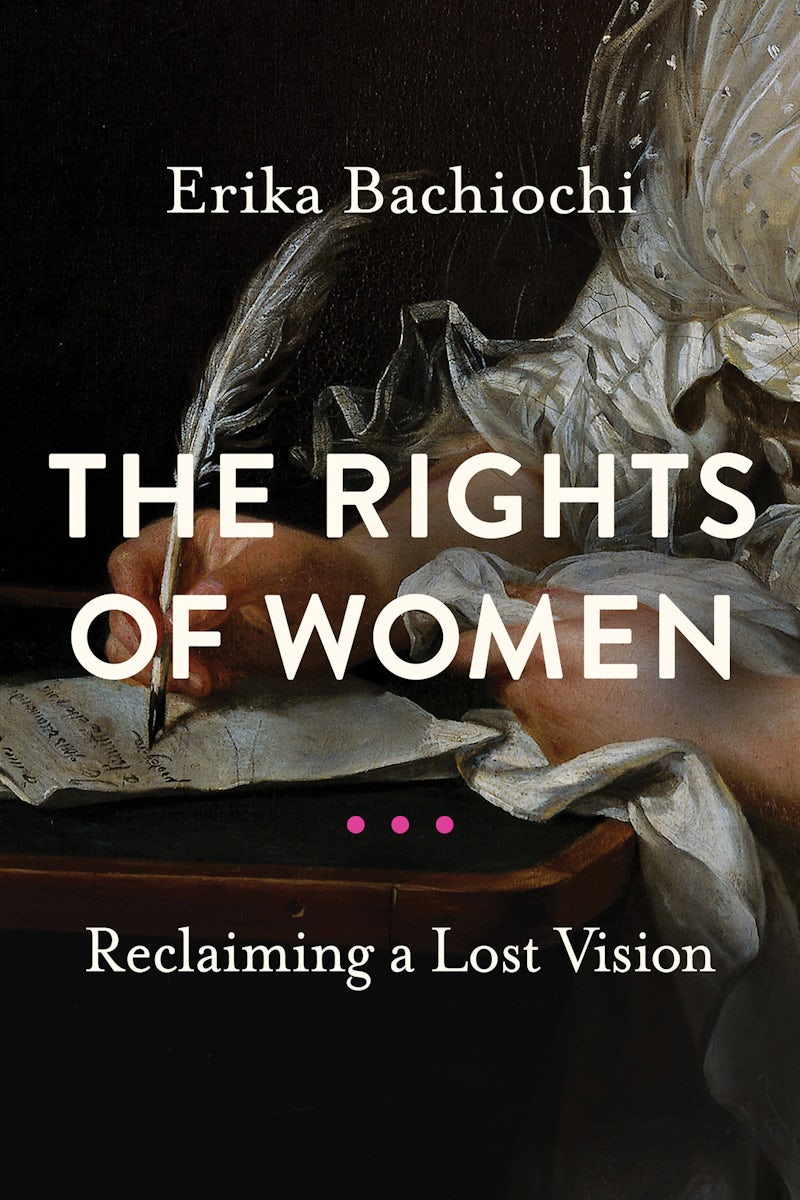
Bachiochi, "The Rights of Women: Reclaiming a Lost Vision"

Notre Dame Press has published The Rights of Women: Reclaiming a Lost Vision, by Erika Bachiochi (Ethics and Public Policy Center / Abigail Adams Institute). A description from the Press:

In The Rights of Women, Erika Bachiochi explores the development of feminist thought in the United States. Inspired by the writings of Mary Wollstonecraft, Bachiochi presents the intellectual history of a lost vision of women’s rights, seamlessly weaving philosophical insight, biographical portraits, and constitutional law to showcase the once predominant view that our rights properly rest upon our concrete responsibilities to God, self, family, and community.

Bachiochi proposes a philosophical and legal framework for rights that builds on the communitarian tradition of feminist thought as seen in the work of Elizabeth Fox-Genovese and Jean Bethke Elshtain. Drawing on the insight of prominent figures such as Sarah Grimké, Frances Willard, Florence Kelley, Betty Friedan, Pauli Murray, Ruth Bader Ginsburg, and Mary Ann Glendon, this book is unique in its treatment of the moral roots of women’s rights in America and its critique of the movement’s current trajectory. The Rights of Women provides a synthesis of ancient wisdom and modern political insight that locates the family’s vital work at the very center of personal and political self-government. Bachiochi demonstrates that when rights are properly understood as a civil and political apparatus born of the natural duties we owe to one another, they make more visible our personal responsibilities and more viable our common life together.

This smart and sophisticated application of Wollstonecraft’s thought will serve as a guide for how we might better value the culturally essential work of the home and thereby promote authentic personal and political freedom. The Rights of Women will interest students and scholars of political theory, gender and women’s studies, constitutional law, and all readers interested in women’s rights.

Advance praise:

"Bachiochi adds an important new voice to the conversation criticizing the nation’s turn to revering market profit and the freedom to be left alone above all else. Feminists may not agree with all of her critique of contemporary feminism, but they would do well to engage with her powerful argument that conceptualizing the movement’s goal as sex equality in the workplace is too narrow." —Maxine Eichner

“Rights cannot flourish alone. They need to be embedded in a thicker moral context that gives voice to the goods that they should serve, the social duties that govern their exercise, and the virtues that enable respect for them. In this book, Erika Bachiochi recovers a tradition of thought about women’s rights that fully recognizes this and, with Mary Wollstonecraft at one end and Mary Ann Glendon at the other, offers an important, salutary correction, not only to libertarian feminism in particular but also to contemporary rights-talk in general.” —Nigel Biggar,

More information is available here. You can listen to an interview with the author here, at New Books Network.

-- Karen Tani

Tuesday, October 19, 2021

Somos & Peters, eds., "The State of Nature: Histories of an Idea"

Brill has published The State of Nature: Histories of an Idea, edited by Mark Somos (Deutsche Forschungsgemeinschaft) and Anne Peters (Max Planck Institute for Comparative Public Law and International Law). A description from the Press:

The phrase, “state of nature”, has been used over centuries to describe the uncultivated state of lands and animals, nudity, innocence, heaven and hell, interstate relations, and the locus of pre- and supra-political rights, such as the right to resistance, to property, to create and leave polities, and the freedom of religion, speech, and opinion, which may be reactivated or reprioritised when the polity and its laws fail. Combining intellectual history with current concerns, this volume brings together fourteen essays on the past, present and possible future applications of the legal fiction known as the state of nature. 

The Table of Contents:

Monday, August 2, 2021

Katz on Women's Legal Right to Hold Public Office

 Elizabeth D. Katz, Washington University in St. Louis School of Law, has posted Sex, Suffrage, and State Constitutional Law: Women's Legal Right to Hold Public Office, which is forthcoming in the Yale Journal of Law & Feminism:

On January 20, 2021, Kamala Harris was sworn in by Justice Sonia Sotomayor as the nation’s first woman Vice President. This occasion, with women of color holding two of the most crucial roles in our national government, would have been unthinkable for most of United States history. While the political efforts necessary to reach this moment have been studied in great depth, the legal challenges have been overlooked and even denied.

Relying on extensive historical research, this Article is the first to examine how women advocated for the legal right to hold public office in state-level litigation, constitutional amendments, legislative lobbying, and other venues for more than a century. From the 1840s through the 1940s, women in many states were excluded from holding even mundane public offices because of state constitutional language and judicial holdings. Opponents of women’s officeholding feared that permitting women to hold posts would deprive men of their rightful opportunities, radically alter gender norms, and fuel the flames of the women’s suffrage movement. The nation’s first women lawyers were particularly active in challenging these restrictions, with results varying by region and reflecting distinct legal, political, and social cultures. Women in the West obtained public offices relatively early, in part because they were the first to secure suffrage. Women in the Northeast and South faced the most difficult hurdles because conservative state judiciaries construed constitutional silences as implying women’s exclusion from office. The Midwest emerged as the contested middle ground; although women could not vote in Midwestern states for most of the studied period, many courts nevertheless held that they were entitled to hold both appointed and elected offices.

Recovering the history of women’s legal right to hold public office challenges three major conventional wisdoms. First, it undermines the commonplace claim in scholarship on women’s legal and political history that officeholding was not a meaningful part of women’s advocacy or experiences until after ratification of the Nineteenth Amendment in 1920. This account instead shows that proponents of women’s rights have long demanded women’s access to public posts, and women held positions more than a half century prior to the federal suffrage amendment. Second, this Article challenges prominent scholarship—mostly focused on interpreting the Reconstruction Amendments—that treats officeholding as an obvious or inevitable twin to suffrage. Foregrounding women’s history and state-level advocacy emphasizes the legal possibility and practical reality of severing these political rights. Third, and relatedly, the Article calls for more attention to state constitutional law and regional variation. The women’s officeholding story clearly demonstrates how focusing on one geographical area, providing a single national account, or limiting analysis to the federal level obscures essential developments in securing rights.

--Dan Ernst

Wednesday, November 4, 2020

SAPD 34:2

Studies in American Political Development 34:2 (October 2020) is open access through the end of the month:

Racism Is Not Enough: Minority Coalition Building in San Francisco, Seattle, and Vancouver
Jae Yeon Kim

The Political Effects of Policy Drift: Policy Stalemate and American Political Development
Daniel J. Galvin, Jacob S. Hacker

Privatizing Employment Law: The Expansion of Mandatory Arbitration in the Workplace
 Sarah Staszak

Democratic Representation of all “the People”: Antislavery Petitions in the U.S. Senate
John D. Griffin, Grace Sager 

--Dan Ernst

Monday, January 27, 2020

Emerson's "The Public's Law": An LHB Symposium

[The annual meeting of the American Society for Legal History last November included an author-meets-readers session on Blake Emerson’s The Public’s Law: Origins and Architecture of Progressive Democracy (Oxford University Press, 2019).  At it, I summarized the book.  Anne Kornhauser, Associate Professor in the History Department of the City College of New York and Associate Professor of History at the CUNY Graduate Center; and Noah Rosenblum, a Ph.D. candidate in history at Columbia University and a Program Affiliate Scholar at the NYU School of Law, provided comments, to which Emerson, Assistant Professor of Law at UCLA, responded.

[We will link to Kornhauser's revised and extended comment when it appears in the New Rambler Review.  This post is my summary of the book.  Rosenblum's comment and Emerson's response will appear in future posts.  DRE]

In Thinking Like Your Editor (2002), Susan Rabiner and Alfred Fortunato suggested a strategy for injecting narrative tension into serious nonfiction.  An author begins by describing some problem that has been bugging her and then explains that the book represents her search for an answer.  If the author does  that much properly, the reader will think, “You know, now that she mentions it, that problem has been bothering me, too.  I’m not exactly sure where her search would take me, but she seems to be a smart cookie who'll have interesting things to say along the way.  I’ll tag along and see whether she finds her answer.”  Narrative tension, then, is provided by the author’s search for an answer.

Emerson’s problem, speaking generally, is the political legitimacy of the administrative state in a democratic United States. The book resulting from his search for an answer has an introduction, a conclusion, and four chapters.  He uses three methodologies: (1) intellectual history (in Chapters 1 and 2); (2) institutional history (in Chapter 3); and (3) what Emerson calls “normative reconstruction” (in Chapter 4).  The answer he arrives at is a kind of bureaucracy that brings the people into the state, new forms of deliberative democratic control within administration itself."  The deliberation is not so much “formally equal, contracting persons” as “relational beings whose identities, interests, and values are formed in joint discourse and action.”  It is a relational state based on the belief that “the conditions of freedom” require that people actively determined the principles and policies by which they were bound.  The result is “the public’s law.”

Friday, December 6, 2019

Carrai's "Soveriegnty in China

Maria Adele Carrai, Katholieke Universiteit Leuven, Belgium, has recently published Sovereignty in China: A Genealogy of a Concept since 1840, with Cambridge University Press:
This book provides a comprehensive history of the emergence and the formation of the concept of sovereignty in China from the year 1840 to the present. It contributes to broadening the history of modern China by looking at the way the notion of sovereignty was gradually articulated by key Chinese intellectuals, diplomats and political figures in the unfolding of the history of international law in China, rehabilitates Chinese agency, and shows how China challenged Western Eurocentric assumptions about the progress of international law. It puts the history of international law in a global perspective, interrogating the widely-held belief of international law as universal order and exploring the ways in which its history is closely anchored to a European experience that fails to take into account how the encounter with other non-European realities has influenced its formation.
Here are some endorsements:

'The Confucian admonition that one needs to study the past to understand the present is especially apt when it comes to China and sovereignty. Fortunately, Dr Maria Adele Carrai’s new book provides a superb genealogy of Chinese approaches to sovereignty over time, from historic times to the present, that will be a key departure point on this important topic for years to come.'

William P. Alford - Jerome A. and Joan L. Cohen Professor of East Asian Legal Studies and Director of East Asian Legal Studies, Harvard University, Massachusetts

'Carrai’s innovative conceptual history of ‘sovereignty’ in China explores the changing meanings of international law and its structures of authority and legitimacy through three periods of dramatic Chinese political transition. This is a study not only of Chinese reception and adaptation. It provides a foundation for scrutiny of China’s active participation in shaping our present international legal order.'

Madeleine Zelin - Dean Lung Professor of Chinese Studies, Columbia University, New York

'This is a stimulating, learned, and readable analysis of the many uses the malleable concept of ‘sovereignty’ has served in China’s relations with the world for almost two centuries. It offers invaluable assistance for parsing the rhetoric of both Xi Jinping and Donald Trump in the current East-West contest for domination.'

Jerome A. Cohen - Faculty Director of US-Asia Law Institute, New York University

'This study provides a much-needed concise history of the genealogy of sovereignty as a central concept of modern international law and politics in the context of Chinese transformation and Sino-foreign encounters since the mid nineteenth century. Its nuanced analysis of Chinese specificity and agency in shaping international legal and political history will be of great interest to scholars of China, comparative politics, and international history.'

Li Chen - University of Toronto

'Sovereignty occupies the conceptual heart of the Chinese Communist Party’s bid to claim for China its rightful place in the world and to justify its international policies. By showing how this concept emerged and what it means today, Carrai sets out the rhetorical terrain across which those who wish to enter into conversation with official China will have to make their way.'

Timothy Brook - Republic of China Chair, Department of History, University of British Columbia

–Dan Ernst

Saturday, July 27, 2019

Weekend Roundup

  • From our friends at the Max Planck Institute for European History, a post on the British Legal History Conference 2019.
  • David A. Reidy, University of Tennessee, has posted a draft chapter from his forthcoming intellectual biography, John Rawls: Envisioning Democracy.  It covers "Rawls's years at Cornell University from 1953-1958 and the gestation of the first (quite incomplete and underdeveloped) expression of justice as fairness in 1958."
  • A recent Economist article took a swipe at historians, claiming that they "remain isolated in their professional cocoons, spending more time fiddling with their footnotes than bringing the past to light for a broader audience." Historians beg to differ here.
  • And speaking of broader audiences: read or listen to this interview with Kalyani Ramnath, Harvard in The Polis Project's Suddenly Stateless series, exploring India's controversial National Register of Citizens and the people fighting to be recognized by it. 
  • From an email to John Q. Barrett 's listserv, we learn that Attorney General William Barr has reclaimed the official Department of Justice portrait of Robert H. Jackson.  Not the most outrageous association with a historical figure we can think of.  DRE
Weekend Roundup is a weekly feature compiled by all the Legal History bloggers.