Wednesday, February 23, 2011

Wolfinger on "A Tale of Two Levittowns: Race and Housing in Suburban Philadelphia"

Over at the UNC Press Blog, James Wolfinger (DePaul University) has posted a short essay titled "A Tale of Two Levittowns: Race and Housing in Suburban Philadelphia."

Here's the first paragraph:
There are two Levittowns outside of Philadelphia. Both were constructed by the famous builder William Levitt in the decades after World War II when mass suburbanization remade America’s cities. The look of these Levittowns is familiar to many of us: small houses on small lots on curving streets, a uniformity that was cost effective to the builder and monotonous to many observers. What is less familiar is that Bill Levitt racially segregated both of these communities from the start. But segregation, especially in the North, depended to a great degree on state law and the prevailing views about race held by local people. One of the Levittowns opened in Bucks County, Pennsylvania, in 1951 while the other opened across the Delaware River in Burlington County, New Jersey, nearly a decade later in 1958. Location is everything, as they say in the real estate industry, and these two communities, despite having the same look and the same policies, had far different histories because of the places they were built and the times that they integrated.
You can read the rest here.

It strikes me that Levittown has become a hot topic. A quick search turned up two recent books: a monograph (David Kushner, Levittown: Two Families, One Tycoon, and the Fight for Civil Rights in America's Legendary Suburb (Walker & Company, 2009)) and an edited collection (Diane Harris, ed., Second Suburb: Levittown, Pennsylvania (University of Pittsburgh Press, 2010)).

The image comes from a State Museum of Pennsylvania exhibit called Levittown, Pa.: Building the Suburban Dream. It includes lots of cool stuff: marketing materials, construction photos, excerpts from a Homeowner's Guide, and a reconstruction of a model kitchen.

Tuesday, February 22, 2011

Schmitt and Post-9/11 Legal Thought

This is the second post in a short series on post-9/11 legal thought.

One of the more curious turns in post-9/11 legal scholarship was the embrace of the work of German theorist and “Nazi fellow-traveler” Carl Schmitt. References to Schmitt proliferated in an ongoing discourse of exceptionality (the idea that normal time had been ruptured by non-normal time). Schmitt’s most widely invoked quote was that the “Sovereign is he who decides on the exception.” This seemed to fit the post-9/11 context perfectly, since President Bush had declared that an exceptional moment, a wartime, had commenced with the September 11 attacks. Italian philosopher Georgio Agamben was also turned to. He draws from Schmitt’s theory of sovereignty to develop a radical critique of the modern state, arguing that states of exception tend to become normalized. (The scholarly consensus is described here.)

For American scholars, the ongoing character of the new security age was evidence that an emergency regime was being normalized. Schmitt’s work, drawing from the experience of Weimar Germany, served as an important warning of what can happen when security concerns stemming from war or crisis seep into domestic politics. But the turn to Schmitt and Agamben reinforced a discourse of exceptionality, seeing the post-9/11 years as a departure from normal times. Consistent across this literature was the idea that time had changed on September 11, that it had ushered in a new era.

Citations to Schmitt in legal scholarship steadily increased. A search of the Westlaw legal periodicals database shows twenty-four citations to Schmitt in 2001, twenty-nine in 2002, fifty-one in 2003, and eighty-six in 2009. Important and influential works invoked Schmitt’s ideas. 
[These numbers and the chart are based on a search in the Westlaw Journals and Law Reviews database. The search was conducted using a common technique for scholarly impact surveys: a search for carl /2 schmitt. False hits were removed from totals. Many thanks to Paul Moorman of the USC Law Library for help with this.]
While some of this work draws upon Schmitt’s articulation of a state of exception and applies it to various contexts, other works critically engage Schmitt in the context of a wider literature on governmental power.  Panels on Schmitt at scholarly conferences were heavily attended.  Some some scholars pushed back.  Bruce Ackerman argued that reliance on Schmitt made discussions of emergency power melodramatic when they need to be taken seriously. Eric Posner and Adrian Vermeule saw the embrace of Schmitt as tied to an undue focus on Weimar.  That history had received too much attention, they argued.  “Weimar was an unconsolidated and institutionally shaky transitional democracy” of the early twentieth century.  Its relevance for contemporary democracies, which tend to be more stable, “is not obvious.”  But curiously, rather than turn away from Schmitt, they drew from what they considered to be the “marrow” of his ideas, and incorporated that marrow into their analysis of executive power. This illustrates the way invocations of Schmitt became a language for discussions of executive power, even for scholars who decried his influence.

A more searching critique of Schmitt’s influence in American political thought appears in John Brenkman, The Cultural Contradictions of Democracy: Political Thought since September 11.  The political problem posed by Schmitt’s theorem, as Brenkman puts it, is that “since the rule of law rests on the capacity to suspend the rule of law if necessary, whoever declares a state of exception will almost inevitably claim that it is necessary for the preservation of the rule of law and indeed the body politic itself,” even if the claim is specious.  However, claims of emergency do not necessarily lead democracies to unravel.  “Political systems can be resiliently self-correcting, especially as the public’s sense of emergency wanes or the government’s claim of necessity is thrown into doubt.”  More fundamentally, Brenkman argues that Schmitt and Agamben’s formulation of the sovereign as he who declares the exception obscures “the little wedge created by the distinction – and hence the potential gap – between declaration and claim, act and justification, rule and legitimacy.”  It is here, “along these hairline fractures in the discourse of power” that Brenkman finds “the very possibility of a political realm and of democracy.”

Where does this hairline fracture appear in legal thought, and how is it managed?  Legal scholars writing about the post-9/11 era, like those engaging the Cold War and other conflicts, tend to take external events that generate a crisis, like wars, as a given.  The crisis appears to exist out in the world, outside the realm of law, and it is the legal scholar’s task to take up the way those external events affect the law’s functioning.  The crisis exists, and law reacts until the crisis goes away.  This way of thinking is reflected in the current exceptionality discourse which assumes that we are in a form of crisis time that differs from normal time. But following from Brenkman, the exception derives not only from something external, but in the wedge between “declaration and claim, act and justification.”  The need for legitimacy puts the possibility of politics in the middle of the identifying of a state of exception.  The crisis isn’t external to the world of politics that law occupies.  Instead, exceptionality derives from something internal and political: the framing or articulation of crisis, and its justification.

Along that hairline fracture, in that political space, lies the construction of the idea of wartime.  It is there that the narrative work is done, framing an episode as a war, and placing it in the legacy of great American conflicts.  For all the challenges of George W. Bush’s presidency, he succeeded completely in this most fundamental task: rallying the nation behind the idea that we were at war.
  
The greatest challenge to the exceptionality thesis was simply the facts on the ground.  If the war on terror was a rupture of normal time, then it was inherently temporary, and would last only until normal times returned.  As the era pressed on, Americans turned their focus to their daily lives, even as American troops continued to patrol dangerous territory in Afghanistan and Iraq, and as American unmanned war planes bombed targets in Pakistan.  This was not the normalization of a state of exception, for ongoing smaller-scale wars had been a feature of American international relations since at least the Cold War.  It was instead the passage of what had become normal time in America.

More on this topic will appear in War Time: A Critical History.

Cross-posted from Balkinization.

CFP: "Private Law, Public Lives"

Via H-Law, we have the following call for papers:
CFP: Law and History Conference: “Private Law, Public Lives”, Brisbane Australia

The 30th annual conference of the Australia and New Zealand Law and History Society will be held in Brisbane, Australia, 12-13 December 2011. The 2011 conference theme – “Private Law, Public Lives” - examines the social dimensions of private law in history. What has been the historical role of private law in the creation of core social values? How did private law in areas such as the laws of marriage, property, succession, labour or contract, for example, shape colonial and postcolonial societies? What are the wider social implications of family law as well as commercial, corporations, competition or insurance law in the common law world and beyond? Proposals are invited from scholars in the fields of law, history and related disciplines. Proposals from all jurisdictions are welcome.

Paper proposals, including paper title, abstract (300 words max.) and brief author bio, should be sent by email to:

Conference committee
"Private Law, Public Lives"
30th annual conference of the ANZLHS
Brisbane, Australia
at lawhistconf@uq.edu.au by 14 May 2011.

The conference is hosted by the University of Queensland, and will be held at the historic Customs House, located on the shores of the Brisbane River.

Andrew Buck
Macquarie Law School
Macquarie University
Sydney, Australia
and
Honorary Professor
TC Beirne School of Law
University of Queensland
Brisbane Australia

Hadden revews Hall, Huebner, eds., "Major Problems in American Constitutional History"

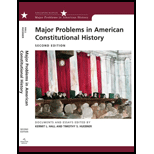
H-Law has posted a review, by Sally Hadden (Florida State University, Department of History), of the second edition of Major Problems in American Constitutional History: Documents and Essays (Boston: Wadsworth Cengage Learning, 2010), originally edited by Kermit Hall and transformed in this second edition by Timothy Huebner (Rhodes College, Department of History).

After identifying some of the original volume's utilities and limits, Hadden describes how the second edition is different: "Huebner, an expert on southern judges in both the antebellum and Reconstruction periods, has carefully transformed the two-volume set, pruning down the original 1000 pages by nearly half, to about 560 pages in all. He’s also taken the first edition’s 24 chapters and reduced them to 15."

Hadden offers particular examples of excised material, much coming from the pre-1865 period. She suggests that, "on balance, . . . when cuts were made, economic issues often lost out to topics like race and federalism in the new volume, since they continue to have strong coverage before and after 1865."

Hadden also notes changes to the secondary writing that accompanies the cases:
Every piece of secondary writing in the first edition has been revisited by Huebner, and most have been replaced with newer scholarship that brings students up to date on interpretive controversies and innovative thinking. Daniel Farber and James McPherson debate the merits of Lincoln on civil rights and collective rights. Derrick Bell and Kermit Hall (posthumously) argue the merits of the Brown legacy. John Yoo and Peter Irons duke it out on whether the president has legitimate augmented powers to combat terrorism. Important additions include the voices of Linda Kerber, Jan Lewis, Joan Hoff, and Catherine MacKinnon, who address the role of gender in constitutional interpretation at various points along the way. The secondary literature chosen to illuminate the primary sources in Major Problems is of the highest quality and reveals the fine touch of the editor’s hand.
For a fuller account of the changes (including a dozen new cases and revisions to the appendix), consult the full review, available here.

Monday, February 21, 2011

Roger Wilkins interviewed on NPR

As part of the commemoration of Black History Month, NPR's Michel Martin recorded a short interview with renowned lawyer, civil rights advocate, journalist, and historian Roger Wilkins. His legacy includes a long involvement with the NAACP, a Pulitzer Prize-winning role in exposing the Watergate scandal, and years of teaching history at George Mason University.

Here's an excerpt of the conversation, in which Wilkins recalls serving as a lawyer for the federal government in the 1960s:

MARTIN: I wanted to ask you, because you joined the Johnson administration when you were 33. Do I have that right?

Prof. WILKINS: Yeah.

MARTIN: About 33 years old. I just wonder, did you feel ambivalence about going into government at that age?

Prof. WILKINS: I went into government working on issues of poverty, and it was called then the Third World, I guess. And particularly I was - I cared about Africa. I came when Kennedy was president. There weren't that many black people in the government at the time. And you could do that work and say, I've got to do something to help. And so I helped and I pushed very, very hard. And I said - I took risks that frightened me, criticizing President Kennedy and Attorney General Kennedy.

(Soundbite of laughter)

Mr. WILKINS: An enraged Attorney General Kennedy said that, he, that green kid - I wasn't green; I was brown - that green kid, he'll never work under this Department of Justice as long as I'm attorney general, and that came true. They maybe mad at you but they discussed what you said.

Ultimately, it is what kind of human being am I? What kind of life am I going to create for myself? Can I stand around and with my two degrees from the University of Michigan and watch other people do the changes? I couldn't be a bystander.

The audio and full transcript are here.

The HistoryMakers (a non-profit that has archived thousands of African American oral histories) has also conducted a series of interviews with Wilkins. The finding aid is here.

Image credit

"Say Something Historical!"


The plenary session of the 2011 annual meeting of the American Historical Association, held in Boston last month, featured a panel on “History and the Public: A Session in Honor of Arnita Jones’ Commitment to the Public Work of Historians.” The panelists debated the proper role of historians in public life. The AHA’s Executive Secretary James Grossman called on historians to become more outspoken on issues of public concern. C-Span covered the event. Here is a link to coverage of the event.

The AHA's call for greater public engagement by historians likely will find support in many quarters. However, it also raises questions about precisely how historians should weigh in on public policy matters. In the past, historians' involvement in public matters has sometimes been quite controversial, at least where legislation or litigation was at issue. The nature of the controversy is twofold.

First, there is the "problem" of historical indeterminacy. Good history is multi-layered and may not provide definitive answers to questions posed. Historians may discover new facts or offer interpretations that illuminate public controversies, but they do so—at their best—through nuanced discussions of the past. Such nuance often make history less "usable" in the context of policy and adversarial legal settings—where clear answers and easily packaged explanations of complex phenomena have the greatest currency.

The indeterminacy problem gives rise to a second barrier to historians’ engagement in public life: a clash of professional cultures. To many, the practice of history and the realms of advocacy are at loggerheads. The idea of historians—professionals guided by truth-seeking and critical standards that favor complexity over simplicity—serving the public good by collaborating with political partisans or lawyers--professionals committed to advocacy for a cause who may not necessarily speak truth or might even distort it—is inherently questionable. Recall, for example, the controversy over the historians Rosalind Rosenberg and Alice Kessler-Harris' turns as experts in EEOC v. Sears, the 1980s' employment discrimination case, the former for the company and the latter for the EEOC. Many historians considered Rosenberg's position—in which she discounted the possibility that discrimination played a role in limiting women’s opportunities in certain employment sectors—an unacceptably “partisan” and strategic use of history. For discussions of the controversy, see Thomas Haskell & Sanford Levinson, Academic Freedom and Expert Witnessing: The Sears Case, 66 Tex. L. Rev. 1629 (1987-88), available here, and Alice Kessler-Harris, A Response to Haskell & Levinson, 67 Tex. L. Rev. 429 (1988-89), available here.

Like other historians, I have puzzled over the competing roles of historians and lawyers on many occasions. The question arises in several contexts: when historians submit amicus briefs to courts; sign letters or petitions in support of causes; or consult with interest groups, corporate bodies, or other entities. I even experience role tension when I teach subjects, such as constitutional law, that feature historicist arguments about contemporary public policy issues—ways of reasoning about history that often seem dubious to me in my capacity as a professional historian.

In reflecting on the question of whether and how historians should engage in public policy debates, I consulted the writings of the great John Hope Franklin. In his essay, "The Historian and Public Policy," (contained in Race and History: Selected Essays, 1938-1988 (Louisiana State, 1989) Franklin wrote about the constant barrage of requests he received asking him to weigh in on matters of public policy. He captured the ceaseless demand that he provide the “right” answer to pressing questions of the day in a pithy sentence. To him, all the requests posed the same dubious question: “Please sir, say something historical!”

The historian could not provide such easy insights, Franklin cautioned. In his view, the historian's craft and the worlds of public policy and litigation were deeply in tension.

But Franklin nonetheless encouraged historians to engage the issues of the day, as had he on many occasions (by serving as an expert for the team of NAACP lawyers in Brown v. Board of Education, for example). Because of the time and context in which he lived, Franklin concluded, he “could not have avoided being a social activist even if [he] had wanted to.” He continually experienced race-based discrimination, and at the same time, he possessed the professional skills to shed needed light on race-related controversies. Franklin could not stand by idly while others, including other historians, deployed evidence from history to defend segregation. Under the circumstances, Franklin felt obliged to participate in policy and legal debates.

Historical arguments are quite attractive and will be made. For example, historical claims are prominent in two high-profile litigation campaigns at present: the cases challenging the Obama administration’s health care law and the litigation challenging the continued necessity of the Voting Rights Act of 1965.

When history is featured in policy battles or litigation, partisans much less inclined than professional historians to tell the truest story possible, given the available evidence, often are the first to trumpet historical arguments. Or, the partisan in question might be a professional historian, one who clings to the virtue of "objectivity" while engaging in partiality—excluding certain actors, viewpoints, events, interpretations, and analytical tools.

In these situations and others, perhaps it is irresponsible to disengage from public conversation. And one can appreciate the request to "say something historical!" and oblige. Context is everything.

OAH Election Results

The Organization of American Historians has announced its election results. They are:

President

Alice Kessler-Harris, R. Gordon Hoxie Professor of American History, Department of History and Institute for Research on Women and Gender, Columbia University

President-Elect

Albert M. Camarillo, Miriam and Peter Haas Centennial Professor in Public Service and Professor of History, Stanford University

Vice President

Alan M. Kraut, University Professor of History, American University

Executive Board

Michele Mitchell, Associate Professor of History, New York University
Elizabeth Clark-Lewis, Professor of History, Howard University
Peter Kolchin, Henry Clay Reed Professor of History, University of Delaware

Nominating Board

David Waldstreicher, Professor of History, Temple University
Linda Gordon, Professor of History, New York University
Bruce A. Ragsdale, Director, Federal Judicial History Office, Federal Judicial Center.

Congratulations!

image credit

Parker on Historicizing Blackstone

Kunal M. Parker, University of Miami School of Law, has posted Historicizing Blackstone’s Commentaries on the Laws of England Difference and Sameness in Historical Time, which is forthcoming in The Treatise in Legal History, ed. Markus Dubber and Angela Fernandez (Hart Publishing), a conference volume. Here is the abstract:
This paper examines the career of Sir William Blackstone's Commentaries on the Laws of England from its first appearance in the 1760s into the twentieth century. Specifically, it asks what we can learn about the nature of historical knowledge itself through an exploration of the different editorial practices to which the Commentaries were subjected over the course of two centuries or more. The paper first explores how the Commentaries went from being objects of active "use" to being akin to museum objects venerated for their "style." The paper then undermines this narrative by showing how "style," uncannily, lay at the heart of all the different and contradictory editorial practices to which the Commentaries were subjected, from those most violative of the text's integrity to those most solicitous of it. The paper attempts to confront a question troubling for historians: how do we come to terms with "style"? How do we come to terms with "style's" repeated invocation as various editors sought to fit the Commentaries to the perceived needs of their times?

Sunday, February 20, 2011

"Amid both the gloom of the season and the recent uprisings in the Arab world, it is bracing to look back at the last thirty years or so and see how much has actually gone more or less well," writes Brian Urquhart, reviewing Civil Resistance and Power Politics: The Experience of Non-violent Action from Gandhi to the Present edited by Adam Roberts and Timothy Garton Ash, and Facts Are Subversive: Political Writing from a Decade Without a Name by Timothy Garton Ash, in the New York Review of Books.

Nick Cullather,The Hungry World: America’s Cold War Battle Against Poverty in Asia, is a "brilliant new book," writes David Reiff for The Nation.
Washington...launched the Green Revolution as a bulwark against the challenges it faced across Asia throughout the cold war. The first challenge came with the victory of Communism in China in 1949, and the subsequent failure of the American military, which had defeated Japan and Germany several years earlier, to secure a less than advantageous stalemate at the end of the Korean War. Then came the development during the 1950s of powerful guerrilla insurgencies in the United States’ former colony, the Philippines, and in British-ruled Malaya (as well as Indochina, obviously). There was also the far more critical matter of India’s apparent growing inability to feed its rapidly rising population, and the increasing disaffection among the country’s numerical majority, the rural poor who had long formed the base of support for the ruling Congress Party. Washington’s ability to sustain its hegemony in Asia was very much in doubt....

Before long, American aid experts had developed a one-sentence catchphrase to describe the phenomenon: “Where hunger goes, Communism follows.”...More than military operations or covert action (not that Washington forswore either of these, not to mention collusion in massacres of Communist Party members by America’s local allies), the Green Revolution became the weapon of choice to ensure that the balance of power remained in America’s favor.
Continue reading here.


The book review is "a late 17th-century invention for knowing about a book - or claiming to know about it - without reading it," writes James Delbourgo in a review of Too Much to Know: Managing Scholarly Information before the Modern Age by Ann M. Blair in the Times Higher Education supplement.

The Presumption of Guilt: The Arrest of Henry Louis Gates Jr. and Race, Class, and Crime in America, by Charles J. Ogletree Jr., and The New Jim Crow: Mass Incarceration in the Age of Colorblindness by Michelle Alexander are taken up in the NY Review of Books.

Also reviewed this week:  In the Times Higher Education supplement:  How to Change the World: Tales of Marx and Marxism by Eric HobsbawmIslanders: The Pacific in the Age of Empire by Nicholas Thomas, and The Colors of Zion: Blacks, Jews, and Irish from 1845 to 1945 by George Bornstein.  In the Los Angeles Times, The Shah (on the last Shah of Iran), by Abbas Milani. In the Boston Globe, KNOWN AND UNKNOWN: A Memoir, by Donald Rumsfeld.

Saturday, February 19, 2011

Weekend Round-up

  • How should writers respond to criticism? Can "extreme negative reviews" be, in author Tao Lin's words, "helpful," "fun," and "interesting"? Find food for thought here and here. (Hat tip: bookforum)
  • We spend lots of time thinking about what to write. Should we also be thinking about what not to write? Over at Prawsblawg, Lyrissa Lidsky makes the case.
  • The history of deinstitutionalization in the mental health context contains lessons for current efforts to reduce mass incarceration. So argues Bernard Harcourt in a recent Balkinization post.
  • Over at the Chronicle of Higher Ed, Julie Miller Vick and Jennifer Furlong discuss what faculty members can do to make graduate students aware of non-academic career options and to help them succeed in alternative paths.
  • In memory of Executive Order 9066, signed 69 years ago today, Eric Muller uses an archival find to reflect on "the sorry roles that American lawyers played in setting up, operating, and defending the system of racial and ethnic oppression." You can find his post here, at the Faculty Lounge.
The Weekend Round-up is a weekly feature compiled by all the Legal History bloggers.

Friday, February 18, 2011

American Journal of Legal History has a new website

The American Journal of Legal History (published by Temple University Beasley School of Law) has announced that it now has a website.

Here is a sampling of what you'll find there:
Current Issue

Forthcoming Issue

Submissions

Editors
Hat tip: H-Law

Maveal on The First Generation of the Detriot Legal Aid Bureau

The First Generation of the Detroit Legal Aid Bureau is an article by Gary Maveal, University of Detroit Mercy School of Law.  It appeared in the Windsor Yearbook of Access to Justice, Vol. 24, No. 2, 2006.  Here's the abstract:
This paper recounts the 1909 founding and first thirty years of Detroit Bar Association’s Legal Aid Bureau. Part of a national legal aid movement, the Bureau was the first such society to be sponsored by a private bar association. The history reveals the integral role that brothers Fred and Henry Butzel had in the Bureau’s development and focuses on the work of the first three directors of the office over its first decades: Edward Pokorny, Otto Wismer, and Louis Miriani.
From its beginnings as strictly part-time work by Edward Pokorny, a sole practitioner, the Bureau grew after World War I with the assistance of funding from the Detroit Community Fund, a consortium of social welfare societies.

As its second director, Otto Wismer oversaw the establishment of suitable and permanent offices where the Bureau served as an integral part of the Community Fund, serving as house counsel to the City’s charities. Wismer was also active in the national association of legal aid organizations and worked to develop a statewide network of legal aid. The third director, Louis Miriani, realized a measure of the agency’s promise by litigation and public education to make the Bureau a respected voice for the cause of legal aid.

Using the Bureau’s annual reports and newspapers as primary sources, the paper surveys the work for the City’s poor, with emphasis on the social background of that clientele. It attempts a critical assessment of each directors’ term after analyzing their work in the context of Detroit’s phenomenal growth during the early twentieth century. It concludes that, despite the valuable efforts of the directors, the Bureau’s limited resources resulted in their work failing to meet the demand for legal services.

Robinson on Japanese Confinement in North America

Columbia University Press has posted an excerpt of Greg Robinson, A Tragedy of Democracy: Japanese Confinement in North America (2009). It's taken from Chapter 5: Military Service and Legal Challenges, and is about the imposition of martial law in Hawaii. You can access it here. (For a fuller sense of the scope of the book, see the TOC, here.)

The Press has also posted a brief interview with the author. Robinson (l'Université du Québec à Montréal) addresses why we need a new book on a topic that seems to be well covered and why this history is relevant today.

I found interesting his explanation of why he uses the word "confinement" rather than "internment":
In technical legal terms, the word “internment” refers to the imprisonment of enemy aliens by governments in time of war. The Justice Department did intern a few thousand Japanese aliens, as well as a similar number of German and Italian aliens, in this manner. All such aliens were granted hearings soon after they were taken into custody, and only those individuals considered dangerous were actually interned. In Canada the federal government interned hundreds of Italian Canadian aliens in addition to some citizens and only later granted them hearings. However, this differs greatly from the shoddy treatment received by West Coast Japanese Americans and Japanese Canadians, where entire populations consisting predominantly of native-born children were taken away with no hearings and locked away in remote areas despite the fact that they were citizens. The word “internment” is even less useful for Mexico’s treatment of Japanese since people were forced to move themselves. That there is no exact term to define these actions reveals how unprecedented and extralegal they were, although both governments invented euphemisms such as “evacuation” for them. In order to avoid confusion and promote understanding, I chose to use the words “removal” and “confinement” because they give a reasonable sense of what occurred and are also inclusive enough to cover the gamut of policies that were put in place in different countries.
You can read the rest of the interview here.

Image Credit; Hat tip: bookforum

Thursday, February 17, 2011

Sundby reviews Davies, Rising Road: A True Tale of Love, Race, and Religion in America

The Conundrum of Zealous Representation is a review essay by Scott E. Sundby, Washington and Lee University School of Law.  It appears in the Ohio State Journal of Criminal Law, Vol. 8, No. 2, 2011.  Here's the abstract:
Hugo Black
In her book, Rising Road: A True Tale of Love, Race, and Religion in America, Sharon Davies recounts the fascinating tale of a murder that commanded national attention when it occurred in 1920. The events leading up to the killing would do justice to any novelist’s imagination: a Methodist minister, Edwin Stephenson, murders a Catholic priest upon learning that the priest had just married the minister’s 18 year-old daughter to a Catholic man who also is a "foreigner." Adding to the emotional turmoil surrounding the case, the murder and the ensuing trial take place in Birmingham, Alabama during a time when anti-Catholic fervor is sweeping across the South. But just in case that volatile mix is not sufficient to pique the reader’s interest, who is Stephenson’s defense attorney? None other than Hugo Black, a rising star in the Alabama bar with a personal grudge against the district attorney. This review uses Hugo Black’s actions during the trial – especially his willingness to engage in tactics that draw off of the religious and racial overtones of the murder – as a way of thinking about what constitutes "zealous" representation of a client. By looking at how Black conducted the defense – building from vigorous cross-examination on up to a courtroom display that Davies quite rightfully terms "extraordinary" for its inflammatory potential – this essay asks the question of whether Black at some point crossed an ethical line from "zealous" to "overzealous" representation.

"Wartime" becomes "Crisis Time" in post-9/11 Legal Thought

With the tenth anniversary of September 11 coming up this year, we are sure to see efforts to take account of the past decade.  There will be tireless repetition of the idea that “everything changed” on September 11.  But it should also be an occasion for meaningful examination of the era of 9/11 as a moment in history.  This is the first of a short series of posts on post-9/11 American legal thought (and it is part of the “wartime” project that some readers will be familiar with).

Legal scholars argued over Bush administration policies, of course.  But underlying these expected disagreements were divisions over just what the post-9/11 environment was, with debates over whether “war” or “state of emergency” was the better way to frame the sort of security environment Americans found themselves.  Many adopted the wartime frame and supported an expansion of executive power, emphasizing the idea that wartime justified government action to address the danger.  Some international law scholars countered that the war on terror did not fit the definition of war under international law.  This mattered since the switch from peace to war triggered the application of the law of war and international human rights protections.  Bruce Ackerman argued that this era was not a war, but an emergency.  Before long “emergency” or “crisis” became dominant ways of describing the era.  Some scholars re-characterized wartimes in American history as emergency times, and at least one important scholarly paper about the impact of war on American courts was renamed, substituting “crisis” for “war.”

Underlying the disagreement about how to characterize the post-9/11 era was the concern that “wartime” called for the suspension of normal restrictions on executive power.  Searching for workable analogies, Mark Tushnet argued that
the long duration of the “war on terrorism” suggests that we ought not to think of it as a war in the sense that the Second World War was a war. It is, perhaps, more like a condition than a war -- more like the war on cancer, the war on poverty, or, most pertinently, the war on crime. Suspending legality during a time-limited war is one thing. Suspending it during a more or less permanent condition is quite another. 
The play in the terms of post-9/11 scholarship reveals a broader issue.  Like the Cold War era, there was a lack of fit between the conceptual categories of wartime and peacetime and the geopolitical era which scholars confronted.  An essential element of a traditional wartime was that war was temporary.  And in the past, war was most commonly defined as a conflict between nations, not between a nation and a social group or an ideology.  The state had dropped out of many definitions of war by the end of the 20th century.  But the war on terror also seemed to defy the idea that war was limited in time.

Most legal scholars responded not by jettisoning the old categories, but by renaming and re-imposing them, retaining the distinction between normal times and exceptional times.  For example, in a 2005 essay, Samuel Issacharoff and Richard H. Pildes described the dividing lines not as between wartime and peacetime, but between “normal times” and “times of heightened risk to the physical safety” of citizens. Post-9/11 scholarship persisted in the assumption that normality is a state of existence outside times of danger. “Wartime” and “peacetime” broke down, but the basic temporal structure (normal times, ruptured by non-normal times) largely remained in place in legal thought, even if it seemed unclear whether normal times would ever return.

While many drew comparisons between the post-9/11 era and other wartimes, for Benjamin Wittes, the era had a different character, for the war on terror was “a conflict unlike any that this country has ever faced.”  For Wittes, it was reasonable for the Bush Administration to adopt a war model after 9/11, but later in the decade the war on terror had “entered a different phase” in which “traditional warfare had given way to something more elastic.” As the immediacy of September 11 receded, the nation seemed to enter an ambiguous era that was neither wartime nor peacetime.  For the most part, however, scholars, courts and lawmakers continued to employ the old categories, although wartime had been renamed as crisis time.

Up next: The turn to Schmitt.


Cross-posted from Balkinization.

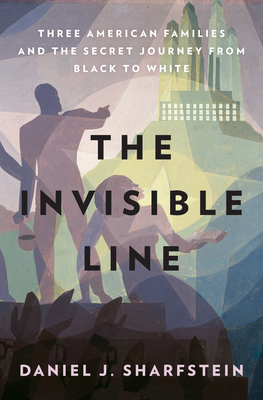
Sharfstein, The Invisible Line: Three American Families and the Secret Journey from Black to White

The Invisible Line: Three American Families and the Secret Journey from Black to White by Daniel J. Sharfstein is released today by Penguin.  Here's the book description:
In America, race is a riddle. The stories we tell about our past have calcified into the fiction that we are neatly divided into black or white. It is only with the widespread availability of DNA testing and the boom in genealogical research that the frequency with which individuals and entire families crossed the color line has become clear.

In this sweeping history, Daniel J. Sharfstein unravels the stories of three families who represent the complexity of race in America and force us to rethink our basic assumptions about who we are. The Gibsons were wealthy landowners in the South Carolina backcountry who became white in the 1760s, ascending to the heights of the Southern elite and ultimately to the U.S. Senate. The Spencers were hardscrabble farmers in the hills of Eastern Kentucky, joining an isolated Appalachian community in the 1840s and for the better part of a century hovering on the line between white and black. The Walls were fixtures of the rising black middle class in post-Civil War Washington, D.C., only to give up everything they had fought for to become white at the dawn of the twentieth century. Together, their interwoven and intersecting stories uncover a forgotten America in which the rules of race were something to be believed but not necessarily obeyed.

Defining their identities first as people of color and later as whites, these families provide a lens for understanding how people thought about and experienced race and how these ideas and experiences evolved-how the very meaning of black and white changed-over time. Cutting through centuries of myth, amnesia, and poisonous racial politics, The Invisible Line will change the way we talk about race, racism, and civil rights.
The press posts many blurbs, including:
"The Invisible Line" shines light on one of the most important, but too often hidden, aspects of American history and culture. Sharfstein's narrative of three families negotiating America's punishing racial terrain is a must read for all who are interested in the construction of race in the United States."
--Annette Gordon-Reed, Pulitzer Prize winning author of The Hemingses of Monticello


"An original and often startling look at the vagaries of the 'color line.' Sharfstein shows definitively that it was not a doctrinaire belief in racial purity that gave the South stability but rather a fluid understanding by its people and its institutions of racial difference and its multiple permutations."
-Henry Louis Gates Jr., Alphonse Fletcher University Professor, Harvard University

"A tremendous contribution to our understanding of the role of race in American history . . . One of those rare books that make history come alive."."
-Lawrence M. Friedman, Marion Rice Kirkwood Professor, Stanford Law School; author of A History of American Law 

"A beautifully written book that reveals not only how the law has shaped American ideas about race but also how the complexity of human experience has pushed against the rigid boundaries of our legal categories."
-Mark S. Weiner, professor of law, Rutgers-Newark School of Law; author of Black Trials

"Brilliant . . . a true American story. Its consequences pervade the American past and shadow its future."
-Ira Berlin, professor of history at the University of Maryland, author of The Making African America

"A must-read for all serious students of the race line in American life, written with care, verve, sophistication, and enormous learning."
--Randall Kennedy, Michael R. Klein Professor of Law, Harvard University  

 And Dan has upcoming book signings, and a virtual book tour!

Bernstein Reviews Maier, Ratification

Our friends at H-Law have posted a review of Pauline Maier, Ratification: The People Debate the Constitution, 1787-1788 (Simon & Schuster, 2010).

Here's how R. B. Bernstein (New York Law School) opens his review:
On February 6, 1788, in a major speech during the concluding session of the Massachusetts ratifying convention, Governor John Hancock noted that “[t]he people of this Commonwealth” are a people “of great intelligence in public business” (p. 206). Hancock’s shrewd compliment applies not only to the people of Massachusetts but to the people of the United States during the great national discussion whether they should adopt or reject the proposed Constitution of the United States. The ratification controversy, both its formal institutions and processes and its informal process of debate and disputation, continues to show the American people at their political and principled best (and, occasionally, at their factional worst). Oddly, despite its intrinsic interest and its remarkable drama and excitement, never until now has the ratification of the Constitution received the comprehensive historical treatment that it deserves. The book under review--large, entertaining, rigorously argued, and formidably researched--does just that. Ten years in the making, it was worth the wait.
The review goes on to place Ratification in the context of Maier's previous scholarship, to give the reader a sense of the book's coverage (Bernstein calls it "truly comprehensive"), and to note the significant research obstacles that Maier overcame.

Bernstein concludes by identifying Ratification as "one of the two starting-points for future historians of the adoption of the Constitution" (the other being The Documentary History of the Ratification of the Constitution and the Bill of Rights, 1787-1791). He devotes the rest of the review to outlining four lines of inquiry and analysis that future scholars may wish to pursue.

The full review is here.

You can find another review, by David Sehat (Georgia State University), at the Intellectual History Blog, here.

Wednesday, February 16, 2011

Cavanagh on Sovereignty, Subjects, and the Hudson's Bay Company, 1670-1763

A Company with Sovereignty and Subjects of its Own? The Case of the Hudson's Bay Company, 1670-1763 is a new article by Edward Cavanagh, University of the Witwatersrand.  It appears in the Canadian Journal of Law and Society (Revue Canadienne Droit et Société), Vol. 26, No. 1, 2011.  Here's the abstract:
Questions about the ways in which colonial subjects were acquired and maintained, and how it was that multiple and often contradictory sovereignties came to overlap in history, may not be purely academic. We raise them today because they spring from issues that remain unresolved, concerning rights to land, resources, and self- determination. Following recent scholarship on the English East India Company, the author redefines the Hudson’s Bay Company, during the period before widespread settler colonialism, as a state (or “company-state”), and in this way argues that the HBC-state possessed its own kind of sovereignty. The article make three main arguments: that it was up to the HBC, not the Crown, to found Rupert’s Land, defend its establishments, make alliances with locals, and challenge intruders; that HBC rule extended to cover not only the company’s employees but, eventually, an indigenous “home guard” population; and that the HBC welfare regime transformed the relationship between ruler and ruled.

Inaugural James and Mary Lassiter Conference: Structural Racism in the U.S.

On February 25, 2011, the University of Kentucky College of Law will host the Inaugural James and Mary Lassiter Conference. The topic is Structural Racism: Inequality in America Today. Here's the conference abstract.
Whenever we see disparate racial outcomes in American society -- in education, health care, housing, criminal justice, or work opportunities -- we are seeing structural racism at work. But this is a form of racism that most white Americans do not perceive. Our society believes racism is both conscious and intentional, so that our legal system often ignores discriminatory effects unless the claimant can show explicitly racially-discriminatory intent. But sociologists discount intent when they analyze social processes. They have demonstrated that social structures and processes produce disparate racial outcomes without conscious intent.

Structural racism appears in our dependence on local property taxes for public school funding, or reliance on social networks to spread information about job openings, or subjective decision-making in the workplace, or a housing market that is driven by unconscious stereotypes, or the on-going exclusion of domestic and farm workers from Social Security benefits. Each example appears on the surface to be race-neutral. Yet their outcomes consistently disadvantage people of color.

The College of Law, Prof. William Wiecek, the inaugural Lassiter Distinguished Visiting Professor at the UK College of Law, faculty from many disciplines at UK, and presenters from other area universities and organizations are pleased to share their research and work on the racial disparities in outcomes and the structural processes that produce those disparities.

The goal of the conference is to engage in a cross-disciplinary exploration of structural racism in order to enable cross-disciplinary action to dismantle structural racism.
Based on the schedule, the legal historical perspective will be well represented. In addition to Professor Wiecek, presenters and commentators include Darrell Miller (University of Cincinnati Law), Owen Williams (Transylvania University), Patricia Minter (Western Kentucky University History), Jakobi Williams (University of Kentucky History), and Ron Formisano (University of Kentucky History).

You can find more information here.

Hat tip: Poverty Law

Tuesday, February 15, 2011

Babcock, Woman Lawyer: The Trials of Clara Foltz

Barbara Babcock's long awaited book, Woman Lawyer: The Trials of Clara Foltz has just been published by Stanford University Press.  A must read for anyone interested in women and the law, and the history of the legal profession.  Here's the book description:
Woman Lawyer tells the story of Clara Foltz, the first woman admitted to the California Bar. Famous in her time as a public intellectual, leader of the women's movement, and legal reformer, Foltz faced terrific prejudice and well-organized opposition to women lawyers as she tried cases in front of all-male juries, raised five children as a single mother, and stumped for political candidates. She was the first to propose the creation of a public defender to balance the public prosecutor. Woman Lawyer uncovers the legal reforms and societal contributions of a woman celebrated in her day, but lost to history until now. It casts new light on the turbulent history and politics of California in a period of phenomenal growth and highlights the interconnection of the suffragists and other movements for civil rights and legal reforms.
And the blurbs:

"Barbara Babcock is one of our leading legal historians. Woman Lawyer gives voice to Clara Foltz's long and fascinating life, making vivid her important contributions as a reformer, 'first' woman lawyer, and legal thinker. It will establish itself as a classic in legal studies, women's studies, and American biography."—Jill Norgren, City University of New York

"Beautifully written and meticulously researched, Woman Lawyer provides a riveting portrait of a remarkable woman and her journey as a mother of five to becoming one of the first women lawyers in United States. Yet even more memorable is this book's evocation of another frontier: California on the brink of its modern identity, forged in the middle of an economic challenge and intense racial and class conflict. Unflinching in its assessment of the temptations of demagoguery to the pioneering Clara Foltz, Barbara Babcock has produced a compelling book of enormous and enduring insight into how even gifted and visionary individuals navigate, shape, and reflect political and social contests."—Martha Minow, Dean of Harvard Law School

"Barbara Babcock's wonderful book only reinforces my view that being a public defender has been the most rewarding part of my professional career. Clara Foltz is my hero, and this book chronicles the challenges and achievements of perhaps the greatest public defender ever." —Charles Ogletree, Harvard Law School

"In her engrossing new book, Woman Lawyer: The Trials of Clara Foltz, Barbara Babcock acknowledges that, for her, full detachment from her courageous, charismatic subject—California's first woman lawyer—is not possible. In fact, full detachment from Clara Foltz is not possible for any of her 'daughters in the law,' and beyond the law. Foltz's struggles to gain a foothold in several all-male worlds, powerfully told, connect to so many of us, across the nation and across the centuries."—Judith S. Kaye, Chief Judge of the State of New York

"Barbara Babcock conjures and brings to life a nearly-forgotten feminist hero. This account of Clara Foltz's rise from an under-educated farmer's wife to an icon of the California women's movement and a national public intellectual is both riveting and strangely familiar. That a single mother of five could have exploded into the hurly-burly world of California in the 1870s and—through mastery of the media, manipulation of her public image, and dogged hard work—become a national force for early progressive jurisprudence is astonishing. That women in 2011 could have no collective memory of Foltz is tragic. Babcock brings Foltz back to us with great tenderness and subtlety, reclaiming a place in American legal history for a working mother and national thinker who has much to teach us still."—Dahlia Lithwick, Senior Editor, Slate
Read the Preface here, and the Introduction here.  And the book has a great Facebook page!  See also Babcock's Women's Legal History website, a terrific resource.