[We have the following announcement.]
Following on (finally!) from the Legal Histories of the British Empire conference in Singapore in 2012, we are pleased to announce "Legal History and Empires: Perspectives from the Colonized," jointly sponsored by the Faculty of Law and Faculty of Humanities and Education, University of the West Indies, Cave Hill Campus, Barbados, 11-13 July 2018. A website and CFP will be announced in the new year. It’s a way off, but as we know July is always busy, so here is a heads up! Save the Date!
For preliminary inquires please contact Shaunnagh Dorsett (shaunnagh.dorsett@uts.edu.au) or Asya Ostroukh (asya.ostroukh@cavehill.uwi.edu).
Monday, October 17, 2016
Sunday, October 16, 2016
Sunday Book Review Roundup

Here's a roundup of some legal history related book reviews published this week. Those of you whose Sunday morning begins with a visit to the Legal History Blog may have noticed that it is tardy. My apologies!
Reviewers and publishers are thinking about voting rights these days (I can’t imagine why…). In the NYRB, David Cole’s How Voting Rights Are Being Rigged covers Give Us the Ballot: The Modern Struggle for Voting Rights in America by Ari Berman and The Great Suppression: Voting Rights, Corporate Cash, and the Conservative Assault on Democracy by Zachary Roth. In The New Republic, Alan Wolfe takes on Roth’s book as well as Jason Brennan’s Against Democracy, which “argues for the establishment of an epistocracy, or rule by the wise.” (IQ tests at the voting booth? How could that possibly go wrong...?).
 Also in the NYRB, Gerard Russell reviews three books on the recent political movements in the Middle East by Jean-Pierre Filiu,
 Thanassis Cambanis and Robert F. Worth. In the same issue, James McPherson reviews a new history of abolition
 by Manisha Sinha and Ian Johnson reviews four books on the Cultural Revolution-- Guobin Yang’s The Red Guard Generation and Political Activism in China, Frank Dikötter’s The Cultural Revolution: A People’s History, 1962–1976, Yang Kuisong’s “Bianyuanren” Jishi [A Record of “Marginal People”]; an edited volume entitled Maoism at the Grassroots: Everyday Life in China’s Era of High Socialism, and The Secret Archives of the Cultural Revolution in Guangxi, an eighteen-part report on the Cultural Revolution made from 1986 to 1988 under the instructions of reformist Party leader Hu Yaobang.
In the NY Times, Adam Kirsch reviews Hitler: Ascent 1889-1939 by Volker Ulrich, who “sees his subject as a consummate political tactician, and still more important, as a gifted actor.”
In the Washington Post, Mary Louise Kelly, NPR’s National Security correspondent, reviews Rogue Heroes, Ben Macintyre’s “riveting new history” of Britain’s Special Air Service—or SAS. Macintyre’s book is also reviewed in The Guardian. Also in The Guardian, Colin Kidd summarizes Ron Chernow’s biography of Alexander Hamilton, which is being published for the first time in the UK as a “taster” for the musical’s opening in London in 2017.
In the Times Literary Supplement, Stephen Lovell reviews The Romanovs by Simon Sebag Montefiore, which has a “gossipy charm that readers will recognize from his earlier work” and as it looks into the “inner chambers” of the Russian dynasty.
In The Nation, Jedediah Purdy reviews John Judis’s The Populist Explosion: How the Great Recession Transformed American and European Politics and What Is Populism? Jan-Werner Müller’s take on populism in Western Europe.
In the LA Review of Books, Amy Brady reviews Richard Kluger’s, Indelible Ink: The Trials of John Peter Zenger and the Birth of America’s Free Press, which “tells the complex and thoroughly engaging history leading up to and including the moment of Zenger’s trial for seditious libel of a government figure,” and Stephen Rhode reviews two new books on the death penalty, Courting Death: The Supreme Court and Capital Punishment (which provides “a clear and comprehensive look at the 40-year modern history of capital punishment in the United States since its reinstatement in 1976”) and Against the Death Penalty (which provides an introduction to Justice Breyer’s dissenting opinion on the death penalty in Glossip v. Gross (2015) and “could chart the legal roadmap to ending this irreversible form of criminal punishment.”).

The LA Times features a review of The General vs. the President: MacArthur and Truman at the Brink of Nuclear War, H.W. Brands’ “highly readable take on the clash of two titanic figures in a period of hair-trigger nuclear tensions.”
This month’s issue of The Federal Lawyer features reviews of Mervyn King’s The End of Alchemy: Money, Banking, and the Future of the Global Economy (review by Christopher C. Faille), Melvin I. Urofsky’s Dissent and the Supreme Court: Its Role in the Court’s History and the Nation’s Constitutional Dialogue (review by John C. Holmes), Nick Bunker’s An Empire on the Edge: How Britain Came to Fight America (review by proud Rhode Islander Neysa M. Slater-Chandler) and Shoba Sivaprasad Wadhia’s Beyond Deportation: The Role of Prosecutorial Discretion in Immigration Cases (review by R. Mark Frey).
And in the New Rambler, Peter Conti Brown’s The Federal Reserve’s Big Bang and the Challenge of Institutional History covers America’s Bank: The Epic Struggle to Create the Federal Reserve by Roger Lowenstein. “By lacing his historical narrative with constant references to the recent financial crisis,” Conti-Brown says, “Lowenstein’s is a presentist history, visiting the past not as a foreign country but as the direct antecedent and guide to what we experience in the present.”


Saturday, October 15, 2016
Weekend Roundup
- Katherine Turk, University of North Carolina at Chapel Hill, will present in the Washington History Seminar on Equality on Trial: Gender and Rights in the Modern American Workplace, on Monday, October 17, 2016, 4:00pm - 5:30pm, at the Woodrow Wilson Center.
- At 6:30 p.m., on Tuesday, October 25, Michael Schoeppner, University of Maine-Farmington, will present Moral Contagion: A Brief History of Danger, Fear and Border Control in America, in the Performance Space in the Emery Community Arts Center on the UMF campus. It is one of UMF’s Public Classroom series of lectures. More.
- "The Heyburn Initiative for Excellence in the Federal Judiciary, in partnership with the University of Kentucky College of Law and UK Libraries, will establish an archives and oral history program for Kentucky’s federal judges and a national lecture series on relevant judicial topics.” More.
- Fordham Law Review 85:1 (October 2016) is a special issue commemorating the 125th anniversary of the U.S. Court of Appeals for the Second Circuit. Contributors include Judge Robert A. Katzmann and John Fabian Witt.
- The John Marshall Law School announces that Professor Samuel Olken has been named the Edward T. and Noble W. Lee Chair in Constitutional Law for the 2016-2017 academic year. In that capacity he will “research, write and speak on constitutional law,” with a special focus on “Chief Justice John Marshall's use of the preamble to interpret the interstices of the Constitution.” More.
- On October 25, the Claremont Institute and Federalist Society will present The Jurisprudence of Clarence Thomas: 25 Years on the Court, in Kennedy Caucus Room (Room 325), Russell Senate Office Building, US Senate.
- CFP: The Newberry Center for Renaissance Studies has a Call out for its 2017 Multidisciplinary Graduate Student Conference, which will showcase work on medieval, Renaissance, and early modern studies of Europe, the Americas, and the Mediterranean world. The deadline is very very soon: Oct.16! Details here.
- The UCI Chancellor's Postdoctoral Fellowship Program in Criminology, Law & Society offers postdoctoral research fellowships and faculty mentoring to qualified scholars in the field whose research, teaching, and service will contribute to diversity and equal opportunity. The deadline is Nov.1, 2016. Full information about the program is here.
- The Wisconsin Discussion Group on Constitutionalism--AKA the Con Law Schmooze--convened at the UW Law School over the Sept.30-Oct.1 weekend. The theme was "Reconstitution: Politico-Legal History as Constitutional Change."
Update: John Fabian Witt, Yale Law School, will deliver the Hands Lecture, Adjudication in the Age of Disagreement, during a special session of the US Court of Appeals for the Second Circuit commemorating the 125th anniversary of the court at 4:00 p.m. on October 26 in the Thurgood Marshall Courthouse, 40 Foley Square, Room 1703, New York City. H/t: SBG.
Weekend Roundup is a weekly feature compiled by all the Legal History bloggers.
Friday, October 14, 2016
Giuliani on Comparative Legal History and the Antiformalist Turn (in Europe)
Adolfo Giuliani, University of Perugia, Facoltà di Giurisprudenza, has posted What is Comparative Legal History? Legal Historiography and the Revolt Against Formalism, 1930-60, which is forthcoming in Comparative Legal History: A Research Handbook in Comparative Law, ed. Aniceto Masferrer, Kjell Å Modéer, and Olivier Moréteau (Elgar 2016):
What is comparative legal history? This essay aims to show that to understand the rise of this field of inquiry we need first to clarify how historiography changes in time. To this purpose, this essay begins from two main ideas.
First, the writing of legal history is deeply intertwined with an image of law which tells us what is law, how it is created and by whom. This is in fact the premise for doing legal history, as it determines the object of investigation.
Second, the decades 1930-60 saw a profound turn in European legal science. Some legal scholars challenged the legacy received from the 19th century and launched an attack on the ‘formalism’ at the heart of its intellectual framework.
Those path-breaking insights gave life to a wave of works self-styled as comparative legal history published in the period 1930-60. At their heart were some of the innovative ideas that have fueled original legal-historical research in the last decades, and which today are shared as an obvious truth (e.g. to place law in context, to think outside the doctrinal box, the dislike of abstract theorising). They are the fruit of the antiformalist turn of the 1930-60.
Brenner and Knake on Shortlisted Women for the US Supreme Court
Hannah Brenner, California Western School of Law, and Renee Newman Knake, University of Houston Law Center, have posted Shortlisted, which is forthcoming in the UCLA Women's Law Journal:
Mildred Lillie fortunately had no children, as the New York Times noted in 1971, and even in her fifties, maintained “a bathing beauty figure.” Lillie was not, however, a swimsuit model. She was one of President Nixon’s possible nominees to the United States Supreme Court. “Shortlisted” tells the stories of nearly a dozen extraordinary women considered for the Court, but ultimately not nominated, before Justice Sandra Day O’Connor became the first in 1981. The public nature of the nomination process enables us to analyze the scrutiny of these women by the profession and media, and analogize to those similarly not selected, elected, or appointed to political office, corporate governance, the judiciary, law firm partnership, and other positions of power. We find that the stories of those women who did not attain these various power roles are as compelling as those who did. Our work builds upon and transcends previous scholarly work on the theory of the “leaking pipeline” — i.e. that women enter the profession in numbers equal to men but do not advance — and dispels the persistent myth that there is a dearth of sufficiently qualified women. The framework for this project, exploring decades of women shortlisted to the Court pre-O’Connor from Presidents Roosevelt to Reagan, allows gender bias to be viewed in a vibrant historical context and illuminates ideas for future advancement of women in law and beyond. "Shortlisted" explores the gendered experiences of this elite group of women — both professional and personal — and situates their stories within the context of gender, judging, and the legal profession. This project is one of first impression. We are the first scholars to identify and assess these women together in light of their shared experience of being shortlisted. Their individual and collective stories have largely gone untold. Until now.
Thank you, Gautham Rao!
A big thanks to Professor Gautham Rao for joining us as a guest blogger this past month. Links to his posts are below:
- On the long, slow road toward publishing National Duties (University of Chicago Press, 2016): "Sigh, Argh, Whoa" (including getting the question “are you sure you want to do history?”)
- On "Sexy History, Legal History and History Departments" (easily winning the prize for best-titled guest blogger post in recent memory)
- On his next big project: "The State the Slaveholders Made"
Thursday, October 13, 2016
Waxman on Hughes and the Power to Wage War Successfully
Matthew C. Waxman, Columbia Law School, has posted The Power to Wage War Successfully, which is forthcoming in the Columbia Law Review:
H/t: Legal Theory BlogA century ago and in the midst of American involvement in World War I, future Chief Justice Charles Evans Hughes delivered one of the most influential lectures on the Constitution in wartime. It was in that address that he uttered his famous axiom that “the power to wage war is the power to wage war successfully.” That statement continues to echo in modern jurisprudence, though the background and details of the lecture have not previously been explored in detail. Drawing on Hughes’s own research notes, this Article examines his 1917 formulation and shows how Hughes presciently applied it to the most pressing war powers issues of its day — namely a national draft and intrusive federal economic regulation. It also shows, however, how he struggled unsuccessfully to define when war powers should turn off, or revert to peacetime powers. The story of Hughes’s defense of (and later worry about) expansive wartime powers in World War I sheds much light on present constitutional war powers and debates about them, including in the context of wars against transnational terrorist groups.
Hughes, 1916 (LC)

Desan's "Making Money" Reviewed
 In case you missed them, a number of reviews of Christine Desan’s Making Money appeared recently. Andrew Edwards, a Princeton graduate student, applied the
book’s argument to the American revolutionary experience in Law and Social Inquiry. Other reviews include Simon Middleton, University of Sheffield, in the Medieval Review, William Roberds, Federal Reserve Bank of Atlanta, in the Journal of Economic Literature, and Bruce Carruthers, Northwestern University, in the American Historical Review.
In case you missed them, a number of reviews of Christine Desan’s Making Money appeared recently. Andrew Edwards, a Princeton graduate student, applied the
book’s argument to the American revolutionary experience in Law and Social Inquiry. Other reviews include Simon Middleton, University of Sheffield, in the Medieval Review, William Roberds, Federal Reserve Bank of Atlanta, in the Journal of Economic Literature, and Bruce Carruthers, Northwestern University, in the American Historical Review.
Lanni on Why Study Athenian Law?
 |
| Adriaan Lanni (HLS) |
Wednesday, October 12, 2016
Kuskowski to Penn History
We've just learned that the medieval legal historian Ada Maria Kuskowski has moved from Southern Methodist University to the University of Pennsylvania. Professor Kuskowski’s webpage in Penn’s History Department is here.
Chicago Law and the "Tradition of Restraint"
Here’s a brief note, mostly for my fellow University of Chicago law alumni, that draws upon a few fugitive hours I spent recently in the Laird Bell papers. It is based on correspondence, as 1940 turned into 1941, between Laird Bell, a masterful lawyer and graduate of the University of Chicago Law School, and its then-dean Wilbur Katz “I was admitted with some other lawyers into the presence of the Assistant Attorney General [Thurman] Arnold the other day in Washington,” Bell reported to Katz, “in a room suggestive of Mussolini’s famous office. Arnold led off by saying that we had a great law school, that the boys were much more alert in their questioning than the students at Yale or Harvard, and that he was delighted with the atmosphere of the institution.” In acknowledging Bell’s note, Katz asked whether Arnold had also said, as he had on other occasions, that the Chicago boys were “not as personable” as Yale or Harvard graduates. “Less polished,” Bell replied. Arnold “apparently felt that there was a tradition of restraint in the eastern institutions not so prevalent on the Midway.”
Tuesday, October 11, 2016
Tyler on the Habeas Corpus Act of 1679
Amanda L. Tyler, University of California, Berkeley School of Law, has posted A “Second Magna Carta”: The English Habeas Corpus Act and the Statutory Origins of the Habeas Privilege, which appears in the Notre Dame Law Review 91 (2016):1949-1996, and is dedicated to her federal courts teacher, the late Daniel Meltzer.
This Article tells the story of the English Habeas Corpus Act of 1679, which came in direct response to perceived failings by the royal courts and the common law writ to do enough to check executive excess at the expense of individual rights. Unearthing the story of the backdrop against which the Act was passed and tracing its role in English law going forward reveals that the Act was enormously significant in the development of English law’s habeas jurisprudence — far more so than most jurists and scholars recognize today. Further, extensive evidence of the Act’s influence across the Atlantic dating from well before, during, and after the Revolutionary War demonstrates that much of early American habeas law was premised upon efforts to incorporate the Act’s key protections rather than developed through judicial innovation. Further, there is every reason to believe that the Act, along with its suspension by Parliament on several occasions in the late seventeenth and eighteenth centuries, established the suspension model that the Founding generation imported into the United States Constitution’s Suspension Clause. Accordingly, in tracing the Anglo-American development of habeas corpus jurisprudence, it is important to account for the statutory roots of the habeas privilege, particularly because statutory developments were designed in important respects to alter and constrain the common law courts’ approach to habeas corpus and harness the common law writ toward specific ends.
Monday, October 10, 2016
Hamburger Replies to Craig's Critique of "Is Administrative Law Unlawful?"
Philip Hamburger, Columbia University Law School, has posted English Experience and American Administrative Power, which is forthcoming in the Missouri Law Review:
What does English experience imply about American constitutional law? My book, Is Administrative Law Unlawful?, argues that federal administrative power generally is unconstitutional. In supporting this conclusion, the book observes that eighteenth-century Americans adopted their constitutions not only with their eyes on the future, but also looking over their shoulder at the past – especially the English past. This much should not be controversial. There remain, however, all sorts of questions about how to understand the English history and its relevance for early Americans.
In opposition to my claims about American law, Paul Craig lobs three critiques from across the pond. His two main arguments concern the English history of prerogative and administrative power – though in addition he makes a conceptual point about the distinction between legislative and judicial power. It will be seen that Craig’s account repeatedly misunderstands the history and even the conceptual framework.
Nonetheless, his article usefully draws attention to some important issues. This therefore is a good occasion not simply to respond, but more broadly to explore the constitutional significance of English prerogative and administrative power.
This Article is organized around the issues raised by Craig. (I) In challenging my thesis that federal administrative power revives a version of prerogative power, he argues that these types of power are crucially different because the prerogative was independent of statute. But his statute-free vision of prerogative power is grossly incorrect, and it therefore cannot distinguish prerogative and administrative power. His argument also is unresponsive. My thesis is that administrative power revives the extralegal character of the absolute prerogative – in other words, that both sorts of power have bound subjects through extralegal edicts – and this extralegal power remains a problem regardless of statutory authorization and limits.
(II) Against my thesis that the English constitution developed in response to extralegal power, Craig points to the existence of seventeenth- and eighteenth-century English “administrative” power. My book also points to this administrative power. Craig, however, relies on its mere existence to suggest that the English constitution did not repudiate extralegal power. This is utterly mistaken. The English constitution clearly included ideals against extralegal power, even though (as my book observes) the English did not apply them systematically – especially not to localized administrative power. The existence of mostly localized administrative power therefore does not undermine my conclusion about the English constitutional rejection of extralegal power.
(III) Against my argument about extralegal power, Craig notes that the distinction between legislative and judicial power can break down at the edges. His observation is not unreasonable. But it is irrelevant, as my argument about extralegal power does not depend on this distinction.
Along the way, this Article also addresses three related but more broadly framed questions. First, how can one distinguish absolute prerogative power and administrative power in seventeenth- and eighteenth-century England? Second, how did the English resolve the tensions between their inherited types of administrative power and their constitutional principles? Third, how did Americans resolve the tensions between their inherited types of administrative power and their constitutional principles?
In sum, Craig’s conclusions about English prerogative and administrative power are simply mistaken. In both England and America, constitutional principles developed in response to the danger of extralegal power, as exemplified by the absolute prerogative. Although the English did not directly apply these principles their inherited and mostly localized administrative power, Americans in the U.S. Constitution pursued their constitutional principles more systematically.
The State the Slaveholders Made
My first book is
out. It finally exists. I have to remind myself every morning that I
cannot keep working on it. It is time to
move on. So what’s next?
My next book is
tentatively entitled Slavery’s Leviathan:
Runaways, Fugitives, and the Slaveholders’ State, 1650-1865. As the title might suggest, it is chiefly about
the creation and practices of laws aimed at recovering runaway and fugitive
slaves in the American south from the colonial era through the Civil War. The project hinges on the basic fact that
from the mid-seventeenth-century through the American Civil War, the labor and
vigilance of elite slaveholders alone was far from sufficient to police and
keep intact the coercive foundations of the master-slave relationship. Rather, as enslaved persons asserted their
humanity in the acts of running away, achieving fugitive status, and demanding
freedom, slaveholders and their political allies understood that they required
the assistance of the white population in their communities—and in far-flung communities—to
preserve the legal status of slaves. Put
another way, to secure a political economy built upon the extraction of
African-American labor power, slaveholders would need to extract the labor
power of able-bodied free white men to prevent and police runaways and
fugitives. Slaves’ pursuit of humanity and freedom thus made slaveholders
constitute and dependent upon public power, and necessitated the construction
of a state capable of demanding and securing the labor power of white men.
So a baseline
assumption for me is that the construction of this state was necessary because
of the actions of the enslaved. As they
contested the terms of their enslavement through any number of actions but
especially through taking flight, and as they crossed jurisdictional borders,
they triggered a series of crises. At
the simplest level they threatened to disrupt some part of the labor process
and its organization. By taking flight,
they also posed a living challenge to the very legal conditions of their enslavement. For planters and their allies, the runaway
slave also invoked the specter of an armed insurrection—a specter that burned
ever brighter after the events, real and imagined, of the Haitian Revolution,
as several scholars have established (most recently by Alec Dun in his
outstanding Dangerous Neighbors: Makingthe Haitian Revolution in Early America).
None of this is my discovery, of course.
Most all of these dimensions of the material, historical, and moral
problem of the runaway slave have been discussed masterfully by legions of
scholars, especially John Hope Franklin and Loren Schweninger in Runaway Slaves: Rebels on the Plantation,
and Rebecca Scott and Jean Hebrard in FreedomPapers: An Atlantic Odyssey in the Age of Emancipation.
Because of the
enormity and strength of the literature on the enslaved and their journeys
through space and time, my book will be less about the enslaved and more about
the enslavers. We’ve come a long way
from the times when slaveowners were understood to be inherently opposed to the
use of state power simply because they opposed the federal government’s
regulatory power. I read Walter
Johnson’s monumental River of DarkDreams: Slavery and Empire in the Cotton Kingdom, for instance, to be about
how plantation owners in the Mississippi Valley forged a public power that was
suitable to the scope of their enterprises.
Put another way, it required an enormous release of capital and energy
to spatially remake an entire region into a “carceral landscape.” Likewise, Sally Hadden’s excellent book Slave Patrols: Law and Violence in Virginia and the Carolinas illustrates the limits and possibilities of slaveowners’
public powers in deploying groups of white men for the specific legal purpose
of apprehending runaway and fugitive slaves.
Jordan Grant, an American University doctoral student in history, is now hard at work on a remarkable dissertation that explains the emergence of the “slave catcher” in
nineteenth-century America.
All of the
layers of governance of that became required the assistance of the white
populations that lived adjacent to or nearby plantations or urban areas with
large slave populations. Going back to
the seventeenth century, statutes aiming to curb runaway slaves tried to
provide incentives for white residents of slave societies to assist in
preventing, apprehending, and renditioning runaway slaves. Consider for instance how Maryland’s 1676
“Act Relateing [sic] to Servants and Slaves” aiming to police “Serants
Runawayes” offered tobacco to locals and those in other colonies to “take upp
such servants or Runnawayes.” Consider,
too, the Fugitive Slave Clause of the United States Constitution: “If any
Person bound to service or labor in any of the United States shall escape into
another State, He or She shall not be discharged from such service or labor but
shall be delivered up to the person justly claiming their service or
labor.” In no less than the
Constitution, then, the phrase “shall be delivered up to the person justly
claiming their service or labor” suggests the intervention of people other than
the solicitous slaveowner. In the early
republic, southern states would enact numerous laws and that continued to grant
awards of cash or commodities to whites that assisted in giving life to
anti-runaway legislation while also criminalizing the acts of aiding or
abetting runaways.
I believe that
the legal institution at the heart of this project is known as the posse comitatus, or the “power of the
county,” which dated back to early modern English common law, and which
referred to the uncompensated, obligatory requirement that able-bodied males
serve as deputies to constables or other officers when called upon to
serve. As I have argued in an early
exploration of this project some years ago, the posse comitatus migrated to North America in the
seventeenth-century and became an important part of the framework of law
enforcement in the American colonies and states through legislation that sought
to prevent riots. But a key aspect of
the posse comitatus was that it was
compulsory. At least as a legal concept,
a white, able-bodied male could not say no to the demands of the law. This was why it proved so important as a
foundation for the legal regime that slaveholders built to police runaways: it
was always there and required obedience at all times. Indeed, the Fugitive Slave Law of 1850 invoked the specific language of the posse comitatus as the south pushed this vision of citizenship upon the nation.
Since I recently
completed National Duties, I am only
just beginning to dive in to the research and writing of this book. Right now I envision that it will span the
eighteenth century through the Civil War.
I am planning chapters that deal with the posse comitatus in the law of slavery, the forging of moral
obedience as a key aspect of white southern citizenship, and studies of the posse in practice: in the Kentucky-Ohio
borderlands, in ports active in the slave trade, in northern states and abroad,
and during the Civil War. I am extremely
fortunate that legal historians and others have written so much outstanding
scholarship on topics that touch on the issues that constitute the spine of
this project. Indeed the field has
changed so drastically since I began thinking about these issues in graduate
school that I am still trying to cobble together a working bibliography that
does justice to these growing historiographies.
As I continue to work on the project, I hope to check back in with you
through the LHB and other venues to let you know where my ideas and research
have gone.
In the meantime,
I want to give a heartfelt thanks to the editors of the LHB—Dan Ernst, Mitra
Sharafi, and Karen Tani—for inviting me to share my work with you. I also want to thank the incredible readers
of the blog who have been so generous with their time in reading and responding
to my posts. I’ve learned so much and
continue to be amazed at the amazing community of collegial and driven scholars
that surround the blog. So thanks again,
everyone!
Zuck, "Divided Sovereignties: Race, Nationhood, and Citizenship in Nineteenth-Century America"
From the University of Georgia Press, here's a new release that appears to speak to important themes in legal history: Divided Sovereignties: Race, Nationhood, and Citizenship in Nineteenth-Century America
In eighteenth- and nineteenth-century debates about the constructions of American nationhood and national citizenship, the frequently invoked concept of divided sovereignty signified the division of power between state and federal authorities and/or the possibility of one nation residing within the geopolitical boundaries of another. Political and social realities of the nineteenth century—such as immigration, slavery, westward expansion, Indigenous treaties, and financial panics—amplified anxieties about threats to national/state sovereignty.

Rochelle Raineri Zuck argues that, in the decades between the ratification of the Constitution and the publication of Sutton Griggs’s novel Imperium in Imperio in 1899, four populations were most often referred to as racial and ethnic nations within the nation: the Cherokees, African Americans, Irish Americans, and Chinese immigrants. Writers and orators from these groups engaged the concept of divided sovereignty to assert alternative visions of sovereignty and collective allegiance (not just ethnic or racial identity), to gain political traction, and to complicate existing formations of nationhood and citizenship. Their stories intersected with issues that dominated nineteenth-century public argument and contributed to the Civil War.
In five chapters focused on these groups, Zuck reveals how constructions of sovereignty shed light on a host of concerns including regional and sectional tensions; territorial expansion and jurisdiction; economic uncertainty; racial, ethnic, and religious differences; international relations; immigration; and arguments about personhood, citizenship, and nationhood.More information is available here. Subscribers to Project Muse may access full content here.
Sunday, October 9, 2016
Book Review Roundup
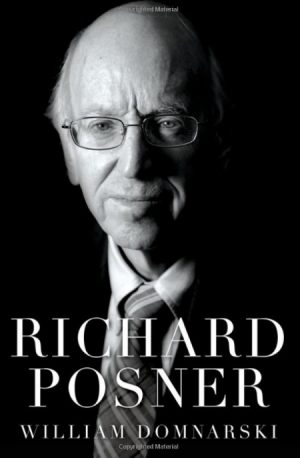
In the New York Times, John Fabian Witt reviews William Donarski’s biography of Richard Posner (in which we “see Posner privately skewering colleagues [and] calling himself “a monster” and disdaining conventional morality”) and gives the reader a primer on Posner’s theories. In the same paper, James Goodman reviews two books about black republicans. One, Black Republicans and the Transformation of the GOP, is by historian Joshua D. Farrington.
 Also in the NYT, Carol Anderson reviews Blood at the Root, in which Patrick Phillips tells the story of the racial violence that forced African Americans out of Forsyth County, GA in 1912. The vigilante justice has a legal equivalent: after a false confession to the murder of a white woman, one black teenager is lynched and his co-defendants are escorted back to the county to be sentenced to death. The book, Anderson says, “provides powerful insight into the motives of the various class and business sectors in the county’s white community, which conducted, acquiesced to or benefited from the terror.” It is also featured in the NY Times Book Review Podcast.
 In The Guardian features a review of The Trials of the King of Hampshire, a book about the insanity trial of the third earl of Portsmouth (“the lengthiest, most costly insanity case in British legal history, running at two guineas a minute”) and the treatment of the mentally ill in Georgian England.
In the same publication, there’s a review of Ian Cobain’s The History Thieves, which reveals the great efforts that British Imperial officers undertook to destroy colonial records:
- “When Britain quit India in 1947, a colonial official noted that ‘the press greatly enjoyed themselves with the pall of smoke which hung over Delhi with the mass destruction of documents’.” …
- “Officials in Kenya were told that documents could be ‘packed in weighted crates and dumped in very deep and current-free waters at maximum practicable distance from the coast’.”
In the NYRB, Maya Jassanoff reviews The Empire of Necessity: Slavery, Freedom, and Deception in the New World
 by Greg Grandin (“about an uprising on a slave ship off the coast of Chile and the successful effort to end it”) and New England Bound: Slavery and Colonization in Early America
 by Wendy Warren (an exploration of slavery in New England, which “long held up as a model of America at its communitarian best, actually rested on the backs of “numerous enslaved and colonized people.”).
In Slate, June Thomas reviews John Preston’s A Very English Scandal: Sex, Lies, and a Murder Plot in the Houses of Parliament, which focuses on the misdeeds of 1960s MP and Liberal leader John Thorpe. It also features an account of the fight to decriminalize male homosexuality in Britain, and a charming anecdote about Lord Arran, the “the quirky peer who moved the bill in the House of Lords.” Arran’s previous speeches in the House had been “to advocate for the rights of badgers.” “Later, after a successful but bruising legislative battle, Arran was asked why homosexual law reform had passed while badgers were still unprotected. “He paused,” Preston reports, “and then said ruminatively, ‘There are not many badgers in the House of Lords.’ ”
In the Washington Post, Louisa Thomas reviews Alan Taylor’s “American Revolutions.” This book is a sequel to Taylor’s book “American Colonies and describes the Revolution as a fight with the Spanish, French and Native Americans as well as the British (he “jokes that he nearly took a fellow historian’s suggestion, with a nod to the “Die Hard” movies, to title it “American Revolutions: Colonize Harder.”) Eric Foner also reviews the book in the London Review of Books. In the same publication,Yonatan Mendel reviews 1929: Year Zero of the Arab-Israeli Conflict by Hillel Cohen, translation by Haim Watzman.
In the New Rambler, Jeffrey Pojanowski reviews Administrative Justice and the Supremacy of Law in the United States, by John Dickinson. Dickinson’s book, written in 1929, “stakes out and defends what has become known as the “appellate review” model for judicial involvement in the administrative state.” Dickinson understood the problems with judicial intervention, Pojanowski explains, but advocated “the supremacy of law” because law “tends to make progress more solid, consistent, and cautious.”
In the New Republic, Matthew Simpson reviews Michael Klarman’s The Framers’ Coup: The Making of the United States Constitution, (“At the risk of oversimplifying—the book comes in at more than 800 pages—Klarman argues that the Constitution is undemocratic because it was designed to protect wealthy merchants and landowners from the redistributive tendencies of popular government.” In the same publication, Elaine Showalter reviews a series of books and articles about Ruth Bader Ginsberg.
New Books Network features an interview with Daniel Amsterdam on Roaring Metropolis: Businessmen’s Campaign for a Civic Welfare State (an investigation of how Gilded Age business leaders pushed for extensive government spending on social programs).
Saturday, October 8, 2016
Weekend Roundup
- From the Ottoman History Podcast: Omar Cheta (Bard College) on "Capitalism and the Courts in 19th Century Egypt."
- The Canadian Legal History Blog reports that the "Osgoode Society oral histories database [is] now online and searchable by keyword."
- Congratulations to Lawrence M. Friedman, Stanford Law School, for receiving the University of Chicago’s Alumni Professional Achievement Award.
 |
| Paul D. Cravath (wiki) |
- Insomniac legal historians rejoice: thanks to LibriVox, you can drift off to sleep listening to Blackstone's Commentaries. DRE.
- Wait, does this mean Eddie Redmayne will play Paul D. Cravath in the movie?
- “Crossing Waters,” a film about immigration and Poughkeepsie's First Ward, will be screened beginning at 7:00 p.m. on Friday, October 28, 2016 in the Henry A. Wallace Center at the FDR Presidential Library and Home, Hyde Park, NY.
- "Legal history can help us overcome the distortions of time and distance that too often obscure our understanding of struggles both past and present." So begins Helen Norton's JOTWELL review of Katie Eyer’s "Ideological Drift and the Forgotten History of Intent."
Friday, October 7, 2016
Cambridge Centre for English Legal History Seminar
Coming soon to the seminar of Cambridge University's Centre for English Legal History:
Tuesday, 11 October 2016
Harshan Kumarasingham, Max Planck Institute for European Legal History
Constitution-maker: the international influence and legacy of Sir Ivor Jennings
Tuesday, 25 October 2016
Kenneth Duggan, King’s College London
Maintaining law and order without the frankpledge system in thirteenth century England
Tuesday, 29 November 2016
Ian Williams, University College London
Printing the law in English, 1625-1642: losing control of professional knowledge
Tuesday, 11 October 2016
Harshan Kumarasingham, Max Planck Institute for European Legal History
Constitution-maker: the international influence and legacy of Sir Ivor Jennings
Tuesday, 25 October 2016
Kenneth Duggan, King’s College London
Maintaining law and order without the frankpledge system in thirteenth century England
Tuesday, 29 November 2016
Ian Williams, University College London
Printing the law in English, 1625-1642: losing control of professional knowledge
TAU's Yigal Arnon Law and History Workshop
Here is the Fall 2016 schedule for the Yigal Arnon Law and History Workshop at Tel Aviv University:
16 November Morton Horwitz, Harvard
Brown v. Board of Education (1954) and Justice Robert Jackson’s unpublished opinion in Brown
23 November Inbal Maimon-Blau, Tel Aviv
Legal and social aspects of the Maagan disaster [Hebrew]
30 November Rachel Zabarkes Friedman, Harvard & Tel Aviv
Classical probability, mutual aid, and the birth of social insurance
7 December Ulas Ince, Singapore Management University
In the beginning, all the world was America: John Locke’s global theory of property
14 December Elia Etkin, Tel Aviv
"Do you like the neighbors?" Shared dwellings, neighborliness and conflicts between neighbors in the urban Yishuv [Hebrew]
21 December Nadav Shoked, Northwestern
An American oddity: The law, history, and toll of the school district
28 December Christopher Tomlins, Berkeley
“Be operational, or disappear”: Thoughts on a present discontent
4 January Natalie Davidson, Hebrew University
Narrating the legality of repression in the Cold War's Western Bloc: The Marcos class action
11 January Thomas Mohr, University College Dublin
Leo Kohn and the law of the British Empire
18 January Yifat Monnickendam, Tel Aviv
Sex, rape and marriage: Between Ephrem and Qumran [Hebrew]
16 November Morton Horwitz, Harvard
Brown v. Board of Education (1954) and Justice Robert Jackson’s unpublished opinion in Brown
23 November Inbal Maimon-Blau, Tel Aviv
Legal and social aspects of the Maagan disaster [Hebrew]
30 November Rachel Zabarkes Friedman, Harvard & Tel Aviv
Classical probability, mutual aid, and the birth of social insurance
7 December Ulas Ince, Singapore Management University
In the beginning, all the world was America: John Locke’s global theory of property
14 December Elia Etkin, Tel Aviv
"Do you like the neighbors?" Shared dwellings, neighborliness and conflicts between neighbors in the urban Yishuv [Hebrew]
21 December Nadav Shoked, Northwestern
An American oddity: The law, history, and toll of the school district
28 December Christopher Tomlins, Berkeley
“Be operational, or disappear”: Thoughts on a present discontent
4 January Natalie Davidson, Hebrew University
Narrating the legality of repression in the Cold War's Western Bloc: The Marcos class action
11 January Thomas Mohr, University College Dublin
Leo Kohn and the law of the British Empire
18 January Yifat Monnickendam, Tel Aviv
Sex, rape and marriage: Between Ephrem and Qumran [Hebrew]
Callen, "Railroads and American Political Development: Infrastructure, Federalism, and State Building"
New from the University Press of Kansas: Railroads and American Political Development: Infrastructure, Federalism, and State Building (Sept. 2016), by Zachary Callen (Allegheny College). A description from the Press:
America’s founders envisioned a federal government of limited and enumerated powers. What they could not envision, of course, was the vast and complex infrastructure that the growing nation would demand—a demand that became ever clearer as the power and importance of railroads emerged. The requirements of a nationwide rail network, it also became clear, far exceeded the resources of state and local government and private industry. The consequences, as seen in this book, amounted to state building from the ground up. In Railroads and American Political Development Zachary Callen tells the story of the federal government’s role in developing a national rail system—and the rail system’s role in expanding the power of the federal government. The book reveals how state building, so often attributed to an aggressive national government, can also result from local governments making demands on the national state—a dynamic that can still be seen at work every time the US Congress takes up a transportation bill.


Though many states invested in their local railroads, and many quite successfully, others were less willing or less capable—so rail development necessarily became a federal concern. Railroads and American Political Development shows how this led to the Land Grant Act of 1850, a crucial piece of legislation in the building of both the nation’s infrastructure and the American state. Chronicling how this previously local issue migrated to the federal state, and how federal action then altered American rail planning, the book offers a new perspective on the exact nature of federalism. In the case of rail development, we see how state governments factor into the American state building process, and how, in turn, the separation of powers at the federal level shaped that process. The result is a fresh view of the development of the American rail system, as well as a clearer picture of the pressures and political logic that have altered and expanded the reach of American federalism.A few blurbs:
“Zachary Callen deftly probes the interface between federalism and the emergence of the railroad system in the antebellum era. He carefully traces the gradual shift away from state-centered railroad policy, pointing out that difficulties in promoting and coordinating railroads were common and induced western states to take the lead in calling for federal assistance. This volume casts welcome light on the nascent movement for federal control of the rail network and raises far-reaching questions about the nature of federalism in the American constitutional order.” —James W. Ely Jr.
“In this thoughtful new book, Zachary Callen reveals the politics of space at the center of America's antebellum railroad saga. The political energy of railroads played out in state legislatures, in Congress, and the tensions within and between them. An innovative reading of early American federalism, its limits and its long-run reverberations in American industrialization and political development.” —Daniel CarpenterMore information is available here.
Thursday, October 6, 2016
Osgoode Society Legal History Workshop, Fall Term 2016 Schedule
From our friends at the Canadian Legal History Blog, the lineup for the Fall 2016 Osgoode Society Legal History Workshop (with our apologies for the belated posting):
Wednesday September 14 – Ryan Alford, Lakehead University: ‘Understanding Judicial Tolerance of Executive Branch Unilateralism: Changing Dynamics in the American Federal Judicial Appointments Process 1972-2010.’
Wednesday September 21 – Thomas Mohr, University College Dublin: TBA
Wednesday October 12 – Paul Craven, York University: “Just Cause – Industrial Discipline at Arbitration in the 1940s.”
Wednesday October 26 – Bradley Miller, University of British Columbia: “Dangerous Doctrine: Jurisdiction in the Northeastern Boundary Dispute.”
Thursday October 27 – 5 – 7 - Annual Osgoode Society Book Launch, and Opening Reception, American Society for Legal History Conference
Wednesday November 9 – Suzie Chiodo, Osgoode Hall Law School: "Class Roots: The Genesis of the Ontario Class Proceedings Act, 1966-1992"
Wednesday November 23 – Constance Backhouse, University of Ottawa: “Claire L’Heureux-Dubé: A Feminist Legal Biography”
Wednesday December 7 - Nelson Ouellet, University of Moncton: ‘Import/Export: The New Brunswick Workers’ Compensation System (1918-1932)
Fidell on military justice
Out
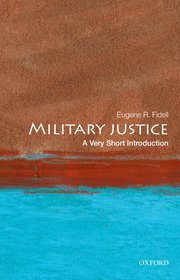
this month with Oxford University Press is Military Justice: A Very Short Introduction, by Eugene R. Fidell (Yale Law School). The book is
partly historical in approach.
From the publisher:
From the publisher:
"You can't handle the truth." These iconic words, bellowed by Jack Nicholson as Colonel Jessup in the 1992 movie A Few Good Men, became an emblem of the conflict between honor and truth that the collective imagination often considers the quintessence of military justice. The military is the rare part of contemporary society that enjoys the privilege of policing its own members' behavior, with special courts and a separate body of rules. Whether one is for or against this system, military trials are fascinating and little understood. This book opens a window on the military judicial system, offering an accessible and balanced assessment of the strengths and weaknesses of military legal regimes around the world. It illuminates US military justice through a comparison with civilian and foreign models for the administration of justice, with a particular emphasis on the UK and Canadian military justice systems. He digs into critical issues such as the response to sexual assault in the armed forces, the challenges of protecting judicial independence, and the effect of social media and modern technology on age-old traditions of military discipline. A rich series of case studies, ranging from examples of misconduct, such as the devastating Abu Ghraib photos, to political tangles, such as the Guantánamo military commissions, throw light on the high profile and occasionally obscure circumstances that emerge from today's military operations around the world. As Fidell's account shows, by understanding the mechanism of military justice we can better comprehend the political values of a country.Table of Contents after the jump.
Drawing on his experience as a serving officer, private practitioner, and law professor, Eugene R. Fidell presents a hard-hitting tour of the field, exploring military justice trends across different countries and compliance (or lack thereof) with contemporary human rights standards.
He digs into critical issues such as the response to sexual assault in the armed forces, the challenges of protecting judicial independence, and the effect of social media and modern technology on age-old traditions of military discipline. A rich series of case studies, ranging from examples of misconduct, such as the devastating Abu Ghraib photos, to political tangles, such as the Guantánamo military commissions, throw light on the high profile and occasionally obscure circumstances that emerge from today's military operations around the world. As Fidell's account shows, by understanding the mechanism of military justice we can better comprehend the political values of a country.
Wednesday, October 5, 2016
Salaymeh's "Beginnings of Islamic Law"
Out this month, and available now at a 20-percent discount, is The Beginnings of Islamic LawLate Antique Islamicate Legal Traditions, by Lena Salaymeh, Tel-Aviv University:
The Beginnings of Islamic Law is a major and innovative contribution to our understanding of the historical unfolding of Islamic law. Scrutinizing its historical contexts, the book proposes that Islamic law is a continuous intermingling of innovation and tradition. Salaymeh challenges the embedded assumptions in conventional Islamic legal historiography by developing a critical approach to the study of both Islamic and Jewish legal history. Through case studies of the treatment of war prisoners, circumcision, and wife-initiated divorce, she examines how Muslim jurists incorporated and transformed 'Near Eastern' legal traditions. She also demonstrates how socio-political and historical situations shaped the everyday practice of law, legal education, and the organization of the legal profession in the late antique and medieval eras. Aimed at scholars and students interested in Islamic history, Islamic law, and the relationship between Jewish and Islamic legal traditions, this book's interdisciplinary approach provides accessible explanations and translations of complex materials and ideas.
Tuesday, October 4, 2016
Stinneford on the Original Meaning of Cruel
John F. Stinneford, University of Florida Levin College of Law, has posted The Original Meaning of “Cruel,” which is forthcoming in volume 105 of the Georgetown Law Journal:
This Article demonstrates that the word “cruel” in the Cruel and Unusual Punishments Clause means “unjustly harsh,” not “motivated by cruel intent.” The word refers to the effect of the punishment, not the intent of the punisher. In prior articles, I have shown that the word “unusual” means “contrary to long usage,” and thus a punishment is cruel and unusual if its effects are unjustly harsh in light of longstanding prior practice.H/t: Legal Theory Blog
This Article solves several important problems plaguing the Supreme Court’s Eighth Amendment jurisprudence. First, it clarifies the Eighth Amendment’s intent requirement. To violate the Cruel and Unusual Punishments Clause, some government official must possess intent to punish but not necessarily intent to punish cruelly. Second, it demonstrates how to determine whether a given punishment is so harsh that it violates the Eighth Amendment. The question is not whether a punishment is unjustly harsh in the abstract but whether it is unjustly harsh in comparison to the traditional punishment practices it has replaced. Third, it shows how to sort between those unintended effects of punishment that may properly be considered part of the punishment and those that may not. If a given punishment heightens the risk of severe, unjustified harm significantly beyond the baseline risk established by longstanding prior practice, it is cruel and unusual. Finally, this Article establishes that the core purpose of the Cruel and Unusual Punishments Clause is to prevent unjust suffering, not the coarsening of public sensibilities. Historically, governmental efforts to protect public sensibilities by making punishment less transparent have increased the risk that the offender will experience undetected cruel suffering. When the government undertakes such efforts, it should bear the burden to show that they do not significantly increase this risk.
The original meaning of the Cruel and Unusual Punishments Clause calls into question the constitutionality of several current punishment practices, including lengthy prison sentences for certain offenses, long-term solitary confinement, the three-drug lethal injection protocol, and certain prison conditions, to name a few.
Monday, October 3, 2016
Rosen Wins Littleton-Griswold
 AHA Today has just landed in our inbox, and with it news that Deborah A. Rosen, Lafayette College, has won the American Historical Association's Littleton-Griswold Prize in "US law and society, broadly defined," for 2016 for Border Law: The First Seminole War and American Nationhood (Harvard University Press, 2015). Congratulations, Professor Rosen!
Subscribe to:
Posts (Atom)