Showing posts with label North Africa. Show all posts

Tuesday, November 26, 2019

Surkis on sex, law, and sovereignty in French Algeria

Judith Surkis, Rutgers University has published Sex, Law, and Sovereignty in French Algeria, 1830-1930 with Cornell University Press. From the publisher:
Sex, Law, and Sovereignty in French Algeria, 1830–1930
During more than a century of colonial rule over Algeria, the French state shaped and reshaped the meaning and practice of Muslim law by regulating it and circumscribing it to the domain of family law, while applying the French Civil Code to appropriate the property of Algerians. In Sex, Law, and Sovereignty in French Algeria, 1830–1930, Judith Surkis traces how colonial authorities constructed Muslim legal difference and used it to deny Algerian Muslims full citizenship. In disconnecting Muslim law from property rights, French officials increasingly attached it to the bodies, beliefs, and personhood. Surkis argues that powerful affective attachments to the intimate life of the family and fantasies about Algerian women and the sexual prerogatives of Muslim men, supposedly codified in the practices of polygamy and child marriage, shaped French theories and regulatory practices of Muslim law in fundamental and lasting ways. Women's legal status in particular came to represent the dense relationship between sex and sovereignty in the colony. This book also highlights the ways in which Algerians interacted with and responded to colonial law. Ultimately, this sweeping legal genealogy of French Algeria elucidates how "the Muslim question" in France became—and remains—a question of sex.
Praise for the book:

 "Sex, Law, and Sovereignty opens up new ways to understand debates about religious and sexual pluralism, and marvelously demonstrates how attention to the paradoxical effects of instability and the workings of transgression, scandal, and crisis, lead to critical analytic perspectives." - Todd Shepard

"This is a masterful study of the ways in which sex and law were inextricably intertwined in the elaboration of French rule in Algeria. Its great virtue is to demonstrate in careful detail, with an impressive range of material (from court records to novels), exactly how the conquest of Algeria repeatedly challenged the very ideals of the secular universalism in whose name colonization was carried out." - Joan Wallach Scott

Further information is available here.

--Mitra Sharafi

Thursday, December 20, 2018

Cheta on the Egyptian legal profession

Omar Cheta, Bard College has published "A Prehistory of the Modern Legal Profession in Egypt, 1840s-1870s" in the International Journal of Middle East Studies 50(2018): 4, 649-68. Here's the abstract: 
This article examines the emergence of a new corps of legal practitioners in Egypt during the 1860s and early 1870s. The proceedings of hundreds of merchant court cases in mid-19th-century Cairo are replete with references to deputies and agents (wukalā; sing. wakīl) who represented merchant-litigants in a wide range of commercial disputes. Examining how these historical actors understood Egyptian, Ottoman, and French laws, and how they strategically deployed their knowledge in the merchant courts, this article revises the commonly accepted historical account of the founding of the legal profession in Egypt. Specifically, it argues that norms of legal practice hitherto linked to the establishment of the Mixed Courts in 1876 were already being formed and refined within the realm of commercial law as part of a more comprehensive program of legal reforms underway during the middle decades of the 19th century. In uncovering this genealogy of practice, the article reevaluates the extent to which the khedival state shared a legal culture with the Ottoman center, and, simultaneously, created the space for a new form of legal representation that became ubiquitous under British, and, subsequently, postcolonial rule.
Further information is available here

Friday, November 2, 2018

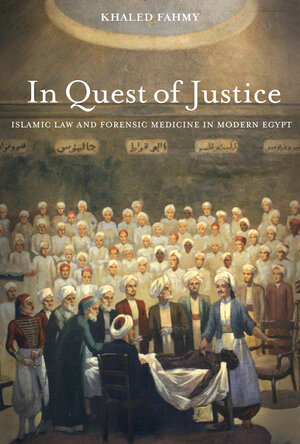
Fahmy on Islamic Law and Forensic Medicine

Out this month with the University of California Press is In Quest of Justice: Islamic Law and Forensic Medicine in Modern Egypt by Khaled Fahmy, University of Cambridge. From the press: 
In Quest of Justice by Khaled FahmyIn Quest of Justice provides the first full account of the establishment and workings of a new kind of state in Egypt in the modern period. Drawing on groundbreaking research in the Egyptian archives, this highly original book shows how the state affected those subject to it and their response. Illustrating how shari’a was actually implemented, how criminal justice functioned, and how scientific-medical knowledges and practices were introduced, Khaled Fahmy offers exciting new interpretations that are neither colonial nor nationalist. Moreover he shows how lower-class Egyptians did not see modern practices that fused medical and legal purposes in new ways as contrary to Islam. This is a major contribution to our understanding of Islam and modernity.
 Some reviews: 

"Through extensive research in Egyptian archives, engaging and creative scholarship, and deep engagement with the history of colonial law and medicine, Khaled Fahmy has produced a masterpiece that confirms his standing as the preeminent social and cultural historian of nineteenth century Egypt." -Eugene Rogan

"Fahmy rewrites the narrative of legal and institutional development by bringing in the Egyptian state with its new capacities and its elite as actors with clear interests and strategies of their own, as well as the broader Egyptian population whose protests and accommodations shaped this history.  This book will make a very major impact in a variety of fields, including those of the history of Islamic law and legal institutions, public health, and urban planning in Egypt." -Judith Tucker

"A deft and original historian, Khaled Fahmy mobilizes the richly populated medical and legal records of a hybrid system of mid-nineteenth century tribunals to rethink the foundations of a distinctive Egyptian modernity." -Brinkley Messick

"Khaled Fahmy's In Quest of Justice is an excellent study on nineteenth-century Egyptian modernization in the Ottoman social and cultural context.The author uses the human body as a metaphor to explain modernization politics and elegantly arranges the book around the five senses: sight, sound, smell, taste and touch. We read about practices such as dissection, sewers, vaccination, torture, quarantine, market control and procedural justice. In addition, Fahmy elaborates on the lives of the non-elite population in a fascinating way, based on archival documents." -Rudolph Peters

Further information is available here.