Showing posts with label genocide. Show all posts

Friday, January 25, 2019

Loeffler on Jewish cosmopolitans and human rights

James Loeffler, University of Virginia, has published Rooted Cosmopolitans: Jews and human rights in the twentieth century with Yale University Press. From the publisher: 
The year 2018 marks the seventieth anniversary of two momentous events in twentieth-century history: the birth of the State of Israel and the creation of the Universal Declaration of Human Rights. Both remain tied together in the ongoing debates about the Israeli-Palestinian conflict, global antisemitism, and American foreign policy. Yet the surprising connections between Zionism and the origins of international human rights are completely unknown today. In this riveting account, James Loeffler explores this controversial history through the stories of five remarkable Jewish founders of international human rights, following them from the prewar shtetls of eastern Europe to the postwar United Nations, a journey that includes the Nuremberg and Eichmann trials, the founding of Amnesty International, and the UN resolution of 1975 labeling Zionism as racism. The result is a book that challenges long-held assumptions about the history of human rights and offers a startlingly new perspective on the roots of the Israeli-Palestinian conflict.
Praise for the book: 

“This absorbingly narrated and brilliantly researched masterpiece reshapes Jewish and human rights history alike.”—Samuel Moyn

“James Loeffler’s pathbreaking research reconstructs the forgotten role of Jewish leaders in creating the architecture of human rights. Loeffler offers a nuanced account of the common origin of Zionism and human rights organizations—and of their increasingly tortured relationship. His story is an intellectually arresting but intensely human drama.”—William A. Galston

"Building on a trove of archival material, this extraordinary book challenges orthodoxies both on the right and on the left.  It has the potential to transform popular understandings of this critical period of history and is a must-read for anyone involved in Jewish communal life or human rights work."—Rabbi Jill Jacobs

"Rooted Cosmopolitans is intellectual history at its most admirable. It's daring in its ambitions to rewrite our received narratives about human rights and Zionism. Loeffler presses his arguments with unfamiliar characters and tells their fascinating stories with nuance, humanity, and verve."—Franklin Foer

Further information is available here.

Friday, November 16, 2018

Sourcebooks on the Holocaust

A multi-volume publication, The Persecution and Murder of the European Jews by Nazi Germany, 1933-1945 is being published by De Gruyter Oldenbourg. The books are a production of the German Federal Archives, the Institute of Contemporary History Munich-Berlin, and the Chair of Modern History at the Albert-Ludwigs University of Freiburg, in collaboration with Yad Vashem.
From the publisher:
This source edition on the persecution and murder of the European Jews by Nazi Germany presents in a total of 16 volumes a thematically comprehensive selection of documents on the Holocaust. The work illustrates the contemporary contexts, dynamics, and intermediate stages of the political and social process that led to this unprecedented mass crime. It can be used by teachers, researchers, students, and all those who are interested in addressing the Holocaust. The edition comprises authentic testimony by persecutors, victims, and onlookers. These testimonies are furnished with academic annotations and the vast majority of them are published here for the first time in English.
The editorial board includes: Susanne Heim, Ulrich Herbert, Michael Hollmann, Horst Möller, Dieter Pohl, Sybille Steinbacher, Simone Walther-von Jena, and Andreas Wirsching. The international advisory board for the English edition consists of: Nomi Halpern, Elizabeth Harvey, Dan Michman, and Alan E. Steinweis. The coordinator of the English-language edition is Caroline Pearce, with assistance from Dorothy Mas.

Further information is available here.

Thursday, October 25, 2018

Drumbl on Defining Genocide

Mark Drumbl, Washington and Lee University School of Law, has posted Genocide: The Choppy Journey to Codification:
The Genocide Convention’s definition of genocide derives from but also shrinks the concept as initially coined by Raphael Lemkin. This chapter unpacks the notion Lemkin had originated and traces how it narrowed through the treaty-making process. The path that genocide took from invented concept to proscribed crime in turn evokes questions about how the formation of law through treaty can deform the ideas that may have prompted the push towards law. Counterfactually, this chapter contrasts the path of crimes against humanity, which only in very recent years has become cogitated as something that ‘needs’ an owner-occupied international convention. In the end, perhaps, an alternate route for the crime of genocide – which Lemkin did not pursue – would have been for it to have been taken as a term of art, organic and open-ended, and then left to stew and brew at a variety of discursive levels before becoming codified: bricolage from below rather than vulcanization from above. Perhaps had this counterfactual path been taken the legal definition of genocide would have been broader and more congruent with Lemkin’s original understanding. That said, it is clear that the legal definition matches many, though certainly not all, of the fundamental values that Lemkin intended the criminalization of genocide to protect. Moreover, codification permitted an interpretive baton to be passed to judges, who may over time incrementally align the crime of genocide closer to Lemkin’s original framing.

Wednesday, June 13, 2018

Bazyler on the Holocaust, genocide, and law

Michael Bazyler, Fowler School of Law, Chapman University published Holocaust, Genocide, and the Law: A Quest for Justice in a Post-Holocaust World with Oxford University Press in 2016. From the publisher:
Cover for 

Holocaust, Genocide, and the Law


A great deal of contemporary law has a direct connection to the Holocaust. That connection, however, is seldom acknowledged in legal texts and has never been the subject of a full-length scholarly work. This book examines the background of the Holocaust and genocide through the prism of the law; the criminal and civil prosecution of the Nazis and their collaborators for Holocaust-era crimes; and contemporary attempts to criminally prosecute perpetrators for the crime of genocide. It provides the history of the Holocaust as a legal event, and sets out how genocide has become known as the "crime of crimes" under both international law and in popular discourse. It goes on to discuss specific post-Holocaust legal topics, and examines the Holocaust as a catalyst for post-Holocaust international justice. Together, this collection of subjects establishes a new legal discipline, which the author Michael Bazyler labels "Post-Holocaust Law."
Praise for the book, which won the 2016 National Jewish Book Award:

"Michael Bazyler has written a comprehensive and compelling study of the legal historiography of the Holocaust, the paradigm of radical evil, and of genocide, the 'crime of crimes.' This book makes a singular contribution to the pursuit of international justice, and to the prevention and combatting of mass atrocity and genocide in our time. An indispensable resource." -Irwin Cotler

"A unique and important book. Michael Bazyler presents a broad, up-to-date overview of Holocaust justice ranging from landmark criminal trials to restitution litigation to the prosecution of Holocaust deniers. He also discusses the ramifications of the Holocaust's judicial reckoning on how the world has addressed, successfully or not, contemporary state-sponsored atrocities across the globe."-Norman Goda

"Prof. Bazyler's book is different than other books on the Holocaust. He first depicts the Holocaust as 'a legal event,' arguing that it was the law, and not its absence, that became an instrument for destruction. He then analyzes current efforts to build a legal world based on what he labels 'Post-Holocaust Law.' This book is a must-read." -Dina Porat

"Bazyler deploys considerable legal expertise to underpin his first, and for readers of this Journal arguably most important thesis: that the Nazi persecution of the Jews, leading ultimately to the attempted genocide of the entire Jewish people, was carried out within a framework of law, even though this was in reality a corrupted and perverted form of pseudo-legality in which only the external forms of true legality were preserved." - Anthony Grenville

 Further information is available here.

Tuesday, April 17, 2018

Koposov on memory, history, and law

Memory Laws, Memory WarsNikolay Koposov, Emory University, has published Memory Laws, Memory Wars: The Politics of the Past in Europe and Russia with Cambridge University Press. From the publisher:
Laws against Holocaust denial are perhaps the best-known manifestation of the present-day politics of historical memory. In Memory Laws, Memory Wars, Nikolay Koposov examines the phenomenon of memory laws in Western and Eastern Europe, Ukraine, and Russia and exposes their very different purposes in the East and West. In Western Europe, he shows how memory laws were designed to create a common European memory centred on the memory of the Holocaust as a means of integrating Europe, combating racism, and averting national and ethnic conflicts. In Russia and Eastern Europe, by contrast, legislation on the issues of the past is often used to give the force of law to narratives which serve the narrower interests of nation states and protect the memory of perpetrators rather than victims. This will be essential reading for all those interested in ongoing conflicts over the legacy of the Second World War, Nazism, and communism.
Here is the Table of Contents:
  • Introduction
  • 1. The rise of memory and the origins of memory laws
  • 2. Memory laws in Western Europe
  • 3. Memory laws in Eastern Europe
  • 4. Memory laws in Ukraine
  • 5. Memory laws in Yeltsin's Russia
  • 6. Memory laws in Putin's Russia
  • Conclusion
Further information is available here.
Tuesday, March 13, 2018

Douglas on a Nazi War Crimes Trial

Lawrence Douglas, Amherst College, published The Right Wrong Man: John Demjanjuk and the Last Great Nazi War Crimes Trial with Princeton University Press in 2016. From the press:
In 2009, Harper's Magazine sent war-crimes expert Lawrence Douglas to Munich to cover the last chapter of the lengthiest case ever to arise from the Holocaust: the trial of eighty-nine-year-old John Demjanjuk. Demjanjuk’s legal odyssey began in 1975, when American investigators received evidence alleging that the Cleveland autoworker and naturalized US citizen had collaborated in Nazi genocide. In the years that followed, Demjanjuk was stripped of his American citizenship and sentenced to death by a Jerusalem court as "Ivan the Terrible" of Treblinka—only to be cleared in one of the most notorious cases of mistaken identity in legal history. Finally, in 2011, after eighteen months of trial, a court in Munich convicted the native Ukrainian of assisting Hitler’s SS in the murder of 28,060 Jews at Sobibor, a death camp in eastern Poland. 
An award-winning novelist as well as legal scholar, Douglas offers a compulsively readable history of Demjanjuk’s bizarre case. The Right Wrong Man is both a gripping eyewitness account of the last major Holocaust trial to galvanize world attention and a vital meditation on the law’s effort to bring legal closure to the most horrific chapter in modern history.
Praise for the book:

"Douglas relates with authority and clarity the story of these complex legal processes. . . . [He] does justice to both the story's factual complexities and its moral and political conundrums. . . . The Right Wrong Man, from its summary title to its thoughtful postscript, is an impressive work, as well as a timely one in its demonstration of the power of legal systems to learn from past missteps." -Anthony Julius


"The Right Wrong Man is powerful, richly observed, and darkly entertaining. Anyone interested in postwar history will want to read it." -Elizabeth Kolbert

"Lawrence Douglas has once again provided us with a history-laden and provocative analysis of Holocaust trials. His riveting study of the Demjanjuk saga is of importance, not just to historians and jurists, but to all those who wonder how can justice ever prevail when the crime being adjudicated is genocide." -Deborah E. Lipstadt
Further information is available here.

Thursday, March 8, 2018

Akçam and Kurt on the Armenian Genocide

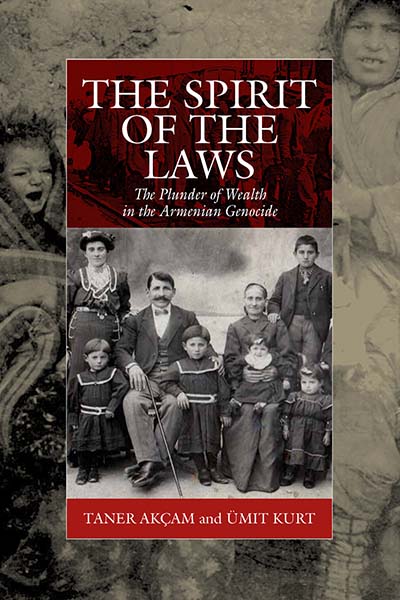
We missed this one back in 2015, when an English-language translation by Aram Arkun of The Spirit of the Laws: The Plunder of Wealth in the Armenian Genocide came out with Berghahn. The book's authors are Taner Akçam, Clark University, and Umit Kurt, Center for Middle Eastern Studies, Harvard University. From the press:
Pertinent to contemporary demands for reparations from Turkey is the relationship between law and property in connection with the Armenian Genocide. This book examines the confiscation of Armenian properties during the genocide and subsequent attempts to retain seized Armenian wealth. Through the close analysis of laws and treaties, it reveals that decrees issued during the genocide constitute central pillars of the Turkish system of property rights, retaining their legal validity, and although Turkey has acceded through international agreements to return Armenian properties, it continues to refuse to do so. The book demonstrates that genocides do not depend on the abolition of the legal system and elimination of rights, but that, on the contrary, the perpetrators of genocide manipulate the legal system to facilitate their plans.
Some blurbs:
“This book is a valuable addition to filling the gaps of our understanding of genocide and helps readers navigate complex terrain in the case study presented… I recommend this book as a case study to be included in graduate level courses. In addition to its thorough review of the questionable statecraft of genocidal states, it is a reminder of the merits of engaged scholarship. Akçam and Kurt, by sharing their research as an act of solidarity with citizens who continue to challenge state restraints and master narratives based on genocide, make a contribution to the ongoing process of crafting a just society.” -Histoire Sociale/Social History
“[This volume] will make an invaluable contribution to the field of genocide studies. It is meticulously researched and features superb attention to detail.” -Deborah Mayersen
“Akçam and Kurt have written a fundamentally important book... We know that genocides are accompanied by the expropriation of the assets possessed by the targeted population... But nothing like that has been done for the Armenian Genocide—until now.”  -Eric Weitz

Further information is available here.