Over on HNN, David Austin Walsh has posted the video of a plenary session at last week’s meeting of the Organization of American Historians, Corporations in America. In it, Naomi Lamoreaux, Yale University, discusses her research on the U.S. Supreme Court's Santa Clara decision. The other speakers are Richard White, Stanford University; Bethany Moreton, University of Georgia; Karen Ho, University of Minnesota; and Peter James Hudson Vanderbilt University.
Other OAH sessions that may be watched on HNN's website include Eric Foner's "Reconstruction" at Twenty-Five and Albert Camarillo's presidential address, Navigating Segregated Life in America's Racial Borderlands.
Monday, April 15, 2013
Saturday, April 13, 2013
Weekend Roundup
- The Sanford Herald reports on a new push to preserve North Carolina’s legal history here.
- The website of the Washington Independent Review of Books has two posts of interest to legal historians. The first is a review of Justice O’Connor’s latest book (and book tour) by Tony Mauro, the Supreme Court correspondent for the National Law Journal. The second is an interview of Larry Gibson, Maryland Law and the author of Young Thurgood, The Making of a Supreme Court Justice.
- If you tuned in to your local public radio station this week, you may have heard Adam Winkler (UCLA) talking about gun control and the history of the Second Amendment. For those who missed it, a short segment from Morning Edition is available here. A longer interview from Forum, a call-in public affairs program based in Northern California, is available here.
- "The Georgetown Law chapter of the Federalist Society for Law and Public Policy Studies will honor the life and legacy of Judge Robert H. Bork with the 10th annual Lifetime Service Award on Tuesday, April 16, 2013, from 6:30 - 8:30 p.m. in the Sport & Fitness Center Lobby, located at 550 First Street, NW, on the Georgetown Law campus. . . . Interim Dean Gregory E. Maggs of George Washington University Law School will pay tribute to Bork's contributions to the legal profession."
- Looking for flashcards for an Anglocentric course in New Zealand Legal History? Try these.
- From Books&Ideas.net, Jean-Marc Dryfus discusses the opening of the records of the International Tracing Service ("at once a crucial tracing center, a memorial to the victims of Nazi persecution, forced labor and the Holocaust, and a gigantic repository of archives") in Bad Arolsen, Germany (here).
- In case you missed it, here's the New York Times article on the turn to the study of capitalism in U.S. Departments of History.


Friday, April 12, 2013
Interdisciplinary Approaches to Halakhic Texts
[We have the following announcement.]
On Tuesday, April 16th, at 7PM, The Bernard Revel Graduate School of Jewish Studies at Yeshiva University will host members of the Graduate Workshop on Jewish Law and Methodology for a symposium exploring new ways to place textual analysis at the forefront of halakhah scholarship. Presenters include doctoral students at the Hebrew University of Jerusalem, Bar-Ilan University and Yeshiva University.
Key Note: Introducing New Academic Approaches to Halakhic Texts
Rachel Furst, Co-founder of the Graduate Workshop, PhD candidate in Jewish History at
the Hebrew University of Jerusalem; Visiting Scholar, Tikvah Center for Law and Jewish
Civilization at NYU Law School
Child Marriage and Marriage Law in Medieval Ashkenaz in Comparative Perspective
Ethan Zadoff, PhD candidate in History at the CUNY Graduate Center; Adjunct Professor,
Hunter College
Anger, Violence and the Law: Reading Emotion in Medieval Legal Texts
Jesse Abelman, PhD candidate in medieval Jewish history at Revel; teaches in the Yesodot
program at Drisha Institute.
Staying Home: Social Standing of Widows in Medieval Spanish Responsa
Sara Tova Brody, MA in Gender Studies at Bar Ilan University; Fellow at Yeshivat Hadar in
NY.
Response and Questions will be moderated by Rachel Furst
On Tuesday, April 16th, at 7PM, The Bernard Revel Graduate School of Jewish Studies at Yeshiva University will host members of the Graduate Workshop on Jewish Law and Methodology for a symposium exploring new ways to place textual analysis at the forefront of halakhah scholarship. Presenters include doctoral students at the Hebrew University of Jerusalem, Bar-Ilan University and Yeshiva University.
Key Note: Introducing New Academic Approaches to Halakhic Texts
Rachel Furst, Co-founder of the Graduate Workshop, PhD candidate in Jewish History at
the Hebrew University of Jerusalem; Visiting Scholar, Tikvah Center for Law and Jewish
Civilization at NYU Law School
Child Marriage and Marriage Law in Medieval Ashkenaz in Comparative Perspective
Ethan Zadoff, PhD candidate in History at the CUNY Graduate Center; Adjunct Professor,
Hunter College
Anger, Violence and the Law: Reading Emotion in Medieval Legal Texts
Jesse Abelman, PhD candidate in medieval Jewish history at Revel; teaches in the Yesodot
program at Drisha Institute.
Staying Home: Social Standing of Widows in Medieval Spanish Responsa
Sara Tova Brody, MA in Gender Studies at Bar Ilan University; Fellow at Yeshivat Hadar in
NY.
Response and Questions will be moderated by Rachel Furst
Werhan on Popular Constitutionalism, Ancient and Modern
Keith Werhan, Tulane University Law School, has posted (an edited version) of Popular Constitutionalism, Ancient and Modern, UC Davis Law Review 46 (2012). Here is the abstract:
This Article examines the contemporary controversy over theories of public constitutionalism through a classical Athenian lens. Theories of popular constitutionalism share in common to varying degrees the project of democratizing the practice of judicial review.
Athens invented the practice of judicial review, and just as in America, it became essential to its democracy. The classical Athenian practice of judicial review aligned precisely with strong theories of popular constitutionalism, that is, theories that largely would transfer the power of constitutional review from politically insulated courts to the People themselves or to their representatives. The article shows how strong popular constitutionalism fit the highly participatory, direct democracy of classical Athens, as well as the theoretical underpinnings and institutional design of the classical democracy. The article argues, however, that because the American institutional design and conception of democracy differ fundamentally from those of the Athenians, theories of strong popular constitutionalism are out of sync with the American system.
The Article argues as well that the comparison between Athens and America suggests that moderate theories of popular constitutionalism hold considerably more promise. These theories would keep judicial review in place, and thus would respect the institutional design of an independent and professional judiciary as the ultimate protector of individual rights for America’s liberal democracy. But these theories also would legitimate public participation in the shaping of the federal judiciary and their constitutional decision-making, and thus to some extent would democratize the exercise of judicial review. The article argues that this balancing between majority rule and the protection of individual rights is true to American constitutionalism, as well as to the founders’ instinct of tempering their Madisonian Constitution with enough of a classical Athenian sensibility to launch the American federal government as an authentically democratic enterprise.
Law's History: An Overview
Thanks to Dan Ernst for inviting me to contribute posts to the Legal History Blog about my new book, Law’s History: American Legal Thought and the Transatlantic Turn to History. In this first post, I will highlight its contents and major conclusions. Later posts will address various historical and historiographical issues the book raises and will respond to comments readers might make.
Law’s History examines the central role of history in late nineteenth-century American legal thought. It argues that a distinctive “Historical School of American Jurisprudence” dominated American legal scholarship from the 1870s until superseded by the sociological jurisprudence promoted by Roscoe Pound in the decade before World War I. The American scholars who are the primary focus of the book include Henry Adams, James Barr Ames, Melville M. Bigelow, James Coolidge Carter, Thomas McIntyre Cooley, William Gardiner Hammond, Oliver Wendell Holmes, Jr., John Norton Pomeroy, Roscoe Pound, James Bradley Thayer, Christopher G. Tiedeman, and Francis Wharton.
I conclude that the founding generation of professional legal scholars in the United States drew from the evolutionary social thought that pervaded Western intellectual life on both sides of the Atlantic during the nineteenth century. They viewed their historical study of law as an inductive science that rejected the prior speculation and “mere theory” of natural law and analytic jurisprudence. Making legal scholarship an inductive science, they believed, justified the inclusion of law schools in the emerging American research universities. Among these scholars, Adams, Bigelow, Holmes, Thayer, and Ames wrote internationally respected original works on the history of English law. Some American law professors also wrote about the history of American law, including constitutional law. I stress that they were much more sophisticated historians than portrayed by the condescending and cursory treatment of them by many subsequent American legal historians.
In developing sociological jurisprudence in the decade before World War I, Roscoe Pound created the characterization of his nineteenth-century predecessors that largely persists to the present. Borrowing substantially from Rudolph von Jhering’s critique of historical jurisprudence in Germany, Pound claimed that the late nineteenth-century American legal scholars were mechanical deductive formalists committed to individualistic principles that impeded needed social reform in the United States. Based on my research, I conclude that this characterization is largely incorrect, that the members of the “Historical School of American Jurisprudence” overwhelmingly rejected deductive formalism and often supported moderate legal reform.
After an introduction and a chapter presenting a biographical overview of the leading American legal scholars in the historical school, the book is divided into three parts. Part I, “The European Background,” discusses the general turn to history in the nineteenth century and the work of the German and English legal scholars who most influenced the Americans, especially Savigny, Sohm, Brunner, Jhering, and Maine. Part II, “The Historical Turn in American Legal Scholarship,” contains separate chapters on each of the major American legal historians; a chapter on “The History of American Constitutional Law,” focusing on Thayer, Cooley, and Tiedeman; and a final chapter, “The Historical School of American Jurisprudence,” that highlights its major characteristics. Part III contains chapters on Maitland, Pound, and twentieth-century interpretations of late nineteenth-century legal thought.
I close this first post by providing links to the full table of contents and to book reviews that have appeared thus far: by Adam Hofri-Winogradow, Ron Harris, Assaf Likhovski, and Roy Kreitner, and a response by me in The Jerusalem Review of Legal Studies, by Alfred Brophy and Brian Tamanaha in the Texas Law Review, and by Herbert Hovenkamp for the Journal of American History. I'm also linking two blog posts about the book: by Kenneth Kersch and by Alfred Brophy, commenting on his and Brian Tamanaha's reviews.
Update: Cambridge is offering Law's History at a 20 percent discount. Use code Rabban12 at the checkout. DRE
[The series continues here.]
Law’s History examines the central role of history in late nineteenth-century American legal thought. It argues that a distinctive “Historical School of American Jurisprudence” dominated American legal scholarship from the 1870s until superseded by the sociological jurisprudence promoted by Roscoe Pound in the decade before World War I. The American scholars who are the primary focus of the book include Henry Adams, James Barr Ames, Melville M. Bigelow, James Coolidge Carter, Thomas McIntyre Cooley, William Gardiner Hammond, Oliver Wendell Holmes, Jr., John Norton Pomeroy, Roscoe Pound, James Bradley Thayer, Christopher G. Tiedeman, and Francis Wharton.
I conclude that the founding generation of professional legal scholars in the United States drew from the evolutionary social thought that pervaded Western intellectual life on both sides of the Atlantic during the nineteenth century. They viewed their historical study of law as an inductive science that rejected the prior speculation and “mere theory” of natural law and analytic jurisprudence. Making legal scholarship an inductive science, they believed, justified the inclusion of law schools in the emerging American research universities. Among these scholars, Adams, Bigelow, Holmes, Thayer, and Ames wrote internationally respected original works on the history of English law. Some American law professors also wrote about the history of American law, including constitutional law. I stress that they were much more sophisticated historians than portrayed by the condescending and cursory treatment of them by many subsequent American legal historians.
In developing sociological jurisprudence in the decade before World War I, Roscoe Pound created the characterization of his nineteenth-century predecessors that largely persists to the present. Borrowing substantially from Rudolph von Jhering’s critique of historical jurisprudence in Germany, Pound claimed that the late nineteenth-century American legal scholars were mechanical deductive formalists committed to individualistic principles that impeded needed social reform in the United States. Based on my research, I conclude that this characterization is largely incorrect, that the members of the “Historical School of American Jurisprudence” overwhelmingly rejected deductive formalism and often supported moderate legal reform.
After an introduction and a chapter presenting a biographical overview of the leading American legal scholars in the historical school, the book is divided into three parts. Part I, “The European Background,” discusses the general turn to history in the nineteenth century and the work of the German and English legal scholars who most influenced the Americans, especially Savigny, Sohm, Brunner, Jhering, and Maine. Part II, “The Historical Turn in American Legal Scholarship,” contains separate chapters on each of the major American legal historians; a chapter on “The History of American Constitutional Law,” focusing on Thayer, Cooley, and Tiedeman; and a final chapter, “The Historical School of American Jurisprudence,” that highlights its major characteristics. Part III contains chapters on Maitland, Pound, and twentieth-century interpretations of late nineteenth-century legal thought.
I close this first post by providing links to the full table of contents and to book reviews that have appeared thus far: by Adam Hofri-Winogradow, Ron Harris, Assaf Likhovski, and Roy Kreitner, and a response by me in The Jerusalem Review of Legal Studies, by Alfred Brophy and Brian Tamanaha in the Texas Law Review, and by Herbert Hovenkamp for the Journal of American History. I'm also linking two blog posts about the book: by Kenneth Kersch and by Alfred Brophy, commenting on his and Brian Tamanaha's reviews.
Update: Cambridge is offering Law's History at a 20 percent discount. Use code Rabban12 at the checkout. DRE
[The series continues here.]
Prifogle on Chambers v. Mississippi
Emily A Prifogle, a J.D., and a Ph.D. candidate in the Department of History, Princeton University, has posted Law and Local Activism: Uncovering the Civil Rights History of Chambers v. Mississippi, which will appear in the California Law Review 101 (2013): 445. Here is the abstract:
Countless academics have examined and discussed the importance of Chambers v. Mississippi in a multitude of areas including compulsory due process, admission of hearsay, third party guilt evidence, false confessions, racial evaluations of hearsay and witnesses, and morally reasonable verdicts. In contrast, this Comment attempts to excavate the account of a rural Mississippi community’s struggle for rights that underlies the U.S. Supreme Court decision in Chambers. On its face, the case has no link or reference to the civil rights movement. However, this Comment reveals that local civil rights activists took armed, direct economic action for equal rights in Woodville, Mississippi, and that activism characterized the events that precipitated the June 14, 1969, killing of Officer Aaron Liberty — Woodville’s black police officer. The article concludes by developing two interrelated claims: in the narrative — which takes place in the gap between secured rights and local realities — law is both everywhere and nowhere. National litigation influenced the terms of exchange between the local movement and white opposition, while micromobilizations of the law through local law enforcement continually operated to suppress civil rights activity. At the same time, there was an absence of legal protections for the black community, who in response mobilized an extralegal self-defense group to bolster the power of boycotts and protect black neighborhoods.
Brooks and Rose's "Saving the Neighborhood"

Saving the Neighborhood tells the charged, still controversial story of the rise and fall of racially restrictive covenants in America, and offers rare insight into the ways legal and social norms reinforce one another, acting with pernicious efficacy to codify and perpetuate intolerance.Blurbs from Robert W. Gordon and Daniel Sharfstein are here; table of contents, here. Also, Professor Rose has posted an article based on the book, Property Law and the Rise, Life, and Demise of Racially Restrictive Covenants, which appears in Powell on Real Property, ed. Michael Allan Wolf and Richard R. Powell (2013). Here is the abstract:
The early 1900s saw an unprecedented migration of African Americans leaving the rural South in search of better work and equal citizenship. In reaction, many white communities instituted property agreements—covenants—designed to limit ownership and residency according to race. Restrictive covenants quickly became a powerful legal guarantor of segregation, their authority facing serious challenge only in 1948, when the Supreme Court declared them legally unenforceable in Shelley v. Kraemer. Although the ruling was a shock to courts that had upheld covenants for decades, it failed to end their influence. In this incisive study, Richard Brooks and Carol Rose unpack why.
At root, covenants were social signals. Their greatest use lay in reassuring the white residents that they shared the same goal, while sending a warning to would-be minority entrants: keep out. The authors uncover how loosely knit urban and suburban communities, fearing ethnic mixing or even “tipping,” were fair game to a new class of entrepreneurs who catered to their fears while exacerbating the message encoded in covenants: that black residents threatened white property values. Legal racial covenants expressed and bestowed an aura of legitimacy upon the wish of many white neighborhoods to exclude minorities. Sadly for American race relations, their legacy still lingers.
The article outlines the ways in which constitutional law and property law engaged in a dialog about white-only racial covenants from their early twentieth-century origins to the middle of the twentieth century and beyond. After a shaky beginning, both constitutional law and property law became relatively permissive about racial covenants by the 1920s. But proponents of racial covenants had to work around property law doctrines — including seemingly arcane doctrines like the Rule Against Perpetuities, disfavor to restraints on alienation, "horizontal privity," and "touch and concern." Moreover, property law weaknesses gave leverage to civil rights opponents of covenants, long before Shelley v. Kraemer (1948), the major constitutional case that made these covenants unenforceable in courts. Even after Shelley's constitutional decision, property law continued to be a contested area for racial covenants, with echoes even today.
Thursday, April 11, 2013
Danner on the American Legal Treatise
Richard A. Danner, Duke University School of Law, has posted Foreword: Oh, the Treatise! Which appears in Michigan Law Review 111 (2013). Here is the abstract:
This foreword to the Michigan Law Review’s 2013 Survey of Books Related to the Law considers the history of the American legal treatise in light of the well-known criticisms of legal scholarship published by Judge Harry Edwards in 1992. As part of his critique, Edwards characterized the legal treatise as “[t]he paradigm of practical legal scholarship.” In his words, treatises “create an interpretive framework; categorize the mass of legal authorities in terms of this framework; interpret closely the various authoritative texts within each category; and thereby demonstrate for judges or practitioners what ‘the law’ requires.” Part I examines the origins of the legal treatise and its early importance to the U.S. lawyers; Part II the impact that the massive growth in published case law had on the treatise during the latter part of the nineteenth century; and Part III the implications for the treatise of shifts from print to electronic formats in the twentieth century. The Foreword concludes by speculating briefly on the continuing need for the treatise in light of Edwards’s concerns and its place in the digital legal information environment.
Foster on Partisan Politics and Income Tax Rates
William E. Foster, Washburn University School of Law, has posted Partisan Politics and Income Tax Rates, which is to appear in Michigan State Law Review in 2013. Here is the abstract:
With income tax reform dominating so much of the current political discourse, now is an optimal time for tax scholars to reflect on the lessons and trends from a century of legislative tinkering with the primary revenue-generating device in the United States. Tax rate changes do not occur in a vacuum, and this article explores one increasingly prominent and often overlooked ingredient in the mixture of variables that can produce or inhibit tax reform -- partisan politics. It does so by comparing individual income tax rates with partisan control of federal political bodies. This article reviews majority party status in the House of Representatives and the Senate, and control of the presidency at times of revisions to top marginal tax rates applicable to various income groups, and notes larger rate trends in the parties’ respective eras of most significant influence. Despite the limitations inherent in isolating a single influential factor, the data analyzed in this article provides strong support for the following trends: higher income earners are the tax rate battleground for party policy implementation; a vast political mandate represented by control of the House, Senate, and presidency is usually necessary to accomplish significant rate revisions; when a sufficient political mandate is achieved, the parties’ implementation of rate changes follows their respective rhetorical associations; and in the end, absent armed conflict or economic crisis, sizeable rate changes are exceptionally rare. These extractions from a century of legislative maneuvers bring scholars closer to unearthing the political recipe for tax rate reform, and accordingly, to a fuller understanding of the necessary components of tax policy implementation.
States and Jurisdiction: Three Essays
During April, Comparative Studies in Society and History is providing access to three essays, each of which treat how states make jurisdictions and how people manage or fail to work around them.
Frontier as Resource: Law, Crime, and Sovereignty on the Margins of Empire by Eric Lewis Beverly
Frontier as Resource: Law, Crime, and Sovereignty on the Margins of Empire by Eric Lewis Beverly
Jurisdictional Borderlands: Extraterritoriality and "Legal Chameleons" in Precolonial Alexandria, 1840-1870 by Ziad FahmyNineteenth-century European colonialism produced a textured and uneven legal terrain rather than homogeneous imperial units. The fragmentation of sovereignty between empires and subordinated states created frontier zones that unsettled the workings of governance. This article views the developing landscape of power in high colonial South Asia from the loosely controlled frontier zone between Hyderabad, a Princely State ruled by sovereign Muslim dynasts titled Nizams, and the Bombay Presidency, part of Britain's Indian Empire, or Raj. I argue that the heterogeneous legal terrain along the border was a useful resource for administrators and subjects. State officials of both Hyderabad and Bombay justified various projects there; subjects of the two states shopped forums in a legal pluralist environment; and populations on either side of the border whose livelihoods and political agendas ran afoul of social pressures or the economic and cultural imperatives of state projects fled there from adversity. I examine cases of alleged cattle rustlers, bandits, and prostitutes and their engagements with police and courts to explore the political challenges and possibilities the frontier offered different groups. Colonial attempts to extend racialized policing practices across the frontier were frequently met by machinations of marginal people trying to avoid imprisonment or extricate themselves from oppressive social structures. Such figures could use the ambiguity of frontier legal authority to their advantage. The picture that emerges is one of a brute and often-arbitrary colonial power offset by alternative malleable sovereignties that resourceful subjects could play against one another.
This essay highlights the role of thousands of nineteenth-century Alexandrian residents with multiple extraterritorial legal identities. The manner with which extraterritoriality was practiced in Egypt effectively gave Western consulates legal jurisdiction not only over their citizens but also over all those able, through whatever means, to acquire protégé status. Many Alexandrians acquired legal protection from multiple consulates, shifting their legal identities in order to maximize their immediate social and economic interests. These legal realities present historians with the dilemma of how to account for and “classify” this highly flexible and syncretic society. I strive to answer this question through the use of a borderland lens. Realizing that the heart of Egypt's borderland society was legal has led me to consider the concept of “jurisdictional borderland” as a productive method for examining the complexity of Egypt's nineteenth-century heterogeneous population. I define a jurisdictional borderland as a significant contact zone where there are multiple, often competing legal authorities and where some level of jurisdictional ambiguity exists. Jurisdictional borderlanders have their own unique and independent agenda that often conflicts with many of the competing “national” or imperial positions. Without an allegiance to any single government—be it Egyptian, Ottoman, or Western—and living in a peripheral environment with multiple, separate, and often competing “national” institutions, these borderlanders thrived in the jurisdictional spaces created in between multiple authorities. I conclude by suggesting how a jurisdictional borderland lens is useful for globally investigating other colonial and precolonial cities, many of which had similar extraterritorial legal systems.Turk and Jew in Berlin: The First Turkish Migration to Germany and the Shoah by Marc David Baer
In this paper I critically examine the conflation of Turk with Muslim, explore the Turkish experience of Nazism, and examine Turkey's relation to the darkest era of German history. Whereas many assume that Turks in Germany cannot share in the Jewish past, and that for them the genocide of the Jews is merely a borrowed memory, I show how intertwined the history of Turkey and Germany, Turkish and German anti-Semitism, and Turks and Jews are. Bringing together the histories of individual Turkish citizens who were Jewish or Dönme (descendants of Jews) in Nazi Berlin with the history of Jews in Turkey, I argue the categories “Turkish” and “Jewish” were converging identities in the Third Reich. Untangling them was a matter of life and death. I compare the fates of three neighbors in Berlin: Isaak Behar, a Turkish Jew stripped of his citizenship by his own government and condemned to Auschwitz; Fazli Taylan, a Turkish citizen and Dönme, whom the Turkish government exerted great efforts to save; and Eric Auerbach, a German Jew granted refuge in Turkey. I ask what is at stake for Germany and Turkey in remembering the narrative of the very few German Jews saved by Turkey, but in forgetting the fates of the far more numerous Turkish Jews in Nazi-era Berlin. I conclude with a discussion of the political effects today of occluding Turkish Jewishness by failing to remember the relationship between the first Turkish migration to Germany and the Shoah.
Wohl's "Father, Son, and Constitution"
Alexander Wohl has published Father, Son, and Constitution: How Justice Tom Clark and Attorney General Ramsey Clark Shaped American Democracy, with the University Press of Kansas.
“The compelling story of Tom and Ramsey Clark has been hiding in plain sight for decades. It took Alex Wohl’s prodigious research to unearth it and show how, as major actors in some of the great legal struggles of twentieth century America, father and son became civil libertarians almost in spite of themselves.”—Linda Greenhouse, author of Becoming Justice Blackmun: Harry Blackmun’s Supreme Court Journey
“A well-written, finely-crafted, and fascinating account of the lives and careers of two men who were linked together by blood and history. . . . A notable contribution to the political, legal, and social history of our times.”—Lawrence M. Friedman, author of A History of American Law
“Wohl guides us along the Clarks’ paths in an intelligent and perceptive manner that also casts light on the larger political affairs of the country they influenced.”—Melvin I. Urofsky, author of Louis Brandeis: A Life
Here are some blurbs:When Supreme Court Justice Tom Clark resigned his seat on the bench at the youthful age of 67 after 18 years, his decision was unique in the annals of Court history: he was leaving so that his son Ramsey, just nominated as Attorney General, could assume the job Clark himself had once held without conflict of interest.
As Alexander Wohl shows, Tom and Ramsey Clark had a profound impact on American law and society. For nearly three quarters of a century, they influenced presidents, policies, and legal rulings, during careers that tracked closely with some of the most significant and controversial episodes in modern American history. Highlighting their consistent effort to balance individual liberties with government power, Wohl examines how their work reflected the tensions that continue to resonate in today’s legal and policy battles.
The two men, however, evolved quite differently. As a young government lawyer, Tom Clark was a key figure in enforcing the relocation of Japanese Americans, and as Attorney General he was vilified by civil liberties advocates for the Cold War policies he implemented, even as he promoted a progressive strategy on civil rights. Ramsey began his career to the ideological left of his father, was intimately involved in enforcement of civil rights laws during the turbulent 1960s, as Attorney General fought to expand protections of individual rights, and as a private attorney represented clients on the farthest reaches of the individual rights–government power spectrum.
A unique approach for understanding our nation’s history during the second half of the twentieth-century, Wohl’s study addresses such salient issues as civil rights, free speech, government surveillance and rights of privacy, presidential power, and the role of judges in interpreting the Constitution. The Clarks’ lives and careers also offer a veritable who’s who of 20th-century American law and policy: from Tom’s close relationships with Harry Truman, Lyndon Johnson, Sam Rayburn, and Earl Warren, to Ramsey’s connections with Robert Kennedy, LBJ, and Martin Luther King Jr. Both men befriended and battled J. Edgar Hoover and both were targets of political attack—twenty years apart—by Richard Nixon.
At its fundamental core, however, Wohl’s book presents a moving and intimate portrait of a unique father-son relationship that endured through triumph and tribulation and that should appeal to anyone interested in how the personal and the political intertwine in a highly public setting.
“The compelling story of Tom and Ramsey Clark has been hiding in plain sight for decades. It took Alex Wohl’s prodigious research to unearth it and show how, as major actors in some of the great legal struggles of twentieth century America, father and son became civil libertarians almost in spite of themselves.”—Linda Greenhouse, author of Becoming Justice Blackmun: Harry Blackmun’s Supreme Court Journey
“A well-written, finely-crafted, and fascinating account of the lives and careers of two men who were linked together by blood and history. . . . A notable contribution to the political, legal, and social history of our times.”—Lawrence M. Friedman, author of A History of American Law
“Wohl guides us along the Clarks’ paths in an intelligent and perceptive manner that also casts light on the larger political affairs of the country they influenced.”—Melvin I. Urofsky, author of Louis Brandeis: A Life
Wednesday, April 10, 2013
OAH: Panels of Interest

Thursday, April 11
Plenary Session: Freedom Struggles
Chair: Matthew Countryman, University of Michigan
Clayborne Carson, Stanford University
Barbara Ransby, University of Illinois at Chicago
Tera W. Hunter, Princeton University
Scott Kurashige, University of Michigan
The year 2013 marks the anniversaries of two major events in the history of black freedom struggles—the March on Washington’s fiftieth and the Emancipation Proclamation’s sesquicentennial. Leading scholars will offer brief reflections on the long history of black freedom movements, their significance to United States history more generally, and their relevance for today.
Early Republic Borderlands: Indian Removal, Slavery, and Non-State Actors
Friday, April 12Chair: David Waldstreicher, Temple University
“Fraught with Disastrous Consequences for our Country”: Cherokee Removal and Nullification, 1824–1839, Nancy Morgan, Temple University
Women at the Crossroads: The Legal and Political Fight to Reverse Indian Removal in Seneca, 1838–1887, Taylor Spence, Yale University
Reading Hearts, Not Books: Affective Literacy and Public Sentiment in David Walker’s Appeal, Tara Bynum,Towson University
Commentator: Matthew Dennis, University of Oregon
American Legal History [A "State of the Field" panel]
Chair: Michael Willrich, Brandeis University
Daniel Hulsebosch, New York University
Ariela Gross, University of Southern California
Andrew Wender Cohen, Syracuse University
William J. Novak, University of Michigan
Jane Dailey, University of Chicago
Oral History at Law Alumni Weekends
In their brilliant skewering of law school histories, Alfred S. Konsefsky and John Henry Schlegel lamented the tendency of authors to ignore the student experience of legal education, when the few glimpses provided in the works they reviewed were so revealing of a significant phase in the making of the American legal profession. I note with interest the following item in the schedule for the upcoming alumni weekend at the University of Chicago:
12:15–3:00 p.m. Oral and Photographic History Project
Lend your voice and wisdom to the Law School’s growing archives! The Communications Office will be on-hand to videotape alumni remembrances about life at the Law School and beyond. Photographs from our archives will also be available for your perusal, and we welcome your help with identifying those pictured.As a sometime historian of legal education and full-time beneficiary of an active alumni relations office, I think this is a terrific idea and wonder if other law schools have tried something similar.
Lubben on the Bankruptcy Clause
Stephen J. Lubben, Seton Hall University School of Law, has posted The Bankruptcy Clause, which is forthcoming in volume 64 of the Case Western Reserve Law Review. Here is the abstract:
In the contest for least studied part of Article I, section 8, the Bankruptcy Clause certainly might win. We have lived with a permanent bankruptcy law since the end of the Nineteenth Century, yet efforts to understand the Clause typically extend little further than an assumption that the Clause is the bankruptcy counterpart to the much better-known Commerce Clause.
To the extent the Bankruptcy Clause is given any thought at all, the modern conception of the Clause is to assume it part of a larger Hamiltonian effort to federalize the economy: the Commerce Clause, the Bankruptcy Clause, and the Contracts Clause, combined perhaps with the Supremacy Clause and the Necessary and Proper Clause, working together to provide that the most important aspects of commerce are federalized, and kept from piecemeal regulation by the states. Indeed, this conception has probably been the most common understanding for almost a century.
That may have been the framers intentions, and it works well in explaining the recent past, particularly since the New Deal, but struggles as an explanation once we remember that Congress only rarely exercised its powers under the Bankruptcy Clause for almost a century after the Nation’s founding.
It also neglects the understanding of the Bankruptcy Clause that developed shortly after ratification: namely, that Congress’ powers with regard to insolvency were simply to impose uniformity, and that the states continued to enjoy full power to enact bankruptcy legislation that would apply to debtors within their realm.
The Supreme Court’s 1819 decision in Sturges v. Crowninshield, striking down a New York bankruptcy law under the Contracts Clause, upended this. But the issue remained contested – and thus the need for a national bankruptcy law debated – until the Gilded Age. By this time, relations between the states and the federal government had been hugely revamped by the Fourteenth Amendment, which made the original “Hamiltonian” project more consistent with the overall conception of the Constitution.
In this article I argue that the only way to really understand the Bankruptcy Clause is to relearn its history. Central to the new understanding of the Clause I suggest is understanding the ways in which American bankruptcy law as enacted by the colonies and the states diverged from that of England. This divergence was well-established by the revolution, and helps to explain why the federal 1800 Bankruptcy Act, which was heavily reflective of English bankruptcy practice, was so ill-received.
Norgren's "Rebels at the Bar"
Jill Norgren, professor emerita at John Jay College and the University Graduate Center, The City University of New York and the author of (among other books) Belva Lockwood: The Woman Who Would be President has recently published Rebels at the Bar: The Fascinating, Forgotten Stories of America's First Women Lawyers with the NYU Press, which is offering the book at a 20 percent discount (Promo code = REBEL13). We learn from the press:
In Rebels at the Bar, prize-winning legal historian Jill Norgren recounts the life stories of a small group of nineteenth century women who were among the first female attorneys in the United States. Beginning in the late 1860s, these determined rebels pursued the radical ambition of entering the then all-male profession of law. They were motivated by a love of learning. They believed in fair play and equal opportunity. They desired recognition as professionals and the ability to earn a good living.
Through a biographical approach, Norgren presents the common struggles of eight women first to train and to qualify as attorneys, then to practice their hard-won professional privilege. Their story is one of nerve, frustration, and courage. This first generation practiced civil and criminal law, solo and in partnership. The women wrote extensively and lobbied on the major issues of the day, but the professional opportunities open to them had limits. They never had the opportunity to wear the black robes of a judge. They were refused entry into the lucrative practices of corporate and railroad law. Although male lawyers filled legislatures and the Foreign Service, presidents refused to appoint these early women lawyers to diplomatic offices and the public refused to elect them to legislatures.
Rebels at the Bar expands our understanding of both women’s rights and the history of the legal profession in the nineteenth century. It focuses on the female renegades who trained in law and then, like men, fought considerable odds to create successful professional lives. In this engaging and beautifully written book, Norgren shares her subjects’ faith in the art of the possible. In so doing, she ensures their place in history.
Tuesday, April 9, 2013
Axel-Lute on Justice Joseph Bradley's Papers
Paul Axel-Lute, Rutgers University Library for the Center for Law & Justice, has posted Justice Bradley's Docket Books and Law Books at Rutgers-Newark. Here is the abstract:
Hat tip: H-Law
 |
| Library of Congress |
Rutgers University’s Library for the Center for Law and Justice, in Newark, New Jersey, holds the personal docket books of Joseph P. Bradley (Associate Justice of the Supreme Court of the United States from 1870 to 1892), as well as a substantial portion of his law library. Part I of this article provides a physical description of the docket books, reports particular annotations of interest in them, and assesses the extent to which the information they contain is available elsewhere. Part II discusses the size and composition of Bradley’s law library and describes selected works that include manuscript material. Appendices include numerical data on appeal cases.
Hat tip: H-Law
Armitage to Deliver 2013 Fulton Lecture in Legal History
David Armitage, the Lloyd C. Blankfein Professor of History and Chair of the Department of History at Harvard University, will deliver this year’s Fulton Lecture in Legal History at the University of Chicago Law School on May 9. It is entitled Civil War: A Genealogy:
Civil war is like pornography--we think know it when we see it. Yet ideas of civil war have a long and contested history with multiple meanings and contested applications. This lecture offers a critical history of conceptions of civil war, with special attention to its legal definition since the nineteenth century. The application of the term “civil war” can depend on whether you are a ruler or a rebel, the victor or the vanquished, an established government or an interested third party. It can also determine whether outside powers intervene, which provisions of international humanitarian laws, and what international aid bodies like the World Bank are willing to invest in war-torn countries. Conflict over its meaning, as well as the meaning of conflict, demand historical reconstruction to illuminate contemporary confusions about civil war.
Gadsden's "Between North and South"
Brett Gadsden, an Associate Professor of African American studies at Emory University, has recently Between North and South: Delaware, Desegregation, and the Myth of American Sectionalism, in the Politics and Culture in Modern America series at the University of Pennsylvania Press, which explains:
The TOC is here.Between North and South chronicles the three-decade-long struggle over segregated schooling in Delaware, a key border state and important site of civil rights activism and white reaction. Historian Brett Gadsden begins by tracing the origins of a long litigation campaign by NAACP attorneys who translated popular complaints about the inequities in Jim Crow schooling into challenges to racial proscriptions in public education. Their legal victories subsequently provided the evidentiary basis for the Supreme Court's historic decision in Brown v. Board of Education, marking Delaware as a center of civil rights advancements. Gadsden's further examination of a novel metropolitan approach to address the problem of segregation in city and suburban schools, wherein proponents highlighted the web of state-sponsored discrimination that produced interrelated school and residential segregation, reveals the strategic creativity of civil rights activists. He shows us how, even in the face of concerted white opposition, these activists continued to advance civil rights reforms into the 1970s, secured one of the most progressive busing remedies in the nation, and created a potential model for desegregation efforts across the United States.
Between North and South also explores how activists on both sides of the contest in this border state—adjacent to the Mason-Dixon line—helped create, perpetuate, and contest ideas of southern exceptionalism and northern innocence. Gadsden offers instead a new framework in which "southern-style" and "northern-style" modes of racial segregation and discrimination are revealed largely as regional myths that civil rights activists and opponents alternately evoked and strategically deployed to both advance and thwart reform.

Kim, "The Story of the Tattooed Lady"
The Fall 2012 issue of Law & Social Inquiry includes "The Story of the Tattooed Lady: Scandal and the Colonial State in British Burma," by Diana Kim (Ph.D. candidate, University of Chicago). Here's the abstract:
This article centers on Branded Woman v. Unknown, an unusual 1889 trial that gave birth to the “ordinarily accepted significance” of Burmese tattoos. What began as a snippet of gossip from a colonial village became a scandal involving the highest echelon of Britain's metropolis. I explain why this dynamic of escalation occurred and how colonial officials in Burma utilized a courtroom to transform tenuous fictions of tattooing into a seemingly coherent fact about Burma. My argument that this process—shaped through cues from a fragmented audience of peers (rather than a single audience of subordinates)—represents the production of an elite public transcript highlights how colonial scandals worked as eventful moments for an always precarious state to reconfigure its claim to power by prompting local agents to enact expressions of certainty. It further carries implications for scholarship on symbolic state power and the construction of legal facts and public knowledge.Subscribers to the journal may access the full article here.
Monday, April 8, 2013
Barnett on Salmon P. Chase
[We posted this notice of my colleague Randy Barnett's paper last year. Recently we learned from the law review that the article, 63 Case W. Res. L.
Rev. 653 (2013), is available here and that a video of Professor Barnett delivering the article as the 2012 Sumner
Canary Lecture at the Case Western Reserve University School of Law is here.]
Randy E. Barnett, Georgetown University Law Center, has posted From Antislavery Lawyer to Chief Justice: The Remarkable But Forgotten Career of Salmon P. Chase, which is forthcoming in the Case Western Reserve Law Review. Here is the abstract:
Randy E. Barnett, Georgetown University Law Center, has posted From Antislavery Lawyer to Chief Justice: The Remarkable But Forgotten Career of Salmon P. Chase, which is forthcoming in the Case Western Reserve Law Review. Here is the abstract:
 |
| Salmon Chase (LC) |
Salmon P. Chase was as responsible as any single person for the abolition of chattel slavery in the United States. Yet his name is barely known and his career is largely forgotten. In this paper, the author seeks to revive his memory by tracing the arc of his career from antislavery lawyer, to antislavery politician, to Chief Justice of the United States. In addition to explaining why this is a career worth both remembering and honoring, the author offers some possible reasons why his remarkable achievements have largely been forgotten.
Goluboff to Lecture on Vagrancy Laws at the Kluge Center
[We're moving up this notice, as Professor Goluboff will be speaking later this week.]
The John W. Kluge Center of the Library of Congress has announced a series of lectures and events for the first half of 2013. On April 11, 2013, Risa Goluboff, Virginia Law, will lecture on “People Out of Place: The Sixties, the Supreme Court, and Vagrancy Law.” She will examine “how 1960s vagrancy laws served to keep marginal populations in place, and how the laws' undoing contributed to the era's social revolutions.” She will speak from 12:00–1:00 p.m. in Room LJ-113 of the Thomas Jefferson Building of the Library of Congress.
The complete list of events is here.
The John W. Kluge Center of the Library of Congress has announced a series of lectures and events for the first half of 2013. On April 11, 2013, Risa Goluboff, Virginia Law, will lecture on “People Out of Place: The Sixties, the Supreme Court, and Vagrancy Law.” She will examine “how 1960s vagrancy laws served to keep marginal populations in place, and how the laws' undoing contributed to the era's social revolutions.” She will speak from 12:00–1:00 p.m. in Room LJ-113 of the Thomas Jefferson Building of the Library of Congress.
The complete list of events is here.
"Making Legal History": A Festschrift for William Nelson
Now available for purchase is Making Legal History: Essays in Honor of William E. Nelson, edited by Daniel Hulsebosch and R. B. Bernstein (NYU Press). The press explains:
"These essays epitomize the deep and broad impact that William Nelson has had on the writing of American legal history. In them we see his passion for archival research and his creative application of new sources and new ideas. Nelson has not so much transformed a field as shaped an entirely new one and inspired one of the most vibrant intellectual communities in academia today."
-David Thomas Konig, Washington University in St. Louis

“It is, literally, impossible to overstate Bill Nelson’s importance to the field of legal history, whether as a result of his prodigious scholarly output, his generous mentorship of young scholars, or his creative institution building. But his influence in all these roles is displayed in this wonderful collection of essays by many of America’s leading legal historians (all former Goliebs who cut their teeth under Bill’s incomparable tutelage)."
-Larry Kramer, President, William & Flora Hewlett Foundation
"Making Legal History is not just a tribute to one of the most productive and creative legal historians in the United States, but a fundamental contribution to our understanding of this country’s legal history. These fine essays cover a wide chronological and topic range, and provide the reader with an understanding of just how far we have come in understanding the role of law in American society under Bill Nelson’s intellectual influence. The book is a fitting tribute to a great scholar, and a boon to students of our legal past."
-Stanley N. Katz, Princeton University
“Over the past forty years, William Nelson has played a crucial role in the amazing growth of the field of legal history His significance comes in the first place from his prodigious scholarship. But as important have been the institutions he has founded and the young scholars he has nurtured. He has been and continues to be a model of the generous and creative senior scholar. The Golieb Fellowship at NYU School of Law, an institution he has long led, has offered a home to two generations of the best young legal historians, as they made transitions into distinguished careers. In the pages of Making Legal History, one finds a wonderful offering of some of their best work.”
-Hendrik Hartog, Princeton University
Table of contents after the jump.
Here are the blurbs:One of the academy’s leading legal historians, William E. Nelson is the Edward Weinfeld Professor of Law at New York University School of Law. For more than four decades, Nelson has produced some of the most original and creative work on American constitutional and legal history. His prize-winning books have blazed new trails for historians with their substantive arguments and the scope and depth of Nelson’s exploration of primary sources. Nelson was the first legal scholar to use early American county court records as sources of legal and social history, and his work (on legal history in England, colonial America, and New York) has been a model for generations of legal historians.
This book collects ten essays exemplifying and explaining the process of identifying and interpreting archival sources—the foundation of an array of methods of writing American legal history. The essays presented here span the full range of American history from the colonial era to the 1980s.Each historian has either identified a body of sources not previously explored or devised a new method of interrogating sources already known.The result is a kaleidoscopic examination of the historian’s task and of the research methods and interpretative strategies that characterize the rich, complex field of American constitutional and legal history.
"These essays epitomize the deep and broad impact that William Nelson has had on the writing of American legal history. In them we see his passion for archival research and his creative application of new sources and new ideas. Nelson has not so much transformed a field as shaped an entirely new one and inspired one of the most vibrant intellectual communities in academia today."
-David Thomas Konig, Washington University in St. Louis
“It is, literally, impossible to overstate Bill Nelson’s importance to the field of legal history, whether as a result of his prodigious scholarly output, his generous mentorship of young scholars, or his creative institution building. But his influence in all these roles is displayed in this wonderful collection of essays by many of America’s leading legal historians (all former Goliebs who cut their teeth under Bill’s incomparable tutelage)."
-Larry Kramer, President, William & Flora Hewlett Foundation
"Making Legal History is not just a tribute to one of the most productive and creative legal historians in the United States, but a fundamental contribution to our understanding of this country’s legal history. These fine essays cover a wide chronological and topic range, and provide the reader with an understanding of just how far we have come in understanding the role of law in American society under Bill Nelson’s intellectual influence. The book is a fitting tribute to a great scholar, and a boon to students of our legal past."
-Stanley N. Katz, Princeton University
“Over the past forty years, William Nelson has played a crucial role in the amazing growth of the field of legal history His significance comes in the first place from his prodigious scholarship. But as important have been the institutions he has founded and the young scholars he has nurtured. He has been and continues to be a model of the generous and creative senior scholar. The Golieb Fellowship at NYU School of Law, an institution he has long led, has offered a home to two generations of the best young legal historians, as they made transitions into distinguished careers. In the pages of Making Legal History, one finds a wonderful offering of some of their best work.”
-Hendrik Hartog, Princeton University
Table of contents after the jump.
Whittington on Unwritten Constitutional Conventions
Keith E. Whittington, Princeton University Department of Politics, has posted The Status of Unwritten Constitutional Conventions in the United States, which will appear in University of Illinois Law Review (2013). Here is the abstract:
Unwritten constitutional conventions have long been understood to be integral to the operation of Westminster parliamentary systems. The British legal scholar A.V. Dicey emphasized that "constitutional morality" supplemented legal rules in regulating the exercise of political power and limiting the discretion of government officials. The presence of a written constitution and judicially enforceable constitutional rules has sometimes been thought to render constitutional conventions superfluous, but these unwritten conventions have been common over the course of American history and have played an important role in defining the effective constitution of the polity. Constitutional law always threatens to displace constitutional morality, however, and unwritten conventions are often seen as in tension with the supremacy of the written text and the primacy of constitutional interpretation.
Baker, "'For the Murder of His Own Female Slave, a Woman Named Mira…': Slavery, Law and Incoherence in Antebellum Culture"
Anthony V. Baker (John Marshall Law School [Atlanta]) has posted "'For the Murder of His Own Female Slave, a Woman Named Mira…': Slavery, Law and Incoherence in Antebellum Culture." Here's the abstract:
On March 28, 1839, a coroner’s inquest presented at the rural Iredell County, NC farm of Mr. John Hoover, to investigate the alleged death of “one Mira a female slave the property of… the said John Hoover…”. An examination of the freshly exhumed body of Mira, then but one short day dead, led to only one conclusion: Mr. Hoover was “taken into penal custody on the spot, under the capital charge of murder.” In trial before the North Carolina Superior Court, Iredell County, Hoover was convicted of the charge and sentenced to hang. This stark verdict was affirmed summarily by the North Carolina Supreme Court in early 1840, Mr. Hoover being publicly executed in May of that year, for “the murder of his own female slave…”. The scant, 3-page 5-paragraph opinion of Mr. Chief Justice Thomas Ruffin for the Court has garnered little academic attention over the years, the few scholars addressing it generally hailing its “progressive stance” in favor of slaves facing institutional mistreatment, reflecting the court’s consistent “liberality toward slaves in all cases involving their personal security as human beings…”.
Not so fast. For if law was rightly used to hurry Mr. Hoover off into eternity for the taking of a human life, it must not be missed that it was law – the common law of human slavery – that uniquely devalued that life in such a way as to deliver it to that man for the easy taking. In exempting the ‘slave’ victim from the protection of the common law of battery as the state Supreme Court had done in State v. Mann 10 years prior, could it not have imagined the inevitable results where such physical ‘correction’ was wholly undergirded by law? If the law turned a blind eye to every fierce stroke against the flesh of a human being within the legally created and garrisoned institution of ‘slavery’ in the midst of a republican democracy, how could it legitimately be concerned with the one stroke that extinguished that legally diminished life? With regard to the broader matter of justice at the heart of this singular event, what is really going on here?
Sunday, April 7, 2013
FDR, Historians and Capitalism, and More: This Week in the Book Pages

David Oshinsky reviews FDR and the Jews (Belknap) by Richard Breitman and Allan J. Lichtman. Oshinsky writes that FDR and the Jews is "the latest, and most thoughtful, entry into [the] scholarly minefield" of books addressing the "troubling moral question" of what Roosevelt did in his time in office to "protect the Jews of Europe from Nazi genocide."
Also in the New York Times this morning, "In History Departments, It's Up with Capitalism." Here's a sample:
After decades of “history from below,” focusing on women, minorities and other marginalized people seizing their destiny, a new generation of scholars is increasingly turning to what, strangely, risked becoming the most marginalized group of all: the bosses, bankers and brokers who run the economy.Other book reviews of interest this week:
Charlie Savage reviews Jess Bravin's The Terror Courts: Rough Justice at Guantanamo Bay (Yale) in the New York Times.
The LA Times has a review of several books about baseball including Stuart Banner's The Baseball Trust: A History of Baseball's Antitrust Exemption (Oxford).
Saturday, April 6, 2013
Weekend Roundup
- R.I.P. Robert V. Remini, an historian known for his work on Andrew Jackson, Henry Clay, Daniel Webster, and the U.S. House of Representatives. A nice obituary, by Richard B. Bernstein, is available here, on H-Net.
- Gujurat National Law University has announced plans for an “Indian Legal History Museum,” to depict 2,500 years of India’s legal past.
- Congratulations to the Yale Law Library Rare Books Blog on the occasion of its fifth anniversary.
- New on the website of the “virtual museum” of the SEC Historical Society are two items. First, the Society has added the papers of a committee that codified and clarified judicial definitions of insider trading, thus laying the groundwork for the proposed Insider Trading Act of 1987. At the invitation of Senator Donald Riegle (D-Michigan), Harvey Pitt, a former SEC General Counsel, convened a working committee of American Bar Association officials, Senate aides, and former and current SEC staff to develop a "plain-language, workable overhaul" of insider trading law. Second, it has added two films: the silent "The Nation's Market Place," which looks at investing in the summer of 1928; and the 1934 film “Where the Money Goes in the United States.”
- R.I.P. James M. Nabrit, III, civil rights lawyer and activist. An obituary, from the New York Times, is available here. (Hat tip: H-Law)
- From the New York Review of Books: Robert Darnton on the launching of the National Digital Public Library.
- From Dissent -- A profile of Jill Lepore, "Microhistorian." (Hat tip: Arts & Letters Daily)
Friday, April 5, 2013
Cushman on NFIB v. Sebelius and the Child Labor Tax Case
Barry Cushman, Notre Dame Law School, has posted The Health Care Decision and the Lost Generation of Child Labor Reform, which is forthcoming in volume 89 of the Notre Dame Law Review (2013). Here is the sbstract:
In National Federation of Independent Business v. Sebelius, Chief Justice Roberts wrote for a majority of five justices in holding that the “shared responsibility payment” required by the Patient Protection and Affordable Care Act (“ACA”) constituted an imposition of a “tax” rather than a “penalty.” Thus, even though the Chief Justice and four other justices had concluded that the provision was not a legitimate exercise of the Commerce Power, the Court held that it was a valid exercise of the Taxing Power.
The origin of the distinction between taxes and penalties in Taxing Power jurisprudence is found in the 1922 decision of Bailey v. Drexel Furniture Co., more commonly known as the Child Labor Tax Case. There the Court invalidated a provision of the 1919 Revenue Act imposing an excise of ten percent on the net profits of all firms employing children under specified ages in various tasks, for longer than specified hours, or at night work. Bailey was followed in other, similar cases in the 1920s and 1930s, and none of these decisions has been formally overruled.
Hobart and William Smith Colleges seek VAP to teach Law and Politics
Via H-Law, we have the following job posting:
Visiting Assistant Professor of American Politics- One Year ReplacementApplication instructions after the jump:
Department of Political Science, Hobart and William Smith Colleges
The Department of Political Science invites applications for a one-year, full-time visiting position in American Politics in the field of Law and Politics at the rank of Visiting Assistant Professor beginning in the Fall of 2013; Ph.D. is preferred, advanced ABD will be considered. Applications from those with a specialization in some aspect of Civil Liberties, Civil Rights, or Labor, are particularly encouraged. The ideal candidate will be able to teach a mixture of the following subjects: Public Law, Law and Society, Introduction to American Politics, and/or Political Theory. The successful candidate's work will be informed by theoretical and historical perspectives on questions important to the understanding of politics in the United States.
The Department values intellectual diversity and supports a wide range of critical and theoretical approaches that help bring people together across subfields as they address questions of power. The Department also supports interdisciplinarity in teaching and research in keeping with the Colleges' longstanding emphasis on liberal arts education. We encourage the creative development of new questions, lines of inquiry, and vectors of critique.
Haugh on Chicago's Great Boodle Trial
Todd Haugh, Chicago-Kent College of Law, has posted Chicago's “Great Boodle Trial,” which is a chapter in Then & Now: Stories of Law and Progress (2013), 4-13. Here is the abstract:
In the summer of 1887, three Chicago politicians made national headlines, not for their oratory skills or legislative acumen, but for the brazenness of their “boodling” — the uniquely-Chicago talent of using political office to enrich oneself through bribes and kickbacks. William McGarigle, Edward McDonald, and Michael “Big Mike” McDonald — the boss of Chicago’s Democratic Machine and the city’s first politician gangster — engineered the “most sensational corruption scandal of the late nineteenth century.” As revealed through testimony of the “Great Boodle Trial” of 1887, their fantastic story is one of proudly corrupt politicians, seemingly-righteous reformers, bag men, kidnappers, and suckered citizens, all set against the backdrop of an city emerging as a national power.
This chapter, which begins Then & Now: Stories of Law and Progress, a compilation of essays produced in connection with IIT Chicago-Kent College of Law’s 125th anniversary, examines Chicago’s Boodle Trial and its legacy. On one level, the Boodle Trial offers a rare and entertaining glimpse into the crooked machine politics of early Chicago and the equally underhanded tactics of overzealous reformers. Some saw the trial as a “corrective antidote” to “[a]n epidemic of fraud” that helped galvanize the city’s reform movement, proving that even well-connected Chicago politicians could be brought to justice. At the same time, the trial exposed the lengths — some say necessary; others say illegal — reformers will go in the pursuit of their goals. On another level, the Boodle Trial is a mirror of today’s public corruption and white collar scandals. Current headlines read much as they did 125 years ago, describing colorful Chicago politicians fighting indictment for schemes that would get an approving nod from the boodlers. In the end, the trial reminds us of just how entrenched corruption is in politics — as dramatic as it was at the time, the trial may have been the beginning, not the end, of Chicago’s legacy of corruption.
Laposata, Barnes, and Glantz on Tobbaco Industry Influence on the Second Restatement of Torts
Maybe it's the Torts professor in me, but the following article -- spotlighted this week over at JOTWELL -- struck me as an item of interest for LHB readers: "Tobacco Industry Influence on the American Law Institute’s Restatements of Torts and Implications for Its Conflict of Interest Policies," by Elizabeth Laposata (UCSF), Richard Barnes (UC Hastings), and Stanton Glantz (UCSF). It was published in Volume 98 of the Iowa Law Review (2012). The authors are not legal historians (they are, respectively, a tobacco control policy researcher, an assistant professor of law, and a professor of medicine), but have used primary sources to uncover some fascinating information about the drafting of the influential Restatement (Second) of the Law of Torts (published in four volumes between 1965 and 1979). Here's part of the abstract:
The American Law Institute (“ALI”) is a prestigious and influential organization that creates treatises on the current state of the law, including “Restatements” of case law that guide judicial decisions and legislation. This paper uses previously secret tobacco industry documents made available as the result of state and federal litigation against the industry to describe how the tobacco companies, acting both indirectly through their trade organization, the Tobacco Institute, and directly, using influential lawyers, quietly influenced the ALI’s writing of the Restatements. The tobacco industry’s ease of access to the ALI calls into question the Institute’s independence, the preparation of major policy documents such as the Restatements, as well as the Institute’s ability to monitor and control conflicts of interest. . . .The full article (which is mostly about what courts, legislatures, and the ALI should do, in light of this finding) is available here. The JOTWELL review that led me to the article is here.
Nov. 2012 Issue of Law & History Review
Oops! I realized today that we never spotlighted the November 2012 issue of the Law & History Review. It was full of good stuff (and the lead article, by Christopher Waldrep, now seems even more timely). Here's the TOC:
Subscribers may access full content, including the book reviews, here.Christopher Waldrep, "The use and abuse of the law: public opinion and United Methodist Church trials of ministers performing same-sex union ceremonies."
Phillip I. Ackerman-Lieberman, "Commercial forms and legal norms in the Jewish community of medieval Egypt."
Anne Fleming, "The borrower's tale: a history of poor debtors in Lochner era New York City."
Joseph P. Younger, "'Naturals of this Republic:' Slave law, sovereignty, and the legal politics of citizenship in the Rio de la Plata borderlands, 1845-1864."
H. Robert Baker, "The fugitive slave clause and the antebellum Constitution."

Thursday, April 4, 2013
Strang's "Worse than the Devil"
Dean A. Strang, a criminal defense lawyer in Madison, Wisconsin, has published Worse than the Devil Anarchists, Clarence Darrow, and Justice in a Time of Terror, with the University of Wisconsin Press. He’ll discuss the book at Boswell Book Co., 2559 N. Downer Ave., in Milwaukee on Friday, April 5, at 7 p.m. The press explains:
—Stanley Kutler, author of Wars of Watergate
“In engaging prose and with a terrific eye for detail, Dean A. Strang gives us the full story of a fascinating—and almost forgotten—moment of conflict from Milwaukee’s past. His book explores debates over civil liberties and terrorism, immigration and radicalism as they were lived and fought over a century ago."
—Beverly Gage, author of The Day Wall Street Exploded
“A probing, sensitive account. Dean A. Strang, himself a skillful defense attorney, has exposed American racism at its worst, and perversion and corruption of the legal system at its best.”In 1917 a bomb exploded in a Milwaukee police station, killing nine officers and a civilian. Those responsible never were apprehended, but police, press, and public all assumed that the perpetrators were Italian. Days later, eleven alleged Italian anarchists went to trial on unrelated charges involving a fracas that had occurred two months before. Against the backdrop of World War I, and amidst a prevailing hatred and fear of radical immigrants, the Italians had an unfair trial. The specter of the larger, uncharged crime of the bombing haunted the proceedings and assured convictions of all eleven. Although Clarence Darrow led an appeal that gained freedom for most of the convicted, the celebrated lawyer's methods themselves were deeply suspect. The entire case left a dark, if hidden, stain on American justice.
Largely overlooked for almost a century, the compelling story of this case emerges vividly in this meticulously researched book by Dean A. Strang. In its focus on a moment when patriotism, nativism, and terror swept the nation, Worse than the Devil exposes broad concerns that persist even today as the United States continues to struggle with administering criminal justice to newcomers and outsiders.
—Stanley Kutler, author of Wars of Watergate
“In engaging prose and with a terrific eye for detail, Dean A. Strang gives us the full story of a fascinating—and almost forgotten—moment of conflict from Milwaukee’s past. His book explores debates over civil liberties and terrorism, immigration and radicalism as they were lived and fought over a century ago."
—Beverly Gage, author of The Day Wall Street Exploded
Thank you, Benjamin Coates!
With the changing of the guest blogger guard (we recently welcomed David Rabban), it is time to bid a fond farewell to Benjamin Coates (Wake Forest University). In addition to bringing history to bear on the recent political controversy over drone strikes (here), he posted some wonderful material on how he has incorporated law into his survey course on U.S. Foreign Relations. Here's a snippet from Law and the U.S. Foreign Relations Survey, Part I: Expanding the Sphere, Filling the Gaps:
This past Fall I taught the first half of the United States & the World survey (1763-1914) for the first time. More so than most classes, the subject matter for this course tows a cartload of nationalist historical baggage. . . . [T]he challenge comes from the more deeply embedded assumption that the history of the United States is the history of a nation-state, and a powerful and exceptional nation-state at that. I knew that it would be a challenge to convince students that in global terms the early United States was a weak nation, a provincial backwater. And even students who are highly aware of the violent dispossession of Native Americans still have a hard time understanding that process not as national growth (“westward expansion”) but as empire (the conquest and rule of foreign peoples and nations).
For easy access to the rest of the series, follow the links:In teaching these topics, I found law—both domestic and international—to be an invaluable companion.
Law and the U.S. Foreign Relations Survey, Part II: Teaching the Founding as Foreign RelationsFrom LHB and all its readers: Thank you, Benjamin Coates!
Law and the U.S. Foreign Relations Survey, Part III: Empire and the Laws of Expansion
Law and the U.S. Foreign Relations Survey, Part IV: Law, Civilization, and Empire
Anderson Reviews Dudziak's "War Time"
Kenneth Anderson, Washington College of Law, American University, has posted Time Out of Joint, his review of War Time: An Idea, Its History, Its Consequences by Mary L. Dudziak, which will appear in volume 91 of Texas Law Review. Here is the abstract:
The meaning of time in war is the topic of legal historian Mary L. Dudziak's 2012 book. This extended review essay (30 pp) considers both on its own terms of cultural criticism, and then from the standpoint of rationalist and realist critics. The book's overall cultural claim is that time in war is its own category and has effects and meaning in war independent of the considerations of security, liberty, and necessity in war that are often thought to be all that matters, with time merely an dependent cultural phenomenon.
Dudziak argues that American culture is long disposed to regard war as an extraordinary time, compared with the "normal" time of peace, a disposition reinforced by America's experience in World War II, World War I, and the Civil War, which each had sharp beginnings and endings. This sense that war is temporary helps soothe acceptance of supposedly short lived suppressions of liberty in the name of emergency and security. She argues that wartime has been historically far less fixed than the American historical imagination believes, and that particularly in the war on terror, as with the Cold War, war time that is seemingly has no end brings about cultural changes that alter the culture of peacetime liberties permanently. The book concludes by arguing for resistance to the idea of war as temporary, and resistance to the idea that the tradeoffs that she finds in the war on terror should be understood as temporary.
Wednesday, April 3, 2013
Historical Perspectives on Congress and Immigration Policy

Welcome, David Rabban!
 We welcome this month’s guest blogger, David M. Rabban, the Dahr Jamail, Randall Hage Jamail and Robert Lee Jamail Regents Chair and the University Distinguished Teaching Professor at the University of Texas School of Law. His teaching and research focus on labor law, higher education and the law, and American legal history. He has long been associated with the American Association of University
Professors, as Counsel, General Counsel, and Chair of its Committee on
Academic Freedom and Tenure. Legal historians know him for his
path-breaking book, Free Speech in Its Forgotten Years, 1870-1920 (Cambridge, 1997), which won the Forkosch Prize of the Journal of the History of Ideas. He has just published the labor of many years, Law's History: American Legal Thought and the Transatlantic Turn to History. We look forward to his posts on Law’s History (among other things). Welcome, David!
We welcome this month’s guest blogger, David M. Rabban, the Dahr Jamail, Randall Hage Jamail and Robert Lee Jamail Regents Chair and the University Distinguished Teaching Professor at the University of Texas School of Law. His teaching and research focus on labor law, higher education and the law, and American legal history. He has long been associated with the American Association of University
Professors, as Counsel, General Counsel, and Chair of its Committee on
Academic Freedom and Tenure. Legal historians know him for his
path-breaking book, Free Speech in Its Forgotten Years, 1870-1920 (Cambridge, 1997), which won the Forkosch Prize of the Journal of the History of Ideas. He has just published the labor of many years, Law's History: American Legal Thought and the Transatlantic Turn to History. We look forward to his posts on Law’s History (among other things). Welcome, David!
Walker, ed., "The African Canadian Legal Odyssey: Historical Essays"
On Monday we mentioned a recent release from the University of Toronto Press (Brown, Arming and Disarming). Here's another one: Barrington Walker, ed., The African Canadian Legal Odyssey: Historical Essays (2012). The Press offers this description:
Check out the TOC after the jump:
The African Canadian Legal Odyssey explores the history of African Canadians and the law from the era of slavery until the early twenty-first century. This collection demonstrates that the social history of Blacks in Canada has always been inextricably bound to questions of law, and that the role of the law in shaping Black life was often ambiguous and shifted over time.
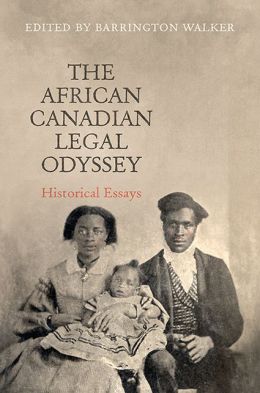

Comprised of eleven engaging chapters, organized both thematically and chronologically, it includes a substantive introduction that provides a synthesis and overview of this complex history. This outstanding collection will appeal to both advanced specialists and undergraduate students and makes an important contribution to an emerging field of scholarly inquiry.
Subscribe to:
Posts (Atom)