Showing posts with label Bureaucracy. Show all posts

Friday, March 21, 2025

Fay, "Courts of Indian Offenses, Courts of Indian Resistance"

Alexandra Fay (University of Tulsa College of Law) has posted "Courts of Indian Offenses, Courts of Indian Resistance," which is forthcoming in the Michigan Law Review (2026). The abstract: 

In the late nineteenth century, the Department of the Interior created the Courts of Indian Offenses with the express goal of eliminating elements of Native culture through the coercive power of criminal law. The courts stood on dubious constitutional grounds, they were almost universally replaced by tribal courts in the twentieth century, and they have been widely derided as crude assimilationist tools.

This Article examines the Courts of Indian Offenses to study how law and legal institutions operate as sites of colonial struggle in the American context. The Courts of Indian Offenses were formally created to criminalize Native culture. In practice, they were more complicated. Native judges entrusted with Washington’s assimilationist designs frequently declined to enforce the “Indian offenses,” instead using the courts to resolve crimes and disputes recognized by their tribal communities.

The Article uses three decades of annual reports from the Commissioner of Indian Affairs and archival records from three Courts of Indian Offenses to illustrate the structure and function of the courts at the turn of the twentieth century. It engages with concepts from subaltern studies, tribal legal studies, and law and colonialism literatures to explore how tribal law adapted and survived despite the formal imposition of Anglo-American legal forms. The Article ultimately suggests that the Courts of Indian Offenses may be understood as contested institutions through which tribal leaders preserved tribal self-government against the imperatives of empire.

The full paper is available here, at SSRN.

-- Karen Tani

Tuesday, March 5, 2024

Wurman on the Opinions Clause and Presidential Power

Ilan Wurman, Arizona State University Sandra Day O'Connor College of Law, has posted The Opinions Clause and Presidential Power:

The two predominant conceptions of executive power and supervision over the administrative state are inadequate. One maintains that all administrative discretion is the President’s, and that by virtue of the grant of executive power the President can both remove and control the discretion of all subordinate officers. That raises the specter of an imperial presidency, and a textual problem: it makes superfluous the Opinions Clause, which empowers the President to require principal officers to provide written opinions about their respective duties. The other maintains that the President is, at best, a “persuader-in-chief,” with no constitutional right to control administrative discretion or to remove officers tasked with implementing statutory duties. Although this view makes sense of the Opinions Clause, there is no historical evidence for it. The proponents of these two schools of thought have thus been locked in a decades-long stalemate, with competing and irreconcilable paradigms of total control or no control.

This paper recovers another, lost way of thinking about presidential power, one that is more modest than either of the two prevailing understandings and that has the potential to advance the debate. According to this conception, Congress can insulate inferior officers from removal because they must follow orders. As for principal officers, however, the President can remove but not control them, at least not directly. There is no constitutional obligation on the part of principal officers to obey; the only inducement is the threat of removal. The Opinions Clause, far from being superfluous, then assures the President the power to acquire information to intelligently exercise the power to remove. In addition to this account’s textual and structural virtues, it appears to have been the understanding of presidential power shared by George Washington, Thomas Jefferson, James Madison, William Wirt, Daniel Webster, William Howard Taft, and the First Congress.

This understanding of executive power may seem overly formalistic, but it allows for the existence of agencies whose heads are removable but nevertheless bound by law to exercise independently the discretion Congress has given them, and for the insulation of civil servants and adjudicators subject however to the ultimate control of the heads of department. In other words, it allows for an independent administrative apparatus but over which the President has an important check. It also suggests a modest resolution to SEC v. Jarkesy, the blockbuster case before the Supreme Court this term.
--Dan Ernst

Tuesday, June 27, 2023

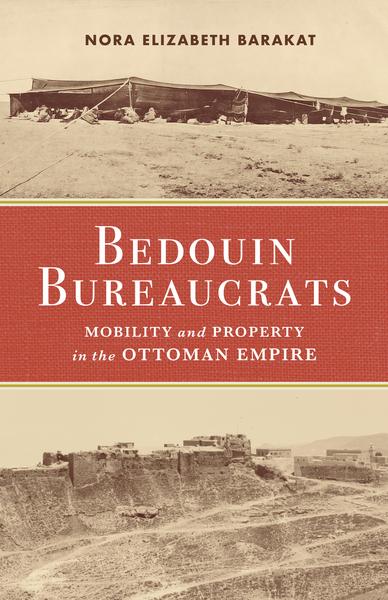
Barakat, "Bedouin Bureaucrats: Mobility and Property in the Ottoman Empire"

Stanford University Press has published Bedouin Bureaucrats: Mobility and Property in the Ottoman Empire (2023), by Nora Elizabeth Barakat (Stanford University). A description from the Press:

In the late nineteenth century, the Ottoman government sought to fill landscapes they legally defined as "empty." Both land and people were incorporated into territorially bounded grids of administrative law. Bedouin Bureaucrats examines how tent-dwelling, seasonally migrating Bedouin engaged in these processes of Ottoman state transformation on local, imperial, and global scales. As the "tribe" became a category of Ottoman administration, Bedouin in the Syrian interior used this category both to gain political influence and to organize community resistance to maintain control over land.

Narrating the lives of Bedouin individuals involved in Ottoman administration, Nora Elizabeth Barakat brings this population to the center of modern state-making, from their involvement in the pilgrimage administration in the eighteenth century and their performance of land registration and taxation as the Ottoman bureaucracy expanded in the nineteenth, to their eventual rejection of Ottoman attempts to reallocate the "empty land" they inhabited in the twentieth. She places the Syrian interior in a global context of imperial expansion into regions formerly deemed marginal, especially in relation to American and Russian empires. Ultimately, the book illuminates Ottoman state formation attempts within Bedouin communities and the unique trajectory of Bedouin in Syria, who maintained their control over land.

Praise from reviewers:

"Bedouin Bureaucrats is a marvel. It is necessary reading for anybody interested in the complexities of state-building, governance, and sovereignty. Nora Barakat has given us a book that will be debated and admired for years to come." —Pekka Hämäläinen

"Through rigorous research and exceptional prose, Nora Barakat shows how Bedouin chiefs participated in the creation of new state structures to ensure their power and privilege and the long-term survival of their communities. Bedouin Bureaucrats convinces us to rethink our assumptions about tribes and their place in the modern Middle East."—Reşat Kasaba,

More information is available here. An interview with Professor Barakat is available here, at New Books Network.

-- Karen Tani

Saturday, July 24, 2021

Weekend Roundup

  • Joseph D. Kearney, Marquette Law, and Thomas W. Merrill, Columbia Law, “discuss the shenanigans that ultimately gave the city and the state of Illinois one of its most priceless parcels of land and preserves it for public use” in a podcast on the ABA Journal’s Legal Talk Network.  They are the authors of  Lakefront: Public Trust and Private Rights in Chicago (Cornell University Press).
  • Congratulations to William & Mary Assistant Professor of History Brianna Nofil, the recipient of the 61st annual Allan Nevins Prize by the Society of American Historians for her dissertation, “Detention Power: Jails, Camps, and the Origins of Immigrant Incarceration, 1900-2002.”  (More.)
  • More CRT: The New Hampshire attorney general says that “teaching about the country’s history of slavery, its racist Jim Crow Laws, the Civil Rights Movement of the 1960s and the modern Black Lives Matter movement won’t violate state law even if those lessons make students uncomfortable, according to legal advice from the state Attorney General’s Office" (Concord Monitor).  
  • And still more: Over 140 organizations, have signed onto this Joint Statement on Legislative Efforts to Restrict Education about Racism in American History, authored by American Association of University Professors, the American Historical Association, the Association of American Colleges & Universities, and PEN America. 
  • We recently discovered the "Now & Then" podcast, hosted by historians Joanne Freeman (Yale University) and Heather Cox Richardson (Boston College). For a particularly relevant recent episode, checkout "Judging the Supreme Court."   
  • Fire in the White House!  At 7 PM EDT on July 28, the Elk Rapids Area Historical Society hosts a live stream of Craig G. Wright, Herbert Hoover Presidential Library and Museum, discussing the fire that gutted the West Wing and ruined the Oval Office on Christmas Eve, 1929.
  • For anyone working on socio-legal history and technology: check out the new Law and Society Fellowship at the Simons Institute at Berkeley.
  • ICYMI: George Thomas on America’s Imperfect Founding (The Bulwark). A notice of The Great Dissenter: The Story of John Marshall Harlan, America’s Judicial Hero, by Peter S. Canellos (Courier Journal). Woman suffrage and Prohibition in Iowa (Cedar Rapids Gazette).  The Buffalo-Niagara LGBTQ History Project’s first historic marker recognizes “local gay rights activist Bob Uplinger,” whose battle in an entrapment case contributed to decriminalization in New York (Buffalo Rising).
  • Update: Colbert King on Karen Hastie Williams (WaPo).
Weekend Roundup is a weekly feature compiled by all the Legal History bloggers.

Sunday, February 21, 2021

A Discussion of "The Neo-Liberal Republic"

On Monday, February 22, at 1:15 PM EST, Cornell University is sponsoring a discussion of Antoine Vauchez and Pierre France’s The Neoliberal Republic: Corporate Lawyers, Statecraft, and the Making of Public-Private France, which appears in Cornell University Press’s Corpus Juris book series, edited by Elizabeth S. Anker, Cornell University.  The discussants are Samuel Moyn, Yale University/Yale Law School, Mitchel Lasser, Cornell Law School, and Katharina Pistor, Columbia Law School.  Antoine Vauchez, Universite Paris 1–Sorbonne, will respond.  Professor Anker will moderate.  Register here.

--Dan Ernst.  H/t:  Thomas Perroud

Wednesday, November 25, 2020

Grisinger Reviews Works on Vertical Files and Paper Shredders

You have to be a certain kind of legal historian to have your imagination fired by tabbed file folders, but, hell, I’m one too.  Over at Jotwell, Joanna Grisinger, Northwestern University, writes on two articles, Craig Robertson, Granular Certainty, The Vertical Filing Cabinet, and the Transformation of Files, 4 Administory 76 (2019); and Marianne Constable, The Paper Shredder: Trails of Law, 23 Law Text Culture 276 (2019).  Professor Grisinger writes:

"The Last of the NRA" (1938)(LC)
Anyone who has done archival research has grappled with someone else’s file organization—are the papers you seek filed chronologically? By correspondent? By topic? By some other method inscrutable to the outsider? Does the filing system reflect the thinking of your research subject, of a secretary or clerk, or of a later archivist seeking to impose order on chaos? Finally, will the files actually contain the documents you’re hoping to find? Two recent articles take seriously the prosaic technologies of file storage, on the one hand, and file destruction, on the other, explicating the history of the tabbed file folder, the filing cabinet, and the paper shredder. These technologies are crucial to the contemporaneous operation of the bureaucratic process, and, of course, silently shape how we write history from those files. [More. ]
–Dan Ernst

Tuesday, June 30, 2020

Thank You, Diana Kim!

We here at LHB are grateful to Diana S. Kim, Georgetown University, for her very thoughtful guest posts this month growing out of her book Empires of Vice: The Rise of Opium Prohibition across Southeast Asia.  As you’ve seen, they mix her insights for other scholars interested in one or more of the topics her book addresses (e.g., her fourth post was for those “interested in theories of state building and symbolic bureaucratic power”) with the challenges of presenting one’s newly published book, at any time but also when the pandemic has curtailed face-to-face events.

Empires of Vice: A First Book with Multiple Audiences
Empires of Vice: For Those Interested in Opium and Archives
Empires of Vice: On Doing a Written Book Interview via Email
Empires of Vice: For Those Interested in the State
Empires of Vice: On Doing a Spoken Book Interview through Zoom, Podcasts
Empires of Vice: For Those Interested in Southeast Asia and Empire

Thank you, Professor Kim!

--Dan Ernst

Sunday, June 7, 2020

Empires of Vice: A First Book with Multiple Audiences

It is a pleasure to contribute to the Legal History Blog. My first book, entitled Empires of Vice: The Rise of Opium Prohibition across Southeast Asia was published recently. Throughout the month of June, I’ll be sharing a set of posts about this book, dwelling on the multiple audiences that I hope it may “speak” to.

As Dan Ernst mentioned in his kind introduction, I received my Ph.D. in political science, currently teach at an interdisciplinary school oriented toward international affairs and policy, and have written a book in the Histories of Economic Life series of Princeton University Press. Like many interdisciplinary creatures, I find it both exciting and challenging to articulate how and why my work matters to whom.

Empires of Vice is a book for political scientists, historians, specialists of Asian Studies, and policy makers, in overlapping but different ways. It is a book about the inner life of a bureaucratic state (that urges political scientists to be more curious about how the nitty-gritty ways that states actually govern). It is also a book about the anti-opium turn of multiple European empires across Southeast Asia during the late 19th and early 20th centuries (that gives reasons for historians to pay more attention to a place and process of change often run roughshod over in prevailing narratives about empires and opium that focus mainly on the British empire, India, and China). And Empires of Vice is also a book about how colonial legacies have shaped Southeast Asia's illicit economies and punitive drug laws today, which more broadly addresses normative challenges and policy implications for transnational problem-solving. 

Each of my posts will elaborate on these points. In addition, I plan to incorporate brief reflections on the practical aspects of “speaking” to different audiences in our current moment.

I write a time when the COVID-19 epidemic continues to unfold globally, making travel, in-person gatherings, conferences, and many conventional ways of presenting scholarship not possible. It is also an impassioned time in the United States where I live, with resounding calls for social change, anxious aspirations for and collective action aimed at profoundly refashioning the existing order. It thus feels like an especially difficult and selfish time to have a new book out. At the same time, it is also feels like an especially important time to think about alternative modes of virtual presentation that may very well become a new norm; to figure out ways to be clear about relevance, in the sense of being explicit about when and how one’s scholarship may (or may not) speak to ongoing events without detracting from its value. 

I have benefitted immensely from wonderful examples of scholars sharing their new books through podcasts (see Claire Edington’s Beyond the Asylum with the New Books Network), online interviews (see Durba Mitra’s Indian Sex Life with Notches), blogposts (see Jill Hasday’s Intimate Lies and the Law with the Legal History Blog) and other forms of virtual presentation (see this online book party for Arunabh Ghosh’s Making it Count). I hope to add to this growing digital archive, by sharing what I wish I had known in advance of some of the podcasts, interviews, short essays that I have done recently: seemingly mundane practical details that ended up mattering a lot for expressing ideas and communicating through different types of media (zoom, phone chats, written scripts), with different types of interlocutors (interviewers as my own students, colleagues, total strangers), and for different audiences (across disciplines and beyond the academy). I’ll also be linking to recently published books by people I admire, especially first-time authors in legal history, histories of empire, political science, and Southeast Asian studies.

I’ll wrap up this first post with an invitation. I’d love to learn from others with first books with multiple audiences, and also welcome suggestions from more seasoned authors and colleagues with more experience ushering their books into the virtual world. 

In my next post, I’ll be writing with legal historians in mind as an audience, highlighting how Empires of Vice explores the inner life of bureaucracies and its use of administrative archives for British and French colonial opium monopolies across Southeast Asia. I’ll also dwell on preparing for my interview with The Docket, the digital imprint of Law and History Review

Diana Kim


Author’s Photograph.
Card Catalogue at Archives nationales d’outre-mer (Aix-en-Provence, France)