Showing posts with label French colonialism. Show all posts

Sunday, June 7, 2020

Empires of Vice: A First Book with Multiple Audiences

It is a pleasure to contribute to the Legal History Blog. My first book, entitled Empires of Vice: The Rise of Opium Prohibition across Southeast Asia was published recently. Throughout the month of June, I’ll be sharing a set of posts about this book, dwelling on the multiple audiences that I hope it may “speak” to.

As Dan Ernst mentioned in his kind introduction, I received my Ph.D. in political science, currently teach at an interdisciplinary school oriented toward international affairs and policy, and have written a book in the Histories of Economic Life series of Princeton University Press. Like many interdisciplinary creatures, I find it both exciting and challenging to articulate how and why my work matters to whom.

Empires of Vice is a book for political scientists, historians, specialists of Asian Studies, and policy makers, in overlapping but different ways. It is a book about the inner life of a bureaucratic state (that urges political scientists to be more curious about how the nitty-gritty ways that states actually govern). It is also a book about the anti-opium turn of multiple European empires across Southeast Asia during the late 19th and early 20th centuries (that gives reasons for historians to pay more attention to a place and process of change often run roughshod over in prevailing narratives about empires and opium that focus mainly on the British empire, India, and China). And Empires of Vice is also a book about how colonial legacies have shaped Southeast Asia's illicit economies and punitive drug laws today, which more broadly addresses normative challenges and policy implications for transnational problem-solving. 

Each of my posts will elaborate on these points. In addition, I plan to incorporate brief reflections on the practical aspects of “speaking” to different audiences in our current moment.

I write a time when the COVID-19 epidemic continues to unfold globally, making travel, in-person gatherings, conferences, and many conventional ways of presenting scholarship not possible. It is also an impassioned time in the United States where I live, with resounding calls for social change, anxious aspirations for and collective action aimed at profoundly refashioning the existing order. It thus feels like an especially difficult and selfish time to have a new book out. At the same time, it is also feels like an especially important time to think about alternative modes of virtual presentation that may very well become a new norm; to figure out ways to be clear about relevance, in the sense of being explicit about when and how one’s scholarship may (or may not) speak to ongoing events without detracting from its value. 

I have benefitted immensely from wonderful examples of scholars sharing their new books through podcasts (see Claire Edington’s Beyond the Asylum with the New Books Network), online interviews (see Durba Mitra’s Indian Sex Life with Notches), blogposts (see Jill Hasday’s Intimate Lies and the Law with the Legal History Blog) and other forms of virtual presentation (see this online book party for Arunabh Ghosh’s Making it Count). I hope to add to this growing digital archive, by sharing what I wish I had known in advance of some of the podcasts, interviews, short essays that I have done recently: seemingly mundane practical details that ended up mattering a lot for expressing ideas and communicating through different types of media (zoom, phone chats, written scripts), with different types of interlocutors (interviewers as my own students, colleagues, total strangers), and for different audiences (across disciplines and beyond the academy). I’ll also be linking to recently published books by people I admire, especially first-time authors in legal history, histories of empire, political science, and Southeast Asian studies.

I’ll wrap up this first post with an invitation. I’d love to learn from others with first books with multiple audiences, and also welcome suggestions from more seasoned authors and colleagues with more experience ushering their books into the virtual world. 

In my next post, I’ll be writing with legal historians in mind as an audience, highlighting how Empires of Vice explores the inner life of bureaucracies and its use of administrative archives for British and French colonial opium monopolies across Southeast Asia. I’ll also dwell on preparing for my interview with The Docket, the digital imprint of Law and History Review. 

—Diana Kim


Author’s Photograph.
Card Catalogue at Archives nationales d’outre-mer (Aix-en-Provence, France)


Friday, March 9, 2018

Agmon on French India

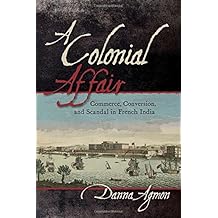
A Colonial Affair: Commerce, Conversion, and Scandal in French IndiaDanna Agmon, Virginia Tech, has published A Colonial Affair: Commerce, Conversion, and  Scandal in French India with Cornell University Press. From the publisher:
A Colonial Affair traces the 1716 conviction of Nayiniyappa, a Tamil commercial agent employed by the French East India Company, for tyranny and sedition, and his subsequent public torture, the loss of his wealth, the exile of his family, and his ultimate exoneration. Danna Agmon’s gripping microhistory is a vivid guide to the "Nayiniyappa Affair" in the French colony of Pondicherry, India. The surprising and shifting fates of Nayiniyappa and his family form the basis of this story of global mobilization, which is replete with merchants, missionaries, local brokers, government administrators, and even the French royal family.
Agmon’s compelling account draws readers into the social, economic, religious, and political interactions that defined the European colonial experience in India and elsewhere. Her portrayal of imperial sovereignty in France’s colonies as it played out in the life of one beleaguered family allows readers to witness interactions between colonial officials and locals. Students and scholars of the history of colonialism, religion, capitalism, and law will find Agmon’s narrative of European imperialism of great interest.
Praise for the book:


"A Colonial Affair is a compelling illustration of the ways in which insights from other disciplines, in this case anthropology, can deepen our understanding of the nature and dynamics of the social, economic, political, and other interactions that were an integral component of the colonial experience in India and elsewhere."
- Richard B. Allen

"A Colonial Affair is highly readable and just the perfect length for a course book. It will generate fruitful discussions not just of substance, such as the respective natures of colonies and empires, but also of method. We can learn a great deal by parsing a single ‘scandal’ from a variety of angles." - Catherine Desbarats

"This smart, nuanced, and well-researched investigation reveals the role of powerful Tamil brokers within the fractious commercial and spiritual enterprise of French India. Danna Agmon foregrounds the role of indigenous brokers in French attempts to establish their Indian Ocean trading base. A lively microhistory founded in legal records, A Colonial Affair animates and analyzes the larger problem of imperial authority in an intricate and often overlooked corner of empire. An informative and engaging read!" - Sue Peabody

"Danna Agmon's dazzling study of French India at the turn of the eighteenth century highlights facets of the encounter between Europe and India that we have often missed. It suggests the possibilities of a different kind of colonialism to that which eventuated under the English. It also tells a rattling good yarn." - David Washbrook 

Further information is available here.

Thursday, March 1, 2018

Voices in the Legal Archives in the French Atlantic

[Via H-Law, we have the following announcement.]

The central aim of this conference is to draw together a dynamic group of international scholars from France, Canada, and the United States whose work stands at the interface of two emerging sub-disciplines:  the history of the French Atlantic and the "new legal history" whose central vector insists on shifting the focus of the field beyond legal structures and frameworks, towards an understanding of how law was actively shaped and applied through the lives and experiences of ordinary men and women.  By uncovering and identifying the "voices" of slaves, indentured servants, artisans, aboriginal people, women entrepreneurs, peasants, merchants, planter elites and government officials, we aim to provide a richer understanding of the ways in which French law was understood and integrated into the lives of ordinary people involved in the 18th century colonial enterprise.  We hope, therefore, to open up new scholarly conversations which seek to reimagine the French colonial world as less the product of metropolitan influences than a process shaped by a multiplicity of actors.

The organizers gratefully acknowledge the sponsorship of the Omohundro Institute for Early American History and Culture; the Social Sciences and Humanities Research Council of Canada; The L.R. Wilson Institute for Canadian History, McMaster University; Office of the President, McMaster University; Dean of Humanities, McMaster University; Department of History, McMaster University; Department of History, University of Western Ontario; McNeil Centre for Early American Studies.

For details regarding program and registration, please visit [here], or contact

Michael Gauvreau (Department of History, McMaster University) mgauvrea@mcmaster.ca
Nancy Christie (Department of HIstory, University of Western Ontario) nchrist8@uwo.ca