Showing posts with label early modern law. Show all posts

Wednesday, May 15, 2024

Craig's "English Administrative Law from 1550"

Paul Craig, Emeritus Professor of English Law, St. John's College, Oxford, has published English Administrative Law from 1550: Continuity and Change in the series Oxford Legal History:

The commonly held view about English administrative law is that it is of recent origin, with some dating it from the mid-20th century and some venturing back to the late 19th century. English Administrative Law from 1550: Continuity and Change upends this conventional thinking, charting its development from the mid-16th century with an in-depth examination of administrative law doctrine based on primary legal materials, statute, and case law.

This book is divided into four parts. Part I sets out the book's principal thesis, contrasting standard perceptions concerning the existence of English administrative law with the reality of its emergence from the mid-16th century. Part II is concerned with Regulation and Administration from the mid-16th century to the end of the 19th century. There is detailed analysis of the regulatory and administrative state, which includes chapters on the way in which administrative policy was developed through individual decision-making and rulemaking, and the role played by contract in service delivery. Part III deals with Courts and Doctrine. It begins with discussion of foundational precepts followed by chapters on natural justice; review of law and fact; rights; delegation, fettering and purpose; reasonableness; proportionability; prerogative; and third and fourth source power. Part IV of the book covers Remedies and Review, with chapters on invalidity; standing; the prerogative writs; injunction, declaration, quo warranto and habeas corpus; and damages and restitutionary liability.

With thought-provoking and original insights, English Administrative Law from 1550 systematically elaborates and contextualizes the origins of administrative law features while linking them to their modern-day equivalents.
–Dan Ernst

Saturday, May 9, 2020

Weekend Roundup

  • Floyd Abrams reviews Wendell Bird’s The Revolution in Freedoms of Press and Speech: From Blackstone to the First Amendment and Fox’s Libel Act” over at First Amendment News.
  • The Federal Judicial Center has arranged its collection of its Notable Federal Trials series in this nifty timeline.  
Robert A. Taft (LC)
  • Sure, you're on lock down, but that doesn't mean you can't (virtually) browse the George Wythe Room at the Wolf Law Library at William & Mary.  H/t: Tom McSweeney.
  • A more accessible version of John Fabian Witt's lecture on the legal history of infectious diseases is here.
  • Over at the Legal History Miscellany: Can you steal a peacock? A post by Krista J. Kesselring on animals in early modern law.
  • The Hoover-Roosevelt Transition premiers on the Facebook page of the FDR Library on Wednesday, May 13.  FDR Library Director Paul Sparrow and Hoover Library Director Thomas Schwartz discuss the relationship between FDR and HH “during the 1932 campaign and the transition between their presidencies, examining their different philosophies in the role of government and the protection of individual liberty and freedom. Followed by a Q&A in the comments.
  • The Tagore Law Lectures (1870-1986) are now available here on the University of Calcutta Digital Library.
  • And also on South Asia: check out this Twitter thread by Kalyani Ramnath (@kalramnath) on epidemics, contagion, migration, and law.
    Weekend Roundup is a weekly feature compiled by all the Legal History bloggers.

Thursday, August 15, 2019

Coşgel and Ergene on Ottoman justice

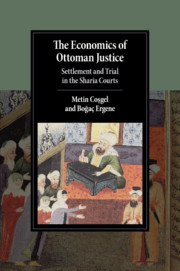
We missed this one earlier, so here it is now: Metin Coşgel, University of Connecticut and Boğaç Ergene, University of Vermont published The Economics of Ottoman Justice: Settlement and Trial in the Sharia Courts with Cambridge University Press in 2016. From the publisher: 
The Economics of Ottoman JusticeDuring the seventeenth and eighteenth centuries, the Ottoman Empire endured long periods of warfare, facing intense financial pressures and new international mercantile and monetary trends. The Empire also experienced major political-administrative restructuring and socioeconomic transformations. In the context of this tumultuous change, The Economics of Ottoman Justice examines Ottoman legal practices and the sharia court's operations to reflect on the judicial system and provincial relationships. Metin Coşgel and Boğaç Ergene provide a systematic depiction of socio-legal interactions, identifying how different social, economic, gender and religious groups used the court, how they settled their disputes, and which factors contributed to their success at trial. Using an economic approach, Coşgel and Ergene offer rare insights into the role of power differences in judicial interactions, and into the reproduction of communal hierarchies in court, and demonstrate how court use patterns changed over time.
Praise for the book: 

"Metin Coşgel and Boğaç Ergene have written a well-researched book that pushes the boundary of interdisciplinary scholarship. Their history is informed by economics, and their economics is generalized via history. It is an impressive and difficult methodology to pull off, yet Coşgel and Ergene have done just this." -Jared Rubin 


Further information is available here.


-posted by Mitra Sharafi