Showing posts with label courts. Show all posts

Monday, October 30, 2023

AJLH: 63:1

The American Journal for Legal History 63:1 (March 2023) is now fully published on line:

The best answer? Justice Nelson’s concurrence in Dred Scott v. Sandford
William B Meyer

‘I Laid Earl and Clementine on a Chair and Whipped Them’: Child Murder and Criminal Justice in the Jim Crow South
Jeffrey S Adler

Limping Marriages: Race, Class, and the Rise of Domicile-Based Divorce Jurisdiction in the British Empire
Priyasha Saksena

Book Reviews

Tamika Y.  Nunley.  The Demands of Justice: Enslaved Women, Capital Crime, and Clemency in Early Virginia (Chapel Hill: University of North Carolina Press, 2023), pp  243, $27.95 (paperback). ISBN 978-1-4696-7312-7

Terri L Snyder

Russell Sandberg, A Historical Introduction to English Law: Genesis of the Common Law
( Cambridge:  Cambridge University Press,  2023), pp.  xiii +280. £90 (hardcover). ISBN 9781107090583

William Eves

 --Dan Ernst

Thursday, February 10, 2022

Perry's "Law in American Meetinghouses"

Jeffrey Thomas Perry, Tusculum University, has published Law in American Meetinghouses
Church Discipline and Civil Authority in Kentucky, 1780–1845
(Johns Hopkins University Press):

Most Americans today would not think of their local church as a site for arbitration and would probably be hesitant to bring their property disputes, moral failings, or personal squabbles to their kin and neighbors for judgment. But from the Revolutionary Era through the mid-nineteenth century, many Protestants imbued local churches with immense authority. Through their ritual practice of discipline, churches insisted that brethren refrain from suing each other before "infidels" at local courts and claimed jurisdiction over a range of disputes: not only moral issues such as swearing, drunkenness, and adultery but also matters more typically considered to be under the purview of common law and courts of equity, including disputes over trespass, land, probate, slave warranty, and theft.

In Law in American Meetinghouses, Jeffrey Thomas Perry explores the ways that ordinary Americans—Black and white, enslaved and free—understood and created law in their local communities, uncovering a vibrant marketplace of authority in which church meetinghouses played a central role in maintaining their neighborhoods' social peace. Churches were once prominent sites for the creation of local law and in this period were a primary arena in which civil and religious authority collided and shaped one another. When church discipline failed, the wronged parties often pushed back, and their responses highlight the various forces that ultimately hindered that venue's ability to effectively arbitrate disputes between members. Relying primarily on a deep reading of church records and civil case files, Perry examines how legal transformations, an expanding market economy, and religious controversy led churchgoers to reimagine their congregations' authority. By the 1830s, unable to resolve doctrinal quibbles within the fellowship, church factions turned to state courts to secure control over their meetinghouses, often demanding that judges wade into messy ecclesiastical disputes.

Tracking changes in disciplinary rigor in Kentucky Baptist churches from that state's frontier period through 1845, and looking beyond statutes and court decrees, Law in American Meetinghouses is a fresh take on church-state relations. Ultimately, it highlights an oft-forgotten way that Americans subtly repositioned religious institutions alongside state authority.

An interview of Professor Perry about his book is here.

--Dan Ernst

Monday, December 27, 2021

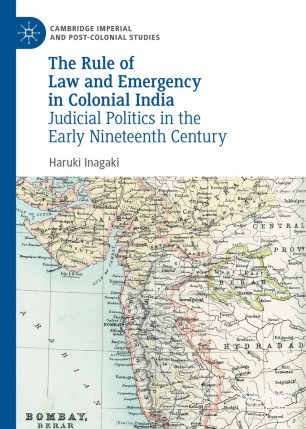
Inagaki on the Rule of Law and Emergency in colonial India

Haruki Inagaki (Aoyama Gakuin University, Japan) has published The Rule of Law and Emergency in Colonial India: Judicial Politics in the Early Nineteenth Century with Palgrave Macmillan. From the press:

This book takes a closer look at colonial despotism in early nineteenth-century India and argues that it resulted from Indians’ ‘forum shopping,’ the legal practice which resulted in jurisdictional jockeying between an executive, the East India Company, and a judiciary, the King’s Court. Focusing on the collisions that took place in Bombay during the 1820s, the book analyses how Indians of various descriptions—peasants, revenue defaulters, government employees, merchants, chiefs, and princes—used the court to challenge the government (and vice versa) and demonstrates the mechanism through which the lawcourt hindered the government’s indirect rule, which relied on local Indian rulers in newly conquered territories. The author concludes that existing political anxiety justified the East India Company’s attempt to curtail the power of the court and strengthen their own power to intervene in emergencies through the renewal of the company’s charter in 1834. An insightful read for those researching Indian history and judicial politics, this book engages with an understudied period of British rule in India, where the royal courts emerged as sites of conflict between the East India Company and a variety of Indian powers.

Praise for the book: 

 “Inagaki’s methodical study demonstrates how the Company’s disputes and eventual subjugation of the independent King’s Court in Bombay embedded the logic of state necessity and perpetual emergency into the governing fabric of the British colonial regime. In so doing, it offers a compelling and important new insight into how colonial rule privileged security and political order over the rule of law.” - Mark Condos

“Britain’s empire did not arrive fully formed in India. Haruki Inagaki’s superbly-researched, well-argued book traces its emergence in a proliferating set of arguments between different groups of British officers, who variously fought with and co-opted Indian elites. It traces the debates which raged amongst British officers about the character of Britain’s presence in India during the early nineteenth century, in doing so unravelling the fractured, debated character of the imperial enterprise itself. British India’s Imperial constitution was, he argues, forged within the opposition between radically different logics of power. Inagaki’s book offers a compelling account of the real life of empire in motion. A vital contribution to the burgeoning field of imperial legal history, it speaks well beyond narrow thematic categories, and is vital reading for anyone interested in the history of empire more broadly and the Indian subcontinent.“ - Jon Wilson

Further information is available here.

--posted by Mitra Sharafi

Monday, September 23, 2019

Choosing Representative Cases from Many; Or, Privilege & Prejudice in 1865 Liverpool.


Choosing Representative Cases from Many; Or, Privilege & Prejudice in 1865 Liverpool.

The Reverend James Kelly of Liverpool was not well liked. His spat with the church’s organist was bad enough, but Kelly’s diatribes against city officials drew public attention to this pugnacious – and litigious – clergyman. Seemingly anxious over the fate of Anglicanism, Kelly – who preached about the Protestant martyrs of Bloody Mary’s reign to a new generation – balked at the appointment of a Roman Catholic priest as chaplain in one of the city’s jails and railed against voters who had returned Liverpool’s first Jewish mayor that same fall. Not content to issue commentary from the pulpit, Kelly broadcast his opinions in the local newspapers.
While a number of local papers followed Kelly’s squabbles with local notables, Randall Sherlock’s Liverpool Mail did so with particular glee. Under the heading “Irish Scandal at St. George’s Church,” the weekly newspaper detailed the “wolfish”-ness of Irish clergy. It began with a diatribe against the Irish clergy in general and then proceeded to describe the barbarity of Kelly using the church for “potato-boiling” and his penchant for brawling (typical of Irish stereotypes as well) [1].
This fusillade of ethnic stereotypes did not even attempt a pretext of defending Catholics from Kelly. The attack on Kelly ran next to a column decrying fanatical Roman Catholic priests “running mad” overseas. Sherlock tried to apologize later. Kelly was unsatisfied, however, and sued. He won, but the jury awarded him a symbolically negligible single farthing. Kelly appealed for a new trial, believing himself entitled to higher damages. The justices of the Queen’s Bench disagreed.
I love the point in research where one gets to immerse oneself in a single case for some time. While this can happen regularly with high profile cases, it is rarer in the cases of ordinary men and women. Indeed, piecing together the ins and outs of a defamation case is not easy at all. Those which appear in law reports can contain more about precedent than on the case itself. Newspaper coverage can be as terse as a few lines, or can stretch out over multiple articles for months – even years – on end. Reconstructing a case can entail a great deal of additional research, and this is simply not feasible to do for over 600 cases. It’s as I concentrate on a cluster of cases that seem to illustrate a broader phenomenon that I really get to plunge into the weeds. I zeroed in on Kelly for an upcoming conference paper initially for pragmatic reasons; I knew that, in addition to the law report which I had in my electronic file, there were a further 80+ articles about the Rev. Kelly in the British Library Newspaper Database. There’s often quite a bit to be unpacked even from a few lines about a trial. There is all the more to be uncovered when one has not only 80 articles, but seemingly verbatim coverage of the trials among them.
If I were telling a history of case law, I would address the two legal issues at issue in Kelly v. Sherlock. First, the Queen’s Bench found that they had no standing to allow for a new trial solely on the basis of insufficient damages. That would illegitimately circumvent the jury’s role. Second, the judge at the assize level provides a particularly eloquent defense of a clergyman’s privilege of preaching to his flock as he sees fit. His phrasing would be republished in legal text books for years [2]. I suppose these points will make their way into my account, but I, like many of you, am more interested in the case’s implications for society at the time. I am want to explore through newspaper and legal reports how a community works out norms of proper authority and the acceptable limits on stereotyping. Here, as in quite a few cases involving the clergy, the question centered on the authority of the pulpit and the privilege (even the duty) of the clergyman (as opposed to the newspaper) to criticize different social groups as a whole. Was Kelly’s behavior a proper subject of public interest (as Sherlock claimed)? Even if it were, what were the boundaries between proper discussion and malice or ridicule?
During this period, standards for legal judgment of such cases were beginning to crystalize. That is important. More interesting still, are the disagreements, however, as one finds in the columns of the newspaper, among judges and juries, and between trials. It is in these moments that one finds critical tensions over who gets to constitute community, its boundaries, and the language that helps to keep it in balance. Perhaps not surprisingly, more elite commentators seemed embarrassed by both Kelly and Sherlock—though Kelly especially. His brand of evangelicalism did not sit well with those who prized cosmopolitan rationality and were more accepting of religious heterodoxy in civil society [3]. Elite commentators themselves were not entirely enlightened, however: keen to distance themselves from Kelly’s bigotry, these commentators attributed it to the “hot-blooded” Irish. Sherlock lost his case because his diatribe against Kelly the individual descended to ridicule; but more genteel anti-Irish stereotyping, which suffused a good portion of those 80+ articles, remained within the bounds of community acceptability [4].

[1] “Irish Scandals at St George’s Church”, Liverpool Mail, February 6, 1864, p. 5. The newspaper continued the diatribe a week later: “Irish Scandals at St George’s Church, No. II”, Liverpool Mail, February 13, 1864, p. 5.

[2] 686 Kelly v Sherlock, Queen's Bench Division, 13 June 1866, (1865-66) L.R. 1 Q.B. 686. See, for example, John Townsend, A Treatise on the Wrongs Called Slander and Libel and on the Remedy by Civil Action for those Wrongs, (London: Steven & Haynes, 1868), p. 354-355.

[3] See, for example: “The Finance Committee,” Liverpool Mail, April 9, 1864, p. 4; and “When a man embarks on a sea of controversy…,” The Englishman, November 5, 1864, p. 5.

[4] “The Rev. James Kelly,” Pall Mall Gazette, August 16, 1865, p. 1.  

--Caroline Shaw

Thursday, August 15, 2019

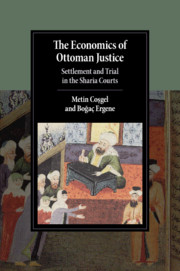
CoÅŸgel and Ergene on Ottoman justice

We missed this one earlier, so here it is now: Metin CoÅŸgelUniversity of Connecticut and BoÄŸaç ErgeneUniversity of Vermont published The Economics of Ottoman Justice: Settlement and Trial in the Sharia Courts with Cambridge University Press in 2016. From the publisher: 
The Economics of Ottoman JusticeDuring the seventeenth and eighteenth centuries, the Ottoman Empire endured long periods of warfare, facing intense financial pressures and new international mercantile and monetary trends. The Empire also experienced major political-administrative restructuring and socioeconomic transformations. In the context of this tumultuous change, The Economics of Ottoman Justice examines Ottoman legal practices and the sharia court's operations to reflect on the judicial system and provincial relationships. Metin CoÅŸgel and BoÄŸaç Ergene provide a systematic depiction of socio-legal interactions, identifying how different social, economic, gender and religious groups used the court, how they settled their disputes, and which factors contributed to their success at trial. Using an economic approach, CoÅŸgel and Ergene offer rare insights into the role of power differences in judicial interactions, and into the reproduction of communal hierarchies in court, and demonstrate how court use patterns changed over time.
Praise for the book: 

"Metin CoÅŸgel and BoÄŸaç Ergene have written a well-researched book that pushes the boundary of interdisciplinary scholarship. Their history is informed by economics, and their economics is generalized via history. It is an impressive and difficult methodology to pull off, yet CoÅŸgel and Ergene have done just this." -Jared Rubin 


Further information is available here.


-posted by Mitra Sharafi