This article casts light on the structure of the Spanish empire by focusing on the relations between two American kingdoms, New Spain and New Galicia. New Spain comprised the heartland of colonial Mexico, and New Galicia lay to its northwest. New Spain enjoyed significant status and to a degree controlled New Galicia and other dependent realms. By the mid-eighteenth century, the viceroy of New Spain sent inspectors, appointed treasury officials, and even wrested the mining camp of Bolaños from New Galicia. Yet New Galicia insisted on its autonomy. Its president resisted the viceregal interventions and finally succeeded in recovering jurisdiction over Bolaños. The relationship between the two North American kingdoms therefore differed from that between other constituent regions of the empire. The kingdom of Quito, for example, was fully subordinate to the Peruvian viceroy in Lima. The empire can therefore be described as multi-tiered and not exclusively characterized by the hegemony of Madrid/Castile over its overseas possessions. Instead, the empire consisted of uneven and overlapping ties between a group of core kingdoms and their dependent territories, and their relations changed over time.
Friday, November 9, 2018
Rosenmüller on New Spain and New Galicia
Christoph Rosenmüller, Middle Tennessee State University, has posted Two Kingdoms in a Multi-Tiered Empire: New Spain and New Galicia in the Mid-Eighteenth Century:


Reid on Testamentary Freedom and Family Protection in Scotland
Kenneth Reid, University of Edinburgh School of Law, has posted Testamentary Freedom and Family Protection in Scotland:
In a sense, testators in Scotland are free to do as they please, for a will is not challengeable on the ground of having failed to provide for children, or a spouse, or some other relative. Yet, regardless of what a will says or does not say, a child or spouse of the deceased is entitled to a fixed share of the deceased’s estate. Since 1964 this has been confined to the deceased’s movable estate and there is no claim in respect of immovable property. Where a deceased is survived by both spouse and children, the movable estate is divided into three – one-third for the spouse, one-third to be shared among the children, and one-third to be disposed of in accordance with the will. Where only a spouse, or only children, survive, the division is into two equal parts and not three. These ‘legal rights’ of the children and surviving spouse are personal rights against the executor of the deceased and are satisfied by payment in money.
This paper considers the history of legal rights in Scotland, their scope and calculation, the rules on discharge, the requirement to collate lifetime advances, and the requirement to choose between legal rights and an express bequest in the will.
Legal rights are of medieval origin, and have survived various attempts to change them. In recent years, the position of children has been seen as especially controversial. On one view, children should have merely a maintenance claim from the deceased’s estate, in cases of proved need. On another view, a child’s position in the family should continue to be recognised by means of a fixed share in their late parent’s estate. In the absence of consensus on this issue, the Scottish Government has recently rejected a package of reforms proposed by the Scottish Law Commission. Uncertain as to what the future should hold, Scotland has chosen to stick with rules developed, unthinkingly, in the distant past.
Thursday, November 8, 2018
Lange on German International Law Scholarshgp
Felix Lange, Humboldt University of Berlin, has posted Between Systematization and Expertise for Foreign Policy: The Practice-Oriented Approach in Germany’s International Legal Scholarship (1920–1980):
German international legal scholarship has been known for its practice-oriented, doctrinal approach to international law. On the basis of archival material, this article tracks how this methodological take on international law developed in Germany between the 1920s and the 1980s. In 1924, as a reaction to the establishment of judicial institutions in the Treaty of Versailles, the German Reich founded the Kaiser Wilhelm Institute for Comparative Public Law and International Law. Director Viktor Bruns institutionalized the practice-oriented method to advance the idea of international law as a legal order as well as to safeguard the interests of the Weimar government before the various courts. Under National Socialism, members of the Institute provided legal justifications for Hitler’s increasingly radical foreign policy. At the same time, some of them did not engage with völkisch-racist theories, but systematized the existing ius in bello. After 1945, Hermann Mosler, as director of the renamed Max Planck Institute, took the view that the practice-oriented approach was not as discredited as the more theoretical approach of völkisch international law. Furthermore, he regarded the method as a promising vehicle to support the policy of Westintegration of Konrad Adenauer. Also, he tried to promote the idea of ‘international society as a legal community’ by analysing international practice.
De on the Indian Constitution
Rohit De, Yale University, has published A People's Constitution: The Everyday Life of Law in the Indian Republic with Princeton University Press. From the publisher:
It has long been contended that the Indian Constitution of 1950, a document in English created by elite consensus, has had little influence on India’s greater population. Drawing upon the previously unexplored records of the Supreme Court of India, A People’s Constitution upends this narrative and shows how the Constitution actually transformed the daily lives of citizens in profound and lasting ways. This remarkable legal process was led by individuals on the margins of society, and Rohit De looks at how drinkers, smugglers, petty vendors, butchers, and prostitutes—all despised minorities—shaped the constitutional culture.
The Constitution came alive in the popular imagination so much that ordinary people attributed meaning to its existence, took recourse to it, and argued with it. Focusing on the use of constitutional remedies by citizens against new state regulations seeking to reshape the society and economy, De illustrates how laws and policies were frequently undone or renegotiated from below using the state’s own procedures. De examines four important cases that set legal precedents: a Parsi journalist’s contestation of new alcohol prohibition laws, Marwari petty traders’ challenge to the system of commodity control, Muslim butchers’ petition against cow protection laws, and sex workers’ battle to protect their right to practice prostitution.
Exploring how the Indian Constitution of 1950 enfranchised the largest population in the world, A People’s Constitution considers the ways that ordinary citizens produced, through litigation, alternative ethical models of citizenship.Praise for the book:
"This book offers genuinely original insights into the transformation of India’s Constitution into a living reality of social and economic life. Its emphasis on the role of ordinary citizens, and civil society organizations, provides a fascinating perspective ignored in standard accounts focusing on the statecraft of political elites in New Delhi." - Bruce Ackerman
“The study of India’s Constitution, perhaps one of the most important documents of the twentieth century, has long been neglected. In A People’s Constitution, De shows how it generated forms of democratic behavior among the nation’s less elite subjects—an important idea, given that India is the world’s largest democracy. No other work so lucidly explains the Indian Constitution, and this informative and original book will be widely read.” - Durba Ghosh
"This wonderful book fills a critical gap in the history of India’s Constitution and is destined to be a classic. A fabulous, rich, and humorous account of how ordinary people interpreted and shaped the Constitution from below, this is truly a people’s history, placing law within everyday life. Deeply learned yet immensely readable, A People’s Constitution must be read not just by legal practitioners and scholars but by all citizens.” - Nandini Sundar
“Rich and deeply researched, this groundbreaking legal history will speak to readers in many fields and countries. De shows how ordinary citizens played a disproportionate role in giving meaning to India’s Constitution, how it became a vehicle for arguing about unresolved tensions among the many groups constituting the new nation, and why constitutionalism became such an important part of modern Indian society. I learned a great deal from this wonderful book.” - Kenneth W. Mack
Further information is available here.
Wednesday, November 7, 2018
Scardamaglia on Lithography
Amanda Scardamaglia, Swinburne University of Technology, has posted A Legal History of Lithography, which appeared in (2017) Griffith Law Review 1-27:
Charles Troedel (1835–1906) was a master printer and lithographer and founder of the firm Troedel & Co. He was also the forgotten face behind the production of much of Australia’s earliest existing and surviving advertising material including posters, labels and other visual ephemera. These works, many of which were registered for colonial copyright and trade mark protection, provide a graphic history of nineteenth-century Australia, speaking to the prevailing state of commerce, culture, social trends and colonial norms. Inexplicably, Troedel’s role in the production of this capsule history has been overlooked. The legal dimension to this history and the relationship between lithography and intellectual property law has also been overlooked – in terms of the stylistic evolution of commercial signifiers and the legal mechanisms which served to protect these graphical expressions. This article uses Troedel’s archive of lithographs as the proxy through which to examine how lithography facilitated and shaped the production of early copyright and trade marks in Australia and more specifically, how lithography, as the technological arrangement mediating early colonial Australian society, was responsible for transforming advertising in nineteenth-century Australia, and the legal categories under which such advertising was defined.
Tuesday, November 6, 2018
Cavanagh on the Imperial Constitution and Crown Law Officers
Edward Cavanagh, Downing College, Cambridge University, has published, ungated it seems, The Imperial Constitution of the Law Officers of the Crown: Legal Thought on War and Colonial Government, 1719–1774, in the Journal of Imperial and Commonwealth History:
The rule of conquest came to receive different applications for different parts of theBritish Empire. How this happened, and who was responsible for it happening, are the interests of this article. Calling upon court reports, parliamentary records, and correspondence between various officeholders in the early Hanoverian government, attention will be drawn in particular to the attorney general and the solicitor general (the law officers of the crown) and the advice they offered upon the governance of colonies between 1719 and 1774. Focusing upon the conventions that pertain to war and conquest in Ireland, the Caribbean, India, and North America, this article reveals inconsistency in doctrine, but consistency in the procedures by which law officers of the crown acquired influence over proceedings in the houses of parliament and in the courts of common law and equity. Just as often in their formal capacities as in their informal capacities, the attorney general and the solicitor general were pivotal to the development of the imperial constitution, in constant response, as they were, to the peculiar demands of various colonies and plantations in the British Empire.

Monday, November 5, 2018
Call for #ASLH2018 Guest Posts and Twitter Updates
If you are attending the American Society for Legal History meeting this week in Houston, the Legal History Blog welcomes your guest posts about any panels you attend. Examples of panel reports from previous meetings are here, here, here and here. The 2018 program is here.
Twitter updates would also be appreciated. We suggest the hashtag #ASLH2018. And do say hello if you see us at the meeting!
Twitter updates would also be appreciated. We suggest the hashtag #ASLH2018. And do say hello if you see us at the meeting!
Sunday, November 4, 2018
Weekend Roundup
- From Government Technology a story on HLS's Caselaw Access Project: “A new free website spearheaded by the Library Innovation Lab at the Harvard Law School makes available nearly 6.5 million state and federal cases dating from the 1600s to earlier this year, in an initiative that could alter and inform the future availability of similar areas of public-sector big data.” More.
- The chance to snap up a portrait of Horace Binney we know you’ve been waiting for has arrived.
- Reviews of Jane Sharon De Hart's biography of Justice Ruth Bader Ginsburg in the NYT and Minneapolis Star Tribune.
- Seth Barrett Tillman comments on Richard H. Fallon, Jr., "Judicial Supremacy, Departmentalism, and the Rule of Law in a Populist Age," 96 Texas Law Review 487 (2018), on the “duty of subordinate Executive Branch officers to obey conflicting commands and policies emanating from the President and the federal courts.”
- ICYMI: Sandra Day's law-school suitors, via NPR. The Scottsboro "boys" get a historical marker.
Saturday, November 3, 2018
Birthright Citizenship Roundup
Given the amount of commentary from historians on birthright citizenship this week (on the heels of President Trump's suggestion that he will attempt to end birthright citizenship by executive order), we are giving this topic its own round-up:
- In the New York Times, you'll find an editorial by Eric Foner (Columbia University), on why "the president has birthright citizenship all wrong."
- Not surprisingly, in light of her recently published book on this very topic, Martha Jones (Johns Hopkins) has offered several commentaries. Here's a recent piece in the Atlantic; here is a segment she did for National Public Radio; here she is on Democracy Now! And here is a link to a piece that ran this past summer in the New York Times.
- Garett Epps (University of Baltimore) also has a piece in the Atlantic, titled "The Citizenship Clause Means What It Says."
- This Washington Post "retropolis" article on birthright citizenship and Wong Kim Ark highlights the work of a number of historians, including Lucy Salyer (University of New Hampshire), Bethany Berger (University of Connecticut), and Erika Lee (University of Minnesota). Last summer, the Washington Post's "Constitutional" podcast also devoted an episode to this topic.
If we've missed anything, please feel free to chime in in the comments and we'll update the post.
Friday, November 2, 2018
Post-Doc: Migration and the Narrative of Europe
[We have the following announcement.]
The Centre of Excellence in Law, Identity and the European Narratives at the University of Helsinki is hiring a post-doctoral researcher for a four-year fixed term period from 1 January 2019 onwards (or as agreed) to contribute to the subproject Migration and the narrative of Europe as an “Area of freedom, security and justice”. The deadline for applications is 18 November 2018.
EuroStorie is funded by the Academy of Finland and hosted by University of Helsinki. The purpose of EuroStorie is to launch a new, third generation inquiry that critically explores the emergence of narratives of Europe as responses to the crises of the twentieth century and how these narratives have shaped the ideas of justice and community in Europe. It studies the foundational stories that underlie the contested idea of a shared European heritage in law and culture, such as the ideas of rule of law, equality, tolerance, pluralism and the rejection of totalitarianism, and their relevance for current debates on identity and history.
See the job advert and instructions on how to apply here. You can read more about the EuroStorie Centre of Excellence here.
The Centre of Excellence in Law, Identity and the European Narratives at the University of Helsinki is hiring a post-doctoral researcher for a four-year fixed term period from 1 January 2019 onwards (or as agreed) to contribute to the subproject Migration and the narrative of Europe as an “Area of freedom, security and justice”. The deadline for applications is 18 November 2018.
EuroStorie is funded by the Academy of Finland and hosted by University of Helsinki. The purpose of EuroStorie is to launch a new, third generation inquiry that critically explores the emergence of narratives of Europe as responses to the crises of the twentieth century and how these narratives have shaped the ideas of justice and community in Europe. It studies the foundational stories that underlie the contested idea of a shared European heritage in law and culture, such as the ideas of rule of law, equality, tolerance, pluralism and the rejection of totalitarianism, and their relevance for current debates on identity and history.
See the job advert and instructions on how to apply here. You can read more about the EuroStorie Centre of Excellence here.
Fahmy on Islamic Law and Forensic Medicine
Out this month with the University of California Press is In Quest of Justice: Islamic Law and Forensic Medicine in Modern Egypt by Khaled Fahmy, University of Cambridge. From the press:
"Through extensive research in Egyptian archives, engaging and creative scholarship, and deep engagement with the history of colonial law and medicine, Khaled Fahmy has produced a masterpiece that confirms his standing as the preeminent social and cultural historian of nineteenth century Egypt." -Eugene Rogan
"Fahmy rewrites the narrative of legal and institutional development by bringing in the Egyptian state with its new capacities and its elite as actors with clear interests and strategies of their own, as well as the broader Egyptian population whose protests and accommodations shaped this history. This book will make a very major impact in a variety of fields, including those of the history of Islamic law and legal institutions, public health, and urban planning in Egypt." -Judith Tucker
"A deft and original historian, Khaled Fahmy mobilizes the richly populated medical and legal records of a hybrid system of mid-nineteenth century tribunals to rethink the foundations of a distinctive Egyptian modernity." -Brinkley Messick
"Khaled Fahmy's In Quest of Justice is an excellent study on nineteenth-century Egyptian modernization in the Ottoman social and cultural context.The author uses the human body as a metaphor to explain modernization politics and elegantly arranges the book around the five senses: sight, sound, smell, taste and touch. We read about practices such as dissection, sewers, vaccination, torture, quarantine, market control and procedural justice. In addition, Fahmy elaborates on the lives of the non-elite population in a fascinating way, based on archival documents." -Rudolph Peters
Further information is available here.
Some reviews:In Quest of Justice provides the first full account of the establishment and workings of a new kind of state in Egypt in the modern period. Drawing on groundbreaking research in the Egyptian archives, this highly original book shows how the state affected those subject to it and their response. Illustrating how shari’a was actually implemented, how criminal justice functioned, and how scientific-medical knowledges and practices were introduced, Khaled Fahmy offers exciting new interpretations that are neither colonial nor nationalist. Moreover he shows how lower-class Egyptians did not see modern practices that fused medical and legal purposes in new ways as contrary to Islam. This is a major contribution to our understanding of Islam and modernity.
"Through extensive research in Egyptian archives, engaging and creative scholarship, and deep engagement with the history of colonial law and medicine, Khaled Fahmy has produced a masterpiece that confirms his standing as the preeminent social and cultural historian of nineteenth century Egypt." -Eugene Rogan
"Fahmy rewrites the narrative of legal and institutional development by bringing in the Egyptian state with its new capacities and its elite as actors with clear interests and strategies of their own, as well as the broader Egyptian population whose protests and accommodations shaped this history. This book will make a very major impact in a variety of fields, including those of the history of Islamic law and legal institutions, public health, and urban planning in Egypt." -Judith Tucker
"A deft and original historian, Khaled Fahmy mobilizes the richly populated medical and legal records of a hybrid system of mid-nineteenth century tribunals to rethink the foundations of a distinctive Egyptian modernity." -Brinkley Messick
"Khaled Fahmy's In Quest of Justice is an excellent study on nineteenth-century Egyptian modernization in the Ottoman social and cultural context.The author uses the human body as a metaphor to explain modernization politics and elegantly arranges the book around the five senses: sight, sound, smell, taste and touch. We read about practices such as dissection, sewers, vaccination, torture, quarantine, market control and procedural justice. In addition, Fahmy elaborates on the lives of the non-elite population in a fascinating way, based on archival documents." -Rudolph Peters
Further information is available here.
Thursday, November 1, 2018
Kammer on "Anti-Intellectualism, the Supreme Court, and the Legitimacy of Law"
Sean Kammer (University of South Dakota Law School) has posted "'Whether or Not Special Expertise Is Needed': Anti-Intellectualism, the Supreme Court, and the Legitimacy of Law," which is forthcoming in the South Dakota Law Review. Here's the abstract:
Recently, there has deservedly been much consternation regarding what some see as the increased politicization of the judiciary and the impact it could have on the law’s legitimacy within the broader political order. While that is a valid concern, we should not ignore other potential threats to the judiciary’s legitimacy, including the spread of a particularly virulent strain of anti-intellectualism. Notably, judges have shown an antipathy to expertise aimed not only toward highly technical or complex fields of study, but also toward scholarly fields that judges and lawyers have typically been willing to apply in their analyses, such as history. This article builds upon scholarship regarding the propensity of lawyers and judges to produce simplistic, selective, and ends-oriented histories, a practice that has come to be known as “law office history,” in support of their legal arguments and rulings. It does so by examining two Supreme Court opinions that represent fundamentally different judicial philosophies, thereby demonstrating that law office histories are not unique to any particular approach to judicial lawmaking. It then examines the history of how the judiciary (especially the Supreme Court) and the broader legal profession have come to attain their elite positions within the American social order. This history shows law’s position—indeed, its legitimacy—to be a tenuous one built in substantial part on the perceived intellectual character of law and the perceived intellectual aptitudes of its practitioners. This article thus concludes that the embrace of anti-intellectualism by the legal community, including the frequent dismissal of the work and methodologies of professional historians, threatens to undermine the rule of law itself.The full article is available here. (H/t Legal Theory Blog)
Wednesday, October 31, 2018
Young on Constitutional Regression and the 14th Amendment
Just in time for President Trump’s attack on birthright citizenship: Ernest A. Young, Duke Law, has posted Dying Constitutionalism and the Fourteenth Amendment, which is forthcoming in the Marquette Law Review:
The notion of a “living Constitution” often rests on an implicit assumption that important constitutional values will “grow” in such a way as to make the Constitution more attractive over time. But there are no guarantees: What can grow can also wither and die. This essay, presented as the 2018 Robert F. Boden Lecture at Marquette University Law School, marks the sesquicentennial of the Fourteenth Amendment’s ratification as a powerful charter of liberty and equality for black Americans. But for much of its early history, the Fourteenth Amendment’s meaning moved in reverse, overwhelmed by the end of Reconstruction, the gradual entrenchment of Jim Crow in the South, and the consolidation of racial discrimination in the North. All of the recognized modalities of living constitutionalism—evolving public mores, social movements, electoral outcomes and landmark legislation, and common law development—contributed to constitutional changes that left the Fourteenth Amendment meaning less in the late 19th and early 20th centuries than it did at its ratification. The Amendment’s early history is thus an instance of dying—not living— constitutionalism. It is far from clear, however, that alternative constitutional approaches—such as originalism—could have prevented this constitutional regression. This essay explores how the Fourteenth Amendment got so off track and whether the theory of living constitutionalism can be modified to help it hang on to the Constitution’s core commitments in the face of social change. Ultimately, the essay suggests that constitutional methodology may be less important than constitutional culture in this regard, and that the culture of living constitutionalism ought to emphasize caution over optimism about the inevitability of moral progress. The Fourteenth Amendment’s “lost years” offer precisely the sense of tragedy that might inspire that cultural shift.
CFP: Zones and Lines, Water and Land: New Conversations on Borders
Via The Junto, we have the following Call for Papers:
Zones and Lines, Water and Land: New Conversations on Borders
Dates: 22-24 May, 2019
Location: Cardiff University, Wales, United Kingdom
In the early modern world, no less than today, borders were contested spaces that fostered opportunity on one hand and anxiety on the other. New technologies expanded the reach and scale of maritime enterprises and empires even as control of coastlines and blue-water spaces remained elusive. European interest in a path to the “western sea” focused North and South American colonists’ attention westward to what turned out to be the landlocked interior of massive continents governed and defended by Native peoples already there. Marshes and mountains, estuaries and arid zones, lakes, rivers, fisheries, and forests shaped the movement, experiences, and encounters of Native Americans, Europeans, and Africans who lived in or entered particular spaces. Two distinct and usually separate lines of scholarship examine these spaces of border contest: inland “frontier” studies and maritime/Atlantic history. This conference invites participants to continue a conversation about the landed and aquatic frontiers of borderlands and maritime history to investigate in a broadly comparative framework how early modern actors defined, defied, and took advantage of borders, be they on land or on water. The organisers hope attendees will simultaneously consider how a variety of actors imagined, pictured, and mapped these spaces. This event provides a forum to explore topics including, but not limited to, port cities, divided, middle, and Native grounds, saltwater frontiers, migration, diaspora, epistemology, and settler colonialism. The co-organisers are historians of the Atlantic World, but welcome proposals from other geographies and fields. They are delighted that Dr Lissa Wadewitz, author of The Nature of Borders: Salmon, Boundaries, and Bandits on the Salish Sea, will deliver the keynote address.
The co-organisers (Dr Rachel Herrmann, Cardiff University, and Dr Jessica Roney, Temple University) envision diverse formats for conference participation including but not limited to pre-circulated papers for extended discussion, pre-circulated two-page abstracts paired with brief presentations (for graduate students early on in their careers), roundtables, and standard formal conference presentations. Several of our committed participants are senior scholars willing to workshop essays by early career scholars. We warmly welcome suggestions for innovative paper formats and sessions. Interested participants should send one document containing a 250-word paper abstract, a few sentences describing preferred delivery format (i.e., roundtable, abstract + presentation, etc.), and a short CV to Rachel Herrmann (HerrmannR@cardiff.ac.uk) by January 1st, 2019. The conference will take place May 22nd, 23rd, and 24th, 2019.
This workshop is the second of three in a series devoted to “Geographies of Power on Land and Water,” made possible by a Networking Scheme Grant from the Arts and Humanities Research Council (United Kingdom) and participates in an ongoing scholarly conversation about space, borders, and power in the early modern world. The co-investigators seek to expand the network over the next twelve months. The final conference will take place in Autumn 2019 at the Institute of Historical Research in London, UK.
Tuesday, October 30, 2018
Reminder - Call for Applications: 2019 Hurst Summer Institute
[We are re-upping this announcement, in light of the approaching deadline. This is a fantastic program and we encourage graduate students, recent J.D. graduates, recently hired faculty, and other junior scholars to apply.]
[We have the following announcement. H/t: Joanna Grisinger]
Call for Applications: Hurst Summer Institute in Legal History: June 9-22, 2019. University of Wisconsin–Madison. Application Deadline: December 3, 2018
The American Society for Legal History and the Institute for Legal Studies at the University of Wisconsin Law School are pleased to invite applications for the tenth biennial Hurst Summer Institute in Legal History. The purpose of the Hurst Institute is to advance the approach to legal scholarship fostered by J. Willard Hurst in his teaching, mentoring, and scholarship. The Hurst Institute assists scholars from law, history, and other disciplines in pursuing research on the legal history of any part of the world.
The 2019 Hurst Institute will be led by [LHB's own!] Mitra Sharafi, Professor of Law and Legal Studies (with History affiliation) at University of Wisconsin–Madison. The two-week program features presentations by guest scholars, discussions of core readings in legal history, and analysis of the work of the participants in the Institute. The ASLH Hurst Selection Committee will select twelve Fellows to participate in this event.
Applicant Qualifications. Scholars in law, history and other disciplines pursuing research on legal history of any part of the world are eligible to apply. Preference will be given to applications from scholars at an early stage of their career (beginning faculty members, doctoral students who have completed or almost completed their dissertations, and J.D. graduates with appropriate backgrounds).
Fellowship Requirements. Fellows are expected to be in residence for the entire two-week term of the Institute, to participate in all program activities of the Institute, and to give an informal works-in-progress presentation in the second week of the Institute. Fellows are expected to engage with scholars from other fields and to foster an atmosphere of collegiality.
Fellowship Terms. The Institute for Legal Studies will pay for approved travel expenses and will provide a private room for each fellow at a hotel located on the University of Wisconsin-Madison campus. Most meals will be provided.
Application Process.
(1) Submit the following materials in a single pdf file starting with your last name to ils@law.wisc.edu. Multiple attachments will not be accepted.
· Curriculum Vitae with your complete contact information.
· Statement of Purpose (maximum 500 words) describing your current work, specific research interests, and the broader perspectives on legal history that inform your work.
(2) Arrange to have two letters of recommendation sent electronically as a pdf files (these must be on institutional letterhead and signed) to ils@law.wisc.edu by the deadline.
Please note that late or incomplete applications will not be accepted.
Additional Information here. Questions: Contact ils@law.wisc.edu
[We have the following announcement. H/t: Joanna Grisinger]
Call for Applications: Hurst Summer Institute in Legal History: June 9-22, 2019. University of Wisconsin–Madison. Application Deadline: December 3, 2018
The American Society for Legal History and the Institute for Legal Studies at the University of Wisconsin Law School are pleased to invite applications for the tenth biennial Hurst Summer Institute in Legal History. The purpose of the Hurst Institute is to advance the approach to legal scholarship fostered by J. Willard Hurst in his teaching, mentoring, and scholarship. The Hurst Institute assists scholars from law, history, and other disciplines in pursuing research on the legal history of any part of the world.
The 2019 Hurst Institute will be led by [LHB's own!] Mitra Sharafi, Professor of Law and Legal Studies (with History affiliation) at University of Wisconsin–Madison. The two-week program features presentations by guest scholars, discussions of core readings in legal history, and analysis of the work of the participants in the Institute. The ASLH Hurst Selection Committee will select twelve Fellows to participate in this event.
Applicant Qualifications. Scholars in law, history and other disciplines pursuing research on legal history of any part of the world are eligible to apply. Preference will be given to applications from scholars at an early stage of their career (beginning faculty members, doctoral students who have completed or almost completed their dissertations, and J.D. graduates with appropriate backgrounds).
Fellowship Requirements. Fellows are expected to be in residence for the entire two-week term of the Institute, to participate in all program activities of the Institute, and to give an informal works-in-progress presentation in the second week of the Institute. Fellows are expected to engage with scholars from other fields and to foster an atmosphere of collegiality.
Fellowship Terms. The Institute for Legal Studies will pay for approved travel expenses and will provide a private room for each fellow at a hotel located on the University of Wisconsin-Madison campus. Most meals will be provided.
Application Process.
(1) Submit the following materials in a single pdf file starting with your last name to ils@law.wisc.edu. Multiple attachments will not be accepted.
· Curriculum Vitae with your complete contact information.
· Statement of Purpose (maximum 500 words) describing your current work, specific research interests, and the broader perspectives on legal history that inform your work.
(2) Arrange to have two letters of recommendation sent electronically as a pdf files (these must be on institutional letterhead and signed) to ils@law.wisc.edu by the deadline.
Please note that late or incomplete applications will not be accepted.
Additional Information here. Questions: Contact ils@law.wisc.edu
Keating on Abraham & White, "The Puzzle of the Dignitary Torts"
Over at JOTWELL, Gregory Keating (USC Gould School of Law) has posted an admiring review of a recent article on the history of tort law: Kenneth S. Abraham & G. Edward White, "The Puzzle of the Dignitary Torts," Cornell Law Review 104 (2018). Here's a taste:
The history of the dignitary torts is indeed a puzzle. Why did scholarly interest in them disappear? Why are they still dormant even though dignity has built up a head of steam in both international human rights law and domestic legal developments such as same-sex marriage and the more general recognition of the dignity of LGBT persons? The Puzzle of the Dignitary Torts offers answers to these questions, and more. It also explores the concept of “dignity” and advances a jurisprudential argument that the dignitary torts were foreordained to wither on the vine. That argument is intuitive at first sight, but elusive on closer inspection. The basic idea is that because the common law creeps forward case by petty case it cannot build a body of law which is systematically organized around a highly general concept like “dignity”.Read on here.
Monday, October 29, 2018
CFP: A Grad Conference on Migration
[We have the following announcement.]
The Nicholas D. Chabraja Center for Historical Studies at Northwestern University announce “Walls and Bridges: Migration and Its Histories,” a Graduate Student Conference to be help on Friday, April 12, 2019. The deadline for proposals is Monday, January 14th 2019.
The recent resurgence in nativist and populist ideologies has reframed and intensified global discourse on migration, citizenship, and societal inclusion. Reviving old nativist slogans and well-worn xenophobia, contemporary political actors and social movements have given new voice to restrictionism, racism, and extremism for the sake of social control and national security. Left in the balance are vulnerable communities of immigrants, migrants, and refugees, all of whom are adversely affected, if not gravely threatened by policies and legislation intended to discriminate, exclude, and expel.
We invite papers on any historical aspect of these themes for any period and place. In historicizing the current sociopolitical moment, we anticipate the conference will explore the historical antecedents of populism and nativism, the role of the past in molding the present, and the ways our work as historians can contribute to informed and open-minded discourse, both in the academy and the public sphere. In this regard, we particularly welcome papers that connect historical work to contemporary activism.
The conference will occur on April 12th, 2019 on Northwestern’s campus in Evanston, Illinois. The keynote speaker will be Professor Erika Lee, Director of the Immigration History Research Center and Chair in Immigration History at the University of Minnesota. You may read more on Professor Lee here.
Please send a paper proposal of no more than one page (250 words) to conference convener Aram Sarkisian (aramsarkisian2012@u.northwestern.edu) by Monday, January 14th, 2019. A committee of Northwestern history faculty will select papers. Upon acceptance, conference papers of 10-12 pages will need to be submitted by Friday, March 29th, 2019, in time for review by faculty panel commentators. Conference presentations will be limited to 10 minutes to encourage discussion.
The Nicholas D. Chabraja Center for Historical Studies at Northwestern University announce “Walls and Bridges: Migration and Its Histories,” a Graduate Student Conference to be help on Friday, April 12, 2019. The deadline for proposals is Monday, January 14th 2019.
The recent resurgence in nativist and populist ideologies has reframed and intensified global discourse on migration, citizenship, and societal inclusion. Reviving old nativist slogans and well-worn xenophobia, contemporary political actors and social movements have given new voice to restrictionism, racism, and extremism for the sake of social control and national security. Left in the balance are vulnerable communities of immigrants, migrants, and refugees, all of whom are adversely affected, if not gravely threatened by policies and legislation intended to discriminate, exclude, and expel.
We invite papers on any historical aspect of these themes for any period and place. In historicizing the current sociopolitical moment, we anticipate the conference will explore the historical antecedents of populism and nativism, the role of the past in molding the present, and the ways our work as historians can contribute to informed and open-minded discourse, both in the academy and the public sphere. In this regard, we particularly welcome papers that connect historical work to contemporary activism.
The conference will occur on April 12th, 2019 on Northwestern’s campus in Evanston, Illinois. The keynote speaker will be Professor Erika Lee, Director of the Immigration History Research Center and Chair in Immigration History at the University of Minnesota. You may read more on Professor Lee here.
Please send a paper proposal of no more than one page (250 words) to conference convener Aram Sarkisian (aramsarkisian2012@u.northwestern.edu) by Monday, January 14th, 2019. A committee of Northwestern history faculty will select papers. Upon acceptance, conference papers of 10-12 pages will need to be submitted by Friday, March 29th, 2019, in time for review by faculty panel commentators. Conference presentations will be limited to 10 minutes to encourage discussion.
CFP: Constitutional History: Comparative Perspectives
Via the Legal Scholarship Blog, we have the following Call for Papers:
Paper proposals are invited for the Fourth Illinois-Bologna conference on Constitutional History: Comparative Perspectives. The conference will be held in Chicago on April 29 & 30, 2019. The conference is sponsored by University of Illinois College of Law, University of Bologna School of Law, and Johns Hopkins Center for Constitutional Studies and Democratic Development.
The full call can be found here. Proposals are due by December 15, 2018.
Gienapp, The Second Creation
New from Harvard University Press: The Second Creation: Fixing the American Constitution in the Founding Era (October 2018), by Jonathan Gienapp (Stanford University). A description from the Press:
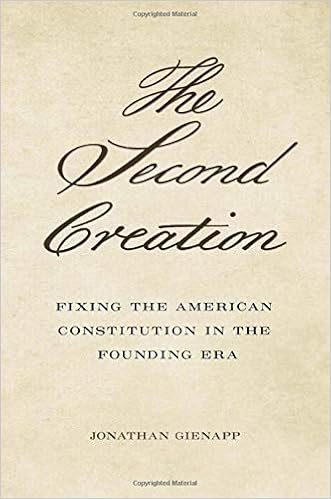
Americans widely believe that the United States Constitution was created when it was drafted in 1787 and ratified in 1788. But in a shrewd rereading of the founding era, Jonathan Gienapp upends this long-held assumption, recovering the unknown story of American constitutional creation in the decade after its adoption—a story with explosive implications for current debates over constitutional originalism and interpretation.
When the Constitution first appeared, it was shrouded in uncertainty. Not only was its meaning unclear, but so too was its essential nature. Was the American Constitution a written text, or something else? Was it a legal text? Was it finished or unfinished? What rules would guide its interpretation? Who would adjudicate competing readings? As political leaders put the Constitution to work, none of these questions had answers.
Through vigorous debates they confronted the document’s uncertainty, and—over time—how these leaders imagined the Constitution radically changed. They had begun trying to fix, or resolve, an imperfect document, but they ended up fixing, or cementing, a very particular notion of the Constitution as a distinctively textual and historical artifact circumscribed in space and time. This means that some of the Constitution’s most definitive characteristics, ones which are often treated as innate, were only added later and were thus contingent and optional.A few blurbs:
“The Second Creation is a brilliant and timely intervention in American constitutional history. By showing how ‘original intentions’ originated in congressional debates about what the framers and ratifiers originally intended, Jonathan Gienapp forces us to take another long look at what we understand the Constitution to be. His innovative and persuasive study will revolutionize the way lawyers as well as scholars interpret the Founding era.”—Peter S. Onuf
“Gienapp focuses our attention on the first decade of controversy over the remarkable new invention, a national Constitution. His fascinating and provocative story—how these debates created and imagined the Constitution—is told with great mastery and drama.”—Mary Sarah BilderMore information is available here. You can also read an interview with Gienapp about the book here, at The Way of Improvement Leads Home. And you can find a symposium on the book over at Balkinization. For example, here is Alison LaCroix's contribution.
Sunday, October 28, 2018
Sunday Book Review Roundup
 Eric Foner reviews David Blight's Frederick Douglass: Prophet of Freedom for The Nation. Also in The Nation is Michael Kazin's review of Arnold Offner's Hubert Humphrey: The Conscience of the Country.
The New York Review of Books carries a review of Allan J. Lichtman's The Embattled Vote in America: From the Founding to the Present.
Rana Hogarth's Medicalizing Blackness: Making Racial Difference in the Atlantic World, 1780-1840 is reviewed at Book and Ideas.
In The New York Review of Books is an essay by Annette Gordon-Reed in which she reviews To the Promised Land: Martin Luther King and the Fight for Economic Justice by Michael K. Honey, Redemption: Martin Luther King Jr.’s Last 31 Hours by Joseph Rosenbloom, The Heavens Might Crack: The Death and Legacy of Martin Luther King Jr. by Jason Sokol, The Seminarian: Martin Luther King Jr. Comes of Age by Patrick Parr, and To Shape a New World: Essays on the Political Philosophy of Martin Luther King, Jr., edited by Tommie Shelby and Brandon M. Terry.
Phil A. Neel's Hinterland: America’s New Landscape of Class and Conflict is reviewed at the Los Angeles Review of Books. Also reviewed at LARB is Russian Homophobia from Stalin to Sochi by Dan Healey.
 Godless Citizens in a Godly Republic: Atheists in American Public Life by R. Laurence Moore and Isaac Kramnick is reviewed in The New Yorker.
At Marginalia Review of Books is a review of Colonial al-Andalus: Spain and the Making of Modern Moroccan Culture by Eric Calderwood.
Joanne Freeman's The Field of Blood: Violence in Congress and the Road to Civil War is reviewed in The Nation and The New Republic.
Saturday, October 27, 2018
Weekend Roundup
- Does Thomas Ruffin's portrait deserve to "dominate" North Carolina's top courtroom? Historians Eric Muller (UNC Law) and Sally Greene (independent scholar) raise the question in the Raleigh-based News & Observer.
- From the Washington Post's "Made by History" section: Allan J. Lichtman (American University) on the history of voting restrictions and the problem of low voter turnout.
- The Environment, Law, and History blog has been running a series of posts on a recent issue of Theoretical Inquiries in Law, on "The Tragedy of the Commons at 50: Context, Precedents, and Afterlife." Here's a link to the first post. The most recent one is here.
Friday, October 26, 2018
A Conversation between Robert Gordon and David Sugarman
Robert W. Gordon. Stanford Law School, and David Sugarman, Institute of Advanced Legal Studies, University of London, have posted Robert W. Gordon in Conversation with David Sugarman. It also appears on The Docket (the Digital Edition of Law & History Review), 1: 3 (October 2018):
The discussion that follows arises out of more than six hours of recorded conversations in which Bob Gordon talks about his life and work. It delineates the importance of Bob’s family background and early life; the Cold War, the Vietnam War, the Civil Rights Movement and the 1960’s; his undergraduate studies at Harvard; his experience of learning law at Harvard Law School; the teachers that most inspired him; his early years as a law professor at Buffalo and Wisconsin; his multifarious research and writing projects, many unfinished or unpublished; and some of the key ideas, ideals, individuals and movements that shaped his thinking, writing and professional development including Barrington Moore Jr., Stanley Hoffmann, Mark de Wolfe Howe, John P. Dawson, Stewart Macaulay, Willard Hurst, E.P. Thompson and the Warwick School of Social History, Morton J. Horwitz, Duncan Kennedy, Lawrence M. Friedman, F.W. Maitland, American Legal Realism and Critical Legal Studies. It also illuminates a range of topics including how he came to write his most cited publication, “Critical Legal Histories”, and its intended goals; his response to its success and to subsequent criticisms, including the efficacy or otherwise of his influential notion of “law as constitutive of consciuousness”; how his vocal and highly visible support for Critical Legal Studies affected him; his copious writings on the legal profession, and their place within the literature on lawyers and society; the presentist dimensions in his work and his response to the issue of presentism; the use of history for either conservative or progressive causes; his preference for essay writing; and his writing style and polemical goals. His reflections on teaching and writing brings the conversation to a close.
Here is Bob in his own words, adding a more personal reflection and commentary to his more formal publications and presentations. I see this conversation as a dialogue with a large invisible audience. By uniquely illuminating the ideas and biography of one of the most influential and much--loved legal historians of the last fifty years, it provides food for legal scholars wishing to think about the relevance of their role, whilst for historians (legal or otherwise) it offers a window into the theory and method of legal history and the ways in which intellectual currents in legal history were navigated over the second half of the twentieth and early twenty--first centuries. Hopefully, it conveys the spirit of our dialogue, and, among other things, what a good time we were having.
Stanford Graduate Student Paper Prize
[We share the following announcement.]
Stanford Center for Law and History Graduate
Student Paper Prize
The Stanford Center for Law and
History invites paper submissions from graduate students for
its second annual conference, which will center on the theme of the upcoming
centennial of the 19th Amendment. SCLH’s goal is to bring together faculty,
postdocs, and students for workshops, conferences, and lectures examining the
relationships between law and history, broadly defined.
The one-day conference will be held on Friday,
May 3, 2019, at Stanford Law School. It will include three panels featuring
prominent legal historians presenting on suffrage, women's rights, citizenship,
and related themes. The conference will conclude with a keynote conversation
with distinguished judges about women in the legal profession, past and
present.
The conference organizers will select one
graduate student as the winner of the SCLH Graduate Student Paper Prize. This
student will present on a panel that includes papers at the intersection of
women's rights, family citizenship, and immigration. Funding for travel and
housing will be provided.
The application deadline is Friday, November 30,
2018. For more detail and to apply, click here. Please direct any questions to SCLH@law.stanford.edu.
Thursday, October 25, 2018
Kantorowicz and the "Battle for Legal Science"
[We have the following announcement.]
“Hermann Kantorowicz (1877-1940): the battle for legal science” conference, October 25th-26th 2018, University of Helsinki
Legal historian, Mediaevalist, legal theorist, legal philosopher, comparative-international lawyer, criminal law expert, philologist, social scientist, political theorist, political activist – all labels that could be attached to Hermann Kantorowicz. Born in 1877, his first major work was published in 1906 under the pseudonym Gnaeus Flavius, the legendary plebeian who demystified Roman law and brought it to the common people in the early Roman Republic, under the title Der Kampf um die Rechtswissenschaft, the “Battle for legal science”
Law is not good law simply by virtue of it being enacted by a legislator, judges and (legal) scientists have to function as interpreters between law and societal fact to help create proper legal rules – this is how the content of the pamphlet can be summarized. The impact of the ?Battle' was large and immediate, as a basic document for the influential Free law movement throughout continental Europe, but also for sociological jurisprudence and Legal realism in the United States.
Yet, the “Battle” is but one of Kantorowicz´s many works. A polymath, a ?Renaissance man', his scholarship is as broad as it is deep. This conference examines the multifaceted thought as an extension to as well as a break with the long 19th century, in connection to Kantorowicz´s widespread influence in a number of scientific fields.
In this spirit, the conference wholeheartedly welcomes attendants and participants from all of the social sciences and humanities, and even beyond. As the original multidisciplinarian who nevertheless always came back to the problem of what it means to be a “legal scientist,” Hermann Kantorowicz is a jurist for the 21st century.
More.
“Hermann Kantorowicz (1877-1940): the battle for legal science” conference, October 25th-26th 2018, University of Helsinki
Legal historian, Mediaevalist, legal theorist, legal philosopher, comparative-international lawyer, criminal law expert, philologist, social scientist, political theorist, political activist – all labels that could be attached to Hermann Kantorowicz. Born in 1877, his first major work was published in 1906 under the pseudonym Gnaeus Flavius, the legendary plebeian who demystified Roman law and brought it to the common people in the early Roman Republic, under the title Der Kampf um die Rechtswissenschaft, the “Battle for legal science”
Law is not good law simply by virtue of it being enacted by a legislator, judges and (legal) scientists have to function as interpreters between law and societal fact to help create proper legal rules – this is how the content of the pamphlet can be summarized. The impact of the ?Battle' was large and immediate, as a basic document for the influential Free law movement throughout continental Europe, but also for sociological jurisprudence and Legal realism in the United States.
Yet, the “Battle” is but one of Kantorowicz´s many works. A polymath, a ?Renaissance man', his scholarship is as broad as it is deep. This conference examines the multifaceted thought as an extension to as well as a break with the long 19th century, in connection to Kantorowicz´s widespread influence in a number of scientific fields.
In this spirit, the conference wholeheartedly welcomes attendants and participants from all of the social sciences and humanities, and even beyond. As the original multidisciplinarian who nevertheless always came back to the problem of what it means to be a “legal scientist,” Hermann Kantorowicz is a jurist for the 21st century.
More.
Drumbl on Defining Genocide
Mark Drumbl, Washington and Lee University School of Law, has posted Genocide: The Choppy Journey to Codification:
The Genocide Convention’s definition of genocide derives from but also shrinks the concept as initially coined by Raphael Lemkin. This chapter unpacks the notion Lemkin had originated and traces how it narrowed through the treaty-making process. The path that genocide took from invented concept to proscribed crime in turn evokes questions about how the formation of law through treaty can deform the ideas that may have prompted the push towards law. Counterfactually, this chapter contrasts the path of crimes against humanity, which only in very recent years has become cogitated as something that ‘needs’ an owner-occupied international convention. In the end, perhaps, an alternate route for the crime of genocide – which Lemkin did not pursue – would have been for it to have been taken as a term of art, organic and open-ended, and then left to stew and brew at a variety of discursive levels before becoming codified: bricolage from below rather than vulcanization from above. Perhaps had this counterfactual path been taken the legal definition of genocide would have been broader and more congruent with Lemkin’s original understanding. That said, it is clear that the legal definition matches many, though certainly not all, of the fundamental values that Lemkin intended the criminalization of genocide to protect. Moreover, codification permitted an interpretive baton to be passed to judges, who may over time incrementally align the crime of genocide closer to Lemkin’s original framing.
Legal History Workshop at Penn
- September 13, 2018: Professor Michael Lobban, London School of Economics, “Martial Law, the Privy Council and The Zulu Rebellion of 1906”
- November 5, 2018: Professor Hidetaka Hirota, Waseda University, “The Genealogy of Alien Contract Labor Law"
- November 15, 2018: Professor Anna Lvovsky, Harvard Law School, “Queer Expertise: Urban Policing and the Discovery of the Gay World, 1920-1970"
Wednesday, October 24, 2018
Nancy Weiss Malkiel Scholars Award
 [We have the following announcement.]
The Nancy Weiss Malkiel Scholars Award is supported by the Andrew W. Mellon Foundation and administered by the Woodrow Wilson National Fellowship Foundation. The Malkiel Scholars Award offers a $17,500 stipend—$10,000 to be used for summer research support and $7,500 for research assistance during the academic year. The award is structured to free the time of junior faculty who have passed their midpoint tenure review—including those from underrepresented groups and others committed to eradicating disparities in their fields—so that they can both engage in and build support for systems, networks, and affinity groups that make their fields and campuses more inclusive.
Along with the research portfolio, selectors will examine evidence of deep campus service and mentoring commitments early in each candidate’s career, with a focus on creating inclusive opportunities for underrepresented scholars at all levels. At the same time, the Malkiel Scholars Program will work to strengthen the community for these emerging leaders within their disciplines by building a network around them and encouraging careers that focus on diversity, inclusion, and engagement.
Girard, Phillips and Brown on Canadian legal history
Philip Girard (Osgoode Hall, York University), Jim Phillips (University of Toronto) and R. Blake Brown (Saint Mary's University) have published volume one of A History of Law in Canada with the University of Toronto Press. From the publisher:
This book is the first of two volumes devoted to the history of law in Canada. This volume begins at a time just prior to European contact and continues to the 1860s, while volume two will start with Confederation and end at approximately 2000. The history of law includes substantive law, legal institutions, legal actors and legal culture. The book assumes that since 1500 there have been three legal systems in Canada – the Indigenous, the French, and the English. At all times, these systems have co-existed and interacted, with the relative power and influence of each being more or less dominant in different periods.
The history of law cannot be treated in isolation, and this book examines law as a dynamic process, shaped by and affecting other histories over the long term. The law guided and was guided by economic developments, was influenced and moulded by the nature and trajectory of political ideas and institutions, and variously exacerbated and mediated by inter-cultural exchange and conflict. These themes are apparent in this examination, and through most areas of law including family law, constitutional, commercial, land settlement and tenure, and criminal.Further information is available here.
Tuesday, October 23, 2018
Murrell on Judicial Independence in Early Modern England
Peter Murrell, University of Maryland , Department of Economics, has posted The Independence of Judges Reduced Legal Development in England, 1600-1800:
Conventional wisdom on English development confers iconic status on the clause of the Act of Settlement (1701) that mandated secure tenure for judges. Because the Act's effect on tenure was partial, the effect of tenure on judicial decisions can be identified. The paper estimates how the awarding of tenure changed the number of citations to judges' decisions, a measure of judicial quality. The empirics uses two new databases, one on judges' biographies and one recording citations in the English Reports to earlier decisions. Several strategies aid identification. A court-year panel permits difference-in-differences. Controls capture judges' human capital and the importance of litigation. Instrumental-variable estimates use judge life-expectancy and political vicissitudes as instruments. Tenure has a strong, significant, and deleterious effect on the quality of associate-judge decisions. Tenure has no effect for chief judges. The Act of Settlement reduces citations by 20% in the 18th century. The results are interpretable in terms of the incentives provided by a powerful legal profession that could protect vulnerable judges in a politically volatile era.
Monday, October 22, 2018
Harrison on the Constitution and the Law of Nations
John C. Harrison, University of Virginia School of Law, has posted The Constitution and the Law of Nations, which appears in Georgetown Law Journal 106 (2018): 1659-1705:
Under the original understanding of the Constitution, customary international law features in the U.S. legal system as general law. It is not law of the United States within the meaning of Articles III or VI of the Constitution, and so does not serve as a basis for federal question jurisdiction or override contrary state law. Under the original understanding, the Constitution does not confer the protections of the international law of state-state relations on either foreign states or governments that have been recognized as such by federal political actors. Congress may confer those protections by statute, but in the absence of statute or treaty, they rest on general law. The Constitution’s text indicates that the laws of the United States referred to in Articles III and VI consist entirely of federal statutes. The Federal Convention’s drafting process indicates that members of the convention had that understanding of the text they produced. That process also indicates that the drafters probably understood the laws referred to by the Take Care Clause of Article II to consist of federal statutes. Prominent figures in the ratification debates treated Articles III and VI as using the term “laws of the United States” to refer to statutes. The First Congress drafted the Judiciary Act of 1789 on the assumption that the laws of the United States referred to in Articles III and VI were federal statutes. During the 1793 prosecution of Gideon Henfield for non-statutory criminal violations of the United States’ neutrality, a number of leading figures took the position that the federal courts could entertain prosecutions under unwritten law. It is unlikely, however, that any of them meant to assert that the law of nations was law of the United States within the meaning of Articles III or VI.
Special Issue: Property in South Asian history
The Journal of the Economic and Social History of the Orient has published a special issue: "Repossessing Property in South Asia: Land, Rights, and Law across the Early Modern/Modern Divide." Here is the Table of Contents from vol.61 (2018):
- Repossessing Property in South Asia: Land, Rights, and Law across the Early Modern/Modern Divide-Introduction. by Faisal Chaudhry
- The Theory and Practice of Property in Premodern South Asia: Disparities and Convergences. by Timothy Lubin
- Property and Social Relations in Mughal India: Litigations and Disputes at the Qazi’s Court in Urban Localities, 17th-18th Centuries. by Farhat Hasan
- Revenue Farming Reconsidered: Tenurial Rights and Tenurial Duties in Early Modern India, ca. 1556-1818. by Sudev Sheth
- Property and Its Rule (in Late Indo-Islamicate and Early Colonial) South Asia: What’s in a Name? by Faisal Chaudhry
- Sovereignty, Property and Land Development: The East India Company in Madras. by Bhavani Raman
- The Problem of Property: Local Histories and Political-Economic Categories in British India. by Upal Chakrabarti
- Fluid Histories: Swamps, Law and the Company-State in Colonial Bengal. by Debjani Bhattacharyya

Further information is available here.
Saturday, October 20, 2018
What History Brings to the Study of Law & Political Economy: Tani on Winant
I have been thinking lately about the intersection of law and political economy, thanks in part to the recently created Law and Political Economy Blog (an outgrowth of a Spring 2017 class at Yale Law School and now a stand-alone project with YLS and non-YLS contributors, both students and faculty). To deepen my own understanding and think more concretely about what historians can add to the conversation, I've decided to join the LPEblog roster. Here's a taste of my first post:
As a historian working in a law school, I think often about what history adds to the study of law and the training of future lawyers. Rarely does history provide an obvious road map to solving new legal problems, but it does at least two other things well: (1) it helps explain why the legal landscape looks the way it does; and (2) it illuminates the consequences of particular legal choices. This makes all the more valuable recent historical work that engages with political economy. We gain from this work a better sense of the political economies that produced our current configuration of laws. We also gain insights into how law constructs the political economy of the future—by sending signals about who will be insulated from the vicissitudes of “the market” and who will be exposed, whose rights can be bargained away and whose are too sacred, whose lives have value and whose do not.
An excellent example of this work is historian Gabriel Winant’s recent article in the Journal of American History, “A Place to Die: Nursing Home Abuse and the Political Economy of the 1970s.” Winant does not frame the piece as legal history, but law is all over the history he tells, in complex and sometimes unintuitive ways.You can read on here. The post identifies the legal threads woven into Winant's argument and emphasizes how deeply law was implicated in Winant's story of abuse and neglect.
Weekend Roundup
- You'd be well advised to read that HNN review of Mary Bilder's Madison's Hand in our last Sunday Book Review Roundup in the light of Daniel Hulsebosch's very thoughtful assessment in his review of the book and Jack Rakove's A Politician Thinking in the latest American Historical Review. “After Bilder’s work," Professor Hulsebosch writes, "no one can read editor Max Farrand’s The Records of the Federal Convention 1787, 3 volumes (1907), the standard source for a century . . . as a comprehensive or objective record of what transpired in Philadelphia.”
- John D. Braithwaite, Distinguished Professor, Australian National University, will deliver the Mitchell Lecture for Fall 2018 in the John Lord O'Brian Hall, Charles B. Sears Law Library, of the University at Buffalo School of Law on Friday, November 9, 2018 at 2 p.m. His topic is Tempered Power: Variegated Capitalism, Law and Society.
- The National Constitution Center announces a free, on-line college-level course, on The Supreme Court and American Politics. Created by Lyle Denniston and members of the University of Baltimore law faculty it traces, “from origins deep in English legal history and American colonial history up through the Senate’s recent consideration of Supreme Court Justice Brett Kavanaugh’s nomination, the role of the Court in safeguarding the right of political representation in the American Republic.”
- James D. Folts, head of Researcher Services at the New York State Archives, reports on recent research conducted in the historical court records there, on the blog of the Historical Society of the New York Courts.
- Congratulations to UNC Law’s Eric Muller, who was named the 2018-2019 recipient of the Professor Keith Aoki Asian Pacific American Jurisprudence Award by the Conference of Asian Pacific American Law Faculty.
- Congratulations, as well, to Victoria Saker Woeste, American Bar Foundation, who will be a visiting professor in the College of Liberal Arts and Law, Fujian Agriculture and Forestry University, November, 11-18, 2018. She will lecture to undergraduates on American constitutional law.
- At the University of Chicago’s Regenstein Library: an exhibit on Censorship and Information Control: A Global History from the Inquisition to the Internet.
- Sessions of the Law and Public Affairs Seminar at Princeton University are by invitation only, but this one is so interesting we’re posting news of it here anyway. On Monday, October 22, Corey Robin, Brooklyn College, will preside over a discussion of the paper Invisible Man: The Black Nationalism of Clarence Thomas's Jurisprudence. “A little known fact about Clarence Thomas,” Professor Robin writes, “is that during the formative period of his life, from 1968 to 1975, he was a black nationalist on the left. In this paper, I show that despite his right turn in the 1970s, Thomas never gave up his black nationalism. The fundamental ideas he formed about race and racism on the black nationalist left continue to structure his jurisprudence from the right. While that's true of his jurisprudence on issues ranging from the Second Amendment to the Takings Clause, I focus here on his opinions about affirmative action and desegregation, showing that his positions on those questions bear little resemblance to either conventional conservatism or liberalism."
- Boyd van Dijk’s article Human Rights in War: On the Entangled Foundations of the 1949 Geneva Conventions is now available online in the American Journal of International Law. “The relationship between human rights and humanitarian law is one of the most contentious topics in the history of international law. Most scholars studying their foundations argue that these two fields of law developed separately until the 1960s. This article, by contrast, reveals a much earlier cross-fertilization between these disciplines. It shows how 'human rights thinking' played a critical generative role in transforming humanitarian law, thereby creating important legacies for today's understandings of international law in armed conflict.”
- CFP: the Canadian Law and Society conference will be in Vancouver (at UBC), June 3-5, 2019
- Over at the Legal History Miscellany: Slavery and Cartwright's case before Somerset by Krista J. Kesselring.
- At ShariaSource: a recent round-up on Islamic law scholarship including work on online fatwas about emergency contraception and DNA paternity testing in the Maghreb.
- ICYMI: more on that Barnette at 75 symposium at FIU and Ronald Chester's lecture on Tapping Reeve at the Litchfield Historical Society. Also Renee Lettow Lerner’s review of Amalia D. Kessler’s Inventing American Exceptionalism: The Origins of American Adversarial Legal Culture, 1800-1877 in the Summer 2018 issue of the Journal of Legal Education. The incoming class at BYU Law has more women than men for the first time. Trump effect?
Friday, October 19, 2018
Group Portraits of SCOTUS
Here's another exhibit at the U.S. Supreme Court: All Together for the Camera: 150 Years of Group Photographs:
Few visual cues say “Supreme Court” better than its group photograph, the first of which was taken in 1867. Although this 150-year-old custom occurred infrequently in the beginning, it has since become one of the Court’s most popular and enduring traditions. For the first 75 years the Justices would gather at studios of various photographers around Washington, D.C. and during this time they gradually settled on ground rules such as a seating arrangement based on seniority, and posing only once after a change in membership. For the past 75 years, the group photograph has been taken in the Supreme Court Building.
The US Supreme Court, 1894 (LC)
This exhibit features the work of 19 different photographers and studios, and traces the development of the group photograph from the first in 1867 to the most recent, taken in June 2017.

In re Lady Lawyers: A SCOTUS Exhibit
We recently learned of an exhibit at the U.S. Supreme Court entitled In Re Lady Lawyers: The Rise of Women Attorneys and the Supreme Court:
In the early 1900s, an employee in the Office of the Clerk began to keep a list of women admitted to the Supreme Court Bar. Kept in an envelope titled In Re Lady Lawyers, the list records the women who carved a path for future female advocates, judges, and eventually, Supreme Court Justices. This exhibition looks at part of the history of women attorneys in the United States, beginning with Myra Bradwell and Belva Lockwood, and continuing with the women serving today as Supreme Court Justices. Notable objects include a c.1905 woman’s suit on loan from the Daughters of the American Revolution Museum, the suit worn by then Judge Sandra Day O’Connor when her nomination was announced, historic photographs, as well as memorabilia and personal effects from Justices Sandra Day O’Connor, Ruth Bader Ginsburg, Sonia Sotomayor, and Elena Kagan.
Belva Lockwood (LC)

Michelman Reviews Klarman's "Framer's Coup"
Frank I. Michelman, Harvard Law School, reviews Michael J. Klarman’s The Framers' Coup, in Constitutional Commentary 33 (2018): 109-28:
This commendatory review of Michael Klarman’s The Framer's Coup takes up for consideration some polemical uses to which the book might be put. One of those might be as a brief in support of calls now heard for a national constitutional convention or other project of major constitutional repair. “[T]hroughout American history,” Klarman reminds us,”political actors have invoked the wisdom and virtue of the Framers as arguments against constitutional change,” while the facts assembled in his new book—about the values, aims, beliefs, tactics, and strategies of those who took controlling parts in the Constitution-making process, about general hazards to rationality affecting the process as a whole, and about the role in these events of sheer accident and luck—can be read as a takedown of the Framing from any high pedestal of reverence it may hitherto have occupied in the minds of readers.
What about more radical implications? Klarman has in the past authored scholarship to question the entire project of constitutionalism, at least of what he has called the “judicially enforceable” type. He has proposed to Americans, for serious consideration as our path of deliverance from a choice between rule from eighteenth-century graveyards and rule by electorally untethered judges, that “we can simply be anticonstitutionalists. That is, we can decide controverted policy questions for ourselves through political struggle (as much of the rest of the world does it), rather than through the edicts of long-dead Framers or relatively unaccountable judges.”
Should we, then, be reading The Framers’ Coup as a brief in support of a general stance of constitutional disparagement? I have doubted it. Setting the Framing on clay feet is one thing; a call for ejection of the resulting Constitution from its place of providing, while it stands, a basic law for the country is quite another thing. The second thing is not logically deducible from the first; and Klarman’s book, to my eye, stops noticeably short of the second—perhaps partly, I suggest, as a result of Klarman's experience in researching and writing this treasure of scholarship.
Elster and friends on Constituent Assemblies
Jon Elster (Columbia University), Roberto Gargarella (Universidad Torcuato Di Tella, Buenos Aires), Vatsal Naresh (Yale University), and Bjørn Erik Rasch (University of Oslo) have co-edited Constituent Assemblies, out now with Cambridge University Press. From the publisher:
Table of Contents after the jump:Comparative constitutional law has a long pedigree, but the comparative study of constitution-making has emerged and taken form only in the last quarter-century. While much of the initial impetus came from the study of the American and French constituent assemblies in the late eighteenth century, this volume exemplifies the large comparative scope of current research. The contributors discuss constituent assemblies in South East Asia, North Africa and the Middle East, Latin America, and in Nordic countries. Among the new insights they provide is a better understanding of how constituent assemblies may fail, either by not producing a document at all or by adopting a constitution that fails to serve as a neutral framework for ordinary politics. In a theoretical afterword, Jon Elster, an inspirational thinker on the current topic, offers an analysis of the micro-foundations of constitution-making, with special emphasis on the role of crises-generated passions.
Thursday, October 18, 2018
Green on Chevron and Political Transformation in American Law
Craig Green, Temple University James E. Beasley School of Law, has posted Deconstructing the Administrative State: Constitutional Debates over Chevron and Political Transformation in American Law:
In 2018, Justice Kennedy wrote that the Supreme Court should “reconsider the premises” of Chevron v. NRDC based on “separation-of-powers principles.” In 2015, Justice Thomas was the first judge to argue in an opinion that Chevron is unconstitutional, and Justices Gorsuch and Kavanaugh are the only judicial nominees whose anti-Chevron critiques were featured elements of their candidacy. Petitions for certiorari have challenged Chevron's constitutionality, echoing litigants in other federal courts, and academics have joined both sides of the debate. This Article responds to modern disputes over Chevron with a new history of how the constitutional crisis developed, a rebuttal of modern critiques, and a description of their potentially destructive effect on administrative governance and constitutional law. The Article describes a shift from Reagan-era support for Chevron to “post-Scalian” attacks. It concludes by considering anti-Chevron constitutional critiques alongside other Trumpist efforts to “deconstruct the administrative state.” To overrule Chevron would be the most radical decision about constitutional structure in eighty years, unsettling hundreds of judicial decisions, thousands of statutes, and countless agency decisions. This Article contributes to existing literature with novel historical research, and detailed engagement with anti-Chevron critiques that have become newly sophisticated and politically powerful.As Professor Green writes over at Balkinization, much of his analysis is “historical. In the 1930s and 1940s, political forces that endorsed pro-business deregulation fiercely resisted agencies’ authority to interpret statutes, but Chevron in its own era was a substantial victory for the pro-business deregulatory Reagan Revolution.”
Subscribe to:
Posts (Atom)