Friday, October 6, 2023

Gillmer on Slavery, Marriage in the US West

Jason Gillmer, Gonzaga University School of Law, has posted Pearson v. Pearson: A Story of Slavery, Marriage, and the West, Told in Black and White:

This Article is a narrative history of a relationship between a white man named Richard and a Black woman named Laura that started in slavery and ended twenty-seven years later in a trial over whether they were husband and wife. The story follows some of the usual plotlines. Richard purchased Laura at a slave sale and brought her to his home in Missouri; he then married a white woman and they had a daughter together. Within a few years, however, that marriage fell apart, and soon after, Richard allegedly freed Laura and the two of them went to California and built a life together. Twenty years later, after Richard died, Richard’s long-lost daughter brought suit in a California courtroom. She sought to eject Laura from the home she shared with Richard on the theory she, rather than Laura, was Richard’s sole surviving heir and entitled to his large estate.

This Article recreates the story of Richard and Laura to offer an intimate glimpse into the complexities of interracial relationships during slavery and the decades that followed. It is built out of the trial transcripts—which until now have remained hidden for 150 years—and relies heavily on the actual words of the lawyers, witnesses, and litigants to shape the narrative. The uniqueness of this approach is also what provides its value. Relying on their words and voices, this Article shines a light on how the parties and the participants saw their world, not on how others saw it for them. Richard and Laura’s story is also noteworthy in that it spans several decades and unfolds over several milestones—slavery, the Gold Rush, and westward expansion—creating the opportunity to expand our understanding of the individual experiences of people involved in Black-white relationships beyond what is typically found in the literature. Hearing about their story, and about the courtroom battle over the legitimacy of their relationship, provides context for why interracial families, even today, continue to suffer from minor indignities and open hostilities simply because they broke the norm. 
--Dan Ernst

Conference: Primary Sources on Copyright, 1450-1900

On October 16-17, CREATe, the copyright law research center at the University of Glasgow, will host a conference “celebrating 15 years of the edited digital archive ‘Primary Sources on Copyright, 1450-1900,’ ed. Lionel Bently and Martin Kretschmer.  The archive now covers material for 10 jurisdictions, each section curated by a national copyright history expert. The conference is hybrid, allowing for online attendance.” 

The full programme for the Glasgow conference this October is [here], but it comprises two key elements. First, a number of national editors will present their new material for the digital archive. Patricia Akester (GPI-IPO) and Victor Drummond (Universidade Gama Filho) will launch their section covering Portugal and Brazil, Marius Buning (University of Oslo), Magne Klasson  (University of Oslo) and Martin Fredriksson (Linköping University) will speak about the forthcoming Scandinavian section, and further material for three existing sections – the Vatican, France and German speaking countries – will be presented by Jane Ginsburg (Columbia Law School), Katie Scott (The Courtauld), Frédéric Rideau (Université de Poitiers) and Friedemann Kawohl (CREATe Fellow). These talks are open to all scholars, including research students, of any discipline or jurisdiction and can be attended in person or online. If you would like to attend, in person or online, please email diane.mcgrattan@glasgow.ac.uk.

--Dan Ernst

Thursday, October 5, 2023

Graber on 14th Amendment, Section 3

Mark Graber, University of Maryland Francis King Carey School of Law, has posted Section Three of the Fourteenth Amendment: Our Questions, Their Answers:

The Congressional Globe, case survey, and constitutional commentaries clearly support the following conclusions. First, the constitutional disqualification of government officials who violated their oath of office was central to the Fourteenth Amendment’s goal of ensuring government by persons who could be trusted to be faithful to the Constitution. Second, with one notable exception, Americans during the 1860s regarded Section Three as self-executing. Third, Section Three when framed was thought to be an additional qualification for officeholding and not a punishment for crime. Fourth, Section Three of the Fourteenth Amendment was intended to bar from office any past or present state or federal officeholder who engaged in an insurrection, not just persons who participated in what members of the Thirty-Ninth Congress referred to as “the late rebellion.” Fifth, the persons who framed Section Three thought presidents of the United States are officers of the United States who are disqualified from holding future federal or state offices if they engage in an insurrection after or while holding office. Sixth, the persons who framed Section Three thought that presidency of the United States was among the offices under the United States that past and present officeholders who participation in insurrections were disqualified from holding. Seventh, an insurrection at the time Section Three was framed consisted of two or more persons resisting the implementation of any law by force, violence and intimidation for a public purpose and was not limited to rebellious attempts to overthrow the government. Eighth, the events of January 6, 2021 are consistent with the legal understanding of insurrection in 1866. Ninth, constitutional authorities before, during and immediately after the Civil War maintained that any person who knowingly contributed to an insurrection as having engaged in the insurrection, even if that person did not personally commit an act of violence or were far from the scene of the violence, force, and intimidation. Tenth, if the allegations made by the Final Report of the Select Committee to Investigate the January 6th Attack on the United States Capitol are true, Donald Trump participated in the insurrection that took place on January 6, 2021.
--Dan Ernst

Deardorff's "Tale of Two Granadas"

Max Deardorff, University of Florida, has published A Tale of Two Granadas: Custom, Community, and Citizenship in the Spanish Empire, 1568–1668 (Cambridge University Press, 2023):

This book offers a wide-ranging analysis of transforming conceptions of citizenship in the Spanish monarchy as it became a global empire. Side-by-side case studies of old Granada (southern Spain, core settlement of Spain's last independent Islamic polity) and colonial New Kingdom of Granada (modern Colombia) show that Spanish ecclesiastics' involvement in the Council of Trent (1545-1563) went hand-in-hand with the monarchy's thinking about the structure and cohesion of its empire. With fine-grained archival work, the book shows how two subject communities -- Andalusi "moriscos" of old Granada and indigenous Muiscas of the New Kingdom of Granada -- weathered a century of political and social change that followed. At stake were the question of the terms of colonial indigenous integration into the monarchy’s social structures and the looming threat of disenfranchisement faced by Granada’s “moriscos.” A Tale of Two Granadas makes the case that even more than 1492, the year that completely reshaped the monarchy was 1568. That year was both the beginning of the famed Rebellion of the Alpujarras in southern Spain, and the year when the famous Junta Magna met in  Madrid to lay out grand new plans for the administration of the monarchy's colonies overseas.
Here is an endorsement:
‘In this lucidly written book, Max Deardorff explores what citizenship meant for those social actors in the early modern Spanish territories who faced degrees of exclusion due to their ethnicity and proximity to orthodox Christianity. Meticulously researched and engagingly written, Deardorff brings together the Iberian Atlantic by looking at lesser-studied regions and the people inhabiting their margins, and also, at the Spanish powerholders who moved across the two jurisdictions.’

Joanne Rappaport - Georgetown University
--Dan Ernst

Wednesday, October 4, 2023

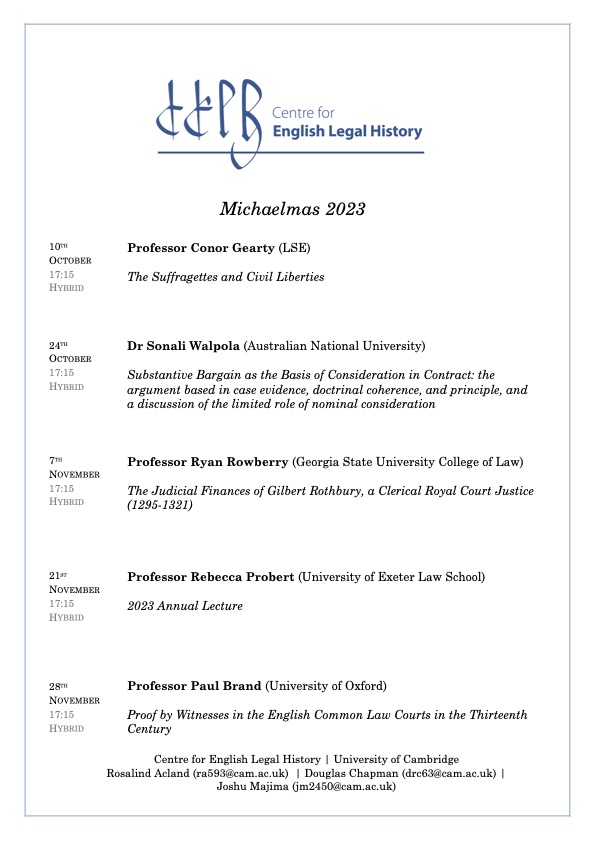
Michaelmas Term at the Centre for English Legal History

Centre for English Legal History at Cambridge University announces its Michaelmas 2023 term card on seminars and a lecture.

--Dan Ernst


Sunstein on Nondelegation, Removal, and Originialists

Cass R. Sunstein, Harvard Law School, has posted Does Evidence Matter? Originalism and the Separation of Powers:

In the last two decades, there has been an extraordinary outpouring of careful historical work on two of the most fundamental questions in constitutional law: (1) whether Congress may delegate open-ended discretionary power to the executive branch (or others) and (2) whether Congress may restrict the president’s power to remove high-level officials in the executive branch. The best reading of the new evidence is that there was no robust nondelegation doctrine at the founding period, if there was a nondelegation doctrine at all. Though the issue is closer, the best reading of the new evidence is that during the founding period, the Constitution was understood to authorize Congress to restrict the president’s power of removal, even over principal officers (with important qualifications). Understood in terms of its original public meaning, the Constitution almost certainly allowed Congress to grant very broad discretion to the executive branch and also permitted Congress to limit the president’s removal authority over (some) principal officers. What is remarkable is that in both contexts, no originalist on the Court has been convinced by the relevant evidence, or even seriously grappled with it. Any explanation of the apparent impotence of historical evidence in this context (or others) would be speculative, but there are three plausible accounts. The first points to a simple lack of awareness of the relevant evidence and the crucial role of epistemic communities in constitutional law. The second is Bayesian and spotlights rational updating. The third points to motivated reasoning. All three accounts offer lessons for lawyers and others seeking to marshal historical evidence to disrupt engrained judicial beliefs.
--Dan Ernst

Kadens on Fraud Prevention in Historical Perspective

Emily Kadens, Northwestern University School of Law, has posted The Persistent Limits of Fraud Prevention in Historical Perspective, which has been published as 118 Nw. U. L. Rev. 167 (2023):

Fraud has been ubiquitous throughout history, and so have the methods of fraud prevention. History demonstrates that no anti-fraud measures have fully succeeded in eliminating deceptive market behavior. Instead, this Essay uses evidence from premodern England to argue that societies and individual contracting parties balance tolerating a certain amount of fraud against the costs of fraud prevention. 
--Dan Ernst

Tuesday, October 3, 2023

Rhee on Dodge and the Neoliberal Turn

Robert J. Rhee, University of Florida Levin College of Law, has published The Neoliberal Corporate Purpose of Dodge v. Ford and Shareholder Primacy: A Historical Context 1919-2019 in the Stanford Journal of Law, Business & Finance:

The article provides a historical context of the most iconic case in corporate law, Dodge v. Ford Motor Co. The case famously asserted that “there should be no confusion” that corporate purpose is “primarily for the profit of the stockholders.” This statement succinctly encapsulates the idea of shareholder primacy, the corporate rule requiring managers to prioritize profit maximization over other interests. A unique period in history gave rise to this political statement. Overt politicism explains why the case split the panel of judges then, and why Dodge was never influential among courts and was ignored by academics until the neoliberal turn of the 1980s. For much of the twentieth century, American capitalism had no use for the idea in Dodge because shareholder primacy conflicted with the prevailing political order and economic system. Dodge found late influence in legal academia only when America embraced neoliberalism. Its pithy shibboleth fit the moment when intellectualization was needed for a new economic system based on the policy preference for capital.

This history-based analysis makes three basic points: (1) shareholder primacy did not exist and could not have existed in law or academic consensus for most of the twentieth century prior to the advent of neoliberalism because it conflicted with the prevailing political order and economic system; (2) shareholder primacy is not a discovery of some natural law of economics after a 250-year search in modern economics, but it is a rule of law of the existing political order and economic system, a rule that, like other laws, came to be because it served the unique policy needs and preferences and the societal conditions of the time; (3) therefore, since there is no end of history of political order and economic system and rules of law, being fluid, are functions of policy preferences of the time, the decline of neoliberalism calls into question the future of Dodge and shareholder primacy. 
--Dan Ernst

Sonin's "Shareholders and Stakeholders"

Joanne F Sonin has published Shareholders and Stakeholders: The Unrealised Promise of Company Law Reform in Post-War Britain (Bloomsbury/Hart):

This book explores the evolution of the shareholder in post-war Britain within the context of changing legal, political, economic, and social conditions. It examines how the post-war transformation of the shareholder body influenced relationships amongst stakeholders, impacting corporate behaviour and the legal and political efforts to govern industry and financial markets.

The book addresses a number of themes, including: 1) how the movements for democratisation influenced the treatment of shareholder interests and the calls for stakeholder representation; 2) how the rhetoric of change created a narrative that deflected from the lack of systemic legal reforms and protected the status quo; 3) how, in the post-war consensus environment, political positions on equity ownership de-radicalised, which proved unsustainable against a background of increasing political polarisation and industrial unrest; and 4) how the institutionalisation of the post-war shareholder body had profound effects on industry, the financial markets, and the economy.

With these themes as a foundation, the evolutionary arch of the post-war shareholder is examined, focusing on developments that influenced the treatment and perception of shareholder and stakeholder interests, including nationalisations, shareholder democracy, corporate purpose, and industrial democracy.

The book further considers how these post-war changes contribute to the post-1979 legal treatment of shareholder and stakeholder interests, including subsequent changes to the Companies Act and the development of corporate governance codes. Parallels to contemporary movements for stakeholder capitalism, corporate purpose, and ESG are drawn.

The historical analysis of the post-war shareholder provides a framework for considering current questions on shareholder primacy and the demands for systemic legal reforms. These missed opportunities for meaningful changes to the treatment of shareholder interests in UK company law serve as useful precedents for evaluating subsequent periods.

--Dan Ernst

Monday, October 2, 2023

CFP: Student Writing Prize on California Legal History

[We have the following announcement.  DRE.] 

The California Supreme Court Historical Society (CSCHS) announces its call for submissions to the 2024 Selma Moidel Smith Student Writing Competition in California Legal History.

We encourage all those working on California legal history (NOT just the history of California courts) to apply. Papers may include elements of digital humanities and may also be co-authored. This is a GREAT WAY to get attention for your hard work!

$5,000 first-place, $2,500 second-place, and $1,000 third-place prizes will be awarded to the best papers on California state or colonial history, broadly considered. Recent winners include a study of the death penalty in California, the evolution of California land law, especially the movement from “free” to “cheap” land, law governing the internment of Japanese Americans during World War II, and the origins of the University of California, as well as a jointly authored paper on Chinese adoption practices and their role in immigration decisions after the Chinese Exclusion Act.

We generally encourage papers of at least 7,500 and no more than 15,000 words, including notes and other explanatory matter. The competition is open to students and recent graduates in history and/or law, provided that they did not have full-time academic employment at the time the paper was written. The paper should also be unpublished, and all prize winners will receive an offer to publish in California Legal History, CSCHS’s journal.

Papers may be self-nominated or sent in by a professor or supervisor. To ensure anonymity, the author’s name should appear only on a separate cover page, along with the author’s mailing address, telephone number, email address, and the name of their school.  

Submissions are due by June 1, 2024 and should be sent to director@cschs.org with the subject line “Smith Prize.” The winners will be announced in early July 2024, and an award ceremony (likely over Zoom) will be held in August 2024.

For the Prize Committee: Sarah Barringer Gordon, Laura Kalman

Blaakman's "Speculation Nation"

Michael A. Blaakman, Princeton University, has published Speculation Nation: Land Mania in the Revolutionary American Republic (University of Pennsylvania Press):

During the first quarter-century after its founding, the United States was swept by a wave of land speculation so unprecedented in intensity and scale that contemporaries and historians alike have dubbed it a “mania.” In Speculation Nation, Michael A. Blaakman uncovers the revolutionary origins of this real-estate bonanza—a story of ambition, corruption, capitalism, and statecraft that stretched across millions of acres from Maine to the Mississippi and Georgia to the Great Lakes.

Patriot leaders staked the success of their revolution on the seizure and public sale of Native American territory. Initially, they hoped that fledgling state and national governments could pay the hefty costs of the War for Independence and extend a republican society of propertied citizens by selling expropriated land directly to white farmers. But those democratic plans quickly ran aground of a series of obstacles, including an economic depression and the ability of many Native nations to repel U.S. invasion. Wily merchants, lawyers, planters, and financiers rushed into the breach. Scrambling to profit off future expansion, they lobbied governments to convey massive tracts for pennies an acre, hounded revolutionary veterans to sell their land bounties for a pittance, and marketed the rustic ideal of a yeoman’s republic—the early American dream—while waiting for land values to rise.

When the land business crashed in the late 1790s, scores of “land mad” speculators found themselves imprisoned for debt or declaring bankruptcy. But through their visionary schemes and corrupt machinations, U.S. speculators and statesmen had spawned a distinctive and enduring form of settler colonialism: a financialized frontier, which transformed vast swaths of contested land into abstract commodities. Speculation Nation reveals how the era of land mania made Native dispossession a founding premise of the American republic and ultimately rooted the United States’ “empire of liberty” in speculative capitalism.

--Dan Ernst

Saturday, September 30, 2023

Weekend Roundup

  • From the LPEblog: Talia Rothstein on "What Law Clinics Left Behind." "[T]he rise of clinics did not represent a simple victory for student protestors. Instead, it left them with a host of unmet demands—many of which remain unfulfilled today."
  • The U.S. Law and Race Initiative at the University of Nebraska-Lincoln seeks to hire a Research Assistant Professor. It is also plans to host "four history or social science graduate students" for a "three-week summer residential fellowship." More information is available here.
  • Berkeley Law’s notice of Dylan Penningroth’s Before the Movement: The Hidden History of Black Civil Rights.
  • Roxana Banu joins Lady Margaret Hall, Oxford University, as  Fellow and Tutor in Law.  “Her current research projects include an exploration of the history of private international law in the colonial context and the social history of interwar cross-border family maintenance conventions.”  More.
  • Phillip W. Magness on "The Problem of the Tariff in American Economic History, 1787–1934"(Cato).

Weekend Roundup is a weekly feature compiled by all the Legal History bloggers.

Friday, September 29, 2023

Walsh on the Assignment of Choses in Action in England and Australia

Xavier P. Walsh, a recent honors graduate of Sydney Law School and, more recently, Tipstaff in the Equity Division of the Supreme Court of New South Wales, has posted Voluntary Assignments of Legal Choses in Action in England and Australia After the Judicature Act 1873, which appears in the Journal of Equity 17 (2023): 59:

The assignment of debts and other legal choses in action is commonplace. The required formalities for a voluntary equitable assignment, before and after the introduction of the Judicature Act 1873, however, have long been the subject of controversy. This article seeks to ascertain why England and Australia have apparently diverged in relation to the required formalities for voluntary equitable assignments of debts and other legal choses in action. This aim necessitates consideration of the principles relevant to voluntary equitable assignments prior to the introduction of the Judicature Act 1873. Consequently, this article will seek to establish that a voluntary equitable assignment may be effected orally in England, whereas signed writing is necessary in Australia today. After demonstrating that English and Australian law currently differ on this point, this article will attempt to explain why these jurisdictions have diverged, by reference to what is different about the English understanding of the law relating to voluntary assignments of debts and other legal choses in action.

--Dan Ernst

Papp Kamali on "Judging Mind" in Medieval England

Elizabeth Papp Kamali, Harvard Law School, has published The Audacity of Judging Mind in Medieval England, in the Journal of Medieval and Early Modern Studies (2023) 53 (3): 493–518:

In medieval English texts, a common refrain, drawn from scripture, urged that only God could search the mind and heart of a sinner, and that those who judge others might face their own grave judgment on the last day. This sits uneasily with the task of issuing a felony verdict, a burden placed squarely upon the shoulders of lay jurors after the Fourth Lateran Council's effective abolition of trial by ordeal in 1215. Nevertheless, jurors did sit in judgment upon their neighbors, and evidence suggests that they were not merely assessing outward conduct but also the state of a defendant's heart and mind which, like the hand of a proband in the era of trial by ordeal, might be declared fair or foul. This essay explores how techniques for unearthing intentionality through circumstantial inquiry—techniques developed in the context of classical rhetoric and adapted for priests hearing confessions—were put to use by coroners and others tasked with investigating crimes. This, in turn, aided jurors in the perilous, even audacious, task of judging alleged felons, ultimately determining who should be acquitted and who should face the gallows.
--Dan Ernst

Masur and Penningroth on the Forgotten Years of the Civil Rights Movement

Online on at noon ET on Thursday, October 5, the National Constitution Center will host a session in its "America's Town hall" series, The Forgotten Years of the Civil Rights Movement:

Prize-winning historians Kate Masur, author of Until Justice Be Done: America’s First Civil Rights Movement, from the Revolution to Reconstruction, and Dylan Penningroth, author of the new book Before the Movement: The Hidden History of Black Civil Rights, explore the central role of African Americans in the struggle for justice and equality long before the social movement of the 1950s and 1960s. Jeffrey Rosen, president and CEO of the National Constitution Center, moderates.
--Dan Ernst

Thursday, September 28, 2023

Stanford Center for Law and History Speaker Series - Fall 2023 lineup

Via our friends at the Stanford Center for Law and History, we have the lineup for their speaker series for Fall Quarter 2023:

The workshops for the Fall will be held in Room 185 of the Law School's Crown Building on the following Tuesdays from 12:45 to 2:00 PM where lunch will be provided.

October 17—Rachel St John, University of California Davis History Department & Stanford Humanities Center: “Zion on the Mississippi: Imagining a Mormon Theodemocracy." RSVP here.

October 31—Gabrielle Braxton, Stanford Law School: "Guess Who's Coming to Stanford: The Battle for the Desegregation of an Elite Law School." RSVP here.

November 14—Kevin Arlyck, Georgetown Law: “The Nation at Sea: Federal Courts and American Sovereignty in the Age of Revolution." RSVP here.

More information about the center is available here.

-- Karen Tani


Hylton on Originalism

Keith N. Hylton, Boston University School of Law, has posted Originalism, Official History, and Perspectives versus Methodologies:

This paper addresses a well-worn topic: originalism, the theory that judges should interpret the Constitution in a manner consistent with the intent of its framers. I am interested in the real-world effects of originalism. The primary effect advanced by originalists is the tendency of the approach to constrain the discretion of judges. However, another effect of originalism that I identify is the creation of official histories, a practice that imposes a hidden tax on society. Another question I consider is whether originalism should be considered a methodology of analyzing the law or a perspective on the law. I argue that originalism is closer to a perspective than a methodology. 
--Dan Ernst

Tobia, Sukhatma, & Nourse on the Supreme Court's Use of "Originalist" Sources

My Georgetown Law colleagues Kevin Tobia, Neel U. Sukhatme, and Victoria Nourse have posted Is Originalism Orthodoxy?

The modern Supreme Court has vocally embraced originalism in controversial cases from religion to abortion to guns. Scholars from right and left now urge that it is critical to understand precisely what the Court’s originalism is. Legal academics have debated theoretical variations of originalism for decades, but assessing its descriptive status (what it is) raises newly urgent questions about Supreme Court practice. Is originalism “our law,” as proponents claim? If so, what exactly is that originalism? Has it always been our law? Justice Scalia once explained that: “not very long ago, originalism was orthodoxy. Everybody, at least purported to be an originalist.” Critics, however, claim that the Supreme Court’s originalism is new, and even a kind of “living constitutionalism.”

This Article is the first to evaluate these claims using data, including the text of 27,767 cases reaching back to the Founding. We build a unique database constituting over 200,000 source documents and, using Python, search for hundreds of original sources that originalists identify as central to their methodology, over the entire universe of cases beginning in 1791. We find that for much of Supreme Court history, conventional indicators of originalist practice did not exist as often as originalists might predict—raising questions about originalism’s past orthodoxy and universality. The data show that originalist practice grows in the Rehnquist Court (the late 20th century), but even today the Court’s practice is not consistently originalist. This calls into question strong empirical, and positivist, claims about originalism’s constancy or “orthodoxy.” And it lends important empirical support to originalist critics who see the Court’s method as new, selective, and disruptive. Finally, it raises new questions about whether originalism is compulsory for modern judges as “our law,” as some originalists today claim.
--Dan Ernst

Wednesday, September 27, 2023

Brooks's "Birth of Law-and-Order Liberalism"

Emily Brooks, “a full-time curriculum writer at the New York Public Library's Center for Educators and Schools [who] received her PhD in history from the Graduate Center at the City University in New York,” has published Gotham’s War within a War: Policing and the Birth of Law-and-Order Liberalism in World War II–Era New York City (University of North Carolina Press):

A surprising history unfolded in New Deal– and World War II–era New York City under Mayor Fiorello La Guardia. Throughout the late nineteenth and early twentieth centuries, members of the NYPD had worked to enforce partisan political power rather than focus on crime. That changed when La Guardia took office in 1934 and shifted the city's priorities toward liberal reform. La Guardia's approach to low-level policing anticipated later trends in law enforcement, including "broken windows" theory and "stop and frisk" policy. Police officers worked to preserve urban order by controlling vice, including juvenile delinquency, prostitution, gambling, and the "disorderly" establishments that officials believed housed these activities.

This mode of policing was central to La Guardia's influential vision of urban governance, but it was met with resistance from the Black New Yorkers, youth, and working-class women it primarily targeted. The mobilization for World War II introduced new opportunities for the NYPD to intensify policing and criminalize these groups with federal support. In the 1930s these communities were framed as perils to urban order; during the militarized war years, they became a supposed threat to national security itself. Emily M. Brooks recasts the evolution of urban policing by revealing that the rise of law-and-order liberalism was inseparable from the surveillance, militarism, and nationalism of war.

--Dan Ernst

Burset's "Empire of Laws"

An Empire of Laws: Legal Pluralism in British Colonial Policy by Christian R Burset, Notre Dame Law School, has now been published by Yale University Press:

For many years, Britain tried to impose its own laws on the peoples it conquered, and English common law usually followed the Union Jack. But the common law became less common after Britain emerged from the Seven Years’ War (1754–63) as the world’s most powerful empire. At that point, imperial policymakers adopted a strategy of legal pluralism: some colonies remained under English law, while others, including parts of India and former French territories in North America, retained much of their previous legal regimes.
 
As legal historian Christian R. Burset argues, determining how much English law a colony received depended on what kind of colony Britain wanted to create. Policymakers thought English law could turn any territory into an anglicized, commercial colony; legal pluralism, in contrast, would ensure a colony’s economic and political subordination. Britain’s turn to legal pluralism thus reflected the victory of a new vision of empire—authoritarian, extractive, and tolerant—over more assimilationist and egalitarian alternatives. Among other implications, this helps explain American colonists’ reverence for the common law: it expressed and preserved their equal status in the empire. This book, the first empire-wide overview of law as an instrument of policy in the eighteenth-century British Empire, offers an imaginative rethinking of the relationship between tolerance and empire.
–Dan Ernst

Tuesday, September 26, 2023

Laurie Wood memorial (10/6) and remembrance

Earlier this year we noted the passing of legal historian Laurie Wood. We now share information about a memorial service, hosted by her home department at Florida State University:
Please join us on October 6, 2023, at 4:00pm [EST] on Zoom as we celebrate our colleague, friend, and mentor, Dr. Laurie Wood.
Registration is required: https://rb.gy/ts2er

In addition, a fuller written remembrance is now available here, on the "in memoriam" section of the ASLH's website. Thank you to Danna Agmon, Edward J. Kolla, Ada Kuskowski, and Mitra Sharafi for co-authoring it.

For those who wish to memorialize Laurie Wood with a donation, please consider the two suggestions that her family has offered: 

-- Karen Tani

Penningroth's "Before the Movement"

Dylan C Penningroth, University of California, Berkeley, has published Before the Movement: The Hidden History of Black Civil Rights (Liveright):

The familiar story of civil rights goes like this: once, America’s legal system shut Black people out and refused to recognize their rights, their basic human dignity, or even their very lives. When lynch mobs gathered, police and judges often closed their eyes, if they didn’t join in. For Black people, law was a hostile, fearsome power to be avoided whenever possible. Then, starting in the 1940s, a few brave lawyers ventured south, bent on changing the law. Soon, ordinary African Americans, awakened by Supreme Court victories and galvanized by racial justice activists, launched the civil rights movement.

In Before the Movement, acclaimed historian Dylan C. Penningroth brilliantly revises the conventional story. Drawing on long-forgotten sources found in the basements of county courthouses across the nation, Penningroth reveals that African Americans, far from being ignorant about law until the middle of the twentieth century, have thought about, talked about, and used it going as far back as even the era of slavery. They dealt constantly with the laws of property, contract, inheritance, marriage and divorce, of associations (like churches and businesses and activist groups), and more. By exercising these “rights of everyday use,” Penningroth demonstrates, they made Black rights seem unremarkable. And in innumerable subtle ways, they helped shape the law itself—the laws all of us live under today.

Penningroth’s narrative, which stretches from the last decades of slavery to the 1970s, partly traces the history of his own family. Challenging accepted understandings of Black history framed by relations with white people, he puts Black people at the center of the story—their loves and anger and loneliness, their efforts to stay afloat, their mistakes and embarrassments, their fights, their ideas, their hopes and disappointments, in all their messy humanness. Before the Movement is an account of Black legal lives that looks beyond the Constitution and the criminal justice system to recover a rich, broader vision of Black life—a vision allied with, yet distinct from, “the freedom struggle.”
The publisher’s Q&A with Professor Penningroth is here.  The Chicago Review of Books review is here.

--Dan Ernst

Monday, September 25, 2023

Schabas's "International Legal Order's Colour Line"

William A. Schabas has published The International Legal Order's Colour Line: Racism, Racial Discrimination, and the Making of International Law (Oxford University Press).

Prior to the twentieth century, international law was predominantly written by and for the 'civilised nations' of the white Global North. It justified doctrines of racial inequality and effectively drew a colour line that excluded citizens of the Global South and persons of African descent from participating in international law-making while subjecting them to colonialism and the slave trade.

The International Legal Order's Colour Line narrates this divide and charts the development of regulation on racism and racial discrimination at the international level, principally within the United Nations. Most notably, it outlines how these themes gained traction once the Global South gained more participation in international law-making after the First World War. It challenges the narrative that human rights are a creation of the Global North by focussing on the decisive contributions that countries of the Global South and people of colour made to anchor anti-racism in international law.

After assessing early historical developments, chapters are devoted to The League of Nations, the adoption and implementation of the International Convention on the Elimination of All Forms of Racial Discrimination, the debates within UNESCO on the notion of race itself, expansion of crimes against humanity to cover peacetime violations, as well as challenges to apartheid in South Africa. At all stages, the focus lies on the role played by those who have been the victims of racial discrimination, primarily the countries of the Global South, in advancing the debate and promoting the development of new legal rules and institutions for their implementation. The International Legal Order's Colour Line provides a comprehensive history and compelling new approach to the history of human rights law.
--Dan Ernst

Saturday, September 23, 2023

Weekend Roundup

  • Marci Hamilton and Michael McConnell discussed he Founders and religious liberty at the National Constitution Center (YouTube). 
  • There's some useful history of the Administrative Procedure Act and judicial deference to the statutory interpretation of administrative agencies in an administrative law professors' brief in Loper Bright Enterprises v. Raimondo.  Among other things, it engages with Aditya Bamzai's The Origins of Judicial Deference to Executive Interpretation, 126 Yale L.J. 908 (2017).
  • Robert L. Tsai, Boston University, has reviewed Cliff Sloan’s The Court at War: FDR, His Justices, and the World They Made in the Washington Monthly.  “Sloan has written an eminently readable book,” Professor Tsai writes, but “it is hard to escape the sense that The Court at War misses an opportunity to show us all the ways in which the imperative to go to war presented both opportunity and peril.” The Washington Post's review is here.  Sloan, a Professor from Practice at Georgetown Law, discusses his book with Malcolm Ferguson in the Washingtonian.
  •  A recording of a program held on September 7 by the Historical Society of the New York Courts’ on its exhibit on the "Lemmon Slave Case" is here.
  • Paul Lombardo, Georgia State University, on Buck v. Bell and eugenics in Virginia (VPM).
 Weekend Roundup is a weekly feature compiled by all the Legal History bloggers.

Friday, September 22, 2023

Inniss on Abortion Law as Protection Narrative

Lolita Buckner Inniss, University of Colorado Law School, has posted Abortion Law as Protection Narrative, which is forthcoming in the Oregon Law Review:

Memoirs of the Rev. Ammi Rogers (LC)
Is there value in exploring centuries-old legal historical accounts in the assessment of contemporary legal matters? If the decision of the United States Supreme Court in Dobbs v. Jackson Women’s Health Organization is any example, the answer is decidedly yes. In Dobbs, the Court relied upon understandings about abortion and fundamental rights that dated back to the early United States. That reliance, however, fails to address the ways that abortion law narratives have consistently been structured: most such narratives center on the idea of protection, in one form or another. Dobbs also fails to acknowledge that the notion of protection is contingent and contested. This Article centers on a key protection narrative in the history of United States abortion law: the case of the Reverend Ammi Rogers, a popular but unconventional Yale-educated Episcopalian minister. In 1820 Rogers was accused of engaging in nonmarital sex with Asenath Smith, impregnating her, and providing her with an abortion. In telling the story of Rogers’ sensational case, this Article urges analyzing the case as a protection narrative: a story whose goal is to promote the erection of defenses against attack, invasion, or injury or other loss. This Article concludes by asserting that contemporary protection narratives surrounding abortion, such as those seen in the opinion of Dobbs v. Jackson Women’s Health Organization, are still as much a part of the modern legal (and political) landscape as those protection narratives that helped to give birth to the earliest codified abortion law in the United States.
--Dan Ernst

LHR 41:3

Law and History Review 41:3 (August 2023) has been published.  It is a special issue, “Paper Empires: Layers of Law in Colonial South Asia and the Indian Ocean,” with guest editors Nandini Chatterjee, Alicia Schrikker, and Dries Lyna. (Links are provided to the articles published open access.)

Paper Empires: Layers of Law in Colonial South Asia and the Indian Ocean
Nandini Chatterjee, Alicia Schrikker, Dries Lyna

An Empire in Disguise: The Appropriation of Pre-Existing Modes of Governance in Dutch South Asia, 1650–1800
Alicia Schrikker, Byapti Sur

Material Pluralism and Symbolic Violence: Palm Leaf Deeds and Paper Land Grants in Colonial Sri Lanka, 1680–1795
Dries Lyna, Luc Bulten

The Power of Parwanas: Indo-Persian Grants and the Making of Empire in Eighteenth-Century Southern India
Leonard R. Hodges, Nandini Chatterjee
   
Registering and Regulating Family Life: The School Thombos in Dutch Sri Lanka
Bente de Leede, Nadeera Rupesinghe

A New Language of Rule: Alwar's Administrative Experiment, c. 1838–58
Elizabeth M. Thelen

A True Copy? Documents and the Production of Legality in the Bombay Inam Commission
Dominic Vendell

Oceanic Mobility and the Empire of the Pass System
Bhavani Raman

The Sailing Scribes: Circulating Law in the Twentieth-Century Indian Ocean
Fahad Ahmad Bishara

Persistence of Practice in Law's Parwana and Palm Leaf Empire
Paul D. Halliday
   
–Dan Ernst

Thursday, September 21, 2023

Maltz on the "Entire 14th Amendment"

Earl M. Maltz, Rutgers Law School, has posted The Entire Fourteenth Amendment:

Discussions of the legislative history of the Fourteenth Amendment have almost uniformly focused on the background of section one. However, the recent debate about the proper interpretation of section three has reminded us that section one was in fact only one part of a multi-faceted measure that was designed to outline the conditions under which the states that had been part of the Confederacy would be allowed to regain their status as equal members of the United States. This article is the first to provide a comprehensive overview of the legislative history of the entire Fourteenth Amendment, including both section one and section three, as well as sections two and four.
--Dan Ernst

Katz on Religion and Family Policing

Elizabeth D. Katz, University of Florida Levin College of Law, has posted Fostering Faith: Religion in the History of Family Policing, which is forthcoming in the Fordham Law Review:

Each year in the United States, approximately 700,000 children live in foster care. Many of these children are placed in religiously oriented homes recruited and overseen by faith-based agencies (FBAs). This arrangement—as well as the scope and operation of child welfare services more broadly—is at a crucial moment of reckoning. Scholars and advocates focused on children’s rights and family integrity maintain that the child welfare system, increasingly termed the “family policing system,” harms children, families, and communities through unnecessary and racist child removal that is partly motivated by perverse financial incentives. Some call for abolition. Meanwhile, in a largely separate conversation, discussants focused on clashes between religious liberty rights and antidiscrimination laws spar over the legality and appropriateness of FBA involvement in fostering children because FBAs may exclude or provide ill-fitting services to LGBTQ individuals and religious minorities.

This Article excavates the persistent involvement of religious organizations in child placements in United States history to provide crucial missing context and valuable lessons for ongoing reform efforts. People and groups motivated by religion have participated in housing poor, orphaned, and otherwise dependent children since the colonial period, gradually securing laws to ensure public funding for their private organizations and to safeguard control over coreligionist youth. Though these services have benefitted many children in the absence of satisfactory public alternatives, they have also inflamed interfaith controversies and left children from minority religious and racial groups with unequal and inadequate care. Criminal law innovations, including the enactment of child abuse laws and the creation of juvenile courts, reinforced religious organizations’ involvement. As the preferred methods for child placement evolved, faith-based providers campaigned in legislatures and the press to preserve their power and control, slowing reforms. This Article’s account supports calls for change by emphasizing how the modern system developed through ad hoc and contingent changes that routinely prioritized cost concerns, crime reduction, and religious groups’ interests over children’s wellbeing. 
--Dan Ernst

Wednesday, September 20, 2023

A Symposium on the Naturalization Act of 1790

[We noted with interest the following livestreamed Symposium on the Naturalization Act of 1790 at UC Davis.  DRE.]

The 1790 Naturalization Act, the first U.S. citizenship law, reserved the privilege of becoming an American to "Free White Person[s].” Join us for a discussion of its lasting impact on the United States and its people.  Friday, September 22, 2023, 12 – 3pm.  King Hall, Room 1301.  Lunch Provided.  Join the Livestream here.  Co-Sponsored by Aoki Center, UC Davis School of Law, Free People of Color - UC Davis Department of History.  Paper and Response Essays to be published in the William and Mary Law Review.

Moderator, Giselle Garcia, J.D. Aoki Center Legal Fellow  

Opening Remarks by Kevin R. Johnson, Dean and Mabie-Apallas Professor of Public Interest Law and Chicana/o Studies, UC Davis School of Law.  "The 'Free White Persons' Clause of the Naturalization Act of 1790 as Super-Statute"

Bethany Berger, Wallace Stevens Professor of Law, University of Connecticut School of Law.  "Separate, Sovereign, and Subjugated?: Native Citizenship and the 1790 Trade and Intercourse Act"

Ming Hsu Chen, Harry & Lillian Hastings Research Chair; Faculty-Director, Center for Race, Immigration, Citizenship & Equality.  "The Road Not Taken: A Critical Juncture in Racial Preferences for Naturalized Citizenship"

Rose Cuison-Villiazor, Professor of Law and Chancellor's Social Justice Scholar; Director, Center for Immigration Law, Policy and Justice, Rutgers Law School. "Occupying Liminal Space: Remedying the Racial Exclusion of Interstitial Citizens"

Amanda Frost, John A. Ewald Jr. Research Professor of Law, University of Virginia School of Law. "Schizophrenic Citizenship"

Please contact Nina Bell at nbell@ucdavis.edu with any questions.

Tuesday, September 19, 2023

Columbia Law School Legal History Workshop 2023-24

From our colleagues at Columbia Law School, we have the lineup for their Legal History Workshop:

Sept. 27

Kate Redburn: The Equal Right to Discriminate: Religious Liberty, Free Speech, and the Long Road to 303 Creative v. Elenis

Commentator: Kim Phillips-Fein

Oct. 25

Melissa Teixeira: Inflation and Economic Citizenship in Brazil: An Economic History of Democratic Transition in the 1970s and 1980s

Commentator: Lev Menand

Nov. 29

Youssef ben Ismail: On Autonomy: Provincial Representation and Imperial Governance in the late Ottoman Empire

Commentator: Greg Mann

Feb. 28

Kevin Arlyck: The Nation at Sea: Federal Courts and American Sovereignty in the Age of Revolution

Commentator: Kellen Funk

Mar. 6

Gautham Rao: Title TBA

Commentator: Sarah Seo

Apr. 3

Tamika K. Nunley: "Its Mother Had a Hard Lot": Black Women, Reproduction, and Early Medical Jurisprudence

Commentator: TBA

All workshops will be held on Wednesdays, 4:20-6pm, at Fayerweather 411.

-- Karen Tani

CFP: Legacies of the Roman Republic: Law, Text, and Spaces

[W e have the following CFP.  DRE.]

Call for papers: “Legacies of the Roman Republic: Law, text, and Spaces” conference, 18-19 January 2024, Helsinki.

Administrative professionalization has conventionally been the hallmark of a modern state. The conceptual separation of the office and its holder has long defined the European way of governance. The origin of this European tradition of the separation of public and private has often been seen in the Roman Republican political organization with its strict responsibilities, term limits and defined powers of its magistracies who operated in public spaces. Nonetheless, this view has been challenged by the recent research on the Roman Republic and its legacy. The conference aims to build a new interpretation of the Roman Republican governance: a comprehensive re-evaluation of the ancient Roman administrative tradition and its links with the European heritage through the lens of Republican and administrative space. The conference seeks to investigate this neglected issue through the spatial analysis of power relations and meanings. The significance of these issues extends much beyond this: the development of administrative space in the European context amounts to nothing less than the emergence of the concept of public.

The conference advances the idea of republicanism through changes that are addressed via developments in the political, economic and social context from the Roman Republic to the Empire and beyond. While much of the earlier research on Republican administration has been constitutional, focused on authority or the individual magistrates, the conference encourages a new interpretation through spatial and topographical analysis, using unconventional methodological tools to explore the social and cultural dimensions of legal and administrative space. At the center is the confrontation of ideas and their contexts from the Roman Republic to modern republicanism, building on the questions: How did the conflict between Republican ideals, political power, and administrative practices transform the spaces of administration? How did this conflict change the social topography of Rome and other cities and the public and private spheres of governance? How did Rome become the model for the Western administrative state?

Themes (suggested, but not limited to):
•    The idea of Republican space
•    Administration and space in practice
•    Republican, democratic, and authoritarian architecture?
•    Distinction of public and private in administration and the everyday
•    Development of institutional space from the Roman Republic to the modern era
•    New methodologies to study Republican administrative space
•    Gender, intersectionality and public space
•    Archaeology and topography of the Roman Republic and magistrates

Keynote speakers: Valentina Arena, Dunia Filippi, Greg Woolf and Aldo Schiavone.

The conference is organized by the ERC-funded project Law, Governance and Space: Questioning the Foundations of the Republican Tradition (SpaceLaw), based at the University of Helsinki. There is no conference fee. The organizers are unfortunately unable to aid in either travel or accommodation arrangements or the cost of travel or accommodation.

Abstracts should be 300 words maximum, for 20-minute papers to be delivered in English.  Abstracts should be sent to lawgovernanceandspace@gmail.com. The extended deadline for abstracts is 1 October 2023.  Questions may be sent to samuli.simelius@helsinki.fi.

Platt on Baldwin Bane and the Securities Act of 1933

We were just thinking to ourselves that someone should study Baldwin Bane.  It turns out, Alexander I. Platt, University of Kansas School of Law, has and has posted the result as The Administrative Origins of Mandatory Disclosure, which is forthcoming in the Journal of Corporation Law:

The birth of mandatory corporate disclosure is one of the defining narratives of the modern regulatory state. The brightest legal minds of their generation were called down from the ivory tower to help FDR rein in the excesses of Wall Street. Inspired by their intellectual mentor Louis Brandeis, they overcame fierce resistance from the securities industry (who opposed any regulation) as well as from the corporatist wing of New Deal reformers (who favored a broader economic planning role for the government) to craft a legislative solution that was so well-conceived that it has remained in place essentially unchanged for nearly a century – the Securities Act of 1933.

Except this foundational narrative turns out to be more of an origin MYTH. Drawing on archival sources, oral histories, and other primary documents, this paper presents a revisionist history of the origins of mandatory disclosure that looks past the abstractions of statutory text to the realities of administration. I show that the real mandatory disclosure regime implemented in the 1930s was not the Brandeisian statutory system crafted by legal luminaries, but was an entirely different, more corporatist regime invented by an obscure mid-level official in defiance of those legislative directives.

This paper excavates the lost history of mandatory disclosure. It is a story of how creative and resourceful administration by an ordinary mid-level official transformed – and likely redeemed – one of the foundational regulatory programs of the modern administrative state. But it is also a story of legislative failure by iconic lawyer intellectuals and their favored model of economic regulation.
--Dan Ernst

Monday, September 18, 2023

RFP: ASLH Projects and Proposals

[We have previously posted the following announcement from the Projects and Proposals Committee of the American Society of Legal History but are moving it up because the deadline has been extended to September 23.  DRE.]

The Projects and Proposals Committee of the American Society for Legal History invites proposals for the funding of new initiatives in the study, presentation, and production of legal historical scholarship and in the communication of legal history to all its possible publics and audiences. It is the mission of the committee to find ways to bring talented new voices into our field, to promote novel forms of scholarly interchange, to support pedagogical experiments in legal history, and to seed new forms and venues for public history.

We welcome a broad range of proposals. We will consider providing support for conferences (including the costs of bringing together participants who could not otherwise afford to attend), scholarly publications, museum exhibits, pedagogical experiments, or any number of other collective pursuits. We encourage projects that seek to internationalize legal history by widening the study of legal history or by bringing a global array of scholars and students of legal history into conversation with one another. We also invite projects that promise to bring a younger generation of scholars and students into the field.

Most of the grants we have awarded have been less than $5000. Ordinarily, we would expect that projects would have other institutional collaborators and/or cosponsors (including home universities). Proposals may come from educational institutions or from informal groups or networks of individuals. In most cases, someone involved in the proposal will be a member of the Society, and we especially encourage proposals from members pursuing new endeavors or outreach in the field. Please note that we are not a funding source for ongoing and recurrent activities of the field or of the Society and will not recommend for funding projects that have already been funded at the recommendation of the committee three times. We do not support individual research projects.

Funds are usually expended in the calendar year following the award. However, in the event that a planned project must be postponed due to COVID-19 restrictions (or other unavoidable circumstances), allocated funds may be held over for future use for a reasonable period with approval of the Projects and Proposals Committee and in consultation with the ASLH Treasurer.

The deadline for receiving applications is [September 23, 2023]. The committee will then review the proposals and recommend a list to the Board of Directors of the Society in preparation for its meeting in November 2023.

The application form is available here.

Please direct any questions, as well as completed application forms, to Allison Tirres, Chair, at proposals@aslh.net. 

Committee members after the jump.

University of Pennsylvania Legal History Workshop Schedule

I am delighted to announce the schedule for the Legal History Workshop at my home institution, the University of Pennsylvania. (We have kept the fall schedule fairly light because of our hosting duties for this year's meeting of the American Society for Legal History. We are honored to be hosting the plenary address and reception on October 27.) 

October 5, 2023: Aziza Ahmed (Boston University School of Law), "'We Are Not Immune': How Feminists Transformed the Law and Science of AIDS"

November 9, 2023: Aaron Hall (University of Minnesota), "U.S. Constitutionalism Before 'the Founding,' 1789-1818"

January 25, 2024: Yanay Israeli (University of Michigan)

February 29, 2024, Danielle Boaz (University of North Carolina, Charlotte)

March 21, 2024: Rabia Belt (Stanford Law School)

April 18, 2024: Hardeep Dhillon (University of Pennsylvania)

May 2, 2024: Fahad Bishara (University of Virginia) 

If you convene a legal history workshop series and would like us to post your schedule, please reach out!

-- Karen Tani

Saturday, September 16, 2023

Weekend Roundup

  • “At UC Law SF this year, [UCLA History Professor Benjamin Madley] he will embark on a new research project, with Indigenous Law Center Faculty Director Jo Carrillo, to explore the laws, executive actions and court rulings that affect Native Americans in California” (UC Law SF).
  • "The Division of the Humanities and Social Sciences at the California Institute of Technology invites applications for a two-year Postdoctoral Instructor appointment in medieval history, with a particular interest in the history of law and legal practices, documentary culture, power, or violence, in the broader Mediterranean (including Islamic and Byzantine) and North Atlantic/Scandinavian worlds as well as in Europe, which will begin Fall 2024." More information here.
  • The American Political History Conference has posted a call for panel and paper submissions. The 2024 meeting will be June 6-8 at Vanderbilt University, on the theme "Reconstructing Democracy: Power, Politics, and Participation." Submissions are due December 31, 2023.

Weekend Roundup is a weekly feature compiled by all the Legal History bloggers.

Friday, September 15, 2023

Parisot on Capitalism and the US Constitution

James Parisot an affiliate faculty member in Sociology at Drexel University, has published Capitalism and the Creation of the U.S. Constitution open access in Studies in American Political Development 37:2 (October 2023):

This article engages with scholars working on the history of capitalism and with scholars of American political development to form a historical materialist perspective on the creation of the American federal government. First, it returns to the debate about the state in capitalist society to develop an approach for theorizing the relations between class, capitalism, and states. Next, it addresses the position of American capitalism in the 1780s, arguing that it was still in a long transition phase. After this, it reinterprets the Constitutional Convention of 1787 in the context of the long and uneven history of American capitalist development. I argue that the U.S. Constitution created the foundations of a state that would serve capitalist interests, including capitalist slave owners, but, at the same time, provided some space for social relations of production not yet fully subordinated to the power of capitalism to coexist.

--Dan Ernst

Thursday, September 14, 2023

Bruhl on Law, Equity and Appellate Procedure

Aaron-Andrew P. Bruhl, William & Mary Law School, has posted Equity on Appeal:

It is generally understood that the Federal Rules of Civil Procedure merged the divergent trial procedures of the common law and of equity and that they did so by adopting the equity practices at almost every turn. This paper traces the origins of federal appellate procedure, where there is also a story of merger, indeed an interesting and more complex one. Just as we used to have separate systems of trial-level procedure for common law (typified by juries and damages) and equity (the chancellor, depositions, and injunctions), we used to have two separate systems for appellate review. At common law, a reviewing court examined the record for errors of law using the procedural vehicle of the writ of error after the final trial judgment. In the equity tradition, by contrast, an appeal was a rehearing of the law and the facts aimed at achieving justice, and the appeal did not need to await a final judgment. Unlike the story with federal trial procedure, where we can identify a date of merger (1938, with the Federal Rules) and a winning side (equity as conqueror), the federal appellate procedure of today merged fitfully over the course of two centuries and left us with a blended system that incorporates important aspects of both of the old traditions.

In addition to revealing some of the complicated roots and hybrid character of current federal appellate practice, the paper has a second goal, namely to show that an appreciation of the history can explain some current pressures in the system and can suggest some modest reforms. Some odd things are happening in the world of appellate courts (e.g., “universal” injunctions and objections thereto, the shadow docket, disregard of the deferential clear-error standard in high-profile cases). Some of these phenomena can profitably be understood as suppressed features of equity practice reasserting themselves. And the federal courts could benefit from the reemergence of some lost practices from the distinctive equity appeal. To be very clear, I do not urge that we somehow transplant the bifurcated appellate procedure of the past into our modern federal court system. Many old distinctions have been abolished for good reason. Neither should we resurrect equity practice in full. Nonetheless, there are some circumstances in which the equitable model of appeal — review of the facts, reweighing of the equities, tolerance of interlocutory appeals, an orientation toward concluding a matter with full justice — still makes sense today. That is, there are good functional reasons for non-antiquarians to appreciate aspects of the equitable model of appeal. In sum, this paper aims to bring the revival of interest in equity, now the subject of a lively scholarly literature, to the law of appeals. 
--Dan Ernst

CFP: Objects of Law in the Medieval and Early Modern Worlds

[We have the following announcement.  DRE.  H/t: MW.]

Objects of Law in the Medieval and Early Modern Worlds.  Universität Bern, Institut für Kunstgeschichte, Aug 29–30, 2024.  Deadline: Nov 1, 2023.  Corinne Mühlemann und Fatima Quraishi

Materials and texts function in a variety of ways in legal contexts, they forge diplomatic ties, grant gifts of land, levy taxes, regulate markets, etc. In the medieval and early modern worlds, these objects took on many different guises. Some were highly ornate objects, such as Fatimid marriage contracts where text was embroidered on woven silk, or tablets of authority produced in gold, silver or wood which allowed travelers to cross the Mongol Empire without difficulty, or wax seals imprinted with imperial images protected in textile bags. Other objects facilitated the execution of law in everyday life; glass weights, stamps for marking loaves of bread, length standards embedded in architecture, volume standards. The connection between the materiality of these artefacts and the law are multiple, their very nature conveyed information, performed authority, and communicated authenticity.

Although legal objects fall between disciplinary categories, their texts have been the main subject of scholarship. The conference, Objects of Law, proposes thinking more deeply about the artistic practices that shaped the materiality, iconography, and texts of legal objects in the medieval and early modern period. What forms did these objects take? How did their form confer authenticity and legal authority? What training or knowledge are evident in the objects? Objects of Law seeks dialogue between scholars working in art history, history, archaeology, legal history, and related disciplines that deal with legal objects. We welcome contributions from all geographical regions that relate to the medieval and early modern period. We invite contributions that address, but are not limited to, the following topics:

- The role of objects in legal practices
- The aesthetics of objects of law
- The artistic practices of crafting legal objects

Proposals should consist of an abstract in English for 30-minute papers (max 2000 characters incl. spaces) and a brief biography (max 1500 characters incl. spaces) in a single document (pdf or word). They should be submitted to: Corinne Mühlemann (corinne.muehlemann@unibe.ch) and Fatima Quraishi (fatimaq@ucr.edu) by November 1, 2023. Graduate students are highly encouraged to apply. Conference participants will be provided with accommodation in Bern for 3 nights and some travel expenses will be covered.